
Yukaghir people
The Yukaghirs, or Yukagirs (Northern Yukaghir: вадул, деткиль (wadul, detkil), Russian: юкаги́ры), are a Siberianethnic group in the Russian Far East, living in the basin of the Kolyma River.
Modern Yukaghirs are thought to be descendants of the late Neolithic Ymyyakhtakh culture.[3]
Geographic distribution

The Tundra Yukaghirs live in the Nizhnekolymsky District in the Sakha Republic; the Taiga Yukaghirs in the Sakha Republic and in Srednekansky District of Magadan Oblast. By the time of Russian colonization in the 17th century, the Yukaghir tribal groups occupied territories from the Lena River to the mouth of the Anadyr River. The number of the Yukaghirs decreased between the 17th and 19th centuries due to epidemics, internecine wars and Tsarist colonial policy which may have included genocide against the sedentary hunter-fisher Anaouls. Some of the Yukaghirs have assimilated with the Yakuts, Evens, and Russians.
Currently, Yukaghirs live in the Sakha Republic and the Chukotka Autonomous Okrug of the Russian Federation. According to the 2002 Census, their total number was 1,509 people, up from 1,112 recorded in the 1989 Census.
According to the latest 2001 all Ukrainian census, 12 Yukaghirs are living in Ukraine. Only 2 of them indicated Yukaghir as their native language. For the remaining others (6) it is Russian and for 1 it is some other tongue.[2]
Yukaghirs (including Chuvans) by selected settlements:[4]
| Name | Total population | Yukaghir population | Percentage of Yukaghir population |
|---|---|---|---|
| Nalemnoye | 230 | 130 | 56.52% |
| Andryushkino | 741 | 197 | 26.59% |
| Chersky | 2,641 | 50 | 1.90% |
| Markovo | 922 | 255 | 27.66% |
| Anadyr | 13,043 | 211 | 1.62% |
| Chuvanskoye | 226 | 134 | 59.29% |
| Snezhnoye | 313 | 111 | 35.46% |
Genetics
Genetically, Yukaghirs exhibit roughly equal frequencies of the Y-DNA haplogroupsN1c, Q1, and C2 (formerly C3).[5]
بحسب دراسة أخرى، تبيّن أن ثلاثة من أصل أحد عشر ذكراً من اليوكاغير ينتمون إلى السلالة الفردية Y-haplogroup N1c (سلالة فرعية مختلفة عن تلك الموجودة لدى الياكوت)، وأربعة آخرون إلى السلالة الفردية Y-haplogroup C2 (التي كانت تُعرف سابقاً باسم C3؛ وهي في معظمها نفس السلالة الفرعية الموجودة أيضاً لدى الكورياك )، وواحد إلى السلالة الفردية Y- haplogroup O ، أما الثلاثة الباقون فيُظهرون تأثيراً جينياً روسياً واضحاً (شخصان ينتميان إلى السلالة الفردية Y- haplogroup R1a ، وواحد إلى السلالة الفردية Y- haplogroup I2a ). كما لم تجد الدراسة أي تشابه بين اليوكاغير والتشوكشي فيما يتعلق بالحمض النووي للميتوكوندريا . [ 6 ]
ثقافة


النشاط التقليدي الرئيسي هو الصيد البدوي وشبه البدوي للغزلان والأيائل والأغنام البرية والظباء، بالإضافة إلى صيد الأسماك. تُربى حيوانات الرنة في الغالب لأغراض النقل. تُعرف الخيول بين اليوكاغير باسم "رنة الياكوت المستأنسة " ( يوقود إيلي في لغة يوكاغير التندرا أو ياقاد آتش في لغة يوكاغير كوليما ). يُطلق على منزل اليوكاغير اسم "تشوم" .
لغة
تُعدّ لغات اليوكاغير عائلة لغوية صغيرة تضم لغتين متقاربتين، هما يوكاغير التندرا ويوكاغير كوليما، مع العلم أنه كان هناك عدد أكبر في الماضي. وهي لغات غير مصنفة، إذ لا يُعرف أصلها ولا علاقتها باللغات الأخرى؛ ويعتبرها بعض الباحثين ذات صلة بعيدة باللغات الأورالية ، [ 7 ] إلا أن هذا التصنيف لا يحظى بقبول غالبية المتخصصين في اللغويات الأورالية. وتُعتبر هذه اللغات في طريقها إلى الزوال، إذ لا يتجاوز عدد المتحدثين بأي من لغتي اليوكاغير 370 شخصًا. ويتحدث معظم اليوكاغيريين اليوم اللغتين الياكوتية والروسية .
دِين
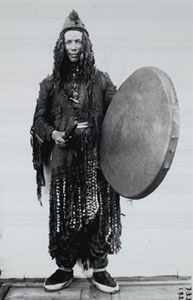
إلى جانب المعتقدات الأرثوذكسية الروسية، يمارس اليوكاغير الشامانية . وتتمثل الطوائف السائدة في عبادة أرواح الأجداد، وأرواح النار والشمس (بوغو) ، والصيد، والأرض، والماء، والتي يمكن أن تعمل كحماة أو أعداء للبشر. وتُعد عبادة بوغو ، إله الشمس، الأهم، فهو القاضي الأعلى في جميع النزاعات. وتذهب أرواح الموتى إلى مكان يُسمى أيبيدزي . وكان لكل عشيرة شامان يُسمى ألما . وبعد الموت، كان يُعامل كل ألما كإله، وكان يتم تقطيع جثة الألما المتوفى والاحتفاظ بها من قبل العشيرة كآثار مقدسة. ولا يزال اليوكاغير يواصلون تقاليد نابعة من أصولهم كصيادين رحل للرنة: فهم يمارسون التضحية بالكلاب ولديهم قصيدة ملحمية تتمحور حول الغربان. وكانت عبادة الحيوانات قوية بشكل خاص في عبادة الأيائل. وكان هناك عدد من الطقوس والمحرمات المرتبطة بصيد الأيائل والغزلان. [ 8 ]
انظر أيضاً
مراجع
ملحوظات
- نيكولاييفا، إيرينا؛ ماير، توماس (2004). "التوثيق عبر الإنترنت لكوليما يوكاجير" . Suomalais-Ugrilainen Seura (الجمعية الفنلندية الأوغرية، Société Finno-Ougrienne).كما تتوفر مواد صوتية مجانية عبر الإنترنت (قصص، أغاني).
- فابا، ليمبيت. "اليوكاغير" . الكتاب الأحمر لشعوب الإمبراطورية الروسية . منظمة الكتاب الأحمر غير الحكومية.
- "يوكاغيرز" . داخل روسيا الجديدة . دار نشر إس سي. 1994.
الحواشي
- ↑ "روستات - إعادة صياغة روسيا 2020" . rosstat.gov.ru . تم الاسترجاع بتاريخ 2023-01-03 .
- 1 2 لجنة الإحصاء الحكومية في أوكرانيا - التركيبة الوطنية للسكان، تعداد 2001 (الأوكراني)
- ^ إيفيرستوف، ستيبان (2014). "Некотолые паралели в kulturaxis дreвниh ымыяkhтацев и юкагиров XVII-XIX вв" [ بعض أوجه التشابه الثقافية بين Ymyyakhtakh القديمة و Yukaghirs في القرنين السابع عشر والتاسع عشر ] . Аrkтика и Sеver (بالروسية) (15) . تم الاسترجاع 2024-01-27 .
- ↑ "رخصة جواز السفر البلدية" . rosstat.gov.ru . تم الاسترجاع بتاريخ 2024-12-17 .
- ↑Duggan, Ana T.; Whitten, Mark; Wiebe, Victor; Crawford, Michael; Butthof, Anne; Spitsyn, Victor; Makarov, Sergey; Novgorodov, Innokentiy; Osakovsky, Vladimir; Pakendorf, Brigitte (2013). "Investigating the Prehistory of Tungusic Peoples of Siberia and the Amur-Ussuri Region with Complete mtDNA Genome Sequences and Y-chromosomal Markers". PLOS ONE. 8 (12) e83570. Bibcode:2013PLoSO...883570D. doi:10.1371/journal.pone.0083570. PMC 3861515. PMID 24349531.
- ↑Fedorova, Sardana A.; Reidla, Maere; Metspalu, Ene; Metspalu, Mait; Rootsi, Siiri; Tambets, Kristiina; Trofimova, Natalya; Zhadanov, Sergey I.; Hooshiar Kashani, Baharak; Olivieri, Anna; Voevoda, Mikhail I.; Osipova, Ludmila P.; Platonov, Fedor A.; Tomsky, Mikhail I.; Khusnutdinova, Elza K. (2013). "Autosomal and uniparental portraits of the native populations of Sakha (Yakutia): implications for the peopling of Northeast Eurasia". BMC Evolutionary Biology. 13 (1): 127. Bibcode:2013BMCEE..13..127F. doi:10.1186/1471-2148-13-127. PMC 3695835. PMID 23782551.
- ↑Nikolaeva & Mayer 2004, ch. "About the Yukaghirs"
- ↑Inside the New Russia (1994): Yukagirs
External links
- Yukaghir portalArchived 2017-09-03 at the Wayback Machine in Arctic Megapedia (in Russian)
- Irina Kurilova's channel (mostly Yukaghir-related videos, sometimes featuring other indigenous peoples of Yakutia) (in Russian)
Modern culture:
- Irina Duskulova - "Chakhadan" (live, w/ English subtitles)
- Irina Duskulova - "Ulegen Nume" (music video)
- Irina Duskulova - "Shakhadjibe" (music video, 2023)
- Concert @ 5th Yukaghir congress (20 March 2016)
- Yukaghir folk singer Ragtyna Tymkal
- Den Pobedyin Yukaghir by Anastasia Kurilova
- Ave Mariain Yukaghir by Yakut singer Saina
- Yukaghir people
- Indigenous peoples of Siberia
- Indigenous small-numbered peoples of the North, Siberia and the Far East
- Hunter-gatherers of Asia
- Modern nomads
- Nomadic groups in Eurasia
- People from Chukotka Autonomous Okrug
- People from Magadan Oblast
- People from the Sakha Republic