
Dispersion relation
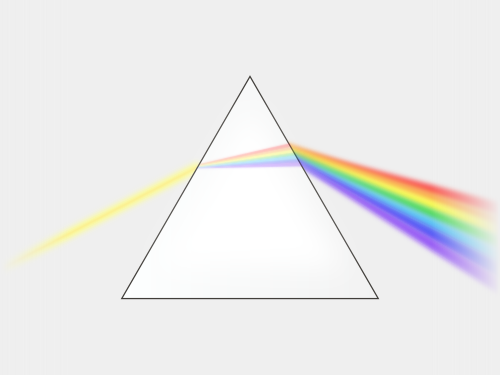
In the physical sciences and electrical engineering, dispersion relations describe the effect of dispersion on the properties of waves in a medium. A dispersion relation relates the wavelength or wavenumber of a wave to its frequency. Given the dispersion relation, one can calculate the frequency-dependent phase velocity and group velocity of each sinusoidal component of a wave in the medium, as a function of frequency. In addition to the geometry-dependent and material-dependent dispersion relations, the overarching Kramers–Kronig relations describe the frequency-dependence of wave propagation and attenuation.
Dispersion may be caused either by geometric boundary conditions (waveguides, shallow water) or by interaction of the waves with the transmitting medium. Elementary particles, considered as matter waves, have a nontrivial dispersion relation, even in the absence of geometric constraints and other media.
In the presence of dispersion, a wave does not propagate with an unchanging waveform, giving rise to the distinct frequency-dependent phase velocity and group velocity.
Dispersion
Dispersion occurs when sinusoidal waves of different wavelengths have different propagation velocities, so that a wave packet of mixed wavelengths tends to spread out in space. The speed of a plane wave, , is a function of the wave's wavelength :


The wave's speed, wavelength, and frequency, f, are related by the identity
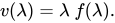
The function expresses the dispersion relation of the given medium. Dispersion relations are more commonly expressed in terms of the angular frequency and wavenumber. Rewriting the relation above in these variables gives



where we now view f as a function of k. The use of ω(k) to describe the dispersion relation has become standard because both the phase velocityω/k and the group velocitydω/dk have convenient representations via this function.
The plane waves being considered can be described by

where
- A is the amplitude of the wave,
- A 0 = A (0, 0),
- يمثل x موضعًا على طول اتجاه حركة الموجة، و
- t هو الوقت الذي يتم فيه وصف الموجة.
الموجات المستوية في الفراغ
تُعد الموجات المستوية في الفراغ أبسط حالات انتشار الموجات: لا يوجد قيد هندسي، ولا يوجد تفاعل مع وسط ناقل.
الموجات الكهرومغناطيسية في الفراغ
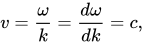
بالنسبة للموجات الكهرومغناطيسية في الفراغ، فإن التردد الزاوي يتناسب مع العدد الموجي:

هذه علاقة تشتت خطية ، وفي هذه الحالة يُقال إن الموجات غير متشتتة . [ 1 ] أي أن سرعة الطور وسرعة المجموعة متساويتان: وبالتالي فإن كليهما يساوي سرعة الضوء في الفراغ، وهي سرعة مستقلة عن التردد.
علاقات التشتت دي برولي
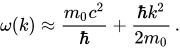
بالنسبة لموجات دي برولي المادية، تكون علاقة تشتت التردد غير خطية: تقول المعادلة تردد الموجة الماديةفي الفراغ، يتغير بتغير العدد الموجي () في التقريب غير النسبي. يتكون التغير من جزأين: جزء ثابت ناتج عن تردد دي برولي للكتلة السكونية () وجزء تربيعي ناتج عن الطاقة الحركية.


الاشتقاق
بينما تحدث تطبيقات موجات المادة بسرعات غير نسبية، استخدم دي برولي النسبية الخاصة لاستنتاج موجاته. انطلاقًا من علاقة الطاقة والزخم النسبية : استخدم علاقات دي برولي للطاقة والزخم لموجات المادة ، حيث ω هي التردد الزاوي و k هو متجه الموجة ذو المقدار | k | = k ، وهو يساوي العدد الموجي . اقسم علىثم نأخذ الجذر التربيعي. وهذا يعطينا علاقة تشتت التردد النسبي :



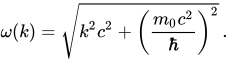
يتم العمل العملي مع موجات المادة عند سرعات غير نسبية. وللتقريب، نستخرج التردد الذي يعتمد على كتلة السكون:

ثم نرى أنالعامل صغير جدًا، لذا بالنسبة لـليس كبيرًا جدًا، سنتوسعواضرب: هذا يُعطي التقريب غير النسبي المذكور أعلاه. إذا بدأنا بمعادلة شرودنغر غير النسبية ، فسننتهي بدون الحد الأول، حد كتلة السكون.


الرسوم المتحركة: سرعة الطور وسرعة المجموعة للإلكترونات 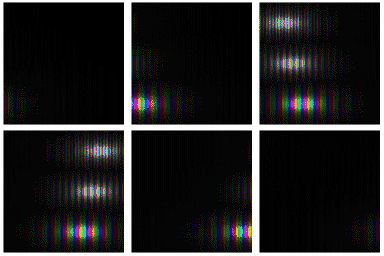
This animation portrays the de Broglie phase and group velocities (in slow motion) of three free electrons traveling over a field 0.4 ångströms in width. The momentum per unit mass (proper velocity) of the middle electron is lightspeed, so that its group velocity is 0.707 c. The top electron has twice the momentum, while the bottom electron has half. Note that as the momentum increases, the phase velocity decreases down to c, whereas the group velocity increases up to c, until the wave packet and its phase maxima move together near the speed of light, whereas the wavelength continues to decrease without bound. Both transverse and longitudinal coherence widths (packet sizes) of such high energy electrons in the lab may be orders of magnitude larger than the ones shown here.
Frequency versus wavenumber
As mentioned above, when the focus in a medium is on refraction rather than absorption—that is, on the real part of the refractive index—it is common to refer to the functional dependence of angular frequency on wavenumber as the dispersion relation. For particles, this translates to a knowledge of energy as a function of momentum.
Waves and optics
The name "dispersion relation" originally comes from optics. It is possible to make the effective speed of light dependent on wavelength by making light pass through a material which has a non-constant index of refraction, or by using light in a non-uniform medium such as a waveguide. In this case, the waveform will spread over time, such that a narrow pulse will become an extended pulse, i.e., be dispersed. In these materials, is known as the group velocity[2] and corresponds to the speed at which the peak of the pulse propagates, a value different from the phase velocity.[3]

Deep water waves

The dispersion relation for deep water waves is often written as

where g is the acceleration due to gravity. Deep water, in this respect, is commonly denoted as the case where the water depth is larger than half the wavelength.[4] In this case the phase velocity is

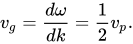
and the group velocity is
Waves on a string

For an ideal string, the dispersion relation can be written as

where T is the tension force in the string, and μ is the string's mass per unit length. As for the case of electromagnetic waves in vacuum, ideal strings are thus a non-dispersive medium, i.e. the phase and group velocities are equal and independent (to first order) of vibration frequency.
For a nonideal string, where stiffness is taken into account, the dispersion relation is written as
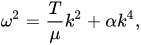
where is a constant that depends on the string.

Electron band structure
In the study of solids, the study of the dispersion relation of electrons is of paramount importance. The periodicity of crystals means that many levels of energy are possible for a given momentum and that some energies might not be available at any momentum. The collection of all possible energies and momenta is known as the band structure of a material. Properties of the band structure define whether the material is an insulator, semiconductor or conductor.
Phonons
Phonons are to sound waves in a solid what photons are to light: they are the quanta that carry it. The dispersion relation of phonons is also non-trivial and important, being directly related to the acoustic and thermal properties of a material. For most systems, the phonons can be categorized into two main types: those whose bands become zero at the center of the Brillouin zone are called acoustic phonons, since they correspond to classical sound in the limit of long wavelengths. The others are optical phonons, since they can be excited by electromagnetic radiation.
Electron optics
With high-energy (e.g., 200 keV, 32 fJ) electrons in a transmission electron microscope, the energy dependence of higher-order Laue zone (HOLZ) lines in convergent beam electron diffraction (CBED) patterns allows one, in effect, to directly image cross-sections of a crystal's three-dimensional dispersion surface.[5] This dynamical effect has found application in the precise measurement of lattice parameters, beam energy, and more recently for the electronics industry: lattice strain.
History
درس إسحاق نيوتن الانكسار في الموشورات، لكنه فشل في إدراك اعتماد علاقة التشتت على المادة، رافضًا عمل باحث آخر لم تتطابق قياساته لتشتت الموشور مع قياسات نيوتن نفسه. [ 6 ]
تمت دراسة تشتت الأمواج على الماء بواسطة بيير سيمون لابلاس في عام 1776. [ 7 ]
لقد تجلى عالمية علاقات كرامرز-كرونيغ (1926-1927) من خلال الأبحاث اللاحقة حول صلة علاقة التشتت بالسببية في نظرية تشتت جميع أنواع الموجات والجسيمات. [ 8 ]
انظر أيضاً
ملحوظات
- ↑ أبلوويتز 2011 ، ص 19-20.
- ↑ ف. أ. جينكينز وهـ. إ. وايت (1957). أساسيات علم البصريات . نيويورك: ماكجرو هيل. ص 223. ISBN 0-07-032330-5.
{{cite book}}عدم توافق رقم ISBN / التاريخ ( مساعدة ) - ↑ آر إيه سيرواي، سي جيه موسى، وسي إيه موير (1989). الفيزياء الحديثة . فيلادلفيا: سوندرز. ص 118. ISBN 0-534-49340-8.
- ↑ آر جي دين و آر إيه دالريمبل (1991). ميكانيكا أمواج الماء للمهندسين والعلماء . سلسلة متقدمة في هندسة المحيطات. المجلد 2. وورلد ساينتيفيك، سنغافورة. ISBN 978-981-02-0420-4.انظر الصفحات 64-66.
- ↑ بي إم جونز، جي إم راكهام، وجيه دبليو ستيدز (1977). "تأثيرات منطقة لاوي من الرتبة العليا في حيود الإلكترون واستخدامها في تحديد معلمات الشبكة". وقائع الجمعية الملكية . أ 354 (1677): 197. رمز Bibcode : 1977RSPSA.354..197J . doi : 10.1098/rspa.1977.0064 . S2CID 98158162 .
- ↑ ويستفال، ريتشارد س. (1983). لا يعرف الراحة: سيرة إسحاق نيوتن (طبعة منقحة ومصورة ). مطبعة جامعة كامبريدج. ص 276. ISBN 9780521274357.
- ↑ ADD Craik (2004). "أصول نظرية موجات الماء". المراجعة السنوية لميكانيكا الموائع . 36 : 1-28 . Bibcode : 2004AnRFM..36....1C . doi : 10.1146/annurev.fluid.36.050802.122118 .
- ↑ جون س. تول (1956). "السببية وعلاقة التشتت: الأسس المنطقية". مجلة الفيزياء 104 (6): 1760-1770 . Bibcode : 1956PhRv..104.1760T . doi : 10.1103/PhysRev.104.1760 .
مراجع
روابط خارجية
- ملصق حول محاكاة CBED للمساعدة في تصور أسطح التشتت، من إعداد أندريه تشوفيلين وأوتي كايزر
- حاسبة التردد الزاوي
- معادلات الفيزياء
- ميكانيكا الموجات