
Djadochta Formation
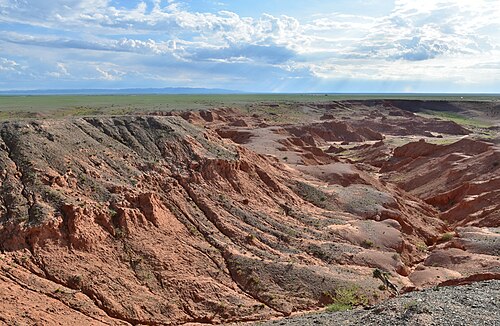
The Djadochta Formation (sometimes transcribed and also known as Djadokhta, Djadokata, or Dzhadokhtskaya) is a highly fossiliferousgeological formation in Central Asia, Gobi Desert, dating from the Late Cretaceous period, during the Campanian to the Maastrichtian. The type locality is the Bayn Dzak locality, famously known as the Flaming Cliffs. Reptile (including dinosaur) and mammal remains are among the fossils recovered from the formation.
Excavation history

The Djadochta Formation was first documented and explored—though only a single locality—during paleontological expeditions of the American Museum of Natural History in 1922–1925, which were part of the Central Asiatic expeditions. The expeditions were led by Roy Chapman Andrews, in company of Walter Willis Granger as chief paleontologist and field team. The team did extensive exploration at the Bayn Dzak (formerly Shabarakh Usu) region, which they nicknamed flaming cliffs, given that at sunset the sediments of this locality had a characteristic reddish color. Notable finds included the first known fossils of Oviraptor, Protoceratops, Saurornithoides, and Velociraptor, the first confirmed dinosaur eggs (a partial nest of Oviraptor), as well as fossil mammals. Some of these were briefly described by Henry Fairfield Osborn during the ongoing years of the expeditions. In 1927 the formation was formally described and established by Berkey and Morris, with Bayn Dzak as the type locality.[1][2]
In 1963 the Mongolian paleontologist Demberelyin Dashzeveg reported the discovery of a new fossiliferous locality of the Djadochta Formation: Tugriken Shireh.[3] During the 1960s to 1970s, Polish-Mongolian and Russian-Mongolian paleontological expeditions collected new, partial to complete specimens of Protoceratops and Velociraptor at this locality, making these dinosaur species a common occurrence in Tugriken Shireh.[4] Some of the most notable excavations made at Tugriken Shireh include the Fighting Dinosaurs (Protoceratops and Velociraptor locked in combat),[5][6] and abundant articulated, in situ (in the original pose), and sometimes complete skeletons of Protoceratops.[7][8]
During the 1980s a joint Soviet-Mongolian paleontological expedition discovered several Mesozoic fossil-rich localities in the Gobi Desert of Mongolia. Among these sites, Udyn Sayr was discovered and examined by the expedition, regarding its age as Late Cretaceous. This new locality was predominantly rich in avimimid fossils, with a lesser abundance of mammal and other dinosaur fossils.[4]
In 1993 a collaborative expedition by the Mongolian Academy of Sciences and the American Museum of Natural History discovered a new fossil site within the Djadochta Formation, named Ukhaa Tolgod, which translates to "Brown Hills." This site has yielded a significant number of well-preserved fossils, including those of mammals, dinosaurs, lizards, and eggs. Most specimens are found in near-complete articulation, indicating excellent preservation conditions. Compared to other Mesozoic fossil sites, Ukhaa Tolgod stands out for its high fossil diversity.[9][10]
Description
The modern-day Djadochta Formation is set in an arid habitat of sand dunes with little freshwater apart from oases and arroyos, in the Gobi Desert. The dominant lithology of the Djadochta Formation is represented by non-marine, cemented reddish-orange and pale orange to light gray, medium to fine-grained sands and sandstones, which include minor deposits of calcareousconcretions and orange-brown silty clay. Less abundant sedimentation comprises conglomerates, siltstones, fluvial (water-deposited) sandstones, and mudstones. The entire thickness of the formation in the Ulan Nur Basin is at least 80 m (260 ft). Several aeolian processes (wind works) indicate the presence of large straight-crested dune-like structures, and smaller barchan (crescent-shaped) and parabolic (poorly U-shaped) dunes across the formation.[11][12][10] Reddish sandstones are observed in numerous localities.[12][10]
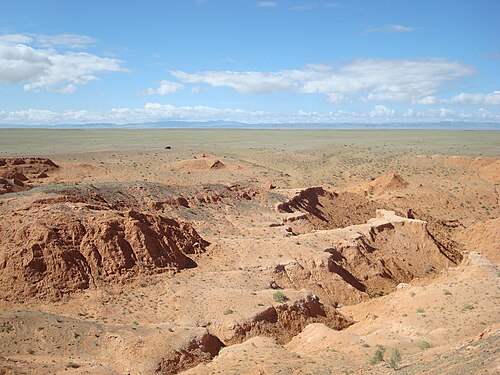
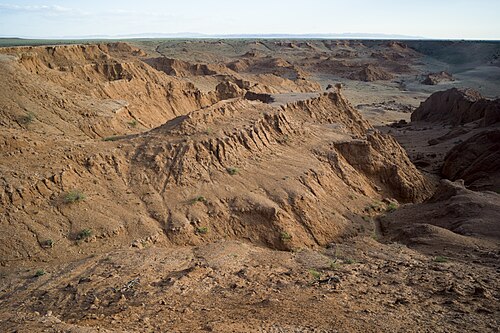
- Bayn Dzak (also spelled Bain Dzak, Bayanzag, Bayn Zag, Bayan Zag, or Shabarakh Usu; locally known as Flaming Cliffs): It is dominated by reddish-orange sandstones and well-sorted, unbedded, and medium-grained sands. The thickness of the strata at the Flaming Cliffs at least more than 30 m (98 ft). Less abundant lithology of Bayn Dzak includes cemented and poorly-cemented siltstones, mudstones, and grayish conglomerates. The latter are better exposed at western escarpments of the Flaming Cliffs.[13][12] Bayn Dzak is about 90 m (300 ft) in total thickness and can be divided into two sections: alternations of horizontally-bedded sandstone and mudstone in the lowermost part, and sandstone-dominated successions in the upper or main part.[14]
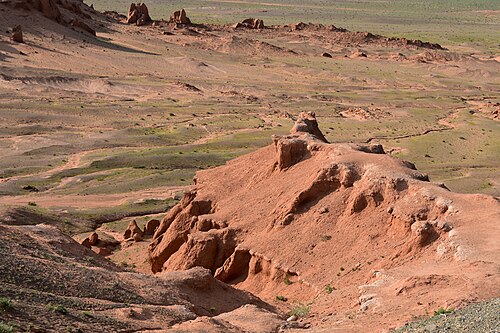
- Tugriken Shireh (also spelled Tugrik, Toogreeg, Toogreek, Tugreek, Tugrug, Turgrugyin, Tugrugeen, Tögrögiin, Tugrikiin, or Tugrikin): This locality is about 30 m (98 ft) in thickness and characterized by poorly cemented, fine-grained sandstones that have colors varying from pink to yellowish-white. The predominant mineral is quartz, and lesser common minerals are represented by feldspars and lithic fragments. Both cross-stratified and structureless sandstones are scattered across Tugriken Shireh.[15][12]
- Udyn Sayr (also spelled Udan Sayr, Udan Sair, Ulaan Sair, or Üüden Sair): Sediments of this locality are exposed across a region of more than 60 km2 (23 mi2). It is divided into lower (thickness of at least more than 10 m (33 ft)) and upper (thickness of about 50 m (160 ft)) beds. The lower beds are fluvial originated and dominated by sandstones and mudstones. The upper beds are likely of aeolian origin and consist of reddish, cross-stratified and structureless sandstones.[16]
- Ukhaa Tolgod (also spelled Oka Tolga): The strata exposed at Ukhaa Tolgod is dominated by reddish sandstones, with some sandstones containing small amounts of conglomeratic lenses and/or cobbles and pebbles. Conglomerate itself is in this site, and to a lesser level are mudstones and siltstones, which are thin and laterally restricted. Cross-stratified and fine-structured sandstones are particularly abundant at Ukhaa Tolgod.[17][10]
- Zamyn Khondt (also spelled Dzamyn Khondt, Zamin Khond, or Dzamin Khond): This locality is characterized by reddish, well-sorted, and fine-grained sandstones with calcareous concretions. Some aeolian beds are present and are finely stratified to massive, having a visible thickness of about 20 m (66 ft).[16]
Stratigraphy and age
The Djadochta Formation occurs in the Late Cretaceous period of the Campanian and Early Maastrichtian stages. Magnetostratigraphic datings from 2006 initially suggested a Campanian age for the formation.[12] But that same study indicated their findings could not be completely substantiated. More recent studies have suggested that the Djadochta, Barun Goyot and Nemegt Formations might instead represent different contemporary environments instead of strict temporal succession from each other.[18] If the Djadochta Formation is the same age as the Nemegt Formation, it would be Maastrichtian in age.[19] Because of this uncertainty, the age of the Djadochta is most parsimoniously Campanian to Maastrichtian.
The upper boundary of the Djadokhta strata has been identified at the erosional surface overlain by gravels of the Palestine Khashaat (Gashoto) Formation.[18]
The Djadochta Formation is separated into a lower Bayn Dzak Member and an upper Turgrugyin Member, which represent very similar depositional environments.[12] Further strata from the Bayn Dzak Member includes that of the Ukhaa Tolgod locality, and its overall age is regarded also within the Campanian.[10] Based on the superposition of the members, the Tugrugyin Member overlies the Bayn Dzak Member making it somewhat younger, which indicates that the Bayn Dzak paleofauna lived somewhat earlier than that from Tugriken Shireh. However, it is not yet understood the precise temporal difference:[12] Localities within the Djadochta Formation are considered to represent a sequence of progressively younger sediments and thereby paleofaunas. Ukhaa Tolgod may be younger than both Bayn Dzak and Tugriken Shireh.[20] Based on their fossil record and strata, Udyn Sayr and Zamyn Khondt have been correlated with other Djadokhta localities, though fossils of Udyn Sayr may indicate that this locality is younger than Bayn Dzak and Tugriken Shireh.[21]
تشير الدراسات التي أُجريت على طبقات موقع ألاغ تيغ (أو ألاغ تيغ أو ألاغ تير)، الذي كان يُعتبر سابقًا جزءًا من هذا التكوين، إلى أنه ينتمي إلى تكوين جيولوجي مختلف: تكوين ألاغتيغ ، وهو أقدم قليلًا من تكوين دجادوختا الذي يعلوه. وبناءً على الرواسب والعلاقات الطبقية، يُربط الجزء السفلي من موقع بين دزاك بموقع ألاغ تيغ، مما يجعل كلا الجزأين جزءًا من تكوين ألاغتيغ. أما الجزء العلوي أو الرئيسي من الموقع الأول فيُعتبر جزءًا من تكوين دجادوختا نفسه، نظرًا لتشابه خصائصه الصخرية وعلاقاته الطبقية مع توغريكن شيره. [ 14 ]
| تشكيل | الفترة الزمنية | عضو | علم الصخور | سماكة | صورة |
|---|---|---|---|---|---|
| بارون غويوت | الماستريختي المبكر | أحجار رملية حمراء إلى بنية محمرة ذات حبيبات دقيقة ومتوسطة ضعيفة التماسك. | ~ 110 متر (360 قدم) | ||
| دجادوختا | كامبانيا | ||||
| تورغروغين | رمال وأحجار رملية ذات لون برتقالي باهت إلى رمادي فاتح (أحيانًا أبيض مصفر). | 30 متراً (98 قدماً) |  | ||
| باين دزاك | أحجار رملية برتقالية محمرة، ذات طبقات متقاطعة، وغير منتظمة الشكل، مع رواسب طفيفة من الطمي البني والحجر الطيني. | 90 متراً (300 قدم) | 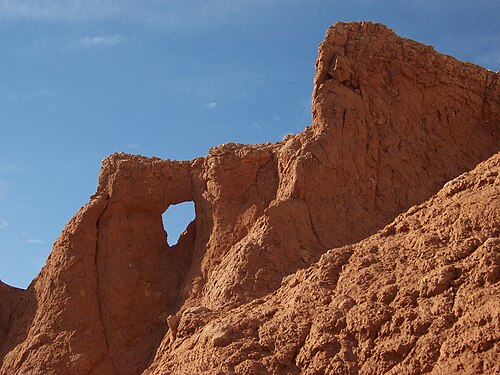 | ||
| ألاغتيج | الكامباني المبكر والسانتوني | "باين دزاك السفلى" | تتناوب طبقات من الحجر الطيني البني المحمر والحجر الرملي ذي الطبقات الأفقية، مع طبقات متقاطعة متموجة وجذور متحجرة. | حوالي 15 مترًا (49 قدمًا) | |
بيئة الترسيب

Based on strata and rock facies (such as sandstones and caliche) of the formation and coeval units (Bayan Mandahu) it is currently agreed that sediments of the Djadochta Formation were deposited by wind activity in arid paleoenvironments comprising sand dunes with a warm semi-arid climate.[23][12][14] Fluvial sedimentation at the Ukhaa Tolgod locality indicates the presence of short-lived water bodies during the times of the formation, which also contributed to its deposition.[10] Floodplains may have also existed.[22] The area has been compared to the Kalahari Desert in Botswana[24] as well as to the desert ecosystems of North Africa and Western Asia.[22] There is still evidence of plant life that may inhabited these semi-arid dunes. These come in the form of Radicites which may have been left overs from a Conifer.[22] Low growing bushes may have also existed.[15]
Soil evidence indicates that summers were hot and dry while winters were probably short and humid.[22]
Taphonomy


A vast majority of articulated specimens from the Djadochta Formation are found in unstructured sandstones, indicating burial in situ by high-energy sand-bearing events. Some buried Protoceratops individuals are preserved in distinctive postures involving the body and head arched upwards, suggesting that the animals died in the process of trying to free themselves from the body of sand, where they eventually fossilized. As they were unable to escape burial, the sandy mass prevented carcasses from being scavenged by vertebrates. Most of these "buried" specimens are found with bite traces and large borings (tunnel-like holes made by small invertebrates) on bone joints areas and other surfaces, indicating that after death they were largely scavenged by invertebrates, such as skin beetles.[25][26][27]
It has been suggested that the repeated occurrence of these feeding traces at limb joints may reflect that the responsible scavengers focused on collagen at the joint cartilage of dried dinosaur carcasses as a source of nitrogen, which was very low in the arid Djadochta Formation environments.[28]
Examinations at the fossil preservation and sediments of Ukhaa Tolgod indicates that preserved animals were buried alive by catastrophic dune collapses. It is thought to have occurred when sand dunes became oversaturated with water resulting in their sudden downfall; heavy rainfall events likely acted as the triggering mechanism for this collapse.[9][29][10] Examples from the Ukhaa Tolgod preservation include Citipati (brooding adults entombed atop nests and eggs);[30][31]Khaan (a pair in close proximity likely killed by a single collapse event);[32] and Saichangurvel (individual buried alive by a muddy dune).[33]
Paleobiota

من بين الأحافير، يُعدّ البروتوسيراتوبس شائعًا للغاية في مواقع دجادوختا. ويُذكر أن باين دزاك من بين المواقع التي تضم أعلى تركيز لأحافير البروتوسيراتوبس، وقد أُطلق عليه اسم " مجموعة البروتوسيراتوبس ". [ 34 ] كما يتواجد البروتوسيراتوبس بكثرة في توغريكن شيره المجاورة لباين دزاك . [ 15 ] وتشمل المكونات الشائعة الأخرى للديناصورات في الأحافير البيناكوصور والفيلوسيرابتور . [ 11 ] وتُعد الفقاريات الصغيرة ، مثل السحالي والثدييات، وفيرة ومتنوعة، حيث يُعتبر الأداميسورس والكريبتوباتار أكثرها وفرة . [ 33 ] [ 35 ] [ 34 ] وتتشابه الأحافير في تكوين دجادوختا إلى حد كبير في تركيبها مع تكوين بايان مانداهو المجاور والمعاصر له في منغوليا الداخلية . تتشابه التكوينات الجيولوجية في العديد من الأجناس، لكنها تختلف في الأنواع. فعلى سبيل المثال، يُعدّ كريبتوباتار داشزيفيجي أكثر الثدييات شيوعًا في تكوين دجادوختا ، بينما في تكوين بايان مانداهو، يُعدّ كريبتوباتار مانداهوينسيس وثيق الصلة به . وبالمثل، تشمل ديناصورات دجادوختا بروتوسيراتوبس أندروزي وفيلوسيرابتور مونغولينسيس ، بينما تضمّ بايان مانداهو بروتوسيراتوبس هيلينيكورينوس وفيلوسيرابتور أوسمولسكاي . [ 23 ] [ 36 ]
على الرغم من ندرة النباتات الأحفورية في تكوين دجادوختا، فإن الوفرة الكبيرة لبروتوسيراتوبس العاشب في موقع توغريكن شيره ذي الرواسب الجافة تشير إلى أنه كان مغطى بشكل معتدل بالشجيرات أو النباتات الأخرى منخفضة النمو. [ 15 ]
يشير انخفاض التنوع البيولوجي القديم والظروف المناخية في تكوين دجادوختا إلى أن هذه الظروف ساهمت في خلق بيئات قديمة مضطربة . تُشكل أحافير البروتوسيراتوبس غالبية الأحافير في هذا التكوين ، بينما تُشكل الأنكيلوصورات والأوفيرابتوريدات والدروميوصورات الصغيرة والمتوسطة الحجم جزءًا كبيرًا من الحياة الأحفورية . أما الحيوانات الضخمة فهي غائبة أو نادرة للغاية في هذا التكوين. وتؤكد المقارنات مع تكوين نيميجت على وجود بيئات قديمة مضطربة . فعلى عكس دجادوختا، كشف تكوين نيميجت عن تنوع واسع من أنواع الديناصورات الكبيرة ، مثل الدينوشيروس والنيميجتوصور والسورولوفوس والتاربوصور والثيريزينوصور . معظم هذه التصنيفات نباتية، وهو ما سمح، إلى جانب البيئة الرطبة (الغنية بالمياه) لتكوين نيميغت، بتطور حيوانات نباتية عملاقة، على عكس تكوين دجادوختا الذي عانى من ظروف بيئية قاسية. ومن المؤشرات الأخرى على البيئات القديمة القاسية ندرة الحيوانات المائية بالكامل . نادرًا ما يتم العثور على السلاحف، ومعظمها بري مثل زانغيرليا . [ 34 ] يُرجح أن معظم بقايا الهادروصور والتيرانوصور والسوروبود المجزأة في التكوين تنتمي إلى أنواع عابرة غير مستوطنة . [ 34 ]
معرض

انظر أيضاً
- قائمة التكوينات الصخرية التي تحتوي على بقايا ديناصورات
- قائمة مواقع الأحافير (مع دليل الروابط)
- تكوين بارون غويوت – تكوين جيولوجي في منغوليا. صفحات تعرض وصفًا موجزًا للأهداف المراد إعادة توجيهها.
- تكوين بيان مانداهو – تكوين جيولوجي في الصين
- تكوين نيميغت – تكوين جيولوجي في منغوليا
مراجع
- ↑ بيركي، سي بي، موريس، إف كيه، 1927. جيولوجيا منغوليا، التاريخ الطبيعي لآسيا الوسطى. المتحف الأمريكي للتاريخ الطبيعي، نيويورك. ص 475.
- ↑ أندروز، آر سي (1932). ريدز، سي إيه (محرر). الفتح الجديد لآسيا الوسطى: سرد لاستكشافات البعثات الآسيوية الوسطى في منغوليا والصين، 1921-1930 . المجلد 1 ( الطبعة الأولى). نيويورك: المتحف الأمريكي للتاريخ الطبيعي. الصفحات 1-549 . OCLC 766770 .
- ↑Dashzeveg, D. (1963). "Яйца динозавров" [Dinosaur eggs]. Priroda (in Russian). 9: 100.
- 12Kurochkin, E. N.; Barsbold, R. (2000). "The Russian-Mongolian expeditions and research in vertebrate palaeontology"(PDF). In Benton, M. J.; Shishkin, M. A.; Unwin, D. M.; Kurochkin, E. N. (eds.). The Age of Dinosaurs in Russia and Mongolia. Cambridge University Press. p. 235−255.
- ↑Kielan-Jaworowska, Z.; Barsbold, R. (1972). "Narrative of the Polish-Mongolian Palaeontological Expeditions, 1967–1971"(PDF). Palaeontologia Polonica. 27: 1–12.
- ↑Barsbold, R. (2016). "The Fighting Dinosaurs: The position of their bodies before and after death". Paleontological Journal. 50 (12): 1412–1417. doi:10.1134/S0031030116120042. S2CID 90811750.
- ↑Fastovsky, D. E.; Weishampel, D. B.; Watabe, M.; Barsbold, R.; Tsogtbaatar, K.; Narmandakh, P. (2011). "A nest of Protoceratops andrewsi (Dinosauria, Ornithischia)". Journal of Paleontology. 85 (6): 1035−1041. doi:10.1666/11-008.1. JSTOR 41409110. S2CID 129085129.
- ↑Hone, D. W. E.; Farke, A. A.; Watabe, M.; Shigeru, S.; Tsogtbaatar, K. (2014). "A New Mass Mortality of Juvenile Protoceratops and Size-Segregated Aggregation Behaviour in Juvenile Non-Avian Dinosaurs". PLOS ONE. 9 (11) e113306. Bibcode:2014PLoSO...9k3306H. doi:10.1371/journal.pone.0113306. PMC 4245121. PMID 25426957.
- 12Dashzeveg, D.; Novacek, M. J.; Norell, M. A.; Clark, J. M.; Chiappe, L. M.; Davidson, A.; McKenna, M. C.; Dingus, L.; Swisher, C.; Perle, A. (1995). "Extraordinary preservation in a new vertebrate assemblage from the Late Cretaceous of Mongolia". Nature. 374 (6521): 446–449. Bibcode:1995Natur.374..446D. doi:10.1038/374446a0. S2CID 4245878.
- 1234567Dingus, L.; Loope, D. B.; Dashzeveg, D.; Swisher III, C. C.; Minjin, C.; Novacek, M. J.; Norell, M. A. (2008). "The Geology of Ukhaa Tolgod (Djadokhta Formation, Upper Cretaceous, Nemegt Basin, Mongolia)". American Museum Novitates (3616): 1–40. doi:10.1206/442.1. hdl:2246/5916. S2CID 129735494.
- 12Jerzykiewicz, T. (1997). "Djadokhta Formation". In Currie, P. J.; Padian, K. (eds.). Encyclopedia of Dinosaurs. San Diego: Academic Press. pp. 188–191. ISBN 978-0-12-226810-6.
- 123456789Dashzeveg, D.; Dingus, L.; Loope, D. B.; Swisher III, C. C.; Dulam, T.; Sweeney, M. R. (2005). "New Stratigraphic Subdivision, Depositional Environment, and Age Estimate for the Upper Cretaceous Djadokhta Formation, Southern Ulan Nur Basin, Mongolia"(PDF). American Museum Novitates (3498): 1–31. doi:10.1206/0003-0082(2005)498[0001:NSSDEA]2.0.CO;2. hdl:2246/5667. S2CID 55836458.
- ↑Lefeld, J. (1971). "Geology of the Djadokhta Formation at Bayn Dzak (Mongolia)"(PDF). Palaeontologia Polonica. 25: 101–127.
- 1234Hasegawa, H.; Tada, R.; Ichinnorov, N.; Minjin, C. (2009). "Lithostratigraphy and depositional environments of the Upper Cretaceous Djadokhta Formation, Ulan Nuur basin, southern Mongolia, and its paleoclimatic implication". Journal of Asian Earth Sciences. 35 (1): 13–26. Bibcode:2009JAESc..35...13H. doi:10.1016/j.jseaes.2008.11.010.
- 1234Fastovsky, D. E. (1997). "The Paleoenvironments of Tugrikin-Shireh (Gobi Desert, Mongolia) and Aspects of the Taphonomy and Paleoecology of Protoceratops (Dinosauria: Ornithishichia)". PALAIOS. 12 (1): 59–70. Bibcode:1997Palai..12...59F. doi:10.2307/3515294. JSTOR 3515294.
- 12Watabe, M.; Tsogtbaatar, K.; Suzuki, S.; Saneyoshi, M. (2010). "Geology of dinosaur fossil-bearing localities (Jurassic and Cretaceous: Mesozoic) in the Gobi Desert: Results of the HMNS-MPC Joint Paleontological Expedition". Hayashibara Museum of Natural Sciences Research Bulletin. 3: 41–118.
- ↑Loope, D. B.; Dingus, L.; Swisher III, C. C.; Minjin, C. (1998). "Life and death in a Late Cretaceous dune field, Nemegt Basin, Mongolia"(PDF). Geology. 28 (1): 27–30. Bibcode:1998Geo....26...27L. doi:10.1130/0091-7613(1998)026<0027:LADIAL>2.3.CO;2.
- 12Jerzykiewicz, Tomasz; Currie, Philip J.; Fanti, Federico; Lefeld, Jerzy (September 2021). "Lithobiotopes of the Nemegt Gobi Basin1". Canadian Journal of Earth Sciences. 58 (9): 829–851. doi:10.1139/cjes-2020-0148. ISSN 0008-4077.
- ↑Tanabe, Myu; Aoki, Kazumasa; Chiba, Kentaro; Saneyoshi, Mototaka; Kodaira, Shota; Nishido, Hirotsugu; Mainbayar, Buuvei; Tsogtbaatar, Khishigjav; Ishigaki, Shinobu (2023). "Apatite U–Pb dating of dinosaur teeth from the Upper Cretaceous Nemegt Formation in the Gobi Desert, Mongolia: Contribution to depositional age constraints". Island Arc. 32 (1) e12488. doi:10.1111/iar.12488. ISSN 1440-1738.
- ↑Makovicky, P. J. (2008). "Telling time from fossils: a phylogeny-based approach to chronological ordering of paleobiotas". Cladistics. 24 (3): 350–351. doi:10.1111/j.1096-0031.2007.00184.x.
- ↑ تشيبينسكي، ل. (2020). "عينات جديدة من البروتوسيراتوبسيد تُحسّن من تحديد عمر طبقات صحراء جوبي في العصر الطباشيري العلوي" (ملف PDF) . مجلة Acta Palaeontologica Polonica . 65 (3): 481–497 . doi : 10.4202/app.00701.2019 .
- 1 2 3 4 5 نوغولنيخ، إس. في. (2016). "التربة القديمة من العصر الطباشيري العلوي في مقطع باين دزاك، جنوب منغوليا" . مجلة علم الأحياء القديمة . 50 (12): 1451-1469 . Bibcode : 2016PalJ...50.1451N . doi : 10.1134/s0031030116120133 . S2CID 133243515 .
- 1 2 جيرزيكيفيتش، ت.؛ كوري، ب. ج.؛ إيبرث، د. أ.؛ جونستون، ب. أ.؛ كوستر، إ. هـ.؛ تشنغ، ج.-ج. (1993). "الطبقات المترابطة لتكوين دجادوختا في منغوليا الداخلية الصينية: نظرة عامة على علم الطبقات، والجيولوجيا الرسوبية، وعلم الأحياء القديمة، ومقارنات مع الموقع النموذجي في صحراء غوبي ما قبل ألتاي". المجلة الكندية لعلوم الأرض . 30 (10): 2180-2195 . Bibcode : 1993CaJES..30.2180J . doi : 10.1139/e93-190 .
- ↑ جيرزيكيفيتش، توم (3 مارس 1998). "واحة أوكافانغو، صحراء كالاهاري: نظير معاصر لموئل الفقاريات في أواخر العصر الطباشيري في حوض غوبي، منغوليا" . علوم الأرض الكندية . ISSN 1911-4850 .
- ↑ كيركلاند، جي آي؛ بادر، ك. (2010). "أحافير آثار الحشرات المرتبطة بجثث البروتوسيراتوبس في تكوين دجادوختا (العصر الطباشيري العلوي)، منغوليا" . في: رايان، إم جيه؛ تشينيري-ألجيير، بي جيه؛ إيبرث، دي إيه (محررون). آفاق جديدة حول الديناصورات ذات القرون: ندوة متحف تيريل الملكي حول السيراتوبسيات . مطبعة جامعة إنديانا. الصفحات 509-519 . ISBN 978-0-253-35358-0JSTOR j.ctt16gzgng .
- ↑ ماتسوموتو، ي.؛ سانيوشي، م. (2010). "هياكل عظمية لديناصورات ملولة" . مجلة الجمعية الجيولوجية اليابانية . 116 (1): I– II. doi : 10.5575/geosoc.116.1.I_II .
- ↑ تاكيوتشي، م.؛ سانيوشي، م.؛ تسوغتباتار، ك.؛ ماينبايار، ب.؛ أولزيتسيرين، س. (2016). "أحافير أثرية على هياكل ديناصورات من العصر الطباشيري العلوي في صحراء غوبي، منغوليا" . نشرة معهد البحوث للعلوم الطبيعية، جامعة أوكاياما للعلوم (46): 1-6 .
- ↑ سانيوشي، م.؛ واتابي، م.؛ سوزوكي، س.؛ تسوغتباتار، ك. (2011). "الأحافير الأثرية على عظام الديناصورات من رواسب العصر الطباشيري العلوي في منغوليا: تفسير علم الحفريات للنظم البيئية القديمة في بيئات صحراوية قديمة" . علم الجغرافيا القديمة، علم المناخ القديم، علم البيئة القديمة . 311 ( 1-2 ): 38-47 . Bibcode : 2011PPP...311...38S . doi : 10.1016/j.palaeo.2011.07.024 .
- ↑ لوب، د.ب.؛ ماسون، ج.أ.؛ دينغوس، ل. (1999). "الانهيارات الرملية المميتة من الكثبان الرملية الإيولية" . مجلة الجيولوجيا . 10 (6): 707-713 . Bibcode : 1999JG....107..707L . doi : 10.1086/314377 . PMID 10517885. S2CID 45715054 .
- ↑ كلارك، جيه إم؛ نوريل، إم إيه؛ تشيابي، إل إم (1999). "هيكل عظمي لأوفيرابتوريد من العصر الطباشيري المتأخر في أوخا تولغود، منغوليا، محفوظ في وضعية حضانة تشبه الطيور فوق عش أوفيرابتوريد" . مجلة المتحف الأمريكي (3265): 1-36 . hdl : 2246/3102 .
- ^ نوريل، MA؛ بالانوف، صباحا؛ بارتا، DE؛ إريكسون، جنرال موتورز (2018). "عينة ثانية من Citipati osmolskae مرتبطة بعش البيض من Ukhaa Tolgod، Omnogov Aimag، منغوليا" . المتحف الأمريكي المبتدئ (3899): 1– 44. دوى : 10.1206/3899.1 . اتش دي ال : 2246/6858 . S2CID 53057001 .
- ↑ سكوت بيرسونز الرابع، دبليو؛ فنستون، جي إف؛ كوري، بي جيه؛ نوريل، إم إيه (2015). " حالة محتملة للازدواج الجنسي في ذيول اثنين من ديناصورات الأوفيرابتوروصور" . التقارير العلمية . 5 (9472): 16247. رمز Bibcode : 2015NatSR...5E9472P . doi : 10.1038/srep09472 . PMC 4379468. PMID 25824625 .
- 1 2 كيكين، جي؛ نوريل، MA (2000). "التركيب التصنيفي والنظامي لتجمعات السحالي في العصر الطباشيري المتأخر من أوخا تولجود والمناطق المجاورة لها، صحراء جوبي المنغولية" . المتحف الأمريكي المبتدئ (249): 1– 118. دوى : 10.1206/0003-0090(2000)249 < 0001:TCASOL > 2.0.CO ; 2 . اتش دي ال : 2246/1596 . S2CID 129367764 .
- 1 2 3 4 لونغريتش، إن آر (2010). "وظيفة العيون الكبيرة في البروتوسيراتوبس: هل هو سيراتوبسي ليلي؟" . في: رايان، إم جيه؛ تشينيري-ألجيير، بي جيه؛ إيبرث، دي إيه (محررون). وجهات نظر جديدة حول الديناصورات ذات القرون: ندوة السيراتوبسيات في متحف تيريل الملكي . مطبعة جامعة إنديانا. ص 308-327 . ISBN 978-0-253-35358-0.
- ^ كيلان جافوروسكا، زد. هوروم، JH؛ بادامغاراف، د. (2003). "مجموعة ممتدة من الكريبتوباتار متعددة الدرنات وتوزيع الثدييات في العصر الطباشيري العلوي لصحراء جوبي" (PDF) . اكتا باليونتولوجيكا بولونيكا . 48 (2): 273 – 278.
- ↑ لونغريتش، إن آر؛ كوري، بي جيه؛ دونغ، زد. (2010). "نوع جديد من الأوفيرابتوريد (ديناصورات: ثيروبودا) من العصر الطباشيري العلوي في بايان مانداهو، منغوليا الداخلية" . علم الأحياء القديمة . 53 (5): 945-960 . Bibcode : 2010Palgy..53..945L . doi : 10.1111/j.1475-4983.2010.00968.x .
- تكوين دجادوختا
- التكوينات الجيولوجية في منغوليا
- التكوينات الجيولوجية في الصين
- سلسلة العصر الطباشيري العلوي في آسيا
- المرحلة الكامبانية
- المرحلة الماستريختية
- تكوينات الحجر الرملي
- الرواسب الريحية
- الرواسب النهرية
- تكوينات جيولوجية ذات كثبان رملية متداخلة
- صحراء جوبي
- جغرافية منغوليا الداخلية
- جغرافية منغوليا