
Knapping

Knapping (/ˈnæpɪŋ/NAP-ing) is the shaping of flint, chert, obsidian, or other conchoidal fracturing stone through the process of lithic reduction to manufacture stone tools, strikers for flintlock firearms, or to produce flat-faced stones for building or facing walls, and flushwork decoration. The term “knap”(1500s) was originally onomatopoeic and meant “strike with a sharp sound” (with the k- pronounced) and later shifted to mean “to shape or work by sharp strikes”. Modern usage is more specific, referring almost exclusively to the free hand percussion process pictured. It is distinguished from the more general verb "chip" (to break up into small pieces, or unintentionally break off a piece of something) and is different from "carve" (removing only part of a face), and "cleave" (breaking along a natural plane).
Method
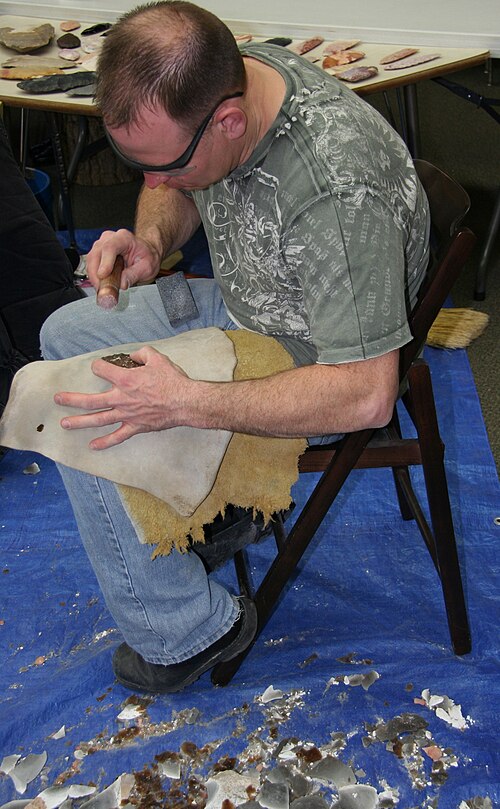
Flintknapping or knapping is done in a variety of ways depending on the purpose of the final product. For stone tools and flintlock strikers, chert is worked using a fabricator such as a hammerstone to remove lithic flakes from a nucleus or core of tool stone. Stone tools can then be further refined using wood, bone, and antler tools to perform pressure flaking.
For building work a hammer or pick is used to split chert nodules supported on the lap. Often the chert nodule will be split in half to create two cherts with a flat circular face for use in walls constructed of lime. More sophisticated knapping is employed to produce near-perfect cubes which are used as bricks.
Tools
There are many different methods of shaping stone into useful tools. One prominent knapping technique in early production is the Levallois technique, which utilizes a distinct striking platform and exploitation surface. Beyond the Levallois technique, there were also polyhedral strategies that differ from Levallois methods in that all faces were used as flaking surfaces and striking platforms. This method involves no division of function amongst parts of the core.[1]
Early knappers could have used simple hammers made of wood or antler to shape stone tools. The factors that contribute to the knapping results are varied, but the EPA (exterior platform angle) indeed influences many attributes, such as length, thickness and termination of flakes.[2]
تُستخدم تقنيات الطرق بالمطرقة الصلبة لإزالة رقائق كبيرة من الحجر. وكثيراً ما استخدم صانعو الأدوات الحجرية الأوائل والهواة الذين يقلدون أساليبهم أحجاراً صلبة جداً، مثل الكوارتزيت. ويمكن لصانعي الأدوات الحجرية استخدام هذه التقنية لإزالة رقائق عريضة يمكن تحويلها إلى أدوات أصغر. ويُعتقد أن هذه الطريقة في التصنيع استُخدمت لصنع بعض أقدم الأدوات الحجرية التي عُثر عليها على الإطلاق، والتي يعود تاريخ بعضها إلى أكثر من مليوني عام.
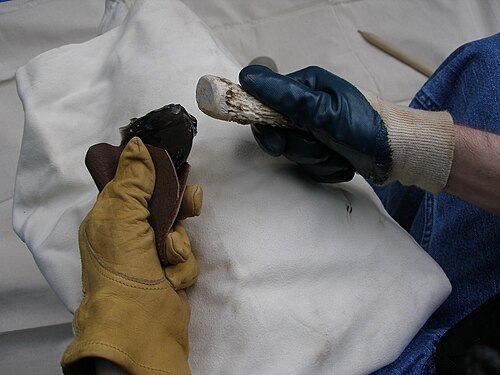
تُعدّ تقنيات الطرق بالطرق اللينة أكثر دقة من الطرق بالطرق الصلبة في تشكيل الحجر. فهي تُمكّن صانع الأدوات الحجرية من تشكيل الحجر إلى أنواع عديدة من أدوات القطع والكشط والرمي. كما تُنتج هذه التقنيات رقائق أطول وأرق، مما يُتيح إمكانية الحفاظ على المواد أو حمل مجموعة أدوات حجرية أخف وزنًا من قِبل المجتمعات المتنقلة. [ 3 ]
تتضمن عملية التشكيل بالضغط إزالة رقائق ضيقة على طول حافة الأداة الحجرية. تُستخدم هذه التقنية غالبًا لترقيق وتشكيل الأدوات الحجرية بدقة. تعتمد هذه العملية على تطبيق قوة كبيرة على منطقة محددة على حافة الأداة، مما يؤدي (عند نجاح العملية) إلى فصل رقاقة ضيقة عن الحجر. يستخدم الهواة المعاصرون أدوات تشكيل بالضغط ذات رؤوس نحاسية أو برونزية، بينما كان صانعو الأدوات الحجرية الأوائل يستخدمون قرون الوعل أو مثقبًا خشبيًا مدببًا؛ ولا يزال صانعو الأدوات الحجرية التقليديون يستخدمون قرون الوعل والأدوات ذات الرؤوس النحاسية. تتمثل الميزة الرئيسية لاستخدام المعادن اللينة بدلًا من الخشب أو العظام في أن المثاقب المعدنية تتآكل بشكل أقل وتكون أقل عرضة للكسر تحت الضغط.
الاستخدامات
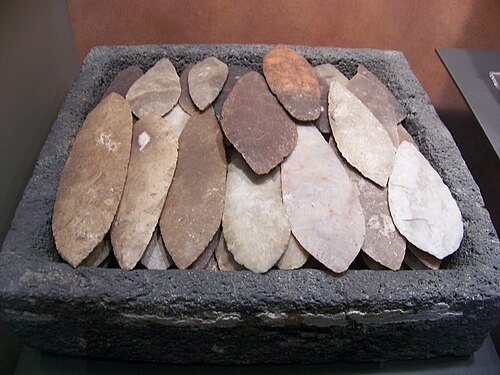


في الثقافات التي لم تتبنَّ تقنيات صناعة المعادن، يُعدّ إنتاج الأدوات الحجرية بواسطة الحرفيين أمرًا شائعًا، أما في الثقافات الحديثة، فيقتصر صنع هذه الأدوات على علماء الآثار التجريبيين والهواة. وعادةً ما يتولى علماء الآثار هذه المهمة لفهم كيفية صنع الأدوات الحجرية في عصور ما قبل التاريخ بشكل أفضل.
طُوِّرت تقنية تشكيل الأدوات الحجرية في أفريقيا لمساعدة الصيادين وجامعي الثمار في جمع الطعام. وكان الصيادون وجامعو الثمار يأخذون معهم أدوات مُجهزة مثل رؤوس ليفالوا ورقائق مثلثة الشكل، ويغادرون مواقع صيدهم. [ 4 ] [ 5 ]
In Ancient Africa, specifically Ancient Egypt, knapping methods were large-scale productions of flint and chert tools made for both soft and hard stone working. Flint knappers made sharp, disposable tools used to shape limestone, granite, and other materials. These flint tools evolved in design depending on the material they worked with, serving multiple purposes like carving hieroglyphs, shaping sculptures, and smoothing surfaces.[5]
During the time when knapping was used to make tools, flaked tools were no less effective compared to other tool making methods. With modern technology, it shows that flake tools stood against environmental shifts and were fit for a purpose.[6]
Knapping gun flints, used by flintlock firearms was formerly a major industry in flint-bearing locations, such as Brandon in Suffolk, England, and the small towns of Meusnes and Couffy in France.[7] Meusnes has a small museum dedicated to the industry.
In 1804, during the Napoleonic Wars, Brandon was supplying over 400,000 flints a month for use by the British Army and Navy.[8] Brandon knappers made gun flints for export to Africa as late as the 1960s.
Knapping for building purposes is still a skill that is practiced in the flint-bearing regions of southern England, such as Sussex, Suffolk, and Norfolk, and in northern France, especially Brittany and Normandy, where there is a resurgence of the craft due to government funding.[9]
Health hazards
The sustained inhalation of flint dust produced by knapping can cause silicosis. This has been called "the world's first industrial disease".[7][10] However, it is unclear how severe the issue may actually have been in prehistoric working conditions, as silicosis is aggravated by a lack of ventilation and the use of metal tools which produce more dust. Ancient knappers, working in the open air and with stone and bone tools, would have had less prolonged exposure to dust than in more modern workshops.[11]
When gun flint knapping was a large-scale industry in Brandon, Suffolk, silicosis was widely known as knappers' rot. It has been claimed silicosis was responsible for the early death of three-quarters of Brandon gun flint makers. In one workshop, seven of the eight workers died of the condition before the age of fifty.[7] The average age of death for knappers was 44 years, compared to 66 for other employed men in the same area.[12]
Modern knappers are advised to work in the open air to reduce the dust hazard, and to wear eye and hand protection.[7] Some modern knappers wear a respirator to guard against dust.[10] A 2020 survey of 173 knappers found that 86% used eye protection, 57% wore gloves, and only 5% used a respirator, mask, or fan to control dust (although 68% preferred to knap outdoors). About half of respondents reported being injured at least "often" when knapping, and 23% admitted having to seek professional medical attention at least once. The most common injuries were cuts and bruises, typically on the fingers and hands, while flakes in the eye were also frequent.[13]
Contemporary study

Modern American interest in knapping can be traced back[14] to the study of a California Native American called Ishi who lived in the early twentieth century. Ishi taught scholars and academics traditional methods of making stone tools and how to use them for survival in the wild. Early European explorers to the New world were also exposed to flint knapping techniques. Additionally, several pioneering nineteenth-century European experimental knappers are also known and in the late 1960s and early 1970s experimental archaeologist Don Crabtree published texts such as Experiments in Flintworking. François Bordes was an early writer on Old World knapping; he experimented with ways to replicate stone tools found across Western Europe. These authors helped to ignite a small craze in knapping among archaeologists and prehistorians.
English archaeologist Phil Harding is another contemporary expert, whose exposure on the television series Time Team has led to him being a familiar figure in the UK and beyond. Many groups, with members from all walks of life, can now be found across the United States and Europe. These organizations continue to demonstrate and teach various ways of shaping stone tools.
See also
- Ancient Egyptian flint jewelry
- Debitage – Archeological term; material produced during the process of lithic reduction
- Eccentric flint – Mayan archaeological artifact
- Lithic technology – Ancient production techniques
- Nap (disambiguation)
- Olduwan – Archaeological culturePages displaying short descriptions of redirect targets
- Solutrean – Archaeological industry of the European Upper Paleolithic
- Tranchet axe – Type of edged stone tool
References
- ↑Hernández, Cristo M.; Mayor, Alejandro; Harzbecher, Karin (2024). "Pleistocene Artefacts Inside an Ancient Egyptian Tomb". Trabajos De Egiptología. Papers on Ancient Egypt (14): 1–27.
- ↑Dibble, Harold; Whittaker, John (1981). "New Experimental Evidence on the Relation Between Percussion Flaking and Flake Variation". Journal of Archaeological Science. 8 (3): 283–296. doi:10.1016/0305-4403(81)90004-2.
- ↑Peclin, Andrew (1997). "The Effect of Indentor Type on Flake Attributes: Evidence from a Controlled Experiment". Journal of Archaeological Science. 24 (7): 613–621. doi:10.1006/jasc.1996.0145.
- ↑Al Kassem, Amal. Variability of Core Reduction Strategies of the Late Middle Palaeolithic of Assemblages 6 and 4 of Yabroud I (Syria): An Analytical and Comparative Study. 2021. U of Cologne, PhD dissertation. Cologne University Publication Server, https://kups.ub.uni-koeln.de/53414/1/Dissertation_Al Kassem.pdf.
- 12Stocks, D.A. (2022). Experiments in Egyptian Archaeology: Stoneworking Technology in Ancient Egypt (2nd ed.). Routledge. https://doi.org/10.4324/9781003269922
- ↑Bamforth, D. B. (1991). Technological Organization and Hunter-Gatherer Land Use: A California Example. American Antiquity, 56(2), 216–234. https://doi.org/10.2307/281416
- 1234"Basic Tool Production Techniques, Health and Safety". ancientcrafts.co.uk. Archived from the original on 14 September 2015. Retrieved 23 August 2015.
- ↑Whittaker, John (2001). "The Oldest British Industry: continuity and obsolescence in a flintknapper's sample set"(PDF). Antiquity. 75 (288): 382–90. doi:10.1017/s0003598x00061032. S2CID 163235035. Archived from the original(PDF) on 2020-04-28. Retrieved 2015-08-18.
- ↑"Architectural flintwork". Archived from the original on 2024-12-13. Retrieved 2016-03-23.
- 12Kalin, Jeffery (2010). "Flintknapping and Silicosis". Pudget Sound Knappers. Retrieved 24 August 2015.
- ↑Shaw 1981, p. 156.
- ↑Shaw 1981, p. 154.
- ↑Gala, Nicholas; Lycett, Stephen J.; Bebber, Michelle R.; Eren, Metin I. (2023). "The Injury Costs of Knapping". American Antiquity. 88 (3): 283–301. doi:10.1017/aaq.2023.27. ISSN 0002-7316.
- ↑Whittaker 1994, p. 56-58.
Further reading
- Crabtree, Donald (January 1971). Experiments in Flintworking. Idaho State University Museum. ASIN B0006XPAQU.
- Shaw, A. Batty (1981). "Knapper's Rot, Silicosis in East Anglian Flint Knappers". Medical History. 25 (2): 151–168. doi:10.1017/s0025727300034359. PMC 1139012. PMID 7012479.
- Waldorf, D.C. (1994). The Art of Flint Knapping (Paperback) (4th ed.). Mound Builder Books, Branson MO, USA. (Excellent illustrations by Valerie Waldorf of processes, techniques, hand tools, ancient and modern knapped artifacts [mostly North American]. On front and rear cover are photos of precisely knapped replicas of prehistoric points and within the text are B&W photos including two full-scale [12+5⁄8 in or 320 mm and 10+3⁄4 in or 270 mm] "Danish dagger" replicas made by the author.)
- Whittaker, John C. (1994). Flintknapping : Making and Understanding Stone Tools (Paperback). University of Texas Press. ISBN 0-292-79083-X.
External links
- Museum of Stone Tools – Interactive 3D models of stone tool artifacts
- Experimental archaeology
- Lithics
- Natural materials