
PBS Satellite Service
The PBS Satellite Service (also known as the PBS National Program Service, with the primary C-band feed being formerly known as PBS Schedule X in Eastern Time, with the West Coast delay signal designated PBS-XP) consists of feeds relayed from PBS by satellite to public television stations throughout the United States. The service launched on March 1, 1978, with wider adoption beginning in September 1978 as more satellite downlinks were installed at each PBS stations.[1] The service provides a mixed variety of programming selected from PBS's regular network services. In the X/XP years a satellite feed was multicast by some PBS member stations on an over-the-air DTV subchannel along with their regular programming, or during overnight hours on their main channel to provide a second opportunity for viewers to watch or record primetime programming.
PBS currently utilizes one transponder on the Galaxy 16 satellite, transponder 22. This is a MCPC (multiple channel per carrier) which currently has seven channels uplinked from the PBS NOC (Network Operations Center) in Alexandria, Virginia.[2] However, in the event of approaching weather or technical difficulties at the NOC in Virginia, PBS will switch to a backup uplink location in Lincoln, Nebraska.[3]
Currently, select stations broadcast the feed, usually overnight, like KGTF (PBS Guam, broadcasts most of the channel as a localised feed). The primary feed, known as HD01, is also available over satellite providers like DirecTV (Channel 389), though this feed is down-converted to SD. PBS provides all of their channels free to TV providers who do not receive local member stations.
As of 2026, PBS's satellite feeds, as well as a few other PBS stations, can be received unscrambled using a free-to-air satellite receiver set to these coordinates:
- PBS National Program Service at 99°W (on the Galaxy 16 satellite), Ku-band, unencrypted.[4]
- Montana PBS at 99°W (on the Galaxy 16 satellite), Ku-band, unencrypted.[4]
- LPB(along with LPB Kids and LPB 3) at 101ºW on the SES-1 satellite, Ku-band, unencrypted.[5]
PBS affiliate KETA, part of the Oklahoma Educational Television Authority (OETA), was also available on AMC-21 until June 2016.[6] Their removal from satellite coincided with the completion of their transition to fiber distribution.[7] In March 2026, LPB begain simulasting on the SES-1 satellite.[8] Later in the month, LPB shut down their transponder on SES-2 at 87ºW[9] (where the station has been uplinking to since 2003 when it was originally known as AMC-3[10]) competing the transition to SES-1.[11][5]
PBS transitioned to a fiber-based interconnection system known as sIX, otherwise known as the sixth generation of PBS's interconnection system, in July 2021. The original end date for linear program feeds via satellite was slated for 2016, but was later pushed to 2018, and was then pushed again to the beginning of 2021; none of these deadlines were met. PBS's main network feeds are still active as of March 2026; however, only one NPS soft-feed service remains, namely HD03. The only programs airing on this feed are news and public affairs programming; all other linear program feeds have moved to sIX; however, there may occasionally be an unannounced feed of program unrelated to news or public affairs, such as re-feeds of certain live events, such as certain episodes of Great Performances.
History
1971–1978: The First-Generation Interconnection System
Starting in 1971, PBS began distributing programs via microwave relay circuits leased from AT&T Long Lines.[12][13] This was the first generation of PBS's interconnection system. Prior to this, PBS would distribute programs to stations via "bicycling tapes," meaning that tapes would be shipped between stations through the mail.[14] The interconnection system consisted of nearly 20,000 miles of microwave paths spread across the country.[13] To send programming, PBS would feed these videotaped programs via the AT&T network of microwave relay circuits throughout the country.[13] Instead of each program being received by each individual public television station, these programs were fed to "regional networks," which would then redirect these feeds to stations within their network.[15] Examples of these regional networks included the Southern Educational Communications Association (SECA), which is now known as the National Educational Telecommunications Association (NETA); the Central Educational Network (CEN); the Eastern Educational Television Network (EEN), which is now known as American Public Television (APT); and Midwestern Educational Television (MET).[15] This system made use of a "round-robin" method when distributing programming; this meant that, "a number of stations on the loop can originate to all other stations in the system."[13]
Issues with the System
The system, however, had its limits. One problem was that video and audio quality would become poorer the farther away a receiving station was due to the distance the program had to travel via the interconnection system.[13] Furthermore, for areas outside the contiguous U.S., such as Hawaii, connecting to the interconnection system was not "economically feasible";[13] to acquire programming, these stations were sent videotapes via the mail.[16] Another issue was that this system was single channel only, meaning that PBS could not feed multiple programs at the same time, giving stations less programming options.[13][16] There were also issues with making last minute changes to programming if PBS needed to pre-empt a previously scheduled program.[16] Lastly, according to PBS, the use of telephone lines to deliver programming was "incapable of producing high-fidelity sound," especially for musical programs such as concerts, so they started to look for an alternate method of distributing programming.[16][17]
PBS began to inquire about the use of satellite for program distribution dating back to 1971.[18] PBS quickly discovered the benefits satellite distribution would have on their operations. A satellite-based interconnection system would allow improved video and audio quality.[13] Unlike the terrestrial-based system, where quality degrades the farther the signal travels, programs fed via satellite would suffer no loss in quality; each station would receive the same copy of the program.[13] A satellite-based system would also allow for more than one program feed.[13]
Digital Audio for Television (DATE)
In 1973, PBS, along with Digital Communication Corp, developed a prototype audio system that would allow for high-quality audio to be transmitted alongside television programming.[19] This system consisted of four 15-kHz audio channels that would be "multiplexed" and transmitted via a "5.5-KHz subcarrier located above the video".[19] This system would become known as DATE (Digital Audio for TElevision). What made date intriguing was that it would allow for high-quality stereo audio,[20] in addition to quadraphonic audio, analog data, and the option to include a Secondary Audio Program (SAP) channel.[19] PBS said that DATE "produces no perceptible picture degradation" and that the audio quality "is maintained at a 70-dB signal-to-noise ratio". Using DATE, according to PBS, would also lead to decreased operational costs and the need for separate facilities that would be needed to transmit high-quality audio. To receive DATE signals, stations required both an encoder and decoder.[19]
While the DATE system sounded promising, PBS said that the system was never widely adopted due to "high cost".[20] Decoders for the DATE system cost up to $11,000 in the mid-1980s.[21] PBS recommended that a station purchase at least two decoders, one of these acting as a backup unit.[21] By 1987, "less than half of PBS's member stations" could adequately decode and broadcast DATE audio signals due to these high costs and the lack of available parts.[21]
1978: Preparations for the Second-Generation, Satellite-Based Interconnection System
In August 1976, PBS submitted their proposal of a satellite-based interconnection system to the FCC. In December 1976,[16] PBS, as well as NPR, received approval from the FCC regarding this proposal.[15] PBS reached an agreement with Western Union in June 1976 to lease three full-time C-band transponders on the Westar 1 satellite, at orbital position 99°W, for a period of seven years (until 1985) at a cost of $800,000 per year; if PBS were to add a fourth transponder, this would cost $750,000 per year.[16] The total cost of implementing this system was around $39,500,000[16][22] ($226,854,261.86 adjusted for inflation as of March 2026). The details of the contract with Western Union follow:[16]
- As stated earlier, PBS would least three transponders at a cost of $800,000 per year, with the option to add a fourth transponder, lowering the cost to $750,000 per year.
- PBS would be guaranteed replacement transponders on Westar 1 or, if the satellite failed, replacement service on Westar 11 at orbital position 123.5ºW.[13][16]
- Western Union guaranteed that all public televisions stations would reliably receive PBS's signals.
- There were no limits on the type of traffic PBS could uplink to satellite, meaning they were free to uplink various types of content such as television programming and data.
- Western Union agreed to "[t]echnical performance limits" for each transponder PBS leased.
- There were maximum limits on the overall movement and attitude of each satellite; this way, there would be no need to install "automatic satellite tracking capability."
- PBS was granted free use of the transponders during implementation of the system, but only up to 300 hours. The free use of the transponders allowed public television stations to test signal reliability during installation of their ground stations.
- Western Union would provide PBS with free engineering assistance during implementation of the system.
June 1977–March 1, 1978: The Implementation Phase
Implementation of the system began in June 1977.[16] During implementation, the terrestrial interconnection system would continue to be operational. The first step was constructing a Main Organization Terminal (MOT) as the soon-to-be PBS SOC. Planning of the construction of the MOT took three years. The MOT was completed by the end of January 1978[16] Throughout 1977 and 1978, satellite dishes (ground stations) were installed at each public television station around the country.[23] Western Union split the country into various segments during the implementation phase.[16] The first two segments were based in the Southeastern and Southern portions of the country. Construction in Segment I was completed by February 1, while Segment II was completed by mid-April. WFSU (Orlando, Florida) was the first station to have a ground station installed. Segment III consisted of stations in the West Coast and Segment IV consisted of stations in the Rocky Mountains. Terrestrial service at each segment would continue for one month after the installation of the ground stations.
March 1, 1978–December 1978: The Launch Phase and End of the First-Generation Interconnection System
On March 1, 1978, PBS began uplinking on Westar 1, initially providing service on transponder 8[16] to 24 public television stations in the Southeastern portions of the country.[23] This marked the launch of their second-generation interconnection system.[14] With the completion of construction at Segments III and IV in mid-June, PBS launched service on transponders 9 and 11, both segments receiving satellite service on June 1. Two-thirds of public television stations were receiving satellite service by August. On July 1, the final terrestrial link, a time zone delay in Denver, Colorado, was shut down, marking the end of the first-generation interconnection system.[16] At the end of September, over 95% of the new system had been completed, with PBS expecting full completion by December. At the end of 1978, 274 public television stations were now receiving programs via satellite.[23] Beginning in 1980, PBS began leasing a fourth "occasional" transponder.[22] In 1982, Westar 4 replaced Westar 1 in the same orbital position; PBS transferred their feeds to this new satellite.[24] One primary advantage of Westar 4 was that it contained 24 transponders, compared to Westar 1's 12 transponders.[25][26]
Direct/Dial Access Communication System (DACS)
To communicate with stations, PBS launched a service called the Dial (later Direct)[27]Access Communications System (DACS).[28] DACS launched in 1981.[27] DACS, considered a form of "electronic mail," allowed PBS and its stations to communicate with each other about private matters.[29] DACS was transmitted in Line 13 of the VBI of their satellite feeds. On July 21, 1995, a new communications system, known as PBS Express, launched.[30] PBS Express launched alongside DACS, which would be discontinued in 1996.[30] Stations now communicate private matters via myPBS, launched in 2013, which is where stations are alerted to new program offers from PBS and other distributors, any schedule changes, or program availability changes. Other station matters are also communicated via The Hub.
Introduction of NOLA Codes
For organizational purposes, PBS created a system to quickly identify programs they distributed. This system consisted of a four-letter code and a six-digit number. These codes were known as NOLA codes.[31] It is unknown what – if any – meaning the abbreviation "NOLA" has. A simple NOLA code is formatted as such: [NOLA 000000]. These codes are assigned to every public television program distributed by APT, NETA, and PBS. For example, the Masterpiece series is assigned the NOLA code "MAST". Further, the complete NOLA code for episode one of the Downton Abbey series (broadcast as season 41, episode 01 of the Masterpiece franchise) would be: [MAST 004101]. Additional NOLA codes include "FRON" for Frontline, "GPER" for Great Performances, and "MLNH" for PBS News Hour.
1987: Controversy Surrounding Potential Use of VideoCipher II
خلال هذه الفترة، لم تستخدم شبكة PBS أي نوع من التشفير في بثها. مع ذلك، بدءًا من منتصف عام 1987، بدأت PBS بدراسة إمكانية تشفير بثها باستخدام خوارزمية VideoCipher II . [ 21 ] ومع تخطيط PBS لتشفير بثها باستخدام VideoCipher II، بدأ مشاهدو البث المنزلي لشبكة PBS عبر الأقمار الصناعية بالتعبير عن مخاوفهم من أن PBS تستعد لتشفير بثهم. إحدى هؤلاء المشاهدات كانت ديان فريدل ديفيس، التي كانت تقيم في سانت جو، أركنساس ، وهي منطقة ريفية في الولاية؛ وقد مثلت أمام جلسة استماع في الكونغرس في 31 يوليو 1987، لمناقشة قانون التسويق العادل للتلفزيون الفضائي المقترح حديثًا. [ 21 ] ينص هذا القانون، فيما يتعلق بالبث العام، على أنه "لا يجوز لأي شخص تشفير أو الاستمرار في تشفير برامج خدمة البث العام التي يتم بثها عبر الأقمار الصناعية والمخصصة للمشاهدة العامة عن طريق إعادة البث من قبل محطات البث العامة". [ 21 ] كان لدى PBS "تحفظات جدية" بشأن هذا الأمر، وطلبت حذف هذا البند من المقترح. [ 21 ] حثّ مايكل إي. هوبز، نائب الرئيس السابق للسياسات والتخطيط في شبكة PBS، الكونغرس على حذف هذا البند. وقال في بيان: "نحثكم على حذف البند الذي يمنع PBS من تشفير الإشارات، ليس لأننا نرغب في ذلك، بل لأن الأثر العملي لهذا البند هو تجميد التلفزيون العام في غياهب التكنولوجيا المتقادمة، وحرمان مالكي أطباق الاستقبال المنزلية ومشاهدي البث على حد سواء من الفوائد الحقيقية". [ 21 ] وفي بيانها، عبّرت ديان عن مشاعر مشاهدي أطباق الاستقبال المنزلية آنذاك، معربةً عن قلقها من احتمال قيام PBS بتشفير إشاراتهم. وقالت في بيانها: "ليس لـPBS الحق في تشفير موجات البث العامة". [ 21 ] وفي بيان مكتوب، قالت إن استخدام طبق استقبال فضائي هو الطريقة الوحيدة المتاحة لها لاستقبال البث التلفزيوني، ليس فقط لأن هوائي التلفزيون لا يستقبل الإشارة، بل لأن شركة الكابل المحلية لم تكن مستعدة لقطع هذه المسافة الطويلة لتوفير الخدمة. [ 21 ] وقالت في بيانها المكتوب: "إذا كان طبق استقبال الأقمار الصناعية هو الوسيلة الوحيدة التي يمكن للشخص من خلالها استقبال تلك الإشارة، فيجب السماح له/لها بالوصول إليها". [ 21 ] She continued, "There are the farmers, the elderly, the physically challenged, and millions of rural Americans who, for one reason or another, live in remote and isolated areas of this vast country. For them, television is their window. Should these people be denied their First Amendment rights just because they do not live in urban or suburban areas where a television signal is received over a standard VHF antenna?"[21]
According to PBS during the July 1987 hearing, VideoCipher II would not be used for general encryption purposes, but rather more efficient stereo audio and the opportunity to add other audio services, such as Descriptive Video Service or a Secondary Audio Program.[20][21] David Hobbs later explained more concerning the reasoning for using VideoCipher II. "We are planning to use that technology to install stereo audio capability system-wide, a dream that we have had in public television for 20 years. We are also working on the development of Descriptive Video Services for the blind, and multi-lingual audio tracks for the non-English-speakers in our audience."[21] Utilizing VideoCipher II would also be cheaper for PBS and its stations; VideoCipher II decoders cost an average of $500 and could be easily found on the market.[21] He also made clear that PBS's proposal to use VideoCipher II did not mean eventual encryption. "We at PBS are proud to have worked vigorously since our earliest days to extend public television service to as many Americans as possible. …In keeping with that commitment, PBS has never scrambled any satellite transmission of our program service. We have not done so, and we have no plan to do so."[21] In a later statement, he reaffirmed this point again by saying, "At the outset, I would like to say once again that PBS has no plans to encrypt its regular program transmissions."[21] In April 1988, PBS began encoding programs with VideoCipher II.[20] The feeds were usually broadcast in a "fixed key" mode (usually 0000), which allowed anyone with a VideoCipher II receiver to be able to receive these feeds.[32] PBS, however, would encrypt the feeds anytime they aired what they referred to as "private communications," which include teleconferences and previews of programs that they haven't yet received broadcast rights for; all other programs remained unencrypted.[20]
The use of VideoCipher II also created confusion among home-dish users who did not have a way to view content encoded with VideoCipher II since, "they have not been able to get reliable information as to the schedule for PBS's 'clear feeds.'"[32] To combat this, PBS took several steps to accommodate these viewers: publishing schedules in satellite magazines, broadcasting nearly every "clear" program transmission on one transponder, broadcasting a slate showing a program schedule, creating an office to answer viewer questions, broadcasting an audio barker message to explain how to obtain a schedule, and sending viewers a monthly schedule of programs upon request.[32]
1991–1997: The Third-Generation Interconnection System
In 1987, PBS, along with the Corporation for Public Broadcasting (CPB), approached Congress with a request upgrade the interconnection system.[33] On March 15, 1988, Bruce L. Christensen, the President of PBS at the time, appeared before a Senate committee to discuss the proposed Public Telecommunications Act of 1988.[20] "The satellite currently used by public television (Westar 4) will run out of fuel by mid-1991, which means that public television must find new satellite capacity," he said in a statement.[20] "Faced with a failing satellite and deteriorating ground facilities, public television must acquire a new satellite distribution system if it is to continue its present services, let alone provide new opportunities for all Americans, in the future."[20] The proposal, "authorizes an additional $200 million to be used over a three year period to replace the satellite interconnection system."[20]
دخل قانون الاتصالات العامة لعام 1988 حيز التنفيذ في 7 نوفمبر 1988، ضامنًا تمويلًا لتحديث نظام الربط البيني لشبكة PBS. [ 34 ] تضمن هذا القانون بندًا ينص على وجوب توفير PBS بثًا واضحًا لبرامجها للمشاهدين الذين يستخدمون أطباق الاستقبال المنزلية ولا يملكون جهاز فك تشفير. [ 35 ] كما أنشأ هذا القانون لجنةً للبحث واقتراح خطط جديدة بشأن استبدال القمر الصناعي المستخدم في نظام الربط البيني، عُرفت باسم لجنة الربط البيني للتلفزيون العام. [ 33 ] تألفت اللجنة من "ممثلين مُعينين عن المحطات العامة". [ 33 ] وافقت هذه اللجنة على خطة استبدال القمر الصناعي في ديسمبر 1981، وحظيت الخطة بموافقة مجلس إدارة PBS. [ 33 ] في هذه الخطة، ستواصل PBS استئجار أربعة أجهزة إرسال واستقبال من النطاق C بدءًا من عام 1991، بهدف تحويل عملياتها عبر الأقمار الصناعية إلى النطاق Ku في وقت ما بين عامي 1993 و1994. [ 33 ] في عام 1991، اشترت PBS مساحة لجهاز إرسال واستقبال من النطاق C على القمر الصناعي Spacenet 1 ، المملوك لشركة GTE ، في الموقع المداري 120 درجة غربًا. [ 14 ] تم هذا الانتقال في 3 يناير 1991. [ 1 ] [ 24 ] بدأ بذلك الجيل الثالث من نظام الربط البيني لـ PBS. كان النظام مضمونًا لمدة 15 عامًا على الأقل، حتى عام 2006. [ 14 ] نقلت PBS لاحقًا تغذياتها إلى قمر صناعي جديد، Spacenet 4، في الموقع المداري 101 درجة غربًا، في 18 يوليو 1992. [ 1 ] [ 24 ]
The move to Spacenet 1 and, later, Spacenet 4 was only a temporary solution. In 1989, an agreement was reached with AT&T for PBS to purchase transponder space on a new satellite named Telstar 401, which wouldn't launch until 1993.[14] Six Ku-band transponders were purchased, but one C-band transponder was purchased; this C-band transponder was purchased to fulfill the "clear feed" requirement in the Public Telecommunication Act of 1988.[14] This C-band feed was the "PBS-X" service. PBS's primary reason for converting to a Ku-band system was to take advantage of "more advanced technical capabilities available on Ku-band transponders," such as increased transponder bandwidth and an increase in the number of services that could be provided.[14] PBS also wanted to create an "educational neighborhood" on Telstar 401 where other public educational services, including PBS's services, would be on the same satellite.[14] PBS said that as many as 80 educational services would be provided via Telstar 401, allowing libraries, schools, and universities to access a multitude of programming on the same satellite.[36] Telstar 401 launched on December 16, 1993.[37] PBS moved to Telstar 401, at orbital position 97°W, on February 5, 1994, ending primary program distribution to affiliates via C-band.[1][24]Telstar 402R, a satellite that launched to orbital position 89°W on September 24, 1995, would serve as a backup.[37]
In 1994, with the launch of the Ku-Band feeds, PBS began testing DigiCipher I, the digital equivalent to VideoCipher.[36] Initial tests proved to be successful, leading PBS to adopt DigiCipher I for all their services in August 1994.[36] PBS had wanted to use the newest version of DigiCipher, known as DigiCipher II, but due to "delays in the adoption of MPEG-2," PBS said that they wouldn't be able to utilize DigiCipher II until "late 1995".[36] Sometime in early 1996, PBS made the switch to DigiCipher II and, in the process, converted their services from analog to digital.[24]
On January 11, 1997, at 6:15 a.m., Telstar 401 suffered a failure due to a coronal mass ejection.[38] AT&T tried to re-establish contact with the satellite, but all attempts failed.[39] To restore service, PBS temporarily moved their feeds to Telstar 402R (later Telstar 4).[40] To prevent noticeable interruption to their service, PBS carried out a Satellite Service Recovery Plan.[14] It took "less than 25 minutes" for PBS to switch service to Telstar 402R, preventing a severe disruption to their services.[14] AT&T, the operator of the Telstar 401 and 402R satellites, granted PBS emergency use of one C-band and one Ku-band transponder on Telstar 402R.[41] During time on Telstar 402R, PBS began researching options to restore full service. Two proposals from Loral Space Systems and GE American were submitted to PBS for consideration. These proposals are listed below:[41]
Loral Space Systems
- The contract submitted by Loral Space Systems was "conditioned on a successful launch of Telstar 5". There would be no protection for a launch failure "until late 1998."
- PBS would continue to uplink services on Telstar 402R. PBS would be granted four Ku-band transponders on the satellite, in addition to one C-band and Ku-band transponder on Telstar 5.
GE American
- GE American proposed giving PBS seven Ku-band transponders on GE-3, a satellite at orbital position 87W that launched on August 9, 1996.[42][14] and one transponder on GE-1, located at 131W, for the non-contiguous U.S. (non-CONUS).
- There was no certainty regarding when PBS would return to full service. GE American proposed that it would be "no later than February 1, 1998."
- PBS would be granted a contract that would last nine years and, if needed, would be granted expansion of the contract.
- There would be "[r]eliable in-orbit protection." GE American also said that there were "firm plans" for the launch of new satellites.
- There was interest in re-establishing the "educational neighborhood" previously found on Telstar 401 before its failure. GE American even expressed interest in expanding the number of services if needed.
According to PBS, there was some hesitancy regarding Loral Space System's proposal.[14] One concern was the sustainability of Telstar 402R. As for Telstar 5, the satellite had not been tested in orbit. Additionally, agreeing to this proposal meant that PBS would need to work with a new satellite provider. As for GE American's proposal, they would provide similar bandwidth as the bandwidth PBS used on Telstar 401. They added that, in the event of a failure, PBS could move their services to GE-1. GE-3, according to GE American, had a life expectancy of 15 years (until 2012). Furthermore, there was no risk to PBS if the launch of GE-3 failed or was delayed. GE American's contract was also cheaper than Loral Space System's contract. What's more, GE American already had an expansive customer list that included HSN, NBC, Time Warner (Court TV) and Viacom (MTV, Nickelodeon, and Showtime).
1997–2006: The Fourth-Generation Interconnection System
The fourth generation of the interconnection system launched in 1997.[14] On April 11, 1997,[41] PBS moved forward with GE American and signed an agreement with them to provide full service to PBS. In the agreement, PBS would purchase seven Ku-band transponders on GE-3 and one C-band transponder on GE-1. The first transmission on GE-3 began on Sunday, October 5, 1997, at 12:01 a.m. ET; PBS completed the move to GE-3 on October 11, 1997, at 11:59 p.m. ET, and subsequentially, they shut down their services on Telstar 402R.[41] There were not many major changes between the third and fourth generation interconnection systems; the primary difference was the transition to DigiCipher II. With the move completed, PBS would own transponders 18–24.
كانت أولى الخدمات التي انتقلت إلى نظام GE-3 هي خدمة تعليم الكبار (الجدول 8) إلى جهاز الإرسال والاستقبال رقم 20 (يُشار إليه فيما يلي بـ "TX" عند الإشارة إلى رقم جهاز الإرسال والاستقبال)، وجهاز الإرسال والاستقبال DigiCipher I MCPC التابع لشبكة PBS (الجداول 5A0، 5A5، 5B1، 5B5، و5B6) إلى جهاز الإرسال والاستقبال رقم 22، وبث المحطات/المناطق إلى جهاز الإرسال والاستقبال رقم 3. [ 43 ] في 6 أكتوبر، أُضيفت الخدمات التناظرية والرقمية المؤجرة على جهازي الإرسال والاستقبال رقم 9 ورقم 18 على التوالي. في 15 أكتوبر، أُضيف بث MCPC التابع لشبكة PBS، والمُشفّر الآن بنظام DigiCipher II، إلى جهاز الإرسال والاستقبال رقم 24 (بنفس جداول جهاز الإرسال والاستقبال DigiCipher I مع إضافة الجدول 8). أُزيل جهاز الإرسال والاستقبال DigiCipher I MCPC في 2 نوفمبر، وأُضيفت بثوث اختبار DTV جديدة إلى جهاز الإرسال والاستقبال رقم 7. سيصبح جهاز الإرسال والاستقبال رقم 9 (TX #9) مقرًا لقناة الأعمال، بالإضافة إلى خدمات البث التناظري الأخرى. في منتصف نوفمبر، نُقلت الخدمات على ثلاثة أجهزة إرسال واستقبال إلى أجهزة أخرى: نُقلت الخدمات على جهاز الإرسال والاستقبال رقم 9 إلى جهاز الإرسال والاستقبال رقم 19، ونُقل بث التلفزيون الرقمي من جهاز الإرسال والاستقبال رقم 7 إلى جهاز الإرسال والاستقبال رقم 21، ونُقلت الخدمات على جهاز الإرسال والاستقبال رقم 3 إلى جهاز الإرسال والاستقبال رقم 23. بمجرد اكتمال عملية النقل في بداية عام 1998، أصبحت شبكة PBS تمتلك أجهزة الإرسال والاستقبال من 18 إلى 24 على جهاز GE-3. [ 43 ]
كان سبب شراء جهاز إرسال واستقبال واحد من نوع C-band على القمر الصناعي GE-1 هو أن المناطق الواقعة خارج الولايات المتحدة القارية، مثل محطات ألاسكا (KAKM) وجزر الكاريبي (KGTF، وPBS غوام)، تقع خارج نطاق تغطية القمر الصناعي GE-3. [ 14 ] ولأن هذه المحطات لن تتمكن من استقبال برامج خدمات PBS من نوع Ku-band على القمر الصناعي GE-3، قامت PBS ببث خدماتها الأساسية بالتزامن على جهاز إرسال واستقبال واحد من نوع MCPC C-band، وهو جهاز الإرسال والاستقبال رقم 3. وتشمل الخدمات المتاحة على هذا الجهاز ما يلي: [ 43 ]
- الجدول 530 (500/PBS-X Ku)
- الجدول 531 (501 كيلوجول)
- الجدول 532 (502 كيلوجول)
- الجدول 533 (503 كيلوجول)
- الجدول 534 (541 Ku ولاحقًا 511 Ku)
- الجدول 535 (542 Ku ولاحقًا 512 Ku)
- الجدول 536 (543 Ku ولاحقًا 513 Ku)
مقدمة عن معرّفات الحزم
بدأت شبكة PBS، منذ حوالي عام 2006، بتخصيص معرّفات حزم للبرامج؛ معرّف الحزمة هو رقم مكوّن من ستة أرقام يُخصّص لجميع البرامج التي توزعها PBS والتي تُقدّمها لها جهات توزيع تلفزيونية عامة أخرى مثل APT وNETA. معرّف الحزمة فريد لكل برنامج وحلقة في المسلسل. يبدأ معرّف الحزمة بالحرف "P"، متبوعًا بالرقم المكوّن من ستة أرقام (مثل P123456). عندما بدأت PBS باستخدام نظام الترقيم هذا، كانت معرّفات الحزم تبدأ دائمًا بـ "P1". ومع مرور الوقت، تستخدم PBS الآن أرقامًا تبدأ بـ "P5"، ومن المتوقع أن تبدأ الأرقام التي تبدأ بـ "P6" في أواخر عام 2026. يمكن تخصيص معرّفات حزم مختلفة لنفس البرنامج أو الحلقة بناءً على نوع البرنامج، مثل ما إذا كانت حزمة البرنامج أساسية، أو مدمجة، أو حزمة تعهد، أو حزمة فعالية تعهد. على سبيل المثال، قد يحمل الإصدار المدمج (الإصدار الذي يتضمن إعلانات ترويجية) من برنامج ما معرّف حزمة P512345، بينما قد يحمل الإصدار الأساسي (الإصدار الذي لا يتضمن هذه الإعلانات الترويجية) من البرنامج نفسه معرّف حزمة P512346. ونادرًا ما يتم تغيير معرّف الحزمة بعد تعيينه. مع ذلك، إذا أعادت قناة PBS بثّ برنامج ما بعد فترة زمنية، فسيتغير معرّف الحزمة. يحدث هذا عادةً مع البرامج التي أُنتجت في الأصل بنسبة عرض إلى ارتفاع 4:3. على سبيل المثال، كان معرّف حزمة الحلقة 1644 من برنامج "حي السيد روجرز" التي بُثّت في يونيو 2017 هو P379906. كانت هذه الحزمة عبارة عن حزمة HD مُحسّنة من الإصدار الأساسي بنسبة عرض إلى ارتفاع 4:3. عندما أُعيد بثّ الحلقة في عام 2019، تم تغيير نوع الحزمة إلى الإصدار الأساسي، وتغيّر معرّف الحزمة إلى P514942. لم تعد حزمة الإصدار الأساسي المُحسّن قيد الاستخدام.
يلي مُعرّف الحزمة ثلاثة أرقام تُشير إلى كل عملية إعادة تغليف، أو كل تعديل أُجري على البرنامج. عادةً ما يكون الإصدار الأول للبرنامج هو أول تعديل؛ على سبيل المثال، الحلقة 13 من الموسم الثاني من مسلسل آرثر (اعتبارًا من مايو 2025) تحمل مُعرّف الحزمة التالي: P504300. عندما صدرت هذه الحزمة لأول مرة في عام 2020، كان مُعرّف الحزمة P504300-001. يشير الرقم "-001" إلى أول تعديل للبرنامج. عندما عُرضت هذه الحلقة على قناة HD03 في 23 نوفمبر 2020، تم تعديل البرنامج وتغيّر مُعرّف الحزمة إلى P504300-002. يتغير رقم التعديل كلما أجرت قناة PBS تعديلات على البرنامج، سواءً كان ذلك لتحديث المشاهد الإضافية، أو التمويل، أو تغيير المحتوى لإزالة أشياء مثل الألفاظ النابية أو لتصحيح الأخطاء التي حدثت أثناء التحرير.
2006–2018: نظام الربط البيني من الجيل الخامس
في عام ٢٠٠٤، نشرت هيئة الإذاعة العامة الأمريكية ( PBS) مقترحًا للجيل الخامس من نظام الربط البيني الخاص بها، والمعروف باسم نظام الربط البيني من الجيل التالي ( NGIS). [ ١٤ ] توقعت PBS وهيئة البث العامة (CPB) أن تبلغ تكلفة التحديث ١٧٧ مليون دولار. كان لدى PBS ثلاثة أسباب لتحديث نظام الربط البيني، أحدها هو أن عقودها مع الأقمار الصناعية كانت مقررة للانتهاء في ٤ أكتوبر ٢٠٠٦. كان نظام الربط البيني الحالي من الجيل الرابع سيبلغ ١٥ عامًا في عام ٢٠٠٦؛ وقالت PBS إن هذا النظام "قد استنفد غرضه" ويحتاج إلى التحديث. [ ١٤ ] إضافة إلى ذلك، أرادت PBS نظامًا جديدًا يدعم التلفزيون الرقمي بشكل كامل. تضمن سبب آخر للتحديث "الاستفادة من التقنيات الجديدة لتعزيز الكفاءة والخدمة المقدمة للمحطات". [ ١٤ ] حذرت PBS من أن نظام NGIS يجب أن يكون جاهزًا للتشغيل بحلول ٤ أكتوبر ٢٠٠٦، وإلا "لن تتمكن PTV من العمل بشكلها الحالي". [ 14 ] كان أحد الجوانب المهمة لنظام NGIS هو أنه سيتيح لشبكة PBS توزيع البرامج في الوقت الفعلي (NRT) عن طريق إرسالها كملفات فيديو رقمية إلى محطات التلفزيون العامة باستخدام شبكة أرضية قائمة على الإنترنت. وأعلنت PBS أن "الغالبية العظمى" من البرامج ستُبث عبر نظام التوزيع NRT، في تحول عن نظام الربط البيني القائم على الأشرطة المستخدم حاليًا. [ 14 ] سيتم تخزين الملفات على "خوادم تخزين مؤقت" في كل محطة تلفزيون عامة. [ 14 ] حتى مع توزيع البرامج بنظام NRT، ظلت PBS ملتزمة بالتوزيع عبر الأقمار الصناعية، لكنها خصصت هذا التوزيع بشكل أساسي للبرامج المباشرة أو شبه المباشرة ذات "فترة إعادة بث قصيرة"، مثل " A Capitol Fourth" و "Charlie Rose" و "The NewsHour with Jim Lehrer "؛ أما البرامج الأخرى، مثل برامج الأطفال والبرامج العامة المسجلة مسبقًا، فستظل تُبث عبر الأقمار الصناعية. [ 14 ] سيعتمد نظام NGIS بشكل كبير على الإنترنت، مما يسمح لمحطات التلفزيون العامة وPBS بالتواصل فيما بينها بسهولة أكبر. [ 14 ]
PBS stated within their report that the NGIS would lead to "increased efficiency" of the distribution or programs.[14] According to PBS, "smaller, financially strained, rural market" stations would air a program as it was being fed via satellite; this was done to save costs.[14] This method led to many "redundant national program feeds," with PBS saying that one program would be fed "as many as five times or more" in a single day.[14] Some of these refeeds would also occur due to weather interfering with satellite reception or due to problems recording the program to tape. In 2001, PBS distributed nearly 120,000 hours of programming through their interconnection system; according to PBS, "all but 7,000 hours were repeated programming" feeds.[14] By using NRT distribution, these redundant feeds would be greatly reduced. The NGIS would also save be cheaper to operate, with station expected to save between $50,000 and $250,000 ever year.[14] PBS expected this system to last about 10 years. The NGIS would launch in October 2006. When the new system launched, PBS launched a transponder that would carry IP data via satellite on two services called NR01 and NR02; these would be the services used for NRT program distribution.[14] NR01 would feed national PBS programs and NR02 would sometimes feed programs from other distributors, such as NETA. Programs would be sent as MXF files. PBS also made the switch to DVB-S MPEG-2 when the new system was launched.
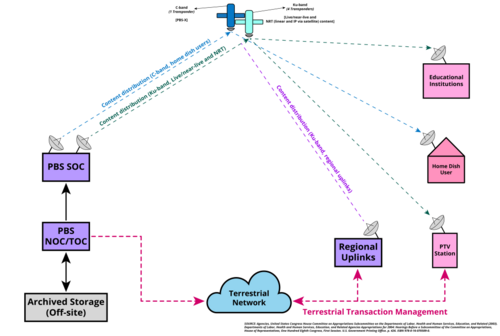
During planning for the NGIS, PBS considered seven different models for this interconnection system.[14]
- The first model would've continued the current operations of the fourth generation interconnection system, with all programming being fed via satellite. The number of transponders would decrease from seven to six. PBS eliminated this model from consideration because they claimed that this was no longer an adequate option due to advancements in digital television; NRT distribution was also not possible.[14]
- كان النموذج الثاني مشابهاً للنموذج الأول، ولكنه كان سيستخدم "خادم تخزين مؤقت" محلياً في محطة التلفزيون العامة. [ 14 ] وكان من شأن هذا النموذج أن يقلل عدد أجهزة الإرسال والاستقبال بشكل كبير، من سبعة إلى ثلاثة. وقد تم استبعاد هذا النموذج للأسباب نفسها التي استبعد النموذج الأول. [ 14 ]
- تضمن النموذج الثالث التوزيع عبر الأقمار الصناعية والشبكات الأرضية، بالإضافة إلى "إدارة المعاملات الأرضية". [ 14 ] اختارت هيئة الإذاعة العامة هذا النموذج نظرًا لتكلفته المعقولة ومخاطره المنخفضة. [ 14 ]
- كان النموذج الرابع سيخصص البث عبر الأقمار الصناعية حصراً للبرامج التي تُبث في الوقت الفعلي، والبث الأرضي حصراً للبرامج التي لا تُبث في الوقت الفعلي. [ 14 ] وقد تم استبعاد هذا النموذج بسبب "ارتفاع تكاليف التشغيل والتنفيذ"، حيث ذكرت شبكة PBS أن تكلفة هذا النموذج كانت ستكون "ضعف" تكلفة النموذج الذي تم اختياره لنظام NGIS. [ 14 ]
- كان النموذج الخامس مشابهاً للنموذج الأول، وهو نظام توزيع يعتمد كلياً على الأقمار الصناعية، ولكنه كان سيضم أقماراً صناعية تعمل بنطاقي Ku وKa . [ 14 ] وذكرت هيئة الإذاعة العامة (PBS) أن هذا النموذج ينطوي على "مخاطر كبيرة" لأن تقنية نطاق Ka كانت آنذاك "غير مجربة"، ما يعني عدم وجود "نموذج عمل مُثبت" لنظام يعمل بنطاق Ka دون مشاكل. [ 14 ] في ذلك الوقت، لم تكن أقمار نطاق Ka للاستخدام التجاري متوفرة، ناهيك عن أن تكاليف الاستثمار التي تغطي عمر القمر الصناعي قد تصل إلى ملياري دولار. [ 14 ] كما لم تعتقد هيئة الإذاعة العامة (PBS) أن "أي شركة اتصالات عبر الأقمار الصناعية ستعتمد في عملياتها على أعمال البث العام". [ 14 ]
- كان النموذج السادس سيُنشئ نظام ربط أرضي لتوزيع جميع البرامج، سواءً كانت تُبث في الوقت الفعلي أو شبه الفعلي. [ 14 ] وكان من المقرر الاستمرار في استخدام الأقمار الصناعية لنسبة ضئيلة من البرامج المباشرة وشبه المباشرة، لكن التوزيع الأرضي كان سيظل الطريقة الأساسية للتوزيع. [ 14 ] وقد تم استبعاد هذا النموذج بسبب "التكاليف الرأسمالية والتشغيلية الباهظة للغاية"، حيث كان من المتوقع أن يُكلف هذا النموذج ما يقارب ثلاثة أضعاف تكلفة تشغيل نموذج NGIS الحالي. [ 14 ] وأشارت PBS إلى أن التوزيع الأرضي بهذا النطاق لم يكن ممكنًا بعد، لكنها قالت: "في المستقبل، قد يُتيح هذا النموذج فرصًا كبيرة". [ 14 ]
- The seventh model, the last to be considered, would use satellite to distribute live and near-live programs, but all other programs would be distributed to stations via "fixed media," such as DVDs.[14] This method has similarities to the "bicycling tapes" system used by PBS before 1971 in that stations would receive a physical copy of programs, being DVDs in this case, through the mail, but these DVDs would not be sent to other stations after one station was finished broadcasting the program. This model was eliminated because it would have created "significant operational complexity" for the public television stations, in addition to there being an "extremely high operational cost and complexity and high risk."[14]
In 2008, PBS switched to a new satellite, AMC-21, which would be in orbital position 125W.[44] In October 2012, PBS began encoding their feeds in the DVB-S2MPEG-4 codec, which they currently use.[45][2]
2018–present: The Sixth-Generation Interconnection System
Diagnosing Issues with the NGIS
Unreliable NRT Distribution
In June 2015, the CPB began to consider options for the sixth generation of PBS's interconnection system, known at the time as "v6".[46] To help consider their options, they commissioned the help of Cognizant Technology Solutions to come up with a new cost-effective solution to improve the Public Television Interconnection System. A report discussing the proposed model for the sixth generation of the interconnection system was published in November 2015.[46] Included in this report were the results of interviews with twelve public television stations, who were chosen as a representative sample of all public television stations; these stations were asked about their satisfaction with the fifth generation interconnection system, the NGIS (referenced in the report, and hereafter, as "v5").[46] Two-thirds of interviewed stations, eight out the chosen twelve, expressed dissatisfaction with the current version of the interconnection system.[46] Overall, according to these stations, the v5 system was able to "effectively" distribute live and near-live content, but as for NRT content, this was where the v5 system failed.[46] NRT program feeds were not "reliable" nor were they "consistent," and because of this, there were "many" stations, according to the report, that did not "fully [adopt] v5"; two stations that were interviewed "did not use the v5 system at all".[46] Indeed, the delivery of NRT content was the biggest problem with the v5 system, with 90% of stations (based on the representative sample size described earlier) agreeing that receiving NRT content was problematic. While the v5 system excelled in delivering live content, it made up very little of the content distributed by the system, only 20%. For NRT content, stations looked for alternatives, such as using FTP (File Transfer Protocol) for content sharing, using other media movement software, or coming up with their own alternatives. Additionally, the Cognizant report cited three reasons as to why v5 was not widely adopted:[46]
- The overall design of the v5 system unsuitable for most stations.
- There was poor communication regarding the switch to the v5 system.
- There was inconsistency regarding implementation of the v5 system.
Along with the representative sample of twelve public television stations, public media entities (PBS, NPR, and American Public Television, hereafter "APT") were also interviewed about the v5 system and its challenges.[46] For this report, Cognizant interviewed ten stakeholders from all three entities: five from PBS, two from APT, and three from NPR concerning the public radio interconnection system known as the Public Radio Satellite System (PRSS) – this paragraph will only focus on the public television interconnection system. Stakeholders from APT and PBS agreed that the v5 system delivered adequately live content, but they agreed that NRT delivery was "unreliable" and that this was the primary reason for why adoption of the v5 system was low. PBS suggested that there were a couple reasons that explained why the v5 system's NRT file delivery system was inadequate: failures with the then-new software used for NRT delivery and issues with formatting files for delivery. It was noted that these issues were resolved over time. Additionally, these twelve stations were also asked about the implementation of the proposed v6 system. There was overwhelming agreement (92%) that a new system was needed, but there was also a lot of apprehension (75%) concerning the rollout of this new system; indeed, the biggest risk concerned the rollout. Some stations were "wary of PBS's propositions for v6."[46]
Limited Content Sharing
Another issue concerned the sharing of content. While nine out of the ten interviewed stations said that NRT distribution was the greatest challenge of the v5 system, one station said that Universal Uplink Capability, or the ability to share content via satellite, was their greatest challenge. This station expressed a desire to share their own content, such as documentaries and investigative reports, with other stations; however, they were unable to do so due to the costs of installing a satellite uplink system. Only 20 stations had uplink capabilities;[46] some of these included the following, all of which had uplink capabilities during 2021 before a full transition to sIX: Connecticut Public Television (CPTV), KCET, New Mexico PBS (KNME), Maryland Public Television (MPT), South Carolina ETV (SCETV), WFSU, WGBH, WGVU, and WVIA.
The New "v6" System
There were three key elements that development of the new v6 system should focus on:[46]
- More reliable NRT content delivery.
- Developing a terrestrial network that is "more cost-effective" than satellite.
- Putting station collaboration, sharing content, at the forefront.
With that, Cognizant's recommendation was "that the system adopt a single interconnection system that is cloud-based, using mainly the public internet and an ecosystem of centralized master control service providers".[46] The selected model would primarily utilize "a terrestrial fiber-based network," with satellite being used as a back-up.[46] This system would decrease the number of transponders used by PBS from three to one. As part of this plan, PBS would switch their primary feeds back to the C-band spectrum beginning in March 2016; however, this transition never occurred. The transition to C-band would have only occurred if PBS consolidated their operations with NPR, which used C-band for their PRSS interconnection system. The primary plan was to transition linear program feeds via satellite, as well as programs fed via the NRT transponder, to the terrestrial-based system.[46] One of the key benefits of the v6 system was that it would allow stations to send content to each other via FTP, allowing for P2P (peer-to-peer) sharing.[46] This would greatly benefit stations that did not have satellite uplink capabilities, making content sharing much easier. By using an FTP client, all stations could easily send content to each other. However, stations could still receive physical media, such as tapes (usually HDCAM) and disks (usually XDCAM discs) "via courier service".[46] These formats were usually bicycling formats.
أتاح نظام الإصدار السادس تخزين المحتوى على السحابة بدلاً من التخزين المحلي، مما وفّر نهجًا أكثر كفاءة في تخزين المحتوى وإدارته، بالإضافة إلى إمكانية إجراء عمليات "التحكم الرئيسي المشترك". [ 46 ] في نظام الإصدار الخامس، كان من الصعب على المحطات الاحتفاظ بأرشيف محلي للبرامج، لأنه في حال امتلاء الأرشيف، كان لا بد من حذف البرامج من خوادم NRT لإفساح المجال لبرامج إضافية. وإذا أرادت محطة ما بث برنامج سبق حذفه، فسيتعين إرساله عبر نظام NRT مرة أخرى. أما مع نظام الإصدار السادس المقترح، فسيتم تخزين جميع المحتويات في السحابة، مما يعني أنه إذا أرادت محطة ما إعادة بث برنامج سبق حذفه من خوادمها، فيمكنها بسهولة إعادة تنزيله لأن المحتوى سيكون متاحًا دائمًا في السحابة. توقعت هيئة البث العامة (CPB) أن يكتمل هذا النظام ويبدأ تشغيله بحلول مايو 2018، [ 46 ] وهو هدف تم تحقيقه في الوقت المحدد. [ 47 ] كلّفت هيئة البث العامة (CPB) شركة Vigor Systems, Inc. بتطوير ونشر نظام الربط البيني الجديد. [ 46 ] ووفقًا لشركة Vigor، يُعرف نظام الربط البيني هذا باسم sIX ("six")، ومعناه الرسمي " ربط الخدمات " . [ 46 ] أُجري أول اختبار بث مباشر لنظام sIX على قناة New Mexico PBS في أواخر مارس 2018، وكان أول برنامج يُبث من هذا النظام الجديد حلقة من مسلسل Arthur . [ 47 ]
نظرة عامة على برنامج sIX

تقوم شبكة PBS وفروعها وشركاؤها بتحميل المحتوى إلى مركز سحابي مركزي، مما يتيح للمحطات تنزيل المحتوى الذي سيتم بثه لاحقًا. يعتمد نظام sIX على منصة التوزيع PitchBlue التابعة لشركة OneVigor، والتي تستخدمها شبكات مثل CBS . لإدارة المحتوى، تستخدم المحطات إما منصة Myers ProTrack أو منصة OneVigor. تُحفظ البرامج التي تم تنزيلها على خوادم إلكترونية تُعرف باسم خوادم Edisen Edge (المعروفة سابقًا باسم MagnuBoxes). يتم تحميل البرامج إلى sIX في أوقات مختلفة؛ على سبيل المثال، قد يتم تحميل حلقة جديدة من برنامج ما إلى sIX قبل حوالي 12 ساعة من بث البرنامج على قناة HD01. في أوقات أخرى، قد يتم جدولة التحميلات لتواريخ وأوقات محددة. في بعض الأحيان، يتوفر موسم كامل من برنامج ما دفعة واحدة، وفي أحيان أخرى يتم تحميل حلقات البرامج أسبوعيًا. بعض البرامج، مثل العروض الأولى لحلقات جديدة من برامج Amanpour & Company و Democracy Now! و Frontline ، بالإضافة إلى الأحداث المباشرة، لا تكون متاحة في البداية عبر sIX كملفات قابلة للتنزيل. تتوفر هذه البرامج فقط عبر البث الفضائي أو الأرضي المباشر لقناتي HD01 وHD02 (لبرنامجي أمانبور وشركاه وفرونت لاين )، أو عبر البث الأرضي المباشر لقناتي HD64 وHD65 (لبرنامج ديمقراطية الآن! وبرامج بي بي سي نيوز وبرامج إن إتش كي). مع ذلك، سيتم تحميل حلقات هذه البرامج - باستثناء برنامج أمانبور وشركاه وبرامج بي بي سي نيوز وجميع برامج إن إتش كي - لاحقًا على منصة sIX بعد البث الفضائي والأرضي الأولي. للبرامج تاريخ انتهاء صلاحية؛ فبمجرد حلول هذا التاريخ، يُحذف الملف من منصة sIX ولا يمكن تحميله. تُسلّم ملفات البرامج دائمًا في حاوية MXF OP1a (بغض النظر عما إذا كان البرنامج عالي الدقة أو فائق الدقة)، حيث تُشفّر معظم برامج HD باستخدام برنامج الترميز XDCAM HD422 (MPEG-2 Long GOP @ 50 ميجابت/ثانية)، وهو تنسيق التسليم المفضل لدى PBS. [ 48 ] من بين برامج الترميز الأخرى المعتمدة للاستخدام عند البث بجودة عالية الوضوح (HD) ثلاثة إصدارات من برنامج الترميز DNxHD : DNx145 وDNx220 وDNx220x. [ 48 ] أما بالنسبة لمحتوى UHD، فقد اعتمدت PBS ثلاثة إصدارات من برنامج الترميز DNxHR : DNxHR HQ وDNxHR HQX وDNxHR 444. [ 48 ]
كانت مؤسسة البث العام (CPB) تُوفر سابقًا تمويلًا لشبكة sIX، ولكن نظرًا لإغلاق المؤسسة في 5 يناير 2026، فإنه من غير الواضح من أين سيأتي تمويل النظام الآن. في أواخر يناير، وبعد إغلاق CPB، أفيد بأن CPB منحت منحة نهائية قدرها 12 مليون دولار مباشرةً للمحطات للمساعدة في تمويل الربط البيني بين التلفزيون العام (sIX) والإذاعة (PRSS). [ 49 ] [ 50 ]
التحول من الأقمار الصناعية
بعد نجاح الاختبارات الأولية لنظام sIX خلال عام 2018، أوقفت PBS خدماتها القائمة على الملفات (غير المتزامنة) على قنوات AMC-21 وNR01 وNR02، والتي أُنشئت كجزء من نظام الربط البيني NGIS، في 2 يناير 2019؛ [ 51 ] ومع إغلاق خدمة NGIS NRT، تم إطلاق نظام sIX رسميًا. وكان الهدف هو نقل جميع المحتويات المُغذّاة خطيًا إلى sIX في المستقبل القريب. وقد صرّحت PBS بأنها ستواصل استئجار مساحة على أجهزة الإرسال والاستقبال للبرامج المباشرة وشبه المباشرة، مثل برنامج PBS NewsHour ؛ كما ستواصل PBS استئجار مساحة على أجهزة الإرسال والاستقبال في حال تعطل نظام sIX فجأة أو انقطاع الخدمة. [ 46 ] ووفقًا لمحطة نيو مكسيكو PBS (KNME)، "نجحت 99% من محطات التلفزيون العامة في تطبيق وظائف sIX". [ 52 ]
مع تقدم عملية الانتقال إلى نظام sIX، بدأت PBS بإيقاف بعض قنوات التوزيع عبر الأقمار الصناعية التابعة لها. وكانت أول قناة يتم إيقافها هي قناة SD01 التابعة لـ PBS، وذلك في 5 سبتمبر 2016؛ وقد حدث هذا قبل الانتقال إلى نظام sIX. [ 53 ] وبعد ذلك بعامين، وكما ذُكر سابقًا، تم إيقاف خدمة NRT القائمة على الملفات في وقت ما قرب نهاية عام 2018. [ 51 ] وفي 4 مارس 2019، تم إيقاف بث PBS على نطاق C على القمر الصناعي SES-3 (103° غربًا)، مما جعل PBS بدون أجهزة إرسال واستقبال نشطة على نطاق C لأول مرة. [ 54 ] وفي 13 نوفمبر 2019، أوقفت PBS بثها على نطاق Ku على قناة SD07 على القمر الصناعي AMC-21، والتي كانت تُبث من SCETV في كولومبيا، كارولاينا الجنوبية . [ 55 ] ويمكن العثور على جميع البرامج على قناة SD07 على قناة HD04، ولكن بجودة HD.
تسارعت عملية الانتقال إلى نظام sIX في مارس 2021 عندما بدأت APT بنقل برامج مختارة من البث الفضائي إلى نظام sIX. وفي يوليو 2021، انتقلت برامج NETA وAPT بالكامل إلى sIX، مما أنهى التوزيع عبر الأقمار الصناعية. [ 56 ] ومع ذلك، استمر بث برنامجين من APT - وهما Consuelo Mack WealthTrack و GZERO World مع إيان بريمر - عبر الأقمار الصناعية على قناة HD03 أيام الجمعة. كما انتقلت روابط البرامج الصاعدة من KNME، باستثناء برنامج Democracy Now! حتى إغلاق خدمة HD05 في 31 مايو 2023، إلى sIX. وكانت PBS نفسها قد نقلت العديد من البث الخطي المنتظم غير الإخباري إلى sIX، بما في ذلك بث برامج التعهدات، والتي كان آخر بث لها في مايو 2021. وكان المحتوى الوحيد المتبقي على قنوات التوزيع الرئيسية الثلاث (آنذاك) التابعة لـ NPS HD، وهي HD03 وHD04 وHD05، هو الأخبار وبرامج الشؤون العامة. في 21 يوليو 2021، وبعد أسابيع قليلة من هذا الانتقال، قامت PBS بإيقاف بث قناتين فضائيتين إضافيتين، SD05 وSD06، في الساعة 2:56 مساءً بتوقيت شرق الولايات المتحدة .
في 20 يناير 2023، بدأ جهاز الإرسال والاستقبال الرئيسي لشبكة PBS على القمر الصناعي AMC-21 (والذي يشمل القنوات HD01-HD03 وHD06 وSD02 وSD04 وSD08) البث المتزامن على القمر الصناعي Galaxy 16، الموجود في المدار عند خط طول 99 درجة غربًا. وفي 3 مايو 2023، ظهر إشعار على القناتين HD04 وHD05 يُعلم بأن الخدمتين ستتوقفان عن البث في 1 يونيو 2023، الساعة 00:00 بالتوقيت العالمي المنسق (31 مايو 2023، الساعة 8:00 مساءً بالتوقيت الشرقي)؛ وتم تحديث الإشعار لاحقًا في 25 مايو 2023، مع تحديد تاريخ إيقاف جديد هو 31 مايو 2023، الساعة 23:59:59 مساءً بالتوقيت الشرقي (11:59:59 مساءً بالتوقيت الشرقي). أعلنت شبكة PBS في شريط الأخبار أن بث برامجها على قناتي HD04 وHD05 سينتقل إلى قناتين أرضيتين جديدتين، هما HD64 وHD65. وفي 31 مايو 2023، الساعة 11:58:52 مساءً بتوقيت شرق الولايات المتحدة، أكملت PBS عملية الانتقال إلى القمر الصناعي Galaxy 16. وتم إيقاف تشغيل قناتي HD04 وHD05 في الوقت نفسه.
في عام ٢٠٢٤، بدأت PBS باختبار بث أرضي جديد كجزء من نظام الربط البيني sIX. هذه الخدمات مماثلة للبث الفضائي الحالي على القمر الصناعي Galaxy 16 (HD01، HD02، HD03، HD06، Create، وWorld). [ ٥٧ ] تم إطلاق بث أرضي للقناة HD03 على منصة sIX في ديسمبر ٢٠٢٤. [ ٥٨ ] ستُضاف خدمة FNX لاحقًا. هذا جزء من مرحلة جديدة في نشر sIX تُعرف بالمرحلة F2، وهي جارية حاليًا. من غير المعروف ما إذا كانت PBS ستوقف البث الفضائي بمجرد اكتمال المرحلة F2. في الوقت الحالي، تسجل المحطات البرامج من كلٍ من البث الفضائي والأرضي، حيث يعمل أحدهما كنسخة احتياطية. كما يعمل نظام sIX القائم على الملفات كنسخة احتياطية أيضًا.
ست مراحل للتنفيذ
يتم طرح نظام sIX على عدة مراحل: [ 46 ]
- تضمنت المرحلة الأولى (حوالي 2016 - 2 يناير 2019) التخلص التدريجي من جهاز الإرسال والاستقبال ذي النطاق Ku القائم على ملفات NGIS NRT ونقل المحتوى إلى sIX.
- Phase 2 (2020 - circa 2022), according to a May 2021 report from the CPB, involved "consider[ing] future options for the delivery of linear and live content."[59] The report says that later stages will be "defined as business and technology needs evolve."[59]
- Phase C (2022 - 2023) focused on station content contribution to the sIX system.[60]
- Phase F1 (2022 - May 31, 2023) involved transitioning feeds from the HD04 and HD05 satellite services to the new HD64 and HD65 terrestrial services.[61]
- Phase F2 (2023–present) involves rolling out terrestrial services that mirror the services uplinked via satellite.[58]
Services
The services currently available via Ku-band satellite on Galaxy 16 at 99°W are listed below (Lyngsat). These services, except FNX, are also provided via the sIX interconnection system.
- Montana PBS[note 1] (this transponder is independent of PBS's other feeds)
- HD01 (PBS East)[note 2]
- HD02 (PBS West)[note 2]
- HD03 (NPS Feed)[note 2]
- HD06 (PBS Kids Channel)[note 2]
- SD02 (Create (TV network))[note 1][note 3]
- SD04 (World Channel)[note 1][note 3]
- SD08 (FNX)[note 1]
Discontinued Feeds:
- HD04 (NPS Feed, SCPC) (December 10, 2008 - May 31, 2023; replaced with HD64 terrestrial feed.)
- HD05 (NPS Feed, SCPC) (June 2013 - May 31, 2023 replaced with HD65 terrestrial feed.)
- SD01 (NPS Feed) (December 9, 2008 - September 5, 2016)
- SD03 (V-me) (December 9, 2008 - March 2017)
- SD05 (NPS Feed, SCPC) (December 10, 2008 - July 21, 2021)
- SD06 (NPS Feed, SCPC) (December 10, 2008 - July 21, 2021)
- SD07 (NPS Feed, SCPC) (December 10, 2008 - November 13, 2019)
Overview of Past Services
Schedules A-E (1978 - August 15, 1994)
على مدار معظم تاريخها في البث الفضائي، استخدمت PBS أربعة أجهزة إرسال واستقبال تتوافق مع "جدول" مختلف، وهي: "الجدول أ"، و"الجدول ب"، و"الجدول ج"، و"الجدول د". وفي عام 1988، أُطلق بث إضافي، هو "الجدول هـ". وابتداءً من عام 1988 تقريبًا، بدأت PBS بعرض جدول البرامج على الشاشة؛ وذلك استجابةً للارتباك والمخاوف التي أبداها مستخدمو أجهزة الاستقبال المنزلية بشأن توفر الجداول. [ 17 ] وكانت PBS تعرض سابقًا جدولًا لبرامجها القادمة، ولكنها كانت تستخدم أحيانًا رموزًا خاصة بدلًا من أسماء البرامج. ثم تخلت PBS عن عرض الجداول على الشاشة بدءًا من عام 1996 تقريبًا.
الجداول 5A0-8 (15 أغسطس 1994 - 1997)
في 15 أغسطس 1994، [ 62 ] بالتزامن مع التحول الرقمي، أطلقت PBS تسع خدمات جديدة لتحل محل قنوات A وB وC وD وE السابقة، وهي: 5A0 و5A5 و5B0 و5B5 و5B6 و6 و7L و7U و8. بعض هذه الخدمات، مثل الجدولين 5A0 و5A5، كانت تستخدم نفس جهاز الإرسال والاستقبال MCPC. [ 62 ] استخدمت PBS أربعة أجهزة إرسال واستقبال على Telstar 401 خلال هذه الفترة، وهي الأجهزة من 5 إلى 8. [ 62 ] كان الجهاز 5 رقميًا ومخصصًا لـ PBS طوال الوقت. [ 62 ] أما الأجهزة من 6 إلى 8 فكانت تناظرية ومشتركة، ما يعني أن خدمات تعليمية أخرى كانت تستخدمها لفترة خلال اليوم؛ ومع ذلك، كانت PBS تتحكم بها بشكل كامل خلال عطلات نهاية الأسبوع. [ 62 ]
الجداول 500-505، 511-515، و540-543 (1997 - 11 فبراير 2009)
في أواخر عام ١٩٩٧، بدأت شبكة PBS بتغيير أسماء أرقام القنوات الافتراضية لكل خدمة تُشغلها. مُنحت PBS حق استخدام أرقام القنوات الافتراضية بدءًا من ٥٠٠ وانتهاءً بـ ٥٩٩. [ ٤٣ ] تزامن هذا التغيير مع التحول إلى نظام DigiCipher II. خلال هذه الفترة، في نوفمبر ١٩٩٧، أطلقت PBS خدمات جديدة لتحل محل خدمات ٥A٠-٨، التي كانت خدمات DigiCipher I. انظر أدناه: [ ٤٣ ]
- الجدول 5A0: تم استبداله بالجدول 501.
- الجدول 5A5: تم استبداله بالجدول 502.
- الجداول 5B0 و6 و7L و7U: تم إيقافها.
- الجدول 5B1: تم استبداله بالجدول 500 (PBS-X).
- الجدولان 5B5 و5B6: لا يوجد ما يعادلهما. سيتم تقسيم البرامج من هذه الخدمات بشكل أساسي بين الجدولين 504 و505، اللذين سيتم إطلاقهما في 12 أكتوبر 1997، والجداول 541 و542 و543 (التي سميت لاحقًا 511 و512 و513 في منتصف نوفمبر 1997).
- الجدول 8: تم استبداله بالجدول 503 (DigiCipher II) و520 (التناظري) (خدمة تعليم الكبار)
تم إطلاق الجدولين 504 و505 في 12 أكتوبر 1997. [ 43 ] وفي أكتوبر أيضًا، تم إطلاق الجداول من 541 إلى 543. بالإضافة إلى الجدولين 504 و505، كانت الجداول من 501 إلى 503 خدمات بث تمهيدي، حيث كانت تُرسل البرامج إلى المحطة قبل موعد بثها. كانت الجداول من 501 إلى 505 هي قنوات البث الرئيسية لشبكة NPS المستخدمة لتوزيع البرامج، بالإضافة إلى ثلاث قنوات بث SCPC، وهي الجداول من 511 إلى 513. كان الجدول 511 هو قناة البث الرئيسية لمحتوى APT، بالإضافة إلى محتوى SD آخر؛ [ 63 ] وكانت هذه الخدمة تُبث في معظم الأحيان من CPTV في هارتفورد، كونيتيكت. خُصص الجدول 512 للوصلات الصاعدة الإقليمية ومحتوى SD آخر. [ 63 ] وكان الجدول 513 هو قناة البث الرئيسية لمحتوى NETA ومحتوى SD آخر. [ 63 ] كانت هذه الخدمة تُبث من محطة SC ETV في كولومبيا، بولاية كارولاينا الجنوبية، في معظم الأوقات. في عام 1998 تقريبًا، أضافت PBS خدمة جديدة للبث الإقليمي تُعرف باسم Schedule 514؛ [ 64 ] من غير المعروف متى توقفت هذه الخدمة أو ما هو المحتوى الذي كانت تُبثه. وبناءً على المعلومات المتاحة، أوقفت PBS بث Schedule 505 في أبريل 2007 تقريبًا، واستبدلتها بقناة Vme. [ 65 ] وفي عام 2006، أُطلقت خدمة جديدة أخرى، Schedule 515، والتي أصبحت فيما بعد قناة Create. [ 66 ] ومن بين الخدمات الأخرى التي كانت تعمل بدوام كامل: Schedule 500 (PBS-X)، ولاحقًا 540 (PBS-X West)، و541 (قناة PBS Kids حتى عام 2005)، و542 (PBS You حتى عام 2005)، و543 (PBS-X East).
خدمة تعليم الكبار
During its operation, the PBS Adult Learning Service (ALS) fed programming via satellite, offering college telecourses and other adult education programs. When the service launched on August 29, 1981,[67] feeds occurred on Schedule A during weekends.[62] During weekdays from 9:00 a.m. to 5:00 a.m. ET, ALS feeds were on Schedule D.[62] During the digital transition in August 1994, ALS feeds moved to Schedule 7U. The feed times remained unchanged. With the launch of Schedule 503 in 1997, ALS feeds moved to this service.[68] The ALS was most active during academic semesters, mainly during the Fall semester (August–December) and Spring semester (January–May),[69] though there would be occasional "blockfeeds" (multiple episodes of one program, usually more than two episodes, fed in a row) during the months of June and July.[70] In addition to PBS programs produced for the ALS, programs from Annenberg/CPB were also fed on this service.[71] The ALS was discontinued in September 2005.
The Beginning of the HD Transition
DT1A, DT1B, DT1C, DT2A, and DT3A
DT1A-DT1C (Appx. Late 2005 - November 2006)
DT1A-DT1C were duplicates of the existing DigiCipher II PBS-X feeds: Schedules 500 (PBS-X), 540 (PBS-XP), and 543 (PBS-X). DT1A-DT1C, however, were DVB services. These services launched around late 2005 as PBS began to transition away from DigiCipher II.[72] All programming that aired on 500, 540, and 543 aired at the same time on DT1A-DT1C. DT1A was a simulcast of 500, DT1B was a simulcast of 543, and DT1C was a simulcast of 540. DT1A-DT1C was on TX (transponder) #21, while the legacy DigiCipher II feeds (500, 540, and 543) were on TX #20. PBS shut down their DigiCipher II MCPC feeds around September 2006; the new DVB MCPC feeds launched on the same transponder.[73] TX #20 shut down around November 2006.[73] After this transition, PBS ceased using the DT1A-DT1C names for the three PBS-X feeds.
DT2A (March 1, 2004 - December 21, 2008)
في الأول من مارس عام ٢٠٠٤ ، أطلقت شبكة PBS خدمة بث عالية الوضوح جديدة باسم DT2A، والتي أصبحت فيما بعد قناة PBS HD. بثت هذه الخدمة مجموعة صغيرة من البرامج عالية الوضوح الأصلية والبرامج التي تم تحويلها إلى جودة عالية الوضوح. ومع مرور السنوات ، أُضيفت المزيد من البرامج عالية الوضوح إلى الخدمة. ولأن DT2A كانت خدمة البث عالية الوضوح الوطنية الوحيدة التي تقدمها PBS في ذلك الوقت، فقد أُعيد بث برامج وقت الذروة من الساعة ٨:٠٠ مساءً إلى ١١:٠٠ مساءً بتوقيت شرق الولايات المتحدة بعد ثلاث ساعات، من الساعة ١١:٠٠ مساءً إلى ٢:٠٠ صباحًا بتوقيت شرق الولايات المتحدة، وذلك لإفادة المحطات على الساحل الغربي.
DT3A (أوائل عام 2008 - 21 ديسمبر 2008)
تم إطلاق DT3A في أوائل عام 2008. [ 77 ] كانت DT3A هي قناة التغذية الناعمة عالية الدقة الرئيسية التي تم استخدامها لتغذية المحتوى عالي الدقة للمحطات، مثل البث عالي الدقة لبرنامج PBS NewsHour (المعروف آنذاك باسم The NewsHour with Jim Lehrer ).
ديسمبر 2008: الانتقال الكامل (HD01-HD04 و SD01-SD07)
في ديسمبر 2008، ومع الانتقال إلى البث عالي الوضوح (HD)، أطلقت شبكة PBS خدمات جديدة تهدف إلى إلغاء بعض خدماتها الحالية ذات الجودة القياسية (SD) ودمجها. [ 63 ] انطلقت قنوات SD01-SD04 في 9 ديسمبر 2008؛ وقنوات HD04 وSD05-SD07 في 10 ديسمبر 2008؛ وقنوات HD01-HD03 في 21 ديسمبر 2008؛ جميعها انطلقت في تمام الساعة 6:00 صباحًا بتوقيت شرق الولايات المتحدة. بدأ بث البرامج على قناة HD04 في 21 ديسمبر 2008. وبدأ بث البرامج على قناة SD01 في 11 فبراير 2009. أما قنوات SD01 وSD03 وSD05 وSD06 وSD07 فقد توقفت عن البث. كما توقف بث قناتي DT2A وDT3A في 21 ديسمبر 2008، في تمام الساعة 6:00 صباحًا، وحلت محلهما قناتا HD01 وHD02. تم إيقاف الجداول 500 (PBS-X) و501-504 و540 (PBS-XP) في 11 فبراير 2009. [ 63 ]
كانت SD01 خدمة بث جديدة بتقنية SD، وكانت بمثابة الخدمة الرئيسية لتوزيع محتوى PBS المُنتج بتقنية SD. [ 63 ] وكانت المؤتمرات الهاتفية وغيرها من محتوى SD من موزعين آخرين تُبث عبر هذه الخدمة. وتم تغيير أسماء بعض الخدمات خلال هذه المرحلة الانتقالية. فقد أُعيد تسمية الخدمة 515، Create، إلى SD02؛ والخدمة 505، V-me، إلى SD03؛ والخدمة 506، World، إلى SD04. بالإضافة إلى ذلك، حلت SD05 محل Schedule 511، وحلت SD06 محل Schedule 512، وحلت SD07 محل Schedule 513. وأصبحت HD01 البث الرئيسي عالي الدقة لبرامج PBS، لتصبح بذلك بث PBS East. وتضمنت هذه الخدمة بثًا من Schedule 500 (PBS-X)، وSchedule 501، وSchedule 502، وDT2A (قناة PBS HD السابقة). وشملت بثوث PBS-X التي نُقلت إلى HD01 جدول برامج نهاية الأسبوع وإعادة بث برامج NPS في وقت متأخر من الليل. انتقلت بثوث برامج الأطفال خلال أيام الأسبوع على الجدول 501، وبثوث أوقات الذروة "ETZ" (المنطقة الزمنية الشرقية) من الجدول 502 إلى HD01. وكان HD02 متأخرًا ثلاث ساعات عن HD01، ويُستخدم كبث لقناة PBS West. وكما هو الحال مع HD01، انتقلت بثوث أوقات الذروة من الجدول 502 إلى HD02، ولكن بثوث "PTZ" (المنطقة الزمنية للمحيط الهادئ) فقط. وكان HD02 بديلًا عن DT3A؛ حيث انتقلت البثوث التمهيدية على DT3A إلى HD03. [ 78 ] وانتقلت بثوث الجدول 540 (PBS-XP) إلى HD02. وأصبح HD03 الخدمة الرئيسية التي تستخدمها PBS لتوزيع محتوى عالي الدقة على المحطات. وتحمل هذه الخدمة محتوى مثل البثوث التمهيدية، والمقاطع الترويجية (من PBS وAPT)، وبثوث التعهدات، وبثوث المعاينة، ومحتوى الموزعين الآخرين، مثل محتوى APT. [ 63 ]
كانت القناة HD04 أول قناة بث عالية الدقة من نوع SCPC. كانت هذه القناة تعرض محتوى محدودًا من PBS، وتعتمد بدلًا من ذلك على توزيع محتوى من موزعين آخرين، مثل NETA، أو قنوات إقليمية أخرى. [ 63 ] كانت هذه القناة هي القناة الرئيسية لبرامج NETA حتى يوليو 2021، عندما انتقلت جميع برامج NETA إلى القناة sIX. استُخدمت هذه القناة حصريًا لبث البرامج التابعة، باستثناء بعض البرامج على القناة HD05، والتي كانت تُبث عادةً من KNME. استخدمت APT هذه القناة أحيانًا لبث مقاطع ترويجية عالية الدقة. تضمنت القنوات اليومية على HD04 أربع قنوات من برامج BBC News (قناتان من BBC World News ، و BBC World News Outside Source ، و BBC World News America ، بالإضافة إلى BBC World News Today الذي يُبث أسبوعيًا أيام الجمعة)، وست قنوات من NHK Newsline من إنتاج تلفزيون كونيتيكت العام . توقف بث هذه القناة في 31 مايو 2023. وكانت آخر قناة تبثها هي BBC News في تمام الساعة 11:00 مساءً بتوقيت شرق الولايات المتحدة .
يونيو 2013: إطلاق HD05
في يونيو 2013، أطلقت شبكة PBS بثها على قناة HD05. [ 79 ] وكما هو الحال مع HD04، كانت HD05 تُبث أحيانًا من مواقع مختلفة، بالإضافة إلى مركز عمليات الشبكة التابع لشبكة PBS. وكان من المرجح أن تُبث برامج التبرعات على هذه القناة أيضًا خلال مواسم التبرعات حتى فبراير 2021، عندما انتقلت جميع برامج التبرعات تقريبًا إلى HD03. تضمنت البثوث اليومية على HD05 بثين لبرنامج " ديمقراطية الآن!" (من KNME) وبثين من DW ( أخبار DW وذا داي ). وشملت البثوث الأسبوعية بثًا لبرنامج "يوروماكس" من DW يوم الثلاثاء وبثًا لبرنامج " وقائع البيت الأبيض" يوم الجمعة. كما تضمنت بثوثًا أسبوعية أخرى لبرنامج " مفترق طرق فلوريدا " يوم الاثنين وبرنامج "تحديث الكابيتول" يومي الجمعة والسبت (من WFSU )، بالإضافة إلى بثين متتاليين لبرنامج "من سوق إلى سوق" (من Iowa PBS ). كانت قناة HD05 مخصصة للبث المباشر للأحداث السياسية التي يغطيها برنامج PBS NewsHour . وكانت هذه البثوث تُبث في الأصل على قناة SD05 حتى توقف البث في 21 يوليو 2021. وتوقف هذا البث نهائيًا في 31 مايو 2023. وكان آخر بث له عبارة عن حلقة من برنامج The Day على قناة DW في تمام الساعة 4:30 مساءً بتوقيت شرق الولايات المتحدة .
أكتوبر 2016: إطلاق HD06
أحدث بث أطلقته شبكة PBS كان بثها عالي الدقة (HD06) في أكتوبر 2016، والذي كان يعرض في البداية نمطًا تجريبيًا فقط . وقد خُصص هذا البث للنسخة الجديدة من قناة PBS Kids ، التي انطلقت في يناير 2017.
خدمات الأقمار الصناعية الحالية
خدمة البرامج الوطنية لشبكة PBS متاحة مجانًا على مستوى البلاد عبر أقمار البث المخصصة لنطاق Ku باستخدام أطباق استقبال فضائية مجانية صغيرة الحجم (30 بوصة). قبل انتقال PBS إلى نظام الربط البيني الجديد في يوليو 2021، كانت قنوات البث الثلاث (HD03، HD04، HD05) تُستخدم لبث برامج مختلفة في أوقات متفرقة من اليوم، مع انقطاع البث عادةً خلال عطلات نهاية الأسبوع وساعات الليل المتأخرة. بعض قنوات البث كانت مؤقتة وغير منتظمة. كانت PBS تبث البرامج عادةً قبل أيام أو أسابيع. نادرًا ما كانت تُستخدم قناتا SD05 وSD06 السابقتان، حيث كانتا تعرضان نمطًا تجريبيًا لليوم بأكمله، مع أن SD05 كانت تبث أحيانًا بثًا مباشرًا لأحداث سياسية هامة، مثل جلسات استماع تثبيت قضاة جدد في المحكمة العليا ، ومؤخرًا، المحاكمتين الأولى والثانية لعزل الرئيس السابق دونالد ترامب . كما استُخدمت SD05 (وأحيانًا SD06) لاستضافة مؤتمرات عبر الهاتف من APT. ستتناول الفقرات القليلة التالية خدمات البث عالي الوضوح (HD) التي تقدمها شبكة PBS (HD01، HD02، HD03، وHD06). أما جميع الخدمات الأخرى، بما فيها SD02، SD04، وSD08، فتُبث عبر مركز عمليات الشبكة التابع لشبكة PBS على مدار الساعة.
HD01 و HD02
تُعدّ HD01 وHD02 الخدمتين الرئيسيتين اللتين تُقدّمهما PBS. [ 78 ] وكما ذُكر سابقًا، تُبثّ HD02 بعد ثلاث ساعات من HD01، مُتّبعةً توقيت منطقة المحيط الهادئ. تُقدّم كلتا الخدمتين برامج مُختارة من مكتبة PBS فقط، ولا تُبثّ برامج من مُوزّعين آخرين، مثل APT وNETA. تُقدّم كلتا الخدمتين باقات مُعدّة مُسبقًا بدون قوائم برامج مُحدّدة. يُبثّ برنامج PBS Kids من الساعة 6:00 صباحًا بتوقيت شرق الولايات المتحدة/9:00 صباحًا بتوقيت المحيط الهادئ إلى الساعة 2:00 ظهرًا بتوقيت شرق الولايات المتحدة/5:00 مساءً بتوقيت المحيط الهادئ خلال أيام الأسبوع، ومن الساعة 6:00 صباحًا بتوقيت شرق الولايات المتحدة/9:00 صباحًا بتوقيت المحيط الهادئ إلى الساعة 1:00 ظهرًا بتوقيت شرق الولايات المتحدة/4: 00 مساءً بتوقيت المحيط الهادئ خلال عطلات نهاية الأسبوع. [ 80 ] كما تُبثّ كلتا الخدمتين برنامجي PBS News Hour و Amanpour & Company خلال أيام الأسبوع. تُعرض البرامج الجديدة لأول مرة خلال أوقات الذروة في أيام الأسبوع. [ 80 ] لا تتضمن أي من الخدمتين شعارًا مضمنًا أثناء البث، على عكس البرامج المعروضة على المحطات المحلية، والسبب هو أن هذه الخدمات تُقدم للمحطات، لذا فهي تتطلب بثًا نظيفًا لعرض شعارها الخاص على الشاشة أثناء البث. وبدلًا من الإعلانات الترويجية والفواصل الزمنية المعتادة في المحطات المحلية (مثل فواصل "قريبًا" أو الإعلانات الترويجية المحددة بوقت معين مثل "الليلة الساعة 7 مساءً/6 مساءً بتوقيت وسط أمريكا")، تُستخدم مواد حشو لملء الوقت المتبقي حتى بدء بث البرنامج التالي. وحتى عام 2021، كانت PBS تبث إعلانات ترويجية محددة بوقت معين خلال فواصل البرامج، بالإضافة إلى تعريف مدته 10 ثوانٍ. يسبق كل بث برنامج ويتبعه ثانية واحدة من الشاشة السوداء. جميع البرامج، باستثناء البرامج المباشرة أو البرامج ذات وقت الانتقال القصير (مثل Amanpour & Company، وFiring Line with Margaret Hoover ، وPBS News Hour ، و Washington Week )، متاحة أيضًا للمحطات عند الطلب عبر نظام sIX.
HD03
كانت قناة HD03 هي القناة الوحيدة التي تبث برامج PBS قبل الانتقال إلى قناة sIX. كما كانت القناة الرئيسية لمعظم برامج APT حتى يوليو 2021، عندما انتقلت جميع برامج APT (باستثناء برنامجي Consuelo Mack WealthTrack و GZERO World مع إيان بريمر ) إلى قناة sIX. وكانت هذه القناة تبث في الغالب برامج تمهيدية، وبرامج تمهيدية، وحتى يناير 2020، مقاطع ترويجية (التي نُقلت إلى PBS Source، حيث تُستضاف المواد الترويجية الأخرى). وتشمل برامج البث على قناة HD03 خلال أيام الأسبوع بثّين من برنامج PBS News Hour بالتوقيت الشرقي (أما البث الثاني، وهو برنامج مُحدّث يُسمى PBS News Hour West ، فقد استمر إنتاجه حتى 19 ديسمبر 2025) [ 81 ] ، وبثًا واحدًا لبرنامج Amanpour & Company كل يوم من أيام الأسبوع. تستمر برامج Consuelo Mack WealthTrack و GZERO World مع إيان بريمر و MotorWeek و To the Contrary مع بوني إربي و White House Chronicle في البث يوم الجمعة. وفي 16 يناير 2026، أُضيف برنامجان جديدان إلى جدول يوم الجمعة: Compass Points و Horizons من PBS News ، ليحلا محل برنامج PBS News Weekend الذي أُلغي في 11 يناير 2026. [ 81 ] كما تُستخدم الخدمة لبث نسخ مُعاد تجميعها (عادةً ما تكون نسخًا مزودة بترجمة متزامنة وشعار "مسجل مسبقًا") من برامج مباشرة مثل A Capitol Fourth وحفل National Memorial Day Concert وحلقات مباشرة من Great Performances .
في 21 أبريل 2025، الساعة 9:59 صباحًا بتوقيت شرق الولايات المتحدة، غيّرت PBS تصميم بث HD03 بعد 16 عامًا (منذ 2009). تستخدم PBS الآن خطها الخاص PBS Sans لجميع النصوص المعروضة على الشاشة. سابقًا، كان يُستخدم الإصدار الغامق من خط Arial. أصبح اسم الخدمة الآن مكتوبًا بأحرف كبيرة، بينما كان سابقًا يُكتب حرف "S" فقط في كلمة "Schedule" واسم الخدمة بأحرف كبيرة. تم استبدال شعار PBS NOC الجديد بنص "PBS NOC" السابق. أُزيلت الساعات من التصميم القديم، التي كانت تعرض التوقيت الشرقي والمحيط الهادئ، واستُبدلت بساعة واحدة تعرض التوقيت الشرقي فقط، وتقع في أسفل يمين أشرطة ألوان SMPTE بنسبة عرض إلى ارتفاع 4:3 ، والتي لم تتغير باستثناء إزالة نص "PBS NOC" من أسفل يسار أشرطة الألوان بنسبة عرض إلى ارتفاع 4:3. لم يعد التاريخ الحالي معروضًا على الشاشة. يُعرض الآن أيضًا إعلان جديد قبل إعادة بث البرامج على قناة HD03؛ وهذه هي المرة الأولى التي تُنبه فيها PBS المحطات إلى إعادة بث عبر خدمات البث الفضائي NPS باستخدام إعلان على الشاشة منذ عام 2006. لا تُقدم أي معلومات حول البرنامج القادم. يظهر على الشاشة نص "تنبيه إعادة البث"، متبوعًا بـ "إعادة البث قادمة...". يُوفر رابط لصفحة على myPBS لتوجيه المحطات إلى معلومات حول إعادة البث. مع ذلك، يؤدي النقر على هذا الرابط إلى ظهور خطأ HTTP 404. بالإضافة إلى ذلك، وكما ذُكر سابقًا، فإن myPBS هي شبكة إنترانت خاصة بـ PBS ولا يمكن الوصول إليها إلا من قِبل موظفي المحطة المعنيين.
HD06
تُعدّ القناة HD06 الخدمة الرئيسية لقناة PBS Kids. على عكس القناتين HD01 وHD02، يظهر شعار القناة مُدمجًا على الشاشة دائمًا أثناء البث، في الزاوية السفلية اليسرى. بينما تتوفر جميع برامج قناة PBS Kids للمحطات عند الطلب عبر sIX، فإنّ الباقات المُخصصة للقناة HD06، والتي تتضمن شعار PBS Kids المُدمج، غير متاحة، إذ تُعدّ هذه الباقات حصرية للقناة HD06 لاحتوائها على إعلانات مُدمجة لبرامج أخرى تُبثّ على القناة HD06. وكما هو الحال في القناتين HD01 وHD02، تُملأ الفترات الزمنية المتبقية بين بثّ البرامج بمقاطع فيديو قصيرة، وتسبق كل بثّ ثانية واحدة من الشاشة السوداء وتليه.
مقاطع فيديو متنوعة للخدمة
- https://www.youtube.com/watch?v=phF2IsbBt84 (الجدول ب، 10 مايو 1990؛ دليل البرامج الإلكتروني الذي يعرض جدولًا زمنيًا لجزء من برامج اليوم الحالي)
- https://www.youtube.com/watch?v=-S80WKV67sY (الجدول ب، 17 مارس 1992؛ دليل البرامج الإلكتروني الذي يعرض برامج ذلك اليوم)
- https://www.youtube.com/watch?v=gTvdHsI3VzY (PBS-X، 1994؛ شعار PBS مع جدول البرامج ورسالة نصية متكررة تقول: "على هذا الجهاز، ستجد برامج من خدمة البرامج الوطنية PBS وبرامج من موزعي التلفزيون العام الآخرين أيضًا.")
- https://www.youtube.com/watch?v=Y0peKirF1SI (PBS-X، 1995؛ شعار مدته 5 ثوانٍ يقول: "أنت تشاهد PBS. تلفزيون عام مدعوم من المشاهدين.")
- https://www.youtube.com/watch?v=9K6YiPSEsvU (2001؛ خلال أحداث 11 سبتمبر، برنامج The NewsHour With Jim Lehrer، قبل ظهور شارة البداية على قناة PBS Kids)
- https://www.youtube.com/watch?v=MwiCfrngm-Q (HD01، 2018؛ إعلانات ترويجية لقناة PBS قبل برنامج حي السيد روجرز )
- https://www.youtube.com/watch?v=gE1mmx8US8A (الجدول SD01، 1 يوليو 2016)
- https://www.youtube.com/watch?v=ps9w_Q8POfo (الجدول HD03، 6 يوليو 2016؛ تم عرض نمط الاختبار واللوحة قبل تشارلي روز ؛ كان هذا هو التصميم السابق قبل تحديث 21 أبريل 2025.)
- https://www.youtube.com/watch?v=7bdGQL4FPj4 (جدول HD04، 16 يونيو 2021؛ نمط الاختبار واللوحة المعروضة قبل إصدار ذلك اليوم من بي بي سي وورلد نيوز أمريكا .)
- https://www.youtube.com/watch?v=JdhbQeb8L0A (جدول HD05، 31 أغسطس 2020؛ نمط الاختبار واللوحة المعروضة قبل برنامج التعهدات بعنوان كين بيرنز: الحرب الأهلية .)
- https://www.youtube.com/watch?v=TO7saQEQDTE (إشعار إيقاف تشغيل HD04/HD05 مع شريط إخباري متحرك في الأسفل، 3 مايو 2023.)
- https://www.youtube.com/watch?v=JZ64_5YqHco (HD03، 23 أبريل 2025؛ نمط الاختبار واللوحة المعروضة قبل التحديث اليومي لبرنامج PBS News Hour، المشار إليه باسم PBS News Hour West ؛ هذا هو التصميم الحالي.)
- https://www.youtube.com/watch?v=qZwm1pgiD0Y (HD03، 7 مايو 2025؛ نمط اختبار متبوع بلوحة تنبيهية لإعادة بث قادمة. كانت إعادة البث هذه لحلقة من مسلسل فرونت لاين .)
مراجع
- 1 2 3 4 دولان، مايكل (2020). "دليل SMPTE" . مجلة SMPTE لتصوير الحركة . 129 : 59-60 . doi : 10.5594/JMI.2019.2956663 . S2CID 242722986 .
- 1 2 "وصلات الأقمار الصناعية. إصدار 2013" (ملف PDF) . PBS . 2010. مؤرشف من الأصل (ملف PDF) في 13 أبريل 2023. تم الاطلاع عليه في 4 يوليو 2023 .
- ↑ "PBS تتجه نحو تكنولوجيا المعلومات التجارية مع Cinegy | ProductionHUB" . ProductionHUB.com . تم الاطلاع عليه بتاريخ 20 مارس 2026 .
- 1 2 "Lyngsat - Galaxy 16 at 99°W" . Lyngsat . Lyngsat.com. مؤرشف من الأصل في 23 أبريل 2026. تم الاطلاع عليه في 27 مايو 2026 .
- 1 2 "SES 1 عند 101.0° غربًا - LyngSat" . www.lyngsat.com . مؤرشف من الأصل بتاريخ 29 أبريل 2026. تم الاطلاع عليه بتاريخ 27 مايو 2026 .
- ↑ "AMC 21 عند 125.0° غربًا - LyngSat" . 21 مايو 2016. مؤرشف من الأصل في 21 مايو 2016. تم الاطلاع عليه في 17 يونيو 2021 .
- ↑ "محضر اجتماع الهيئة العادي" (ملف PDF) . 10 أكتوبر 2015. مؤرشف من الأصل (ملف PDF) في 11 أغسطس 2022. تم الاطلاع عليه في 4 يوليو 2023 .
- ↑ "موقع LPB / LPB Feeds الجديد" . rickcaylor.websitetoolbox.com . تم الاطلاع عليه بتاريخ 24 مارس 2026 .
- ↑ "Lyngsat - SES 2 عند 87.0° غربًا" . Lyngsat.com. مؤرشف من الأصل بتاريخ 14 نوفمبر 2018. تم الاطلاع عليه بتاريخ 8 ديسمبر 2018 .
- ↑ "AMC 3 عند 87.0° غربًا - LyngSat" . www.lyngsat.com . مؤرشف من الأصل في 3 فبراير 2004. تم الاطلاع عليه في 26 مارس 2026 .
- ↑ "SES 2 عند 87.0° غربًا - LyngSat" . www.lyngsat.com . مؤرشف من الأصل في 1 أبريل 2026. تم الاطلاع عليه في 27 مايو 2026 .
- ↑ براون، ليس (19 يونيو 1976). "شبكة بي بي إس ستمدد استخدام البث التلفزيوني عبر الأقمار الصناعية" . صحيفة نيويورك تايمز . الرقم الدولي الموحد للدوريات 0362-4331 . تاريخ الاسترجاع: 9 مايو 2021 .
- 1 2 3 4 5 6 7 8 9 10 11 ERIC (26 أكتوبر 1976). ERIC ED134178: نظام الربط البيني للأقمار الصناعية للبث العام .
- ١ ٢ ٣ ٤ ٥ ٦ ٧ ٨ ٩ ١٠ ١١ ١٢ ١٣ ١٤ ١٥ ١٦ ١٧ ١٨ ١٩ ٢٠ ٢١ ٢٢ ٢٣ ٢٤ ٢٥ ٢٦ ٢٧ ٢٨ ٢٩ ٣٠ ٣١ ٣٢ ٣٣ ٣٤ ٣٥ ٣٦ ٣٧ ٣٨ ٣٩ ٤٠ ٤١ ٤٢ ٤٣ ٤٤ ٤٥ ٤٦ لجنة الاعتمادات بمجلس النواب الأمريكي ، اللجنة الفرعية المعنية بوزارات العمل والصحة والخدمات الإنسانية والتعليم والوكالات ذات الصلة ( ٢٠٠٣ ) . اعتمادات وزارات العمل والصحة والخدمات الإنسانية والتعليم والوكالات ذات الصلة لعام ٢٠٠٤ : جلسات استماع أمام لجنة فرعية تابعة للجنة الاعتمادات، مجلس النواب، الدورة الأولى للكونغرس المئة والثامن . مكتب الطباعة الحكومي الأمريكي. الصفحات 394-429 . رقم الكتاب المعياري الدولي (ISBN) 978-0-16-070509-0.
{{cite book}}: صيانة CS1: أسماء متعددة: قائمة المؤلفين ( رابط ) - 1 2 3 ERIC (1977). ERIC ED144149: تقرير حالة البث العام 1977. ص 17.
- ١ ٢ ٣ ٤ ٥ ٦ ٧ ٨ ٩ ١٠ ١١ ١٢ ١٣ ١٤ بول ، جون إي دي (١٩٧٨). "تخطيط وتنفيذ نظام الربط الفضائي للتلفزيون العام" . مجلة SMPTE . ٨٧ (١٢): ٨٢٥-٨٣١ . doi : 10.5594/J10464 . ISSN ٠٠٣٦-١٦٨٢ .
- ١ ٢ المالية، لجنة الطاقة والتجارة بمجلس النواب الأمريكي، اللجنة الفرعية للاتصالات والتمويل (١٩٨٩). تشويش الأقمار الصناعية: جلسة استماع أمام اللجنة الفرعية للاتصالات والتمويل التابعة للجنة الطاقة والتجارة، مجلس النواب، الدورة المئة، الجلسة الأولى [ والثانية ] بشأن مشروع القانون رقم ١٨٨٥. مكتب الطباعة الحكومي الأمريكي. الصفحات ١٥٠-١٥١ .
- ↑ ERIC (30 أكتوبر 1972). ERIC ED070269: الوضع الحالي للأقمار الصناعية المحلية لتوزيع شبكات التلفزيون . ص 2.
- 1 2 3 4 سلاموف، ستيفن ب. (1979). "نظام DATE: الصوت البرنامجي عبر مرافق نقل الفيديو الحالية" . مجلة SMPTE . 88 (6): 421-425 . doi : 10.5594/J06661 . ISSN 0036-1682 .
- ١ ٢ ٣ ٤ ٥ ٦ ٧ ٨ ٩ لجنة التجارة والعلوم والنقل بمجلس الشيوخ الأمريكي، اللجنة الفرعية للاتصالات (١٩٨٨). قانون الاتصالات العامة لعام ١٩٨٨: جلسة استماع أمام اللجنة الفرعية للاتصالات التابعة للجنة التجارة والعلوم والنقل بمجلس الشيوخ الأمريكي، الدورة الثانية من الكونغرس المئة، بشأن مشروع القانون رقم ٢١١٤ ... ١٥ مارس ١٩٨٨. مكتب الطباعة الحكومي الأمريكي. الصفحات ٥٠-٩٠ .
{{cite book}}: صيانة CS1: أسماء متعددة: قائمة المؤلفين ( رابط ) - ١ ٢ ٣ ٤ ٥ ٦ ٧ ٨ ٩ ١٠ ١١ ١٢ ١٣ ١٤ ١٥ ١٦ ١٧ لجنة التجارة والعلوم والنقل بمجلس الشيوخ الأمريكي، اللجنة الفرعية للاتصالات (١٩٨٧). قانون التسويق العادل للتلفزيون الفضائي: جلسة استماع أمام اللجنة الفرعية للاتصالات التابعة للجنة التجارة والعلوم والنقل بمجلس الشيوخ الأمريكي، الدورة الأولى للكونغرس المئة، بشأن مشروع القانون رقم ٨٨٩ ... ٣١ يوليو ١٩٨٧. مكتب الطباعة الحكومي الأمريكي. الصفحات ١٧٠-١٩١ .
{{cite book}}: صيانة CS1: أسماء متعددة: قائمة المؤلفين ( رابط ) - ١ ٢ لجنة الاتصالات الفيدرالية الأمريكية، فريق التحقيق الخاص بالشبكات (١٩٨٠). شبكات التلفزيون الجديدة: الدخول، والاختصاص، والملكية، والتنظيم . لجنة الاتصالات الفيدرالية. ص ١٢٦.
- ١ ٢ ٣ لجنة العلوم والتكنولوجيا التابعة لمجلس النواب الأمريكي، اللجنة الفرعية للنقل والطيران والاتصالات (١٩٨٠). أبحاث وتطوير الاتصالات: جلسات استماع أمام اللجنة الفرعية للنقل والطيران والاتصالات واللجنة الفرعية للعلوم والبحوث والتكنولوجيا التابعة للجنة العلوم والتكنولوجيا، مجلس النواب الأمريكي، الدورة السادسة والتسعون، الجلسة الثانية، ٢٠، ٢١، ٢٢، ٢٨ مايو ١٩٨٠. مكتب الطباعة الحكومي الأمريكي. ص ٣٢٦.
{{cite book}}: صيانة CS1: أسماء متعددة: قائمة المؤلفين ( رابط ) - 1 2 3 4 5 جيرود، كارلوس ف. (1995). "خدمة البث العامة، والأقمار الصناعية، وضغط الفيديو الرقمي" . مجلة SMPTE . 104 (2): 73-76 . doi : 10.5594/J04709 . ISSN 0036-1682 . مؤرشف من الأصل في 9 يونيو 2018.
- ↑ "ويستار 4، 5، 6" . صفحة غونتر الفضائية . مؤرشفة من الأصل في 27 مايو 2025. تم الاطلاع عليها في 27 مايو 2026 .
- ↑ "ويستار 1، 2، 3" . صفحة غونتر الفضائية . مؤرشفة من الأصل في 12 أكتوبر 2025. تم الاطلاع عليها في 27 مايو 2026 .
- 1 2 أديي، أديريمي أ.؛ ريتشر، مارك س. (1988). "تطوير وأداء نظام توصيل بيانات PBS VBI" . مجلة SMPTE . 97 (6): 470-473 . doi : 10.5594/J02944 . ISSN 0036-1682 .
- ↑ وود، دونالد ن.؛ وايلي، دونالد ج. (1977). الاتصالات التعليمية . شركة وادزورث للنشر. ص 105. ISBN 978-0-534-00494-1.
- ↑ هاليك، ديدي (2002). رؤى محمولة باليد: الإمكانيات المستحيلة لوسائل الإعلام المجتمعية . مطبعة جامعة فوردهام. ص 173. ISBN 978-0-8232-2101-1.
- 1 2 "Current.org | PBS switching online technology, 1995" . current.org . تم الاطلاع عليه في 21 يونيو 2023 .
- ↑ "مسرد المصطلحات" . docs.pbs.org . تم الاطلاع عليه في 23 مارس 2026 .
- ١ ٢ ٣ لجنة التجارة والعلوم والنقل بمجلس شيوخ الولايات المتحدة (١٩٨٨). الترشيحات - يوليو - سبتمبر: جلسات استماع أمام لجنة التجارة والعلوم والنقل، مجلس شيوخ الولايات المتحدة، الدورة الثانية للكونغرس المئة، في ١٤ يوليو ١٩٨٨، ليزلي ألكسندر ... مؤسسة البث العام؛ ٩ سبتمبر ١٩٨٨، بي. كينت بيرتون ... وزارة التجارة؛ ١٥ سبتمبر ١٩٨٨، توماس غريسكوم ... مؤسسة الاتصالات عبر الأقمار الصناعية . مكتب الطباعة الحكومي الأمريكي. الصفحات ١٤-١٥ .
{{cite book}}: صيانة CS1: أسماء متعددة: قائمة المؤلفين ( رابط ) - 12345United States Congress Senate Committee on Appropriations Subcommittee on Departments of Labor, Health and Human Services, Education, and Related Agencies (1990). Departments of Labor, Health and Human Services, Education, and Related Agencies Appropriations for Fiscal Year 1990: Hearings Before a Subcommittee of the Committee on Appropriations, United States Senate, One Hundred First Congress, First Session, on H.R. 2990/H.R. 3566. U.S. Government Printing Office. p. 508.
{{cite book}}: CS1 maint: multiple names: authors list (link) - ↑"Public Telecommunications Act of 1988 (1988 - H.R. 4118)". GovTrack.us. Retrieved June 12, 2023.
- ↑United States Congress (100th congress: 2nd session) (1990). Senate reports. U.S. Government Printing Office. p. 30.
{{cite book}}: CS1 maint: numeric names: authors list (link) - 1234United States Congress House Committee on Energy and Commerce Subcommittee on Telecommunications and Finance (1995). CPB Authorization: Hearing Before the Subcommittee on Telecommunications and Finance of the Committee on Energy and Commerce, House of Representatives, One Hundred Third Congress, Second Session, September 12, 1994. U.S. Government Printing Office. pp. 15–77. ISBN 978-0-16-046727-1.
- 12"Telstar 401, 402, 402R". Gunter's Space Page. Archived from the original on March 30, 2026. Retrieved May 27, 2026.
- ↑"CNN - Sun 'ejection' killed TV satellite - Jan. 21, 1997". CNN. Archived from the original on June 12, 2023. Retrieved June 12, 2023.
- ↑"Telstar 401 out of service - Jan. 17, 1997". money.cnn.com. Archived from the original on January 22, 2025. Retrieved June 12, 2023.
- ↑"Current.org | PBS recovers quickly from satellite failure". current.org. Retrieved May 9, 2021.
- 1234Adam Bernstein (December 28, 2024). PBS GE3 Transition / Digicipher II initial planning. Retrieved March 24, 2026– via YouTube.
- ↑"GE 1, 2, 3 / AMC 1, 2, 3 / Eagle 1". Gunter's Space Page. Retrieved June 12, 2023.
- 123456Adam Bernstein (December 29, 2024). PBS Engineering Conference: GE3 transition & Dicipher II migration. Retrieved March 24, 2026– via YouTube.
- ↑"AMC 21 at 125.0°W - LyngSat". December 17, 2008. Archived from the original on December 17, 2008. Retrieved May 9, 2021.
- ↑"PBS slate - MPEG2 end notice". rickcaylor.websitetoolbox.com. Retrieved June 12, 2023.
- 12345678910111213141516171819202122"Interconnection for Public Television: The Way Forward: Key Findings and Recommendations"(PDF). Corporation for Public Broadcasting. Archived from the original(PDF) on April 13, 2023. Retrieved July 4, 2023.
- 12Fybush, Scott. "Public TV begins transition to new interconnection system - Current". current.org. Archived from the original on December 22, 2025. Retrieved March 23, 2026.
- 123"PBS Technical Operating Specification: 2023 Edition"(PDF). PBS. Archived from the original(PDF) on December 7, 2025. Retrieved May 27, 2026.
- ↑Fuller, Austin (January 23, 2026). "CPB to award $12M in interconnection funds to stations". Current. Retrieved March 20, 2026.
- ↑Langan, Nick (January 23, 2026). "CPB Approves Interconnection Payments to Stations". Radio World. Retrieved March 20, 2026.
- 12"AMC 21 iptv ? - Ricks Satellite Wildfeed and Backhaul Forum". rickcaylor.websitetoolbox.com. Retrieved June 12, 2023.
- ↑"2019 Local Content and Service Report to the Community"(PDF). New Mexico PBS. February 2020. Archived from the original(PDF) on April 13, 2023. Retrieved July 4, 2023.
- ↑"PBS SD01". rickcaylor.websitetoolbox.com. Retrieved June 12, 2023.
- ↑"It's Official: PBS Sunset March 4th, 2019". SatelliteGuys.US. February 17, 2019. Retrieved May 9, 2021.
- ↑"PBS SD07 Sign Off". rickcaylor.websitetoolbox.com. Retrieved June 12, 2023.
- ↑"July Feed Schedule | NETA". mailchimp.com. Archived from the original on January 20, 2025. Retrieved July 8, 2021.
- ↑"Interconnection Global GUI User Guide"(PDF). app.edisen.com. Archived from the original(PDF) on May 27, 2026. Retrieved May 27, 2026.
- 12"Interconnection Local GUI User Guide"(PDF). help.edisen.com. Archived from the original(PDF) on May 27, 2026. Retrieved May 27, 2026.
- 12"Corporation for Public Broadcasting Appropriation Request and Justification FY 2022/FY 2024"(PDF). Corporation for Public Broadcasting. May 24, 2021. Archived from the original(PDF) on April 13, 2023. Retrieved July 4, 2023.
- ↑"Interconnection Phase C Content Contribution Onboarding Package | Orb Group Help Center". help.edisen.com. Retrieved March 23, 2026.
- ↑"Service Interconnection Phase F1 Implementation Guide | Orb Group Help Center". help.edisen.com. Retrieved March 23, 2026.
- 1234567"UGA Brown Media Archives : physical object : Tech Talk: Getting the Feed [oisd_7063]". bmac.libs.uga.edu. Retrieved June 20, 2023.
- 1 2 3 4 5 6 7 8 "انتقال خدمة المتنزهات الوطنية عالية الدقة: الجدول الزمني المُعدَّل" (ملف PDF) . بي بي إس. 2 ديسمبر 2008. الصفحات 6-16 . مؤرشف من الأصل (ملف PDF) في 21 يونيو 2023. تم الاطلاع عليه في 4 يوليو 2023 .
- ↑ "أرشيفات الوسائط بجامعة جورجيا براون : كائن مادي : تحديث رقمي مباشر من ALS [ oisd_8051 ] " . bmac.libs.uga.edu . 1999. تم الاسترجاع في 24 مارس 2026 .
- ↑ "AMC 3 عند 87.0° غربًا - LyngSat" . www.lyngsat.com . مؤرشف من الأصل في 6 مايو 2007. تم الاطلاع عليه في 24 مارس 2026 .
- ↑ "AMC 3 عند 87.0° غربًا - LyngSat" . www.lyngsat.com . مؤرشف من الأصل في 8 أبريل 2006. تم الاطلاع عليه في 24 مارس 2026 .
- ↑ "خدمة تعليم الكبار التابعة لشبكة PBS تبلغ من العمر 10 سنوات" . صحيفة كرونيكل للتعليم العالي . 4 سبتمبر 1991. مؤرشف من الأصل في 27 يونيو 2023. تم الاطلاع عليه في 27 مايو 2026 .
- ↑ بثّ برنامج PBS رقم 503 "خدمة تعليم الكبار" (6 أبريل 2003) ، 25 فبراير 2022 ، تم استرجاعه في 21 يونيو 2023
- ↑ "خدمة تعليم الكبار من PBS - دليل الدورات - جداول بث الدورات" . خدمة تعليم الكبار من PBS . مؤرشف من الأصل في 4 أبريل 2004. تم الاطلاع عليه في 21 يونيو 2023 .
- ↑ "برنامج PBS ALS - دورات معتمدة جامعياً - جدول البث الصيفي لعام 2004" . خدمة تعليم الكبار التابعة لـ PBS . مؤرشف من الأصل في 17 أبريل 2004. تم الاطلاع عليه في 21 يونيو 2023 .
- ↑ "جدول البث الفضائي (مارس 2004) - خدمة تعليم الكبار التابعة لـ PBS" . PBS . 2 مايو 2004. مؤرشف من الأصل في 2 مايو 2004. تم الاطلاع عليه في 27 فبراير 2022 .
- ↑ "AMC 3 عند 87.0° غربًا - LyngSat" . www.lyngsat.com . مؤرشف من الأصل في 13 يناير 2006. تم الاطلاع عليه في 31 مايو 2026 .
- 1 2 "AMC 3 عند 87.0° غربًا - LyngSat" . www.lyngsat.com . مؤرشف من الأصل في 9 ديسمبر 2006. تم الاطلاع عليه في 31 مايو 2026 .
- ↑ «تطلق PBS قناة "PBS HD" في 1 مارس 2004، والتي تعرض برامج متطورة حائزة على جوائز بتقنية الوضوح العالي والشاشة العريضة» . 25 فبراير 2004. مؤرشف من الأصل في 23 مارس 2004. تم الاطلاع عليه في 17 ديسمبر 2024 .
- ↑ "جدول برامج قناة HD بتوقيت شرق الولايات المتحدة ليوم 5 فبراير" (ملف PDF) . wvpt.net . مؤرشف من النسخة الأصلية (ملف PDF) بتاريخ 14 مايو 2005. تم الاطلاع عليه بتاريخ 31 مايو 2026 .
- ↑ "قائمة برامج قناة WVPT عالية الدقة" (ملف PDF) . www.wvpt.net . مؤرشف من النسخة الأصلية (ملف PDF) بتاريخ 13 أكتوبر 2008. تم الاطلاع عليه بتاريخ 31 مايو 2026 .
- ↑ "مشاهدات لبرامج عالية الدقة جديدة كلياً على قناة PBS؟" . منتدى AVS . 15 ديسمبر 2007. تم الاطلاع عليه في 30 مايو 2026 .
- 1 2 "آخر الأخبار: معلومات حول انتقال القناة عالية الدقة" . 19 يونيو 2008. مؤرشف من الأصل في 19 يونيو 2008. تم الاطلاع عليه في 20 ديسمبر 2024 .
- ↑ "المؤتمر السنوي السابع والثلاثون لتقنية PBS" (ملف PDF) . 3 أبريل 2014. مؤرشف من الأصل (ملف PDF) في 11 أغسطس 2022. تم الاطلاع عليه في 4 يوليو 2023 .
- 1 2 "جدول برامج قناة PBS - شبكة HD - المنطقة الشرقية" . TV Passport . تم الاطلاع عليه في 20 مارس 2026 .
- 1 2 ويلي، جوليان (13 نوفمبر 2025). "WETA ستخفض عدد الموظفين، وتلغي برنامج 'PBS News Weekend'، وتغلق مكتب News Hour West" . Current . تم الاطلاع عليه في 17 نوفمبر 2025 .
روابط خارجية
- بي بي إس
- التلفزيون الفضائي
- شبكات التلفزيون في الولايات المتحدة
- محطات التلفزيون الناطقة باللغة الإنجليزية في الولايات المتحدة
- القنوات والمحطات التلفزيونية التي تم إنشاؤها عام 1978