
Sierpiński carpet
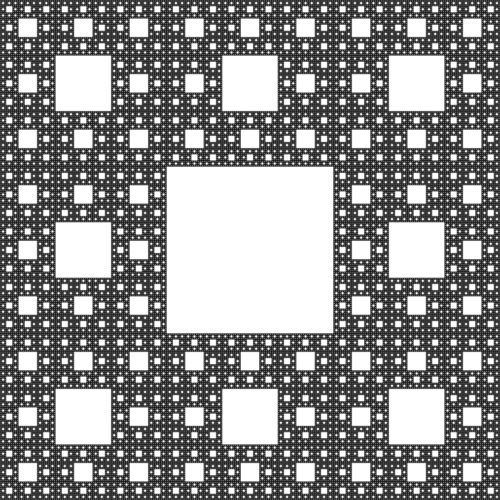

The Sierpiński carpet is a plane fractal first described by Wacław Sierpiński in 1916. The carpet is a generalization of the Cantor set to two dimensions; another such generalization is the Cantor dust.
The technique of subdividing a shape into smaller copies of itself, removing one or more copies, and continuing recursively can be extended to other shapes. For instance, subdividing an equilateral triangle into four equilateral triangles, removing the middle triangle, and recursing leads to the Sierpiński triangle. In three dimensions, a similar construction based on cubes is known as the Menger sponge.
Construction
The construction of the Sierpiński carpet begins with a square. The square is cut into 9 congruent subsquares in a 3-by-3 grid, and the central subsquare is removed. The same procedure is then applied recursively to the remaining 8 subsquares, ad infinitum. It can be realised as the set of points in the unit square whose coordinates written in base three do not both have a digit '1' in the same position, using the infinitesimal number representation of .[1]

The process of recursively removing squares is an example of a finite subdivision rule.
Properties

The area of the carpet is zero (in standard Lebesgue measure).
- Proof: Denote as ai the area of iteration i. Then ai + 1 = 8/9ai. So ai = (8/9)i, which tends to 0 as i goes to infinity.
The interior of the carpet is empty.
- البرهان: لنفترض جدلاً وجود نقطة P داخل السجادة. عندئذٍ يوجد مربع مركزه P محصور بالكامل داخل السجادة. يحتوي هذا المربع على مربع أصغر إحداثياته من مضاعفات 1 / 3k ، حيث k قيمة معينة . ولكن ، إذا لم يُزل هذا المربع مسبقًا، فلا بد أنه قد تم حفره في التكرار k + 1 ، وبالتالي لا يمكن أن يكون محصورًا داخل السجادة - وهذا تناقض.
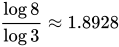
أبعاد السجادة وفقًا لتصنيف هاوسدورف هي[ 2 ]
أثبت سيربينسكي أن سجادته عبارة عن منحنى مستوٍ شامل. [ 3 ] أي أن: سجادة سيربينسكي هي مجموعة جزئية مضغوطة من المستوى ذات بُعد تغطية ليبيغ يساوي 1، وكل مجموعة جزئية من المستوى بهذه الخصائص متماثلة شكليًا مع مجموعة جزئية من سجادة سيربينسكي.
إنّ "شمولية" سجادة سيربينسكي هذه ليست خاصية شاملة حقيقية بالمعنى المقصود في نظرية الفئات: فهي لا تُميّز هذا الفضاء بشكلٍ فريد حتى التشاكل. على سبيل المثال، يُعدّ الاتحاد المنفصل لسجادة سيربينسكي ودائرة منحنىً مستويًا شاملًا أيضًا. مع ذلك، في عام ١٩٥٨، حدّد غوردون وايبورن [ ٤ ] سجادة سيربينسكي بشكلٍ فريد على النحو التالي: أي منحنى متصل محليًا وليس له "نقاط قطع محلية" يكون متماثلًا مع سجادة سيربينسكي. هنا، نقطة القطع المحلية هي نقطة p التي يكون لبعض الجوار المتصل U الخاص بها خاصية أن U − { p } غير متصل. لذا، على سبيل المثال، أي نقطة على الدائرة هي نقطة قطع محلية.
في الورقة البحثية نفسها ، قدّم وايبورن توصيفًا آخر لسجادة سيربينسكي. تذكّر أن المتصل هو فضاء متري مضغوط متصل غير فارغ. لنفترض أن X متصل مُضمّن في المستوى. ولنفترض أن مكمله في المستوى له عدد قابل للعد من المكونات المتصلة C1 ، C2 ، C3 ، ... ولنفترض :
- يؤول قطر C i إلى الصفر عندما i → ∞ ؛
- تكون حدود C i وحدود C j منفصلة إذا كان i ≠ j ؛
- حدود C i عبارة عن منحنى مغلق بسيط لكل i ؛
- اتحاد حدود المجموعات C i كثيف في X.
إذن، فإن X متماثل الشكل مع سجادة سيربينسكي.
الحركة البراونية على سجادة سيربينسكي
حظي موضوع الحركة البراونية على سجادة سيربينسكي باهتمام واسع. [ 5 ] وقد بيّن مارتن بارلو وريتشارد باس أن المشي العشوائي على سجادة سيربينسكي ينتشر بمعدل أبطأ من المشي العشوائي غير المقيد في المستوى. إذ يصل الأخير إلى متوسط مسافة يتناسب مع √n بعد n خطوة، بينما لا يصل المشي العشوائي على سجادة سيربينسكي المتقطعة إلا إلى متوسط مسافة يتناسب مع β√n لبعض قيم β > 2. كما بيّنا أن هذا المشي العشوائي يحقق متباينات انحراف كبيرة أقوى (ما يُسمى "متباينات شبه غاوسية")، وأنه يحقق متباينة هارناك الإهليلجية دون أن يحقق المتباينة المكافئة. وقد ظل وجود مثل هذا المثال مسألة مفتوحة لسنوات عديدة.
منخل واليس

يبدأ نوعٌ مُعدّل من سجادة سيربينسكي، يُسمى غربال واليس ، بنفس الطريقة، بتقسيم المربع الواحد إلى تسعة مربعات أصغر وإزالة المربع الأوسط منها. في مستوى التقسيم التالي، يُقسّم كل مربع إلى 25 مربعًا أصغر ويُزال المربع الأوسط، ويستمر في الخطوة i بتقسيم كل مربع إلى (2i + 1) ² ( المربعات الفردية [ 6 ] ) مربعًا أصغر وإزالة المربع الأوسط. وفقًا لجداء واليس ، تبلغ مساحة المجموعة الناتجة π / 4 ، على عكس سجادة سيربينسكي القياسية التي تبلغ مساحتها النهائية صفرًا. على الرغم من أن لغربال واليس قياس ليبيغ موجب ، إلا أنه لا توجد مجموعة جزئية ناتجة عن ضرب ديكارتي لمجموعتين من الأعداد الحقيقية تمتلك هذه الخاصية، لذا فإن قياس جوردان الخاص بها يساوي صفرًا . [ 7 ]
التطبيقات
Mobile phone and Wi-Fifractal antennas have been produced in the form of a few iterations of the Sierpiński carpet. Due to their self-similarity and scale invariance, they easily accommodate multiple frequencies. They are also easy to fabricate and smaller than conventional antennas of similar performance, thus being optimal for pocket-sized mobile phones.[8][9][10]
See also
References
- ↑Allouche, Jean-Paul; Shallit, Jeffrey (2003). Automatic Sequences: Theory, Applications, Generalizations. Cambridge University Press. pp. 405–406. ISBN 978-0-521-82332-6. Zbl 1086.11015.
- ↑Semmes, Stephen (2001). Some Novel Types of Fractal Geometry. Oxford Mathematical Monographs. Oxford University Press. p. 31. ISBN 0-19-850806-9. Zbl 0970.28001.
- ↑Sierpiński, Wacław (1916). "Sur une courbe cantorienne qui contient une image biunivoque et continue de toute courbe donnée". C. R. Acad. Sci. Paris (in French). 162: 629–632. ISSN 0001-4036. JFM 46.0295.02.
- ↑Whyburn, Gordon (1958). "Topological characterization of the Sierpinski curve". Fund. Math. 45: 320–324. doi:10.4064/fm-45-1-320-324.
- ↑Barlow, Martin; Bass, Richard, Brownian motion and harmonic analysis on Sierpiński carpets(PDF)
- ↑Sloane, N. J. A. (ed.). "SequenceA016754(Odd squares: a(n) = (2n+1)^2. Also centered octagonal numbers.)". The On-Line Encyclopedia of Integer Sequences. OEIS Foundation.
- ↑Rummler, Hansklaus (1993). "Squaring the circle with holes". The American Mathematical Monthly. 100 (9): 858–860. doi:10.2307/2324662. JSTOR 2324662. MR 1247533.
- ↑Saidatul, N. A; Azremi, A.A.H.; Ahmad, R.B.; Soh, P.J.; Malek, F. (November 2009). A development of Fractal PIFA (planar inverted F antenna) with bandwidth enhancement for mobile phone applications. 2009 Loughborough Antennas & Propagation Conference. Loughborough, UK: IEEE. pp. 113–116. doi:10.1109/lapc.2009.5352584.
- ↑Kalaimani, T.; Venkatesh, P. Maheswara; Mohanamurali, R.; Shanmuganantham, T. (3–5 April 2013). A modified Sierpinski carpet fractal antenna for wireless applications. 2013 International Conference on Communication and Signal Processing. Melmaruvathur, India: IEEE. pp. 722–725. doi:10.1109/iccsp.2013.6577150. ISBN 978-1-4673-4865-2.
- ↑Chen, Wen-Ling; Wang, Guang-Ming; Zhang, Chen-Xin (31 December 2008). "Small-Size Microstrip Patch Antennas Combining Koch and Sierpinski Fractal-Shapes". IEEE Antennas and Wireless Propagation Letters. 7: 738–741. Bibcode:2008IAWPL...7..738C. doi:10.1109/LAWP.2008.2002808. ISSN 1536-1225.
External links
- Iterated function system fractals
- Fractal curves
- Topological spaces
- Science and technology in Poland