
Spring Street station (IND Eighth Avenue Line)
The Spring Street station is a local station on the IND Eighth Avenue Line of the New York City Subway. Located at Spring Street and Sixth Avenue (Avenue of the Americas) in the Hudson Square and SoHo neighborhoods of lower Manhattan, it is served by the E train at all times, the C train at all times except late nights, and the A train during late nights.
History
Construction and opening
New York City mayor John Francis Hylan's original plans for the Independent Subway System (IND), proposed in 1922, included building over 100 miles (160 km) of new lines and taking over nearly 100 miles (160 km) of existing lines. The lines were designed to compete with the existing underground, surface, and elevated lines operated by the Interborough Rapid Transit Company (IRT) and Brooklyn–Manhattan Transit Corporation (BMT).[4][5] On December 9, 1924, the New York City Board of Transportation (BOT) gave preliminary approval for the construction of the IND Eighth Avenue Line.[6] This line consisted of a corridor connecting Inwood, Manhattan, to Downtown Brooklyn, running largely under Eighth Avenue but also paralleling Greenwich Avenue and Sixth Avenue in Lower Manhattan.[6][7] The BOT announced a list of stations on the new line in February 1928, with a local station at Spring Street and Sixth Avenue.[8]
تم حفر معظم خط الجادة الثامنة باستخدام طريقة الحفر والتغطية الرخيصة . [ 9 ] [ 10 ] وكان من المقرر أن تكون محطة شارع سبرينغ واحدة من ثلاث محطات لخط الجادة الثامنة تحت الجادة السادسة في مانهاتن السفلى؛ أما المحطتان الأخريان فكانتا في شارع كانال وشارع ويست فورث . [ 8 ] وكجزء من إنشاء خط الجادة الثامنة في مانهاتن السفلى، تم تمديد الجادة السادسة جنوبًا إلى شارع تشيرش بدءًا من عام 1926. [ 11 ] وقد تطلب ذلك هدم عشرات المباني على طول المسار. [ 12 ] وبحلول أغسطس 1930، أفاد مجلس النقل أن خط الجادة الثامنة قد اكتمل تقريبًا، باستثناء المحطات الواقعة بين شارع تشامبرز - محطة هدسون وشارع ويست فورث (بما في ذلك محطة شارع سبرينغ)، والتي لم يكتمل منها سوى 21%. [ 13 ] واكتمل الخط بالكامل بحلول سبتمبر 1931، باستثناء تركيب البوابات الدوارة. [ 14 ]
أُقيمت فعالية تمهيدية لخط المترو الجديد في 8 سبتمبر 1932، قبل يومين من الافتتاح الرسمي. [ 15 ] [ 16 ] افتُتحت محطة شارع سبرينغ في 10 سبتمبر 1932، كجزء من الجزء الأول من خط IND الذي تديره المدينة، وهو خط الجادة الثامنة بين شارع تشامبرز وشارع 207. [ 17 ] [ 18 ] عند افتتاح المحطة عام 1932، كانت تخدمها قطارات AA المحلية . وعندما افتُتح خط IND كونكورس في 1 يوليو 1933، [ 19 ] أصبحت جميع القطارات المحلية قطارات CC متجهة إلى خط كونكورس. [ 20 ] بدأ خط E باستخدام المسارات المحلية في 19 أغسطس 1933، عند افتتاح خط IND كوينز بوليفارد . [ 21 ]
السنوات اللاحقة
The New York City Board of Transportation announced plans in November 1949 to spend $325,000 extending platforms at several IND stations, including Canal Street, to accommodate 11-car, 660-foot (200 m) trains.[22][23] The lengthened trains began running during rush hour on September 8, 1953, with eleven-car trains operating on weekdays.[24]:37–38 The project cost $400,000 and increased the total carrying capacity of rush-hour trains by 4,000 passengers.[25] The operation of eleven-car trains ended in 1958 because of operational difficulties. The signal blocks, especially in Manhattan, were too short to accommodate the longer trains, and the motormen had a very small margin of error to properly align the train with the platform. It was found that operating ten-car trains allowed for two additional trains per hour to be scheduled.[26]
The station was renovated as part of the 2010–2014 MTA Capital Program. An MTA study conducted in 2014 found that 31% of station components were out of date.[27]
As part of a rezoning of 550 Washington Street, it was proposed to make the downtown platform of the station wheelchair-accessible in compliance with the Americans with Disabilities Act of 1990, as well as add a new street stair at the southwest corner of Spring Street and Sixth Avenue.[28] Construction began around June 2024.[29] The elevator on the downtown platform opened in December 2025. Along with the elevator, a new street stair to the southwestern corner of Spring Street and Sixth Avenue was opened.
As part of its 2025–2029 Capital Program, the MTA has proposed making the station fully wheelchair-accessible in compliance with the Americans with Disabilities Act of 1990.[30]
Station layout
| Ground | Street level | Exit/entrance |
| Platform level | Side platform | |
| Northbound local | ←  toward 168th Street(West Fourth Street–Washington Square)← toward 168th Street(West Fourth Street–Washington Square)←  toward Jamaica Center–Parsons/Archer(West Fourth Street–Washington Square)← toward Jamaica Center–Parsons/Archer(West Fourth Street–Washington Square)←  toward Inwood–207th Street late nights (West Fourth Street–Washington Square) toward Inwood–207th Street late nights (West Fourth Street–Washington Square) | |
| Northbound express | ← does not stop here | |
| Southbound express | does not stop here → | |
| Southbound local | toward Euclid Avenue(Canal Street) → toward World Trade Center(Canal Street) → toward Far Rockaway–Mott Avenue late nights (Canal Street) → | |
| Side platform | ||
| Basement 2 | Crossunder | Connection between platforms |


Like most local subway stations, Spring Street has two side platforms and four tracks. The two center express tracks are used by the A train during daytime hours. A crossunder just within fare control allows a free transfer between directions.
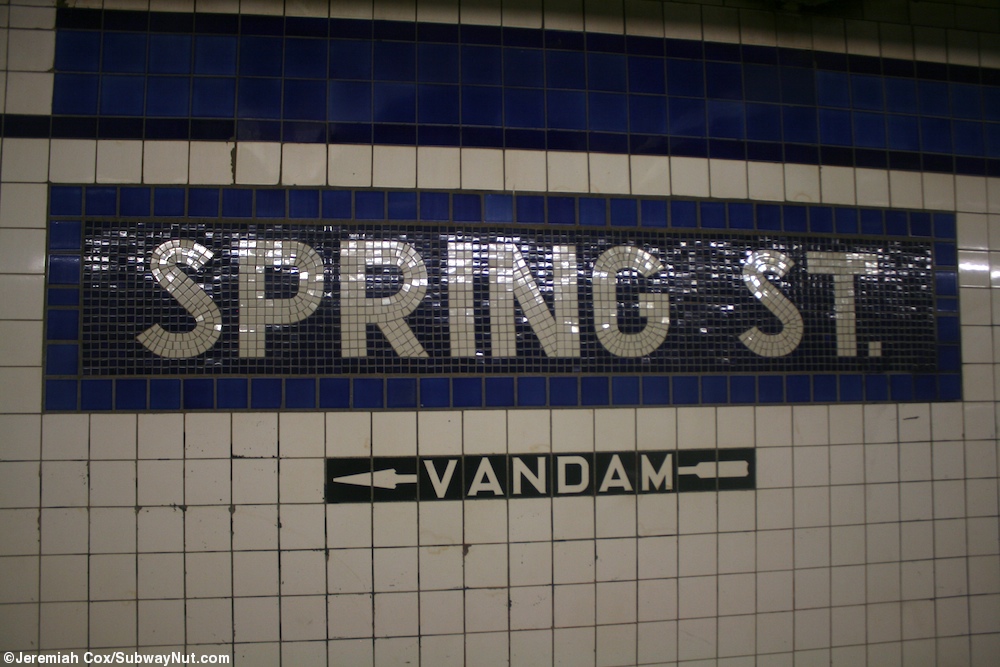
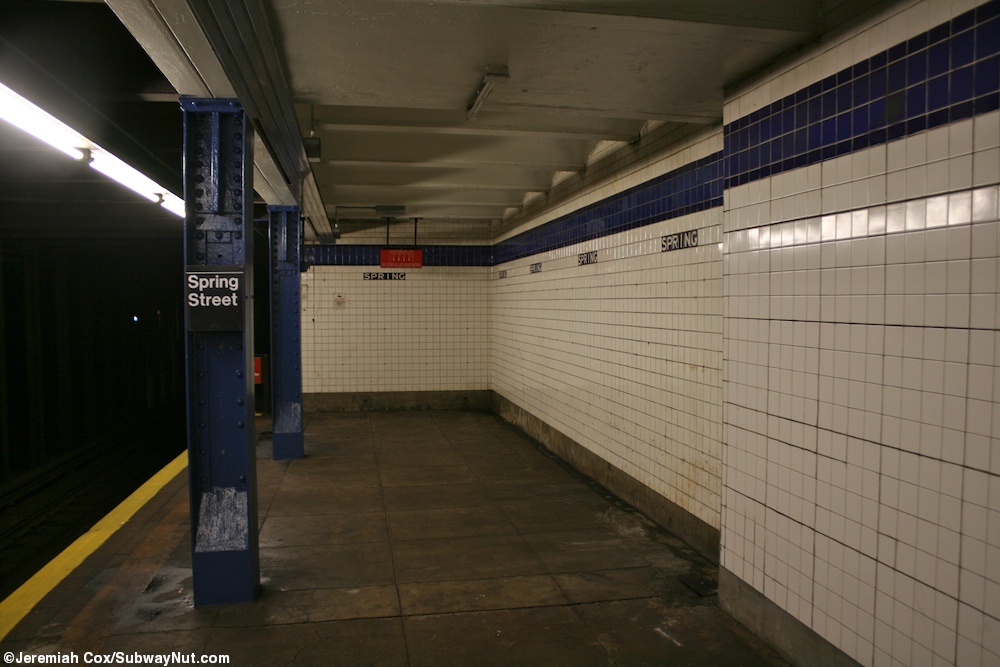
Wall tiling suggests that fare controls and a crossunder have been removed from the north end of the station. The platforms have a blue trim line on a dark blue border (ultramarine blue and cobalt blue, with replacement tiles at the north end that are ultramarine blue and navy blue).[31] The name tablets consist of "SPRING ST" in white sans-serif font on a dark blue background with a lighter blue border. Beneath the trim line and name tablets are "SPRING" and directional signs in white lettering on a black border tiled onto the walls.[32] Blue I-beam columns run along the entire length of both platforms, with every other one having the standard black and white station signs.[33]
Exits
All fare control areas are at platform level. The station's main ones are at the south end of the platform. Each contains banks of regular and HEET turnstiles, a token booth, and staircases going up to Spring Street and Sixth Avenue. The single one on the northbound side is built inside the headquarters for God's Love We Deliver and leads to the northeast corner, while the two on the southbound side lead to either western corner.[34] The southbound platform has an un-staffed HEET entrance that has a single staircase going up to the southwest corner of Vandam Street and Sixth Avenue.[34] There are also closed fare control areas at the north end of the station that led to all four corners of the intersection of Prince Street/Charlton Street and Sixth Avenue.[27]
Artwork
In December 1984, Chilean artist Alfredo Jaar rented all the ad space in the station for the month, and put up an installation he called "Rushes", which showed 81 photos he had taken of poor Brazilian workers digging in Serra Pelada, a government-run gold mine. Scattered amongst them were signs giving world oil prices.[35][36][37]
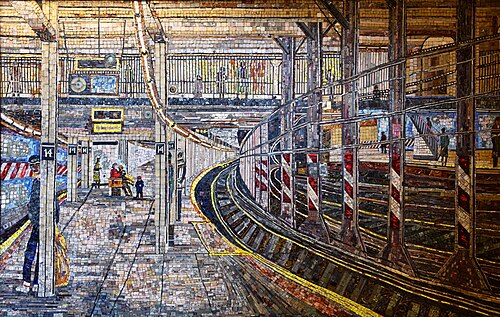
The 1994 artwork installed at the stairway of the northbound platform's fare control is a large, lively mosaic called New York City Subway Station by Edith Kramer.[38] It consists of a single painting depicting 14th Street–Union Square on the IRT Lexington Avenue Line.[38]
References
- ↑"Glossary". Second Avenue Subway Supplemental Draft Environmental Impact Statement (SDEIS)(PDF). Vol. 1. Metropolitan Transportation Authority. March 4, 2003. pp. 1–2. Archived from the original(PDF) on February 26, 2021. Retrieved January 1, 2021.
- ↑"List of the 28 Stations on the New 8th Av. Line". The New York Times. September 10, 1932. p. 6. ISSN 0362-4331. Retrieved April 21, 2020.
- 12"Annual Subway Ridership (2018–2023)". Metropolitan Transportation Authority. 2023. Retrieved April 20, 2024.
- ↑"Two Subway Routes Adopted by City". The New York Times. August 4, 1923. p. 9. ISSN 0362-4331. Retrieved August 1, 2019.
- ↑"Plans Now Ready to Start Subways". The New York Times. March 12, 1924. p. 1. ISSN 0362-4331. Retrieved August 1, 2019.
- 12"Hylan Subway Plan Links Four Boroughs at $450,000,000 Cost". The New York Times. December 10, 1924. p. 1. ISSN 0362-4331. Archived from the original on June 14, 2018. Retrieved June 29, 2018.
- ↑Raskin, Joseph B. (2013). The Routes Not Taken: A Trip Through New York City's Unbuilt Subway System. New York, New York: Fordham University Press. doi:10.5422/fordham/9780823253692.001.0001. ISBN 978-0-82325-369-2.
- 12"Express and Local Stations For New Eighth Avenue Line". New York Herald Tribune. February 5, 1928. p. B1. ISSN 1941-0646. ProQuest 1113431477.
- ↑Warner, Arthur (November 22, 1931). "The City's New Underground Province; The Eighth Avenue Subway Will Be Not Only a Transit Line but a Centre for the Shopper A New Underground Province of New York The Eighth Avenue Subway Will Be a Rapid Transit Line With Innovations and Will Provide Centres for the Shoppers". The New York Times. ISSN 0362-4331. Archived from the original on May 3, 2018. Retrieved May 2, 2018.
- ↑Daly, William Jerome (February 5, 1928). "New Subway Work Far Advanced, From the Circle to 207th Street: Small Section Near St. Nicholas Avenue and 148th Street Being Constructed". New York Herald Tribune. p. B1. ProQuest 1113431484.
- ↑Adams, Mildred (September 19, 1926). "Traffic Now Forces Huge Street Cutting; Sixth Avenue Extension to Focal Point on Canal, Street Is Perhaps the Most Extraordinary of Its Kind in the Entire History of New York City". The New York Times. ISSN 0362-4331. Retrieved May 15, 2018.
- ↑"Subway Wipes Out Landmarks In Lower Sixth Avenue Area". The New York Times. May 15, 1927. p. RE1. ISSN 0362-4331. ProQuest 104159892.
- ↑"Eighth Av. Subway Nearly Completed; Basic Construction Work From Chambers to 207th St. Done Except on Few Short Stretches". The New York Times. August 24, 1930. ISSN 0362-4331. Retrieved March 15, 2023.
- ↑ أوبراين، جون سي. (9 سبتمبر 1931). "خط الجادة الثامنة يُعجّل استخدامه في 1 يناير: تركيب البوابات الدوارة في مترو الأنفاق يبدأ يوم الاثنين؛ معدات أخرى جاهزة لبدء خدمة القطارات. لم تعثر المدينة بعد على شركة التشغيل. مسؤول النقل في رحلة، من الخط 207 إلى شارع القناة، يتفقد النفق المكتمل". نيويورك هيرالد تريبيون . ص 1. ISSN 1941-0646 . ProQuest 1331181357 .
- ↑ "المتفرجون يقتحمون مترو الأنفاق الجديد بعد رفع الحاجز" . صحيفة نيويورك تايمز . 9 سبتمبر 1932. ISSN 0362-4331 . مؤرشف من الأصل في 1 يوليو 2022. تم الاطلاع عليه في 1 يوليو 2022 .
- ↑ "مترو الجادة الثامنة يحصل على أول رسمة من فئة 5 سنتات بسبب خطأ امرأة: تنظر إلى داخل المحطة، تسمع صوت قطار، تدفع ثمن الرحلة، لكنها تستعد مبكرًا جدًا لزحام الغد في مترو الجادة الثامنة". نيويورك هيرالد تريبيون . 9 سبتمبر 1932. ص 1. ProQuest 1125436641 .
- ↑ كرويل، بول (10 سبتمبر 1932). "حشود من المثليين يركبون أولى قطارات مترو الأنفاق الجديد في منتصف الليل: حشود غفيرة في المحطة قبل ساعة من الموعد المحدد، يندفعون نحو البوابات الدوارة عند فتح السلاسل" (ملف PDF) . صحيفة نيويورك تايمز . تاريخ الاسترجاع: 8 نوفمبر 2015 .
- ↑ سيبرينغ، لويس ب. (10 سبتمبر 1932). "ازدحام منتصف الليل يفتتح مترو الأنفاق الجديد في المدينة: بوابات الدخول تعمل في تمام الساعة 12:01 صباحًا مع حشود تتنافس على أماكن في القطارات الأولى. طفل يبلغ من العمر 7 سنوات يقود التدافع في محطة شارع 42. المدينة أخيرًا ترحب بخط الجادة الثامنة بعد انتظار دام 7 سنوات؛ عربات أكبر وأنظف. مفوض النقل يفتتح رسميًا مترو الأنفاق الجديد في منتصف الليل". نيويورك هيرالد تريبيون . ص 1. ISSN 1941-0646 . ProQuest 1114839882 .
- ↑ "افتتاح خط مترو أنفاق جديد في برونكس" . صحيفة نيويورك تايمز . 1 يوليو 1933. ص 15. ISSN 0362-4331 . تاريخ الاطلاع: 29 يونيو 2018 .
- ↑ دليل المحطة، سكة حديد النقل السريع المملوكة للمدينة (ملف PDF) (خريطة). مجلس النقل بمدينة نيويورك . حوالي عام 1937.
- ↑ «افتتاح وحدتين من قطارات الأنفاق عند منتصف الليل» . صحيفة نيويورك تايمز . ١٨ أغسطس ١٩٣٣. ص ١٧. الرقم الدولي الموحد للدوريات ٠٣٦٢-٤٣٣١ . تاريخ الاطلاع ٢٩ يونيو ٢٠١٨ .
- ↑Bennett, Charles G. (November 20, 1949). "Transit Platforms on Lines in Queens to Be Lengthened; $3,850,000 Program Outlined for Next Year to Care for Borough's Rapid Growth". The New York Times. ISSN 0362-4331. Retrieved May 23, 2023.
- ↑"37 Platforms On Subways To Be Lengthened: All Stations of B. M. T. and I.R.T. in Queens Included in $5,000,000 Program". New York Herald Tribune. November 20, 1949. p. 32. ISSN 1941-0646. ProQuest 1325174459.
- ↑Report. New York City Transit Authority. 1953.
- ↑Ingalls, Leonard (August 28, 1953). "2 Subway Lines to Add Cars, Another to Speed Up Service"(PDF). The New York Times. ISSN 0362-4331. Retrieved January 25, 2016.
- ↑Perlow, Austin (August 10, 1962). "16-Point Plan Can Give Boro Relief Now". Long Island Star–Journal. Retrieved April 24, 2018.
- 12Review of the A and C Lines(PDF) (Report). Metropolitan Transportation Authority. December 11, 2015. Archived from the original(PDF) on February 3, 2020. Retrieved January 19, 2016.
- ↑"Technical memorandum 002"(PDF). Archived from the original(PDF) on November 30, 2018.
- ↑@HudsonSquareNYC (July 29, 2024). "We had to say goodbye to our 3 trees in Spring Street park so MTA can now install a new elevator and stairs to the CE downtown line on Spring street and 6th Avenue. Fingers crossed this will benefit the society in the long run!" (Tweet) – via X (formerly Twitter).
- ↑MTA Board - Capital Program Committee Meeting - 3/24/2025. Retrieved March 24, 2025– via www.youtube.com. 53:31 in video
- ↑"IND Station Tile Colors". www.nycsubway.org. Retrieved February 15, 2013.
- ↑Cox, Jeremiah (May 24, 2010). "A Spring St name tablet on the downtown platform with exit text to Vandam". subwaynut.com. Retrieved April 2, 2018.
- ↑Cox, Jeremiah (January 2, 2011). "The extreme northern end of the uptown platform tiling gets back to normal". subwaynut.com. Retrieved April 2, 2018.
- 12"MTA Neighborhood Maps: SoHo / Tribeca"(PDF). Metropolitan Transportation Authority. 2015. Retrieved August 6, 2015.
- ↑Michael W. Brooks (1997). Subway City: Riding the Trains, Reading New York. Rutgers University Press. p. 214. ISBN 9780813523965. Retrieved February 14, 2013.
spring street ind station -atlanta.
- ↑Tracy Fitzpatrick (May 30, 2009). Art and the Subway: New York Underground. Rutgers University Press. ISBN 9780813544526. Retrieved February 14, 2013.
- ↑"IN THE SUBWAYS; A Little Digging Yields Clues to the Revolution". Retrieved February 15, 2013.
{{cite news}}: CS1 maint: deprecated archival service (link) - 12"subway station art". Ephemeral New York. Retrieved February 15, 2013.
External links
- nycsubway.org – IND 8th Avenue: Spring Street
- nycsubway.org — New York Subway Station Artwork by Edith Kramer (1994)
- Station Reporter — C Train
- Station Reporter — E Train
- Spring Street entrance from Google Maps Street View
- Vandam Street entrance from Google Maps Street View
- Platform from Google Maps Street View
- Accessible New York City Subway stations
- Future accessible New York City Subway stations
- IND Eighth Avenue Line stations
- Sixth Avenue
- New York City Subway stations in Manhattan
- Railway stations in the United States opened in 1932
- 1932 establishments in New York City
- SoHo, Manhattan
- Hudson Square