
Talisay, Negros Occidental
Talisay, officially the City of Talisay (Hiligaynon: Dakbanwa sang Talisay; Filipino: Lungsod ng Talisay), is a component city in the province of Negros Occidental, Philippines. According to the 2024 census, it has a population of 109,204 people.[5]
The city is often confused with another Visayas city also named Talisay, which is a component city in the neighboring province of Cebu.
History
Precolonial Period
Indigenous people settled in the cogon-lined lowlands of northwest Negros long before Spanish conquest. The settlement was called Minuluan, but was also known as Talisay by the province and neighboring communities in Panay. Its residents were either lowlanders or part of the Aetas who usually resided up in the highlands of northern Negros.[6]
Spanish Colonial Period
The Augustinian Recollects arrived in Negros Island in 1848 and converted the settlement into a parish in 1849, separating it from Silay.[7] Fray Fernando Cuenca, a Recollect and the town's parish priest from 1850 to his death in 1902, spearheaded the development of Minuluan's land into agricultural farms. The town became a monocrop farm for sugarcane, which eventually become the dominant cash crop in the whole of Negros Island.[8]

Negros Island's cheap land attracted settlers from Iloilo, Cebu and Bohol.[9] Four major haciendas came to being: Minuluan, Bago, Bacolod and Silay. In 1850, these four haciendas produced 150 tons of sugar. Coupled with the opening of Iloilo Port to world trade, demand for sugar from Negros soared, and the island's sugar output continued to rise through the 1860s until the end of the century.[10]

With the sugar boom, the local hacienderos amassed great wealth and began to build extravagant homes for their families.[11]Balay ni Tana Dicang of the Lizares clan is one of the first, and still-extant bahay na bato from this period, characterized by ground floors made from stone and second floor made from wood. It was built in 1872.[12] In the early 1890s, the largest property owner in Minuluan was Isidro de la Rama with around 1,260 hectares of landholdings.[10]
Philippine Revolution
During the Revolution, Minuluan became a battleground for Philippine independence. In November 3, 1898 the local hacienderos (landlords) of Negros banded together to revolt against the Spaniards.[13] After two days of preparation, wealthy landowners and local leaders Aniceto Lacson led the troops north of Bacolod including Minuluan, while Juan Araneta of Bago led the troops south of Bacolod. They successfully ended Spanish control in the island, remarkably without much bloodshed. This also led to the establishment of the Republic of Negros. Today, the day of the revolt is called Cinco de Noviembre, and is a local holiday commemorated in Negros Island.[14]
American Colonial Period
Around 1901, Minuluan was formally renamed Talisay, as it started to appear in US records of the war.[15]
The local elementary school was established in 1912. It is now known as the Talisay South Elementary School.
Another local land baron, Don Mariano Ledesma, built a ten-room Italianate manor for his family in 1920. This became a local landmark renown for its luxurious exterior. During World War II, the American and Filipino forces torched the place, only leaving its concrete skeleton. While it was never restored to its original grandeur, it has been turned into a tourist attraction called The Ruins and has since become one of the most visited spots in Negros Occidental.[16]
Postwar
In 1954, the Negros Occidental School of Arts and Trades was established in the town. Later on, this school will become the main campus of the Carlos Hilado Memorial State University.[17]
Two years later, in 1956, A.S. Diaz Electric Service was founded to provide power, lighting and heating in Talisay and nearby Bacolod. It was eventually folded into CENECO in 1975.[18]
A cholera pandemic hit Negros Island in 1961, starting explosively in Bacolod and Talisay.[19]
Martial Law Period
The Visayas Technical Institute was established in Talisay in 1977. This is the precursor to the TUP Visayas.[20]
Meanwhile, during the mid1970s, world prices of sugar collapsed as Western European and United States' demand for sugar fell. This, combined with a monopoly sponsored by the Marcos administration created a massive surplus of sugar, driving down prices further and devastating the economy of Negros island. In 1985, the sugar prices hit rock-bottom.[21][22] Talisay was affected greatly and caused the closure of its sugar mills, including the Talisay-Silay Milling Co. (TASIMICO), in the late 1980s, displacing thousands of workers.[23]
Contemporary
On February 11, 1998, by virtue of Republic Act No. 8489, Talisay was finally elevated into a city through the efforts of its local officials led by Mayor Amelo Lizares.[24]
Located between Bacolod in the south and Silay with Bacolod Airport in the north, Talisay is experiencing spillover development. Real estate company Megaworld has now set up in the city, with Northill Gateway township, currently under construction.[25]
Talisay is also positioning itself as a retail hub within Negros Occidental[26] as well as a retirement haven for expats.[27]
Geography
Talisay City is 7 kilometres (4.3 mi) north of Bacolod, facing the Bacolod–Silay Access Road in the east. It is part of the metropolitan area called Metro Bacolod, which includes its neighbors, Silay to the north and Bacolod to the south.[28] It has a total land area of 20,118 hectares (49,710 acres).
Barangays
Talisay City is politically subdivided into 27 barangays. Each barangay consists of puroks and some have sitios.
- Bubog
- Cabatangan
- Zone 4-A (Poblacion)
- Zone 4 (Poblacion)
- Concepcion
- Dos Hermanas
- Efigenio Lizares
- Zone 7 (Poblacion)
- Zone 14-B (Poblacion)
- Zone 12-A (Poblacion)
- Zone 10 (Poblacion)
- Zone 5 (Poblacion)
- Zone 16 (Poblacion)
- Matab-ang
- Zone 9 (Poblacion)
- Zone 6 (Poblacion)
- Zone 14 (Poblacion)
- San Fernando
- Zone 15 (Poblacion)
- Zone 14-A (Poblacion)
- Zone 11 (Poblacion)o
- Zone 8 (Poblacion)
- Zone 12 (Poblacion)
- Zone 1 (Poblacion)
- Zone 2 (Poblacion)
- Zone 3 (Poblacion)
- Katilingban
Climate
| Climate data for Talisay | |||||||||||||
|---|---|---|---|---|---|---|---|---|---|---|---|---|---|
| Month | Jan | Feb | Mar | Apr | May | Jun | Jul | Aug | Sep | Oct | Nov | Dec | Year |
| Mean daily maximum °C (°F) | 28(82) | 29(84) | 30(86) | 32(90) | 31(88) | 30(86) | 29(84) | 30(86) | 29(84) | 29(84) | 29(84) | 28(82) | 30(85) |
| Mean daily minimum °C (°F) | 23(73) | 23(73) | 23(73) | 24(75) | 25(77) | 25(77) | 25(77) | 25(77) | 25(77) | 24(75) | 24(75) | 24(75) | 24(75) |
| Average precipitation mm (inches) | 120(4.7) | 87(3.4) | 95(3.7) | 97(3.8) | 187(7.4) | 263(10.4) | 251(9.9) | 220(8.7) | 227(8.9) | 268(10.6) | 220(8.7) | 158(6.2) | 2,193(86.4) |
| Average rainy days | 16.1 | 12.6 | 15.4 | 16.8 | 25.8 | 28.4 | 29.1 | 27.9 | 27.7 | 28.5 | 23.9 | 18.4 | 270.6 |
| Source: Meteoblue[29] | |||||||||||||
Demographics
| Year | Pop. | ±% p.a. |
|---|---|---|
| 1903 | 14,548 | — |
| 1918 | 14,165 | −0.18% |
| 1939 | 40,547 | +5.14% |
| 1948 | 43,610 | +0.81% |
| 1960 | 46,308 | +0.50% |
| 1970 | 45,084 | −0.27% |
| 1975 | 48,518 | +1.48% |
| 1980 | 53,624 | +2.02% |
| 1990 | 63,260 | +1.67% |
| 1995 | 68,401 | +1.47% |
| 2000 | 79,146 | +3.18% |
| 2007 | 96,444 | +2.76% |
| 2010 | 97,571 | +0.42% |
| 2015 | 102,214 | +0.89% |
| 2020 | 108,909 | +1.34% |
| 2024 | 109,204 | +0.06% |
| Source: Philippine Statistics Authority[30][31][32][33][34] | ||
Economy
Poverty incidence of Talisay
Source:Philippine Statistics Authority[35][36][37][38][39][40][41][42]
Business process outsourcing
In 2016, business process outsourcing (BPO) company iQor opened its call/contact center in Talisay, making it the first BPO company in the city.[43]
Education
Talisay is also known for its two major tertiary institutions: The Technological University of the Philippines – Visayas and Carlos Hilado Memorial State University, Main Campus. Talisay also has two private schools that offer K-12 Education which are the: Colegio San Nicolas de Tolentino-Recoletos and Notre Dame of Talisay City.
Places of interest
 The Lacson Ruins, Iconic Philippine mansion and a popular tourist spot
 Statue of Andres Bonifacio
 The District - North Point at Ayala North Point, is the major shopping place in the city
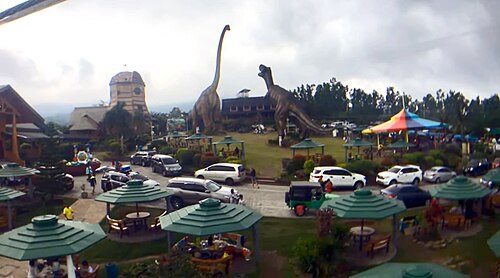 Campuestohan Highland Resort in Sitio Campuestohan, Barangay Cabatangan
 Aniceto Lacson House
Notable Personalities
- Alfredo Alcala - Comic book artist for DC Comics and Marvel Comics
- Rafael Alunan Sr. - Secretary of Finance, Secretary of Agriculture and Commerce, Secretary of the Interior
- Rafael Alunan III - 5th Secretary of Tourism (Philippines), Secretary of the Interior and Local Government
- Jose Miguel Arroyo - First Gentleman of the Philippines as the husband of Gloria Macapagal Arroyo the 14th President of the Philippines
- Iggy Arroyo - member of the Philippine House of Representatives for the fifth district of Negros Occidental
- Carlos Balcells - Bass guitarist for rock band The Dawn
- Pedro Hernaez - Secretary of Commerce and Industry, Ambassador of the Philippines to Spain, Senator of the Philippines
- Reynel Hugnatan - Professional Basketball player and coach
- Celia Díaz Laurel - theatre actress, singer, painter, Second Lady of the Philippines as the wife of Salvador Laurel the 8th Vice President of the Philippines
- Denise Laurel - Singer, Film and Television actress
- Cocoy Laurel - Singer, Theater and Film actor
- Aniceto Lacson - Revolutionary, President of the Republic of Negros
- Arsenio Lacson - 17th Mayor of Manila, Member of the House of Representatives of the Philippines, Journalist, Member of the Philippine national football team
- Isaac Lacson - Senator of the Philippines, Member of the House of Representatives of the Philippines, 12th Governor of Negros Occidental
- Leo Ordiales - Volleyball player, member of the Philippines men’s national volleyball team
- Bernadeth Pons - Professional volleyball player at the Premier Volleyball League
- فيكي راشتون - عارضة أزياء، ملكة جمال، فائزة بمسابقة ملكة جمال موتيا نغ بيليبيناس الدولية 2011، زميلة منزل في بينوي الأخ الأكبر: الكل في
- كاميلو تاكوسالمي - لاعب كرة قدم ومدرب، وعضو في المنتخب الوطني الفلبيني لكرة القدم
انظر أيضاً
مراجع
- ↑ مدينة تاليساي | (وزارة الداخلية والحكم المحلي)
- ↑ "تعداد السكان لعام 2015، التقرير رقم 3 - السكان، مساحة الأرض، والكثافة السكانية" (ملف PDF) . هيئة الإحصاء الفلبينية . مدينة كويزون، الفلبين. أغسطس 2016. ISSN 0117-1453 . مؤرشف (ملف PDF) من الأصل في 25 مايو 2021. تم الاطلاع عليه في 16 يوليو 2021 .
- ↑ "تعداد السكان لعام 2024 (POPCEN): إعلان رسمي من قبل الرئيس" . هيئة الإحصاء الفلبينية. 17 يوليو 2025. تم الاطلاع عليه في 18 يوليو 2025 .
- ↑ "هيئة الإحصاء الفلبينية تصدر تقديرات الفقر على مستوى المدن والبلديات لعام 2021" . هيئة الإحصاء الفلبينية. 2 أبريل 2024. تم الاطلاع عليه بتاريخ 28 أبريل 2024 .
- ↑ "تعداد السكان لعام 2024 (POPCEN): إعلان رسمي من قبل الرئيس" . هيئة الإحصاء الفلبينية. 17 يوليو 2025. تم الاطلاع عليه في 18 يوليو 2025 .
- ^ “مقاطعة سان نيكولاس دي تولينتينو دي أوغستينوس ديسكالزوس دي لا مجمع إسبانيا والهند” (PDF) . مانيلا : Imprenta del Colegio de Santo Tomás، شحنة من DG Memije. 1879.
- ^ "أبرشية سان نيكولا دي تولينتينو تاليساي سيتي ، نيجروس أوكسيدنتال" . أوغستينوس ريكوليتوس . تم الاسترجاع في 17 سبتمبر 2024 .
- ↑ رومانيلوس، إيمانويل لويس. "تاريخ أبرشية مدينة تاليساي (Neg. Occ.) من عام 1850 إلى التسعينيات" (PDF) . جامعة ريوخا . تم الاسترجاع في 17 سبتمبر 2024 .
- ↑ لاركين، جون (يناير 1992). "السكر وأصول المجتمع الفلبيني الحديث" . publishing.cdlib.org .
- 1 2 أغيلار، فيلومينو الابن (3 مايو 2017). "إنتاج السكر في الحقبة الاستعمارية في الفلبين الإسبانية: مقارنة بين كالامبا ونيغروس" . مجلة دراسات جنوب شرق آسيا . 48 (2): 237-261 . doi : 10.1017/S0022463417000066 . تاريخ الاسترجاع: 17 سبتمبر 2024 .
- ↑ كروز، إلفيرين. "عن البيوت التي بناها السكر" . Philstar.com . تم الاطلاع عليه في 17 سبتمبر 2024 .
- ↑"The enduring legacy of Talisay's Balay ni Tana Dicang". Philstar Life. Retrieved September 17, 2024.
- ↑"Cinco de Noviembre and the Negros Republic". Independence Day. Retrieved September 19, 2024.
- ↑"Cinco de Noviembre". Festival Escape. October 30, 2023. Retrieved September 17, 2024.
- ↑"Annual Reports of the War Department: 1901". United States War Department. 1901. Retrieved September 18, 2024.
- ↑Morton, Ella (December 16, 2014). "The Magnificent Ruined Mansion of Talisay". Slate. Retrieved September 17, 2024.
- ↑"Republic Act No. 848". LawPhil. Retrieved September 17, 2024.
- ↑"Republic Act No 1453, June 14, 1956". Judiciary.gov.ph. Retrieved September 18, 2024.
- ↑Joseph, P. R.; Tamayo, J. F.; Mosley, W. H.; Alvero, M. G.; Dizon, J. J.; Henderson, D. A. (1965). "Studies of cholera El Tor in the Philippines. 2. A retrospective investigation of an explosive outbreak in Bacolod City and Talisay, November 1961". Bulletin of the World Health Organization. 33 (5): 637–643. PMC 2475864. PMID 5295144.
- ↑"About - Technological University of the Philippines Visayas". www.tupvisayas.edu.ph. Retrieved September 20, 2024.
- ↑Tribune, Chicago (November 24, 1985). "SUGAR-CHOKED ISLAND STARVING". Chicago Tribune. Retrieved September 18, 2024.
- ↑Nagano, Yoshiko (December 3, 2007). "The Collapse of the Sugar Industry in Negros Occidental and Its Social and Economic Consequences". Kasarinlan: Philippine Journal of Third World Studies. 3 (3): 59–64. ISSN 2012-080X. Retrieved September 18, 2024.
- ↑"Sugar gone sour. Economic crisis in the Philippines". Christian Science Monitor. Retrieved September 18, 2024.
- ↑"Talisay City". Negros Occidental Provincial Government. Retrieved July 10, 2014.
- ↑Bajenting, Johanna Marie O. (October 23, 2016). "'Talisay is the future of the Metro'". SunStar Publishing Inc. Retrieved September 20, 2024.
- ↑"Talisay positioned as Negros Occidental retail capital". Talisay City, Negros Occidental. July 4, 2017. Retrieved September 20, 2024.
- ↑"Building a new history of grassroots governance"(PDF). Institute for Solidarity in Asia. Retrieved September 20, 2024.
- ↑"Building Globally Competitive Metro Areas in the Philippines"(PDF). Archived from the original(PDF) on July 5, 2010. Retrieved June 16, 2010.
- ↑"Talisay: Average Temperatures and Rainfall". Meteoblue. Retrieved May 7, 2020.
- ↑"2024 Census of Population (POPCEN) Population Counts Declared Official by the President". Philippine Statistics Authority. July 17, 2025. Retrieved July 18, 2025.
- ↑Census of Population (2015). "Region VI (Western Visayas)". Total Population by Province, City, Municipality and Barangay. Philippine Statistics Authority. Retrieved June 20, 2016.
- ↑Census of Population and Housing (2010). "Region VI (Western Visayas)"(PDF). Total Population by Province, City, Municipality and Barangay. National Statistics Office. Retrieved June 29, 2016.
- ↑Censuses of Population (1903–2007). "Region VI (Western Visayas)". Table 1. Population Enumerated in Various Censuses by Province/Highly Urbanized City: 1903 to 2007. National Statistics Office.
- ↑"Province of". Municipality Population Data. Local Water Utilities Administration Research Division. Retrieved December 17, 2016.
- ↑"Poverty incidence (PI):". Philippine Statistics Authority. Retrieved December 28, 2020.
- ↑"Estimation of Local Poverty in the Philippines"(PDF). Philippine Statistics Authority. November 29, 2005.
- ↑"2003 City and Municipal Level Poverty Estimates"(PDF). Philippine Statistics Authority. March 23, 2009.
- ↑"City and Municipal Level Poverty Estimates; 2006 and 2009"(PDF). Philippine Statistics Authority. August 3, 2012.
- ↑"2012 Municipal and City Level Poverty Estimates"(PDF). Philippine Statistics Authority. May 31, 2016.
- ↑"Municipal and City Level Small Area Poverty Estimates; 2009, 2012 and 2015". Philippine Statistics Authority. July 10, 2019.
- ↑"PSA Releases the 2018 Municipal and City Level Poverty Estimates". Philippine Statistics Authority. December 15, 2021. Retrieved January 22, 2022.
- ↑"PSA Releases the 2021 City and Municipal Level Poverty Estimates". Philippine Statistics Authority. April 2, 2024. Retrieved April 28, 2024.
- ↑"MassKara 2016: Get Hired And Celebrate With iQor | SignedEvents.com". Archived from the original on October 20, 2016.
External links
- Official website
- Talisay City Profile at the Official Website of Negros Occidental
- Philippine Standard Geographic Code
- 2007 Philippine Census Information Region VI - Western Visayas
- Local Governance Performance Management SystemArchived March 4, 2016, at the Wayback Machine
- Cities in Negros Occidental
- Metro Bacolod
- Component cities in the Philippines