
Botafogo FR
Botafogo de Futebol e Regatas (Brazilian Portuguese pronunciation:[bɔtaˈfoɡudʒifutʃiˈbɔwiʁeˈɡatɐs]; Botafogo Football and Rowing) is a Brazilian football club based in the neighborhood of Botafogo, in the city of Rio de Janeiro. Although it competes in a number of different sports, Botafogo is mostly known for its association football team. It plays in the Campeonato Brasileiro Série A, the top tier of the Brazilian football league system, and in the Campeonato Carioca, the state ofRio de Janeiro's premier state league.
The club is among Brazil's "Big 12 Clubs" having won the Brazilian league three times (1968, 1995, 2024), the Copa Libertadores in 2024, and the Copa CONMEBOL in 1993. In addition, the Botafogo de Futebol e Regatas has some of Brazilian football's most notable records, including most unbeaten matches: 52 games between 1977 and 1978; the most unbeaten matches in the Brazilian league: 42, also between 1977 and 1978; and the most players called up to the Brazil national team in World Cups. The club holds the record for the greatest victory ever recorded in Brazilian football: 24–0 against Sport Club Mangueira in 1909.
In 2000, Botafogo finished 12th in a vote by subscribers of FIFA Magazine for the FIFA Club of the Century.[2][3] In 2024, Botafogo was ranked 5th in the world in the IFFHS Men's Club World Ranking, making it the highest-ranked club from South America.[4] In 2025, the club qualified for the FIFA Club World Cup and pulled off a major upset by defeating European champions Paris Saint-Germain 1–0 in the group stage, advancing to the knockout rounds.[5] Botafogo was also named as one of five finalists for the 2025 Ballon d’Or Men’s Club of the Year award, being the only non-European club in the category.[6]
History
Formation and merger
On 1 July 1894, the Club de Regatas Botafogo was founded in Rio de Janeiro as a rowing club.[7]

On 12 August 1904, another club was founded in the neighborhood: the Electro Club, the name first given to the Botafogo Football Club. The idea came during an algebra lesson at Alfredo Gomes College. The Electro Club was founded, but its name did not last. After a suggestion from Dona Chiquitota, Flávio's grandmother, the club finally became the Botafogo Football Club, on its 18 September. The colors were black and white like those of Juventus FC, (who took the colours from Notts County F.C., the oldest professional football team in the world.) the team of Itamar Tavares, one of the club's founders. Its badge was drawn by Basílio Vianna Jr., in Swiss style with the BFC monogram. The Botafogo Football Club would soon become one of the strongest football teams in Rio de Janeiro, winning the championships of 1907, 1910, 1912 and more.[8]
With the same name, the same location, the same colours and most importantly the same supporters, it seemed inevitable that the clubs would merge. They did so on 8 December 1942, after a basketball match between both clubs, when the Botafogo Football Club player Armando Albano died suddenly, that the idea of a merger began. On this tragic occasion, the president of the Club de Regatas Botafogo, Augusto Frederico Schmidt, spoke: "At this time, I declare to Albano that his last match ended with the victory of his team. We won't play the time left on the clock. We all want the young fighter to leave this great night as a winner. This is how we salute him." Eduardo Góis Trindade, the president of the Botafogo Football Club said: "Between the matches of our clubs, only one can be the winner: Botafogo!." And then Schmidt declared the fusion: "What else do we need for our clubs to become one?." The Botafogo de Futebol e Regatas finally came into being. The Football Club's badge became black, and the monogram substituted by the Clube de Regatas' lone star.[9]
On the field

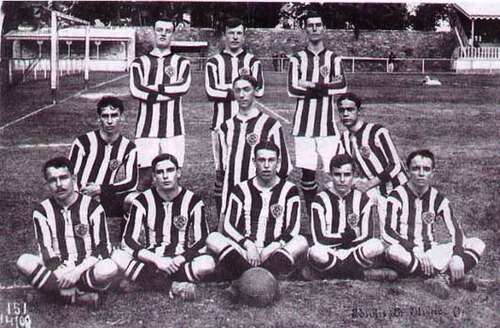
The team won the Campeonato Carioca in 1907, 1910 and 1912. In 1909 the team beat Mangueira 24–0, which remains the highest score in Brazilian football.[10] They won further state titles in 1930, 1932, 1933, 1934 and 1935.[11]
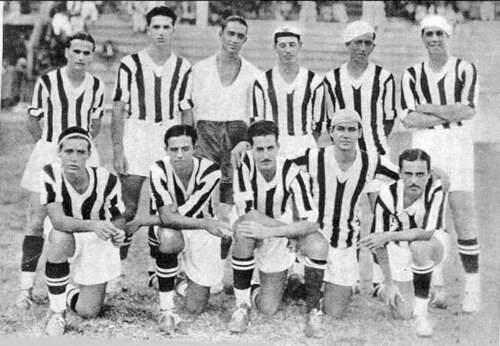
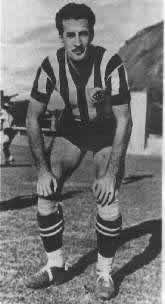
In the 1940s, after the creation of the Botafogo de Futebol e Regatas, the team's best player was Heleno de Freitas. However, Heleno did not win a championship for Botafogo. He scored 204 goals in 233 matches, but went to the Boca Juniors in 1948, the year Botafogo won its 9th state championship.

They won the Campeonato Carioca in 1957, 1961 and 1962, and in 1968 they won Serie A, becoming the first carioca club to win the Brazilian league.[12]
1989 ended a period of 21 years without a title when the club won the state championship, retaining the trophy in 1990.[12]
In the 1990s, Botafogo won Copa Conmebol (the precursor of the current Copa Sudamericana).[13] And in 1995 they won the Brazilian League for the second time in club's history, after drawing 1–1 the second leg of the Final against Santos FC at São Paulo.
Botafogo would be relegated to the Second Division after ranking last in the Brazilian League of 2002. In 2003, Botafogo ranked second in Brazil's Second division (after Palmeiras) and returned to the First Division.
In 2006, the club won the Rio de Janeiro State Championship for the 18th time, and again in 2010 and 2013 with the iconic players Loco Abreu and Clarence Seedorf, respectively.
In the 2020 edition of the Série A, Botafogo performed poorly and ended the championship in the last position, causing the club's relegation to the Série B for their third time in history.[14]
Nowadays, Botafogo is the only club to have won titles in three different centuries, including the state championship for rowing in 1899.
The SAF Era
At the beginning of 2020, Botafogo underwent a series of internal audits to spin off its football division as a for-profit corporate entity, owned by the club, but which could be portioned and sold to investors. This was due to unprecedented legislation allowing for football clubs to be operated as corporations, and would be a solution to the severe financial crisis the club had faced for decades. Relegation to the Série B, however, delayed these plans.
2021 saw Botafogo's debt reach one billion real. They placed 6th in the Rio de Janeiro State Championship, after a penalty decision lost to the also relegated Vasco da Gama. The club was off to a middling start to the Série B season, but bounced back after the hiring of manager Enderson Moreira, who was able to bring Botafogo back to the top tier of Brazilian football, as champions of the 2021 edition of Série B. It was Botafogo's second Série B title.
Meanwhile, the incoming administration had begun internal restructuring, hiring executive Jorge Braga for the brand-new post of CEO and downsizing its workforce considerably. Botafogo entered into a partnership with the investment firm XP Inc. to seek out potential buyers for its football division, which was in the process of becoming its own corporate entity. Congress had recently passed the Sociedade Anônima de Futebol (SAF) law, allowing foreigners to purchase shares in Brazilian football clubs for the first time in history.
Having averted complete financial disaster by returning to Série A, the country's top competitive tier, Botafogo finalized its transition into the SAF legal structure. The social club remained as an entity, owning 100% of Botafogo SAF's shares. In January 2022, it came to light that American investor John Textor, owner of a majority stake in Premier League club Crystal Palace F.C., was in talks to purchase a majority share of Botafogo. In February 2022, the club announced the acquisition of 90% of the shares of Botafogo's football division by Textor's holding company Eagle Holdings and the start of a new era for the club.
Textor's first major move in charge of the club was the dismissal of Enderson Moreira in favor of Portuguese manager Luís Castro. Castro signed with Botafogo in March 2022, and the team had to hurry to build their squad for the 2022 Campeonato Brasileiro.[15] Botafogo finished that year's league edition in 11th place, guaranteeing a spot in the 2023 Copa Sudamericana.
At the 2023 Campeonato Brasileiro, Botafogo, then thought of as a team that at most would fight for a spot in the top 6,[16][17] shocked everyone by coming in first place after only 3 rounds, then leading the league by 13 points after 19 matches and on course to have the greatest first half of a season in Brazilian football history. In June 2023, coach Luís Castro accepted an offer from Al Nassr of the Saudi Pro League,[18] paving the way for the arrival of Portuguese manager Bruno Lage.[19] However, due to poor results and controversies,[20] Lage was dismissed after about 3 months.[21] For the remainder of the 2023 season, with the coaching position vacant, Botafogo's SAF leadership decided to promote two fan favorites to key positions in the team's management: a former coach of Botafogo's U-23 team, Lúcio Flávio, was appointed interim coach, with former Argentine defender Joel Carli as his assistant.
Constant change of managers caused Botafogo to have the biggest title collapse in football history, as the team won only 2 of their last 17 fixtures, not only losing the title to Palmeiras but dropping to 5th in the table and losing the automatic qualification spot for the Copa Libertadores. A round of 16 exit in the Copa do Brasil, a quarterfinal exit in the Copa Sudamericana, and a disappointing Campeonato Carioca made the year one of the most painful seasons in the club's history.[22]
The total debt owned by the club has been reduced and now sits at around 730 million reais.[23]
Stadium
The team's home ground is the Estádio Olímpico Nilton Santos, named in honor of Nilton Santos, a former club player and two-time world champion with the Brazil national football team, regarded as one of the greatest left-backs of all time.[24] The stadium is commonly called Engenhão by fans, in reference to the neighbourhood of Engenho de Dentro, where it is located. The stadium was built for the 2007 Pan American Games and it also hosted the 2016 Summer Olympics.[25]

Other stadiums used by the club during its history are:
- Maracanã Stadium, 1950-2007
- Voluntários da Pátria Street Field, the club's first pitch at their neighborhood of origin.
- Estádio General Severiano, the club's first own stadium.(1913-1974)
- Marechal Hermes Stadium, for less important matches during 1978–1986.
- Estádio Caio Martins, at the neighboring city of Niterói. (1990-2004)
- Estádio Luso Brasileiro, during the 2005 and 2016 seasons.


Rivalries
Historically, Botafogo biggest rivalries are with the other three clubs that, along with it, make up the Big Four of Rio de Janeiro: Flamengo, Fluminense, and Vasco da Gama.[26]
The rivalry against Fluminense is the oldest classic between major clubs in Brazil, and the third oldest in the Americas. The two teams have faced each other since 1905, which is why it's called the Clássico Vovô (Grandpa Derby).[27] The duel against Flamengo became known as the Clássico da Rivalidade (Rivalry Derby) since they started facing each other in rowing before football.[28] The clashes against Vasco da Gama do not have a unanimous name among the two fan bases, being called the Clássico da Amizade (Friendship Derby) by the media.[29]
From outside the city, the club also has a historic rivalry with Santos FC since the 1960s, because it brought together on the field two of the greatest players of their time, Pelé and Garrincha.[30]
Mascots


The dog Biriba is one the most traditional mascots of Botafogo, in 1948 this real stray dog, known for invading the field, was the mascot that led them to the Campeonato Carioca title.[31] Another Botafogo's mascot is Manequinho, an urinating boy originating from a replica of Brussels' Manneken Pis statue that stands near Botafogo's headquarters, which on occasion had a Botafogo jersey put onto by supporters of the team.[32] The first mascot was Donald Duck, who cartoonist Lorenzo Mollas drew in the early 1940s wearing Botafogo's jersey, but it was never officially adopted due to rights issues.[33]
Honours
The club has some of Brazilian football's top records, including most unbeaten matches: 52 games between 1977 and 1978,[34] most unbeaten games in the Brazilian Championship: 42, also between 1977 and 1978,[35] most player participations in total matches of the Brazil national team (considering official and unofficial games): 1,094 participations,[36] and the most players assigned to the Brazil national team for the World Cup.[37]
Official tournaments
| Continental | ||
|---|---|---|
| Competitions | Titles | Seasons |
| Copa Libertadores | 1 | 2024 |
| Copa CONMEBOL | 1 | 1993 |
| National | ||
| Competitions | Titles | Seasons |
| Campeonato Brasileiro Série A | 3 | 1968, 1995, 2024 |
| Campeonato Brasileiro Série B | 2 | 2015, 2021 |
| Inter-state | ||
| Competitions | Titles | Seasons |
| Torneio Rio–São Paulo[38] | 4 | 1962, 1964, 1966, 1998 |
| State | ||
| Competitions | Titles | Seasons |
| Campeonato Carioca | 21 | 1907, 1910, 1912, 1930, 1932, 1933, 1934, 1935, 1948, 1957, 1961, 1962, 1967, 1968, 1989, 1990, 1997, 2006, 2010, 2013, 2018 |
Runners-up
- Recopa Sudamericana (2): 1994, 2025
- Derby of the Americas (1): 2024
- Campeonato Brasileiro Série A (3): 1962, 1972, 1992
- Copa do Brasil (1): 1999
- Supercopa do Brasil (1): 2025
- Campeonato Brasileiro Série B (1): 2003
- Torneio Rio–São Paulo (3): 1960, 1961, 2001
- Campeonato Carioca (21): 1908, 1909, 1913, 1914, 1916, 1918, 1939, 1942, 1944, 1945, 1946, 1947, 1959, 1971, 1975, 2007, 2008, 2009, 2012, 2015, 2016
Youth team
- Campeonato Brasileiro Sub-20 (1): 2016
- Taça Belo Horizonte de Juniores (1): 1999
- Copa Macaé de Juvenis (1): 1997
Awards
- Fita Azul (1): 1965
Fita Azul do Futebol Brasileiro (Brazilian Football Blue Ribbon) was an award given for the club which succeeds in an excursion out of the country.
Players
Current squad
- As of 24 July 2026.[39]
Note: Flags indicate national team as defined under FIFA eligibility rules; some limited exceptions apply. Players may hold more than one non-FIFA nationality.
|
|



Botafogo B and Youth Academy
Note: Flags indicate national team as defined under FIFA eligibility rules; some limited exceptions apply. Players may hold more than one non-FIFA nationality.
|
|
Other players under contract
Note: Flags indicate national team as defined under FIFA eligibility rules; some limited exceptions apply. Players may hold more than one non-FIFA nationality.
|
Out on loan
Note: Flags indicate national team as defined under FIFA eligibility rules; some limited exceptions apply. Players may hold more than one non-FIFA nationality.
|
|


Records
| World Best Players | ||
| # | Name | Year |
|---|---|---|
| 1. |  Didi Didi | 1958 |
| 2. | Garrincha | 1962 |
| World Cup Champions | ||
| # | Name | Year |
|---|---|---|
| 1. | Nílton Santos | 1958, 1962 |
| 2. | Didi | 1958, 1962 |
| 3. | Garrincha | 1958, 1962 |
| 4. | Amarildo | 1962 |
| 5. | Zagallo | 1962 |
| 6. | Jairzinho | 1970 |
| 7. | Paulo Cezar Caju | 1970 |
| 8. | Roberto Miranda | 1970 |
| Most appearances | ||||
| # | Name | Matches | Goals | Year |
|---|---|---|---|---|
| 1. | Nílton Santos | 723 | 11 | 1948–64 |
| 2. | Garrincha | 612 | 243 | 1953–65 |
| 3. | Jefferson | 459 | * | 2003–2005 and 2009–2018 |
| 4. | Valtencir | 453 | 6 | 1967–76 |
| 5. | Quarentinha | 444 | 306 | 1954–64 |
| 6. | Manga | 442 | * | 1959–68 |
| 7. | Carlos Roberto | 442 | 15 | 1967–76 |
| 8. | Geninho | 422 | 115 | 1940–54 |
| 9. | Jairzinho | 413 | 186 | 1962–74, 1981 |
| 10. | Wágner | 412 | * | 1993–02 |
| 11. | Osmar | 387 | 4 | 1970–79 |
| 12. | Juvenal | 384 | 12 | 1946–57 |
| 13. | Gérson dos Santos | 371 | 2 | 1945–56 |
| 14. | Wilson Gottardo | 354 | 13 | 1987–90, 1994–96 |
| 15. | Roberto Miranda | 352 | 154 | 1962–73 |
| 16. | Pampolini | 347 | 27 | 1955–62 |
| 17. | Mendonça | 340 | 116 | 1975–82 |
| * goalkeeper. | ||||

| Most goals | |||||||||||||
| # | Name | Goals | Matches | G/M | |||||||||
|---|---|---|---|---|---|---|---|---|---|---|---|---|---|
| 1. | Quarentinha | 306 | 444 | 0,68 | |||||||||
| 2. | Carvalho Leite | 261 | 303 | 0,86 | |||||||||
| 3. | Garrincha | 243 | 612 | 0,39 | |||||||||
| 4. | Heleno de Freitas | 209 | 235 | 0,88 | |||||||||
| 5. | Nilo | 190 | 201 | 0,94 | |||||||||
| 6. | Jairzinho | 186 | 413 | 0,45 | |||||||||
| 7. | Octávio Moraes | 171 | 200 | 0,85 | |||||||||
| 8. | Túlio Maravilha | 159 | 223 | 0,71 | |||||||||
| 9. | Roberto Miranda | 154 | 352 | 0,43 | |||||||||
| 10. |  Dino da Costa Dino da Costa | 144 | 176 | 0,81 | |||||||||
| 11. | Amarildo | 136 | 231 | 0,58 | |||||||||
| 12. | Paulinho Valentim | 135 | 206 | 0,65 | |||||||||
| 13. | Nílson Dias | 127 | 301 | 0,42 | |||||||||
| 14. | Mendonça | 116 | 340 | 0,34 | |||||||||
| 15. | Geninho | 115 | 422 | 0,27 | |||||||||
| 16. | Didi | 114 | 313 | 0,36 | |||||||||
| 17. | Zezinho | 110 | 174 | 0,63 | |||||||||
| 18. | Paschoal | 105 | 158 | 0,66 | |||||||||
| 19. | Patesko | 102 | 242 | 0,42 | |||||||||
| 20. | Gérson | 96 | 248 | 0,39 | |||||||||
- Note: numbers do not count matches played in Torneio Início.
- Source: RSSSF Brasil – Botafogo
Notes
Other sports
Basketball
See also
References
- ↑"Informações Técnicas do Estádio Nilton Santos – Botafogo de Futebol e Regatas". Archived from the original on 2 February 2017. Retrieved 29 January 2017.
- ↑"The FIFA Club of the Century"(PDF). FIFA. Archived from the original(PDF) on 23 April 2007. Retrieved 11 August 2016.
- ↑"FIFA World Player 2000 award information". FIFA.com. 6 December 2000. Archived from the original on 19 December 2016. Retrieved 7 July 2017.
- ↑IFFHS. "IFFHS Men's Club World Ranking 2024 – The Top 500." 9 December 2024. Retrieved 18 August 2025.
- ↑"Botafogo shock PSG 1–0 at Club World Cup". Reuters. 20 June 2025. Retrieved 20 August 2025.
- ↑"Ballon d'Or 2025 Club of the Year Nominees—Ranked". Sports Illustrated. 8 August 2025. Retrieved 20 August 2025.
- ↑"History". Botafogo de Futebol e Regatas. Retrieved 19 November 2013.
{{cite web}}: CS1 maint: deprecated archival service (link) - ↑"De como o Eletro Club tornou-se Botafogo". Gazeta Esportiva. Archived from the original on 16 August 2004. Retrieved 7 October 2007.
- ↑"História – A união dos dois clubes fez nascer um dos times de maior tradição no Brasil". Botafogo de Futebol e Regatas official website. Archived from the original on 6 August 2007. Retrieved 7 October 2007.
- ↑"Maior goleada da história do futebol brasileiro completa um século". GloboEsporte.com. 25 May 2009. Retrieved 27 July 2014.
- ↑"Botafogo: Fogão flames burn eternal". Clubs. FIFA. Archived from the original on 26 March 2013. Retrieved 28 February 2013.
- 12"Botafogo FR: Trophies". Soccerway. Perform. Archived from the original on 17 May 2014. Retrieved 16 May 2014.
- ↑Rsssf.comArchived 1 February 2010 at the Wayback Machine
- ↑"Botafogo 0 x 1 Sport – Campeonato Brasileiro rodada 34 – Tempo Real – Globo Esporte".
- ↑"Botafogo anuncia contratação do técnico Luís Castro". 25 March 2022.
- ↑"Campeão por 1 ponto de vantagem, gigante rebaixado e mais: site parceiro da ESPN prevê classificação final do Brasileiro". ESPN (in Portuguese). 15 April 2023. Retrieved 12 July 2024.
- ↑Borges, João Alexandre (13 January 2023). "Retorno à competição internacional, continuação do trabalho de Luís Castro e mais: o que esperar do Botafogo em 2023: Botafogo". O Dia (in Brazilian Portuguese). Retrieved 12 July 2024.
- ↑"Castro leaves Botafogo to coach Ronaldo at Al Nassr". ESPN UK. 29 June 2023.
- ↑"Botafogo acerta contratação do técnico Bruno Lage". GE (in Portuguese). 7 July 2023.
- ↑"Os cinco erros capitais de Bruno Lage no Botafogo". GE (in Portuguese). 4 October 2023.
- ↑"Oficial: Bruno Lage despedido do Botafogo". Record (in Portuguese). 4 October 2023.
- ↑"Veja como fica a comissão técnica do Botafogo após saída de Bruno Lage". GE (in Portuguese). 5 October 2023.
- ↑"As dívidas dos clubes brasileiros de futebol em novo ranking". 21 May 2023.
- ↑"Botafogo FR". Soccerway. Perform. Archived from the original on 17 October 2015. Retrieved 30 August 2015.
- ↑"Prefeito permite, e Engenhão "vira" Estádio Nilton Santos". Terra (in Brazilian Portuguese). Retrieved 22 October 2023.
- ↑"Campeonato Carioca não tem campeão fora dos 4 grandes há quase 60 anos". UOL (in Brazilian Portuguese). 1 March 2025. Retrieved 8 February 2026.
- ↑"Clássico Vovô: de onde vem o apelido de Botafogo x Fluminense". Lance! (in Brazilian Portuguese). Retrieved 9 February 2026.
- ↑"Botafogo x Flamengo: origem e curiosidades do Clássico da Rivalidade". www.band.com.br (in Brazilian Portuguese). 14 October 2025. Retrieved 9 February 2026.
- ↑"Clássico da Amizade: de onde vem o apelido de Botafogo x Vasco". Lance! (in Brazilian Portuguese). Retrieved 9 February 2026.
- ↑"Botafogo x Santos: clássico de muitos craques". Globo Esporte (in Brazilian Portuguese). 15 September 2017. Retrieved 9 February 2026.
- ↑"Maybe Brazil Needs a Pitch Invading Dog". The Guardian. 4 July 2014. Archived from the original on 4 July 2014. Retrieved 4 July 2014.
- ↑Paixão de torcedor faz surgir o mascote do Botafogo, o Manequinho
- ↑"Os mascotes dos clubes Brasileiros". Canelada. 2 August 2010. Archived from the original on 3 March 2016. Retrieved 6 August 2015.
- ↑"Botafogo 1x0 Flamengo – Jogo da invencibilidade (1979)". Rádio Botafogo. 18 July 2011. Archived from the original on 8 March 2016. Retrieved 11 August 2016.
- ↑"Botafogo é recordista de invencibilidade no futebol brasileiro". Fala Glorioso. 17 September 2014. Archived from the original on 11 August 2014. Retrieved 27 July 2014.
- ↑"Jogadores cedidos por clube na história da Seleção Brasileira". RSSSF Brasil. Archived from the original on 1 October 2015. Retrieved 18 November 2015.
- ↑"Copa: Botafogo segue líder entre clubes que mais cederam jogadores à Seleção". GloboEsporte.com. 7 May 2014. Retrieved 7 May 2014.
- ↑"Torneio Rio-São Paulo – List of Champions". Rec.Sport.Soccer Statistics Foundation. Archived from the original on 6 March 2010. Retrieved 16 March 2010.
- ↑"Elenco"[Squad] (in Brazilian Portuguese). Botafogo FR. Retrieved 24 May 2024.
External links
- Official website(in Portuguese)
- Canal Botafogo(in Portuguese)
- Vestiario Alvinegro (archived)
- Grupo Mais Botafogo (archived)
- Botafogo page at Globo (archived)
- SouBotafogo. Archived 26 March 2021 at the Wayback Machine.
- Botafogo FR
- 1904 establishments in Brazil
- Association football clubs established in 1904
- Football clubs in Rio de Janeiro (city)
- Copa CONMEBOL winning clubs
- Campeonato Brasileiro Série A winning clubs
- Copa Libertadores winning clubs