
مجموعة كونواي
في مجال الجبر الحديث المعروف بنظرية المجموعة ، فإن مجموعات كونواي هي المجموعات البسيطة المتفرقة Co 1 و Co 2 و Co 3 بالإضافة إلى المجموعة المحدودة ذات الصلة Co 0 التي قدمها ( كونواي 1968 ، 1969 ) .
أكبر مجموعات كونواي، Co 0 ، هي مجموعة التشاكلات الذاتية لشبكة ليتش Λ بالنسبة للجمع والضرب الداخلي . ولها رتبة
- ٨,٣١٥,٥٥٣,٦١٣,٠٨٦,٧٢٠,٠٠٠ = ١٦! ٦! ٤! ٢٣
لكنها ليست مجموعة بسيطة. المجموعة البسيطة Co 1 من الرتبة
- 4,157,776,806,543,360,000 = 2 21 · 3 9 · 5 4 · 7 2 · 11 · 13 · 23
يُعرَّف بأنه خارج قسمة Co 0 على مركزه ، والذي يتكون من المصفوفات العددية ±1. المجموعات Co 2 من الرتبة
- 42,305,421,312,000 = 2 18 · 3 6 · 5 3 · 7 · 11 · 23
و Co 3 من الترتيب
- 495,766,656,000 = 2 × 10 × 3 × 7 × 5 × 3 × 7 × 11 × 23
تتألف من التشاكلات الذاتية لـ Λ التي تثبت متجه شبكي من النوع 2 والنوع 3 على التوالي. وبما أن العدد القياسي − 1 لا يثبت أي متجه غير صفري، فإن هاتين المجموعتين متماثلتان مع مجموعات فرعية من Co 1 .
يُعرَّف الضرب الداخلي على شبكة ليتش بأنه ثُمن مجموع حاصل ضرب إحداثيات متجهي المضروبين؛ وهو عدد صحيح. المعيار التربيعي لمتجه هو ضربه الداخلي في نفسه، وهو دائمًا عدد زوجي صحيح. من الشائع الإشارة إلى نوع متجه شبكة ليتش بنصف المعيار التربيعي. غالبًا ما تُسمى المجموعات الفرعية نسبةً إلى أنواع النقاط الثابتة ذات الصلة. لا تحتوي هذه الشبكة على متجهات من النوع 1.
تاريخ
ThomasThompson (1983) relates how, in about 1964, John Leech investigated close packings of spheres in Euclidean spaces of large dimension. One of Leech's discoveries was a lattice packing in 24-space, based on what came to be called the Leech lattice Λ. He wondered whether his lattice's symmetry group contained an interesting simple group, but felt he needed the help of someone better acquainted with group theory. He had to do much asking around because the mathematicians were pre-occupied with agendas of their own. John Conway agreed to look at the problem. John G. Thompson said he would be interested if he were given the order of the group. Conway expected to spend months or years on the problem, but found results in just a few sessions.
Witt (1998, page 329) stated that he found the Leech lattice in 1940 and hinted that he calculated the order of its automorphism group Co0.
Monomial subgroup N of Co0
Conway started his investigation of Co0 with a subgroup he called N, a holomorph of the (extended) binary Golay code (as diagonal matrices with 1 or −1 as diagonal elements) by the Mathieu group M24 (as permutation matrices). N ≈ 212:M24.
A standard representation, used throughout this article, of the binary Golay code arranges the 24 co-ordinates so that 6 consecutive blocks (tetrads) of 4 constitute a sextet.
The matrices of Co0 are orthogonal; i. e., they leave the inner product invariant. The inverse is the transpose. Co0 has no matrices of determinant −1.
The Leech lattice can easily be defined as the Z-module generated by the set Λ2 of all vectors of type 2, consisting of
- (4, 4, 022)
- (28, 016)
- (−3, 123)
and their images under N. Λ2 under N falls into 3 orbits of sizes 1104, 97152, and 98304. Then |Λ2| = 196,560 = 24⋅33⋅5⋅7⋅13. Conway strongly suspected that Co0 was transitive on Λ2, and indeed he found a new matrix, not monomial and not an integer matrix.
Let η be the 4-by-4 matrix
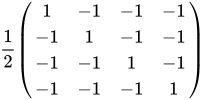
Now let ζ be a block sum of 6 matrices: odd numbers each of η and −η.[1][2]ζ is a symmetric and orthogonal matrix, thus an involution. Some experimenting shows that it interchanges vectors between different orbits of N.
To compute |Co0| it is best to consider Λ4, the set of vectors of type 4. Any type 4 vector is one of exactly 48 type 4 vectors congruent to each other modulo 2Λ, falling into 24 orthogonal pairs {v, –v}. A set of 48 such vectors is called a frame or cross. N has as an orbit a standard frame of 48 vectors of form (±8, 023). The subgroup fixing a given frame is a conjugate of N. The group 212, isomorphic to the Golay code, acts as sign changes on vectors of the frame, while M24 permutes the 24 pairs of the frame. Co0 can be shown to be transitive on Λ4. Conway multiplied the order 212|M24| of N by the number of frames, the latter being equal to the quotient |Λ4|/48 = 8,292,375 = 36⋅53⋅7⋅13. That product is the order of any subgroup of Co0 that properly contains N; hence N is a maximal subgroup of Co0 and contains 2-Sylow subgroups of Co0. N also is the subgroup in Co0 of all matrices with integer components.
Since Λ includes vectors of the shape (±8, 023), Co0 consists of rational matrices whose denominators are all divisors of 8.
The smallest non-trivial representation of Co0 over any field is the 24-dimensional one coming from the Leech lattice, and this is faithful over fields of characteristic other than 2.
Involutions in Co0
Any involution in Co0 can be shown to be conjugate to an element of the Golay code. Co0 has 4 conjugacy classes of involutions.
A permutation matrix of shape 212 can be shown to be conjugate to a dodecad. Its centralizer has the form 212:M12 and has conjugates inside the monomial subgroup. Any matrix in this conjugacy class has trace 0.
A permutation matrix of shape 2818 can be shown to be conjugate to an octad; it has trace 8. This and its negative (trace −8) have a common centralizer of the form (21+8×2).O8+(2), a subgroup maximal in Co0.
Sublattice groups
Conway and Thompson found that four recently discovered sporadic simple groups, described in conference proceedings (Brauer & Sah 1969), were isomorphic to subgroups or quotients of subgroups of Co0.
Conway himself employed a notation for stabilizers of points and subspaces where he prefixed a dot. Exceptional were .0 and .1, being Co0 and Co1. For integer n ≥ 2 let .n denote the stabilizer of a point of type n (see above) in the Leech lattice.
Conway then named stabilizers of planes defined by triangles having the origin as a vertex. Let .hkl be the pointwise stabilizer of a triangle with edges (differences of vertices) of types h, k and l. The triangle is commonly called an h-k-l triangle. In the simplest cases Co0 is transitive on the points or triangles in question and stabilizer groups are defined up to conjugacy.
Conway identified .322 with the McLaughlin group McL (order 898,128,000) and .332 with the Higman–Sims group HS (order 44,352,000); both of these had recently been discovered.
Here is a table[3][4] of some sublattice groups:
| Name | Order | Structure | Example vertices |
|---|---|---|---|
| •2 | 218 36 53 7 11 23 | Co2 | (−3, 123) |
| •3 | 210 37 53 7 11 23 | Co3 | (5, 123) |
| •4 | 218 32 5 7 11 23 | 211:M23 | (8, 023) |
| •222 | 215 36 5 7 11 | PSU6(2) ≈ Fi21 | (4, −4, 022), (0, −4, 4, 021) |
| •322 | 27 36 53 7 11 | McL | (5, 123),(4, 4, 022) |
| •332 | 29 32 53 7 11 | HS | (5, 123), (4, −4, 022) |
| •333 | 24 37 5 11 | 35 M11 | (5, 123), (0, 212, 011) |
| •422 | 217 32 5 7 11 | 210:M22 | (8, 023), (4, 4, 022) |
| •432 | 27 32 5 7 11 23 | M23 | (8, 023), (5, 123) |
| •433 | 210 32 5 7 | 24.A8 | (8, 023), (4, 27, −2, 015) |
| •442 | 212 32 5 7 | 21+8.A7 | (8, 023), (6, −27, 016) |
| •443 | 27 32 5 7 | M21:2 ≈ PSL3(4):2 | (8, 023), (5, −3, −3, 121) |
Two other sporadic groups
Two sporadic subgroups can be defined as quotients of stabilizers of structures on the Leech lattice. Identifying R24 with C12 and Λ with
![{\displaystyle \mathbf {Z} \left[e^{{\frac {2}{3}}\pi i}\right]^{12},}](https://wikimedia.org/api/rest_v1/media/math/render/svg/326324564b54ab185c9ca6f223a4212452d85ba6)
the resulting automorphism group (i.e., the group of Leech lattice automorphisms preserving the complex structure) when divided by the six-element group of complex scalar matrices, gives the Suzuki group Suz (order 448,345,497,600). This group was discovered by Michio Suzuki in 1968.
A similar construction gives the Hall–Janko group J2 (order 604,800) as the quotient of the group of quaternionic automorphisms of Λ by the group ±1 of scalars.
The seven simple groups described above comprise what Robert Griess calls the second generation of the Happy Family, which consists of the 20 sporadic simple groups found within the Monster group. Several of the seven groups contain at least some of the five Mathieu groups, which comprise the first generation.
Suzuki chain of product groups
Co0 has 4 conjugacy classes of elements of order 3. In M24 an element of shape 38 generates a group normal in a copy of S3, which commutes with a simple subgroup of order 168. A direct productPSL(2,7) × S3 in M24 permutes the octads of a trio and permutes 14 dodecad diagonal matrices in the monomial subgroup. In Co0 this monomial normalizer 24:PSL(2,7) × S3 is expanded to a maximal subgroup of the form 2.A9 × S3, where 2.A9 is the double cover of the alternating group A9.
John Thompson pointed out it would be fruitful to investigate the normalizers of smaller subgroups of the form 2.An(Conway 1971, p. 242). Several other maximal subgroups of Co0 are found in this way. Moreover, two sporadic groups appear in the resulting chain.
There is a subgroup 2.A8 × S4, the only one of this chain not maximal in Co0. Next there is the subgroup (2.A7 × PSL2(7)):2. Next comes (2.A6 × SU3(3)):2. The unitary group SU3(3) (order 6,048) possesses a graph of 36 vertices, in anticipation of the next subgroup. That subgroup is (2.A5 o 2.HJ):2, in which the Hall–Janko group HJ makes its appearance. The aforementioned graph expands to the Hall–Janko graph, with 100 vertices. Next comes (2.A4 o 2.G2(4)):2, G2(4) being an exceptional group of Lie type.
تنتهي السلسلة بـ 6.Suz:2 (Suz = مجموعة سوزوكي المتفرقة )، والتي، كما ذكر أعلاه، تحترم تمثيلًا معقدًا لشبكة ليتش.
ضوء القمر الوحشي المعمم
اقترح كونواي ونورتون في بحثهما عام 1979 أن مفهوم "الضوء القمري الوحشي" لا يقتصر على الوحش. لاحقًا، وجدت لاريسا كوين وآخرون أنه يمكن بناء امتدادات العديد من وحدات Hauptmoduln من تركيبات بسيطة لأبعاد المجموعات المتفرقة. بالنسبة لمجموعات كونواي، فإن متسلسلة ماكاي-تومسون ذات الصلة هي= {1، 0، 276،-204811202 ،-49,152 ، ...} ( OEIS : A007246 ) و= {1، 0، 276،204811202 ،49,152 ، ...} ( OEIS : A097340 ) حيث يمكن تحديد الحد الثابت a(0) = 24 ،


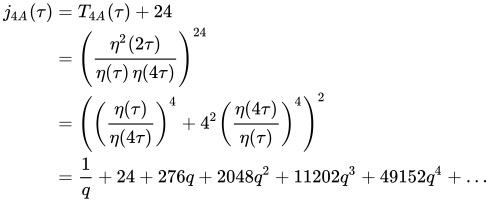
و η ( τ ) هي دالة Dedekind eta .
مراجع
- كونواي، جون هورتون (1968)، "مجموعة مثالية من الرتبة 8,315,553,613,086,720,000 والمجموعات البسيطة المتفرقة"، وقائع الأكاديمية الوطنية للعلوم في الولايات المتحدة الأمريكية ، 61 (2): 398-400 ، Bibcode : 1968PNAS...61..398C ، doi : 10.1073/pnas.61.2.398 ، MR 0237634 ، PMC 225171 ، PMID 16591697
- براور، ر .؛ ساه، تشيهان، محرران (1969)، نظرية المجموعات المنتهية: ندوة ، دبليو إيه بنجامين، نيويورك-أمستردام، MR 0240186
- كونواي، جون هورتون (1969)، "مجموعة من الرتبة 8,315,553,613,086,720,000"، نشرة جمعية لندن الرياضية ، 1 : 79-88 ، doi : 10.1112/blms/1.1.79 ، ISSN 0024-6093 ، MR 0248216
- كونواي، جون هورتون (1971)، "ثلاث محاضرات حول الزمر الاستثنائية"، في باول، إم بي؛ هيغمان، غراهام (محرران)، الزمر البسيطة المنتهية ، وقائع مؤتمر تعليمي نظمته جمعية لندن الرياضية (معهد دراسات متقدمة تابع لحلف الناتو)، أكسفورد، سبتمبر 1969، بوسطن، ماساتشوستس: أكاديميك برس ، ص 215-247 ، ISBN 978-0-12-563850-0، MR 0338152 Reprinted in Conway & Sloane (1999, 267–298)
- Conway, John Horton; Sloane, Neil J. A. (1999), Sphere Packings, Lattices and Groups, Grundlehren der Mathematischen Wissenschaften, vol. 290 (3rd ed.), Berlin, New York: Springer-Verlag, doi:10.1007/978-1-4757-2016-7, ISBN 978-0-387-98585-5, MR 0920369
- Thompson, Thomas M. (1983), From error-correcting codes through sphere packings to simple groups, Carus Mathematical Monographs, vol. 21, Mathematical Association of America, ISBN 978-0-88385-023-7, MR 0749038
- Conway, John Horton; Parker, Richard A.; Norton, Simon P.; Curtis, R. T.; Wilson, Robert A. (1985), Atlas of finite groups, Oxford University Press, ISBN 978-0-19-853199-9, MR 0827219
- Griess, Robert L. Jr. (1998), Twelve sporadic groups, Springer Monographs in Mathematics, Berlin, New York: Springer-Verlag, doi:10.1007/978-3-662-03516-0, ISBN 978-3-540-62778-4, MR 1707296
- Atlas of Finite Group Representations: Co1 version 2
- Atlas of Finite Group Representations: Co1 version 3
- Wilson, Robert A. (1983), "The maximal subgroups of Conway's group Co₁", Journal of Algebra, 85 (1): 144–165, doi:10.1016/0021-8693(83)90122-9, ISSN 0021-8693, MR 0723071
- Wilson, Robert A. (1988), "On the 3-local subgroups of Conway's group Co₁", Journal of Algebra, 113 (1): 261–262, doi:10.1016/0021-8693(88)90192-5, ISSN 0021-8693, MR 0928064
- Wilson, Robert A. (2009), The finite simple groups., Graduate Texts in Mathematics 251, vol. 251, Berlin, New York: Springer-Verlag, doi:10.1007/978-1-84800-988-2, ISBN 978-1-84800-987-5, Zbl 1203.20012
- Witt, Ernst (1998), Collected papers. Gesammelte Abhandlungen, Springer Collected Works in Mathematics, Berlin, New York: Springer-Verlag, doi:10.1007/978-3-642-41970-6, ISBN 978-3-540-57061-5, MR 1643949
- R. T. Curtis and B. T. Fairburn (2009), "Symmetric Representation of the elements of the Conway Group .0", Journal of Symbolic Computation, 44: 1044–1067.
- Sporadic groups
- John Horton Conway