
G-module
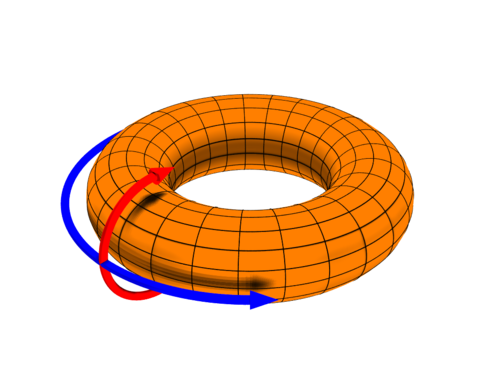
In mathematics, given a group, a G-module is an abelian group on which acts compatibly with the abelian group structure on . This widely applicable notion generalizes that of a representation of G. Group (co)homology provides an important set of tools for studying general -modules.


The term G-module is also used for the more general notion of an R-module on which acts linearly (i.e. as a group of -module automorphisms).

Definition and basics
Let be a group. A left -module consists of[1] an abelian group together with a left group action such that


for all and in and all in , where denotes . A right -module is defined similarly. Given a left -module , it can be turned into a right -module by defining .


A function is called a morphism of -modules (or a -linear map, or a -homomorphism) if is both a group homomorphism and -equivariant.


The collection of left (respectively right) -modules and their morphisms form an abelian category (resp. ). The category (resp. ) can be identified with the category of left (resp. right) -modules, i.e. with the modules over the group ring.


![{\displaystyle \mathbb {Z} [G]}](https://wikimedia.org/api/rest_v1/media/math/render/svg/f40260c366fc309a5872899d2ea34cf094855857)
A submodule of a -module is a subgroup that is stable under the action of , i.e. for all and . Given a submodule of , the quotient module is the quotient group with action .



Examples
- Given a group , the abelian group is a -module with the trivial action.
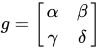
- Let be the set of binary quadratic forms with integers, and let (the 2×2 special linear group over ). Define


- where
- and is matrix multiplication. Then is a -module studied by Gauss.[2] Indeed, we have



- If is a representation of فوق حقل، ثمهو-وحدة (إنها مجموعة تبديلية تحت الجمع).


المجموعات الطوبولوجية
لوهي مجموعة طوبولوجية وإذا كانت G زمرة طوبولوجية أبيلية، فإن وحدة G الطوبولوجية هي- وحدة حيث خريطة الإجراءاتمتصلة (حيث يتم أخذ طوبولوجيا المنتج على). [ 3 ]


بمعنى آخر، طوبولوجي-module هي مجموعة طوبولوجية أبيليةبالإضافة إلى خريطة متصلةتلبية العلاقات المعتادة،، و.


ملحوظات
- ↑ كورتيس، تشارلز و .؛ راينر، إيرفينغ (1988) [1962]. نظرية تمثيل المجموعات المنتهية والجبر الترابطي . جون وايلي وأولاده. ISBN 978-0-470-18975-7.
- ↑ كيم، ميونغ هوان (1999)، الأشكال التربيعية التكاملية والشبكات: وقائع المؤتمر الدولي حول الأشكال التربيعية التكاملية والشبكات، 15-19 يونيو 1998، جامعة سيول الوطنية، كوريا ، الجمعية الرياضية الأمريكية.
- ↑ د. ويغنر (1973). "التماثل الجبري للمجموعات الطوبولوجية" . معاملات الجمعية الأمريكية للرياضيات 178 : 83-93 . doi : 10.1090 /s0002-9947-1973-0338132-7 .
مراجع
- نظرية الزمر
- نظرية تمثيل المجموعات