
2000 United States redistricting cycle
The 2000 United States redistricting cycle took place following the completion of the 2000 United States census. In all fifty states, various bodies re-drew state legislative and congressional districts. States that are apportioned more than one seat in the United States House of Representatives also drew new districts for that legislative body. The resulting new districts were first implemented for the 2001 and 2002 elections, which saw Republicans add eight seats to their U.S. House majority, capture eight state legislative chambers and win a majority of state legislative seats for the first time in half a century.
The districts drawn in the 2000 redistricting cycle remained in effect until the next round of redistricting following the 2010 United States census.
Reapportionment
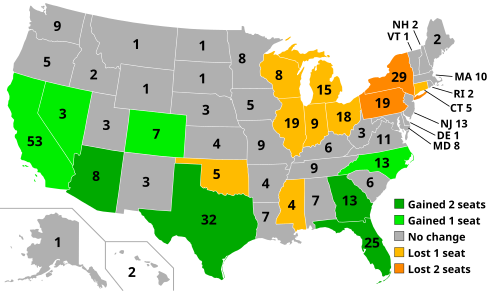
Following the 2000 census, Texas, Florida, Arizona and Georgia each gained two seats, while California, North Carolina, Colorado and Nevada picked up one new seat apiece.[1] New York and Pennsylvania both lost two seats, while Connecticut, Michigan, Illinois, Wisconsin, Indiana, Ohio, Oklahoma and Mississippi each lost one seat.
Newly created districts and eliminated districts
The new seats were first contested in the 2002 United States House of Representatives elections.
| Eliminated districts | Created districts |
|---|---|
Means of redistricting
Most states were redistricted by joint committees of state legislatures, with twelve states having set up either citizen-ran or politically appointed commissions to redraw legislative maps and six states having set up commissions for congressional maps.
Subsequent mid-decade redistricting
Texas
In 2002, Republicans gained control of the Texas Legislature for the first time in 130 years, and despite a gain of two seats from the court-ran redraw of the Texas congressional map in 2001, set about to redraw the congressional map for the state to increase Republican gains from a narrow 17D-15R deficit. It led to a protracted standoff between the Democratic and Republican legislative caucuses which ended with the defeat of the Democratic caucus' quorum-busting attempt and the creation of new congressional maps which saw Republicans gain the majority of congressional districts in Texas for the first time since Reconstruction.
Georgia
بعد أن رسم الديمقراطيون في الجمعية العامة لولاية جورجيا خرائط انتخابية تشريعية وكونغرسية تحمي من المزيد من الخسائر، رفع الجمهوريون دعوى قضائية ضد هذه الخرائط استنادًا إلى قانون حقوق التصويت . وعقب انتخابات عام 2004، التي شهدت فوز الجمهوريين بالأغلبية في كلا المجلسين لأول مرة في تاريخ جورجيا، أعادوا رسم الخرائط التشريعية والكونغرسية في عام 2004 [ 2 ] بعد أن أبطل قضاة فيدراليون الخريطتين اللتين رسمتهما الهيئة التشريعية رقم 146 لمخالفتهما مبدأ "صوت واحد لكل شخص" المنصوص عليه في دستور الولايات المتحدة، مما أدى إلى إعادة توزيع الدوائر الانتخابية التي دخلت حيز التنفيذ في الهيئة التشريعية التالية، الأمر الذي عزز مكاسب الجمهوريين في كلا المجلسين وفي الكونغرس.
مراجع
- ↑ ميتشل، أليسون (13 مارس 2002). "إعادة تقسيم الدوائر الانتخابية لعام 2002 لا تُحدث تغييرات جذرية" . صحيفة نيويورك تايمز . تم الاطلاع عليه بتاريخ 4 أغسطس 2021 .
- ↑ «الهيئة التشريعية في جورجيا توافق على إعادة تقسيم الدوائر الانتخابية» . UPI.com . تم الاطلاع عليه بتاريخ 4 أغسطس 2021 .
- إعادة تقسيم الدوائر الانتخابية في الولايات المتحدة
- الجغرافيا الانتخابية للولايات المتحدة