
Definable real number
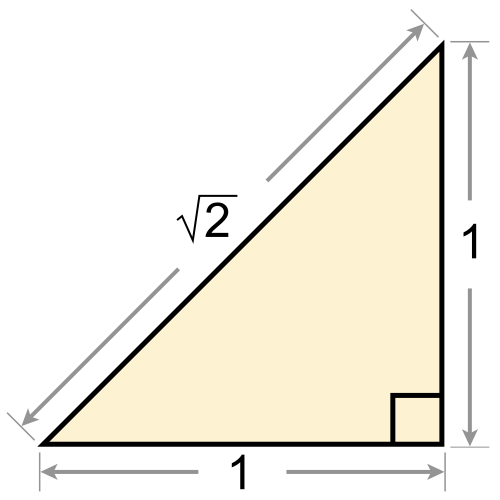
Informally, a definable real number is a real number that can be uniquely specified by its description. The description may be expressed as a construction or as a formula of a formal language. For example, the positive square root of 2, , can be defined as the unique positive solution to the equation , and it can be constructed with a compass and straightedge.


Different choices of a formal language or its interpretation give rise to different notions of definability. Specific varieties of definable numbers include the constructible numbers of geometry, the algebraic numbers, and the computable numbers.
Constructible numbers
One way of specifying a real number uses geometric techniques. A real number is a constructible number if there is a method to construct a line segment of length using a compass and straightedge, beginning with a fixed line segment of length 1.

Each positive integer, and each positive rational number, is constructible. The positive square root of 2 is constructible. However, the cube root of 2 is not constructible; this is related to the impossibility of doubling the cube.
Real algebraic numbers
A real number is called a real algebraic number if there is a polynomial, with only integer coefficients, so that is a root of , that is, . Each real algebraic number can be defined individually using the order relation on the reals. For example, if a polynomial has 5 real roots, the third one can be defined as the unique such that and such that there are two distinct numbers less than at which is zero.


All rational numbers are constructible, and all constructible numbers are algebraic. There are numbers such as the cube root of 2 which are algebraic but not constructible.
The real algebraic numbers form a subfield of the real numbers. This means that 0 and 1 are algebraic numbers and, moreover, if and are algebraic numbers, then so are , , and, if is nonzero, .


The real algebraic numbers also have the property, which goes beyond being a subfield of the reals, that for each positive integer and each real algebraic number , all of the th roots of that are real numbers are also algebraic.

There are only countably many algebraic numbers, but there are uncountably many real numbers, so in the sense of cardinality most real numbers are not algebraic. This nonconstructive proof that not all real numbers are algebraic was first published by Georg Cantor in his 1874 paper "On a Property of the Collection of All Real Algebraic Numbers".
Non-algebraic numbers are called transcendental numbers. The best known transcendental numbers are π and e.
Computable real numbers
A real number is a computable number if there is an algorithm that, given a natural number , produces a decimal expansion for the number accurate to decimal places. This notion was introduced by Alan Turing in 1936.[1]
The computable numbers include the algebraic numbers along with many transcendental numbers including and . Like the algebraic numbers, the computable numbers also form a subfield of the real numbers, and the positive computable numbers are closed under taking th roots for each positive .


Not all real numbers are computable. Specific examples of noncomputable real numbers include the limits of Specker sequences, and algorithmically random real numbers such as Chaitin's Ω numbers.
Definability in arithmetic
Another notion of definability comes from the formal theories of arithmetic, such as Peano arithmetic. The language of arithmetic has symbols for 0, 1, the successor operation, addition, and multiplication, intended to be interpreted in the usual way over the natural numbers. Because no variables of this language range over the real numbers, a different sort of definability is needed to refer to real numbers. A real number is definable in the language of arithmetic (or arithmetical) if its Dedekind cut can be defined as a predicate in that language; that is, if there is a first-order formula in the language of arithmetic, with three free variables, such that Here m, n, and p range over nonnegative integers.


The second-order language of arithmetic is the same as the first-order language, except that variables and quantifiers are allowed to range over sets of naturals. A real that is second-order definable in the language of arithmetic is called analytical.
كل عدد حقيقي قابل للحساب هو عدد حسابي، والأعداد الحسابية تشكل حقلاً فرعياً من الأعداد الحقيقية، وكذلك الأعداد التحليلية. كل عدد حسابي هو عدد تحليلي، ولكن ليس كل عدد تحليلي هو عدد حسابي. ولأن عدد الأعداد التحليلية محدود، فإن معظم الأعداد الحقيقية ليست تحليلية، وبالتالي ليست حسابية أيضاً.
كل عدد قابل للحساب هو عدد حسابي، ولكن ليس كل عدد حسابي قابل للحساب. على سبيل المثال، نهاية متتالية سبيكر هي عدد حسابي غير قابل للحساب.
يمكن تصنيف تعريفات الأعداد الحقيقية الحسابية والتحليلية إلى تسلسل هرمي حسابي وتسلسل هرمي تحليلي . بشكل عام، يكون العدد الحقيقي قابلاً للحساب إذا وفقط إذا كان قطع ديديكيند الخاص به عند المستوى 1.من التسلسل الهرمي الحسابي، أحد أدنى المستويات. وبالمثل، تشكل الأعداد الحقيقية ذات القطوع الحسابية من نوع ديديكيند أدنى مستوى في التسلسل الهرمي التحليلي.

قابلية التعريف في نماذج ZFC
عدد حقيقييمكن تعريفها من الدرجة الأولى بلغة نظرية المجموعات، بدون معلمات ، بالنسبة لنموذج معينفيما يخص تقنية ZFC ، إذا كانت هناك صيغةبلغة نظرية المجموعات ، مع متغير حر واحد ، بحيثهو العدد الحقيقي الفريد في بحيث[ 2 ] وهذا يعطي مفاهيم مختلفة عن قابلية التعريف لنماذج مختلفة، والتي لا يمكن وصفها بصيغة في لغة نظرية المجموعات.


جميع الأعداد التحليلية، وخاصة جميع الأعداد القابلة للحساب، قابلة للتعريف بلغة نظرية المجموعات. وبالتالي، فإن الأعداد الحقيقية القابلة للتعريف بلغة نظرية المجموعات تشمل جميع الأعداد الحقيقية المألوفة مثل 0 و 1 و،إلخ، إلى جانب جميع الأعداد الجبرية. وبافتراض أنها تشكل مجموعة في النموذج، فإن الأعداد الحقيقية القابلة للتعريف بلغة نظرية المجموعات تشكل حقلاً.
كل نموذجيجب أن يحتوي أي نظام يحتوي على عدد لا يُحصى من الأعداد الحقيقية على أعداد حقيقية غير قابلة للتعريف بالنسبة إلى(بدون معلمات). وينتج هذا عن حقيقة أن عدد الصيغ محدود، وبالتالي عدد عناصرها محدود.يمكن تعريفها علىوبالتالي، إذايحتوي على عدد لا يُحصى من الأعداد الحقيقية، ويمكن إثبات ذلك من "الخارج".ليس كل عدد حقيقييمكن تعريفها على.
تصبح هذه الحجة أكثر إشكالية إذا طُبقت على نماذج الفئات في نظرية ZFC، مثل كون فون نيومان . إن الادعاء "العدد الحقيقييمكن تعريفها على نموذج الفئةلا يمكن التعبير عن ذلك بصيغة ZFC. [ 3 ] [ 4 ] وبالمثل، لا يمكن التعبير عن مسألة ما إذا كان كون فون نيومان يحتوي على أعداد حقيقية لا يمكن تعريفها بجملة في لغة ZFC. علاوة على ذلك، توجد نماذج قابلة للعد في ZFC حيث يمكن تعريف جميع الأعداد الحقيقية، وجميع مجموعات الأعداد الحقيقية، والدوال على الأعداد الحقيقية، وما إلى ذلك. [ 3 ] [ 4 ]


انظر أيضاً
مراجع
- ↑ تورينج، أ.م. (1937)، "حول الأعداد القابلة للحساب، مع تطبيق على مسألة القرار" ، وقائع الجمعية الرياضية في لندن ، 2، 42 (1): 230-265 ، doi : 10.1112/plms/s2-42.1.230 ، S2CID 73712
- ↑ كونين، كينيث (1980)، نظرية المجموعات: مقدمة في براهين الاستقلال ، أمستردام: نورث هولاند، ص 153، ISBN 978-0-444-85401-8
- 1 2 هامكينز، جويل ديفيد ؛ لينيتسكي، ديفيد؛ ريتز، جوناس (2013)، "نماذج قابلة للتعريف نقطيًا لنظرية المجموعات"، مجلة المنطق الرمزي ، 78 (1): 139-156 ، arXiv : 1105.4597 ، doi : 10.2178/jsl.7801090 ، S2CID 43689192
- 1 2 تسيرلسون، بوريس (2020)، "هل يمكن تحديد كل رقم بنص محدود؟"، ويكي جورنال أوف ساينس ، المجلد 3، العدد 1، ص 8، arXiv : 1909.11149 ، doi : 10.15347/WJS/2020.008 ، S2CID 202749952
- نظرية المجموعات