
Derivation (differential algebra)
In mathematics, a derivation is a function on an algebra that generalizes certain features of the derivative operator. Specifically, given an algebra over a ring or a field, a -derivation is a -linear map that satisfies Leibniz's law:



More generally, if is an -bimodule, a -linear map that satisfies the Leibniz law is also called a derivation. The collection of all -derivations of to itself is denoted by . The collection of -derivations of into an -module is denoted by .


Derivations occur in many different contexts in diverse areas of mathematics. The partial derivative with respect to a variable is an -derivation on the algebra of real-valued differentiable functions on . The Lie derivative with respect to a vector field is an -derivation on the algebra of differentiable functions on a differentiable manifold; more generally it is a derivation on the tensor algebra of a manifold. It follows that the adjoint representation of a Lie algebra is a derivation on that algebra. The Pincherle derivative is an example of a derivation in abstract algebra. If the algebra is noncommutative, then the commutator with respect to an element of the algebra defines a linear endomorphism of to itself, which is a derivation over . That is,


![{\displaystyle [FG,N]=[F,N]G+F[G,N]\,,}](https://wikimedia.org/api/rest_v1/media/math/render/svg/836ced4d428fe3cf3a62a476cc76b476bdeea1cc)
where is the commutator with respect to . An algebra equipped with a distinguished derivation forms a differential algebra, and is itself a significant object of study in areas such as differential Galois theory.
![{\displaystyle [\cdot ,N]}](https://wikimedia.org/api/rest_v1/media/math/render/svg/d61055f1a5b4d930c261dd9b052d756ed1f8ab21)


Properties
If is a -algebra, for a ring, and D: → is a -derivation, then
- If has a unit 1, then , so that . Thus by -linearity, for all .
- If is commutative, then , and , by the Leibniz rule.
- More generally, for any , it follows by induction that



- which is if for all , commutes with .



- For , is not a derivation, instead satisfying a higher-order Leibniz rule:


- Moreover, if is an -bimodule, write
- for the set of -derivations from to .

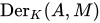
- is a module over .
- is a Lie algebra with Lie bracket defined by the commutator:
- since it is readily verified that the commutator of two derivations is again a derivation.
![{\displaystyle [D_{1},D_{2}]=D_{1}\circ D_{2}-D_{2}\circ D_{1}.}](https://wikimedia.org/api/rest_v1/media/math/render/svg/9196a962e980d7f5237277994ccc82fe82b3c205)
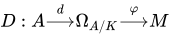
- There is an -module (called the Kähler differentials) with a -derivation through which any derivation العوامل. أي، لأي اشتقاقهناكخريطة الوحدة النمطيةمع

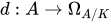


- المراسلاتهو تماثل لـ-الوحدات النمطية:


- لوإذا كانت حلقة فرعية ، فـيرثبنية الجبر، لذلك يوجد تضمين


- منذ أي-الاشتقاق هو من باب أولى-اشتقاق.

الاشتقاقات المتدرجة
بالنظر إلى الجبر المتدرجوخريطة خطية متجانسةمن الدرجةعلى،يكون الاشتقاق متجانساً إذا


لكل عنصر متجانسوكل عنصرللعامل التبديلالاشتقاق المتدرج هو مجموع اشتقاقات متجانسة لها نفس.


لو، يؤول هذا التعريف إلى الحالة المعتادة. إذالكن، إذن


للفردي، ويُطلق عليه اسم الاشتقاق المضاد .
تشمل أمثلة المشتقات المضادة المشتق الخارجي والناتج الداخلي الذي يعمل على الأشكال التفاضلية .
الاشتقاقات المتدرجة للجبر الفائق (أي،تُسمى الجبر المتدرج غالبًا بالمشتقات الفائقة .

مفاهيم ذات صلة
مشتقات هاس-شميت هيتماثلات الجبر
![{\displaystyle A\to A[[t]].}](https://wikimedia.org/api/rest_v1/media/math/render/svg/21d5019fc824697626911b9b24eff8d080bc8fe9)
إضافة إلى ذلك، يتم استخدام الخريطة التي ترسل سلسلة قوى رسمية.إلى المعامليقدم اشتقاقًا.


انظر أيضاً
مراجع
- بورباكي، نيكولاس (1989)، الجبر 1 ، عناصر الرياضيات، سبرينغر-فيرلاغ، ISBN 3-540-64243-9.
- أيزنبد، ديفيد (1999)، الجبر التبادلي مع نظرة نحو الهندسة الجبرية (الطبعة الثالثة )، سبرينغر-فيرلاغ، ISBN 978-0-387-94269-8.
- ماتسومورا، هيديوكي (1970)، الجبر التبادلي ، سلسلة محاضرات محاضرات الرياضيات، WA Benjamin، ISBN 978-0-8053-7025-6.
- كولار، إيفان؛ سلوفاك، يان؛ ميخور، بيتر دبليو. (1993)، العمليات الطبيعية في الهندسة التفاضلية ، سبرينغر-فيرلاغ.
- الجبر التفاضلي