
التوقيت القياسي الفلبيني
التوقيت القياسي الفلبيني ( PST [ 1 ] [ 2 ] أو PhST ؛ [ 3 ] [ 4 ] باللغة الفلبينية : Pamantayang Oras ng Pilipinas )، المعروف أيضًا باسم التوقيت الفلبيني ( PHT )، هو الاسم الرسمي للمنطقة الزمنية المستخدمة في الفلبين . تستخدم البلاد منطقة زمنية واحدة فقط، بفارق زمني قدره UTC+08:00 ، ولكنها طبقت التوقيت الصيفي لفترات وجيزة من 1 نوفمبر 1936 حتى 20 سبتمبر 1978.
التفاصيل الجغرافية
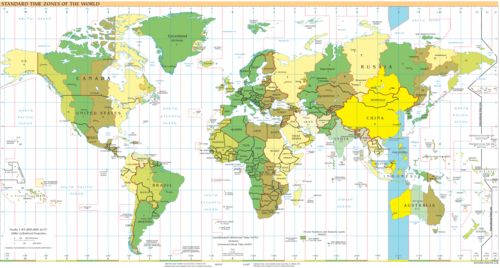
تقع الفلبين جغرافياً بين خطي عرض 114°17′/116°53′ و126°37′ شرق خط غرينتش ، [ 5 ] وبالتالي فهي تقع بالكامل ضمن المنطقة الزمنية UTC+08:00 . وتتولى إدارة خدمات الأرصاد الجوية والجيوفيزيائية والفلكية الفلبينية (PAGASA) مسؤولية ضبط التوقيت القياسي الفلبيني. وتشترك الفلبين في نفس المنطقة الزمنية مع الصين ، وتايوان ، وهونغ كونغ ، وماكاو ، وماليزيا ، وسنغافورة ، وغرب أستراليا ، وبروناي ، وإيركوتسك ( روسيا )، ووسط إندونيسيا ، ومعظم منغوليا .
تاريخ
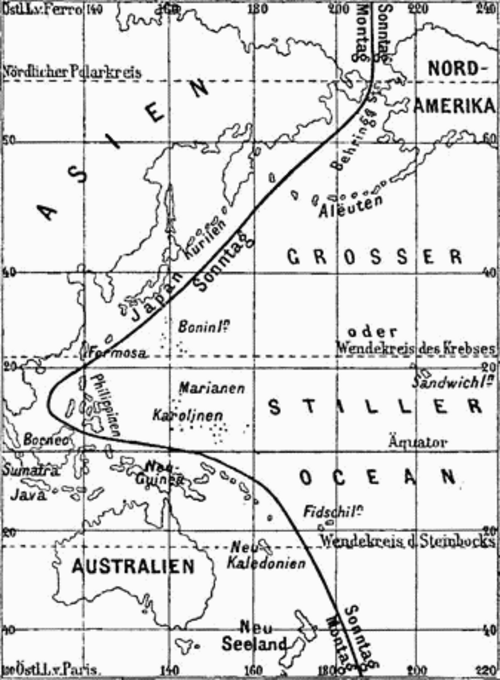
For 323 years, 9 months, and 4 days,[note 1] which lasted from Saturday, March 16, 1521 (Julian Calendar), until Monday, December 30, 1844 (Gregorian Calendar), the Philippines followed the date of the western hemisphere and had the same date as Mexico. This was because it was a Spanish colony supplied and controlled via Mexico through Manila-Acapulco Galleon trade, which lasted up to 250 years from July 2, 1565, until September 14, 1815, few years before Mexico's declaration of independence from Spain on September 27, 1821.[6]
On August 16, 1844, the Spanish Governor-General Narciso Claveria decreed that Tuesday, December 31, 1844, should be removed from the Philippine calendar. Monday, December 30, 1844, was immediately followed by Wednesday, January 1, 1845, which added 1 day or 24 hours to the local time. This change meant that the International Date Line moved from going west of the Philippines to go on the east side of the country, which had to follow the eastern hemisphere to align itself with the rest of Asia.[6][7]
At the time, local mean time was used to set clocks, meaning that every place used its own local time based on its longitude because the time was measured by locally observing the Sun.
Philippine Standard Time was instituted through Batas Pambansa Blg. 8 (that defined the metric system), approved on December 2, 1978, and implemented on January 1, 1983. The Philippines is one of the few countries to officially and almost exclusively use the 12-hour clock in non-military situations.[note 2]
In September 2011, the Department of Science and Technology proposed to synchronize time nationwide, which was an effort to discourage tardiness and non-standard time displayed on television and radio stations. PAGASA installed a rubidiumatomic clock, a GPS receiver, a time interval counter, a distribution amplifier, and a computer to help calculate the time difference with every satellite within its antenna's field of view.[8][9]
In order to promote synchronicity with official time, on May 15, 2013, President Benigno Aquino III signed Republic Act No. 10535 setting the Philippine Standard Time,[10] requiring all government offices and media networks to synchronize their timepieces with PAGASA's rubidium atomic clock.[11][12]
Time in the Philippines
| فترة الاستخدام | فرق التوقيت عن توقيت غرينتش/التوقيت العالمي المنسق | اسم الوقت |
|---|---|---|
| السبت، 16 مارس 1521 (التقويم اليولياني) - الاثنين، 30 ديسمبر 1844 (التقويم الغريغوري) | GMT-15:56 (في مانيلا ) | التوقيت المحلي |
| GMT−16:12 (في بالاباك ، الجزيرة الواقعة في أقصى الغرب) | ||
| GMT−15:34 (في دافاو أورينتال ، المنطقة الواقعة في أقصى الشرق) | ||
| اليوم الذي لم يحدث قط، وذلك بناءً على أمر الحاكم العام الإسباني نارسيسو كلافيريا بإضافة 24 ساعة إلى التوقيت المحلي. [ 13 ] | تغيير المنطقة الزمنية [ ملاحظة 3 ] | |
| الأربعاء، 1 يناير 1845 - 10 مايو 1899 | GMT+08:04 (في مانيلا) | التوقيت المحلي |
| GMT+07:48 (في بالاباك، الجزيرة الواقعة في أقصى الغرب) | ||
| GMT+08:26 (في دافاو أورينتال، المنطقة الواقعة في أقصى الشرق) | ||
| 11 مايو 1899 - 31 أكتوبر 1936 | GMT+08:00 | التوقيت القياسي الفلبيني |
| 1 نوفمبر 1936 - 31 يناير 1937 | GMT+09:00 | التوقيت الصيفي في الفلبين |
| 1 فبراير 1937 - 30 أبريل 1942 | GMT+08:00 | التوقيت القياسي الفلبيني |
| 1 مايو 1942 - 31 أكتوبر 1944 | GMT+09:00 | التوقيت القياسي في طوكيو [ ملاحظة 4 ] |
| 1 نوفمبر 1944 - 11 أبريل 1954 | GMT+08:00 | التوقيت القياسي الفلبيني |
| 12 أبريل 1954 - 30 يونيو 1954 | GMT+09:00 | التوقيت الصيفي في الفلبين |
| 1 يوليو 1954 - 21 مارس 1978 | GMT/UTC+08:00 | التوقيت القياسي الفلبيني |
| 22 مارس 1978 - 20 سبتمبر 1978 | UTC+09:00 | التوقيت الصيفي في الفلبين |
| 21 سبتمبر 1978 - حتى الآن | UTC+08:00 | التوقيت القياسي الفلبيني |
استخدام التوقيت الصيفي
لم تعد الفلبين تطبق التوقيت الصيفي منذ عام 1979. وقد تم تطبيقه لفترات قصيرة خلال فترات رئاسة مانويل إل. كويزون في الفترة 1936-1937، ورامون ماجسايساي في عام 1954، وفرديناند ماركوس في عام 1978، وكورازون أكينو في عام 1990. [ 14 ] [ 15 ] [ 16 ]
قاعدة بيانات المناطق الزمنية التابعة لهيئة IANA
تحتوي قاعدة بيانات المناطق الزمنية التابعة لهيئة الأرقام المخصصة للإنترنت (IANA) على منطقة واحدة للفلبين في الملف zone.tab ، باسم Asia/Manila
تنسيق التاريخ والوقت
تاريخ
- التاريخ القياسي: 18 أغسطس 2023 (شهر يوم سنة أو mm/dd/yyyy)
- الوثائق الرسمية (العامة): اليوم الثامن عشر من شهر أغسطس 2023 أو 18 أغسطس 2023 (اليوم الشهر السنة)
- الفلبينية: ika- 18 ng Agosto , 2023 أو 18 Agosto 2023 (dd-mm-yyyy)
- جواز السفر: 18 08 2023 (يوم شهر سنة)
وقت
- المعيار: ساعة 12 ساعة
- العسكرية/الكشافة: التوقيت العسكري الأمريكي
- وسائل النقل العام وفعاليات الماراثون: نظام التوقيت 24 ساعة
- لغة مشتركة منطوقة
- المصطلحات الإسبانية المُحَوَّلة إلى التاغالوغية (التهجئة الإسبانية الأصلية بين قوسين؛ محطات راديو AM والمحادثات اليومية)
- 8:41 – للأسف otso kuwarenta y uno ( A las ocho cuarenta y uno )
- 5:30 – للأسف الشديد والميديا ( A las cinco y media )
- 3:00 – Alas tres ( A las tres ; en punto ، والتي تعني حرفيًا "على النقطة"، يمكن إضافتها للدلالة على "الساعة".)
- English (Business, Legal and others)
- 8:41 pm – Eight forty-one pm
- 5:30 am – Five Thirty am
- 3:00 pm – Three O'Clock or Three pm
- 12:00 pm – Twelve Midday or Twelve Noon – Twelve pm is seldom used as it might be confused with 12 Midnight
- 12:00 am – Twelve Midnight – Twelve am is seldom used as it might be confused with 12 Noon
- Tagalog and Filipino
- Starts with Spanish-derived (original spelling in parentheses) and ends with Tagalog – Umaga starts at 5:00 am and ends 11:59 am. Tanghalì is noon. Hapon starts at 1:00 pm and ends 5:59 pm. Gabí starts at 6:00 pm and ends 12:00 am which is Hatinggabi. Madalíng Araw starts at 12:01 am and ends 4:59 am. Except in very formal situations, Filipinos rarely use the vernacular numbers in telling time.
- 8:41 P.M. – Alas otso kuwarenta y uno (A las ocho cuarenta y uno) ng gabí or Apatnapú't-isá(ng minuto) makalipas ng ikawaló ng gabí or (ika)waló at apatnapú't-isá (na) ng gabi
- 5:30 A.M. – Alas singko y medya (A las cinco y media) ng umaga or Tatlumpû(ng minuto) makalipas ng ikalimá ng umaga or Kalahati makalipas ng ikalimá ng umaga or (ika)limá at kalaháti ng umaga or (ika)limá at tatlumpû(ng minuto) (na) ng umaga
- 3:00 P.M. – Alas tres (A las tres) ng hapon o Ikatló ng hapon
- 12:00 P.M. – Alas dose (A las doce) ng tanghalì o Ikalabíndalawá ng tanghalì
- 12:00 A.M. – Alas dose (A las doce) ng hatinggabi o Ikalabíndalawá ng hatinggabí
- 2:00 A.M. – Alas dos ng madalíng araw (A las dos) o Ikalawá ng madalíng araw
- المصطلحات الإسبانية المُحَوَّلة إلى التاغالوغية (التهجئة الإسبانية الأصلية بين قوسين؛ محطات راديو AM والمحادثات اليومية)
Notes
- ↑Within the Papal Bull of Pope Gregory XIII that mandated the introduction of the Gregorian calendar in 1582. Italy, Portugal, and Spain (including its overseas possessions like the Philippines, and the Americas) skipped 10 days to make the process of a calendrical switch from the Julian to the Gregorian calendar. Thursday, October 4, was followed by Friday, October 15, 1582. Because the Julian calendar acknowledged a leap year day regularly and the Gregorian calendar did not during centennial years (ending with “00”, unless if the centennial year is evenly divisible to 400 years. Then the year will automatically be a "Century Leap Year"), the Julian calendar fell one day further behind, bringing the difference to 11 days from March 1 (O.S. February 19), 1700 until February 28 (O.S. February 17), 1800, and another one day to 12 days from March 1 (O.S. February 18), 1800 to February 28 (O.S. February 16), 1900; the count of excess days became considered as only 2 instead of 14 at the end of 1844, to acknowledge the 10 days that the Philippines lose during the period when it was using the American date.
- ↑Aside from the 12-hour clock, the Philippines also uses the 24-hour clock format, which some Filipinos prefer for personal use. Smartwatches sold in the country are typically programmed to display the 24-hour format by default. Likewise, smartphones, laptops, and personal computers can be set to either the 12-hour or 24-hour format, depending on the user’s preference. However, despite the availability and use of the 24-hour format on devices, Filipinos generally continue to pronounce and express time using the 12-hour format in everyday conversation.
- ↑The change also applied to Caroline Islands, Guam, Marianas Islands, Marshall Islands and Palau for being part of the Captaincy General of the Philippines during that time.
- ↑During World War II, the Philippines became under the control of Imperial Japan following the "Fall of Manila" on January 2, 1942, caused by the invasion of the Imperial Japanese Army. However, Japan was defeated by the United States Navy at the Battle of Leyte Gulf and then liberated Visayas on October 26, 1944. After a few days, the clocks set back to Philippine Standard Time.
See also
References
- ↑"Republic Act No. 10535, The Philippine Standard Time (PST) Act of 2013". Official Gazette of the Republic of the Philippines. May 15, 2013.
- ↑Medina, Marielle (January 4, 2017). "National Time Consciousness Week". Philippine Daily Inquirer. Inquirer Research. Retrieved January 6, 2018.
- ↑Lacanilao, Arianne (January 5, 2018). "DOST urges Pinoys to follow PH Standard Time". Philippine News Agency. Philippine Canadian Inquirer. Archived from the original on January 6, 2018. Retrieved January 6, 2018.
- ↑"PAGASA". Philippine Standard Time.
- ↑"Republic Act No. 9522". Official Gazette of the Republic of the Philippines. Archived from the original on August 14, 2018. Retrieved February 13, 2022.
- 12van Gent, R. H. "A History of the International Date Line". Webspace.science.uu.nl. Retrieved December 30, 2011.
- ↑Tantiangco, Aya (January 1, 2017). "Philippines skipped New Year's Eve and lost a day in 1844". GMA News Online. Retrieved April 15, 2023.
- ↑Pedrasa, Ira (September 26, 2011). "Juan Time: Filipino time redefined". ABS-CBN News. Archived from the original on January 24, 2014. Retrieved November 7, 2011.
- ↑"Clocks and countdowns set for 'Juan Time'". Philippine Daily Inquirer. December 31, 2011. Archived from the original on January 6, 2018.
- ↑Republic Act No. 10535 (May 15, 2013), "The Philippine Standard Time (PST) Act of 2013", Official Gazette of the Republic of the Philippines, archived from the original on July 3, 2017
- ↑"PHL Standard Time to counter 'Filipino time' starting June 1". GMA News. May 25, 2013.
- ↑"Are you on Philippine Standard Time? | ABS-CBN News". Archived from the original on January 24, 2014. Retrieved May 26, 2013.
- ↑Joel (August 27, 2007). "Missing date in Philippines history: 31 December 1844". wordpress.com. Far Outliers. Retrieved March 7, 2022.
- ↑ ديلا كروز، كريستا آي. (30 أغسطس 2024). "الفلبين طبقت التوقيت الصيفي في الماضي - تاريخ التوقيت الصيفي في الفلبين" . مجلة إسكواير الفلبينية . تاريخ الاطلاع: 8 يونيو 2026 .
- ↑ "الأمر التنفيذي رقم 415" . مشروع لوفيل - مؤسسة أريلانو للقانون. 20 يوليو 1990. تم الاطلاع عليه في 8 يونيو 2026.
إلغاء برنامج التوقيت الصيفي الذي تم إقراره بموجب الأمر التذكيري الوطني للطوارئ رقم 17 لسنة 1990، اعتبارًا من منتصف ليل 28 يوليو 1990
. - ↑ "التوقيت الصيفي 2024 في الفلبين" . timeanddate.com .
روابط خارجية

- الوقت في الفلبين
- التوقيت في جنوب شرق آسيا