
Duke of Manchester
Duke of Manchester is a title in the Peerage of Great Britain, and the current senior title of the House of Montagu. It was created in 1719 for the politician Charles Montagu, 4th Earl of Manchester. Manchester Parish in Jamaica was named after the 5th Duke, while its capital Mandeville was named after his son and heir. The current Duke is Alexander Montagu, 13th Duke of Manchester, a controversial British and Australian citizen who lives in the United States and has served several prison sentences. He succeeded to the peerage in 2002[1] following the death of his father Angus Montagu, 12th Duke of Manchester, the last of the dukes to hold a seat in the House of Lords.
History
Their ancestor was Richard Ladde, grandfather of the Lord Chief JusticeSir Edward, who changed his name to Montagu around 1447. His descendants claimed a connection with the older house of Montagu or Montacute, Barons Montagu or Montacute and Earls of Salisbury, but there is no sound evidence that the two families were related. A case has been made out for the possibility that the Ladde alias came from a division among coheirs about 1420 of the remaining small inheritance of a line of Montagus at Spratton and Little Creton, also in Northamptonshire.[2]
The judge Sir Edward Montagu's grandson, Edward Montagu, was raised to the peerage as 1st Baron Montagu of Boughton. He is the ancestor of the Dukes of Montagu. His brother, Sir Henry Montagu (c. 1563–1642), who served as Lord Chief Justice as well as Lord High Treasurer and Lord Privy Seal, was in 1620 raised to the Peerage of England as Viscount Mandeville, with the additional title Baron Montagu of Kimbolton, of Kimbolton in the County of Huntingdon. In 1626, he was made Earl of Manchester, of Manchester in the County of Lancaster.[3] It is sometimes said, erroneously, that the title refers to Godmanchester in Huntingdonshire, and that the word "God" was deliberately excluded from the title on the basis that the grantee thought it would be blasphemous for him to be known as "Lord Godmanchester".[4] However, the form of the creation makes it clear that the title refers to what is now the city of Manchester (at the time a town in Lancashire, formally known as the County of Lancaster).
His son, the 2nd Earl, was a prominent Parliamentary General during the Civil War, but later supported the restoration of Charles II. His son, the 3rd Earl, represented Huntingdonshire in the House of Commons. His son was the 4th Earl, who in 1719 was created Duke of Manchester.
Charles, 1st Duke of Manchester, was succeeded by his eldest son. The 2nd Duke notably served as Captain of the Yeomen of the Guard in the administration of Sir Robert Walpole. He was childless, and on his death, the titles passed to his younger brother, the 3rd Duke. He had earlier represented Huntingdonshire in Parliament. He was succeeded by his son, the 4th Duke. He was Ambassador to France and served as Lord Chamberlain of the Household. His son, the 5th Duke, was Governor of Jamaica between 1827 and 1830 also held office as Postmaster General. He was succeeded by his son, the 6th Duke. He represented Huntingdon in the House of Commons as a Tory.
His eldest son, the 7th Duke, was Conservative Member of Parliament for Bewdley and Huntingdonshire. His son, the 8th Duke, briefly represented Huntingdonshire in Parliament. He was succeeded by his eldest son, the 9th Duke. He sat on the Liberal benches in the House of Lords and served as Captain of the Yeomen of the Guard in the Liberal administration of Sir Henry Campbell-Bannerman. In the twentieth century, mismanagement and profligacy resulted in the wholesale depletion of the Dukedom's estates. Generational instability caused further damage to the family's honour: the 9th, 12th and 13th Dukes all had a criminal record.[5][6]
Angus Montagu, 12th Duke of Manchester was the last of the dukes to serve in the House of Lords, until the adoption of the House of Lords Act 1999.
Alexander Montagu, the oldest son of the 12th Duke, succeeded his father as the 13th Duke in July 2002; a British and Australian citizen who lives in the United States, he had been known by the courtesy title of the heir apparent, Viscount Mandeville, since his father's succession to the peerage in 1985.[1][7][8] He has not taken the required action to be included on the Roll of the Peerage, which was created two years after his succession in 2004; while this doesn't change his status as a duke itself, which is legally established by the letters patent, inclusion in the roll is since 2004 a requirement to have his title included in his passport. Under the provisions of the 2004 royal warrant he may register with the roll at any time.[9]
Seats

The principal estate of the Dukes of Manchester was Kimbolton Castle. It was sold, together with 50 acres (20 ha) of parkland, by the 10th Duke in 1951, and is now a private school. A remaining 3,250 acres (1,320 ha) of the estate were sold by his eldest son and heir in 1975. The other family seat was Tandragee Castle, in County Armagh, Northern Ireland. It was sold in 1955, and the remaining estate in 1975, and is now the headquarters of Tayto (NI) Ltd.[5]
London residences
William Montagu, 2nd Duke of Manchester leased No. 26 Grosvenor Square from 1732 until his death in 1739.[10] He was succeeded by his brother Robert Montagu, 3rd Duke of Manchester, who had maintained his London residence at No. 17 Cork Street, Mayfair, which he subsequently vacated upon his succession as Duke in 1739.[11]
During the 1760s, the Duke of Manchester’s London house was located in Berkeley Square, although in 1767 George Montagu, 4th Duke of Manchester sold the house to Robert Child MP owing to his own shortage of funds.[12]Manchester House in Manchester Square was built in 1776 for George Montagu, 4th Duke of Manchester, who maintained the property as his London residence until his death in 1788.[13] By 1791, the house was being used as the Spanish Embassy, and was later acquired by Francis, 2nd Marquess of Hertford in 1797, after which the building was known as Hertford House.[13] The house now serves as the location of the Wallace Collection museum.[14]
William Montagu, 5th Duke of Manchester leased No. 96 Park Lane from 1828, which remained as his London residence until his death in 1843.[15] He was succeeded by his son George Montagu, 6th Duke of Manchester, who in turn was succeeded by his own son William Montagu, 7th Duke of Manchester upon the former’s death in 1855.
In 1856, the 7th Duke purchased a new London house at No. 1 Great Stanhope Street, Mayfair, from the executors of George Cowper, 6th Earl Cowper,[16] which remained as his London house until his death in 1890; he bequeathed his leasehold of the house to his widow Louisa, Dowager Duchess of Manchester.[17] In 1892, the Dowager Duchess remarried Spencer Cavendish, 8th Duke of Devonshire, and by 1895 No. 1 Great Stanhope Street was being offered for sale by the executors of the 7th Duke of Manchester.[18] Details of the sale advertisements noted that the property was held on an 850-year lease for a nominal ground rent, and therefore effectively on the same terms as a freehold.[18]
The 7th Duke was briefly succeeded by his son George Montagu, 8th Duke of Manchester, who died in 1892. In 1876, the 8th Duke, then Viscount Mandeville, had married the wealthy American heiress Consuelo Yznaga; upon his death he was succeeded as Duke by their fifteen-year-old son William Montagu, 9th Duke of Manchester. Consuelo, Dowager Duchess of Manchester, maintained her family’s London residence at No. 45 Portman Square from c. 1895, until the house was partially damaged by a fire on 26 November 1904.[19][20] In 1905, she purchased the lease of No. 5 Grosvenor Square, where she later died in 1909.[21]
The 9th Duke inherited his mother’s leasehold interest in the house, which he maintained as his London residence until the outbreak of the First World War in 1914, after which the house was used as a military hospital.[21] He later leased No. 38 Park Lane (later renumbered as No. 128) in 1917.[15]
Burial place

Many members of the Montagu family (Earls and Dukes of Manchester and their family members) are buried at St Andrew's Church, Kimbolton, Cambridgeshire (historically in Huntingdonshire). Several Montagu monuments still exist in the South Chapel, while the Montagu Vault (extended in 1853) is located beneath the North Chapel. The Montagu Vault is accessed from the churchyard via a doorway surmounted by heraldic beasts, which was added to the building in 1893.[22]The 12th Duke of Manchester, who died in 2002, was cremated at Bedford Crematorium after which his ashes were placed in the Montagu Vault.
Arms
 |
|
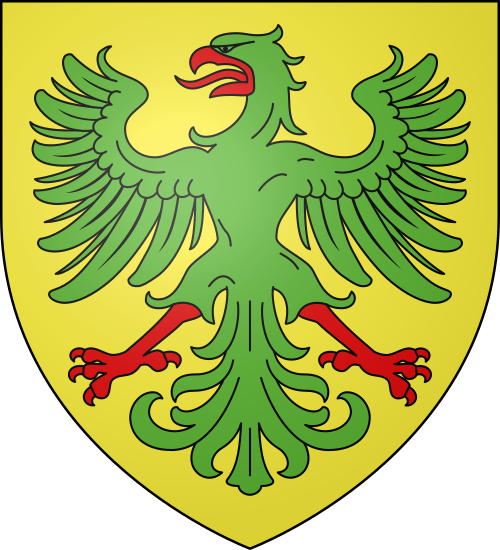
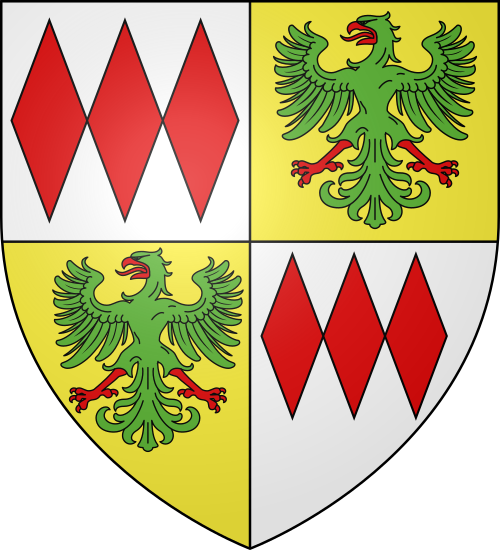
The arms of the Duke of Manchester have the following blazon: Quarterly, 1st & 4th: Argent, 3 fusils conjoined in fess gules (Montagu); 2nd & 3rd: Or an eagle displayed vert beaked and membered gules (Monthermer).[25] The fusils or diamond shapes in the Montagu arms were originally intended to represent a range of mountains,[26] as the name comes from the old French mont agu meaning "pointed hill".[27] The arms represent a claim to be a cadet of the medieval Montagu (Montacute) family, earls of Salisbury, for which there is no proof (see above origins).


Titles
The Duke of Manchester holds the subsidiary titles Earl of Manchester, Viscount Mandeville, and Baron Montagu of Kimbolton.
The heir apparent to the Dukedom takes the courtesy titleViscount Mandeville, and the heir apparent's eldest son is styled Lord Kimbolton.[28]
Viscount Mandeville (1620)
| # | Name | Life span | Period | Spouse | Other titles |
|---|---|---|---|---|---|
| 1 | Henry Montagu | 1563–1642 | 1620–1642 | (1) Catherine Spencer | Baron Montagu of Kimbolton |
| (2) Anne Halliday, née Wincot | |||||
| (3) Margaret Crouch |
Earls of Manchester (1626)
| # | Name | Life span | Period | Spouse | Notes | Other titles |
|---|---|---|---|---|---|---|
| 1 | Henry Montagu | 1563–1642 | 1626–1642 | (1) Catherine Spencer | --- | Viscount MandevilleBaron Montagu of Kimbolton |
| (2) Anne Halliday, née Wincot | ||||||
| (3) Margaret Crouch | ||||||
| 2 | Edward Montagu | 1602–1671 | 1642–1671 | (1) Susannah Hill | Son of the preceding | |
| (2) Lady Anne Rich | ||||||
| (3) Essex, Lady Bevill | ||||||
| (4) Eleanor, Dowager Countess of Warwick | ||||||
| (5) Margaret, Dowager Countess of Carlisle | ||||||
| 3 | Robert Montagu | 1634–1683 | 1671–1683 | Anne Yelverton | Son of the preceding | |
| 4 | Charles Montagu | 1662–1722 | 1683–1722 | Dodington Greville | Son of the preceding |
Dukes of Manchester (1719)


| Created by George I of Great Britain | ||||||
|---|---|---|---|---|---|---|
| # | Name | Life span | Period | Spouse | Notes | Other titles |
| 1 | Charles Montagu | c. 1662 – 1722 | 1719–1722 | Dodington Greville | Earl of Manchester,Viscount Mandeville,Baron Montagu of Kimbolton | |
| 2 | William Montagu | 1700–1739 | 1722–1739 | Lady Isabella Montagu | Son of the preceding | |
| 3 | Robert Montagu | 1710–1762 | 1739–1762 | Harriet Dunch | Brother of the preceding | |
| 4 | George Montagu | 1737–1788 | 1762–1788 | Elizabeth Dashwood | Son of the preceding | |
| 5 | William Montagu | 1771–1843 | 1788–1843 | Lady Susan Gordon | Son of the preceding | |
| 6 | George Montagu | 1799–1855 | 1843–1855 | (1) Millicent Sparrow(2) Harriet Sydney Dobbs | Son of the preceding | |
| 7 | William Montagu | 1823–1890 | 1855–1890 | Countess Louisa of Alten | Son of the preceding | |
| 8 | George Montagu | 1853–1892 | 1890–1892 | Consuelo Yznaga | Son of the preceding | |
| 9 | William Montagu | 1877–1947 | 1892–1947 | (1) Helena Zimmerman(2) Kathleen Dawes | Son of the preceding | |
| 10 | Alexander Montagu | 1902–1977 | 1947–1977 | (1) Nell Vere Stead(2) Elizabeth Fullerton | Son of the preceding | |
| 11 | Sidney Montagu | 1929–1985 | 1977–1985 | (1) Adrienne Valerie Christie(2) Andrea Joss | Son of the preceding | |
| 12 | Angus Montagu | 1938–2002 | 1985–2002 | (1) Mary Eveleen McClure(2) Diane Pauline Plimsaul(3) Anne-Louise Taylor(4) Biba Jennians | Brother of the preceding | |
| 13 | Alexander Montagu[a] | b. 1962 | 2002–present | (1) Marion Stoner (2) Wendy Dawn Buford (3) Laura Smith | Son of the preceding Incumbent | |
The heir presumptive to the dukedom is the present Duke's younger brother, Lord Kimble William Drogo Montagu (born 1964), whose heir is his only son William Anthony Drogo Montagu (born 2000).[29]
- ↑The 13th Duke of Manchester succeeded to the peerage in 2002,[1] but as of July 2022 does not appear on the Roll of the Peerage. To be legally recognised as a Peer in official documents, he must prove his succession and be placed on the Roll.[9]
Family tree and succession
| |||||||||||||||||||||||||||||||||||||||||||||||||||||||||||||||||||||||||||||||||||||||||||||||||||||||||||||||||||||||||||||||||||||||||||||||||||||||||||||||||||||||||||||||||||||||||||||||||||||||||||||||||||||||||||||||||||||||||||||||||||||||||||||||||||||||||||||||||||||||||||||||||||||||||||||||||||||||||||||||||||||||||||||||||||||||||||||||||||||||||||||||||||||||||||||||||||||||||||||||||||||||||||||||||||||||||||||||||||||||||||||||||||||||||||||||||||||||||||||||||||||||||||||||||||||||||||||||||||||||||||||||||||||||||||||||||||||||||||||||||||||||||||||||||||||||||||||||||||||||||||||||||||||||||||||||||||||||||||||||||||||||||||||||||||||||||||||||||||||||||||||||||||||||||||||||||||||||||||||||||||||||||||||||||||||||||||||||||||||||||||||||||||||||||||||||||||||||||||||||||||||||||||||||||||||||||||||||||||||||||||||||||||||||||||||||||||||||||||||||||||||||||||||||||||||||||||||||||||||||||||||||||||||||||||||||||||||||||||||||||||||||||||||||||||||||||||||||||||||||
Line of succession (simplified)[29] |
|---|
There are further male heirs in remainder to the Earldom of Manchester descended from the younger sons of the first Earl.[29] |

References
- 123"Duke of Manchester to remain in Las Vegas jail". The Guardian. 31 August 2016. Retrieved 29 September 2020.
- ↑Wagner, Anthony (1960). English Genealogy. Oxford: Oxford University Press. ISBN 9780712667241.
The explanation of a fifteenth century yeoman's Norman name might sometimes be female descent from a knightly house through a coheir. The Montagus of Boughton, Northhamptonshire, who acquired a barony in 1621, an earldom in 1689, the dukedom of Montagu in 1705, and in their younger branches the earldom of Manchester in 1626, the dukedom of Manchester in 1719, and the earldom of Sandwich in 1660, descended from Richard Montagu alias Ladde, a yeoman or husbandman, living in 1471 at Hanging Houghton, Northamptonshire, where the Laddes had been tenants since the fourteenth century. Alias names, in some respect the forerunners of modern compound (or double-barreled) name, were common in the Middle Ages. In the earliest times, when surnames were new, an alias may just mean indecision between equally attractive alternatives. Later they sometimes indicate bastardy (one name perhaps being the father's and one the mother's), but in most cases probably mark inheritance through an heiress whose name was thus perpetuated. A good case has been made out for the possibility that the Ladde alias came from a division among coheirs about 1420 of the remaining small inheritance of a line of Montagus at Spratton and Little Creton, also in Northamptonshire. This line was of knightly origin and probably a branch of the baronial Montagus (Earls of Salisbury from 1337), whose almost certain ancestor Dru de Montagud was a tenant-in-chief in 1086. Other yeoman Montagus are found in Buckinghamshire from 1354 when Roger Montagu appears as a witness to a quitclaim of land in Great Kimble, notably in Halton where a family of Montagu alias Elot held land from about 1440 to 1610. A line of Montagus found in Waddesdon from about 1540 may have branched from these. These in the eighteenth century were shepherds and drovers and one set up in Aylesbury as a wheelwright and another as a tailor. Another line, also possibly branched from Halton, is found at Boveney and Dorney in the sixteenth and seventeenth centuries. This produced Richard Montagu, Bishop of Chichester (1628–38) and Norwich (1638–41), and Peter Montagu, who settled in Virginia.
{{cite book}}: ISBN / Date incompatibility (help) - ↑Masters, Brian (2001). The Dukes: The Origins, Ennoblement and History of Twenty-Six Families. London: Random House. p. 336. ISBN 9780712667241.
- ↑Brooke, Christopher (1985). A History of Gonville and Caius College. Boydell & Brewer Ltd. p. 127. ISBN 9780851154237.
- 12Scriven, Marcus (2009). Splendor and Squalor: The Disgrace And Disintegration of Three Aristocratic Dynasties. London: Atlantic Books. pp. 143, 211-214. ISBN 9781843541240.
- ↑Barlass, Tim (27 January 2013). "Dastardly duke strikes again". Sydney Morning Herald. Archived from the original on 22 December 2022. Retrieved 16 September 2024.
- ↑"Australian man with British title to stay jailed in Vegas". Associated Press. 31 August 2016. Retrieved 29 September 2020.
- ↑"The bigamist Duke and his three wives". The Telegraph. 24 July 2011. Retrieved 29 September 2020.
- 12"Roll of the Peerage". College of Arms. 8 July 2022. Retrieved 18 February 2023.
Under the terms of the Royal Warrant of 1 June 2004 any person who succeeds to a Peerage must prove his or her succession and be placed on the Roll, otherwise that person may not be legally recognised as a Peer in official documents.
- ↑Sheppard, F. H. W., ed. (1980). "Grosvenor Square: Individual Houses built before 1926". Survey of London: Volume 40, the Grosvenor Estate in Mayfair, Part 2 (The Buildings). London: London County Council. pp. 117–166. Retrieved 2 August 2026– via British History Online.
- ↑Sheppard, F. H. W., ed. (1963). "Cork Street and Savile Row Area: Savile Row". Survey of London: Volumes 31 and 32, St James Westminster, Part 2. London: London County Council. pp. 517–545. Retrieved 2 August 2026– via British History Online.
- ↑Sands, Frances (2012). "Kimbolton Castle, Huntingdon, Cambridgeshire: designs for the house and park for George Montagu, 4th Duke of Manchester, 1763–71". Sir John Soane's Museum Collection Online. Retrieved 2 August 2026.
- 12Brooke, Alan; Brandon, David (2016). Secrets of Central London's Squares. Amberley Publishing. Chapter 13, PT59. ISBN 978-1-4456-5665-6. Retrieved 2 August 2026– via Google Books.
- ↑"Hertford House". British Listed Buildings. Retrieved 2 August 2026.
- 12Sheppard, F. H. W., ed. (1980). "Park Lane". Survey of London: Volume 40, the Grosvenor Estate in Mayfair, Part 2 (The Buildings). London: London County Council. pp. 264–289. Retrieved 2 August 2026– via British History Online.
- ↑"Duke of Manchester purchases No. 1 Great Stanhope Street". Daily News. 3 July 1856. p. 8. Retrieved 13 July 2026– via Newspapers.com.
- ↑"Will of the late Duke of Manchester". Manchester Evening News. 14 August 1890. p. 2. Retrieved 13 July 2026– via Newspapers.com.
- 12"For sale: No. 1 Great Stanhope Street, Park Lane". The Morning Post. 10 June 1895. p. 10. Retrieved 13 July 2026– via Newspapers.com.
- ↑"45 Portman Square: Duchess of Manchester". The Pall Mall Gazette. 23 March 1897. p. 8. Retrieved 2 August 2026– via Newspapers.com.
- ↑"Fire at Duchess's residence". Manchester Courier and Lancashire General Advertiser. 28 November 1904. Retrieved 2 August 2026– via Newspapers.com.
- 12Sheppard, F. H. W., ed. (1980). "Grosvenor Square: Individual Houses built before 1926". Survey of London: Volume 40, the Grosvenor Estate in Mayfair, Part 2 (The Buildings). London: London County Council. pp. 117–166. Retrieved 2 August 2026– via British History Online.
- ↑Guided Tour of St Andrew's Church, Kimbolton, access date 27 July 2015
- ↑Boutell, Charles (1914). The Handbook to English Heraldry. London: Reeves & Turner. p. 16. Retrieved 14 May 2015.
- ↑"Last name: Montague". The Internet Surname Database. Retrieved 14 May 2015.
- ↑Debrett's Peerage, 1968, Montagu of Beaulieu (original form of), p.788
- ↑Boutell, Charles (1914). The Handbook to English Heraldry. London: Reeves & Turner. p. 16. Retrieved 14 May 2015.
- ↑"Last name: Montague". The Internet Surname Database. Retrieved 14 May 2015.
- ↑"Courtesy Titles". Cracroft's Peerage. Retrieved 25 January 2021.
- 123Morris, Susan; Bosberry-Scott, Wendy; Belfield, Gervase, eds. (2019). "Manchester, Duke of". Debrett's Peerage and Baronetage. Vol. 1 (150th ed.). London: Debrett's Ltd. pp. 2336–2342. ISBN 978-1-999767-0-5-1.
Further reading
- Kidd, Charles, and Williamson, David (editors): Debrett's Peerage and Baronetage 1990 edition. New York, St Martin's Press, 1990,
- McNeill, Ronald John (1911). . In Chisholm, Hugh (ed.). Encyclopædia Britannica. Vol. 17 (11th ed.). Cambridge University Press. pp. 543–544.
- Dukes of Manchester
- Montagu family
- Dukedoms in the Peerage of Great Britain
- Noble titles created in 1719