
قانون حكومة الهند لعام 1858
كان قانون حكومة الهند لعام 1858 [ أ ] ( 21 و22 فيكت. الفصل 106) قانونًا صادرًا عن برلمان المملكة المتحدة في 2 أغسطس 1858. ونصت أحكامه على تصفية شركة الهند الشرقية (التي كانت حتى ذلك الحين تحكم جزءًا كبيرًا من الهند تحت رعاية البرلمان) ونقل وظائفها إلى التاج البريطاني . [ 1 ]
قدّم اللورد بالمرستون ، رئيس وزراء المملكة المتحدة آنذاك ، مشروع قانون عام 1858 لنقل إدارة حكومة الهند من شركة الهند الشرقية إلى التاج البريطاني، مشيرًا إلى العيوب الجسيمة في النظام الحكومي القائم في الهند. [ 2 ] إلا أنه قبل إقرار هذا القانون، أُجبر بالمرستون على الاستقالة بسبب قضية أخرى.
قام إدوارد ستانلي، إيرل ديربي الخامس عشر (الذي أصبح فيما بعد أول وزير دولة للهند )، بتقديم مشروع قانون آخر بعنوان "قانون لتحسين إدارة الهند" وتم إقراره في 2 أغسطس 1858. ونص هذا القانون على أن الهند ستُحكم مباشرة وباسم التاج.
تاريخ
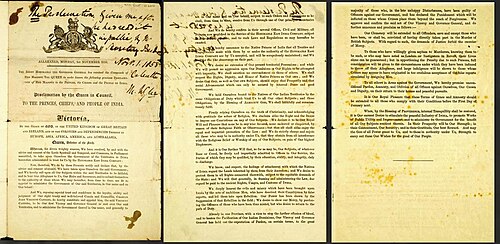
أجبرت الثورة الهندية عام 1857 الحكومة البريطانية على إصدار القانون. وبعد بضعة أشهر، أصدرت الملكة فيكتوريا إعلانًا إلى "أمراء وزعماء وشعب الهند"، جاء فيه، من بين أمور أخرى: "إننا نلتزم تجاه سكان أراضينا الهندية بنفس واجب الالتزام الذي نلتزم به تجاه جميع رعايا بلادنا الآخرين" (ص 2).
الأحكام
- كان من المقرر أن تُعهد أراضي الشركة في الهند إلى الملكة ، وأن تتوقف الشركة عن ممارسة سلطتها وسيطرتها على هذه الأراضي. وكان من المقرر أن تُحكم الهند باسم الملكة.
- تسلّم وزير الدولة الرئيسي للملكة صلاحيات وواجبات مجلس إدارة الشركة. وعُيّن مجلسٌ مؤلف من خمسة عشر عضوًا لمساعدة وزير الدولة لشؤون الهند، وأصبح هذا المجلس هيئةً استشاريةً في الشؤون الهندية. وبذلك، أصبح وزير الدولة القناة الرئيسية للتواصل بين بريطانيا والهند.
- كان وزير الدولة لشؤون الهند مخولاً بإرسال بعض المراسلات السرية إلى الهند مباشرة دون استشارة المجلس. كما كان مخولاً بتشكيل لجان خاصة تابعة للمجلس.
- The Crown was empowered to appoint a Governor-General and the governors of the presidencies.
- An Indian Civil Service was to be created under the control of the Secretary of State.
- All the property and other assets of the East India Company were transferred to the Crown. The Crown also assumed the responsibilities of the company as they related to treaties, contracts, and so forth.[3]
The act ushered in a new period of Indian history, bringing about the end of Company rule in India. The era of the new British Raj would last until the Partition of India in August 1947, when the territory of India was granted dominion status as the Dominion of Pakistan and the Dominion of India.[3]
Significance
The act is one of the most consequential pieces of legislation in the constitutional history of India:
- It formally ended the rule of the East India Company and transferred all powers, territories, and revenues of the Company to the British Crown, marking the beginning of the era of the British Raj in India.
- The Governor-General of India was given the additional title of Viceroy of India, making him the direct representative of the British Crown in India — Lord Canning becoming the first Viceroy.
- It abolished the dual control system established by Pitt's India Act 1784 (24 Geo. 3. Sess. 2. c. 25) by scrapping both the Court of Directors and the Board of Control, replacing them with a single Secretary of State for India assisted by a 15-member Council of India.
- The Secretary of State for India was a member of the British Cabinet, directly accountable to the British Parliament — thereby bringing Indian administration under full parliamentary oversight for the first time.
- The Doctrine of Lapse, aggressively used by Lord Dalhousie to annex Indian states, was formally abolished, and the right of Indian princes to adopt heirs was recognised — helping to restore trust between the British Crown and Indian princely states.
- Queen Victoria's Proclamation of 1858, issued under the authority of the act, promised non-interference in Indian religious practices, equal opportunity in public service regardless of race or creed, and respect for the rights and dignity of Indian princes — setting a new tone for British governance in India.
- The Indian Civil Service (ICS), established under the act, was formally opened to Indians through competitive examinations, although in practice access remained limited due to examinations being held only in Britain.
- The act marked the formal recognition of India as a direct Crown possession, replacing the anomalous position of a territory governed by a trading company under parliamentary licence.
Limitations
Despite its historic importance, the act had several significant shortcomings:
- The act made no structural changes to the actual administration of India on the ground — the same officials, laws, and administrative machinery of the Company simply continued under Crown authority, leading critics to observe that it changed the masters but not the system.
- The Secretary of State held near-absolute authority over Indian affairs and could send secret dispatches to the Viceroy without consulting even his own Council of India — making genuine parliamentary accountability largely illusory.
- The Council of India, which advised the Secretary of State, consisted entirely of Britons with Indian experience and included no Indian members, leaving the Indian population with no voice in decisions affecting them.
- While Queen Victoria's Proclamation promised equal opportunity in public service, the civil service examinations were held exclusively in London, in the English language, and within a narrow age range — effectively excluding the vast majority of Indians.
- The act made no provision for the expansion of Indian representation in legislative councils — an omission that fuelled the growing Indian nationalist movement and necessitated the Indian Councils Act 1861 (24 & 25 Vict. c. 67).
- The abolition of the Doctrine of Lapse, while welcomed by Indian princes, did nothing to address the political and economic grievances of ordinary Indians, including the exploitative revenue system, restrictions on Indian trade, and the suppression of civil liberties.
- The centralised nature of authority under the Viceroy and the Secretary of State made the governance of a vast and diverse subcontinent inherently rigid and unresponsive to local needs — a structural flaw that would take decades and multiple legislative reforms to partially address.
Subsequent developments
The whole act, except section 4, was repealed by section 130 of, and the fourth schedule to, the Government of India Act 1915 (5 & 6 Geo. 5. c. 61), which came into force on 1 January 1916.[4]
Section 4 of the act was repealed by section 11(2) of, and the fourth schedule to, the Ministers of the Crown Act 1937 (1 Edw. 8. & 1 Geo. 6. c. 38), which came into force on 1 July 1937.[5]
See also
Notes
- 12The citation of this act by this short title was authorised by section 1 of, and the first schedule to, the Short Titles Act 1896. Due to the repeal of those provisions it is now authorised by section 19(2) of the Interpretation Act 1978.
- ↑Section 74.
References
- ↑Wolpert, Stanley (1989). A New History of India (3d ed.), pp. 239–240. Oxford University Press. ISBN 0-19-505637-X.
- ↑Klein, Ira (July 2000). "Materialism, Mutiny and Modernization in British India". Modern Asian Studies. 34 (3): 564. JSTOR 313141.
- 12"Official, India". World Digital Library. 1890–1923. Retrieved 30 May 2013.
- ↑"Government of India Act 1915", legislation.gov.uk, The National Archives, Geo5/5-6 c. 61
- ↑"Ministers of the Crown Act 1937", legislation.gov.uk, The National Archives, Edw8and1Geo6/1 c. 38
External links
- One Scholar's Bibliography
- Partial text of Government of India Act 1858
- Partial text of Government of India Act, 1858 (21 & 22 Vict. c. 106)
- Complete text of the Government of India Act 1858, (21 & 22 Vict. c.106.
- United Kingdom Acts of Parliament 1858
- Acts of the Parliament of the United Kingdom concerning India
- Repealed acts of the Parliament of the United Kingdom
- 1858 in British India
- August 1858
- Henry John Temple, 3rd Viscount Palmerston
- East India Company Acts