
تاريخ الهند

تشير التقديرات إلى أن الإنسان الحديث تشريحياً وصل لأول مرة إلى شبه القارة الهندية بين 73,000 و55,000 عام مضت. [ 1 ] وتعود أقدم البقايا البشرية المعروفة في جنوب آسيا إلى 30,000 عام مضت. بدأ الاستقرار في جنوب آسيا حوالي عام 7000 قبل الميلاد؛ وبحلول عام 4500 قبل الميلاد، انتشرت الحياة المستقرة، [ 2 ] وتطورت تدريجياً إلى حضارة وادي السند ، إحدى الحضارات الثلاث الأولى في العالم القديم ، [ 3 ] والتي ازدهرت بين عامي 2500 و1900 قبل الميلاد في باكستان الحالية وشمال غرب الهند. في أوائل الألفية الثانية قبل الميلاد، تسبب الجفاف المستمر في تشتت سكان وادي السند من المراكز الحضرية الكبيرة إلى القرى. حوالي عام 1800-1500 قبل الميلاد، انتقلت القبائل الهندية الآرية إلى المنطقة الشمالية الغربية من الهند، البنجاب الحالية ، من آسيا الوسطى في عدة موجات هجرة . تميز العصر الفيدي للشعوب الفيدية في شمال الهند (1500-500 قبل الميلاد) بتأليف مجموعاتهم الواسعة من الترانيم ( الفيدا ). كان النظام الاجتماعي هرميًا بشكل غير محكم عبر نظام فارنا ، الذي اندمج لاحقًا في نظام جاتي المتطور للغاية في عصرنا الحالي . انتشر الهنود الآريون، الرعاة الرحل، من البنجاب إلى سهل الغانج . حوالي عام 600 قبل الميلاد، حدثت موجة تحضر ثانية أسفرت عن ظهور ثقافة إقليمية جديدة؛ ثم تم دمج الممالك الصغيرة (جاناباداس) في دول عظيمة ( ماهاجاناباداس ). شهدت هذه الفترة ظهور حركات زهدية جديدة ومفاهيم دينية جديدة، [ 4 ] بما في ذلك ظهور الجاينية والبوذية . اندمجت البوذية مع الثقافات الدينية السابقة في جنوب آسيا، مما أدى إلى ظهور الهندوسية .


أطاح تشاندراغوبتا موريا بإمبراطورية ناندا وأسس أول إمبراطورية عظيمة في الهند القديمة، وهي إمبراطورية موريا . ويُعرف ملك موريا الهندي، أشوكا، على نطاق واسع بحرب كالينغا العنيفة ، واعتناقه البوذية تاريخيًا ، ومحاولاته لنشر اللاعنف والسلام في جميع أنحاء إمبراطوريته. وتشهد هذه الفترة انتشارًا سريعًا للديانات الشرامانية.
انهارت إمبراطورية موريا عام 185 قبل الميلاد، إثر اغتيال الإمبراطور بريهادراثا على يد قائده بوشياميترا شونغا . وتفككت إمبراطورية شونغا في شمال وشمال شرق شبه القارة الهندية إلى دويلات أصغر. أما في الشمال الغربي، فقد أسس الإغريق البختريون الممالك الهندية اليونانية ، التي حلت محلها غزوات متتالية من الهنود السكيثيين ، والهنود البارثيين، وإمبراطوريات كوشان . وفي القرنين الرابع والسادس الميلاديين، أعادت إمبراطورية جوبتا ، التي انطلقت من ماجادها الكبرى ، توحيد هذه المناطق، كما ورد في عمود دلهي الحديدي . وتُعرف هذه الفترة، التي شهدت نهضة دينية وفكرية هندوسية ، بالعصر الكلاسيكي أو الذهبي للهند . وانتشرت جوانب من الحضارة والإدارة والثقافة والدين الهندي في معظم أنحاء آسيا، مما أدى إلى قيام ممالك متأثرة بالثقافة الهندية في المنطقة، مُشكلةً الهند الكبرى . [ 5 ] [ 4 ]
بدأت إمبراطورية جوبتا بالتراجع تدريجيًا نتيجةً لغزوات متكررة من شعب الهونا وفقدانها لأراضيها الأساسية. وقد تصدى حكام المناطق لغزوات الهونا، بمن فيهم يشودهارمان المدعوم من سلالة جوبتا المتأخرة ، ثم هارشا . وأدى الغزو الواسع النطاق لشعب الهونا واندماجهم إلى ظهور سلالة براتيهارا التوفيقية . وكان الحدث الأبرز بين القرنين السابع والحادي عشر هو الصراع الثلاثي الذي تمحور حول كانوج، والذي أسفر عن انتصار براتيهارا.
شهد جنوب الهند صعود قوى إمبراطورية متعددة منذ منتصف القرن الخامس. غزت سلالة تشولا جنوب الهند في القرن الحادي عشر. وفي أوائل العصور الوسطى، أثرت الرياضيات الهندية ، بما في ذلك الأرقام الهندوسية ، على تطور الرياضيات وعلم الفلك في العالم العربي ، بما في ذلك ابتكار نظام الأرقام الهندوسية العربية . [ 6 ]
حققت الفتوحات الإسلامية تقدماً محدوداً في أفغانستان والسند الحديثتين منذ القرن الثامن الميلادي، [ 7 ] تلتها غزوات محمود الغزنوي . [ 8 ] حكمت سلطنة دلهي ، التي أسسها الأتراك من آسيا الوسطى عام 1206، معظم شمال الهند في القرن الرابع عشر. وتناوبت على حكمها سلالات تركية وأفغانية مختلفة، من بينها سلالة التغلق الهندية التركية . [ 9 ] [ 10 ] تراجعت الإمبراطورية في أواخر القرن الرابع عشر بعد غزوات تيمورلنك ، [ 11 ] وشهد ذلك ظهور سلطنات مالوا وغوجارات وبهمني ، التي انقسمت الأخيرة عام 1518 إلى سلطنات الدكن الخمس. كما برزت سلطنة البنغال الثرية كقوة عظمى، واستمرت لأكثر من ثلاثة قرون . [ 12 ] خلال هذه الفترة، ظهرت ممالك هندوسية قوية متعددة، أبرزها إمبراطورية فيجاياناغارا ودول راجبوت التابعة لمملكة ميوار، ولعبت أدوارًا مهمة في تشكيل المشهد الثقافي والسياسي للهند. [ 13 ] [ 14 ]
بدأ العصر الحديث المبكر في القرن السادس عشر، عندما غزت الإمبراطورية المغولية معظم شبه القارة الهندية، [ 15 ] مُعلنةً بذلك بداية التصنيع ، لتصبح أكبر اقتصاد وقوة صناعية في العالم. [ 16 ] [ 17 ] [ 18 ] عانى المغول من تراجع تدريجي في أوائل القرن الثامن عشر، ويعود ذلك في معظمه إلى صعود قوة الماراثا ، الذين سيطروا على مناطق شاسعة من شبه القارة الهندية، بالإضافة إلى الغزوات الأفغانية المتعددة . [ 19 ] [ 20 ] [ 21 ] سيطرت شركة الهند الشرقية ، بصفتها قوة سيادية نيابةً عن الحكومة البريطانية ، تدريجيًا على مساحات شاسعة من الهند بين منتصف القرن الثامن عشر ومنتصف القرن التاسع عشر. أدت سياسات حكم الشركة في الهند إلى ثورة الهند عام 1857. بعد ذلك، خضعت الهند لحكم التاج البريطاني المباشر ، في ظل الحكم البريطاني (الراج البريطاني ). بعد الحرب العالمية الأولى ، أطلق المؤتمر الوطني الهندي ، بقيادة المهاتما غاندي ، نضالاً وطنياً من أجل الاستقلال. وفي وقت لاحق، دعت الرابطة الإسلامية لعموم الهند إلى دولة قومية مستقلة ذات أغلبية مسلمة . وفي أغسطس/آب 1947، قُسّمت الإمبراطورية البريطانية الهندية إلى دومينيون الهند ودومينيون باكستان ، ونالت كل منهما استقلالها.
العصر ما قبل التاريخ (قبل حوالي 3300 قبل الميلاد)

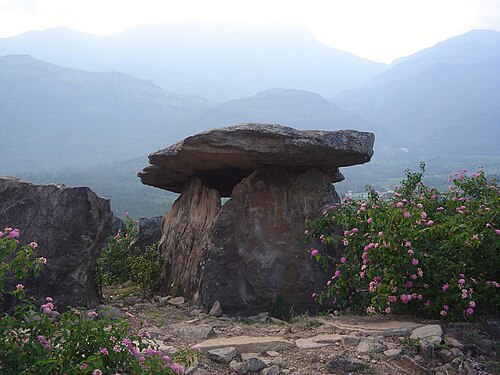

العصر الحجري القديم
تشير التقديرات إلى أن توسع أشباه البشر من أفريقيا وصل إلى شبه القارة الهندية قبل حوالي مليوني عام، وربما قبل ذلك بنحو 2.2 مليون عام. [ 25 ] [ 26 ] [ 27 ] ويستند هذا التأريخ إلى الوجود المعروف للإنسان المنتصب في إندونيسيا قبل 1.8 مليون عام وفي شرق آسيا قبل 1.36 مليون عام، بالإضافة إلى اكتشاف أدوات حجرية في ريوات بباكستان. [ 26 ] [ 28 ] ورغم وجود بعض الاكتشافات الأقدم، إلا أن التواريخ المقترحة، والمستندة إلى تأريخ الرواسب النهرية ، لم يتم التحقق منها بشكل مستقل. [ 27 ] [ 29 ]
أقدم بقايا أحفورية بشرية في شبه القارة الهندية هي تلك الخاصة بالإنسان المنتصب (Homo erectus) أو الإنسان الهايدلبرغي (Homo heidelbergensis) ، من وادي نارمادا في وسط الهند، ويعود تاريخها إلى حوالي نصف مليون سنة. [ 26 ] [ 29 ] وقد تم الادعاء باكتشاف أحافير أقدم، لكنها تُعتبر غير موثوقة. [ 29 ] تشير مراجعات الأدلة الأثرية إلى أن استيطان أشباه البشر لشبه القارة الهندية كان متقطعًا حتى حوالي 700,000 سنة مضت، ثم انتشر جغرافيًا على نطاق واسع بحلول حوالي 250,000 سنة مضت. [ 29 ] [ 27 ]
بحسب تيم دايسون، المؤرخ الديموغرافي المتخصص في تاريخ جنوب آسيا، دخل الإنسان العاقل الجزء الشمالي الغربي من شبه القارة الهندية في مجموعات صغيرة قبل ما بين 60,000 و80,000 عام، على الأرجح عبر الساحل. ووصف وجود البشر في شبه القارة قبل 55,000 عام بأنه "شبه مؤكد"، مع أنه أشار أيضاً إلى أن أقدم الأحافير المكتشفة لا يعود تاريخها إلا إلى 30,000 عام. [ 30 ]
وفقًا لمايكل د. بيتراجليا وبريدجيت ألتشين ، " يبلغ متوسط تواريخ الاندماج لمعظم السكان غير الأوروبيين ما بين 73-55 ألف سنة." [ 31 ]
يشير مؤرخ جنوب آسيا، مايكل إتش. فيشر، إلى أن الباحثين يقدرون أن أول توسع ناجح للبشر عبر شبه الجزيرة العربية حدث بين 80,000 و40,000 سنة مضت. وكان أحد المسارات التي امتد عبرها نطاق السكان البشريين هو ساحل الخليج العربي وشمال المحيط الهندي، حيث دخلت مجموعات من البشر الهند بين 75,000 و35,000 سنة مضت. [ 32 ]
تشير الأدلة الأثرية إلى وجود إنسان حديث تشريحياً في شبه القارة الهندية قبل 78000 إلى 74000 عام، [ 33 ] على الرغم من أن هذا التفسير محل خلاف. [ 34 ] [ 35 ] وقد حوّل استيطان الإنسان الحديث لجنوب آسيا، في البداية بأشكال مختلفة من العزلة كصيادين وجامعين للثمار، المنطقة إلى بيئة شديدة التنوع، لا تضاهيها في التنوع الجيني البشري سوى أفريقيا. [ 36 ]
بحسب دايسون، تتمتع المنطقة بمستوى عالٍ للغاية من التنوع الجيني، لا يفوقه إلا تنوع سكان أفريقيا. ويرتبط بهذا أدلة قوية على أحداث "التأسيس"، حيث تنحدر مجموعة فرعية، كقبيلة مثلاً، من عدد قليل من الأفراد "الأصليين". كما يتميز سكان هذه المنطقة بممارستهم مستويات أعلى من الزواج الداخلي مقارنةً بغيرهم. [ 36 ]
العصر الحجري الحديث


ظهرت الحياة المستقرة في شبه القارة الهندية على الهوامش الغربية لرواسب نهر السند قبل حوالي 9000 عام، وتطورت تدريجيًا إلى حضارة وادي السند في الألفية الثالثة قبل الميلاد. [ 2 ] [ 38 ] ووفقًا لتيم دايسون: "بحلول 7000 عام مضت، كانت الزراعة راسخة في بلوشستان... [و] انتشرت ببطء شرقًا إلى وادي السند." ويضيف مايكل فيشر: [ 39 ]
أقدم مثال مكتشف لمجتمع زراعي راسخ ومستقر هو موقع مهرغار في التلال الواقعة بين ممر بولان وسهل نهر السند (في باكستان حاليًا) (انظر الخريطة 3.1). منذ حوالي 7000 قبل الميلاد، بدأت المجتمعات هناك باستثمار المزيد من الجهد في تجهيز الأرض واختيار وزراعة ورعاية وحصاد محاصيل الحبوب. كما قاموا بتدجين الحيوانات، بما في ذلك الأغنام والماعز والخنازير والثيران (بنوعيها: الزيبو السنامي [ Bos indicus ] والثور غير السنامي [ Bos taurus ]). على سبيل المثال، أدى خصي الثيران إلى تحويلها من مصدر رئيسي للحوم إلى حيوانات جرّ مدجنة أيضًا. [ 39 ]
العصر البرونزي (حوالي 3300 - 1800 قبل الميلاد)
حضارة وادي السند
بدأ العصر البرونزي في شبه القارة الهندية حوالي عام 3300 قبل الميلاد. وكانت منطقة وادي السند واحدة من ثلاث مهود مبكرة للحضارة في العالم القديم ؛ وكانت حضارة وادي السند هي الأكثر اتساعًا، [ 3 ] وربما بلغ عدد سكانها في ذروتها خمسة ملايين نسمة. [ 40 ]
تركزت الحضارة بشكل أساسي في باكستان الحالية، في حوض نهر السند، وبشكل ثانوي في حوض نهري غاغار-هاكرا . ازدهرت حضارة السند الناضجة من حوالي 2600 إلى 1900 قبل الميلاد، مما يمثل بداية الحضارة المدنية في شبه القارة الهندية. وشملت مدنًا مثل هارابا ، وجانويروال ، وموهينجو دارو في باكستان الحالية، ودولافيرا ، وكاليبانجان ، وراخيغارهي ، ولوثال في الهند الحالية.
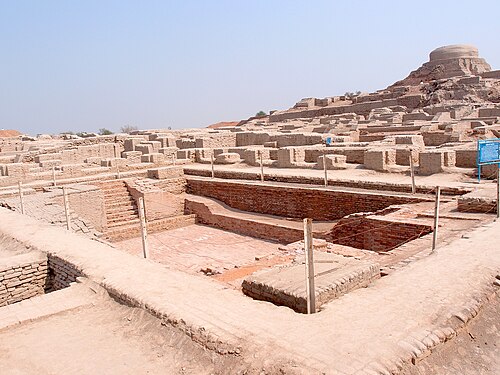


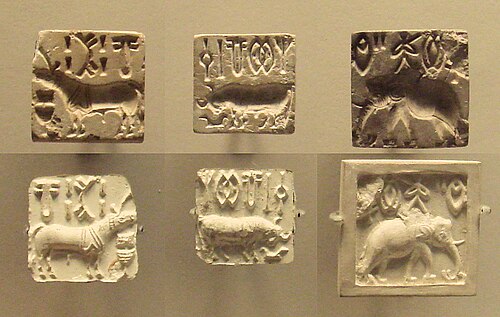
طوّر سكان وادي نهر السند القديم، المعروفون باسم الهارابيين، تقنيات جديدة في علم المعادن والحرف اليدوية، وأنتجوا النحاس والبرونز والرصاص والقصدير. [ 42 ] تشتهر هذه الحضارة بمدنها المبنية من الطوب، وأنظمة تصريف المياه على جوانب الطرق، ويُعتقد أنها كانت تمتلك نوعًا من التنظيم البلدي. كما طوّرت هذه الحضارة كتابة السند ، وهي أقدم الكتابات الهندية القديمة ، والتي لم تُفك رموزها حتى الآن. [ 43 ] لهذا السبب، لا توجد أدلة مباشرة على وجود لغة هارابا ، وانتماءها غير مؤكد. [ 44 ]
بعد انهيار حضارة وادي السند، هاجر السكان من وديان نهري السند وغاجار-هاكرا، نحو سفوح جبال الهيمالايا في حوض نهري الغانج واليامونا. [ 45 ]
ثقافة الفخار ذي اللون المغرة

خلال الألفية الثانية قبل الميلاد، ازدهرت ثقافة الفخار الملون بالمغرة في منطقة غانغا يامونا دوآب. كانت هذه مستوطنات ريفية تعتمد على الزراعة والصيد. وكان سكانها يستخدمون أدوات نحاسية مثل الفؤوس والرماح والسهام والسيوف، كما كانوا يربون حيوانات مستأنسة. [ 47 ]
العصر الحديدي (حوالي 1800 - 200 قبل الميلاد)
العصر الفيدي (حوالي 1500 - 600 قبل الميلاد)
ابتداءً من حوالي عام 1900 قبل الميلاد، هاجرت القبائل الهندوآرية من آسيا الوسطى إلى شمال غرب الهند على عدة موجات . [ 48 ] [ 49 ] [ 50 ] وشهد العصر الفيدي كتابة الفيدا، وهي ترانيم دينية منسوبة إلى الشعوب الهندوآرية. وتركزت الثقافة الفيدية في جزء من شمال غرب الهند، بينما تميزت أجزاء أخرى من الهند بهوية ثقافية فريدة. وشهدت العديد من مناطق شبه القارة الهندية انتقالًا من العصر النحاسي إلى العصر الحديدي خلال هذه الفترة. [ 51 ]
تُوصَف الثقافة الفيدية في نصوص الفيدا ، التي لا تزال مقدسة لدى الهندوس، والتي نُسِخَت شفهيًا وتُناقلَت باللغة السنسكريتية الفيدية . تُعدّ الفيدا من أقدم النصوص الباقية في الهند. [ 52 ] وقد أسهمت الفترة الفيدية، التي امتدت من حوالي 1500 إلى 500 قبل الميلاد، [ 53 ] [ 54 ] في إرساء أسس العديد من الجوانب الثقافية لشبه القارة الهندية.
المجتمع الفيدي
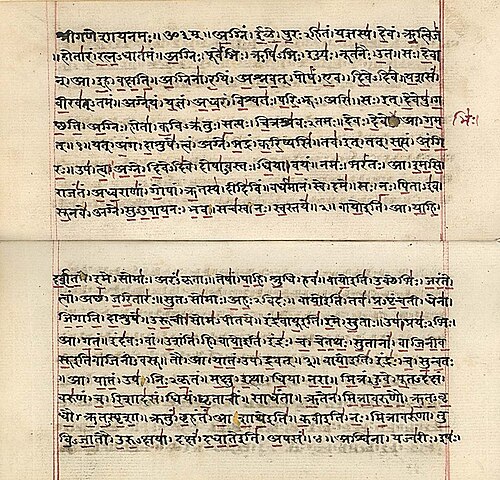
حلل المؤرخون الفيدا ليؤكدوا وجود ثقافة فيدية في البنجاب وسهل الغانج الأعلى . [ 51 ] وقد تم تقديس شجرة البيبال والبقرة بحلول زمن أثارفا فيدا . [ 56 ] وتعود جذور العديد من مفاهيم الفلسفة الهندية التي تم تبنيها لاحقًا، مثل الدارما ، إلى أصول فيدية. [ 57 ]
وُصِفَ المجتمع الفيدي المبكر في الريجفيدا ، أقدم نص فيدي، والذي يُعتقد أنه جُمِعَ خلال الألفية الثانية قبل الميلاد، [ 58 ] [ 59 ] في المنطقة الشمالية الغربية من شبه القارة الهندية. [ 60 ] في ذلك الوقت، كان المجتمع الآري يتألف في الغالب من جماعات قبلية ورعوية، متميزة عن التحضر الهاراباني الذي كان قد هُجِرَ. [ 61 ] من المحتمل أن يتوافق الوجود الهندوآري المبكر، جزئيًا، مع ثقافة الفخار الملون بالمغرة في السياقات الأثرية. [ 62 ] [ 63 ]
في نهاية العصر الريجفيدي، امتد المجتمع الآري من المنطقة الشمالية الغربية لشبه القارة الهندية إلى سهل الغانج الغربي . وازداد اعتماده على الزراعة، ونظم اجتماعياً وفقاً لتسلسل الطبقات الاجتماعية الأربع ( فارناس) . [ 64 ] تميز هذا الهيكل الاجتماعي باستبعاد بعض الشعوب الأصلية بتصنيف مهنها على أنها نجسة. [ 65 ] خلال هذه الفترة، بدأت العديد من الوحدات القبلية الصغيرة والمشيخات السابقة بالاندماج لتشكيل جاناباداس (كيانات سياسية ملكية على مستوى الدولة). [ 66 ]
الملاحم السنسكريتية
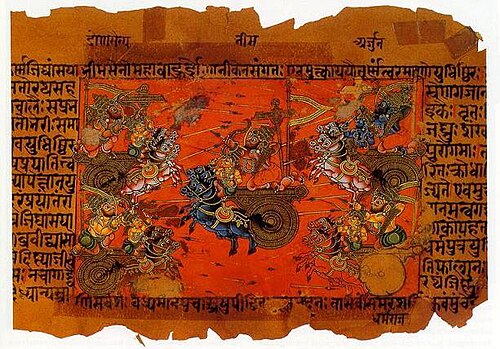
أُلِّفت الملحمتان السنسكريتيتان رامايانا وماهابهاراتا خلال هذه الفترة. [ 67 ] ولا تزال ماهابهاراتا أطول قصيدة منفردة في العالم. [ 68 ] افترض المؤرخون سابقًا وجود "عصر ملحمي" كبيئة لهاتين الملحمتين، لكنهم يُقرّون الآن بأن النصوص مرّت بمراحل تطور متعددة على مرّ القرون. [ 69 ] ويُعتقد أن النصوص الموجودة لهاتين الملحمتين تنتمي إلى العصر ما بعد الفيدي، بين حوالي 400 قبل الميلاد و400 ميلادي. [ 69 ] [ 70 ]
جاناباداس

يتميز العصر الحديدي في شبه القارة الهندية ، من حوالي 1200 قبل الميلاد إلى القرن السادس قبل الميلاد ، بظهور جاناباداس، وهي ممالك وجمهوريات - ولا سيما ممالك العصر الحديدي كورو وبانشالا وكوسالا وفيديها . [ 71 ] [ 72 ]
كانت مملكة كورو ( حوالي 1200-450 قبل الميلاد) أول مجتمع على مستوى الدولة في العصر الفيدي، والذي تزامن مع بداية العصر الحديدي في شمال غرب الهند، حوالي 1200-800 قبل الميلاد، [ 73 ] وكذلك مع تأليف أثارفا فيدا . [ 74 ] قامت دولة كورو بتنظيم الترانيم الفيدية في مجموعات، وطورت طقوس شروتا للحفاظ على النظام الاجتماعي. [ 74 ] كان من أبرز شخصيات دولة كورو الملك باريكشيت وخليفته جاناميجيا ، اللذان حوّلا هذه المملكة إلى القوة السياسية والاجتماعية والثقافية المهيمنة في شمال الهند. [ 74 ] عندما تراجعت مملكة كورو، انتقل مركز الثقافة الفيدية إلى جيرانهم الشرقيين، مملكة بانشالا. [ 74 ] يُعتقد أن ثقافة الفخار الرمادي الملون ( PGW ) الأثرية ، التي ازدهرت في منطقتي هاريانا بشمال شرق الهند وأوتار براديش غربًا من حوالي 1100 إلى 600 قبل الميلاد، [ 62 ] تتوافق مع مملكتي كورو وبانشالا . [ 74 ] [ 75 ]
خلال العصر الفيدي المتأخر، برزت مملكة فيديها كمركز جديد للثقافة الفيدية، تقع في أقصى الشرق (في ما يُعرف اليوم بنيبال وولاية بيهار )؛ [ 63 ] وبلغت ذروتها في عهد الملك جانكا ، الذي رعى بلاطه حكماء وفلاسفة البراهمة مثل ياجنافالكيا وأروني وجارجي فاتشاكنافي . [ 76 ] ويتزامن الجزء الأخير من هذه الفترة مع توحيد دول وممالك متزايدة الحجم، تُعرف باسم ماهاجاناباداس ، في جميع أنحاء شمال الهند.
التحضر الثاني (حوالي 600 - 200 قبل الميلاد)

شهدت الفترة بين 800 و200 قبل الميلاد ظهور حركة الشرامانا ، التي انبثقت منها الجاينية والبوذية . وكُتبت أولى الأوبانيشاد خلال هذه الفترة. بعد 500 قبل الميلاد، بدأت ما يُسمى بـ"التحضر الثاني" [ ملاحظة 1 ] ، مع ظهور مستوطنات حضرية جديدة في سهل الغانج. [ 78 ] وُضعت أسس "التحضر الثاني" قبل 600 قبل الميلاد، في ثقافة الفخار الرمادي الملون في غاغار-هاكرا وسهل الغانج العلوي؛ على الرغم من أن معظم مواقع الفخار الرمادي الملون كانت عبارة عن قرى زراعية صغيرة، إلا أن "عشرات" المواقع ظهرت في نهاية المطاف كمستوطنات كبيرة نسبيًا يمكن وصفها بأنها مدن، أكبرها كانت محصنة بخنادق أو حواجز مائية وسدود ترابية مدعومة بأسوار خشبية. [ 79 ]
كان سهل الغانج الأوسط، حيث برزت مملكة ماجادها وشكّلت قاعدة إمبراطورية موريا ، منطقة ثقافية متميزة، [ 80 ] مع ظهور دول جديدة بعد عام 500 قبل الميلاد. [ 81 ] [ 82 ] وقد تأثرت هذه المنطقة بالثقافة الفيدية، [ 83 ] لكنها اختلفت اختلافًا كبيرًا عن منطقة كورو-بانشالا. [ 84 ] وكانت هذه المنطقة "أول منطقة معروفة بزراعة الأرز في جنوب آسيا ، وبحلول عام 1800 قبل الميلاد، كانت موطنًا لسكان العصر الحجري الحديث المتقدم المرتبطين بموقعي شيراند وتشيتشار". [ 85 ] وفي هذه المنطقة، ازدهرت الحركات الشرامانية، ونشأت الجاينية والبوذية. [ 75 ]
البوذية والجاينية


شهدت الفترة ما بين 800 قبل الميلاد و400 قبل الميلاد تأليف أقدم الأوبانيشاد ، [ 86 ] [ 87 ] [ 88 ] والتي تشكل الأساس النظري للهندوسية الكلاسيكية ، وتُعرف أيضًا باسم فيدانتا (خاتمة الفيدا ) . [ 89 ]
أدى التوسع الحضري المتزايد في الهند خلال القرنين السابع والسادس قبل الميلاد إلى ظهور حركات زهدية جديدة أو ما يُعرف بـ"الشامانا"، والتي تحدت التقاليد الراسخة للطقوس. [ 86 ] وكان ماهافيرا ( حوالي 599-527 قبل الميلاد)، داعية الجاينية ، وغوتاما بوذا ( حوالي 563-483 قبل الميلاد)، مؤسس البوذية، من أبرز رموز هذه الحركة. وقد انبثقت من الشامانا مفاهيم دورة الميلاد والموت، ومفهوم السامسارا ، ومفهوم التحرر. [ 90 ] ووجد بوذا طريقًا وسطًا خفف من حدة الزهد المفرط الذي اتسمت به ديانات الشامانا . [ 91 ]
في نفس الفترة تقريبًا، نشر ماهافيرا ( التيرثانكارا الرابع والعشرون في الجاينية) لاهوتًا أصبح فيما بعد الجاينية. [ 92 ] ومع ذلك، يعتقد أتباع الجاينية أن تعاليم التيرثانكارا أقدم من كل العصور المعروفة، ويعتقد الباحثون أن بارشفاناثا (حوالي 872 - حوالي 772 قبل الميلاد)، الذي مُنح مكانة التيرثانكارا الثالث والعشرين ، كان شخصية تاريخية. ويُعتقد أن الفيدا قد وثّقت عددًا من التيرثانكارا ونظامًا زهديًا مشابهًا لحركة الشرامانا . [ 93 ]
ماهاجاناباداس

شهدت الفترة الممتدة من حوالي 600 قبل الميلاد إلى حوالي 300 قبل الميلاد صعود المهاجاناباداس ، وهي ست عشرة مملكة قوية وجمهوريات أوليغارشية امتدت من غاندارا في الشمال الغربي إلى البنغال في الجزء الشرقي من شبه القارة الهندية، بما في ذلك أجزاء من منطقة ما وراء فينديا . [ 94 ] تشير النصوص البوذية القديمة ، مثل أنغوتارا نيكايا ، [ 95 ] بشكل متكرر إلى هذه الممالك والجمهوريات الست عشرة العظيمة : أنغا ، وأساكا ، وأفانتي ، وشيدي ، وغاندارا ، وكاشي ، وكامبوجا ، وكوسالا ، وكورو ، وماغادا ، ومالا ، وماتسيا (أو ماتشا)، وبانشالا ، وسوراسينا ، وفريجي ، وفاتسا . وشهدت هذه الفترة ثاني ازدهار كبير للتحضر في الهند بعد حضارة وادي السند . [ 96 ]

كانت "الجمهوريات" المبكرة أو " غاناسانغا " [ 97 ] ، مثل شاكياس وكولياس ومالاكاس وليتشافيس ، تتمتع بحكومات جمهورية. وقد وُجدت "غاناسانغا " [ 97 ] ، مثل مالاكاس التي تمركزت في مدينة كوسيناغارا ، ورابطة فاجيكا التي تمركزت في مدينة فايشالي ، منذ القرن السادس قبل الميلاد، واستمرت في بعض المناطق حتى القرن الرابع الميلادي. [ 98 ] وكانت عشيرة ليتشافيس أشهر عشائر الاتحاد الحاكم في فاجي ماهاجانابادا. [ 99 ]
تتزامن هذه الفترة، من الناحية الأثرية، مع ثقافة الفخار الأسود المصقول الشمالي . وقد تركزت هذه الثقافة بشكل خاص في سهل الغانج الأوسط، لكنها امتدت أيضًا عبر مساحات شاسعة من شمال ووسط شبه القارة الهندية، وتتميز بظهور مدن كبيرة ذات تحصينات ضخمة، ونمو سكاني ملحوظ، وتزايد التراتبية الاجتماعية، وشبكات تجارية واسعة النطاق، وبناء منشآت معمارية عامة وقنوات مائية، وصناعات حرفية متخصصة، ونظام للأوزان، وعملات معدنية مختومة ، وإدخال الكتابة بخطي براهمي وخاروشتي . [ 100 ] [ 101 ] كانت لغة النبلاء في ذلك الوقت هي السنسكريتية ، بينما تُعرف لغات عامة سكان شمال الهند باسم البراكريت .
بحلول زمن غوتاما بوذا ، اندمجت العديد من الممالك الست عشرة في أربع ممالك رئيسية . وهذه الممالك الأربع هي: فاتسا، وأفانتي، وكوسالا، وماجادها. [ 96 ]
السلالات الماغادية المبكرة

شكلت ماجادها إحدى الممالك الست عشرة الكبرى ( ماهاجاناباداس ، وتعني باللغة السنسكريتية "الممالك العظيمة") في الهند القديمة . كان قلب المملكة منطقة بيهار جنوب نهر الغانج ؛ وكانت عاصمتها الأولى راجاغريها (راجغير الحديثة)، ثم باتاليبوترا ( باتنا الحديثة ). توسعت ماجادها لتشمل معظم بيهار والبنغال بعد غزو ليتشافي وأنجا على التوالي، [ 102 ] ثم امتدت لتشمل جزءًا كبيرًا من شرق أوتار براديش وأوريسا. ذُكرت مملكة ماجادها القديمة بكثرة في النصوص الجينية والبوذية. كما ورد ذكرها في رامايانا وماهابهاراتا والبورانات . [ 103 ] أول إشارة إلى شعب ماجادها وردت في أثارفا فيدا، حيث ذُكروا إلى جانب أنجا وغانداري وموجافات . لعبت ماجادها دورًا هامًا في تطور الجينية والبوذية . تم دمج المجتمعات الجمهورية (مثل مجتمع راجاكومارا) في مملكة ماجادها. وكانت للقرى مجالسها الخاصة تحت قيادة زعمائها المحليين المعروفين باسم غراماكاس. وانقسمت إداراتها إلى وظائف تنفيذية وقضائية وعسكرية.
تشير المصادر القديمة، من نصوص البالي البوذية ، والنصوص الجينية ، والبورانات الهندوسية ، إلى أن مملكة ماجادها خضعت لحكم سلالتي براديوتا وهاريانكا ( حوالي 544-413 قبل الميلاد) لمدة 200 عام تقريبًا، أي حوالي 600-413 قبل الميلاد. وقد انتهج الملك بيمبيسارا، من سلالة هاريانكا، سياسة توسعية نشطة، فغزا أنجا في ما يُعرف اليوم بشرق بيهار وغرب البنغال . أُطيح بالملك بيمبيسارا وقُتل على يد ابنه، الأمير أجاتاشاترو ، الذي واصل سياسة ماجادها التوسعية. وخلال هذه الفترة، عاش غوتاما بوذا ، مؤسس البوذية، معظم حياته في مملكة ماجادها. وقد بلغ التنوير في بود جايا ، وألقى أول خطبة له في سارناث ، وعُقد أول مجمع بوذي في راججريها . [ 104 ] أُطيح بسلالة هاريانكا على يد سلالة شايشوناغا ( حوالي 413-345 قبل الميلاد). اغتيل آخر حكام شايشوناغا، كالاسوكا، على يد ماهابادما ناندا عام 345 قبل الميلاد، وهو أول من يُعرف باسم "الناندا التسعة" (ماهابادما ناندا وأبناؤه الثمانية).
إمبراطورية ناندا وحملة الإسكندر
استندت إمبراطورية ناندا إلى الأسس التي وضعها أسلافها من هاريانكا وشيشوناغا . [ 105 ] امتلكت الإمبراطورية جيشًا جرارًا، يتألف من 200,000 جندي مشاة ، و 20,000 فارس ، و2,000 عربة حربية ، و3,000 فيل حربي (وفقًا لأقل التقديرات). [ 106 ] [ 107 ]
إمبراطورية موريا


وحّدت إمبراطورية موريا (322-185 قبل الميلاد) معظم شبه القارة الهندية في دولة واحدة، وكانت أكبر إمبراطورية في جنوب آسيا. [ 108 ] في أوج اتساعها، امتدت إمبراطورية موريا شمالًا حتى الحدود الطبيعية لجبال الهيمالايا ، وشرقًا إلى ما يُعرف اليوم بولاية آسام . أما غربًا، فقد امتدت إلى ما وراء باكستان الحالية، وصولًا إلى جبال هندوكوش في ما يُعرف اليوم بأفغانستان. أسس هذه الإمبراطورية تشاندراغوبتا موريا بمساعدة تشاناكيا ( كوتيلية ) في ماجادها (في ولاية بيهار الحالية ) عندما أطاح بإمبراطورية ناندا . [ 109 ]
وسع تشاندراغوبتا نفوذه بسرعة غربًا عبر وسط وغرب الهند، وبحلول عام 317 قبل الميلاد، كانت إمبراطوريته قد سيطرت بالكامل على شمال غرب الهند. هزمت الإمبراطورية الماورية سلوقس الأول ، مؤسس الإمبراطورية السلوقية ، خلال الحرب السلوقية الماورية ، وبذلك كسبت أراضي إضافية غرب نهر السند. وخلف بيندوسارا ، ابن تشاندراغوبتا، العرش حوالي عام 297 قبل الميلاد. وبحلول وقت وفاته حوالي عام 272 قبل الميلاد، كان جزء كبير من شبه القارة الهندية تحت السيادة الماورية. ومع ذلك، ظلت منطقة كالينغا (حول ولاية أوديشا الحالية ) خارج سيطرة الماوريين، ربما مما أعاق التجارة مع الجنوب. [ 110 ]

خلف أشوكا بيندوسارا ، واستمر حكمه حتى وفاته حوالي عام 232 قبل الميلاد. [ 111 ] ورغم نجاح حملته ضد الكالينجيين حوالي عام 260 قبل الميلاد، إلا أنها أسفرت عن خسائر فادحة في الأرواح ومعاناة شديدة. دفع هذا أشوكا إلى نبذ العنف، واعتناق البوذية لاحقًا. [ 110 ] بدأت الإمبراطورية بالانحدار بعد وفاته، واغتيل آخر حكام الماوريين، بريهادراثا ، على يد بوشياميترا شونغا لتأسيس إمبراطورية شونغا . [ 111 ]
في عهد تشاندراغوبتا موريا وخلفائه، ازدهرت التجارة الداخلية والخارجية والزراعة والأنشطة الاقتصادية وتوسعت في جميع أنحاء الهند بفضل إنشاء نظام مالي وإداري وأمني موحد وفعال. بنى الموريون طريق جراند ترانك ، أحد أقدم وأطول الطرق الرئيسية في آسيا، والذي يربط شبه القارة الهندية بآسيا الوسطى. [ 112 ] بعد حرب كالينجا ، شهدت الإمبراطورية ما يقرب من نصف قرن من السلام والأمن في عهد أشوكا. كما تمتعت الهند الموريّة بعصر من الوئام الاجتماعي والتحول الديني وتوسع المعرفة العلمية. ساهم اعتناق تشاندراغوبتا موريا للجاينية في زيادة التجديد والإصلاح الاجتماعي والديني في مجتمعه، بينما يُقال إن اعتناق أشوكا للبوذية كان أساسًا لحكم السلام الاجتماعي والسياسي واللاعنف في جميع أنحاء الهند. رعى أشوكا البعثات البوذية في جميع أنحاء منطقة البحر الأبيض المتوسط الهندية ، وفي سريلانكا وجنوب شرق آسيا وغرب آسيا وشمال إفريقيا وأوروبا المتوسطية . [ 113 ]
يُعدّ كتاب "أرثاشاسترا" الذي كتبه تشاناكيا ومراسيم أشوكا أهمّ السجلات المكتوبة للعصر الماوري. ومن الناحية الأثرية، يقع هذا العصر ضمن حقبة الفخار الأسود المصقول الشمالي . قامت الإمبراطورية الماورية على اقتصاد ومجتمع حديثين وفعّالين، حيث كانت تجارة البضائع تخضع لرقابة حكومية صارمة. [ 114 ] ورغم غياب النظام المصرفي في المجتمع الماوري، إلا أن الربا كان شائعًا. وقد عُثر على كمّ كبير من السجلات المكتوبة حول الرق، مما يشير إلى انتشاره آنذاك. [ 115 ] خلال هذه الفترة، طُوّر نوعٌ من الفولاذ عالي الجودة يُسمى فولاذ ووتز في جنوب الهند، ثم صُدّر لاحقًا إلى الصين والجزيرة العربية. [ 116 ]
فترة سانغام

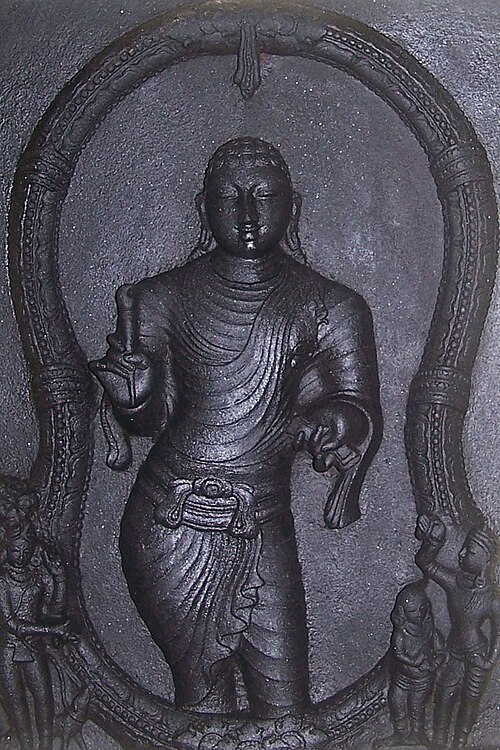
خلال فترة سانغام، ازدهرت الأدبيات التاميلية من القرن الثالث قبل الميلاد إلى القرن الرابع الميلادي. حكمت ثلاث سلالات تاميلية، تُعرف مجتمعة باسم ملوك تاميلكام الثلاثة المتوجين : سلالة تشيرا ، وسلالة تشولا ، وسلالة بانديا، أجزاءً من جنوب الهند. [ 118 ]
تتناول أدبيات سانغام تاريخ وسياسة وحروب وثقافة شعب التاميل في تلك الفترة. [ 119 ] وعلى عكس كتّاب السنسكريتية الذين كان معظمهم من البراهمة، فقد انتمى كتّاب سانغام إلى طبقات وخلفيات اجتماعية متنوعة، وكان معظمهم من غير البراهمة. [ 120 ]
في الفترة ما بين 300 قبل الميلاد و 200 ميلادي تقريبًا، تم تأليف "باثوباتو" ، وهي مختارات من عشرة كتب متوسطة الطول، تُعتبر جزءًا من أدب سانغام ؛ بالإضافة إلى تأليف ثماني مختارات من الأعمال الشعرية بعنوان "إيتوثوغاي" ، وثمانية عشر عملًا شعريًا قصيرًا بعنوان "باتينكيلكانكو "؛ وفي الوقت نفسه ، تم تطوير "تولكابيام" ، وهو أقدم عمل نحوي في اللغة التاميلية . [ 121 ] كما تم خلال فترة سانغام تأليف اثنتين من الملاحم الخمس الكبرى للأدب التاميلي . قام إيلانغو أديغال بتأليف سيلاباتيكارام ، وهو عمل غير ديني، يدور حول كاناجي ، [ 122 ] ومانيميكالاي ، التي ألفها تشيثالاي تشاتانار ، هي تكملة لسيلاباتيكارام ، وتروي قصة ابنة كوفالان ومادهافي ، التي أصبحت راهبة بوذية . [ 123 ] [ 124 ]
العصر الكلاسيكي (حوالي 200 قبل الميلاد - 650 ميلادي)
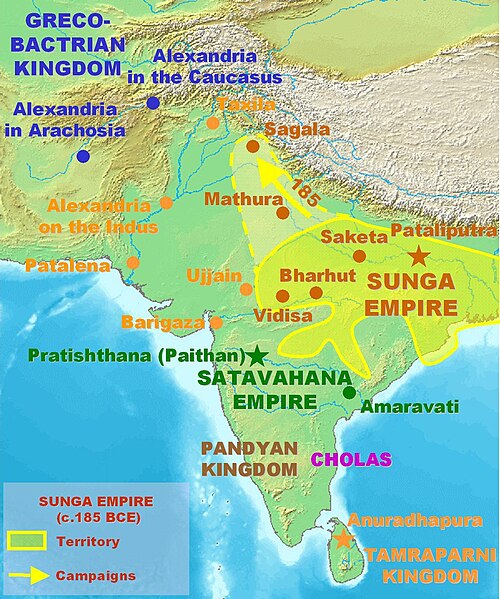 الهند القديمة خلال صعود إمبراطورية شونغا من الشمال، وسلالة ساتافاهانا من الدكن ، وسلالة بانديان وسلالة تشولا من الجزء الجنوبي من الهند .
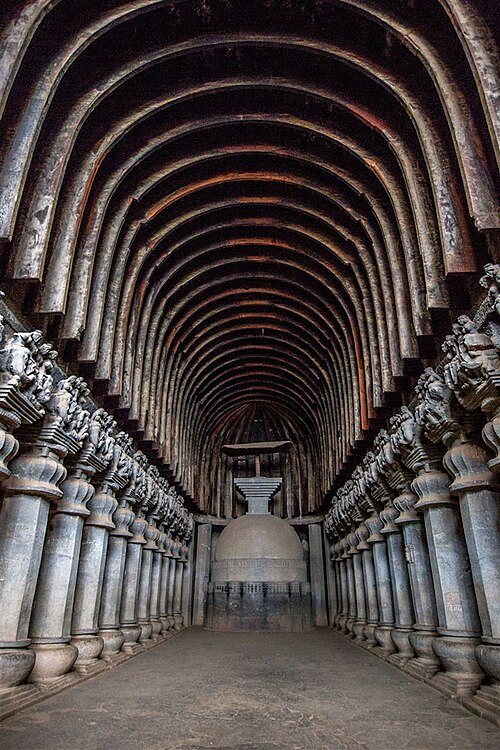 معبد تشايتيا العظيم في كهوف كارلا . تم تطوير الأضرحة على مدى الفترة من القرن الثاني قبل الميلاد إلى القرن الخامس الميلادي.
 تعد كهوف Udayagiri وKhandagiri موطنًا لنقش Hathigumpha ، الذي تم نقشه في عهد Kharavela ، ثم إمبراطور كالينجا من سلالة Mahameghavahana .
يُشار إلى الفترة الممتدة بين إمبراطورية موريا في القرن الثالث قبل الميلاد ونهاية إمبراطورية جوبتا في القرن السادس الميلادي باسم العصر الكلاسيكي للهند. [ 127 ] وتُعتبر إمبراطورية جوبتا (القرن الرابع إلى السادس الميلادي) العصر الذهبي للهند ، على الرغم من حكم العديد من الممالك للهند خلال هذه القرون. كما ازدهرت أدبيات سانجام في جنوب الهند من القرن الثالث قبل الميلاد إلى القرن الثالث الميلادي. [ 128 ] وخلال هذه الفترة، يُقدّر أن اقتصاد الهند كان الأكبر في العالم، إذ امتلك ما بين ثلث وربع ثروة العالم، وذلك من عام 1 ميلادي إلى عام 1000 ميلادي. [ 129 ] [ 130 ]
الفترة الكلاسيكية المبكرة (حوالي 200 قبل الميلاد - 320 ميلادي)
إمبراطورية شونغا


انحدرت سلالة الشونغا من ماجادها ، وسيطرت على مساحات شاسعة من وسط وشرق شبه القارة الهندية من حوالي 187 إلى 78 قبل الميلاد. أسس هذه السلالة بوشياميترا شونغا ، الذي أطاح بآخر أباطرة الموريا . كانت عاصمتها باتاليبوترا ، لكن أباطرة لاحقين، مثل بهاغابادرا ، اتخذوا من فيديشا ، بيسناغار الحديثة ، مقرًا لحكمهم . [ 131 ]
حكم بوشياميترا شونغا لمدة 36 عامًا، وخلفه ابنه أغنيميترا . تعاقب على حكم سلالة شونغا عشرة حكام. إلا أنه بعد وفاة أغنيميترا، تفككت الإمبراطورية سريعًا؛ [ 132 ] وتشير النقوش والعملات إلى أن معظم شمال ووسط الهند كان يتألف من ممالك صغيرة ودويلات مدن مستقلة عن أي هيمنة لسلالة شونغا. [ 133 ] اشتهرت الإمبراطورية بحروبها العديدة مع قوى أجنبية ومحلية على حد سواء. فقد خاضت حروبًا ضد سلالة ماهاميغافاهانا في كالينغا ، وسلالة ساتافاهانا في ديكان ، والهنود اليونانيين ، وربما أيضًا ضد البانشالا والميترا في ماثورا .
ازدهرت الفنون والتعليم والفلسفة وغيرها من أشكال المعرفة خلال هذه الفترة، بما في ذلك المعالم المعمارية مثل ستوبا بهارهوت وستوبا سانشي العظيمة الشهيرة . ساهم حكام شونغا في ترسيخ تقليد الرعاية الملكية للعلم والفن. كان الخط المستخدم في الإمبراطورية شكلاً من أشكال خط براهمي ، وقد استُخدم لكتابة اللغة السنسكريتية . لعبت إمبراطورية شونغا دورًا محوريًا في رعاية الثقافة الهندية في وقتٍ شهد بعضًا من أهم التطورات في الفكر الهندوسي.
إمبراطورية ساتافاهانا


اتخذ الساتافاهاناس من أمارافاتي في ولاية أندرا براديش مقراً لهم، بالإضافة إلى جونار ( بونه ) وبراتيشثان ( بايثان ) في ولاية ماهاراشترا . وامتدت إمبراطوريتهم لتشمل أجزاءً واسعة من الهند منذ القرن الأول قبل الميلاد. بدأ الساتافاهاناس كدول تابعة لسلالة موريا ، لكنهم أعلنوا استقلالهم مع انحطاطها.
اشتهرت سلالة ساتافاهانا برعايتها للهندوسية والبوذية، مما أدى إلى ظهور معالم بوذية تمتد من إلورا ( موقع تراث عالمي لليونسكو ) إلى أمارافاتي . وكانت من أوائل الولايات الهندية التي أصدرت عملات معدنية تحمل صور حكامها. وقد شكلت جسراً ثقافياً ولعبت دوراً حيوياً في التجارة ونقل الأفكار والثقافة من وإلى سهل الغانج الهندي وصولاً إلى أقصى جنوب الهند.
كان عليهم التنافس مع إمبراطورية شونغا ، ثم سلالة كانفا في ماجادها ، لترسيخ حكمهم. لاحقًا، لعبوا دورًا حاسمًا في حماية جزء كبير من الهند من الغزاة الأجانب كالساكا واليافانا والبهلافا . وعلى وجه الخصوص، استمر صراعهم مع الكشاترابا الغربيين لفترة طويلة. تمكن حكام سلالة ساتافاهانا البارزون ، غوتاميبوترا ساتكارني وسري ياجنا ساتكارني، من دحر الغزاة الأجانب كالكشاترابا الغربيين ووقف توسعهم. في القرن الثالث الميلادي، انقسمت الإمبراطورية إلى دويلات أصغر. [ 134 ]
التجارة والسفر إلى الهند
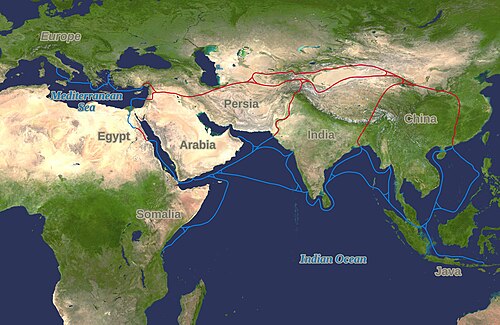
اجتذبت تجارة التوابل في ولاية كيرالا الهندية تجارًا من جميع أنحاء العالم القديم إلى الهند. وقد رسّخ ميناء موزيريس، الواقع على الساحل الجنوبي الغربي للهند ، مكانته كمركز تجاري رئيسي للتوابل منذ عام 3000 قبل الميلاد، وفقًا للسجلات السومرية . ووصل التجار اليهود إلى كوتشي ، بولاية كيرالا، في وقت مبكر يعود إلى عام 562 قبل الميلاد. [ 135 ] وتبع ذلك وصول التجار اليونانيين والرومانيين عبر التجارة على طول طريق البخور والطرق الهندية الرومانية . [ 136 ] وخلال القرن الثاني قبل الميلاد، التقت السفن اليونانية والهندية للتجارة في موانئ عربية مثل عدن . [ 137 ] وخلال الألفية الأولى قبل الميلاد، سيطر الهنود والإثيوبيون على الطرق البحرية المؤدية إلى الهند ، ليصبحوا القوة التجارية البحرية المهيمنة على البحر الأحمر .
نقل التجار الهنود العاملون في تجارة التوابل المطبخ الهندي إلى جنوب شرق آسيا، حيث لاقت خلطات التوابل والكاري رواجًا بين السكان المحليين. [ 138 ] دخلت البوذية الصين عبر طريق الحرير في القرن الأول أو الثاني الميلادي. [ 139 ] أصبحت المؤسسات الدينية الهندوسية والبوذية في جنوب وجنوب شرق آسيا مراكز إنتاج وتجارة بفضل تراكم رؤوس الأموال التي تبرع بها الرعاة. وانخرطت هذه المؤسسات في إدارة العقارات والحرف اليدوية والتجارة. ورافقت البوذية على وجه الخصوص التجارة البحرية، فساهمت في نشر المعرفة والفنون واستخدام العملات المعدنية. [ 140 ]
إمبراطورية كوشان


امتدت إمبراطورية كوشان من أفغانستان الحالية إلى شمال غرب شبه القارة الهندية بقيادة إمبراطورها الأول، كوجولا كادفيسيس ، في منتصف القرن الأول الميلادي تقريبًا. ويُحتمل أن الكوشان كانوا قبيلة تتحدث اللغة التخارية ، [ 141 ] إحدى الفروع الخمسة لاتحاد اليويتشي . [ 142 ] [ 143 ] وبحلول عهد حفيده، كانيشكا العظيم ، امتدت الإمبراطورية لتشمل معظم أفغانستان ، [ 144 ] ثم الأجزاء الشمالية من شبه القارة الهندية. [ 145 ]
كان الإمبراطور كانيشكا راعيًا عظيمًا للبوذية؛ إلا أنه مع توسع الكوشانيين جنوبًا، أصبحت آلهة عملاتهم اللاحقة تعكس أغلبيتهم الهندوسية الجديدة . [ 146 ] [ 147 ] قال المؤرخ فنسنت سميث عن كانيشكا:
لعب دور أشوكا الثاني في تاريخ البوذية. [ 148 ]
ربطت الإمبراطورية التجارة البحرية في المحيط الهندي بتجارة طريق الحرير عبر وادي نهر السند، مما شجع التجارة لمسافات طويلة، لا سيما بين الصين وروما . أدخل الكوشانيون اتجاهات جديدة إلى فنون غاندارا وماثورا الناشئة والمزدهرة ، والتي بلغت ذروتها خلال حكمهم. [ 149 ] تُعرف فترة السلام في ظل حكم الكوشانيين باسم باكس كوشانا . وبحلول القرن الثالث الميلادي، كانت إمبراطوريتهم في الهند تتفكك، وكان آخر إمبراطور عظيم معروف لهم هو فاسوديفا الأول . [ 150 ] [ 151 ]
العصر الكلاسيكي (حوالي 320 - 650 م)
إمبراطورية جوبتا

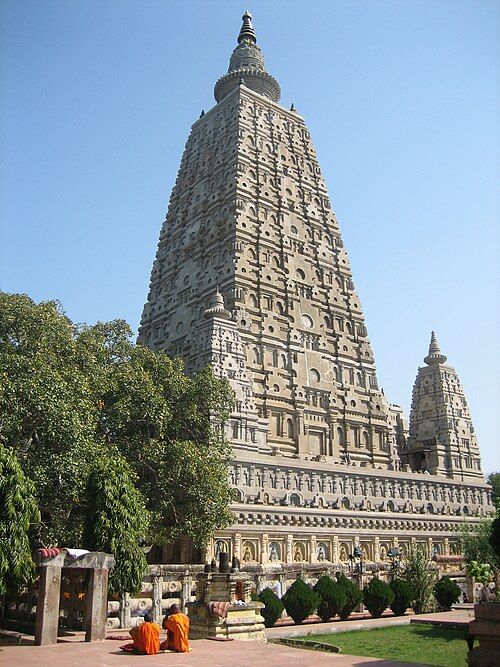
اشتهرت فترة حكم سلالة غوبتا بالإبداع الثقافي، لا سيما في الأدب والعمارة والنحت والرسم. [ 152 ] وقد أنجبت هذه الفترة علماء بارزين مثل كاليداسا ، وأريابهاتا ، وفاراهاميهيرا ، وفيشنو شارما ، وفاتسيايانا . مثّلت فترة حكم غوبتا نقطة تحول في الثقافة الهندية، إذ أقام الغوبتا طقوسًا دينيةً فيديةً لإضفاء الشرعية على حكمهم، كما رعوا البوذية، كبديلٍ عن المذهب البراهمي. وقد أخضعت المآثر العسكرية للحكام الثلاثة الأوائل - تشاندراغوبتا الأول ، وسامودراغوبتا ، وتشاندراغوبتا الثاني - جزءًا كبيرًا من الهند لحكمهم. وبلغت العلوم والإدارة السياسية آفاقًا جديدةً خلال عصر غوبتا. كما جعلت العلاقات التجارية القوية المنطقة مركزًا ثقافيًا هامًا، وجعلتها قاعدةً مؤثرةً في الممالك والمناطق المجاورة. [ 153 ] [ 154 ] وتُعرف فترة السلام في ظل حكم غوبتا باسم "باكس غوبتا" .
نجحت سلالة جوبتا الأخيرة في مقاومة الممالك الشمالية الغربية حتى وصول الهون الألخون ، الذين استقروا في أفغانستان في النصف الأول من القرن الخامس الميلادي، واتخذوا من باميان عاصمة لهم . [ 155 ] مع ذلك، لم تتأثر معظم مناطق جنوب الهند، بما في ذلك الدكن، بهذه الأحداث إلى حد كبير. [ 156 ] [ 157 ]
إمبراطورية فاكاتاكا
نشأت إمبراطورية فاكاتاكا في منطقة الدكن في منتصف القرن الثالث الميلادي. ويُعتقد أن دولتهم امتدت من الأطراف الجنوبية لمالوا وغوجارات شمالاً إلى نهر تونغابهادرا جنوباً، ومن بحر العرب غرباً إلى أطراف تشاتيسغار شرقاً. وكانوا أهم خلفاء سلالة ساتافاهانا في الدكن، وعاصروا سلالة غوبتا في شمال الهند ، وخلفهم سلالة فيشنوكندينا .
اشتهر آل فاكاتاكا برعايتهم للفنون والعمارة والأدب. وقد بُنيت الأديرة البوذية المنحوتة في الصخر، بما فيها الأديرة البوذية التقليدية (التي تُعد موقعًا للتراث العالمي لليونسكو )، برعاية الإمبراطور فاكاتاكا، هاريشينا . [ 158 ] [ 159 ]

 رهبان بوذيون يصلون أمام داغوبا كهف تشايتيا رقم 26 من كهوف أجانتا.
 قاعة الصلاة البوذية "تشايتيا غريها"، مع تمثال بوذا جالس، الكهف رقم 26 من كهوف أجانتا.
 تم إدراج العديد من السفراء والممثلين والمسافرين الأجانب كأتباع حضروا نزول بوذا من سماء تراياستريمسا؛ لوحة من الكهف رقم 17 من كهوف أجانتا.
مملكة كاماروبا

يذكر نقش عمود الله أباد الذي يعود للقرن الرابع الميلادي، والذي يعود إلى عهد سامودراغوبتا ، مملكتي كاماروبا ( غرب آسام ) [ 160 ] ودافاكا (وسط آسام) [ 161 ] كمملكتين حدوديتين لإمبراطورية جوبتا. وقد ضُمت دافاكا لاحقًا إلى كاماروبا، التي نمت لتصبح مملكة واسعة امتدت من نهر كاراتويا إلى ما يقارب ساديا الحالية ، وشملت وادي براهمابوترا بأكمله، وشمال البنغال ، وأجزاء من بنغلاديش ، وفي بعض الأحيان بورنيا وأجزاء من غرب البنغال . [ 162 ]
حكمت المنطقة ثلاث سلالات: فارماناس (حوالي 350-650 م)، وسلالة مليتشا (حوالي 655-900 م)، وكاماروبا-بالاس (حوالي 900-1100 م)، من عواصمها في غواهاتي الحالية ( براغجيوتيشبورا )، وتيزبور ( هاروبيسوارا ) ، وشمال غواهاتي ( دورجايا ) على التوالي. ادعت السلالات الثلاث جميعها نسبها إلى ناراكاسورا . في عهد ملك فارمان، بهاسكار فارمان (حوالي 600-650 م)، زار الرحالة الصيني شوانزانغ المنطقة وسجل رحلاته. لاحقًا، وبعد ضعف وتفكك سلالة كاماروبا-بالاس، امتدت تقاليدها إلى حد ما حتى حوالي عام 1100 م. في عام ١٢٥٥ ميلاديًا، أسست السلالتان القمريتان الأولى (حوالي ١١٢٠-١١٨٥ ميلاديًا) والثانية (حوالي ١١٥٥-١٢٥٥ ميلاديًا) مملكة كاماروبا. [ ١٦٣ ] انتهت مملكة كاماروبا في منتصف القرن الثالث عشر الميلادي عندما نقلت سلالة خين، بقيادة سانديا حاكم كاماروباناجارا (شمال غواهاتي)، عاصمتها إلى كاماتابور (شمال البنغال) بعد غزو الأتراك المسلمين، وأسست مملكة كاماتا . [ ١٦٤ ]
إمبراطورية بالافا

كان البالافا ، خلال القرنين الرابع والتاسع الميلاديين، إلى جانب الغوبتا في الشمال ، من أبرز رعاة تطوير اللغة السنسكريتية في جنوب شبه القارة الهندية. وشهد عهد البالافا ظهور أولى النقوش السنسكريتية بخط يُسمى غرانثا . [ 165 ] وارتبط البالافا الأوائل بدول جنوب شرق آسيا بعلاقات متنوعة. استخدم البالافا العمارة الدرافيدية لبناء بعض المعابد والأكاديميات الهندوسية الهامة في مامالابورام وكانشيبورام وغيرها من الأماكن؛ وشهد حكمهم بروز شعراء عظام. وانتشرت عادة تخصيص المعابد لآلهة مختلفة، تلاها فن معماري ونحتي راقٍ مستوحى من علم فاستو شاسترا . [ 166 ]
بلغت سلالة بالافاس ذروة قوتها خلال عهد ماهيندرافارمان الأول (571-630 م) وناراسيمهافارمان الأول (630-668 م) وسيطرت على مناطق التيلجو والأجزاء الشمالية من منطقة التاميل حتى نهاية القرن التاسع. [ 167 ]
إمبراطورية كادامبا

نشأت مملكة كادامبا في ولاية كارناتاكا ، وأسسها مايوراشارما عام 345 ميلادي، والتي أظهرت لاحقًا إمكاناتٍ للتطور إلى إمبراطورية. هزم الملك مايوراشارما جيوش بالافا في كانشي، ربما بمساعدة بعض القبائل المحلية. بلغت شهرة كادامبا ذروتها خلال حكم كاكوستافارما ، الحاكم البارز الذي أقامت معه ملوك سلالة جوبتا في شمال الهند تحالفات زواج. عاصر الكادامبا سلالة غانغا الغربية ، وشكّلوا معًا أوائل الممالك المحلية التي حكمت البلاد باستقلالٍ تام. استمرت السلالة لاحقًا في الحكم كدولة تابعة لإمبراطوريات كانادا الكبرى، إمبراطوريتي تشالوكيا وراشتراكوت ، لأكثر من خمسمائة عام، تفرّعت خلالها إلى سلالات أصغر ( كادامبا غوا ، كادامبا هالاسي ، وكادامبا هانغال ).
إمبراطورية هارشا

حكم هارشا شمال الهند من عام 606 إلى عام 647 ميلادي. كان ابن برابهاكارفاردانا والأخ الأصغر لراجيافاردانا ، وكانا من أعضاء سلالة فاردانا وحكما ثانسار ، في ولاية هاريانا الحالية .
بعد سقوط إمبراطورية جوبتا السابقة في منتصف القرن السادس الميلادي، عادت شمال الهند إلى جمهوريات أصغر ودول ملكية. وأدى الفراغ السلطوي إلى صعود سلالة فارداناس في ثانيسار، الذين بدأوا بتوحيد الجمهوريات والملكيات من البنجاب إلى وسط الهند. بعد وفاة والد هارشا وشقيقه، توّج ممثلو الإمبراطورية هارشا إمبراطورًا في أبريل 606 ميلادي، ومنحوه لقب مهراجا. [ 169 ] في أوج قوتها، امتدت إمبراطوريته لتشمل معظم شمال وشمال غرب الهند، وامتدت شرقًا حتى كاماروبا ، وجنوبًا حتى نهر نارمادا ؛ واتخذ في النهاية من كانوج (في ولاية أوتار براديش الحالية ) عاصمة له، وحكم حتى عام 647 ميلادي. [ 170 ]
جعل السلام والازدهار اللذان سادا بلاطه مركزًا للتعددية الثقافية، جاذبًا العلماء والفنانين والزوار الدينيين. [ 170 ] خلال هذه الفترة، اعتنق هارشا البوذية بعد أن كان هندوسيًا. [ 171 ] زار الرحالة الصيني شوانزانغ بلاط هارشا وكتب عنه وصفًا إيجابيًا للغاية، مشيدًا بعدله وكرمه. [ 170 ] تصف سيرته الذاتية " هارشاتشاريتا " ("أعمال هارشا")، التي كتبها الشاعر السنسكريتي بانابهاتا ، علاقته بثانيسار والقصر الذي كان يضم مبنى "دافالاغريها" (القصر الأبيض) المكون من طابقين. [ 172 ] [ 173 ]
الفترة القروسطية المبكرة (حوالي 650 - 1200)
بدأت فترة العصور الوسطى المبكرة في الهند بعد نهاية إمبراطورية جوبتا في القرن السادس الميلادي. [ 127 ] وتشمل هذه الفترة أيضًا "العصر الكلاسيكي المتأخر" للهندوسية، الذي بدأ بعد انهيار إمبراطورية هارشا في القرن السابع، [ 174 ] وانتهى في القرن الثالث عشر مع صعود سلطنة دلهي في شمال الهند؛ [ 175 ] وبداية إمبراطورية كانوج ، مما أدى إلى الصراع الثلاثي ؛ ونهاية سلالة تشولا المتأخرة بوفاة راجندرا تشولا الثالث عام 1279 في جنوب الهند؛ ومع ذلك، استمرت بعض جوانب الفترة الكلاسيكية حتى سقوط إمبراطورية فيجاياناغارا في الجنوب حوالي القرن السابع عشر.
من القرن الخامس إلى القرن الثالث عشر، تراجعت طقوس شروتا ، وازداد الدعم للشيفية والفيشنوية والشاكتية في البلاط الملكي، بينما تراجع الدعم للبوذية. [ 176 ] وكان من العوامل الرئيسية في تراجع البوذية عدم جاذبيتها لدى عامة الشعب الريفي، الذين اعتنقوا بدلاً منها الهندوسية البراهمية المتشكلة من التوليف الهندوسي ، وتضاؤل الدعم المالي من المجتمعات التجارية والنخب الملكية. [ 177 ]
في القرن السابع الميلادي، وضع كوماريلا بهاتا مدرسته الفلسفية ميمامسا ودافع عن موقفه بشأن الطقوس الفيدية. [ 178 ]
من القرن الثامن إلى القرن العاشر، تنافست ثلاث سلالات على السيطرة على شمال الهند: غوجارا براتيهارا في مالوا، وبالاس في البنغال، وراشتراكوتاس في الدكن. لاحقًا، سيطرت سلالة سينا على إمبراطورية بالا؛ وتفككت غوجارا براتيهارا إلى دويلات مختلفة، أبرزها مملكة مالوا ، ومملكة بونديلخاند ، ومملكة داهالا ، وتوماراس في هاريانا ، ومملكة سامبهار ، وكانت هذه الدويلات من أوائل ممالك راجبوت ؛ [ 179 ] بينما ضُمت الراشتراكوتاس إلى تشالوكيا الغربية . [ 180 ] خلال هذه الفترة، ظهرت سلالة تشالوكيا . شيّد آل تشولوكيا معابد ديلوارا ، ومعبد مودهيرا للشمس ، وبئر راني كي فاف [ 181 ] على طراز عمارة مارو-غورجارا ، وكانت عاصمتهم أنهيلوارا ( باتان الحديثة، غوجارات ) إحدى أكبر مدن شبه القارة الهندية، حيث قُدّر عدد سكانها بنحو 100,000 نسمة حوالي عام 1000. وشهد ازدهار باتان أيضًا إحياءً للجاينية في غوجارات خلال عهد هيمشاندراشاريا . واشتهرت المدينة بمجموعتها من المخطوطات الجاينية القديمة، وأصبحت مركزًا هامًا للدراسات الجاينية [ 182 ] ، مما أثار إعجاب العديد من العلماء. وقد وصف عالم الهنديات والسنسكريتية البريطاني بيتر بيترسون هذه المجموعة على النحو التالي:
لا أعرف مدينة في الهند، وقليلاً في العالم، يمكنها أن تتباهى بمثل هذا المخزون الهائل من الوثائق القديمة العريقة. ستكون هذه الوثائق فخرًا وكنزًا ثمينًا لأي مكتبة جامعية في أوروبا. [ 183 ]
برزت إمبراطورية تشولا كقوة عظمى خلال عهد راجا راجا تشولا الأول وراجيندرا تشولا الأول، اللذين نجحا في غزو أجزاء من جنوب شرق آسيا وسريلانكا في القرن الحادي عشر. [ 184 ] كان لاليتاديتيا موكتابيدا (حكم من 724 إلى 760) إمبراطورًا لسلالة كاركوتا الكشميرية ، التي مارست نفوذًا في شمال غرب الهند من عام 625 حتى عام 1003، وتلتها سلالة لوهارا . ينسب كالهانا في كتابه "راجاتارانجيني" إلى الملك لاليتاديتيا قيادة حملة عسكرية عدوانية في شمال الهند وآسيا الوسطى. [ 185 ] [ 186 ] [ 187 ]
حكمت سلالة شاهي الهندوسية أجزاءً من شرق أفغانستان وشمال باكستان وكشمير من منتصف القرن السابع إلى أوائل القرن الحادي عشر. وفي أوديشا، برزت إمبراطورية غانغا الشرقية ، التي اشتهرت بتطوير العمارة الهندوسية ، وأبرزها معبد جاغاناث ومعبد كونارك للشمس ، فضلاً عن رعايتها للفنون والآداب.
 معبد مارتاند الشمسي المركزي، مخصص للإله سوريا ، وقد بناه الحاكم الثالث لسلالة كاركوتا ، لاليتاديتيا موكتابيدا ، في القرن الثامن.
 معبد كونارك للشمس في كونارك ، أوريسا ، بناه ناراسيمها ديفا الأول (1238-1264) من سلالة غانغا الشرقية.

سلالة جوبتا اللاحقة

حكمت سلالة غوبتا المتأخرة منطقة ماجادها في شرق الهند بين القرنين السادس والسابع الميلاديين. وقد خلفت سلالة غوبتا المتأخرة سلالة غوبتا الإمبراطورية في حكم ماجادها، ولكن لا يوجد دليل يربط بين السلالتين؛ إذ يبدو أنهما عائلتين منفصلتين. [ 188 ] سُميت سلالة غوبتا المتأخرة بهذا الاسم لأن أسماء حكامها كانت تنتهي باللاحقة "-غوبتا"، والتي ربما اعتمدوها لتصوير أنفسهم كورثة شرعيين لسلالة غوبتا الإمبراطورية. [ 189 ]
إمبراطورية تشالوكيا
حكمت إمبراطورية تشالوكيا أجزاءً واسعة من جنوب ووسط الهند بين القرنين السادس والثاني عشر، كثلاث سلالات مترابطة وإن كانت مستقلة. حكمت أقدم هذه السلالات، والمعروفة باسم "تشالوكيا بادامي"، من فاتابي ( بادامي الحديثة ) منذ منتصف القرن السادس. بدأ تشالوكيا بادامي في تأكيد استقلالهم مع تراجع مملكة كادامبا في بانافاسي ، وسرعان ما برزوا خلال عهد بولاكشين الثاني . يُمثل حكم تشالوكيا علامة فارقة في تاريخ جنوب الهند وعصرًا ذهبيًا في تاريخ كارناتاكا . تحوّل المناخ السياسي في جنوب الهند من ممالك صغيرة إلى إمبراطوريات واسعة مع صعود تشالوكيا بادامي. سيطرت مملكة مركزها جنوب الهند على المنطقة الواقعة بين نهري كافيري ونارمادا، ووحدتها . شهد صعود هذه الإمبراطورية ظهور إدارة فعّالة، وتجارة خارجية مزدهرة، وتطور نمط معماري جديد يُعرف باسم "عمارة تشالوكيا". حكمت سلالة تشالوكيا أجزاء من جنوب ووسط الهند من بادامي في كارناتاكا بين عامي 550 و 750، ثم مرة أخرى من كالياني بين عامي 970 و 1190.
 يُعد معبد جالاجاناثا في مجمع باتاداكال ( موقع تراث عالمي لليونسكو ) مثالاً على فن العمارة في بادامي تشالوكيا

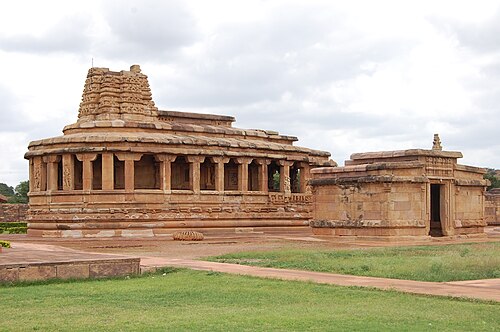 منظر خارجي لمعبد دورجا الذي يعود للقرن الثامن في مجمع أيهول . ويضم معابد وآثاراً هندوسية وبوذية وجاينية.
إمبراطورية راشتراكوت
أسس دانتيدورغا إمبراطورية راشتراكوت حوالي عام 753، [ 190 ] وحكمت من عاصمتها مانياخيتا لما يقرب من قرنين. [ 191 ] في أوج قوتها، امتد حكم الراشتراكوت من منطقة دوآب الغانج-يامونا شمالًا إلى رأس كومورين جنوبًا، وهي فترة ازدهار في الإنجازات المعمارية والأدبية. [ 192 ] [ 193 ]
كان حكام هذه السلالة الأوائل هندوسًا، لكن الحكام اللاحقين تأثروا بشدة بالجاينية. [ 194 ] يُعدّ كلٌّ من جوفيندا الثالث وأموغافارشا أشهرَ حكام هذه السلالة من بين سلسلة طويلة من الإداريين الأكفاء. كان أموغافارشا أيضًا مؤلفًا، وقد كتب " كافيراجامارغا" ، وهو أقدم عمل معروف باللغة الكنادية في علم الشعر. [ 191 ] [ 195 ] بلغ فن العمارة ذروته في الطراز الدرافيدي، ويُعدّ معبد كايلاسانات في إلورا أروع مثال على ذلك. ومن الإسهامات المهمة الأخرى معبد كاشيفيشفاناثا ومعبد جاين نارايانا في باتاداكال في كارناتاكا.
وصف الرحالة العربي سليمان إمبراطورية راشتراكوت بأنها إحدى الإمبراطوريات الأربع العظيمة في العالم. [ 196 ] شهدت فترة راشتراكوت بداية العصر الذهبي للرياضيات في جنوب الهند. وكان للرياضي الجنوب هندي العظيم ماهافيرا تأثير كبير على رياضيي جنوب الهند في العصور الوسطى. [ 197 ] كما رعى حكام راشتراكوت الأدباء بمختلف اللغات. [ 191 ]


إمبراطورية غوجارا-براتيهارا
لعبت سلالة غوجارا-براتيهارا دورًا محوريًا في صدّ الجيوش العربية المتجهة شرق نهر السند . هزم ناغابهاتا الأول الجيش العربي بقيادة جنيد وتمين خلال الحملات الأموية في الهند . [ 198 ] في عهد ناغابهاتا الثاني ، أصبحت سلالة غوجارا-براتيهارا أقوى سلالة حاكمة في شمال الهند. وخلفه ابنه رامابادرا ، الذي حكم لفترة وجيزة قبل أن يخلفه ابنه ميهيرا بهوجا . في عهد بهوجا وخليفته ماهيندرا بالا الأول ، بلغت إمبراطورية براتيهارا ذروة ازدهارها وقوتها. وبحلول عهد ماهيندرا بالا، امتدت أراضيها من حدود السند غربًا إلى بيهار شرقًا، ومن جبال الهيمالايا شمالًا إلى ما حول نهر نارمادا جنوبًا. [ 199 ] أدى هذا التوسع إلى صراع ثلاثي على السلطة مع إمبراطوريتي راشتراكوت وبالا للسيطرة على شبه القارة الهندية.
بحلول نهاية القرن العاشر، استغل العديد من الإقطاعيين التابعين للإمبراطورية الضعف المؤقت لغورجارا-براتيهارا لإعلان استقلالهم، ولا سيما مملكة مالوا، ومملكة بونديلخاند، وتوماراس هاريانا ، ومملكة سامبهار [ 200 ] ومملكة داهالا .

 منحوتات بالقرب من معبد تيلي كا ماندير، قلعة غواليور
 المعالم الأثرية والتماثيل الكهفية المتعلقة بالجاينية المنحوتة في واجهة الصخر داخل كهوف سيدهاشال ، قلعة غواليور
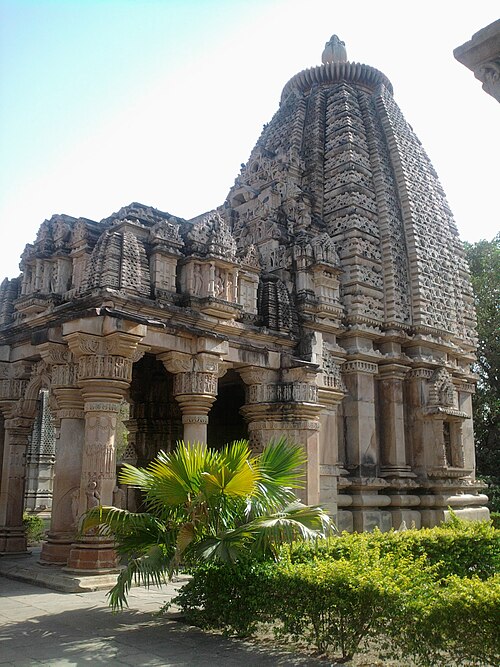 معبد غاتيشوارا ماهاديفا في مجمع معابد بارولي . مجمع من ثمانية معابد، بناها غوجارا-براتيهارا، داخل سور محيط.
سلالة غاهادافالا
حكمت سلالة غاهادافالا أجزاءً من ولايتي أوتار براديش وبيهار الهنديتين الحاليتين ، خلال القرنين الحادي عشر والثاني عشر. وكانت عاصمتهم تقع في فاراناسي . [ 202 ]
سلالة كارنات

في عام 1097 ميلادي، ظهرت سلالة كارنات في ميثيلا على الحدود بين بيهار ونيبال، واتخذت من داربانغا وسيمراونغاد عاصمتين لها . أسس هذه السلالة نانياديفا ، وهو قائد عسكري من أصل كارناتاكي. في عهد هذه السلالة، بدأت لغة المايثيلي بالتطور، حيث ظهر أول عمل أدبي بها، وهو كتاب " فارنا راتناكارا" ، في القرن الرابع عشر الميلادي على يد جيوتيريشوار ثاكور. كما شنّ الكارنات غارات على نيبال ، وسقطوا عام 1324 بعد غزو غياث الدين تغلق . [ 203 ] [ 204 ]
إمبراطورية بالا

تأسست إمبراطورية بالا على يد جوبالا الأول . [ 205 ] [ 206 ] [ 207 ] وحكمتها سلالة بوذية من البنغال. أعاد البالا توحيد البنغال بعد سقوط مملكة غودا التابعة لشاشانكا . [ 208 ]
كان البالاس من أتباع الماهايانا والتانترا البوذية ، [ 209 ] كما رعىوا الشيفية والفيشنوية . [ 210 ] بلغت الإمبراطورية ذروتها في عهد دارما بالا وديفابالا . يُعتقد أن دارما بالا قد غزا كانوج ووسع نفوذه حتى أقصى حدود الهند في الشمال الغربي. [ 210 ]
يمكن اعتبار إمبراطورية بالا العصر الذهبي للبنغال. [ 211 ] أسس دارما بالا فيكراماشيلا وأعاد إحياء نالاندا، [ 210 ] التي تُعدّ من أوائل الجامعات العظيمة في التاريخ المُسجّل. بلغت نالاندا أوج ازدهارها تحت رعاية إمبراطورية بالا. [ 211 ] [ 212 ] كما بنى البالا العديد من الأديرة . وحافظوا على علاقات ثقافية وتجارية وثيقة مع دول جنوب شرق آسيا والتبت . وقد أسهمت التجارة البحرية بشكل كبير في ازدهار إمبراطورية بالا.
تشولاس
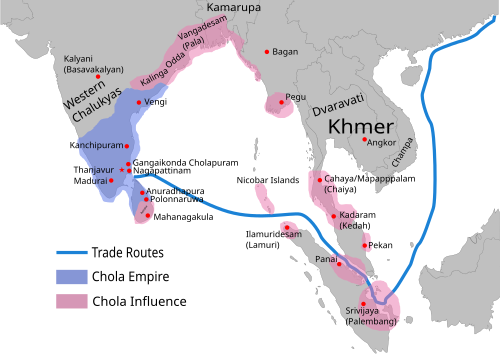
برزت سلالة تشولا في منتصف القرن التاسع الميلادي، وأسست أعظم إمبراطورية شهدتها جنوب الهند. [ 213 ] نجحوا في توحيد جنوب الهند تحت حكمهم، وبفضل قوتهم البحرية، بسطوا نفوذهم في دول جنوب شرق آسيا، مثل سريفيجايا . [ 184 ] في عهد راجاراجا تشولا الأول وخلفائه راجندرا تشولا الأول ، وراجادراجا تشولا ، وفيراجندرا تشولا، وكولوثونغا تشولا الأول، أصبحت السلالة قوة عسكرية واقتصادية وثقافية في جنوب وجنوب شرق آسيا. [ 214 ] [ 215 ] سيطرت أساطيل راجندرا تشولا الأول على السواحل البحرية من بورما إلى فيتنام، [ 216 ] وجزر أندامان ونيكوبار ، وجزر لاكشادويب (لاكاديف)، وسومطرة ، وشبه جزيرة الملايو . أُعلن عن قوة الإمبراطورية الجديدة للعالم الشرقي من خلال الحملة التي قام بها راجندرا تشولا الأول إلى نهر الغانج ، ومن خلال احتلال مدن الإمبراطورية البحرية سريفيجايا في جنوب شرق آسيا، فضلاً عن السفارات المتكررة إلى الصين. [ 217 ]
هيمنوا على الشؤون السياسية لسريلانكا لأكثر من قرنين من الزمان عبر غزوات واحتلالات متكررة. كما حافظوا على علاقات تجارية مستمرة مع العرب والإمبراطورية الصينية. [ 218 ] وحد راجاراجا تشولا الأول وابنه راجندرا تشولا الأول جنوب الهند سياسيًا، وأسسا إمبراطورية تشولا كقوة بحرية مرموقة. [ 219 ] في عهد التشولا، بلغ جنوب الهند آفاقًا جديدة من التميز في الفن والدين والأدب. وفي جميع هذه المجالات، مثّل عصر التشولا ذروة حركات بدأت في عصر سابق في عهد البالافا. وبلغت العمارة الضخمة، المتمثلة في المعابد المهيبة والمنحوتات الحجرية والبرونزية، مستوىً من الإتقان لم يسبق له مثيل في الهند. [ 220 ]

 الجرانيت جوبورام (برج) معبد بريهاديسوارار ، 1010
 تفاصيل العربة في معبد إيرافاتيسفارا الذي بناه راجاراجا تشولا الثاني في القرن الثاني عشر
 الهيكل الهرمي فوق قدس الأقداس في معبد بريهاديسفارا .
 مدخل معبد بريهاديسوارا، جوبورامز في ثانجافور
إمبراطورية تشالوكيا الغربية
حكمت إمبراطورية تشالوكيا الغربية معظم غرب الدكن ، جنوب الهند، بين القرنين العاشر والثاني عشر الميلاديين. [ 222 ] وخضعت مناطق شاسعة بين نهر نارمادا شمالًا ونهر كافيري جنوبًا لسيطرة تشالوكيا. [ 222 ] وخلال هذه الفترة، كانت العائلات الحاكمة الرئيسية الأخرى في الدكن، وهي الهويسالا ، والسيانا يادافا من ديفاجيري ، وسلالة كاكيتيا ، والكالاشوري الجنوبيون ، تابعةً لتشالوكيا الغربية، ولم تنل استقلالها إلا عندما تراجع نفوذ تشالوكيا خلال النصف الثاني من القرن الثاني عشر الميلادي. [ 223 ]
طوّرت سلالة تشالوكيا الغربية أسلوبًا معماريًا يُعرف اليوم بالأسلوب الانتقالي، وهو حلقة وصل معمارية بين أسلوب سلالة تشالوكيا المبكرة وأسلوب إمبراطورية هويسالا اللاحقة. تقع معظم آثارها في المناطق المتاخمة لنهر تونغابهادرا في وسط كارناتاكا. ومن الأمثلة الشهيرة على ذلك معبد كاسيفيسفيسفارا في لاكوندي ، ومعبد ماليكارجونا في كوروفاتي، ومعبد كاليسفارا في باجالي، ومعبد سيدهيسفارا في هافيري، ومعبد ماهاديفا في إيتاجي. [ 224 ] كانت هذه فترة مهمة في تطور الفنون الجميلة في جنوب الهند، وخاصة في الأدب، حيث شجع ملوك تشالوكيا الغربية الكتّاب باللغة الكانادية ، والسنسكريتية، مثل الفيلسوف ورجل الدولة باسافا، والرياضي العظيم بهاسكارا الثاني . [ 225 ] [ 226 ]

 مدخل مزخرف إلى القاعة المغلقة من الجنوب في معبد كاليشوارا في باجالي
 نقش بارز على جدار الضريح، وإفريز زخرفي، وبرج زخرفي مصغر في معبد ماليكارجونا في كوروفاتي
 منظر خلفي يُظهر المداخل الجانبية لمعبد ماهاديفا في إيتاجي
أواخر العصور الوسطى (حوالي 1200 - 1526)
تميزت فترة العصور الوسطى المتأخرة بالغزوات المتكررة من قبل القبائل البدوية المسلمة في آسيا الوسطى، [ 227 ] [ 228 ] وحكم سلطنة دلهي، ونمو دول أخرى، بُنيت على التكنولوجيا العسكرية للسلطنة. [ 229 ]
سلطنة دلهي
كانت سلطنة دلهي سلسلة من الدول الإسلامية المتعاقبة التي اتخذت من دلهي مقرًا لها، وحكمتها سلالات عديدة ذات أصول متنوعة. سيطرت هذه الدولة على أجزاء واسعة من شبه القارة الهندية من القرن الثالث عشر إلى أوائل القرن السادس عشر. [ 230 ] تأسست السلطنة في القرنين الثاني عشر والثالث عشر على يد الأتراك القادمين من آسيا الوسطى، الذين غزو أجزاءً من شمال الهند وأسسوا الدولة على أراضٍ كانت سابقًا تحت سيطرة الهندوس. [ 231 ] تمكنت سلالة المماليك التي حكمت دلهي لاحقًا من غزو مناطق واسعة من شمال الهند. أما سلالة الخلجي، فقد غزت معظم وسط الهند، وأجبرت الممالك الهندوسية الرئيسية في جنوب الهند على الخضوع لها . [ 230 ]
شهدت الهند في عهد السلطنة نهضة ثقافية عظيمة. وقد خلّف هذا التمازج الثقافي بين الهند والإسلام آثارًا خالدة في العمارة والموسيقى والأدب والدين والملابس. ويُعتقد أن اللغة الأردية نشأت خلال فترة سلطنة دلهي. وكانت هذه السلطنة الدولة الإسلامية الهندية الوحيدة التي نصّبت إحدى الحاكمات القلائل في الهند، وهي راضية سلطانة ( حكمت من 1236 إلى 1240 ).
رغم ما أحدثته سلطنة دلهي من اضطراب في البداية نتيجة انتقال السلطة من النخب الهندية الأصلية إلى النخب التركية المسلمة، إلا أنها ساهمت في دمج شبه القارة الهندية في نظام عالمي متنامٍ، وجذبت الهند إلى شبكة دولية أوسع، مما كان له أثر بالغ على الثقافة والمجتمع الهندي. [ 232 ] مع ذلك، تسببت سلطنة دلهي أيضاً في تدمير وتدنيس واسع النطاق للمعابد في شبه القارة الهندية. [ 233 ]
صدّت سلطنة دلهي بنجاح الغزوات المغولية للهند خلال حكم علاء الدين الخلجي . وكان من أهم عوامل نجاحهم جيش المماليك الأتراك ، الذين برعوا في أسلوب حرب الفرسان البدوية نفسه الذي استخدمه المغول. وربما كانت الإمبراطورية المغولية لتتوسع في الهند لولا دور سلطنة دلهي في صدّهم. [ 234 ] وبفضل صدّها المتكرر للغزاة المغول، [ 235 ] أنقذت السلطنة الهند من الدمار الذي لحق بغرب ووسط آسيا. هاجر جنود من تلك المنطقة، بالإضافة إلى علماء وإداريين فرّوا من الغزوات المغولية لإيران، إلى شبه القارة الهندية، مما أدى إلى نشوء ثقافة هندية إسلامية توفيقية في الشمال. [ 234 ]
شنّ تيمورلنك ، الفاتح التركي المغولي القادم من آسيا الوسطى، هجومًا على السلطان ناصر الدين محمود، سلطان سلالة تغلق، في دلهي. [ 236 ] هُزم جيش السلطان في 17 ديسمبر 1398. دخل تيمورلنك دلهي، ونهبها ودمرها، وتركها خرابًا بعد أن قتل جيشه وسلبها لثلاثة أيام وليالٍ. أمر تيمورلنك بنهب المدينة بأكملها باستثناء السادة والعلماء و"باقي المسلمين" (الفنانين)؛ ويُقال إنه تم إعدام 100 ألف أسير حرب في يوم واحد. [ 237 ] عانت السلطنة بشدة من نهب دلهي. ورغم انتعاشها لفترة وجيزة في عهد سلالتي السادة واللوديين ، إلا أنها لم تكن سوى ظل باهت لما كانت عليه في عهد السادة. استمر حكم اللودي في دلهي حتى هزيمة آخر سلاطينها، إبراهيم خان لودي ، عام 1526 على يد قوات بابر . [ 238 ]
 قطب منار ، وهو موقع مدرج ضمن قائمة التراث العالمي لليونسكو ، والذي بدأ بناؤه قطب الدين أيبك ، أول سلطان لدلهي.
إمبراطورية فيجاياناغارا

تأسست إمبراطورية فيجاياناغارا عام 1336 على يد هاريهارا الأول وشقيقه بوكا رايا الأول من سلالة سانغاما ، [ 239 ] التي نشأت كوريث سياسي لإمبراطورية هويسالا ، وإمبراطورية كاكيتيا ، [ 240 ] وإمبراطورية بانديان . [ 241 ] برزت الإمبراطورية كنتيجة لجهود قوى جنوب الهند لصد الغزوات الإسلامية بحلول نهاية القرن الثالث عشر. استمرت حتى عام 1646، على الرغم من تراجع قوتها بعد هزيمة عسكرية كبيرة عام 1565 على يد جيوش سلطنات الدكن مجتمعة . سُميت الإمبراطورية نسبةً إلى عاصمتها فيجاياناغارا ، التي تُحيط آثارها بمدينة هامبي الحالية ، وهي الآن موقع تراث عالمي في ولاية كارناتاكا بالهند. [ 242 ]
في العقدين الأولين بعد تأسيس الإمبراطورية، سيطر هاريهارا الأول على معظم المنطقة الواقعة جنوب نهر تونغابهادرا، وحصل على لقب بورفاباشيما سامودراديشفارا ("سيد البحار الشرقية والغربية"). وبحلول عام 1374، كان بوكا رايا الأول، خليفة هاريهارا الأول، قد هزم مشيخة أركوت ، وعائلة ريدي في كوندافيدو، وسلطان مادوراي ، وسيطر على غوا غربًا ومنطقة تونغابهادرا-كريشنا دوآب شمالًا. [ 243 ] [ 244 ]
قام هاريهارا الثاني ، الابن الثاني لبوكا رايا الأول، بتعزيز رقعة المملكة إلى ما وراء نهر كريشنا ، وضمّ جنوب الهند بأكملها تحت مظلة مملكة فيجاياناغارا. [ 245 ] وخلفه الحاكم ديفا رايا الأول ، الذي حقق انتصارات على غاجاباتي أوديشا، وأشرف على مشاريع تحصين وري هامة. [ 246 ] وصفه الرحالة الإيطالي نيكولو دي كونتي بأنه أقوى حكام الهند. [ 247 ] وتولى ديفا رايا الثاني العرش عام 1424، ويُعتقد أنه كان الأكثر كفاءة بين حكام سلالة سانغاما. [248] وقد أخمد تمرد الإقطاعيين، بالإضافة إلى زامورين كاليكوت وكيلون في الجنوب . وغزا جزيرة سريلانكا ، وأصبح سيدًا على ملوك بورما في بيغو وتاناسيريم . [ 249 ] [ 250 ] [ 251 ]
كان أباطرة فيجاياناغارا متسامحين مع جميع الأديان والطوائف، كما يتضح من كتابات الزوار الأجانب. [ 252 ] استخدم الملوك ألقابًا مثل غوبراهامانا براتيبالاناتشاريا ( وتعني حرفيًا "حامي الأبقار والبراهمة") وهيندوراياسوراترانا ( وتعني حرفيًا "حامي العقيدة الهندوسية")، مما يدل على نيتهم حماية الهندوسية، ومع ذلك كانوا في الوقت نفسه متمسكين بشدة بالتعاليم الإسلامية في مراسم بلاطهم وملابسهم. [ 253 ] كان مؤسسا الإمبراطورية، هاريهارا الأول وبوكا رايا الأول، من أتباع الشيفية المتدينين (عبدة شيفا )، لكنهما قدما منحًا لطائفة فيشنو في سرينجيري ، واتخذا فيديارانيا قديسًا راعيًا لهما، وعيّنا فاراها (أحد تجليات فيشنو) شعارًا لهما. [ 254 ] كما قدم نبلاء من ممالك تيمور في آسيا الوسطى إلى فيجاياناغارا. [ 255 ] كان ملوك سالوفا وتولوفا اللاحقون فايشنافا بالإيمان، لكنهم عبدوا عند قدمي اللورد فيروباكشا (شيفا) في هامبي وكذلك اللورد فينكاتيشوارا (فيشنو) في تيروباتي . [ 256 ] عمل سنسكريتي، جامبافاتي كاليانام للملك كريشناديفارايا، يُدعى اللورد فيروباكشا كارناتا راجيا راكشا ماني ("جوهرة الحماية لإمبراطورية كارناتا"). [ 257 ] رعى الملوك قديسي رتبة دفايتا (فلسفة الثنائية) من مادفاتشاريا في أودوبي . [ 258 ]


 سوق فيجاياناغارا في هامبي ، إلى جانب الخزان المقدس الموجود على جانب معبد كريشنا.
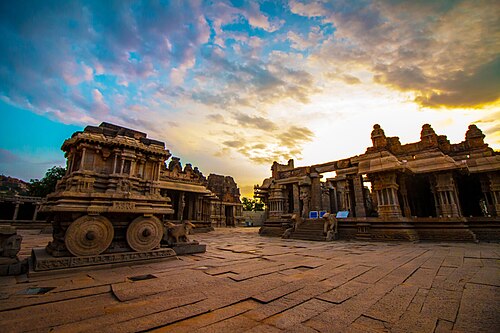 عربة معبد حجري في معبد فيثالا في هامبي
يشمل إرث الإمبراطورية العديد من المعالم الأثرية المنتشرة في جنوب الهند، وأشهرها مجموعة هامبي. وقد تضافرت تقاليد بناء المعابد السابقة في جنوب الهند لتُشكّل طراز فيجاياناغارا المعماري. وألهم امتزاج جميع الأديان واللغات المحلية الابتكار المعماري في بناء المعابد الهندوسية. ازدهرت الرياضيات في جنوب الهند تحت رعاية إمبراطورية فيجاياناغارا في ولاية كيرالا. أسس عالم الرياضيات مادهافا من سانغاماغراما مدرسة كيرالا الشهيرة لعلم الفلك والرياضيات في القرن الرابع عشر، والتي خرّجت العديد من علماء الرياضيات البارزين في جنوب الهند، مثل باراميشوارا، ونيلاكانثا سوماياجي، وجيشتاديفا . [ 261 ] ساهمت الإدارة الفعّالة والتجارة الخارجية النشطة في جلب تقنيات جديدة، مثل أنظمة إدارة المياه للري. [ 262 ] مكّنت رعاية الإمبراطورية الفنون الجميلة والآداب من بلوغ آفاق جديدة في لغات الكانادا والتيلجو والتاميلية والسنسكريتية، بينما تطورت موسيقى كارناتيك إلى شكلها الحالي. [ 263 ]
بدأت إمبراطورية فيجاياناغارا بالانحدار بعد هزيمتها في معركة تاليكوتا (1565). بعد وفاة عليا راما رايا في تلك المعركة، أسس تيرومالا ديفا رايا سلالة أرافيدو ، ونقل عاصمة جديدة إلى بينوكوندا ليحل محل هامبي المدمرة، وحاول إعادة بناء ما تبقى من إمبراطورية فيجاياناغارا. [ 264 ] تنازل تيرومالا عن العرش عام 1572، وقسم ما تبقى من مملكته بين أبنائه الثلاثة، وانقطع عن الحكم حتى وفاته عام 1578. حكم خلفاء سلالة أرافيدو المنطقة، لكن الإمبراطورية انهارت عام 1614، وانتهى وجودها نهائيًا عام 1646، نتيجة الحروب المتواصلة مع سلطنة بيجابور وغيرها. [ 265 ] [ 266 ] [ 267 ] خلال هذه الفترة، نالت ممالك أخرى في جنوب الهند استقلالها وانفصلت عن فيجاياناغارا. وتشمل هذه الممالك مملكة ميسور ، وكيلادي ناياكا ، وناياك مادوراي ، وناياك تانجوري ، وناياك شيترادورجا، ومملكة ناياك جينجي - وكلها أعلنت استقلالها وكان لها تأثير كبير على تاريخ جنوب الهند في القرون اللاحقة. [ 265 ]
ممالك أخرى
 فيجايا ستامبا (برج النصر).
 معبد داخل قلعة تشيتورغاره
 قصر مان سينغ (ماناسيمها) في قلعة غواليور
 مخطوطة صينية بعنوان "زرافة الجزية مع مرافقها" ، تصور زرافة قدمها مبعوثون بنغاليون باسم السلطان سيف الدين حمزة شاه سلطان البنغال إلى الإمبراطور يونغلي من أسرة مينغ الصينية.
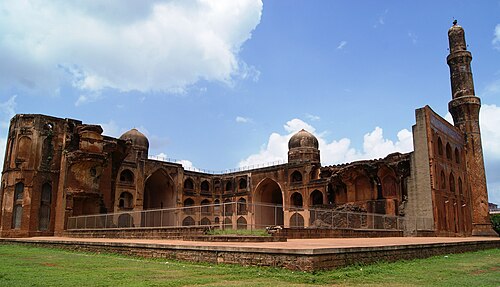 تم بناء مدرسة محمود غوان على يد محمود غوان، وزير سلطنة بهماني، لتكون مركزًا للتعليم الديني والعلماني على حد سواء.
على مدى قرنين ونصف، بدءًا من منتصف القرن الثالث عشر، هيمنت سلطنة دلهي على السياسة في شمال الهند ، بينما سيطرت إمبراطورية فيجاياناغارا على جنوبها. مع ذلك، كانت هناك قوى إقليمية أخرى حاضرة أيضًا. فبعد سقوط إمبراطورية بالا، حكمت سلالة تشيرو معظم شرق ولاية أوتار براديش ، وبيهار ، وجهارخاند ، من القرن الثاني عشر إلى القرن الثامن عشر. [ 268 ] [ 269 ] [ 270 ] ثم نجحت سلالة ريدي في هزيمة سلطنة دلهي، ووسعت نفوذها من كوتاك شمالًا إلى كانشي جنوبًا، لتُضم في نهاية المطاف إلى إمبراطورية فيجاياناغارا الآخذة في التوسع. [ 271 ]
في الشمال، ظلت ممالك راجبوت القوة المهيمنة في غرب ووسط الهند. هزمت سلالة ميوار بقيادة المهراجا حمير محمد تغلق وأسرته بمساعدة البارجوجار كحلفائه الرئيسيين. اضطر تغلق لدفع فدية ضخمة والتنازل عن جميع أراضي ميوار. بعد هذا الحدث، لم تشن سلطنة دلهي هجومًا على تشيتور لعدة قرون. استعاد الراجبوت استقلالهم، وأُقيمت دول راجبوتية شرقًا حتى البنغال وشمالًا حتى البنجاب . استقر التومارا في غواليور ، وأعاد مان سينغ تومار بناء قلعة غواليور . [ 272 ] خلال هذه الفترة ، برزت ميوار كدولة راجبوتية رائدة؛ ووسع رانا كومبا مملكته على حساب سلطنتي مالوا وغوجارات . [ 272 ] [ 273 ] أصبح رانا سانغا ، حاكم ميوار العظيم التالي، الشخصية الرئيسية في شمال الهند . اتسعت أهدافه، فخطط لغزو دلهي. لكن هزيمته في معركة خانوا عززت حكم سلالة المغول الجديدة في الهند. [ 272 ] واجهت سلالة ميوار بقيادة المهراجا أوداي سينغ الثاني هزيمة أخرى على يد الإمبراطور المغولي أكبر ، حيث سقطت عاصمتهم تشيتور. نتيجةً لذلك، أسس أوداي سينغ الثاني مدينة أودايبور ، التي أصبحت العاصمة الجديدة لمملكة ميوار . قاوم ابنه، المهراجا براتاب ، المغول بشدة. أرسل أكبر العديد من الحملات ضده، لكنه نجا في النهاية وسيطر على ميوار بأكملها، باستثناء قلعة تشيتور . [ 274 ]
في الجنوب، كانت سلطنة بهماني في الدكن، التي نشأت من ثورة عام 1347 ضد سلالة تغلق ، [ 275 ] المنافس الرئيسي لإمبراطورية فيجاياناغارا، وكثيراً ما كانت تُسبب لها الصعوبات. [ 276 ] ابتداءً من عام 1490، ثار حكام سلطنة بهماني، وشكّلت دولهم المستقلة سلطنات الدكن الخمس ؛ أعلنت أحمد نجار استقلالها، وتبعتها بيجابور وبرار في العام نفسه؛ ونالت غولكوندا استقلالها عام 1518، وبيدار عام 1528. [ 277 ] على الرغم من كونها متنافسة بشكل عام، إلا أنها تحالفت ضد إمبراطورية فيجاياناغارا عام 1565، مما أدى إلى إضعاف فيجاياناغارا بشكل دائم في معركة تاليكوتا. [ 278 ] [ 279 ]
في الشرق، ظلت مملكة غاجاباتي قوة إقليمية مؤثرة، وارتبطت بفترة ازدهار ثقافي ومعماري إقليمي. في عهد كابيليندراديفا ، امتدت إمبراطورية غاجاباتي من نهر الغانج السفلي شمالًا إلى نهر كافيري جنوبًا. [ 280 ] وفي شمال شرق الهند ، كانت مملكة أهوم قوة عظمى لستة قرون؛ [ 281 ] [ 282 ] بقيادة لاشيت بورفوكان ، حقق الأهوم هزيمة ساحقة للجيش المغولي في معركة ساراغات خلال الصراع بين الأهوم والمغول . [ 283 ] وإلى الشرق من ذلك في شمال شرق الهند، كانت تقع مملكة مانيبور ، التي حكمت من عاصمتها في قلعة كانغلا ، وطورت ثقافة هندوسية متطورة من طائفة غوديا فايشنافيا . [ 284 ] [ 285 ] [ 286 ]
كانت سلطنة البنغال القوة المهيمنة في دلتا نهري الغانج وبراهمابوترا ، حيث امتدت شبكة من مدن سك العملة عبر المنطقة. كانت مملكة سنية ذات أغلبية مسلمة، تضم نخبة من المسلمين الهنود الأتراك والعرب والحبشة والبنغال . اشتهرت السلطنة بتعددها الديني، حيث تعايشت المجتمعات غير المسلمة بسلام. امتلكت سلطنة البنغال دائرة من الدويلات التابعة ، شملت أوديشا في الجنوب الغربي، وأراكان في الجنوب الشرقي، وتريبورا في الشرق. في أوائل القرن السادس عشر، بلغت سلطنة البنغال ذروة اتساعها الإقليمي، حيث سيطرت على كامروب وكاماتا في الشمال الشرقي، وجونبور وبيهار في الغرب. اشتهرت بكونها دولة تجارية مزدهرة، وإحدى أقوى دول آسيا. وصفها زوار أوروبيون وصينيون معاصرون بأنها مملكة مزدهرة نسبيًا ، و"أغنى دولة للتجارة معها". تركت سلطنة البنغال إرثًا معماريًا عريقًا. تُظهر المباني من تلك الفترة تأثيرات أجنبية امتزجت لتُشكّل طرازًا بنغاليًا مميزًا. وكانت سلطنة البنغال أيضًا أكبر سلطة وأكثرها هيبة بين الدول الإسلامية المستقلة في العصور الوسطى في تاريخ البنغال . بدأ انحدارها بفترة فراغ حكم من قِبل إمبراطورية سوري ، أعقبها الغزو المغولي وتفككها إلى ممالك صغيرة.
حركة بهاكتي والسيخية
تشير حركة بهاكتي إلى التيار التعبدي الإلهي الذي ظهر في الهندوسية في العصور الوسطى [ 287 ] ، ثم تطور لاحقًا في السيخية . [ 288 ] نشأت هذه الحركة في جنوب الهند في القرن السابع الميلادي (أجزاء من ولايتي تاميل نادو وكيرالا حاليًا)، وانتشرت شمالًا. [ 287 ] ثم اجتاحت شرق وشمال الهند بدءًا من القرن الخامس عشر، وبلغت ذروتها بين القرنين الخامس عشر والسابع عشر. [ 289 ]
- تطورت حركة بهاكتي إقليميًا حول آلهة وإلهات مختلفة، مثل الفيشنافية (فيشنو)، والشيفية (شيفا)، والشاكتية (إلهات شاكتي)، والسمارتية . [ 290 ] [ 291 ] [ 292 ] استلهمت الحركة من العديد من الشعراء القديسين، الذين دافعوا عن مجموعة واسعة من المواقف الفلسفية، بدءًا من الثنائية الإلهية لدفيتا وصولًا إلى وحدة الوجود المطلقة لأدفايتا فيدانتا . [ 293 ] [ 294 ]
- السيخية ديانة توحيدية تؤمن بوحدة الوجود ، وتستند إلى التعاليم الروحية لغورو ناناك ، أول غورو، [ 295 ] والغورو العشرة الذين تعاقبوا عليه . بعد وفاة الغورو العاشر، غورو غوبيند سينغ ، أصبح كتاب السيخ المقدس، غورو غرانث صاحب ، تجسيدًا حرفيًا للغورو الأبدي غير الشخصي، حيث تُعدّ كلمات الكتاب دليلًا روحيًا للسيخ. [ 296 ] [ 297 ] [ 298 ]
- ازدهرت البوذية في الهند في ممالك الهيمالايا ، وتحديداً مملكة نامجيال في لاداخ ، ومملكة سيكيم في سيكيم، ومملكة تشوتيا في أروناتشال براديش في أواخر العصور الوسطى.
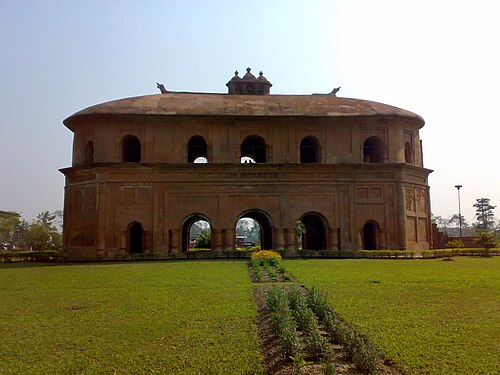 يُعدّ رانج غار ، الذي بناه براماتا سينغا في رانجبور عاصمة مملكة أهوم ، أحد أقدم أجنحة الملاعب الخارجية في شبه القارة الهندية.
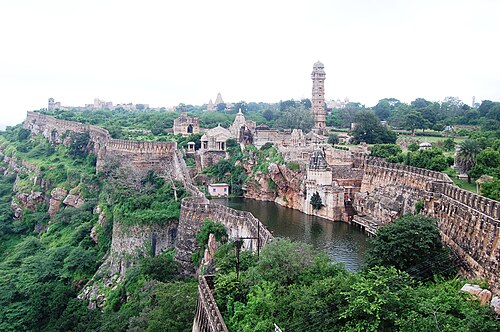 تُعد قلعة تشيتور أكبر قلعة في شبه القارة الهندية؛ وهي واحدة من قلاع التلال الست في ولاية راجستان.
 تم بناء معبد راناكبور جاين في القرن الخامس عشر بدعم من ولاية ميوار راجبوت
 يضم غول غومباز، الذي بنته سلطنة بيجابور ، ثاني أكبر قبة من العصر ما قبل الحديث في العالم بعد قبة آيا صوفيا البيزنطية.
الفترة الحديثة المبكرة (1526-1858)
يُؤرَّخ العصر الحديث المبكر من تاريخ الهند بين عامي 1526 و1858، وهو ما يتوافق مع صعود وسقوط الإمبراطورية المغولية التي ورثت إرث عصر النهضة التيمورية . خلال هذه الحقبة ، ازدهر اقتصاد الهند، وساد السلام النسبي، وحظيت الفنون برعاية واسعة. وشهدت هذه الفترة مزيدًا من التطور في العمارة الهندية الإسلامية ؛ [ 299 ] [ 300 ] كما مكّن نمو الماراثا والسيخ من حكم مناطق واسعة من الهند في أواخر أيام الإمبراطورية المغولية. [ 15 ] ومع اكتشاف طريق رأس الرجاء الصالح في القرن السادس عشر، كان البرتغاليون أول الأوروبيين الذين وصلوا بحرًا واستقروا هناك، وتحديدًا في غوا وبومباي . [ 301 ]
الإمبراطورية المغولية
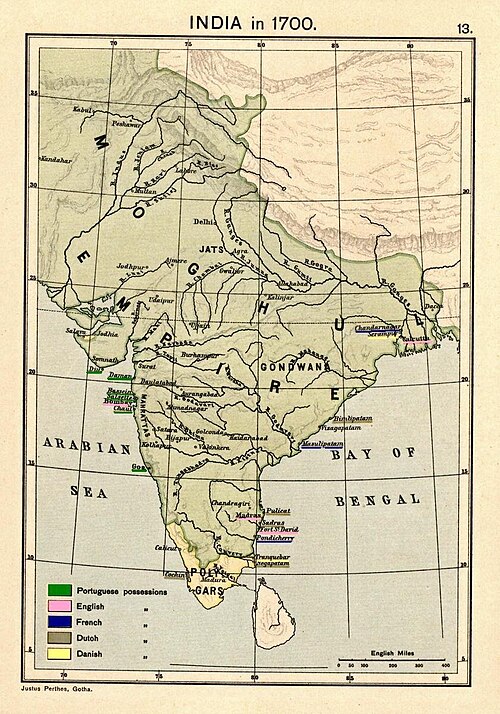
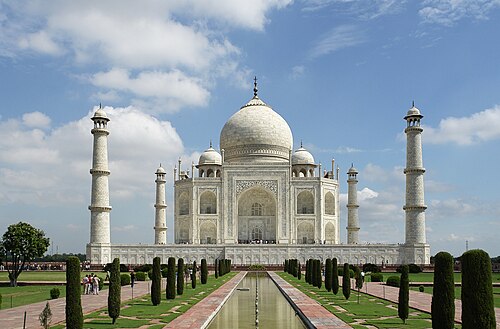
في عام 1526، اجتاح بابر ممر خيبر وأسس الإمبراطورية المغولية، التي بلغت أوج قوتها وامتدت على مساحة واسعة من جنوب آسيا. [ 303 ] إلا أن ابنه همايون هُزم على يد المحارب الأفغاني شير شاه سوري عام 1540، واضطر همايون للتراجع إلى كابول . بعد وفاة شير شاه، أسس ابنه إسلام شاه سوري وقائده الهندوسي هيمو فيكراماديتيا حكمًا علمانيًا في شمال الهند انطلاقًا من دلهي حتى عام 1556، حين هزم أكبر ( حكم من 1556 إلى 1605 )، حفيد بابر، هيمو في معركة بانيبات الثانية في 6 نوفمبر 1556 بعد انتصاره في معركة دلهي . سعى أكبر إلى إقامة علاقات طيبة مع الهندوس، فأعلن "الأمري" أو عدم قتل الحيوانات في الأيام المقدسة للجاينية، وألغى ضريبة الجزية المفروضة على غير المسلمين. تزوج أباطرة المغول من أفراد العائلات المالكة المحلية، وتحالفوا مع المهراجات المحليين ، وحاولوا دمج ثقافتهم التركية الفارسية مع الأساليب الهندية القديمة، مما أدى إلى خلق ثقافة هندية فارسية فريدة وعمارة هندية سراسية .
تزوج أكبر من الأميرة راجبوت مريم الزماني ، وأنجبا ابناً اسمه جهانكير ( حكم من 1605 إلى 1627 ). [ 304 ] سار جهانكير على نهج والده. وبحلول عام 1600، سيطرت سلالة المغول على معظم شبه القارة الهندية. وشهد عهد شاه جهان ( حكم من 1628 إلى 1658 ) العصر الذهبي للعمارة المغولية، حيث شيّد العديد من المعالم الضخمة، أشهرها تاج محل في أغرا.
كانت إحدى أكبر الإمبراطوريات التي وُجدت في شبه القارة الهندية، [ 305 ] وتفوقت على الصين لتصبح أكبر قوة اقتصادية في العالم، إذ سيطرت على 24.4% من الاقتصاد العالمي ، [ 306 ] وكانت رائدة عالميًا في مجال التصنيع، [ 307 ] حيث أنتجت 25% من الناتج الصناعي العالمي. [ 308 ] وقد حفّزت الإصلاحات الزراعية المغولية هذا الازدهار الاقتصادي والديموغرافي ، إذ كثّفت الإنتاج الزراعي، [ 309 ] ونسبة عالية نسبيًا من التمدن. [ 310 ]

 مدينة فاتحبور سيكري ، بالقرب من أغرا، تُظهر بولاند داروازا ، المجمع الذي بناه أكبر ، ثالث أباطرة المغول
 القلعة الحمراء ، دلهي، شُيّدت عام 1648
بلغت الإمبراطورية المغولية ذروة اتساعها الإقليمي خلال عهد أورنكزيب ( حكم من 1658 إلى 1707 )، الذي تفوقت الهند في عهده على الصين في عهد أسرة تشينغ لتصبح أكبر اقتصاد في العالم. [ 311 ] [ 312 ] كان أورنكزيب أقل تسامحًا من أسلافه، إذ أعاد فرض ضريبة الجزية ودمر العديد من المعابد التاريخية، بينما بنى في الوقت نفسه معابد هندوسية أكثر مما دمر، [ 313 ] ووظف عددًا أكبر بكثير من الهندوس في جهازه البيروقراطي الإمبراطوري مقارنة بأسلافه، ورقى الإداريين بناءً على الكفاءة لا الدين. [ 314 ] ومع ذلك، غالبًا ما يُلام على تآكل التقاليد التوفيقية المتسامحة لأسلافه، فضلًا عن ازدياد الجدل الديني والمركزية. وقد مُنيت شركة الهند الشرقية الإنجليزية بهزيمة في الحرب الأنجلو-مغولية . [ 315 ] [ 316 ]

تكبّد المغول هزائم متكررة جراء غزوات الماراثا والراجابوت والجات والأفغان . ففي عام ١٧٣٧، غزا الجنرال الماراثا باجيراو، قائد إمبراطورية الماراثا ، دلهي ونهبها. وأرسل الإمبراطور المغولي ، بقيادة الجنرال أمير خان أمراو العودات، ٨٠٠٠ جندي لصدّ ٥٠٠٠ من فرسان الماراثا، لكن باجيراو تمكّن من هزيمة الجنرال المغولي المبتدئ بسهولة. وفي عام ١٧٣٧، وفي الهزيمة النهائية لإمبراطورية المغول، هُزم قائد جيش المغول، نظام الملك، في بوبال على يد جيش الماراثا، مما أنهى فعليًا الإمبراطورية المغولية. وفي الوقت نفسه، اجتاحت ولاية بهاراتبور، بقيادة حاكم الجات سوراج مال ، حامية المغول في أغرا ونهبتها. [ 317 ] في عام 1739، هزم نادر شاه ، إمبراطور إيران، جيش المغول في معركة كارنال . [ 318 ] بعد هذا النصر، استولى نادر على دلهي ونهبها، واستولى على كنوزها، بما في ذلك عرش الطاووس . [ 319 ] بدأ أحمد شاه دوراني غزواته الخاصة كحاكم لإمبراطورية دوراني، ونهب دلهي في نهاية المطاف عام 1757. [ 320 ] ازداد ضعف حكم المغول بسبب المقاومة الهندية المحلية المستمرة؛ قاد باندا سينغ بهادور الخالصة السيخية ضد القمع الديني المغولي؛ ثار راجا البنغال الهندوسي، براتاباديتيا وراجا سيتارام راي ؛ وحارب المهراجا تشاتراسال ، من راجبوت بونديلا ، المغول وأسس دولة بانا . [ 321 ] بحلول عام 1757، تحولت سلالة المغول إلى حكام صوريين. ووقعت حرب فادا غالوغارا في ظل الحكومة المحلية المسلمة التي تتخذ من لاهور مقرًا لها، بهدف القضاء على السيخ، حيث قُتل 30 ألف سيخي. بدأ هذا الهجوم مع المغول، بحرب تشوتا غالوغارا ، [ 322 ] واستمر لعقود عديدة في ظل الدول الإسلامية التي خلفتها. [ 323 ]
إمبراطورية ماراثا

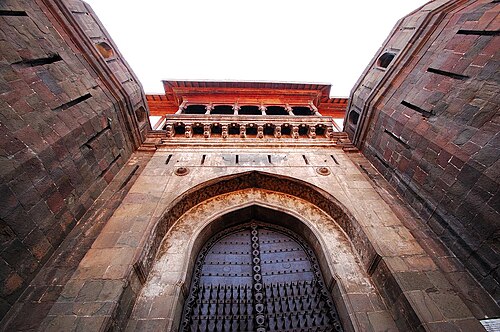
أسس تشاتراباتي شيفاجي مملكة الماراثا ووحدها . [ 324 ] ومع ذلك، يُنسب الفضل في جعل الماراثا قوةً هائلةً على الصعيد الوطني إلى بيشوا (رئيس الوزراء) باجيراو الأول . كتب المؤرخ كيه كيه داتا أن باجيراو الأول "يمكن اعتباره المؤسس الثاني لإمبراطورية الماراثا". [ 325 ]
في أوائل القرن الثامن عشر، وتحت حكم البيشوا، عزز الماراثا سيطرتهم على معظم أنحاء جنوب آسيا. ويُعزى إليهم الفضل إلى حد كبير في إنهاء حكم المغول في الهند. [ 326 ] [ 327 ] [ 328 ] وفي عام 1737، هزم الماراثا جيشًا مغوليًا في عاصمتهم، في معركة دلهي. وواصل الماراثا حملاتهم العسكرية ضد المغول، ونظام حيدر آباد ، ونواب البنغال ، وإمبراطورية دوراني لتوسيع حدودهم. وفي أوج قوتهم، امتدت إمبراطورية الماراثا لتشمل معظم شبه القارة الهندية. [ 329 ] حتى أن الماراثا حاولوا الاستيلاء على دلهي، وناقشوا تنصيب فيشواسراو بيشوا على العرش هناك بدلًا من الإمبراطور المغولي. [ 330 ]
امتدت إمبراطورية الماراثا في أوجها من تاميل نادو جنوبًا، [ 331 ] إلى بيشاور ( خيبر بختونخوا الحالية ، باكستان [ 332 ] [ ملاحظة 2 ] ) شمالًا، والبنغال شرقًا. توقف التوسع الشمالي الغربي للماراثا بعد معركة بانيبات الثالثة (1761). ومع ذلك، أُعيد تأسيس سلطة الماراثا في الشمال في غضون عقد من الزمن تحت قيادة بيشوا مادهافراو الأول . [ 334 ]
في عهد مادهافراو الأول، مُنح أقوى الفرسان شبه استقلال ذاتي، مما أدى إلى إنشاء اتحاد دول الماراثا المتحدة تحت قيادة عائلات جايكواد في بارودا ، وهولكار في إندور ومالوا ، وسيندياس في غواليور وأوجين ، وبهونسال في ناجبور ، وبوار في دار وديواس . في عام 1775 ، تدخلت شركة الهند الشرقية في صراع على خلافة عائلة بيشوا في بونه ، مما أدى إلى الحرب الأنجلو-ماراثية الأولى ، والتي انتهت بانتصار الماراثا. [ 335 ] وظل الماراثا قوة عظمى في الهند حتى هزيمتهم في الحربين الأنجلو-ماراثيتين الثانية والثالثة (1805-1818).
الإمبراطورية السيخية
كانت الإمبراطورية السيخية كيانًا سياسيًا حكم المناطق الشمالية الغربية من شبه القارة الهندية، وكان مركزها البنجاب ، من عام 1799 إلى عام 1849. وقد تم تشكيلها على أسس الخالصة ، تحت قيادة المهراجا رانجيت سينغ (1780-1839).
وحّد المهراجا رانجيت سينغ معظم شمال الهند في إمبراطورية باستخدام جيشه السيخي الخالصة ، الذي تدرب على الأساليب العسكرية الأوروبية وجُهز بأحدث التقنيات العسكرية. أثبت رانجيت سينغ براعته كقائد استراتيجي بارع، واختار قادةً أكفاء لجيشه. نجح في إنهاء الحروب الأفغانية السيخية . وعلى مراحل، ضمّ إلى إمبراطوريته وسط البنجاب، ومقاطعتي ملتان وكشمير، ووادي بيشاور. [ 336 ] [ 337 ]
في أوج قوتها خلال القرن التاسع عشر، امتدت الإمبراطورية من ممر خيبر غربًا إلى كشمير شمالًا، ومن السند جنوبًا إلى هيماشال براديش شرقًا، مرورًا بنهر سوتليج. بعد وفاة رانجيت سينغ، ضعفت الإمبراطورية، مما أدى إلى صراع مع شركة الهند الشرقية البريطانية. شكلت الحرب الأنجلو-سيخية الأولى والحرب الأنجلو-سيخية الثانية نهاية الإمبراطورية السيخية، لتصبح بذلك من بين آخر مناطق شبه القارة الهندية التي غزاها البريطانيون.
ممالك أخرى

The Kingdom of Mysore in southern India expanded to its greatest extent under Hyder Ali and his son Tipu Sultan in the later half of the 18th century. Under their rule, Mysore fought series of wars against the Marathas and British or their combined forces. The Maratha–Mysore War ended in April 1787, following the finalising of treaty of Gajendragad, in which Tipu Sultan was obligated to pay tribute to the Marathas. Concurrently, the Anglo-Mysore Wars took place, where the Mysoreans used the Mysorean rockets. The Fourth Anglo-Mysore War (1798–1799) saw the death of Tipu. Mysore's alliance with the French was seen as a threat to the British East India Company, and Mysore was attacked from all four sides. The Nizam of Hyderabad and the Marathas launched an invasion from the north. The British won a decisive victory at the Siege of Seringapatam (1799).
Hyderabad was founded by the Qutb Shahi dynasty of Golconda in 1591. Following a brief Mughal rule, Asif Jah, a Mughal official, seized control of Hyderabad and declared himself Nizam-al-Mulk of Hyderabad in 1724. The Nizams lost considerable territory and paid tribute to the Maratha Empire after being routed in multiple battles, such as the Battle of Palkhed.[338] However, the Nizams maintained their sovereignty from 1724 until 1948 through paying tributes to the Marathas, and later, being vassals of the British. Hyderabad State became a princely state in British India in 1798.
The Nawabs of Bengal had become the de facto rulers of Bengal following the decline of Mughal Empire. However, their rule was interrupted by Marathas who carried out six expeditions in Bengal from 1741 to 1748, as a result of which Bengal became a tributary state of Marathas. On 23 June 1757, Siraj ud-Daulah, the last independent Nawab of Bengal was betrayed in the Battle of Plassey by Mir Jafar. He lost to the British, who took over the charge of Bengal in 1757, installed Mir Jafar on the Masnad (throne) and established itself to a political power in Bengal.[339] In 1765 the system of Dual Government was established, in which the Nawabs ruled on behalf of the British and were mere puppets to the British. In 1772 the system was abolished and Bengal was brought under the direct control of the British. In 1793, when the Nizamat (governorship) of the Nawab was also taken away, they remained as mere pensioners of the British East India Company.[340][341]
In the 18th century, the whole of Rajputana was virtually subdued by the Marathas. The Second Anglo-Maratha War distracted the Marathas from 1807 to 1809, but afterward Maratha domination of Rajputana resumed. In 1817, the British went to war with the Pindaris, raiders who were fled in Maratha territory, which quickly became the Third Anglo-Maratha War, and the British government offered its protection to the Rajput rulers from the Pindaris and the Marathas. By the end of 1818 similar treaties had been executed between the other Rajput states and Britain. The Maratha Sindhia ruler of Gwalior gave up the district of Ajmer-Merwara to the British, and Maratha influence in Rajasthan came to an end.[342] Most of the Rajput princes remained loyal to Britain in the Revolt of 1857, and few political changes were made in Rajputana until Indian independence in 1947. The Rajputana Agency contained more than 20 princely states, most notable being Udaipur State, Jaipur State, Bikaner State and Jodhpur State.
After the fall of the Maratha Empire, many Maratha dynasties and states became vassals in a subsidiary alliance with the British. With the decline of the Sikh Empire, after the First Anglo-Sikh War in 1846, under the terms of the Treaty of Amritsar, the British government sold Kashmir to Maharaja Gulab Singh and the princely state of Jammu and Kashmir, the second-largest princely state in British India, was created by the Dogra dynasty.[343][344] While in eastern and north-eastern India, the Hindu and Buddhist states of Cooch Behar Kingdom, Twipra Kingdom and Kingdom of Sikkim were annexed by the British and made vassal princely state.
After the fall of the Vijayanagara Empire, Polygar states emerged in Southern India; and managed to weather invasions and flourished until the Polygar Wars, where they were defeated by the British East India Company forces.[345] Around the 18th century, the Kingdom of Nepal was formed by Rajput rulers.[346]
Portuguese exploration

In 1498, a Portuguese fleet under Vasco da Gama discovered a new sea route from Europe to India, which paved the way for direct Indo-European commerce. The Portuguese soon set up trading posts in Velha Goa, Damaon, Dio island, and Bombay. The Portuguese instituted the Goa Inquisition, where new Indian converts were punished for suspected heresy against Christianity and non-Christians were condemned.[347] Goa remained the main Portuguese territory until it was annexed by India in 1961.[348]
Other Europeans
The next to arrive were the Dutch, with their main base in Ceylon. They established ports in Malabar. However, their expansion into India was halted after their defeat in the Battle of Colachel by the Kingdom of Travancore during the Travancore-Dutch War. The Dutch never recovered from the defeat and no longer posed a large colonial threat to India.[349][350]
The internal conflicts among Indian kingdoms gave opportunities to the European traders to gradually establish political influence and appropriate lands. Following the Dutch, the British — who set up in the west coast port of Surat in 1619 — and the French both established trading outposts in India. Although continental European powers controlled various coastal regions of southern and eastern India during the ensuing century, they eventually lost all their territories in India to the British, with the exception of the French outposts of Pondichéry and Chandernagore, and the Portuguese colonies of Goa, Daman and Diu.[351][352]
East India Company rule in India


The English East India Company was founded in 1600. It gained a foothold in India with the establishment of a factory in Masulipatnam on the Eastern coast of India in 1611 and a grant of rights by the Mughal emperor Jahangir to establish a factory in Surat in 1612. In 1640, after receiving similar permission from the Vijayanagara ruler farther south, a second factory was established in Madras on the southeastern coast. The islet of Bom Bahia in present-day Mumbai (Bombay) was a Portuguese outpost not far from Surat. It was presented to Charles II of England as dowry in his marriage to Catherine of Braganza. Charles in turn leased Bombay to the Company in 1668. Two decades later, the company established a trade post in the River Ganges delta. During this time other companies established by the Portuguese, Dutch, French, and Danish were similarly expanding in the subcontinent.
The company's victory under Robert Clive in the 1757 Battle of Plassey and another victory in the 1764 Battle of Buxar (in Bihar), consolidated the company's power, and forced emperor Shah Alam II to appoint it the diwan, or revenue collector, of Bengal, Bihar, and Orissa. The company thus became the de facto ruler of large areas of the lower Gangetic plain by 1773. It also proceeded by degrees to expand its dominions around Bombay and Madras. The Anglo-Mysore Wars (1766–1799) and the Anglo-Maratha Wars (1772–1818) left it in control of large areas of India south of the Sutlej River. With the defeat of the Marathas, no native power represented a threat for the company any longer.[353]
The expansion of the company's power chiefly took two forms. The first of these was the outright annexation of Indian states and subsequent direct governance of the underlying regions that collectively came to comprise British India. The annexed regions included the North-Western Provinces (comprising Rohilkhand, Gorakhpur, and the Doab) (1801), Delhi (1803), Assam (Ahom Kingdom 1828), and Sindh (1843). Punjab, North-West Frontier Province, and Kashmir were annexed after the Anglo-Sikh Wars in 1849–1856 (period of tenure of Marquess of Dalhousie Governor General). However, Kashmir was immediately sold under the Treaty of Amritsar (1850) to the Dogra dynasty of Jammu and thereby became a princely state. In 1854, Berar was annexed along with the state of Oudh two years later.
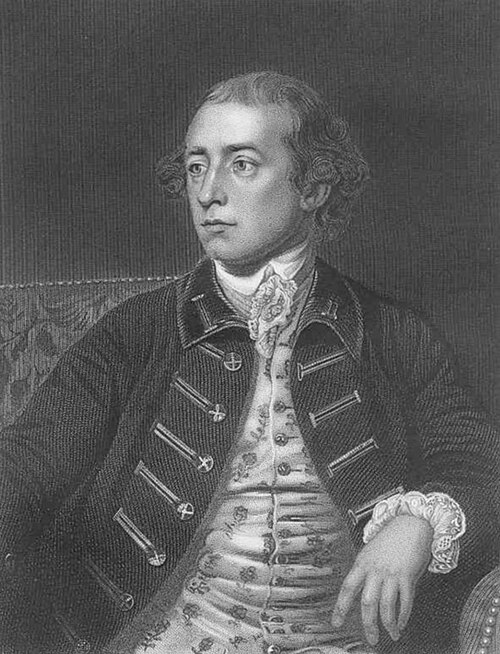 Warren Hastings, the first governor-general of Fort William (Bengal) who oversaw the company's territories in India
 Gold coin, minted 1835, with obverse showing the bust of William IV, king of United Kingdom from 26 June 1830 to 20 June 1837, and reverse marked "Two mohurs" in English (do ashrafi in Urdu) issued during Company rule in India
 Photograph (1855) showing the construction of the Bhor Ghaut incline bridge, Bombay; the incline was conceived by George Clark, the Chief Engineer in the East India Company's Government of Bombay
The second form of asserting power involved treaties in which Indian rulers acknowledged the company's hegemony in return for limited internal autonomy. Since the company operated under financial constraints, it had to set up political underpinnings for its rule.[354] The most important such support came from the subsidiary alliances with Indian princes.[354] In the early 19th century, the territories of these princes accounted for two-thirds of India.[354] When an Indian ruler who was able to secure his territory wanted to enter such an alliance, the company welcomed it as an economical method of indirect rule that did not involve the economic costs of direct administration or the political costs of gaining the support of alien subjects.[355]
In return, the company undertook the "defense of these subordinate allies and treated them with traditional respect and marks of honor."[355] Subsidiary alliances created the princely states of the Hindu maharajas and the Muslim nawabs. Prominent among the princely states were Cochin (1791), Jaipur (1794), Travancore (1795), Hyderabad (1798), Mysore (1799), Cis-Sutlej Hill States (1815), Rajputana (1818),[356]Central India Agency (1819), Cutch and Gujarat Gaikwad territories (1819), and Bahawalpur (1833).
Indian indenture system
The Indian indenture system was an ongoing system of indenture, a form of debt bondage, by which 3.5 million Indians were transported to colonies of European powers to provide labour for the (mainly sugar) plantations. It started from the end of slavery in 1833 and continued until 1920. This resulted in the development of a large Indian diaspora that spread from the Caribbean to the Pacific Ocean and the growth of large Indo-Caribbean and Indo-African populations.
Late modern period and contemporary history (1857–1947)
Rebellion of 1857 and its consequences
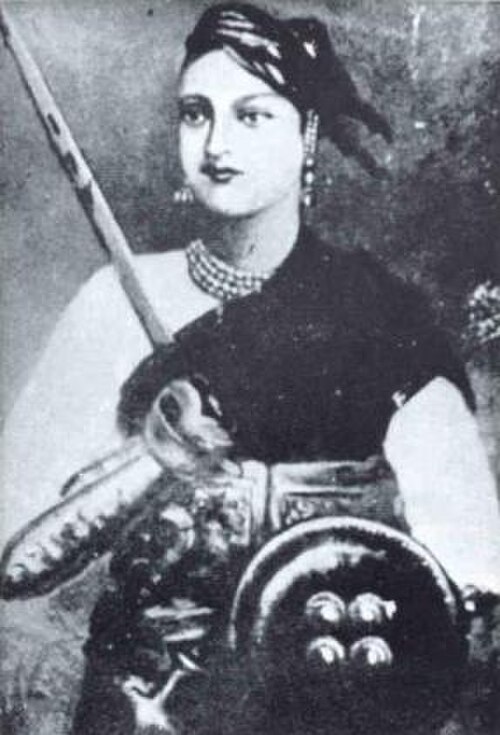 Lakshmibai, the Rani of Jhansi, one of the principal leaders of the rebellion who earlier had lost her kingdom as a result of the Doctrine of lapse.
 Bahadur Shah Zafar, the last Mughal Emperor. Crowned Emperor of India by the rebels, he was deposed by the British and died in exile in Burma.
 Charles Canning, the Governor-General of India during the rebellion.
 Lord Dalhousie, the Governor-General of India from 1848 to 1856, who devised the Doctrine of Lapse.
The Indian rebellion of 1857 was a large-scale rebellion by soldiers employed by the British East India Company in northern and central India against the company's rule. The spark that led to the mutiny was the issue of new gunpowder cartridges for the Enfield rifle, which was insensitive to local religious prohibition. The key mutineer was Mangal Pandey.[357] In addition, the underlying grievances over British taxation, the ethnic gulf between the British officers and their Indian troops and land annexations played a significant role in the rebellion. Within weeks after Pandey's mutiny, dozens of units of the Indian army joined peasant armies in widespread rebellion. The rebel soldiers were later joined by Indian nobility, many of whom had lost titles and domains under the Doctrine of Lapse and felt that the company had interfered with a traditional system of inheritance. Rebel leaders such as Nana Sahib and the Rani of Jhansi belonged to this group.[358]
After the outbreak of the mutiny in Meerut, the rebels very quickly reached Delhi. The rebels had also captured large tracts of the North-Western Provinces and Awadh (Oudh). Most notably, in Awadh, the rebellion took on the attributes of a patriotic revolt against British presence.[359] However, the British East India Company mobilised rapidly with the assistance of friendly Princely states, but it took the British the better part of 1858 to suppress the rebellion. Due to the rebels being poorly equipped and having no outside support or funding, they were brutally subdued.[360]
In the aftermath, all power was transferred from the British East India Company to the British Crown, which began to administer most of India as provinces. The Crown controlled the company's lands directly and had considerable indirect influence over the rest of India, which consisted of the Princely states ruled by local royal families. There were officially 565 princely states in 1947, but only 21 had actual state governments, and only three were large (Mysore, Hyderabad, and Kashmir). They were absorbed into the independent nation in 1947–1948.[361]
British Raj (1858–1947)


After 1857, the colonial government strengthened and expanded its infrastructure via the court system, legal procedures, and statutes. The Indian Penal Code came into being.[362] In education, Thomas Babington Macaulay had made schooling a priority for the Raj in 1835 and succeeded in implementing the use of English for instruction. By 1890, some 60,000 Indians had matriculated.[363] The Indian economy grew at about 1% per year from 1880 to 1920, and the population also grew at 1%. However, from the 1910s, Indian private industry began to grow significantly. India built a modern railway system in the late 19th century which was the fourth largest in the world.[364] Historians have been divided on issues of economic history, with the Nationalist school arguing that India was poorer due to British rule.[365]
In 1905, Lord Curzonsplit the large province of Bengal into a largely Hindu western half and "Eastern Bengal and Assam", a largely Muslim eastern half. The British goal was said to be efficient administration but the people of Bengal were outraged at the apparent "divide and rule" strategy. It also marked the beginning of the organised anti-colonial movement. When the Liberal Party in Britain came to power in 1906, he was removed. Bengal was reunified in 1911. The new Viceroy Gilbert Minto and the new Secretary of State for India John Morley consulted with Congress leaders on political reforms. The Morley-Minto reforms of 1909 provided for Indian membership of the provincial executive councils as well as the Viceroy's executive council. The Imperial Legislative Council was enlarged from 25 to 60 members and separate communal representation for Muslims was established in a dramatic step towards representative and responsible government.[366] Several socio-religious organisations came into being at that time. Muslims set up the All India Muslim League in 1906 to protect the interests of the aristocratic Muslims. The Hindu Mahasabha sought to represent Hindu interests. The Hindu nationalist Rashtriya Swayamsevak Sangh (RSS) was formed in 1925–1926.[367] Sikhs founded the Shiromani Akali Dal in 1920.[368] However, the largest and oldest political party Indian National Congress, founded in 1885, attempted to keep a distance from the socio-religious movements and identity politics.[369]
 Two silver rupee coins issued by the British Raj in 1862 and 1886 respectively, the first in obverse showing a bust of Victoria, Queen, the second of Victoria, Empress. Victoria became Empress of India in 1876.
 Ronald Ross, left, at Cunningham's laboratory of Presidency Hospital in Calcutta, where the transmission of malaria by mosquitoes was discovered, winning Ross the second Nobel Prize for Physiology or Medicine in 1902.
 A Darjeeling Himalayan Railway train shown in 1870. The railway became a UNESCO World Heritage Site in 1999.
 A second-day cancellation of the stamps issued in February 1931 to commemorate the inauguration of New Delhi as the capital of the British Indian Empire. Between 1858 and 1911, Calcutta had been the capital of the Raj.
Indian Renaissance
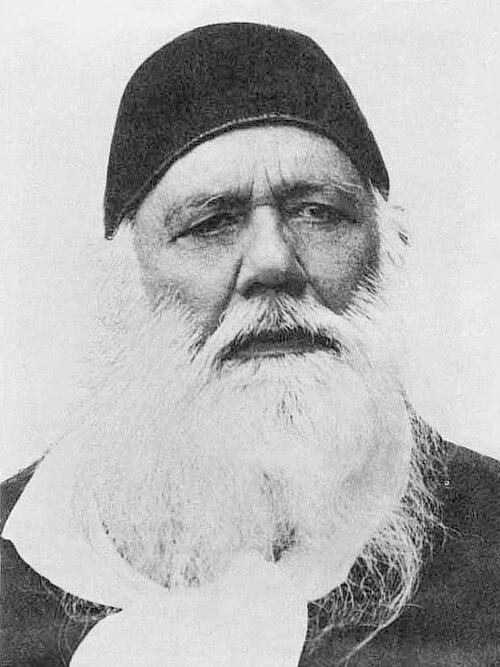 Sir Syed Ahmad Khan (1817–1898), the author of Causes of the Indian Mutiny, was the founder of Muhammadan Anglo-Oriental College, later the Aligarh Muslim University
 Pandita Ramabai (1858–1922) was a social reformer, and a pioneer in the education and emancipation of women in India
 Rabindranath Tagore (1861–1941) was a Bengali language poet, short-story writer, and playwright, and in addition a music composer and painter, who won the Nobel prize for Literature in 1913
 Srinivasa Ramanujan (1887–1920) was an Indian mathematician who made seminal contributions to number theory
The Bengali Renaissance refers to a social reform movement, dominated by Bengali Hindus, in the Bengal region of the Indian subcontinent during the nineteenth and early twentieth centuries, a period of British rule. Historian Nitish Sengupta describes the renaissance as having started with reformer and humanitarian Raja Ram Mohan Roy (1775–1833), and ended with Asia's first Nobel laureate Rabindranath Tagore (1861–1941).[370] This flowering of religious and social reformers, scholars, and writers is described by historian David Kopf as "one of the most creative periods in Indian history."[371]
During this period, Bengal witnessed an intellectual awakening that is in some way similar to the Renaissance. This movement questioned existing orthodoxies, particularly with respect to women, marriage, the dowry system, the caste system, and religion. One of the earliest social movements that emerged during this time was the Young Bengal movement, which espoused rationalism and atheism as the common denominators of civil conduct among upper caste educated Hindus.[372] It played an important role in reawakening Indian minds and intellect across the Indian subcontinent.
Famines
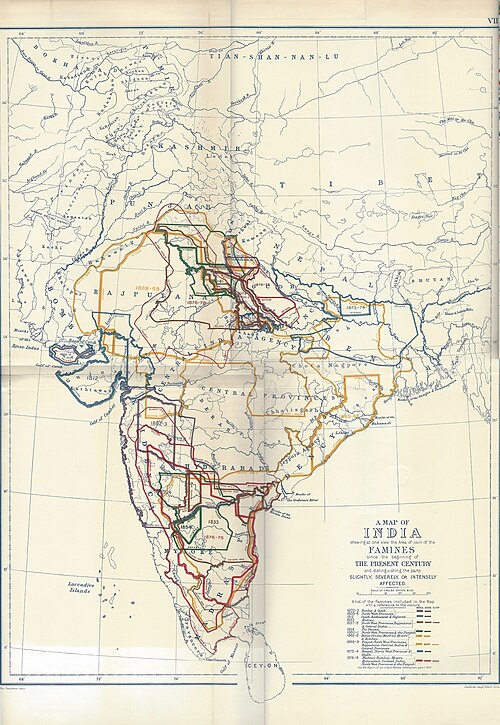 Map of famines in India during British Empire in year 1800–1885.
 Engraving from The Graphic, October 1877, showing the plight of animals as well as humans in Bellary district, Madras Presidency, British India during the Great Famine of 1876–1878
 Government famine relief, Ahmedabad, India, during the Indian famine of 1899–1900
 A picture of orphans who survived the Bengal famine of 1943, a man-made disaster by the British government
During British East India Company and British Crown rule, India experienced some of deadliest ever recorded famines. These famines, usually resulting from crop failures and often exacerbated by policies of the colonial government,[373] included the Great Famine of 1876–1878 in which 6.1 million to 10.3 million people died,[374] the Great Bengal famine of 1770 where between 1 and 10 million people died,[375][376] the Indian famine of 1899–1900 in which 1.25 to 10 million people died,[373] and the Bengal famine of 1943 where between 2.1 and 3.8 million people died.[377] The third plague pandemic in the mid-19th century killed 10 million people in India.[378] Despite persistent diseases and famines, the population of the Indian subcontinent, which stood at up to 200 million in 1750,[379] had reached 389 million by 1941.[380]
World War I
 Indian cavalry on the Western front 1914
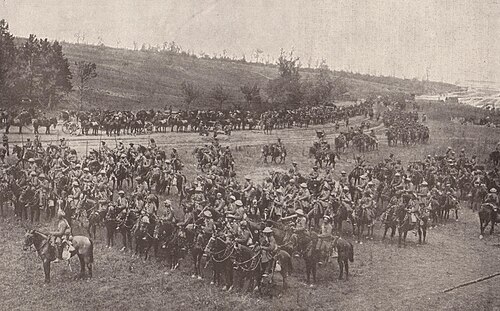 Indian cavalry from the Deccan Horse during the Battle of Bazentin Ridge in 1916.
 Indian Army gunners (probably 39th Battery) with 3.7-inch mountain howitzers, Jerusalem 1917
 India Gate is a memorial to 70,000 soldiers of the British Indian Army who died in the period 1914–21 in the First World War
During World War I, over 800,000 volunteered for the army, and more than 400,000 volunteered for non-combat roles, compared with the pre-war annual recruitment of about 15,000 men.[381] The Army saw early action on the Western Front at the First Battle of Ypres. After a year of front-line duty, sickness and casualties had reduced the Indian Corps to the point where it had to be withdrawn. Nearly 700,000 Indians fought the Turks in the Mesopotamian campaign. Indian formations were also sent to East Africa, Egypt, and Gallipoli.[382]
The Indian Army and the Imperial Service Troops fought during the Sinai and Palestine Campaign's defence of the Suez Canal in 1915, at Romani in 1916 and to Jerusalem in 1917. Indian units occupied the Jordan Valley and after the German spring offensive they became the major force in the Egyptian Expeditionary Force during the Battle of Megiddo and in the Desert Mounted Corps' advance to Damascus and on to Aleppo. Other divisions remained in India guarding the North-West Frontier and fulfilling internal security obligations.
One million Indian troops served abroad during the war. In total, 74,187 died,[383] and another 67,000 were wounded.[384] The roughly 90,000 soldiers who died fighting in World War I and the Afghan Wars are commemorated by the India Gate.
World War II
 General Claude Auchinleck (right), Commander-in-Chief of the Indian Army, with the then ViceroyWavell (centre) and General Montgomery (left)
 Indian women training for Air Raid Precautions (ARP) duties in Bombay in 1942
 Indian infantrymen of the 7th Rajput Regiment about to go on patrol on the Arakan front in Burma, 1944
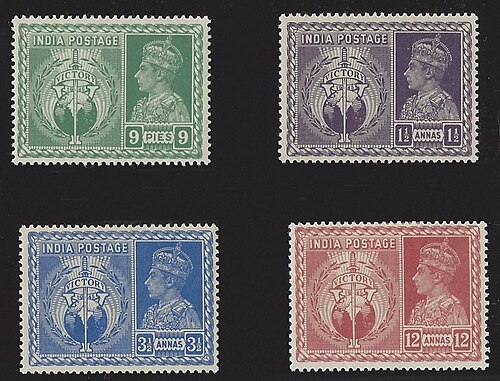 The stamp series "Victory" issued by the Government of British India to commemorate allied victory in World War II
British India officially declared war on Nazi Germany in September 1939.[385] The British Raj, as part of the Allied Nations, sent over two and a half million volunteer soldiers to fight under British command against the Axis powers. Additionally, several princely states provided large donations to support the Allied campaign. India also provided the base for American operations in support of China in the China Burma India Theatre.
Indians fought throughout the world, including in the European theatre against Germany, in North Africa against Germany and Italy, against the Italians in East Africa, in the Middle East against the Vichy French, in the South Asian region defending India against the Japanese and fighting the Japanese in Burma. Indians also aided in liberating British colonies such as Singapore and Hong Kong after the Japanese surrender in August 1945. Over 87,000 soldiers from the subcontinent died in World War II.
The Indian National Congress denounced Nazi Germany but would not fight it or anyone else until India was independent. Congress launched the Quit India Movement in August 1942, refusing to co-operate in any way with the government until independence was granted. The government immediately arrested over 60,000 national and local Congress leaders. The Muslim League rejected the Quit India movement and worked closely with the Raj authorities.
Subhas Chandra Bose (also called Netaji) broke with Congress and tried to form a military alliance with Germany or Japan to gain independence. The Germans assisted Bose in the formation of the Indian Legion;[386] however, it was Japan that helped him revamp the Indian National Army (INA), after the First Indian National Army under Mohan Singh was dissolved. The INA fought under Japanese direction, mostly in Burma.[387] Bose also headed the Provisional Government of Free India (or Azad Hind), a government-in-exile based in Singapore.[388][389]
By 1942, neighbouring Burma was invaded by Japan, which by then had already captured the Indian territory of Andaman and Nicobar Islands. Japan gave nominal control of the islands to the Provisional Government of Free India on 21 October 1943, and in the following March, the Indian National Army with the help of Japan crossed into India and advanced as far as Kohima in Nagaland. This advance on the mainland of the Indian subcontinent reached its farthest point on Indian territory, retreating from the Battle of Kohima in June and from that of Imphal on 3 July 1944.
The region of Bengal in British India suffered a devastating famine during 1940–1943. An estimated 2.1–3 million died from the famine, frequently characterised as "man-made,"[390] with most sources asserting that wartime colonial policies exacerbated the crisis.[391]
Indian independence movement (1885–1947)
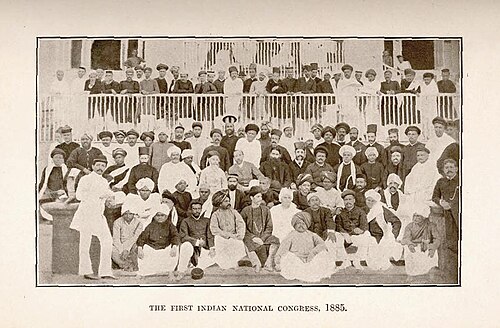 The first session of the Indian National Congress in 1885. A. O. Hume, the founder, is shown in the middle (third row from the front). The Congress was the first modern nationalist movement to emerge in the British Empire in Asia and Africa.[392]
 Front page of the Tribune (25 March 1931), reporting the execution of Bhagat Singh, Rajguru and Sukhdev by the British for the murder of 21-year-old police officer J. P. Saunders. Bhagat Singh quickly became a folk hero of the Indian independence movement.
 From the late 19th century, and especially after 1920, under the leadership of Mahatma Gandhi (right), the Congress became the principal leader of the Indian independence movement.[393] Gandhi is shown here with Jawaharlal Nehru, later the first prime minister of India.
The numbers of British in India were small,[394] yet they were able to rule 52% of the Indian subcontinent directly and exercise considerable leverage over the princely states that accounted for 48% of the area.[395]
One of the most important events of the 19th century was the rise of Indian nationalism,[396] leading Indians to seek first "self-rule" and later "complete independence". However, historians are divided over the causes of its rise. Probable reasons include a "clash of interests of the Indian people with British interests",[396] "racial discriminations",[397] and "the revelation of India's past".[398]
The first step toward Indian self-rule was the appointment of councillors to advise the British viceroy in 1861 and the first Indian was appointed in 1909. Provincial Councils with Indian members were also set up. The councillors' participation was subsequently widened into legislative councils. The British built a large British Indian Army, with the senior officers all British and many of the troops from small minority groups such as Gurkhas from Nepal and Sikhs.[399] The civil service was increasingly filled with natives at the lower levels, with the British holding the more senior positions.[400]
Bal Gangadhar Tilak, an Indian nationalist leader, declared Swaraj (home rule) as the destiny of the nation. His popular sentence "Swaraj is my birthright, and I shall have it"[401] became the source of inspiration. Tilak was backed by rising public leaders like Bipin Chandra Pal and Lala Lajpat Rai, who held the same point of view, notably they advocated the Swadeshi movement involving the boycott of imported items and the use of Indian-made goods;[402] the triumvirate were popularly known as Lal Bal Pal. In 1907, the Congress was split into two factions: The radicals, led by Tilak, advocated civil agitation and direct revolution to overthrow the British Empire and the abandonment of all things British. The moderates, led by leaders like Dadabhai Naoroji and Gopal Krishna Gokhale, on the other hand, wanted reform within the framework of British rule.[402]
The partition of Bengal in 1905 further increased the revolutionary movement for Indian independence. The disenfranchisement lead some to take violent action.
The British themselves adopted a "carrot and stick" approach in response to renewed nationalist demands. The means of achieving the proposed measure were later enshrined in the Government of India Act 1919, which introduced the principle of a dual mode of administration, or diarchy, in which elected Indian legislators and appointed British officials shared power.[403] In 1919, Colonel Reginald Dyer ordered his troops to fire their weapons on peaceful protestors, including unarmed women and children, resulting in the Jallianwala Bagh massacre; which led to the non-cooperation movement of 1920–1922. The massacre was a decisive episode towards the end of British rule in India.[404]
From 1920 leaders such as Mahatma Gandhi began highly popular mass movements to campaign against the British Raj using largely peaceful methods. The Gandhi-led independence movement opposed the British rule using non-violent methods like non-co-operation, civil disobedience and economic resistance. However, revolutionary activities against the British rule took place throughout the Indian subcontinent and some others adopted a militant approach like the Hindustan Republican Association, that sought to overthrow British rule by armed struggle.
The All India Azad Muslim Conference gathered in Delhi in April 1940 to voice its support for an independent and united India.[405] Its members included several Islamic organisations in India, as well as 1,400 nationalist Muslim delegates.[406][407][408] The pro-separatist All-India Muslim League worked to try to silence those nationalist Muslims who stood against the partition of India, often using "intimidation and coercion".[407][408] The murder of the All India Azad Muslim Conference leader Allah Bakhsh Soomro also made it easier for the pro-separatist All-India Muslim League to demand the creation of a Pakistan.[408]
After World War II (c. 1946–1947)
In January 1946, several mutinies broke out in the armed services, starting with that of RAF servicemen frustrated with their slow repatriation. The mutinies came to a head with mutiny of the Royal Indian Navy in Bombay in February 1946, followed by others in Calcutta, Madras, and Karachi. The mutinies were rapidly suppressed. In early 1946, new elections were called and Congress candidates won in eight of the eleven provinces.
Late in 1946, the Labour government decided to end British rule of India, and in early 1947 it announced its intention of transferring power no later than June 1948 and participating in the formation of an interim government.


Along with the desire for independence, tensions between Hindus and Muslims had also been developing over the years. Muslim League leader Muhammad Ali Jinnah proclaimed 16 August 1946 as Direct Action Day, with the stated goal of highlighting, peacefully, the demand for a Muslim homeland in British India, which resulted in the outbreak of the cycle of violence that would be later called the "Great Calcutta Killing of August 1946". The communal violence spread to Bihar, Noakhali in Bengal, Garhmukteshwar in the United Provinces, and on to Rawalpindi in March 1947 in which Sikhs and Hindus were attacked or driven out by Muslims.[409]Louis Mountbatten became the Viceroy of India in February 1947, arriving in India in March, and oversaw the decolonisation and partition of British India.
Independence and partition (1947–present)
 A map of the prevailing religions of the British Indian empire based on district-wise majorities based on the Indian census of 1909, and published in the Imperial Gazetteer of India. The partition of the Punjab and Bengal was based on such majorities.
 Gandhi touring Bela, Bihar, a village struck by religious rioting in March 1947. On the right is Khan Abdul Gaffar Khan.
 Jawaharlal Nehru being sworn in as the first prime minister of independent India by viceroy Lord Louis Mountbatten at 8:30 AM 15 August 1947.
 Literacy in India grew very slowly until independence in 1947. An acceleration in the rate of literacy growth occurred in the 1991–2001 period.
"A moment comes, which comes but rarely in history, when we step out from the old to the new; when an age ends; and when the soul of a nation long suppressed finds utterance."
In August 1947, the British Indian Empire was partitioned into the Union of India and Dominion of Pakistan. In particular, the partition of the Punjab and Bengal led to rioting between Hindus, Muslims, and Sikhs in these provinces and spread to other nearby regions, leaving some 500,000 dead. The police and army units were largely ineffective. The British officers were gone, and the units were beginning to tolerate if not actually indulge in violence against their religious enemies.[411][412][413] Also, this period saw one of the largest mass migrations anywhere in modern history, with a total of 12 million Hindus, Sikhs and Muslims moving between the newly created nations of India and Pakistan (which gained independence on 15 and 14 August 1947 respectively).[412] In 1971, Bangladesh, formerly East Pakistan and East Bengal, seceded from Pakistan.[414]
See also
References
Notes
Citations
- ↑Michael D. Petraglia; Bridget Allchin (22 May 2007). The Evolution and History of Human Populations in South Asia: Inter-disciplinary Studies in Archaeology, Biological Anthropology, Linguistics and Genetics. Springer Science & Business Media. p. 6. ISBN 978-1-4020-5562-1. Quote: "Y-Chromosome and Mt-DNA data support the colonization of South Asia by modern humans originating in Africa. ... Coalescence dates for most non-European populations average to between 73–55 ka."
- 12Wright 2010, pp. 44, 51.
- 12Wright 2010, p. 1.
- 12Flood, Gavin. Olivelle, Patrick. 2003. The Blackwell Companion to Hinduism. Malden: Blackwell. pp. 273–274
- ↑The Cambridge History of Southeast Asia: From Early Times to c. 1800, Band 1 by Nicholas Tarling, p. 281
- ↑Essays on Ancient India by Raj Kumar p. 199
- ↑Al Baldiah wal nahaiyah vol: 7 p. 141 "Conquest of Makran"
- ↑Meri 2005, p. 146.
- ↑Dr. K. S. Lal (1967). History of the Khaljis, A.D. 1290-1320. p. 14.
The khalji revolt is essentially a revolt of the Indian Muslims against the Turkish hegemony, of those who looked to Delhi, against those who sought inspiration from Ghaur and Ghazna.
- ↑Radhey Shyam Chaurasia (2002). History of Medieval India:From 1000 A.D. to 1707 A.D. Atlantic. p. 30. ISBN 978-81-269-0123-4.
In spite of all this, capturing the throne for Khilji was a revolution, as instead of Turks, Indian Muslims gained power
- ↑Kumar, Sunil (2013). "Delhi Sultanate (1206-1526)". In Bowering, Gerhard (ed.). The Princeton Encyclopedia of Islamic Political Thought. Princeton University Press. pp. 127–128. ISBN 978-0-691-13484-0.
- ↑Eaton, Richard M. (31 July 1996). The Rise of Islam and the Bengal Frontier, 1204–1760. University of California Press. pp. 64–. ISBN 978-0-520-20507-9.
- ↑Darwin, John (2008). After Tamerlane: The Rise and Fall of Global Empires, 1400-2000. Penguin Books Limited. pp. Only in Mewar and in Vijaynagar had Hindu states withstood the deluge". ISBN 978-0-14-101022-9.
- ↑Majumdar, R.C (1960). History and Culture of the Indian People, Volume 06, The Delhi Sultanate (3rd ed.). Bhartiya Vidya Bhavan. pp. 70 "It is also quite clear from contemporary chronicles that Muhammad Tughluq and the later Sultans practically left Rajputana severely alone, and the various Rajput principalities recognised Mewar as the paramount power at least in name".
- 12"India before the British: The Mughal Empire and its Rivals, 1526–1857". University of Exeter.
- ↑Parthasarathi, Prasannan (11 August 2011). Why Europe Grew Rich and Asia Did Not: Global Economic Divergence, 1600–1850. Cambridge University Press. pp. 39–45. ISBN 978-1-139-49889-0.
- ↑Maddison, Angus (25 September 2003). Development Centre Studies The World Economy Historical Statistics: Historical Statistics. OECD Publishing. pp. 259–261. ISBN 92-64-10414-3.
- ↑Harrison, Lawrence E.; Berger, Peter L. (2006). Developing cultures: case studies. Routledge. p. 158. ISBN 978-0-415-95279-8.
- ↑MacDonald, Myra (1 January 2017). Defeat is an Orphan: How Pakistan Lost the Great South Asian War. Oxford University Press. p. 85. ISBN 978-1-84904-858-3.
- ↑Ian Copland; Ian Mabbett; Asim Roy; et al. (2012). A History of State and Religion in India. Routledge. p. 161.
- ↑Michaud, Joseph (1926). History of Mysore Under Hyder Ali and Tippoo Sultan. p. 143.
- ↑Taçon, Paul S.C. (17 October 2018). "The Rock Art of South and East Asia". In David, Bruno; McNiven, Ian J. (eds.). The Oxford Handbook of the Archaeology and Anthropology of Rock Art. Oxford University Press. pp. 181–. ISBN 978-0-19-084495-0.
- ↑Mithen, Steven J. (2006). After the Ice: A Global Human History, 20,000–5000 BC. Harvard University Press. pp. 411–. ISBN 978-0-674-01999-7.
- ↑Dubey-Pathak, Meenakshi (2014). "The Rock Art of the Bhimbetka Area in India"(PDF). Adoranten: 16, 19. Archived(PDF) from the original on 13 September 2021.
- ↑Chauhan 2010, p. 147.
- 123Petraglia & Allchin 2007, p. 5.
- 123Petraglia 2010, pp. 167–170.
- ↑Mishra, Sheila (1999). "Developing an Indian stone age chronology". In Murray, Tim (ed.). Time and Archaeology. Routledge. p. 84. ISBN 978-0-415-11762-3.
- 1234Chauhan 2010, pp. 147–160.
- ↑Dyson 2018, p. 1.
- ↑Petraglia & Allchin 2007, p. 6.
- ↑Fisher 2018, p. 23.
- ↑Tuniz, Claudio; Gillespie, Richard; Jones, Cheryl (16 June 2016). The Bone Readers: Science and Politics in Human Origins Research. Routledge. pp. 163–. ISBN 978-1-315-41888-9.
- ↑Petraglia, Michael D.; Haslam, Michael; Fuller, Dorian Q.; Boivin, Nicole; Clarkson, Chris (25 March 2010). "Out of Africa: new hypotheses and evidence for the dispersal of Homo sapiens along the Indian Ocean rim"(PDF). Annals of Human Biology. 37 (3): 288–311. doi:10.3109/03014461003639249. ISSN 0301-4460. PMID 20334598. S2CID 6421383.
- ↑Mellars, Paul; Gori, Kevin C.; Carr, Martin; Soares, Pedro A.; Richards, Martin B. (25 June 2013). "Genetic and archaeological perspectives on the initial modern human colonization of southern Asia". Proceedings of the National Academy of Sciences. 110 (26): 10699–10704. Bibcode:2013PNAS..11010699M. doi:10.1073/pnas.1306043110. PMC 3696785. PMID 23754394.
- 12Dyson 2018, p. 28.
- ↑"Metropolitan Museum of Art". metmuseum.org. Archived from the original on 16 March 2022. Retrieved 21 April 2019.
- ↑Dyson 2018, p. 4-5.
- 12Fisher 2018, p. 33.
- ↑McIntosh, Jane (2008). The Ancient Indus Valley: New Perspectives. ABC-Clio. p. 387. ISBN 978-1-57607-907-2.
- ↑Shuichi Takezawa (August 2002). "Stepwells – Cosmology of Subterranean Architecture As Seen in Adalaj"(PDF). Journal of Architecture and Building Science. 117 (1492): 24. Retrieved 18 November 2009.
- ↑Kenoyer, J. M., Miller, H. M.-L. "Metal technologies of the Indus Valley tradition in Pakistan and western India."The Archaeometallurgy of the Asian Old World, MASCA research papers in science and archaeology. 1999, Vol 16, pp 107-151; ref : 7 p. 1/4. ISSN 1048-5325
- ↑Early India: A Concise History, D.N. Jha, 2004, p. 31
- ↑Menon, Sunil; Mishra, Siddhartha (13 August 2018). "We Are All Harappans". Outlook. Archived from the original on 3 August 2018.
- ↑Sarkar, Anindya; Mukherjee, Arati Deshpande; Bera, M. K.; Das, B.; Juyal, Navin; Morthekai, P.; Deshpande, R. D.; Shinde, V. S.; Rao, L. S. (May 2016). "Oxygen isotope in archaeological bioapatites from India: Implications to climate change and decline of Bronze Age Harappan civilization". Scientific Reports. 6 (1) 26555. Bibcode:2016NatSR...626555S. doi:10.1038/srep26555. PMC 4879637. PMID 27222033.
- ↑Kumar, Vijay. "A note on Chariot Burials found at Sinauli district Baghpat U.P"(PDF). Indian Journal of Archaeology.
- ↑Singh, Upinder (2008). A History of Ancient and Early Medieval India: From the Stone Age to the 12th Century. Pearson Education India. pp. 216–219. ISBN 978-81-317-1120-0. Retrieved 8 September 2018.
- ↑Stein, Burton (2010). Arnold, David (ed.). A History of India (2nd ed.). Oxford: Wiley-Blackwell. p. 47. ISBN 978-1-4051-9509-6.
- ↑Kulke & Rothermund 2004, p. 31.
- ↑"South Asia, 2000–1000 B.C. | Chronology | Heilbrunn Timeline of Art History | The Metropolitan Museum of Art". The Met's Heilbrunn Timeline of Art History. Retrieved 20 December 2024.
- 12Upinder Singh 2008, p. 255.
- ↑Antonova, Bongard-Levin & Kotovsky 1979, p. 51.
- ↑MacKenzie, Lynn (1995). Non-Western Art: A Brief Guide. Prentice Hall. p. 151. ISBN 978-0-13-104894-2.
- ↑Romila Thapar, A History of India: Part 1, pp. 29–30.
- ↑Staal, Frits (1986). The Fidelity of Oral Tradition and the Origins of Science. North Holland Publishing Company.
- ↑Singhal, K. C.; Gupta, Roshan (2003). The Ancient History of India, Vedic Period: A New Interpretation. New Delhi: Atlantic Publishers & Distributors. pp. 150–151. ISBN 81-269-0286-8. OCLC 53360586.
- ↑Day, Terence P. (1982). The Conception of Punishment in Early Indian Literature. Ontario: Wilfrid Laurier University Press. pp. 42–45. ISBN 978-0-919812-15-4.
- ↑Duiker, William J.; Spielvogel, Jackson J. (2018) [First published 1994]. World History (9th ed.). Cengage. pp. 44, 59. ISBN 978-1-337-40104-3.
- ↑Nelson, James Melvin (2009). Psychology, Religion, and Spirituality. Springer. p. 77.
- ↑Flood, Gavin Dennis (13 July 1996). An Introduction to Hinduism. Cambridge University Press. p. 37. ISBN 978-0-521-43878-0.
- ↑"India: The Late 2nd Millennium and the Reemergence of Urbanism". Encyclopædia Britannica. Retrieved 12 May 2007.
- 12Reddy 2003, p. A11.
- 12Michael Witzel (1989), Tracing the Vedic dialects in Dialectes dans les litteratures Indo-Aryennes ed. Caillat, Paris, 97–265.
- ↑Samuel 2008, p. 43, 48, 51, 86–87.
- ↑Kulke & Rothermund 2004, pp. 41–43.
- ↑Upinder Singh 2008, p. 200.
- ↑Valmiki (10 April 1990). Goldman, Robert P.; Pollock, Sheldon (eds.). The Ramayana of Valmiki: An Epic of Ancient India, Volume 1: Balakanda. Princeton, New Jersey: Princeton University Press. p. 23. ISBN 978-0-691-01485-2.
- ↑Romila Thapar, A History of India Part 1, p. 31.
- 12Upinder Singh 2008, pp. 18–19.
- ↑Brockington, J. L. (1998). The Sanskrit epics, Part 2. Vol. 12. Brill. p. 21. ISBN 978-90-04-10260-6.
- ↑Lanman, Charles Rockwell (1912) [First published 1884]. A Sanskrit reader: with vocabulary and notes. Boston: Ginn & Co.OCLC 633836.
... jána, m. creature; man; person; in plural, and collectively in singular, folks; a people or race or tribe ... cf. γένος, Lat. genus, Eng. kin, 'race' ...
- ↑Potter, Stephen; Sargent, Laurens Christopher (1974). Pedigree: The Origins of Words from Nature. Taplinger Publishing Company. ISBN 978-0-8008-6248-0.
... *gen-, found in Skt. jana, 'a man', and Gk. genos and L. genus, 'a race' ...
- ↑Basu, Abhijit (2013). Marvels and Mysteries of the Mahabharata. Leadstart publishing. p. 153. ISBN 978-93-84027-47-6.
- 12345Witzel, Michael (1995). "Early Sanskritization. Origins and Development of the Kuru State". Electronic Journal of Vedic Studies. 1 (4): 1–26. doi:10.11588/ejvs.1995.4.823. Archived from the original on 7 April 2022. Retrieved 20 November 2018.
- 12Samuel 2008, p. 48.
- ↑H.C. Raychaudhuri (1950), Political History of Ancient India and Nepal, Calcutta: University of Calcutta, p. 58
- ↑Samuel 2008, p. 41.
- ↑Samuel 2008, p. 47.
- ↑Heitzman, James (31 March 2008). The City in South Asia. Routledge. pp. 12–13. ISBN 978-1-134-28963-9.
- ↑Samuel 2008, pp. 47–48.
- ↑"The beginning of the historical period, c. 500–150 BCE". Encyclopædia Britannica. 2015.
- ↑Samuel 2008, pp. 41, 43.
- ↑Samuel 2008, p. 61.
- ↑Samuel 2008, pp. 48–51.
- ↑Samuel 2008, p. 49.
- 12Flood, Gavin Dennis (1996). An Introduction to Hinduism. Cambridge University Press. p. 82. ISBN 978-0-521-43878-0.
- ↑Mascaró, Juan (1965). The Upanishads. Penguin Books. pp. 7–. ISBN 978-0-14-044163-5.
- ↑Olivelle, Patrick (2008). Upaniṣads. Oxford University Press. pp. xxiv–xxix. ISBN 978-0-19-954025-9.
- ↑Baumann, Martin (2010). "Hinduism". In Melton, J. Gordon; Baumann, Martin (eds.). Religions of the World. Vol. 3 (2nd ed.). ABC-Clio. p. 1324. ISBN 978-1-59884-204-3.
- ↑Olivelle, Patrick (2003). "The Renouncer Tradition". In Flood, Gavin (ed.). The Blackwell Companion to Hinduism. Blackwell. pp. 273–274. ISBN 978-0-631-21535-6.
The second half of the first millennium BC was the period that created many of the ideological and institutional elements that characterise later Indian religions. The renouncer tradition played a central role during this formative period of Indian religious history. ... Some of the fundamental values and beliefs that we generally associate with Indian religions in general and Hinduism, in particular, were in part the creation of the renouncer tradition. These include the two pillars of Indian theologies: samsara—the belief that life in this world is one of suffering and subject to repeated deaths and births (rebirth); moksa/nirvana—the goal of human existence ...
- ↑Laumakis, Stephen (2008). An Introduction to Buddhist Philosophy. Cambridge University Press. p. 4. ISBN 978-0-511-38589-6.
- ↑Fisher, Mary Pat (2011) [First published 1991]. Living Religions: An Encyclopedia of the World's Faiths (8th ed.). Prentice Hall. p. 121. ISBN 978-0-205-83585-0.
Jainism's major teacher for this age is Mahavira ... was a contemporary of the Buddha and died approximately 527 BCE.
- ↑Fisher, Mary Pat (2011) [First published 1991]. Living Religions: An Encyclopedia of the World's Faiths (8th ed.). Prentice Hall. p. 122. ISBN 978-0-205-83585-0.
The extreme antiquity of Jainism as a non-Vedic, indigenous Indian religion is well documented. Ancient Hindu and Buddhist scriptures refer to Jainism as an existing tradition which began long before Mahavira.
- ↑Upinder Singh 2008, pp. 260–261.
- ↑Anguttara Nikaya I. p. 213; IV. pp. 252, 256, 261.
- 12Reddy 2003, p. A107.
- 12Thapar, Romila (2002). Early India: From the Origins to AD 1300. University of California Press. pp. 146–150. ISBN 978-0-520-24225-8. Retrieved 28 October 2013.
- ↑Raychaudhuri Hemchandra (1972), Political History of Ancient India, Calcutta: University of Calcutta, p. 107
- ↑Republics in ancient India. Brill Archive. pp. 93–. GGKEY:HYY6LT5CFT0.
- ↑J.M. Kenoyer (2006), "Cultures and Societies of the Indus Tradition. In Historical Roots" in the Making of 'the Aryan, R. Thapar (ed.), pp. 21–49. New Delhi, National Book Trust.
- ↑Shaffer, Jim (1993). "Reurbanization: The eastern Punjab and beyond". Urban Form and Meaning in South Asia: The Shaping of Cities from Prehistoric to Precolonial Times. Symposium Papers XV. Vol. 31. National Gallery of Art. pp. 53–67. JSTOR 42620472.
- ↑Majumdar, Ramesh Chandra (1977). Ancient India (8th ed.). Motilal Banarsidass Publishers. ISBN 978-81-208-0436-4.
- ↑"Magadha Empire – Magadha Empire in India, History of Magadh Empire". iloveindia.com. Archived from the original on 4 January 2018. Retrieved 8 March 2014.
- ↑"Lumbini Development Trust: Restoring the Lumbini Garden". lumbinitrust.org. Archived from the original on 6 March 2014. Retrieved 6 January 2017.
- ↑Upinder Singh 2008, p. 273.
- ↑Mookerji 1988, p. 34.
- ↑Raychaudhuri, Hem Chandra; Mukherjee, Bratindra Nath (1996) [First published 1923]. Political History of Ancient India: From the Accession of Parikshit to the Extinction of the Gupta Dynasty (8th ed.). Oxford University Press. pp. 208–209. ISBN 978-0-19-563789-2.
- ↑Turchin, Peter; Adams, Jonathan M.; Hall, Thomas D. (December 2006). "East–West Orientation of Historical Empires". Journal of World-Systems Research. 12 (2): 223. ISSN 1076-156X. Retrieved 12 September 2016.
- ↑Romila Thapar. A History of India: Volume 1. p. 70.
- 12Thapar 2003, pp. 178–180.
- 12Thapar 2003, pp. 204–206.
- ↑Bhandari, Shirin (5 January 2016). "Dinner on the Grand Trunk Road". Roads & Kingdoms. Retrieved 19 July 2016.
- ↑Kulke & Rothermund 2004, p. 67.
- ↑Romila Thapar. A History of India: Volume 1. p. 78.
- ↑Antonova, Bongard-Levin & Kotovsky 1979, p. 91.
- ↑Technology and Society by Menon, R.V.G. p. 15
- ↑Rosen, Elizabeth S. (1975). "Prince ILango Adigal, Shilappadikaram (The anklet Bracelet), translated by Alain Damelou. Review". Artibus Asiae. 37 (1/2): 148–150. doi:10.2307/3250226. JSTOR 3250226.
- ↑Sen 1999, pp. 204–205.
- ↑Essays on Indian Renaissance by Raj Kumar p. 260
- ↑The First Spring: The Golden Age of India by Abraham Eraly p. 655
- ↑
- Zvelebil, Kamil. 1973. The smile of Murugan on Tamil literature of South India. Leiden: Brill. Zvelebil dates the Ur-Tholkappiyam to the 1st or 2nd century BCE
- ↑"Silappathikaram Tamil Literature". Tamilnadu.com. 22 January 2013.
{{cite web}}: CS1 maint: deprecated archival service (link) - ↑Mukherjee 1999, p. 277
- ↑"Cittalaiccattanar (c. 500): Manimekalai". gretil.sub.uni-goettingen.de.
- ↑Hardy, Adam (1995). Indian Temple Architecture: Form and Transformation: the Karṇāṭa Drāviḍa Tradition, 7th to 13th Centuries. Abhinav Publications. p. 39. ISBN 978-81-7017-312-0.
- ↑Le, Huu Phuoc (2010). Buddhist Architecture. Grafikol. p. 238. ISBN 978-0-9844043-0-8.
- 12Stein, B. (27 April 2010), Arnold, D. (ed.), A History of India (2nd ed.), Oxford: Wiley-Blackwell, p. 105, ISBN 978-1-4051-9509-6
- ↑A Social History of Early India by Brajadulal Chattopadhyaya p. 259
- ↑Maddison, Angus (17 September 2006). The World Economy (GDP): Historical Statistics by Professor Angus Maddison(PDF). Development Centre Studies. World Economy. doi:10.1787/9789264022621-en. ISBN 978-92-64-02261-4. Retrieved 21 May 2013.
- ↑Maddison, Angus (2006). The World Economy – Volume 1: A Millennial Perspective and Volume 2: Historical Statistics. OECD Publishing by Organisation for Economic Co-operation and Development. p. 656. ISBN 978-92-64-02262-1.
- ↑Stadtner, Donald (1975). "A Śuṅga Capital from Vidiśā". Artibus Asiae. 37 (1/2): 101–104. doi:10.2307/3250214. ISSN 0004-3648. JSTOR 3250214.
- ↑K. A. Nilkantha Shastri (1970), A Comprehensive History of India: Volume 2, p. 108: "Soon after Agnimitra there was no 'Sunga empire'".
- ↑Bhandare, Shailendra. "Numismatics and History: The Maurya-Gupta Interlude in the Gangetic Plain" in Between the Empires: Society in India, 300 to 400 ed. Patrick Olivelle (2006), p. 96
- ↑Sircar, D. C. (2008). Studies in Indian Coins. Motilal Banarsidass Publishers. ISBN 978-81-208-2973-2.
- ↑Schreiber, Mordecai (2003). The Shengold Jewish Encyclopedia. Rockville, MD: Schreiber Publishing. p. 125. ISBN 978-1-887563-77-2.
- ↑Law 1978, p. 164.
- ↑Greatest emporium in the world, CSI, UNESCO.
- ↑Collingham 2006, p. 245.
- ↑The Medical Times and Gazette, Volume 1. London: John Churchill. 1867. p. 506.
- ↑Donkin 2003, pp. 67, 60–70.
- ↑Loewe, Michael; Shaughnessy, Edward L. (1999). The Cambridge History of Ancient China: From the Origins of Civilization to 221 BC. Cambridge University Press. pp. 87–88. ISBN 978-0-521-47030-8. Retrieved 1 November 2013.
- ↑Runion, Meredith L. (2007). The history of Afghanistan. Westport: Greenwood Press. p. 46. ISBN 978-0-313-33798-7.
The Yuezhi people conquered Bactria in the second century BCE. and divided the country into five chiefdoms, one of which would become the Kushan Empire. Recognizing the importance of unification, these five tribes combined under the one dominate Kushan tribe, and the primary rulers descended from the Yuezhi.
- ↑Liu, Xinru (2001). "The Silk Road: Overland Trade and Cultural Interactions in Eurasia". In Adas, Michael (ed.). Agricultural and Pastoral Societies in Ancient and Classical History. Philadelphia: Temple University Press. p. 156. ISBN 978-1-56639-832-9.
- ↑Buddhist Records of the Western World Si-Yu-Ki, (Tr. Samuel Beal: Travels of Fa-Hian, The Mission of Sung-Yun and Hwei-Sing, Books 1–5), Kegan Paul, Trench, Trubner & Co. Ltd. London. 1906 and Hill (2009), pp. 29, 318–350
- ↑which began about 127 CE. "Falk 2001, pp. 121–136", Falk (2001), pp. 121–136, Falk, Harry (2004), pp. 167–176 and Hill (2009), pp. 29, 33, 368–371.
- ↑Grégoire Frumkin (1970). Archaeology in Soviet Central Asia. Brill Archive. pp. 51–. GGKEY:4NPLATFACBB.
- ↑Rafi U. Samad (2011). The Grandeur of Gandhara: The Ancient Buddhist Civilization of the Swat, Peshawar, Kabul and Indus Valleys. Algora Publishing. pp. 93–. ISBN 978-0-87586-859-2.
- ↑Oxford History of India – Vincent Smith
- ↑Los Angeles County Museum of Art; Pratapaditya Pal (1986). Indian Sculpture: Circa 500 B.C.–A.D. 700. University of California Press. pp. 151–. ISBN 978-0-520-05991-7.
- ↑"The History of Pakistan: The Kushans". kushan.org. Archived from the original on 7 July 2015. Retrieved 6 January 2017.
- ↑Si-Yu-Ki, Buddhist Records of the Western World, (Tr. Samuel Beal: Travels of Fa-Hian, The Mission of Sung-Yun and Hwei-Sing, Books 1–5), Kegan Paul, Trench, Trubner & Co. Ltd. London. 1906
- ↑"Gupta dynasty: empire in 4th century". Encyclopædia Britannica. Archived from the original on 30 March 2010. Retrieved 16 May 2010.
- ↑Coedes, G. (1968) The Indianized States of Southeast Asia Edited by Walter F. Vella. Translated by Susan Brown Cowing. Canberra: Australian National University Press. Introduction... The geographic area here called Farther India consists of Indonesia, or island Southeast Asia....
- ↑Bernard Philippe Groslier (1962). The art of Indochina: including Thailand, Vietnam, Laos and Cambodia. Crown Publishers.
- ↑Iaroslav Lebedynsky, Les Nomades, p. 172.
- ↑Early History of India, p. 339, Dr V.A. Smith; See also Early Empire of Central Asia (1939), W.M. McGovern.
- ↑Ancient India, 2003, p. 650, Dr V.D. Mahajan; History and Culture of Indian People, The Age of Imperial Kanauj, p. 50, Dr R.C. Majumdar, Dr A.D. Pusalkar.
- ↑Gopal, Madan (1990). K.S. Gautam (ed.). India through the ages. Publication Division, Ministry of Information and Broadcasting, Government of India. p. 173.
- ↑The precise number varies according to whether or not some barely started excavations, such as cave 15A, are counted. The ASI say "In all, total 30 excavations were hewn out of rock which also include an unfinished one", UNESCO and Spink "about 30". The controversies over the end date of excavation is covered below.
- ↑Tej Ram Sharma, 1978, "Personal and geographical names in the Gupta inscriptions. (1.publ.)", p. 254, Kamarupa consisted of the Western districts of the Brahmaputra valley which being the most powerful state.
- ↑Suresh Kant Sharma, Usha Sharma – 2005, "Discovery of North-East India: Geography, History, Culture, ... – Volume 3", p. 248, Davaka (Nowgong) and Kamarupa as separate and submissive friendly kingdoms.
- ↑The eastern border of Kamarupa is given by the temple of the goddess Tamreshvari (Pūrvāte Kāmarūpasya devī Dikkaravasini in Kalika Purana) near present-day Sadiya. "...the temple of the goddess Tameshwari (Dikkaravasini) is now located at modern Sadiya about 100 miles to the northeast of Sibsagar" (Sircar 1990, pp. 63–68).
- ↑Barpujari, H.K., ed. (1990). The Comprehensive History of Assam (1st ed.). Guwahati, India: Assam Publication Board. OCLC 499315420.
- ↑Sarkar, J.N. (1992), "Chapter II The Turko-Afghan Invasions", in Barpujari, H.K., The Comprehensive History of Assam, 2, Guwahati: Assam Publication Board, pp. 35–48
- ↑"Pallava script". SkyKnowledge.com. 30 December 2010.
- ↑Nilakanta Sastri, pp. 412–413
- ↑Hall, John Whitney, ed. (2005) [1988]. "India". History of the World: Earliest Times to the Present Day. John Grayson Kirk. North Dighton, MA: World Publications Group. p. 246. ISBN 978-1-57215-421-6.
- ↑"CNG: eAuction 329. India, Post-Gupta (Ganges Valley). Vardhanas of Thanesar and Kanauj. Harshavardhana. Circa AD 606–647. AR Drachm (13 mm, 2.28 g, 1h)". cngcoins.com.
- ↑RN Kundra & SS Bawa, History of Ancient and Medieval India
- 123International Dictionary of Historic Places: Asia and Oceania by Trudy Ring, Robert M. Salkin, Sharon La Boda p. 507
- ↑"Harsha". Encyclopædia Britannica. 2015.
- ↑"Sthanvishvara (historical region, India)". Encyclopædia Britannica. Retrieved 9 August 2014.
- ↑"Harsha (Indian emperor)". Encyclopædia Britannica. Retrieved 9 August 2014.
- ↑Michaels 2004, p. 41.
- ↑Michaels 2004, p. 43.
- ↑Sanderson, Alexis (2009). "The Śaiva Age: The Rise and Dominance of Śaivism during the Early Medieval Period". In Einoo, Shingo (ed.). Genesis and Development of Tantrism. Institute of Oriental Culture Special Series. Vol. 23. Tokyo: Institute of Oriental Culture, University of Tokyo. pp. 41–43. ISBN 978-4-7963-0188-6.
- ↑Sarao, Decline of Buddhism in India
- ↑Sheridan, Daniel P. "Kumarila Bhatta", in Great Thinkers of the Eastern World, ed. Ian McGready, New York: HarperCollins, 1995, pp. 198–201. ISBN 0-06-270085-5.
- ↑Avari, Burjor (2007). India: The Ancient Past. A History of the Indian-Subcontinent from 7000 BC to AD 1200. New York: Routledge. pp. 204–205. ISBN 978-0-203-08850-0.
Madhyadesha became the ambition of two particular clans among a tribal people in Rajasthan, known as Gurjara and Pratihara. They were both parts of a larger federation of tribes, some of which later came to be known as the Rajputs
- ↑Kamath 1980, p. 93.
- ↑Vinod Chandra Srivastava (2008). History of Agriculture in India, Up to C. 1200 A.D. Concept. p. 857. ISBN 978-81-8069-521-6.
- ↑Kudalk, J. S. (1920). "The Jain Manuscript-Bhandars at Patan a Final Word on Their Search". Annals of the Bhandarkar Oriental Research Institute. 3: 35–52. JSTOR 44526773.
- ↑"Proceedings and Transactions of the All-India Oriental Conference — General President's Address by A. N. Upadhye (1969)". Gurukul Kangri University. 1969. p. 19. Retrieved 25 September 2025.
- 12The Dancing Girl: A History of Early India by Balaji Sadasivan p. 129
- ↑Pollock, Sheldon (2006). The Language of the Gods in the World of Men: Sanskrit, Culture, and Power in Premodern India. University of California Press. pp. 241–242. ISBN 978-0-520-93202-9.
- ↑Sunil Fotedar (June 1984). The Kashmir Series: Glimpses of Kashmiri Culture – Vivekananda Kendra, Kanyakumari (p. 57).
- ↑R. C. Mazumdar, Ancient India, p. 383
- ↑Karl J. Schmidt (2015). An Atlas and Survey of South Asian History. Routledge. p. 26. ISBN 978-1-317-47681-8.
- ↑Sailendra Nath Sen (1999). Ancient Indian History and Civilization. New Age. p. 246. ISBN 978-81-224-1198-0.
- ↑Thapar 2003, p. 334.
- 123Chandra, Satish (2009). History of Medieval India. New Delhi: Orient Blackswan. pp. 19–20. ISBN 978-81-250-3226-7.
- ↑Kamath 1980, pp. 83, 85, 97.
- ↑Puttaswamy, T.K. (2012). "Mahavira". Mathematical Achievements of Pre-modern Indian Mathematicians. London: Elsevier Publications. p. 231. ISBN 978-0-12-397913-1.
- ↑Sen 1999, p. 380.
- ↑Sen 1999, pp. 380–381.
- ↑Daniélou 2003, p. 170.
- ↑The Britannica Guide to Algebra and Trigonometry by William L. Hosch p. 105
- ↑Wink, André (2002) [First published 1990]. Al-Hind: The making of the Indo-Islamic World. Vol. I. Brill Academic Publishers. pp. 283–284. ISBN 978-0-391-04173-8.
- ↑Avari 2007, p. 204.
- ↑Wink, André (2002) [First published 1990]. Al-Hind: The making of the Indo-Islamic World. Vol. I. Brill Academic Publishers. pp. 285–286. ISBN 978-0-391-04173-8.
- ↑K.D. Bajpai (2006). History of Gopāchala. Bharatiya Jnanpith. p. 31. ISBN 978-81-263-1155-2.
- ↑Niyogi 1959, p. 38.
- ↑Sinha, CPN (1969). "Origin of the Karnatas of Mithila - A Fresh Appraisal". Proceedings of the Indian History Congress. 31: 66–72. JSTOR 44138330.
- ↑Chakrabarty, Dilip (2010). The Geopolitical Orbits of Ancient India: The Geographical Frames of the Ancient Indian Dynasties. Oxford University Press. pp. 47–48. ISBN 978-0-19-908832-4.
- ↑Epigraphia Indica, XXIV, p. 43, Dr N.G. Majumdar
- ↑Nitish K. Sengupta (2011). Land of Two Rivers: A History of Bengal from the Mahabharata to Mujib. Penguin Books India. pp. 43–45. ISBN 978-0-14-341678-4.
- ↑Biplab Dasgupta (2005). European Trade and Colonial Conquest. Anthem Press. pp. 341–. ISBN 978-1-84331-029-7.
- ↑Kulke & Rothermund 2004, pp. 112, 119.
- ↑History of Buddhism in India, Translation by A Shiefner
- 123Chandra, Satish (2009). History of Medieval India. New Delhi: Orient Blackswan. pp. 13–15. ISBN 978-81-250-3226-7.
- 12Sen 1999, p. 278.
- ↑PN Chopra; BN Puri; MN Das; AC Pradhan, eds. (2003). A Comprehensive History Of Ancient India (3 Vol. Set). Sterling. pp. 200–202. ISBN 978-81-207-2503-4.
- ↑History of Ancient India: Earliest Times to 1000 A.D. by Radhey Shyam Chaurasia p. 237
- ↑Kulke & Rothermund 2004, p. 116.
- ↑Keay 2000, p. 215: The Cholas were in fact the most successful dynasty since the Guptas ... The classic expansion of Chola power began anew with the accession of Rajaraja I in 985.
- ↑"The Last Years of Cholas: The decline and fall of a dynasty". En.articlesgratuits.com. 22 August 2007. Archived from the original on 20 January 2010. Retrieved 23 September 2009.
- ↑K. A. Nilakanta Sastri, A History of South India, p. 158
- ↑Buddhism, Diplomacy, and Trade: The Realignment of Sino-Indian Relations by Tansen Sen p. 229
- ↑History of Asia by B.V. Rao p. 297
- ↑Indian Civilization and Culture by Suhas Chatterjee p. 417
- ↑"Sri Ranganathaswamy Temple, Srirangam".
- 12A Comprehensive History of Medieval India: by Farooqui Salma Ahmed, Salma Ahmed Farooqui p. 24
- ↑Ancient Indian History and Civilization by Sailendra Nath Sen pp. 403–405
- ↑World Heritage Monuments and Related Edifices in India, Band 1 by ʻAlī Jāvīd pp. 132–134
- ↑History of Kannada Literature by E.P. Rice p. 32
- ↑Bilhana by Prabhakar Narayan Kawthekar, p. 29
- ↑Asher & Talbot 2006, p. 47.
- ↑Metcalf & Metcalf 2006, p. 6.
- ↑Asher & Talbot 2006, p. 53.
- 12Delhi Sultanate, Encyclopædia Britannica
- ↑Bartel, Nick (1999). "Battuta's Travels: Delhi, capital of Muslim India". The Travels of Ibn Battuta – A Virtual Tour with the 14th Century Traveler. Archived from the original on 12 June 2010.
- ↑Asher & Talbot 2006, pp. 50–52.
- ↑Richard Eaton (2000), Temple Desecration and Indo-Muslim States, Journal of Islamic Studies, 11(3), pp. 283–319
- 12Asher & Talbot 2006, pp. 50–51.
- ↑Ludden 2002, p. 67.
- ↑"Timur – conquest of India". Gardenvisit. Archived from the original on 12 October 2007.
- ↑Elliot & Dawson. The History of India As told By Its Own Historians Vol III. pp. 445–446.
- ↑Hussein-zadeh, Huda Seyyed; Miller, Isabel (2018). "Delhi Sultanate". In Madelung, Wilferd; Daftary, Farhad (eds.). Encyclopaedia Islamica Online. Translated by Asatryan, Mushegh. Brill Online. ISSN 1875-9831.
- ↑History of Classical Sanskrit Literature: by M. Srinivasachariar p. 211
- ↑Eaton 2005, pp. 28–29.
- ↑Sastri 1976, p. 239.
- ↑South India by Amy Karafin, Anirban Mahapatra p. 32
- ↑Kamath 1980, pp. 170–171.
- ↑Sastri 1976, p. 317.
- ↑The success was probably also due to the peaceful nature of Muhammad II Bahmani, according to Sastri 1976, p. 242
- ↑From the notes of Portuguese Nuniz. Robert Sewell notes that a big dam across was built the Tungabhadra and an aqueduct 15 miles (24 km) long was cut out of rock (Sastri 1976, p. 243).
- ↑Bowman, John Stewart, ed. (2000). Columbia Chronologies of Asian History and Culture. Columbia University Press. p. 271. ISBN 0-231-11004-9.
- ↑Sastri 1976, p. 244.
- ↑From the notes of Persian Abdur Razzak. Writings of Nuniz confirms that the kings of Burma paid tributes to Vijayanagara empire. (Sastri 1976, p. 245)
- ↑Kamath 1980, p. 173.
- ↑From the notes of Abdur Razzak about Vijayanagara: a city like this had not been seen by the pupil of the eye nor had an ear heard of anything equal to it in the world (Hampi, A Travel Guide 2003, p. 11)
- ↑From the notes of Duarte Barbosa. (Kamath 1980, p. 189)
- ↑Wagoner, Phillip B. (November 1996). "Sultan among Hindu Kings: Dress, Titles, and the Islamicization of Hindu Culture at Vijayanagara". The Journal of Asian Studies. 55 (4): 851–880. doi:10.2307/2646526. JSTOR 2646526. S2CID 163090404.
- ↑Kamath 1980, pp. 188–189.
- ↑Fritz, John M.; Michell, George (2015) [First published 2011]. Hampi Vijayanagara. Jaico Publishing House. p. 50. ISBN 978-8 1-8495-602-3.
- ↑Fritz, John M.; Michell, George (2015) [First published 2011]. Hampi Vijayanagara. Jaico Publishing House. pp. 41, 43. ISBN 978-8 1-8495-602-3.
- ↑Wagoner, Phillip B. (2001). "Architecture and Royal Authority under the Early Sangamas". In Fritz, John. M.; Michell, George (eds.). New Light on Hampi: Recent Research at Vijayanagara. Marg Publications. p. 14. ISBN 81-85026-53-X.
- ↑Kamath 1980, p. 189.
- ↑"The austere, grandiose site of Hampi was the last capital of the last great Hindu Kingdom of Vijayanagar. Its fabulously rich princes built Dravidian temples and palaces which won the admiration of travellers between the 14th and 16th centuries. Conquered by the Deccan Muslim confederacy in 1565, the city was pillaged over a period of six months before being abandoned." From the brief description UNESCO World Heritage List.
- ↑"Vijayanagara Research Project::Elephant Stables". Vijayanagara.org. 9 February 2014. Archived from the original on 17 May 2017. Retrieved 21 May 2018.
- ↑History of Science and Philosophy of Science by Pradip Kumar Sengupta p. 91
- ↑Medieval India: From Sultanat to the Mughals-Delhi Sultanat (1206–1526) by Satish Chandra pp. 188–189
- ↑Art History, Volume II: 1400–present by Boundless p. 243
- ↑Eaton 2005, pp. 100–101.
- 12Kamath 1980, p. 185.
- ↑Vijaya Ramaswamy (2007). Historical Dictionary of the Tamils. Scarecrow Press. pp. li–lii. ISBN 978-0-8108-6445-0.
- ↑Eaton 2005, pp. 101–115.
- ↑Singh, Pradyuman (19 January 2021). Bihar General Knowledge Digest. Prabhat Prakashan. ISBN 978-93-5266-769-7.
- ↑Surendra Gopal (2017). Mapping Bihar: From Medieval to Modern Times. Taylor & Francis. pp. 289–295. ISBN 978-1-351-03416-6.
- ↑Surinder Singh; I. D. Gaur (2008). Popular Literature and Pre-modern Societies in South Asia. Pearson Education India. pp. 77–. ISBN 978-81-317-1358-7.
- ↑Gordon Mackenzie (1990) [First published 1883]. A manual of the Kistna district in the presidency of Madras. Asian Educational Services. pp. 9–10, 224–. ISBN 978-81-206-0544-2.
- 123Sen, Sailendra (2013). A Textbook of Medieval Indian History. Primus Books. pp. 116–117. ISBN 978-93-80607-34-4.
- ↑Lectures on Rajput history and culture by Dr. Dasharatha Sharma. Publisher: Motilal Banarsidass, Jawahar Nagar, Delhi 1970. ISBN 0-8426-0262-3.
- ↑John Merci, Kim Smith; James Leuck (1922). "Muslim conquest and the Rajputs". The Medieval History of India pg 67–115
- ↑Eaton 2005, pp. 41–42.
- ↑Farooqui Salma Ahmed, A Comprehensive History of Medieval India: From Twelfth to the Mid-Eighteenth Century, (Dorling Kindersley Pvt. Ltd., 2011)
- ↑Majumdar, R. C., ed. (1974). The Mughul Empire. The History and Culture of the Indian People. Vol. VII. Bombay: Bharatiya Vidya Bhavan. p. 412.
- ↑Mitchell, George; Zebrowski, Mark (1999). Architecture and Art of the Deccan Sultanates (The New Cambridge History of India Vol. I:7). Cambridge: Cambridge University Press. p. 10. ISBN 0-521-56321-6.
- ↑Eaton 2005, p. 98.
- ↑Majumdar, R. C.; Pusalker, A. D.; Majumdar, A. K., eds. (1980) [First published 1960]. The Delhi Sultanate. The History and Culture of the Indian People. Vol. VI (3rd ed.). Bombay: Bharatiya Vidya Bhavan. p. 367. OCLC 664485.
[Describing the Gajapati kings of Orissa] Kapilendra was the most powerful Hindu king of his time, and under him Orissa became an empire stretching from the lower Ganga in the north to the Kaveri in the south.
- ↑Sailendra Nath Sen (1999). Ancient Indian History and Civilization. New Age International. p. 305. ISBN 978-81-224-1198-0.
- ↑Yasmin Saikia (2004). Fragmented Memories: Struggling to be Tai-Ahom in India. Duke University Press. p. 8. ISBN 978-0-8223-8616-2.
- ↑Sarkar, J.N. (1992), "Chapter VIII Assam-Mughal Relations", in Barpujari, H.K. (ed.), The Comprehensive History of Assam, vol. 2, Guwahati: Assam Publication Board, p. 213
- ↑Williams 2004, pp. 83–84, the other major classical Indian dances are: Bharatanatyam, Kathak, Odissi, Kathakali, Kuchipudi, Cchau, Satriya, Yaksagana and Bhagavata Mela.
- ↑Massey 2004, p. 177.
- ↑Devi 1990, pp. 175–180.
- 12Schomer & McLeod (1987), p. 1.
- ↑Johar, Surinder (1999). Guru Gobind Singh: A Multi-faceted Personality. MD Publications. p. 89. ISBN 978-81-7533-093-1.
- ↑Schomer & McLeod (1987), pp. 1–2.
- ↑Lance Nelson (2007), An Introductory Dictionary of Theology and Religious Studies (Editors: Orlando O. Espín, James B. Nickoloff), Liturgical Press, ISBN 978-0-8146-5856-7, pp. 562–563
- ↑SS Kumar (2010), Bhakti – the Yoga of Love, LIT Verlag Münster, ISBN 978-3-643-50130-1, pp. 35–36
- ↑Wendy Doniger (2009), Bhakti, Encyclopædia Britannica; The Four Denomination of HinduismArchived 13 January 2020 at the Wayback Machine Himalayan Academy (2013)
- ↑Schomer & McLeod (1987), p. 2.
- ↑Novetzke, Christian (2007). "Bhakti and Its Public". International Journal of Hindu Studies. 11 (3): 255–272. doi:10.1007/s11407-008-9049-9. JSTOR 25691067. S2CID 144065168.
- ↑Singh, Patwant (2000). The Sikhs. Alfred A Knopf Publishing. p. 17. ISBN 0-375-40728-6.
- ↑Louis Fenech and WH McLeod (2014), Historical Dictionary of Sikhism, 3rd Edition, Rowman & Littlefield, ISBN 978-1-4422-3600-4, p. 17
- ↑William James (2011), God's Plenty: Religious Diversity in Kingston, McGill Queens University Press, ISBN 978-0-7735-3889-4, pp. 241–242
- ↑Mann, Gurinder Singh (2001). The Making of Sikh Scripture. United States: Oxford University Press. p. 21. ISBN 978-0-19-513024-9.
- ↑Asher & Talbot 2006, p. 115.
- ↑Robb 2001, pp. 90–91.
- ↑Flores, Jorge (5 June 2018). Unwanted Neighbours: The Mughals, the Portuguese, and Their Frontier Zones. Oxford University Press. ISBN 978-0-19-909368-7.
- ↑Centre, UNESCO World Heritage. "Taj Mahal". UNESCO World Heritage Centre.
- ↑"The Islamic World to 1600: Rise of the Great Islamic Empires (The Mughal Empire)". University of Calgary. Archived from the original on 27 September 2013.
- ↑Jeroen Duindam (2015), Dynasties: A Global History of Power, 1300–1800, p. 105, Cambridge University Press
- ↑Turchin, Peter; Adams, Jonathan M.; Hall, Thomas D (December 2006). "East-West Orientation of Historical Empires"(PDF). Journal of World-Systems Research. 12 (2): 223. ISSN 1076-156X. Archived from the original(PDF) on 14 September 2021. Retrieved 2 October 2021.
- ↑Maddison, Angus (2003): Development Centre Studies The World Economy Historical Statistics: Historical Statistics, OECD Publishing, ISBN 92-64-10414-3, p. 261
- ↑Parthasarathi, Prasannan (2011), Why Europe Grew Rich and Asia Did Not: Global Economic Divergence, 1600–1850, Cambridge University Press, p. 2, ISBN 978-1-139-49889-0
- ↑Jeffrey G. Williamson, David Clingingsmith (August 2005). "India's Deindustrialization in the 18th and 19th Centuries"(PDF). Harvard University. Retrieved 18 May 2017.
- ↑Richards, John F. (1995) [First published 1993]. The Mughal Empire. Cambridge University Press. p. 190. ISBN 978-0-521-56603-2.
- ↑Abraham Eraly (2007). The Mughal World: Life in India's Last Golden Age. Penguin Books. p. 5. ISBN 978-0-14-310262-5.
- ↑Maddison, Angus (2003): Development Centre Studies The World Economy Historical Statistics: Historical Statistics, OECD Publishing, ISBN 9264104143, pages 259–261
- ↑Giorgio Riello, Tirthankar Roy (2009). How India Clothed the World: The World of South Asian Textiles, 1500–1850. Brill Publishers. p. 174. ISBN 978-90-474-2997-5.
- ↑Ian Copland; Ian Mabbett; Asim Roy; et al. (2012). A History of State and Religion in India. Routledge. p. 119. ISBN 978-1-136-45950-4.
- ↑Audrey Truschke (2017). Aurangzeb: The Life and Legacy of India's Most Controversial King. Stanford University Press. pp. 56, 58. ISBN 978-1-5036-0259-5.
- ↑Hasan, Farhat (1991). "Conflict and Cooperation in Anglo-Mughal Trade Relations during the Reign of Aurangzeb". Journal of the Economic and Social History of the Orient. 34 (4): 351–360. doi:10.1163/156852091X00058. JSTOR 3632456.
- ↑Vaugn, James (September 2017). "John Company Armed: The English East India Company, the Anglo-Mughal War and Absolutist Imperialism, c. 1675–1690". Britain and the World. 11 (1).
- ↑Royina Grewal (2007). In the Shadow of the Taj: A Portrait of Agra. Penguin Books. p. 220. ISBN 978-0-14-310265-6.
- ↑Dupuy, R. Ernest and Trevor N. Dupuy (1993). The Harper Encyclopedia of Military History (4th ed.). Harper Collins Publishers. p. 711.
- ↑"Iran in the Age of the Raj". avalanchepress.com. Retrieved 6 January 2017.
- ↑Gupta, Hari Ram (1961). Marathas and Panipat. Panjab University. p. 326.
- ↑Asher & Talbot 2006, p. 265.
- ↑A Popular Dictionary of Sikhism: Sikh Religion and Philosophy, p. 86, Routledge, W. Owen Cole, Piara Singh Sambhi, 2005
- ↑Khushwant Singh, A History of the Sikhs, Volume I: 1469–1839, Delhi, Oxford University Press, 1978, pp. 127–129
- ↑Shivaji and his Times (1919) – J.N. Sarkar
- ↑An Advanced History of India, Dr. K.K. Datta, p. 546
- ↑Pearson, M.N. (February 1976). "Shivaji and the Decline of the Mughal Empire". The Journal of Asian Studies. 35 (2): 221–235. doi:10.2307/2053980. JSTOR 2053980. S2CID 162482005.
- ↑Capper, J. (1997) [First published 1918]. Delhi, the Capital of India. Asian Educational Services. p. 28. ISBN 978-81-206-1282-2. Retrieved 6 January 2017.
- ↑Sen, S.N. (2010). An Advanced History of Modern India. Macmillan India. p. 1941. ISBN 978-0-230-32885-3. Retrieved 6 January 2017.
- ↑"Maratha empire | History, Definition, Map, & Facts | Britannica". Encyclopædia Britannica. 1 December 2023. Retrieved 21 January 2024.
- ↑Ghazi, Mahmood Ahmad (2002). Islamic Renaissance in South Asia 1707–1867: The Role of Shāh Walī Allāh and His Successors. Islamic Research Institute. pp. 129–130. ISBN 969-408-232-3.
- ↑Mehta, Jaswant Lal (2005). Advanced Study in the History of Modern India, 1707–1813. New Dawn Press. p. 204. ISBN 978-1-932705-54-6.
The Maratha Governor of Trichinopoly
- ↑Sailendra Nath Sen (2010). An Advanced History of Modern India. Macmillan India. p. 16. ISBN 978-0-230-32885-3.
- ↑Bharatiya Vidya Bhavan, Bharatiya Itihasa Samiti, Ramesh Chandra Majumdar – The History and Culture of the Indian People: The Maratha supremacy
- ↑N.G. Rathod (1994). The Great Maratha Mahadaji Scindia. Sarup & Sons. p. 8. ISBN 978-81-85431-52-9.
- ↑Naravane, M.S. (2014). Battles of the Honorourable East India Company. A.P.H. Publishing Corporation. p. 63. ISBN 978-81-313-0034-3.
- ↑Singh, Gulcharan (July 1981). "Maharaja Ranjit Singh and the Principles of War". USI Journal. 111 (465): 184–192.
- ↑Grewal, J.S. (1990). The Sikhs of the Punjab. The New Cambridge History of India. Vol. II.3. Cambridge University Press. pp. 101, 103–104. ISBN 978-0-521-26884-4.
Aggrandisement which made him the master of an empire ... the British recognized Ranjit Singh as the sole sovereign ruler of the Punjab and left him free to ... oust the Afghans from Multan and Kashmir ... Peshawar was taken over ... The real strength of Ranjit Singh's army lay in its infantry and artillery ... these new wings played an increasingly decisive role ... possessed 200 guns. Horse artillery was added in the 1820s ... nearly half of his army in terms of numbers consisted of men and officers trained on European lines ... In the expansion of Ranjit Singh's dominions ... vassalage proved to be nearly as important as the westernized wings of his army.
- ↑Sen, S. N. (15 August 2006). History Modern India. New Age International. ISBN 978-81-224-1774-6– via Google Books.
- ↑Chaudhury, Sushil; Mohsin, KM (2012). "Sirajuddaula". In Islam, Sirajul; Jamal, Ahmed A. (eds.). Banglapedia: National Encyclopedia of Bangladesh (Second ed.). Asiatic Society of Bangladesh. Archived from the original on 14 June 2015. Retrieved 15 August 2018.
- ↑Singh, Vipul (2009). Longman History & Civics (Dual Government in Bengal). Pearson Education India. pp. 29–. ISBN 978-81-317-2888-8.
- ↑Madhya Pradesh National Means-Cum-Merit Scholarship Exam (Warren Hasting's system of Dual Government). Upkar Prakashan. 2009. pp. 11–. ISBN 978-81-7482-744-9.
- ↑Black, Jeremy (2006), A Military History of Britain: from 1775 to the Present, Westport, Conn.: Greenwood Publishing Group, p. 78, ISBN 978-0-275-99039-8
- ↑"Treaty of Amritsar"(PDF). Archived from the original(PDF) on 26 August 2014. Retrieved 25 August 2014.
- ↑Rai, Mridu (2004). Hindu Rulers, Muslim Subjects: Islam, Rights, and the History of Kashmir. Princeton University Press. pp. 27, 133. ISBN 978-0-691-11688-4.
- ↑Indian History. Allied Publishers. 1988. pp. C-114. ISBN 978-81-8424-568-4.
- ↑Karl J. Schmidt (20 May 2015). An Atlas and Survey of South Asian History. Routledge. pp. 138–. ISBN 978-1-317-47681-8.
- ↑Glenn Ames (2012). Ivana Elbl (ed.). Portugal and its Empire, 1250–1800 (Collected Essays in Memory of Glenn J. Ames).: Portuguese Studies Review, Vol. 17, No. 1. Trent University Press. pp. 12–15 with footnotes, context: 11–32.
- ↑Praval, K. C. (2009) [First published 1987]. Indian Army after Independence. New Delhi: Lancer. p. 214. ISBN 978-1-935501-10-7.
- ↑Koshy, M.O. (1989). The Dutch Power in Kerala, 1729–1758. Mittal Publications. p. 61. ISBN 978-81-7099-136-6.
- ↑http://mod.nic.inArchived 12 March 2016 at the Wayback Machine 9th Madras Regiment
- ↑"The British in India – The Map Archive". themaparchive.com. 18 February 2022. Retrieved 16 November 2024.
- ↑Magedera, Ian H. (November 2010). "Arrested Development: The Shape of 'French India' after the Treaties of Paris of 1763 and 1814". Interventions. 12 (3): 331–343. doi:10.1080/1369801X.2010.516092. ISSN 1369-801X.
- ↑Markovits, Claude, ed. (2004) [First published 1994 as Histoire de l'Inde Moderne]. A History of Modern India, 1480–1950 (2nd ed.). London: Anthem Press. pp. 271–. ISBN 978-1-84331-004-4.
- 123Brown 1994, p. 67
- 12Brown 1994, p. 68
- ↑Ludden 2002, p. 133
- ↑Saul David, p. 70, The Indian Mutiny, Penguin Books 2003
- ↑Bandyopadhyay 2004, p. 172, Bose & Jalal 2003, p. 91, Brown 1994, p. 92
- ↑Bandyopadhyay 2004, p. 177, Bayly 2000, p. 357
- ↑Christopher Hibbert, The Great Mutiny: India 1857 (1980)
- ↑Pochhammer, Wilhelm von (1981), India's road to nationhood: a political history of the subcontinent, Allied Publishers, ISBN 978-81-7764-715-0
- ↑"Law Commission of India – Early Beginnings"
- ↑Suresh Chandra Ghosh (1995). "Bentinck, Macaulay and the introduction of English education in India". History of Education. 24 (1): 17–25. doi:10.1080/0046760950240102.
- ↑I. D. Derbyshire (1987). "Economic Change and the Railways in North India, 1860–1914". Modern Asian Studies. 21 (3): 521–545. doi:10.1017/S0026749X00009197. JSTOR 312641. S2CID 146480332.
- ↑Robb, Peter (November 1981). "British Rule and Indian 'Improvement'". Economic History Review. 34 (4): 507–523. doi:10.2307/2595587. JSTOR 2595587.
- ↑S. A. Wolpert, Morley and India, 1906–1910, (1967)
- ↑Bhatt, Chetan (August 2004). "Democracy and Hindu nationalism". Democratization. 11 (4): 133–154. doi:10.1080/1351034042000234567.
- ↑Harjinder Singh Dilgeer. Shiromani Akali Dal (1920–2000). Sikh University Press, Belgium, 2001.
- ↑The History of the Indian National Congress, B. Pattabhi Sitaramayya (1935)
- ↑Nitish Sengupta (2001). History of the Bengali-speaking People. UBS Publishers' Distributors. pp. 210–213. ISBN 978-81-7476-355-6.
Producing in about three quarters of a century so many creative stalwarts in literature, art, music, social and religious reform and also trading and industry ... The Bengal Renaissance can be said to have started with Raja Ram Mohan Roy (1775–1833) and ended with Rabindranath Tagore (1861–1941) ... On the whole, it remained an elitist movement restricted to Hindu bhadralok (gentry) and zamindars.
- ↑Kopf, David (December 1994). "Amiya P. Sen. Hindu Revivalism in Bengal 1872". American Historical Review (Book review). 99 (5): 1741–1742. doi:10.2307/2168519. JSTOR 2168519.
- ↑Sharma, Mayank (January 2012). "Essay on 'Derozio and the Young Bengal Movement'". Archived from the original on 14 November 2018. Retrieved 9 August 2017.
- 12Davis, Mike. Late Victorian Holocausts. 1. Verso, 2000. ISBN 1-85984-739-0 p. 173
- ↑Davis, Mike. Late Victorian Holocausts. 1. Verso, 2000. ISBN 1-85984-739-0 p. 7
- ↑Datta, Rajat (2000). Society, economy, and the market: commercialization in rural Bengal, c. 1760-1800. New Delhi: Manohar Publishers & Distributors. pp. 262, 266. ISBN 81-7304-341-8. OCLC 44927255.
- ↑Amartya Sen (1981). Poverty and Famines: An Essay on Entitlement and Deprivation. Oxford University Press. p. 39. ISBN 978-0-19-828463-5.
- ↑Greenough, Paul Robert (1982). Prosperity and Misery in Modern Bengal: The Famine of 1943–1944. Oxford University Press. ISBN 978-0-19-503082-2.
- ↑"Plague". Archived from the original on 17 February 2009. Retrieved 5 July 2014.. World Health Organisation.
- ↑Colin Clark (1977). Population Growth and Land Use. Springer Science+Business Media. p. 64. ISBN 978-1-349-15775-4.
- ↑"Reintegrating India with the World Economy". Peterson Institute for International Economics.
- ↑Pati 1996, p. 31
- ↑"Participants from the Indian subcontinent in the First World War". Memorial Gates Trust. Archived from the original on 1 July 2019. Retrieved 12 September 2009.
- ↑"Commonwealth War Graves Commission Annual Report 2007–2008 Online". Archived from the original on 26 September 2007.
- ↑Sumner 2001, p. 7.
- ↑Kux, Dennis (1992). India and the United States: estranged democracies, 1941–1991. Diane Publishing. ISBN 978-1-4289-8189-8.
- ↑Müller 2009, p. 55.
- ↑Fay 1993, p. viii
- ↑Sarkar 1989, p. 410
- ↑Bandyopadhyay 2004, p. 426
- ↑Arnold 1991, pp. 97–98
- ↑Devereux (2000, p. 6)
- ↑Marshall, P. J. (2001), The Cambridge Illustrated History of the British Empire, Cambridge University Press, p. 179, ISBN 978-0-521-00254-7 Quote: "The first modern nationalist movement to arise in the non-European empire, and one that became an inspiration for many others, was the Indian Congress."
- ↑"Information about the Indian National Congress". open.ac.uk. Arts & Humanities Research council. Archived from the original on 22 September 2018. Retrieved 29 July 2015.
- ↑"Census Of India 1931". archive.org. 1933.
- ↑Markovits, Claude (2004). A history of modern India, 1480–1950. Anthem Press. pp. 386–409. ISBN 978-1-84331-004-4.
- 12Modern India, Bipin Chandra, p. 76
- ↑India Awakening and Bengal, N.S. Bose, 1976, p. 237
- ↑British Paramountcy and Indian Renaissance, Part–II, Dr. R.C. Majumdar, p. 466
- ↑"'India's well-timed diversification of army helped democracy' | Business Standard News". Business Standard. Retrieved 6 January 2017.
- ↑Anil Chandra Banerjee, A Constitutional History of India 1600–1935 (1978) pp. 171–173
- ↑R, B.S.; Bakshi, S.R. (1990). Bal Gangadhar Tilak: Struggle for Swaraj. Anmol Publications Pvt. Ltd. ISBN 978-81-7041-262-5. Retrieved 6 January 2017.
- 12Chandra, Bipan; Mukherjee, Mridula; Mukherjee, Aditya; Mahajan, Sucheta; Panikkar, K.N. (2016) [First published 1987]. India's Struggle for Independence (Revised and updated ed.). Penguin Books. p. 128. ISBN 978-0-14-010781-4.
- ↑Albert, Sir Courtenay Peregrine. The Government of India. Clarendon Press, 1922. p. 125
- ↑Bond, Brian (October 1963). "Amritsar 1919". History Today. Vol. 13, no. 10. pp. 666–676.
- ↑Qasmi, Ali Usman; Robb, Megan Eaton (2017). Muslims against the Muslim League: Critiques of the Idea of Pakistan. Cambridge University Press. p. 2. ISBN 978-1-108-62123-6.
- ↑Haq, Mushir U. (1970). Muslim politics in modern India, 1857–1947. Meenakshi Prakashan. p. 114.
This was also reflected in one of the resolutions of the Azad Muslim Conference, an organization which attempted to be representative of all the various nationalist Muslim parties and groups in India.
- 12Ahmed, Ishtiaq (27 May 2016). "The dissenters". The Friday Times.
However, the book is a tribute to the role of one Muslim leader who steadfastly opposed the Partition of India: the Sindhi leader Allah Bakhsh Soomro. Allah Bakhsh belonged to a landed family. He founded the Sindh People's Party in 1934, which later came to be known as 'Ittehad' or 'Unity Party'. ... Allah Bakhsh was totally opposed to the Muslim League's demand for the creation of Pakistan through a division of India on a religious basis. Consequently, he established the Azad Muslim Conference. In its Delhi session held during April 27–30, 1940 some 1,400 delegates took part. They belonged mainly to the lower castes and working class. The famous scholar of Indian Islam, Wilfred Cantwell Smith, feels that the delegates represented a 'majority of India's Muslims'. Among those who attended the conference were representatives of many Islamic theologians and women also took part in the deliberations ... Shamsul Islam argues that the All-India Muslim League at times used intimidation and coercion to silence any opposition among Muslims to its demand for Partition. He calls such tactics of the Muslim League as a 'Reign of Terror'. He gives examples from all over India including the NWFP where the Khudai Khidmatgars remain opposed to the Partition of India.
- 123Ali, Afsar (17 July 2017). "Partition of India and Patriotism of Indian Muslims". The Milli Gazette.
- ↑Talbot, Ian; Singh, Gurharpal (2009), The Partition of India, Cambridge University Press, p. 67, ISBN 978-0-521-67256-6,
The signs of 'ethnic cleansing' are first evident evident in the Great Calcutta Killing of 16–19 August 1946. Over 100,000 people were made homeless. They were also present in the wave of violence that rippled out from Calcutta to Bihar, where there were high Muslim casualty figures, and to Noakhali deep in the Ganges-Brahmaputra delta of Bengal. Concerning the Noakhali riots, one British officer spoke of a 'determined and organized' Muslim effort to drive out all the Hindus, who accounted for around a fifth of the total population. Similarly, the Punjab counterparts to this transition of violence were the Rawalpindi massacres of March 1947. The level of death and destruction in such West Punjab villages as Thoa Khalsa was such that communities couldn't live together in its wake.
- ↑"Great speeches of the 20th century". The Guardian. 8 February 2008.
- ↑Philip Ziegler, Mountbatten(1985) p. 401.
- 12Symonds, Richard (1950). The Making of Pakistan. London: Faber and Faber. p. 74. OCLC 1462689.
At the lowest estimate, half a million people perished and twelve millions became homeless.
- ↑Abid, Abdul Majeed (29 December 2014). "The forgotten massacre". The Nation.
On the same dates [4 and 5 March 1947], Muslim League-led mobs fell with determination and full preparations on the helpless Hindus and Sikhs scattered in the villages of Multan, Rawalpindi, Campbellpur, Jhelum and Sargodha. The murderous mobs were well supplied with arms, such as daggers, swords, spears and fire-arms. (A former civil servant mentioned in his autobiography that weapon supplies had been sent from NWFP and money was supplied by Delhi-based politicians.)
- ↑Srinath Raghavan (2013). 1971. Harvard University Press. ISBN 978-0-674-73129-5.
Sources
Printed sources
- Antonova, K.A.; Bongard-Levin, G.; Kotovsky, G. (1979). История Индии[History of India] (in Russian). Moscow: Progress.
- Arnold, David (1991), Famine: Social Crisis and Historical Change, Wiley-Blackwell, ISBN 978-0-631-15119-7
- Asher, C.B.; Talbot, C (2006), India Before Europe (1st ed.), Cambridge University Press, ISBN 978-0-521-51750-8
- Bandyopadhyay, Sekhar (2004), From Plassey to Partition: A History of Modern India, Orient Longman, ISBN 978-81-250-2596-2
- Bayly, Christopher Alan (2000) [1996], Empire and Information: Intelligence Gathering and Social Communication in India, 1780–1870, Cambridge University Press, ISBN 978-0-521-57085-5
- Bose, Sugata; Jalal, Ayesha (2003), Modern South Asia: History, Culture, Political Economy (2nd ed.), Routledge, ISBN 0-415-30787-2
- Brown, Judith M. (1994), Modern India: The Origins of an Asian Democracy (2nd ed.), Oxford University Press, ISBN 978-0-19-873113-9, archived from the original on 12 December 2011, retrieved 29 August 2017
- Bentley, Jerry H. (June 1996), "Cross-Cultural Interaction and Periodization in World History", The American Historical Review, 101 (3): 749–770, doi:10.2307/2169422, JSTOR 2169422
- Chauhan, Partha R. (2010). "The Indian Subcontinent and 'Out of Africa 1'". In Fleagle, John G.; Shea, John J.; Grine, Frederick E.; Baden, Andrea L.; Leakey, Richard E. (eds.). Out of Africa I: The First Hominin Colonization of Eurasia. Springer Science & Business Media. pp. 145–164. ISBN 978-90-481-9036-2.
- Collingham, Lizzie (2006), Curry: A Tale of Cooks and Conquerors, Oxford University Press, ISBN 978-0-19-532001-5
- Daniélou, Alain (2003), A Brief History of India, Rochester, VT: Inner Traditions, ISBN 978-0-89281-923-2
- Datt, Ruddar; Sundharam, K.P.M. (2009), Indian Economy, New Delhi: S. Chand Group, ISBN 978-81-219-0298-4
- Devereux, Stephen (2000). Famine in the twentieth century(PDF) (Technical report). IDS Working Paper. Vol. 105. Brighton: Institute of Development Studies. Archived from the original(PDF) on 16 May 2017.
- Devi, Ragini (1990). Dance Dialects of India. Motilal Banarsidass. ISBN 978-81-208-0674-0.
- Doniger, Wendy, ed. (1999). Merriam-Webster's Encyclopedia of World Religions. Merriam-Webster. ISBN 978-0-87779-044-0.
- Donkin, Robin A. (2003), Between East and West: The Moluccas and the Traffic in Spices Up to the Arrival of Europeans, Diane Publishing Company, ISBN 978-0-87169-248-1
- Dyson, Tim (2018). A Population History of India: From the First Modern People to the Present Day. Oxford University Press. ISBN 978-0-19-882905-8.
- Eaton, Richard M. (2005), A Social History of the Deccan: 1300–1761: Eight Indian Lives, The new Cambridge history of India, vol. I.8, Cambridge University Press, ISBN 978-0-521-25484-7
- Fay, Peter Ward (1993), The forgotten army: India's armed struggle for independence, 1942–1945, University of Michigan Press, ISBN 978-0-472-10126-9
- Fisher, Michael H. (18 October 2018). An Environmental History of India: From Earliest Times to the Twenty-First Century. Cambridge University Press. ISBN 978-1-107-11162-2.
- Fritz, John M.; Michell, George, eds. (2001). New Light on Hampi: Recent Research at Vijayanagara. Marg. ISBN 978-81-85026-53-4.
- Fritz, John M.; Michell, George (2016). Hampi Vijayanagara. Jaico. ISBN 978-81-8495-602-3.
- Guha, Arun Chandra (1971), First Spark of Revolution, Orient Longman, OCLC 254043308
- Gupta, S.P.; Ramachandran, K.S., eds. (1976), Mahabharata, Myth and Reality – Differing Views, Delhi: Agam prakashan
- Gupta, S.P.; Ramachandra, K.S. (2007). "Mahabharata, Myth and Reality". In Singh, Upinder (ed.). Delhi – Ancient History. Social Science Press. pp. 77–116. ISBN 978-81-87358-29-9.
- Kamath, Suryanath U. (1980), A concise history of Karnataka: From pre-historic times to the present, Bangalore: Archana Prakashana, OCLC 7796041
- Keay, John (2000), India: A History, Atlantic Monthly Press, ISBN 978-0-87113-800-2
- Kenoyer, J. Mark (1998). The Ancient Cities of the Indus Valley Civilisation. Oxford University Press. ISBN 978-0-19-577940-0.
- Kulke, Hermann; Rothermund, Dietmar (2004) [First published 1986], A History of India (4th ed.), Routledge, ISBN 978-0-415-15481-9
- Law, R. C. C. (1978), "North Africa in the Hellenistic and Roman periods, 323 BC to AD 305", in Fage, J.D.; Oliver, Roland (eds.), The Cambridge History of Africa, vol. 2, Cambridge University Press, ISBN 978-0-521-20413-2
- Ludden, D. (2002), India and South Asia: A Short History, One World, ISBN 978-1-85168-237-9
- Massey, Reginald (2004). India's Dances: Their History, Technique, and Repertoire. Abhinav Publications. ISBN 978-81-7017-434-9.
- Metcalf, B.; Metcalf, T.R. (9 October 2006), A Concise History of Modern India (2nd ed.), Cambridge University Press, ISBN 978-0-521-68225-1
- Meri, Josef W. (2005), Medieval Islamic Civilization: An Encyclopedia, Routledge, ISBN 978-1-135-45596-5
- Michaels, Axel (2004), Hinduism. Past and present, Princeton, New Jersey: Princeton University Press
- Mookerji, Radha Kumud (1988) [First published 1966], Chandragupta Maurya and his times (4th ed.), Motilal Banarsidass, ISBN 81-208-0433-3
- Mukerjee, Madhusree (2010). Churchill's Secret War: The British Empire and the Ravaging of India During World War II. Basic Books. ISBN 978-0-465-00201-6.
- Mukherjee, Sujit (1999). A Dictionary of Indian Literature: Beginnings-1850. Vol. 1. Orient blackswan. ISBN 978-81-250-1453-9.
- Müller, Rolf-Dieter (2009). "Afghanistan als militärisches Ziel deutscher Außenpolitik im Zeitalter der Weltkriege". In Chiari, Bernhard (ed.). Wegweiser zur Geschichte Afghanistans. Paderborn: Auftrag des MGFA. ISBN 978-3-506-76761-5.
- Niyogi, Roma (1959). The History of the Gāhaḍavāla Dynasty. Oriental. OCLC 5386449.
- Pati, Budheswar (1996). India and the First World War. Atlantic Publishers & Distributors. ISBN 81-7156-581-6.
- Petraglia, Michael D.; Allchin, Bridget (2007). The Evolution and History of Human Populations in South Asia: Inter-disciplinary Studies in Archaeology, Biological Anthropology, Linguistics and Genetics. Springer Science & Business Media. ISBN 978-1-4020-5562-1.
- Petraglia, Michael D. (2010). "The Early Paleolithic of the Indian Subcontinent: Hominin Colonization, Dispersals and Occupation History". In Fleagle, John G.; Shea, John J.; Grine, Frederick E.; Baden, Andrea L.; Leakey, Richard E. (eds.). Out of Africa I: The First Hominin Colonization of Eurasia. Springer Science & Business Media. pp. 165–179. ISBN 978-90-481-9036-2.
- Pochhammer, Wilhelm von (1981). India's Road to Nationhood: A Political History of the Subcontinent. Allied Publishers. ISBN 978-81-7764-715-0.
- Ratnagar, Shereen (2006a). Trading Encounters: From the Euphrates to the Indus in the Bronze Age (2nd ed.). Oxford University Press. ISBN 978-0-19-566603-8.
- Raychaudhuri, Tapan; Habib, Irfan, eds. (1982). The Cambridge Economic History of India, Volume 1: c. 1200 – c. 1750. Cambridge University Press. ISBN 978-0-521-22692-9.
- Reddy, Krishna (2003). Indian History. New Delhi: Tata McGraw Hill. ISBN 978-0-07-048369-9.
- Robb, P (2001). A History of India. London: Palgrave.
- Samuel, Geoffrey (2008). The Origins of Yoga and Tantra. Cambridge University Press. ISBN 978-0-521-87351-2.
- Sarkar, Sumit (1989) [First published 1983]. Modern India, 1885–1947. MacMillan Press. ISBN 0-333-43805-1.
- Sastri, K. A. Nilakanta (1976) [First published 1955]. A history of South India from prehistoric times to the fall of Vijayanagar (4th ed.). New Delhi: Oxford University Press. ISBN 978-0-19-560686-7.
- Schomer, Karine; McLeod, W.H., eds. (1987). The Sants: Studies in a Devotional Tradition of India. Motilal Banarsidass. ISBN 978-81-208-0277-3.
- Sen, Sailendra Nath (1 January 1999). Ancient Indian History and Civilization. New Age International. ISBN 978-81-224-1198-0.
- Singh, Upinder (2008), A History of Ancient and Early Medieval India: From the Stone Age to the 12th Century, Pearson, ISBN 978-81-317-1120-0
- Sircar, D C (1990), "Pragjyotisha-Kamarupa", in Barpujari, H K (ed.), The Comprehensive History of Assam, vol. I, Guwahati: Publication Board, Assam, pp. 59–78
- Sumner, Ian (2001), The Indian Army, 1914–1947, Osprey Publishing, ISBN 1-84176-196-6
- Thapar, Romila (1977), A History of India. Volume One, Penguin Books
- Thapar, Romila (1978), Ancient Indian Social History: Some Interpretations(PDF), Orient Blackswan, archived from the original(PDF) on 14 February 2015
- Thapar, Romila (2003). The Penguin History of Early India (First ed.). Penguin Books India. ISBN 978-0-14-302989-2.
- Williams, Drid (2004). "In the Shadow of Hollywood Orientalism: Authentic East Indian Dancing"(PDF). Visual Anthropology. 17 (1). Routledge: 69–98. doi:10.1080/08949460490274013. S2CID 29065670. Archived from the original(PDF) on 4 March 2016. Retrieved 1 July 2020.
- Wright, Rita P. (2010). The Ancient Indus: Urbanism, Economy, and Society. Cambridge University Press. p. 1. ISBN 978-0-521-57652-9.
Further reading
Overview Histories
- Basham, A.L., ed. A Cultural History of India (Oxford University Press, 1997 reprint, 1975 original publication)
- Buckland, C.E. Dictionary of Indian Biography (1906) 495pp full text
- Chattopadhyaya, D. P. (ed.). History of Science, Philosophy and Culture in Indian Civilization. Vol. 15-volum + parts Set. Delhi: Centre for Studies in Civilizations.
- Dharma Kumar and Meghnad Desai, eds. The Cambridge Economic History of India: Volume 2, c. 1751–1970 (2nd ed. 2010), 1114pp of scholarly articles
- Mcleod, John. The History of India (2002) excerpt and text search
- Majumdar, R.C. : An Advanced History of India. London, 1960. ISBN 0-333-90298-X
- Majumdar, R.C. (ed.) : The History and Culture of the Indian People, Bombay, 1977 (in eleven volumes).
- Mansingh, Surjit The A to Z of India (2010), a concise historical encyclopedia
- Rothermund, Dietmar. An Economic History of India: From Pre-Colonial Times to 1991 (1993)
- Sarkar, Sumit. Modern India, 1885–1947 (2002)
- Senior, R.C. (2006). Indo-Scythian coins and history. Volume IV. Classical Numismatic Group, Inc. ISBN 978-0-9709268-6-9.
- Singhal, D. P. (1983). A History of the Indian People. London: Methuen. ISBN 0-413-48730-X.
- Smith, Vincent. The Oxford History of India (3rd ed. 1958), old-fashioned
- Spear, Percival. A History of India. Volume 2. Penguin Books. (1990) [First published 1965]
- Stein, Burton. A History of India (1998)
- Truschke, Audrey (2025). India: 5,000 Years of History on the Subcontinent. Princeton: Princeton University Press. ISBN 978-0691221229.
- Wolpert, Stanley. A New History of India (8th ed. 2008) online 7th edition
Historiography
- Bannerjee, Gauranganath (1921). India as known to the ancient world. London: Humphrey Milford, Oxford University Press.
- Bose, Mihir. "India's Missing Historians: Mihir Bose Discusses the Paradox That India, a Land of History, Has a Surprisingly Weak Tradition of Historiography", History Today 57#9 (2007) pp. 34–. onlineArchived 15 September 2011 at the Wayback Machine
- Jain, M. (2011). "4". The India They Saw: Foreign Accounts. Delhi: Ocean Books.
- Lal, Vinay (2003). The History of History: Politics and Scholarship in Modern India.
- Palit, Chittabrata (2008). Indian Historiography.
- Sharma, Arvind (2003). Hinduism and Its Sense of History. Oxford University Press. ISBN 978-0-19-566531-4.
- Sreedharan, E. (2004). A Textbook of Historiography, 500 B.C. to A.D. 2000.
- Warder, A.K. (1972). An introduction to Indian historiography.
Primary
- Elliot, Henry Miers; Dowson, John (1867). The History of India, as told by its own historians. The Muhammadan Period. London: Trübner and Co. Archived from the original on 25 August 2009.
- The Imperial Gazetteer of India. 1908–1931. Highly detailed description of all of India in 1901.
Histories of Early India
- Chakrabarti D.K. 2009. India, an archaeological history : palaeolithic beginnings to early historic foundations.
- Sharma, R.S., India's Ancient Past, (Oxford University Press, 2005)
- Thapar, Romila. Early India: From the Origins to AD 1300 (2004) excerpt and text search
Histories of Colonial to Independent India
- Chakrabarti D.K. 2009. India, an archaeological history : palaeolithic beginnings to early historic foundations.
- Guha, Ramachandra. India After Gandhi: The History of the World's Largest Democracy (2007), 890pp; since 1947
- James, Lawrence. Raj: The Making and Unmaking of British India (2000) online
- Khan, Yasmin. The Raj At War: A People's History Of India's Second World War (2015); also published as India At War: The Subcontinent and the Second World WarIndia At War: The Subcontinent and the Second World War.
- Khan, Yasmin. The Great Partition: The Making of India and Pakistan (2n d ed. Yale UP 2017) excerpt
- Markovits, Claude, ed. A History of Modern India, 1480–1950 (2002) by a team of French scholars
- Metcalf, Barbara D. and Thomas R. Metcalf. A Concise History of Modern India (2006)
- Peers, Douglas M. India under Colonial Rule: 1700–1885 (2006), 192pp
- Riddick, John F. The History of British India: A Chronology (2006) excerpt
- Riddick, John F. Who Was Who in British India (1998); 5000 entries excerpt
- Thompson, Edward, and G.T. Garratt. Rise and Fulfilment of British Rule in India (1934) 690 pages; scholarly survey, 1599–1933 excerpt and text search
- Tomlinson, B.R. The Economy of Modern India, 1860–1970 (The New Cambridge History of India) (1996)
- Tomlinson, B.R. The political economy of the Raj, 1914–1947 (1979) online
- History of India
- History of South Asia by country