
List of mammals of Estonia
This list of mammals of Estonia shows the IUCN Red List status of the mammalfauna occurring in Estonia. It is somewhat impoverished compared to that of southern and central Europe due to the short period since the last ice age. Native species are considered to be those which are today present in the country. There are no endemic mammal species in Estonia. The list follows Moks et al. (2015)[1] with later additions.
The following tags are used to highlight each species' conservation status as assessed by the International Union for Conservation of Nature:
| EX | Extinct | No reasonable doubt that the last individual has died. |
| EW | Extinct in the wild | Known only to survive in captivity or as a naturalized population well outside its previous range. |
| CR | Critically endangered | The species is in imminent risk of extinction in the wild. |
| EN | Endangered | The species is facing an extremely high risk of extinction in the wild. |
| VU | Vulnerable | The species is facing a high risk of extinction in the wild. |
| NT | Near threatened | The species does not meet any of the criteria that would categorise it as risking extinction but it is likely to do so in the future. |
| LC | Least concern | There are no current identifiable risks to the species. |
| DD | Data deficient | There is inadequate information to make an assessment of the risks to this species. |
Order: Artiodactyla (even-toed ungulates)

The even-toed ungulates are ungulates whose weight is borne about equally by the third and fourth toes, rather than mostly or entirely by the third as in perissodactyls. There are about 220 artiodactyl species, including many that are of great economic importance to humans.
- Family: Suidae (pigs)
- Family: Cervidae (deer)
- Subfamily: Cervinae
- Subfamily: Capreolinae
Order: Carnivora (carnivorans)


There are over 260 species of carnivorans, the majority of which feed primarily on meat. They have a characteristic skull shape and dentition.
- Suborder: Feliformia
- Family: Felidae (cats)
- Subfamily: Felinae
- Genus: Lynx
- Eurasian lynx, L. lynxLC[3]
- Genus: Lynx
- Subfamily: Felinae
- Family: Felidae (cats)
- Suborder: Caniformia
- Family: Canidae (dogs, foxes)
- Genus: Canis
- Gray wolf, C. lupusLC[4]
- European jackal, C. aureus moreoticusLC (first found in 2013[2])
- Genus: Nyctereutes
- Raccoon dog, N. procyonoidesLC (introduced)
- Genus: Vulpes
- Genus: Canis
- Family: Ursidae (bears)
- Genus: Ursus
- Brown bear, U. arctosLC[6]
- Genus: Ursus
- Family: Mustelidae (mustelids)
- Genus: Gulo
- Genus: Lutra
- European otter, L. lutra NT[7]
- Genus: Martes
- Pine marten, M. martesLC
- Beech marten, M. foinaLC
- Genus: Meles
- European badger, M. melesLC[8]
- Genus: Mustela
- Stoat, M. ermineaLC
- European mink, M. lutreola CR reintroduced[9]
- Least weasel, M. nivalisLC
- European polecat, M. putoriusLC
- Genus: Neogale
- American mink, N. visonLC introduced[10]
- Family: Phocidae (pinnipeds especially earless seals)
- Genus: Halichoerus
- Grey seal, H. grypusLC
- Genus: Pusa
- Ringed seal, P. hispidaLC
- Genus: Halichoerus
- Family: Canidae (dogs, foxes)
Order: Cetacea (whales)

The order Cetacea includes whales, dolphins and porpoises. They are the mammals most fully adapted to aquatic life with a spindle-shaped nearly hairless body, protected by a thick layer of blubber, and forelimbs and tail modified to provide propulsion underwater.
- Suborder: Odontoceti
- Family: Phocoenidae (porpoises)
- Genus: Phocoena
- Harbour porpoise, Phocoena phocoenaVU (last proven sighting in 1988[11])
- Genus: Phocoena
- Family: Monodontidae (narwhals)
- Genus: Delphinapterus
- Family: Delphinidae (marine dolphins)
- Genus: Lagenorhynchus
- White-beaked dolphin, Lagenorhynchus albirostrisLC (sighted once in 2008[13])
- Genus: Tursiops
- Bottlenose dolphin, Tursiops truncatusDD (sighted once in 2020 and maybe also in 2015[13])
- Genus: Lagenorhynchus
- Family: Phocoenidae (porpoises)
Order: Chiroptera (bats)


The bats' most distinguishing feature is that their forelimbs are developed as wings, making them the only mammals capable of flight. Bat species account for about 20% of all mammals.
- Family: Vespertilionidae
- Subfamily: Myotinae
- Genus: Myotis
- Brandt's bat, Myotis brandtiLC
- Pond bat, Myotis dasycnemeVU
- Daubenton's bat, Myotis daubentoniiLC
- Whiskered bat, Myotis mystacinusLC
- Natterer's bat, Myotis nattereriLC
- Genus: Myotis
- Subfamily: Vespertilioninae
- Genus: Barbastella
- Western barbastelle, B. barbastellusNT[14] (unproven[15])
- Genus: Eptesicus
- Northern bat, Eptesicus nilssoniLC
- Genus: Nyctalus
- Common noctule, Nyctalus noctulaLC
- Genus: Pipistrellus
- Nathusius' pipistrelle, Pipistrellus nathusiiLC
- Common pipistrelle, Pipistrellus pipistrellusLC
- Soprano pipistrelle, Pipistrellus pygmaeusLC
- Genus: Plecotus
- Brown long-eared bat, P. auritusLC[16]
- Genus: Vespertilio
- Parti-coloured bat, Vespertilio murinusLC
- Genus: Barbastella
- Subfamily: Myotinae
Order: Eulipotyphla (shrews, hedgehogs, gymnures, moles and solenodons)
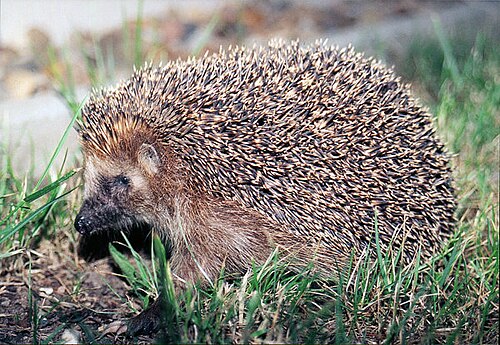
Eulipotyphlans are insectivorous mammals. Shrews and solenodons resemble mice, hedgehogs carry spines, gymnures look more like large rats, while moles are stout-bodied burrowers.
- Family: Erinaceidae (hedgehogs)
- Subfamily: Erinaceinae
- Genus: Erinaceus
- West European hedgehog, E. europaeusLC[17]
- Northern white-breasted hedgehog, E. roumanicusLC[18]
- Genus: Erinaceus
- Subfamily: Erinaceinae

- Family: Soricidae (shrews)
- Subfamily: Soricinae
- Tribe: Nectogalini
- Genus: Neomys
- Eurasian water shrew, Neomys fodiensLC
- Mediterranean water shrew, Neomys anomalusLC[2]
- Genus: Neomys
- Tribe: Soricini
- Genus: Sorex
- Common shrew, Sorex araneusLC
- Laxmann's shrew, Sorex caecutiensLC
- Eurasian pygmy shrew, Sorex minutusLC
- Eurasian least shrew, Sorex minutissimusLC (one uncertain finding from 1971[2])
- Genus: Sorex
- Tribe: Nectogalini
- Subfamily: Soricinae
- Family: Talpidae (moles)
- Subfamily: Talpinae
- Tribe: Talpini
- Genus: Talpa
- European mole, Talpa europaeaLC
- Genus: Talpa
- Tribe: Talpini
- Subfamily: Talpinae
Order: Lagomorpha (lagomorphs)
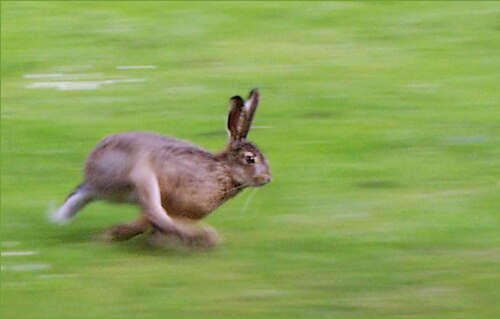
The lagomorphs comprise two families, Leporidae (hares and rabbits), and Ochotonidae (pikas). Though they can resemble rodents, and were classified as a superfamily in that order until the early twentieth century, they have since been considered a separate order. They differ from rodents in a number of physical characteristics, such as having four incisors in the upper jaw rather than two.
- Family: Leporidae (rabbits, hares)
- Genus: Lepus
- European hare, L. europaeusLC[19]
- Mountain hare, L. timidusLC[20]
- Genus: Lepus
Order: Rodentia (rodents)

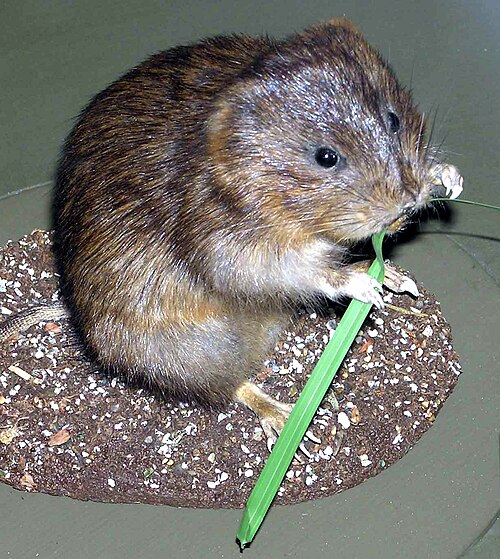
Rodents make up the largest order of mammals, with over 40% of mammalian species. They have two incisors in the upper and lower jaw which grow continually and must be kept short by gnawing. Most rodents are small though the capybara can weigh up to 45 kg (99 lb).
- Suborder: Sciurognathi
- Family: Castoridae (beavers)
- Genus: Castor
- Eurasian beaver, C. fiberLC[21]
- Genus: Castor
- Family: Sciuridae (squirrels)
- Subfamily: Sciurinae
- Tribe: Sciurini
- Genus: Sciurus
- Red squirrel, S. vulgarisLC[22]
- Genus: Sciurus
- Tribe: Sciurini
- Tribe: Pteromyini
- Genus: Pteromys
- Siberian flying squirrel, P. volans NT
- Genus: Pteromys
- Subfamily: Sciurinae
- Family: Gliridae (dormice)
- Subfamily: Leithiinae
- Genus: Eliomys
- Garden dormouse, Eliomys quercinusVU (last sighted in 1986[15])
- Genus: Muscardinus
- Hazel dormouse, Muscardinus avellanarius NT (last sighted in 1986[15])
- Genus: Eliomys
- Subfamily: Leithiinae
- Family: Dipodidae (jerboas)
- Subfamily: Sicistinae
- Genus: Sicista
- Northern birch mouse, Sicista betulina NT
- Genus: Sicista
- Subfamily: Sicistinae
- Family: Cricetidae
- Subfamily: Arvicolinae
- Genus: Arvicola
- European water vole or north-western water vole, Arvicola amphibius LC
- Genus: Clethrionomys
- Bank vole, Myodes glareolus or Clethrionomys glareolusLC
- Genus: Microtus
- Field vole, Microtus agrestis LC
- Common vole, Microtus arvalis LC
- Root vole, Microtus oeconomus LC (one lower jaw found in 1970[2])
- Sibling vole, Microtus levis LC
- European pine vole, Microtus subterraneus LC
- Genus: Myopus
- Wood lemming, Myopus schisticolor LC (first found in 2019)[2]
- Genus: Ondatra
- Muskrat, Ondatra zibethicus LC (introduced)
- Genus: Arvicola
- Subfamily: Arvicolinae
- Family: Muridae (mice, rats, voles, gerbils, hamsters, etc.)
- Subfamily: Murinae
- Genus: Apodemus
- Striped field mouse, Apodemus agrarius LC
- Yellow-necked mouse, Apodemus flavicollis LC
- Ural field mouse, Apodemus uralensis LC
- Genus: Micromys
- Harvest mouse, Micromys minutus NT
- Genus: Rattus
- Genus: Mus
- House mouse, Mus musculus LC
- Genus: Apodemus
- Subfamily: Murinae
- Family: Castoridae (beavers)
See also
External links
- Eesti imetajate levikuatlas(in Estonian)
References
- 12Moks, Epp; Remm, Jaanus; Kalda, Oliver; Valdmann, Harri (2015). Eesti imetajad[Estonian mammals] (in Estonian). Varrak. ISBN 978-9985-3-3470-6.
- 1234567Timm, Uudo (2020). "Väike-vesimutt ja metslemming Eestis"[Mediterranean water shrew and wood lemming in Estonia](PDF). Eesti Loodus (in Estonian) (3): 58–60.
- ↑Breitenmoser, U.; Breitenmoser-Würsten, C.; Lanz, T.; von Arx, M.; Antonevich, A.; Bao, W. & Avgan, B. (2015). "Lynx lynx". IUCN Red List of Threatened Species. 2015 e.T12519A121707666.
- ↑Boitani, L.; Phillips, M. & Jhala, Y. (2018). "Canis lupus". IUCN Red List of Threatened Species. 2018 e.T3746A119623865. doi:10.2305/IUCN.UK.2018-2.RLTS.T3746A119623865.en.
{{cite journal}}: CS1 maint: multiple names: authors list (link) - ↑Hoffmann, M.; Sillero-Zubiri, C. (2016). "Vulpes vulpes". IUCN Red List of Threatened Species. 2016 e.T23062A46190249. doi:10.2305/IUCN.UK.2016-1.RLTS.T23062A46190249.en.
- ↑McLellan, B. N.; Proctor, M. F.; Huber, D. & Michel, S. (2017). "Ursus arctos". IUCN Red List of Threatened Species. 2017 e.T41688A121229971. doi:10.2305/IUCN.UK.2017-3.RLTS.T41688A121229971.en.
- ↑Roos, A.; Loy, A.; de Silva, P.; Hajkova, P.; Zemanová, B. (2015). "Lutra lutra". IUCN Red List of Threatened Species. 2015 e.T12419A21935287. doi:10.2305/IUCN.UK.2015-2.RLTS.T12419A21935287.en.
- ↑Kranz, A.; Abramov, A. V.; Herrero, J. & Maran, T. (2016). "Meles meles". IUCN Red List of Threatened Species. 2016 e.T29673A45203002.
- ↑Maran, T.; Aulagnier, S.; Libois, R.; Kranz, A.; Abramov, A. & Wozencraft, C. (2010). "Mustela lutreola". IUCN Red List of Threatened Species. 2010 e.T14018A4381596.
- ↑Reid, F.; Schiaffini, M.; Schipper, J. (2016). "Neovison vison". IUCN Red List of Threatened Species. 2016 e.T41661A45214988.
- ↑Jüssi, Ivar (2020). "Hülged tunnevad jääst ja lumest puudust"[Seals miss ice and snow](PDF). Eesti Loodus (2): 42–47.
- ↑Ernits, Peeter (1986). "Valgevaal Eesti vetes"[Beluga in Estonian water]. Eesti Loodus (8): 529–533.
- 12"Dolphins sighted in Kopli Bay in Estonia". The Baltic Course. 2 June 2020. Retrieved 30 December 2022.
- ↑Piraccini, R. (2016). "Barbastella barbastellus". IUCN Red List of Threatened Species. 2016 e.T2553A22029285.
- 123Timm, Uudo; Maran, Tiit (2020). "Kui palju on muutunud imetajate fauna Eestis?"[How much mammalian fauna in Estonia has changed?](PDF). Eesti Loodus (in Estonian) (3): 12–21.
- ↑Gazaryan, S.; Kruskop, S.V. & Godlevska, L. (2021) [errata version of 2020 assessment]. "Plecotus auritus". IUCN Red List of Threatened Species. 2020 e.T85535522A195861341.
- ↑Amori, G. (2016). "Erinaceus europaeus". IUCN Red List of Threatened Species. 2016 e.T29650A2791303.
- ↑Amori, G.; Hutterer, R.; Kryštufek, B.; Yigit, N.; Mitsain, G. & Palomo, L.J. (2016). "Erinaceus roumanicus". IUCN Red List of Threatened Species. 2016 e.T136344A115206348.
- ↑Hacklande, K. & Schai-Braun, S. (2019). "Lepus europaeus". IUCN Red List of Threatened Species. 2019 e.T41280A45187424.
- ↑Smith, A.T. & Johnston, C.H. (2019). "Lepus timidus". IUCN Red List of Threatened Species. 2019 e.T11791A45177198.
- ↑Batbold, J.; Batsaikhan, N.; Shar, S.; Hutterer, R.; Kryštufek, B.; Yigit, N.; Mitsain, G.; Palomo, L. (2016). "Castor fiber". IUCN Red List of Threatened Species. 2016 e.T4007A115067136.
- ↑Amori, G.; Hutterer, R.; Kryštufek, B.; Yigit, N.; Mitsain, G.; Muñoz, L. J. P. (2010). "Sciurus vulgaris". IUCN Red List of Threatened Species. 2010 e.T20025A9136220.
- Lists of biota of Estonia
- Lists of mammals of Europe
- Fauna of Estonia
- Lists of mammals by country