
Serine hydroxymethyltransferase
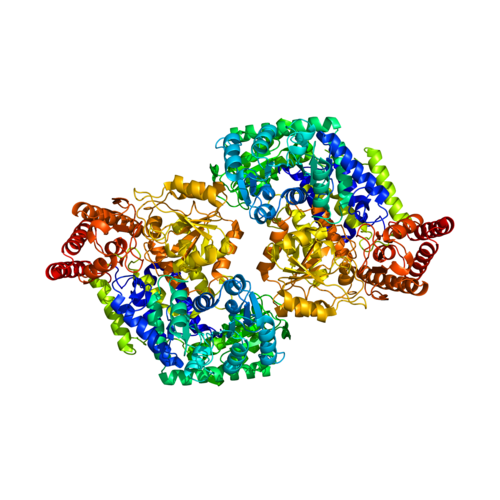
Serine hydroxymethyltransferase (SHMT) is a pyridoxal phosphate (PLP) (Vitamin B6) dependent enzyme (EC2.1.2.1) which plays an important role in cellular one-carbon pathways by catalyzing the reversible, simultaneous conversions of L-serine to glycine and tetrahydrofolate (THF) to 5,10-methylenetetrahydrofolate (5,10-CH2-THF).[1] This reaction provides the largest part of the one-carbon units available to the cell.[2]
Structure
The structure of the SHMT monomer is similar across prokaryotes and eukaryotes, but whereas the active enzyme is a dimer in prokaryotes, the enzyme exists as a tetramer in eukaryotic cells, though the evolutionary basis for this difference in structure is unknown.[1] However, the evolutionary path taken by SHMT going from prokaryotic dimeric form to the eukaryotic tetrameric form can be easily seen as a sort of doubling event. In other words, the eukaryotic SHMT tetramer resembles two prokaryotic dimers that have packed together, forming what has been described as a “dimer of dimers.”[3] The interaction between two monomers within a dimer subunit has been found to occur over a greater contact area and is thus much tighter than the interaction between the two dimers.[3] Human serine hydroxymethyltransferase 2 (SHMT2) regulates one-carbon transfer reactions required for amino acid and nucleotide metabolism, and the regulated switch between dimeric and tetrameric forms of SHMT2, which is induced by pyridoxal phosphate,[4] has recently been shown to be involved in regulation of the BRISC deubiquitylase complex, linking metabolism to inflammation. The SHMT2 dimer, but not the PLP-bound tetramer, is a potent inhibitor of the multimeric BRISC complex, revealing a potential mechanism for SHMT2 regulation of inflammation.[5]
يمكن تقسيم مونومر SHMT الواحد إلى ثلاثة نطاقات: "ذراع" طرفي N ، ونطاق "كبير" ، ونطاق "صغير". [ 3 ] يبدو أن الذراع الطرفي N يحافظ على التفاعل الوثيق بين مونومرين. يلتف هذا الذراع، المكون من حلزونين ألفا وصفيحة بيتا ، حول المونومر الآخر عندما يكون في شكل متعدد الوحدات. [ 3 ] يحتوي النطاق "الكبير" على موقع ارتباط PLP ، كما هو الحال في بروتينات أخرى تعتمد على PLP، مثل ناقلة أمين الأسبارتات . [ 3 ] يحتوي النطاق الكبير في الشكل حقيقي النواة أيضًا على هيستيدين ضروري لاستقرار الرباعي. [ 3 ] تقع جميع الهيستيدينات الأربعة لهذه البقايا، واحد من كل مونومر، في مركز المركب الرباعي، حيث يتفاعل هيستيدينان من وحدة فرعية ثنائية مع هيستيدينات الوحدة الفرعية الأخرى في تفاعلات تكديس . [ 3 ] يحتوي إنزيم SHMT بدائيات النوى على بقايا البرولين بدلاً من الهيستيدين في الموضع المكافئ، وهو ما يفسر جزئياً سبب عدم تكوين إنزيم SHMT بدائيات النوى لرباعيات. [ 6 ]
يُعدّ تركيب الموقع النشط محفوظًا بدرجة عالية عبر أشكال حقيقيات النوى وبدائيات النوى. يرتبط جزيء PLP بواسطة الليسين ، الذي يُشكّل رابطة قاعدة شيف ألديمين مع ألدهيد PLP . [ 7 ] وقد افترض الباحثون أن التيروسين المجاور يعمل كمانح ومستقبل للبروتون خلال خطوة نقل الأدينامين، وكذلك خطوة نقل الفورميل ، وأن بقايا الأرجينين تُشارك السلسلة الجانبية للتيروسين في تفاعل كاتيون-π ، مما يُساعد على خفض قيمة pKa للتيروسين ، وبالتالي تقليل حاجز نقل البروتون. [ 7 ]
الآلية
تُعزى الآلية الشائعة لنشاط إنزيم SHMT إلى عملية تبادل الأميد متبوعة بفصل السلسلة الجانبية للحمض الأميني عن السلسلة الرئيسية. [ 7 ] يقوم الأمين الطرفي N للسيرين بهجوم نيوكليوفيلي على الألديمين الموجود بين الليسين في إنزيم SHMT (الألديمين الداخلي) وألدهيد PLP لتكوين ثنائي أمين متجاور، ثم ينتقل الزوج الإلكتروني الحر للأمين الطرفي N ليحل محل الليسين، مكونًا ألديمينًا جديدًا، هذه المرة مع السيرين (الألديمين الخارجي). [ 7 ] [ 8 ] يُعتقد أن التيروسين المجاور مسؤول عن معظم عمليات نقل البروتون التي تحدث أثناء عملية تبادل الأميد. [ 7 ] [ 9 ] [ 10 ]

Once the serine is bonded to PLP, PLP triggers the α-elimination of the hydroxymethyl group of the substrate (serine). This group is released as a formaldehyde molecule because a nearby glutamate abstracts the proton from the hydroxyl group. Afterwards, the nucleophilic amine on THF attacks the free formaldehyde intermediate to make the carbinolamine intermediate.[8][12] In the second case, the nucleophilic amines on THF attack the serine side chain carbon, simultaneously forming a carbinolamine intermediate on the THF and a quinoid intermediate with the PLP.[8][13] However, THF is not an obligate substrate for SHMT, meaning the cleavage of serine and other β-hydroxy amino acids (such as threonine) can occur without the presence of THF and, in this case, the mechanism is a retro-aldol cleavage.[14] Also, it seems that the subsequent dehydration of the carbinolamine intermediate to form the methylene bridge and fully cyclize into 5,10-CH2-THF is not catalyzed by the enzyme and this reaction may occur spontaneously.[8] In fact, this conversion could occur outside the enzyme, but a study shows that this reaction is faster and thermodynamically favourable when occurs inside the SHMT aided by the Glu57 residue. Moreover, the cyclisation of the carbinolamine intermediate to form 5,10-CH2-THF is essential to Glu57 restore its proton that is used to protonate the quinonoid intermediate and complete the catalytic cycle.[12]
Clinical significance
Folate metabolism has already been the subject of chemotherapeutic strategies, but SHMT inhibition, while researched, had not really been taken advantage of in commercial anticancer drugs.[15] However, because the folates used by folate metabolic and folate-dependent enzymes are all very similar in structure and folate mimics are already common in medical use, it has not been difficult to find potential molecular structures that may inhibit SHMT.[15] For example, pemetrexed is already used as an antifolate to treat mesothelioma and was found to be an effective inhibitor of SHMT[15] and screening other antifolates revealed lometrexol as another effective inhibitor of SHMT.[16]
SHMT has also undergone investigation as a potential target for antimalarial drugs. Research indicates that the active site environment of Plasmodium SHMTs (PSHMTs) differs from that of human cytosolic SHMT, allowing for the possibility of selective inhibition of PSHMT and, thus, the treatment of malaria infections.[17] In particular, certain pyrazolopyran molecules have been shown to have a selective nanomolar efficacy against PSHMTs. Poor pharmacokinetics, however, have prevented these pyrazolopyrans from being effective in living models.[18]
Isoforms
Bacteria such as Escherichia coli and Bacillus stearothermophilus have versions of this enzyme and there appear to be two isoforms of SHMT in mammals, one in the cytoplasm (cSHMT) and another in the mitochondria (mSHMT).[1] Plants may have an additional SHMT isoform within chloroplasts.[19]
In mammals, the enzyme is a tetramer of four identical subunits of approximately 50,000 daltons each. The intact holoenzyme has a molecular weight of approximately 200,000 daltons and incorporates four molecules of PLP as a coenzyme.[20]
Other reactions
As well as its primary role in folate metabolism, SHMT also catalyzes other reactions that may be biologically significant, including the conversion of 5,10-Methenyltetrahydrofolate to 10-Formyltetrahydrofolate.[2] When coupled with C1-tetrahydrofolate synthase and tetrahydropteroate, cSHMT also catalyzes the conversion of formate to serine.[2]
Role in Smith–Magenis syndrome
Smith–Magenis syndrome (SMS) is a rare disorder that manifests as a complex set of traits including facial abnormalities, unusual behaviors, and developmental delay.[21] It results from an interstitial deletion within chromosome 17p11.2, including the cSHMT gene and a small study showed SHMT activity in SMS patients was ~50% of normal.[21] Reduced SHMT would result in a reduced glycine pool, which could affect the nervous system by reducing the functioning of NMDA receptors. This could be a potential mechanism for explaining SMS.[21]
Figures

References
- 123Appaji Rao N, Ambili M, Jala VR, Subramanya HS, Savithri HS (April 2003). "Structure-function relationship in serine hydroxymethyltransferase". Biochimica et Biophysica Acta (BBA) - Proteins and Proteomics. 1647 (1–2): 24–29. doi:10.1016/s1570-9639(03)00043-8. PMID 12686103.
- 123Stover P, Schirch V (August 1990). "Serine hydroxymethyltransferase catalyzes the hydrolysis of 5,10-methenyltetrahydrofolate to 5-formyltetrahydrofolate". The Journal of Biological Chemistry. 265 (24): 14227–14233. doi:10.1016/S0021-9258(18)77290-6. PMID 2201683.
- 1234567Renwick SB, Snell K, Baumann U (September 1998). "The crystal structure of human cytosolic serine hydroxymethyltransferase: a target for cancer chemotherapy". Structure. 6 (9): 1105–1116. doi:10.1016/s0969-2126(98)00112-9. PMID 9753690.
- ↑Giardina G, Brunotti P, Fiascarelli A, Cicalini A, Costa MG, Buckle AM, et al. (April 2015). "How pyridoxal 5'-phosphate differentially regulates human cytosolic and mitochondrial serine hydroxymethyltransferase oligomeric state". The FEBS Journal. 282 (7): 1225–1241. doi:10.1111/febs.13211. PMID 25619277. S2CID 11561274.
- ↑Eyers PA, Murphy JM (November 2016). "The evolving world of pseudoenzymes: proteins, prejudice and zombies". BMC Biology. 14 (1): 98. Bibcode:2019Natur.570..194W. doi:10.1038/s41586-019-1232-1. PMC 5106787. PMID 27835992.
- ↑Scarsdale JN, Radaev S, Kazanina G, Schirch V, Wright HT (February 2000). "Crystal structure at 2.4 A resolution of E. coli serine hydroxymethyltransferase in complex with glycine substrate and 5-formyl tetrahydrofolate". Journal of Molecular Biology. 296 (1): 155–168. doi:10.1006/jmbi.1999.3453. PMID 10656824.
- 12345Florio R, di Salvo ML, Vivoli M, Contestabile R (November 2011). "Serine hydroxymethyltransferase: a model enzyme for mechanistic, structural, and evolutionary studies". Biochimica et Biophysica Acta (BBA) - Proteins and Proteomics. 1814 (11): 1489–1496. doi:10.1016/j.bbapap.2010.10.010. PMID 21059411.
- 12345Schirch V, Szebenyi DM (October 2005). "Serine hydroxymethyltransferase revisited". Current Opinion in Chemical Biology. 9 (5): 482–487. doi:10.1016/j.cbpa.2005.08.017. PMID 16125438.
- ↑Oliveira EF, Cerqueira NM, Fernandes PA, Ramos MJ (October 2011). "Mechanism of formation of the internal aldimine in pyridoxal 5'-phosphate-dependent enzymes". Journal of the American Chemical Society. 133 (39): 15496–15505. doi:10.1021/ja204229m. PMID 21854048.
- ↑ سيركيرا، ن.م.، فرنانديز، ب.أ.، راموس، م.ج. (مايو 2011). "دراسات آلية حسابية تتناول تفاعل نقل الأمين الموجود في جميع الإنزيمات التي تتطلب بيريدوكسال 5'-فوسفات". مجلة نظرية الحساب الكيميائي . 7 (5): 1356-1368 . doi : 10.1021/ct1002219 . PMID 26610130 .
- ↑ تريفيدي ف، غوبتا أ، جالا ف ر، سارافانان ب، راو ج س، راو ن أ، وآخرون . (مايو 2002). "البنية البلورية للمركبات الثنائية والثلاثية لإنزيم سيرين هيدروكسي ميثيل ترانسفيراز من بكتيريا باسيلوس ستيروموفيلوس: رؤى حول الآلية التحفيزية" . مجلة الكيمياء البيولوجية . 277 (19): 17161-17169 . doi : 10.1074/jbc.M111976200 . PMID 11877399 .
- 1 2 3 فيرنانديز إتش إس ، راموس إم جيه، سيركيرا إن إم (2018-10-03). "الآلية التحفيزية لإنزيم سيرين هيدروكسي ميثيل ترانسفيراز: دراسة حسابية باستخدام نموذج ONIOM QM/MM". مجلة ACS Catalysis . 8 (11): 10096–10110 . doi : 10.1021/acscatal.8b02321 . ISSN 2155-5435 . S2CID 105838672 .
- ↑ Szebenyi DM, Musayev FN, di Salvo ML, Safo MK, Schirch V (يونيو 2004). "إنزيم سيرين هيدروكسي ميثيل ترانسفيراز: دور الغلوتامات 75 ودليل على أن السيرين يُشطر بآلية ريترو ألدول" . الكيمياء الحيوية . 43 (22): 6865-6876 . doi : 10.1021/bi049791y . PMID 15170323 .
- ↑ تشيبا واي، تيرادا تي، كاميا إم، شيميزو كيه، أراي إتش، إيشي إم، إيغاراشي واي (فبراير 2012). "آلية تفاعل الألدولاز غير المعتمد على حمض الفوليك والمحفز بواسطة سيرين هيدروكسي ميثيل ترانسفيراز" . مجلة FEBS . 279 (3): 504-514 . doi : 10.1111/j.1742-4658.2011.08443.x . PMID 22141341 .
- 1 2 3 دايدون إف، فلوريو آر، رينالدو إس، كونتيستابيلي آر، دي سالفو إم إل، كوتروزولا إف، وآخرون . (مايو 2011). "التحقق الحاسوبي والمخبري من سيرين هيدروكسي ميثيل ترانسفيراز كهدف علاجي كيميائي لدواء بيميتريكسيد المضاد للفولات". المجلة الأوروبية للكيمياء الطبية . 46 (5): 1616-1621 . doi : 10.1016/j.ejmech.2011.02.009 . PMID 21371789 .
- ↑Paiardini A, Fiascarelli A, Rinaldo S, Daidone F, Giardina G, Koes DR, et al. (March 2015). "Screening and in vitro testing of antifolate inhibitors of human cytosolic serine hydroxymethyltransferase". ChemMedChem. 10 (3): 490–497. doi:10.1002/cmdc.201500028. PMC 5438088. PMID 25677305.
- ↑Pinthong C, Maenpuen S, Amornwatcharapong W, Yuthavong Y, Leartsakulpanich U, Chaiyen P (June 2014). "Distinct biochemical properties of human serine hydroxymethyltransferase compared with the Plasmodium enzyme: implications for selective inhibition". The FEBS Journal. 281 (11): 2570–2583. doi:10.1111/febs.12803. PMID 24698160.
- ↑Witschel MC, Rottmann M, Schwab A, Leartsakulpanich U, Chitnumsub P, Seet M, et al. (April 2015). "Inhibitors of plasmodial serine hydroxymethyltransferase (SHMT): cocrystal structures of pyrazolopyrans with potent blood- and liver-stage activities". Journal of Medicinal Chemistry. 58 (7): 3117–3130. doi:10.1021/jm501987h. PMID 25785478.
- ↑Besson V, Nauburger M, Rebeille F, Douce R (1995). "Evidence for three serine hydroxymethyltransferases in green leaf cells. Purification and characterization of the mitochondrial and chloroplastic isoforms". Plant Physiol. Biochem. 33 (6): 665–673.
- ↑Martinez-Carrion M, Critz W, Quashnock J (April 1972). "Molecular weight and subunits of serine transhydroxymethylase". Biochemistry. 11 (9): 1613–1615. doi:10.1021/bi00759a011. PMID 5028104.
- 123Elsea SH, Juyal RC, Jiralerspong S, Finucane BM, Pandolfo M, Greenberg F, et al. (December 1995). "Haploinsufficiency of cytosolic serine hydroxymethyltransferase in the Smith-Magenis syndrome". American Journal of Human Genetics. 57 (6): 1342–1350. PMC 1801426. PMID 8533763.
- ↑Nonaka H, Nakanishi Y, Kuno S, Ota T, Mochidome K, Saito Y, et al. (February 2019). "Design strategy for serine hydroxymethyltransferase probes based on retro-aldol-type reaction". Nature Communications. 10 (1) 876. Bibcode:2019NatCo..10..876N. doi:10.1038/s41467-019-08833-7. PMC 6382819. PMID 30787298.
Further reading
- Akhtar M, el-Obeid HA (March 1972). "Inactivation of serine transhydroxymethylase and threonine aldolase activities". Biochimica et Biophysica Acta (BBA) - Enzymology. 258 (3): 791–799. doi:10.1016/0005-2744(72)90180-5. PMID 5017703.
- Blakley RL (December 1960). "A spectrophotometric study of the reaction catalysed by serine transhydroxymethylase". The Biochemical Journal. 77 (3): 459–465. doi:10.1042/bj0770459. PMC 1205057. PMID 16748851.
- Fujioka M (1969). "Purification and properties of serine hydroxymethylase from soluble and mitochondrial fractions of rabbit liver". Biochimica et Biophysica Acta (BBA) - Enzymology. 185 (2): 338–349. doi:10.1016/0005-2744(69)90427-6. PMID 5808700.
- Kumagai H, Nagate T, Yoshida H, Yamada H (March 1972). "Threonine aldolase from Candida humicola. II. Purification, crystallization and properties". Biochimica et Biophysica Acta (BBA) - Enzymology. 258 (3): 779–790. doi:10.1016/0005-2744(72)90179-9. PMID 5017702.
- Schirch L, Gross T (November 1968). "Serine transhydroxymethylase. Identification as the threonine and allothreonine aldolases". The Journal of Biological Chemistry. 243 (21): 5651–5655. doi:10.1016/S0021-9258(18)91916-2. PMID 5699057.
- Schirch L, Quashnock J (June 1981). "Evidence that tetrahydrofolate does not bind to serine hydroxymethyltransferase with positive homotropic cooperativity". The Journal of Biological Chemistry. 256 (12): 6245–6249. doi:10.1016/S0021-9258(19)69154-4. PMID 6787050.
- Quashnock JM, Chlebowski JF, Martinez-Carrion M, Schirch L (January 1983). "Serine hydroxymethyltransferase. 31P nuclear magnetic resonance study of the enzyme-bound pyridoxal 5'-phosphate". The Journal of Biological Chemistry. 258 (1): 503–507. doi:10.1016/S0021-9258(18)33284-8. PMID 6848517.
External links
- Serine+Hydroxymethyltransferase at the U.S. National Library of Medicine Medical Subject Headings (MeSH)
- EC 2.1.2