
الهاميلتوني الجزيئي
في الفيزياء الذرية والجزيئية والبصرية والكيمياء الكمية ، يُعدّ الهاميلتوني الجزيئي مؤثر هاميلتوني يُمثّل طاقة الإلكترونات والنوى في الجزيء . ويلعب هذا المؤثر ومعادلة شرودنغر المرتبطة به دورًا محوريًا في الكيمياء والفيزياء الحاسوبية لحساب خصائص الجزيئات وتجمعاتها، مثل التوصيل الحراري ، والحرارة النوعية ، والتوصيل الكهربائي ، والخصائص البصرية والمغناطيسية ، والتفاعلية .
تتكون الجزيئة من ذرات، تتميز بأعدادها الذرية Z ، والإلكترونات، التي تحمل شحنة أولية سالبة −e . ينتج عن تفاعلها شحنة نووية مقدارها Z + q ، حيث q = −eN ، و N هو عدد الإلكترونات. تُعتبر الإلكترونات والنوى، بتقريب جيد جدًا، شحنات نقطية وكتل نقطية. هاميلتونيان الجزيئة هو مجموع عدة حدود: حدوده الرئيسية هي الطاقات الحركية للإلكترونات وتفاعلات كولوم (الكهروستاتيكية) بين نوعي الجسيمات المشحونة. يُعرف الهاميلتونيان الذي يحتوي فقط على الطاقات الحركية للإلكترونات والنوى، وتفاعلات كولوم بينهما، باسم هاميلتونيان كولوم . ويفتقر هذا الهاميلتونيان إلى عدد من الحدود الصغيرة، معظمها ناتج عن اللف المغزلي الإلكتروني والنووي .
على الرغم من أنه يُفترض عمومًا أن حل معادلة شرودنغر غير المعتمدة على الزمن والمرتبطة بهاملتونيان كولوم يُمكنه التنبؤ بمعظم خصائص الجزيء، بما في ذلك شكله (بنيته ثلاثية الأبعاد)، إلا أن الحسابات القائمة على هاملتونيان كولوم الكامل نادرة جدًا. والسبب الرئيسي هو صعوبة حل معادلة شرودنغر الخاصة بها. وتقتصر تطبيقاتها على أنظمة صغيرة كجزيء الهيدروجين.
تعتمد جميع حسابات الدوال الموجية الجزيئية تقريبًا على فصل هاميلتونيان كولوم الذي ابتكره بورن وأوبنهايمر . تُحذف حدود الطاقة الحركية النووية من هاميلتونيان كولوم، ويُعتبر الهاميلتونيان المتبقي هاميلتونيانًا للإلكترونات فقط. تدخل النوى الثابتة في المسألة فقط كمولدات لجهد كهربائي تتحرك فيه الإلكترونات بطريقة كمومية. ضمن هذا الإطار، تم تبسيط هاميلتونيان الجزيئي إلى ما يُسمى هاميلتونيان النواة المثبتة ، أو هاميلتونيان الإلكترونات ، الذي يعمل فقط على دوال الإحداثيات الإلكترونية.
بعد حل معادلة شرودنغر لهاملتونيان النواة المثبتة لعدد كافٍ من تشكيلات النوى، يمكن اعتبار قيمة ذاتية مناسبة (عادةً ما تكون الأدنى) دالةً لإحداثيات النواة، مما يؤدي إلى سطح طاقة كامنة . في الحسابات العملية، يُطابق هذا السطح عادةً بدلالة بعض الدوال التحليلية. في الخطوة الثانية من تقريب بورن-أوبنهايمر، يُستبدل جزء هاملتونيان كولوم الكامل الذي يعتمد على الإلكترونات بسطح الطاقة الكامنة. هذا يحوّل هاملتونيان الجزيء الكلي إلى هاملتونيان آخر يؤثر فقط على إحداثيات النواة. في حالة انهيار تقريب بورن-أوبنهايمر - والذي يحدث عندما تكون طاقات الحالات الإلكترونية المختلفة متقاربة - يلزم استخدام أسطح الطاقة الكامنة المجاورة، راجع هذه المقالة لمزيد من التفاصيل حول هذا الموضوع.
يمكن حل معادلة شرودنغر لحركة النواة في إطار مرجعي ثابت (إطار المختبر) ، ولكن في هذه الحالة لا تُؤخذ طاقات الحركة الانتقالية والدورانية (الخارجية) في الحسبان. تدخل الاهتزازات الذرية (الداخلية) فقط في المسألة. علاوة على ذلك، بالنسبة للجزيئات الأكبر من الجزيئات ثلاثية الذرات، من الشائع استخدام التقريب التوافقي ، الذي يُقارب سطح طاقة الوضع كدالة تربيعية للإزاحات الذرية. وهذا يُعطي هاميلتوني حركة النواة التوافقي . وباستخدام التقريب التوافقي، يُمكننا تحويل الهاميلتوني إلى مجموع هاميلتونيات مذبذب توافقي أحادي البعد غير مقترن . يُعد المذبذب التوافقي أحادي البعد أحد الأنظمة القليلة التي تسمح بحل دقيق لمعادلة شرودنغر.
Alternatively, the nuclear motion (rovibrational) Schrödinger equation can be solved in a special frame (an Eckart frame) that rotates and translates with the molecule. Formulated with respect to this body-fixed frame the Hamiltonian accounts for rotation, translation and vibration of the nuclei. Since Watson introduced in 1968 an important simplification to this Hamiltonian, it is often referred to as Watson's nuclear motion Hamiltonian, but it is also known as the Eckart Hamiltonian.
Coulomb Hamiltonian
The algebraic form of many observables—i.e., Hermitian operators representing observable quantities—is obtained by the following quantization rules:
- Write the classical form of the observable in Hamilton form (as a function of momenta p and positions q). Both vectors are expressed with respect to an arbitrary inertial frame, usually referred to as laboratory-frame or space-fixed frame.
- Replace p by and interpret q as a multiplicative operator. Here is the nabla operator, a vector operator consisting of first derivatives. The well-known commutation relations for the p and q operators follow directly from the differentiation rules.


Classically the electrons and nuclei in a molecule have kinetic energy of the form p2/(2 m) and interact via Coulomb interactions, which are inversely proportional to the distancerij between particle i and j.

In this expression ri stands for the coordinate vector of any particle (electron or nucleus), but from here on we will reserve capital R to represent the nuclear coordinate, and lower case r for the electrons of the system. The coordinates can be taken to be expressed with respect to any Cartesian frame centered anywhere in space, because distance, being an inner product, is invariant under rotation of the frame and, being the norm of a difference vector, distance is invariant under translation of the frame as well.
By quantizing the classical energy in Hamilton form one obtains the a molecular Hamilton operator that is often referred to as the Coulomb Hamiltonian. This Hamiltonian is a sum of five terms. They are
- The kinetic energy operators for each nucleus in the system;
- The kinetic energy operators for each electron in the system;
- The potential energy between the electrons and nuclei – the total electron-nucleus Coulombic attraction in the system;
- The potential energy arising from Coulombic electron-electron repulsions
- The potential energy arising from Coulombic nuclei-nuclei repulsions – also known as the nuclear repulsion energy. See electric potential for more details.
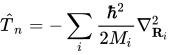
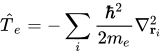
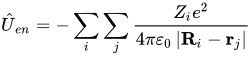


Here Mi is the mass of nucleus i, Zi is the atomic number of nucleus i, and me is the mass of the electron. The Laplace operator of particle i is:. Since the kinetic energy operator is an inner product, it is invariant under rotation of the Cartesian frame with respect to which xi, yi, and zi are expressed.

Small terms
In the 1920s much spectroscopic evidence made it clear that the Coulomb Hamiltonian is missing certain terms. Especially for molecules containing heavier atoms, these terms, although much smaller than kinetic and Coulomb energies, are nonnegligible. These spectroscopic observations led to the introduction of a new degree of freedom for electrons and nuclei, namely spin. This empirical concept was given a theoretical basis by Paul Dirac when he introduced a relativistically correct (Lorentz covariant) form of the one-particle Schrödinger equation. The Dirac equation predicts that spin and spatial motion of a particle interact via spin–orbit coupling. In analogy spin-other-orbit coupling was introduced. The fact that particle spin has some of the characteristics of a magnetic dipole led to spin–spin coupling. Further terms without a classical counterpart are the Fermi-contact term (interaction of electronic density on a finite size nucleus with the nucleus), and nuclear quadrupole coupling (interaction of a nuclear quadrupole with the gradient of an electric field due to the electrons). Finally a parity violating term predicted by the Standard Model must be mentioned. Although it is an extremely small interaction, it has attracted a fair amount of attention in the scientific literature because it gives different energies for the enantiomers in chiral molecules.
The remaining part of this article will ignore spin terms and consider the solution of the eigenvalue (time-independent Schrödinger) equation of the Coulomb Hamiltonian.
The Schrödinger equation of the Coulomb Hamiltonian
يتميز هاميلتونيان كولوم بطيف متصل نتيجة لحركة مركز كتلة الجزيء في الفضاء المتجانس. في الميكانيكا الكلاسيكية، يسهل فصل حركة مركز الكتلة لنظام من الكتل النقطية. كلاسيكيًا، تكون حركة مركز الكتلة منفصلة عن الحركات الأخرى. يتحرك مركز الكتلة بانتظام (أي بسرعة ثابتة) عبر الفضاء كما لو كان جسيمًا نقطيًا كتلته تساوي مجموع كتل جميع الجسيمات.
في ميكانيكا الكم، يمتلك الجسيم الحر دالة حالة هي دالة الموجة المستوية، وهي دالة غير قابلة للتكامل التربيعي لزخم محدد جيدًا. يمكن أن تأخذ الطاقة الحركية لهذا الجسيم أي قيمة موجبة. يكون موضع مركز الكتلة احتماليًا بشكل منتظم في كل مكان، بما يتوافق مع مبدأ هايزنبرغ للشك .
بإدخال متجه الإحداثيات X لمركز الكتلة كثلاث درجات حرية للنظام، وحذف متجه إحداثيات جسيم واحد (اختياري)، بحيث يبقى عدد درجات الحرية كما هو، نحصل بتحويل خطي على مجموعة جديدة من الإحداثيات tᵢ . هذه الإحداثيات هي تراكيب خطية للإحداثيات القديمة لجميع الجسيمات (النوى والإلكترونات ). بتطبيق قاعدة السلسلة، يمكن إثبات أن

الفصل الدراسي الأول منتمثل الطاقة الحركية لحركة مركز الكتلة، والتي يمكن معالجتها بشكل منفصل لأنلا يعتمد على X. وكما ذُكر آنفًا، فإن حالاته الذاتية هي موجات مستوية. يتكون الجهد V ( t ) من حدود كولوم المعبر عنها بالإحداثيات الجديدة. الحد الأول منله المظهر المعتاد لمؤثر الطاقة الحركية. يُعرف الحد الثاني بحد استقطاب الكتلة . الهاميلتوني المتناظر إزاحيًايمكن إثبات أن المصفوفة ذاتية الترافق ومحدودة من الأسفل. أي أن أصغر قيمة ذاتية لها حقيقية ومحدودة. على الرغم منيكون ثابتًا بالضرورة تحت تباديل الجسيمات المتطابقة (لأنوطاقة الحركة لمركز الكتلة ثابتة)، فإن ثباتها ليس واضحًا.


لا توجد تطبيقات جزيئية فعلية كثيرة لـموجودة؛ مع ذلك، انظر العمل الرائد [ 1 ] حول جزيء الهيدروجين للاطلاع على تطبيق مبكر. في الغالبية العظمى من حسابات الدوال الموجية الجزيئية، تُحل المسألة الإلكترونية باستخدام هاميلتوني النواة المثبتة الذي يظهر في الخطوة الأولى من تقريب بورن-أوبنهايمر .
See Ref.[2] for a thorough discussion of the mathematical properties of the Coulomb Hamiltonian. Also it is discussed in this paper whether one can arrive a priori at the concept of a molecule (as a stable system of electrons and nuclei with a well-defined geometry) from the properties of the Coulomb Hamiltonian alone.
Clamped nucleus Hamiltonian
The clamped nucleus Hamiltonian, which is also often called the electronic Hamiltonian,[3][4] describes the energy of the electrons in the electrostatic field of the nuclei, where the nuclei are assumed to be stationary with respect to an inertial frame. The form of the electronic Hamiltonian is

The coordinates of electrons and nuclei are expressed with respect to a frame that moves with the nuclei, so that the nuclei are at rest with respect to this frame. The frame stays parallel to a space-fixed frame. It is an inertial frame because the nuclei are assumed not to be accelerated by external forces or torques. The origin of the frame is arbitrary, it is usually positioned on a central nucleus or in the nuclear center of mass. Sometimes it is stated that the nuclei are "at rest in a space-fixed frame". This statement implies that the nuclei are viewed as classical particles, because a quantum mechanical particle cannot be at rest. (It would mean that it had simultaneously zero momentum and well-defined position, which contradicts Heisenberg's uncertainty principle).
Since the nuclear positions are constants, the electronic kinetic energy operator is invariant under translation over any nuclear vector. The Coulomb potential, depending on difference vectors, is invariant as well. In the description of atomic orbitals and the computation of integrals over atomic orbitals this invariance is used by equipping all atoms in the molecule with their own localized frames parallel to the space-fixed frame.
As explained in the article on the Born–Oppenheimer approximation, a sufficient number of solutions of the Schrödinger equation of leads to a potential energy surface (PES) . It is assumed that the functional dependence of V on its coordinates is such that for where t and s are arbitrary vectors and Δφ is an infinitesimal angle, Δφ >> Δφ2. This invariance condition on the PES is automatically fulfilled when the PES is expressed in terms of differences of, and angles between, the Ri, which is usually the case.




Harmonic nuclear motion Hamiltonian
In the remaining part of this article we assume that the molecule is semi-rigid. In the second step of the BO approximation the nuclear kinetic energy Tn is reintroduced and the Schrödinger equation with Hamiltonian is considered. One would like to recognize in its solution: the motion of the nuclear center of mass (3 degrees of freedom), the overall rotation of the molecule (3 degrees of freedom), and the nuclear vibrations. In general, this is not possible with the given nuclear kinetic energy, because it does not separate explicitly the 6 external degrees of freedom (overall translation and rotation) from the 3N − 6 internal degrees of freedom. In fact, the kinetic energy operator here is defined with respect to a space-fixed (SF) frame. If we were to move the origin of the SF frame to the nuclear center of mass, then, by application of the chain rule, nuclear mass polarization terms would appear. It is customary to ignore these terms altogether and we will follow this custom.

In order to achieve a separation we must distinguish internal and external coordinates, to which end Eckart introduced conditions to be satisfied by the coordinates. We will show how these conditions arise in a natural way from a harmonic analysis in mass-weighted Cartesian coordinates.
In order to simplify the expression for the kinetic energy we introduce mass-weighted displacement coordinates Since the kinetic energy operator becomes, If we make a Taylor expansion of V around the equilibrium geometry, and truncate after three terms (the so-called harmonic approximation), we can describe V with only the third term. The term V0 can be absorbed in the energy (gives a new zero of energy). The second term is vanishing because of the equilibrium condition. The remaining term contains the Hessian matrixF of V, which is symmetric and may be diagonalized with an orthogonal 3N × 3N matrix with constant elements: It can be shown from the invariance of V under rotation and translation that six of the eigenvectors of F (last six rows of Q) have eigenvalue zero (are zero-frequency modes). They span the external space. The first 3N − 6 rows of Q are—for molecules in their ground state—eigenvectors with non-zero eigenvalue; they are the internal coordinates and form an orthonormal basis for a (3N - 6)-dimensional subspace of the nuclear configuration space R3N, the internal space. The zero-frequency eigenvectors are orthogonal to the eigenvectors of non-zero frequency. It can be shown that these orthogonalities are in fact the Eckart conditions. The kinetic energy expressed in the internal coordinates is the internal (vibrational) kinetic energy.


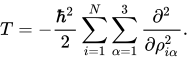


With the introduction of normal coordinates the vibrational (internal) part of the Hamiltonian for the nuclear motion becomes in the harmonic approximation The corresponding Schrödinger equation is easily solved, it factorizes into 3N − 6 equations for one-dimensional harmonic oscillators. The main effort in this approximate solution of the nuclear motion Schrödinger equation is the computation of the Hessian F of V and its diagonalization.
![{\displaystyle {\hat {H}}_{\text{nuc}}\approx {\frac {1}{2}}\sum _{t=1}^{3N-6}\left[-\hbar ^{2}{\frac {\partial ^{2}}{\partial q_{t}^{2}}}+f_{t}q_{t}^{2}\right].}](https://wikimedia.org/api/rest_v1/media/math/render/svg/90bfb77e3f22368cedd0c7246ccbebf9bfde7668)
This approximation to the nuclear motion problem, described in 3N mass-weighted Cartesian coordinates, became standard in quantum chemistry, since the days (1980s-1990s) that algorithms for accurate computations of the Hessian F became available. Apart from the harmonic approximation, it has as a further deficiency that the external (rotational and translational) motions of the molecule are not accounted for. They are accounted for in a rovibrational Hamiltonian that sometimes is called Watson's Hamiltonian.
Watson's nuclear motion Hamiltonian
In order to obtain a Hamiltonian for external (translation and rotation) motions coupled to the internal (vibrational) motions, it is common to return at this point to classical mechanics and to formulate the classical kinetic energy corresponding to these motions of the nuclei. Classically it is easy to separate the translational—center of mass—motion from the other motions. However, the separation of the rotational from the vibrational motion is more difficult and is not completely possible. This ro-vibrational separation was first achieved by Eckart[5] in 1935 by imposing by what is now known as Eckart conditions. Since the problem is described in a frame (an "Eckart" frame) that rotates with the molecule, and hence is a non-inertial frame, energies associated with the fictitious forces: centrifugal and Coriolis force appear in the kinetic energy.
In general, the classical kinetic energy T defines the metric tensor g = (gij) associated with the curvilinear coordinatess = (si) through
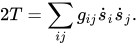
The quantization step is the transformation of this classical kinetic energy into a quantum mechanical operator. It is common to follow Podolsky[6] by writing down the Laplace–Beltrami operator in the same (generalized, curvilinear) coordinates s as used for the classical form. The equation for this operator requires the inverse of the metric tensor g and its determinant. Multiplication of the Laplace–Beltrami operator by gives the required quantum mechanical kinetic energy operator. When we apply this recipe to Cartesian coordinates, which have unit metric, the same kinetic energy is obtained as by application of the quantization rules.

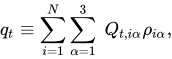
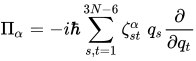
The nuclear motion Hamiltonian was obtained by Wilson and Howard in 1936,[7] who followed this procedure, and further refined by Darling and Dennison in 1940.[8] It remained the standard until 1968, when Watson[9] was able to simplify it drastically by commuting through the derivatives the determinant of the metric tensor. We will give the ro-vibrational Hamiltonian obtained by Watson, which often is referred to as the Watson Hamiltonian. Before we do this we must mention that a derivation of this Hamiltonian is also possible by starting from the Laplace operator in Cartesian form, application of coordinate transformations, and use of the chain rule.[10] The Watson Hamiltonian, describing all motions of the N nuclei, is The first term is the center of mass term The second term is the rotational term akin to the kinetic energy of the rigid rotor. Here is the α component of the body-fixed rigid rotor angular momentum operator, see this article for its expression in terms of Euler angles. The operator is a component of an operator known as the vibrational angular momentum operator (although it does not satisfy angular momentum commutation relations), with the Coriolis coupling constant: Here εαβγ is the Levi-Civita symbol. The terms quadratic in the are centrifugal terms, those bilinear in and are Coriolis terms. The quantities Q s, iγ are the components of the normal coordinates introduced above. Alternatively, normal coordinates may be obtained by application of Wilson's GF method. The 3 × 3 symmetric matrix is called the effective reciprocal inertia tensor. If all q s were zero (rigid molecule) the Eckart frame would coincide with a principal axes frame (see rigid rotor) and would be diagonal, with the equilibrium reciprocal moments of inertia on the diagonal. If all q s would be zero, only the kinetic energies of translation and rigid rotation would survive.





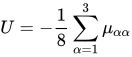
The potential-like term U is the Watson term: proportional to the trace of the effective reciprocal inertia tensor.[11]
The fourth term in the Watson Hamiltonian is the kinetic energy associated with the vibrations of the atoms (nuclei) expressed in normal coordinates qs, which as stated above, are given in terms of nuclear displacements ρiα by

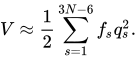
Finally V is the unexpanded potential energy by definition depending on internal coordinates only. In the harmonic approximation it takes the form
See also
References
- ↑W. Kołos & L. Wolniewicz (1963). "Nonadiabatic Theory for Diatomic Molecules and Its Application to the Hydrogen Molecule". Reviews of Modern Physics. 35 (3): 473–483. Bibcode:1963RvMP...35..473K. doi:10.1103/RevModPhys.35.473.
- ↑R. G. Woolley & B. T. Sutcliffe (2003). "P.-O. Löwdin and the Quantum Mechanics of Molecules". In E. J. Brändas & E. S. Kryachko (eds.). Fundamental World of Quantum Chemistry. Vol. 1. Kluwer Academic Publishers. pp. 21–65.
- ↑Whitfield, James D.; Biamonte, Jacob; Aspuru-Guzik, Alán (10 March 2011). "Simulation of electronic structure Hamiltonians using quantum computers". Molecular Physics. 109 (5): 735–750. arXiv:1001.3855. doi:10.1080/00268976.2011.552441. ISSN 0026-8976.
- ↑"26.2: The Born-Oppenheimer Approximation". Chemistry LibreTexts. 21 October 2022. Retrieved 3 July 2024.
- ↑Eckart, C. (1935). "Some studies concerning rotating axes and polyatomic molecules". Physical Review. 47 (7): 552–558. Bibcode:1935PhRv...47..552E. doi:10.1103/PhysRev.47.552. Archived from the original on 26 June 2020. Retrieved 14 December 2019.
- ↑Podolsky, B. (1928). "Quantum-mechanically correct form of Hamiltonian function for conservative system". Physical Review. 32 (5): 812. Bibcode:1928PhRv...32..812P. doi:10.1103/PhysRev.32.812.
- ↑E. Bright Wilson Jr. & J. B. Howard (1936). "The Vibration–Rotation Energy Levels of Polyatomic Molecules I. Mathematical Theory of Semirigid Asymmetrical Top Molecules". The Journal of Chemical Physics. 4 (4): 260–268. Bibcode:1936JChPh...4..260W. doi:10.1063/1.1749833.
- ↑B. T. Darling & D. M. Dennison (1940). "The water vapor molecule". Physical Review. 57 (2): 128–139. Bibcode:1940PhRv...57..128D. doi:10.1103/PhysRev.57.128.
- ↑Watson, James K.G. (1968). "Simplification of the molecular vibration-rotation hamiltonian". Molecular Physics. 15 (5): 479–490. Bibcode:1968MolPh..15..479W. doi:10.1080/00268976800101381.
- ↑Biedenharn, L. C.; Louck, J. D. (1981). "Angular Momentum in Quantum Physics". Encyclopedia of Mathematics. Vol. 8. Reading: Addison–Wesley. ISBN 978-0-201-13507-7.
- ↑Biedenharn and Louck, op. cit., Eq. (7.10.155) p. 563
Further reading
- Born, Max; Oppenheimer, Robert (25 August 1927). "Zur Quantentheorie der Molekeln". Annalen der Physik. 389 (20): 457–484. Bibcode:1927AnP...389..457B. doi:10.1002/andp.19273892002.
- Moss, R. E. (1973). Advanced Molecular Quantum Mechanics. Chapman and Hall. ISBN 978-0-412-10490-9.
- Tinkham, Michael (2003). Group Theory and Quantum Mechanics. Dover Publications. ISBN 978-0-486-43247-2.
- A readable and thorough discussion on the spin terms in the molecular Hamiltonian is in: McWeeny, R. (1989). Methods of Molecular Quantum Mechanics (2nd ed.). London: Academic. ISBN 978-0-12-486550-1.
- Molecular physics
- Quantum chemistry
- Spectroscopy