
Opus Majus

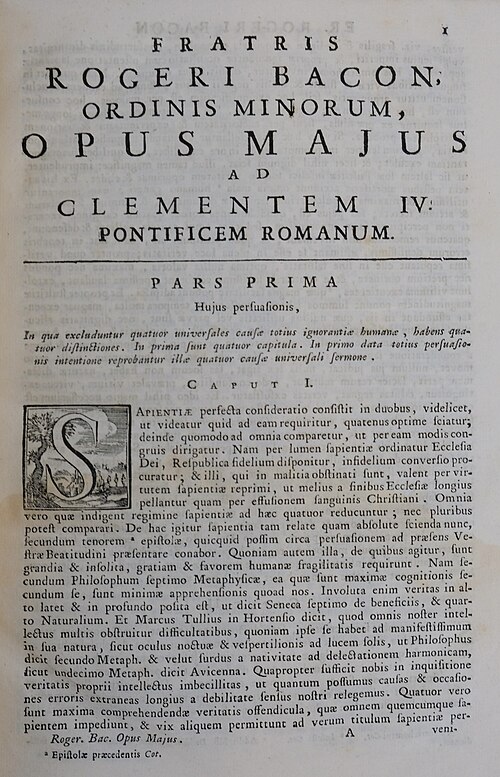
The Opus Majus (Latin for "Greater Work") is the most important work of Roger Bacon. It was written in Medieval Latin, at the request of Pope Clement IV, to explain the work that Bacon had undertaken. The 878-page treatise ranges over all aspects of natural science, from grammar and logic to mathematics, physics, and philosophy. Bacon sent his work to the Pope in 1267.[1] It was followed later the same year by a smaller second work, his Opus Minus, which was intended as an abstract or summary of the longer work, followed shortly by a third work, Opus Tertium, as a preliminary introduction to the other two.
Contents
The Opus Majus is divided into seven parts:
- Part one considers the obstacles to real wisdom and truth, classifying the causes of error (offendicula) into four categories: following a weak or unreliable authority, custom, the ignorance of others, and concealing one's own ignorance by pretended knowledge.
- Part two considers the relationship between philosophy and theology, concluding that theology (and particularly Holy Scripture) is the foundation of all sciences.
- Part three contains a study of Biblical languages: Latin, Greek, Hebrew, and Arabic, as a knowledge of language and grammar is necessary to understand revealed wisdom.
- Part four contains a study of Mathematics: As part of the study, he vividly drew out the flaws in the Julian Calendar, proposing to drop a day every 125 years from 325 CE (Council of Nicaea). He also noted the shifting of the Equinoxes to the Solstices.[2]
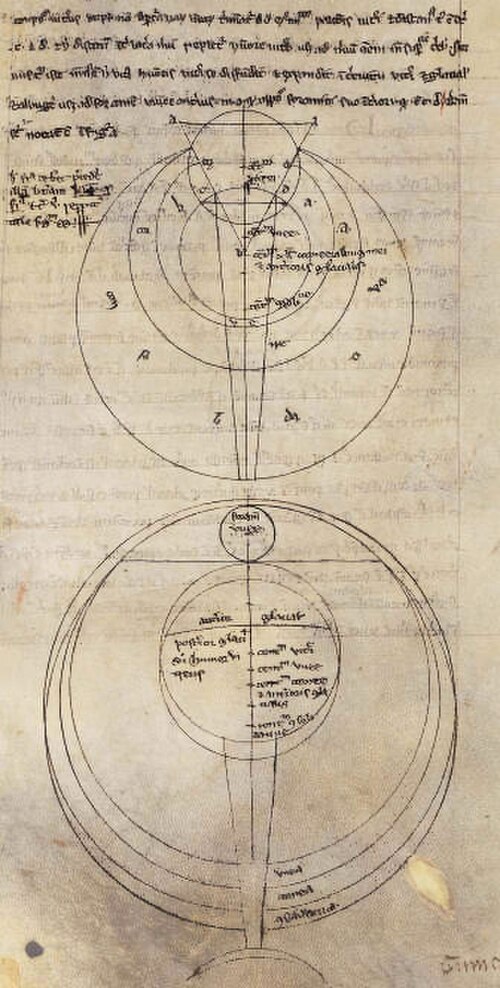
- Part five contains a study of Optics: The study of optics in part five seems to draw on the works of the Arab writers Kindi and Alhazen, including a discussion of the physiology of eyesight, the anatomy of the eye and the brain, and considers light, distance, position, and size, direct vision, reflected vision, and refraction, mirrors and lenses.
- الجزء السادس، "في العلم التجريبي" ، دراسةٌ للعلوم التجريبية : يتضمن مراجعةً للخيمياء ، وصناعة البارود، ومواقع وأحجام الأجرام السماوية ، ويستشرف اختراعاتٍ لاحقة ، مثل المجاهر ، والتلسكوبات، والنظارات ، وآلات الطيران ، والهيدروليكا ، والسفن البخارية . تعكس الدلالات الخفية لهذا القسم اهتمام بيكون بالسحر ، الذي كتب عنه أيضًا في كتابه "في أسرار الأعمال الفنية والطبيعة، وفي إبطال السحر" . وكان له تأثيرٌ كبيرٌ على نظرية جون دي في " السحر القديم" . [ 3 ]
- يتناول الجزء السابع الفلسفة الأخلاقية والأخلاق .
تؤكد المؤرخة أماندا باور أن هذا العمل المهم لا يمكن قراءته بشكل مفيد في سياق تاريخ العلوم والفلسفة فقط، مع إغفال التزام بيكون الديني بالرهبنة الفرنسيسكانية . " كان كتابه "أوبوس مايوس" بمثابة نداء للإصلاح موجه إلى الزعيم الروحي الأعلى للعقيدة المسيحية ، كُتب في ظل ترقب نهاية العالم، ومتأثرًا بالهموم الأساسية للرهبان. وقد صُمم لتحسين تدريب المبشرين وتزويدهم بمهارات جديدة تُستخدم في الدفاع عن العالم المسيحي ضد عداء غير المسيحيين والمسيح الدجال " . [ 4 ]
تاريخ النشر
تم نشر نسخة غير مكتملة من كتاب بيكون Opus Majus بواسطة ويليام بوير في لندن عام 1733. وقد قام صموئيل جيب بتحريرها من مخطوطة في كلية ترينيتي، كامبريدج، والتي حذفت الجزء السابع.
مراجع
- ↑ تم إرفاق كتاب Opus Majus في عام 1267 برسالة إهداء إلى البابا.
- ↑ ديفيد إيوينغ دنكان، التقويم ، 2011، ص 3-5.
- ↑ كلولي، نيكولاس هـ؛ فيكرز، برايان (1984). "على مفترق طرق السحر والعلم: أرشماستري جون دي". في فيكرز، برايان (محرر). العقليات الخفية والعلمية في عصر النهضة . ص 59. doi : 10.1017/CBO9780511572999.003 . ISBN 9780511572999.
- ↑(p. 692) Power, Amanda. (2006). "A Mirror for Every Age: The Reputation of Roger Bacon". The English Historical Review. 121 (492): 657–692. doi:10.1093/ehr/cel102.
Sources
- A History of Western Philosophy Vol. II by Ralph McInerny from the Jacques Maritain Center, University of Notre Dame
- Roger Bacon from the Catholic Encyclopedia
- Fr. Rogeri Bacon Opera quaedam hactenus Inedita, Vol. 1 at Google Books. Contains the Opus Tertium, Opus Minus, and Compendium Philosophiae.
External links
- Opus Majus, Volume I in the Internet Archive – original text in Latin (omitting Part IV), ed. by John Henry Bridges, 1897.
- Opus Majus, Volume I in the Internet Archive – original text in Latin (including Part IV), ed. by John Henry Bridges, 1900.
- Opus Majus, Volume II in the Internet Archive – original text in Latin, ed. by John Henry Bridges, 1897.
- Opus Majus, Volume I at Google Books – English trans. by Robert Belle Burke, 1928.
- Opus Majus, Volume II in the Internet Archive – English trans. by Robert Belle Burke, 1962.
- Works by Roger Bacon
- 1267 books
- British literature
- 13th-century books in Latin
- Medieval philosophical literature