
Political commissar

In the military, a political commissar or political officer (or politruk, a portmanteau word from Russian: политический руководитель, romanized: politicheskiy rukovoditel, lit.'political leader or political instructor') is a supervisory officer responsible for the political education (ideology) and organization of the unit to which they are assigned, with the intention of ensuring political control of the military.
The function first appeared as commissaire politique (political commissioner) or représentant en mission (representative on mission) in the French Revolutionary Army during the French Revolution (1789–1799).[1] Political commissars were heavily used within the International Brigades during the Spanish Civil War (1936–1939). They also existed, with interruptions, in the Soviet Red Army from 1918 to 1991, as well as in the armed forces of Nazi Germany from 1943 to 1945 as Nationalsozialistische Führungsoffiziere (national socialist leadership officers).
The function remains in use in China's People's Liberation Army.
China
People's Republic of China
The position of political commissar (Chinese:政治委员) existed in the Chinese Red Army since the Sanwan Reorganization of 1927 (Chinese:三湾改编), which established military organizations at various levels with Chinese Communist Party committees. The practice was formalized with the principle of the "Party commands the gun" and the Gutian Conference of 1929. Red Army was part of the Communist revolution forces; thus Mao Zedong had constantly emphasized its role in both combat and political missions. The political commissioners were tasked to teach communist ideologies to internal members of the Red Army, as well as propaganda tasks targeting the enemy by showing the Red Army as a righteous force.[2]
In the People's Liberation Army (PLA), each level of the command has a dual-command structure, with a military organ and a Party organ. This collective leadership is held between the military commander (Chinese:军事主官) and political commander (Chinese:政治主官, i.e. the political commissar).[3] The political commissar is always a uniformed military officer with both tactical and political training and Chinese Communist Party cadre. In the past, this position has been used to give civilian party officials some experience with the military.[4]
Usually, the operational command organ has the military commander as the highest decision maker, while the political commissar serves as the second-in-command. As the deputy, political commissar are largely responsible for administrative tasks such as public relations, unit welfare, mental health, morale, and political education.[4][3] The party organs are chaired by the political commissar, with the military commanders serving as the deputy secretaries. This framework ensures that both military and political officers can collectively design the goals and tasks of their respective units.[2]
The role of the political commissar is not universal across different branches of the PLA. In the Ground Force (PLAGF), the political commissar is often second-in-command, while the military officer is responsible for the operation. Whereas in the Navy (PLAN), the political commissar and the Party committee are the supreme decision-makers, while military works are delegated to the operational commander as the second-in-command.[2]
Republic of China
كان منصب المفوض السياسي ( بالصينية :政戰官، وتعني حرفيًا "ضابط الحرب السياسية") موجودًا أيضًا في جيش جمهورية الصين (تايوان). تلقى تشيانغ تشينغ كو ، الذي عُيّن مديرًا للشرطة السرية لحزب الكومينتانغ (الحزب القومي الصيني) عام 1950، تعليمه في الاتحاد السوفيتي، وبدأ بتطبيق نظام عسكري على النمط السوفيتي في القوات المسلحة لجمهورية الصين ، حيث أعاد تنظيم وتنسيق سلك الضباط السياسيين، ونشر أنشطة المراقبة وحزب الكومينتانغ في جميع أنحاء الجيش. عارض هذا النهج الجنرال سون لي جين ، الذي تلقى تعليمه في المعهد العسكري الأمريكي في فرجينيا . [ 5 ] ثم اعتقل تشيانغ تشينغ كو سون لي جين، متهمًا إياه بالتآمر مع وكالة المخابرات المركزية الأمريكية للتخطيط للإطاحة بتشيانغ كاي شيك وحزب الكومينتانغ. وُضع سون قيد الإقامة الجبرية عام 1955. [ 6 ] [ 7 ]
الاتحاد السوفيتي والكتلة الشرقية

أُنشئ نوع مبكر من المفوضين السياسيين خلال ثورة فبراير عام 1917، عندما أصدر مفوض الشرطة (إسبولكوم) الأمر رقم 1 المثير للجدل . [ 8 ] ومع وصول البلاشفة إلى السلطة عبر ثورة أكتوبر في نوفمبر 1917، ومع اندلاع الحرب الأهلية الروسية (1917-1922)، أسس ليون تروتسكي تدريجيًا الجيش الأحمر ، وحدد دور الضباط السياسيين. وكُلِّف هؤلاء الضباط بضمان ولاء القوات المسلحة للأحزاب الشيوعية . ورغم وجود اختلاف كبير بين ثورة فبراير وثورة أكتوبر ، إلا أن قادة كلتيهما كانوا يخشون ثورة مضادة، واعتبر كلاهما الضباط العسكريين التهديد المضاد للثورة الأكثر ترجيحًا. [ 9 ] [ 10 ]
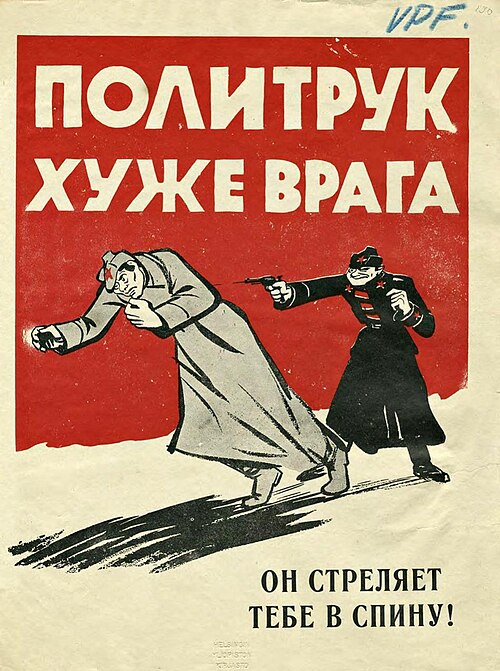
في وقت لاحق، كان بإمكان المفوضين في الكتلة الشرقية ممارسة أدوار أوسع في الهندسة الاجتماعية . [ 11 ]
في الاتحاد السوفيتي

في الجيش الأحمر (1918-1946) والجيش السوفيتي (1946-1991)، لم يكن منصب المفوض السياسي ( بالروسية : комиссар ، بالحروف اللاتينية : komissar ) موجودًا رسميًا إلا خلال الفترات 1918-1924، و1937-1940، و1941-1942؛ ولم يكن كل ضابط سياسي في الجيش الأحمر مفوضًا. كان المفوض السياسي يحمل رتبة عسكرية مساوية لقائد الوحدة التي يتبع لها؛ علاوة على ذلك، كان يتمتع بسلطة عسكرية لإلغاء أوامر قائد الوحدة في أي وقت. أما خلال الفترات الأخرى من تاريخ الجيش الأحمر، فكان الضباط السياسيون تابعين عسكريًا لقادة الوحدات، ولم يكن منصب المفوض السياسي موجودًا آنذاك.
كانت الرقابة السياسية على الجيش الروسي تتم بواسطة المفوض السياسي، الذي كان حاضرًا في كل وحدة وتشكيل، من مستوى السرية إلى مستوى الفرقة ، بما في ذلك البحرية. وقد أُنشئت مجالس عسكرية ثورية (أو ريفويينسوفيتس، RVS) على مستوى الجيش والجبهة والأسطول والأسطول الصغير ، وتضم كل منها ثلاثة أعضاء على الأقل: القائد واثنين من العاملين السياسيين. وكان يُطلق على العاملين السياسيين اسم "أعضاء في مجلس ريفويينسوفيتس"، وليس "مفوضين"، على الرغم من منصبهم كمفوضين سياسيين رسميين.
في عام ١٩١٩، أُطلق لقب "بوليتراك" ( بالروسية : политрук، من политический руководитель، أي القائد السياسي ) على الضباط السياسيين على مستوى السرية . ورغم منصبهم كمفوضين سياسيين رسميين، لم يُخاطبوا بلقب "مفوض". ابتداءً من عام ١٩٢٥، ترسخ المسار العقائدي السياسي العسكري نحو " إيدينوناشالي" ( بالروسية : единоначалие ، أي القيادة الفردية)، وتلاشى دور المفوض السياسي كمؤسسة عسكرية. وكان تطبيق " إيدينوناشالي" ذا شقين: إما انضمام القائد العسكري إلى الحزب الشيوعي ليصبح الضابط السياسي لوحدته، أو تعيين ضابط "بومبوليت" ( بالروسية : помполит ، أي مساعد القائد للشؤون السياسية) تابعًا له. في وقت سابق، في عام 1924، أعيد تسمية مجالس RVS إلى مجالس عسكرية، وأصبح الضابط السياسي رفيع المستوى يُعرف باسم ChVS ( Chlen Voennogo Soveta ، عضو المجلس العسكري)؛ وتم إلغاؤها في عام 1934.
On 10 May 1937, the role of political commissar was reinstated in the Red Army, and Military Councils were set up. These derived from the political purges in the Soviet armed forces. Again, in August 1940, the office of political commissars was abolished, yet the Military Councils continued throughout the Second World War and after. Below army level, the edinonachalie (single-command) system was restored. In July 1941, consequent to the Red Army's defeats at the war's start, the position of political commissar reappeared. The commissars had an influential role as "second commanders" within the military units during this time. Their rank and insignia generally paralleled those of officers. Because this proved ineffective, General Ivan Konev asked Joseph Stalin to subordinate the political officer to commanding officers: the commissars' work was re-focused to morale-related functions. The term "commissar" was abolished in August 1942, and at the company- and regiment-level, the pompolit officer was replaced with the zampolit (deputy for political matters). Although no longer known by the original "commissar" title, political officers were retained by all the Soviet Armed Forces, e.g., Army, Navy, Air Force, Strategic Missile Troops, et al., until the dissolution of the Soviet Union in 1991.
In the officially atheist structures of the Soviet military, a political commissar had a role analogous to that of a religious chaplain.[12]
Red Army rank designations
Source:[13]
- Armeysky komissar 1-go ranga (Army Commissar 1st rank)
- Armeysky komissar 2-go ranga (Army Commissar 2nd rank)
- Korpusnoy komissar (Commissar of the corps)
- Divizionny komissar (Commissar of the division)
- Brigadny komissar (Commissar of the brigade)
- Polkovoy komissar (Commissar of the regiment)
- Starshi batalonny komissar (Senior commissar of the battalion)
- Batalonny komissar (Commissar of the battalion)
- Starshy politruk (Senior politleader)
- Politruk (Politleader)
- Mladshy politruk (Junior politleader)
Eastern Bloc armies
بعد الحرب العالمية الثانية، استخدمت جيوش أخرى من الكتلة الشرقية ضباطًا سياسيين على غرار النموذج السوفيتي. فعلى سبيل المثال، استخدم جيش الشعب الوطني في ألمانيا الشرقية ضباطًا سياسيين كنائبين لقائد الوحدة مسؤولين عن التثقيف السياسي. وخلال الحرب الكورية ، عُرف مفوضو جيش الشعب الكوري باسم "الأقسام الثقافية" أو "الأقسام السياسية". [ 14 ]
الجمهورية الإسبانية الثانية
خلال الحرب الأهلية الإسبانية ، اعتمد الجيش الجمهوري الإسباني والألوية الدولية بشكل كبير على الضباط السياسيين. أُنشئت المفوضية الحربية الإسبانية بعد أربعة أشهر من اندلاع الحرب. [ 15 ] استُلهمت فكرة المفوضين السياسيين في الجيش الجمهوري الإسباني من المفوض السياسي للجيش الثوري الفرنسي خلال حروب الثورة الفرنسية . تمثلت مهمة المفوض في رفع معنويات الجنود، وتزويدهم بالتوجيه السياسي، وإلهامهم. [ 16 ]
انظر أيضاً
مراجع
الاقتباسات
- ^ ر. دوبوي، تاريخ فرنسا المعاصر: La République jacobine (2005) p.156
- 1 2 3 بنسون، جيه دبليو؛ يانغ، زد. (2020). "دور المفوض السياسي" . في: الحزب على الجسر: المفوضون السياسيون في البحرية الصينية . مركز الدراسات الاستراتيجية والدولية (CSIS): 9-21 .
- 1 2 راوسون، بايتون (13 نوفمبر 2023). "كيف تقود الصين جيشها الشعبي"" . الاستراتيجي .
- 1 2 بيكلي، مايكل (2018). لا مثيل لها: لماذا ستبقى أمريكا القوة العظمى الوحيدة في العالم . مطبعة جامعة كورنيل. ص 67. doi : 10.7591/9781501724794 . ISBN 978-1-5017-2479-4.
- ↑ جاي تايلور (2000). ابن الجنراليسيمو: تشيانغ تشينغ كو والثورات في الصين وتايوان . مطبعة جامعة هارفارد. ص 195. ISBN 0-674-00287-3تم الاطلاع عليه بتاريخ 28-06-2010 .
- ↑ بيتر ر. مودي (1977). المعارضة والاختلاف في الصين المعاصرة . دار هوفر للنشر. ص 302. ISBN 0-8179-6771-0تم الاطلاع عليه بتاريخ 30 نوفمبر 2010 .
- ↑Nancy Bernkopf Tucker (1983). Patterns in the dust: Chinese-American relations and the recognition controversy, 1949-1950. Columbia University Press. p. 181. ISBN 0-231-05362-2. Retrieved 2010-06-28.
- ↑Richard Pipes, The Russian Revolution, Swedish ISBN 91-27-09935-0, pp. 106-108
- ↑Richard Pipes, The Russian Revolution, Swedish ISBN 91-27-09935-0, p. 120.
- ↑Isaac Deutscher, Stalin, 2nd edition, 1961, Swedish ISBN 91-550-2469-6, pp. 168-169.
- ↑For example:Podgórecki, Adam (1996). "Sociotechnics: Basic Problems and Issues". In Podgórecki, Adam; Alexander, Jon; Shields, Rob (eds.). Social Engineering. McGill-Queen's Press - MQUP. p. 31. ISBN 9780886292706. Retrieved 20 November 2021.
Each institution (including universities) [in Poland in 1981] received a military 'commissar' who supervised both the administrative work and the political atmosphere.
- ↑Herspring, Dale R. (6 June 2001). Soldiers, Commissars, and Chaplains: Civil-Military Relations since Cromwell. Bloomsbury Academic. p. XII. ISBN 9780742511064. Retrieved 20 June 2026.
The Soviet political officer's primary concerns seemed to be the same things that motivated chaplains — morale, motivation, counselling, and resolving political socialization.
- ↑BootSpoon (2023-02-08). "Red Army Insignia". Soviet Reenacting. Retrieved 2026-04-28.
- ↑Appleman, Roy E. (1998). South to the Naktong, North to the Yalu: United States Army in the Korean War. Department of the Army. p. 350. ISBN 978-0-16-001918-0. Archived from the original on 2014-02-07. Retrieved 2022-08-17.
- ↑"The Commissar and The Good Fight – by Saul Wellman". Alba Volunteer. 16 December 2015. Retrieved 7 January 2026.
- ↑"ANNUAL LECTURE 2017/18: Commissars in the Republican Popular Army during the Spanish Civil War, 1936-1939". University of Kent. 21 March 2018. Retrieved 14 January 2026.
Sources
- The Soviet Military Encyclopedia.
- Müller, Rolf-Dieter (2016). Hitler's Wehrmacht, 1935-1945. Translated by Ancker, Janice W. University Press of Kentucky. ISBN 9780813168043.
روابط خارجية
- الحزب الشيوعي والجيش الأحمر – حول المفوض العسكري ، ليون تروتسكي
للمزيد من القراءة
- تيرتيتسكي، فيودور (2022). "تطور مؤسسة الضباط السياسيين في الجيش الكوري الشمالي: مقاومة الانقلابات مقابل الفعالية العسكرية". مجلة الدراسات الكورية الشمالية . 18 (1). ماكفارلاند وشركاه: 7-27 . الرقم الدولي الموحد للدوريات 1551-2789 .
- جيش الاتحاد السوفيتي
- الوظائف في الحزب الشيوعي للاتحاد السوفيتي
- العلاقات المدنية العسكرية
- المفوضون
- جيش التحرير الشعبي
- دعاية
- التواصل السياسي