
كيمياء الحالة الصلبة

كيمياء الحالة الصلبة ، أو ما يُعرف أيضًا بكيمياء المواد ، هي دراسة تركيب وبنية وخواص المواد الصلبة. ولذلك، فهي تتداخل بشكل كبير مع فيزياء الحالة الصلبة ، وعلم المعادن ، وعلم البلورات ، والسيراميك، وعلم المعادن ، والديناميكا الحرارية ، وعلم المواد ، والإلكترونيات ، مع التركيز على تركيب مواد جديدة وتوصيفها. وتُستخدم مجموعة متنوعة من تقنيات التركيب، مثل طريقة السيراميك والترسيب الكيميائي للبخار ، لإنتاج مواد الحالة الصلبة. ويمكن تصنيف المواد الصلبة إلى بلورية وغير بلورية بناءً على طبيعة الترتيب الموجود في بنية جزيئاتها المكونة. [ 1 ] ويمكن توصيف تركيبها العنصري وبنيتها المجهرية وخواصها الفيزيائية من خلال مجموعة متنوعة من الطرق التحليلية.
تاريخ

نظراً لارتباطها المباشر بالمنتجات التجارية، فقد تأثرت كيمياء الحالة الصلبة غير العضوية بشكل كبير بالتكنولوجيا. وغالباً ما كان التقدم في هذا المجال مدفوعاً بمتطلبات الصناعة، وأحياناً بالتعاون مع الأوساط الأكاديمية. [ 2 ] تشمل التطبيقات التي اكتُشفت في القرن العشرين استخدام الزيوليت والمحفزات القائمة على البلاتين لمعالجة البترول في خمسينيات القرن الماضي، والسيليكون عالي النقاء كمكون أساسي للأجهزة الإلكترونية الدقيقة في ستينيات القرن الماضي، والموصلية الفائقة "ذات درجة الحرارة العالية" في ثمانينيات القرن الماضي. وكان اختراع علم البلورات بالأشعة السينية في أوائل القرن العشرين على يد ويليام لورانس براغ ابتكاراً تمكينياً. وقد ساهم عمل كارل فاغنر في نظرية معدل الأكسدة، والانتشار المعاكس للأيونات، وكيمياء العيوب، في تعزيز فهمنا لكيفية سير التفاعلات على المستوى الذري في الحالة الصلبة بشكل كبير. وبسبب إسهاماته، يُشار إليه أحياناً بأنه أبو كيمياء الحالة الصلبة . [ 3 ]
الأساليب التركيبية
Given the diversity of solid-state compounds, an equally diverse array of methods are used for their preparation.[1][4] Synthesis can range from high-temperature methods, like the ceramic method, to gas methods, like chemical vapour deposition. Often, the methods prevent defect formation[5] or produce high-purity products.[6]
High-temperature methods
Ceramic method
The ceramic method is one of the most common synthesis techniques.[7] The synthesis occurs entirely in the solid state.[7] The reactants are ground together, formed into a pellet using a pellet press and hydraulic press, and heated at high temperatures.[7] When the temperature of the reactants are sufficient, the ions at the grain boundaries react to form desired phases. Generally ceramic methods give polycrystalline powders, but not single crystals.
Using a mortar and pestle, ResonantAcoustic mixer, or ball mill, the reactants are ground together, which decreases size and increases surface area of the reactants.[8] If the mixing is not sufficient, we can use techniques such as co-precipitation and sol-gel.[7] A chemist forms pellets from the ground reactants and places the pellets into containers for heating.[7] The choice of container depends on the precursors, the reaction temperature and the expected product.[7] For example, metal oxides are typically synthesized in silica or alumina containers.[7] A tube furnace heats the pellet.[7] Tube furnaces are available up to maximum temperatures of 2800 °C.[9]

Molten flux synthesis

Molten flux synthesis can be an efficient method for obtaining single crystals. In this method, the starting reagents are combined with flux, an inert material with a melting point lower than that of the starting materials. The flux serves as a solvent. After the reaction, the excess flux can be washed away using an appropriate solvent or it can be heat again to remove the flux by sublimation if it is a volatile compound.
Crucible materials have a great role to play in molten flux synthesis. The crucible should not react with the flux or the starting reagent. If any of the material is volatile, it is recommended to conduct the reaction in a sealed ampule. If the target phase is sensitive to oxygen, a carbon- coated fused silica tube or a carbon crucible inside a fused silica tube is often used which prevents the direct contact between the tube wall and reagents.
Chemical vapour transport
Chemical vapour transport results in very pure materials. The reaction typically occurs in a sealed ampoule.[10] A transporting agent, added to the sealed ampoule, produces a volatile intermediate species from the solid reactant.[10] For metal oxides, the transporting agent is usually Cl2 or HCl.[10] The ampoule has a temperature gradient, and, as the gaseous reactant travels along the gradient, it eventually deposits as a crystal.[10] An example of an industrially-used chemical vapor transport reaction is the Mond process. The Mond process involves heating impure nickel in a stream of carbon monoxide to produce pure nickel.[6]
Low-temperature methods
Intercalation method
Intercalation synthesis is the insertion of molecules or ions between layers of a solid.[11] The layered solid has weak intermolecular bonds holding its layers together.[11] The process occurs via diffusion.[11] Intercalation is further driven by ion exchange, acid-base reactions or electrochemical reactions.[11] The intercalation method was first used in China with the discovery of porcelain. Also, graphene is produced by the intercalation method, and this method is the principle behind lithium-ion batteries.[12]
Solution methods
It is possible to use solvents to prepare solids by precipitation or by evaporation.[5] At times, the solvent is a hydrothermal that is under pressure at temperatures higher than the normal boiling point.[5] A variation on this theme is the use of flux methods, which use a salt with a relatively low melting point as the solvent.[5]
Gas methods

Many solids react vigorously with gas species like chlorine, iodine, and oxygen.[13][14] Other solids form adducts, such as CO or ethylene. Such reactions are conducted in open-ended tubes, which the gasses are passed through. Also, these reactions can take place inside a measuring device such as a TGA. In that case, stoichiometric information can be obtained during the reaction, which helps identify the products.
Chemical vapour deposition
Chemical vapour deposition is a method widely used for the preparation of coatings and semiconductors from molecular precursors.[15] A carrier gas transports the gaseous precursors to the material for coating.[16]
Characterization
This is the process in which a material's chemical composition, structure, and physical properties are determined using a variety of analytical techniques.
New phases
Synthetic methodology and characterization often go hand in hand in the sense that not one but a series of reaction mixtures are prepared and subjected to heat treatment. Stoichiometry, a numerical relationship between the quantities of reactant and product, is typically varied systematically. It is important to find which stoichiometries will lead to new solid compounds or solid solutions between known ones. A prime method to characterize the reaction products is powder diffraction because many solid-state reactions will produce polycrystalline molds or powders. Powder diffraction aids in the identification of known phases in the mixture.[17] If a pattern is found that is not known in the diffraction data libraries, an attempt can be made to index the pattern. The characterization of a material's properties is typically easier for a product with crystalline structures.
Compositions and structures
بمجرد معرفة وحدة الخلية لطور جديد، تتمثل الخطوة التالية في تحديد نسبة العناصر المكونة لهذا الطور. ويمكن القيام بذلك بعدة طرق. أحيانًا، قد يُشير تركيب الخليط الأصلي إلى ذلك، في حال العثور على منتج ذي نمط مسحوقي واحد فقط، أو في حال تكوين طور ذي تركيب معين قياسًا على مادة معروفة، ولكن هذا نادر الحدوث.
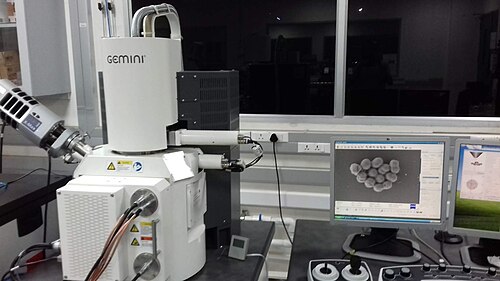
غالبًا ما يتطلب الحصول على عينة نقية من المادة الجديدة بذل جهد كبير في تحسين إجراءات التخليق. إذا أمكن فصل الناتج عن باقي خليط التفاعل، يمكن استخدام طرق التحليل العنصري مثل المجهر الإلكتروني الماسح (SEM) والمجهر الإلكتروني النافذ (TEM). يوفر الكشف عن الإلكترونات المتناثرة والنافذة من سطح العينة معلومات حول تضاريس السطح وتركيب المادة. [ 18 ] يُعدّ التحليل الطيفي للأشعة السينية المشتتة للطاقة (EDX) تقنية تستخدم إثارة حزمة الإلكترونات. يؤدي إثارة الغلاف الداخلي للذرة بالإلكترونات الساقطة إلى انبعاث أشعة سينية مميزة ذات طاقة محددة لكل عنصر. [ 19 ] يمكن لطاقة الذروة تحديد التركيب الكيميائي للعينة، بما في ذلك التوزيع والتركيز. [ 19 ]

على غرار تحليل حيود الأشعة السينية المشتتة للطاقة (EDX)، يعتمد تحليل حيود الأشعة السينية (XRD) على توليد أشعة سينية مميزة عند تفاعلها مع العينة. وتُستخدم شدة الأشعة المنعكسة بزوايا مختلفة لتحليل الخصائص الفيزيائية للمادة، مثل التركيب الطوري والبنية البلورية. [ 20 ] ويمكن دمج هاتين التقنيتين لتحقيق نتائج أفضل. فعلى سبيل المثال، يُعد المجهر الإلكتروني الماسح (SEM) مكملاً مفيداً لتحليل حيود الأشعة السينية المشتتة للطاقة (EDX) بفضل شعاع الإلكترونات المركز، إذ يُنتج صورة عالية التكبير توفر معلومات عن تضاريس السطح. [ 18 ] وبمجرد تحديد المنطقة المراد دراستها، يُمكن استخدام تحليل حيود الأشعة السينية المشتتة للطاقة (EDX) لتحديد العناصر الموجودة في تلك البقعة. كما يُمكن دمج حيود الإلكترونات في منطقة محددة مع المجهر الإلكتروني النافذ (TEM) أو المجهر الإلكتروني الماسح (SEM) لدراسة مستوى التبلور ومعاملات الشبكة البلورية للعينة. [ 21 ]
للمزيد من المعلومات
يُستخدم حيود الأشعة السينية أيضًا نظرًا لقدراته التصويرية وسرعة توليد البيانات. [ 22 ] غالبًا ما يتطلب ذلك إعادة النظر في إجراءات التحضير وتحسينها، وهو ما يرتبط بتحديد الأطوار المستقرة عند تركيبات ونسب ستويكيومترية محددة. بعبارة أخرى، كيف يبدو مخطط الأطوار ؟ [ 23 ] تُعد تقنيات التحليل الحراري، مثل DSC و DTA، أداةً مهمةً في تحديد ذلك، وكذلك حيود المساحيق المعتمد على درجة الحرارة، والذي يزداد استخدامه مع ظهور السنكروترونات . غالبًا ما تؤدي المعرفة المتزايدة بعلاقات الأطوار إلى مزيد من التحسين في إجراءات التخليق بطريقة تكرارية. وبالتالي، تُوصَف الأطوار الجديدة بنقاط انصهارها ونطاقاتها الستويكيومترية. يُعد هذا الأخير مهمًا للعديد من المواد الصلبة التي تُمثل مركبات غير ستويكيومترية. تُعد معلمات الخلية المُستخرجة من حيود الأشعة السينية مفيدةً بشكل خاص في تحديد نطاقات التجانس لهذه المركبات.
البنية المحلية
على عكس البنى الكبيرة للبلورات، تصف البنية المحلية تفاعل الذرات المتجاورة الأقرب. تستخدم طرق التحليل الطيفي النووي نوى محددة لدراسة المجالات الكهربائية والمغناطيسية المحيطة بها. على سبيل المثال، تُعد تدرجات المجال الكهربائي حساسة للغاية للتغيرات الطفيفة الناتجة عن تمدد/انضغاط الشبكة البلورية (الحراري أو الضغطي)، أو تغيرات الطور، أو العيوب الموضعية. ومن الطرق الشائعة في هذا المجال مطيافية موسباور والارتباط الزاوي المضطرب .
الخصائص البصرية
بالنسبة للمواد المعدنية، تنشأ خصائصها البصرية من الإثارة الجماعية لإلكترونات التوصيل. تُسمى التذبذبات المتماسكة للإلكترونات تحت تأثير الإشعاع الكهرومغناطيسي، بالإضافة إلى التذبذبات المصاحبة للمجال الكهرومغناطيسي، برنينات البلازمون السطحي . [ 24 ] يوفر طول موجة الإثارة وتردد رنينات البلازمون معلومات حول حجم الجسيم وشكله وتركيبه وبيئته البصرية المحلية. [ 24 ]
بالنسبة للمواد غير المعدنية أو أشباه الموصلات ، يمكن تمييزها من خلال بنية نطاقاتها. تحتوي هذه البنية على فجوة نطاقية تمثل الحد الأدنى لفرق الطاقة بين أعلى نطاق التكافؤ وأسفل نطاق التوصيل. يمكن تحديد هذه الفجوة النطاقية باستخدام مطيافية الأشعة فوق البنفسجية والمرئية للتنبؤ بالخصائص الكيميائية الضوئية لأشباه الموصلات. [ 25 ]
مزيد من التوصيف
في كثير من الحالات، تُوصَف المركبات الصلبة الجديدة بشكلٍ أدق [ 26 ] باستخدام تقنيات متنوعة تتداخل مع الخط الفاصل بين كيمياء الحالة الصلبة وفيزياء الحالة الصلبة. انظر قسم "الوصف في علم المواد" لمزيد من المعلومات.
مراجع
- 1 2 ويست، أنتوني ر. (2004). كيمياء الحالة الصلبة وتطبيقاتها . جون وايلي وأولاده. ISBN 981-253-003-7.
- ↑ كاناتزيديس، ميركوري ج. (2018). "تقرير من ورشة العمل الثالثة حول التوجهات المستقبلية لكيمياء الحالة الصلبة: وضع كيمياء الحالة الصلبة وتأثيرها في العلوم الفيزيائية". التقدم في كيمياء الحالة الصلبة . 36 ( 1-2 ): 1-133 . doi : 10.1016/j.progsolidstchem.2007.02.002 – عبر Elsevier Science Direct.
- 1 2 مارتن، مانفريد (ديسمبر 2002). "حياة وإنجازات كارل فاغنر، الذكرى المئوية لميلاده" . أيونيات الحالة الصلبة . 152-153 : 15-17 . doi : 10.1016/S0167-2738(02)00318-1 .
- ↑ تشيثام، أ.ك.؛ داي، بيتر (1988). كيمياء الحالة الصلبة: تقنيات . ISBN 0198552866.
- 1 2 3 4 بن سميدة، يوسف؛ المرزوقي، الرياض؛ كايا، سافاش؛ اركان، سلطان؛ فوزي زيد، محمد؛ هشام حمزاوي، أحمد (2020-10-07)، "طرق التوليف في كيمياء الحالة الصلبة" ، في المرزوقي، رياض (محرر)، طرق التوليف والبلورة ، IntechOpen، دوى : 10.5772/intechopen.93337 ، ISBN 978-1-83880-223-3، S2CID 225173857 ، تم استرجاعه بتاريخ 16-04-2023
- 1 2 موند، لودفيغ؛ لانغر، كارل؛ كوينكه، فريدريش (1890-01-01). "L.—تأثير أول أكسيد الكربون على النيكل" . مجلة الجمعية الكيميائية، المعاملات . 57 : 749-753 . doi : 10.1039/CT8905700749 . ISSN 0368-1645 .
- 1 2 3 4 5 6 7 8 راو، سي إن آر (2015). أساسيات تركيب المواد غير العضوية . كانيشكا بيسواس. هوبوكين، نيو جيرسي. ISBN 978-1-118-89267-1. OCLC 908260711 .
{{cite book}}: CS1 maint: موقع الناشر مفقود ( رابط ) - ↑Pagola, Silvina (January 2023). "Outstanding Advantages, Current Drawbacks, and Significant Recent Developments in Mechanochemistry: A Perspective View". Crystals. 13 (1): 124. Bibcode:2023Cryst..13..124P. doi:10.3390/cryst13010124. ISSN 2073-4352.
- ↑"Tube Furnaces"(PDF). Retrieved March 30, 2023.
- 1234Binnewies, Michael; Glaum, Robert; Schmidt, Marcus; Schmidt, Peer (February 2013). "Chemical Vapor Transport Reactions - A Historical Review". Zeitschrift für anorganische und allgemeine Chemie. 639 (2): 219–229. Bibcode:2013ZAACh.639..219B. doi:10.1002/zaac.201300048.
- 1234Laipan, Minwang; Xiang, Lichen; Yu, Jingfang; Martin, Benjamin R.; Zhu, Runliang; Zhu, Jianxi; He, Hongping; Clearfield, Abraham; Sun, Luyi (2020-04-01). "Layered intercalation compounds: Mechanisms, new methodologies, and advanced applications". Progress in Materials Science. 109 100631. Bibcode:2020PrMS..10900631L. doi:10.1016/j.pmatsci.2019.100631. ISSN 0079-6425. S2CID 213438764.
- ↑Rajapakse, Manthila; Karki, Bhupendra; Abu, Usman O.; Pishgar, Sahar; Musa, Md Rajib Khan; Riyadh, S. M. Shah; Yu, Ming; Sumanasekera, Gamini; Jasinski, Jacek B. (2021-03-10). "Intercalation as a versatile tool for fabrication, property tuning, and phase transitions in 2D materials". npj 2D Materials and Applications. 5 (1) 30: 1–21. doi:10.1038/s41699-021-00211-6. ISSN 2397-7132. S2CID 232164576.
- ↑Fromhold, Albert T.; Fromhold, Regina G. (1984-01-01), "Chapter 1 An Overview of Metal Oxidation Theory", in Bamford, C. H.; Tipper, C. F. H.; Compton, R. G. (eds.), Comprehensive Chemical Kinetics, Reactions of Solids with Gases, vol. 21, Elsevier, pp. 1–117, doi:10.1016/s0069-8040(08)70006-2, ISBN 9780444422880, retrieved 2023-04-03
- ↑ كوجا، واي؛ هاريسون، إل جي (1984-01-01)، "الفصل 2: تفاعلات المواد الصلبة مع الغازات الأخرى غير الأكسجين" ، في بامفورد، سي إتش؛ تيبر، سي إف إتش؛ كومبتون، آر جي (محررون)، الحركية الكيميائية الشاملة ، المجلد 21، إلسيفير، الصفحات 119-149 ، doi : 10.1016/s0069-8040(08)70007-4 ، ISBN 9780444422880تم الاطلاع عليه بتاريخ 2023-04-03
- ↑ دليل تقنيات الترسيب للأغشية والطلاءات : العلم والتطبيقات والتكنولوجيا . بيتر م. مارتن ( الطبعة الثالثة). أمستردام: إلسيفير. 2010. ISBN 978-0-08-095194-2. OCLC 670438909 .
{{cite book}}صيانة CS1: أخرى ( رابط ) - ↑ فيرناردو، ديميترا (يناير 2020). "عدد خاص: التطورات في الترسيب الكيميائي للبخار" . المواد . 13 ( 18): 4167. Bibcode : 2020Mate...13.4167V . doi : 10.3390/ma13184167 . ISSN 1996-1944 . PMC 7560419. PMID 32961715 .
- ↑ هولدر، كاميرون ف.؛ شاك، ريموند إي. (23 يوليو 2019). "دليل تعليمي حول حيود الأشعة السينية للمساحيق لتوصيف المواد النانوية" . ACS Nano . 13 (7): 7359–7365 . Bibcode : 2019ACSNa..13.7359H . doi : 10.1021/acsnano.9b05157 . ISSN 1936-0851 . PMID 31336433. S2CID 198194051 .
- 1 2 شارما، سوريندر كومار، محرر. (2018). دليل توصيف المواد . تشام: دار نشر سبرينغر الدولية. doi : 10.1007/978-3-319-92955-2 . ISBN 978-3-319-92954-5. S2CID 199491129 .
- 1 2 بيل، دي سي؛ غارات-ريد، إيه جيه (10-07-2003). تحليل الأشعة السينية المشتتة للطاقة في المجهر الإلكتروني (الطبعة 0 ). جارلاند ساينس. doi : 10.4324/9780203483428 . ISBN 978-1-135-33140-5.
- ↑ واسيدا، يوشيو؛ ماتسوبارا، إيتشيرو؛ شينودا، كوزو (2011). علم البلورات باستخدام حيود الأشعة السينية: مقدمة، أمثلة، ومسائل محلولة . برلين، هايدلبرغ: سبرينغر برلين هايدلبرغ. doi : 10.1007/978-3-642-16635-8 . ISBN 978-3-642-16634-1.
- ↑Zhou, Wuzong; Greer, Heather F. (March 2016). "What Can Electron Microscopy Tell Us Beyond Crystal Structures?". European Journal of Inorganic Chemistry. 2016 (7): 941–950. Bibcode:2016EJIC.2016..941Z. doi:10.1002/ejic.201501342. hdl:10023/8104. ISSN 1434-1948.
- ↑Schülli, Tobias U. (September 2018). "X-ray nanobeam diffraction imaging of materials". Current Opinion in Solid State and Materials Science. 22 (5): 188–201. Bibcode:2018COSSM..22..188S. doi:10.1016/j.cossms.2018.09.003.
- ↑cf. Chapter 12 of Elements of X-ray diffraction, B.D. Cullity, Addison-Wesley, 2nd ed. 1977 ISBN 0-201-01174-3
- 12Harris, Nadine; Blaber, Martin G.; Schatz, George C. (2016), "Optical Properties of Metal Nanoparticles", in Bhushan, Bharat (ed.), Encyclopedia of Nanotechnology, Dordrecht: Springer Netherlands, pp. 3027–3048, doi:10.1007/978-94-017-9780-1_22, ISBN 978-94-017-9779-5, retrieved 2023-04-15
- ↑Makuła, Patrycja; Pacia, Michał; Macyk, Wojciech (2018-12-06). "How To Correctly Determine the Band Gap Energy of Modified Semiconductor Photocatalysts Based on UV–Vis Spectra". The Journal of Physical Chemistry Letters. 9 (23): 6814–6817. Bibcode:2018JPCL....9.6814M. doi:10.1021/acs.jpclett.8b02892. ISSN 1948-7185. PMID 30990726. S2CID 105763124.
- ↑cf. Chapter 2 of New directions in Solid State Chemistry. C. N. R. Rao and J. Gopalakrishnan. Cambridge U. Press 1997 ISBN 0-521-49559-8
External links

- Solid-state chemistry
- Materials science