
Lefschetz hyperplane theorem
In mathematics, specifically in algebraic geometry and algebraic topology, the Lefschetz hyperplane theorem is a precise statement of certain relations between the shape of an algebraic variety and the shape of its subvarieties. More precisely, the theorem says that for a variety X embedded in projective space and a hyperplane sectionY, the homology, cohomology, and homotopy groups of X determine those of Y. A result of this kind was first stated by Solomon Lefschetz for homology groups of complex algebraic varieties. Similar results have since been found for homotopy groups, in positive characteristic, and in other homology and cohomology theories.
A far-reaching generalization of the hard Lefschetz theorem is given by the decomposition theorem.
The Lefschetz hyperplane theorem for complex projective varieties
Let be an -dimensional complex projective algebraic variety in , and let be a hyperplane section of such that is smooth. The Lefschetz theorem refers to any of the following statements:[1][2]


- The natural map in singular homology is an isomorphism for and is surjective for .
- The natural map in singular cohomology is an isomorphism for and is injective for .
- The natural map is an isomorphism for and is surjective for .





Using a long exact sequence, one can show that each of these statements is equivalent to a vanishing theorem for certain relative topological invariants. In order, these are:
- The relative singular homology groups are zero for .
- The relative singular cohomology groups are zero for .
- The relative homotopy groups are zero for .


Lefschetz's proof
Solomon Lefschetz[3] used his idea of a Lefschetz pencil to prove the theorem. Rather than considering the hyperplane section alone, he put it into a family of hyperplane sections , where . Because a generic hyperplane section is smooth, all but a finite number of are smooth varieties. After removing these points from the -plane and making an additional finite number of slits, the resulting family of hyperplane sections is topologically trivial. That is, it is a product of a generic with an open subset of the -plane. لذا، يمكن فهم ذلك إذا فهمنا كيفية تحديد مقاطع المستويات الفائقة عبر الشقوق وعند النقاط الشاذة. بعيدًا عن النقاط الشاذة، يمكن وصف التحديد استقرائيًا. عند النقاط الشاذة، تشير مبرهنة مورس إلى وجود خيار لنظام إحداثيات لـذات شكل بسيط للغاية. يمكن استخدام نظام الإحداثيات هذا لإثبات النظرية مباشرة. [ 4 ]


برهان أندريوتي وفرانكل
أدرك ألدو أندريوتي وثيودور فرانكل [ 5 ] أنه يمكن إعادة صياغة نظرية ليفشيتز باستخدام نظرية مورس . [ 6 ] هنا المعاملتؤدي دور دالة مورس. الأداة الأساسية في هذا النهج هي نظرية أندريوتي-فرانكل ، التي تنص على أن التنوع الأفيني المعقد ذو البعد المعقد(وبالتالي البعد الحقيقي)) له نوع التماثل لمركب CW ذي البعد (الحقيقي)وهذا يعني أن مجموعات التماثل النسبي لـفيتكون تافهة في درجة أقل منومن ثم فإن التسلسل الدقيق الطويل للتشابه النسبي يعطي النظرية.

إثباتات توم وبوت
لا يُشير برهان ليفشيتز ولا برهان أندريوتي وفرانكل بشكل مباشر إلى نظرية ليفشيتز للمستويات الفائقة لمجموعات التماثل. وقد توصل رينيه ثوم إلى منهج يُحقق ذلك في موعد أقصاه عام 1957، ثم قام راؤول بوت بتبسيطه ونشره عام 1959. [ 7 ] يُفسر ثوم وبوتباعتباره الموضع المتلاشي فيجزء من حزمة خطية. تطبيق نظرية مورس على هذا الجزء يعني أنيمكن بناؤها منعن طريق تجاور الخلايا ذات الأبعادأو أكثر. ومن هذا، يترتب أن مجموعات التماثل النسبي والتماثل الموضعي لـفيتتركز في درجاتوأعلى من ذلك، مما يؤدي إلى النظرية.
دليل كودايرا وسبنسر لمجموعات هودج
وجد كونيهيكو كودايرا ودونالد سي. سبنسر أنه في ظل قيود معينة، من الممكن إثبات نظرية من نوع ليفشيتز لمجموعات هودجوبالتحديد، افترض أنسلسة وأن حزمة الخطكافية. ثم خريطة التقييديكون تماثلاً إذاويكون حقنيًا إذا[ 8 ] [ 9 ] وفقًا لنظرية هودج ، فإن مجموعات التماثل هذه تساوي مجموعات التماثل الحزميةووبالتالي، فإن النظرية تستنتج من تطبيق نظرية أكيزوكي-ناكانو للتلاشي علىوباستخدام تسلسل دقيق طويل.





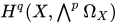
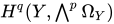

Combining this proof with the universal coefficient theorem nearly yields the usual Lefschetz theorem for cohomology with coefficients in any field of characteristic zero. It is, however, slightly weaker because of the additional assumptions on .
Artin and Grothendieck's proof for constructible sheaves
Michael Artin and Alexander Grothendieck found a generalization of the Lefschetz hyperplane theorem to the case where the coefficients of the cohomology lie not in a field but instead in a constructible sheaf. They prove that for a constructible sheaf on an affine variety , the cohomology groups vanish whenever .[10]


The Lefschetz theorem in other cohomology theories
The motivation behind Artin and Grothendieck's proof for constructible sheaves was to give a proof that could be adapted to the setting of étale and -adic cohomology. Up to some restrictions on the constructible sheaf, the Lefschetz theorem remains true for constructible sheaves in positive characteristic.

The theorem can also be generalized to intersection homology. In this setting, the theorem holds for highly singular spaces.
A Lefschetz-type theorem also holds for Picard groups.[11]
Hard Lefschetz theorem
Let be a -dimensional non-singular complex projective variety in . Then in the cohomology ring of , the -fold product with the cohomology class of a hyperplane gives an isomorphism between and .


This is the hard Lefschetz theorem, christened in French by Grothendieck more colloquially as the Théorème de Lefschetz vache.[12][13] It immediately implies the injectivity part of the Lefschetz hyperplane theorem.
The hard Lefschetz theorem in fact holds for any compact Kähler manifold, with the isomorphism in de Rham cohomology given by multiplication by a power of the class of the Kähler form. It can fail for non-Kähler manifolds: for example, Hopf surfaces have vanishing second cohomology groups, so there is no analogue of the second cohomology class of a hyperplane section.
The hard Lefschetz theorem was proven for -adic cohomology of smooth projective varieties over algebraically closed fields of positive characteristic by PierreDeligne (1980).
References
- ↑Milnor 1963, Theorem 7.3 and Corollary 7.4
- ↑Voisin 2003, Theorem 1.23
- ↑Lefschetz 1924
- ↑ غريفيث، سبنسر ووايت هيد 1992
- ↑ أندريوتي وفرانكل 1959
- ↑ ميلنور 1963 ، ص 39
- ↑ بوت 1959
- ↑ لازارسفيلد 2004 ، مثال 3.1.24
- ^ فوازين 2003 ، النظرية 1.29
- ↑ لازارسفيلد 2004 ، النظرية 3.1.13
- ↑ لازارسفيلد 2004 ، مثال 3.1.25
- ↑ بوفيل
- ↑ صباح 2001
فهرس
- أندريوتي، ألدو ؛ فرانكل، ثيودور (1959)، "نظرية ليفشيتز حول مقاطع المستويات الفائقة"، حوليات الرياضيات ، السلسلة الثانية، 69 (3): 713-717 ، doi : 10.2307/1970034 ، ISSN 0003-486X ، JSTOR 1970034 ، MR 0177422
- بوفيل، أرنو ، حدسية هودج ، CiteSeerX 10.1.1.74.2423
- بوت، راؤول (1959)، "حول نظرية ليفشيتز" ، مجلة ميشيغان الرياضية ، 6 (3): 211-216 ، doi : 10.1307/mmj/1028998225 ، MR 0215323 ، تم الاسترجاع في 30 يناير 2010
- Deligne، Pierre (1980)، “La conjecture de Weil. II” ، منشورات Mathématiques de l’IHÉS ، 52 (52): 137–252 ، دوى : 10.1007 / BF02684780 ، ISSN 1618-1913 ، MR 0601520 ، S2CID 189769469
- غريفيث، فيليب ؛ سبنسر، دونالد سي .؛ وايتهيد، جورج دبليو. (1992)، "سليمان ليفشيتز"، في الأكاديمية الوطنية للعلوم، مكتب وزير الداخلية (محرر)، مذكرات سيرية ، المجلد 61، مطبعة الأكاديميات الوطنية، ISBN 978-0-309-04746-3
- لازارسفيلد، روبرت (2004)، الإيجابية في الهندسة الجبرية. أنا ، Ergebnisse der Mathematik und ihrer Grenzgebiete. 3. فولج. سلسلة المسوحات الحديثة في الرياضيات [النتائج في الرياضيات والمجالات ذات الصلة. السلسلة الثالثة. سلسلة من المسوحات الحديثة في الرياضيات]، المجلد. 48 برلين، نيويورك: Springer-Verlag ، دوى : 10.1007 / 978-3-642-18808-4 ، ISBN 978-3-540-22533-1MR 2095471
- Lefschetz, Solomon (1924), L'Analysis situs et la géométrie algébrique, Collection de Monographies publiée sous la Direction de M. Émile Borel (in French), Paris: Gauthier-Villars Reprinted in Lefschetz, Solomon (1971), Selected papers, New York: Chelsea Publishing Co., ISBN 978-0-8284-0234-7, MR 0299447
- Milnor, John Willard (1963), Morse theory, Annals of Mathematics Studies, No. 51, Princeton University Press, MR 0163331
- Sabbah, Claude (2001), Théorie de Hodge et théorème de Lefschetz « difficile »(PDF), archived from the original(PDF) on 2004-07-07
- Voisin, Claire (2003), Hodge theory and complex algebraic geometry. II, Cambridge Studies in Advanced Mathematics, vol. 77, Cambridge University Press, doi:10.1017/CBO9780511615177, ISBN 978-0-521-80283-3, MR 1997577
- Topological methods of algebraic geometry
- Morse theory
- Theorems in algebraic geometry
- Theorems in algebraic topology