
زيكا البندقية
دار سك العملة ( Zecca ) هي مبنى يعود للقرن السادس عشر في مدينة البندقية بإيطاليا، وكان يضم في السابق دار سك العملة لجمهورية البندقية . شُيّد المبنى الحجري ذو الطابع الريفي المميز بين عامي 1536 و1548، وكان يتألف في الأصل من طابقين فقط، وقد صممه جاكوبو سانسوفينو ليحل محل دار سك عملة سابقة، وذلك تحديدًا لضمان السلامة من الحرائق وتوفير الحماية الكافية لودائع الفضة والذهب. وقد اعتبره جورجيو فاساري أجمل وأغنى وأقوى مباني سانسوفينو ("... bellissimo, ricchissimo, e fortissimo edificio de' suoi è la Zecca di Venezia ..."). [ 1 ]
استمر سك العملات بعد سقوط جمهورية البندقية عام 1797، لكنه توقف عام 1852 خلال فترة الحكم النمساوي الثانية (1814-1866). ثم جرى تعديل المبنى ليصبح مقرًا لغرفة التجارة من عام 1872 حتى عام 1900. ومنذ عام 1904، يضم المبنى الجزء الرئيسي من مكتبة مارسيانا ، التي أصبح مبناها التاريخي المجاور متحفًا في معظمه.
الخلفية التاريخية
أُغلقت دار سك العملة السابقة ، الواقعة في أبرشية سان بارتولوميو على الجانب الآخر من القناة الكبرى مقابل سوق ريالتو ، وباعت الحكومة قطعة الأرض عام ١١١٢. [ ملاحظة ١ ] تشير الوثيقة المتعلقة بالبيع إلى أن الموقع كان يشغله دار سك العملة منذ القدم، وربما منذ سك أول عملة محلية، وهي بنس فضي كارولنجي صدر باسم الإمبراطور لويس الورع . [ ملاحظة ٢ ] تشير الأدلة إلى توقف لاحق لسك العملة في منتصف القرن الثاني عشر، حيث يبدو أن عملات فيرونا كانت تُستخدم في المعاملات المحلية، بينما استُخدمت العملات البيزنطية في التجارة لمسافات طويلة. [ ٢ ] استؤنف سك العملة محليًا عندما صدرت العملة الدوقية لأول مرة في عهد فيتالي الثاني ميشيل ( في منصبه ١١٥٦-١١٧٢ ) [ ٣ ] وازداد بشكل ملحوظ عند إدخال عملة غروسو . [ ٤ ]
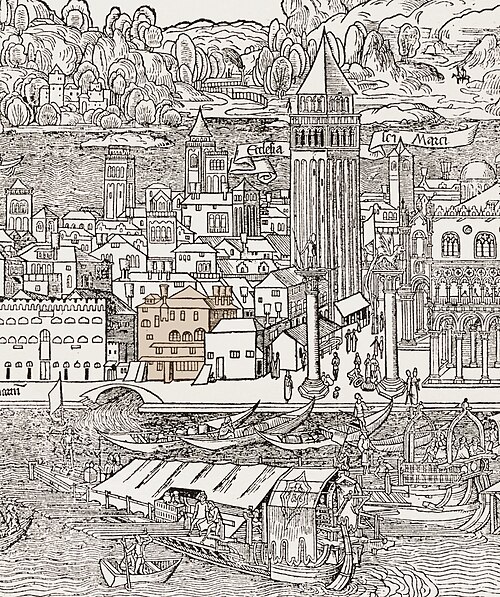
A new silver mint is mentioned as already present in Saint Mark's Square in a resolution of the Great Council in 1278.[note 3] The location, across the Piazzetta from the Doge's Palace, facilitated oversight by the appropriate magistracy, the Council of Forty, and ensured greater security. It also followed a long-standing tradition in Italy that the mint, as a symbol of fiscal autonomy and economic prosperity, be located near the seat of the government.[note 4] A separate gold mint, probably adjacent to the existing silver mint, was established in 1285 following the introduction of the ducat.[5] It is referred to in a deliberation of the Great Council, dated that same year, as the Zecca, from the Arabic noun sikka, meaning "die". By 1290, the name was also used for the silver mint, formerly known by the term Moneta.[6]
Over time, these mint facilities were expanded and floors added as demand for coinage increased.[note 5] The Reuwich woodcut (Mainz, 1486) and the de' Barbari engraving (Venice, 1500) show the mint as a single, three-story building with a courtyard behind.[7][8] The structure is delimited on all sides: to the west by a canal, to the north by the tenth-century hospice for pilgrims, to the east by a series of hostelries and the meat market, and to the south by a row of lean-to stalls that were rented by the procurators of Saint Mark de supra to vendors of sausage and cheese.
Safety concerns within the mint were raised when fire broke out in July 1532.[9] Following an inspection by Doge Andrea Gritti (in office 1523–1538) to verify conditions, the Council of Ten, the magistracy responsible for the defence of vital state interests, deliberated on 4 December 1535 that the entire mint was to be rebuilt with stone vaults in order to eliminate the use of wooden beams.[10][11] This decision coincided with a need to add furnaces and increase production following a deliberation of the Council of Ten in 1526 that obligated the government offices dislocated in the subject cities on the mainland to accept only Venetian currency, effectively substituting local currencies for official business. In addition, it was necessary to improve security when after 1528 interest-earning private deposits began to be accepted at the mint as a means of increasing the supply of silver for minting.[12]
For the design of the new mint, three projects were reviewed, and on 28 March 1536, the Council of Ten awarded the commission to Jacopo Sansovino.[13][14] The architect, as proto (consultant architect and buildings manager) of the procurators of Saint Mark de supra, had already supervised the final stages in the construction of the Procuratie vecchie in Saint Mark's Square following the death of his predecessor Pietro Bon,[note 6] but the mint was his first major commission in Venice.
Building
Construction
1536-1548


Independently of the need to provide greater fire protection and security as well as space for increased production, the mint was intended to symbolize Venice's financial recovery from years of famine and war.[note 7] It was an integral part of the renovatio urbis, the vast architectural programme begun under Doge Andrea Gritti to express Venice's renewed self-confidence and reaffirm its international prestige after the earlier defeat at Agnadello during the War of Cambrai and the subsequent Peace of Bologna which sanctioned Habsburg hegemony on the Italian peninsula at the end of the War of the League of Cognac. The programme, which included the library (1537) and the loggia of the bell tower (1538), called for the transformation of Saint Mark’s Square from an antiquated medieval town centre with food vendors, money changers, and even latrines into a classical forum. The intent was to evoke the memory of the ancient Roman republic and, in the aftermath of the Sack of Rome in 1527, to present Venice as Rome’s true successor.[16] Sansovino's understanding of Vitruvian principles and his direct knowledge of ancient Roman prototypes, garnered from his time in Rome, provided the expertise necessary to enact the programme.
To raise the 5,000 ducats appropriated for construction, the Council of Ten authorized the freeing of slaves on Cyprus, then a Venetian possession, at 50 ducats a head.[17][14][note 8] Additional funds were similarly raised in 1539 and 1544. Ultimately, the construction of the mint exceeded initial cost estimates roughly sixfold.[note 9]
Construction began in 1536 and, given the importance of the mint, does not seem to have been hindered by the financial constraints at the time of the Ottoman–Venetian War (1537–1540).[note 10] Since minting operations could not be interrupted, work had to proceed piecemeal, beginning with the charcoal depository on the northern side. To protect the structure from high tides, the floor level was raised by approximately 1 m (3.3 ft).[14] In 1539, it was decided to incorporate the lean-to cheese and sausage shops along the embankment into the new structure in order to give greater dignity to the mint façade but also to then extend the upper floor over the shops and provide additional space for the gold mint which was located upstairs. But for security concerns, the shops were relocated in 1588. The arcades on the ground floor, originally open to facilitate commercial activities, were walled, and the space was annexed to the mint.[18][19] Construction terminated in 1548.[20][21][note 11]
1558 addition
Sansovino's original building had only two floors with a low attic above, lit by small rectangular windows. But the attic became unusable during the summer months due to the combined heat of the sun on the leaden roof above and the furnaces below. In 1558, the Council of Ten consequently authorized the construction of an additional floor to be paid for with the remaining funds.[22][23] Although Sansovino was likely consulted for technical and structural aspects, it is improbable that he in fact designed the uppermost floor.[note 12]
Architecture
Layout
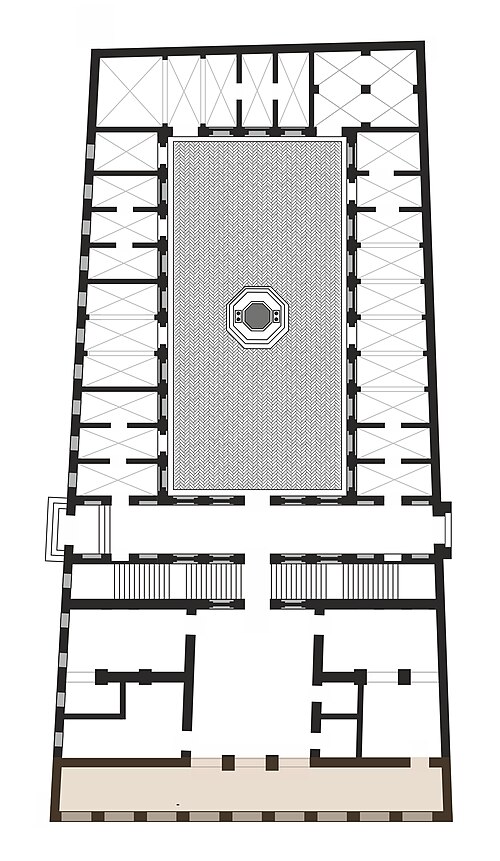
نظراً لضرورة ضمان استمرار عمليات سك العملة أثناء الإنشاء، يُرجّح أن التصميم الأساسي لدار سك العملة السابقة قد حُفظ، مع نقل الأنشطة مؤقتاً بالتزامن مع بناء الأقسام الجديدة. [ 24 ] كانت المنطقة في الطابق الأرضي المطلة على البحيرة، والمفصولة عن باقي المبنى بدرج وممر طويل يربط مدخل الماء على طول القناة بمدخل البر المؤدي إلى ساحة بيازيتا، تضم مكاتب مسؤولي الفضة وأفران صهر وصب الفضة. في القسم الخلفي، وُضعت عشرون ورشة عمل لإنتاج العملات الفضية على جانبي فناء مستطيل. صمّم سانسوفينو هذه الورش كمساحات صغيرة بحيث توفر الجدران المتقاربة دعماً كافياً للأقبية الحجرية الضخمة. وُضعت رواسب الفحم على الجانب الآخر من الفناء. تم بناء خزان لتجميع مياه الأمطار تحت الرصيف، وكان يتم الوصول إلى المياه من خلال بئر مع تمثال لأبولو تم تكليف الفنان دانزي كاتانيو بنحته . أما الطابق العلوي، المخصص لسك العملات الذهبية، فقد تم ترتيبه بشكل مماثل ولكن مع ورش عمل أكبر، وبالتالي أقل عددًا. [ 25 ]
الواجهة
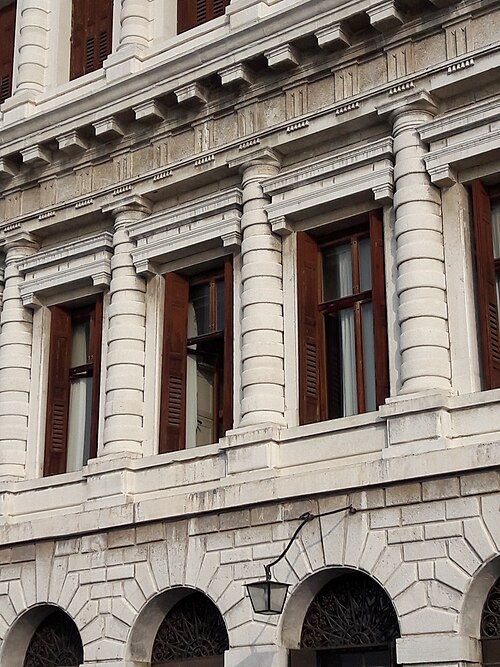
لإضفاء إحساس بالحصانة يتناسب مع وظيفة دار سك العملة، استخدم سانسوفينو في الطابق الأرضي زخارف خشنة بارزة امتدت فوق الطراز الدوري في الطابق العلوي. في البندقية، سبق أن استخدم ماورو كودوسي هذا المزيج من الحجر الجيري الإستري ذي القطع الخشن والطرازات الكلاسيكية في كنيسة سان ميشيل إن إيزولا (بدأ بناؤها عام 1469)، وبشكل أكثر هدوءًا في قصر كورنر سبينيلي (1497-1500). مع ذلك، يُرجح أن سانسوفينو استلهم تصميمه من بوابة بورتا ماجوري القديمة التي بُنيت في عهد كلوديوس (52)، ومن تصاميم جوليو رومانو لبوابة فيلا ماداما (1519)، وكذلك لمنزله الخاص في ماسيل دي كورفي (1523-1524، هُدم عام 1902)، والذي كان سانسوفينو على دراية به من فترة إقامته الثانية في روما (1516-1527). [ 26 ] [ 27 ] ومن الجدير بالذكر أن سيباستيانو سيرليو ، في أطروحته المعمارية المكونة من سبعة مجلدات بعنوان " Tutte l'opere d'architettura et prospetiva" ، اعتبر حل التيجان والقواعد الواضحة مع الأعمدة الخشنة ذات المظهر الريفي رمزًا للقوة الكبيرة ومناسبًا للحصن. [ 28 ]
النوافذ الموجودة في الطابق الدوري، والتي كانت محمية في الأصل بشبكات حديدية ثقيلة، مثبتة بإحكام بين الأعمدة المدمجة دون أي سطح مكشوف، مما يوحي بأنها غائرة بعمق في جدار سميك، ويعزز الشعور بالحصانة. ويتعزز هذا التأثير بفضل العتبات الضخمة البارزة في الأعلى. أما الأرضية التي أضيفت لاحقًا فتعتمد الطراز الأيوني ، ورغم أنها تستمر في استخدام أسلوب الزخرفة الريفية، إلا أن الجدران المكشوفة حول النوافذ والزخارف المثلثية الرقيقة في الأعلى، وهي سمة أكثر شيوعًا في العمارة السكنية، تتناقض مع تصميم المبنى الأصلي، مما يقلل من الشعور العام بالضخامة. [ 29 ]
دخول
تم دمج بوابة المدخل ذات الطابع الريفي الكثيف، والمحاطة بعمودين يدعمان إفريزًا دوريًا ، لاحقًا في الرواق السابع عشر للمكتبة . [ ملاحظة 13 ] وفي الممر الناتج، وُضع تمثالان ضخمان، نحتهما جيرولامو كامبانيا وتيزيانو أسبيتي .
موظفو ومسؤولو دار سك العملة


إنتاج
تذبذب نشاط سك العملة على مدار العام وفقًا لتوافر السبائك والاحتياجات التجارية للتجار، ولكنه كان أكثر كثافة في الربيع وأوائل الصيف عندما كان التجار الألمان يجلبون الفضة والذهب إلى المدينة بعد ذوبان الثلوج في جبال الألب ، وكانت أساطيل السفن التجارية المغادرة تحتاج إلى كميات كبيرة من العملات المعدنية للتجارة في الشرق . [ 30 ]
The number of employees consequently varied, but in addition to the salaried gastaldi (foremen), fabri (blacksmiths who forged dies), intaidori (die engravers), pexadori (weighers), and fanti (unskilled workers with menial tasks), the staff routinely included skilled labourers paid at a piecework rate: afinadori (refiners), fondadori (casters who cast blank flans), mendadori (emenders who controlled the prescribed weight tolerances), and stampadori (moneyers who struck coins) for both the silver mint (lower floor) and the gold mint (upper floor).[note 14] Estimates for the medieval mint place the workforce at around 225 individuals, making the mint the second largest single employer after the Arsenal, the government-operated shipyards.[31]
- Massari alla moneta e Massari all'oro e all'argento
The technical operations were coordinated by the Massari alla moneta e Massari all'argento e all'oro (mintmasters, separate for silver and gold). Usually of noble status, the Massari were responsible for acquiring bullion, supervising manufacture, and distributing newly minted coins.[note 15]
Oversight

In addition, several magistracies existed to provide oversight:
- Provveditori in Zecca
The Council of Ten was ultimately responsible for the control of the mint in consideration of its vital interest for the security of the state. But beginning in 1522, supervisory functions were assigned to a magistrate, chosen from among the Council membership, with the title of Provveditore in Zecca. Initially charged with the acquiring and minting of gold and the refining of silver, the Provveditore quickly assumed responsibility for the general direction of the mint. In addition, the Provveditore was responsible for dispensing government funds that were deposited in the mint to the subject cities and to the army. In 1562, the number of members of the Magistracy was increased to two and in 1572 a third was added. Following the reform of the Council of Ten in 1582, the magistracy came under the jurisdiction of the Senate.[32]
- Depositario
Created in 1543 by the Council of the Ten, the Depositario was responsible for the mint’s cash accounts. The Depositario also maintained accounts for private capital deposited in the mint and ensured that the funds were not misappropriated by the government.[33]
- Provveditori a ori e monete
The Provveditori a ori e monete were created in 1551 to ensure that gold, whether coined or not, was not sold at a price other than the official rate fixed by the government.[34]
- Provveditori sopra ori e argenti
Created in 1585, the Provveditori sopra ori e argenti intervened in cases of money exchanged at other than face value.[35]
- Conservatore dei pubblici depositi
The office of the Conservatore dei pubblici depositi was made permanent in 1592 with the responsibility for the reserve funds of the state that were kept in the mint.[35]
- Provveditore alli prò
Instituted in 1639, the Provveditore alli prò oversaw the payment of interest on the private funds deposited in the mint.[35]
Later adaptations
Chamber of Commerce
استمرت عمليات سك العملة بعد سقوط جمهورية البندقية عام ١٧٩٧، لكنها توقفت عام ١٨٥٢ خلال الفترة الثانية من الحكم النمساوي (١٨١٤-١٨٦٦). [ ٣٦ ] في عام ١٨٧٢، استأجرت غرفة التجارة المبنى بموجب عقد إيجار لمدة تسعة وعشرين عامًا. [ ٣٧ ] ولتجهيز المبنى لوظيفته الجديدة واستيعاب المكاتب، أُجريت عليه عملية ترميم واسعة النطاق بين عامي ١٨٧٠ و١٨٧٢. وشملت هذه العملية إضافة نوافذ إلى أروقة الطابق الأرضي المطلة على الفناء. [ ٣٨ ] أما بالنسبة للواجهة، فقد أُزيلت الشبكات الحديدية لنوافذ الطابقين العلويين. وقد انتقد مؤرخ الفن كاميلو بويتو بشدة النتيجة المتعلقة بنوافذ الطابق الأول ، مشيرًا إلى أن العتبات البارزة الثقيلة صُممت مع الشبكات الحديدية أسفلها كوحدة متكاملة لإضفاء إحساس بالقوة والمنعة على الواجهة. بدون الأعمال الحديدية المصاحبة كدعامة بصرية، بدت العتبات متوازنة بشكل غير مستقر، وكانت النوافذ "منظرًا قبيحًا ومشوهًا، يفتقر إلى أي منطق" ( "una bruttura goffa e priva di senso comune" ). [ 39 ] انتقد بويتو بشدة التعديلات التي أُجريت لنقل المدخل الرئيسي للجمهور إلى الواجهة الرئيسية على طول الواجهة البحرية. من بين الأروقة التسعة المغلقة ، المصممة كسلسلة، فُتحت الأروقة الثلاثة المركزية لخلق نقطة محورية بصرية وتحديد المدخل. ولكن لم تكن هناك نقطة محورية مماثلة في الطوابق العليا، ونتيجة لذلك فقد المبنى إحساسه بالوحدة. [ 39 ] [ 40 ] أُعيد المظهر الأصلي للواجهة عندما فُتحت الأروقة المتبقية في عام 1892. [ 41 ]
مكتبة مارسيانا
In 1900, after the Chamber of Commerce declared its willingness to vacate the building prior to the expiration of the lease, the Italian government made the decision to utilize the structure for the Marciana Library.[42] At that time, the collection of codices and books was housed in the former Hall of the Great Council in the Doge's Palace, having been moved there from the library’s historical building in 1811. The palace, however, was ill-suited for the needs of the library. The space was insufficient, and the collection was inconveniently scattered in various rooms and corridors, with a heightened risk of theft. Visitors who toured the palace routinely disturbed readers, who were confined to a small, poorly lit room.[43] Most importantly, the collection had grown from around 50,000 volumes in 1811 to around 400,000, and the weight of the books threatened the palace's structural integrity: in 1897, several of the rooms had to be reinforced and damage repaired. The following year a commission of three architects inspected the building and concluded that they could not ensure its future stability.[44]
Over time, various alternative locations were considered, including the former monastery of San Zaccaria, Ca' Corner, and Ca' Rezzonico. The proposal to use the Zecca was first made by the librarian Carlo Castallani in 1885 and gained the support of the mayor of Venice, Filippo Grimani, and the Venetian senator and historian Pompeo Molmenti who intervened with the government. The architectural project to adapt the building was developed by the local office of the Ministry of Public Works, advised by the library administration.[40]
Given the urgent need to remove the collection from the palace, work proceeded rapidly. The divisions erected by the Chamber of Commerce to create individual offices were removed in order to have large, open-bay repositories for books. The reading room for printed books was created in the courtyard by roofing the space with a skylight in timber and glass and installing heating. The wellhead was removed and the original pavement covered with flooring.[note 16] New furnishings, walnut tables and chairs, were ordered. The reading room for manuscripts was set up in the area originally occupied by the silver furnaces. For this, bookcases were brought from the palace and modified to fit the new spaces. Other bookcases were modified for the room on the first floor where the manuscripts were to be kept. The collection was transferred between 12 August and 18 September 1904, and the library was opened to the public on 19 December 1904.[37] Before the official inauguration on 27 April 1905, the vaults were painted with themes that record the history of the library.
Notes
- ↑The mint was located along the Canal della Fava between the churches of San Bartolomeo and San Salvatore. See Stahl, Zecca..., p. 8.
- ↑The coin resembles issues minted throughout the empire from 819-822 in appearance and weight. See Stahl, Zecca..., pp. 3-4.
- ↑The deliberation of the Great Council, dated 8 October, obligated merchants to sell silver either at Rialto or in Saint Mark's Square at the Mint or the moneychangers' booths. See Stahl, Zecca..., p. 281
- ↑In their architectural treatises both Vitruvius and later Filarete recommended that the mint, or treasury, be situated near the centre of government. Elsewhere in Italy, the Vatican mint was built near the entrance to the Apostolic Palace and the Florentine Mint initially opposite the Palazzo della Signoria and subsequently behind the Loggia de' Signori. See Howard, Jacopo Sansovino..., p. 168, note 4.
- ↑Between 1319 and 1339, both the silver and gold mints were expanded. An additional floor to the gold mint was authorized in 1343 to accommodate four additional hearths, but this was eliminated in 1352. See Stahl, Zecca..., pp. 285-286.
- ↑Pietro Bon, chief consulting architect for the procurators of Saint Mark de supra is often confused with Bartolomeo Bon, chief consulting architect for the Salt Office. For relative documentation and the attribution of various projects, see Stefano Mariani, 'Vita e opere dei proti Bon Bartolomeo e Pietro' (unpublished doctoral thesis, Istituto Universitario di Architettura – Venezia, Dipartimento di Storia dell'Architettura, 1983).
- ↑The second Italian war (1499-1504) largely coincided with the conflict against the Ottomans (1499-1503). The third Italian war lasted from 1508-1516. Conflicts on the mainland began anew in 1521 with the fourth and fifth Italian wars and concluded in 1530. Famine struck in 1527-1528.
- ↑An estimated 23,000 to 24,000 slaves existed on Cyprus. These were descendants of the earlier invaders who had later been enslaved by the Byzantines. For a discussion, see Federico Berchet, 'Contributo alla storia dell'edificio della veneta Zecca, prima della sua destinazione a sede della Biblioteca Nazionale Marciana', Atti del Regio Istituto Veneto di Scienze, Lettere ed Arti, lxix (1909-1910), part II, pp. 339-367.
- ↑By 1558, 28,879 ducats had been spent to complete Sansovino's design. Additional funds in the amount of 1,790 ducats arrived later and were used to finance the additional floor. See Howard, Jacopo Sansovino..., pp. 42 and 169, note 31.
- ↑Contracts were already awarded in January 1537 (=Venetian year 1536) for the vaults of a portion of the ground floor, an indication that work had progressed sufficiently. See Howard, Jacopo Sansovino..., p. 169, note 13.
- ↑Sansovino received a final payment on 17 May 1549. See Morresi, Jacopo Sansovino, p. 184.
- ↑The decision to add another floor to the mint coincided with a legal dispute between Sansovino's regular employers, the procurators of Saint Mark de supra, and the mint officials, the provveditori in Zecca, regarding the rightful recipient of the rental income from the sausage and cheese shops that had been incorporated into the mint. In 1554, the Provveditori ordered the tenets to pay the rent to the mint rather than to the procurators as in the past. In the resulting case, the provveditori objected to Sansovino's testimony on the grounds that he was an employee of the procurators and therefore biased. In such tense circumstances, it is unlikely that they would have awarded him the contract for the new floor of the mint. See Howard, Jacopo Sansovino..., p. 42, Morresi, Jacopo Sansovino, p. 184, and Tafuri, Jacopo Sansovino..., p. 72, note 89.
- ↑Giulio Lorenzetti erroneously ascribes the design of the entry to Vincenzo Scamozzi, Sansovino's pupil, in Itinerario sansoviniano in Venezia (1929), but as the entry is already mentioned by Francesco Sansovino in Tutte le cose notabili che sono in Venetia (1556), prior to Scamozzi's superintendence of the library, it should be ascribed to Sansovino. See Morresi, Jacopo Sansovino, p. 184.
- ↑See Stahl, Zecca..., pp.320-353 for a description of mint operations.
- ↑For the duties of the mintmasters, see Stahl, Zecca..., pp. 245-255. See also Milan and others, Guida alle magistrature..., p. 114.
- ↑The wellhead is now located in the courtyard of Ca' Pesaro.
References
- ↑Vasari, Le vite..., VII (1881), p. 504. The quote does not appear in the 1568 edition of Vite but was included in an expanded biography of Sansovino written by Vasari after 1570 and republished in 1789. See Gaetano Milanesi's note on page 485.
- ↑Stahl, Zecca..., pp. 8-13.
- ↑Stahl, Zecca..., p. 13
- ↑Stahl, Zecca..., pp. 16-22
- ↑Stahl, Zecca..., p. 285
- ↑Stahl, Zecca..., pp.33-34
- ↑Morresi, Jacopo Sansovino, pp. 182-183
- ↑Stahl, Zecca..., pp. 282-283. Stahl mistakes the central meat market to the east as a part of the mint.
- ↑Sanudo, Diari, 57 (1902), col. 516, 7 July 1532
- ↑Howard, Jacopo Sansovino..., p. 39.
- ↑Morresi, Jacopo Sansovino, p. 182
- ↑Morresi, Jacopo Sansovino, p. 182
- ↑Howard, Jacopo Sansovino..., p. 39. The document is in the State Archives of Venice in Consiglio di Dieci, Comuni, reg, II, c. 106.
- 123Morresi, Jacopo Sansovino, p. 183
- ↑Howard, Jacopo Sansovino..., p. 40
- ↑See in general Chambers, The Imperial Age of Venice..., pp. 12–31.
- ↑Howard, Jacopo Sansovino..., p. 39
- ↑Howard, Jacopo Sansovino..., p. 42
- ↑Morresi, Jacopo Sansovino, p. 184. The senate deliberation is in the State Archives of Venice in Senato Terra, f. 108, 15 Sept. 1588; PS, b. 33, proc. 67, c. 34-40t.
- ↑Howard, Jacopo Sansovino..., p. 169, note 24
- ↑Morresi, Jacopo Sansovino, pp. 183-184. The document relative to the closing of the construction site is in the State Archives of Venice in Provveditori di Zecca, Terminazioni, reg. 22, c. 82, 3 Jan 1547 m.v. (=1548).
- ↑Howard, Jacopo Sansovino..., pp. 42-43
- ↑Morresi, Jacopo Sansovino, p. 184
- ↑Howard, Jacopo Sansovino..., p. 40
- ↑Morresi, Jacopo Sansovino, p. 183
- ↑Howard, The Architectural History of Venice, p. 145
- ↑Morresi, Jacopo Sansovino, p. 189
- ↑Serlio, Regole generali di architetura..., fol. XIIIv
- ↑Morresi, Jacopo Sansovino, p. 190
- ↑Stahl, Zecca..., pp. 369-370
- ↑Stahl, Zecca..., p. 320
- ↑Milan and others, Guida alle magistrature..., pp. 114-115
- ↑ ميلان وآخرون، دليل القضاة ... ، الصفحات 115-116
- ↑ ميلان وآخرون، دليل القضاة ... ، ص 115
- 1 2 3 ميلان وآخرون، دليل القضاة ... ، ص 116
- ^ موريسي، جاكوبو سانسوفينو ، ص. 191
- 1 2 زورزي، La libreria di san Marco ... , p. 398
- ↑ ساندري وآخرون، Le Potenzialità trasformative ... ، ص. 31
- 1 2 بويتو، أسئلة حول الفن الجميل ... , ص. 290
- 1 2 ساندري وآخرون، Le Potenzialità Trasformative ... , p. 47
- ^ بويتو، Questioni Pratiche di belle arti … ، الصفحات من 290 إلى 291
- ^ زورزي، مارينو، La libreria di san Marco … ، الصفحات من 397 إلى 398.
- ↑ كلارك، "حول مكتبة القديس مرقس..." ، ص 311
- ^ زورزي، La libreria di san Marco ... ، ص. 397
فهرس
- بويتو، كاميلو، أسئلة الممارسة الفنية الجميلة: المطاعم، الاتفاقيات، التشريعات، المهنة، الإرشادات (ميلانو: أولريكو هوبلي، 1893)
- كابيليتي، جوزيبي، ستوريا ديلي ماجيستراتور فينيتي (فينيسيا: غريمالدو، 1873)
- تشامبرز، ديفيد، العصر الإمبراطوري للبندقية 1380-1580 (لندن: تيمز وهدسون، 1970) ISBN 0155408917
- كلارك، جيه دبليو، "حول مكتبة سان ماركو، البندقية"، وقائع جمعية كامبريدج للآثار ، المجلد 60 (24 أبريل - 29 مايو 1911)، 300-314
- هوارد، ديبورا ، التاريخ المعماري لمدينة البندقية (لندن: بي تي باتسفورد، 1980) ISBN 9780300090291
- هوارد، ديبورا ، جاكوبو سانسوفينو: العمارة والرعاية في عصر النهضة في البندقية (نيو هيفن: مطبعة جامعة ييل، 1975) ISBN 9780300018912
- ميلان، كاتيا، أنطونيو بوليتي، وبرونو فيانيلو، دليل جميع القضاء: Elementi per la conoscenza della Repubblica veneta (Sommacampagna: Cierre، 2003) ISBN 8883142047
- موريسي، مانويلا، جاكوبو سانسوفينو (ميلانو: إليكتا، 2000) ISBN 8843575716
- ساندري، دومينيكو وآخرون، القدرة التحويلية لشعار: لا زيكا أورا مكتبة مارسيانا (فينيسيا: كلوفا، 1989) ISBN 8885067670
- Sanudo, Marin, Diari, ed. by G. Berchet, N. Barozzi, and M. Allegri, 58 vols (Venezia: [n. pub.], 1879–1903)
- Serlio, Sebastiano, Regole generali di architetura sopra le cinque maniere de gliedifici (Venetia: Francesco Marcolini, 1537)
- Stahl, Alan M., Zecca, the Mint of Venice in the Middle Ages (Baltimore: Johns Hopkins University Press, 2000) ISBN 978-0801863837
- Tafuri, Manfredo, Jacopo Sansovino e l'architettura del '500 a Venezia (Padova: Marsilio, 1969)
- Tafuri, Manfredo, Renovatio urbis: Venezia nell'età di Andrea Gritti (1523-1538) (Roma: Officina, 1984)
- Vasari, Giorgio, Le vite de' più eccellenti pittori, scultori ed architettori, 9 vols (Firenze: G. C. Sansoni, 1878–1885)
- Zorzi, Marino, La libreria di san Marco: libri, lettori, società nella Venezia dei dogi (Milano: Mondadori, 1987) ISBN 8804306866
External links
 Media related to Zecca (Venice) at Wikimedia Commons
45°26′00″N12°20′21″E / 45.43333°N 12.33917°E / 45.43333; 12.33917
- Buildings and structures completed in 1548
- Buildings and structures in Venice
- Libraries in Venice
- Renaissance architecture in Venice
- Coinage of the Republic of Venice
- Jacopo Sansovino buildings
- Piazza San Marco
- 1548 establishments in the Republic of Venice