
مجموعة التفرع
في نظرية الأعداد ، وبشكل أكثر تحديدًا في نظرية حقل الفئة المحلية ، تعتبر مجموعات التفرع بمثابة ترشيح لمجموعة غالوا لامتداد حقل محلي ، مما يوفر معلومات مفصلة عن ظواهر التفرع للامتداد.
نظرية التفرع في التقييمات
في الرياضيات ، تدرس نظرية التفرع للتقييمات مجموعة امتدادات التقييم v لحقل K إلى امتداد L لـ K. وهي تعميم لنظرية التفرع لمجالات ديديكيند . [ 1 ] [ 2 ]
تكون بنية مجموعة الامتدادات معروفة بشكل أفضل عندما يكون L / K هو Galois .
مجموعة التفكيك ومجموعة القصور الذاتي
ليكن ( K , v ) حقلاً قيماً ، وليكن L امتداداً غالواياً منتهياً لـ K. ولتكن S<sub> v</sub> مجموعة فئات التكافؤ لامتدادات v إلى L ، ولتكن G زمرة غالوا لـ L فوق K. عندئذٍ، تؤثر G على S <sub>v </sub> بالعلاقة σ[ w ] = [ w ∘ σ] (أي أن w يمثل فئة التكافؤ [ w] ∈ S<sub>v</sub>، و[w] يُرسل إلى فئة تكافؤ تركيب w مع التشاكل الذاتي σ : L → L ؛ وهذا مستقل عن اختيار w في [ w ] ) . في الواقع ، هذا التأثير متعدٍ .
بالنظر إلى امتداد ثابت w من v إلى L ، فإن مجموعة التفكيك لـ w هي مجموعة التثبيت G w من [ w ] ، أي أنها المجموعة الفرعية من G التي تتكون من جميع العناصر التي تحدد فئة التكافؤ [ w ] ∈ S v .
Let mw denote the maximal ideal of w inside the valuation ringRw of w. The inertia group of w is the subgroup Iw of Gw consisting of elements σ such that σx ≡ x (mod mw) for all x in Rw. In other words, Iw consists of the elements of the decomposition group that act trivially on the residue field of w. It is a normal subgroup of Gw.
The reduced ramification indexe(w/v) is independent of w and is denoted e(v). Similarly, the relative degreef(w/v) is also independent of w and is denoted f(v).
Ramification groups in lower numbering
Ramification groups are a refinement of the Galois group of a finite Galois extension of local fields. We shall write for the valuation, the ring of integers and its maximal ideal for . As a consequence of Hensel's lemma, one can write for some where is the ring of integers of .[3] (This is stronger than the primitive element theorem.) Then, for each integer , we define to be the set of all that satisfies the following equivalent conditions.


![{\displaystyle {\mathcal {O}}_{L}={\mathcal {O}}_{K[\alpha ]}](https://wikimedia.org/api/rest_v1/media/math/render/svg/3ab2ad0e9c78bb318fb59d180ce0527188187c26)


- (i) operates trivially on
- (ii) for all
- (iii)



The group is called -th ramification group. They form a decreasing filtration,


In fact, the are normal by (i) and trivial for sufficiently large by (iii). For the lowest indices, it is customary to call the inertia subgroup of because of its relation to splitting of prime ideals, while the wild inertia subgroup of . The quotient is called the tame quotient.


The Galois group and its subgroups are studied by employing the above filtration or, more specifically, the corresponding quotients. In particular,
- where are the (finite) residue fields of .[4]
- is unramified.
- is tamely ramified (i.e., the ramification index is prime to the residue characteristic.)





The study of ramification groups reduces to the totally ramified case since one has for .


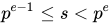
One also defines the function . (ii) in the above shows is independent of choice of and, moreover, the study of the filtration is essentially equivalent to that of .[5] satisfies the following: for ,






Fix a uniformizer of . Then induces the injection where . (The map actually does not depend on the choice of the uniformizer.[6]) It follows from this[7]




- is cyclic of order prime to
- is a product of cyclic groups of order .


In particular, is a p-group and is solvable.
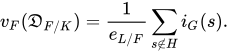
The ramification groups can be used to compute the different of the extension and that of subextensions:[8]


If is a normal subgroup of , then, for , .[9]


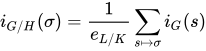
Combining this with the above one obtains: for a subextension corresponding to ,

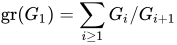
If , then .[10] In the terminology of Lazard, this can be understood to mean the Lie algebra is abelian.


Example: the cyclotomic extension
The ramification groups for a cyclotomic extension, where is a -th primitive root of unity, can be described explicitly:[11]




where e is chosen such that .
Example: a quartic extension
Let K be the extension of Q2 generated by . The conjugates of are , , .


A little computation shows that the quotient of any two of these is a unit. Hence they all generate the same ideal; call it π. generates π2; (2)=π4.

Now , which is in π5.

and which is in π3.

Various methods show that the Galois group of K is , cyclic of order 4. Also:


and

so that the different


satisfies X4 − 4X2 + 2, which has discriminant 2048 = 211.
Ramification groups in upper numbering
If is a real number , let denote where i the least integer . In other words, Define by[12]




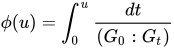
where, by convention, is equal to if and is equal to for [ 13 ] ثملمن الواضح أنهي دالة متصلة ومتزايدة تمامًا، وبالتالي فإن لها دالة عكسية متصلةمحدد في. يُعرِّف . ويُطلق عليها حينها اسم مجموعة التفرع رقم v في الترقيم الأعلى. بعبارة أخرى،. ملحوظةتم تعريف الترقيم العلوي بحيث يكون متوافقًا مع الانتقال إلى القسمة: [ 14 ] إذاأمر طبيعي في، ثم

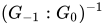



- للجميع


(بينما يكون الترقيم الأدنى متوافقًا مع الانتقال إلى المجموعات الفرعية.)
نظرية هيربراند
تنص نظرية هيربراند على أن مجموعات التفرع في الترقيم الأدنى تحقق(لأينهو الامتداد الفرعي المقابل لـوأن مجموعات التفرع في الترقيم العلوي تستوفي[ 15 ] [ 16 ] يسمح هذا بتعريف مجموعات التفرع في الترقيم العلوي لامتدادات غالوا اللانهائية (مثل مجموعة غالوا المطلقة لحقل محلي) من النظام العكسي لمجموعات التفرع للامتدادات الفرعية المحدودة .



يُعدّ الترقيم العلوي للامتداد الأبلي مهمًا بسبب نظرية هاس-آرف . تنص هذه النظرية على أنه إذاإذا كانت أبيلية، فإن القفزات في الترشيحهي أعداد صحيحة؛ أيحينماليس عددًا صحيحًا. [ 17 ]


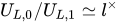
يتوافق الترقيم العلوي مع ترشيح مجموعة البقايا المعيارية بواسطة مجموعات الوحدة في ظل تماثل أرتين . صورةفي ظل التشاكل


هو فقط [ 18 ]

انظر أيضاً
ملحوظات
- ↑ فروليش، أ .؛ تايلور، م. ج. (1991). نظرية الأعداد الجبرية . دراسات كامبريدج في الرياضيات المتقدمة. المجلد 27. مطبعة جامعة كامبريدج . ISBN 0-521-36664-X. Zbl 0744.11001 .
- ↑ زاريسكي، أوسكار ؛ صموئيل، بيير (1976) [1960]. الجبر التبادلي، المجلد الثاني . نصوص الدراسات العليا في الرياضيات . المجلد 29. نيويورك، هايدلبرغ: سبرينغر-فيرلاغ. الفصل السادس. ISBN 978-0-387-90171-8. Zbl 0322.13001 .
- ↑ نوكيرش (1999) ص 178
- ↑ منذمتماثلة بشكل قانوني مع مجموعة التفكيك.
- ↑ سير (1979) ص 62
- ↑ كونراد
- ↑ استخدمو
- ^ سيري (1979) 4.1 Prop.4، ص.64
- ^ سيري (1979) 4.1. الاقتراح 3، ص 63
- ^ سيري (1979) 4.2. الاقتراح 10.
- ↑ سيري، موقع الفيلق . الفصل. IV، §4، الاقتراح 18
- ↑ سير (1967) ص 156
- ↑ نوكيرش (1999) ص 179
- ↑ سير (1967) ص 155
- ↑ نوكيرش (1999) ص 180
- ↑ سير (1979) ص 75
- ↑ نوكيرش (1999) ص 355
- ↑ سنايث (1994) ص 30-31


مراجع
- ب. كونراد، رياضيات ٢٤٨أ. مجموعات التفرع العليا
- فروليش، أ .؛ تايلور، م. ج. (1991). نظرية الأعداد الجبرية . دراسات كامبريدج في الرياضيات المتقدمة. المجلد 27. مطبعة جامعة كامبريدج . ISBN 0-521-36664-X. Zbl 0744.11001 .
- نيوكيرتش، يورغن (1999). جبرية زهلينثيوري . Grundlehren der mathematischen Wissenschaften . المجلد. 322. برلين: سبرينغر-فيرلاغ . رقم ISBN 978-3-540-65399-8. السيد 1697859 . زبل 0956.11021 .
- سير، جان بيير (1967). "السادس. نظرية حقل الأصناف المحلية". في: كاسيلز، جيه دبليو إس ؛ فروليش، أ. (محرران). نظرية الأعداد الجبرية. وقائع مؤتمر تعليمي نظمته جمعية لندن الرياضية (معهد دراسات متقدمة تابع لحلف الناتو) بدعم من الاتحاد الرياضي الدولي . لندن: أكاديميك برس. ص 128-161 . Zbl 0153.07403 .
- سير، جان بيير (1979). الحقول المحلية . نصوص الدراسات العليا في الرياضيات. المجلد 67. ترجمة مارفن جاي غرينبيرغ . برلين، نيويورك: سبرينغر-فيرلاغ . ISBN 0-387-90424-7. السيد 0554237 . زبل 0423.12016 .
- سنايث، فيكتور ب. (1994). بنية وحدة غالوا . سلسلة دراسات معهد فيلدز. بروفيدنس، رود آيلاند: الجمعية الرياضية الأمريكية . ISBN 0-8218-0264-X. Zbl 0830.11042 .
- نظرية الأعداد الجبرية