الدين في أيرلندا الشمالية
تُعدّ المسيحية أكبر ديانة في أيرلندا الشمالية . ففي تعداد عام 2021، عرّف 79.7% من سكان أيرلندا الشمالية أنفسهم كمسيحيين: كاثوليك (42.3%)، مشيخيون (16.6%)، كنيسة أيرلندا (11.5%)، ميثوديون (2.4%)، ومسيحيون آخرون (6.9%). في المقابل، ينتمي 1.3% من السكان إلى ديانات أخرى، بينما صرّح 17.4% بأنهم غير متدينين، ولم يُحدد 1.5% هويتهم الدينية أو غير الدينية. [ 1 ] شهدت الكنيسة الكاثوليكية نموًا طفيفًا في عدد أتباعها، في حين شهدت الجماعات المسيحية الأخرى المسجلة انخفاضًا.
توجد أيضاً جاليات صغيرة من المسلمين والسيخ والهندوس والبوذيين واليهود. يوجد في بلفاست كنيس يهودي، ومعبد سيخي (غوردوارا) ، ومسجد ، ومعبدان هندوسيان. ويوجد معبد سيخي آخر في ديري .
الدين في أيرلندا الشمالية - 2021 [ 1 ]
نسب السكان الذين نشأوا على الدين (2021)
|
إحصائيات
تم عرض أرقام التعداد السكاني لعام 2001 و2011 و2021 المتعلقة بالدين (وليس الدين أو الدين الذي نشأ عليه الفرد ) أدناه.
| دِين | 2001 [ 2 ] | 2011 [ 3 ] [ 4 ] [ 5 ] | 2021 [ 1 ] | |||
|---|---|---|---|---|---|---|
| رقم | % | رقم | % | رقم | % | |
| كاثوليكي | 678,462 | 40.2 | 738,033 | 40.8 | 805,151 | 42.3 |
| الكنيسة المشيخية | 348,742 | 20.7 | 345,101 | 19.1 | 316,103 | 16.6 |
| كنيسة أيرلندا | 257,788 | 15.3 | 248,821 | 13.7 | 219,788 | 11.5 |
| الميثوديين | 59,173 | 3.5 | 54,253 | 3.0 | 44,725 | 2.4 |
| مسيحيون آخرون | 102,221 | 6.1 | 104,380 | 5.8 | 130,385 | 6.9 |
| (مسيحي غير كاثوليكي بالكامل) | 767,924 | 45.6 | 752,555 | 41.6 | 711,001 | 37.4 |
| (مسيحي بالكامل) | 1,446,386 | 85.8 | 1,490,588 | 82.3 | 1,516,152 | 79.7 |
| ديانات أخرى | 5028 | 0.3 | 14859 | 0.8 | 25,524 | 1.3 |
| لا دين | 233,853 | 13.9 | 183,164 | 10.1 | 330,983 | 17.4 |
| لم يتم تحديد الدين | 122,252 | 6.8 | 30,529 | 1.6 | ||
| إجمالي عدد السكان | 1,685,267 | 100.0 | 1,810,863 | 100.0 | 1,903,188 | 100.0 |
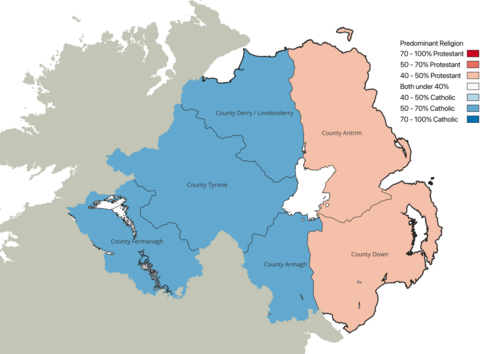
بحسب تعداد عام 2021، فيما يتعلق بالخلفية الدينية، كانت أربع من المقاطعات الست التقليدية ذات أغلبية كاثوليكية، وواحدة ذات أغلبية بروتستانتية، وواحدة ذات أغلبية بروتستانتية. [ 6 ] أما بالنسبة للدين الممارس حاليًا، فأربع مقاطعات ذات أغلبية كاثوليكية، واثنتان ذات أغلبية بروتستانتية. [ 7 ]
| الدين أو الخلفية الدينية لسكان أيرلندا الشمالية حسب المقاطعة | ||||||
|---|---|---|---|---|---|---|
| الدين / دين التنشئة | أنتريم | أرماغ | لندنديري | تحت | فيرماناغ | تايرون |
| كاثوليكي | 40.1% | 58.2% | 61.3% | 32.3% | 58.8% | 66.5% |
| البروتستانت وغيرهم من المسيحيين | 47.0% | 34.0% | 32.5% | 53.5% | 35.5% | 28.9% |
| الديانات الأخرى | 2.1% | 1.2% | 0.9% | 1.5% | 1.1% | 0.6% |
| لا دين ولا تربية دينية | 10.8% | 6.7% | 5.3% | 12.7% | 4.6% | 4.0% |
| الدين الممارس حالياً | ||||||
| كاثوليكي | 36.4% | 55.1% | 57.9% | 28.8% | 55.7% | 63.8% |
| البروتستانت وغيرهم من المسيحيين | 40.1% | 30.6% | 29.1% | 44.5% | 32.2% | 26.7% |
| الديانات الأخرى | 1.8% | 1.0% | 0.8% | 1.4% | 0.9% | 0.6% |
| لا دين ولا تربية دينية | 21.7% | 13.3% | 12.2% | 25.3% | 11.2% | 9.0% |
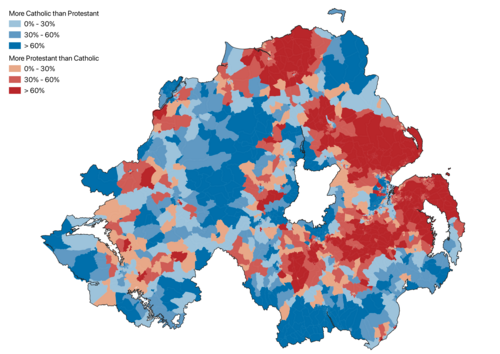
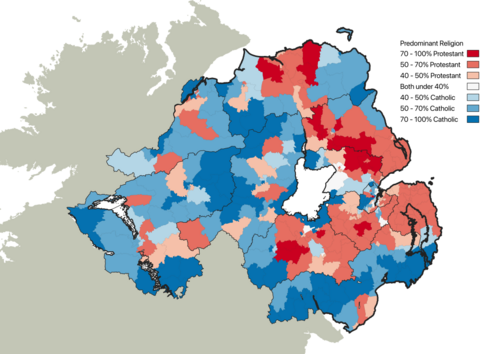
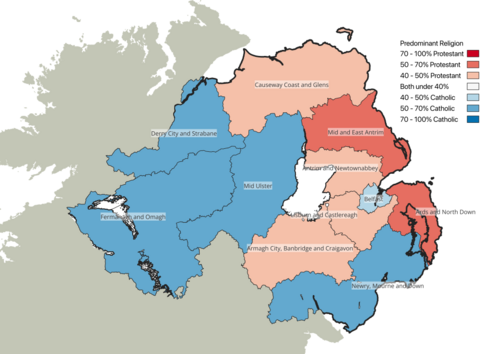
كانت الانتماءات الدينية على مختلف المستويات الجغرافية [ 7 ] [ 8 ] [ 9 ] [ 10 ] [ 11 ] [ 12 ] في أيرلندا الشمالية كما يلي في عام 2021. اللون الأزرق يمثل الكاثوليكية واللون الأحمر يمثل البروتستانت والمسيحيين الآخرين:


| يصرف | 2001 [ 13 ] | 2011 [ 13 ] | 2021 [ 10 ] | ||||||
|---|---|---|---|---|---|---|---|---|---|
| كاثوليكي | البروتستانت وغيرهم من المسيحيين | آخر | كاثوليكي | البروتستانت وغيرهم من المسيحيين | آخر | كاثوليكي | البروتستانت وغيرهم من المسيحيين | آخر | |
| أنتريم | 35.2% | 47.2% | 17.6% | 37.5% | 43.2% | 19.2% | 38.1% | 39.0% | 22.9% |
| أردز | 10.4% | 68.7% | 20.9% | 10.9% | 65.4% | 23.6% | 10.9% | 58.8% | 30.3% |
| أرماغ | 45.4% | 45.5% | 9.1% | 44.8% | 43.0% | 12.2% | 46.4% | 41.1% | 12.5% |
| باليمينا | 19.0% | 67.8% | 13.3% | 20.4% | 63.3% | 16.3% | 21.3% | 58.4% | 20.2% |
| باليموني | 29.5% | 59.1% | 11.3% | 29.6% | 56.7% | 13.6% | 30.0% | 53.8% | 16.1% |
| بانبريدج | 28.6% | 58.7% | 12.7% | 29.4% | 55.3% | 15.3% | 31.0% | 49.4% | 19.5% |
| بلفاست | 42.1% | 40.3% | 17.5% | 41.9% | 34.1% | 24.0% | 42.5% | 29.7% | 27.8% |
| كاريكفيرغوس | 6.5% | 70.4% | 23.1% | 7.6% | 67.2% | 25.2% | 7.6% | 59.5% | 33.0% |
| كاسلري | 15.8% | 64.9% | 19.3% | 19.5% | 57.3% | 23.2% | 21.8% | 48.4% | 29.8% |
| كوليرين | 24.1% | 60.5% | 15.4% | 25.0% | 56.8% | 18.2% | 25.3% | 52.5% | 22.2% |
| كوكستاون | 55.2% | 38.0% | 6.8% | 55.1% | 34.0% | 11.0% | 58.2% | 31.8% | 10.0% |
| كريغافون | 41.7% | 46.7% | 11.6% | 42.1% | 42.1% | 15.8% | 43.4% | 37.7% | 18.9% |
| ديري | 70.9% | 20.8% | 8.4% | 67.4% | 19.4% | 13.1% | 70.3% | 18.0% | 11.7% |
| تحت | 57.1% | 29.2% | 13.7% | 57.5% | 27.1% | 15.4% | 58.4% | 24.8% | 16.8% |
| دونغانون | 57.3% | 34.9% | 7.7% | 58.7% | 29.8% | 11.5% | 62.6% | 26.9% | 10.5% |
| فيرماناغ | 55.5% | 36.1% | 8.4% | 54.9% | 34.3% | 10.8% | 55.8% | 32.1% | 12.1% |
| لارن | 22.2% | 61.9% | 15.9% | 21.8% | 59.7% | 18.5% | 21.3% | 54.7% | 24.1% |
| ليمافادي | 53.1% | 36.1% | 10.7% | 56.0% | 34.3% | 9.7% | 57.5% | 31.7% | 10.8% |
| ليسبورن | 30.1% | 53.6% | 16.4% | 32.8% | 47.9% | 19.3% | 35.2% | 41.8% | 23.0% |
| ماغيرافيلت | 61.5% | 32.0% | 6.5% | 62.4% | 28.3% | 9.3% | 65.0% | 26.2% | 8.8% |
| مويل | 56.6% | 33.8% | 9.6% | 54.4% | 32.3% | 13.3% | 54.3% | 32.1% | 13.6% |
| نيوري ومورن | 75.9% | 16.4% | 7.7% | 72.1% | 15.2% | 12.7% | 75.1% | 14.9% | 10.0% |
| نيوتونابي | 17.1% | 64.5% | 18.4% | 19.9% | 57.8% | 22.3% | 22.1% | 51.0% | 27.0% |
| نورث داون | 10.0% | 64.5% | 25.5% | 11.2% | 60.3% | 28.5% | 11.6% | 52.2% | 36.2% |
| أوماغ | 65.1% | 26.3% | 8.6% | 65.4% | 24.8% | 9.8% | 67.7% | 22.9% | 9.5% |
| سترابان | 63.1% | 30.9% | 6.0% | 60.1% | 30.7% | 9.2% | 63.0% | 29.5% | 7.5% |
تم تصنيف الأديان حسب مكان الميلاد في تعداد عام 2021. [ 14 ]

| مكان الميلاد | كاثوليكي | البروتستانت وغيرهم من المسيحيين | ديانات أخرى | لم يُذكر شيء أو لم يُذكر |
|---|---|---|---|---|
| أيرلندا الشمالية | 87.7% | 91.7% | 38.6% | 77.1% |
| إنجلترا | 2.6% | 3.1% | 5.1% | 8.1% |
| اسكتلندا | 0.5% | 0.8% | 0.8% | 1.8% |
| ويلز | 0.1% | 0.1% | 0.2% | 0.4% |
| جمهورية أيرلندا | 3.3% | 1.0% | 1.8% | 1.6% |
| دول الاتحاد الأوروبي الأخرى | 4.1% | 1.6% | 4.4% | 6.1% |
| دول أوروبية أخرى غير أعضاء في الاتحاد الأوروبي | 0.1% | 0.2% | 2.1% | 0.4% |
| آخر | 1.4% | 1.1% | 37.3% | 3.8% |
كانت الانتماءات الدينية في مختلف الفئات العمرية في تعداد عام 2011 كما يلي:
| الأعمار التي تم بلوغها (بالسنوات) | 2011 [ 15 ] | 2021 [ 16 ] | ||||||
|---|---|---|---|---|---|---|---|---|
| كاثوليكي | البروتستانت وغيرهم من المسيحيين | آخر | لا أحد | كاثوليكي | البروتستانت وغيرهم من المسيحيين | آخر | لا أحد | |
| من 0 إلى 4 | 44.3% | 31.7% | 0.9% | 23.2% | 46.5% | 27.2% | 1.6% | 24.7% |
| من 5 إلى 9 | 45.5% | 36.1% | 0.7% | 17.7% | 47.7% | 30.8% | 1.6% | 19.9% |
| من 10 إلى 14 | 45.9% | 37.9% | 0.6% | 15.6% | 47.8% | 32.9% | 1.4% | 18.0% |
| من 15 إلى 19 | 44.8% | 37.6% | 0.6% | 17.0% | 45.7% | 32.7% | 1.3% | 20.3% |
| من 20 إلى 24 | 43.4% | 35.2% | 0.7% | 20.7% | 42.8% | 29.5% | 1.6% | 26.1% |
| من 25 إلى 29 | 44.8% | 33.1% | 1.1% | 21.0% | 40.9% | 29.3% | 1.7% | 28.1% |
| من 30 إلى 34 | 44.0% | 34.3% | 1.4% | 20.3% | 42.2% | 29.8% | 2.1% | 25.9% |
| من 35 إلى 39 | 41.5% | 37.8% | 1.2% | 19.5% | 44.9% | 31.2% | 2.1% | 21.9% |
| من 40 إلى 44 | 40.4% | 41.1% | 0.9% | 17.7% | 44.3% | 33.6% | 1.8% | 20.3% |
| من 45 إلى 49 | 40.0% | 42.8% | 0.8% | 16.3% | 42.5% | 37.3% | 1.4% | 18.7% |
| من 50 إلى 54 | 39.2% | 44.9% | 0.7% | 15.1% | 41.5% | 41.0% | 1.0% | 16.4% |
| من 55 إلى 59 | 38.1% | 46.5% | 0.8% | 14.6% | 41.2% | 42.8% | 0.9% | 15.1% |
| من 60 إلى 64 | 35.8% | 50.0% | 0.7% | 13.4% | 40.2% | 44.9% | 0.8% | 14.1% |
| من 65 إلى 69 | 33.7% | 54.4% | 0.7% | 11.2% | 39.1% | 46.5% | 0.7% | 13.7% |
| من 70 إلى 74 | 32.9% | 56.4% | 0.7% | 10.1% | 36.2% | 51.1% | 0.7% | 12.0% |
| من 75 إلى 79 | 32.0% | 58.1% | 0.6% | 9.3% | 34.0% | 55.6% | 0.6% | 9.7% |
| من 80 إلى 84 | 30.0% | 60.0% | 0.6% | 9.3% | 32.9% | 58.2% | 0.6% | 8.3% |
| من 85 إلى 89 | 28.1% | 61.8% | 0.5% | 9.6% | 31.9% | 60.0% | 0.6% | 7.4% |
| 90 عامًا فأكثر | 25.8% | 64.0% | 0.5% | 9.6% | 29.3% | 62.7% | 0.6% | 7.4% |
| متوسط العمر | 32 | 41 | 34 | 30 | 36 | 46 | 32 | 32 |
 كاثوليكي
 الكنيسة المشيخية في أيرلندا
 كنيسة أيرلندا
 الكنيسة الميثودية في أيرلندا
 مسيحيون آخرون
 ديانات أخرى
المسيحية


المسيحية هي الديانة الرئيسية في أيرلندا الشمالية. أظهر تعداد المملكة المتحدة لعام 2011 أن 40.8% من السكان كاثوليك، و19.1% يتبعون الكنيسة المشيخية، و 13.7% يتبعون كنيسة أيرلندا ، و5.0% يتبعون الكنيسة الميثودية. وشكّل أتباع الكنائس المسيحية الأخرى 5.8%، بينما صرّح 17% بأنهم لا يتبعون أي دين أو لم يحددوا دينهم، وبلغت نسبة أتباع الديانات غير المسيحية 0.8%. [ 3 ] [ 4 ]
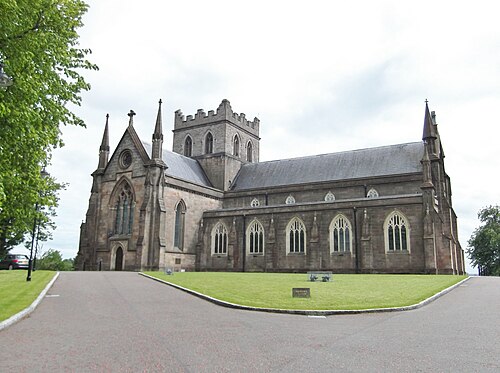
الكنيسة الكاثوليكية هي أكبر كنيسة في أيرلندا. وهي مُقسّمة إلى أربع مقاطعات، مع العلم أن هذه المقاطعات لا تتطابق مع التقسيم السياسي الحالي لأيرلندا. ويقع مقر رئيس أساقفة أرماغ ، وهو المنصب الأعلى في أيرلندا ، في كاتدرائية القديس باتريك في أرماغ .
الكنيسة المشيخية في أيرلندا ، المرتبطة ارتباطًا وثيقًا -وإن لم يكن رسميًا- بكنيسة اسكتلندا من حيث اللاهوت والتاريخ، هي ثاني أكبر كنيسة وأكبر طائفة بروتستانتية. تليها الكنيسة الأنجليكانية في أيرلندا ، التي كانت الكنيسة الرسمية لأيرلندا حتى تم فصلها عن الدولة بموجب قانون الكنيسة الأيرلندية لعام 1869. في عام 2002، وقّعت الكنيسة الميثودية في أيرلندا، وهي أصغر حجمًا بكثير ، ميثاقًا لتعزيز التعاون وإمكانية تحقيق الوحدة النهائية مع كنيسة أيرلندا. [ 18 ] وتُعد كنيسة أيرلندا جزءًا من الكنيسة الأنجليكانية .
توجد طوائف بروتستانتية أصغر حجماً، مثل الكنيسة المشيخية الحرة في أولستر ، والكنيسة المشيخية الإصلاحية في أيرلندا ( بين المشيخيين)، وجماعة الإخوة المنفتحين ، في العديد من المجتمعات الريفية. كما أن رابطة الكنائس المعمدانية في أيرلندا وجمعيات الله في أيرلندا منظمتان على مستوى أيرلندا بأكملها، مع العلم أن هذا التنظيم في حالة جمعيات الله كان نتيجة لإعادة تنظيم حديثة. [ 19 ]
مقارنة مع بريطانيا العظمى
In the 2011 census Northern Ireland had substantially more people stating that they were Christian (82.2%) than did England (59.4%), Scotland (53.8%) or Wales (57.6%).[20][21][22][23] The proportion who stated that they had any religion was also higher in Northern Ireland (83%) than in England (68.1%), Scotland (56.3%) or Wales (60.3%).[20][21][22][23] In Northern Ireland those who did not state any religion in the 2011 census amounted to 13.9% of the population, lower than in England (31.9%), Scotland (43.7%) or Wales (39.7%).[20][21][22][23] This represented an increase from the 2001 census in those not stating a religion of 11.7% in Northern Ireland, lower than the increases in England (54.5%), Scotland (38.1%) or Wales (57.6%).[20][21][22][23]
Secularisation in Northern Ireland has followed different paths within each of the two main communities, being at a more advanced stage within the mainly Protestant community in which it is reflected more often with a formal move away from the churches and by expressing no formal religious attachment, mirroring the pattern in Great Britain, whereas in the mainly Catholic community it is reflected by declining mass attendance but often with retaining a formal Catholic identification, mirroring the pattern in the Republic of Ireland.[24] Those stating that they had no religion in the 2011 census were concentrated in largely Protestant areas, suggesting that they were mostly from a Protestant background.
Comparison with the Republic of Ireland
In their respective 2011 censuses Northern Ireland had a lower proportion of people stating that they were Christian (82.3%) than the Republic of Ireland (90.4%) and had a higher proportion of people stating that they had no religion or not indicating a religious belief (16.9%) than the Republic of Ireland (7.6%). While in the 2011 census 84.2% of people in the Republic of Ireland identified themselves as Catholic in the 2011 census in Northern Ireland only 40.8% identified themselves as Catholic.
Minor religions
Islam
The bulk of Muslims in Northern Ireland today come from families who have immigrated since the late 20th century. At the time of the 2011 Census there were 3,832 living in Northern Ireland,[25] although by the 2021 census, the Muslim population stood at 10,870 (or 0.57% of the population). The Belfast Islamic Centre states that roughly half of the Muslim population lives in Belfast alone.[26] The Muslims in Northern Ireland come from over 40 countries of origin, from Western Europe all the way through to the Far East.[27] This situation is reflected in comparably complex institutional arrangements.[28]
Judaism
The earliest recorded Jew living in Northern Ireland was a tailor by the name of Manuel Lightfoot in 1652. The first Jewish congregation in Northern Ireland, Belfast Hebrew Congregation, was founded in 1870. In 2006, there were an estimated 300 Jewish people living in Northern Ireland.[29]
Baháʼí Faith
The Baháʼí Faith in Northern Ireland begins after a century of contact between Irishmen and Baháʼís beyond the island and on the island.[30][31][32] The members of the religion elected its first Baháʼí Local Spiritual Assembly in 1949 in Belfast.[33] The Baháʼís held an international conference in Dublin in 1982 which was described as “…one of the very few occasions when a world event for a faith community has been held in Ireland".[34] By 1993 there were a dozen assemblies in Northern Ireland.[35] By 2005 Baháʼí sources claim some 300 Baháʼís across Northern Ireland.[36]
Hinduism
Hinduism is a relatively minor religion in Northern Ireland with only around 200 Hindu families in the region.[37] There are, however, three Mandirs in Belfast and by the 2021 census the Hindu population had risen to 4,190 (or 0.22% of the population).
History
The Troubles
The Troubles were a period of ethno-political conflict in Northern Ireland which spilled over at various times into Great Britain and the Republic of Ireland. The duration of the Troubles is conventionally dated from approximately 1968 to the signing of the Belfast Agreement in 1998. Violence nonetheless continued beyond this period and still manifests on a small-scale basis.[38]
The principal issues at stake in the Troubles were the constitutional status of Northern Ireland and the relationship between the mainly Protestant Unionist and mainly Catholic Nationalist communities in Northern Ireland. The Troubles had both political and military (or paramilitary) dimensions. Its participants included politicians and political activists on both sides, republican and loyalist paramilitary organisations, the Royal Ulster Constabulary, the British Army and the security forces of the Republic of Ireland.
See also
References
- 123"MS-B21: Religion". Northern Ireland Statistics and Research Agency. 22 September 2022. Retrieved 7 January 2023.
- ↑"Census 2001: Religion (administrative geographies)". nisra.gov.uk. Retrieved 11 December 2012.
- 12"Census 2011: Religion: KS211NI (administrative geographies)". nisra.gov.uk. Retrieved 11 December 2012.
- 12"Census 2011: Key Statistics for Northern Ireland"(PDF). nisra.gov.uk. Retrieved 11 December 2012.
- ↑"Northern Ireland Statistics and Research Agency Census 2011: Key Statistics for Northern Ireland"(PDF).
- ↑"Religion or religion brought up in". NISRA. Retrieved 17 August 2023.
- 12"Census 2021: Religion by county". NISRA. Retrieved 25 January 2026..
- ↑"Census 2021: Religion by ward". NISRA. Retrieved 25 January 2026.
- ↑"Census 2021: Religion by DEA". NISRA. Retrieved 25 May 2026.
- 12"Census 2021: Religion by pre-2015 Local Government Districts". nisra.gov.uk. Retrieved 24 January 2026.
- ↑"Census 2021: Religion by current LGD". NISRA. Retrieved 25 January 2026.
- ↑"Census 2021: Religion by parliamentary constituency". NISRA. Retrieved 25 January 2026.
- 12"Northern Ireland Neighbourhood Information Service". Retrieved 22 July 2014.
- ↑"Census 2021: Religion". nisra.gov.uk. Retrieved 24 January 2026.
- ↑"Census 2011: Religion by Age". Retrieved 24 January 2026.
- ↑"Census 2021: Religion by age". nisra.gov.uk. Retrieved 24 January 2026.
- ↑"CAIN Web Service". Retrieved 21 April 2022.
- ↑"Church of Ireland - A Member of the Anglican Communion". www.ireland.anglican.org.
- ↑Launch of the Assemblies of God IrelandArchived 14 May 2015 at the Wayback Machine eyeoneurope.org, accessed 31 December 2009
- 1234"NISRA". NISRA. Retrieved 30 December 2015.
- 1234"Scotland's Census". Scotland's census. Scottish government. Retrieved 30 December 2015.
- 1234"Office of National Statistics". ons. Retrieved 30 December 2015.
- 1234"Office of National Statistics". The Welsh Government. Welsh government. Archived from the original on 15 January 2016. Retrieved 30 December 2015.
- ↑"Research Update"(PDF). ARK. Retrieved 31 December 2015.
- ↑Northern Ireland Census 2001 Key StatisticsArchived 22 November 2009 at the Wayback Machine
- ↑"History – Belfast Islamic Centre". Archived from the original on 24 January 2021. Retrieved 4 June 2019.
- ↑"Belfast Islamic Centre". Archived from the original on 8 October 2009.
- ↑Scharbrodt, Oliver, "Islam in Ireland: organising a migrant religion". 318 – 336 in Olivia Cosgrove et al. (eds), Ireland's new religious movements. Cambridge Scholars, 2011; ISBN 978-1-4438-2588-7
- ↑"Ireland: Virtual Jewish History tour". Jewish Virtual Library. Retrieved 11 August 2013.
- ↑"Baha'is (sic) mark killing of founder". belfasttelegraph.co.uk. 12 July 2005. Retrieved 2 June 2010.
- ↑Palin, Iain S. "The First Irish Baháʼís". U.K. Baháʼí Heritage Site. Archived from the original on 16 September 2011. Retrieved 31 May 2010.
- ↑Armstrong-Ingram, R. Jackson (July 1998). "Early Irish Baháʼís : Issues of Religious, Cultural, and National Identity". Research Notes in Shaykhi, Babi and Baháʼí Studies. 02 (4). Retrieved 31 May 2010.
- ↑"History and Inspiration". CommuNIqué-Newsletter of the Baháʼí Community in Northern Ireland (106). Baháʼí Council for Northern Ireland. 1 June 2005. Retrieved 31 May 2010.
- ↑"Book Review; The Faiths of Ireland by Stephen Skuce". CommuNIqué – Newsletter of the Baháʼí Community in Northern Ireland (123). Baháʼí Council for Northern Ireland. 1 December 2006. Retrieved 31 May 2010.
- ↑Momen, Moojan. "Baháʼí History of the United Kingdom". Articles for the Baháʼí Encyclopedia. Archived from the original on 6 February 2012. Retrieved 31 May 2010.
- ↑"Religious Education Core Syllabus". Statements on Matters of Public Interest / Concern. Baháʼí Council for Northern Ireland. 25 November 2003. Archived from the original on 3 April 2012. Retrieved 3 June 2010.
- ↑Programme 1 – Indian Community bbc.c.uk, accessed 10 January 2009
- ↑"Draft List of Deaths Related to the Conflict. 2002–". Retrieved 31 July 2008.
External links
- Homepage of the Irish Bishops' Conference (Catholic)
- CatholicIreland.net, Content-rich portal of the Catholic Church in Ireland
- Presbyterian Church in IrelandArchived 30 November 2020 at the Wayback Machine
- Church of Ireland
- Methodist Church in Ireland
- Association of Baptist Churches in Ireland
- Assemblies of God Ireland
- Religion in Northern Ireland
- Religion in the United Kingdom