
أحجار رونية فارانجية




الأحجار الرونية الفارانجية هي أحجار رونية في الدول الاسكندنافية ، وتحديداً في السويد ، تذكر الرحلات إلى الشرق ( باللغة النوردية القديمة : Austr ) أو الطريق الشرقي ( باللغة النوردية القديمة: Austrvegr )، أو إلى مواقع شرقية أكثر تحديداً مثل غارداريكي في أوروبا الشرقية .
توجد أيضًا العديد من الأحجار الرونية الإضافية في الدول الاسكندنافية التي تتحدث عن رحلات شرقًا، مثل أحجار اليونان الرونية ، وأحجار إيطاليا الرونية ، والنقوش التي تركها الحرس الفارانجي . ومن بين الأحجار الرونية الأخرى التي تتناول رحلات الفارانجيين، أحجار سيركلاند الرونية (التي تتناول رحلات إلى الشرق الأوسط) وأحجار إنجفار الرونية (التي أقيمت تكريمًا أو تخليدًا لذكرى أولئك الذين سافروا إلى بحر قزوين مع إنجفار الرحالة ). [ 1 ] [ 2 ] [ 3 ] كما توجد مقالة منفصلة عن أحجار رحلات البلطيق الرونية . بالإضافة إلى ذلك، ذُكرت رحلات إلى أوروبا الغربية على أحجار رونية، والتي تم تناولها في مقالات أحجار الفايكنج الرونية ، وأحجار إنجلترا الرونية ، وأحجار هاكون يارل الرونية .
أُقيمت معظم الأحجار الرونية خلال فترة تنصير القرن الحادي عشر، حين كان نقشها رائجًا، ولكن من الجدير بالذكر أن حجر كالفيستن الروني (أوغ 8) نُقش في القرن التاسع، حين لعب الفارانجيون دورًا محوريًا فيما سيُعرف لاحقًا بروسيا وأوكرانيا. كانت هذه المنطقة الشاسعة مصدرًا غنيًا بالفراء والجلود والسكان، ومكونًا هامًا في الاقتصاد السويدي آنذاك. [ 4 ] ويعني اسمها في اللغة النوردية القديمة "أرض الحصون"، وهو مشتق من سلاسل الحصون التي شُيّدت على طول طرق التجارة. [ 4 ]
نُقشت جميع الأحجار باللغة النوردية القديمة باستخدام الأبجدية الرونية الصغرى (الفوثارك الأصغر) ، ويمكن تلخيص رسالة العديد من النقوش بقصيدة على نمط فورنيرديسلاج الموجودة على حجر تورينج الروني Sö 338 :
Brøðr vaʀu þæiʀ bæzstra manna، alandi ok i liði uti، Holdu sina huskarla ve[l]. لقد نشأ هان فيول في غاروم، وتعلم الكثير من الأشياء، وكسب المال. [ 5 ]
كان هذان الأخوان من أفضل الرجال في البلاد وخارجها في الحاشية، وكانا يُحسنان إدارة حراسهما . سقط أحدهما في معركة في الشرق في غارذار (روسيا)، وكان قائد الحاشية، وأفضل ملاك الأراضي. [ 6 ]
فيما يلي عرضٌ للأحجار الرونية استنادًا إلى مشروع Rundata . معظم النصوص المكتوبة باللغة النوردية القديمة مكتوبة باللهجة السويدية والدنماركية لتسهيل المقارنة مع النقوش، بينما تُقدّم الترجمة الإنجليزية التي يوفرها مشروع Rundata الأسماء باللهجة القياسية الفعلية (اللهجة الأيسلندية والنرويجية):
السويد
أبلاند
يو 153

يُعدّ هذا الحجر الروني، المصمم على طراز Pr3، أحد الأحجار الرونية في هاغبي . [ 7 ] اكتُشف عام 1930 في قبو المبنى الرئيسي لعقار ليسبي القديم، الذي هُدم في أواخر القرن التاسع عشر. [ 8 ] كان الحجر مُثبّتًا في جدار القبو، وكان جانبه المنقوش ظاهرًا مع الحجرين الرونيين U 152 و U 154. [ 9 ] عندما انهار القبو، تشظّى الحجر الروني إلى عدد كبير من القطع الصغيرة والكبيرة، وكان الجزء العلوي منها هو الأكبر. [ 10 ] عُثر على جزء من الحجر في حقل ضمن ملكية ليسبي. [ 11 ] في المجمل، أُعيد تجميع ما لا يقل عن 70 قطعة، وفي عام 1931، رُفع الحجر المُرمّم إلى حديقة هاغبي. [ ١٢ ] الحجر من الجرانيت، ويبلغ ارتفاعه ٢.٦٠ مترًا وعرضه ١.٥ مترًا. [ ١٣ ] النقش متضرر، وخاصة في بدايته ونهايته. [ ١٤ ] يشير إلى عدة أحجار، وربما كان أحدها الحجر الروني U ١٥٥. [ ١٥ ]
يمكن إعادة بناء الأحرف الرونية الأخيرة إما على النحو التالي: [i karþ]um (في غارذار ، [ ملاحظة 1 ] أي في أراضي روس ) أو [i krik]um (بين اليونانيين، أي في الإمبراطورية البيزنطية ). [ 22 ] [ 23 ]
نص النقش: [ 24 ] [ 25 ] [ 26 ]
...[(u)](a)i-
[S]væi[nn]
×
[(أ)]المملكة المتحدة
نعم
×
ulf-
أولف[ر]
ليتو
ليتو
×
رايسا
رايسا
×
stai-(a)
stæi[n]a
×
e(f)tiʀ
بعد
×
hlftan
هالفدان
·
أوك
نعم
·
بعد
بعد
×
كونار
غونار،
×
bryþr
brøðr
×
سينا
سينا.
×
þaiʀ
Þæiʀ
·
أنتاثوس
ændaðus
×
أستراليا...
أستراليا[r]
...(u)m
...
...[(u)](a)i- × [(a)]uk × ulf- litu × raisa × stai-(a) × e(f)tiʀ × hlftan · auk · eftiʀ × kunar × bryþr × sina × þaiʀ · antaþus × aust... ...(u)m
[S]væi[nn] {} ok {} Ulf[ʀ] Letu {} ræisa {} stæi[n]a {} æftiʀ {} Halfdan {} ok {} æftiʀ {} Gunnar، {} brøðr {} sina. {} Þæiʀ {} ændaðus {} aust[r] ...
أقام سفين وأولفر الحجرين تخليداً لذكرى هالفدان وغونار، أخويهما. وقد لقيا حتفهما في الشرق...
يو 154
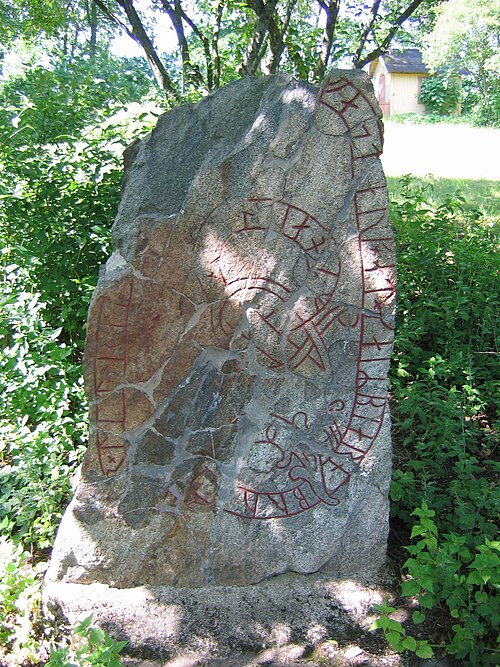
هذا الحجر الروني من طراز Pr3، وهو أحد الأحجار الرونية في هاغبي . [ 27 ] اكتُشف مع الحجرين U 151 وU 153 في قبو منهار أسفل الجزء الشرقي من أساسات المبنى الرئيسي لمزرعة ليسبي. [ 28 ] عند اكتشافه، كان لا يزال قائمًا، لكنه كان قد سُحق وتفتت إلى 50 قطعة عند إزالته من الجدار. [ 29 ] أُعيد تجميعه، لكن الجزء العلوي منه فُقد ولم يُسترجع. [ 30 ] في عام 1931، نُصب في حديقة هاغبي. [ 31 ] الحجر داكن اللون، ويبلغ ارتفاعه 1.23 مترًا وعرضه 0.3 مترًا. [ 32 ] النقش متضرر في عدة مواضع. [ 33 ]
نص النقش: [ 34 ] [ 35 ] [ 36 ]
[þ(o)]...r
...
×
مضاء
يترك
×
راي...
ræi[sa]
...
...
...سريع
...سريع
·
أوك
نعم
×
في
في
×
(k)aiʀbiarn
Gæiʀbiorn,
×
بروث-
brøð[r]
...
...
...i(ʀ)
[þæ]iʀ
·
(ل
مزدوج
أ(و)س...
aus[tr].
×
[þ(o)]...r × lit × rai... ... ...fast · auk × at × (k)aiʀbiarn × bruþ- ... ...i(ʀ) · (t)oa(u)s... ×
... {} Let {} ræi[sa] ... ...fast {} ok {} at {} Gæiʀbiorn, {} brøð[r] ... [þæ]iʀ {} dou aus[tr]. {}
... قد ربوا ... ...-أسرع وتخليداً لذكرى جيربيورن، (إخوانهم) ... ماتوا في الشرق.
يو 209
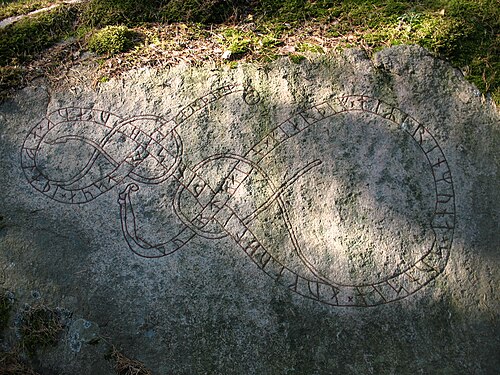
هذا ليس حجرًا رونيًا بالمعنى الدقيق، بل هو نقش روني على طراز Pr4 نُحت على صخرة مسطحة في فيدا. ويعود تاريخه إلى منتصف القرن الحادي عشر. [ 37 ] وقد أمر بنقشه ثورستين الذي أثرى نفسه في أراضي روس تخليدًا لذكرى ابنه. ويُرجّح أوميلجان بريتساك أن ثورستين هذا هو نفسه ثورستين، القائد السابق لإحدى الحاشية، [ 38 ] الذي يُخلّد ذكراه على حجر تورينج الروني . [ 39 ] [ 40 ] ويشير إلى أن ثورستين كان قائد حاشية ياروسلاف الحكيم ، وأن ابنه إيرينموند ربما يكون قد توفي في غارداريكي أثناء خدمته تحت قيادة والده. [ 41 ]
من المرجح أن العقار الذي تم شراؤه هو مزرعة فيدا، حيث يوجد النقش. [ 42 ] ويكتسب هذا النقش أهمية خاصة لأنه يشير إلى أن الثروات التي جُمعت في أوروبا الشرقية قد أدت إلى استحداث إجراء جديد لشراء أراضي الأودال بشكل قانوني . [ 4 ]
نص النقش: [ 43 ] [ 44 ] [ 45 ]
þurtsain
Þorstæinn
×
kiarþi|
gærði
|if×tiʀ
بعد
إيرينمونت
إيرينموند،
×
شمس
شمس
الخطيئة
سين،
أوك|
نعم
|kaubti
køypti
þinsa
þennsa
بو
بواسطة
×
أوك
نعم
×
aflaþi
aflaði
×
أسترالي
أسترالي
أنا
أنا
كارثوم
غاردوم.
þurtsain × kiarþi| |if×tiʀ irinmunt × sun sin auk| |kaubti þinsa bu × auk × aflaþi × austr i karþum
Þorstæinn {} gærði æftiʀ Ærinmund, {} sun sinn, ok køypti þennsa by {} ok {} aflaði {} austr i Garðum.
صنع ثورستين (الحجر) تخليداً لذكرى ابنه إيرينموند، واشترى هذه الضيعة واكتسب (الثروة) في الشرق في غاردار (روسيا).
يو 283

كان هذا الحجر الروني موجودًا في ضيعة تورساكر، لكنه اختفى. يُفترض أنه كان على طراز Pr3 وصنعه صانع الأحجار الرونية فوت . وقد أقامه ثلاثة رجال تخليدًا لذكرى رجل رابع توفي في الشرق.
نص النقش: [ 46 ] [ 47 ] [ 48 ]
[×
سيبي
سيبي
×
أوك
نعم
×
irmuntr
Ærnmundr
×
أوك
نعم
×
þoriʀ
Þoriʀ
×
ليتو
ليتو
×
رايسا
رايسا
×
بقع
شتاين
×
إفطار
بعد
×
s(u)...
...
...
...
...--
...
(ح)(أ)ن
هان
·
ل
يفعل
×
أسترالي
أوستر،
×
شمس
شمس
×
[كيسمونتار]
جيسموندار.
[× سيبي × أوك × إيرمنتر × أوك × þoriʀ × ليتو × رايسا × ستاين × إفتيʀ × s(u)... ... ...-- (ح)(أ)ن · إلى × أوستر × شمس × كيسمنتاʀ]
{} سيبي {} ok {} Ærnmundr {} ok {} Þoriʀ {} Letu {} ræisa {} stæin {} æftiʀ {} ... ... ... Hann {} do {} austr، {} sunn {} Gismundaʀ.
أقام سيبي وإرنموندر وثورير الحجر تخليداً لذكرى ... توفي ابن جيسموندر في الشرق.
يو 366

عُثر على هذا الحجر الروني على شكل شظايا في غاديرستا، وقد اختفى، لكنه كان على الأرجح من طراز Pr4 . وقد أُقيم تخليداً لذكرى رجل توفي على الطريق الشرقي.
نص النقش: [ 49 ] [ 50 ] [ 51 ]
[...]
...
uaʀ
فار
·
tauþr
dauðr
×
أنا
أنا
أوستروه
austrveg[i]
...]
...
[... uaʀ · tauþr × i austruih- ...]
... vaʀ {} dauðr {} i austrveg[i] ...
... توفي على الطريق الشرقي ...
يو 504
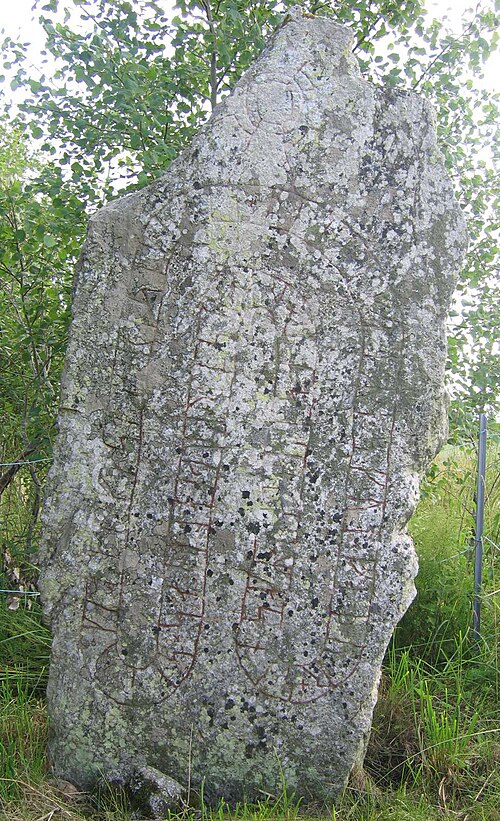
هذا الحجر الروني نقشٌ قديمٌ على طراز RAK بدون زخارف. يقع في أوبي، وقد أُقيم تخليداً لذكرى أبٍ سافر غرباً وشرقاً.
نص النقش: [ 52 ] [ 53 ] [ 54 ]
+
kitil×fastr
كايتيلفاستر
×
ريستي
رايستي
×
ستين
شتاين
+
þina
þenna
×
إفطار
بعد
×
أسكوت
أسغوت،
×
فاثور
faður
+
الخطيئة
سين.
×
سار
سار
×
uas
فاس
×
uistr
فيستر
×
المملكة المتحدة
نعم
×
ustr
أسترالي
+
kuþ
غود
إيالبي
هيالبي
×
مثل
هانز
×
سلام
سلام.
+ كيتل × فاستر × ريستي × ستين + þina × iftiʀ × أسكوت × فاور + سين × ساʀ × أواس × أويستر × المملكة المتحدة × أوستر + كوþ إيلبي × أس × سالو
{} Kætilfastr {} ræisti {} stæin {} þenna {} æftiʀ {} Asgaut، {} faður {} خطيئة. {} Saʀ {} فاس {} فيستر {} طيب {} austr. {} Guð hialpi {} hans {} سالو.
أقام كيتيلفاستر هذا الحجر تخليداً لذكرى والده آسغاوتر. كان في الغرب والشرق. رحمه الله.
يو 636
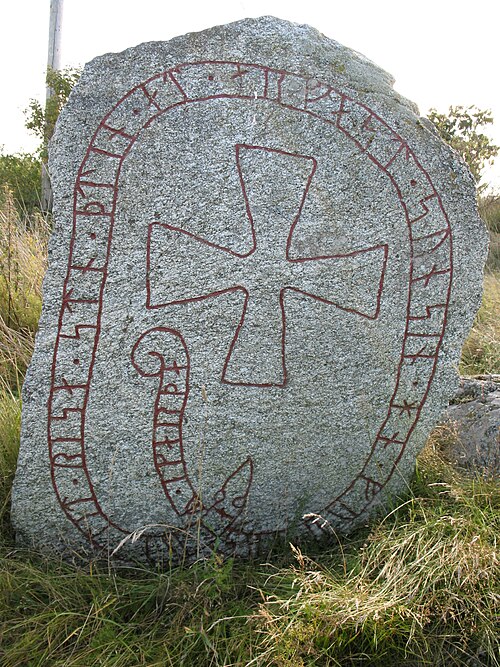
عُثر على هذا الحجر في لاديرستا، وهو مبني على طراز Fp . أُقيم تخليداً لذكرى ابن يُدعى أرنفاست سافر إلى غارداريكي . ذُكر اسم أرنفاست أيضاً على الحجر U 635.
هناك قراءتان لعبارة i karþa . إحداهما تعني "إلى غارذار " أو "إلى غارذاريكي "، أي "إلى أراضي روس ". [ 55 ] مع ذلك، في النقوش الرونية، يظهر هذا الاسم الجغرافي دائمًا بصيغة الجمع غير المباشر، [ 56 ] مما يوحي بأن صيغة المفرد i karþa ربما كانت تشير إلى مدينة معينة تُدعى غارذار ، أي إما إلى القسطنطينية [ 57 ] أو إلى كييف . [ 58 ]
نص النقش: [ 59 ] [ 60 ] [ 61 ]
ألوي
ألفي
·
مضاء
يترك
·
ريسا
رايسا
·
محطة
شتاين
·
þtin
þenna
·
في
في
·
سريع
أرنفاست،
·
شمس
شمس
الخطيئة
سين.
·
هن
هان
·
ف
ل
·
أوسر
أسترالي
·
أنا
أنا
كارثا
غاردا.
alui · lit · risa · stn · þtin · at · arfast · sun sin · hn · fur · ausʀ · i karþa
ألفي {} دع {} رايسا {} ستين {} þenna {} في {} أرنفاست، {} صن سين. {} هان {} لـ {} austr {} i Garða.
أقام Ǫlvé هذا الحجر تخليداً لذكرى ابنه أرنفستر. وسافر شرقاً إلى غارذار (روسيا).
يو 687
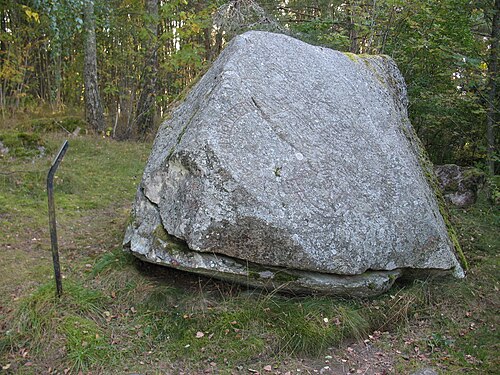
عُثر على هذا الحجر، الذي وقّعه خبير الرون أوبير ، في سيستا بالقرب من سكوكلوستر . وهو منقوش على طراز Pr4 ، وقد أقامته امرأة تُدعى رونا تخليدًا لذكرى أبنائها الأربعة الذين توفوا. وقد أمرت بصنعه مع زوجة ابنها سيغريدر، أرملة سبيالبودي. وأضافتا أن المكان الذي توفي فيه سبيالبودي هو i olafs kriki ، وقد ناقش العديد من العلماء معنى هذه الأحرف الرونية. [ 62 ]
في عام 1875، اقترح ريتشارد دايبك أن كلمة "كريكي" تُمثل كلمة " غريك " في اللغة النوردية القديمة ، والتي تعني "اليونان"، ولكن في عام 1891، قرأها سوفوس بوغه على أنها " غريذ "، والتي تعني "الحاشية". [ 63 ] لاحقًا، في عام 1904، فسّرها أدولف نورين على أنها "كريكر" ، والتي تعني "الخطاف"، [ 64 ] ولكن في عام 1907، اقترح أوتو فون فريزن أن الأحرف الرونية تُقرأ "آي أولافس كيركي" ، أي "في كنيسة القديس أولاف في نوفغورود ". ومنذ ذلك الحين، أصبح تفسير أوتو فون فريزن هو التفسير المقبول. [ 65 ]
يشير أوميلجان بريتساك إلى أن سبجالبودي توفي في حريق دمر الكنيسة حوالي عام 1070-1080. [ 66 ] من ناحية أخرى، يعزو جانسون وفاة سبجالبودي في كنيسة إلى حقيقة أن العديد من كنائس العصور الوسطى كانت هياكل دفاعية. [ 67 ]
النص الروني موقع من قبل خبير الرون أوبير ، الذي كان نشطًا خلال أواخر القرن الحادي عشر وأوائل القرن الثاني عشر في أوبلاند .
نص النقش: [ 68 ] [ 69 ] [ 70 ]
رونا
رونا
'
مضاء
يترك
كيارا
gæra
'
ميركي
ماركي
في
في
'
sbialbuþa
Spiallbuða
'
المملكة المتحدة
نعم
'
في
في
'
سوين
سفين
'
المملكة المتحدة
نعم
'
في
في
·
أنتويت
أندفيت
'
المملكة المتحدة
نعم
في
في
'
راكنار
راجنار،
'
سوني
مرادف
'
الخطيئة
سينا
'
المملكة المتحدة
نعم
'
إكلا
Hælga/Ægla/Ængla,
'
المملكة المتحدة
نعم
'
siri(þ)
سيغريد
'
في
في
'
sbialbuþa
Spiallbuða,
'
بونتا
بوندا
الخطيئة
سين.
أن
هان
uaʀ
فار
'
tauþr
dauðr
'
أنا
أنا
هولمكارثي
هولمغاردي
'
أنا
أنا
أولاف
أولافس
·
كريكي
كيركيو.
'
أوبير
أوبير
·
ريستي
ريستي
'
ru
رونار.
runa ' lit kiara ' mirki at ' sbialbuþa ' uk ' at ' suain ' uk ' at · anuit ' uk at ' raknaʀ ' suni ' sin ' uk ' ekla ' uk ' siri(þ) ' at ' sbialbuþa ' bonta sin an ua' tauþr ' i hulmkarþi ' i olafs · كريكي 'ubiʀ · risti' ru
Runa {} Let gæra {} mærki at {} Spiallbuða {} ok {} at {} Svæin {} ok {} at {} Andvett {} ok at {} Ragnar, {} Syni {} sina {} ok {} Hælga/Ægla/Ængla, {} ok {} Sigrið {} at {} Spiallbuða, {} Bonda sinn. Hann vaʀ {} dauðr {} i Holmgarði {} i Olafs {} kirkiu. {} Øpiʀ {} risti {} runaʀ.
قامت Rúna بعمل المعلم تخليدًا لذكرى Spjallboði وتخليدًا لذكرى Sveinn وتخليدًا لذكرى Andvéttr وتخليدًا لذكرى Ragnarr أبناءها وهيلجي / إيجلي / إنجلي ؛ و Sigríðr تخليداً لذكرى فلاحها Spjallboði. توفي في هولمغار في كنيسة ألفر. Œpir نحت الرونية.
يو 898
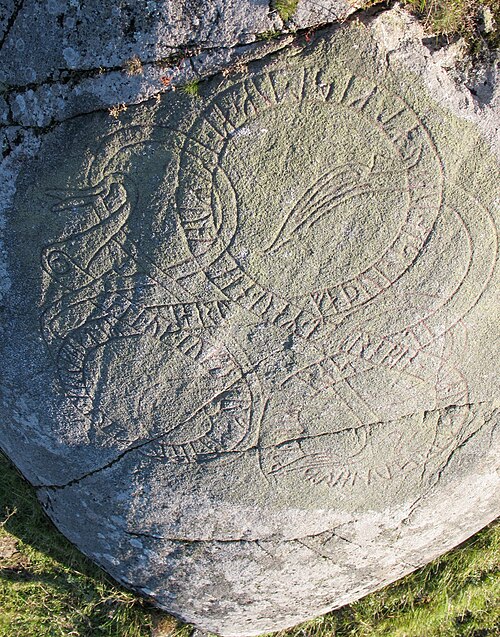
هذا ليس حجرًا رونيًا بالمعنى الدقيق، بل نقش روني على صخرة مسطحة في نوربي. وهو مكتوب على طراز Pr4 ، وقد أُقيم تخليدًا لذكرى ثلاثة رجال، توفي أحدهم في الشرق. وقد وقّع على النص الروني خبير الرون أوبير.
نص النقش: [ 71 ] [ 72 ] [ 73 ]
علي
علي/علي
'
المملكة المتحدة
نعم
'
iufurfast
Iofurfast
·
ليتو
ليتو
'
جيرا
gæra
'
ميركي
ماركي
'
إفطار
بعد
iarl
إيرل،
فاثور
faður
الخطيئة
سين،
'
المملكة المتحدة
نعم
'
في
في
'
كيسل
جيسل
'
المملكة المتحدة
نعم
'
في
في
'
إيكيمونت
إنجيموند.
هان
هان
'
uaʀ
فار
'
تريبين
دريبين
'
hustr
أوستر،
'
شمس
شمس
'
iarls
إيرلز.
ybiʀ
أوبير
ريستي
ريستي.
ali 'uk' iufurfast · litu 'gera 'merki' iftiʀ iarl faþur sin 'uk' at 'kisl'uk' at 'ikimunt han' uaʀ 'trebin' hustr 'sun' irls ybiʀ risti
Ali/Alli {} ok {} Iofurfast {} Letu {} gæra {} mærki {} æftiʀ Iarl، faður sinn، {} ok {} at {} Gisl {} ok {} at {} Ingimund. Hann {} vaʀ {} drepinn {} austr، {} sunn {} Iarls. Øpiʀ risti.
أمر كل من آلي/آلي ويوفرفاست ببناء هذا المعلم تخليداً لذكرى يارل، والدهم، وتخليداً لذكرى جيسل وإنجيموندر. قُتل إنجيموندر، ابن يارل، في الشرق. نُحتت هذه العلامة.
سودرمانلاند
Sö 33

يقع هذا الحجر الروني في سكآنغ، وهو من طراز Fp . وقد أُقيم تخليداً لذكرى رجل توفي في اجتماع في الشرق. ومن المحتمل أيضاً أن يكون النقش يشير إلى أن الرجل توفي في موكب في الشرق. [ 74 ]
نص النقش: [ 75 ] [ 76 ] [ 77 ]
+
غنوبها
غنوبا
~
ليþ
يترك
:
رايسا
رايسا
:
بقع
شتاين
:
þinsa
þennsa
:
هيبتير
بعد
:
كولايف
غودليف،
:
بروثور
برودور
الخطيئة
سين.
هان
هان
:
أنتاثيس
ændaðis
:
أسترالي
أسترالي
:
في
في
þikum
þingum.
+ غنوبها ~ liþ : raisa : وصمة عار : þinsa : هبتي : kulaif : bruþur sin han : antaþis : austr : at þikum
{} Gnupa {} Let {} ræisa {} stæin {} þennsa {} æftiʀ {} Guðlæif، {} broður sinn. هان {} ændaðis {} austr {} في þingum.
أقام غنوبا هذا الحجر تخليداً لذكرى غوليفر، شقيقه. وقد لقي حتفه في الشرق عند الجمعية.
Sö 34

يقع هذا الحجر الروني على طريق يُسمى "تيوفستيجن" (درب اللصوص)، وهو منحوت على طراز KB، وهو تصنيف للنقوش التي تحمل صليبًا محاطًا بنص روني. يشير النص الروني إلى أنه أُقيم تخليدًا لذكرى شقيقين كانا من طبقة " ثيغن " ( الطبقة العليا )، وهي طبقة من الحاشية، وتوفيا في مكان ما في الشرق. استُخدمت العبارة نفسها بصيغة المفرد على الحجرين الرونيين Vg 8 من هيالستاد و DR 143 من غونديروب. يصف حوالي خمسين حجرًا رونيًا تذكاريًا المتوفى بأنه كان من طبقة "ثيغن".
نص النقش: [ 78 ] [ 79 ] [ 80 ]
ستيرلوغ
ستيرلوغ
·
أوك
نعم
·
هولمبر
هولمبر
·
ستاينا
stæina
·
رايستو
رايستو
·
في
في
·
bryþr
brøðr
·
سينا
سينا،
·
brau(t)u
براوتو
·
نيستا
næsta.
·
þaiʀ
Þæiʀ
·
entaþus
ændaðus
·
أنا
أنا
·
النمسا
أوسترفيجي،
·
þurkil
ثوركيل
·
أوك
نعم
ستوربيارن
ستيربيورن،
þiaknaʀ
þiægnar
·
كوثير
goðiʀ.
styrlaugʀ · auk · hulmbʀ · ستينا · raistu · at · bryþr · sina · brau(t)u · Nesta · þaiʀ · entaþus · i · austruiki · þurkil · auk sturbiarn þiaknaʀ · kuþiʀ
Styrlaugʀ {} ok {} Holmbʀ {} stæina {} ræistu {} at {} brøðr {} sina، {} brautu {} næsta. {} Þæiʀ {} ændaðus {} i {} austrvegi، {} Þorkell {} ok Styrbiorn، þiægnaʀ {} goðiʀ.
أقام ستيرلاوغر وهولمر الحجارة بجانب الطريق تخليداً لذكرى أخويهما. وقد لقيا حتفهما على الطريق الشرقي، ثوركيل وستيربيورن، ثيغنز الطيبين.
Sö 92

عُثر على هذا الحجر الروني في مقبرة هوسبي. واجهته الأمامية مغطاة بالكامل بالرسومات، ويُنسب إلى الطراز Pr3-Pr4 . نُحت هذا الحجر على يد خبير الرون بالي تخليدًا لذكرى شقيق أحدهم الذي توفي في الشرق.
نص النقش: [ 81 ] [ 82 ] [ 83 ]
...
...
·
مضاء
يترك
·
رايسا
رايسا
·
شارع...
st[æin]
...
...
ريسو
ريسيو (؟)،
·
أخ)...
bro[ður]
·
الخطيئة
سين.
·
ها...
هان
...
...
أسترالي
أسترالي
·
بالي
بالي
...
...
... · مضاءة · raisa · st... ... rysu · br(o)... · sin · ha... ... austr · بالي ...
... {} Let {} ræisa {} st[æin] ... Rysiu(?), {} bro[ður] {} sinn. {} ها[ن] ... أوستر. { } بالي ...
... رفع الحجر ... ريسجا (؟)، شقيقه. هو ... شرقًا. بالي ...
Sö 121

اختفى هذا الحجر الروني، لكنه كان موجودًا في بونستاد. وقد صُنع على طراز راك تخليدًا لذكرى رجل توفي في الشرق.
نص النقش: [ 84 ] [ 85 ] [ 86 ]
[سومو
< سومو >
:
هاوكا
هاجفا
:
ستان
ستاين،
:
مجموع
مجموع
ir
er
:
tuþ
داود
:
أستراليا
أسترالي
·
أنا
أنا
:
التونة
< تونة >
:
as(u)]
< asu > .
[sumuʀ : hauka : stan : sum iʀ : tuþ : austʀ · i : tuna : as(u)]
<sumuʀ> {} haggva {} stæin, {} sum eʀ {} dauð {} austr {} i {} <tuna> {} <asu>.
<sumuʀ> cut the stone, who died in the east in <tuna> ...
Sö 126

This runestone is a runic inscription on flat bedrock in Fagerlöt. It is in the style Pr2-Pr3 and it was made in memory of a man named Áskell who fell in battle in the East. The second sentence of the inscription is in the meter fornyrðislag, and it contains a virtually unique use of the Old Norse word grimmr ('cruel') in the sense "commander".[87] Áskell's title folksgrimmr may be the title that the commander had in the druzhina of Yaroslav I the Wise in Novgorod.[88]
The inscription reads:[89][90][91]
hu(l)(m)(f)riþ
Holmfriðr,
·
ilin--r
<ilin--r>,
·
[þ]aʀ
þaʀ
·
litu
letu
·
hakua
haggva
·
stain
stæin
·
eftiʀ
æftiʀ
eskil
Æskel,
·
faþur
faður
·
sin
sinn.
·
han
Hann
·
trauh
draug
·
orustu
orrustu
·
i
i
·
austru[i]hi
austrvegi,
aþaa
aðan
·
fulks·krimʀ
folksgrimʀ
·
fala
falla
·
orþi
orði.
hu(l)(m)(f)riþ · ilin--r · [þ]aʀ · litu · hakua · stain · eftiʀ eskil · faþur · sin · han · trauh · orustu · i · austru[i]hi aþaa · fulks·krimʀ · fala · orþi
Holmfriðr, {} <ilin--r>, {} þaʀ {} letu {} haggva {} stæin {} æftiʀ Æskel, {} faður {} sinn. {} Hann {} draug {} orrustu {} i {} austrvegi, aðan {} folksgrimʀ {} falla {} orði.
Holmfríðr (and) <ilin--r>, they had the stone cut in memory of Áskell, their father. He engaged in battle on the eastern route, before the people's commander wrought his fall.
Sö 130

This runestone is found near a homestead named Hagstugan. It is either style Fp or possibly style Pr1 and it is raised in memory of a man who fell in what is today Russia. It is composed in fornyrðislag and the last line, which contains cipher runes, was decoded by Elias Wessén. It is from the first half of the 11th century.[92]
The inscription reads:[93][94][95]'''"-97" id="mwAs8">[96][97][98]
fiuriʀ
Fiuriʀ
:
kirþu
gærðu
:
at
at
:
faþur
faður
:
kuþan
goðan
:
tyrþ
dyrð
:
trikela
drængila
:
at
at
:
tumara
Domara/domara,
:
miltan
mildan
:
urþa
orða
uk
ok
:
mataʀ
mataʀ
kuþan
goðan,
:
þat
þat
·
(u)-(h)---(u)--(u)(k)(þ)
...
fiuriʀ : kirþu : at : faþur : kuþan : tyrþ : trikela : at : tumara : miltan : urþa uk : mataʀ kuþan : þat · (u)-(h)---(u)--(u)(k)(þ)
Fiuriʀ {} gærðu {} at {} faður {} goðan {} dyrð {} drængila {} at {} Domara/domara, {} mildan {} orða ok {} mataʀ goðan, {} þat {} ...
Four (sons) made the magnificence in memory of (their) good father, valiantly in memory of Dómari/the judge, gentle in speech and free with food ...
h^a
Hann(?)
l^f
fiall(?)
[i(?)]
kirþu
Garðum(?)
<o>
...
h^a l^f {} kirþu <o>
Hann(?) fiall(?) [i(?)] Garðum(?) ...
He(?) fell(?) in(?) Garðar(?) (Russia) ..."
Sö 148
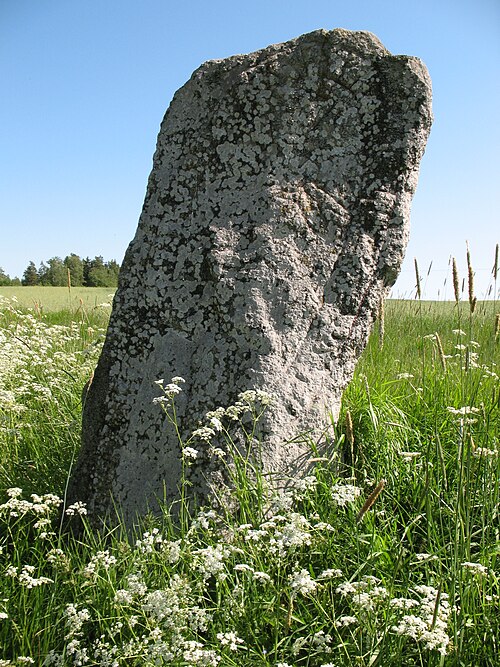
This runestone is found in Innberga and it was raised in memory of a man who died in what is today Russia. It is dated to the first half of the 11th century.[99]
The inscription reads:[100][101][102]
þiuþulfʀ
Þiuðulfʀ,
:
bui
Boi,
:
þaiʀ
þæiʀ
:
raisþu
ræisþu
:
stain
stæin
þansi
þannsi
:
at
at
:
farulf
Farulf,
:
faþur
faður
:
sin
sinn.
:
han
Hann
uas
vas
antaþ
ændaðr
austr
austr
i
i
kaþ(u)(m)
Garðum.
þiuþulfʀ : bui : þaiʀ : raisþu : stain þansi : at : farulf : faþur : sin : han uas antaþ austr i kaþ(u)(m)
Þiuðulfʀ, {} Boi, {} þæiʀ {} ræisþu {} stæin þannsi {} at {} Farulf, {} faður {} sinn. {} Hann vas ændaðr austr i Garðum.
Þjóðulfr (and) Búi, they raised this stone in memory of Farulfr, their father. He met his end in the east in Garðar (Russia).
Sö 171

This runestone is a boulder that was found in Esta, and it was made in memory of the captain of a ship who died in Novgorod.[103] The boulder is badly damaged due to weathering, but thanks to a 17th-century drawing scholars know what it said.[104] Three parts of the stone are located in the Swedish Museum of National Antiquities in Stockholm.
According to Jansson, the runestone testifies to the unrest that could appear in the important marketplace of Novgorod,[67] and it was not only the captain who died, but also the entire crew.[105]Omeljan Pritsak, on the other hand, thinks that the deceased had probably died in the service of the Novgorodian prince in the first half of the 11th century.[106] The second half of the inscription is in the fornyrðislag meter.[107]
The inscription reads:[108][109][110]
(i)nk(i)f(a)[s]tr
Ingifastr
·
l[i](t)
let
(h)(a)ku...
haggv[a]
st(a)...n
stæ[i]n
·
eftiʀ
æftiʀ
·
sihuiþ
Sigvið,
·
faþ-r
fað[u]r
·
si[n
sinn.
·
han
Hann
·
fial
fioll
·
i
i
h]ul(m)[karþi
Holmgarði,
·
skaiþaʀ
skæiðaʀ
·
uisi
visi
mi]þ
með
·
ski...ra
ski[pa]ra.
(i)nk(i)f(a)[s]tr · l[i](t) (h)(a)ku... st(a)...n · eftiʀ · sihuiþ · faþ-r · si[n · han · fial · i h]ul(m)[karþi · skaiþaʀ · uisi mi]þ · ski...ra
Ingifastr {} let haggv[a] stæ[i]n {} æftiʀ {} Sigvið, {} fað[u]r {} sinn. {} Hann {} fioll {} i Holmgarði, {} skæiðaʀ {} visi með {} ski[pa]ra.
Ingifastr had the stone cut in memory of Sigviðr, his father. He fell in Holmgarðr, the ship's leader with the seamen.
Sö 216

This runestone was found as a fragment in Aska, but it has disappeared. What remained said that it was made in memory of a man who died in the East.
The inscription reads:[111][112][113]
[(u)tar
Ottarr
:
auk
ok
:
-...
...
...
...
...þis
[ænda]ðis
:
a^ustr
austr
×
...uk-ma]
...
[(u)tar : auk : -... ... ...þis : a^ustr × ...uk-ma]
Ottarr {} ok {} ... ... [ænda]ðis {} austr {} ...
Óttarr and ... met his end in the east ...
Sö 308

This runestone is a runic inscription by the runemasterÖpir in the style Pr5 on a large boulder. It is located outside the railroad station in Södertälje. It was made in memory of two men who were in the east. The runic text is signed by the runemaster Öpir, and uses a bind rune to combine the a-rune and s-rune in the word hua^str, which is tentatively translated as austr ('east').[114] Öpir used the same a^s bind rune in inscription U 485 in Marma.[115]
The inscription reads:[116][117][118]
hulmfastr
Holmfastr,
'
roþelfr
Roðælfʀ,
'
---u
[let]u
'
[ri]sta
rista
'
run[a]
runaʀ
'
a-
a[t]
...
...
...
...
(i)kifast
Ingifast,
'
suni
syni
:
sina
sina,
[']
-iʀ
[þ]æiʀ
ua(ʀ)u
vaʀu
·
hua^str
austr(?)/vestr.
·
i(n)
En
·
ybir
Øpiʀ
risti
risti.
hulmfastr ' roþelfr ' ---u ' [ri]sta ' run[a] ' a- ... ... (i)kifast ' suni : sina ['] -iʀ ua(ʀ)u · hua^str · i(n) · ybir risti
Holmfastr, {} Roðælfʀ, {} [let]u {} rista {} runaʀ {} a[t] ... ... Ingifast, {} syni {} sina, {} [þ]æiʀ vaʀu {} austr(?)/vestr. {} En {} Øpiʀ risti.
Holmfastr (and) Hróðelfr had the runes carved in memory of ... Ingifastr, their sons. They were in the east(?)/west. And Œpir carved.
Sö 338
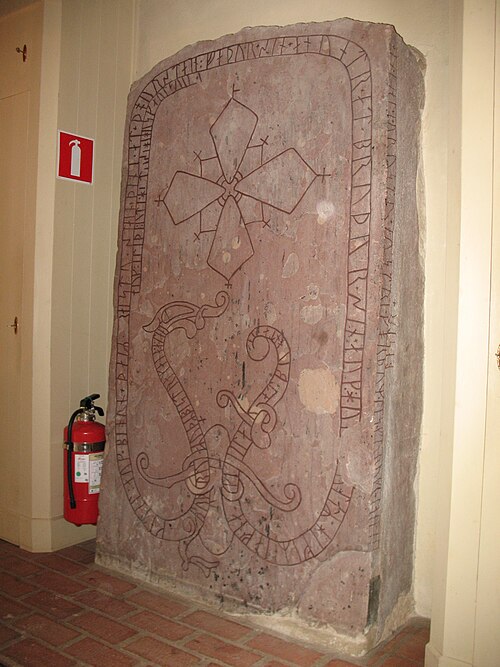
This is a runestone raised in the church of Turinge. It is in sandstone, in the style Pr4 and it was made in memory of the chieftain of a warband. It is the most verbose of all the Varangian stones,[119] and it was probably made in the mid-11th century.[120]
Omeljan Pritsak identifies this Þorsteinn with Þorsteinn of the Veda inscription, who bought an estate for his son with money earned in the lands of Rus'.[121][122][123] He suggests that Þorsteinn was the commander of the retinue of Yaroslav I the Wise[124] and that his son Erinmundr may have died in Garðaríki while serving under his father.[41]
The inscription reads:[125][126][127][128][129][130]
·
ketil
Kætill
:
auk
ok
+
biorn
Biorn
+
þaiʀ
þæiʀ
+
raistu
ræistu
+
stain
stæin
+
þin[a]
þenna
+
at
at
+
þourstain
Þorstæin,
:
faþur
faður
+
sin
sinn,
+
anuntr
Anundr
+
at
at
+
bruþur
broður
+
sin
sinn
+
auk
ok
:
hu[skar]laʀ
huskarlaʀ
+
hifiʀ
æftiʀ(?)
+
iafna
iafna,
+
ketilau
Kætiløy
at
at
+
buanta
boanda
sin
sinn.
·
¶
bruþr
Brøðr
uaʀu
vaʀu
þaʀ
þæiʀ
bistra
bæstra
mana
manna,
:
a
a
:
lanti
landi
auk
ok
:
i
i
liþi
liði
:
uti
uti,
:
h(i)(l)(t)u
heldu
sini
sina
huska(r)la
huskarla
:
ui-
ve[l].
+
· ketil : auk + biorn + þaiʀ + raistu + stain + þin[a] + at + þourstain : faþur + sin + anuntr + at + bruþur + sin + auk : hu[skar]laʀ + hifiʀ + iafna + ketilau at + buanta sin · ¶ bruþr uaʀu þaʀ bistra mana : a : lanti auk : i liþi : uti : h(i)(l)(t)u sini huska(r)la : ui- +
{} Kætill {} ok {} Biorn {} þæiʀ {} ræistu {} stæin {} þenna {} at {} Þorstæin, {} faður {} sinn, {} Anundr {} at {} broður {} sinn {} ok {} huskarlaʀ {} æftiʀ(?) {} iafna, {} Kætiløy at {} boanda sinn. {} {} Brøðr vaʀu þæiʀ bæstra manna, {} a {} landi ok {} i liði {} uti, {} heldu sina huskarla {} ve[l]. {}
Ketill and Bjǫrn, they raised this stone in memory of Þorsteinn, their father; Ǫnundr in memory of his brother and the housecarls in memory of the just(?) (and) Ketiley in memory of her husbandman. These brothers were the best of men in the land and abroad in the retinue, held their housecarls well.
han
Hann
+
fial
fioll
+
i
i
+
urustu
orrustu
+
austr
austr
+
i
i
+
garþum
Garðum,
+
lis
liðs
+
furugi
forungi,
+
lanmana
landmanna
+
bestr
bæstr.
han + fial + i + urustu + austr + i + garþum + lis + furugi + lanmana + bestr
Hann {} fioll {} i {} orrustu {} austr {} i {} Garðum, {} liðs {} forungi, {} landmanna {} bæstr.
He fell in battle in the east in Garðar (Russia), commander of the retinue, the best of landholders.
Västmanland
Vs 1


This runestone was discovered in 1938 in the ruins of the church of Stora Rytterne.[131][132] It forms a monument together with image stone Vs 2, and it was raised in memory of a son who died either in what is today Russia or in Khwarezm in Persia.
Jansson, who was the first scholar to publish an analysis of the inscription, suggested in 1940 that i · karusm was a misspelling for i krþum (i garðum, 'in Gardariki'). However, in 1946, he discovered that it may refer to Khwarezm in Central Asia. He proposed that it may be one of the Ingvar Runestones and that it tells where the Ingvar expedition ultimately ended in 1041. The archaeologist Ture J. Arne criticized this analysis claiming that although a Viking chieftain could arrive to the Caspian Sea in 922, when Vikings met Ibn Fadlan, such a voyage would not have been possible in the 1040s.[133] Arne instead accepted Jansson's first analysis of the inscription.[134]
The Rundata project retains Khwarezm as an equal possibility,[135] and Omeljan Pritsak notes that karusm agrees with *qarus-m which is what the Middle Turkic form of Khwarezm would have been.[136] Moreover, Pritsak notes that Arne was wrong in his claim that it would have been impossible for Ingvar to go to Kwarezm at the time. On the contrary, there were no obstacles for such a voyage during the period 1035–1041.[137][138]
The inscription is somewhat unusual in that the sponsor's name kuþlefʀ, which is the first word in the inscription, is preceded and followed by a cross, perhaps done to draw attention.[139]
The inscription reads:[140][141][142]
+
kuþlefʀ
Guðlæifʀ
+
seti
satti
:
stff
staf
:
auk
ok
:
sena
stæina
:
þasi
þasi
:
uftiʀ
æftiʀ
slakua
Slagva,
:
sun
sun
:
sia
sinn,
:
etaþr
ændaðr
:
austr
austr
·
i
i
·
karusm
Garðum(?)/Chorezm(?).
·
+ kuþlefʀ + seti : stff : auk : sena : þasi : uftiʀ slakua : sun : sia : etaþr : austr · i · karusm ·
{} Guðlæifʀ {} satti {} staf {} ok {} stæina {} þasi {} æftiʀ Slagva, {} sun {} sinn, {} ændaðr {} austr {} i {} Garðum(?)/Chorezm(?). {}
Guðleifr placed the staff and these stones in memory of Slagvi, his son, (who) met his end in the east in Garðar(?)/Chorezm(?).
Vs Fv1988;36

This runestone is carved in runestone style Fp and was raised in memory of Grímmundr who travelled to the east.[143] It was discovered in 1986 at Jädra near Västerås, when stones were removed from a field. It is a lightly reddish stone which is granular and finely textured. The surface of the inscription is even but it is damaged due to flaking, making parts of the inscription difficult to read. It is 2.27 m tall, 0.9 m wide and 0.33 m thick. It is of note that the inscription when discovered still carried traces of its original colouring, which was determined to be of iron oxide but without any noticeable traces of binding material. The nuance appears to have been the same the one used by the Department of Runes when repainting runes in modern days. The stone is of historic note as it mentions the construction of a bridge on the old trail from Badelunda and lake Mälaren to the district of Dalarna.[144]
The Rundata designation for this Västmanland inscription, Vs Fv1988;36, refers to the year and page number of the issue of Fornvännen in which the runestone was first described.
The inscription reads:[145][146][147]
taf
Taf(?)
:
lit
let
:
risa
ræisa
:
estn
stæin
:
þina
þenna
:
hitiʀ
æftiʀ
:
kri(m)ut
Grimmund.
~
uas
Vaʀ
:
farin
farinn,
:
sun
sunn
:
(u)iþfast--
Viðfast[aʀ],
:
aust:arla
austarla.
ulfr
Ulfʀ
:
auk
ok
:
uibiurn
Vibiorn
:
-...
...
kitilas
Kætilas(?)/Kætilhôss(?)
:
krþi
gærðu
:
b-...(u)
b[ryggi]u
·
(o)
a
:
s---
...
taf : lit : risa : estn : þina : hitiʀ : kri(m)ut ~ uas : farin : sun : (u)iþfast-- : aust:arla ulfr : auk : uibiurn : -... kitilas : krþi : b-...(u) · (o) : s---
Taf(?) {} let {} ræisa {} stæin {} þenna {} æftiʀ {} Grimmund. {} Vaʀ {} farinn, {} sunn {} Viðfast[aʀ], {} austarla. Ulfʀ {} ok {} Vibiorn {} ... Kætilas(?)/Kætilhôss(?) {} gærðu {} b[ryggi]u {} a {} ...
Taf(?) had this stone raised in memory of Grímmundr. The son of Viðfastr travelled to the east. Ulfr and Vébjǫrn ... Ketilas(?)/Ketilhǫss(?) made the bridge at ...
Östergötland
Ög 8

The Kälvesten stone in Östergötland is dated to the 9th century.[148] It is the oldest inscription that mentions a Viking chieftain leading an expedition eastwards, and many other chieftains would follow in his wake.[149] Unfortunately, it does not tell the exact destination of the Viking expedition.[150]
In the inscription, the runes aukrimulfʀ are to be read as auk krimulfʀ and the k rune,  , thus represents two letters at the same time.[148] The runes represent the common Norse name Grímulfr, which was in use all over Scandinavia. It is of note that the name appears in such an old runestone as the other runic attestations of the name are considerably younger, and the name was common in medieval Norway. The name of the deceased, Eyvindr, is a common name in Swedish runic inscriptions, but not Eivísl, the name of the chieftain of the expedition. The only other secure attestation appears on the contemporary Sparlösa Runestone in Västergötland. Since the name appears on two runestones from roughly the same time and in two districts that were culturally closely connected, the name may refer to the same person on the two runestones.[151] Unfortunately, the Sparlösa Runestone is damaged in several places and although it mentions a battle and although there are images like birds hovering above the rigging of a ship, scholars cannot be certain that it refers to a chieftain who had fallen in battle. The identification between the name Eivísl on the two runestones will remain a hypothesis.[149]
The inscription reads:[152][153][154][155][156][157]
stikuʀ
Styguʀ/Stygguʀ
(')
karþi
gærði
kubl
kumbl
þ(a)^(u)
þau
aft
aft
auint
Øyvind,
sunu
sunu
sin
sinn.
'
sa
Sa
fial
fioll
austr
austr
stikuʀ (') karþi kubl þ(a)^(u) aft auint sunu sin ' sa fial austr
Styguʀ/Stygguʀ {} gærði kumbl þau aft Øyvind, sunu sinn. {} Sa fioll austr
Stigr/Styggr made this monument in memory of Eyvindr, his son. He fell in the east
miʀ
með
aiuisli
Æivisli.
'
uikikʀ
Vikingʀ
faþi
faði
auk|
ok
|krimulfʀ
Grimulfʀ.
miʀ aiuisli ' uikikʀ faþi auk| |krimulfʀ
með Æivisli. {} Vikingʀ faði ok Grimulfʀ.
with Eivísl. Víkingr coloured and Grímulfr.
Ög 30

This runestone is found at Skjorstad. It is in the style Fp and it was raised in memory of a man named Ingvarr who died in the East.
The inscription reads:[158][159][160]
:
siksten
Sigstæinn
:
let
let
:
rasti
ræisa
:
stain
stæin
:
þe(n)...
þenn[a]
:
eftiʀ
æftiʀ
:
ikuar
Ingvar,
:
sun
sun
:
sin
sinn.
:
han
Hann
:
uarþ
varð
:
austr
austr
:
tauþr
dauðr.
:
: siksten : let : rasti : stain : þe(n)... : eftiʀ : ikuar : sun : sin : han : uarþ : austr : tauþr :
{} Sigstæinn {} let {} ræisa {} stæin {} þenn[a] {} æftiʀ {} Ingvar, {} sun {} sinn. {} Hann {} varð {} austr {} dauðr. {}
Sigsteinn had this stone raised in memory of Ingvarr, his son. He died in the east.
Västergötland
Vg 135

This runestone has disappeared but was found in the village of Hassla. It was in the style RAK and it was raised in memory of a brother who died on the eastern route.
The inscription reads:[161][162][163]
[brantr
Brandr
+
risþi
ræisti
+
stin
stæin
+
þinsi
þennsi
·
eftiʀ
æftiʀ
nosmu
Asmund(?),
×
bruþur
broður
sin
sinn.
·
saʀ
Saʀ
uarþ
varð
þrebin
drepinn
×
o
a
tustitki]
austrvegi(?).
[brantr + risþi + stin + þinsi · eftiʀ nosmu × bruþur sin · saʀ uarþ þrebin × o tustitki]
Brandr {} ræisti {} stæin {} þennsi {} æftiʀ Asmund(?), {} broður sinn. {} Saʀ varð drepinn {} a austrvegi(?).
Brandr raised this stone in memory of Ásmundr(?), his brother; he was killed on the eastern route(?).
Vg 184
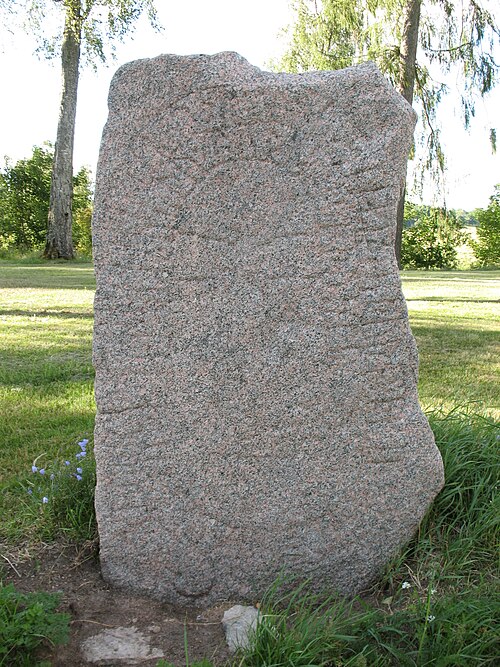
This runestone was raised in the cemetery of the church of Smula, but has been moved to the grounds of Dagsnäs Castle. It is carved in the style Fp and it is raised in memory of a brother who died as a warrior in the east. He may have been a member of the Varangian Guard.[164]
The inscription reads:[165][166][167]
:
kuli
Gulli/Kolli
:
rsþi
ræisti
:
stin
stæin
:
þesi
þennsi
:
eftiʀ
æftiʀ
:
rþr
brøðr
:
kunu
konu
:
sinaʀ
sinnaʀ,
:
esburn
Æsbiorn
:
ok
ok
:
iula
Iula,
:
treka
drængia
:
hrþa
harða
:
kuþa
goða.
:
ian
En
:
þiʀ
þæiʀ
:
urþu
urðu
:
tuþiʀ
dauðiʀ
:
i
i
:
lþi
liði
:
ustr
austr.
:
: kuli : rsþi : stin : þesi : eftiʀ : rþr : kunu : sinaʀ : esburn : ok : iula : treka : hrþa : kuþa : ian : þiʀ : urþu : tuþiʀ : i : lþi : ustr :
{} Gulli/Kolli {} ræisti {} stæin {} þennsi {} æftiʀ {} brøðr {} konu {} sinnaʀ, {} Æsbiorn {} ok {} Iula, {} drængia {} harða {} goða. {} En {} þæiʀ {} urðu {} dauðiʀ {} i {} liði {} austr. {}
Gulli/Kolli raised this stone in memory of his wife's brothers Ásbjǫrn and Juli, very good valiant men. And they died in the east in the retinue.
Vg 197
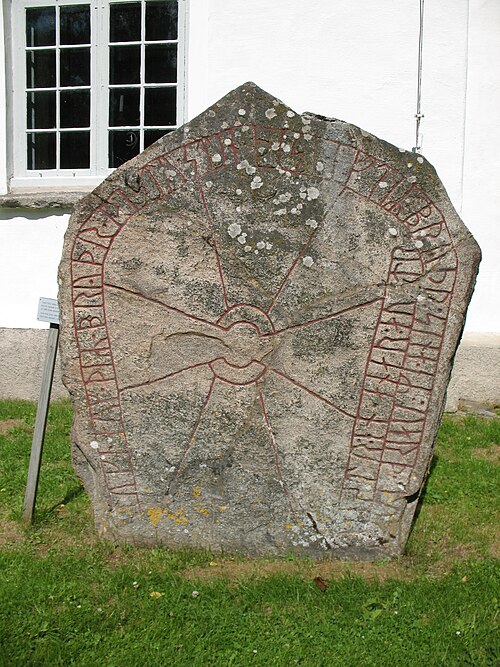
This runestone is raised on the cemetery of the church of Dalum. It was raised in memory of a two brothers, one of whom died in the west while the other one died in the east.
The inscription reads:[168][169][170]
tuki
Toki
·
auk
ok
·
þiʀ
þæiʀ
·
bryþr
brøðr
·
ristu
ræistu
·
stin
stæin
·
þesi
þennsi
·
eftiʀ
æftiʀ
:
bryþr
brøðr
:
sina
sina.
·
eʀ
Eʀ
:
uarþ
varð
·
tu(þ)r
dauðr
uestr
vestr,
:
en
en
·
anar
annarr
:
au(s)tr
austr.
:
tuki · auk · þiʀ · bryþr · ristu · stin · þesi · eftiʀ : bryþr : sina · eʀ : uarþ · tu(þ)r uestr : en · anar : au(s)tr :
Toki {} ok {} þæiʀ {} brøðr {} ræistu {} stæin {} þennsi {} æftiʀ {} brøðr {} sina. {} Eʀ {} varð {} dauðr vestr, {} en {} annarr {} austr. {}
Tóki and his brothers raised this stone in memory of their brothers. One died in the west, another in the east.
Öland
Öl 28 (58)

This runestone is raised on the cemetery of Gårdby and it is raised in memory of a man who either stayed in what is today Russia or in a nearby location. It is dated to the period 1020–1050.[88]
The inscription reads:[171][172][173][171][174][175]
harþruþr
Hærþruðr
+
raisti
ræisti
+
stain
stæin
+
þinsa
þennsa
+
aiftiʀ
æftiʀ
+
sun
sun
+
sin
sinn
+
s(m)iþ
Smið,
+
trak
dræng
+
kuþan
goðan.
+
halfburin
Halfborinn,
+
bruþiʀ
broðiʀ
ans
hans,
+
sitr
sitr
+
kar¶þum
Garðum.
¶
brantr
Brandr
+
rit-
rett
×
iak
hiogg,
þu
þy
raþa
raða
+
khn
kann.
harþruþr + raisti + stain + þinsa + aiftiʀ + sun + sin + s(m)iþ + trak + kuþan + halfburin + bruþiʀ ans + sitr + kar¶þum ¶ brantr + rit- × iak þu raþa + khn
Hærþruðr {} ræisti {} stæin {} þennsa {} æftiʀ {} sun {} sinn {} Smið, {} dræng {} goðan. {} Halfborinn, {} broðiʀ hans, {} sitr {} Garðum. {} Brandr {} rett {} hiogg, þy raða {} kann.
Herþrúðr raised this stone in memory of her son Smiðr, a good valiant man. Halfborinn, his brother, sits in Garðar (Russia). Brandr cut rightly, for whoever can interpret (the runes).
harþruþr
Hærþruðr
+
raisti
ræisti
+
stain
stæin
+
þinsa
þennsa
+
aiftiʀ
æftiʀ
+
sun
sun
+
sin
sinn
+
s(m)iþ
Smið,
+
trak
dræng
+
kuþan
goðan.
+
halfburin
Halfborinn,
+
bruþiʀ
broðiʀ
ans
hans,
+
sitr
sitr
+
kar¶þum
Garðum
¶
brantr
Brandr.
+
rit
Rett
-
[i]
×
iak
hiogg,
þu
þy
raþa
raða
+
khn
kann.
harþruþr + raisti + stain + þinsa + aiftiʀ + sun + sin + s(m)iþ + trak + kuþan + halfburin + bruþiʀ ans + sitr + kar¶þum ¶ brantr + rit - × iak þu raþa + khn
Hærþruðr {} ræisti {} stæin {} þennsa {} æftiʀ {} sun {} sinn {} Smið, {} dræng {} goðan. {} Halfborinn, {} broðiʀ hans, {} sitr {} Garðum {} Brandr. {} Rett [i] {} hiogg, þy raða {} kann.
Herþrúðr raised this stone in memory of her son Smiðr, a good valiant man. His halfbrother Brandr sits in Garðir. Cut rightly into, for whoever can interpret (the runes).
Gotland
There are only about ten runestones on Gotland that commemorate men who died in foreign lands, which appears to challenge the common view that the island was "the international trade center of the Viking Age".[176] Four of these runestones mention East European place names.[176]
G 114

This runestone refers to a man who was in a place called karþum. One view holds that the place name is Garðar, i.e. Garðaríki (the lands of Rus'), and another view is that the name refers to Garda Parish not far from the stone.[177]Omeljan Pritsak holds the first view to be the correct one, since having been to a neighbouring parish hardly merits a mention on a runestone.[177] It is probably from the first half of the 11th century.[88]
The inscription reads:[178][179][180][181][182][183][184][185][186][187][188][189]
:
syniʀ
Syniʀ
:
likna(t)(a)-
Liknhvata[ʀ]
...
...
...(a)rua
[g]ærva
:
merki
mærki
:
kut
gott
:
ebtir
æftiʀ
:
ailikni
Æilikni,
:
kunu
konu
:
koþa
goða,
:
moþur
moður
:
: syniʀ : likna(t)(a)- ... ...(a)rua : merki : kut : ebtir : ailikni : kunu : koþa : moþur :
{} Syniʀ {} Liknhvata[ʀ] ... [g]ærva {} mærki {} gott {} æftiʀ {} Æilikni, {} konu {} goða, {} moður {}
The sons of Líknhvatr ... the good landmark made in memory of Eilíkn, a good wife, mother ...
...(s)
...
:
auk
ok
:
kaiʀuataʀ
Gæiʀhvataʀ
:
auk
ok
:
liknuiaʀ
Liknviaʀ.
:
...(s) : auk : kaiʀuataʀ : auk : liknuiaʀ :
... {} ok {} Gæiʀhvataʀ {} ok {} Liknviaʀ. {}
and Geirhvatr and Líknvé.
:
kuþ
Guð
a-...
o[k](?)
...
...
...(n)
[naði]n(?)
:
heni
hænni
:
auk
ok
:
kieruantum
gærvandum
:
merki
mærki
:
m-...
...
...ua
...
:
aʀ
eʀ
:
men
mænn
:
sin
sen
:
: kuþ a-... ... ...(n) : heni : auk : kieruantum : merki : m-... ...ua : aʀ : men : sin :
{} Guð o[k](?) ... [naði]n(?) {} hænni {} ok {} gærvandum {} mærki {} ... ... {} eʀ {} mænn {} sen {}
God ... be gracious to her and those making the landmark ... who men
...(ʀ)
...
:
i
i
:
karþum
Garðum/Garde,
:
aʀ
eʀ
:
uaʀ
vaʀ
:
ui(u)(e)
Vivi(?)
meʀ
meðr
::
(h)...
...
...(ʀ) : i : karþum : aʀ : uaʀ : ui(u)(e) meʀ :: (h)...
... {} i {} Garðum/Garde, {} eʀ {} vaʀ {} Vivi(?) meðr {} ...
... in Garðir/Garde, he was with Vivi(?) ... ...
G 134
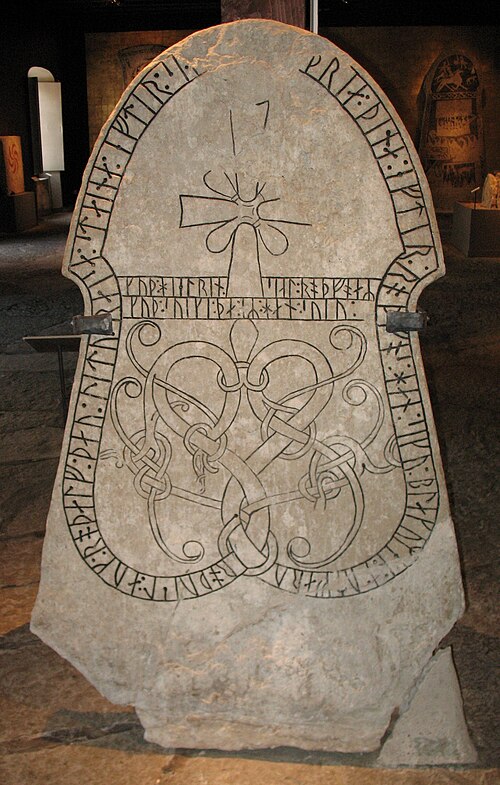
The stones G 134 and G 135 tell about the same family, and there is also an additional runestone about the same people, G 136. These runestones tell of a common situation for Scandinavian families in the 11th century: one son was killed through treason in the South, possibly as a member of the Varangian Guard, and another son died in Vindau (Ventspils, Latvia).[190]
The men who betrayed Hróðfúss were according to the runestone blökumenn ('black men') and most scholars interpret them as Walachians,[191] but others, such as Omeljan Pritsak, argue in favour of a theory that they were Polovtsians.[192] This theory was proposed in 1929 by Akeksej I. Sobolevskij, and he suggested that blökumenn was connected to a Central European name for the Kipchak (Qipčaq) Polovcians (Qūmans), which was Blawen, Blauen and a translation of the Slavic Plavci. All the Old Norse information on the blökumenn date to the period 1016–1017 in the case of Eymundar þáttr and to 1122 concerning the Berroa battle (Saint Olaf's miracles), but the first mention of the Wallachians is in Niketas Choniates' Chronikē diēgesis and it concerns an event in 1164. Moreover, Pritsak notes that ON blakkr also had the meaning 'pale' which designated the first ruling horde of the Kipchaks who were one of the most important nomadic peoples in the 11th and 12th centuries.[191]
The inscription reads:[193][194][195]
roþuisl
Hroðvisl
:
auk
ok
:
roþalf
Hroðælfʀ
:
þau
þaun
:
litu
letu
:
raisa
ræisa
:
staina
stæina
:
eftir
æftiʀ
:
sy-...
sy[ni
...
sina]
þria
þria.
:
þina
Þenna
:
eftir
æftiʀ
:
roþfos
Hroðfoss.
:
han
Hann
:
siku
sviku
:
blakumen
blakumenn
:
i
i
:
utfaru
utfaru.
kuþ
Guð
:
hialbin
hialpin
:
sial
sial
:
roþfoaʀ
Hroðfosaʀ.
kuþ
Guð
:
suiki
sviki
:
þa
þa,
:
aʀ
eʀ
:
han
hann
:
suiu
sviku.
:
roþuisl : auk : roþalf : þau : litu : raisa : staina : eftir : sy-... ... þria : þina : eftir : roþfos : han : siku : blakumen : i : utfaru kuþ : hialbin : sial : roþfoaʀ kuþ : suiki : þa : aʀ : han : suiu :
Hroðvisl {} ok {} Hroðælfʀ {} þaun {} letu {} ræisa {} stæina {} æftiʀ {} sy[ni sina] þria. {} Þenna {} æftiʀ {} Hroðfoss. {} Hann {} sviku {} blakumenn {} i {} utfaru. Guð {} hialpin {} sial {} Hroðfosaʀ. Guð {} sviki {} þa, {} eʀ {} hann {} sviku. {}
Hróðvísl and Hróðelfr, they had the stones raised in memory of (their) three sons. This (one) in memory of Hróðfúss. Wallachians betrayed him on a voyage. May God help Hróðfúss' soul. May God betray those who betrayed him.
G 220
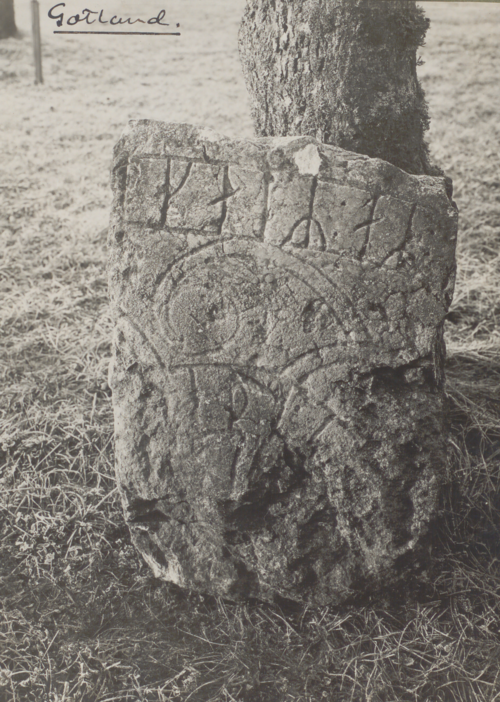
This runestone is found in a museum in Gotland. It is a fragment of a runestone made of limestone and it was made in memory of a man who died in Novgorod. The inscription testifies to the intense contacts that existed between Gotland and Novgorod, where the Gotlanders had a trading station of their own.[196]
The inscription reads:[197][198][199]
...
...
...tkaiʀ
[U]ddgæiʀ/[Bo]tgæiʀ.
:
aʀ
Eʀ
:
to
do
i
i
:
hulmka-...
Holmga[rði]
...iþ(i)
...
:
-...
...
... ...tkaiʀ : aʀ : to i : hulmka-... ...iþ(i) : -...
... [U]ddgæiʀ/[Bo]tgæiʀ. {} Eʀ {} do i {} Holmga[rði] ... {} ...
... Oddgeirr/Bótgeirr. He died in Holmgarðir ...
G 280
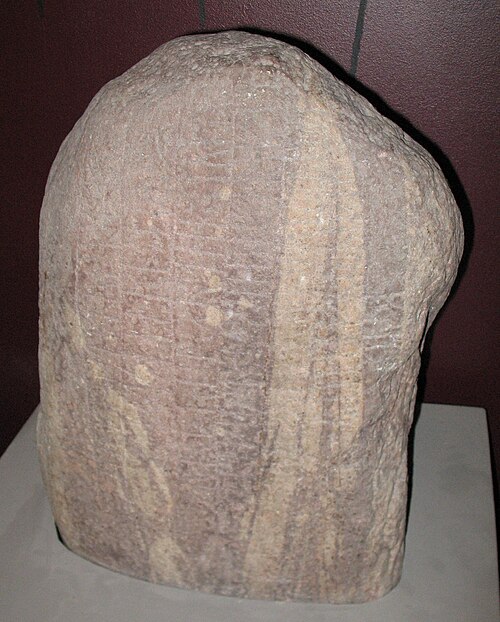
This runestone was found in Pilgårds, but is now located in a museum on Gotland. It was dated to the last half of the 10th century by Wolfgang Krause. The runestone was raised in memory of men led by Vífil who navigated the Dniepr cataracts, and tried to pass the most dangerous of them, the Nenasytec', the άειφόρ of Constantine Porphyrogenitus (Eifor). When they arrived at Rvanyj Kamin' (Rufstain), Rafn was killed and the crew raised stones in his memory south of it.[200]
The inscription reads:[201][202][203]
biarfaa
Biartfann
:
statu
staddu
:
sis[o]
þenna(?)
stain
stæin
¶
hakbiarn
Hægbiorn
:
[ok]
bruþr
brøðr
¶
[hans]
ruþuisl
Roðvisl,
:
austain
Øystæinn,
:
imuar
<-muar>,
¶
is
es
af[a]
hafa
:
st[ai]n[a]
stæina
:
stata
stadda
:
aft
aft
:
raf[a]
Rafn
¶
su[þ]
suðr
furi
fyriʀ
:
ru[f]staini
Rufstæini.
:
kuamu
Kvamu
¶
uit
vitt
i
i
aifur
Æifur.
:
uifil
Vifill
¶
[ba]uþ
bauð
[u^m]
...
biarfaa : statu : sis[o] stain ¶ hakbiarn : bruþr ¶ ruþuisl : austain : imuar ¶ is af[a] : st[ai]n[a] : stata : aft : raf[a] ¶ su[þ] furi : ru[f]staini : kuamu ¶ uit i aifur : uifil ¶ [ba]uþ [u^m]
Biartfann {} staddu {} þenna(?) stæin {} Hægbiorn [ok] brøðr [hans] Roðvisl, {} Øystæinn, {} <-muar>, {} es hafa {} stæina {} stadda {} aft {} Rafn {} suðr fyriʀ {} Rufstæini. {} Kvamu {} vitt i Æifur. {} Vifill {} bauð ...
Hegbjǫrn raised this stone glaring (and his) brothers Hróðvísl, Eysteinn, <-muar>, who have had stones raised in memory of Hrafn south of Rofstein. They came far and wide in Eifor. Vífill bade ...
Denmark
DR 108

This runestone is found in Kolind in Syddjurs Municipality, Denmark. It is in style RAK and it was raised in memory of a brother who died in the east.
The inscription reads:[204][205][206]
tusti
Tosti
⁑
risþi
resþi
⁑
stin
sten
¶
þonsi
þænsi
⁑
ift
æft
⁑
tufa
Tofa,
⁑
is
æs
¶
uarþ
warþ
(:)
tuþr
døþr
:
ustr
østr,
:
burþu¶r
broþur
⁑
sin
sin,
⁑
smiþr
smiþr
⁑
osuiþaʀ
Aswiþaʀ.
tusti ⁑ risþi ⁑ stin ¶ þonsi ⁑ ift ⁑ tufa ⁑ is ¶ uarþ (:) tuþr : ustr : burþu¶r ⁑ sin ⁑ smiþr ⁑ osuiþaʀ
Tosti {} resþi {} sten {} þænsi {} æft {} Tofa, {} æs {} warþ {} døþr {} østr, {} broþur {} sin, {} smiþr {} Aswiþaʀ.
Tosti, Ásviðr's smith, raised this stone in memory of Tófi, his brother, who died in the east.
Norway
N 62
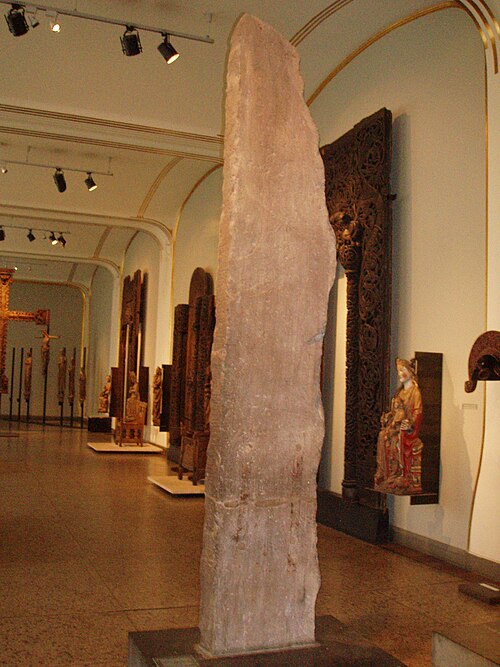
This runic inscription is found on the same stone as N 61,[207] and they tell of the same clan.[208]Bjørn Hougen dated N 61 to 1000-1030[207][209] and Magnus Olsen dated N 62 to the 1060s.[210] It is in short-twig runes.
It relates of a man who died in a location in Eastern Europe, and there has been some scholarly debate on exactly where. Olsen read the location as Vitaholmi, miðli Vitaholms ok Garða ('Vitaholm, between Vitaholm and Garðar'), but in 1933, Lis Jacobsen suggested that the second toponym was ustaulm. In 1961, an archaeological excavation in Vitičev, near Kiev, by B. A. Rybakov and Boris Kleiber, provided a solution. They discovered a beacon which had given fire signals to Kiev, and in Old Norse such a beacon was called a viti. The name Vitičev has no Slavic etymology, and so Kleiber suggested that its original name was Vitičev xolm, i.e. Vitaholmi.[211] The name Vitičev would originally have been Vitiča, a suffixed borrowing of viti.[212] Kleiber analysed the first part of the second Vitaholmi as usta, a genitive of an *usti which would have been how the Norse rendered the Slavic toponym Ustja (Zarub). Ustja was located on a hill near a ford across the Trubež, a tributary of the Dniepr.[213] According to Kleiber, Garða is a shortened form of Kœnugarðar, the Old Norse name for Kiev.[214] This solution reads the location of Þóraldr's death as "in Vitičev between Ustja and Kiev".[215]
According to Judith Jesch, Vitaholm may be related either to Witland, a historical region on the east side of the River Vistula,[216] or to Vindau on the coast of Courland.[217]
Kleiber suggests that Engli was a member of Eymund's warband which fought in the lands of Rus' during the first half of the 11th century.[218]
The inscription reads:[219][220][221]
×
ikli
Engli
×
reisti
reisti
stein
stein
þana
þenna
eftir
eptir
×
þoral(t)...
Þórald,
sun
son
sin
sinn,
is
er
uarþ
varð
tauþr
dauðr
×
i
í
uitahol(m)(i)
Vitaholmi,
miþli
miðli
ustaulms
Ustaholms
auk
ok
karþa
Garða.
×
× ikli × reisti stein þana eftir × þoral(t)... sun sin is uarþ tauþr × i uitahol(m)(i) miþli ustaulms auk karþa ×
{} Engli {} reisti stein þenna eptir {} Þórald, son sinn, er varð dauðr {} í Vitaholmi, miðli Ustaholms ok Garða. {}
Engli raised this stone in memory of Þóraldr, his son, who died in Vitaholmr - between Ustaholmr and Garðar (Russia).
See also
Notes
- ↑Garðar was the original name for the lands of Rus', particularly of Novgorodian Rus', in runic inscriptions, poetry of skalds and sagas.[16][17][18][19] The name was then superseded by Garðaríki,[20] which first appeared in Icelandic sagas in the twelfth century.[21]
Citations
- ↑Jones 1968, p. 267: "This was that Yngvar the Widefarer whose exploits in the east entered Norse legend - and Norse history inasmuch as twenty-five east Swedish memorial stones of the early mid-eleventh century tell of men who took the eastern road to Serkland and fell with Yngvar's host".
- ↑Thunberg 2010, p. 6.
- ↑Thunberg 2011, p. 56.
- 123Jansson 1980, p. 31.
- ↑Runor Sö 338, section Inscription, Runic Swedish: "Brøðr vaʀu þæiʀ bæztra manna, a landi ok i liði uti, heldu sina huskarla ve[l]. Hann fioll i orrustu austr i Garðum, liðs forungi, landmanna bæztr."
- ↑Runor Sö 338, section Inscription, English: "These brothers were the best of men in the land and abroad in the retinue, held their housecarls well. He fell in battle in the east in Garðar (Russia), commander of the retinue, the best of landholders."
- ↑Runor U 153.
- ↑Wessén & Jansson 1943, p. 232: "Stenen anträffades liksom den föregående år 1930 i en källare under östra delen av grunden till den gamla mangårdsbyggnaden i Lissby, som skall ha rivits vid slutet av 1800-talet. [The stone, like the previous one, was found in 1930 in a basement under the eastern part of the foundation of the old manor building in Lissby, which must have been demolished at the end of the 19th century.]"
- ↑Wessén & Jansson 1943, p. 232: "Liksom U 152 och U 154 har även denna runsten varit inbyggd i källarväggen med ristningen synlig. [Like U 152 and U 154, this rune stone has also been built into the basement wall with the carving visible.]"
- ↑Wessén & Jansson 1943, p. 232: "Då källaren rasade samman, krossades stenen i en mängd större och mindre stycken. Fotstycket stod ännu kvar på sin plats; det största stycket var därjämte toppen. [When the basement collapsed, the stone was crushed into a number of larger and smaller pieces. The foot-piece still remained in its place; the largest piece was also the top.]"
- ↑Wessén & Jansson 1943, p. 232: "Ett fragment av stenen hittades i åkern invid Lissby. [A fragment of the stone was found in the field near Lissby.]"
- ↑Wessén & Jansson 1943, p. 232: "Sammanlagt ha icke mindre än o. 70 stycken av stenen hopplockats och sammanfogats. Stenen restes 1931 på gårdsplanen i Hagby. [In total, no less than about 70 pieces of the stone have been collected and joined together. The stone was erected in 1931 in the courtyard in Hagby.]"
- ↑Wessén & Jansson 1943, p. 232: "Granit. Höjd 2,60 m., bredd 1,50 m. [Height 2.60 m., width 1.50 m.]"
- ↑Wessén & Jansson 1943, p. 232: "Ristningen är nedtill svårt skadad, bitar av stenen fattas, och skärvor av ytan ha slagits av. Inskriftens början och slut äro därför fördärvade. [The carving is badly damaged at the bottom, pieces of the stone are missing, and fragments of the surface have been knocked off. The beginning and end of the inscription are therefore defaced.]"
- ↑Wessén & Jansson 1943, p. 233: "I inskriften talas om »stenar». Den andra stenen har sannolikt varit U 155, varav tyvärr endast fragment äro bevarade. [The inscription speaks of »stones». The other stone was probably U 155, of which unfortunately only fragments are preserved.]"
- ↑Gade & Whaley 2009, p. 279: "Garðar or Garðaríki is Novgorod (Hólmgarðr) and its territory in north-west Russia."
- ↑Duczko 2004, p. 60: "These two original centres of Rus were Staraja Ladoga and Rurikovo Gorodishche, two points on the ends of an axis, the Volkhov, a river running for 200 km between two lakes, from the Ilmen in the south to the Ladoga in the north. This was the territory that most probably was originally called by the Norsemen Gardar, a name that long after Viking Age was given much wider content and become Gardariki, a denomination for whole Old Russian State."
- ↑Jackson 2003, p. 37: "In the skaldic poetry of the tenth through the twelfth century, Old Rus is called only by its earliest Old Norse name Garðar. In the runic inscriptions of the eleventh century, the toponym Garðar is used nine times."
- ↑Pritsak 1981, p. 366: "In the older sources, such as the scaldic poetry and the King's sagas, the usual ON name for Rus’ (especially Novgorodian Rus’) was Garðar, the plural form of Garðr."
- ↑Jackson 2003, p. 38: "... in the late tenth century the place-name Garðar was spread in Old Norse, while in the thirteenth century it was practically no longer used having been substituted by Garðaríki."
- ↑Jackson 2003, p. 37: "According to Braun, the name Garðaríki was created by those Icelanders who wrote down sagas from the late twelfth century."
- ↑Wessén & Jansson 1943, p. 233: "Slutet av inskriften kan förmodas ha varit: þaiʀ · antaþus × aust[r × i kriki]um (jfr U 136 och 140) eller möjligen þaiʀ · antaþus × aust[r × i karþ]um (jfr Sö 338 och D 2:116 Veda, Ångarns sn). [The end of the inscription can be assumed to have been: þaiʀ · antaþus × aust[r × i kriki]um (cf. U 136 and 140) or possibly þaiʀ · antaþus × aust[r × i karþ]um (cf. Sö 338 and D 2:116 Veda, Ångarns parish).]"
- ↑Pritsak 1981, p. 368: "There are two equally likely possibilities for the reconstruction of Halfdan's place of death: [i karþ]um, “in Garðar” (Rus’), and [i krik]um “among Greeks,” i.e. in Byzantium."
- ↑Runor U 153, section Inscription, Rune reading: "…[(u)](a)i- × [(a)]uk × ulf- litu × raisa × stai-(a) × e(f)tiʀ × hlftan · auk · eftiʀ × kunar × bryþr × sina × þaiʀ · antaþus × aust… …(u)m"
- ↑Runor U 153, section Inscription, Runic Swedish: "[S]væi[nn] ok Ulf[ʀ] letu ræisa stæi[n]a æftiʀ Halfdan ok æftiʀ Gunnar, brøðr sina. Þæiʀ ændaðus aust[r] …"
- ↑Runor U 153, section Inscription, English: "Sveinn and Ulfr had the stones raised in memory of Halfdan and in memory of Gunnarr, their brothers. They met their end in the east..."
- ↑Runor U 154.
- ↑Wessén & Jansson 1943, p. 233: "Liksom U 151 och U 153 anträffades denna runsten år 1930 i en hoprasad källare under östra delen av grunden till den gamla mangårdsbyggnaden i Lissby. [Like U 151 and U 153, this rune stone was found in 1930 in a collapsed basement under the eastern part of the foundation of the old manor building in Lissby.]"
- ↑Wessén & Jansson 1943, p. 233: "Denna runsten stod vid anträffandet ännu upprätt i den forna källarväggen, men var krossad och föll, då den togs fram, sönder i o. 50 större och mindre delar, som sedan måste sammanfogas. [This rune stone still stood upright when found in the former cellar wall, but was crushed and fell when it was taken out, broken into about 50 larger and smaller parts, which then had to be joined together.]"
- ↑Wessén & Jansson 1943, p. 233: "Upptill på v. sidan saknades ett större stycke med inskrift, som icke har kunnat återfinnas. [At the top, on the left side, a larger piece with an inscription was missing, which could not be found.]"
- ↑Wessén & Jansson 1943, p. 233: "Stenen lagades och restes 1931 i parken till Hagby, o. 40 m. bakom flygelbyggnaden. [In 1931, the stone was prepared and placed in the courtyard in Hagby, approx. 40 m. behind the wing building.]"
- ↑Wessén & Jansson 1943, p. 233: "Mörk stenart. Höjd 1,23 m., bredd 0,80 m. [Dark rock. Height 1.23 m, width 0.80 m]"
- ↑Wessén & Jansson 1943, p. 233: "Ristningsytan är på flera ställen svårt skadad. [The carving surface is badly damaged in several places.]"
- ↑Runor U 154, section Inscription, Rune reading: "[þ(o)]…r × lit × rai… … …fast · auk × at × (k)aiʀbiarn × bruþ- … …i(ʀ) · (t)o a(u)s… ×"
- ↑Runor U 154, section Inscription, Runic Swedish: "… let ræi[sa] … …fast ok at Gæiʀbiorn, brøð[r] … [þæ]iʀ dou aus[tr]."
- ↑Runor U 154, section Inscription, English: "… had raised … …-fastr and in memory of Geirbjǫrn, (their) brothers … They died in the east."
- ↑Pritsak 1981, p. 367: "... (Sö 338 and U 209) from the middle of the 11th century..."
- ↑Pritsak 1981, p. 396: "Þōrstæinn, then, was a commander (forungi) of a retinue (lið) in Rus’ (i garþum)"
- ↑Pritsak 1981, p. 367: "Two stones with the name Garðar (Sö 338 and U 209) from the middle of the 11th century refer to the activity of a retinue commander Þōrstæinn, active in Rus’"
- ↑Pritsak 1981, p. 396: "Þōrstæinn must have spent a long time in Rus’ since he managed to accumulate a sizable fortune there (as witnessed by his huge monument, Sö 338)"
- 12Pritsak 1981, p. 396: "It is regrettable that we do not know how the son died; it is possible that he had been in Rus' together with his father."
- ↑Harrison & Svensson 2007, p. 35.
- ↑Runor U 209, section Inscription, Rune reading: "þurtsain × kiarþi| |if×tiʀ irinmunt × sun sin auk| |kaubti þinsa bu × auk × aflaþi × austr i karþum"
- ↑Runor U 209, section Inscription, Runic Swedish: "Þorstæinn gærði æftiʀ Ærinmund, sun sinn, ok køypti þennsa by ok aflaði austr i Garðum."
- ↑Runor U 209, Inscription, English: "Þorsteinn made (the stone) in memory of Erinmundr, his son, and bought this estate and earned (wealth) in the east in Garðar (Russia)."
- ↑Runor U 283, section Inscription, Rune reading: "[× sibi × auk × irmuntr × auk × þoriʀ × litu × raisa × stain × iftiʀ × s(u)… … …-- (h)(a)n · to × austr × sun × kismuntaʀ]"
- ↑Runor U 283, section Inscription, Runic Swedish: "Sibbi ok Ærnmundr ok Þoriʀ letu ræisa stæin æftiʀ … … … Hann do austr, sunn Gismundaʀ."
- ↑Runor U 283, section Inscription, English: "Sibbi and Ernmundr and Þórir had the stone raised in memory of … He, Gísmundr's son, died in the east."
- ↑Runor U 366, section Inscription, Rune reading: "[… uaʀ · tauþr × i austr·uih- …]"
- ↑Runor U 366, section Inscription, Runic Swedish: "… vaʀ dauðr i austrveg[i] …"
- ↑Runor U 366, section Inscription, English: "… died on the eastern route …"
- ↑Runor U 504, section Inscription, Rune reading: "+ kitil×fastr × risti × stin + þina × iftiʀ × askut × faþur + sin × saʀ × uas × uistr × uk × ustr + kuþ ialbi × as × salu"
- ↑Runor U 504, section Inscription, Runic Swedish: "Kætilfastr ræisti stæin þenna æftiʀ Asgaut, faður sinn. Saʀ vas vestr ok austr. Guð hialpi hans salu."
- ↑Runor U 504, section Inscription, English: "Ketilfastr raised this stone in memory of Ásgautr, his father. He was in the west and in the east. May God help his soul."
- ↑Runor U 636.
- ↑Pritsak 1981, p. 366: "In the Swedish inscriptions Garðar “Rus’” always appears in the plural dative form (karþum), usually preceded by the preposition i, “in” and by the word explaining the direction: austr, east"
- ↑Jackson 2003, p. 38: "...Garðr (singular) and Garðar (plural), the first being a shortening from Miklagarðr ‘Constantinople’, the second serving as a designation of Rus."
- ↑Pritsak 1981, p. 371: "Only one Swedish inscription (from about 1020-1060) has the singular form Garðr (U 636) which probably was used for Kiev"
- ↑Runor U 636, section Inscription, Rune reading: "alui · lit · risa · stn · þtin · at · arfast · sun sin · hn · fur · ausʀ · i karþa"
- ↑Runor U 636, section Inscription, Runic Swedish: "Alvi let ræisa stæin þenna at Arnfast, sun sinn. Hann for austr i Garða."
- ↑Runor U 636, section Inscription, English: "Ǫlvé had this stone raised in memory of Arnfastr, his son. He travelled to the east to Garðar (Russia)."
- ↑Pritsak 1981, p. 370: "The place of Spjallbuðis’ death, specified in the inscription as i olafs kriki has been the subject of scholarly speculation"
- ↑Pritsak 1981, p. 370: "Richard Dybeck (1857) explained kriki as Grikk- “Greece,” while Sophus Bugge (1891) read the word as grið, “retinue,”"
- ↑Pritsak 1981, p. 370: "... Adolf Noreen (1904) connected it with ON krikr “hook,” “bend,” “corner,”"
- ↑Pritsak 1981, p. 370: "Otto von Friesen first propounded the reading i olafs kirki, “in [St.] Ólafr's church,” in 1907, and this has since been accepted."
- ↑Pritsak 1981, p. 371.
- 12Jansson 1980, p. 23.
- ↑Runor U 687, section Inscription, Rune reading: "runa ' lit kiara ' mirki at ' sbialbuþa ' uk ' at ' suain ' uk ' at · antuit ' uk at ' raknaʀ ' suni ' sin ' uk ' ekla ' uk ' siri(þ) ' at ' sbialbuþa ' bonta sin an uaʀ ' tauþr ' i hulmkarþi ' i olafs · kriki ' ubiʀ · risti ' ru"
- ↑Runor U 687, section Inscription, Runic Swedish: "Runa let gæra mærki at Spiallbuða ok at Svæin ok at Andvett ok at Ragnar, syni sina ok Hælga/Ægla/Ængla, ok Sigrið at Spiallbuða, bonda sinn. Hann vaʀ dauðr i Holmgarði i Olafs kirkiu. Øpiʀ risti runaʀ."
- ↑Runor U 687, section Inscription, English: "Rúna had the landmark made in memory of Spjallboði and in memory of Sveinn and in memory of Andvéttr and in memory of Ragnarr, sons of her and Helgi/Egli/Engli; and Sigríðr in memory of Spjallboði, her husbandman. He died in Holmgarðr in Ólafr's church. Œpir carved the runes."
- ↑Runor U 898, section Inscription, Rune reading: "ali ' uk ' iufurfast · litu ' gera ' merki ' iftiʀ iarl faþur sin ' uk ' at ' kisl ' uk ' at ' ikimunt han ' uaʀ ' trebin ' hustr ' sun ' iarls ybiʀ risti"
- ↑Runor U 898, section Inscription, Runic Swedish: "Ali/Alli ok Iofurfast letu gæra mærki æftiʀ Iarl, faður sinn, ok at Gisl ok at Ingimund. Hann vaʀ drepinn austr, sunn Iarls. Øpiʀ risti."
- ↑Runor U 898, section Inscription, English: "Áli/Alli and Jǫfurfast had the landmark made in memory of Jarl, their father, and in memory of Gísl and in memory of Ingimundr. He, Jarl's son, was killed in the east. Œpir carved."
- ↑Pritsak 1981, p. 358: "... “he met his end in the east during the thing” (or: “in the retinue,” Sö 33). Unfortunately we do not know in which “east” the given thing (þing assembly)(cf. OR сънемъ) took place or what its character was."
- ↑Runor Sö 33, section Inscription, Rune reading: "+ gnubha ~ liþ : raisa : stain : þinsa : hibtiʀ : kulaif : bruþur sin han : antaþis : austr : at þikum"
- ↑Runor Sö 33, section Inscription, Runic Swedish: "Gnupa let ræisa stæin þennsa æftiʀ Guðlæif, broður sinn. Hann ændaðis austr at þingum."
- ↑Runor Sö 33, section Inscription, English: "Gnúpa had this stone raised in memory of Gulleifr, his brother. He met his end in the east at the Assembly."
- ↑Runor Sö 34, section Inscription, Rune reading: "styrlaugʀ · auk · hulmbʀ · staina · raistu · at · bryþr · sina · brau(t)u · nesta · þaiʀ · entaþus · i · austruiki · þurkil · auk sturbiarn þiaknaʀ · kuþiʀ"
- ↑Runor Sö 34, section Inscription, Runic Swedish: "Styrlaugʀ ok Holmbʀ stæina ræistu at brøðr sina, brautu næsta. Þæiʀ ændaðus i austrvegi, Þorkell ok Styrbiorn, þiagnaʀ goðiʀ."
- ↑Runor Sö 34, section Inscription, English: "Styrlaugr and Holmr raised the stones next to the path in memory of their brothers. They met their end on the eastern route, Þorkell and Styrbjǫrn, good Þegns."
- ↑Runor Sö 92, section Inscription, Rune reading: "… · lit · raisa · st… … rysu · br(o)… · sin · ha… … austr · bali · …"
- ↑Runor Sö 92, section Inscription, Runic Swedish: "… let ræisa st[æin] … Rysiu(?), bro[ður] sinn. Ha[nn] … austr. Balli …"
- ↑Runor Sö 92, section Inscription, English: "… had the stone raised … Rysja(?), his brother. He … east. Balli …"
- ↑Runor Sö 121, section Inscription, Rune reading: "[sumuʀ : hauka : stan : sum iʀ : tuþ : austʀ · i : tuna : as(u)]"
- ↑Runor Sö 121, section Inscription, Runic Swedish: "<sumuʀ> haggva stæin, sum eʀ dauð austr i <tuna> <asu>."
- ↑Runor Sö 121, section Inscription, English: "<sumuʀ> cut the stone, who died in the east in <tuna> …"
- ↑Pritsak 1981, p. 366: "This inscription preserves an interesting term for the designation of the commander of the retinue (guard = pъlkъ): folks grimmR “prince of the people” (“people” meaning company or retinue)."
- 123Pritsak 1981, p. 366.
- ↑Runor Sö 126, section Inscription, Rune reading: "hu(l)(m)(f)riþ · ilin--r · [þ]aʀ · litu · hakua · stain · eftiʀ eskil · faþur · sin · han · trauh · orustu · i · austru[i]hi aþaa · fulks·krimʀ · fala · orþi"
- ↑Runor Sö 126, section Inscription, Runic Swedish: "Holmfriðr, <ilin--r>, þaʀ letu haggva stæin æftiʀ Æskel, faður sinn. Hann draug orrustu i austrvegi, aðan folksgrimʀ falla orði."
- ↑Runor Sö 126, section Inscription, English: "Holmfríðr (and) <ilin--r>, they had the stone cut in memory of Áskell, their father. He engaged in battle on the eastern route, before the people's commander wrought his fall."
- ↑Pritsak 1981, p. 367: "The entire inscription from Hagstuga (Sö 130) is composed in fornyrðislag meter and is in honor of a drængR active in Rus’ in the first half of the eleventh century".
- ↑Runor Sö 130, section Inscription, Rune reading: "§A fiuriʀ : kirþu : at : faþur : kuþan : tyrþ : trikela : at : tumara : miltan : urþa uk : mataʀ kuþan : þat · (u)-(h)---(u)--(u)(k)(þ)"
- ↑Runor Sö 130, section Inscription, Runic Swedish: "§A Fiuriʀ gærðu at faður goðan dyrð drængila at Domara/domara, mildan orða ok mataʀ goðan, þat …"
- ↑Runor Sö 130, section Inscription, English: "§A Four (sons) made the magnificence in memory of (their) good father, valiantly in memory of Dómari/the judge, gentle in speech and free with food … "
- '''"_97-0" rel="mw:referencedBy" id="mwCLM">↑Runor Sö 130, section Inscription, Rune reading: "§B h^a l^f kirþu <o>"
- ↑Runor Sö 130, section Inscription, Runic Swedish: "§B Hann(?) fiall(?) [i(?)] Garðum(?) …"
- ↑Runor Sö 130, section Inscription, English: "§B He(?) fell(?) in(?) Garðar(?) (Russia) …
- ↑Pritsak 1981, p. 366: "The stones Sö 148 and G 114 are also old (surely before 1050)"
- ↑Runor Sö 148, section Inscription, Rune reading: "þiuþulfʀ : bui : þaiʀ : raisþu : stain þansi : at : farulf : faþur : sin : han uas antaþ austr i kaþ(u)(m)"
- ↑Runor Sö 148, section Inscription, Runic Swedish: "Þiuðulfʀ, Boi, þæiʀ ræisþu stæin þannsi at Farulf, faður sinn. Hann vas ændaðr austr i Garðum."
- ↑Runor Sö 148, section Inscription, English: "Þjóðulfr (and) Búi, they raised this stone in memory of Farulfr, their father. He met his end in the east in Garðar (Russia)."
- ↑Jones 1968, p. 267: "A stone from Estaberg, Södermanland, records of Sigvid: ‘He fell in Holmgard (Novgorod), the ship’s captain with his crew’;"
- ↑Jansson 1987, p. 47.
- ↑Jansson 1980, p. 28.
- ↑Pritsak 1981, p. 369: "The Södermanlander Sigviðr from Esta, captain of a skæið, “longship,” probably died in the service of the Novgorodian prince (before 1050)."
- ↑Pritsak 1981, p. 369: "The following is in fornyrðislag meter: He fell in Hōlmgarðr (Novgorod), the ship's captain with [his] crew."
- ↑Runor Sö 171, section Inscription, Rune reading: "(i)nk(i)f(a)[s]tr · l[i](t) (h)(a)ku… st(a)…n · eftiʀ · sihuiþ · faþ-r · si[n · han · fial · i h]ul(m)[karþi · skaiþaʀ · uisi mi]þ · ski…ra"
- ↑Runor Sö 171, section Inscription, Runic Swedish: "Ingifastr let haggv[a] stæ[i]n æftiʀ Sigvið, fað[u]r sinn. Hann fioll i Holmgarði, skæiðaʀ visi með ski[pa]ra."
- ↑Runor Sö 171, section Inscription, English: "Ingifastr had the stone cut in memory of Sigviðr, his father. He fell in Holmgarðr, the ship's leader with the seamen."
- ↑Runor Sö 216, section Inscription, Rune reading: "[(u)tar : auk : -… … …þis : a^ustr × …uk-ma]"
- ↑Runor Sö 216, section Inscription, Runic Swedish: "Ottarr ok … … [ænda]ðis austr …"
- ↑Runor Sö 216, section Inscription, English: "Óttarr and … met his end in the east …"
- ↑MacLeod 2002, p. 135.
- ↑MacLeod 2002, p. 135: "Of the 46 inscriptions signed by Uppland's most prolific rune-carver, Œpir, only three evidence binds. Interestingly enough, the same bind-rune of a^s is found twice in his work (U 485: ‘inkifa^st’; Sö 338: ‘hua^str’)..."
- ↑Runor Sö 308, section Inscription, Rune reading: "hulmfastr ' roþelfr ' ---u ' [ri]sta ' run[a] ' a- … … (i)kifast ' suni : sina ['] -iʀ ua(ʀ)u · hua^str · i(n) · ybir risti"
- ↑Runor Sö 308, section Inscription, Runic Swedish: "Holmfastr, Roðælfʀ, [let]u rista runaʀ a[t] … … Ingifast, syni sina, [þ]æiʀ vaʀu austr(?)/vestr. En Øpiʀ risti."
- ↑Runor Sö 308, section Inscription, English: "Holmfastr (and) Hróðelfr had the runes carved in memory of … Ingifastr, their sons. They were in the east(?)/west. And Œpir carved."
- ↑Jones 1968, p. 267: "The memorial can be full and verse-adorned, like this to Thorstein at Turinge, Södermanland..."
- ↑Pritsak 1981, p. 367: "Two stones with the name Garðar (Sö 338 and U 209) from the middle of the 11th century..."
- ↑Pritsak 1981, p. 367: "The same Þōrstæinn bought an estate in Uppland for fis son Ærinmundr. Ærinmundr died and his father erected a memorial for him in Veda"
- ↑Pritsak 1981, p. 396: "Þōrstæinn must have spent a long time in Rus’ since he managed to accumulate a sizable fortune there (as witnessed by his huge monument, Sö 338)."
- ↑Pritsak 1981, p. 396: "He must also have been the one who bought the estate of Veda in Uppland (Angarns sn, Vallentuna hd) that he later gave to his son."
- ↑Pritsak 1981, p. 396: "Certain characteristics of the Old Swedish language (e.g. biorn) used in this inscription assign it to sometime around the middle of the eleventh century, probably just after 1050 (cf. R 79). Þōrstæinn must therefore have been the commander of Jaroslav's retinue and died in the early fifties of the eleventh century."
- ↑Runor Sö 338, section Inscription, Rune reading: "§A · ketil : auk + biorn + þaiʀ + raistu + stain + þin[a] + at + þourstain : faþur + sin + anuntr + at + bruþur + sin + auk : hu[skar]laʀ + hifiʀ + iafna + ketilau at + buanta sin · ¶ bruþr uaʀu þaʀ bistra mana : a : lanti auk : i liþi : uti : h(i)(l)(t)u sini huska(r)la : ui- + "
- ↑Runor Sö 338, section Inscription, Runic Swedish: "§A Kætill ok Biorn þæiʀ ræistu stæin þenna at Þorstæin, faður sinn, Anundr at broður sinn ok huskarlaʀ æftiʀ(?) iafna, Kætiløy at boanda sinn. Brøðr vaʀu þæiʀ bæztra manna, a landi ok i liði uti, heldu sina huskarla ve[l]."
- ↑Runor Sö 338, section Inscription, English: "§A Ketill and Bjǫrn, they raised this stone in memory of Þorsteinn, their father; Ǫnundr in memory of his brother and the housecarls in memory of the just(?) (and) Ketiley in memory of her husbandman. These brothers were the best of men in the land and abroad in the retinue, held their housecarls well."
- ↑Runor Sö 338, section Inscription, Rune reading: "§B han + fial + i + urustu + austr + i + garþum + lis + furugi + lanmana + bestr"
- ↑Runor Sö 338, section Inscription, Runic Swedish: "§B Hann fioll i orrustu austr i Garðum, liðs forungi, landmanna bæztr."
- ↑Runor Sö 338, section Inscription, English: "§B He fell in battle in the east in Garðar (Russia), commander of the retinue, the best of landholders."
- ↑Pritsak 1981, p. 443: "In one of the eleventh-century stones discovered in 1938 in the church ruins at Stora Rytten (Västmanland) (but which does not mention Ingvarr), the word karusm appears, a term hitherto unknown in the runic inscriptions (Vs 1-2)..."
- ↑Jansson 1964, p. 6: "Stenarna kommo i dagen sommaren 1938 i samband med att Stora Rytterns kyrkoruin restaurerades. Vs 1 upptäcktes den 22 juni och Vs 2 ett par veckor senare. [The stones came to light in the summer of 1938 in connection with the restoration of Stora Ryttern's church ruins. Vs 1 was discovered on June 22 and Vs 2 a couple of weeks later.]"
- ↑Pritsak 1981, p. 443: "This theory was criticized by the eminent Swedish archaeologist Ture J. Arne, who declared that a Viking cheftain would have been incapable making the journey to Khwārizm, south of the estuary of the Amu Darya at the Aral Sea as late as about 1040. Such an enterprise would have been possible only during the time of Ibn Fadlān’s expedition of 922."
- ↑Pritsak 1981, p. 443.
- ↑Runor Vs 1.
- ↑Pritsak 1981, pp. 443–445.
- ↑Pritsak 1981, p. 450.
- ↑Pritsak 1981, p. 451: "Contrary to a statement by T. J. Arne, it was only during the years 1035-1041 that a Varangian could have sailed to Khwārizm."
- ↑Meijer 2007, p. 86: "A special case is Stora Ryttern (Vs 1), where the sponsor's name is preceded and followed by a cross: + kuþlefʀ + . As is to be expected, this name is the first word of the inscription. It is tempting to think that this sponsor proudly drew attention to himself in this way."
- ↑Runor Vs 1, section Inscription, Rune reading: "+ kuþlefʀ + seti : stff : auk : sena : þasi : uftiʀ slakua : sun : sia : etaþr : austr · i · karusm ·"
- ↑Runor Vs 1, section Inscription, Runic Swedish: "Guðlæifʀ satti staf ok stæina þasi æftiʀ Slagva, sun sinn, ændaðr austr i Garðum(?)/Chorezm(?)."
- ↑Runor Vs 1, section Inscription, English: "Guðleifr placed the staff and these stones in memory of Slagvi, his son, (who) met his end in the east in Garðar(?)/Chorezm(?)."
- ↑Runor Vs Fv1988;36.
- ↑Strid 1988, pp. 35–38.
- ↑Runor Vs Fv1988;36, section Inscription, Rune reading: "taf : lit : risa : estn : þina : hitiʀ : kri(m)ut ~ uas : farin : sun : (u)iþfast-- : aust:arla ulfr : auk : uibiurn : -… kitilas : krþi : b-…(u) · (o) : s---"
- ↑Runor Vs Fv1988;36, section Inscription, Runic Swedish: "Taf(?) let ræisa stæin þenna æftiʀ Grimmund. Vaʀ farinn, sunn Viðfast[aʀ], austarla. Ulfʀ ok Vibiorn … Kætilas(?)/Kætilhǫss(?) gærðu b[ryggi]u a …"
- ↑Runor Vs Fv1988;36, section Inscription, English: "Taf(?) had this stone raised in memory of Grímmundr. The son of Viðfastr travelled to the east. Ulfr and Vébjǫrn … Ketilas(?)/Ketilhǫss(?) made the bridge at …"
- 12Jansson 1987, p. 39.
- 12Jansson 1987, p. 41.
- ↑Jansson 1987, p. 42.
- ↑Jansson 1987, p. 40.
- ↑Runor Ög 8, section Inscription, Rune reading: "§A stikuʀ (') karþi kubl þ(a)^(u) aft auint sunu sin ' sa fial austr"
- ↑Runor Ög 8, section Inscription, Runic Swedish: "§A Stiguʀ/Stygguʀ gærði kumbl þau aft Øyvind, sunu sinn. Sa fioll austr"
- ↑Runor Ög 8, section Inscription, English: "§A Stigr/Styggr made these monuments in memory of Eyvindr, his son. He fell in the east"
- ↑Runor Ög 8, section Inscription, Runic Swedish: "§B með Æivisli. Vikingʀ faði ok Grimulfʀ."
- ↑Runor Ög 8, section Inscription, Rune reading: "§B miʀ aiuisli ' uikikʀ faþi auk| |krimulfʀ"
- ↑Runor Ög 8, section Inscription, English: "§B with Eivísl. Víkingr coloured and Grímulfr."
- ↑Runor Ög 30, section Inscription, Rune reading: ": siksten : let : rasti : stain : þe(n)… : eftiʀ : ikuar : sun : sin : han : uarþ : austr : tauþr :"
- ↑Runor Ög 30, section Inscription, Runic Swedish: "Sigstæinn let ræisa stæin þenn[a] æftiʀ Ingvar, sun sinn. Hann varð austr dauðr."
- ↑Runor Ög 30, section Inscription, English: "Sigsteinn had this stone raised in memory of Ingvarr, his son. He died in the east."
- ↑Runor Vg 135, section Inscription, Rune reading: "[brantr + risþi + stin + þinsi · eftiʀ nosmu × bruþur sin · saʀ uarþ þrebin × o tustitki]"
- ↑Runor Vg 135, section Inscription, Runic Swedish: "Brandr ræisti stæin þennsi æftiʀ Asmund(?), broður sinn. Saʀ varð drepinn a austrvegi(?)."
- ↑Runor Vg 135, section Inscription, English: "Brandr raised this stone in memory of Ásmundr(?), his brother; he was killed on the eastern route(?)."
- ↑Pritsak 1981, p. 353.
- ↑Runor Vg 184, section Inscription, Rune reading: ": kuli : rsþi : stin : þesi : eftiʀ : rþr : kunu : sinaʀ : esburn : ok : iula : treka : hrþa : kuþa : ian : þiʀ : urþu : tuþiʀ : i : lþi : ustr :"
- ↑Runor Vg 184, section Inscription, Runic Swedish: "Gulli/Kolli ræisti stæin þennsi æftiʀ brøðr konu sinnaʀ, Æsbiorn ok Iula, drængia harða goða. En þæiʀ urðu dauðiʀ i liði austr."
- ↑Runor Vg 184, section Inscription, English: "Gulli/Kolli raised this stone in memory of his wife's brothers Ásbjǫrn and Juli, very good valiant men. And they died in the east in the retinue."
- ↑Runor Vg 197, section Inscription, Rune reading: "tuki · auk · þiʀ · bryþr · ristu · stin · þesi · eftiʀ : bryþr : sina · eʀ : uarþ · tu(þ)r uestr : en · anar : au(s)tr :"
- ↑Runor Vg 197, section Inscription, Runic Swedish: "Toki ok þæiʀ brøðr ræistu stæin þennsi æftiʀ brøðr sina. Eʀ varð dauðr vestr, en annarr austr."
- ↑Runor Vg 197, section Inscription, English: "Tóki and his brothers raised this stone in memory of their brothers. One died in the west, another in the east."
- 12Runor Öl 28, section Inscription, Rune reading: "harþruþr + raisti + stain + þinsa + aiftiʀ + sun + sin + s(m)iþ + trak + kuþan + halfburin + bruþiʀ ans + sitr + kar¶þum ¶ brantr + rit - × iak þu raþa + khn"
- ↑Runor Öl 28, section Inscription, Runic Swedish: "Hærþruðr ræisti stæin þennsa æftiʀ sun sinn Smið, dræng goðan. Halfborinn, broðiʀ hans, sitr Garðum. Brandr rett [i] hiogg, þy raða kann."
- ↑Runor Öl 28, section Inscription, English: "Herþrúðr raised this stone in memory of her son Smiðr, a good valiant man. Halfborinn, his brother, sits in Garðar (Russia). Brandr cut rightly, therefore (one) can interpret (the runes)."
- ↑Runor Öl 28, section Inscription, Runic Swedish: "Hærþruðr ræisti stæin þennsa æftiʀ sun sinn Smið, dræng goðan. Halfborinn broðiʀ hans, sitr Garðum Brandr. Rett [i] hiogg, þy raða kann."
- ↑Runor Öl 28, section Inscription, English: "Herþrúðr raised this stone in memory of her son Smiðr, a good valiant man. His halfbrother Brandr sits in Garðir. Cut rightly into, therefore (one) can interpret (the runes)."
- 12Pritsak 1981, p. 344.
- 12Pritsak 1981, p. 346.
- ↑Runor G 114, section Inscription, Rune reading: "§A : syniʀ : likna(t)(a)- … …(a)rua : merki : kut : ebtir : ailikni : kunu : koþa : moþur :"
- ↑Runor G 114, section Inscription, Runic Swedish: "§A Syniʀ Liknhvata[ʀ] … [g]ærva mærki gott æftiʀ Æilikni, konu goða, moður"
- ↑Runor G 114, section Inscription, English: "§A The sons of Líknhvatr … the good landmark made in memory of Eilíkn, a good wife, mother …"
- ↑Runor G 114, section Inscription, Rune reading: "§B …(s) : auk : kaiʀuataʀ : auk : liknuiaʀ :"
- ↑Runor G 114, section Inscription, Runic Swedish: "§B … ok Gæiʀhvataʀ ok Liknviaʀ."
- ↑Runor G 114, section Inscription, English: "§B and Geirhvatr and Líknvé."
- ↑Runor G 114, section Inscription, Rune reading: "§C : kuþ a-… … …(n) : heni : auk : kieruantum : merki : m-… …ua : aʀ : men : sin :"
- ↑Runor G 114, section Inscription, Runic Swedish: "§C Guð o[k](?) … [naði]n(?) hænni ok gærvandum mærki … … eʀ mænn sen"
- ↑Runor G 114, section Inscription, English: "§C God … be gracious to her and those making the landmark … who men"
- ↑Runor G 114, section Inscription, Rune reading: "§D …(ʀ) : i : karþum : aʀ : uaʀ : ui(u)(e) meʀ :: (h)…"
- ↑Runor G 114, section Inscription, Runic Swedish: "§D … i Garðum/Garde, eʀ vaʀ Vivi(?) meðr …"
- ↑Runor G 114, section Inscription, English: "§D … in Garðir/Garde, he was with Vivi(?) …"
- ↑Pritsak 1981, p. 345.
- 12Pritsak 1981, p. 373.
- ↑Pritsak 1981, pp. 344, 345, 373.
- ↑Runor G 134, section Inscription, Rune reading: "roþuisl : auk : roþalf : þau : litu : raisa : staina : eftir : sy-… … þria : þina : eftir : roþfos : han : siku : blakumen : i : utfaru kuþ : hielbin : sial : roþfoaʀ kuþ : suiki : þa : aʀ : han : suiu :"
- ↑Runor G 134, section Inscription, Runic Swedish: "Hroðvisl ok Hroðælfʀ þau letu ræisa stæina æftiʀ sy[ni sina] þria. Þenna æftiʀ Hroðfos. Hann sviku blakumenn i utfaru. Guð hialpin sial Hroðfosaʀ. Guð sviki þa, eʀ hann sviku."
- ↑Runor G 134, section Inscription, English: "Hróðvísl and Hróðelfr, they had the stones raised in memory of (their) three sons. This (one) in memory of Hróðfúss. Wallachians betrayed him on a voyage. May God help Hróðfúss' soul. May God betray those who betrayed him."
- ↑Jansson 1980, p. 30.
- ↑Runor G 220, section Inscription, Rune reading: "… …tkaiʀ : aʀ : to i : hulmka-… …iþ(i) : -…"
- ↑Runor G 220, section Inscription, Runic Swedish: "… [U]ddgæiʀ/[Bo]tgæiʀ. Eʀ do i Holmga[rði] … …"
- ↑Runor G 220, section Inscription, English: "… Oddgeirr/Bótgeirr. He died in Holmgarðir …"
- ↑Pritsak 1981, p. 326: "The expedition succeeded in penetrating far into this cataract, but in struggling over the first level - the so-called Rvanyj Kamin’ (Rufstain) - one of the members of the expedition, Rafn, lost his life. South of the Rvanyj Kamin’ the “brothers” erected a gravemarker for this man, and upon their return home they had a memorial stone erected in their Gotland fatherland in his memory."
- ↑Runor G 280, section Inscription, Rune reading: "biarfaa : statu : sis[o] stain ¶ hakbiarn : bruþr ¶ ruþuisl : austain : imuar ¶ is af[a] : st[ai]n[a] : stata : aft : raf[a] ¶ su[þ] furi : ru[f]staini : kuamu ¶ uit i aifur : uifil ¶ [ba]uþ [u^m]"
- ↑Runor G 280, section Inscription, Runic Swedish: "Biartfann staddu þis[o](?) stæin Hægbiorn [ok] brøðr [hans] Roðvisl, Øystæinn, <-muar>, es hafa stæin[a] stadda aft Rafn suðr fyriʀ Ru[f]stæini. Kvamu vitt i Æifur. Vifill bauð …"
- ↑Runor G 280, section Inscription, English: "Hegbjǫrn raised this stone glaring (and his) brothers Hróðvísl, Eysteinn, <-muar>, who have had stones raised in memory of Hrafn south of Rofstein. They came far and wide in Eifor. Vífill bade …"
- ↑Runor DR 108, section Inscription, Rune reading: "tusti ⁑ risþi ⁑ stin ¶ þonsi ⁑ ift ⁑ tufa ⁑ is ¶ uarþ (:) tuþr : ustr : burþu¶r ⁑ sin ⁑ smiþr ⁑ osuiþaʀ"
- ↑Runor DR 108, section Inscription, Runic Swedish: "Tosti resþi sten þænsi æft Tofa, æs warþ døþr østr, broþur sin, smiþr Aswiþaʀ."
- ↑Runor DR 108, section Inscription, English: "Tosti, Ásviðr's smith, raised this stone in memory of Tófi, his brother, who died in the east."
- 12Runor N 62.
- ↑Pritsak 1981, p. 371: "The stone of Alstad in Opland fylke has two inscriptions placed there at different times by members of the same clan."
- ↑Pritsak 1981, p. 371: "Bjørn Hougen established that the first inscription (NYR 61) was made about 1000-1030..."
- ↑Pritsak 1981, p. 372: "... according to Magnus Olsen the second inscription (NYR 62) was made in the sixties of the eleventh century."
- ↑Pritsak 1981, p. 372: "Kleiber connects viti with the name Vitičev (xolm), for which there is no Slavic etymology, and identifies the first Vitaholm with Vitičev xolm."
- ↑Pritsak 1981, p. 372: "As to the second Vitaholm, Kleiber suggests that the first part of the name has to be read as usta, a genitive of *usti which is the supposed Old Norse rendition of the Slavic name Ustia (or Zarub) located on a hill at the mouth of the river Trubež, where a major ford over the Dnieper was situated."
- ↑Pritsak 1981, p. 372: "Kleiber interprets Garðar, the well-known Old Norse designation for Rus', as Kiev (probably a short form of Kœnugarðar)."
- ↑Pritsak 1981, p. 372: "Due to this proposition the second inscription can be now fully understood: Þóraldr found death in Vitičev, located between Ustja (Zarub) and Kiev."
- ↑Jesch 2001, p. 90: "The secondary inscription on the Alstad stone (N 62) records the death of a man i uitahol(m)(i) ‘in Vitaholmr’, on his way to Russia (see also below). It has been conjectured that this otherwise unidentified place-name has some connection with the Witland, on the east side of the mouth of the River Vistula (NlyR I, 155-7), that is mentioned by Wulfstan in the late ninth century (Lund 1984, 23)."
- ↑Jesch 2001, p. 90: "There may or may not be some connection between this and the place called Vindau, on the coast of Kúrland, directly opostite Gotland (SR XI, 271), which is probably mentioned in G 135, in which it is said of the commemorated that he --rþ tauþr a ui(t)au ‘died in Vindau’."
- ↑Pritsak 1981, p. 373: "Kleiber Suggests that Engli may have been a member of Eymundr’s force in Rus’ in the first half of the eleventh century, and was fortunate enough to return home."
- ↑Runor N 62, section Inscription, Rune reading: "× ikli × reisti stein þana eftir × þoral(t) sun sin is uarþ tauþr × i uitahol(m)(i) miþli ustaulms auk karþa ×"
- ↑Runor N 62, section Inscription, Old West Norse: "Engli reisti stein þenna eptir Þórald, son sinn, er varð dauðr í Vitaholmi, miðli Ustaholms ok Garða."
- ↑Runor N 62, section Inscription, English: "Engli raised this stone in memory of Þóraldr, his son, who died in Vitaholmr - between Ustaholmr and Garðar (Russia)."
References
- Duczko, Wladyslaw (2004). Viking Rus: Studies on the Presence of Scandinavians in Eastern Europe. The Northern World. North Europe and the Baltic c. 400-1700 AD. Peoples, Economies and Cultures. Leiden, Boston: Brill. ISBN 9789004138742.
- Gade, Kari Ellen; Whaley, Diana, eds. (2009). "Arnórr jarlaskáld Þórðarson, Haraldsdrápa 17'". Poetry from the Kings' Sagas 2: From c. 1035 to c. 1300. Skaldic Poetry of the Scandinavian Middle Ages. Vol. 2. Turnhout: Brepols N.V. pp. 279–280. ISBN 978-2503518978.
- Harrison, Dick; Svensson, Kristina (2007). Vikingaliv (in Swedish). Oxford, Philadelphia: Natur och Kultur. ISBN 9789127357259.
- Jackson, Tatjana (2003). "The Image of Old Rus in Old Norse Literature". Middelalderforum (1–2). Oslo. Retrieved 2023-10-04.
- Jansson, Sven Birger Fredrik (1964). "Sveriges Runinskrifter". Sveriges Runinskrifter (in Swedish). XIII: Västmanlands Runinskrifter. Stockholm: Kungl. Vitterhets Historie och Antikvitets Akademien.
- Jansson, Sven Birger Fredrik (1980). Runstenar (in Swedish). Stockholm: Svenska turistföreningen. ISBN 9171560157.
- Jansson, Sven Birger Fredrik (1987). Runes in Sweden. Stockholm: Gidlund. ISBN 917844067X.
- Jones, Gwyn (1968). A History of the Vikings. New York, Toronto: Oxford University Press. ISBN 9780192158826.
- Jesch, Judith (2001). Ships and Men in the Late Viking Age: The Vocabulary of Runic Inscriptions and Skaldic Verse. Woodbrige: The Boydell Press. ISBN 0851158269.
- MacLeod, Mindy (2002). Bind-Runes: an Investigation of Ligatures in Runic Epigraphy. Uppsala: Uppsala Universitet: Institutionen för Nordiska Språk. ISBN 9150615343.
{{cite book}}: CS1 maint: publisher location (link) - Meijer, Jan (2007). "Punctuation Marks on Viking Age Rune Stones". In Langbroek, Erika; Quak, Arend; Roeleveld, Annelies; Vermeyden, Paula (eds.). Amsterdamer Beiträge Zur älteren Germanistik (in German and English). Amsterdam, New York: Rodopi. ISBN 9789042022560.
- Pritsak, Omeljan (1981). The Origin of Rus': Old Scandinavian Sources Other than the Sagas. Cambridge, Massachusetts: Harvard University Press. ISBN 0-674-64465-4.
- "U 153". Runor (in Swedish and English). Department of Scandinavian Languages, Uppsala University. Retrieved 2023-09-17.
- "U 154". Runor (in Swedish and English). Department of Scandinavian Languages, Uppsala University. Retrieved 2023-09-17.
- "U 209". Runor (in Swedish and English). Department of Scandinavian Languages, Uppsala University. Retrieved 2023-09-17.
- "U 283". Runor (in Swedish and English). Department of Scandinavian Languages, Uppsala University. Retrieved 2023-09-17.
- "U 366". Runor (in Swedish and English). Department of Scandinavian Languages, Uppsala University. Retrieved 2023-09-17.
- "U 504". Runor (in Swedish and English). Department of Scandinavian Languages, Uppsala University. Retrieved 2023-09-17.
- "U 636". Runor (in Swedish and English). Department of Scandinavian Languages, Uppsala University. Retrieved 2023-09-17.
- "U 687". Runor (in Swedish and English). Department of Scandinavian Languages, Uppsala University. Retrieved 2023-09-17.
- "U 898". Runor (in Swedish and English). Department of Scandinavian Languages, Uppsala University. Retrieved 2023-09-17.
- "Sö 33". Runor (in Swedish and English). Department of Scandinavian Languages, Uppsala University. Retrieved 2023-09-17.
- "Sö 34". Runor (in Swedish and English). Department of Scandinavian Languages, Uppsala University. Retrieved 2023-09-17.
- "Sö 92". Runor (in Swedish and English). Department of Scandinavian Languages, Uppsala University. Retrieved 2023-09-17.
- "Sö 121". Runor (in Swedish and English). Department of Scandinavian Languages, Uppsala University. Retrieved 2023-09-17.
- "Sö 126". Runor (in Swedish and English). Department of Scandinavian Languages, Uppsala University. Retrieved 2023-09-17.
- "Sö 130". Runor (in Swedish and English). Department of Scandinavian Languages, Uppsala University. Retrieved 2023-09-17.
- "Sö 148". Runor (in Swedish and English). Department of Scandinavian Languages, Uppsala University. Retrieved 2023-09-17.
- "Sö 171". Runor (in Swedish and English). Department of Scandinavian Languages, Uppsala University. Retrieved 2023-09-17.
- "Sö 216". Runor (in Swedish and English). Department of Scandinavian Languages, Uppsala University. Retrieved 2023-09-17.
- "Sö 308". Runor (in Swedish and English). Department of Scandinavian Languages, Uppsala University. Retrieved 2023-09-17.
- "Sö 338". Runor (in Swedish and English). Department of Scandinavian Languages, Uppsala University. Retrieved 2023-09-17.
- "G 114". Runor (in Swedish and English). Department of Scandinavian Languages, Uppsala University. Retrieved 2023-09-12.
- "G 134". Runor (in Swedish and English). Department of Scandinavian Languages, Uppsala University. Retrieved 2023-09-17.
- "G 220". Runor (in Swedish and English). Department of Scandinavian Languages, Uppsala University. Retrieved 2023-09-17.
- "G 280". Runor (in Swedish and English). Department of Scandinavian Languages, Uppsala University. Retrieved 2023-09-17.
- "DR 108". Runor (in Swedish and English). Department of Scandinavian Languages, Uppsala University. Retrieved 2023-09-17.
- "N 62". Runor (in Swedish and English). Department of Scandinavian Languages, Uppsala University. Retrieved 2023-09-17.
- "Vs 1". Runor (in Swedish and English). Department of Scandinavian Languages, Uppsala University. Retrieved 2023-09-17.
- "Vs Fv1988;36". Runor (in Swedish and English). Department of Scandinavian Languages, Uppsala University. Retrieved 2023-09-17.
- "Ög 8". Runor (in Swedish and English). Department of Scandinavian Languages, Uppsala University. Retrieved 2023-09-17.
- "Ög 30". Runor (in Swedish and English). Department of Scandinavian Languages, Uppsala University. Retrieved 2023-09-17.
- "Öl 28". Runor (in Swedish and English). Department of Scandinavian Languages, Uppsala University. Retrieved 2023-09-17.
- "Vg 135". Runor (in Swedish and English). Department of Scandinavian Languages, Uppsala University. Retrieved 2023-09-17.
- "Vg 184". Runor (in Swedish and English). Department of Scandinavian Languages, Uppsala University. Retrieved 2023-09-17.
- "Vg 197". Runor (in Swedish and English). Department of Scandinavian Languages, Uppsala University. Retrieved 2023-09-17.
- Strid, Jan Paul (1988). "Runfynd 1986"(PDF). Fornvännen. 83. Swedish National Heritage Board: 34–38. ISSN 1404-9430. Retrieved 17 August 2010.
- Thunberg, Carl L. (2010). Ingvarståget och dess monument (in Swedish). Stockholm: Göteborgs universitet, CLTS. ISBN 9789198185928.
- Thunberg, Carl L. (2011). Särkland och dess källmaterial (in Swedish). Stockholm: Göteborgs universitet, CLTS. ISBN 9789198185935.
- Wessén, Elias; Jansson, Sven Birger Fredrik (1943). "Sveriges Runinskrifter". Sveriges Runinskrifter (in Swedish). VI: Upplands Runinskrifter del 1. Stockholm: Kungl. Vitterhets Historie och Antikvitets Akademien. ISSN 0562-8016.
General References
- Larsson, Mats G. (2002). Götarnas riken: upptäcktsfärder till Sveriges enande (in Swedish). Stockholm: Atlantis. ISBN 9789174866414.
- Peterson, Lena (2002). "Nordisk Runnamnslexikon" (in Swedish). Swedish Institute for Linguistics and Heritage (Institutet för språk och folkminnen). Archived from the original on 2011-02-25.
- "Samnordisk runtextdatabas". Uppsala University, Department of Scandinavian Languages (in Swedish and English).
External links
- Runestones in Uppland
- Runestones in Östergötland
- Runestones in Södermanland
- Runestones in memory of Viking warriors
- Kievan Rus'
- Varangians