
Hausdorff space
In topology and related branches of mathematics, a Hausdorff space (/ˈhaʊsdɔːrf/HOWSS-dorf, /ˈhaʊzdɔːrf/HOWZ-dorf[1]), T2 space or separated space, is a topological space where distinct points have disjointneighbourhoods. Of the many separation axioms that can be imposed on a topological space, the "Hausdorff condition" (T2) is the most frequently used and discussed. It implies the uniqueness of limits of sequences, nets, and filters.[2]
Hausdorff spaces are named after Felix Hausdorff, one of the founders of topology. Hausdorff's original definition of a topological space (in 1914) included the Hausdorff condition as an axiom.[3]
Definitions
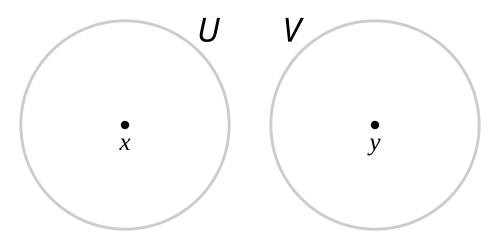
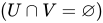
Points and in a topological space can be separated by neighbourhoods if there exists a neighbourhood of and a neighbourhood of such that and are disjoint. is a Hausdorff space if any two distinct points in are separated by neighbourhoods. This condition is the third separation axiom (after T0 and T1), which is why Hausdorff spaces are also called T2 spaces. The name separated space is also used.


A related, but weaker, notion is that of a preregular space. is a preregular space if any two topologically distinguishable points can be separated by disjoint neighbourhoods. A preregular space is also called an R1 space.
العلاقة بين هذين الشرطين هي كما يلي: يكون الفضاء الطوبولوجي هاوسدورف إذا وفقط إذا كان شبه منتظم (أي أن النقاط المتميزة طوبولوجيًا مفصولة بجوارات) وكولموغوروف ( أي أن النقاط المتميزة متميزة طوبولوجيًا). ويكون الفضاء الطوبولوجي شبه منتظم إذا وفقط إذا كان خارج قسمة كولموغوروف الخاص به هاوسدورف.
المكافئات
للفضاء الطوبولوجي، ما يلي متكافئ: [ 2 ]
- هو مساحة هاوسدورف.
- حدود الشباك فيفريدة من نوعها. [ 4 ]
- حدود الفلاتر علىفريدة من نوعها. [ 4 ]
- أي مجموعة فرديةيساوي تقاطع جميع الأحياء المغلقة لـ[ 5 ] (حي مغلق منهي مجموعة مغلقة تحتوي على مجموعة مفتوحة تحتوي على.)
- القطرتُعتبر مجموعة مغلقة كجزء من فضاء المنتج.
- أي حقن من الفضاء المنفصل بنقطتين إلىتتمتع بخاصية الرفع الأيسر بالنسبة للخريطة من الفضاء الطوبولوجي المحدود بنقطتين مفتوحتين ونقطة مغلقة واحدة إلى نقطة واحدة.



أمثلة على فضاءات هاوسدورف وغير هاوسدورف
معظم الفضاءات التي تُصادف في التحليل هي فضاءات هاوسدورف؛ والأهم من ذلك، أن الأعداد الحقيقية (وفقًا للطوبولوجيا المترية القياسية على الأعداد الحقيقية) هي فضاءات هاوسدورف. وبشكل أعم، فإن جميع الفضاءات المترية هي فضاءات هاوسدورف. في الواقع، العديد من الفضاءات المستخدمة في التحليل، مثل الزمر الطوبولوجية والمتشعبات الطوبولوجية ، تنص تعريفاتها صراحةً على شرط هاوسدورف.
مثال بسيط على الطوبولوجيا التي هي T 1 ولكنها ليست هاوسدورف هو الطوبولوجيا المحدودة المعرفة على مجموعة غير منتهية ، وكذلك الطوبولوجيا القابلة للعد المعرفة على مجموعة غير قابلة للعد .
لا تُعدّ الفضاءات شبه المترية عادةً فضاءات هاوسدورف، ولكنها فضاءات شبه منتظمة، ويقتصر استخدامها في التحليل عادةً على بناء فضاءات قياس هاوسدورف . في الواقع، عندما يصادف المحللون فضاءً غير هاوسدورف، فإنه على الأرجح لا يزال شبه منتظم على الأقل، وعندها يستبدلونه ببساطة بفضاء كولموغوروف الخاص به، وهو فضاء هاوسدورف. [ 6 ]
في المقابل، تُصادف الفضاءات غير المنتظمة بشكل متكرر في الجبر المجرد والهندسة الجبرية ، لا سيما في طوبولوجيا زاريسكي على صنف جبري أو طيف حلقة . كما تظهر أيضًا في نظرية النماذج للمنطق الحدسي : فكل جبر هيتينغ كامل هو جبر المجموعات المفتوحة لفضاء طوبولوجي ما، ولكن هذا الفضاء ليس بالضرورة منتظمًا، فضلًا عن كونه هاوسدورف، وفي الواقع غالبًا ما يكون غير منتظم وغير منتظم. ويتضمن مفهوم مجال سكوت أيضًا فضاءات غير منتظمة.
بينما يشير وجود نهايات فريدة للشبكات والمرشحات المتقاربة إلى أن الفضاء هاوسدورف، توجد فضاءات T1 غير هاوسدورفية يكون لكل متتالية متقاربة فيها نهاية فريدة. [ 7 ] تُسمى هذه الفضاءات فضاءات US . [ 8 ] بالنسبة للفضاءات المتسلسلة ، يُكافئ هذا المفهوم كون الفضاء هاوسدورف ضعيفًا .
ملكيات
الفضاءات الجزئية وحاصل ضرب الفضاءات الهاوسدورفية هي فضاءات هاوسدورفية، لكن فضاءات القسمة للفضاءات الهاوسدورفية ليست بالضرورة فضاءات هاوسدورفية. في الواقع، يمكن تمثيل أي فضاء طوبولوجي على أنه فضاء قسمة لفضاء هاوسدورفي ما. [ 9 ]
تُصنف فضاءات هاوسدورف ضمن فئة T1 ، أي أن كل عنصر أحادي فيها هو مجموعة مغلقة. وبالمثل، تُصنف الفضاءات شبه المنتظمة ضمن فئة R0 . كل فضاء هاوسدورف هو فضاء سوبر، مع أن العكس ليس صحيحًا في الغالب.
من خصائص فضاءات هاوسدورف أن كل مجموعة متراصة فيها هي مجموعة مغلقة. أما بالنسبة للفضاءات غير الهاوسدورفية، فقد تكون كل مجموعة متراصة فيها مجموعة مغلقة (على سبيل المثال، طوبولوجيا العد المشترك على مجموعة غير قابلة للعد) أو لا تكون كذلك (على سبيل المثال، طوبولوجيا الإنهاء المشترك على مجموعة غير منتهية وفضاء سيربينسكي ).
يُعرّف فضاء هاوسدورف بأنه يمكن فصل النقاط بواسطة جوارات. ويتضح أن هذا يستلزم شيئًا يبدو أقوى: ففي فضاء هاوسدورف، يمكن فصل أي زوج من المجموعات المدمجة المنفصلة بواسطة جوارات أيضًا، [ 10 ] أي أن هناك جوارًا لإحدى المجموعتين وجوارًا للأخرى، بحيث يكون هذان الجواران منفصلين. وهذا مثال على القاعدة العامة التي تنص على أن المجموعات المدمجة غالبًا ما تتصرف كالنقاط.
Compactness conditions together with preregularity often imply stronger separation axioms. For example, any locally compact preregular space is completely regular.[11][12]Compact preregular spaces are normal,[13] meaning that they satisfy Urysohn's lemma and the Tietze extension theorem and have partitions of unity subordinate to locally finite open covers. The Hausdorff versions of these statements are: every locally compact Hausdorff space is Tychonoff, and every compact Hausdorff space is normal Hausdorff.
The following results are some technical properties regarding maps (continuous and otherwise) to and from Hausdorff spaces.
Let be a continuous function and suppose is Hausdorff. Then the graph of , , is a closed subset of .




Let be a function and let be its kernel regarded as a subspace of .

- If is continuous and is Hausdorff then is a closed set.
- If is an open surjection and is a closed set then is Hausdorff.
- If is a continuous, open surjection (i.e. an open quotient map) then is Hausdorff if and only if is a closed set.

If are continuous maps and is Hausdorff then the equalizer is a closed set in . It follows that if is Hausdorff and and agree on a dense subset of then . In other words, continuous functions into Hausdorff spaces are determined by their values on dense subsets.




Let be a closed surjection such that is compact for all . Then if is Hausdorff so is .


Let be a quotient map with a compact Hausdorff space. Then the following are equivalent:
- is Hausdorff.
- is a closed map.
- is a closed set.
Preregularity versus regularity
All regular spaces are preregular, as are all Hausdorff spaces. There are many results for topological spaces that hold for both regular and Hausdorff spaces. Most of the time, these results hold for all preregular spaces; they were listed for regular and Hausdorff spaces separately because the idea of preregular spaces came later. On the other hand, those results that are truly about regularity generally do not also apply to nonregular Hausdorff spaces.
There are many situations where another condition of topological spaces (such as paracompactness or local compactness) will imply regularity if preregularity is satisfied. Such conditions often come in two versions: a regular version and a Hausdorff version. Although Hausdorff spaces are not, in general, regular, a Hausdorff space that is also (say) locally compact will be regular, because any Hausdorff space is preregular. Thus from a certain point of view, it is really preregularity, rather than regularity, that matters in these situations. However, definitions are usually still phrased in terms of regularity, since this condition is better known than preregularity.
See History of the separation axioms for more on this issue.
Variants
The terms "Hausdorff", "separated", and "preregular" can also be applied to such variants on topological spaces as uniform spaces, Cauchy spaces, and convergence spaces. The characteristic that unites the concept in all of these examples is that limits of nets and filters (when they exist) are unique (for separated spaces) or unique up to topological indistinguishability (for preregular spaces).
As it turns out, uniform spaces, and more generally Cauchy spaces, are always preregular, so the Hausdorff condition in these cases reduces to the T0 condition. These are also the spaces in which completeness makes sense, and Hausdorffness is a natural companion to completeness in these cases. Specifically, a space is complete if and only if every Cauchy net has at least one limit, while a space is Hausdorff if and only if every Cauchy net has at most one limit (since only Cauchy nets can have limits in the first place).
Algebra of functions
The algebra of continuous (real or complex) functions on a compact Hausdorff space is a commutative C*-algebra, and conversely by the Banach–Stone theorem one can recover the topology of the space from the algebraic properties of its algebra of continuous functions. This leads to noncommutative geometry, where one considers noncommutative C*-algebras as representing algebras of functions on a noncommutative space.
Academic humour
- Hausdorff condition is illustrated by the pun that in Hausdorff spaces any two points can be "housed off" from each other by open sets.[14]
- في معهد الرياضيات بجامعة بون ، حيث أجرى فيليكس هاوسدورف أبحاثه وألقى محاضراته، توجد غرفة معينة تحمل اسم " هاوسدورف-راوم" . وهذا تورية ، إذ أن كلمة "راوم" تعني كلاً من الغرفة والفضاء في اللغة الألمانية.
انظر أيضاً
- فضاء النقطة الثابتة - الفضاء الذي تكون فيه جميع الدوال لها نقاط ثابتة ، وهو فضاء هاوسدورف X بحيث يكون لكل دالة متصلة f : X → X نقطة ثابتة.
- فضاء هاوسدورف محليًا - فضاء بحيث يكون لكل نقطة فيه حي هاوسدورف
- متعدد الشعب غير الهاوسدورفي – تعميم متعددات الشعب
- الفضاء شبه الطوبولوجي – الوظيفة في الطوبولوجيا
- بديهية الفصل – بديهيات في علم الطوبولوجيا تحدد مفاهيم "الفصل"
- مساحة هاوسدورف الضعيفة
ملحوظات
- ↑ "تعريف ومعنى فضاء هاوسدورف" . www.dictionary.com . تم الاطلاع عليه بتاريخ 15 يونيو 2022 .
- 1 2 "مسلمات الفصل في nLab" . ncatlab.org . مؤرشف من الأصل بتاريخ 30-09-2020 . تم الاطلاع عليه بتاريخ 16-10-2019 .
- ^ هاوسدورف ، فيليكس (1914). Grundzüge der Mengenlehre (في المانيا). لايبزيغ: فيت وشركات. ص. 213.
- 1 2 ويلارد 2004 ، ص 86-87
- ↑ بورباكي 1966 ، ص 75
- ↑ انظر على سبيل المثال فضاء Lp# فضاءات Lp وتكاملات ليبيغ ، ومكدس باناش-مازور، إلخ.
- ↑ فان دوفن، إريك ك. (1993). "فضاء فريشيه مضاد لهاوسدورف تكون فيه المتتاليات المتقاربة ذات نهايات فريدة" . الطوبولوجيا وتطبيقاتها . 51 (2): 147-158 . doi : 10.1016/0166-8641(93)90147-6 .
- ↑ ويلانسكي، ألبرت (1967). "بين T1 و T2 " . المجلة الرياضية الأمريكية الشهرية . 74 (3): 261-266 . doi : 10.2307/2316017 . JSTOR 2316017 .
- ↑ شيمرات، م. (1956). "فضاءات التفكيك وخصائص الفصل". المجلة الفصلية للرياضيات . 2 : 128-129 . doi : 10.1093/qmath/7.1.128 .
- ↑ ويلارد 2004 ، ص 124
- ↑Schechter 1996, 17.14(d), p. 460.
- ↑"Locally compact preregular spaces are completely regular". math.stackexchange.com.
- ↑Schechter 1996, 17.7(g), p. 457.
- ↑Adams, Colin; Franzosa, Robert (2008). Introduction to Topology: Pure and Applied. Pearson Prentice Hall. p. 42. ISBN 978-0-13-184869-6.
References
- Arkhangelskii, A.V.; Pontryagin, L.S. (1990). General Topology I. Springer. ISBN 3-540-18178-4.
- Bourbaki (1966). Elements of Mathematics: General Topology. Addison-Wesley.
- "Hausdorff space", Encyclopedia of Mathematics, EMS Press, 2001 [1994]
- Schechter, Eric (1996). Handbook of Analysis and Its Foundations. San Diego, CA: Academic Press. ISBN 978-0-12-622760-4. OCLC 175294365.
- Willard, Stephen (2004). General Topology. Dover Publications. ISBN 0-486-43479-6.
- Separation axioms
- Properties of topological spaces