
أوميغا بوينت
نقطة أوميغا هي حدثٌ مُفترضٌ في المستقبل ، حيثُ يدور الكون بأسره حلزونيًا نحو نقطة توحيد نهائية . صاغ هذا المصطلح الكاهن اليسوعي الفرنسي بيير تيلار دي شاردان (1881-1955). [ 1 ] جادل تيلار بأن نقطة أوميغا تُشبه الكلمة المسيحية ، أي المسيح ، الذي يجذب كل شيء إليه، والذي هو، بحسب قانون الإيمان النيقاوي ، "إله من إله"، و"نور من نور"، و"إله حق من إله حق"، و"به خُلِق كل شيء". [ 2 ] في سفر الرؤيا ، يصف المسيح نفسه ثلاث مرات بأنه " الألف والياء ، البداية والنهاية". بعد عدة عقود من وفاة تيلار، توسّعت فكرة نقطة أوميغا في كتابات جون ديفيد غارسيا (1971)، وباولو سوليري (1981)، وفرانك تيبلر (1994)، وديفيد دويتش (1997). [ 3 ] [ 4 ] [ 5 ]
نظرية بيير تيلار دو شاردان

أصل الكلمة
كان تيلارد دي شاردان عالم حفريات وكاهنًا كاثوليكيًا في الرهبنة اليسوعية. في فرنسا خلال عشرينيات القرن العشرين، بدأ بدمج نظرياته الكونية في محاضراتٍ ربط فيها بين الكاثوليكية والتطور . وبسبب هذه المحاضرات، اشتبه به المكتب المقدس في إنكار عقيدة الخطيئة الأصلية ، مما أدى إلى نفيه إلى الصين ومنعه من النشر من قبل السلطات الكنسية. [ 6 ] لم تُنشر كتاباته للعالم إلا بعد عام من وفاته عام 1955. وقد حظيت أعماله بدعم من كتابات مجموعة من المفكرين الكاثوليك، من بينهم البابا بنديكت السادس عشر . [ 6 ] خضع كتابه "ظاهرة الإنسان" لتحليل دقيق من قبل علماء الفيزياء الفلكية وعلماء الكون، ويُنظر إليه الآن على أنه عملٌ يطرح نظرية لاهوتية أو فلسفية لا يمكن إثباتها علميًا. تيلارد، الذي لم يكن عالم كونيات ، يستهل كتبه بالعبارة التالية:
... إذا أردنا فهم هذا الكتاب فهماً صحيحاً، فيجب قراءته ليس كعمل في الميتافيزيقا، ولا كنوع من المقالات اللاهوتية، بل كرسالة علمية بحتة وبسيطة. [ 7 ]
تطور
أكد تيلارد أن الكائنات وحيدة الخلية تتطور إلى حيوانات متعددة الخلايا، لكن بعض أفراد هذا التصنيف يطورون كائنات ذات أجهزة عصبية معقدة . تمتلك هذه المجموعة القدرة على اكتساب الذكاء . عندما سكن الإنسان العاقل الأرض عبر التطور، نشأت طبقة معرفية تُسمى "النوسفير" . ومع استمرار التطور، تكتسب هذه الطبقة تماسكًا. أوضح تيلارد أنه يمكن، بمساعدة العلم، توجيه هذه الطبقة أو بنائها لتصبح "نقطة أوميغا"، أو المرحلة التطورية النهائية. [ 8 ] يشير تيلارد إلى هذه العملية باسم "التكوين الكوكبي". في النهاية، تسيطر طبقة النوسفير سيطرة تامة على المحيط الحيوي، وتصل إلى نقطة استقلال كامل عن الطاقة الخارجية، مُشكلةً كيانًا ميتافيزيقيًا يُسمى "نقطة أوميغا". [ 9 ]
طاقة
توجد الطاقة في نمطين أساسيين:
- "الطاقة المماسية": الطاقة التي يمكن قياسها بواسطة الفيزياء .
- "الطاقة الشعاعية": طاقة روحية تتراكم لتصل إلى حالة أعلى مع مرور الوقت.
يُعرّف تيلارد الطاقة الشعاعية بأنها ازدياد تركيزها وتوافرها، باعتبارها عنصرًا حاسمًا في تطور الإنسان. تنطبق هذه النظرية على جميع أشكال المادة، وتخلص إلى أن كل ما هو موجود يحمل نوعًا من الحياة. وفيما يتعلق بكتاب تيلارد " ظاهرة الإنسان " ، كتب بيتر ميداوار : "يمكن مساواة الطاقة الشعاعية أو الروحية أو النفسية عند تيلارد بـ'المعلومات' أو 'محتوى المعلومات' بالمعنى الذي حدده مهندسو الاتصالات بدقة معقولة." [ 10 ]
الخصائص الرسمية
تستند نظرية تيلارد إلى أربع "خصائص":
- سينجو البشر من الموت الحراري للكون . ويفترض أن الطاقة الشعاعية، لكونها لا تخضع لقانون الإنتروبيا، تفلت من انهيار القوى عند نهاية العالم.
- لا توجد نقطة أوميغا ضمن التسلسل الزمني للكون، بل تقع على الحافة الدقيقة لنهاية الزمن. ومن تلك النقطة، تُسحب جميع تسلسلات الوجود إلى داخلها.
- يمكن فهم نقطة أوميغا على أنها حجم على شكل مخروط حيث يتناقص كل قسم، مأخوذ من القاعدة إلى القمة، حتى يتلاشى إلى نقطة نهائية.
- يجب فهم الحجم الموصوف في الخاصية الثالثة على أنه كيان ذو حدود محدودة. يوضح تيلارد ذلك قائلاً:
... what would have become of humanity, if, by some remote chance, it had been free to spread indefinitely on an unlimited surface, that is to say, left only to the devices of its internal affinities? Something unimaginable. ... Perhaps even nothing at all, when we think of the extreme importance of the role played in its development by the forces of compression.[11]
Forces of compression
Teilhard calls the contributing universal energy that generates the Omega Point "forces of compression". Unlike the scientific definition, which incorporates gravity and mass, Teilhard's forces of compression are sourced from communication and contact between human beings. This value is limitless and directly correlated with entropy. It suggests that as humans continue to interact, consciousness evolves and grows. For the theory to occur, humans must also be bound to the finite earth. The creation of this boundary forces the world's convergence upon itself which he theorizes to result in time ending in communion with the Omega Point-God. This portion of Teilhard's thinking shows his lack of expectation for humans to engage in space travel and transcend the bounds of Earth.[9]
The Omega Point cosmology
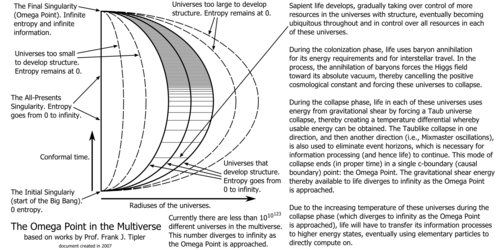
Mathematical physicist Frank Tipler generalized[12] Teilhard's term Omega Point to describe what he alleges is the ultimate fate of the universe as required by the laws of physics: roughly, Tipler argues that quantum mechanics is inconsistent unless the future of every point in spacetime contains an intelligent observer to collapse the wavefunction and that the only way for this to happen is if the Universe is closed (that is, it will collapse to a single point) and yet contains observers with a "God-like" ability to perform an unbounded series of observations in finite time.[13] Tipler's conception of the Omega Point is regarded as pseudoscience by some scientists.[14][15]
The originator of quantum computing, Oxford's David Deutsch, wrote about how a universal quantum computer could bring about Tipler's salvation in his 1997 book, The Fabric of Reality.
Related concepts
Big Crunch
The scientific hypothesis of the Big Crunch closely resembles the Omega Point theory. However, the current scientific consensus rejects this theory. Nevertheless, in 2025, a paper in the journal Monthly Notices appeared suggesting that the universe's expansion is not accelerating, as commonly believed, but slowing, and that it could result in a Big Crunch. This followed another paper earlier in the year reaching similar conclusions.[16]
Accelerating expansion of the universe
In 1998, a value measured from observations of Type Ia supernovae seemed to indicate that what was once assumed to be temporary cosmological expansion was actually accelerating.[17] The apparent acceleration has caused further dismissal of the validity of Tipler's Omega Point, since the necessity of a final big crunch singularity is key to the Omega Point's workability. However, Tipler believes that the Omega Point is still workable, arguing that a big crunch/ final singularity is still required under many current universal models.[18][19]
Technological singularity
The technological singularity is the hypothetical advent of artificial general intelligence becoming capable of recursive self-improvement, resulting in an irreversible machine intelligence explosion, with unknown impact on humanity.[20] Eric Steinhart, a proponent of "Christian transhumanism," argues there is a significant overlap of ideas between the secular singularity and Teilhard's religious Omega Point.[3] Steinhart quotes Ray Kurzweil, who stated that "evolution moves inexorably toward our conception of God, albeit never reaching this ideal."[3][21] Like Kurzweil, Teilhard predicted a period of rapid technological change that results in a merger of humanity and technology. He believes that this marks the birth of the noosphere and the emergence of the "spirit of the Earth," but the Teilhardian Singularity comes later. Unlike Kurzweil, Teilhard's singularity is marked by the evolution of human intelligence reaching a critical point in which humans ascend from "transhuman" to "posthuman." He identifies this with the Christian "parousia."[3]
In popular culture
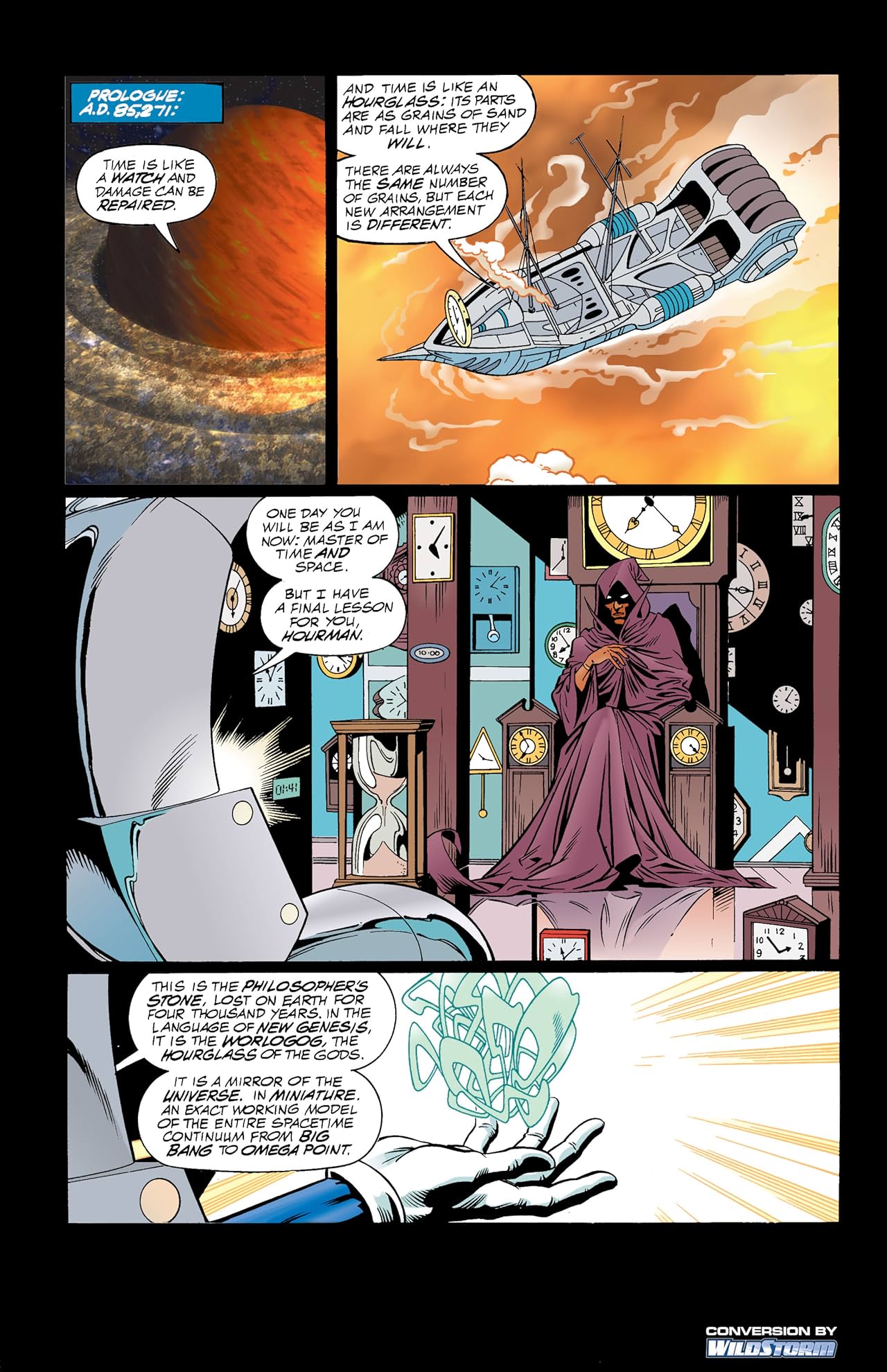
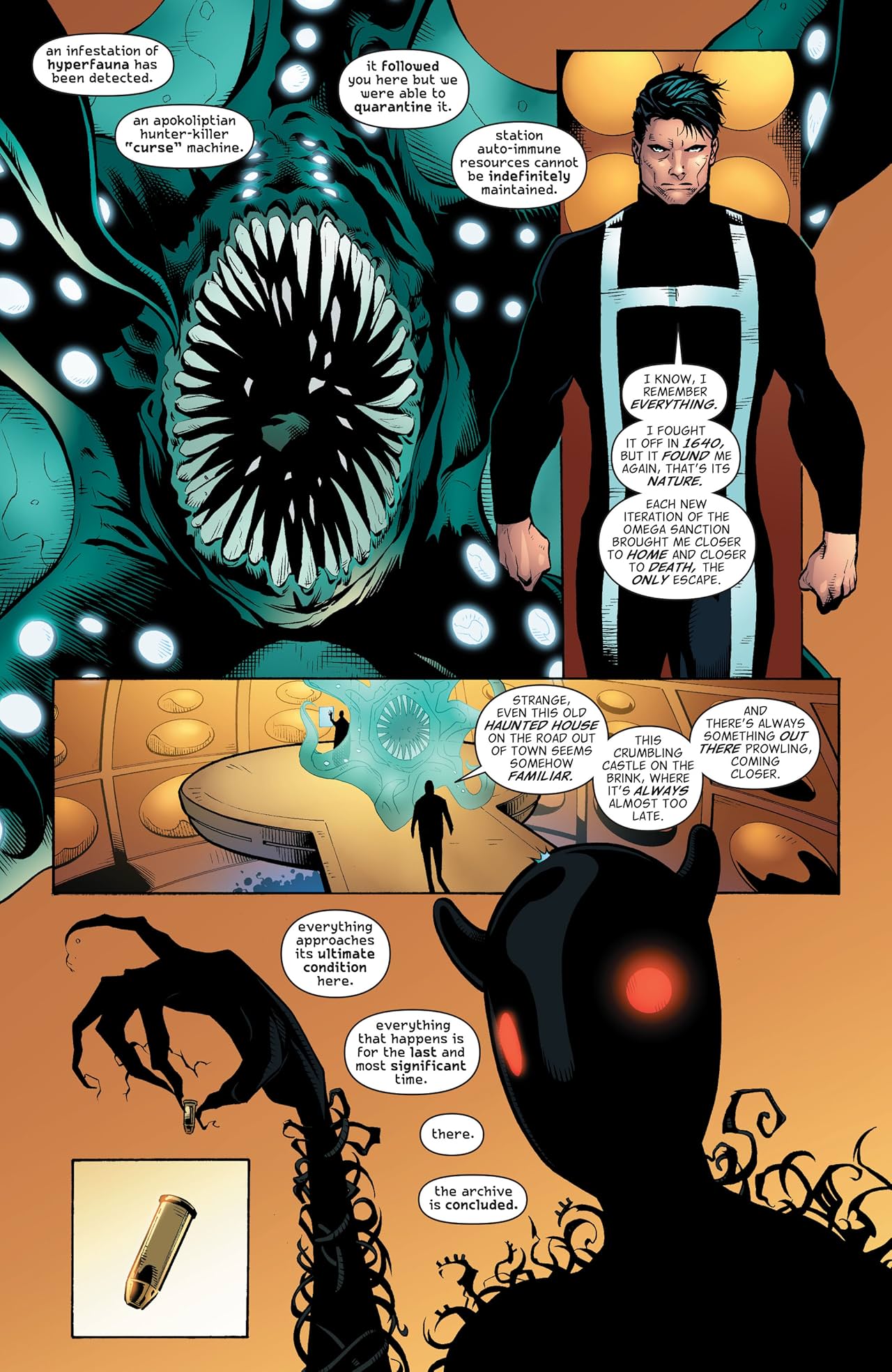
The Spanish painter Salvador Dalí was familiar with Teilhard de Chardin's Omega Point theory. His 1959 painting The Ecumenical Council is said to represent the "interconnectedness" of the Omega Point.[22]Point Omega by Don DeLillo takes its name from the theory and involves a character who is studying Teilhard de Chardin.[23]Flannery O'Connor's acclaimed collection of short stories refers to the Omega Point theory in its title, Everything That Rises Must Converge, and science fiction writer Frederik Pohl references Frank Tipler and the Omega Point in his 1998 short story "The Siege of Eternity".[24] Scottish writer / counterculture figure Grant Morrison has used the Omega Point as a plot line in several of his Justice League of America and Batman stories.[25][26][27]
Dan Simmons references Teilhard and the Omega Point throughout the Hyperion Cantos, with extended discussions about the feasibility of the concept driving much of the plot.
Julian May's Galactic Milieu Series includes multiple references to Chardin, the Omega Point and the Noosphere. Part of the driving force for the Milieu of the title is to promote an increase in the population of various intelligent species, including humans, in order to enable them to reach a point of psychic Unity.
Arthur C. Clarke and Stephen Baxter's The Light of Other Days references Teilhard de Chardin and includes a brief explanation of the Omega Point.[28] Italian writer Valerio Evangelisti has used the Omega Point as main theme of his Il Fantasma di Eymerich novel.[29] In William Peter Blatty's novel The Exorcist, the character of Father Merrin references Omega Point. In 2021, Dutch symphonic metal band Epica released their eighth studio album, Omega, which features concepts related to the Omega Point theory. Epica's guitarist and vocalist, Mark Jansen, specifically referenced Teilhard's theory when describing the album's concept.[30]
Charles Sheffield's 1997 novel Tomorrow and Tomorrow also uses the concept in the concluding act of the novel.
See also
مراجع
- ↑ كاستيلو، ماوريسيو (مارس 2012). " نقطة أوميغا وما بعدها: حدث التفرد" (ملف PDF) . المجلة الأمريكية لعلم الأشعة العصبية . 33 (3): 393-395 . doi : 10.3174/ajnr.A2664 . PMC 7966419. PMID 21903920. تاريخ الاسترجاع: 6 يونيو 2015 .
- ↑ هيكي، مايكل (2016-03-07). الوصول إلى النهاية: نظرة كاثوليكية إلى نهاية الزمان . لندن: UPA. ص 104. ISBN 9780761867333.
- 1 2 3 4 ستاينهارت، إريك (2008). "تيلارد دي شاردان وما بعد الإنسانية" . مجلة التطور والتكنولوجيا . 20 (1): 1-22 . ISSN 1541-0099 . تاريخ الاسترجاع: 2015-06-03 .
- ↑ غرين، رونالد (2012). "تحدي قيم ما بعد الإنسانية". تقرير مركز هاستينغز . 43 (4): 45-47 . doi : 10.1002/hast.195 .
- ↑ ليلي، ستيفن (2013). "التجاوز أم التعدي؟". ما بعد الإنسانية والمجتمع . سلسلة سبرينغر الموجزة في الفلسفة. ص 13-24 . doi : 10.1007/978-94-007-4981-8_2 . ISBN 978-94-007-4980-1.
{{cite book}}تم|work=تجاهله ( مساعدة ) - 1 2 براينت، م. دارول (2018-04-20). من الجليل: الفكر المسيحي كحوار عظيم . يوجين، أوريغون: دار نشر ويبف آند ستوك. ص 300. ISBN 9781532638497.
- ↑ تيلار دي شاردان ، بيير (2008). ظاهرة الإنسان . ترجمة برنارد وول. نيويورك: هاربر بيرينال مودرن ثوت. ص 29. ISBN 978-0061632655.
- ↑ فيست، ريتشارد؛ سويت، ويليام (2013). الدين وتحديات العلم . بيرلينجتون، فيرمونت: دار نشر أشجيت المحدودة. ص 66. ISBN 9781409477624.
- 1 2 تيبلر، فرانك ج. (1994). فيزياء الخلود: علم الكونيات الحديث، الله، وقيامة الموتى (الطبعة الأولى من دار أنكور بوكس ) . نيويورك: دار أنكور بوكس. ص 111، 113، 115. ISBN 978-0385467995.
- ↑ مدور، السير بيتر. "ظاهرة الإنسان" . bactra.org . تم الاسترجاع في 16 فبراير 2018 .
- ↑ تيلار دي شاردان ، بيير (2008). ظاهرة الإنسان . ترجمة برنارد وول ( الطبعة الأولى). نيويورك: هاربر بيرينال مودرن ثوت. ص 239. ISBN 978-0061632655.
- ↑ تيبلر، فرانك ج. "نقطة أوميغا كنهاية العالم: إجابات على أسئلة باننبرغ للعلماء." زيغون (مجلة) 24.2 (1989): 217-253. "غني عن القول، إن المصطلحات من ابتكار تيلارد دي شاردان..."
- ↑ إليس، جورج فرانسيس راينر (1994). "التقوى في السماء" (ملف PDF) . مجلة نيتشر . 371 (6493): 115. رمز Bibcode : 1994Natur.371..115E . doi : 10.1038/371115a0 . S2CID 36282720. مؤرشف من الأصل (ملف PDF) بتاريخ 2012-11-05 . تم الاطلاع عليه بتاريخ 2018-04-03 .
إنه تحفة من تحف العلوم الزائفة.
- ↑ كراوس، لورانس (مايو 2007). "أكثر خطورة من الهراء". مجلة نيو ساينتست . 194 (2603): 53. doi : 10.1016/S0262-4079(07)61199-3 .
أميل إلى وصف كتاب تيبلر الجديد بالهراء، لكن ذلك سيكون مجحفًا بحق مفهوم الهراء نفسه.
- ↑ "قضية فرانك جينينغز تيبلر الغريبة" . مجلة سكيبتيكال إنكوايرر . 2008. مؤرشف من الأصل في 5 أغسطس 2011. تم الاطلاع عليه في 21 سبتمبر 2016.
بدأت أتساءل عما إذا كان الكتاب خدعة بارعة ومضحكة. للأسف، ليس كذلك.
- ↑ ديفلين، هانا. "دراسة تشير إلى أن توسع الكون قد يتباطأ، لا يتسارع" . صحيفة الغارديان . مجموعة غارديان الإعلامية . تاريخ الاطلاع: 18 نوفمبر 2025 .
- ↑ بالمر، جيسون (4 أكتوبر 2011). "جائزة نوبل في الفيزياء تُكرّم اكتشاف تسارع الكون" . بي بي سي نيوز .
- ↑ بريسكو، جوليو (26 سبتمبر 2012). "مقابلة مع فرانك ج. تيبلر (نوفمبر 2002)" . كنيسة تورينج . مؤرشف من الأصل في 3 أكتوبر 2017. تم الاطلاع عليه في 2 أكتوبر 2017 .
- ↑ مؤرشف في Ghostarchiveوآلة Waybackمقابلة مع فرانك تيبلر حول نبات الغاردينيا البيضاء . ديسمبر 2015.
- ↑ تشالمرز، ديفيد. "التفرد: تحليل فلسفي". مجلة دراسات الوعي 17.9-10 (2010): 7-65.
- ↑ كورزويل، راي (2005). التفرد قريب . نيويورك: فايكنغ بوكس. ISBN 978-0-670-03384-3.، ص 476؛ انظر أيضًا ص 375، 389-390
- ↑ "فن VCE: المجلس المسكوني" (ملف PDF) . مورد تعليمي من المعرض الوطني لفيكتوريا.
- ↑ ديللو، دون (2010). نقطة أوميغا . سكريبنر.
- ↑ بول، فريدريك (1998). حصار الأبدية . تور ساينس فيكشن. ISBN 978-0812577662.
- ↑ موريسون، غرانت. صفحة نموذجية من باتمان: عودة بروس واين. مؤرشفة بتاريخ 3 أكتوبر 2017 في أرشيف الإنترنت (Wayback Machine) العدد 2 (يونيو 2010). دي سي كوميكس.
- ↑ موريسون، جرانت. صفحة نموذجية من المجلد الثالث من JLA : " صخرة الدهور ".
- ↑ موريسون، غرانت. صفحة نموذجية من باتمان: عودة بروس واين #6 (نوفمبر 2010). دي سي كوميكس.
- ↑ كلارك، آرثر سي. (2001). نور الأيام الأخرى . توم دوهرتي أسوشيتس. ص 331. ISBN 978-0-812-57640-5.
- ^ إيفانجيليستي، فاليريو (2018). فانتازما دي إيمريش . موندادوري. رقم ISBN 978-8804702245.
- ↑ جانسن، مارك، مدونة فيديو إبيكا من جلسات تسجيل ألبوم أوميغا .
روابط خارجية
- خطى تاريخ الكمبيوتر نحو نقطة أوميغا المتوقعة بقلم يورغن شميدهوبر ، من "الذكاء الاصطناعي الجديد: عام وسليم وذو صلة بالفيزياء"، في ب. غورتزل و سي. بيناشين، محرران: الذكاء الاصطناعي العام ، ص 175-198، 2006.
- مقالات بقلم تيبلر حول نقطة أوميغا
- معهد أبحاث التطور البشري، مؤرشف بتاريخ 19 يونيو 2018 على موقع Wayback Machine
- مشروع برينستون نوسفير يستشهد بتيلارد دي شاردان
- علم الأخرويات المسيحي
- مفاهيم في الميتافيزيقا
- التصوف
- وحدة الوجود
- فلسفة الدين
- فلسفة التكنولوجيا
- الدين والعلم
- التفرد