
Colonna family
The House of Colonna is a prominent Italian family, forming part of the papal nobility. It played a pivotal role in medieval and RenaissanceRome, supplying one pope (Martin V), 23 cardinals and many other church and political leaders.
Other notable family members are Vittoria Colonna, close friend of Michelangelo, Marcantonio II Colonna (Marcantonio Colonna), leader of the papal fleet in the Battle of Lepanto (1571) and Costanza Colonna, patron and protector of Caravaggio.[4]
The family was notable for its bitter feud with the Orsini family over their influence in Rome, which was eventually settled by the issuing of the papal bullPax Romana by Pope Julius II in 1511.
In 1571, the heads of both families married nieces of Pope Sixtus V. Thereafter, historians recorded that "no peace had been concluded between the princes of Christendom, in which they had not been included by name".[5] Today, the family is led by Don Prospero Colonna (b.1956).[6]
History
Origins
According to tradition, the Colonna family is a branch of the Counts of Tusculum — by Peter (Pietro Colonna, 1078–1108 or 1099–1151) son of Gregory III, called Peter "de Columna" (Petrus de Columna) from his property the Columna Castle in Colonna, in the Alban Hills and Lord of Colonna, Monteporzio, Zagarolo and Gallicano. Further back, they trace their lineage past the Counts of Tusculum via Lombard and Italo-Roman nobles, merchants, and clergy through the Early Middle Ages — ultimately claiming origins from the Julio-Claudian dynasty and the gens Julia whose origin is lost in the mists of time but which entered the annals for the first time in 489 BC with the consulship of Gaius Julius Iullus. Peter married Elena, Lady of Palestrina, widow of a Donodeo and relative of Pope Paschal II.
The first cardinal from the family was appointed in 1206, when Giovanni Colonna di Carbognano was made Cardinal Deacon of SS. Cosma e Damiano.[7] For many years, Cardinal Giovanni di San Paolo (elevated in 1193) was identified as a member of the Colonna family and therefore its first representative in the College of Cardinals, but modern scholars have established that this was based on false information from the beginning of the 16th century.[8]
Giovanni Colonna (born c.1206)[9] nephew of Cardinal Giovanni Colonna di Carbognano, made his solemn vows as a Dominican around 1228 and received his theological and philosophical training at the Roman studium of Santa Sabina, the forerunner of the Pontifical University of Saint Thomas Aquinas, Angelicum. He served as the Provincial of the Roman province of the Dominican Order and led the provincial chapter of 1248 at Anagni.[10] Colonna was appointed as Archbishop of Messina in 1255.[11]
Margherita Colonna (died 1248) was a member of the Franciscan Order. She was beatified by Pope Pius IX in 1848.

At this time, a rivalry began with the pro-papal Orsini family, leaders of the Guelph faction. This reinforced the pro-Emperor Ghibelline course that the Colonna family followed throughout the period of conflict between the Papacy and the Holy Roman Empire. Ironically according to their own family legend, the Orsini are also descended from the Julio-Claudian dynasty of ancient Rome.
Colonna versus the Papacy
In 1297, Cardinal Jacopo disinherited his brothers Ottone, Matteo, and Landolfo of their lands[12]. The latter three appealed to Pope Boniface VIII, who ordered Jacopo to return the land, and furthermore hand over the family's strongholds of Colonna, Palestrina, and other towns to the Papacy. Jacopo refused; in May, Boniface removed him from the College of Cardinals and excommunicated him and his followers.[13]
أعلنت عائلة كولونا (باستثناء الإخوة الثلاثة المتحالفين مع البابا) أن انتخاب بونيفاس كان غير شرعي عقب تنازل البابا سلستين الخامس عن العرش في سابقة تاريخية . أدى هذا النزاع إلى حرب مفتوحة، وفي سبتمبر، عيّن بونيفاس لاندولفو قائداً لجيشه لإخماد ثورة أقارب لاندولفو من عائلة كولونا. وبحلول نهاية عام ١٢٩٨، كان لاندولفو قد استولى على كولونا وباليسترينا ومدن أخرى، وسوّاها بالأرض. وُزّعت أراضي العائلة بين لاندولفو وإخوته المخلصين، بينما فرّ باقي أفراد العائلة من إيطاليا. [ ١٤ ]
تحالف آل كولونا المنفيون مع عدو البابا اللدود الآخر، فيليب الرابع ملك فرنسا ، الذي تلقى تعليمه في شبابه على يد الكاردينال إيجيديو كولونا . في سبتمبر 1303، قاد شيارا ومستشار فيليب، غيوم دي نوغاريه ، قوة صغيرة إلى أناغني لاعتقال بونيفاس الثامن وإحضاره إلى فرنسا لمحاكمته [ 15 ] . تمكن الاثنان من القبض على البابا، ويُقال إن شيارا صفع البابا على وجهه أثناء ذلك، وهو ما عُرف بـ"فضيحة أناغني". باءت المحاولة بالفشل بعد بضعة أيام، عندما أطلق السكان المحليون سراح البابا [ 16 ] . مع ذلك، توفي بونيفاس الثامن في 11 أكتوبر، مما سمح لفرنسا بالسيطرة على خلفائه الأضعف خلال فترة بابوية أفينيون .
أواخر العصور الوسطى
ظلت العائلة في قلب الحياة المدنية والدينية طوال أواخر العصور الوسطى. توفي الكاردينال إيجيديو كولونا في البلاط البابوي في أفينيون عام 1314. كان من أتباع الراهب الأوغسطيني، وقد درس اللاهوت في باريس على يد القديس توما الأكويني ليصبح أحد أبرز مفكري عصره.
في القرن الرابع عشر، قامت العائلة برعاية تزيين كنيسة سان جيوفاني ، ولا سيما الفسيفساء الأرضية.
في عام ١٣٢٨، دخل لويس الرابع ملك ألمانيا إيطاليا لحضور تتويجه إمبراطورًا للإمبراطورية الرومانية المقدسة . ولأن البابا يوحنا الثاني والعشرون كان مقيمًا في أفينيون، وقد أعلن جهرًا أنه لن يتوج لويس، قرر الملك أن يتوج على يد أحد أفراد الطبقة الأرستقراطية الرومانية، فاقترح شيارا كولونا. وتخليدًا لهذه المناسبة، مُنحت عائلة كولونا امتياز استخدام التاج الإمبراطوري المدبب على شعار نبالتهم.
The poet Petrarch, was a great friend of the family, in particular of Giovanni Colonna and often lived in Rome as a guest of the family. He composed a number of sonnets for special occasions within the Colonna family, including "Colonna the Glorious, the great Latin name upon which all our hopes rest". In this period, the Colonna started claiming they were descendants of the Julio-Claudian dynasty.

At the Council of Constance, the Colonna finally succeeded in their papal ambitions when Oddone Colonna was elected on 14 November 1417. As Martin V, he reigned until his death on 20 February 1431.
Early modern period
Vittoria Colonna became famous in the sixteenth century as a poet and a figure in literate circles.
In 1627 Anna Colonna, daughter of Filippo I Colonna, married Taddeo Barberini of the family Barberini; nephew of Pope Urban VIII.
In 1728, the Carbognano branch (Colonna di Sciarra) of the Colonna family added the name Barberini to its family name[17] when Giulio Cesare Colonna di Sciarra married Cornelia Barberini, daughter of the last male Barberini to hold the name and granddaughter of Maffeo Barberini (son of Taddeo Barberini).
Current status
The Colonna family were Prince Assistants to the Papal Throne.[18]
The family residence in Rome, the Palazzo Colonna, is open to the public every Friday and Saturday morning.
The main 'Colonna di Paliano' line is represented today by Prince Marcantonio Colonna di Paliano, Prince and Duke of Paliano (b. 1948), whose heir is Don Giovanni Andrea Colonna di Paliano (b. 1975), and by Don Prospero Colonna di Paliano, Prince of Avella (b. 1956), whose heir is Don Filippo Colonna di Paliano (b. 1995).
The 'Colonna di Stigliano' line is represented by Don Prospero Colonna di Stigliano, Prince of Stigliano (b. 1938), whose heir is his nephew Don Stefano Colonna di Stigliano (b. 1975).
Notable members

- Blessed Margherita Colonna (c.1255 – 1280)
- Stefano Colonna (1265 – c.1348), an influential noble in Medieval Rome and Imperial vicar in the early 14th century
- Jacopo Colonna (1250–1318), cardinal
- Giacomo "Sciarra" Colonna (1270–1329), who took part in the Outrage of Anagni against Pope Boniface VIII
- Giovanni Colonna (1295–1348), influential cardinal during the Avignon papacy
- Oddone Colonna (1369–1431), whose election as Pope Martin V in 1417 ended the Western Schism
- Ludovico Colonna (1390–1436), condottiero
- Prospero I Colonna (1410–1463), cardinal
- Fabrizio Colonna (c.1450 – 1520), condottiero, the father of Vittoria Colonna, and a general in the Holy League
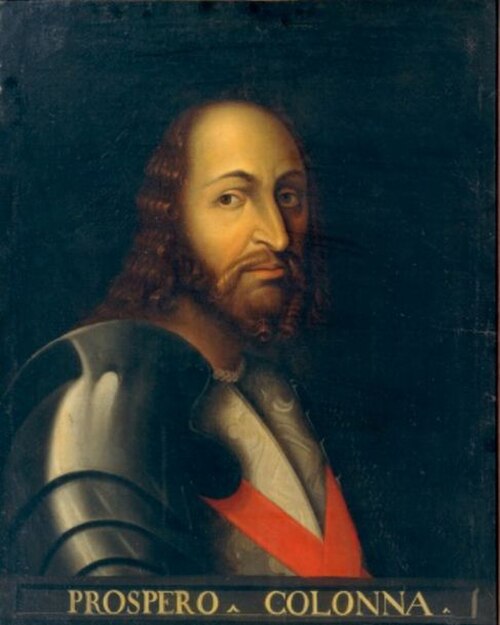
- Prospero Colonna (1452–1523), famed condottiero, who fought alongside his cousin Fabrizio Colonna
- Francesco Colonna (1453? – 1517?) [La "Pugna d'amore in sogno" di Francesco Colonna Romano, 1996, Maurizio Calvesi], who was credited (along with the monk Francesco Colonna) with the authorship of the Hypnerotomachia Poliphili by an acrostic in the text; also believed to have written the story
- Marcantonio I Colonna (1478–1522), condottiero of the 15th–16th centuries
- Pompeo Colonna (1479–1532), cardinal, a nephew of Prospero Colonna, mentioned above. Viceroy of Naples from 1530 to 1532
- Vittoria Colonna (1490–1547), friend of Michelangelo. Married in 1507 the Spanish-Italian Fernando d'Avalos, marquis of Pescara (deceased 1525), adopting (on becoming a widow) Alfonso d'Avalos, also marquis del Vasto, a nephew of her former husband
- Pirro Colonna (1500–1552), 16th century captain under Charles V, Holy Roman Emperor
- Marco Antonio Colonna (1523–1597), cardinal
- Marcantonio II Colonna the Younger (1535–1584), Duke of Tagliacozzo. Son of Ascanio Colonna and Juana de Aragón. He participated in the naval Battle of Lepanto against the Turks, 7 October 1571 and was Viceroy of Sicily in 1577–1584. Prince of Paliano.
- Ascanio Colonna (1560–1608), cardinal
- Federico Colonna y Tomacelli, Prince of Butera (1601–1641), Viceroy of Valencia, in Spain, 1640–1641, Viceroy of Catalonia, 1641. He was Great Constable of the kingdom of Naples (1639–1641) as had been his father Filippo I Colonna, (1578 – 11 April 1639).
- Marcantonio V Colonna (1606/1610–1659), Prince of Paliano
- Lorenzo Onofrio Colonna, Viceroy of Aragon, 1678–1681, in Spain
- Prospero II Colonna (1662–1743), cardinal
- Carlo Colonna (1665–1739), cardinal, created by Clement XI in 1706
- Marcantonio Colonna (1724–1793), cardinal
- Giovanni Antonio Colonna (1878–1940), politician
- Guido Colonna di Paliano (1908–1982), diplomat and European Commissioner
See also
References
- ↑"The Colonna Family".
- ↑"The Colonna Family".
- ↑"Colonna Palace of Paliano".
- ↑"The Colonna Family".
- ↑History of the popes; their church and state (Volume III) by Leopold von Ranke (Wellesley College Library, reprint; 2009)
- ↑"An Insiders' Tour of Palazzo Colonna, Rome's Last Great Sanctuary of Renaissance Splendor". 24 September 2019.
- ↑Werner Maleczek, Papst und Kardinalskolleg von 1191 bis 1216, Vienna 1984, p. 154-155
- ↑Helene Tillmann, "Ricerche sull'origine dei membri del collegio cardinalizio nel XII secolo. II/2. Identificazione dei cardinali del secolo XII di provenienza Romana", Rivista di Storia della Chiesa in Italia, 1975, p. 401-402
- ↑Stefano, Antonio N. Di (1 January 1995). Fra Giovanni Colonna (in Italian). Edizioni Studio Domenicano. ISBN 9788870941920.
- ↑Monumenta et antiquitates veteris disciplinae Ordinis Praedicatorum ab anno 1216 ad 1348 praesertim in romana provincia praefectorumque qui eandem rexerunt biographica chronotaxis... opera et studio p. fr. Pii-Thomae Masetti... (in Latin). ex Typographia Rev. Cam. Apostolicae. 1 January 1864.
- ↑Antonio N. Di Stefano (1995). Fra Giovanni Colonna. Edizioni Studio Domenicano. pp. 30–31. ISBN 9788870941920. Retrieved 24 February 2013.
- ↑Tosti, Don Louis. History of Pope Boniface VIII And his times with notes and documentary evidence in six books(PDF). p. 190.
- ↑Tosti, Don Louis. History of Pope Boniface VIII And his times with notes and documentary evidence in six books(PDF). pp. 193–194.
- ↑Tosti, Don Louis. History of Pope Boniface VIII And his times with notes and documentary evidence in six books(PDF). pp. 255–258.
- ↑Schaff, Philip. History of the Christian Church. § 4. Boniface VIII. and Philip the Fair of France.
{{cite book}}: CS1 maint: location (link) - ↑Jervis, William Henley (1872). A History of France from the Earliest Times to the Establishment of the Second Empire in 1852. p. 185.
- ↑Worldroots - BarberiniArchived October 15, 2009, at the Wayback Machine
- ↑Article by Guy de Stair Sainty on Papal CourtArchived March 13, 2007, at the Wayback Machine
Sources
- Original 1922 Almanach de Gotha (edited by Justice Perthes) entry for the Colonna family, link to the original universally-recognised genealogical reference document, with details of family honours
External links
 Media related to House of Colonna at Wikimedia Commons
- Palazzo Colonna website
- Colonna family
- Papal families
- Medieval Rome
- Roman Catholic families