
عظمة أوراكل
عظام العرافة هي قطع من لوح كتف الثور ودرع السلحفاة ، كانت تُستخدم في التنجيم الناري - وهو شكل من أشكال العرافة - خلال أواخر عهد أسرة شانغ ( حوالي 1250 - 1050 قبل الميلاد ) في الصين القديمة. يُطلق مصطلح "التنجيم باللوح" تحديدًا إذا استُخدم لوح كتف الثور، بينما يُطلق مصطلح "التنجيم بالدرع" إذا استُخدم درع السلحفاة. وقدّر إحصاء حديث وجود حوالي 13000 عظمة، تحمل ما يزيد قليلًا عن 130000 نقش، في مجموعات في الصين ونحو أربعة عشر بلدًا آخر. [ 1 ]
كان العرافون يطرحون أسئلة على الآلهة بشأن الطقس، وزراعة المحاصيل، ومصائر أفراد العائلة المالكة، والمساعي العسكرية، ومواضيع مماثلة. [ 2 ] وكانت هذه الأسئلة تُنقش على العظم أو الصدفة باستخدام أداة حادة. ثم تُعرَّض لحرارة شديدة بواسطة قضيب معدني حتى يتشقق العظم أو الصدفة نتيجة التمدد الحراري . بعد ذلك، يُفسِّر العراف نمط الشقوق ويكتب التنبؤ على القطعة أيضًا. [ 3 ] استمر استخدام العظام في التنجيم بالنار في الصين حتى عهد أسرة تشو ، ولكن الأسئلة والتنبؤات كانت تُكتب بشكل متزايد بالفرشاة وحبر الزنجفر ، مما أدى إلى تلفها بمرور الوقت.
Oracle bones bear the earliest known significant corpus of ancient Chinese writing, using an early form of Chinese characters.[a] The inscriptions contain around 5,000 different characters, many of which are still being used today,[6] though the total number of discrete characters is uncertain as some may be different versions of the same character. Specialists have agreed on the form, meanings, and sound of a little more than a quarter of the characters, roughly 1,200 with certainty, but several hundred more remain under discussion; these known characters comprise much of the core vocabulary of modern Chinese.[10] They provide important information on the late Shang period, and scholars have reconstructed the Shang royal genealogy from the cycle of ancestral sacrifices recorded on oracle bones.[11][b] When they were discovered at the end of the nineteenth century and deciphered in the early twentieth century,[12] these records confirmed the existence of the Shang, whose historicity had been subject to scrutiny at the time by the Doubting Antiquity School.
Oraculology is the discipline for the study of oracle bones and the oracle bone script.[13]
Discovery

يُعتقد أن عظام التنبؤ التي تعود إلى عصر شانغ كانت تُكتشف بين الحين والآخر من قِبل المزارعين المحليين [14] منذ عهد أسرتي سوي وتانغ ، وربما منذ عهد أسرة هان . [ 15 ] في آنيانغ ، التي كانت عاصمة أسرة شانغ في عهد أسرتي سوي وتانغ ، كانت تُستخرج عظام التنبؤ خلال مراسم الدفن، على الرغم من أن حفاري القبور لم يدركوا ماهية هذه العظام، وكانوا يعيدون دفنها في الغالب. [ 16 ] خلال القرن التاسع عشر، اكتشف القرويون في المنطقة، أثناء حفرهم في الحقول، عددًا من العظام، واستخدموها كعظام تنين ، مُتبعين بذلك ممارسة الطب الصيني التقليدي المتمثلة في طحن أحافير العصر البليستوسيني لصنع مقويات أو كمادات . [ 16 ] [ 17 ] وُصفت شظايا صدفة السلحفاة لعلاج الملاريا، [ ج ] بينما استُخدمت عظام الحيوانات الأخرى في شكل مسحوق لعلاج جروح السكاكين. [ 18 ]
في عام ١٨٩٩، حصل تاجر تحف من شاندونغ، كان يبحث عن تماثيل برونزية صينية في المنطقة، على عدد من عظام التنبؤ من السكان المحليين، ثم باع بعضها لاحقًا إلى وانغ ييرونغ ، رئيس الأكاديمية الإمبراطورية في بكين. [ ١٦ ] كان وانغ جامعًا خبيرًا للتماثيل البرونزية الصينية، ويُعتقد أنه أول من تعرف في العصر الحديث على علامات عظام التنبؤ باعتبارها كتابة صينية قديمة مشابهة لتلك الموجودة على تماثيل برونزية من عهد أسرة تشو . [ ١٦ ] تروي إحدى الحكايات الشعبية أن وانغ كان مريضًا بالملاريا، وكان صديقه العالم ليو إي يزوره ويساعده في فحص أدويته. اكتشفا أن العظام، قبل طحنها إلى مسحوق، كانت تحمل نقوشًا غريبة، وبعد دراسة النقوش البرونزية القديمة ، تعرفا عليها على أنها كتابة قديمة. [ ١٨ ] يذكر شو ياهوي أنه "لا أحد يعلم عدد عظام التنبؤ التي طُحنت، قبل عام ١٨٩٩، في الصيدليات الصينية التقليدية واختفت في بطون الناس". [ 18 ]
لا يُعرف كيف عثر وانغ وليو على هذه العينات، لكن يُنسب إلى وانغ الفضل في كونه أول من أدرك أهميتها. [ 18 ] خلال ثورة الملاكمين ، قبل وانغ على مضض قيادة الدفاع، وانتحر عام 1900 عندما دخلت قوات الحلفاء بكين. باع ابنه العظام لاحقًا إلى ليو، الذي نشر أول كتاب لنسخ نقوش عظام التنبؤ عام 1903. [ 19 ] [ 20 ] مع انتشار خبر اكتشاف عظام التنبؤ في جميع أنحاء الصين وبين هواة جمع التحف والباحثين الأجانب، ازدهر سوق العظام، على الرغم من أن العديد من هواة الجمع سعوا إلى إبقاء موقع مصدر العظام سرًا. [ 21 ] على الرغم من محاولة الباحثين العثور على مصدرها، ادعى تجار التحف زورًا أن العظام جاءت من تانغين في خنان. [ 18 ] في عام 1908، اكتشف الباحث لوه تشن يو مصدر العظام بالقرب من أنيانغ، وأدرك أن المنطقة كانت موقع آخر عاصمة لسلالة شانغ. [ 21 ]
تلت ذلك عقود من التنقيبات غير المنظمة التي غذّت تجارة التحف، [ د ] ودخلت العديد من هذه القطع في نهاية المطاف مجموعات في أوروبا والولايات المتحدة وكندا واليابان. [ 22 ] كان أول جامع غربي هو المبشر الأمريكي فرانك هـ. تشالفانت (1862-1914). [ هـ ] أطلق تشالفانت على الكتابة اسم "نقوش على العظام وصدفة السلحفاة" في كتابه " الكتابة الصينية المبكرة" الصادر عام 1906. وظهر المقابل الصيني jiǎgǔwén甲骨⽂ في العقود اللاحقة. [ 16 ]
لم يكن يعرف موقع عظام التنبؤ سوى عدد قليل من التجار وهواة الجمع حتى عثر عليها المبشر الكندي جيمس ميلون مينزيس ، أول من قام بالتنقيب عنها ودراستها وفك رموزها علميًا. وكان أول من استنتج أن العظام سجلات للتنبؤ من عهد أسرة شانغ، وأول من ابتكر طريقة لتأريخها (لتجنب الوقوع ضحية للقطع المزيفة). في عام ١٩١٧، نشر أول دراسة علمية عن العظام، شملت ٢٣٦٩ رسمًا ونقشًا وآلاف النسخ المطبوعة بالحبر. وبفضل تبرعات السكان المحليين وحفرياته الأثرية الخاصة، تمكن من اقتناء أكبر مجموعة خاصة في العالم، تضم أكثر من ٣٥٠٠٠ قطعة. أصرّ على بقاء مجموعته في الصين، رغم إرسال بعضها إلى كندا من قبل زملائه الذين كانوا يخشون تدميرها أو سرقتها خلال الغزو الياباني للصين عام ١٩٣٧. [ ٢٤ ] ولا يزال الصينيون يُقرّون بإسهام مينزيس الرائد بوصفه "أبرز باحث غربي في ثقافة يين-شانغ ونقوش عظام التنبؤ" . وقد أُعلن منزله السابق في آنيانغ "كنزًا محميًا" عام ٢٠٠٤، وأُنشئ متحف جيمس ميلون مينزيس التذكاري لدراسات عظام التنبؤ. [ ٢٤ ] [ ٢٥ ] [ ٢٦ ]
الحفريات الرسمية
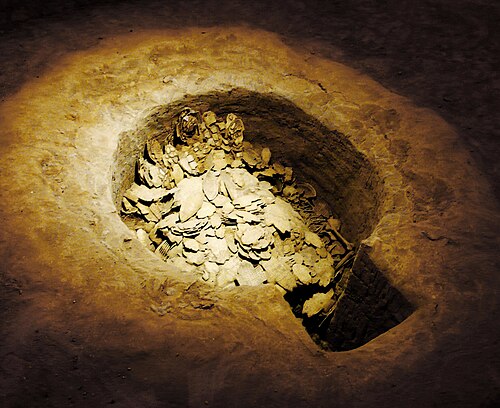
بحلول وقت تأسيس معهد التاريخ وفقه اللغة على يد فو سينيان في الأكاديمية الصينية عام ١٩٢٨، كان مصدر عظام التنبؤ قد حُدِّدَ في قرية شياوتون (小屯村) الحالية في آنيانغ بمقاطعة خنان. وقد كشفت الحفريات الأثرية الرسمية التي قادها لي جي ، أبو علم الآثار الصيني، [ ٢٧ ] بين عامي ١٩٢٨ و١٩٣٧ عن ٢٠٠٠٠ قطعة من عظام التنبؤ، والتي تُشكِّل الآن الجزء الأكبر من مجموعة الأكاديمية الصينية في تايوان، وتُمثِّل حوالي خُمس إجمالي ما تم اكتشافه. [ و ] وكانت أهم حفر العظام التي تم التنقيب عنها أثريًا هي:
- الحفرة YH127 في شياوتون الشمالية (1936)، مع أكثر من 17000 قطعة منقوشة.
- شياوتون الجنوبية (1977-1979)، مع 4612 قطعة منقوشة.
- هوايونغتشوانغ الشرقية (1991)، مع 561 قطعة منقوشة. [ 28 ]
عند فك رموز النقوش على عظام التنبؤ، تبيّن أنها سجلات للتنبؤات التي أُجريت لصالح أو من قِبل العائلة المالكة. هذه النقوش، إلى جانب المقابر الفخمة، أثبتت للمرة الأولى، وبشكل قاطع، وجود سلالة شانغ، التي كانت موضع شك مؤخرًا، وموقع عاصمتها الأخيرة، يين. ولذلك، تُعرف شياوتون في آنيانغ اليوم أيضًا باسم أطلال يين، أو يينكسو .
منشور
نُشرت نقوش عظام العرافة فور اكتشافها في مجلدات . لاحقًا، نُشرت أيضًا العديد من مجموعات النقوش. فيما يلي أهم هذه المجموعات.
- 殷墟文字甲編؛ Yinxu Wenzi جيابيان
- 殷墟文字乙編; Yinxu wenzi yibian
- 殷墟文字丙編; Yinxu Wenzi Bingbian
- 殷虛書契前編; يين شو شو تشي تشيان بيان
- 集殷虛文字楹帖彙編; جي يين شو ون زي ينغ تاي هوي بيان
- 殷墟萃編; Yinxu cuibian
- 后上; هوشانغ
- 后下; هوشيا
- 粹編; Cuibian
- 殷虛書契續編; يين شو شو تشي شو بيان
- 亀甲; كيكو
- 殷契摭佚續編; Yinqizhiyi xubian
- 殷契遺珠; ينكي ييتشو
- أفضل ما في الأمر هو أن كل ما تحتاج إليه هو ما تحتاجه ؛ كيوتو ديغاكو جيمبونكاجاكو كينكيوشوزو كوكوتسوموجي
- 殷契佚存; ييكي ييكون
- 甲骨綴合編; جياجو زويهيبيان
- 鐵雲藏龜拾遺; تييون كانغي شيي
- 戰後京津新獲甲骨集; زانهو جينجين شينهو جياجوجي (1954)
- 殷墟文字存真; Yinxu wenzi cunzhen
- 戰後寧滬新獲甲骨集؛ زانهو نينغهو شينهو جياجوجي (1951)
لاحظ المؤرخان هو هوكسوان وغو مورو أن توثيق هذه الأعمال المختلفة أصبح مُرهقًا، فبدآ جهدًا لنشر جميع العظام المكتشفة بحلول منتصف خمسينيات القرن العشرين بشكل شامل. وكانت النتيجة كتاب "جياغوين هيجي" (1978-1982)، الذي حرره هوكسوان وغو مورو، والذي يُعد ، مع ملحقه (1999) الذي حرره بينغ بانغجيونغ، الفهرس الأكثر شمولًا لشظايا عظام التنبؤ. تحتوي المجلدات العشرون على نسخ لأكثر من 55000 شظية. كما يتضمن عمل منفصل نُشر عام 1999 نسخًا من النقوش إلى الأحرف القياسية. [ 30 ]
مواعدة

The vast majority of the inscribed oracle bones were found at the Yinxu site in modern Anyang and date to the reigns of the last nine Shang kings.[31] The diviners named on the bones have been assigned to five periods by Dong Zuobin:[32]
| Period | Kings | Common diviners |
|---|---|---|
| I | Wu Ding[i] | nán𬆩, Bīn賓, Zhēng爭, Xuān宣 |
| II | Zu Geng, Zu Jia | Dà大, Lǚ旅, Xíng行, Jí即, Yǐn尹, Chū出 |
| III | Lin Xin, Kang Ding | Hé何 |
| IV | Wu Yi, Wen Wu Ding | |
| V | Di Yi, Di Xin |
The kings were involved in divination in all periods, with divinations in later periods done personally by the king.[34] The extant inscriptions are not evenly distributed across these periods, with 55% coming from period I and 31% from periods III and IV.[35] A few oracle bones date to the beginning of the subsequent Zhou dynasty.
تُسجّل أقدم عظام التنبؤ (التي تعود إلى عهدي وو دينغ وزو غنغ) التواريخ باستخدام دورة الستين يومًا فقط ، مع ذكر الشهر أحيانًا. [ 36 ] وتركز محاولات تحديد تسلسل زمني مطلق على عدد من خسوفات القمر المسجلة في نقوش مجموعة بين، التي عملت خلال عهد وو دينغ، وربما امتدت إلى عهد زو غنغ. وبافتراض استمرار دورة الستين يومًا دون انقطاع خلال الفترة المؤرخة بدقة، سعى الباحثون إلى مطابقة التواريخ المسجلة مع التواريخ المحسوبة للخسوفات. [37] وهناك اتفاق عام على أربعة منها، تمتد تواريخها من 1198 إلى 1180 قبل الميلاد. [37] ويُنسب خسوف خامس إلى عام 1201 قبل الميلاد من قِبل بعض الباحثين . [ 38 ] استنادًا إلى هذه البيانات، اعتمد مشروع التسلسل الزمني لسلالات شيا-شانغ-تشو ، بناءً على ما ورد في فصل "ضد الترف والرخاء" من كتاب الوثائق من أن حكم وو دينغ دام 59 عامًا، على الفترة ما بين 1250 و1192 قبل الميلاد. [ 39 ] [ 40 ] جادل عالم الصينيات الأمريكي ديفيد كايتلي بأن فصل "ضد الترف والرخاء" لا ينبغي اعتباره نصًا تاريخيًا لأنه كُتب في وقت لاحق، ويُقدم مدد الحكم كأحكام أخلاقية، ويُورد مدد حكم أخرى تتعارض مع الأدلة الموجودة على عظام التنبؤ. [ 41 ] بافتراض متوسط مدة حكم يبلغ 20 عامًا استنادًا إلى عهود سلالة تشو المؤرخة، اقترح كايتلي أن حكم وو دينغ بدأ حوالي عام 1200 قبل الميلاد أو قبل ذلك. [ 42 ] يؤرخ كين-إيتشي تاكاشيما أقدم نقوش عظام التنبؤ إلى عام 1230 قبل الميلاد. [ 43 ] تم تحديد عمر 26 عظمة من عظام التنبؤ التي عُثر عليها خلال عهد وو دينغ باستخدام التأريخ بالكربون المشع، حيث تراوحت أعمارها بين 1254 و1197 قبل الميلاد (±10 سنوات)، مع احتمال بنسبة 80-90% لاحتوائها على الأعمار الحقيقية لكل عظمة. [ 44 ]
غالبًا ما تُحدد نقوش الفترة الخامسة دورات طقوسية مرقمة، مما يُسهّل تقدير مدة حكم الملكين الأخيرين. [ 45 ] يُؤرّخ كايتلي بداية هذه الفترة بين عامي 1100 و1090 قبل الميلاد، بينما يُؤرّخها مشروع شيا-شانغ-تشو بين عامي 1101 قبل الميلاد. [ 46 ] [ 40 ] يتفق معظم الباحثين الآن على أن غزو تشو لسلالة شانغ حدث في حوالي عام 1046 أو 1045 قبل الميلاد، أي بعد أكثر من قرن من التاريخ التقليدي. [ 47 ] [ 48 ] [ 49 ]
التنجيم في شانغ
بما أن التنجيم كان يتم عن طريق الحرارة أو النار وفي أغلب الأحيان على الدروع أو عظام الكتف، فإن مصطلحات التنجيم بالنار ، والتنجيم بالدروع [ j ] ، والتنجيم بعظام الكتف تستخدم غالبًا لهذه العملية.
مواد

The oracle bones are mostly turtle plastrons, probably female[k] and ox scapulae, although there are also examples of tortoise carapaces, ox rib bones,[l] the scapulae of sheep, boars, horses, and deer, and other various animal bones.[m] The skulls of deer, oxen, and humans have also been found with inscriptions on them,[n] although these are very rare and appear to have been inscribed for record keeping or practice rather than for actual divination;[50][o] in one case, inscribed deer antlers were reported, but Keightley reports that they are fake.[51][p] Interestingly, tortoises are not native to the areas oracle bones were discovered and thus it is theorized they were presented to the region as tribute.[52] Neolithic diviners in China had long been heating the bones of deer, sheep, pigs, and cattle for similar purposes; evidence for this in Liaoning has been found dating to the late fourth millennium BCE.[53] However, over time, the use of ox bones increased, and use of tortoise shells does not appear until early Shang culture. The earliest tortoise shells found that had been prepared for divinatory use (i.e., with chiseled pits) date to the earliest Shang stratum at Erligang (modern Zhengzhou).[54] By the end of the Erligang, the plastrons were numerous,[54] and at Anyang, scapulae and plastrons were used in roughly equal numbers.[55] Due to the use of these shells in addition to bones, early references to the oracle bone script often used the term "shell and bone script", but since tortoise shells are actually a bony material, the more concise term "oracle bones" is applied to them as well.
The bones or shells were first sourced and then prepared for use. Their sourcing is significant because some of them (especially many of the shells) are believed to have been presented as tribute to the Shang, which provides valuable information about diplomatic relations of the time. We know this because notations were often made on them recording their provenance (e.g., tribute of how many shells from where and on what date). For example, one notation records that "Què (雀) sent 250 (tortoise shells)", identifying this as, perhaps, a statelet within the Shang sphere of influence.[56][57][q] These notations were generally made on the back of the shell's bridge (called bridge notations), the lower carapace, or the xiphiplastron (tail edge). Some shells may have been from locally raised tortoises, however.[r] Scapula notations were near the socket or a lower edge. Some of these notations were not carved after being written with a brush, proving (along with other evidence) the use of the writing brush in Shang times. Scapulae are assumed to have generally come from the Shang's own livestock, perhaps those used in ritual sacrifice, although there are records of cattle sent as tribute as well, including some recorded via marginal notations.[59]
Preparation

The bones or shells were cleaned of meat and then prepared by sawing, scraping, smoothing, and even polishing to create flat surfaces.[58][60][s] The predominance of scapulae, and later of plastrons, is also thought to be related to their ease of use as large, flat surfaces that needed minimal preparation. There is also speculation that only female tortoise shells were used, as these are significantly less concave.[56] Pits or hollows were then drilled or chiseled partway through the bone or shell in an orderly series. At least one such drill has been unearthed at Erligang, exactly matching the pits in size and shape.[61] The shape of these pits evolved over time, and is an important indicator for dating the oracle bones within various sub-periods in the Shang dynasty. The shape and depth also helped determine the nature of the crack that would appear. The number of pits per bone or shell varied widely.
Cracking and interpretation

Divinations were typically carried out for the Shang kings in the presence of a diviner. Very few oracle bones were used in divination by other members of the royal family or nobles close to the king. By the latest periods, the Shang kings took over the role of diviner personally.[4]
During a divination session, the shell or bone was anointed with blood[62] and, in an inscription section called the "preface", the date was recorded using the Heavenly Stems and Earthly Branches, along with the diviner's name. Next, the topic of divination (called the "charge") was posed,[t] such as whether a particular ancestor was causing a king's toothache. The divination charges were often directed at ancestors, whom the ancient Chinese revered and worshiped, as well as natural powers and Dì (帝), the highest god in the Shang society. Anything of concern to the royal house of Shang served as possible topics for charges, from illness, birth and death, to weather, warfare, agriculture, tribute and so on.[2] One of the most common topics was whether performing rituals in a certain manner would be satisfactory.[u]
An intense heat source[v] was then inserted in a pit until it cracked. Due to the shape of the pit, the front side of the bone cracked in a rough 卜 shape. The character卜 (bǔ or pǔ; Old Chinese: *puk; 'to divine') may be a pictogram of such a crack; the reading of the character may also be an onomatopoeia for the cracking. A number of cracks were typically made in one session, sometimes on more than one bone, and these were typically numbered. The diviner in charge of the ceremony read the cracks to learn the answer to the divination. How exactly the cracks were interpreted is not known. The topic of divination was raised multiple times, and often in different ways, such as in the negative, or by changing the date being divined about. One oracle bone might be used for one session or for many,[w] and one session could be recorded on a number of bones. The divined answer was sometimes then marked either "auspicious" or "inauspicious", and the king occasionally added a "prognostication", his reading on the nature of the omen.[64] On very rare occasions, the actual outcome was later added to the bone in what is known as a "verification".[64] A complete record of all the above elements is rare; most bones contain just the date, diviner and topic of divination,[64] and many remained uninscribed after the divination.[63]
The uninscribed divination is thought to have been brush-written with ink or cinnabar on the oracle bones or accompanying documents, as a few of the oracle bones found still bear their brush-written divinations without carving,[x] while some have been found partially carved. After use, shells and bones used ritually were buried in separate pits (some for shells only; others for scapulae only),[y] in groups of up to hundreds or even thousands (one pit unearthed in 1936 contained over 17,000 pieces along with a human skeleton).[65]
Changes in the nature of divination
The targets and purposes of divination changed over time. During the reign of Wu Ding, diviners were likely to ask the powers or ancestors about things like the weather, success in battle, or building settlements. Offerings were promised if they would help with earthly affairs.
صنع الشقوق على جيازي (اليوم 1) تنبأ تشنغ قائلاً: "في الصلاة من أجل الحصاد للشمس، (سنقوم) بشق عشر بقرات مرقطة، ونتعهد بمئة بقرة مرقطة." ( هيجي 10116؛ Y530.2)
يوضح كايتلي أن هذه العرافة فريدة من نوعها لأنها موجهة إلى الشمس، ولكنها نموذجية في تقديم عشرة رؤوس من الماشية، مع تقديم مئة رأس أخرى إذا كان الحصاد جيدًا. [ 66 ] أما العرافات اللاحقة فكانت على الأرجح شكلية ومتفائلة، يقوم بها الملك بنفسه، موجهة إلى أسلافه، ضمن دورة منتظمة، ونادرًا ما تطلب من الأسلاف القيام بأي شيء. ويشير كايتلي إلى أن هذا يعكس تغيرًا في الأفكار حول ما يمكن أن تفعله القوى والأسلاف، ومدى تأثير الأحياء عليهم. [ 67 ]
دليل على بيرومانسي ما قبل أنيانغ
على الرغم من أن استخدام العظام في التنجيم كان شائعًا في جميع أنحاء العالم تقريبًا، إلا أن التنجيم الذي يستخدم النار أو الحرارة كان موجودًا بشكل عام في آسيا وثقافات أمريكا الشمالية ذات الأصل الآسيوي فقط. [ 68 ] يعود أصل استخدام الحرارة لكسر عظام الكتف (التنجيم الناري بالكتف) إلى الصين القديمة، حيث يعود أقدم دليل على ذلك إلى الألفية الرابعة قبل الميلاد مع اكتشافات أثرية من لياونينغ، على الرغم من أنها لم تكن منقوشة. [ 53 ] تم العثور على عظام كتف الأبقار والأغنام والخنازير والغزلان المستخدمة في التنجيم الناري في مواقع أثرية من العصر الحجري الحديث، [ 69 ] ويبدو أن هذه الممارسة أصبحت شائعة جدًا بحلول نهاية الألفية الثالثة قبل الميلاد. تم الكشف عن عظام الكتف إلى جانب أعداد أقل من الدروع الصدرية الخالية من الحفر في مرحلة نانغوانواي (南關外) في تشنغتشو؛ كما تم اكتشاف عظام الكتف بالإضافة إلى أعداد أقل من الدروع البطنية ذات الحفر المنحوتة في مرحلتي إرليغانغ السفلى والعليا. [ 70 ]
لم يظهر استخدام ملحوظ لدروع السلاحف إلا في مواقع حضارة شانغ. [ 54 ] عُثر على عظام كتف ودروع ثيران، كلاهما مُعدٌّ للتنبؤ، في مواقع حضارة شانغ في تايكسيكون (台西村) في خبي وتشيوان (丘灣) في جيانغسو . [ 71 ] عُثر على عظمة كتف واحدة أو أكثر منقّرة في لوسيكون (鹿寺村) في خنان، بينما عُثر على عظام كتف غير منقّرة في إرليتو في خنان، وسيكسيان (磁縣) في خبي، ونينغتشنغ (寧城) في لياونينغ، وتشيجيا (齊家) في قانسو . [ 72 ] لا يصبح عدد الصفائح البطنية أكثر من عدد صفائح الكتف إلا في مرحلة رينمين (人民) بارك. [ 73 ]
Other sites
Four inscribed bones have been found at Zhengzhou: three with numbers 310, 311, and 312 in the Hebu corpus, and one that has a single character (ㄓ), which also appears in late Shang inscriptions. HB 310, which contained two brief divinations, has been lost, but is recorded in a rubbing and two photographs. HB 311 and 312 each contain a pair of characters that are similar to the late Shang script. HB 312 was found in an upper layer of the Erligang culture. The others were found accidentally in river management earthworks, and so lack archaeological context. Pei Mingxiang argued that they predated the Anyang site. Takashima, referring to character forms and syntax, argues that they were contemporaneous with the reign of Wu Ding.[74][75]
A turtle plastron bearing several short inscriptions was found at Daxinzhuang in Shandong on the floor of a semi-subterranean house dating from the Late Shang period. The style of characters is close to that used by particular diviner groups active at Anyang during the reign of Wu Ding, though it shows some variations.[76]
Nearly 300 inscribed oracle bones (HB 1–290) were found in 1977 in two pits dug into a building foundation at Qijia, Fufeng County, Shaanxi, part of the Zhou ritual centre known as the Zhōuyuán. Some of these are believed to be contemporaneous with the reign of Di Xin, the last Shang king, and others to date from the early Western Zhou.[77][78] The inscriptions are distinguished from those of Anyang in the way the bones and shells were prepared and used, the smallness of the characters, the presence of unique vocabulary, and the use of the phases of the moon as a dating device.[79] Four pieces (HB 1, 12, 13 and 15) have been particularly puzzling, because they refer to sacrifices in the temples of Shang ancestors, and also differ from the other bones in calligraphy and syntax. Scholars disagree on whether they were produced at Anyang or the Zhouyuan, and whether the diviners and scribes were Shang or Zhou.[80][81]
In 2003, around 600 inscribed bones were found at Zhougongmiao, a temple dedicated to the Duke of Zhou during the Tang dynasty, about 18 km (11 mi) west of Qijia. They mention the Duke of Zhou and other figures of the early Western Zhou.[77] A handful of oracle bones have been found at other Western Zhou sites, including some from Beijing.[82]
After the Shang
After the founding of Zhou, the Shang practices of bronze casting, pyromancy, and writing continued. Oracle bones that were found in the 1970s have been dated to the Zhou dynasty, with some dating to the Spring and Autumn period; very few, however, were inscribed. It is thought that other methods of divination supplanted pyromancy, such as numerological divination using milfoil (yarrow) in connection with the hexagrams of the I Ching, leading to the decline of inscribed oracle bones. However, evidence for the continued use of plastromancy exists for the Eastern Zhou, Han, Tang,[83] and Qing[84] dynasty periods, and Keightley mentions its use in Taiwan as late as 1972.[85]
Pyromancy is described in the earliest historical records of Japan; it may have been loaned entirely from China, or partially indigenous. The Records of the Three Kingdoms attest to deer-bone scapulimancy among the Wa, and the Nara classics Kojiki and Nihon Shoki are in agreement. However, there is no indication of plastromancy until the early Heian, at which point it became standard. The clan name Urabe (卜部) means "divining caste", and this clan did indeed hold a monopoly on divination for Imperial purposes. Today, Japan is the only place in the world where pyro-plastromancy is still practiced.[86]
See also
Notes
- ↑A tiny number of isolated mid to late Shang pottery, bone and bronze inscriptions may predate the oracle bones. However, the oracle bones are considered the earliest significant body of writing due to the length of the inscriptions, the vast amount of vocabulary (roughly 4000 graphs), and the sheer quantity of pieces found – at least 160,000 pieces[4][5] bearing millions of characters.[6] There are also inscribed or brush-written Neolithic signs in China, but they do not generally occur in strings of signs resembling writing, instead appearing singly. Whether or not these signs constitute writing or are ancestral to the Shang writing system is currently a matter of great academic controversy. They are also insignificant in number compared to the massive amounts of oracle bones found thus far.[7][8][9]
- ↑Chou 1976, p. 12 cites two such scapulae, citing his own "商殷帝王本紀" Shāng–Yīn dìwáng bĕnjì, pp. 18–21.
- ↑Xu 2002, pp. 4–5 cites The Compendium of Materia Medica and includes a photo of the relevant page and entry.
- ↑Xu 2002, p. 6 cites eight waves of illegal digs over three decades, with tens of thousands of pieces taken.
- ↑Rev. Chalfant acquired 803 oracle bone pieces between 1903 and 1908, and hand-traced over 2500 pieces including these.[23]
- ↑over 100,000 pieces have been found in total.[4][5]
- ↑Eleven royal-sized tombs were found.[29] This exactly matches the number of kings who should have been buried at Yin (the 12th king died in the Zhou conquest and would not have received a royal burial).
- ↑The Heji was published between 1978 and 1982 by the Zhonghua Publishing House. Somewhat unusually, the work was credited to Guo Moruo (郭沫若) as 主編 and Hu Houxuan (胡厚宣) as 总编辑. Both terms are translated into English as 'chief editor' or 'editor-in-chief'. The project of a creating comprehensive catalog of oracle bone inscriptions was proposed in the early 1950s by Guo, who served as the first president of the Chinese Academy of Sciences (CAS) from 1949 to 1978. Hu was transferred from Fudan University to the CAS in 1956 for the purpose of editing the Heji, and was in charge of the day-to-day editorial activity of the Heji when the project officially began in 1961, with Guo playing an advisory role. Guo died in 1978.
- ↑Dong also included kings Pan Geng, Xiao Xin and Xiao Yi. However, few or perhaps no inscriptions can be reliably assigned to pre-Wu Ding reigns. Many scholars assume that earlier oracle bones from Anyang exist but have not yet been found.[33]
- ↑According to Keightley 1978a, p. 5, citing Yang Junshi 1963, the term plastromancy (from plastron + Greek μαντεία, "divination") was coined by Li Ji.
- ↑Keightley 1978a, p. 9 – the female shells are smoother, flatter and of more uniform thickness, facilitating pyromantic use.
- ↑According to Chou 1976, p. 7, only four rib bones have been found.
- ↑such as ox humerus or talus bone.[22]
- ↑Xu 2002, p. 34 shows a large, clear photograph of a piece of inscribed human skull in the collection of the Institute of History and Philology at the Academia Sinica, Taiwan, presumably belonging to an enemy of the Shang.
- ↑There appears to be some confusion in published reports between inscribed bones in general, and bones that have actually been heated and cracked for use in divination.
- ↑Xu 2002, p. 35 does show an inscribed deer skull, thought to have been killed by a Shang king during a hunt.
- ↑Some cattle scapulae were also tribute.[58]
- ↑Keightley 1978a, p. 12 mentions reports of Xiǎotún villagers finding hundreds of shells of all sizes, implying live tending or breeding of the turtles onsite.
- ↑ يشير تشو 1976 ، ص 12 إلى وجود دليل على النشر على بعض عظام العرافة، وأن المناشير كانت على الأرجح مصنوعة من البرونز، على الرغم من عدم العثور على أي منها على الإطلاق.
- ↑ هناك جدل أكاديمي حول ما إذا كان الموضوع قد طُرح كسؤال أم لا؛ يفضل كايتلي مصطلح "الاتهام"، حيث لم تكن الأسئلة النحوية متضمنة في كثير من الأحيان.
- ↑ للحصول على نظرة عامة أكثر شمولاً حول مواضيع العرافة وما يمكن استخلاصه منها حول شعب شانغ وبيئتهم، انظر Keightley 2000 .
- ↑ لا تزال طبيعة مصدر الحرارة هذا موضع نقاش.
- ↑ تحمل معظم عظام العرافة الكاملة (غير المجزأة) نقوشًا متعددة، أطولها يبلغ طولها حوالي 90 حرفًا. [ 63 ]
- ↑ يذكر كيو 2000 ، ص 60 أن بعضها كتب بالفرشاة إما بالحبر أو الزنجفر، ولكن لم يتم نقشها.
- ↑ أما تلك التي كانت مخصصة للتدريب أو التسجيل فقد دُفنت في حفر النفايات العامة. [ 65 ]
مراجع
- ↑ ويلكنسون 2022 ، ص. 1277.
- 1 2 Keightley 1978a ، ص 33-35.
- ↑ Keightley 1978a ، ص 40-42.
- 1 2 3 تشيو 2000 ، ص. 61.
- 1 2 كيتلي 1978 أ ، ص. الثالث عشر.
- 1 2 تشيو 2000 ، ص. 49.
- ↑ كيو 2000 .
- ↑ بولتز 2003 .
- ↑ وون 1987 .
- ↑ ويلكنسون 2022 ، ص 1278.
- ↑ Keightley 1978a ، ص. 13، 185–187.
- ↑ مينزيس 1917 ، ص 2.
- ↑ وانغ، يوكسين؛ 王宇信 (2010). جيا غو شيويه داو لون = تاريخ التأريخ الصيني . جيان تشن وي. بكين: الأكاديمية الصينية للعلوم الاجتماعية . ISBN 978-7-5004-8878-1. OCLC 690131145 .
- ^ تشيو 2000 ، ص. 60.
- ^ تشو 1976 ، ص. 1 ، نقلاً عن Wei Juxian 1939، "Qín-Hàn shi fāxiàn jiīgówén shuō"، في Shuōwén Yuè Kān، المجلد. 1، رقم 4؛ و He Tianxing 1940، "JiɎgƔwén yi xianyu gīdài shuō"، في Xueshu (ShànghƎi)، لا. 1
- 1 2 3 4 5 ويلكنسون 2013 ، ص. 681.
- ↑ فيربانك وغولدمان 2006 ، ص 33.
- 1 2 3 4 5 شو 2002 ، ص. 4.
- ↑ ويلكنسون 2013 ، ص 681-682.
- ^ شو 2002 ، ص. 16.
- 1 2 ويلكنسون 2013 ، ص. 682.
- 1 2 تشو 1976 ، ص. 1.
- ↑ تشو 1976 ، ص 1-2.
- 1 2 يورك 2008 .
- ↑ وانغ هايبينغ (2006). "مينزيس ومنح ين-شانغ الثقافية - رابطة لا تنفصم". صحيفة أنيانغ ريباو [صحيفة أنيانغ اليومية]، 12 أغسطس 2006، ص 1
- ↑ انظر لينفو دونغ (2005). التبادل الثقافي والإيمان: حياة وأعمال جيمس ميلون مينزيس . تورنتو: مطبعة جامعة تورنتو، رقم ISBN 978-0-8020-3869-2.
- ^ شو 2002 ، ص. 9.
- ↑ ويلكنسون 2013 ، ص 684.
- ^ شو 2002 ، ص. 10.
- ↑ ويلكنسون 2013 ، ص 685-686.
- ↑ Keightley 1978a ، ص. 13، 139.
- ↑ Keightley 1978a ، ص 31، 92-93، 203.
- ↑ Keightley 1978a ، ص 97-98، 139-140، 203.
- ↑ Keightley 1978a ، ص 31.
- ↑ Keightley 1978a ، ص 139-140.
- ↑ Keightley 1978a ، ص 113-116.
- 1 2 Keightley 1978a ، ص. 174.
- ↑ Zhang 2002 ، ص 353.
- ^ تشانغ 2002 ، ص 352-354.
- 1 2 Li 2002 ، ص. 331.
- ↑ Keightley 1978b ، ص 428-429.
- ↑ Keightley 1978a ، ص 174-175 ، 228.
- ^ تاكاشيما 2012 ، ص. 142.
- ↑ Liu et al. 2021 ، ص 165.
- ↑ Keightley 1978a ، ص 116، 174-175.
- ↑ Keightley 1978a ، ص 228.
- ↑ Keightley 1978a ، ص 226-228.
- ^ لي 2002 ، ص 328-330.
- ^ تاكاشيما 2012 ، ص 142-143.
- ↑ Keightley 1978a ، ص 7.
- ↑ Keightley 1978a ، ص 7 ، ملاحظة 21.
- ↑ رافين، جيمس (2020). تاريخ أكسفورد المصور للكتاب ( طبعة مصورة). مطبعة جامعة أكسفورد. ISBN 978-0-19-870298-6.
- 1 2 Keightley 1978a ، ص. 3.
- 1 2 3 Keightley 1978a ، ص. 8.
- ↑ Keightley 1978a ، ص 10.
- 12Keightley 1978a, p. 9.
- ↑Xu 2002, p. 22.
- 12Xu 2002, p. 24.
- ↑Keightley 1978a, p. 11.
- ↑Keightley 1978a, pp. 13–14.
- ↑Keightley 1978a, p. 18.
- ↑Xu 2002, p. 28, citing the Rites of Zhou.
- 12Qiu 2000, p. 62.
- 123Xu 2002, p. 30.
- 12Xu 2002, p. 32.
- ↑David N. Keightley "The Making of the Ancestors: Late Shang Religion and its Legacy" in Keightley, David N. These Bones Shall Rise Again: Selected Writings on Early China.. Albany, NY: State Univ of New York Pr, 2014. p.161
- ↑David N. Keightley "Late Shang Divination: The Magico-Religious Legacy" in Keightley, David N. These Bones Shall Rise Again: Selected Writings on Early China.. Albany, NY: State Univ of New York Pr, 2014 p.108, David N. Keightley "The Shang: China’s First Historical Dynasty" in Loewe, Michael, and Edward L. Shaughnessy. The Cambridge History of Ancient China: From the Origins of Civilization to 221 BC. Cambridge: Cambridge University Press, 1999. p.243-5
- ↑Keightley 1978a, pp. 3, 4, n. 11 and 12.
- ↑Keightley 1978a, pp. 3, 6, n.16.
- ↑Keightley 1978a, p. 8, note 25, citing KKHP 1973.1, pp. 70, 79, 88, 91, plates 3.1, 4.2, 13.8.
- ↑Keightley 1978a, p. 8, note 25 cites KK 1973.2 p.74.
- ↑Keightley 1978a, p. 6, n.16.
- ↑Keightley 1978a, p. 8, note 25 cites Zhèngzhoū Èrlĭgāng, p.38.
- ↑Takashima 2012, pp. 143–160.
- ↑Qiu 2000, pp. 41–42.
- ↑Takashima 2012, pp. 160–171.
- 12Li 2013, p. 118.
- ↑Takashima 2012, p. 141.
- ↑Shaughnessy 1985–1987, p. 155.
- ↑Li 1985–1987, pp. 173–174.
- ↑Takashima 2015, pp. 158–165.
- ↑Shaughnessy 1985–1987, p. 147.
- ↑Keightley 1978a, p. 4 n.4.
- ↑Keightley 1978a, p. 9, n.30, citing Hu Xu 1782–1787, ch. 4, p.3b on use in Jiangsu
- ↑Keightley 1978a, p. 9 cites Zhāng Guangyuan 1972
- ↑Kory, Stephan N. "Kory, Stephan N. "From Deer Bones to Turtle Shells: The State Ritualization of Pyro-Plastromancy During the Nara-Heian Transition." Japanese Journal of Religious Studies 42.2 (2015): 339–380". Japanese Journal of Religious Studies.
Works cited
- Boltz, William G. (2003). The origin and early development of the Chinese writing system. New Haven, CT: American Oriental Society. ISBN 0-940490-18-8.
- Chou, Hung-hsiang 周鴻翔 (1976). Oracle Bone Collections in the United States. University of California Press. ISBN 0-520-09534-0.
- Fairbank, John King; Goldman, Merle (2006). China: a new history (2nd ed.). Cambridge, MA: Belknap Press of Harvard University Press. ISBN 0-674-01828-1.
- Keightley, David N. (1978a). Sources of Shang history : the oracle-bone inscriptions of Bronze Age China. Berkeley: University of California Press. ISBN 0-520-02969-0.
- ——— (1978b). "The Bamboo Annals and Shang-Chou Chronology". Harvard Journal of Asiatic Studies. 38 (2): 423–438. doi:10.2307/2718906. JSTOR 2718906.
- ——— (2000). The ancestral landscape: time, space, and community in late Shang China, ca. 1200–1045 B.C. Berkeley: University of California. ISBN 1-55729-070-9.
- Li, Feng (2013). Early China: a social and cultural history. New York: Cambridge University Press. ISBN 978-0-521-71981-0.
- Li, Xueqin (1985–1987). "Are they Shang inscriptions or Zhou inscriptions?". Early China. 11/12: 173–176. JSTOR 23351461.
- ——— (2002). "The Xia-Shang-Zhou Chronology Project: Methodology and Results". Journal of East Asian Archaeology. 4: 321–333. doi:10.1163/156852302322454585.
- Liu, Kexin; Wu, Xiaohong; Guo, Zhiyu; Yuan, Sixun; Ding, Xingfang; Fu, Dongpo; Pan, Yan (2021). "Radiocarbon Dating of Oracle Bones of the Late Shang Period in Ancient China". Radiocarbon. 63 (1): 155–175. Bibcode:2021Radcb..63..155L. doi:10.1017/RDC.2020.90.
- Menzies, James M. (1917). Oracle Records from the Waste of Yin. Shanghai: Kelly & Walsh, Limited.
- Qiu, Xigui (2000). Chinese writing (Wenzixue gaiyao). Transl. by Gilbert L. Mattos and Jerry Norman. Berkeley: Society for the Study of Early China. ISBN 1-55729-071-7.
- Shaughnessy, Edward L. (1985–1987). "Zhouyuan Oracle-Bone Inscriptions: Entering the Research Stage?". Early China. 11/12: 146–163. doi:10.1017/S0362502800003990. JSTOR 23351457.
- Takashima, Ken-ichi (2012). "Literacy to the South and the East of Anyang in Shang China: Zhengzhou and Daxinzhuang". In Li, Feng; Branner, David Prager (eds.). Writing and Literacy in Early China: Studies from the Columbia Early China Seminar. University of Washington Press. pp. 141–172. ISBN 978-0-295-80450-7.
- ——— (2015). A Little Primer of Chinese Oracle-bone Inscriptions with Some Exercises. Harrassowitz. ISBN 978-3-447-19355-9.
- Wilkinson, Endymion (2013). Chinese History: A New Manual (4th ed.). Cambridge, MA: Harvard University Asia Center. ISBN 978-0-674-06715-8.
- ——— (2022). Chinese History: A New Manual (6th ed.). Cambridge, MA: Harvard University Asia Center. ISBN 978-0-674-26018-4.
- Woon Wee Lee (雲惟利) (1987). Chinese Writing: Its Origin and Evolution. Macau: University of East Asia. Now issued by Joint Publishing, Hong Kong.
- Xu Yahui (許雅惠) (2002). Ancient Chinese Writing, Oracle Bone Inscriptions from the Ruins of Yin. Translated by Caltonhill, Mark; Moser, Jeff. Taipei: National Palace Museum. ISBN 978-957-562-420-0. Illustrated guide to the Special Exhibition of Oracle Bone Inscriptions from the Institute of History and Philology, Academia Sinica. Govt. Publ. No. 1009100250.
- York, Geoffrey (January 19, 2008). "The Unsung Canadian Some Knew as 'Old Bones'". The Globe and Mail. pp. F4–5.
- Zhang, Peiyu (2002). "Determining Xia–Shang–Zhou Chronology through Astronomical Records in Historical Texts". Journal of East Asian Archaeology. 4: 335–357. doi:10.1163/156852302322454602.
External links
- Oracle bones, United College Library, Chinese University of Hong Kong. Includes 45 inscribed fragments.
- Oracle Bone CollectionArchived 2017-06-23 at the Wayback Machine, Institute of History and Philology, Taipei City.
- High-resolution digital images of oracle bones, Cambridge Digital Library.
- Couling-Chalfant oracle bone collection 甲骨Archived 2023-05-31 at the Wayback Machine (Or 7694/1506–2125), British Library.
- Yīnxū shūqì 殷虛書契 by Luo Zhenyu – a collection of rubbings or oracle bone fragments.
- Guījiǎ shòugǔ wénzì 龜甲獸骨文字 by Hayashi Taisuke – another collection of rubbings.
- 四方风 or Winds of the Four DirectionsWorld Digital Library. National Library of China.
- Archaeological database documenting the origins of Oracle Bone divination in Ancient East Asia
- Archaeology of China
- Chinese inscriptions
- Chinese inventions
- Objects used for divination
- Shang dynasty
- Religion in the Shang dynasty
- Writing media
- Oraculology
- Bone carvings