
Shibuya Station
Shibuya Station (渋谷駅, Shibuya-eki) is a major railway station in Shibuya, Tokyo, Japan, operated by East Japan Railway Company (JR East), Keio Corporation, Tokyu Corporation, and Tokyo Metro. It serves as a terminal for six railway lines, five of which are operated by Tokyo Metro and Tokyu Corporation.
As of 2025, the station is visited by approximately 3 million people per day, making it the second-busiest railway station in the world. The station handles a large population of commuter traffic between the city center and suburbs to the south and west.[1]
Lines
JR East
 Saikyō Line /
  Shōnan–Shinjuku Line (Yamanote Freight Line) - also used by Narita Express trains
 Yamanote Line
Private railways
 Keio Inokashira Line - terminus
 Den-en-toshi Line - through service with Tokyo Metro Hanzomon Line
 Tōyoko Line - through service with Tokyo Metro Fukutoshin Line
Subways
 Ginza Line - terminus
 Hanzōmon Line - through service with Tokyu Den-en-toshi Line
 Fukutoshin Line - through service with Tokyu Tōyoko Line
Note that while the Tokyo Metro Hanzōmon Line and Fukutoshin Line are directly connected to each other (and passengers can switch from one to another without passing through ticket gates), the Ginza Line station is a standalone terminal. Transfers to the Fukutoshin/Tōyoko Line are given 60 min to do so outside the fare control area, but those needing to transfer to Hanzōmon/Den-en-toshi Line should transfer at the Omotesando station instead.
History

On 1 March 1885, Shibuya Station was opened by the Nippon Railway as a stop on the Shinagawa Line, a predecessor of the present-day Yamanote Line. The station in its first years saw little usage by passengers, with an average of 16 to 17 people per day. The Shinagawa Line itself was initially single-tracked, and the station was serviced by two-car formations making three return trips. Usage increased from 1887, when local residents began to recognize the convenience of rail travel.[2] The Nippon Railway was later nationalized in 1906 under the Railway Nationalization Act.[3] The station was later expanded to accommodate the Tamagawa Line, now a section of the Setagaya Line, in August 1907. The Tokyo Toden extended to the station in August 1911. The station building was rebuilt with a new structure featuring a clock tower.
In 1922, Tamagawa Electric Railway opened the Tenngennji Line which terminates at the station.

The station continued to service additional lines, beginning with the Toyoko Line operated by the predecessor of Tokyu Corporation from 1927, and the current Inokashira Line in 1933.[4] The Tokyo Rapid Railway (later the Tokyo Metro Ginza Line) opened and began serving the station in 1938. Developments in the area around Shibuya Station paused during World War II.[2]
Following the end of the war, the Den-en-toshi Line (1977), the Hanzōmon Line (1978), and the Fukutoshin Line (2008) began serving the station. Between December 2008 and March 2009, piezoelectric-generating mats were installed at Shibuya Station as a small-scale test.[5][6][7][8]
From 22 February 2013, station numbering was introduced on Keio lines, with Shibuya Station denoted "IN01".[9] Station numbering was later introduced to the JR East platforms in 2016 with Shibuya assigned station numbers JS19 for the Shonan-Shinjuku line, JA10 for the Saikyo line, and JY20 for the Yamanote Line. At the same time, JR East assigned three-letter codes to its major transfer stations; Shibuya was assigned the code "SBY".[10][11]
Redevelopments
في عامي 2013 و2014، خضعت محطة شيبويا لعمليات تجديد شاملة ضمن خطة طويلة الأجل لإعادة تطوير الموقع. [ 12 ] أُغلقت المباني القديمة، مثل مبنى المحطة الرئيسي السابق الذي كان يضم متجر توكيو متعدد الأقسام، وهُدمت. [ 13 ] افتُتح مبنى شيبويا هيكاري ، المملوك أيضاً لمجموعة توكيو ، في عام 2012، ويضم متاجر متعددة الأقسام ومطاعم ومكاتب. [ 14 ]
أعادت شركة JR East بناء المحطة، وبدأت أعمال إعادة الإعمار بشكل جدي في السنة المالية 2015. [ 15 ] في 3 يناير 2020، نُقلت أرصفة خط غينزا حوالي 50 مترًا (164 قدمًا وبوصة واحدة) شرق موقعها السابق. [ 16 ] في 1 يونيو 2020، نُقلت أرصفة خط سايكيو حوالي 350 مترًا (1148 قدمًا و4 بوصات) شمال الأرصفة القديمة، وهي الآن مجاورة مباشرة لأرصفة خط يامانوتي. [ 17 ] جرت أعمال توسعة رئيسية على رصيف الحلقة الداخلية لخط يامانوتي (الرصيف 2) في 23-24 أكتوبر 2021. [ 18 ] ونتيجة لذلك، تم تعليق خدمة خط يامانوتي بين إيكيبوكورو وأوساكي. [ 19 ] مع افتتاح خط سوتيتسو لينك في 30 نوفمبر 2019، بدأ خط سايكيو في تقديم خدمات النقل المباشر إلى خط سكة حديد ساغامي .
على رصيف خط تويوكو، الذي نُقل إلى الجانب الشرقي من المحطة، شيدت شركة توكيو مبنى تجاريًا بارتفاع 230 مترًا (754 قدمًا و7 بوصات) و47 طابقًا يُدعى " شيبويا سكرامبل سكوير "، والذي أصبح أطول مبنى في شيبويا عند افتتاحه في نوفمبر 2019. ولا تزال أجزاء أخرى من المجمع قيد الإنشاء، ومن المقرر الانتهاء منها بحلول عام 2031. [ 20 ] ومن المقرر الانتهاء من العديد من المباني التجارية المتصلة بالمحطة بحلول عام 2027. [ 21 ]
تصميم المحطة
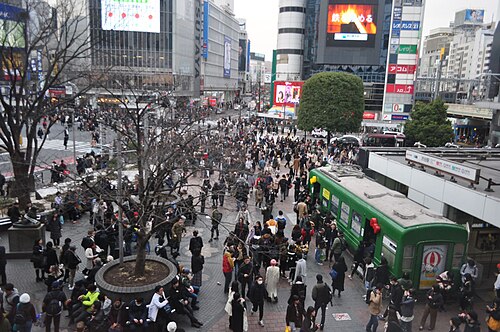
يستخدم خط طوكيو مترو غينزا ، الذي بنته وأدارته في الأصل شركة تابعة لمجموعة توكيو كيريتسو ، أرصفة في الطابق الثالث من مبنى المحطة. أما خطوط JR فتقع في الطابق الثاني باتجاه شمال-جنوب. وكان خط توكيو تويوكو يستخدم في الأصل أرصفة متوازية في الطابق الثاني من المبنى نفسه، ولكن اعتبارًا من 16 مارس 2013، انتقل خط تويوكو إلى الأنفاق لتوفير خدمة السكك الحديدية مع خط طوكيو مترو فوكوتوشين . ويتشارك خط طوكيو مترو هانزومون وخط توكيو دين-إن-توشي أرصفة تحت الأرض في جزء آخر من المحطة. ويستخدم خط كيو إينوكاشيرا أرصفة في الطابق الثاني من مبنى شيبويا مارك سيتي غرب مجمع المحطة الرئيسي. [ 22 ]
يحتوي مجمع JR/Tokyu/Tokyo Metro الرئيسي على ستة مخارج. يعد مخرج هاتشيكو الشمالي الغربي (ハチ公口، Hachikō-guchi ) ، الذي سمي على اسم التمثال القريب للكلب هاتشيكو ويقع بجوار معبر التدافع الشهير في شيبويا ، مكانًا شهيرًا للاجتماع بشكل خاص. يؤدي مخرج تاماجاوا (玉川口، Tamagawa-guchi ) الموجود على الجانب الغربي إلى أرصفة محطة شيبويا على خط كيو إينوكاشيرا. [ 22 ]
في 17 نوفمبر 2008 ( 2008-11-17 ) ، تم الكشف عن جدارية للفنان تارو أوكاموتو بعنوان "أسطورة الغد"، والتي تصور شخصية بشرية تتعرض لضربة قنبلة ذرية، في موقعها الدائم الجديد في المحطة، في الممر المؤدي إلى مدخل خط كيو إينوكاشيرا. [ 23 ]
جيه آر إيست
المنصات
يوجد رصيفان جزيريان بإجمالي أربعة مسارات. يخدم أحد الرصيفين خط يامانوتي ، بينما يخدم الآخر خط سايكيو وخط شونان-شينجوكو .
The station opened in 1885 with one island platform serving what is now the Yamanote Line. To alleviate congestion, a second side platform was opened to the west in July 1940 and the original platform was converted to a side platform. In March 1996, the first Saikyō Line platform was opened. It was located to the south of the Yamanote Line platforms, approximately 350 m (1,148 ft 4 in) away. This platform was relocated to its current location during 30–31 May 2020.[15][24] The original Yamanote Line platform was then widened during 23–24 October 2021.[25] Further widened during 7–8 January 2023, when the west side platform was removed from service and both directions of the Yamanote Line were recombined into a single island platform.[26]
| 1 | Yamanote Line | for Shinjuku, and Ikebukuro |
| 2 | Yamanote Line | for Shinagawa and Tokyo |
| 3 | Saikyō Line | for Shinjuku, Ōmiya, and Kawagoe |
| Shōnan-Shinjuku Line | for Shinjuku and Ōmiya(via the  Takasaki Line) for Kumagaya, Takasaki, Maebashi(via the Utsunomiya Line) for Oyama, Utsunomiya Takasaki Line) for Kumagaya, Takasaki, Maebashi(via the Utsunomiya Line) for Oyama, Utsunomiya | |
| 4 | Saikyō Line | for Ōsaki Rinkai Line for Shin-Kiba Rinkai Line for Shin-Kiba Sotetsu Line for Hazawa yokohama-kokudai and Ebina Sotetsu Line for Hazawa yokohama-kokudai and Ebina |
| Shōnan-Shinjuku Line | for Yokohama and Ōfuna(via the  Tōkaidō Line) for Odawara(via the Tōkaidō Line) for Odawara(via the  Yokosuka Line) for Zushi Yokosuka Line) for Zushi | |
| ■ Ltd. Express Narita Express | for Tokyo and Narita Airport |
Tokyo Metro/Tokyu
| Station layout | ||
|---|---|---|
| 3FGinza Line platforms | Platform 2 | Ginza Line towards Asakusa(Omotesandō) → |
| Island platform, doors will open on the right | ||
| Platform 1 | Ginza Line towards Asakusa(Omotesandō) → | |
| Ginza Line concourse | Ginza Line ticket barriers, ticket officePassageways to JR platforms | |
| 2F | Upper mezzanine | Ginza Line ticket barriers, ticket machines, station agent Passageways to JR and Keio Inokashira Line platforms |
| 1F | Street Level | Exit/Entrance Transfer between Ginza Line and Hanzomon Line/Fukutoshin Line/Tokyu stations |
| B1F | Transfer mezzanine | Staircases and elevators to lower mezzanine |
| B2F | Lower mezzanine | Hanzomon Line/Fukutoshin Line/Tokyu ticket barriers, ticket machines, station agent |
| B3F Hanzōmon LineDen-en-toshi Line platform | Platform 2 | Hanzōmon Line towards Oshiage(Omotesandō) → |
| Island platform, doors will open on the right | ||
| Platform 1 | ← Tōkyū Den-en-toshi Line towards Chūō-rinkan(Ikejiri-ōhashi) ← Hanzōmon Line termination track | |
| B4F | Transfer mezzanine | Transfer between Hanzōmon Line/Den-en-toshi Line and Fukutoshin Line/Tōyoko Line platforms |
| B5F Fukutoshin LineTōyoko Line platforms | Platform 6 | Fukutoshin Line towards Wakōshi(Meiji-Jingūmae) → |
| Island platform, doors will open on the left/right | ||
| Platform 5 | Fukutoshin Line towards Wakōshi(Meiji-Jingūmae) → | |
| Platform 4 | ← Tokyu Toyoko Line towards Yokohama(Daikan-yama) | |
| Island platform, doors will open on the left/right | ||
| Platform 3 | ← Tōkyū Tōyoko Line towards Yokohama(Daikan-yama) | |
Tokyu Den-en-toshi Line and Tokyo Metro Hanzomon Line
Platforms
On the third basement (B3F) level, a single underground island platform serves two tracks.[27]


Tokyu Toyoko Line and Tokyo Metro Fukutoshin Line
Platforms
Two underground island platforms on the fifth basement (B5F) level serve four tracks.[28] Tokyu has been managing the station since the opening of the Fukutoshin Line in 2008, and the Toyoko Line uses platforms 3 and 4 since the start of through services with the two lines on 16 March 2013.
| 3-4 | Tōyoko Line |
|
| 5-6 | Fukutoshin Line | for Shinjuku-sanchome, Ikebukuro, and Wakoshi
|



Tokyo Metro Ginza Line
Platforms
As of January 2020, one island platform serves two tracks.[28] Until December 2019, two side platforms each served one track, with one platform for terminating services and one for services departing towards Asakusa.
Due to the distance between the Ginza and Hanzomon Line platforms, transfer information is announced at Omote-sando Station instead.
| 1-2 | Ginza Line | for Akasaka-mitsuke, Ginza, Ueno, and Asakusa |
 The Ginza Line platforms in 1977
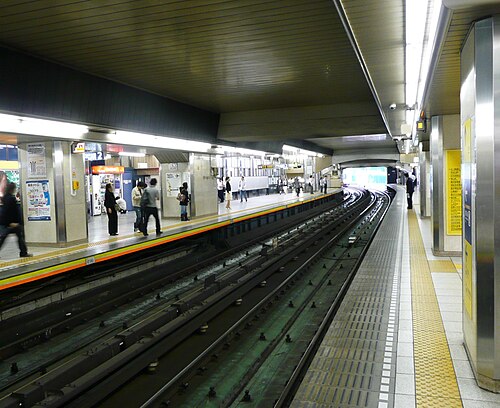 The same platforms in 2010
Keio Inokashira Line
Platforms
The Keio station consists of two bay platforms serving two tracks.[29] It began operations on 1 August 1933.[30]
| 1, 2 | Keio Inokashira Line | for Shimo-Kitazawa, Meidaimae, Eifukuchō, and Kichijōji |
Former Toyoko Line station
The former above-ground Tokyu Toyoko Line terminal station platforms were taken out of use after the last train service on 15 March 2013. From the start of the revised timetable on 16 March 2013, Toyoko Line services used the underground platforms 3-4 shared with Tokyo Metro Fukutoshin Line services.
Platforms
The station had four 8-car long bay platforms numbered 1 to 4, serving four tracks.
| 1-4 | ■ Tokyu Toyoko Line | for Naka-Meguro, Jiyūgaoka, Yokohama, (Minatomirai Line) Motomachi-Chūkagai |
Passenger statistics
1953-2000
Source: Tokyo Metropolitan Government[31]
2000-present
In fiscal year 2013, the JR East station was used by 378,539 passengers daily (boarding passengers only), making it the fifth-busiest JR East station.[32] Over the same fiscal year, the Keio station was used by an average of 336,957 passengers daily (exiting and entering passengers), making it the busiest station on the Inokashira Line.[33] In fiscal 2013, the Tokyo Metro Ginza station was used by an average of 212,136 passengers daily and the Tokyo Metro Hanzōmon and Fukutoshin stations were used by an average of 731,184 passengers daily. Note that the latter statistics consider passengers who travel through Shibuya station on a through service as users of the station, even if they did not disembark at the station.[34] In fiscal 2013, the Tokyu Toyoko Line station was used by an average of 441,266 passengers daily and the Den-en-toshi Line station was used by an average of 665,645 passengers daily.[35] The daily passenger figures for each operator in previous years are as shown below.
| Fiscal year | JR East | Tokyu | Tokyo Metro | Keio | |
|---|---|---|---|---|---|
| Tōyoko Line | Den-en-toshi Line | ||||
| 1999 | 423,336[36] | 323,180[4] | |||
| 2000 | 428,165[37] | ||||
| 2005 | 423,884[38] | 412,237[39] | 631,481[39] | ||
| 2010 | 403,277[40] | 419,482[41] | 647,331[41] | 336,926[42] | |
| 2011 | 402,766[43] | 420,163[44] | 641,781[44] | 217,117[45] | 335,475[42] |
| 2012 | 412,009[46] | 435,994[47] | 656,867[47] | 226,644[48] | 344,972[33] |
| 2013 | 378,539[32] | 441,266[35] | 665,645[35] | 212,136[34] | 336,957[33] |
- Note that JR East figures are for boarding passengers only.
- Note that the Tokyo Metro figures are for the Ginza Line station only.
Source: Tokyo Metropolitan Government[31]
Surrounding area


Surrounding the station is the commercial center of Shibuya. The Tokyu Department Store is connected to the east gate of the station and several other department stores are within walking distance.
- Shibuya Ward Office
- NHK Broadcasting Center
- NHK Hall
- Shibuya Mark City
- Shibuya 109
- Shibuya Hikarie
- Yoyogi Park
- Miyashita Park
The Shibuya River flows directly under the station, to the east and parallel to the JR tracks. Unlike most other Japanese department stores, the east block of Tokyu Department Store closed in 2013, and due for demolition as a part of the Shibuya Station redevelopment plan, did not have basement retail space due to the river passing directly underneath. An escalator in the east block of the store was constructed over the river stops a few steps above floor level to make space for machinery underneath without the need for further excavation. Rivers are deemed public space under Japanese law, so building over one is normally illegal. It is not clear why this was allowed when the store buildings were first constructed in 1933.
Cultural references
The station and its surrounding area serves as the setting for the manga/animeJujutsu Kaisen from Chapters 79-136 (Episodes 32-47), the arc aptly named the “Shibuya Incident”. The show takes a particular interest in floor B5F in Episode 33 “Shibuya Incident - Gate, Open”.
See also
References
- ↑JR East 891,460 , Tokyu 414,833+680,395 "各駅乗降人員" (in Japanese). Archived from the original on 2012-06-03. Retrieved 2012-10-04., Tokyo Metro Hanzomon Line 472,123+258,609 "東京メトロ|企業情報|データライブラリー" (in Japanese). Archived from the original on 2008-06-22. Retrieved 2008-06-22., Keio 343,697 "京王グループ - Ir・企業情報 - 1日の駅別乗降人員" (in Japanese). Archived from the original on 2008-03-03. Retrieved 2009-10-28. Totals 3,061,117 million
- 12"渋谷駅は、なぜあんなに複雑になったのか". 東洋経済オンライン (in Japanese). 2016-10-16. Retrieved 2025-06-12.
- ↑日本鉄道史 (in Japanese). Ministry of Railways. 1921. p. 312. doi:10.11501/12061229.
- 12Terada, Hirokazu (July 2002). データブック日本の私鉄[Databook: Japan's Private Railways] (in Japanese). Japan: Neko Publishing. p. 205. ISBN 4-87366-874-3.
- ↑"Power-Generating Floors Offer New Source of Clean Energy". Trends in Japan. Web Japan. January 2010. Retrieved 2011-08-25.
- ↑Skjoldan, Lasse (2009-01-29). "Foot Powering Tokyo Train Station". News and Opinions. Celsias. Archived from the original on 2011-10-05. Retrieved 2011-08-25.
- ↑Fermoso, Jose (2008-12-17). "Power Generating Floor in Train Stations Light Up Holiday Displays". Wired – Gadget Lab. Condé Nast Digital. Retrieved 2011-08-26.
- ↑Keferl, Michael (2009-07-08). "Electricity-Generating Flooring Gets Tokyo Test". CScout. Archived from the original on 2011-06-30. Retrieved 2011-08-25.
- ↑京王線・井の頭線全駅で「駅ナンバリング」を導入します.[Station numbering to be introduced on Keio Line and Inokashira Line](PDF). News release (in Japanese). Keio Corporation. 2013-01-18. Archived from the original(PDF) on 2013-01-23. Retrieved 2013-02-23.
- ↑"⾸都圏エリアへ 「駅ナンバリング」を導⼊します"[Introduce "station numbering" to the Tokyo metropolitan area](PDF). jreast.co.jp (in Japanese). 6 April 2016. Archived from the original(PDF) on 7 December 2022. Retrieved 7 January 2023.
- ↑Kusamachi, Yoshikazu (7 April 2016). "JA・JK・JT・AKB...JR東日本、首都圏で駅ナンバリングなど導入へ"[JA, JK, JT, AKB ... JR East to introduce station numbering in the Tokyo metropolitan area]. Response Automotive Media (in Japanese). Archived from the original on 6 August 2022. Retrieved 7 January 2023.
- ↑"Urban Planning Proposal for Areas Surrounding Shibuya Station"(PDF) (in Japanese). Tokyu Corporation. 2013-03-28. Retrieved 2014-03-19.
- ↑ "東急百貨店、渋谷再開発後も本店再出店せず 街を「館」に" . نيكي (باللغة اليابانية). 2025-02-17. مؤرشفة من الأصلي في 17 فبراير 2025 . تم الاسترجاع 2025-06-14 .
- ^ يوشيناجا ، يويتشي (10/01/2025). "هل من الممكن أن يكون هذا هو الحال بالنسبة لك؟" . أخبار المرور (باللغة اليابانية) . تم الاسترجاع 2025-06-14 .
- 1 2 ناغاتا، كازواكي (17 أبريل 2014). "إعادة بناء محطة شيبويا" . صحيفة جابان تايمز الإلكترونية (باللغة اليابانية). اليابان: شركة جابان تايمز المحدودة. ص 2. تاريخ الاسترجاع: 17 أبريل 2014 .
- ↑ "東京メトロ銀座線渋谷駅の新駅舎が開業 ホーム幅2倍に:朝日新聞デジタル" . اساهي شيمبون (باللغة اليابانية). مؤرشفة من الأصلي بتاريخ 2020-01-03 . تم الاسترجاع 2025-06-12 .
- ^ يوشيناجا ، يويتشي (11/01/2023). "هل من الممكن أن يكون لديك 2 面に؟"外回りホームと共に消えた"記憶"أخبار المرور (باللغة اليابانية). مؤرشفة من الأصل بتاريخ 7 سبتمبر 2024. تم الاطلاع عليها بتاريخ 12 يونيو 2025 .
- ↑ "渋谷駅 山手線内回り線路切換工事(ホーム拡幅)に伴う列車の運休について" [ محطة شيبويا: حول تعليق الخدمة بسبب أعمال تبديل خط الحلقة الداخلية لخط Yamanote (توسيع المنصة) ] (PDF) . jresast.co.jp (باللغة اليابانية). 19 يوليو 2021. أرشفة (PDF) من النسخة الأصلية بتاريخ 19 يوليو 2021 . تم الاسترجاع في 25 أكتوبر 2021 .
- ^ أوسانو، كاجيتوشي (2021/10/27). "山手線2日間運休「渋谷駅大工事」何をどう変えた" . تويو كيزاي (باللغة اليابانية). مؤرشفة من الأصلي في 8 فبراير 2025 . تم الاسترجاع في 12 يونيو 2025 .
- ↑ ""هل من الممكن أن يكون هذا هو الحال؟ 「え、そこ!؟"駅と街の大改造いよいよ完成形に" . أخبار المرور (باللغة اليابانية). 2025-06-04. مؤرشفة من الأصلي في 11 سبتمبر 2025 . تم الاسترجاع 2025-06-11 .
- ↑ «ساحة شيبويا سكرامبل، التي تُطل على حيٍّ متغيّر في طوكيو، من المقرر افتتاحها في الأول من نوفمبر» . صحيفة جابان تايمز . ٢٤ أكتوبر ٢٠١٩. تم الاطلاع عليه بتاريخ ٢٦ يناير ٢٠٢١ .
- 1 2渋谷[全体図][Shibuya (full map)](PDF) (in Japanese). Keiō Inokashira Line. Archived(PDF) from the original on November 27, 2021. Retrieved October 26, 2022.
- ↑"明日の神話 | 岡本太郎記念館" (in Japanese). Retrieved 2021-06-10.
- ↑"渋谷駅線路切換工事に伴う列車の運休および新しい埼京線ホームの供用開始について"(PDF) (in Japanese). 18 February 2020.
- ↑"渋谷駅 山手線内回り線路切換工事(ホーム拡幅)に伴う列車の運休について"(PDF) (in Japanese). 19 July 2021.
- ↑"渋谷駅 山手線外回り線路切換工事(内・外回り同一ホーム化)に伴う列車の運休について"(PDF) (in Japanese). 18 October 2022.
- ↑"Shibuya Station/G01/Z01/F16 | Route/Station Information | Tokyo Metro Line". www.tokyometro.jp. Retrieved 2021-06-10.
- 12"Shibuya Station Station Map". Retrieved January 3, 2020.
- ↑Kawashima, Ryozo (April 2010). 日本の鉄道 中部ライン 全線・全駅・全配線 第1巻 東京駅―三鷹エリア[Railways of Japan - Chubu Line - Lines/Stations/Track plans - Vol 1 Tokyo Station - Mitaka Area] (in Japanese). Japan: Kodansha. p. 10. ISBN 978-4-06-270061-0.
- ↑"Keio Handbook 2020"(PDF). www.keio.co.jp (in Japanese). Archived from the original(PDF) on 2024-04-18. Retrieved 2025-06-14.
- 12"東京都統計年鑑|東京都の統計". www.toukei.metro.tokyo.lg.jp. Retrieved 2026-06-12.
- 12各駅の乗車人員 (2013年度)[Station passenger figures (Fiscal 2013)] (in Japanese). Japan: East Japan Railway Company. Retrieved 31 August 2014.
- 1231日の駅別乗降人員[Average daily station usage figures] (in Japanese). Japan: Keio Corporation. 2013. Retrieved 31 August 2014.
- 12各駅の乗降人員ランキング[Station usage ranking] (in Japanese). Tokyo Metro. Retrieved 31 August 2014.
- 1232013年度乗降人員[2013 Station passenger figures] (in Japanese). Japan: Tokyū Corporation. 4 June 2014. Retrieved 2 September 2014.
- ↑各駅の乗車人員 (1999年度)[Station passenger figures (Fiscal 1999)] (in Japanese). Japan: East Japan Railway Company. Retrieved 23 February 2013.
- ↑各駅の乗車人員 (2000年度)[Station passenger figures (Fiscal 2000)] (in Japanese). Japan: East Japan Railway Company. Retrieved 23 February 2013.
- ↑各駅の乗車人員 (2005年度)[Station passenger figures (Fiscal 2005)] (in Japanese). Japan: East Japan Railway Company. Retrieved 23 February 2013.
- 122005年度乗降人員[2005 Station passenger figures] (in Japanese). Japan: Tokyū Corporation. 19 May 2006. Retrieved 2 September 2014.
- ↑各駅の乗車人員 (2010年度)[Station passenger figures (Fiscal 2010)] (in Japanese). Japan: East Japan Railway Company. Retrieved 23 February 2013.
- 122010年度乗降人員[2010 Station passenger figures] (in Japanese). Japan: Tokyū Corporation. 19 May 2011. Retrieved 2 September 2014.
- 121日の駅別乗降人員[Average daily station usage figures] (in Japanese). Japan: Keio Corporation. 2013. Retrieved 23 February 2013.
- ↑各駅の乗車人員 (2011年度)[Station passenger figures (Fiscal 2011)] (in Japanese). Japan: East Japan Railway Company. Retrieved 2 July 2013.
- 122011年度乗降人員[2011 Station passenger figures] (in Japanese). Japan: Tokyū Corporation. 15 May 2012. Retrieved 2 September 2014.
- ↑駅別乗降人員順位表(2011年度1日平均)[Station passenger figures (Fiscal 2011)] (in Japanese). Japan: Tokyo Metro. Retrieved 23 February 2013.
- ↑各駅の乗車人員 (2012年度)[Station passenger figures (Fiscal 2012)] (in Japanese). Japan: East Japan Railway Company. Retrieved 31 August 2014.
- 122012年度乗降人員[2012 Station passenger figures] (in Japanese). Japan: Tokyū Corporation. 29 May 2013. Retrieved 2 September 2014.
- ↑各駅の乗降人員ランキング (2012年)[Station usage ranking (2012)] (in Japanese). Tokyo Metro. Retrieved 31 August 2014.
External links
- Shibuya Station information (JR East) (in Japanese)
- Shibuya Station information (Tokyo Metro) (in Japanese)
- Shibuya Station information (Tokyu) (in Japanese)
- Shibuya Station information (Keio) (in Japanese)
- Stations of Tokyu Corporation
- Tokyu Den-en-toshi Line
- Keio Inokashira Line
- Stations of Keio Corporation
- Shōnan-Shinjuku Line
- Saikyō Line
- Yamanote Line
- Tokyu Toyoko Line
- Tokyo Metro Ginza Line
- Tokyo Metro Hanzomon Line
- Tokyo Metro Fukutoshin Line
- Stations of East Japan Railway Company
- Stations of Tokyo Metro
- Railway stations in Shibuya
- Railway stations in Japan opened in 1885
- Railway stations in Japan opened in 1933
- Railway stations in Japan opened in 1938
- Railway stations in Japan opened in 1977
- Railway stations in Japan opened in 2008
- Railway stations in Japan closed in 2013
- Hachikō
- Elevated railway stations in Tokyo
- Railway stations located underground in Tokyo