
موريس، ناخب ساكسونيا
كان موريس ( بالألمانية : موريتز ؛ 21 مارس 1521 - 9 يوليو 1553) دوق ساكسونيا من عام 1541 إلى عام 1553، والذي أصبح أميرًا ناخبًا ورئيسًا للحرس الإمبراطوري للإمبراطورية الرومانية المقدسة في عام 1547. ومن خلال المناورات السياسية الذكية، واستغلال التحالفات والمنافسات بمهارة، أمّن أراضي واسعة ولقبًا انتخابيًا لفرع ألبرتين من سلالة فتين . [ 1 ]
خلف موريس والده في منصب دوق ساكسونيا عام 1541. ورغم كونه بروتستانتيًا، فقد ساند الإمبراطور شارل الخامس في البداية في عدة حروب، ثم قبل عام 1545 وعد الإمبراطور له بمنحه حق التصويت في ساكسونيا، وانقلب على الفرع الإرنستيني المنافس ، وساعد في الاستيلاء على حق التصويت في ساكسونيا . وبعد هزيمة جون فريدريك في مولبرغ (1547)، كوفئ موريس باللقب الانتخابي وأراضٍ جديدة شاسعة.
سرعان ما انفصل عن شارل، غاضباً من خطط إعادة الكاثوليكية إلى الأراضي البروتستانتية واستمرار سجن صهره، فيليب الأول أمير هيس . ورغم إرساله لإخضاع ماغدبورغ عام ١٥٥٠، استغل موريس المهمة لتجنيد جيش وعقد تحالفات مع فرنسا والأمراء البروتستانت. وفي عام ١٥٥٢، أجبرت حملتهم الإمبراطور على الفرار وإطلاق سراح فيليب، كما ضمنت معاهدة باساو (١٥٥٢) مؤقتاً مصالح اللوثريين. عاد موريس لاحقاً إلى جانب الإمبراطور، لكنه قُتل عام ١٥٥٣ بعد هزيمة ألبرت ألكيبيادس في معركة سيفيرسهاوزن .
1521–1541: الطفولة والشباب
كان موريس الطفل الرابع، ولكنه الابن البكر لهنري الرابع، دوق ساكسونيا المستقبلي ، الذي كان كاثوليكيًا آنذاك، وزوجته البروتستانتية كاثرين من مكلنبورغ-شفيرين . وكان هنري الشقيق الأصغر لجورج، دوق ساكسونيا .
في ديسمبر 1532، انتقل موريس، البالغ من العمر 11 عامًا، للعيش في قلعة عرابه، الكاردينال ألبرت من براندنبورغ، رئيس أساقفة ماغديبورغ وماينز . عاش موريس حياةً تأمليةً لمدة عامين، إلى أن طالبه عمه الدوق جورج بالعودة إلى ساكسونيا. بدأ جورج بتدريب الدوق المستقبلي وتعليمه الكاثوليكية. لكن في عام 1536، اعتنق والد موريس البروتستانتية، وعندما خلف جورج دوقًا في عام 1539، جعل الدوقية بروتستانتية.
Henry and Catherine took the education of their son into their hands. In 1539 Maurice, now 18 years old, went to live in Torgau with his older cousin John Frederick I, Elector of Saxony, whom he despised; this led to a strong hatred between them. With another cousin, however, Philip I, Landgrave of Hesse, whom he met in Dresden, Maurice struck up a lifelong friendship.
With Maurice now of age, his parents began to look for a wife for him. The favorite was Philip's eldest daughter, Agnes. The marriage plans threatened to fail, however, because of the illegal double marriage of the Landgrave. Without the knowledge of his parents, Maurice remained committed to his engagement with Agnes. The wedding, particularly disapproved of by his mother, took place in Marburg on 9 January 1541. Letters from that time illustrate the strong mutual devotion of the couple. Together they had two children:
- Anna (b. Dresden, 23 December 1544 – d. Dresden, 18 December 1577), married on 24 August 1561 to Prince William I of Orange-Nassau. They divorced in 1574
- Albert (b. Dresden, 28 November 1545 – d. Dresden, 12 April 1546) died in infancy.
1541–1548: The Wurzener Feud and the Schmalkaldic War

On 18 August 1541 Henry died, and Maurice, as the eldest son, succeeded him as duke of Saxony and head of the Albertine Line. He replaced most of his advisors, because they had been opposed to his marriage with Agnes from the very start. George von Carlowitz, one of the new confidants of the Duke, advised Maurice (in order to prevent a war with Emperor Charles V and his brother Ferdinand, at the same time King of the Romans and his neighbour as King of Bohemia) not to endanger the survival of the Protestant Movement.
Thus he participated in the emperor's army in the war against the forces of Suleiman the Magnificent of the Ottoman Empire (1542), William of Jülich-Cleves-Berg (1543), and Francis I of France (1544). At the same time, the duke confiscated the properties of the Catholic Church in his lands. From the wealth of dissolved monasteries in his country Maurice founded the princes' schools (Fürstenschulen) of Schulpforta (100 places), Meissen (60 places) and Grimma (70 places). The legal basis for this was the "New National Order" (Neue Landesordnung) of 1543.
لاحقًا، رفض موريس الانضمام إلى الرابطة البروتستانتية الشمالية ، على الرغم من أن فيليب الهيسي ، صديقه وحماه، كان زعيمها. ويُعزى السبب الرئيسي لرفضه عمومًا إلى كراهيته لابن عمه الإرنستيني يوحنا فريدريك الأول، ووعد الإمبراطورية له بمنصب الناخب الساكسوني، الذي كان يشغله آنذاك. وفي أسبوع الآلام عام ١٥٤٢، وفي خضم نزاع وورزنر ، كاد الأمر أن يتحول إلى حرب أهلية ، لأن يوحنا فريدريك احتل "بلاد وورزنر" التي كانت تُدار بشكل مشترك. وكان قد نشب خلاف سابق بين موريس ويوحنا فريدريك حول استخدام أموال الضرائب من هذه المنطقة. وقد حال تدخل لاندغراف فيليب الهيسي ومارتن لوثر دون اندلاع الحرب.
بسبب إصرار الأمير الناخب يوحنا فريدريك على ترسيخ المذهب البروتستانتي، فرض الإمبراطور شارل الخامس، في 20 يوليو 1546، الحظر الإمبراطوري ( الرايخسات ) عليه، بموافقة المجالس الإمبراطورية الكاثوليكية ، وأُسند تنفيذه إلى موريس بعد نزاع فورزنر. سعى الإمبراطور بهذه الطريقة إلى تعميق الانقسام في صفوف البروتستانت لمنع انتشار المذهب البروتستانتي. كان موريس يأمل، في حال نجاح تنفيذ الحظر، أن يُنصّبه الإمبراطور أميرًا ناخبًا. تردد موريس طويلًا، خشية أن يطال هذا الإجراء العقابي حماه فيليب من هيس أيضًا. ولكن عندما أراد شقيق الإمبراطور، فرديناند الأول، شنّ حملة ضد أمير ساكسونيا الناخب ، اضطر موريس إلى التراجع عنها، خشية أن يفقد زمام المبادرة في أراضيه لصالح آل هابسبورغ.
Maurice returned to Charles's camp. After initial successes — he occupied the Electorate of Saxony nearly without a fight — Maurice with his army was driven back by the Schmalkaldic League and retreated towards Bohemia. In the crucial Battle of Mühlberg on the Elbe, the Emperor and his brother Ferdinand, as well as Maurice, were able to defeat the Schmalkaldic League by capturing Landgrave Philip and John Frederick. According to contemporary chronicles, all of this happened on the same day, 24 April 1547. In order to escape being beheaded, John Frederick ceded the electorate and sizable lands to Maurice in the Capitulation of Wittenberg. In a brief ceremony in the field camp after the battle on 4 June 1547 Duke Maurice of Saxony was raised to the dignified position of elector of Saxony. The official appointment took place later, but at a high price: He had betrayed the Protestant Faith and had brought his father-in-law, Philip of Hesse, into a hopeless situation. Maurice assured him that he would not be imprisoned, if he would surrender to the emperor. However, Philip was taken prisoner and exiled, after he had fallen on his knees before Charles V.
 Albertine domains (yellow) upon the Treaty of Leipzig (1485)
 Albertine domains (red and shaded) upon the Capitulation of Wittenberg (1547)
 Albertine domains (red and shaded) upon the Treaty of Naumburg (1554)
1548–1553: The Diet of Augsburg and the Peace of Passau
Maurice, insulted after these incidents by his compatriots and called a "Judas", was also disappointed by the emperor's attitude (because now Charles V tried to reintroduce Catholicism into the Empire's Protestant territories and continued the imprisonment of his father-in-law, Landgrave Philip of Hesse, whose freedom Charles V had guaranteed), he hid his feelings from him up to the Diet of Augsburg on 25 February 1548, where the ceremony of the formal inauguration of Maurice as elector of Saxony took place.
Charles V hoped that, with Maurice's appointment as the elector of Saxony, with the signing of the agreement known as the Augsburg Interim, and with his own assistance, they could put an end to the religious strife that was splitting his empire.
When commissioned to capture the rebellious Lutheran city of Magdeburg (1550), Maurice seized the opportunity to raise an army and signed anti-Habsburg compacts with France and Germany's Protestant princes.
In the Treaty of Chambord signed with the French King Henry II in January 1552 Maurice promised the King money and weapons to assist him in his campaign against Charles V. In return, Henry was able to take four Imperial cities (Metz, Toul, Verdun and Cambrai) as well as their bishoprics, although Maurice had no right to them.
In March 1552 the rebels overran the southern German states, including parts of Austria, forcing the Emperor to flee and release Philip of Hesse. While Henry advanced up to the Rhine and occupied the promised Imperial lands, the emperor surprised by the attack fled over the Alps to Villach in the Austrian Duchy of Carinthia. During 1552, Maurice of Saxony led a Protestant revolt to conserve princely freedoms. This revolt was initiated by the imprisonment of John Frederick I of Saxony and by tensions surrounding the will of Charles V. Ultimately, Maurice was successful as he enlisted the help of Henry II of France in order to force Charles' forces to flee.[2]
In view of this success, Maurice abandoned his alliance with Henry II and negotiated a treaty with Charles's brother King Ferdinand I, to which Charles willingly agreed. When the Peace of Passau, was signed in August 1552, the Lutheran position was provisionally guaranteed.
As part of the Peace, his former opponents from the Schmalkaldic War, John Frederick I of Saxony and the Landgrave Philipp of Hesse were released. The war was terminated in 1556 by Ferdinand I; the Imperial cities remained in possession of the French.
When Maurice returned to Saxony after the Peace of Passau, he was no longer seen as a traitor; both Protestants and Catholics rendered him equal respect. In addition the emperor in correspondence to both parties exhorted them to maintain peace in his empire; shortly after, he campaigned against the Ottomans in Hungary.
The Margrave Albert Alcibiades of Brandenburg-Kulmbach (who had rejected the Passau armistice) soon afterwards conquered the bishoprics of Würzburg and Bamberg — which had been under his control for eleven years previously, after their former owner, John Frederick had ceded them to him. This was the beginning of the Second Margrave War, which only ended with the Peace of Augsburg of 1555.
In 1552, Maurice, with the army of the Holy Roman Empire (11,000 men), marched into Hungary. The Ottomans besieged Eger, but the Black Death broke out in Hungary, and Maurice did not dare to move up his forces.[3]
Death
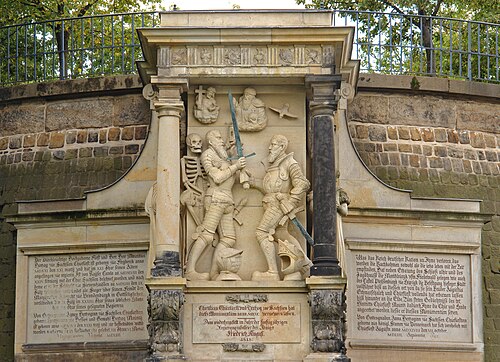
Albert Alcibiades was a former ally of Maurice, who had fought in the Schmalkaldic War on his side. But now Maurice, involved in an alliance of princes, with Ferdinand I amongst others, was compelled to fight against Albert Alcibiades. On 9 July 1553 the Battle of Sievershausen took place at Lehrte. Maurice won this battle, but was badly wounded in the stomach by a shot from the rear and succumbed two days later in the field camp at the age of 32. He was buried in Freiberg Cathedral. In 1853, 300 years after the battle, the place of his death was commemorated by a monument erected to his memory. The 7.5 ton heavy granite monument came from his native Saxony. The original monument is now in the Rustkammer museum in Dresden, with a simplified version being recreated in its outer location.[4]
Because Maurice died without a surviving male heir, his brother Augustus succeeded him as Elector. In Dresden, shortly after the death of Maurice, he erected the Maurice Monument (Moritzmonument), the first historical monument to be erected in Saxony.
See also
References
- ↑"Maurice". Encyclopaedia Britannica.
- ↑Lindberg, Carter (2021). The European reformations (Third ed.). Hoboken, New Jersey: John Wiley & Sons. p. 196. ISBN 978-1-119-64074-5.
- ↑Ágnes Várkonyi: Age of Reforms (Megújulások kora), Magyar Könyvklub, Budapest, 2001; ISBN 963-548-471-2
- ↑Rustkammer: Moritz monument
Sources
- Baumgarten, Hans. Moritz von Sachsen, Berlin 1941.
- Blaschke, Karlheinz. Moritz von Sachsen. Ein Reformationsfürst der zweiten Generation. Göttingen 1983.
- Brandenburg, Eric. Moritz von Sachsen, Bd. I, Leipzig 1899.
- Groß, Reiner (2007). Die Wettiner. Stuttgart: Kohlhammer Verlag.
- Wartenberg, Günther. Landesherrschaft und Reformation. Moritz von Sachsen und die albertinische Kirchenpolitik bis 1546. Weimar 1988.
- Johannes Herrmann, Moritz von Sachsen. Beucha 2003.
- Hof und Hofkultur unter Moritz von Sachsen (1521–1553), hrsg. von André Thieme und Jochen Vötsch, unter Mitarbeit von Ingolf Gräßler im Auftrag des Vereins für sächsische Landesgeschichte, Beucha 2004.
- تتضمن هذه المقالة نصًا من منشور أصبح الآن ملكًا عامًا : تشيشولم، هيو ، محرر (1911). " موريس، ناخب ساكسونيا ". الموسوعة البريطانية ( الطبعة الحادية عشرة). مطبعة جامعة كامبريدج.
- هانز يواكيم بوتشر، آنا برينزيسين فون ساكسونيا (1544-1577) - Eine Lebenstragödie ، دريسدن 2013، ISBN 978-3-941757-39-4.
- ويلسون، بيتر هـ. (2016). قلب أوروبا: تاريخ الإمبراطورية الرومانية المقدسة . كامبريدج: مطبعة جامعة هارفارد.
- 1521 ولادة
- 1553 حالة وفاة
- سكان فرايبرغ
- حكام ساكسونيا
- أمراء ساكسونيا الناخبون
- صيادون ألمان
- بيت ويتين
- قتلى عسكريين ألمان في المعركة
- مراسم الدفن في كاتدرائية فرايبرغ
- أمراء الساكسون
- المتحولون إلى المذهب اللوثري من الكاثوليكية الرومانية
- فرع ألبرتين
- حكام الإمبراطورية الرومانية المقدسة