
Canon (title)
Canon (Ancient Greek: κανονικός, romanized: kanonikós) is a Christian title usually used to refer to a member of certain bodies in subject to an ecclesiastical rule.
Originally, a canon was a cleric living with others in a clergy house or, later, in one of the houses within the precinct of or close to a cathedral or other major church and conducting his life according to the customary discipline or rules of the church. This way of life grew common (and is first documented) in the 8th century AD. In the 11th century, some churches required clergy thus living together to adopt the rule first proposed by Saint Augustine that they renounce private wealth. Those who embraced this change were known as Augustinians or Canons Regular, whilst those who did not were known as secular canons.
Secular canons
Latin Church
In the Latin Church, canons are the members of a chapter, that is a body of senior clergy overseeing either a cathedral (a cathedral chapter) or a collegiate church. Depending on the title of the church, several languages use specific titles, e.g., in German Domherr or Domkapitular in a Dom (i.e., cathedral), Stiftsherr in a prelature that has the status of a Stift (notably under a prince of the Church).
One of the functions of the cathedral chapter in the Latin Church was to elect a vicar capitular (now named a diocesan administrator) to serve during a sede vacante period of the diocese. Since the 1983 revision of the Code of Canon Law, this responsibility belongs to the college of consultors, unless the national bishops conference decides that the functions that canon law ascribes to the college of consultors, including this one, are to be entrusted to the cathedral chapter.[1]
Church of England
جميع قساوسة كنيسة إنجلترا علمانيون منذ الإصلاح ، مع أن القسيس الواحد قد يكون عضوًا في رهبنة دينية. لكن في الغالب، يكونون مُرَسَّمين، أي كهنة أو رجال دين آخرين. واليوم، يُحتفظ بنظام القساوسة بشكل شبه حصري في الكنائس الكاتدرائية . والقسيس عضو في مجلس الكهنة (في أغلب الأحيان)، برئاسة عميد ، وهو المسؤول عن إدارة الكاتدرائية أو بعض الكنائس الأخرى التي تُسمى كنائس جماعية . والعميد والمجلس هما الهيئة الرسمية المسؤولة قانونيًا عن الكاتدرائية وعن انتخاب الأسقف.
القساوسة الفخريون
لقب "القس" ليس لقبًا دائمًا، وعندما يفقد الرجل منصبه الذي يُؤهله للترقية، يُحذف عادةً من قائمة ألقاب رجال الدين. مع ذلك، لا يزال يُمنح في العديد من الأبرشيات لكبار كهنة الرعايا (بمن فيهم بعض عمداء المناطق الريفية ، ومن كان لهم دور في الحياة العامة للأبرشية، ومن خدموا فيها لفترة طويلة، أو ما شابه ذلك) كلقب فخري في الغالب. ويُمنح عادةً تقديرًا للخدمة الطويلة والمخلصة للأبرشية.
يقصد الأساقفة أنه عند تقاعد الكاهن الفخري، يحتفظ بلقبه وإن لم يحتفظ بمكانه في الكاتدرائية أو أي مسؤوليات مرتبطة به. ويبقى اسمه فقط هو ما يجعله كاهناً.

بشكل عام، ينقسم القساوسة في الكنائس الأنجليكانية إلى نوعين: قساوسة مقيمون (يعملون في الكاتدرائية، وعددهم قليل) وقساوسة فخريون (رجال دين من خارج الكاتدرائية يُمنحون هذا اللقب كعلامة شرف، وغالبًا ما يكون عددهم كبيرًا). ويجوز لكلا النوعين ارتداء رداء بنفسجي أو مُطرز باللون البنفسجي . في بعض أبرشيات كنيسة إنجلترا ، يُستخدم لقب "قسيس" بدلًا من "قسيس" عندما يكون رجل الدين مُشاركًا إداريًا في الكاتدرائية. القساوسة الفخريون أعضاء في المجلس الكنسي اسميًا، لكنهم غير مقيمين ولا يتقاضون أي رواتب . يحق لهم أن يُطلقوا على أنفسهم لقب "قسيس"، وقد يكون لهم دور في إدارة الكاتدرائية.
قد يكون القساوسة أعضاءً في طاقم الأبرشية أو الأسقف بدلاً من طاقم الكاتدرائية، كما هو الحال في الكنيسة الأسقفية الأمريكية ، حيث يكون "قسيس الأبرشية" كاهناً كبيراً يعمل مباشرةً تحت إشراف أسقف الأبرشية (الأسقف). [ 2 ]
لا يزال من الممكن ترشيح قساوسة فخريين داخل الكنيسة الكاثوليكية بعد المجمع الفاتيكاني الثاني . كما أن كهنة (وقساوسة فخريين) فرسان مالطا وفرسان القبر المقدس هم في الواقع قساوسة اسميون أو فخريون في هاتين الرتبتين، ولهم الحق في لقب "قس" و"مونسنيور" بالإضافة إلى زي جوقة القساوسة، والذي يتضمن الموزيتا (أسود اللون بخطوط أرجوانية لمالطا، وأبيض اللون بصليب القدس الأحمر لفرسان القبر المقدس). [ 3 ] [ 4 ]
القوانين الدينية

منذ عهد الملك هنري الرابع ، منح البابا رؤساء فرنسا لقب الكاهن الفخري الوحيد لكاتدرائية القديس يوحنا اللاتيراني وكاتدرائية القديس بطرس . [ 5 ] [ 6 ] ومع زوال مملكة فرنسا، انتقل هذا الشرف إلى رؤساء الجمهورية ، وهو حاليًا من نصيب إيمانويل ماكرون . وينطبق هذا حتى لو كان الرئيس الفرنسي غير كاثوليكي أو حتى ملحدًا. أما الكاهن الأول لكاتدرائية القديسة مريم الكبرى البابوية فهو ملك إسبانيا ، فيليب السادس حاليًا . [ 7 ] [ 8 ]
إضافةً إلى القساوسة من رجال الدين ، يجوز للكاتدرائيات في الكنيسة الأنجليكانية تعيين أشخاص عاديين كقساوسة. وتُمنح رتبة "القس العلماني" تحديدًا لمستشاري الأبرشيات (أكبر المسؤولين القانونيين في الأبرشية، والذي يكون عادةً، وإن لم يكن حصريًا، شخصًا عاديًا).
أساتذة كانون

A canon professor is a canon at an Anglican cathedral (either lay or in orders) who also holds a university professorship. There are four canon professorships in the University of Oxford in conjunction with Christ Church Cathedral, Oxford and two in Durham University in conjunction with Durham Cathedral,[9][10] although academics titled "canon professor" may also be found at other universities where the appointments as canon and professor have been made independently.[11][12][13]
Section 2 of the Church of England (Miscellaneous Provisions) Measure 1995[14] was passed for the express purpose of enabling Christ Church Cathedral, Oxford, to appoint not more than two lay canons. One of the motivations for this provision was that, under section 6 of the Ecclesiastical Commissioners Act 1840 (3 & 4 Vict. c. 113), the position of Regius Professor of Ecclesiastical History in the University of Oxford was annexed to a residentiary canonry of the cathedral, meaning that the Regius professorship could be held only by an Anglican priest. Following the death of Peter Hinchliff in 1995 the Regius professorship was held by Henry Mayr-Harting, a Catholic layman, from 1997 until 2003, and was taken up by another lay person, Sarah Foot, in Michaelmas Term 2007. Three other Statutory Professorships, the Regius Professorship of Divinity, Lady Margaret Professorship of Divinity, recently held by the famous Anglican theologian, John Macquarrie, and Regius Professorship of Moral and Pastoral Theology, are annexed to canonries of Christ Church and were until recently held only by Anglican priests.
At Durham, the canon professorships are the Van Mildert Professor of Divinity, the holder of which must be an Anglican priest, and the Michael Ramsey Professor of Anglican Studies, who must be Anglican but did not have to be ordained.[15][16][17] Historically, the chair in Greek at the university was also a canon professorship. This canonry was transferred to the Lightfoot Professor of Divinity in 1940.[18]
The Lightfoot professorship was attached to the canonry until 1985,[19] when the non-Anglican James Dunn was appointed.
Minor canons
Minor canons are those clergy who are members of the foundation of a cathedral or collegiate establishment. They take part in the daily services. They have sometimes formed a distinct corporation as at St Paul's Cathedral, London. In St Patrick's Cathedral, Dublin, they are distinct from, and rank before, the Vicars Choral. The two groups overlap however; the two senior vicars, the Dean's Vicar and the Succentor, are also the two senior Minor Canons. Some Minor Canons do sit with, but are not voting members of, the Chapter. Although at present Minor Canons are generally more junior clergy this is a recent development. Within living memory such offices were often freehold and were held by clergy of great distinction and seniority.
Canons regular
Canons regular are the members of certain religious orders in the Catholic Church (not to be confused with clerics regular), composed of priests who live in community with lay brothers. Their goal is to combine the clerical and monastic forms of life, thus they are equally committed to pastoral ministry and to the communal celebration of the Liturgy of the Hours. Their distinctive religious habit is the rochet, which can be rendered in a range of forms.
There are a variety of congregations of canons, some of which are part of the Confederation of Canons Regular of St. Augustine:
- Canons Regular of the Lateran or St. Saviour, which seems to date back to Pope Alexander II (1063)
- Order of the Canons Regular of Premontre, commonly known as Norbertines, founded by St. Norbert (1120)
- Order of the Holy Cross (Canons Regular) founded in Portugal in 1131 and re-founded in 1977
- Canons Regular of the Order of the Holy Cross (the Crosiers), founded at Clair-lieu, near Huy, in Belgium, in 1211
- Swiss Congregation of Canons Regular of the Abbey of Saint Maurice of Agaune
- Gilbertine Order, a solely English order of canons regular, driven to extinction under King Henry VIII
- Canons Regular of the Immaculate Conception, founded in France in 1871
- Canons Regular of St. John Cantius, founded in 1998 by C. Frank Phillips, C.R., and Francis Cardinal George, O.M.I.
- The Institute of Christ the King Sovereign Priest, which is a Catholic Society of Apostolic Life dedicated to the Traditional Latin Mass, practice a rule of life generally based on historical secular canons. They wear distinct choir dress.
Many bishops endeavoured to imitate St. Augustine and St. Eusebius, and to live a common life with the clergy of their church. Rules taken from the sacred canons were even drawn up for their use, of which the most celebrated is that of St. Chrodegang, Bishop of Metz (766). In the tenth century, this institution declined; the canons, as the clergy attached to a church and living a common life were called, began to live separately; some of them, however, resisted this relaxation of discipline, and even added poverty to their common life. This is the origin of the canons regular. Pope Benedict XII by his constitution Ad decorem (15 May 1339) prescribed a general reform of the canons regular. The canons regular ex professo united Holy Orders with religious life, and being attached to a church, devoted themselves to promoting the dignity of divineworship. With monks, Holy Orders are incidental and secondary, and are superadded to the religious life. With canons as with the clerks regular, Holy Orders are the principal thing, and the religious life is superadded to the Holy Orders.
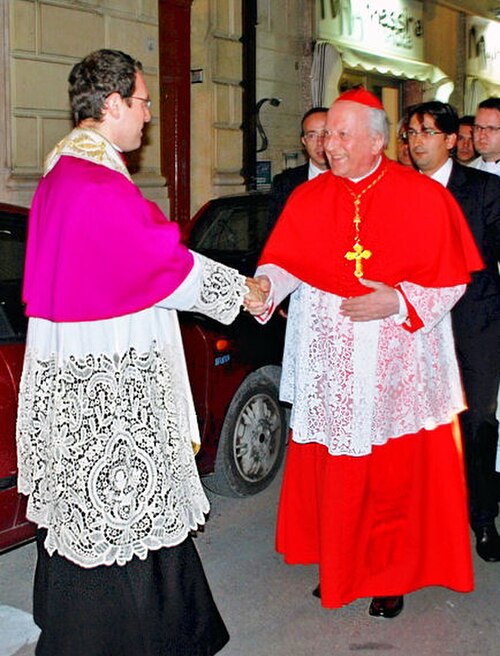 A canon ceremonially receives Cardinal Franc Rodé., C.M.
 Canons, Bruges, Belgium
 Canon cross by Giennadij Jerszow, Gdańsk
See also
References
- ↑"Canon 502 §3". The Code of Canon Law. Vatican City: Holy See. Retrieved 2013-12-01.
- ↑The Episcopal Diocese of New York (2019). "Episcopal Church Terminology". DioceseNY.org. Retrieved 24 November 2019.
- ↑Insignia according to Gammarelli and Barbiconi
- ↑"Canon information". www.smomge.org/Brianz.jpg (Image search result). Retrieved 14 January 2018.
- ↑"Ente - Santissimo Salvatore e Santi Giovanni Battista ed Evangelista in Laterano" (in Italian). Vicariate of the Diocese of Rome. Archived from the original on 9 November 2013. Retrieved 18 June 2014.
- ^ “إنتي – سان بيترو في الفاتيكان” (باللغة الإيطالية). نيابة عن أبرشية روما . تم الاسترجاع 18 يونيو 2014 .
- ↑ "الفصل الليبيري. فصل القديسة مريم الكبرى" . روما: الفاتيكان . تم الاطلاع عليه بتاريخ 14 يناير 2018 .
- ^ "إنتي - سان باولو فوري لو مورا" . نيابة عن أبرشية روما. أرشفة من الأصلي في 19 أغسطس 2016 . تم الاسترجاع في 14 يناير 2018 .
- ↑ مارك هيل؛ راسل ساندبرغ؛ نورمان دو (2011). الدين والقانون في المملكة المتحدة . كلوير لو إنترناشونال. ص 182. ISBN 9789041134400.
- ↑ "الكاتدرائية والجامعة ترحبان بأساتذة جدد" . مؤسسة بريمير كريستيان ميديا ترست. 2014. تم الاطلاع عليه بتاريخ 30 ديسمبر 2016 .
- ↑ "الأستاذة إيلين غراهام" . جامعة تشيستر . تم الاطلاع عليه بتاريخ 30 ديسمبر 2016 .
- ↑ "القس البروفيسور ريتشارد بوريدج" . كلية كينجز لندن . تم الاطلاع عليه بتاريخ 30 ديسمبر 2016 .
- ↑ "القس البروفيسور ليزلي فرانسيس" . جامعة وارويك . تم الاطلاع عليه بتاريخ 30 ديسمبر 2016 .
- ↑ "قانون كنيسة إنجلترا (أحكام متنوعة) رقم 2 لسنة 1995" . legislation.gov.uk . تم الاطلاع عليه بتاريخ 30 أبريل 2019 .
- ↑ "تعيين أستاذين جديدين في كلية كانون" . جامعة دورهام. 12 فبراير 2015. تم الاطلاع عليه بتاريخ 30 ديسمبر 2016 .
- ↑ «فان ميلدرت، أستاذ اللاهوت» . مؤرشف من الأصل في 4 مارس 2016. تم الاطلاع عليه في 30 ديسمبر 2016 .
- ↑ «مايكل رامزي، أستاذ الدراسات الأنجليكانية» . مؤرشف من الأصل في 4 مارس 2016. تم الاطلاع عليه في 30 ديسمبر 2016 .
- ↑ مجلة الجامعات، المجلدات 13-17 . 1940. ص 37.
- ↑ "الأستاذ القس دوغلاس جونز" . صحيفة الإندبندنت . 2 ديسمبر 2005.
روابط خارجية
- . الموسوعة البريطانية . المجلد الخامس ( الطبعة التاسعة). 1878. ص 15.
- رهبان النظاميين للحبل بلا دنس
- رهبان القديس يوحنا كانتيوس النظاميون، شيكاغو
- رهبان بريمونتري النظاميون، مقاطعة أورانج، كاليفورنيا
- الكهنة (القساوسة)
- المكاتب الكنسية الأنجليكانية
- الألقاب الكنسية الكاثوليكية
- الكهنوت الكاثوليكي
- الألقاب الكنسية