
Gymnastics
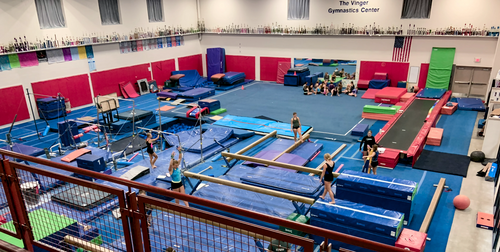
Gymnastics is a group of sports that includes physical exercises requiring balance, strength, flexibility, agility, coordination, artistry and endurance.[1] The movements involved in gymnastics contribute to the development of the arms, legs, shoulders, back, chest, and abdominal muscle groups. Gymnastics evolved from exercises used by the ancient Greeks that included skills for mounting and dismounting a horse.[2]
The most common form of competitive gymnastics is artistic gymnastics; for women, the events include floor, vault, uneven bars, and balance beam; for men, besides floor and vault, it includes rings, pommel horse, parallel bars, and horizontal bar.
The governing body for competition in gymnastics throughout the world is World Gymnastics, formerly known as the International Gymnastics Federation or FIG (from the French Fédération Internationale de Gymnastique). Eight sports are governed by the FIG, including gymnastics for all, men's and women's artistic gymnastics, rhythmic gymnastics (women's branch only), trampolining (including double mini-trampoline), tumbling, acrobatic, aerobic, parkour and para-gymnastics.[3] Disciplines not currently recognized by FIG include wheel gymnastics, aesthetic group gymnastics, TeamGym, men's rhythmic gymnastics (both the Spanish form which is identical to the women's version and the Japanese version which is a different sport) and mallakhamba.
Participants in gymnastics-related sports include young children, recreational-level athletes, and competitive athletes at all skill levels.
Etymology
The word gymnastics derives from the common Greek adjective γυμνός (gymnos),[4] by way of the related verb γυμνάζω (gymnazo), whose meaning is to "train naked", "train in gymnastic exercise", generally "to train, to exercise".[5] The verb had this meaning because athletes in ancient times exercised and competed without clothing.
History
Gymnastics can be traced to exercises performed in Ancient Greece, specifically in Sparta and Athens. Exercise of that time was documented by Philostratus'[6] work Gymnastics: The Ethics of an Athletic Aesthetic. The original term for the practice of gymnastics is from the related Greek verb γυμνάζω (gumnázō), which translates as "to train naked or nude," because young men exercised without clothing. In ancient Greece, physical fitness was highly valued among both men and women. It was not until after the Romans conquered Greece in 146 BC that gymnastics became more formalized and was used to train men in warfare.[7] On Philostratus' claim that gymnastics is a form of wisdom, comparable to philosophy, poetry, music, geometry, and astronomy,[6] the people of Athens combined this more physical training with the education of the mind. At the Palestra, a physical education training center, the disciplines of educating the body and the mind were combined, allowing for a form of gymnastics that was more aesthetic and individual and that left behind the focus on strictness, discipline, the emphasis on defeating records, and a focus on strength.[8]

Don Francisco Amorós y Ondeano—a Spanish colonel born on 19 February 1770, in Valencia, who died on 8 August 1848, in Paris—was the first person to introduce educative gymnastics in France. The German Friedrich Ludwig Jahn began the German gymnastics movement in 1811 in Berlin, which led to the invention of the parallel bars, rings, the horizontal bar, the pommel horse and the vault horse.[9]
Germans Charles Beck and Charles Follen and American John Neal brought the first wave of gymnastics to the United States in the 1820s. Beck opened the first gymnasium in the US in 1825 at the Round Hill School in Northampton, Massachusetts.[10] Follen opened the first college gymnasium and the first public gymnasium in the US in 1826 at Harvard University and in Boston, Massachusetts, respectively.[11] Neal was the first American to open a public gymnasium in the US, in Portland, Maine, in 1827.[12] He also documented and promoted these early efforts in the American Journal of Education[13] and The Yankee, helping to establish the American branch of the movement.[14]

The Federation of International Gymnastics (FIG) was founded in Liege in 1881.[15] By the end of the nineteenth century, men's gymnastics competition was popular enough to be included in the first modern Olympic Games, in 1896.[16] From then until the early 1950s, both national and international competitions involved a changing variety of exercises gathered under the rubric, gymnastics, which included, for example, synchronized team floor calisthenics, rope climbing, high jumping, running, and horizontal ladder. During the 1920s, women organized and participated in gymnastics events. Elin Falk revolutionized how gymnastics was taught in Swedish schools between 1910 and 1932.[17] The first women's Olympic competition was limited, involving only synchronized calisthenics and track and field. These games were held in 1928 in Amsterdam.
By 1954, Olympic Games apparatus and events for men and women had been standardized in a modern format, and uniform grading structures (including a point system from 1 to 15) had been agreed upon. In 1930, the first UK mass movement organization of women in gymnastics, the Women's League of Health and Beauty, was founded by Mary Bagot Stack in London.[18] At this time, Soviet gymnasts astounded the world with highly disciplined and difficult performances, setting a precedent that continues. Television has helped publicize and initiate a modern age of gymnastics. Both men's and women's gymnastics now attract considerable international interest, and excellent gymnasts can be found on every continent.
In 2006, a new points system for Artistic gymnastics was put into play. An A Score (or D score) is the difficulty score, which as of 2009 derives from the eight highest-scoring elements in a routine (excluding Vault), in addition to the points awarded for composition requirements; each vault has a difficulty score assigned by the FIG. The B Score (or E Score), is the score for execution and is given for how well the skills are performed.[19]
FIG-recognized disciplines
The following disciplines are governed by FIG.
Artistic gymnastics

Artistic gymnastics is usually divided into men's and women's gymnastics. Men compete on six events: floor exercise, pommel horse, still rings, vault, parallel bars, and horizontal bar, while women compete on four: vault, uneven bars, balance beam, and floor exercise. In some countries, women at one time competed on the rings, horizontal bar, and parallel bars (for example, in the 1950s in the USSR).
In 2006, FIG introduced a new point system for artistic gymnastics.[19] Unlike the old code of points, in which there was a maximum 10.0 score, there are two separate scores that are added to produce the final score. The first is the execution score, which starts at 10 and has deductions taken for execution mistakes, and the second is the difficulty score, which is open-ended and based on what elements the gymnasts perform. It may be lower than the intended difficulty score if the gymnast does not perform or complete all the skills, or they do not connect a skill meant to be connected to another. Scoring for national developmental levels or outside of the FIG competition system may continue to use the 10.0 system; for example, US women's collegiate gymnastics still uses the 10.0 system.[21]
Competitive events for women in artistic gymnastics

Vault
In the vaulting events, gymnasts sprint down a 25 metres (82 ft) runway, to take off onto a spring board performing a roundoff handspring or front handspring entry onto a vault board). They then land momentarily inverted on the hands-on the vaulting horse or vaulting table (pre-flight segment) and propel themselves forward or backward off that platform to a two-footed landing (post-flight segment). The post-flight segment may include one or more saltos, or twisting movements. A round-off entry vault, called a Yurchenko, is a commonly performed vault in the higher levels of women's gymnastics. Other vaults include taking off from the vault board with both feet at the same time and either doing a front handspring or round-off onto the vaulting table.
In 2001, the traditional vaulting horse was replaced with a new apparatus, sometimes known as a tongue, horse, or vaulting table. The new apparatus is more stable, wider, and longer than the older vaulting horse, approximately 1 metre (3.3 ft) in length and 1 metre (3.3 ft) in width, giving gymnasts a larger blocking surface. This apparatus is thus considered safer than the vaulting horse used in the past. With the addition of this new, safer vaulting table, gymnasts are attempting more difficult vaults.[22]

Uneven bars
On the uneven bars, gymnasts perform a timed routine on two parallel horizontal bars set at different heights. These bars are made of fiberglass covered in wood laminate to prevent them from breaking. In the past, bars were made of wood, but the bars were prone to breaking, providing an incentive to switch to newer technologies. The height of the bars may be adjusted by 5 centimetres (2.0 in) to the size needed by individual gymnasts, although the distance between bars cannot be changed for individual gymnasts in elite competition.
In the past, the uneven parallel bars were closer together. The bars have been moved increasingly further apart, allowing gymnasts to perform swinging, circling, transitional, and release moves that may pass over, under, and between the two bars. At the elite level, movements must pass through the handstand. Gymnasts often mount the uneven bars using a springboard or a small mat, and they may use chalk (MgCO3) and grips (a leather strip with holes for fingers to protect hands and improve performance) when performing this event. The chalk helps take the moisture out of gymnasts' hands to decrease friction and prevent rips (tears to the skin of the hands); dowel grips help gymnasts grip the bar.
Balance beam

The gymnast performs a choreographed routine of up to 90 seconds in length consisting of leaps, acrobatic skills, somersaults, turns, and dance elements on a padded beam. The beam is 125 centimetres (4 ft 1 in) above the ground, 5 metres (16 ft 5 in) long, and 10.16 centimetres (4.00 in) wide.[23] It can also be adjusted, to be raised higher or lower.
Floor
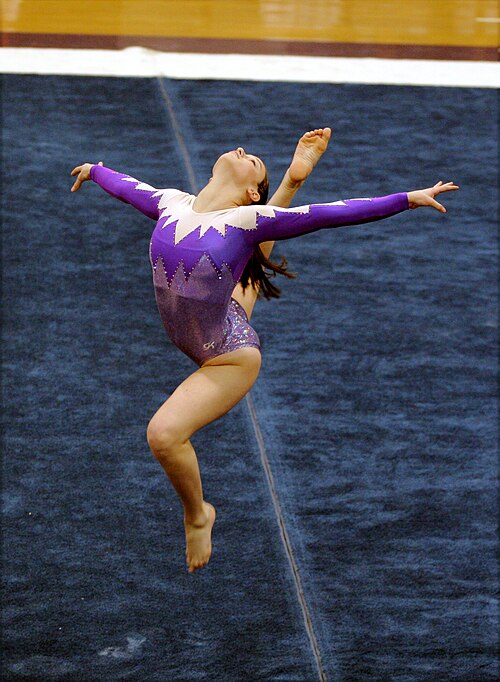
The event in gymnastics performed on the floor is called floor exercise. In the past, the floor exercise event was executed on the bare floor or mats such as wrestling mats. The floor event now occurs on a carpeted 12 metres (39 ft) x 12 metres (39 ft) square, usually consisting of hard foam over a layer of plywood, which is supported by springs generally called a spring floor. This provides a firm surface that provides extra bounce or spring when compressed, allowing gymnasts to achieve greater height and a softer landing after the composed skill. Gymnasts perform a choreographed routine to music (without words) for up to 90 seconds. The routine should consist of tumbling passes, series of jumps, leaps, dance elements, acrobatic skills, and turns, or pivots, on one foot. A gymnast can perform up to four tumbling passes, each of which usually includes at least one flight element without hand support.[24]
Competitive events for men in artistic gymnastics
Floor
Male gymnasts also perform on a 12 metres (39 ft) x 12 metres (39 ft) spring floor. A series of tumbling passes are performed to demonstrate flexibility, strength, and balance. Strength skills include circles, scales, and press handstands. Men's floor routines usually have multiple passes that have to total between 60 and 70 seconds and are performed without music, unlike the women's event. Rules require that male gymnasts touch each corner of the floor at least once during their routine.
Pommel horse
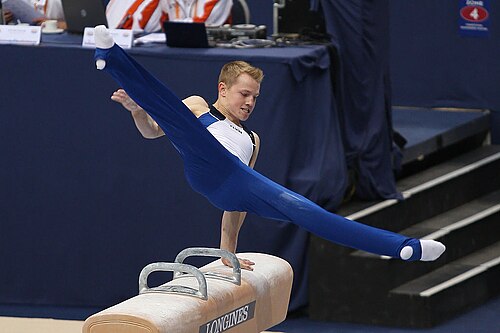
The pommel horse consists of a horizontal body with two pommels, or handles. Gymnasts perform by using their hands to support themselves on the horse. A typical pommel horse exercise involves both single-leg and double-leg work. Single-leg skills are generally found in the form of scissors, an element often done on the pommels. Double leg work, however, is the main staple of this event. The gymnast swings both legs in a circular motion (clockwise or counterclockwise depending on preference) and performs such skills on all parts of the apparatus. To make the exercise more challenging, gymnasts often include variations on a typical circling skill by turning (moores and spindles) or by straddling their legs (flares). Routines end when the gymnast performs a dismount, either by swinging his body over the horse or landing after a handstand variation.
Still rings


The rings are suspended on wire cable from a point 5.75 metres (18.9 ft) from the floor. The gymnast grips the rings and must perform a routine demonstrating balance, strength, power, and dynamic motion while preventing the rings themselves from swinging. At least one static strength move is required, but some gymnasts may include two or three. A routine ends with a dismount.
Vault
Gymnasts sprint down a runway, which is a maximum of 25 metres (82 ft) runway in length, before hurdling onto a springboard. They then land momentarily inverted on the hands-on the vaulting horse or vaulting table (pre-flight segment) and propel themselves forward or backward off that platform to a two-footed landing (post-flight segment). In advanced gymnastics, multiple twists and somersaults may be added in the post-flight segment before landing. Successful vaults depend on the speed of the run, the length of the hurdle, the power the gymnast generates from the legs and shoulder girdle, the kinesthetic awareness in the air, how well they stuck the landing, and the speed of rotation in the case of more difficult and complex vaults.
Parallel bars
Men perform on two bars set in parallel by executing a series of swings, balances, and releases that require great strength and coordination. The width between the bars is adjustable depending upon the actual needs of the gymnasts, and the bars are usually 2 metres (6.6 ft) high.
Horizontal bar
A 2.8 centimetres (1.1 in) thick steel bar raised 2.5 metres (8.2 ft) is raised the landing area. The gymnast holds on to the bar and performs giant swings or giants (forward or backward revolutions around the bar in the handstand position), release skills, twists, and changes of direction. By using the momentum from giants and then releasing at the proper point, enough height can be achieved for spectacular dismounts, such as a triple-back salto. Leather grips are usually used to help maintain a grip on the bar, and to prevent rips by reducing friction on the skin.[25] While training for this event, straps are often used to ensure that the gymnasts do not fall off the bar as they are learning new skills.
Rhythmic gymnastics

According to FIG rules, only women compete in rhythmic gymnastics. This is a sport that combines elements of ballet, gymnastics, dance, and apparatus manipulation, with a much greater emphasis on the aesthetic rather than the acrobatic.[26] Gymnasts compete either as individuals or in groups. Individuals perform four separate routines, each using one of the four apparatuses—ball, ribbon, hoop, clubs, and formerly, rope—on a floor area. Groups consist of five gymnasts who perform two routines together, one with five of the same apparatus and one with three of one apparatus and two of another; the FIG defines which apparatuses groups use each year.
Routines are given three sub-scores: difficulty, execution, and artistry. Difficulty is open-ended and based on the value given to the elements performed in the routine, and execution and artistry start at ten points and are lowered for specific mistakes made by the gymnasts. The three sub-scores are added together for the final score for each routine.[27]
International competitions are split between Juniors, under sixteen by their year of birth, and Seniors, for women sixteen and over. Gymnasts in Russia and Europe typically start training at a very young age and those at their peak are typically in their late teens (15–19) or early twenties. The largest events in the sport are the Olympic Games, World Championships, European Championships, World Cup and Grand Prix series. The first World Championships were held in 1963, and rhythmic gymnastics made its first appearance at the Olympics in 1984.[28]
Rhythmic gymnastics apparatus


- Ball
- The ball may be made of rubber or a similar synthetic material, and it can be of any color. It should rest in the gymnast's hand and not be pressed against the wrist or grasped with the fingers, which incurs a penalty. Fundamental elements of a ball routine include bouncing or rolling the ball.
- Hoop
- The hoop comes up to about the gymnast's hip. It may be made of plastic or wood, and it may be covered with adhesive tape either of the same or different color as the hoop, which may be in decorative patterns. Fundamental requirements of a hoop routine include rotation of the hoop around the hand or body, rolling the hoop on the body or floor, and the gymnast passing through the hoop.
- Ribbon
- The ribbon consists of a handle, which may be made of wood, bamboo, or synthetic materials such as fiberglass, and the ribbon itself, which is made of satin. The ribbon is six meters long, and due to its length, it can easily become tangled or knotted; knots must be undone or the gymnast will be penalized. Fundamental elements of a ribbon routine consist of making continuous shapes with the length of the fabric, such as tight circles (spirals) or waves (snakes), and elements called boomerangs, in which the gymnast tosses the handle, then pulls it back by the end of the ribbon and catches it.
- Clubs
- The clubs may be made of wood or synthetic materials, and they are always used in a pair. They may be connected together by inserting the end of one club into the head of the other. The handles and bodies are typically wrapped with decorative tapes. Fundamental elements of a clubs routine including swinging the heads of the clubs in circles, small throws in which the clubs rotate in the air, and asymmetrical movements.
- Rope
- The rope is made from hemp or a similar synthetic material; it can be knotted and have anti-slip material at the ends, but it does not have handles. The fundamental requirements of a rope routine include leaping and skipping. In 2011, the FIG decided to eliminate the use of rope in senior individual rhythmic gymnastics competitions. It is still sometimes seen in junior group competition.
Men's rhythmic gymnastics
There are two versions of rhythmic gymnastics for men, neither of which is currently recognized by the FIG. One was developed in Japan in the 1940s and was originally practiced by both boys and girls for fitness, with women still occasionally participating on the club level today. Gymnasts either perform in groups with no apparatus, or individually with apparatus (stick, clubs, rope, or double rings). Unlike women's rhythmic gymnastics, it is performed on a sprung floor, and the gymnasts perform acrobatic moves and flips.[29] The first World Championships was held in 2003. The other version was developed in Europe and uses generally the same rules as the women and the same set of apparatus. It is most prominent in Spain, which has held national men's competitions since 2009 and mixed-gender group competitions since 2021, and France.[30][31] There currently is no World Championships for this form of Men's Rhythmic Gymnastics.
Trampolining
Trampolining
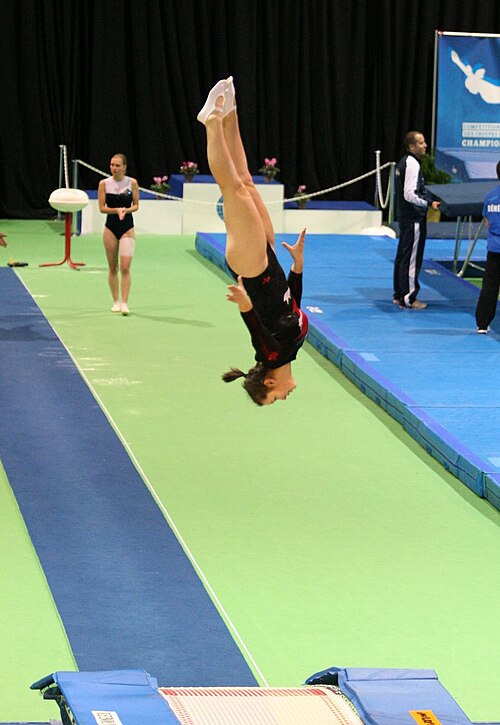
Trampolining and tumbling consists of four events, individual and synchronized trampoline, double mini trampoline, and tumbling (also known as power tumbling or rod floor). Since 2000, individual trampoline has been included in the Olympic Games. The first World Championships were held in 1964.
Individual trampoline
Individual routines in trampolining involve a build-up phase, during which the gymnast jumps repeatedly to achieve height, followed by a sequence of ten bounces without pause during which the gymnast performs a sequence of aerial skills. Routines are marked out of a maximum score of 10 points. Additional points (with no maximum at the highest levels of competition) can be earned depending on the difficulty of the moves and the length of time taken to complete the ten skills which is an indication of the average height of the jumps. In high level competitions, there are two preliminary routines, one which has only two moves scored for difficulty and one where the athlete is free to perform any routine. This is followed by a final routine, which is again optional (that is, the gymnast is allowed to perform whichever skills they choose). Some competitions restart the score from zero for the finals, while others add the final score to the preliminary results.
Synchronized trampoline
Synchronized trampoline is similar except that both competitors must perform the routine together and marks are awarded for synchronization as well as the form and difficulty of the moves.
Double-mini trampoline
Double mini trampoline involves a smaller trampoline with a run-up; two scoring moves are performed per routine. Moves cannot be repeated in the same order on the double-mini during a competition. Skills can be repeated if a skill is competed as a mounter in one routine and a dismount in another. The scores are marked in a similar manner to individual trampoline.
Tumbling
In tumbling, athletes perform an explosive series of flips and twists down a sprung tumbling track. Scoring is similar to trampolining. Tumbling was originally contested as one of the events in Men's Artistic Gymnastics at the 1932 Summer Olympics, and in 1955 and 1959 at the Pan American Games. From 1974 to 1998 it was included as an event for both genders at the Acrobatic Gymnastics World Championships. The event has also been contested since 1976 at the Trampoline and Tumbling World Championships.
Tumbling is competed along a 25-metre sprung tack with a 10-metre run up. A tumbling pass or run is a combination of 8 skills, with an entry skill, normally a round-off, to whips (similar to a handspring without hand support) and into an end skill. Usually the end skill is the hardest skill of the pass. At the highest level, gymnasts perform transitional skills. These are skills which are not whips, but are double or triple somersaults (usually competed at the end of the run), but now competed in the middle of the run connected before and after by either a whip or a flick.
Competition is made up of a qualifying round and a finals round. There are two different types of competition in tumbling, individual and team. In the team event three gymnasts out of a team of four compete one run each, if one run fails the final member of the team is allowed to compete with the three highest scores being counted. In the individual event qualification, the competitor will compete two runs, one a straight pass (including double and triple somersaults) and a twisting pass (including full twisting whips and combination skills such as a full twisting double straight 'full in back'). In the final of the individual event, the competitor must compete two different runs which can be either twisting or straight but each run normally uses both types (using transition skills).
Acrobatic gymnastics

Acrobatic gymnastics (formerly sport acrobatics), often referred to as acro, acrobatic sports or simply sports acro, is a group gymnastic discipline for both men and women. Acrobats perform to music in groups of two, three and four.
There are four international age categories: 11–16, 12–18, 13–19, and Senior (15+), which are used in the World Championships and many other events around the world, including the European Championships and the World Games.
All levels require a balance routine, which focuses on held balance skills, and a dynamic routine, which focuses on flipping elements; 12–18, 13–19, and Seniors are also required to perform a final (combined) routine.
Currently, acrobatic gymnastics scores are marked out of 30.00 for juniors, and they can be higher at the Senior FIG level based on difficulty:
- Difficulty – An open score, which is the sum of the difficulty values of elements (valued from the tables of difficulties) successfully performed in an exercise, divided by 100. This score is unlimited in senior competitions.
- Execution – Judges give a score out of 10.00 for technical performance (how well the skills are executed), which is then doubled to emphasize its importance.
- Artistic – Judges give a score out of 10.00 for artistry (the overall performance of the routine, namely choreography).
There are five competitive event categories:
- Women's Pairs
- Mixed Pairs
- Men's Pairs
- Women's Groups (3 women)
- Men's Groups (4 men)
The World Championships have been held since 1974.
Aerobic gymnastics

Aerobic gymnastics (formally sport aerobics) involves the performance of routines by individuals, pairs, trios, groups with 5 people, and aerobic dance and aerobic step (8 people). Strength, flexibility, and aerobic fitness rather than acrobatic or balance skills are emphasized. Seniors perform routines on a 10 m (33 ft) x 10 m (33 ft) floor, with a smaller 7 m (23 ft) x 7 m (23 ft) floor used for younger participants. Routines last 70–90 seconds depending on the age of the participants and the routine category.[32] The World Championships have been held since 1995.
The events consist of:
- Individual Women
- Individual Men
- Mixed Pairs
- Trios
- Groups
- Dance
- Step
Parkour
On 28 January 2018, parkour, also known as freerunning, was given the go-ahead to begin development as a FIG sport.[33][34] The FIG was planning to run World Cup competitions from 2018 onwards. The first Parkour World Championships were planned for 2020, but were delayed due to the COVID-19 pandemic,[35][36][37] and instead took place from 15 to 16 October 2022 in Tokyo, Japan.[38]
The events consist of:
- Speedrun
- Freestyle
Para-gymnastics
Para-gymnastics, gymnastics for disabled athletes with para-athletics classifications, was recognized as a new FIG discipline in October 2024.[39] As an FIG discipline, it currently only covers artistic gymnastics.[40]
Other disciplines
The following disciplines are not currently recognized by the Fédération Internationale de Gymnastique.
Aesthetic group gymnastics

Aesthetic Group Gymnastics (AGG) was developed from the Finnish "naisvoimistelu". It differs from rhythmic gymnastics in that body movement is large and continuous and teams are larger, and athletes do not use apparatus in international AGG competitions. The sport requires physical qualities such as flexibility, balance, speed, strength, coordination and sense of rhythm where movements of the body are emphasized through the flow, expression and aesthetic appeal. A good performance is characterized by uniformity and simultaneity. The competition program consists of versatile and varied body movements, such as body waves, swings, balances, pivots, jumps and leaps, dance steps, and lifts. The International Federation of Aesthetic Group Gymnastics (IFAGG) was established in 2003.[41] The first Aesthetic Group Gymnastics World Championships was held in 2000.[42]
TeamGym

TeamGym is a form of competition created by the European Union of Gymnastics, originally named EuroTeam. The first official competition was held in Finland in 1996. TeamGym events consist of three sections: women, men and mixed teams. Athletes compete in three different disciplines: floor, tumbling and trampette. Teams require effective teamwork and tumbling technique.[43] There is no World Championships; however, there has been a European Championships held since 2010.[44]
Wheel gymnastics

Wheel gymnasts do exercises in a large wheel known as the Rhönrad, gymnastics wheel, gym wheel, or German wheel. It has also been known as the ayro wheel, aero wheel, and Rhon rod.
There are four core categories of exercise: straight line, spiral, vault and cyr wheel. The first World Championships was held in 1995.[45]
Mallakhamba

Mallakhamba (Marathi: मल्लखम्ब) is a traditional Indian sport in which a gymnast performs feats and poses in concert with a vertical wooden pole or rope. The word also refers to the pole used in the sport.
Mallakhamba derives from the terms malla which denotes a wrestler and khamba which means a pole. Mallakhamba can therefore be translated to English as "pole gymnastics".[46] On 9 April 2013, the Indian state of Madhya Pradesh declared mallakhamba as the state sport. In February 2019 the first Mallahkhamb World Championship was held in Mumbai
Digital Gymnastics

الجمباز الرقمي، وهو محاكاة للجمباز داخل ألعاب الفيديو ، يُمارس في الغالب في بيئات الواقع الافتراضي ، بالإضافة إلى منصات مثل روبلوكس وفورتنايت وماينكرافت. تستخدم هذه الفعاليات الواقع الافتراضي لتمكين المشاركين من استعراض مهاراتهم عن بُعد. شهدت هذه العروض ازدهارًا ملحوظًا خلال جائحة كوفيد-19 ، في أواخر يوليو 2020، ثم تراجعت منذ ذلك الحين.
الجمباز غير التنافسي
تُمكّن الجمباز العام، المعروف أيضًا باسم "الجمباز للجميع"، الأشخاص من جميع الأعمار والقدرات من المشاركة في فرق أداء تتراوح بين 6 إلى أكثر من 150 رياضيًا. على عكس أنواع الجمباز الأخرى، يُعتبر الجمباز العام أقرب إلى برنامج رياضي أو فن أدائي منه إلى رياضة بالمعنى التقليدي. يُمكن أداء أي "حدث" من أي فرع من فروع الجمباز، ومن الشائع رؤية، على سبيل المثال، عرض الحلقات الثابتة متبوعًا بالترامبولين المتزامن، ثم عرض الخطوات من الجمباز الهوائي، أو حتى عروض غير معترف بها حاليًا في الجمباز، مثل الحرير الهوائي. يُمكنهم أداء حركات متزامنة ومصممة بدقة. قد تتكون الفرق من كلا الجنسين، ويتم تقسيمها إلى فئات عمرية. يُعدّ معرض الجمباز العالمي (World Gymnaestrada )، الذي يُقام كل أربع سنوات، أكبر معرض عام للجمباز ، وقد أُقيم لأول مرة عام 1939. وفي عام 1984، اعتُرف رسميًا بالجمباز للجميع كبرنامج رياضي من قِبل الاتحاد الدولي للجمباز (FIG)، ثم من قِبل الاتحادات الوطنية للجمباز في جميع أنحاء العالم، ويبلغ عدد المشاركين فيه حاليًا 30 مليونًا. ويُعتبر الجمباز غير التنافسي مفيدًا لفوائده الصحية. [ 47 ]
نظام احتساب النقاط (رمز النقاط)
تُحسب درجة لاعبة الجمباز الفني من خلال خصم نقاط من القيمة الابتدائية لعناصر روتينها. وتُحدد القيمة الابتدائية للروتين بناءً على صعوبة العناصر التي تؤديها اللاعبة ومدى استيفائها لمتطلبات التكوين. وتختلف متطلبات التكوين باختلاف الأجهزة. تُسمى هذه الدرجة بالدرجة D. [ 48 ] تُخصم نقاط الأداء والبراعة الفنية من حد أقصى قدره 10.0. تُسمى هذه الدرجة بالدرجة E. [ 49 ] تُحسب الدرجة النهائية بجمع الدرجتين D و E. [ 50 ]
يُعتمد نظام التقييم الحالي، الذي يجمع بين درجتي D و E للحصول على الدرجة النهائية، منذ عام 2006. [ 51 ] يُطلق على هذا النظام اسم "التقييم المفتوح" لعدم وجود حد أقصى نظري (مع وجود حد أقصى عملي) لدرجة D، وبالتالي للدرجة الإجمالية الممكنة للروتين. [ 52 ] قبل عام 2006، كانت الدرجة النهائية للرياضي تُخصم من الحد الأقصى الممكن وهو 10 درجات للروتين.
يتم تنقيح قانون النقاط أو المبادئ التوجيهية لتسجيل صعوبة وتنفيذ الروتين بشكل طفيف لكل فترة أربع سنوات تتوج بسنة الألعاب الأولمبية.
الأجهزة والأحداث السابقة
تسلق الحبال
عادةً، يتسلق المتنافسون حبلاً من الألياف الطبيعية بطول 6 أمتار (20 قدمًا) أو 8 أمتار (26 قدمًا) وقطر 38 ملم (1.5 بوصة) لتحقيق السرعة، بدءًا من وضعية الجلوس على الأرض باستخدام اليدين والذراعين فقط. وكان يُسمح عادةً بركل الساقين. يستطيع العديد من لاعبي الجمباز القيام بذلك في وضعية التباعد أو وضعية الانحناء، مما يُلغي الحاجة إلى مساعدة الساقين، مع العلم أنه يُمكن القيام بذلك باستخدام الساقين أيضًا.
حلقات طائرة
كانت رياضة الحلقات الطائرة حدثًا مشابهًا لرياضة الحلقات الثابتة ، ولكن يؤدي فيه المؤدي سلسلة من الحركات البهلوانية أثناء التأرجح. وكانت هذه الرياضة حدثًا جمبازيًا معتمدًا من قبل كل من الرابطة الوطنية لرياضة الجامعات (NCAA) والاتحاد الرياضي للهواة (AAU) حتى أوائل الستينيات.
تأرجح العصا
كانت رياضة تأرجح الهراوات، المعروفة أيضاً باسم الهراوات الهندية، إحدى منافسات الجمباز الفني للرجال حتى خمسينيات القرن العشرين. وكانت مشابهة لرياضة الهراوات في الجمباز الإيقاعي للرجال والسيدات، ولكنها أبسط بكثير، حيث يُسمح بعدد قليل من الرميات. وقد أُدرجت هذه الرياضة في دورة الألعاب الأولمبية الصيفية لعامي 1904 و1932.
أخرى (فنية للرجال)
- فريق العارضة الأفقية والعارضة المتوازية في دورة الألعاب الأولمبية الصيفية لعام 1896
- نظام الفرق الحرة والنظام السويدي في دورة الألعاب الأولمبية الصيفية لعامي 1912 و1920
- الألعاب المركبة والترياتلون في دورة الألعاب الأولمبية الصيفية لعام 1904
- قفز الحصان الجانبي في دورة الألعاب الأولمبية الصيفية لعام 1924
- الشقلبة في دورة الألعاب الأولمبية الصيفية لعام 1932
أخرى (فنية نسائية)
- التمرين الجماعي في دورات الألعاب الأولمبية الصيفية لعام 1928 و1936 و1948
- جهاز المتوازي في بطولة العالم 1938
- الأجهزة المحمولة للفرق في دورة الألعاب الأولمبية الصيفية لعامي 1952 و1956
الصحة والسلامة
تعتبر رياضة الجمباز واحدة من أخطر الرياضات، حيث تشهد الفتيات من سن 11 إلى 18 عامًا معدل إصابات مرتفعًا للغاية. [ 53 ]
بعض الحركات الجمبازية التي كانت مسموحة في المسابقات السابقة أصبحت الآن محظورة لأسباب تتعلق بالسلامة؛ فعلى سبيل المثال، تم حظر حركة "توماس سالتو" ، وهي حركة شقلبة ملتوية تنتهي بلفة أمامية على الأرض، بعد تعرضها لعدة إصابات. فقد كسرت إيلينا موخينا ، بطلة العالم في الجمباز الشامل عام 1978، رقبتها أثناء ممارستها لهذه الحركة وهي في حالة إرهاق شديد، مما أدى إلى إصابتها بشلل رباعي . [ 54 ] وفي أوائل العقد الأول من القرن الحادي والعشرين، استُبدل حصان القفز القديم بطاولة القفز، وأُضيفت حصيرة إضافية حول لوح القفز لأسباب تتعلق بالسلامة بعد أن أُصيبت العديد من لاعبات الجمباز، مثل جوليسا غوميز ، بالشلل أثناء محاولات القفز. [ 55 ]
الهبوط
في حركات الشقلبة، سواءً كانت حركة بهلوانية أو هبوطًا أو قفزة، تُعدّ مرحلة الهبوط المرحلة الأخيرة بعد الإقلاع والطيران. [ 56 ] تُعتبر هذه مهارة بالغة الأهمية من حيث الأداء في المنافسات، والنتائج العامة، وتقليل احتمالية الإصابات. فبدون تبديد الطاقة الكافي أثناء الارتطام، يزداد خطر الإصابة أثناء الشقلبة. وتحدث هذه الإصابات عادةً في الأطراف السفلية، مثل تمزق الغضاريف والأربطة، وكدمات/كسور العظام. [ 57 ] ولتجنب هذه الإصابات، والحصول على نتيجة عالية، يجب على لاعب الجمباز استخدام التقنية الصحيحة. "يجب أن تتم مرحلة الهبوط على الأرض بشكل آمن، وجميل، ومتقن باستخدام القدمين معًا." [ 58 ] يُصنف الهبوط الناجح في الجمباز على أنه هبوط لين، أي أن مفصلي الركبة والورك يكونان في وضعية انثناء تزيد عن 63 درجة. [ 56 ]
تؤدي مرحلة الطيران الأعلى إلى قوة رد فعل أرضية رأسية أعلى. تمثل قوة رد الفعل الأرضية الرأسية (vGRF) قوة خارجية يتعين على لاعبي الجمباز التغلب عليها بقوة عضلاتهم، وتؤثر على الزخم الخطي والزاوي لديهم. ومن المتغيرات المهمة الأخرى التي تؤثر على الزخم الخطي والزاوي زمن الهبوط. يستطيع لاعبو الجمباز تقليل قوة الارتطام بزيادة زمن الهبوط، وذلك من خلال زيادة مدى حركة الورك والركبة والكاحل. [ 56 ]
التدريب على المنصة
يشير التدريب على المنصة إلى جلسة التدريب الرسمية التي تسبق بدء منافسات الجمباز. والهدف من ذلك هو تمكين لاعبي الجمباز المتنافسين من التعرف على معدات المنافسة داخل الصالة التي سيتنافسون فيها، [ 59 ] وذلك لأسباب تتعلق بالسلامة في المقام الأول.
الإصابات الجسدية
بالمقارنة مع الرياضيين الذين يمارسون رياضات أخرى، فإن لاعبي الجمباز أكثر عرضةً من غيرهم لإصابات الإجهاد المتكرر والإصابات الناجمة عن التخصص الرياضي المبكر لدى الأطفال والشباب. [ 60 ] [ 61 ] كما أنهم أكثر عرضةً لإصابات القدم والمعصم. [ 62 ] [ 63 ] ويمكن أن تساعد تمارين تقوية العضلات في الوقاية من هذه الإصابات.
إساءة
سُجّلت حالات إساءة عاطفية وجنسية في رياضة الجمباز في العديد من البلدان. [ 64 ] وتُعتبر فضيحة الاعتداء الجنسي في اتحاد الجمباز الأمريكي واحدة من أكبر فضائح الاعتداء في تاريخ الرياضة. [ 65 ] وفي عام 2022، نُشر تقرير وايت ، الذي انتقد ممارسات الإساءة الواسعة النطاق التي مارسها اتحاد الجمباز البريطاني، والتي شملت الإساءة الجنسية والعاطفية، والتحكم المفرط في وزن الرياضيين. [ 66 ]
مشكلة الطول
يميل لاعبو الجمباز إلى أن يكونوا قصار القامة ، ولكن من غير المرجح أن تؤثر هذه الرياضة على نموهم. كما يميل آباء لاعبي الجمباز إلى أن يكونوا أقصر من المتوسط. [ 53 ]
انظر أيضاً
- رقص الأكروبات
- الألعاب البهلوانية
- التشجيع
- فيتكيد
- مسرد مصطلحات الجمباز
- الجمنازيوم (اليونان القديمة)
- قاعة مشاهير الجمباز الدولية
- قائمة الأنشطة البهلوانية
- قائمة مسابقات الجمباز
- قائمة مصطلحات الجمباز
- قائمة لاعبي الجمباز
- أبرز الإنجازات في رياضة الجمباز على مستوى الدولة
- فرقة الماجوريت
- بطولة الجمباز للرجال التابعة للرابطة الوطنية لرياضة الجامعات (الولايات المتحدة الأمريكية)
- بطولة الرابطة الوطنية لرياضة الجامعات الأمريكية للجمباز للسيدات
- القفز على الترامبولين
- خداع
- تيرنرز
- الزي الرسمي (الجمباز)
- بطولة العالم للجمباز
مراجع
الاقتباسات
- ↑ "الجمباز | الفعاليات، المعدات، الأنواع، التاريخ، والحقائق | بريتانيكا" . www.britannica.com . 22 ديسمبر 2023. تم الاطلاع عليه في 2 فبراير 2024 .
- ↑ مجلة سميثسونيان؛ سولي، ميلان. "تاريخ الجمباز، من اليونان القديمة إلى طوكيو 2020" . مجلة سميثسونيان . تم الاطلاع عليه بتاريخ 29 يناير 2024 .
- ↑ "حول FIG" . FIG . تم الاطلاع عليه بتاريخ 31 مايو 2019 .
- ↑ γυμνός ، هنري جورج ليدل، روبرت سكوت، معجم يوناني إنجليزي ، في مشروع بيرسيوس
- ↑ γυμνάζω ، هنري جورج ليدل، روبرت سكوت، معجم يوناني إنجليزي ، في مشروع بيرسيوس
- 1 2 ريد، هيذر ل. (2016). "جمباز فيلوستراتوس: أخلاقيات الجمال الرياضي". مذكرات الأكاديمية الأمريكية في روما . 61 : 77-90 . ISSN 0065-6801 . JSTOR 44988074 .
- ↑ "تاريخ الجمباز: من اليونان القديمة إلى العصر الحديث | سكولاستيك" . www.scholastic.com . تم الاطلاع عليه بتاريخ 8 نوفمبر 2019 .
- ^ جود ، ليزلي. دي كارلو، توماس. كيرن، رينيه (1969). معرض الجمباز . نيويورك: مطبعة الرابطة. ص. 17 . رقم ISBN 978-0-8096-1704-3.
- ↑ جودبودي، جون (1982). التاريخ المصور للجمباز . لندن: ستانلي بول وشركاه. ISBN 0-09-143350-9.
- ↑ ليونارد، فريد يوجين (1923). دليل لتاريخ التربية البدنية . فيلادلفيا، بنسلفانيا ونيويورك، نيويورك: ليا وفيبيجر. الصفحات 232-233 .
- ↑ ليونارد، فريد يوجين (1923). دليل لتاريخ التربية البدنية . فيلادلفيا، بنسلفانيا ونيويورك، نيويورك: ليا وفيبيجر. الصفحات 235-236 .
- ↑ ليونارد، فريد يوجين (1923). دليل لتاريخ التربية البدنية . فيلادلفيا، بنسلفانيا ونيويورك، نيويورك: ليا وفيبيجر. الصفحات 227-250 .
- ↑ ليونارد، فريد يوجين (1923). دليل لتاريخ التربية البدنية . فيلادلفيا، بنسلفانيا ونيويورك، نيويورك: ليا وفيبيجر. الصفحات 235-250 . OCLC 561890463 .
- ↑ باري، ويليام د. (20 مايو 1979). "أبو الرياضة في الولاية: شخصية متعددة الجوانب". صحيفة مين صنداي تلغراف . بورتلاند، مين. الصفحات 1D– 2D.
- ↑ تاريخ الجمباز الفني، مؤرشف في 4 أبريل 2009 على موقع Wayback Machine على الرابط fig-gymnastics.com
- ↑ راسل، كيث (2013)، "تطور الجمباز" ، الجمباز ، جون وايلي وأولاده المحدودة، ص 1-14 ، doi : 10.1002/9781118357538.ch1 ، ISBN 978-1-118-35753-8تم الاطلاع عليه بتاريخ 12 ديسمبر 2024
- ↑ "skbl.se - Elin Falk" . skbl.se. تم الاطلاع عليه بتاريخ 20 أكتوبر 2024 .
- ↑ ماثيوز، جيل جوليوس (1990). "لقد استمتعن كثيرًا: رابطة النساء للصحة والجمال بين الحربين". مجلة ورشة التاريخ . 30 (1): 22-54 . doi : 10.1093/hwj/30.1.22 . ISSN 1477-4569 .
- 1 2 "الاتحاد الأمريكي للجمباز - نظام تسجيل النقاط للنخبة/الدولية التابع للاتحاد الدولي للجمباز" . usagym.org . مؤرشف من الأصل في 4 أغسطس 2016. تم الاطلاع عليه في 8 سبتمبر 2014 .
- ↑ "فن ضائع: تفوق البنية الجسدية القوية على الرشاقة الساحرة" . هيرالد اسكتلندا . تم الاطلاع عليه بتاريخ 8 يناير 2022. على عكس ناديا كومانيتشي وأولغا كوربوت، تُكافأ لاعبات الجمباز المعاصرات مثل سيمون
بايلز على لياقتهن البدنية أكثر من فنهن... ذلك الفن الساحر الذي لم يمنح الرياضة اسمها فحسب، بل جلب لها شهرة عالمية.
- ↑ غريمسلي، إليزابيث (5 يناير 2013). "مبادئ الجمباز: ما يجب معرفته عن التسجيل والتصنيفات والمزيد قبل بطولة الجمباز القادمة" . صحيفة ذا ريد آند بلاك . تاريخ الاسترجاع: 7 أكتوبر 2019 .
- ↑ "Vault: كل ما تحتاج معرفته عن Vault" . About.com Sports . مؤرشف من الأصل في 13 أبريل 2014. تم الاطلاع عليه في 4 أكتوبر 2009 .
- ↑ "معايير الأجهزة" . الشكل . ص. II/51. مؤرشف من الأصل في 19 ديسمبر 2011. تم الاطلاع عليه في 4 أكتوبر 2009 .
- ↑ "قانون نقاط الاتحاد العالمي للجمباز 2009-2012" . الشكل . ص 29. مؤرشف من الأصل في 19 ديسمبر 2011. تم الاطلاع عليه في 2 أكتوبر 2009 .
- ^ جوتمان ، دان (1998). الجمباز . كتب البطريق . ص. 59. ردمك 9781101160657.
- ↑ تينسيا، روكسانا ماريا (18 يونيو 2019). "تطور الحركة والتناسق في أداء الجمباز الإيقاعي لدى الأطفال والناشئين" . نشرة جامعة ترانسيلفانيا في براشوف. السلسلة التاسعة: علوم الحركة البشرية : 145-150 . doi : 10.31926/but.shk.2019.12.61.19 . ISSN 2344-2026 .
- ↑ "قانون النقاط للجمباز الإيقاعي 2022-2024" (ملف PDF) . الاتحاد الدولي للجمباز . 25 أبريل 2022. تاريخ الاطلاع: 5 مارس 2024 .
- ↑ "الاتحاد الدولي للجمباز - الجمباز الإيقاعي - التاريخ" . www.gymnastics.sport . تم الاطلاع عليه بتاريخ 24 ديسمبر 2019 .
- ↑ غالوفارو، كلير (7 أغسطس 2021). "لاعبو الجمباز الإيقاعي للرجال محبوبون في اليابان بعد استبعادهم من الألعاب الأولمبية" . وكالة أسوشيتد برس . تم الاطلاع عليه بتاريخ 3 أغسطس 2024 .
- ^ لوبيز، ف. ديل ريو، ص. لونا ، ج. (8 يوليو 2020). "روبن أوريهويلا: "يمكننا أن نثبت أننا نتمتع بنفس القدر من القدرات"[ روبين أوريويلا: "لقد استطعنا أن نثبت أننا كنا قادرين تمامًا" ] . RTVE.es (بالإسبانية) . تم الاطلاع عليه بتاريخ 4 أكتوبر 2024 .
- ↑ "الجمباز الإيقاعي: نضال رجل واحد من أجل المساواة" . كريستيان ساينس مونيتور . ISSN 0882-7729 . تاريخ الاطلاع: 3 أغسطس 2024 .
- ↑ "قانون النقاط للجمباز الهوائي 2022-2024" (ملف PDF) . الاتحاد الدولي للجمباز . مايو 2022.
- ↑ "الباركور" . نحن الجمباز FIG GYMNASTICS.COM . الاتحاد الدولي للجمباز (FIG).
- ↑ "قواعد الباركور" . نحن الجمباز FIG GYMNASTICS.COM . الاتحاد الدولي للجمباز . تم الاطلاع عليه بتاريخ 5 فبراير 2018 .
- ↑ «القرارات الرئيسية الصادرة عن المجلس الثامن عشر للاتحاد الدولي للجمباز في إسطنبول» . الاتحاد الدولي للجمباز . مؤرشف من الأصل بتاريخ 14 يوليو 2018. تم الاطلاع عليه بتاريخ 7 أغسطس 2024 .
- ↑ «هيروشيما تستضيف أول بطولة عالمية للباركور التابعة للاتحاد الدولي للجمباز في عام 2020» . الاتحاد الدولي للجمباز . 23 أغسطس 2019. مؤرشف من الأصل في 10 يناير 2022. تم الاطلاع عليه في 7 أغسطس 2024 .
- ↑ "تأجيل بطولة العالم الأولى للباركور التابعة للاتحاد الدولي للجمباز" . www.gymnastics.sport . تاريخ الاطلاع: 7 أغسطس 2024 .
- ↑ "الباركور | بطولة العالم | طوكيو" . olympics.com . تم الاطلاع عليه بتاريخ 7 أغسطس 2024 .
- ↑ «اعترف الاتحاد الدولي للجمباز برياضة الجمباز البارالمبي كرياضة رسمية في تصويتٍ "غيّر قواعد اللعبة"» . www.british-gymnastics.org . 28 أكتوبر 2024. تم الاطلاع عليه بتاريخ 28 أكتوبر 2024 .
- ↑ «اختتام المؤتمر الخامس والثمانين للاتحاد الدولي للجمباز في الدوحة» . الاتحاد الدولي للجمباز . ٢٦ أكتوبر ٢٠٢٤. تاريخ الاطلاع: ٢٨ أكتوبر ٢٠٢٤ .
- ^ Lajiesittely أرشفة 21 يونيو 2014 في آلة Wayback .، Suomen Voimisteluliitto.
- ↑ "بطولة العالم | الاتحاد الدولي لرياضة الجمباز والجمباز" . مؤرشف من الأصل بتاريخ 19 أغسطس 2020. تم الاطلاع عليه بتاريخ 7 أكتوبر 2019 .
- ↑ "نبذة عن فريق الجمباز" . الاتحاد البريطاني للجمباز . تم الاطلاع عليه بتاريخ 6 أكتوبر 2024 .
- ↑ "جمباز جامعة شرق إثيوبيا" . جمباز جامعة شرق إثيوبيا . تم الاطلاع عليه بتاريخ 7 أكتوبر 2019 .
- ↑ "الجمباز على العجلات - موقع رينيه هيفتيس!" . مؤرشف من الأصل بتاريخ 12 فبراير 2018. تم الاطلاع عليه بتاريخ 11 فبراير 2018 .
- ↑ "الجذور الهندية للجمباز" . إن دي تي في - الرياضة . مومباي، الهند. 6 ديسمبر 2007. مؤرشف من الأصل في 10 يونيو 2014.
- ↑ "الجمباز لكل التاريخ" . الشكل .
- ↑ "قانون نقاط الاتحاد العالمي للجمباز 2009-2012" . الشكل . صفحة 11. مؤرشف من الأصل (ملف PDF) بتاريخ 19 ديسمبر 2011. تم الاطلاع عليه بتاريخ 2 أكتوبر 2009 .
- ↑ "قانون نقاط الاتحاد العالمي للجمباز 2009-2012" . الشكل . صفحة 13. مؤرشف من الأصل (ملف PDF) بتاريخ 19 ديسمبر 2011. تم الاطلاع عليه بتاريخ 2 أكتوبر 2009 .
- ↑ "قانون نقاط الاتحاد العالمي للجمباز 2009-2012" . الشكل . صفحة 14. مؤرشف من الأصل (ملف PDF) بتاريخ 19 ديسمبر 2011. تم الاطلاع عليه بتاريخ 2 أكتوبر 2009 .
- ↑ "الاتحاد الأمريكي للجمباز | نظام تسجيل النقاط للنخبة/الدولية التابع للاتحاد الدولي للجمباز" . usagym.org . مؤرشف من الأصل بتاريخ 4 أغسطس 2016. تم الاطلاع عليه بتاريخ 23 أغسطس 2019 .
- ↑ نورميل، دوايت. "حان الوقت لجعل قانون النقاط مفتوحًا حقًا" . مجلة الجمباز الدولية على الإنترنت . تم الاطلاع عليه بتاريخ 23 أغسطس 2019 .
- 1 2 بيرجيرون، مايكل ف.؛ ماونتجوي، مارغو؛ أرمسترونغ، نيل؛ شيا، مايكل؛ كوتيه، جان؛ إيمري، كارولين أ.؛ فايغنبوم، أفيري؛ هول، غاري؛ كريملر، سوزي (يوليو 2015). "بيان توافق آراء اللجنة الأولمبية الدولية بشأن تنمية الرياضة للشباب" ( ملف PDF) . المجلة البريطانية للطب الرياضي . 49 (13): 843-851 . doi : 10.1136/bjsports-2015-094962 . ISSN 1473-0480 . PMID 26084524. S2CID 4984960. مؤرشف (ملف PDF) من الأصل في 11 مارس 2017 .
- ↑ دفورا مايرز (2016). نهاية العلامة الكاملة 10: صناعة وتحطيم أعلى علامة في الجمباز - من ناديا إلى الآن . سايمون وشوستر. ISBN 978-1-501-10140-3.
- ↑ يان، هولي (13 نوفمبر 2019). "حوادث الوفاة في الجمباز نادرة، لكن الكوارث السابقة دفعت إلى تغييرات في إجراءات السلامة" . سي إن إن . تم الاطلاع عليه في 5 نوفمبر 2014 .
- 1 2 3 مارينسيك، م. (2010). الإقراض الأساسي. 59-67.
- ↑ يو، سي.، لي، بي.، وغوه، جيه. (2009). تأثير ارتفاع الهبوط على الحركة، والحركية، وتبديد الطاقة في المستوى الأمامي عند مفاصل الطرف السفلي. مجلة الميكانيكا الحيوية، 1967-1973.
- ↑ جيتوز، إم جيه، وإيرين، جي. (2012). مناهج ميكانيكية حيوية لفهم المتطلبات التي قد تسبب إصابات في عمليات الهبوط على غرار الجمباز. الطب الرياضي: تكنولوجيا العلاج التأهيلي، 1-9.
- ↑ إليك سبب أهمية التدريب على منصة التتويج في الجمباز (مؤرشف في 17 أبريل 2019)
- ↑ فيلي، برايان ت.؛ أجيل، جولي؛ لابرايد، روبرت ف. (يناير 2016). "متى يكون التخصص في رياضة واحدة مبكرًا جدًا؟". المجلة الأمريكية للطب الرياضي . 44 (1): 234-241 . doi : 10.1177/0363546515576899 . ISSN 1552-3365 . PMID 25825379. S2CID 15742871 .
- ↑ بنجامين، هولي جيه؛ إنجل، شون سي؛ تشودزيك، ديبرا (سبتمبر-أكتوبر 2017). "ألم الرسغ لدى لاعبي الجمباز: مراجعة لأمراض الرسغ الشائعة الناتجة عن الإفراط في الاستخدام لدى لاعبي الجمباز". تقارير الطب الرياضي الحالية . 16 (5): 322-329 . doi : 10.1249/JSR.0000000000000398 . ISSN 1537-8918 . PMID 28902754. S2CID 4103946 .
- ↑ شيرون، شارلين؛ لو سكانف، كريستين؛ ليبوف-يد، شارلوت (2016). "العلاقة بين نوع الرياضة وإصابات الإفراط في استخدام الأطراف لدى الأطفال والمراهقين: مراجعة منهجية" . العلاج بتقويم العمود الفقري والعلاجات اليدوية . 24 : 41. doi : 10.1186/s12998-016-0122-y . PMC 5109679. PMID 27872744 .
- ↑ وولف، ميغان ر.؛ أفيري، دانيال؛ وولف، جينيفر مورياتيس (فبراير 2017). "إصابات الطرف العلوي لدى لاعبي الجمباز". عيادات اليد . 33 (1): 187-197 . doi : 10.1016/j.hcl.2016.08.010 . ISSN 1558-1969 . PMID 27886834 .
- ↑ فيشر، ليزلي أ.؛ أندرس، أليسون دانيال (3 مارس 2020). "الانخراط في علم النفس الرياضي الثقافي لاستكشاف الاستغلال الجنسي المنهجي في الجمباز الأمريكي: دعوة للالتزامات" . مجلة علم النفس الرياضي التطبيقي . 32 (2): 129-145 . doi : 10.1080/10413200.2018.1564944 . ISSN 1041-3200 . S2CID 149606211 .
- ↑ غراهام، برايان أرمين (16 ديسمبر 2017). "لماذا لا نهتم بأكبر فضيحة اعتداء جنسي في تاريخ الرياضة؟" . صحيفة الغارديان . مؤرشف من الأصل في 3 مايو 2021. تم الاطلاع عليه في 23 يناير 2018 .
- ↑ كاتي فالكينغهام (16 يونيو 2022). "إساءة معاملة لاعبي الجمباز: تقرير وايت يجد أن مشاكل الإساءة الجسدية والعاطفية كانت "منهجية"" . بي بي سي سبورت . تم الاطلاع عليه بتاريخ 17 يونيو 2022 .
مصادر
- "الاتحاد الدولي للجمباز" . www.fig-gymnastics.com . تم الاسترجاع في 27 نوفمبر 2018 .
روابط خارجية
- الموقع الرسمي للاتحاد الدولي للجمباز (FIG)
- الموقع الرسمي للاتحاد الدولي للجمباز الجماعي الجمالي
 نصوص على ويكي مصدر:
 - " الجمباز ". الموسوعة الدولية الجديدة . 1905.
- " الجمباز والصالة الرياضية ". الموسوعة البريطانية ( الطبعة الحادية عشرة). 1911.
- " الجمباز ". موسوعة كولير الجديدة . 1921.
- الجمباز
- الرياضات الأولمبية الصيفية
- الرياضات الفردية
- قواعد وأنظمة الرياضة
- الرياضات البهلوانية