
لغة شيلها
التشلحيت ( تُلفظ / ˈtæʃəlhɪt / ، من الاسم المحلي Taclḥiyt ، IPA : [ tæʃlħijt ] ) ، والمعروفة أيضًا باسم الشلحة ( تُلفظ / ˈʃɪlhə / ، من اسمها في اللهجة المغربية Šəlḥa ) ، هي لغة أمازيغية يتحدث بها شعب الشلحة في جنوب المغرب . عند الإشارة إلى هذه اللغة، يُفضل علماء الأنثروبولوجيا والمؤرخون استخدام اسم الشلحة، وهو الاسم الوارد في قاموس أكسفورد الإنجليزي ( OED ) . أما اللغويون الذين يكتبون باللغة الإنجليزية فيُفضلون استخدام التشلحيت (أو تهجئة بديلة). وفي المصادر الفرنسية، تُسمى اللغة tachelhit أو chelha أو chleuh .
بحسب تعداد المغرب لعام 2024، يتحدث 14.2% من السكان، أي ما يقارب 5.2 مليون نسمة، لغة الشلحة. [ 1 ] تشمل المنطقة الجزء الغربي من جبال الأطلس الكبير والمناطق الواقعة جنوبها حتى نهر درعة ، بما في ذلك جبال الأطلس الصغير وحوض نهر سوس . أكبر المراكز الحضرية في المنطقة هي مدينة أغادير الساحلية (يزيد عدد سكانها عن 400 ألف نسمة) وبلدات كلميم ، وتارودانت ، وأولاد تيما ، وتيزنيت ، وورزازات . [ 2 ] [ 3 ]
تحد منطقة الشلحة من الشمال والجنوب مناطق ناطقة بالعربية . وفي الشمال الشرقي، على امتداد خط دمناتي - زاكورة تقريبًا ، يوجد ترابط لهجي مع الأمازيغية في جبال الأطلس الأوسط . وضمن المنطقة الناطقة بالشلحة، توجد عدة تجمعات ناطقة بالعربية، أبرزها مدينة تارودانت وضواحيها. وتوجد جاليات مهاجرة كبيرة ناطقة بالشلحة في معظم المدن والبلدات الكبرى في شمال المغرب ، وخارج المغرب في بلجيكا وفرنسا وألمانيا وكندا والولايات المتحدة وإسرائيل . [ 3 ]
تتمتع مدينة الشلحة بتراث أدبي مميز وغني يعود تاريخه إلى عدة قرون قبل عصر الحماية . وقد حُفظت العديد من النصوص المكتوبة بالخط العربي، والتي يعود تاريخها إلى أواخر القرن السادس عشر وحتى يومنا هذا، في مخطوطات. وشهدت الشلحة تطوراً ملحوظاً في الأدب المطبوع الحديث منذ سبعينيات القرن العشرين. [ 4 ]
اسم
يُشير متحدثو لغة الشلحة عادةً إلى لغتهم باسم "تكلحيت" . [ 5 ] هذا الاسم مؤنث من الناحية الصرفية، مشتق من كلمة "أكلحي" المذكرة، والتي تعني "متحدث الشلحة". تُصاغ أسماء لغات الشلحة الأخرى بنفس الطريقة، على سبيل المثال " عربي "، و" تكلحيت " التي تعني "اللغة العربية". [ 6 ]
أصبح أصل اسمي أكلحي وتاكلحييت موضوع نقاش مؤخرًا (انظر شعب شلحة#التسمية للاطلاع على النظريات المختلفة). يشير وجود حرف الحاء في الاسم إلى أصل عربي . أول ظهور للاسم في مصدر مطبوع غربي وُجد في كتاب مارمول " الوصف العام لأفريقيا " (1573)، الذي يذكر "الأفارقة الأصليين الذين يُطلق عليهم اسم زيلوهيس أو البربر" ( los antiguos Affricanos llamados Xilohes o Beréberes ). [ 7 ]
الحرف الأول A- في كلمة Aclḥiy هو بادئة اسمية من نوع الشلحة (انظر § الأسماء المصرفة ). أما اللاحقة -iy (المستعارة من اللاحقة العربية -iyy ) فتُستخدم لتكوين الأسماء والصفات. وهناك أيضاً صيغتان بديلتان هما Aclḥay و Taclḥayt ، حيث تُستبدل اللاحقة -iy باللاحقة -ay بتأثير الحرف الساكن السابق ḥ . [ 8 ] جمع كلمة Aclḥiy هو Iclḥiyn ؛ والمتحدثة الأنثى المفردة هي Taclḥiyt (اسم متجانس مع اسم اللغة)، وجمعها Ticlḥiyin .
في اللهجة المغربية العامية، يُطلق على المتحدث الذكر اسم "شلح" ، وجمعه "شلح" ، واللغة هي " شلحة" [ 9 ]، وهي صيغة مؤنثة مشتقة من "تكلهيت" . وقد استُعيرت الأسماء العربية المغربية إلى الإنجليزية بصيغ "شلح " و" شلح" و "شلحة" ، وإلى الفرنسية بصيغ "شلوح" و "شلوح" و "شلحة "، أو الأكثر شيوعًا " شلوح" .
يبدو أن الاسمين الشائعين حاليًا ، تاكلهيت وإكلهين ، في استخدامهما المحلي، قد شاع استخدامهما مؤخرًا نسبيًا، إذ لا يُوثق وجودهما إلا في النصوص المخطوطة التي يعود تاريخها إلى القرنين التاسع عشر والعشرين. أما في النصوص الأقدم، فلا تزال اللغة تُشار إليها باسم تامازيغيت أو تامازيكست (الأمازيغية). فعلى سبيل المثال، يتحدث المؤلف أوزال (أوائل القرن الثامن عشر) عن " نادم ن تامازيكست آن إيفلكين " أي "مؤلفة بتلك اللغة الأمازيغية الجميلة". [ 10 ]
نظرًا لأن سوس هي المنطقة الأكثر كثافة سكانية في نطاق اللغة، فإن اسم "تاسوسيت" (حرفيًا "لغة سوس") يُستخدم الآن غالبًا كمصطلح عام للغة بأكملها. [ 11 ] يُطلق على متحدث لغة تاسوسيت اسم "أسوسي " ، وجمعه "إيسوسيين" ، ومؤنثه "تاسوسيت" ، وجمعه "تيسوسيين" .
عدد المتحدثين

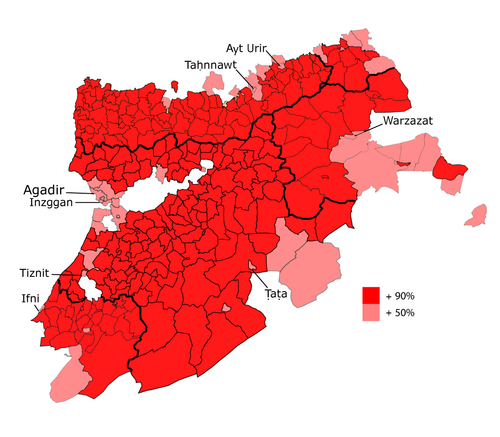
تُعدّ لغة التشلحيت، التي يتحدث بها 4.7 مليون شخص، أي ما يعادل 14% من سكان المغرب، اللغة الأمازيغية الأكثر انتشاراً في المملكة، متقدمةً على لغتي التمازيغت والطريفية . ويمثل متحدثوها أكثر من نصف إجمالي الناطقين بالأمازيغية البالغ عددهم 8.8 مليون نسمة. [ 2 ]
كما أنها اللغة الأمازيغية الأكثر انتشاراً جغرافياً في البلاد، إذ يتواجد متحدثوها في 1512 بلدية من أصل 1538 بلدية في المملكة. ويعود هذا الانتشار بشكل ملحوظ إلى هجرة أعداد كبيرة من التجار الصغار الذين استقروا في أنحاء البلاد، فضلاً عن العمال الباحثين عن فرص عمل. [ 2 ] [ 13 ]
تتجاوز نسبة المتحدثين باللغة التشلحيت في خمس مناطق مغربية المعدل الوطني، وهي: سوس ماسة ، وكلمن وادي نون ، ومراكش آسفي ، ودرعة تافيلالت ، وبني ملال خنيفرة . مع ذلك، تُشكل اللغة التشلحيت أغلبية سكان منطقة سوس ماسة، حيث تبلغ نسبتهم 63.2%. وتنخفض هذه النسبة إلى 48.1% في كلمن وادي نون، و25.8% في درعة تافيلالت، و24.5% في مراكش آسفي، و14.4% في بني ملال خنيفرة. [ 1 ]
كما هو الحال مع الكثافة العالية للمتحدثين باللغة التشلهيتية في الداخلة، تُستخدم هذه اللغة على نطاق واسع في البلديات المغربية خارج المنطقة التي نشأت فيها تاريخيًا. ومع وجود 49% من متحدثيها في المدن، أصبحت التشلهيتية لغة حضرية بامتياز. فعلى سبيل المثال، يتحدث 10% من سكان الدار البيضاء التشلهيتية، أي أكثر من 334 ألف نسمة. وبذلك، تُعدّ الدار البيضاء أول مدينة تستخدم التشلهيتية في المغرب، متقدمةً على أكادير (225 ألف متحدث). وبالمثل، يتحدث 9.2% من سكان الرباطية التشلهيتية، أي أكثر من 52 ألف نسمة، أو 4% من سكان طنجة ووجديس. وأخيرًا، توجد حالات استثنائية في بلديات نائية جدًا، مثل قرية إمليلي للصيد، جنوب الداخلة (60% من المتحدثين). تُذكّر هذه الأوضاع بالهجرات التاريخية المتتالية على المدى الطويل، ولا سيما الهجرة الريفية الجماعية التي بدأت في القرن العشرين نحو المراكز الاقتصادية الكبرى. [ 13 ] [ 2 ]
اللهجات
Dialect differentiation within Shilha, such as it is, has not been the subject of any targeted research, but several scholars have noted that all varieties of Shilha are mutually intelligible. The first was Stumme, who observed that all speakers can understand each other, "because the individual dialects of their language are not very different."[14] This was later confirmed by Ahmed Boukous, a Moroccan linguist and himself a native speaker of Shilha, who stated: "Shilha is endowed with a profound unity which permits the Shluh to communicate without problem, from the Ihahan in the northwest to the Aït Baamran in the southwest, from the Achtouken in the west to the Iznagen in the east, and from Aqqa in the desert to Tassaout in the plain of Marrakesh."[15]
There exists no sharply defined boundary between Shilha dialects and the dialects of Central Atlas Tamazight (CAT). The dividing line is generally put somewhere along the line Marrakesh-Zagora, with the speech of the Ighoujdamen, Iglioua and Aït Ouaouzguite ethnic groups[b] belonging to Shilha, and that of the neighboring Inoultan, Infedouak and Imeghran ethnic groups counted as CAT.
Writing systems
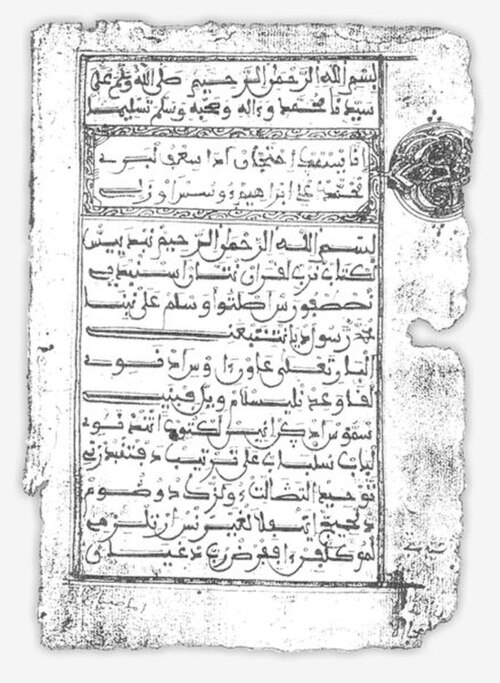
Though Tashelhit has historically been an oral language, manuscripts of mostly religious texts have been written in Tashelhit using the Arabic script since at least the 16th century.[16][17] Today, Tashelhit is most commonly written in the Arabic script, although Neo-Tifinagh is also used.[18]
Literature
Shilha has an extensive body of oral literature in a wide variety of genres (fairy tales, animal stories, taleb stories, poems, riddles, and tongue-twisters). A large number of oral texts and ethnographic texts on customs and traditions have been recorded and published since the end of the 19th century, mainly by European linguists.[19][20][21]
Shilha possesses an old literary tradition. Numerous texts written in Arabic script are preserved in manuscripts dating from the 16th century.[17] The earliest datable text is a compendium of lectures on the "religious sciences" (lɛulum n ddin) composed in metrical verses by Brahim u Ɛbdllah Aẓnag, who died in 1597. The best known writer in this tradition is Mḥmmd u Ɛli Awzal, author of al-Ḥawḍ "The Cistern" (a handbook of Maliki law in verse), Baḥr al-Dumūʿ "The Ocean of Tears" (an adhortation, with a description of Judgment Day, in verse) and other texts.[22]
Modern Tashelhit literature has been developing since the end of the 20th century.[23][24]
Research
The first attempt at a grammatical description of Shilha is the work of the German linguist Hans Stumme (1864–1936), who in 1899 published his Handbuch des Schilḥischen von Tazerwalt. Stumme's grammar remained the richest source of grammatical information on Shilha for half a century. A problem with the work is its use of an over-elaborate, phonetic transcription which, while designed to be precise, generally fails to provide a transparent representation of spoken forms. Stumme also published a collection of Shilha fairy tales (1895, re-edited in Stroomer 2002).
The next author to grapple with Shilha is Saïd Cid Kaoui (Saʿīd al-Sidqāwī, 1859-1910), a native speaker of Kabyle from Algeria. Having published a dictionary of Tuareg (1894), he then turned his attention to the Berber languages of Morocco. His Dictionnaire français-tachelh’it et tamazir’t (1907) contains extensive vocabularies in both Shilha and Central Atlas Tamazight, in addition to some 20 pages of useful phrases. The work seems to have been put together in some haste and must be consulted with caution.
On the eve of the First World War there appeared a small, practical booklet composed by Captain (later Colonel) Léopold Justinard (1878–1959), entitled Manuel de berbère marocain (dialecte chleuh). It contains a short grammatical sketch, a collection of stories, poems and songs, and some interesting dialogues, all with translations. The work was written while the author was overseeing military operations in the region of Fez, shortly after the imposition of the French protectorate (1912). Justinard also wrote several works on the history of the Souss.
قام إميل لاوست (1876-1952)، وهو مؤلف غزير الإنتاج للكتب والمقالات حول اللغات البربرية، في عام 1921 بنشر كتابه Cours de berbère marocain (الطبعة الثانية الموسعة 1936)، وهو عبارة عن قواعد تعليمية مع دروس متدرجة ومفردات موضوعية، وبعض النصوص الإثنوغرافية الجيدة (بدون ترجمات) وقائمة كلمات.
قام إدموند ديستانج (1872–1940) بتطوير معرفته بمعجم شيلها بشكل كبير من خلال كتابه Etude sur la tachelḥît du Soûs. Vocabulaire français-berbère (1920) وكتابه Textes berbères en parler des Chleuhs du Sous (المغرب) (1940، مع ملاحظات معجمية غزيرة). خطط ديستانج أيضًا لقواعد نحوية لإكمال الثلاثية، لكن لم يتم نشرها مطلقًا.
الملازم المترجم (لاحقًا القائد) روبرت أسبينيون هو مؤلف كتاب " لنتعلم البربرية: مقدمة في لهجات الشلوه" (1953)، وهو كتاب قواعد نحوية تعليمي غني بالمعلومات وإن كان غير منظم إلى حد ما. وقد ألغت نسخ أسبينيون البسيطة والدقيقة الأنظمة الصوتية السابقة والأنظمة القائمة على اللغة الفرنسية.
أول محاولة لوصف اللغة الإنجليزية هي كتاب "مخطط بنية الشلحة " (1958) للغوي الأمريكي جوزيف أبليجيت (1925-2003). يستند هذا العمل إلى دراسة أجراها متحدثون أصليون من إفني، وهو مكتوب بأسلوب كثيف ومعقد، يفتقر إلى نموذج واضح المعالم. أما النسخ المكتوبة، فإلى جانب كونها غير تقليدية، فهي غير موثوقة في مجملها.
إنّ الدراسة النحوية الوحيدة المتاحة والمُيسّرة المكتوبة ضمن إطار لغوي حديث هي كتاب " البربرية " (1988) لليونيل غالاند (1920-2017)، اللغوي الفرنسي المتخصص في البربرية. وتستند هذه الدراسة بشكل أساسي إلى لغة الإغشان، وهي مجموعة عرقية من جبال الأطلس الصغير، مع ملاحظات مقارنة حول لغة القبائل في الجزائر والطوارق في النيجر.
وتشمل الدراسات الحديثة التي استغرقت وقتًا طويلاً في الكتب كلاً من جواد (1995، حول المقاييس)، وديل وإلمدلاوي (2002 و2008، حول المقاطع والمقاييس)، والمنتصر (2009، قواعد تعليمية)، وروتجر (2017، حول النبر والتنغيم) والعديد من طبعات النصوص التي قام بها سترومر (انظر أيضًا § الأعمال المذكورة والمزيد من القراءة ).
علم الأصوات
النبرة والتنغيم
لا يوجد حاليًا أي دليل على وجود تشديد على الكلمات في لغة تاشلهيت. [ 25 ]
حروف العلة
تحتوي لغة شيلها على ثلاثة حروف علة صوتية، ولا يُعدّ طولها سمة مميزة لها. [ 26 ] وتُظهر حروف العلة نطاقًا واسعًا من النطق البديل. [ 27 ] يُنطق حرف العلة /a/ غالبًا كـ [a] أو [æ]، ويُنطق /u/ دون أي تقريب ملحوظ إلا عند مجاورته لحرف w . ويؤدي وجود حرف ساكن بلعومي إلى نطق أكثر مركزية لحرف العلة، كما في kraḍ [krɐdˤ] "ثلاثة"، وkkuẓ [kkɤzˤ] "أربعة"، وsḍis [sdˤɪs] "ستة" (قارن بـ yan [jæn] "واحد"، وsin [sin] "اثنان"، و smmus [smmʊs] "خمسة").
| أمام | وسط المدينة | خلف | |
|---|---|---|---|
| يغلق | أنا | u | |
| يفتح | أ |
تظهر حروف العلة الصوتية الإضافية بشكل متقطع في الكلمات المستعارة الحديثة، على سبيل المثال /o/ كما في rristora "مطعم" (من الفرنسية).
حروف العلة الانتقالية و"شوا"
إضافةً إلى حروف العلة الصوتية الثلاثة، توجد حروف علة انتقالية غير صوتية، يُشار إليها غالبًا باسم " شوا ". عادةً ما يُسمع حرف العلة الانتقالي بعد بداية مقطع لفظي خالٍ من حروف العلة CC أو CCC، إذا كان أي من الحرفين الساكنين المجاورين، أو كلاهما، مجهورًا، [ 28 ] على سبيل المثال: tigmmi [tiɡĭmmi] بمعنى "منزل"، وamḥḍar [amɐ̆ʜdˤɐr] بمعنى "تلميذ". في النسخ الصوتية لستوم (1899) وديستانغ (1920، 1940)، تم الإشارة إلى العديد من حروف العلة الانتقالية هذه.
Later authors such as Aspinion (1953), use the symbol ⟨e⟩ to mark the place where a transitional vowel may be heard, irrespective of its quality, and they also write ⟨e⟩ where in reality no vowel, however short, is heard, for example ⟨akessab⟩/akssab/ "owner of livestock", ⟨ar icetta⟩/ariʃtta/ "he's eating". The symbol ⟨e⟩, often referred to as "schwa", as used by Aspinion and others, thus becomes a purely graphical device employed to indicate that the preceding consonant is a syllable onset: [a.k(e)s.sab], [a.ri.c(e)t.ta].[29] As Galand has observed, the notation of "schwa" in fact results from "habits which are alien to Shilha".[30] And, as conclusively shown by Ridouane (2008), transitional vowels or "intrusive vocoids" cannot even be accorded the status of epenthetic vowels. It is therefore preferable not to write transitional vowels or "schwa", and to transcribe the vowels in a strictly phonemic manner, as in Galand (1988) and all recent text editions.[c]
Consonants
The chart below represents Tashlhiyt consonants in IPA, with orthographical representations added between angled brackets when different:[31]
| Labial | Dental | Post-alveolar | Velar | Uvular | Pharyn-geal | Glottal | |||||
|---|---|---|---|---|---|---|---|---|---|---|---|
| plain | phar. | plain | lab. | plain | lab. | ||||||
| Nasal | m | n̪ | |||||||||
| Plosive | voiceless | t̪ | t̪ˤ⟨ṭ⟩ | k | kʷ⟨k°⟩ | q | qʷ⟨q°⟩ | ||||
| voiced | b | d̪ | d̪ˤ⟨ḍ⟩ | g | gʷ⟨g°⟩ | ||||||
| Fricative | voiceless | f | s̪ | s̪ˤ⟨ṣ⟩ | ʃ⟨c⟩ | χ⟨x⟩ | χʷ⟨x°⟩ | ʜ⟨ḥ⟩ | |||
| voiced | z̪ | z̪ˤ⟨ẓ⟩ | ʒ⟨j⟩ | ʁ⟨ɣ⟩ | ʁʷ⟨ɣ°⟩ | ʢ⟨ɛ⟩ | ɦ⟨h⟩ | ||||
| Approximant | l̪ | l̪ˤ⟨ḷ⟩ | j⟨y⟩ | w | |||||||
| Trill | r̪ | r̪ˤ⟨ṛ⟩ | |||||||||
تظهر الحروف الساكنة الصوتية الإضافية بشكل متقطع في الكلمات المستعارة الحديثة، على سبيل المثال /bʷ/ كما في bb°a "(والدي)" (من اللهجة المغربية)، و /p/ كما في laplaj "شاطئ" (من الفرنسية).
كغيرها من اللغات البربرية والعربية، تحتوي لغة تشلحيت على كلٍّ من الحروف الساكنة الحلقية (المؤكدة) والحروف الساكنة السنية العادية. [ 32 ] [ 33 ] كما يوجد تمييز بين الحروف الساكنة الشفوية والحروف الساكنة الظهرية العادية . [ 33 ] ويُعدّ تثنية الحروف الساكنة أو طولها عاملاً تباينياً. [ 34 ]
أشباه الحروف المتحركة
للحرفين شبه المتحركين /w/ و /j/ نطقان صوتيان بديلان هما [u] و [i] بين الحروف الساكنة (C_C) وبين الحرف الساكن والوقفة (C_# و#_C). وبالمثل، يمكن أن يكون للحرفين المتحركين العاليين /u/ و /i/ نطقان صوتيان بديلان هما [w] و [j] لتجنب الوقفة. في معظم اللهجات، [ 35 ] تتوزع الحروف شبه المتحركة بشكل تكميلي مع الحروف المتحركة العالية، حيث تظهر الحروف شبه المتحركة في بداية المقطع أو نهايته، بينما تظهر الحروف المتحركة العالية في نواة المقطع. وقد أدى هذا التوزيع السطحي للحروف شبه المتحركة والحروف المتحركة العالية إلى إخفاء مكانتها كأربعة أصوات مميزة، حتى أن بعض اللغويين ينكرون مكانة /w/ و/j/ كصوتين مميزين. [ 36 ]
إن افتراض وجود أربعة أصوات مميزة ضروري لأن أنصاف الحروف المتحركة والحروف المتحركة العالية يمكن أن تظهر متتابعة، بترتيب معجمي محدد، على سبيل المثال tazdwit "نحلة"، وtahruyt "نعجة" (وليس * tazduyt أو * tahrwit ). إضافةً إلى ذلك، فإن أنصاف الحروف المتحركة /w/ و /j/ ، مثل غيرها من الحروف الساكنة، تظهر طويلة، كما في afawwu "لفافة"، وtayyu "سنام الجمل". [ 37 ] كما أن افتراض وجود أربعة أصوات يُسهم في وصف أكثر دقة للصرف. [ 38 ]
في الأمثلة أدناه، يتم نسخ w و y صوتيًا في بعض أشكال الاقتباس، ولكن دائمًا صوتيًا في السياق، على سبيل المثال ysti- "بنات" و dars snat istis "لديه ابنتان".
التزاوج والطول
Any consonant in Tashlhiyt, in any position within a word, may be simple or geminate. There may be up to two geminates in a stem, and up to three in a word.[39]
The role of gemination varies:[39]
| Word with Simple Consonant | Word with Geminate Consonant | Role of Gemination | ||
|---|---|---|---|---|
| Tashlhiyt | Translation | Tashlhiyt | Translation | |
| tamda | pond | tamdda | brown buzzard | lexical difference |
| zdi | to stick (perfect) | zddi | to stick (imperfective) | morphology |
Gemination also may occur due to phonological assimilation. For example, the following phrase would be realized as [babllfirma]:[39]
bab
owner
n=l-firma
of=farm
bab n=l-firma
owner of=farm
the owner of the farm
Some consonants are realized differently during morphological gemination; ḍḍ as ṭṭ, ww as gg°, ɣɣ as qq, and ɣɣ° as qq°.[39]
Syllable structure
Shilha syllable structure has been the subject of a detailed and highly technical discussion by phoneticians. The issue was whether Shilha does or does not have vowelless syllables. According to John Coleman, syllables which are vowelless on the phonemic level have "schwa" serving as vocalic nucleus on the phonetic level. According to Rachid Ridouane on the other hand, Shilha's apparently vowelless syllables are truly vowelless, with all phonemes, vowels as well as consonants, capable of serving as nucleus. The discussion is summed up in Ridouane (2008, with listing of relevant publications), where he conclusively demonstrates that a perfectly ordinary Shilha phrase such as tkkst stt "you took it away" indeed consists of three vowelless syllables [tk.ks.tst:.], each made up of voiceless consonants only, and with voiceless consonants (not "schwa") serving as nucleus. Many definitions of the syllable that have been put forward do not cover the syllables of Shilha.[40]
Syllable types
The syllable structure of Shilha was first investigated by Dell and Elmedlaoui in a seminal article (1985). They describe how syllable boundaries can be established through what they call "core syllabification". This works by associating a nucleus with an onset, to form a core syllable CV or CC. Segments that are higher on the sonority scale have precedence over those lower on the scale in forming the nucleus in a core syllable, with vowels and semivowels highest on the scale, followed by liquids and nasals, voiced fricatives, voiceless fricatives, voiced stops and voiceless stops. When no more segments are available as onsets, the remaining single consonants are assigned as coda to the preceding core syllable, but if a remaining consonant is identical to the consonant that is the onset of the following syllable, it merges with it to become a long consonant. A morpheme boundary does not necessarily constitute a syllable boundary.
ddan
they.went
s
to
yaw
one
wurti
EA-orchard
kcmn
they.enter
iss
into-it
ad
to-
ccin
they.eat
tazart
EL-figs
d
with
waḍil
EA-grapes
ddan s yaw wurti kcmn iss ad ccin tazart d waḍil
they.went to one EA-orchard they.enter into-it to- they.eat EL-figs with EA-grapes
"they went to an orchard and entered it to eat figs and grapes"
| دان سياو ورتي كشمن إيس اد شين تازارت د وضيل | ddan s yaw wurti kcmn iss ad ccin tazart d waḍil |
|---|---|
| Core syllabification | ddan syaw wurti kcmn iss ad ccin tazart dwaḍil |
| Coda assignment: | d:an syaw:urti kcmn is: ad ccintazart dwaḍil |
Comparative diagram of the following:
| Example of Phonological Processes in Shilha | ||||||||||||||||||||||||||||
|---|---|---|---|---|---|---|---|---|---|---|---|---|---|---|---|---|---|---|---|---|---|---|---|---|---|---|---|---|
| Gloss of text | they.went | to | one | EA-orchard | they.enter | into-it | to- | they.eat | EL-figs | with | EA-grapes | |||||||||||||||||
| Shilha text | ddan | s | yaw | wurti | kcmn | iss | ad | ccin | tazart | d | waḍil | |||||||||||||||||
| Core Syll | d | (da) | (ns) | (ya) | w | (wu) | r | (ti) | k | (cm) | (ni) | s | (sa) | (dc) | (ci) | n | (ta) | (za) | r | (td) | (wa) | (ḍi) | l | |||||
| Coda Assgn. | (d:a) | (ns) | (ya) | (w:ur) | (tik) | (cm) | (ni) | (s:a) | (dc) | (cin) | (ta) | (zar) | (td) | (wa) | (ḍil) | |||||||||||||
| English trans | "they went to an orchard and entered it to eat figs and grapes" | |||||||||||||||||||||||||||
Application of core syllabification produces the following Shilha syllable types:
| C V | C: V | ||
| C V C | C: V C | C V C: | C: V C: |
| C C | C: C | C C: | C: C: |
| C C C | C: C C | C C C: | C: C C: |
Shilha syllable structure can be represented succinctly by the formula CX(C), in which C is any consonant (single/long), and X is any vowel or consonant (single) and with the restriction that in a syllable CXC the X, if it is a consonant, cannot be higher on the resonance scale than the syllable-final consonant, that is, syllables such as [tsk.] and [wrz.] are possible, but not *[tks.] and *[wzr.].
Exceptional syllables of the types X (vowel or single/long consonant) and V(C) (vowel plus single/long consonant) occur in utterance-initial position:
- rgl t رگلت[r.glt.] "close it!" (syllable C)
- ffɣat فغات[f:.ɣat.] "go out!" (syllable C:)
- awi t id او ئي تيد[a.wi.tid.] "bring it here!" (syllable V)
- acki d أشكيد[ac.kid.] "come here!" (syllable VC)
Another exceptional syllable type, described by Dell and Elmedlaoui (1985), occurs in utterance-final position, when a syllable of the type CC or CC: is "annexed" to a preceding syllable of the type CV or C:V, for example fssamt فسامت"be silent!" is [fs.samt.] not *[fs.sa.mt.].
Since any syllable type may precede or follow any other type, and since any consonant can occur in syllable-initial or final position, there are no phonotactical restrictions on consonant sequences. This also means that the concept of the consonant cluster is not applicable in Shilha phonology, as any number of consonants may occur in sequence:
frḥɣ
I.am.glad
s
by.means.of
lmɛrft
the.acquaintance
nnk
of.you
frḥɣ s lmɛrft nnk
I.am.glad by.means.of the.acquaintance of.you
"I'm glad to make your acquaintance"
فرحغس لمعرفت أنك
- [fr.ḥɣs.lm.ɛrf.tn.nk.] (6 syllables, 14 consonants, no vowels)
Metrics
The metrics of traditional Shilha poems, as composed and recited by itinerant bards (inḍḍamn), was first described and analyzed by Hassan Jouad (thesis 1983, book 1995; see also Dell and Elmedlaoui 2008). The traditional metrical system confirms the existence of vowelless syllables in Shilha, and Jouad's data have been used by Dell and Elmedlaoui, and by Ridouane to support their conclusions.
The metrical system imposes the following restrictions:
- each line in a poem contains the same number of syllables as all the other lines
- each syllable in a line contains the same number of segments as its counterpart in other lines
- each line contains one particular syllable that must begin or end with a voiced consonant
- each line is divided into feet, with the last syllable in each foot stressed ("lifted") in recitation
Within these restrictions, the poet is free to devise his own metrical form. This can be recorded in a meaningless formula called talalayt which shows the number and the length of the syllables, as well as the place of the obligatory voiced consonant (Jouad lists hundreds of such formulae).
The system is illustrated here with a quatrain ascribed to the semi-legendary Shilha poet Sidi Ḥammu (fl. 18th century) and published by Amarir (1987:64):
a titbirin a tumlilin a timgraḍ ab bahra wr takkamt i lxla hann lbaz igan bu tassrwalt ig lxatm ɣ uḍaḍ ak k°nt yut ukan iɣli d ignwan izug
يا حمامات بيضاء، يا حيوانات أليفة! لا تغامروا بالذهاب إلى الصحراء كثيراً، فهناك الصقر، يرتدي سروالاً قصيراً؛ سيضع خاتماً على إصبعك، ليضربك مرة واحدة فقط - ثم يصعد إلى السماء ويختفي!
يكشف تطبيق تقسيم المقاطع الأساسي لديل وإلمدلاوي عن فسيفساء منتظمة من المقاطع:
| 1 | 2 | 3 | 4 | 5 | 6 | 7 | 8 | 9 | 10 | 11 | 12 | ||||
|---|---|---|---|---|---|---|---|---|---|---|---|---|---|---|---|
| السطر 1 | أ | ت إي ت | ثنائي الجنس | ري | نا | توم | لي | لي | نا | تي إي | ملغ | r á ḍ | |||
| السطر 2 | أ | ب: آ ح | را | wr | تا | ك: أ م | تي | لوكس | لا | ح أ | ن: ل | ب أ ز | |||
| السطر 3 | أنا | g an | بو | تا | s: r | وال | تي | GL | xa | ت م | ɣ u | أب | |||
| السطر 4 | أ | k°: ń t | يو | تو | كا | n í ɣ | لي | دي | gn | وا | ني | z ú g |
تم تأليف القصيدة على وزن مذكور من قبل جواد (1995:283) وموضح بالصيغة a láy , la li la láy , la li la lá , li lád (يشير حرف d في المقطع الأخير إلى موضع الحرف الساكن الإلزامي المجهور).
قواعد اللغة
الأسماء
بناءً على شكلها، يمكن تمييز ثلاثة أنواع من أسماء الشلهة، نوعان محليان ونوع واحد ذو أصل خارجي:
- الأسماء المصرفة
- الأسماء غير المصرفة
- القروض غير المدمجة
الفئات الصرفية النحوية ذات الصلة هي الجنس والعدد والحالة. [ 41 ]
الأسماء المصرفة
تُعدّ الأسماء المصرفة النوع الأكثر عدداً بلا منازع. ويمكن تمييز هذه الأسماء بسهولة من خلال شكلها الخارجي: فهي تبدأ ببادئة اسمية تأخذ الشكل (t)V- :
- أزال "وقت النهار"
- igigil "يتيم"
- uṣkay "كلب صيد"
- tadgg°at "evening"
- tibinṣrt "الخطمي (نبات)"
- tuḍfit "ant"
تُميّز الأسماء المُصرّفة بين جنسين، المذكر والمؤنث؛ وعددين، المفرد والجمع؛ وحالتين، يُشار إليهما عادةً باسميهما الفرنسيين état libre ("الدولة الحرة") و état d'annexion ("الدولة المُلحقة") [ 42 ] ويُرمز لهما اختصارًا بـ EL و EA . يُشار إلى الجنس والعدد بوضوح، ولكن التغيرات الصوتية التاريخية والمعاصرة أدت في بعض الحالات إلى تلاشي الفرق بين EL وEA.
The nominal prefix has no semantic content, i.e. it is not a sort of (in)definite article, although it is probably demonstrative in origin. It is made up of one or both of two elements, a gender prefix and a vocalic prefix. Singular feminine nouns may also have a gender suffix. For example, the noun tazdwit "bee" has the feminine prefix t-, the vocalic prefix a- and the feminine singular suffix -t added to the nominal stem zdwi. While feminine inflected nouns always have the feminine prefix, masculine nouns do not have a gender prefix in the free state (EL); for example abaɣuɣ "fox" has no gender prefix, but only a vocalic prefix a- added to the nominal stem baɣuɣ.
Gender is thus marked unambiguously, albeit asymmetrically. In just a handful of nouns, the morphological gender does not conform to the grammatical gender (and number): ulli "sheep and goats" is morphologically masculine singular, but takes feminine plural agreement; alln "eyes" is morphologically masculine plural, but takes feminine plural agreement; tarwa "(someone's) children, offspring" is morphologically feminine singular, but takes masculine plural agreement.
The annexed state (EA) is regularly formed by reducing the vocalic prefix to zero and, with masculine nouns, adding the masculine gender prefix w-:[43]
- EL t-a-zdwi-t "bee" → EA t-zdwi-t
- EL a-baɣuɣ "fox" → EA w-baɣuɣ
With some nouns, the original vocalic prefix has fused with a stem-initial vowel, to produce an inseparable (and irreducible) vowel:
- EL ayyur "moon, month" → EA w-ayyur (not *w-yyur)
- EL t-afuk-t "sun" → EA t-afuk-t (not *t-fuk-t)
With feminine nouns that have an inseparable vocalic prefix, the difference between EL and EA is thus neutralized.
While most inflected nouns have a vocalic prefix a-, some have i- (in some cases inseparable), and a few have u- (always inseparable). When a masculine noun has the vocalic prefix i- (separable or inseparable), the masculine gender prefix w- changes to y-. The table below presents an overview (all examples are singular; plurals also distinguish EL and EA):
| Masculine | Feminine | ||||
|---|---|---|---|---|---|
| EL | EA | EL | EA | ||
| "fox" | a-baɣuɣ | w-baɣuɣ | "bee" | t-a-zdwi-t | t-zdwi-t |
| "moon" | ayyur | w-ayyur | "sun" | تافوك ت | تافوك ت |
| "كهف" | آي-فراي | من الجمعة إلى الجمعة | "لحمة" | تي-فيي | تي-فيي |
| "رماد" | iɣd | y-iɣd | "ملح" | ليس كذلك | ليس كذلك |
| " موفلون " | أوداد | و-وداد | "ضوء" | t-ufaw-t | t-ufaw-t |
لا يمكن التنبؤ بالقيمة EA من شكل الاسم، قارن:
- afus "يد" → EA wfus
- ركبة " أفود " → EA wafud
تنطبق القواعد الصوتية المتعلقة بنطق /w/ و/j/ على المقطع الصوتي EA أيضًا. على سبيل المثال، المقطع الصوتي EA لكلمة a-mɣar التي تعني "رئيس" هو /w-mɣar/، ويُنطق wmɣar بعد حرف متحرك، وumɣar بعد حرف ساكن.
- idda wmɣar s dar lqqaḍi "ذهب الرئيس لرؤية القاضي"
- imun umɣar d lqqaḍi "رافق الرئيس القاضي"
تُظهر الأسماء المصرفة تنوعًا كبيرًا في صيغ الجمع، وذلك بتطبيق عملية واحدة أو أكثر من العمليات التالية:
- اللواحق (المذكر -ن ، المؤنث -ين )
- تغيير حروف العلة (إضافة أو حذف أو تغيير صوتي )
- مضاعفة أو إزالة مضاعفة الحروف الساكنة
- امتداد الجذر (+ aw ، + iw ، + t ، + w ، دائمًا مع لاحقة)
توجد أيضاً صيغ جمع شاذة وتكميلية. وتُحذف لاحقة المفرد المؤنث -t بشكل طبيعي في صيغة الجمع.
وبغض النظر عن هذه العمليات، يتم استبدال البادئة الصوتية القابلة للفصل a- دائمًا بـ i- . أما البادئة الصوتية غير القابلة للفصل فإما أن تبقى دون تغيير، أو تتغير كجزء من تغيير حرف العلة (ولكن إذا كانت البادئة الصوتية غير قابلة للفصل في المفرد، فقد تكون قابلة للفصل في الجمع، كما هو الحال مع aduz "dune"، والعكس صحيح، كما هو الحال مع aydi "dog"؛ انظر الجدول أدناه).
فيما يلي عينة من الأسماء، توضح مختلف صيغ الجمع.
| المفرد | جمع | العملية (العمليات) | |
|---|---|---|---|
| "جبل" | a-drar | i-drar-n | الإلحاق |
| "الكثبان الرملية" | أدوز | آي-داز-ن | تغيير حرف العلة، الإنبات، اللاحقه |
| "رأس" | أ-غايو | أنا-جايا | تغيير حرف العلة |
| "أذن" | a-mẓẓug | i-mzga-n | (جمع غير منتظم) |
| "بئر ماء" | أنو | أونا | تغيير حرف العلة |
| "وثيقة" | أرا | arra+tn | امتداد الساق، إضافة اللاحقة |
| "يوم" | مؤخرة | الولايات المتحدة الأمريكية | تغيير حروف العلة، إضافة اللواحق |
| "كلب" | a-ydi | إيدا-ن | (جمع غير منتظم) |
| "جبهة" | i-gnzi | i-gnzi+tn | امتداد الساق، إضافة اللاحقة |
| "الساعد" | أنا-جيل | إي-غال-ن | تغيير حرف العلة، الإنبات، اللاحقه |
| "العقرب" | iɣirdm | iɣardm+iw-n | تغيير حروف العلة، امتداد الجذر، إضافة اللواحق |
| "شاهد" | إي-نيجي | إيناغا-ن | تغيير حروف العلة، إضافة اللواحق |
| "عبد" | i-smg | i-smga-n | تغيير حروف العلة، إضافة اللواحق |
| "وجه" | udm | udm+aw-n | امتداد الساق، إضافة اللاحقة |
| "أغنية" | urar | أورار-ن | الإلحاق |
| "ابن آوى" | يو سي إن | يوكان-ن | تغيير حروف العلة، إضافة اللواحق |
| "بيضة" | تا-غلاي-ت | تي-غلاي | (جمع غير منتظم) |
| "شيء" | تا-غاوسا | ti-ɣaws+iw-in | امتداد الساق، إضافة اللاحقة |
| "فأرة" | تا-غرداي-ت | تي-جي آر دي واي-إن | الإلحاق |
| "زبد" | ta-gccul-t | tig°cl-in | تغيير حروف العلة، إضافة لاحقة، إزالة التأنيث |
| "مدفأة" | تاكا-ت | تاكا + ت في | امتداد الساق، إضافة اللاحقة |
| "امرأة" | تامغارت | tu-mɣar-in [ d ] | الإلحاق |
| "القنفذ" | t-aruc-t | تي-يوراك | تغيير حرف العلة |
| "مفتاح" | تا-سارو-ت | تي-سورا | تغيير حرف العلة |
| "منزل" | ti-gmmi | تيغ°ما | تغيير حرف العلة |
| "نعجة" | تي-إيلي | تاتن | (جمع تكميلي) |
| "وجبة" | تي-إرم-تي | تي-إيرام | تغيير حرف العلة |
| "عين" | تي-إت | جميع-ن | (جمع تكميلي) |
| "ممر جبلي" | تي-إيزي | بيتزا | تغيير حرف العلة، التضعيف |
| "اللبؤة" | ت-إزم-ت | t-izm+aw-in | الإلحاق، امتداد الساق |
| "ضوء" | t-ifaw-t | t-ifaw-in | الإلحاق |
لا يمكن التنبؤ بصيغة الجمع عمومًا من شكل صيغة المفرد، قارن بما يلي:
- aduku "حذاء"، جمع idukan (تغيير حرف العلة واللاحقة)
- aruku "إناء"، جمع irukutn (امتداد الجذع واللاحقة)
العديد من الأسماء لها أكثر من صيغة جمع واحدة، على سبيل المثال a-jnwiy "سكين"، وجمعها i-jnway (تغيير حرف العلة) أو i-jnwiy-n (إضافة لاحقة).
العديد من أسماء الأماكن في شيلها هي أسماء مُصرفة صرفياً:
- الاسم "أنامور"
- I-ɣ°rays-n " Irhoreïsene"
- تارودانت "تارودانت"
- تيزغزاوين "Tizegzaouine"
وينطبق الأمر نفسه على أسماء عرقية شيلها:
- Amml-n "الـ Ammeln" (المفرد Imml )
- Actuk-n "الأختوكن" (المفرد: أكتوك )
- I-lall-n "Illallen" (المفرد I-lillu )
- I-sk°ta-n "الاسوكتان" (المفرد A-sktu )
تتضمن الأسماء المصرفة العديد من الكلمات المُقترضة المُدمجة. ومن الأمثلة على ذلك:
- تا-كيرا "شمع" (من اللاتينية)
- a-ɣanim "القصب" (من اللغة البونية)
- urti "قطعة أرض للخضراوات، بستان" (من الرومانسية المبكرة)
- مسلم (من اللغة العربية)
- رسالة (من اللغة العربية)
الأسماء غير المصرفة
هذا النوع هو الأقل شيوعًا، ويشمل أيضًا بعض القروض. أمثلة:
- ديكوك "الوقواق"
- موضة "العطش"
- gmz "thumb"
- كدران "تار" (من العربية)
- lagar "محطة" (من الفرنسية)
- mllɣ "إصبع السبابة"
- sksu "couscous"
- wiẓugn "cricket"
- xizzu "جزر"
من المحتمل أن جميع الأسماء غير المصرفة كانت في الأصل مذكرة. أما الأسماء القليلة التي تأخذ الآن صيغة المؤنث، فتحتوي على عناصر أعيد تحليلها على أنها تدل على الجنس المؤنث، على سبيل المثال ttjdmnni "نوع من العناكب" ( حيث يُنظر إلى حرف t الأولي على أنه بادئة مؤنثة)، وhlima "خفاش" (ليست كلمة عربية دخيلة، ولكن تم تحليل حرف a النهائي على أنه النهاية العربية المؤنثة).
العديد من الأسماء غير المصرفة هي أسماء جمع أو أسماء غير معدودة ليس لها صيغة جمع منفصلة. أما تلك التي لها صيغة جمع، فتُجمع بإضافة أداة الجمع "id" ، على سبيل المثال "id lagar " بمعنى "محطات".
الاسم غير المصرف mddn أو middn "الناس، البشر" هو مفرد مذكر من الناحية الصرفية ولكنه يأخذ صيغة الجمع المذكر.
يمكن اعتبار أسماء الأشخاص وأسماء الأماكن الأجنبية نوعًا فرعيًا من الأسماء غير المصرفة، على سبيل المثال موسى (اسم رجل)، منى (اسم امرأة)، فاس "فاس"، برقديز "البرتغال". لا يُحدد الجنس بشكل واضح في هذه الأسماء، ولكن تلك التي تشير إلى البشر تتوافق مع الجنس الطبيعي للمُشار إليه (مذكر/مذكر، مؤنث/مؤنث).
القروض غير المسجلة
هذه أسماء من أصل عربي (بما في ذلك الأسماء المُقترضة من الفرنسية والإسبانية عبر العربية) والتي احتفظت إلى حد كبير بصيغتها العربية. وهي تميز بين جنسين (ليس بالضرورة بشكل واضح) وعددين (محددين صراحةً). ومن السمات البارزة لهذه الأسماء أنها مُقترضة مع أداة التعريف العربية، والتي تُصبح مُحايدة دلاليًا في لغة الشلحة.
- اللهجة المغربية : l-kabus "المسدس" → Shilha lkabus "المسدس، مسدس"
- العربية المغربية t-tabut "التابوت" → Shilha ttabut "التابوت، تابوت"
غالباً ما يتم استبدال اللاحقة المؤنثة العربية -a باللاحقة المؤنثة المفردة -t :
- العربية المغربية l-faky-a → شلحة lfaki-t "فاكهة"
- العربية المغربية ṛ-ṛuḍ-a → Shilha ṛṛuṭ-ṭ "قبر قديس"
تحتفظ الكلمات العربية المُقترضة عادةً بجنسها في نظام الشلحة. ويُستثنى من ذلك الأسماء العربية المذكرة التي تنتهي بحرف التاء ؛ إذ يتغير جنسها إلى مؤنث في نظام الشلحة، مع إعادة تحليل حرف التاء الأخير كلاحقة المفرد المؤنث في نظام الشلحة -ت .
- العربية المغربية الحديث "التقليد النبوي" (مذكر) → شلحة الحديث (مؤنث)
- اللهجة المغربية "الموت" (مذكر) → شلحة "الموت" (مؤنث)
تُستعار صيغ الجمع في اللغة العربية عادةً مع صيغ المفرد. وإذا لم يُحدد جنس صيغة الجمع المستعارة صراحةً (وفقًا لقواعد الصرف العربية)، فإنها تكون من نفس جنس صيغة المفرد.
- lbhim-t "حيوان أليف" (مؤنث)، جمع lbhaym (مؤنث)
- lbzim "إبزيم" (مذكر)، جمع lbzaym (مذكر)
قد يكون للكلمات المستعارة التي يكون مفردها مذكراً جمع مؤنث، ويتم تمييزها على هذا النحو (وفقًا للصرف العربي)، على سبيل المثال lɛlam "علم" (مذكر)، والجمع lɛlum-at (مؤنث).
استخدام الدولة الملحقة
يتم استخدام الحالة الملحقة (EA) للاسم المصرف في عدد من السياقات النحوية المحددة بوضوح: [ 43 ]
- عندما يظهر الاسم كفاعل في موقع ما بعد الفعل:
تفولكي إنه جميل tmazirt دولة EA نون منكم tfulki tmazirt nnun إنها دولة شرق أفريقيا الجميلة. "بلدك جميل" | تامازيرت البلد نون منكم تفولكي إنه جميل tamazirt nnun tfulki بلدك جميل أما بلدكم فهو جميل. |
- بعد معظم حروف الجر (انظر أيضًا § حروف الجر ):
تيسكرت الثوم د مع uẓalim EA - البصل tiskrt d uẓalim الثوم مع البصل "الثوم والبصل" (EL aẓalim ) | تانجولت رغيف الخبز ن ل uɣrum خبز EA tangult n uɣrum رغيف خبز EA "رغيف خبز" (EL aɣrum ) |
- بعد الأرقام من 1 إلى 10 وبعد الرقم غير المحدد (انظر أيضًا § الأرقام ):
كرات ثلاثة tmkilin أطباق EA كرات تمكيلين ثلاثة أطباق من EA ( التيمكيلين ) | mnaw كثير ووسان EA - أيام مناو وسان أيام عديدة من EA (EL ussan ) |
- بعد بعض العناصر التي تتطلب عبارة اسمية لاحقة (انظر أيضًا § الأسماء المملوكة ):
- أهل أغادير
- bu tɣanimt "هو مع EA-reed: عازف الفلوت" (EL taɣanimt )
- بعد كلمة " wan " بمعنى "مثل، مثل" (ما قبل الحداثة، مهجورة في اللغة الحديثة)
وان
يحب
uɣu
حليب EA
smmiḍn
وهو بارد
wan uɣu smmiḍn
مثل حليب EA البارد
"مثل الحليب البارد، مثل الحليب البارد"
خارج هذه السياقات، يتم استخدام صيغة EL. تبقى الأسماء غير المصرفة والكلمات المقترضة غير المدمجة، التي لا تميز بين الحالات، دون تغيير في هذه السياقات.
دلالات الأسماء المؤنثة
The formation of feminine nouns from masculine nouns is a productive process. A feminine noun is formed by adding both the feminine nominal prefix t- (and, if necessary, a vocalic prefix), and the feminine singular suffix -t to a masculine noun. The semantic value of the feminine derivation is variable.
For many nouns referring to male and female humans or animals (mainly larger mammals), matching masculine and feminine forms exist with the same nominal stem, reflecting the sex of the referent:
- adgal "widower" → tadgalt "widow"
- amuslm "Muslim" → tamuslmt "Muslima"
- ikni "twin boy" → tiknit "twin girl"
- afullus "cock, rooster" → tafullust "hen"
- izm "lion" → tizmt "lioness"
- udad "moufflon" → tudatt "female moufflon"
In a few cases there are suppletive forms:
- argaz "man, husband" ― tamɣart "woman, wife"
- ankkur "buck" ― taɣaṭṭ "goat"
Feminine nouns derived from masculine nouns with inanimate reference have diminutive meaning:
- aẓru "stone" → taẓrut "small stone"
- ifri "cave" → tifrit "hole, lair"
- lbit "room" → talbitt "small room"
- ṣṣnduq "box" → taṣṣnduqt "little box"
- urti "garden" → turtit "small garden"
Conversely, a masculine noun derived from a feminine noun has augmentative meaning:
- tamda "lake" → amda "large lake"
- tigmmi "house" → igmmi "large house"
- tiznirt "fan palm" → iznir "large fan palm"
Feminine nouns derived from masculine collective nouns have singulative meaning:
- asngar "maize" → tasngart "a cob"
- ififl "peppers" → tififlt "a pepper"
- bitljan "aubergines" → tabitljant "an aubergine"
- luqid "matches" → taluqitt "a match"
Feminine derivations are also used as names of languages, professions and activities:
- ahulandiy "Dutchman" → tahulandiyt "the Dutch language"
- fransis "the French" → tafransist "the French language"
- amzil "blacksmith" → tamzilt "blacksmith's profession"
- inmmtri "beggar" → tinmmtrit "begging"
- lmumsik "miser" → talmumsikt "avarice"
- g°ma "(my) brother" → tag°mat "brotherhood"
There is an overlap here with feminine nouns denoting females:
- tafransist "Frenchwoman" and "the French language"
- tinmmtrit "beggarwoman" and "begging"
Nominal deictic clitics
There are three deictic clitics which can follow a noun: proximal a-d "this, these", distal a-nn "that, those" (compare § Verbal deictic clitics) and anaphoric lli "the aforementioned":
- tammnt ad ur tɣ°li "[as for] this honey, it is not expensive"
- yaɣ usmmiḍ taɣaṭṭ ann bahra "the cold has badly afflicted that goat"
- ifk ṭṭir lli i tazzanin ar srs ttlɛabn "then he gave the bird to some children to play with"
Personal pronouns
There are three basic sets of personal pronouns:
- independent
- direct object clitics
- suffixes
In addition, there are two derived sets which contain the suffixed pronouns (except in 1st singular):
- indirect object clitics
- possessive complements
Gender is consistently marked on 2nd singular, and on 2nd and 3rd plural. Gender is not consistently marked on 3rd singular and 1st plural. Gender is never marked on 1st singular.
| Independent | Direct object clitics | Suffixes | Indirect object clitics | Possessive complements | |||
|---|---|---|---|---|---|---|---|
| 1 | sg. | nkki(n) | yyi | V-Ø / C-i | yyi | V nw / C inw | |
| pl. | m. | nkk°ni(n) | a(n)ɣ | -nɣ | a-(n)ɣ | nnɣ | |
| f. | nkk°nti(n) | ||||||
| 2 | sg. | m. | kyyi(n) | k | -k | a-k | nn-k |
| f. | kmmi(n) | km | -m | a-m | nn-m | ||
| pl. | m. | k°nni(n) | k°n | V-wn / C-un | a-wn | nn-un | |
| f. | k°nnimti(n) | k°nt | V-wnt / C-unt | a-wnt | nn-unt | ||
| 3 | sg. | m. | ntta(n) | t | -s | a-s | nn-s |
| f. | nttat | tt / stt | |||||
| pl. | m. | nttni(n) | tn | -sn | a-sn | nn-sn | |
| f. | nttnti(n) | tnt | -snt | a-snt | nn-snt | ||
| ∅ = zero morpheme | |||||||
The independent ("overt") pronouns are used to topicalize the subject or the object.
nkk°ni
wie
wr
not
a
we.wear
nlssa
EL-sandals
turẓyin
of
n
EA-alfa
wagg°ri
nkk°ni wr a nlssa turẓyin n wagg°ri
wie not we.wear EL-sandals of EA-alfa
"أما نحن فلا نرتدي الصنادل المصنوعة من جلد العجل" عدم تطابق في عدد الكلمات بين السطرين: 7 كلمات في السطر 1، 6 كلمات في السطر 2 ( مساعدة )؛
tumɣarin
نساء
نتنتن
هم
أ
هذا هو
ybnnun
من يقوم بالبناء
أندارو
EL -coop
ن
ل
إيفوليسن
دجاج EA
tumɣarin nttntin a ybnnun andaru n ifullusn
نساء EL، هن من يبنين حظيرة دجاج EA
"النساء هن من يقمن (عادةً) ببناء قن الدجاج"
كما أنها تستخدم مع بعض حروف الجر الزائفة مثل zund "مثل"، abla "باستثناء":
ɛlah,
لماذا
نككي ،
أنا
giɣ
أنا أكون
أغيول
EL -ass
زوند
يحب
كيي ؟
أنت
ɛlah, nkki , giɣ aɣyul zund kyyi ?
لماذا أنا أحمق مثلك؟
"لماذا أنا، أحمق مثلك؟"
ur
لا
إقعادة
من المحتمل
أي
الذي - التي
ياكر
هو يسرق
أبلا
يستثني
k°nni
you.mpl
ur iqqadda ay yak°r abla k°nni
ليس من المرجح أنه يسرق إلا أنت.
"لا أحد يستطيع سرقتها إلا أنتم".
تُستخدم ضمائر المفعول به المباشر مع الأفعال المتعدية:
يوزن
أرسل
tn
هم
s
ل
tmzgida
EA -Koranic.school
yuzn tn s tmzgida
أرسلهم إلى EA-Koranic.school
"أرسلهم إلى المدرسة القرآنية"
إيغ
متى
yyi
أنا
يوت
هو.يهزم
ar
أنا أهرب
ttrwalɣ
iɣ yyi yut ar ttrwalɣ
عندما يضربني، أهرب.
"عندما يضربني أهرب" عدم تطابق في عدد الكلمات بين السطرين: 5 كلمات في السطر 1، 4 كلمات في السطر 2 ( مساعدة )؛
يُستخدم الشكل الثالث المؤنث المفرد stt بعد الوقف السني، قارن:
- awi tt id "أحضروها إلى هنا!" (صيغة الأمر المفردة)
- awyat stt id "أحضروها إلى هنا!" (صيغة الأمر بصيغة الجمع المذكر)
تُستخدم ضمائر المفعول به المباشر أيضًا للإشارة إلى الفاعل بأفعال زائفة، [ 44 ] ومع حرف التقديم ha "هنا، voici ":
- waḥdu yyi (وحدي) "أنا وحدي"
- kullu tn (جميعهم) "جميعهم، جميعهم"
- لاه ت (غيابه) "إنه ليس هناك، لقد اختفى"
- مانزا تي تي (أين هي) "أين هي؟"
- ها يي (هنا أنا) "أنا هنا"
The pronominal suffixes are used with prepositions to indicate the object (see § Prepositions), and with a closed set of necessarily possessed kinship terms to indicate possession (see § Possessed nouns). The plural forms add an infix -t- before the suffix with kinship terms, for example baba-t-nɣ "our father" (never *baba-nɣ); this infix also occurs with some prepositions as a free or dialectal variant of the form without the -t-:
- flla-sn or flla-t-sn "on them"
- dar-sn "with them" (never *dar-t-sn)
The indirect object clitics convey both benefactive and detrimental meaning:
alliɣ
when
immut
he.died
babas
father-her
ifl
he.left
as
to.her
d
hither
ayda
EL-possessions
nns
of.him
alliɣ immut babas ifl as d ayda nns
when he.died father-her he.left to.her hither EL-possessions of.him
"when her father died he left her his possessions"
tamurɣi
EL-locust
tcca
she.ate
y
to.her
as
EL-vegetable.patch
tibḥirt
of.her
nns
tamurɣi tcca y as tibḥirt nns
EL-locust she.ate to.her EL-vegetable.patch of.her
"the locusts, they've eaten her vegetable patch" Mismatch in the number of words between lines: 6 word(s) in line 1, 5 word(s) in line 2 (help);
The possessive complements follow the noun (see § Possession).
Prepositions
Prepositions can have up to three different forms, depending on the context in which they are used:
- before a noun or demonstrative pronoun
- with a pronominal suffix
- independent in relative clause
The form before nouns and demonstrative pronouns and the independent form are identical for most prepositions, the exception being the dative preposition i (independent mi, mu).
| Before noun or demonstrative pronoun | Independent | With pronominal suffix | Translation equivalents |
|---|---|---|---|
| ar | — | — | terminative: "until, as far as" |
| d | d | id-, did- | comitative: "with, in the company of; and" |
| dar | dar | dar- | "at the place of, chez" |
| ddu | ... | ddaw-, ddawa- | "beneath, under" |
| f | f | flla- | "on; because of" |
| gr | ... | gra- | "between" |
| (i)ngr | ... | (i)ngra- | "among" |
| ɣ | ɣ | gi(g)- | locative: "in, at" |
| i | mi, mu | (indirect object clitics) | dative: "for, to" |
| n | — | (possessive complements) | possessive: "of" |
| nnig | ... | nniga- | "above" |
| s | s | is- | instrumental: "with, by means of" |
| s | s | sr- | allative: "to, toward" |
| zɣ | zɣ | zgi(g)- | المفعول به : "من" |
| - غير موجود ... غير موثق، وربما غير موجود | |||
تتطلب معظم حروف الجر أن يكون الاسم المصرف الذي يليها في حالة الإضافة (EA) (انظر § استخدام حالة الإضافة ). وتشمل الاستثناءات حرف الجر ar بمعنى "حتى"، وs بمعنى "نحو" (في بعض اللهجات الحديثة، وفي النصوص القديمة)، وحروف الجر المستعارة من اللغة العربية (غير المدرجة في الجدول) مثل bɛd بمعنى "بعد" و qbl بمعنى "قبل".
كانت حروف الجر الآلية والضميرية ، s بمعنى "بواسطة" (مع EA) و s بمعنى "نحو" (مع EL)، تُفصل باستمرار في نصوص المخطوطات ما قبل الحديثة. أما في معظم اللهجات الحديثة، فقد دُمجت هذه الحروف، حيث يتطلب كل منهما الآن EA، وتظهر صيغ ما قبل الضمير بكلا المعنيين: sr-s بمعنى "نحوه" (وأيضًا "معه")، و is-s بمعنى "معه" (وأيضًا "نحوه").
يتم توضيح استخدام الأشكال المختلفة هنا باستخدام حرف الجر ɣ "في":
إيدر
لقد سقط
أونزار
EA - مطر
إزوارن
في
ɣ
EA - بداية
ukccum
ل
ن
أكتوبر
كتوبر
(مع اسم)
iḍr unẓar izwarn ɣ ukcccum n ktubr
هطل المطر في شرق أفريقيا في بداية شهر أكتوبر
"سقط المطر الأول في بداية شهر أكتوبر" عدم تطابق في عدد الكلمات بين الأسطر: 7 كلمات في السطر 1، 6 كلمات في السطر 2 ( مساعدة )؛
ggawrn
ال
gsnt
يجلس
ar
فيهم
سان
إنهم يشربون
lqhwa
قهوة
(مع لاحقة ضميرية)
ggawrn gisnt ar ssan lqhwa
يجلسون هناك، يشربون القهوة
يجلسون فيها [أي المقاهي] ويشربون القهوة.
أورتي
بستان إي إل
ɣ
في أي
إيلان
هم موجودون
لاكجار
الأشجار
إيلي
الذي - التي
stɣllanin
إنهم يؤتيون ثمارهم
ar
يتم ريها
ittyiswa
(مستقل)
urti ɣ llan lacjar lli stɣllanin ar ittyiswa
البستان الذي توجد فيه الأشجار التي تثمر ويتم ريه
"عادة ما يتم ري البستان الذي توجد فيه أشجار مثمرة" عدم تطابق في عدد الكلمات بين السطرين: 8 كلمات في السطر 1، 7 كلمات في السطر 2 ( مساعدة )؛
يمكن دمج حرفي جر:
إيلا
موجود
yglgiz
خنفساء EA
إيلي
الذي - التي
yttzdaɣn
إنه حي
ɣ ddu
في
tsbnit
تحت
EA -dung
illa yglgiz lli yttzdaɣn { ɣ ddu } tsbnit
إنها موجودة، خنفساء EA التي تعيش تحت روث EA
"هناك نوع من الخنافس التي تعيش تحت الروث" عدم تطابق في عدد الكلمات بين الأسطر: 6 كلمات في السطر 1، 7 كلمات في السطر 2 ( مساعدة )؛
ar
إنهم ذاهبون
ttddan
ل
s dar
في مكان
أوهجام
حلاق EA
ɣ
في
تي فراوت
EA -Tafraout
ar ttddan { s dar } uḥjjam ɣ Tfrawt
سيذهبون إلى مكان حلاق EA في EA-Tafraout
"يذهبون دائماً إلى حلاق في تافراوت"
كما يتم التعبير عن العلاقات المكانية بعبارات من نوع "فوق":
- ɣ iggi n umdduz "فوق كومة الروث"
- ɣ تاما ن uɣaras "بجانب الطريق"
- ɣ tuẓẓumt n wasif "في وسط النهر"
يُعرض أدناه حرف الجر gi(g)- بمعنى "في" مع لواحق الضمائر، بجميع صيغه الحرة واللهجية، [ 45 ] . أما حروف الجر الأخرى فتُظهر تنوعًا أقل بكثير في الصيغ.
| أزعج- | جي- | مع -t- | غير منتظم | |
|---|---|---|---|---|
| 1 مفرد | جيج-آي | gi-Ø | جي-تي | |
| 2 سم مكعب | جيك-ك | جي-ك | ||
| 2 sg.f. | جيج-م | جي-إم | ||
| 3 مفردة | جي- إس | giz, gid, git | ||
| 1 مكان | جيج-نيغ | gi-(n)ɣ | جي-تي-نوغ | |
| 2 مساءً | جيج-أون | جي-ون | جي-تي-يون | |
| 2 pl.f. | جيجانت | جي-وينت | جي-ت-نت | |
| الساعة 3 مساءً | جي-سن | جي-تي-إس إن | جيزن، جيدسن | |
| 3 pl.f. | gi-snt | جي-تي-سنت | جيزنت، جيدسنت |
الأرقام
يتألف نظام الأرقام الأصلي الموروث من عشرة أرقام (لا تزال مستخدمة) وثلاثة أسماء عددية (مهجورة الآن) للدلالة على "عشرة" و"مائة" و"ألف". كما يوجد عدد غير محدد يعني "عدة" أو "كم عدد؟"، وهو يتشابه صرفيًا ونحويًا مع الأرقام من 1 إلى 10. أما بالنسبة للأعداد من 20 فما فوق، فيُستخدم عادةً الأرقام العربية.
الأرقام من 1 إلى 10، والأرقام غير المحددة
هذه مدرجة أدناه. [ 43 ] إن تكوين كلمتي "واحد" و"اثنان" المؤنثتين غير منتظم.
| مذكر | المؤنث | |
|---|---|---|
| "واحد" | يا-ن | يا-ت |
| "اثنين" | الخطيئة | سنات |
| "ثلاثة" | كراد | كرات-ت |
| "أربعة" | kkuẓ | kkuẓ-t |
| "خمسة" | smmus | smmus-t |
| "ستة" | sḍis | sḍis-t |
| "سبعة" | سا | قعد |
| "ثمانية" | تام | تام-ت |
| "تسعة" | tẓa | tẓa-t |
| "عشرة" | رسم | mraw-t |
| غير محدد | mnaw | mnaw-t |
تُبنى الأرقام من 1 إلى 10 باستخدام الأسماء (الأسماء المصرفة في اللغة الإنجليزية القديمة)، ويتوافق جنس الرقم مع جنس الاسم:
يان "واحد واغمار EA - حصان" يان واغ°مار "حصان واحد من EA" يات "واحد تيفوناست EA - بقرة" يات تفوناست "بقرة واحدة من EA" | الخطيئة "اثنين واغمارن EA -horses" سين واغ مارن "حصانان من فئة EA" سنات "اثنين tfunasin EA - الأبقار" سنات تفوناسين "بقرتان من نوع EA" |
[ هـ ] وينطبق الشيء نفسه على العدد غير المحدد:
- mnnaw wag°marn "عدة/كثير من خيول EA، كم عدد الخيول؟"
- mnnawt tfunasin "عدة/كثير من الأبقار EA، كم عدد الأبقار؟"
تُستخدم الأرقام yan و yat بمعنى "واحد" أيضًا كأداة تعريف غير محددة، على سبيل المثال yan urumiy بمعنى "غربي واحد، غربي"، وتُستخدم بشكل مستقل بمعنى "أي شخص" ( yan ) و "أي شيء" ( yat ):
- ur iẓri ḥtta yan "لم يرَ أحدًا"
- ur ksuḍɣ yat "أنا لا أخاف من أي شيء"
غالباً ما يتم دمج حرف النون الأخير من كلمتي " yan " و " sin " المذكرتين، أو دمجه مع حرف w أو y أو l التالي :
- yan w-ass → yaw wass "one EA-day"
- yan w-sgg°as → ya wsgg°as "سنة واحدة من سنوات العمل"
- يان لماكان → يال مكان "مكان"
- sin y-sgg°as-n → si ysgg°asn "سنتان من سنوات EA"
- sin y-ir-n → siy yrn "شهرين EA"
مراهقون
تُصاغ الأعداد من 1 إلى 9 بربط الأرقام من 1 إلى 9 بالرقم 10 باستخدام حرف الجر " مع". في اللغة القديمة، كان كلا العددين يأخذان جنس الاسم المعدود، مع الاسم التالي في صيغة الجمع (EA):
الخطيئة اثنين د مع رسم عشرة واغمارن EA - الخيول sin d mraw wag°marn اثنان مع عشرة خيول من نوع EA "اثنا عشر حصانًا" | سنات اثنين د مع mrawt عشرة tfunasin أبقار EA snat d mrawt tfunasin اثنان مع عشرة أبقار EA "اثنتا عشرة بقرة" |
في اللغة الحديثة، تطورت أشكال مدمجة يكون فيها الرقم الأول دائمًا مذكرًا، [ 46 ] بينما يكون الاسم التالي في صيغة المفرد، ويرتبط بحرف الجر n "of": [ 47 ]
سيندمراو اثنا عشر ن ل واغمار EA - حصان sindmraw n wag°mar اثنا عشر من EA-horse "اثنا عشر حصانًا" | سيندمراوت اثنا عشر ن ل تيفوناست EA - بقرة sindmrawt n tfunast اثنا عشر من EA-cow "اثنتا عشرة بقرة" |
العشرات، المئات، الآلاف
توجد ثلاثة أسماء موروثة للدلالة على "عشرة" و"مائة" و"ألف". ويبدو أنها أصبحت الآن مهجورة، لكنها موثقة جيدًا في المخطوطات القديمة. [ 48 ] من الناحية الصرفية، هي أسماء عادية مُصرّفة.
| المفرد | جمع | |||
|---|---|---|---|---|
| إل | EA | إل | EA | |
| "متوتر" | تامراوت | تي-مراو-تي | تي-مراو-إن | تي-مراو-إن |
| "مائة" | تي-ميدي | تي-ميدي | تي-ماد | تي-ماد |
| "ألف" | إذا | y-ifḍ | أفدا-ن | وافدا |
تم تكوين العشرات والمئات والآلاف من خلال دمج الأرقام من 1 إلى 10 مع الأسماء العددية:
سنات اثنين tmrawin EA -tensomes سنات تي إم راوين مجموعتان من EA-tensomes "عشرون" | سنات اثنين tmaḍ EA - مئات snat tmaḍ مئتان من EA "مئتان" | الخطيئة اثنين وافدان EA - آلاف سن وافدان ألفان من عملة إي إيه "ألفان" |
ترتبط الأسماء العددية بحرف الجر n "من" إلى الاسم، والذي يكون في أغلب الأحيان في صيغة المفرد:
تيميدي مئة ن ل واغمار EA - حصان timiḍi n wag°mar EL-مائة من EA-حصان "مائة حصان" سنات اثنين tmaḍ EA - مئات ن ل واغمار EA - حصان snat tmaḍ n wag°mar مئتا حصان من فئة EA "مئتا حصان" | إذا ألف ن ل تيفوناست EA - بقرة ifḍ n tfunast ألف بقرة "ألف بقرة" الخطيئة اثنين وافدان EA - آلاف ن ل تيفوناست EA - بقرة sin wafḍan n tfunast ألفان من الأبقار "ألفا بقرة" |
في اللغة العربية الحديثة، تُستخدم العشرات، والتي تطورت لها صيغة مؤنثة منفصلة:
ɛcrin عشرون ن ل واغمار EA - حصان ɛcrin n wag°mar عشرون من EA-horse "عشرون حصانًا" | ɛcrint عشرون ن ل تيفوناست EA - بقرة ɛcrint n tfunast عشرون بقرة EA "عشرون بقرة" |
الأرقام بين العشرات تُكتب في أغلب الأحيان باستخدام الأرقام العربية من 1 إلى 10:
xmsa خمسة w و ɛcrin عشرون ن ل واغمار EA - حصان xmsa w ɛcrin n wag°mar خمسة وعشرون من EA-horse "خمسة وعشرون حصانًا" | xmsa خمسة w و ɛcrint عشرون ن ل تيفوناست EA - بقرة xmsa w ɛcrint n tfunast خمسة وعشرون من EA-cow "خمس وعشرون بقرة" |
تُستخدم المئات والآلاف العربية في اللغة الحديثة، لتحل محل الأسماء العددية الأصلية مع الحفاظ على التركيب النحوي الأصلي:
ميا مائة ن ل واغمار EA - حصان ميا ن واغمار مئات من خيول EA "مائة حصان" سنات اثنين بطاقة تعريف PL ميا مائة ن ل واغمار EA - حصان snat id miya n wag°mar مئتان من PL من EA-horse "مئتا حصان" | ألف ألف ن ل تيفوناست EA - بقرة ألف ن تفوناست آلاف من أبقار EA "ألف بقرة" الخطيئة اثنين والفين EA - آلاف ن ل تيفوناست EA - بقرة sin walfiwn n tfunast ألفان من الأبقار "ألفا بقرة" |
يوجد أيضًا نظام عشري مبني على الرقم العربي ɛcrin "عشرون، 20"، [ 49 ] على سبيل المثال:
الخطيئة
اثنين
بطاقة تعريف
PL
ɛcrint
نتيجة
ن
ل
تيفوناست
EA - بقرة
sin id ɛcrint n tfunast
درجة PL لبقرة EA
"أربعون بقرة"
الأعداد الترتيبية
عادةً ما يتم التعبير عن كلمتي "الأول" و "الأخير" باستخدام الصيغ النسبية للفعلين izwur بمعنى "أن يكون الأول" و ggru بمعنى "أن يكون الأخير":
تاوريق صفحة إزوارن أيهما أولا tawriqqt izwarn الصفحة الأولى "الصفحة الأولى" | أوسان أيام gg°ranin والتي هي الأخيرة ussan gg°ranin الأيام الأخيرة "الأيام الأخيرة" |
توجد أيضاً أسماء فاعلة مشتقة من هذه الأفعال والتي تُقابل الاسم أو تُستخدم بشكل مستقل:
aḍrf ثلم أمزوارو الأول aḍrf amzwaru أخدود الأول "الأخدود الأول" | توكا وصلت د هنا تامجاروت الأخير توكا د تامجاروت وصلت إلى هنا، آخر واحدة. "وصلت أخيراً" |
يتم تشكيل الأعداد الترتيبية الأخرى عن طريق إضافة البادئة wis- للمذكر و tis- للمؤنث إلى عدد أصلي، [ 50 ] والذي يتم بعد ذلك بناؤه باستخدام اسم جمع بالطريقة المعتادة:
ويس-كراد أمر - ثلاثة ووسان EA - أيام wis-kraḍ wussan ORD-ثلاثة EA-أيام "اليوم الثالث" | tis-kraṭṭ أمر - ثلاثة توال إي إيه تايمز tis-kraṭṭ twal ORD-three EA-times "المرة الثالثة" |
تُستخدم البادئات الترتيبية أيضًا مع الأرقام العربية ومع الأرقام غير المحددة:
- wis-xmsa w-ɛcrin n dulqqiɛda "اليوم الخامس والعشرون من [شهر] ذي القعدة"
- wis-mnnawt twal "the how-manieth time?"
لأن أربعة من الأرقام من 1 إلى 10 تبدأ بالحرف s ، فإن الحرف ss المضاعف الناتج عن إضافة البادئة wis- و tis- (كما في wissin و wissmmus وما إلى ذلك) غالبًا ما يتم تعميمه على الأرقام الأخرى: wissin و wisskraḍ و wisskkuẓ وما إلى ذلك.
الأفعال
إن صيغة الفعل في صيغة شيلها هي في الأساس مزيج من لاحقة الشخص والعدد والجنس (PNG) وجذر الحالة المزاجية والجانب والنفي (MAN).
أمثلة على الأفعال
تُوضَّح آلية عمل هذا النظام هنا من خلال التصريف الكامل للفعل fk بمعنى "يعطي". يُستخدم النفي التام مع أداة النفي wr بمعنى "لا". أما النفي غير التام فيُستخدم مع أداة النفي ar (باستثناء صيغة الأمر والصيغ الموصولة عادةً).
| الماضي التام | متحسن | مثالي | غير كامل | |
|---|---|---|---|---|
| جذع الرجل → | fk(i) | fki/a | fki | أكا |
| 1 مفرد | fk-ɣ | fki-ɣ | ur fki-ɣ | ar akka-ɣ |
| 2 مفرد | تي-إف كيه-تي | تي-فكي-تي | ur t-fki-t | ar t-akka-t |
| 3 سم مكعب | أنا-فك | i-fka | ur i-fki | ar y-akka |
| 3 sg.f. | تي-إف كيه | تي-إف كيه إيه | ur t-fki | ar t-akka |
| 1 مكان | ن-فك | ن-فكا | ur n-fki | ar n-akka |
| 2 مساءً | t-fki-m | تي-إف كيه إيه-إم | ur t-fki-m | ar t-aka-m |
| 2 pl.f. | t-fki-mt | t-fka-mt | ur t-fki-mt | ar t-akka-mt |
| الساعة 3 مساءً | fki-n | fka-n | ur fki-n | ar akka-n |
| 3 pl.f. | fki-nt | fka-nt | ur fki-nt | ar akka-nt |
| إلزامي | ||||
| 2 مفرد | fk | أكا | ||
| 2 مساءً | fk-at | أكا-ي-ات | ||
| 2 pl.f. | fk-amt | أكا-ي-أمت | ||
| نسبي | ||||
| sg. | i-fka-n | ur i-fki-n | يا-أكا-ن | |
| pl. | fka-n-in | ur fki-n-in | أكا-ن-ين |
يحتوي الفعل fk "يعطي" على مجموعة كاملة من أربعة جذور مختلفة من نوع MAN:
- صيغة الماضي التام fk(i) - fk في صيغة المفرد المتكلم والمخاطب والغائب، وصيغة الجمع المتكلم، وصيغة الأمر، ولكن fki في صيغة الجمع المخاطب والغائب.
- صيغة التمام fki/a - fki في صيغة المفرد المتكلم والمخاطب، ولكن fka مع الصيغ الأخرى
- صيغة النفي التام fki - جميع الصيغ
- عكا غير الكاملة (تكوين غير منتظم) – جميع الأشكال
لواحق رقم الشخص والجنس
هناك مجموعتان أساسيتان من لواحق PNG، مجموعة واحدة تحدد فاعل صيغ الفعل العادية، ومجموعة أخرى تحدد فاعل صيغة الأمر.
تُضاف لاحقتان (المفرد -ن ، والجمع -ين ) إلى صيغ الفعل المفرد الغائب وصيغة الجمع المذكر الغائب على التوالي لتكوين صيغ الوصل (المعروفة أيضًا باسم "المشاركات")، كما في i-fka-n "الذي يعطي"، و fka-n-in "الذين يعطون". [ f ]
| 1 سم مكعب | ... | -ɣ | |
| 2 مفرد | ت- | ... | -t |
| 3 سم مكعب | y- | ... | |
| 3 sg.f. | ت- | ... | |
| 1 مكان | ن- | ... | |
| 2 مساءً | ت- | ... | -م |
| 2 pl.f. | ت- | ... | -mt |
| الساعة 3 مساءً | ... | -ن | |
| 3 pl.f. | ... | -nt | |
| إلزامي | |||
| 2 مفرد | ... | -Ø | |
| 2 مساءً | ... | -في | |
| 2 pl.f. | ... | -كمية | |
| نسبي | |||
| 3 مفردة | y- | ... | -ن |
| 3 pl. | ... | -n-in |
Mood-aspect-negation stems
A few verbs have just one MAN stem. The majority of verbs have two, three or four different MAN stems.[51] The Aorist stem serves as the citation form of a verb. The list below offers an overview of MAN stem paradigms. Around 15 paradigms of non-derived verbs can be recognized, based on the formation of the Perfective and the Perfective negative. Further subdivisions could be made on the basis of the formations of the Imperfective. All sections in the list contain a selection of verbs, except sections 12, 14, and 15, which contain a full listing.
| Aorist | Perfective | Perfectivenegative | Imperfective | ||
|---|---|---|---|---|---|
| 1 | "laugh" | ḍssa | ḍssa | ḍssa | ḍssa |
| "bark" | ttaɣ | ttaɣ | ttaɣ | ttaɣ | |
| 2 | "accompany" | mun | mun | mun | tt-mun |
| "sit" | skkiws | skkiws | skkiws | skkiwis, tt-skiwis | |
| "be crazy" | nufl | nufl | nufl | tt-nuful | |
| 3 | "enter" | kcm | kcm | kcim | kccm |
| "graze" | frd | frd | frid | ffrd | |
| "mention" | bdr | bdr | bdir | addr, tt-bdar | |
| "ascend, climb" | ɣly | ɣly | ɣliy | aqqlay | |
| "open, be open" | rẓm | rẓm | rẓim | tt-nurẓum | |
| 4 | "fall" | ḍr | ḍr | ḍir | ṭṭar |
| "hit" | wt | wt | wit | kkat | |
| 5 | "break, be broken" | rẓ(i) | rẓi/a | rẓi | rẓẓa |
| "eat" | cc(i) | cci/a | cci | ctta | |
| "give" | fk(i) | fki/a | fki | akka | |
| "show, explain" | ml(i) | mli/a | mli | mmal | |
| "drink" | sw(i) | swi/a | swi | ssa | |
| "call" | ɣr(i) | ɣri/a | ɣri | aqqra | |
| "be; put" | g(i) | gi/a | gi | tt-gga | |
| 6 | "sew" | gnu | gni/a | gni | gnna, gnnu, tt-gnu |
| "go" | ftu | fti/a | fti | fttu, tt-ftu | |
| "go" | ddu | ddi/a | ddi | tt-dda, tt-ddu, tt-udu | |
| "divide" | bḍu | bḍi/a | bḍi | aṭṭa | |
| 7 | "be better" | af | uf | uf | tt-afa |
| "fly" | ayll | uyll | uyll | tt-aylal | |
| "give back" | rar | rur | rur | tt-rara | |
| "inherit" | kkas | kkus | kkus | tt-kasa | |
| 8 | "take" | amẓ | umẓ | umiẓ | tt-amẓ |
| "steal" | ak°r | ukr | ukir | tt-ak°r | |
| "help" | aws | iws | iwis | tt-aws | |
| "run" | azzl | uzzl | uzzil | tt-azzal | |
| 9 | "find" | af(i) | ufi/a | ufi | tt-afa |
| "come" | ack(i) | ucki/a | ucki | tt-acka | |
| 10 | "flay" | azu | uzi/a | uzi | tt-azu |
| "contain" | amu | umi/a | umi | tt-amu | |
| 11 | "hold, possess" | ṭṭf, ṭṭaf | ṭṭf, ṭṭaf | ṭṭif | tt-ṭṭf, tt-ṭṭaf |
| "take away" | kks, kkis | kks, kkis | kkis | tt-kks, tt-kkis | |
| "go out" | ffɣ, ffuɣ | ffɣ, ffuɣ | ffiɣ | tt-ffɣ, tt-ffuɣ | |
| 12 | "die" | mmt | mmut | mmut | tt-mttat |
| 13 | "be afraid" | iksuḍ, ksuḍ | ksaḍ | ksaḍ | tt-iksuḍ, tt-ksuḍ |
| "be first, precede" | izwur, zwur | zwar | zwar | tt-izwur, zgg°ur | |
| 14 | "possess" | ili | li/a | li | tt-ili |
| "want" | iri | ri/a | ri | tt-iri | |
| 15 | "exist" | ili | lli/a | lli | tt-ili |
| "say" | ini | nni/a | nni | tt-ini |
Uses of MAN stems
The table below is adapted from Kossmann (2012:40, table 2.12 Uses of MAN stems in Figuig Berber).
| MAN stem | Main context in which MAN stem is used | Examples | Translation |
|---|---|---|---|
| Aorist | imperativeconsecutive | amẓy-amẓ | "take!""(and then) he took" |
| ad + Aorist | non-realized | ay y-amẓ | "that he take" |
| rad + Aorist | future | ray y-amẓ | "he will take" |
| ur + Aorist | negated consecutive | ur y-amẓ | "(and then) he didn't take" |
| ad + ur + Aorist | negated imperative | ad ur t-amẓ-t | "don't take!" |
| ur + rad + Aorist | negated future | ur ray y-amẓ | "he will not take" |
| Perfective | past actionstate (including resultant state) | y-umẓi-rɣa | "he took""it was hot, it is hot" |
| ur + Perfective Negative | negated past actionnegated state | ur y-umiẓur i-rɣi | "he did not take""it was not hot, it is not hot" |
| Imperfective | habitual/iterative imperative | tt-amẓ | "always take!" |
| ad + Imperfective | habitual/iterative imperative | at tt-amẓ-t[g] | "you must always take" |
| ad + ur + Imperfective | negated habitual/iterative imperative | ad ur tt-amẓ-t | "you should never take" |
| ar + Imperfective | simultaneous action (progressive)habitual, iterative, durative | ar i-tt-amẓ | "he is taking, he always takes" |
| ur + ar + Imperfective | negated simultaneous actionnegated habitual, iterative, durative | ur a y-tt-amẓ, ur aɣ i-tt-amẓ[h] | "he is not taking, he never takes" |
Stative verbs
Shilha has around twenty stative verbs which are still recognizable as a separate type of verb on the basis of their MAN stem paradigms. In earlier stages of the language, these verbs had their own separate set of PNG markers, which are sporadically found in premodern manuscripts:[52]
- iḍ ɣzzif "the night, it is long" (cf. modern iḍ i-ɣzzif)
- rẓag-t isafarn "medicines are bitter" (cf. modern rẓag-n isafarn)
In the modern language, these verbs take the regular PNG markers. Only the original singular relative form without prefix y- may still be encountered, for example adrar mqqur-n or adrar i-mqqur-n (mountain which.is.big) "big mountain". Stative verbs do not have a separate Perfective negative form. The table shows a selection of stative verbs.
| Aorist | Perfective | Imperfective | |
|---|---|---|---|
| "be few" | idrus | drus | tt-idrus |
| "be many" | igut | ggut | tt-igut |
| "be small, young" | imẓiy | mẓẓiy | tt-imẓiy |
| "be big, old" | imɣur | mqqur | tt-imɣur |
| "be yellow" | iwriɣ | wraɣ | tt-iwriɣ |
| "be red" | izwiɣ | zgg°aɣ | tt-izwiɣ |
Verbal deictic clitics
There are two deictic clitics which are used with verbs to indicate movement toward or away from the point of reference: centripetal d "hither" and centrifugal nn "thither":
ur
not
issin
he.knew
man
which
ass
EL-day
d
hither
wrrin
they-return
ur issin man ass d wrrin
not he.knew which EL-day hither they-return
"he knew not on which day they would return (toward him)"
nɣiɣ
I.killed
awn
father-your
babatun
I.threw
luḥɣ
tither
nn
EL-head
ixf
of.him
nns
in
ɣ
EA-waterhole
wanu
nɣiɣ awn babatun luḥɣ nn ixf nns ɣ wanu
I.killed father-your I.threw tither EL-head of.him in EA-waterhole
"I killed your father and threw his head (away from me) into a waterhole" Mismatch in the number of words between lines: 9 word(s) in line 1, 8 word(s) in line 2 (help);
The use of these clitics is compulsory (idiomatic) with certain verbs. For example, the verb ack "come" almost always goes with the centripetal particle, and af "find" with the centrifugal clitic:
yucka
he.came
d
hither
darsn
one
yan
EA-messenger
urqqas
from
zɣ
Ali
Ɛli
Oumhaouch
Umḥawc
yucka d darsn yan urqqas zɣ Ɛli Umḥawc
he.came hither one EA-messenger from Ali Oumhaouch
"a messenger came to their place from Ali Oumhaouch" Mismatch in the number of words between lines: 8 word(s) in line 1, 7 word(s) in line 2 (help);
igg°z
he.descended
s
to
wanu
EA-waterhole
yaf
he.finds
nn
tither
ixf
EL-head
n
of
izimmr
EA-ram
igg°z s wanu yaf nn ixf n izimmr
he.descended to EA-waterhole he.finds tither EL-head of EA-ram
"he descended into the waterhole and found the head of a ram"
When the verbal deictic clitics occur after an object pronoun, they change to id and inn:
iga
he.put
tn
them
id
hither
ɣ
in
yan
one
uqqrab
EA-pouch
iga tn id ɣ yan uqqrab
he.put them hither in one EA-pouch
"he put them in a pouch"
ar
them
tn
tither
inn
we.are.putting
nttgga
in
ɣ
EA-jar
txibit
ar tn inn nttgga ɣ txibit
them tither we.are.putting in EA-jar
"we usually put them in a jar" Mismatch in the number of words between lines: 6 word(s) in line 1, 5 word(s) in line 2 (help);
Possession
Within a noun phrase
A possessive construction within a noun phrase is most frequently expressed as Possessee n Possessor. The preposition n "of" requires a following inflected noun to be in the annexed state. This kind of possessive construction covers a wide range of relationships, including both alienable and inalienable possession, and most of them not involving actual ownership:
- anu n Dawd "Daoud's waterhole"
- imi n tsraft "the entrance of the grain silo"
- tarwa n Brahim "Brahim's children"
- ig°dar n idqqi "pots of clay"
- imikk n tisnt "a little salt"
- atig n usngar "the price of maize"
- tiɣ°rdin n imkli "after lunch"
- lmdint n Ssnbul "the city of Istanbul"
- aɣllay n tafukt "the rising of the sun"
- aɣaras n ssk°ila "the road to school"
- ddin n Wudayn "the religion of the Jews"
- lqqiṣt n Yusf "the story of Joseph"
Many such possessive constructions are compounds, whose meaning cannot be deduced from the ordinary meaning of the nouns:
- aɣaras n walim "road of straw: the Milky Way"
- imi n wuccn "mouth of jackal: a length measure"[i]
- talat n tilkin "ravine of lice: nape, back of the neck"
- tassmi n ifrgan "needle of hedges: kind of bird"
The possessor can itself be a possessee in a following possessive construction:
- lmudda n tgldit n Mulay Lḥasan "the era of the reign of Moulay Lahcen"
- luqt n warraw n wulli "the time of the giving birth of the sheep and goats"
As a rule, the preposition n assimilates to, or fuses with, a following w, y, l or m:[j]
- awal n w-aɛrab-n → awal w waɛrabn "the language of the Arabs"
- a-ḍbib n y-isa-n → aḍbib y yisan "horse-doctor"
- luq-t n w-nẓar → luqt unẓar "the season of rain"
- a-gllid n y-muslm-n → agllid imuslmn "the king of the Muslims"
- addag n litcin → addag l litcin "orange tree"
- a-sngar n miṣr → asngar m Miṣr "maize of Egypt"
The possessor can also be expressed with a pronominal possessive complement. This consists of a pronominal suffix added to the preposition, which then takes the shape nn- (see § Pronouns). The form of the 1st singular possessive complement is anomalous: nw after a vowel, and inw after a consonant (or, in some dialects, niw):
- agayyu nu "my head"
- ifassn inu "my hands"
- aḍar niw "my leg"
- aqqrab nnk "your (sg.m.) pouch"
- lumur nnm "your (sg.f.) affairs"
- timlsa nns "his clothes"
- rriy nns "her opinion"
- aḍu nns "its smell"
- adjarn nnɣ "our neighbours"
- tawwuri nnun "your (pl.m.) occupation"
- timddukkal nnunt "your (pl.f.) friends"
- lmɛict nnsn "their (m.) livelihood"
- tik°yaḍ nnsnt "their (f.) locks of hair"
Within a clause
There are two ways to express possession within a clause. The most common way is to use the "exist with" construction:
tlla
she.exists
dars
with.him
yat
one
txsayt
EA-pumpkin
tlla dars yat txsayt
she.exists with.him one EA-pumpkin
"he has a pumpkin"
ur
not
dari
with.me
ylli
it.exists
wmya
EA-anything
ma
what
nn
thither
lssaɣ
I.wear
ur dari ylli wmya ma nn lssaɣ
not with.me it.exists EA-anything what thither I.wear
"I've got nothing to wear"
The verb ili "exist" (perfective lli/a) is usually omitted, leaving a verbless clause:
darnɣ
with.us
argan
EL-argan
ar
it.is.growing
inkkr
in
ɣ
EA-forest
tagant
darnɣ argan ar inkkr ɣ tagant
with.us EL-argan it.is.growing in EA-forest
"we have an argan tree growing in the forest" Mismatch in the number of words between lines: 6 word(s) in line 1, 5 word(s) in line 2 (help);
is
question
ur
not
dark
with.you
kra
something
yaḍnin?
other
is ur dark kra yaḍnin?
question not with.you something other
"don't you have something different?"
Alternatively, the verb ṭṭf, ṭṭaf "hold, possess" can be used:
iṭṭaf
he.possesses
yan
one
uɣyul
EA-donkey
immuddu
he.travels
srs
with.it
iṭṭaf yan uɣyul immuddu srs
he.possesses one EA-donkey he.travels with.it
"he has a donkey which he travels with"
nkki
I
wr
not
ṭṭifɣ
I.possess
luraqq
papers
inu
of.me
nkki wr ṭṭifɣ luraqq inu
I not I.possess papers of.me
"[as for] me, I haven't got my papers"
In addition, there is the verb ili "possess" (perfective li/a), whose use is restricted to (inalienable) part-whole relationships and kinship relationships:
liɣ
I.possess
alln
EL-eyes
ɛdlnin
which.are.good
liɣ alln ɛdlnin
I.possess EL-eyes which.are.good
"I have good eyes"
lan
they.possess
sḍis
six
tarwa
EA-children
lan sḍis tarwa
they.possess six EA-children
"they have six children"
In al its usages ili can be replaced with ṭṭaf or the "exist with" construction, but not the other way around:
azrg
EL-hand-mill
ila
it.possesses
yan
one
uskti
EA-handle
(or azrg iṭṭaf yan uskti)
azrg ila yan uskti
EL-hand-mill it.possesses one EA-handle
"a hand-mill has one handle"
ṭṭafɣ
I.possess
snat
two
tg°mma
EA-houses
(not *liɣ snat tg°mma)
ṭṭafɣ snat tg°mma
I.possess two EA-houses
"I have two houses"
Possessed nouns
These are a subtype of uninflected nouns. As with proper names, gender is not transparently marked on possessed nouns, which take gender agreement according to the natural sex of the referent. Plurals are either suppletive or made with the preposed pluralizer id. Most possessed nouns are consanguinal kinship terms which require a possessive suffix (the table contains a selection).
| Singular | Plural | Remarks | |
|---|---|---|---|
| "the mother(s) of" | ma- | id ma- | |
| "the father(s) of" | baba- | id baba- | |
| "the daughter(s) of" | ylli- | ysti- | |
| "the son(s) of" | yiw-, yu-, ywi- | (t-arwa) | the plural is a pl.m. inflected noun "sons, offspring" |
| "the sister(s) of" | wlt-ma- | yst-ma- | compound, lit. "the daughter(s) of the mother of" |
| "the brother(s) of" | g°-ma- | ayt-ma- | compound, lit. "the son(s) of the mother of" |
| "grandmother: the mother of the mother of" | jdda- | Arabic loan | |
| "grandfather: the father of the mother of" | ti-ma- | compound | |
| "grandmother: the mother of the father of" | tabt-ti- | compound | |
| "grandfather: the father of the father of" | jddi- | Arabic loan |
These kinship terms cannot occur without pronominal suffix. Example:
| ultma-Ø | "my sister" |
| ultma-k | "your (sg.m.) sister" |
| ultma-m | "your (sg.f.) sister" |
| ultma-s | "her sister, his sister" |
| istma-t-nɣ | "our sisters" |
| istma-t-un | "your (pl.m.) sisters" |
| istma-t-unt | "your (pl.f.) sisters" |
| istma-t-sn | "their (m.) sisters" |
| istma-t-snt | "their (f.) sisters" |
If these nouns are part of an NP-internal possessive construction, possession must be indicated twice:
baba-s
father-her
n
of
tslit
EA-bride
baba-s n tslit
father-her of EA-bride
"the father of the bride"
yiwi-s
son-his
n
of
g°ma-Ø
brother-my
yiwi-s n g°ma-Ø
son-his of brother-my
"my brother's son"
illi-s
daughter-its
n
of
wasif
EA-river
illi-s n wasif
daughter-its of EA-river
"the daughter of the river: fever" (compound)
The suffix must also be added when possession is expressed in a clause:
ur
not
iṭṭif
he.possesses
abla
except
yat
one
ultma-s
sister.his
ur iṭṭif abla yat ultma-s
not he.possesses except one sister.his
"he only has one sister"
Some kinship terms are not possessed nouns but inflected nouns which take possessive complements (see examples above).
Another group of possessed nouns require a following noun phrase, occurring only in an NP-internal possessive phrase. A following inflected noun must be in the EA.
| Singular | Plural | |
|---|---|---|
| "the son(s) of, native(s) of" | w | ayt |
| "the female native(s) of" | wlt | yst |
These four possessed nouns occur as first element in compound kinship terms (see above; w then becomes g° in g°-ma- "the brother of"). They also serve to indicate descent, origin and ethnicity:
- Ḥmad u Musa "Ahmed son of Moussa" (name of a famous saint)[53]
- u Brayyim "member of the Aït Brayyim ethnic group"
- u bṛṛa "native of outside: a foreigner"
- u Trudant "a native of Taroudant"
- ayt Ugrsif "the natives of Aguercif"
- ult Uglu "native woman of Aglou"
- ist Tfrawt "the women of Tafraout"
When w is followed by another (phonemic) w the result is gg°:
- w Wijjan → Gg°ijjan "native of Ouijjane" (also surname: Gouijjane)
- a-rgaz w w-rgaz → argaz gg°rgaz "a man, son of a man: a man of virtue"
Ayt occurs in many Shilha ethnonyms:
- Ayt Bubkr "the Sons of Boubker" (Aït Boubker), singular U Bubkr
- Ayt Wafqqa "the Sons of Ouafka" (Aït Ouafka), singular w Wafqqa → Gg°afqqa
Proprietive and privative elements
The proprietive elements masc. bu "he with, he of" and fem. mm "she with, she of" are borrowed from Arabic (original meaning "father of", "mother of"). They are used as formative elements and require a following inflected noun to be in the annexed state. The plural is formed with the pluralizer id:
bu he of sa seven yiwaliwn EA-words bu sa yiwaliwn {he of} seven EA-words "a liar" bu he of tagant EA-forest bu tagant {he of} EA-forest "wild boar" | bu he with tbratin EA-letters bu tbratin {he with} EA-letters "postman" |
In many cases, bu fuses with a following nominal prefix:
bu
he with
w-marg
EA-poetry
→
bumarg
"a poet"
bu w-marg → bumarg
{he with} EA-poetry {} {"a poet"}
bu
he with
y-g°ra
EA-frogs
→
Biyg°ra, Big°ra
"Biougra" (place-name)
bu y-g°ra → {Biyg°ra, Big°ra}
{he with} EA-frogs {} {"Biougra" (place-name)}
The feminine mm is encountered less frequently:
mm
she with
igrtal
EA-mats
mm igrtal
{she with} EA-mats
"prayer room in a mosque"
mm
she with
lɣrur
delusion
mm lɣrur
{she with} delusion
"the world, worldly existence"
id
PL
mm
she with
ifalan
EA-threads
id mm ifalan
PL {she with} EA-threads
"needles"
The privative elements masc. war "he without" and fem. tar "she without" are made up of a gender prefix (masculine w-, feminine t-) and an element ar which is probably related to the negation wr "not". They do not require the annexed state, and should probably be translated as "who does not have", with the following noun phrase as object:
war he without acrik EL-partner war acrik {he without} EL-partner "God" id PL war he without tawwuri EL-job id war tawwuri PL {he without} EL-job "the unemployed" | tar she without azal EL-daylight tar azal {she without} EL-daylight "wide-brimmed hat" tar she without laman certainty tar laman {she without} certainty "the world, worldly existence" |
Lexicon
Tashlhiyt, like other Berber languages, has a small number of loanwords from Phoenician-Punic, Hebrew, and Aramaic.[54] There are also Latin loans from the time of the Roman empire, although the region in which Tashlhiyt is spoken was never in the empire's territory.[55]
Most Tashlhiyt loanwords are Arabic in origin. Maarten Kossmann estimates that about 6% of the basic Tashlhiyt lexicon is borrowed from Arabic; Salem Chaker estimates that 25% of the stable lexicon overall is borrowed from Arabic.[56]
Although some nouns denoting typically Islamic concepts such as timzgida "mosque", taẓallit "ritual prayer", uẓum "fasting", which certainly belong to the very oldest layer of Arabic loans,[57] are fully incorporated into Shilha morphology, many equally central Islamic concepts are expressed with unincorporated nouns, for example lislam "Islam", lḥajj "pilgrimage to Mecca", zzka "alms tax". It is possible that during the early stages of islamization such concepts were expressed with native vocabulary or with earlier, non-Arabic loans.[58][59] One such term which has survived into the modern era is tafaska "ewe for slaughter on the (Islamic) Feast of Immolation",[k] from pascha,[l] the Latinized name of the Jewish festival of Passover (Pesaḥ) or, more specifically, of the paschal lamb (qorbān Pesaḥ) which is sacrificed during the festival.[60] Another example is ibkkaḍan "sins", obsolete in the modern language, but attested in a premodern manuscript text,[61] whose singular abkkaḍu is borrowed from Romance (cf. Spanish pecado, Latin peccātum; modern Shilha uses ddnub "sins", from Arabic).[62][63]
Tashlhiyt numerals 5 to 9 may be loanwords, although their origin is unclear; they do not seem to originate from Phoenician-Punic or Arabic.[64] Additionally, all Tashlhiyt numerals agree in gender, whereas Arabic numerals do not.[65]
Secret languages
Destaing[66] mentions a secret language (argot) called inman or tadubirt which is spoken by "some people of Souss, in particular the descendants of Sidi Ḥmad u Musa." He quotes an example: is kn tusat inman? "do you speak the secret language?"
Two secret languages used by Shilha women are described by Lahrouchi and Ségéral. They are called tagnawt (cf. Shilha agnaw "deaf-mute person") and taɛjmiyt or taqqjmiyt. They employ various processes, such as reduplication, to disguise the ordinary language.[67][68]
Notes
- ↑In this article, the graphemes ⟨c⟩ and ⟨j⟩ are used to represent /ʃ/ and /ʒ/ respectively, as is usual in the Berber Latin alphabet; also, ⟨°⟩ is used to indicate labialization (IPA /ʷ/), and ⟨ɛ⟩ is /ʢ/.
- ↑Shilha ethnic names are quoted here in a conventional French orthography, as is usual in berberological literature. These names are also often given in an Arabicized form, for example Ghoujdama, Glaoua, Fetouaka, etc.
- ↑Text published in the modern orthography in Arabic script also do not represent transitional vowels or "schwa".
- ↑In a few feminine nouns, the plural vocalic prefix i has become u under the influence of a following m, as in t-u-mɣar-in "women" and t-u-mẓ-in "barley" (cf. Central Atlas Tamazight t-i-mɣar-in, t-i-mẓ-in).
- ↑Examples presented here of numerals with horses and cows are extrapolated from attested constructions.
- ↑Each relative form is now used for both genders. An obsolete feminine singular relative form t-…-t is found in some manuscript texts, for example tikki t-ɛḍm-t (gift which.is.glorious) "a glorious gift" (modern tikki y-ɛḍm-n).
- ↑Imperfective 2sg. t-tt-amẓ-t is usually realized as tt-amẓ-t.
- ↑The imperfective preverbal particle ar changes to a or aɣ (depending on the dialect) after the negation.
- ↑The distance between the outstretched tips of thumb and little finger.
- ↑For the sake of transparency, the preposition "of" is consistently transcribed as n in the examples in this article. Unassimilated realizations occur in deliberate speech.
- ↑The Feast of Immolation itself is known in Shilha as lɛid n tfaska "the feast of the sacrificial ewe".
- ↑Pronounced in classical times as [paskʰa] or [paska].
References
- 123Gauthier, Christophe. "كلمة افتتاحية للسيد المندوب السامي للتخطيط بمناسبة الندوة الصحفية الخاصة بتقديم معطيات الإحصاء العام للسكان والسكنى 2024". Site institutionnel du Haut-Commissariat au Plan du Royaume du Maroc (in French). Retrieved 2024-12-23.
- 1234Gauthier, Christophe. "Données du Recensement Général de la Population et de l'Habitat de 2014 - Niveau national (Version Ar et Fr)". Site institutionnel du Haut-Commissariat au Plan du Royaume du Maroc (in French). Retrieved 2025-03-18.
- 12Adnor, Abdellah (2004). An Electronic Tashlhit-English Dictionary (Prototype) (PhD thesis). Mohammed V University, Rabat, Morocco. p. 13-14.
- ↑El Mountassir, Abdallah (2004). "La littérature écrite et la question de l'aménagement linguistique de l'amazigh". La littérature amazighe: oralité et écriture, spécificités et perspectives(PDF). Colloque international sur la littérature amazighe. l'Institut royal de la culture amazighe. pp. 139–140. ISBN 995443903X.
- ↑Justinard (1914:2), Destaing (1920:166), Galand (1988, 1.14).
- ↑Destaing (1920:20, 166). See also § Semantics of feminine nouns.
- ↑Marmol (1573, book I, chapter XXXIII, fol. 43v).
- ↑Stumme (1899:3); Laoust (1936:v).
- ↑Fox and Abu-Talib (1966:155), Colin (1993:976).
- ↑Awzal, Baḥr al-Dumūʿ, v. 5 (edition in van den Boogert 1997).
- ↑Justinard (1914:2), Laoust (1936:vi).
- ↑Maaroufi, Youssef. "Recensement général de la population et de l'habitat 2004". Site institutionnel du Haut-Commissariat au Plan du Royaume du Maroc (in French). Retrieved 2022-06-01.
- 12"Y a-t-il un " vote tachelhit " ? – TAFRA" (in French). 2019-02-25. Retrieved 2025-03-23.
- ↑Stumme (1899:4).
- ↑Boukous (1977:126).
- ↑Campbell, George L. (2012). The Routledge handbook of scripts and alphabets. Christopher Moseley (2nd ed.). Milton Park, Abingdon, Oxon: Routledge. pp. 58–59. ISBN 978-0-203-86548-4. OCLC 810078009.
- 12Saadouni, Mohamed; Stroomer, Harry (2019). "Tashelhiyt berber manuscripts in Arabic characters: an update". Études et Documents Berbères (in French). 42 (2): 193, 198. doi:10.3917/edb.042.0193. ISSN 0295-5245.
- ↑Souag, Lameen (2005-07-30). "Writing Berber Languages". Archived from the original on 2005-07-30. Retrieved 2024-04-21.
- ↑Stroomer, Harry, ed. (2001). An anthology of Tashelhiyt Berber folktales (South Morocco). Berber studies. Köln: Köppe. p. 16. ISBN 978-3-89645-381-5.
- ↑Stroomer, Harry (2008). "Three Tashelhiyt Berber Texts from the Arsène Roux Archives". Studies in Slavic and General Linguistics. 33: 389–391. ISSN 0169-0124. JSTOR 40997575.
- ↑Dell, François; Medlaoui, Mohamed El (2008). Poetic meter and musical form in Tashlhiyt. Berber studies. Köln: Köppe. ISBN 978-3-89645-398-3.
- ↑Van den Boogert (1997) offers a first exploration of Shilha manuscript literature, including an edition and translation of Awzal's work Baḥr al-Dumūʿ. An older edition of this work, in the original Arabic script, is in Stricker (1960).
- ↑Chafii, Hamza (November 2015). "A Linguistic Investigation of the Main Concepts of Amazigh Poetry in Morocco and Algeria". Transnational Literature. 8 (1): 2 – via EBSCOhost.
- ↑Merolla, Daniela (2020-04-29), "Amazigh/Berber Literature and "Literary Space"", in Ojaide, Tanure; Ashuntantang, Joyce (eds.), Routledge Handbook of Minority Discourses in African Literature (1 ed.), Routledge, pp. 39–41, doi:10.4324/9780429354229-5, ISBN 978-0-429-35422-9, retrieved 2024-04-23
- ↑Roettger, Timo B. (2017). "Word stress in Tashlhiyt". Tonal placement in Tashlhiyt: How an intonation system accommodates to adverse phonological environments. Berlin: Language Science Press. p. 60. doi:10.5281/zenodo.814472. ISBN 978-3-944675-99-2.
At present, there is no convincing phonetic or phonological evidence for the presence of word stress in Tashlhiyt.
{{cite book}}: CS1 maint: publisher location (link) - ↑Galand (1988, 2.4).
- ↑Galand (1988, 2.13).
- ↑Galand (1988, 2.1).
- ↑Cf. Dell and Elmedlaoui (2002:232), who observe the same practice in transcriptions of Moroccan Arabic. The practice is almost never applied entirely consistently. For example, the noun idrimn "money" is written as ⟨idrimen⟩, with ⟨e⟩ indicating that m is the onset of the last syllable: [id.ri.m(e)n]. But when a vowel follows, as in idrimn inu "my money", ⟨e⟩ should not be written, because the syllabic structure then becomes [id.rim.ni.nu]. In such cases Aspinion and others routinely write ⟨idrimen inu⟩, with superfluous ⟨e⟩.
- ↑Galand (1988, 2.1), "le plus souvant les nombreuses notations de [ə] que l'on observe chez les berbèrisants résultent d'habitudes étrangères au chleuh".
- ↑Ridouane, Rachid (2014). "Tashlhiyt Berber". Journal of the International Phonetic Association. 44 (2): 208. doi:10.1017/S0025100313000388. ISSN 0025-1003. JSTOR 26351981. S2CID 232344118.
- ↑Kossmann, Maarten (2012). "Berber". The Afroasiatic languages. Zygmunt Frajzyngier, Erin Shay. Cambridge: Cambridge University Press. pp. 22–23. ISBN 978-1-139-42364-9. OCLC 795895594.
- 12Roettger, Timo B. (2017). Tonal placement in Tashlhiyt : How an intonation system accommodates to adverse phonological environments. Berlin: Language Science Press. p. 37. ISBN 978-3-944675-99-2. OCLC 1030816520.
- ↑Ridouane, Rachid (2014). "Tashlhiyt Berber". Journal of the International Phonetic Association. 44 (2): 211. doi:10.1017/S0025100313000388. ISSN 0025-1003. JSTOR 26351981. S2CID 232344118.
- ↑The speech of the Ighchan, and possibly other Shilha variants, often retains the original semivowels (Galand 1988, 2.9), and this can also be seen in premodern manuscript texts (van den Boogert 1997:249).
- ↑Applegate (1958), Dell and Elmedlaoui (1985, 2002), Ridouane (2008).
- ↑This issue is discussed in connection with other languages by Dixon (2010:284).
- ↑Van den Boogert (1997:247–8), with examples.
- 1234Elmedlaoui, Mohamed (2012). "Berber". In Edzard, Lutz (ed.). Semitic and Afroasiatic: challenges and opportunities. Porta linguarum orientalium. Wiesbaden: Harrassowitz. p. 143. ISBN 978-3-447-06695-2.
- ↑For example, "Syllable: A phonological unit consisting of a vowel or other unit that can be produced in isolation, either alone or accompanied by one or more less sonorous units" (P.H. Matthews, Oxford concise dictionary of linguistics, Second Edition, Oxford: OUP, 2007). See also Syllable, which contains references to other languages with vowelless syllables.
- ↑Galand (1988, 4.9–12).
- ↑Both Galand (1988. 4.11) and Kossmann (2012:67n7) rightly point out that the annexed state in Berber is not to be confused with the construct state of the Semitic languages.
- 123Galand (1988, 4.11).
- ↑Cf. Kossmann (2012:86–7).
- ↑Gathered from published texts.
- ↑Examples in Destaing (1920) sub onze, douz, etc.
- ↑Galand (1988, 4.15).
- ↑See van den Boogert (1997:286–7).
- ↑Aspinion (1953:254).
- ↑Galand (1988, 4.18).
- ↑A fifth MAN stem, the Imperfective negative, is sporadically found in manuscript texts (see Van den Boogert 1997:270).
- ↑See van den Boogert (1997:271–272). There are many other stative verbs which do not belong to this separate type, such as rɣ "to be hot", uggug "to be distant", and all stative verbs borrowed from Arabic such as ḥlu "to be sweet".
- ↑The possessed noun wlt, the feminine counterpart of w, is not used in genealogies; thus, Fadma the daughter of Moussa is Faḍma Musa, not *Faḍma wlt Musa (cf. Aspinion 1953:30).
- ↑Kossmann, Maarten G. (2013). The Arabic influence on Northern Berber. Leiden. pp. 57–60. ISBN 978-90-04-25309-4. OCLC 858861608.
{{cite book}}: CS1 maint: location missing publisher (link) - ↑Kossmann, Maarten G. (2013). The Arabic influence on Northern Berber. Leiden. pp. 63–72. ISBN 978-90-04-25309-4. OCLC 858861608.
{{cite book}}: CS1 maint: location missing publisher (link) - ↑Kossmann, Maarten G. (2013). The Arabic influence on Northern Berber. Leiden. pp. 107–110. ISBN 978-90-04-25309-4. OCLC 858861608.
{{cite book}}: CS1 maint: location missing publisher (link) - ↑Van den Boogert and Kossmann (1997).
- ↑Boogert, Nico van den; Kossmann, Maarten (1997). "Les Premiers Emprunts Arabes en Berbère". Arabica. 44 (2): 317. doi:10.1163/1570058972582506.
Les nouveaux-convertis ne parlaient pas l'arabe et il fallut fabriquer un vocabulaire religieux dans leur propre langue, le berbère
- ↑Kossmann, Maarten Gosling (2013). The Arabic influence on Northern Berber. Studies in Semitic languages and linguistics. Leiden Boston: Brill. pp. 76–77. ISBN 978-90-04-25308-7.
The present distribution of many specifically Berber terms for Islamic religious concepts suggests that a uniform Berber Islamic terminology was consciously created in order to meet this need, no doubt by early missionaries. […] There are three types of Islamic religious terms which are possibly part of the earliest stratum of missionary activity: newly coined terms or terms taken over from Berber; ancient Christian or Jewish terms mainly from Latin (or maybe Greek); and Arabic terms.
- ↑Stroomer, Harry (2025). Dictionnaire Berbère tachelhiyt - français: Tome 4 T- Z. Handbook oriental studies. Leiden: Brill. p. 2355. ISBN 978-90-04-70047-5.
lʕid n tfaska « la fête du mouton»
- ↑Aẓnag (late 16th century), Lɛqayd n ddin, in the phrase ingaẓn n tarwa…da ssiridn ibkkaḍan "the pains of childbirth are washing away the sins".
- ↑Stroomer, Harry (2025). Dictionnaire berbère tachelḥiyt - français. Handbook of Oriental studies = Handbuch der Orientalistik. Section one, The Near and Middle East. Boston: Brill. pp. 40, 710. ISBN 978-90-04-70049-9.
abkkaḍu, pl. ibkkaḍan ‖ «péché » [...] ddnb, pl. ddnub ‖ ◊ 1. « ①péché »
- ↑Kossmann, Maarten G. (2013). The Arabic influence on Northern Berber. Studies in Semitic languages and linguistics. Leiden; Boston: Brill. p. 67. ISBN 978-90-04-25308-7.
[...] one suspects that abǝkkaḍ, as a Christian term, is a relatively late borrowing.
- ↑Kossmann, Maarten G. (2013). The Arabic influence on Northern Berber. Leiden. p. 61. ISBN 978-90-04-25309-4. OCLC 858861608.
{{cite book}}: CS1 maint: location missing publisher (link) - ↑Kossmann, Maarten (2012). "Berber". The Afroasiatic languages. Zygmunt Frajzyngier, Erin Shay. Cambridge: Cambridge University Press. p. 64. ISBN 978-1-139-42364-9. OCLC 795895594.
- ↑Destaing (1920:21).
- ↑Lahrouchi, Mohamed; Ségéral, Philippe (July 2009). "Morphologie gabaritique et apophonie dans un langage secret féminin (taqjmit) en berbère tachelhit". Canadian Journal of Linguistics. 54 (2): 291–316. doi:10.1017/S0008413100001262. ISSN 0008-4131. S2CID 197667081.
- ↑Ségéral, Philippe; Lahrouchi, Mohamed (2010-06-01). "Peripheral vowels in Tashlhiyt Berber are phonologically long: Evidence from Tagnawt, a secret language used by women". Brill's Annual of Afroasiatic Languages and Linguistics. 2 (1): 204. doi:10.1163/187666310X12688137960740. ISSN 1876-6633.
Cited works and further reading
- Agrour, R. (2012). "A contribution to the study of an itinerant word: Chleuh". Cahiers d'études africaines. 208 (4): i–xliii.
- Amard, P. (1997). Textes berbères des Aït Ouaouzguite. Edités et annotés par Harry Stroomer. Aix-en-Provence: Edisud. ISBN 2-85744-960-7.
- Amarīr, ʿU. (1987). al-Shiʿr al-āmāzīghī al-mansūb ilā Sīdī Ḥammū al-Ṭālib. Casablanca: Maktabat Provence (in Arabic and Shilha).
- Applegate, J.R. (1958). An outline of the structure of Shilḥa. New York: American Council of Learned Societies.
- Aspinion, R. (1953). Apprenons le berbère. Initiation aux dialectes chleuhs. Rabat: Moncho.
- Bellakhdar, J. (1997). La pharmacopée marocaine traditionnelle. N.p.: Ibis Press. ISBN 2-910728-03-X.
- Boogert, N. van den (1989). "Some notes on Maghribi script"(PDF). Manuscripts of the Middle East. 4: 30–43.
- Boogert, N. van den (1997). The Berber literary tradition of the Sous. De Goeje Fund, Vol. XXVII. Leiden: NINO. ISBN 90-6258-971-5.
- Boogert, N. van den (1998). La révélation des énigmes. Lexiques arabo-berbères des xviie et xviiie siècles. Travaux et documents de l'Irémam, no. 19. Aix-en-Provence: Irémam. ISBN 2-906809-18-7.
- Boogert, N. van den (2000). "Medieval Berber orthography". In Chaker, S.; Zaborski, A. (eds.). Etudes berères et chamito-sémitiques, Mélanges offerts à Karl-G. Prasse. Paris and Louvain: Peeters (pp. 357–377). ISBN 978-90-429-0826-0.
- Boogert, N. van den (2002). "The names of the months in medieval Berber". In Naït-Zerrad, K. (ed.). Articles de linguistique berbère. Mémorial Werner Vycichl. Paris: L'Harmattan (pp. 137–152). ISBN 2747527069.
- Boogert, N. van den & Kossmann, M. (1997). "Les premiers emprunts arabes en berbère"(PDF). Arabica. 44 (2): 317–322. doi:10.1163/1570058972582506. hdl:1887/4151.
- Boukous, A. (1977). Langage et culture populaires au Maroc. Essai de sociolinguistique. Casablanca: Dar El Kitab (the bland title hides a book on Shilha containing, among others, nine narrative texts with translations, pp. 152–289).
- Boumalk, A. (2004). Manuel de conjugaison du tachelhit. Paris: L'Harmattan. ISBN 2747555275.
- Boumalk, A. & Bounfour, A. (2001). Vocabulaire usuel du tachelhit (tachelhit-français). Rabat: Centre Tarik Ibn Zyad. ISBN 9954022899.
- Cid Kaoui, S. (1907). Dictionnaire français-tachelh'it et tamazir't (dialectes berbères du Maroc). Paris: Leroux.
- Colin, G.S. (1993). Le dictionnaire Colin d'arabe dialectal marocain. Vol. 1–8. Edited by Z.I. Sinaceur. Rabat: Al Manahil, Ministère des affaires culturelles. ISBN 9981-832-03-0.
{{cite book}}: CS1 maint: location (link) - Dell, F. & Elmedlaoui, M. (1985). "Syllabic consonants and syllabification in Imdlawn Tashlhiyt Berber". Journal of African Languages and Linguistics. 7 (2): 105–130. doi:10.1515/jall.1985.7.2.105. S2CID 29304770.
- Dell, F. & Elmedlaoui, M. (2002). Syllables in Tashlhiyt Berber and in Moroccan Arabic. Dordecht, Boston, London: Kluwer. ISBN 978-1-4020-1077-4.
- Dell, F. & Elmedlaoui, M. (2008). Poetic metre and musical form in Tashelhiyt Berber songs. Köln: Köppe. ISBN 978-3-89645-398-3.
- Destaing, E. (1920). Etude sur la tachelḥît du Soûs. Vocabulaire français-berbère(PDF). Paris: Leroux (reprinted 1938).
- Destaing, E. (1937). Textes arabes en parler des Chleuḥs du Sous (Maroc). Paris: Geuthner.
- Destaing, E. (1940). Textes berbères en parler des Chleuhs du Sous (Maroc). Paris: Geuthner (contains the same texts as Destaing 1937, which see for the translations).
- Dixon, R.M.W. (2010). Basic linguistic theory. Volume 1, Methodology. Oxford: Oxford University Press. ISBN 978-0-19-957106-2.
- Fox, M. & Abu-Talib, M. (1966). A dictionary of Moroccan Arabic. Washington: Georgetown University Press. ISBN 0-87840-007-9.
- Galand, L. (1988). "Le berbère". In D. Cohen (ed.). Les langues dans le monde ancien et moderne. Troisième partie, Les langues chamito-sémitiques. Paris: CNRS (pp. 207–242). ISBN 2-222-04057-4.
- Galand-Pernet, P. (1972). Recueil de poèmes chleuhs. Paris: Klincksieck. ISBN 2-252-01415-6.
- Gg°ijjan, Lḥusin bn Iḥya (2002). Amarg n Faṭima Tabaɛmrant. Rabat: al-Jamʿīyah al-maghribīyah li-l-baḥth wa-l-tabādul al-thaqāfī (in Shilha).
- Ibáñez, E. (1954). Diccionario Español-Baamarani (dialecto Bereber de Ifni). Madrid: Instituto de Estudios Africanos.
- Jordan, A. (1934). Dictionnaire berbère-français (dialectes tašelhait). Rabat: Omnia.
- Jordan, A. (1935). Textes berbères, dialecte tachelhait. Rabat: Omnia.
- Jouad, H. (1983). Les éléments de la versification en berbère marocain, tamazight et tachlhit. Paris: Thèse en vue du Doctorat de 3ème cycle.
- Jouad, H. (1995). Le calcul inconscient de l'improvisation. Poésie berbère. Rythme, nombre et sens. Paris, Louvain: Peeters. ISBN 9789068317503.
- Justinard, L. (1914). Manuel de berbère marocain (dialecte chleuh). Paris: Librairie orientale & américaine.
- Justinard, L. (1954). Un petit royaume berbère: le Tazeroualt. Paris: Librairie orientale & américaine.
- Kossmann, M. (2012). "Berber". In Frajzyngier, Z.; Shay, E. (eds.). The Afroasiatic languages. Cambridge: Cambridge University Press (pp. 18–101). ISBN 978-0-521-86533-3.
- Kossmann, M. (2013). The Arabic influence on Northern Berber. Leiden: Brill. ISBN 978-90-04-25308-7.
- Kossmann, M.G. & Stroomer, H.J. (1997). "Berber phonology". In Kaye, A.S. (ed.). Phonologies of Asia and Africa. Vol. 1. Winona Lake, Indiana: Eisenbrauns (pp. 461–475). ISBN 1-57506-017-5.
{{cite book}}: CS1 maint: location (link) - Lahrouchi, Mohamed & Ségéral, Philippe (July 2009). "Morphologie gabaritique et apophonie dans un langage secret féminin (taqjmit) en berbère tachelhit"(PDF). Canadian Journal of Linguistics. 54 (2): 291–316. doi:10.1017/S0008413100001262. ISSN 0008-4131. S2CID 220973309.
- Lahrouchi, Mohamed (2010). "On the Internal Structure of Tashlhiyt Berber Triconsonantal Roots"(PDF). Linguistic Inquiry. 41 (2): 255–288. doi:10.1162/ling.2010.41.2.255. S2CID 45938533.
- Lamzoudi, M. (1999). Guide d'initiation au dialecte berbère Tachelḥit. Casablanca: Najah El Jadida.
- Laoust, E. (1920). Mots et choses berbères. Notes de linguistique et d'ethnography, dialectes du Maroc. Paris: Challamel.
- Laoust, E. (1936). Cours de berbère marocain. Dialectes du Sous du Haut et de l'Anti-Atlas. Deuxième édition revue et corrigée. Paris: Société d'éditions géographiques, maritimes et coloniales (first ed. Paris: Challamel, 1921).
- Mármol Carvajal, L. del (1573). Primera parte de la descripcion general de Affrica. Granada: Rene Rabut.
- El Mountassir, Abdallah (2003). Dictionnaire des verbes tachelhit-français. Paris: L'Harmattan. ISBN 2747535770.
- El Mountassir, Abdallah (2009). Méthode de tachelhit, langue amazighe (berbère) du sud du Maroc. Paris: L'Asiathèque. ISBN 978-2915255843.
- El Mountassir, Abdallah (2017). Metodo di tachelhit : lingua amazigh (berbera) del Sud del Marocco : asselmd n-tchelhit. Di Tolla, Anna Maria. Napoli: Unior. ISBN 978-88-6719-148-2. OCLC 1141568167.
- Peace Corps Morocco (2011). Tashlheet textbook.
- Podeur, J. (1995). Textes berbères des Aït Souab, Anti-Atlas, Maroc. Edités et annotés par N. van den Boogert, M. Scheltus, H. Stroomer. Aix-en-Provence: Edisud. ISBN 2-85744-826-0.
- Ridouane, R. (2008). "Syllables without vowels. Phonetic and phonological evidence from Tashelhiyt Berber". Phonology. 25 (2): 321–359. doi:10.1017/S0952675708001498. S2CID 16558373.
- Roettger, T.B. (2017). Tonal placement in Tashlhiyt. How an intonation system accommodates to adverse phonological environments. Berlin: Language Science Press (open access publication). ISBN 978-3-944675-99-2.
- Roux, A. (2009). La vie berbère par les textes, parlers du sud-ouest marocain (tachelhit). Ethnographic texts re-edited, translated into English by John Cooper. Köln: Köppe. ISBN 978-3-89645-923-7.
- Stricker, B.H. (1960). L'Océan des pleurs. Poème berbère de Muḥammad al-Awzalî. Leyde: E.J. Brill (Shilha text in Arabic script).
- Stroomer, H. (1998). "Dialect differentiation in Tachelhiyt Berber (Morocco)". Actes du 1er Congrès Chamito-Sémitique de Fès. Université Sidi Mohamed Ben Abdellah, Faculté des lettres et des sciences humaines. pp. 37–49. ISBN 998187812X.
- Stroomer, H. (2001a). "A Tashelhiyt Berber tale from the Goundafa region (High Atlas, Morocco)". In Zaborski, A. (ed.). New Data and New Methods in Afroasiatic Linguistics: Robert Hetzron in Memoriam. Wiesbaden: Harrassowitz (pp. 183–193). ISBN 978-3-447-04420-2.
- Stroomer, H., ed. (2001b). Textes berbères des Guedmioua et Goundafa (Haut Atlas, Maroc). Basés sur les documents de F. Corjon, J.-M. Franchi et J. Eugène. Aix-en-Provence: Edisud. ISBN 2-7449-0263-2.
- Stroomer, H. (2001c). An anthology of Tashelhiyt Berber folk tales (South Morocco). Köln: Köppe. ISBN 3-89645-381-5.
- Stroomer, H (2002). Tashelhiyt Berber folktales from Tazerwalt (South Morocco). A linguistic reanalysis of Hans Stumme's Tazerwalt texts with an English translation. Köln: Köppe. ISBN 3-89645-383-1.
- Stroomer, H. (2003). Tashelhiyt Berber texts from the Ayt Brayyim, Lakhsas and Guedmioua region (south Morocco). Köln: Köppe. ISBN 3-89645-384-X.
- Stroomer, H. (2004). Tashelhiyt Berber texts from the Ida u Tanan (south Morocco). Köln: Köppe. ISBN 3-89645-388-2.
- Stroomer, H. (2008). "Three Tashelhiyt Berber texts from the Arsène Roux archives". In Lubitzky, A.; et al. (eds.). Evidence and Counter-Evidence. Essays in Honour of Frederik Kortlandt. Vol. 2. Amsterdam: Rodopi (pp. 389–397). ISBN 978-90-420-2471-7.
- Stroomer, H. (2025). Dictionnaire tachelhit-français. Vol. 1. Brill. ISBN 978-90-04-70049-9.
- Stroomer, H. (2025). Dictionnaire tachelhit-français. Vol. 2. Brill. ISBN 978-90-04-70051-2.
- Stroomer, H. (2025). Dictionnaire tachelhit-français. Vol. 3. Brill. ISBN 978-90-04-70045-1.
- Stroomer, H. (2025). Dictionnaire tachelhit-français. Vol. 4. Brill. ISBN 978-90-04-70047-5.
- Stumme, H. (1894). "Elf Stücke im Šílḥa-Dialekt von Tázĕrwalt". Zeitschrift der Deutschen Morgenländischen Gesellschaft. 48: 381–406.
- Stumme, H. (1895). Märchen der Schlūḥ von Tázerwalt. Leipzig: Hinrichs.
- Stumme, H. (1899). Handbuch des Schilḥischen von Tazerwalt. Leipzig: Hinrichs.
- Stumme, H. (1907). "Mitteilungen eines Shilḥ über seine marokkanische Heimat". Zeitschrift der Deutschen Morgenländischen Gesellschaft. 61: 503–541.
Various online articles
- "Syllable structure as coupled oscillator modes: evidence from Georgian vs. Tashlhiyt Berber"(PDF). (690 KB)
- "Regular and Irregular Imperfective conjugations in Berber languages"(PDF). (140 KB)
- "Laryngeal behavior in voiceless words and sentences: a photoelectroglottographic study"(PDF). (350 KB)
- John Coleman, "Epenthetic vowels in Tashlhiyt Berber" (includes sound samples)
External links
- World atlas of language structures (WALS) – Tashlhiyt (data not entirely accurate)
EL:free state ("état libre") EA:annexed state ("état d'annexion") ORD:ordinal numeral
- Berber languages
- Berbers in Morocco
- Languages of Morocco
- Shilha language