
Bernoulli's principle
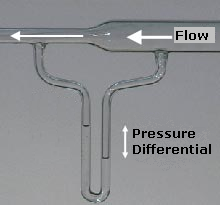
Bernoulli's principle is a concept in fluid dynamics that relates pressure, speed and height. For example, for a fluid flowing horizontally, Bernoulli's principle states that an increase in the speed occurs simultaneously with a decrease in pressure.[1]:Ch.3[2]:156–164,§ 3.5 The principle is named after the Swiss mathematician and physicist Daniel Bernoulli, who published it in his book Hydrodynamica in 1738.[3] Although Bernoulli deduced that pressure decreases when the flow speed increases, it was Leonhard Euler in 1752 who derived Bernoulli's equation in its usual form.[4][5]
Bernoulli's principle can be derived directly from Isaac Newton's second law of motion. When a small volume of fluid is flowing horizontally from a region of high pressure to a region of low pressure, there is more pressure from behind than in front. This gives a net force on the volume, accelerating it along the streamline.[a] If the pressure is decreasing along the streamline, the fluid is accelerated and the speed increases. Thus the decrease of pressure is the cause of a higher speed.[7][b] Similarly, if the pressure is increasing, the speed decreases.
Bernoulli's principle can also be derived from the principle of conservation of energy which states that in a steady fluid flow the sum of all forms of energy is the same throughout the flow. This requires that the sum of kinetic energy, potential energy and internal energy remains constant.[2]:§ 3.5 Thus an increase in the kinetic energy of the fluid occurs with a simultaneous decrease in its potential energy and internal energy. [9]:Example 3.5 and p.116
Overview
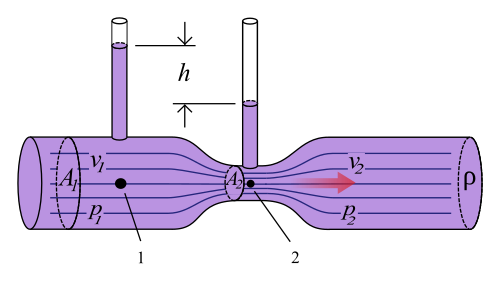
Bernoulli's principle states that within a flow of constant energy, when fluid flows through a region of lower pressure it speeds up and when it flows through a region of higher pressure it slows down.[10] Thus, Bernoulli's principle quantifies changes in speed and changes in pressure within a flow field.
Bernoulli's equation is derived by considering the forces or energy along a streamline, but it can also be applied to a flow field where all the streamlines come from a region of uniform velocity and pressure.[11] It cannot be used to compare different flow fields,[12] for example comparing a plume or jet of air with the surrounding stationary air. (See this example below).
Fluid particles are subject only to pressure and their own weight. If a fluid is flowing horizontally, when its speed increases it can only be because the fluid on that section has moved from a region of higher pressure to a region of lower pressure; and if its speed decreases, it can only be because it has moved from a region of lower pressure to a region of higher pressure. Consequently, within a fluid flowing horizontally, the highest speed occurs where the pressure is lowest, and the lowest speed occurs where the pressure is highest.[13]
Bernoulli's principle is only applicable for isentropic flows: when the effects of irreversible processes (like turbulence) and non-adiabatic processes (e.g. thermal radiation) are small and can be neglected. The simple form of Bernoulli's equation is valid for incompressible flows (e.g. most liquid flows and gases moving at low Mach number). More advanced forms may be applied to compressible flows at higher Mach numbers.
Incompressible flow equation
In most flows of liquids, and of gases at low Mach number, the density of a fluid parcel can be considered to be constant, regardless of pressure variations in the flow. Therefore, the fluid can be considered to be incompressible, and these flows are called incompressible flows. Bernoulli performed his experiments on liquids, so his equation in its original form is valid only for incompressible flow.
A common form of Bernoulli's equation is:
| A |
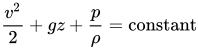
where:
- is the fluid flow speed at a point,
- is the acceleration due to gravity,
- is the elevation of the point above a reference plane, with the positive -direction pointing upward—so in the direction opposite to the gravitational acceleration,
- is the static pressure at the chosen point, and
- is the density of the fluid at all points in the fluid.


Bernoulli's equation and the Bernoulli constant are applicable throughout any region of flow where the energy per unit mass is uniform. Because the energy per unit mass of liquid in a well-mixed reservoir is uniform throughout, Bernoulli's equation can be used to analyze the fluid flow everywhere in that reservoir (including pipes or flow fields that the reservoir feeds) except where viscous forcesdominate and erode the energy per unit mass.[9]:Example 3.5 and p.116
The following assumptions must be met for this Bernoulli equation to apply:[2]:265
- the flow must be steady, that is, the flow parameters (velocity, density, etc.) at any point cannot change with time,
- the flow must be incompressible—even though pressure varies, the density must remain constant along a streamline;
- friction by viscous forces must be negligible.
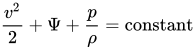
For conservative force fields (not limited to the gravitational field), Bernoulli's equation can be generalized as:[2]:265 where Ψ is the force potential at the point considered. For example, for the Earth's gravity Ψ = gz.
By multiplying with the fluid density ρ, equation (A) can be rewritten as: or: where


- q = 1/2ρv2 is dynamic pressure,
- h = z + p/ρg is the piezometric head or hydraulic head (the sum of the elevation z and the pressure head)[14][15] and
- p0 = p + q is the stagnation pressure (the sum of the static pressurep and dynamic pressureq).[16]
The constant in the Bernoulli equation can be normalized. A common approach is in terms of total head or energy headH:
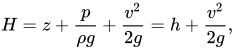
The above equations suggest there is a flow speed at which pressure is zero, and at even higher speeds the pressure is negative. Most often, gases and liquids are not capable of negative absolute pressure, or even zero pressure, so clearly Bernoulli's equation ceases to be valid before zero pressure is reached. In liquids—when the pressure becomes too low—cavitation occurs. The above equations use a linear relationship between flow speed squared and pressure. At higher flow speeds in gases, or for sound waves in liquid, the changes in mass density become significant so that the assumption of constant density is invalid.
Simplified form
In many applications of Bernoulli's equation, the change in the ρgz term is so small compared with the other terms that it can be ignored. For example, in the case of aircraft in flight, the change in height z is so small the ρgz term can be omitted. This allows the above equation to be presented in the following simplified form: where p0 is called total pressure, and q is dynamic pressure.[17] Many authors refer to the pressure p as static pressure to distinguish it from total pressure p0 and dynamic pressure q. In Aerodynamics, L.J. Clancy writes: "To distinguish it from the total and dynamic pressures, the actual pressure of the fluid, which is associated not with its motion but with its state, is often referred to as the static pressure, but where the term pressure alone is used it refers to this static pressure."[1]:§ 3.5

The simplified form of Bernoulli's equation can be summarized in the following memorable word equation:[1]:§ 3.5
Every point in a steadily flowing fluid, regardless of the fluid speed at that point, has its own unique static pressure p and dynamic pressure q. Their sum p + q is defined to be the total pressure p0. The significance of Bernoulli's principle can now be summarized as "total pressure is constant in any region free of viscous forces". If the fluid flow is brought to rest at some point, this point is called a stagnation point, and at this point the static pressure is equal to the stagnation pressure.
If the fluid flow is irrotational, the total pressure is uniform and Bernoulli's principle can be summarized as "total pressure is constant everywhere in the fluid flow".[1]:Equation 3.12 It is reasonable to assume that irrotational flow exists in any situation where a large body of fluid is flowing past a solid body. Examples are aircraft in flight and ships moving in open bodies of water. However, Bernoulli's principle importantly does not apply in the boundary layer such as in flow through long pipes.
Unsteady potential flow
The Bernoulli equation for unsteady potential flow is used in the theory of ocean surface waves and acoustics. For an irrotational flow, the flow velocity can be described as the gradient∇φ of a velocity potentialφ. In that case, and for a constant density ρ, the momentum equations of the Euler equations can be integrated to:[2]:383
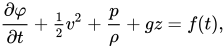
وهي معادلة برنولي صالحة أيضًا للتدفقات غير المستقرة - أو المتغيرة مع الزمن. هنا ، يرمز ∂φ/∂t إلى المشتق الجزئي لجهد السرعة φ بالنسبة للزمن t ، و v = | ∇φ | هي سرعة التدفق. تعتمد الدالة f ( t ) على الزمن فقط ، وليس على الموضع في المائع. ونتيجة لذلك، تنطبق معادلة برنولي عند لحظة معينة t على كامل نطاق المائع. وينطبق هذا أيضًا على الحالة الخاصة للتدفق المستقر غير الدوراني، حيث تكون f و∂ φ / ∂t ثابتتين، وبالتالي يمكن تطبيق المعادلة ( أ ) في كل نقطة من نطاق المائع. [ 2 ] : 383 علاوة على ذلك، يمكن جعل f ( t ) مساوية للصفر بإدخالها في جهد السرعة باستخدام التحويل التالي: مما أدى إلى:
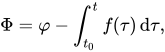
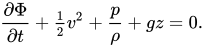
لاحظ أن العلاقة بين الجهد وسرعة التدفق لا تتأثر بهذا التحويل: ∇Φ = ∇ φ .
يبدو أن معادلة برنولي للتدفق الكامن غير المستقر تلعب أيضًا دورًا محوريًا في مبدأ لوك التبايني ، وهو وصف تبايني لتدفقات السطح الحر باستخدام ميكانيكا لاغرانج .
معادلة التدفق الانضغاطي
استنبط برنولي مبدئه من ملاحظاته على السوائل، وتُعدّ معادلة برنولي صالحة للسوائل المثالية: أي تلك غير اللزجة وغير القابلة للانضغاط والتي تخضع فقط لقوى محافظة. وهي صالحة أحيانًا لتدفق الغازات أيضًا، بشرط عدم انتقال الطاقة الحركية أو الكامنة من تدفق الغاز إلى انضغاطه أو تمدده. إذا تغير كل من ضغط الغاز وحجمه في آنٍ واحد، فسيُبذل شغل على الغاز أو بواسطته. في هذه الحالة، لا يمكن افتراض صحة معادلة برنولي بصيغتها الخاصة بالتدفق غير القابل للانضغاط. مع ذلك، إذا كانت عملية الغاز متساوية الضغط أو الحجم تمامًا ، فلن يُبذل أي شغل على الغاز أو بواسطته (وبالتالي لا يختل توازن الطاقة البسيط). وفقًا لقانون الغازات، تُعدّ العملية متساوية الضغط أو الحجم عادةً الطريقة الوحيدة لضمان ثبات كثافة الغاز. كما تتناسب كثافة الغاز طرديًا مع نسبة الضغط إلى درجة الحرارة المطلقة . مع ذلك، تتغير هذه النسبة عند الانضغاط أو التمدد، بغض النظر عن كمية الحرارة المضافة أو المُزالة. الاستثناء الوحيد هو عندما يكون صافي انتقال الحرارة صفرًا، كما هو الحال في دورة ديناميكية حرارية كاملة أو في عملية متساوية الإنتروبيا ( عملية كظيمة عديمة الاحتكاك )، وحتى في هذه الحالة، يجب عكس هذه العملية العكوسة لإعادة الغاز إلى ضغطه وحجمه النوعي الأصليين، وبالتالي كثافته. عندها فقط تكون معادلة برنولي الأصلية غير المعدلة قابلة للتطبيق. في هذه الحالة، يمكن استخدام المعادلة إذا كانت سرعة تدفق الغاز أقل بكثير من سرعة الصوت ، بحيث يمكن تجاهل التغير في كثافة الغاز (نتيجة لهذا التأثير) على طول كل خط انسيابي. يُعتبر التدفق الكظيمي بسرعة أقل من 0.3 ماخ بطيئًا بما فيه الكفاية بشكل عام. [ 18 ]
من الممكن استخدام المبادئ الأساسية للفيزياء لتطوير معادلات مماثلة تنطبق على الموائع القابلة للانضغاط. توجد معادلات عديدة، كل منها مصممة لتطبيق معين، لكنها جميعًا مماثلة لمعادلة برنولي، وتعتمد جميعها على المبادئ الأساسية للفيزياء فقط، مثل قوانين نيوتن للحركة أو القانون الأول للديناميكا الحرارية .
التدفق القابل للانضغاط في ديناميكا الموائع
بالنسبة لسائل قابل للانضغاط، مع معادلة حالة باروتروبية ، وتحت تأثير القوى المحافظة، [ 19 ] أين:

- p هو الضغط
- ρ هي الكثافة، و ρ ( p ) تشير إلى أنها دالة للضغط.
- v هي سرعة التدفق
- Ψ هو الجهد المرتبط بمجال القوة المحافظ، وغالبًا ما يكون جهد الجاذبية
في التطبيقات الهندسية، تكون الارتفاعات صغيرة عمومًا مقارنةً بحجم الأرض، وتكون الأطر الزمنية لتدفق الموائع قصيرة بما يكفي لاعتبار معادلة الحالة كظيمة. في هذه الحالة، تصبح المعادلة المذكورة أعلاه للغاز المثالي كما يلي: [ 1 ] : § 3.11 حيث، بالإضافة إلى الشروط المذكورة أعلاه:

- γ هي نسبة الحرارة النوعية للسائل
- g هو التسارع الناتج عن الجاذبية
- يمثل z ارتفاع النقطة فوق مستوى مرجعي
في العديد من تطبيقات التدفق الانضغاطي، تكون التغيرات في الارتفاع ضئيلة مقارنةً بالحدود الأخرى، لذا يمكن حذف الحد gz . ويكون الشكل المفيد جدًا للمعادلة كما يلي:

أين:
- p 0 هو الضغط الكلي
- ρ 0 هي الكثافة الكلية
التدفق الانضغاطي في الديناميكا الحرارية
الصيغة الأكثر عمومية للمعادلة، والمناسبة للاستخدام في الديناميكا الحرارية في حالة التدفق (شبه) المستقر، هي: [ 2 ] : § 3.5 [ 20 ] : § 5 [ 21 ] : § 5.9
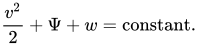
هنا w هي المحتوى الحراري لكل وحدة كتلة (المعروف أيضًا باسم المحتوى الحراري النوعي)، والذي غالبًا ما يُكتب أيضًا على أنه h (لا ينبغي الخلط بينه وبين "الرأس" أو "الارتفاع").
لاحظ أن حيث e هي الطاقة الديناميكية الحرارية لكل وحدة كتلة، والمعروفة أيضًا باسم الطاقة الداخلية النوعية . لذا، بالنسبة للطاقة الداخلية الثابتةوتتحول المعادلة إلى شكل التدفق غير القابل للانضغاط.
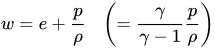

يُطلق على الثابت الموجود على الجانب الأيمن غالبًا اسم ثابت برنولي ويُرمز له بالرمز b . في حالة التدفق الأديباتي المستقر غير اللزج، والذي لا يحتوي على مصادر أو مصارف إضافية للطاقة، يكون b ثابتًا على طول أي خط انسيابي مُحدد. وبشكل عام، حتى عندما يتغير b على طول الخطوط الانسيابية، فإنه يظل مُعاملًا مفيدًا، يرتبط بـ "ضغط" المائع (انظر أدناه).
عندما يمكن تجاهل التغير في Ψ ، فإن الشكل المفيد جداً لهذه المعادلة هو: حيث w 0 هي المحتوى الحراري الكلي. بالنسبة لغاز مثالي حرارياً مثل الغاز المثالي، فإن المحتوى الحراري يتناسب طردياً مع درجة الحرارة، وهذا يؤدي إلى مفهوم درجة الحرارة الكلية (أو درجة حرارة الركود).

عند وجود موجات صدمية ، وفي إطار مرجعي تكون فيه الصدمة ثابتة والتدفق مستقرًا، تتعرض العديد من معاملات معادلة برنولي لتغيرات مفاجئة عند مرورها عبر الصدمة. ويبقى معامل برنولي ثابتًا. ويُستثنى من هذه القاعدة الصدمات الإشعاعية، التي تُخالف الافتراضات التي تقوم عليها معادلة برنولي، وتحديدًا عدم وجود مصادر أو مصارف إضافية للطاقة.
تدفق الجهد غير المستقر
بالنسبة لسائل قابل للانضغاط، ذي معادلة حالة باروتروبية، فإن معادلة حفظ الزخم غير المستقرة
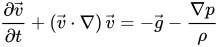
بافتراض عدم وجود دوران، أي أن سرعة التدفق يمكن وصفها بأنها تدرج ∇ φ لجهد السرعة φ . تصبح معادلة حفظ الزخم غير المستقرة كما يلي مما يؤدي إلى


في هذه الحالة، تصبح المعادلة المذكورة أعلاه للتدفق المتساوي الإنتروبيا كما يلي:

الاشتقاقات
يمكن اشتقاق معادلة برنولي للسوائل غير القابلة للانضغاط إما عن طريق تكامل قانون نيوتن الثاني للحركة أو عن طريق تطبيق قانون حفظ الطاقة ، مع تجاهل اللزوجة والانضغاطية والتأثيرات الحرارية.
- الاشتقاق عن طريق تكامل قانون نيوتن الثاني للحركة
أبسط طريقة للاستنتاج هي تجاهل الجاذبية أولاً، والنظر في الانقباضات والتمددات في الأنابيب المستقيمة، كما هو الحال في تأثير فنتوري . لنفترض أن المحور السيني موجه لأسفل محور الأنبوب.
لنفترض وجود كتلة من سائل تتحرك عبر أنبوب مساحة مقطعه العرضي A ، وطولها dx ، وحجمها Adx . إذا كانت كثافة الكتلة ρ ، فإن كتلة الكتلة تساوي الكثافة مضروبة في حجمها m = ρAdx . ويكون التغير في الضغط على طول المسافة dx هو dp ، وسرعة التدفق v = dx / dt .
بتطبيق قانون نيوتن الثاني للحركة (القوة = الكتلة × التسارع) ، مع العلم أن القوة المؤثرة على كتلة السائل هي −A dp ، إذا انخفض الضغط على طول الأنبوب، فإن dp تكون سالبة ، لكن القوة الناتجة عن التدفق تكون موجبة على طول المحور السيني .
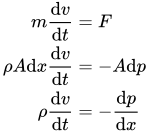
في التدفق المستقر، يكون حقل السرعة ثابتًا بالنسبة للزمن، v = v ( x ) = v ( x ( t )) ، لذا فإن v نفسها ليست دالة مباشرة للزمن t . فقط عندما تتحرك الجسيمة عبر الموضع x تتغير مساحة المقطع العرضي: تعتمد v على t فقط من خلال موضع المقطع العرضي x ( t ) .

باعتبار الكثافة ρ ثابتة، يمكن كتابة معادلة الحركة على النحو التالي عن طريق التكامل بالنسبة إلى x حيث C ثابت، يُشار إليه أحيانًا بثابت برنولي. وهو ليس ثابتًا عامًا ، بل ثابت خاص بنظام مائع معين. والنتيجة هي: عندما تكون السرعة عالية، يكون الضغط منخفضًا، والعكس صحيح.
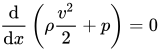
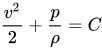
في الاشتقاق أعلاه، لم يتم الاستناد إلى أي مبدأ خارجي للشغل والطاقة. بل تم اشتقاق مبدأ برنولي من خلال معالجة بسيطة لقانون نيوتن الثاني.

- الاشتقاق باستخدام قانون حفظ الطاقة
ثمة طريقة أخرى لاستنباط مبدأ برنولي لتدفق غير قابل للانضغاط، وهي تطبيق قانون حفظ الطاقة. [ 22 ] في صورة نظرية الشغل والطاقة ، التي تنص على أن [ 23 ]

لذلك،
يتكون النظام من حجم من السائل، يقع مبدئيًا بين المقطعين العرضيين A1 و A2 . خلال الفترة الزمنية Δt ، تتحرك عناصر السائل الموجودة مبدئيًا عند مقطع التدفق الداخل A1 مسافة s1 = v1 / Δt ، بينما عند مقطع التدفق الخارج ، يتحرك السائل بعيدًا عن المقطع العرضي A2 مسافة s2 = v2 / Δt . حجم السائل المزاح عند التدفق الداخل والخارج هو A1s1 و A2s2 على التوالي . كتلة السائل المزاحة المرتبطة بها - عندما تكون ρ هي كثافة كتلة السائل - تساوي الكثافة مضروبة في الحجم، أي ρA1s1 و ρA2s2 . وبحسب قانون حفظ الكتلة ، يجب أن تكون هاتان الكتلتان المزاحتان خلال الفترة الزمنية Δt متساويتين ، ويُرمز لهذه الكتلة المزاحة بـ Δm .
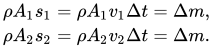
يتكون العمل الذي تقوم به القوى من جزأين:
- الشغل المبذول بفعل الضغط المؤثر على المنطقتين A1 و A2
- الشغل المبذول بفعل الجاذبية : تُفقد طاقة الوضع التثاقلية في الحجم A1 ، وتُكتسب عند التدفق الخارجي في الحجم A2 . لذا، فإن التغير في طاقة الوضع التثاقلية ΔE <sub> pot ,gravity</sub> خلال الفترة الزمنية Δt هو

الآن، يكون الشغل الناتج عن قوة الجاذبية معاكساً للتغير في طاقة الوضع ، W = −ΔE = pot,gravity . فعندما تكون قوة الجاذبية في الاتجاه السالب للمحور z ، يكون الشغل - قوة الجاذبية مضروبة في التغير في الارتفاع - سالباً عند تغير الارتفاع الموجب Δz = z₂ − z₁ ، بينما يكون التغير المقابل في طاقة الوضع موجباً. [ 24 ] : 14-4 ، §14-3 .وبالتالي فإن إجمالي الشغل المنجز في هذه الفترة الزمنية Δt هو الزيادة في الطاقة الحركية هي Putting these together, the work-kinetic energy theorem W = ΔEkin gives:[22] or After dividing by the mass Δm = ρA1v1 Δt = ρA2v2 Δt the result is:[22] or, as stated in the first paragraph:







| Eqn. 1, which is also Equation (A) |
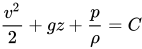
Further division by g produces the following equation. Note that each term can be described in the length dimension (such as meters). This is the head equation derived from Bernoulli's principle:
| Eqn. 2a |
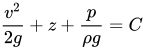
The middle term, z, represents the potential energy of the fluid due to its elevation with respect to a reference plane. Now, z is called the elevation head and given the designation zelevation.
A free falling mass from an elevation z > 0 (in a vacuum) will reach a speed when arriving at elevation z = 0. Or when rearranged as head: The term v2/2g is called the velocity head, expressed as a length measurement. It represents the internal energy of the fluid due to its motion.


The hydrostatic pressurep is defined as with p0 some reference pressure, or when rearranged as head: The term p/ρg is also called the pressure head, expressed as a length measurement. It represents the internal energy of the fluid due to the pressure exerted on the container. The head due to the flow speed and the head due to static pressure combined with the elevation above a reference plane, a simple relationship useful for incompressible fluids using the velocity head, elevation head, and pressure head is obtained.


| Eqn. 2b |

If Eqn. 1 is multiplied by the density of the fluid, an equation with three pressure terms is obtained:
| Eqn. 3 |
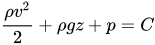
Note that the pressure of the system is constant in this form of the Bernoulli equation. If the static pressure of the system (the third term) increases, and if the pressure due to elevation (the middle term) is constant, then the dynamic pressure (the first term) must have decreased. In other words, if the speed of a fluid decreases and it is not due to an elevation difference, it must be due to an increase in the static pressure that is resisting the flow.
All three equations are merely simplified versions of an energy balance on a system.
The derivation for compressible fluids is similar. Again, the derivation depends upon (1) conservation of mass, and (2) conservation of energy. Conservation of mass implies that in the above figure, in the interval of time Δt, the amount of mass passing through the boundary defined by the area A1 is equal to the amount of mass passing outwards through the boundary defined by the area A2: Conservation of energy is applied in a similar manner: It is assumed that the change in energy of the volume of the streamtube bounded by A1 and A2 is due entirely to energy entering or leaving through one or the other of these two boundaries. Clearly, in a more complicated situation such as a fluid flow coupled with radiation, such conditions are not met. Nevertheless, assuming this to be the case and assuming the flow is steady so that the net change in the energy is zero, where ΔE1 and ΔE2 are the energy entering through A1 and leaving through A2, respectively. The energy entering through A1 is the sum of the kinetic energy entering, the energy entering in the form of potential gravitational energy of the fluid, the fluid thermodynamic internal energy per unit of mass (ε1) entering, and the energy entering in the form of mechanical p dV work: where Ψ = gz is a force potential due to the Earth's gravity, g is acceleration due to gravity, and z is elevation above a reference plane. A similar expression for ΔE2 may easily be constructed. So now setting 0 = ΔE1 − ΔE2: which can be rewritten as: Now, using the previously-obtained result from conservation of mass, this may be simplified to obtain which is the Bernoulli equation for compressible flow.






An equivalent expression can be written in terms of fluid enthalpy (h):

Applications
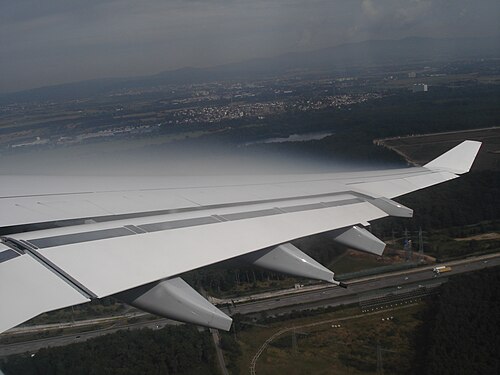
In modern everyday life there are many observations that can be successfully explained by application of Bernoulli's principle, even though no real fluid is entirely inviscid,[27] and a small viscosity often has a large effect on the flow.
- Bernoulli's principle can be used to calculate the lift force on an airfoil, if the behaviour of the fluid flow in the vicinity of the foil is known. For example, if the air flowing past the top surface of an aircraft wing is moving faster than the air flowing past the bottom surface, then Bernoulli's principle implies that the pressure on the surfaces of the wing will be lower above than below. This pressure difference results in an upwards lifting force.[c][28] Whenever the distribution of speed past the top and bottom surfaces of a wing is known, the lift forces can be calculated (to a good approximation) using Bernoulli's equations,[29] which were established by Bernoulli over a century before the first man-made wings were used for the purpose of flight.
- The basis of a carburetor used in many reciprocating engines is a throat in the air flow to create a region of low pressure to draw fuel into the carburetor and mix it thoroughly with the incoming air. The low pressure in the throat can be explained by Bernoulli's principle, where air in the throat is moving at its fastest speed and therefore it is at its lowest pressure. The carburetor may or may not use the difference between the two static pressures which result from the Venturi effect on the air flow in order to force the fuel to flow, and as a basis a carburetor may use the difference in pressure between the throat and local air pressure in the float bowl, or between the throat and a Pitot tube at the air entry.
- An injector on a steam locomotive or a static boiler.
- يُستخدم أنبوب بيتوت ومنفذ الضغط الساكن في الطائرة لتحديد سرعتها الجوية . ويرتبط هذان الجهازان بمؤشر السرعة الجوية ، الذي يحدد الضغط الديناميكي لتدفق الهواء المار بالطائرة. ويُستخدم مبدأ برنولي لمعايرة مؤشر السرعة الجوية بحيث يعرض السرعة الجوية المُشار إليها بما يتناسب مع الضغط الديناميكي. [ 1 ] : § 3.8
- تستخدم فوهة دي لافال مبدأ برنولي لتوليد قوة عن طريق تحويل طاقة الضغط الناتجة عن احتراق الوقود إلى سرعة. وهذا بدوره يولد قوة دفع وفقًا لقانون نيوتن الثالث للحركة .
- يمكن قياس سرعة تدفق السوائل باستخدام أجهزة مثل مقياس فنتوري أو صفيحة ذات فتحة ، والتي يمكن وضعها في الأنابيب لتقليل قطر التدفق. بالنسبة للأجهزة الأفقية، تُظهر معادلة الاستمرارية أنه بالنسبة للسوائل غير القابلة للانضغاط، فإن تقليل القطر سيؤدي إلى زيادة سرعة تدفق السائل. وبناءً على ذلك، يُبين مبدأ برنولي أنه لا بد من انخفاض الضغط في منطقة القطر المُصغّر. تُعرف هذه الظاهرة بتأثير فنتوري .
- يمكن حساب أقصى معدل تصريف ممكن لخزان ذي فتحة أو صنبور في قاعدته مباشرةً من معادلة برنولي، وقد وُجد أنه يتناسب طرديًا مع الجذر التربيعي لارتفاع السائل في الخزان. هذا هو قانون توريتشيلي ، المتوافق مع مبدأ برنولي. تؤدي زيادة اللزوجة إلى خفض معدل التصريف هذا؛ وينعكس ذلك في معامل التصريف، الذي يعتمد على رقم رينولدز وشكل الفتحة. [ 30 ]
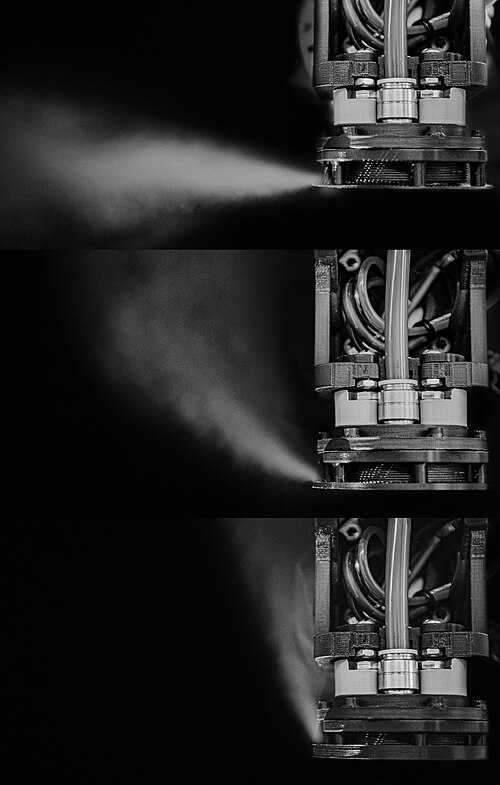
- تعتمد قبضة برنولي على هذا المبدأ لإنشاء قوة لاصقة بدون تلامس بين السطح والقبضة [ 31 ] .
المفاهيم الخاطئة والتطبيقات غير الصحيحة
هناك العديد من الظواهر التي تُفسَّر أحيانًا بشكل خاطئ باستخدام مبدأ برنولي. [ 32 ] [ 33 ] ومن الأمثلة على ذلك:
رفع الجناح

من أكثر التفسيرات الخاطئة شيوعًا للرفع الديناميكي الهوائي افتراض أن الهواء يجب أن يعبر السطحين العلوي والسفلي للجناح في نفس المدة الزمنية، مما يعني ضمنيًا أنه نظرًا لأن السطح العلوي يمثل مسارًا أطول، فلا بد أن الهواء يتحرك فوق الجناح أسرع من حركته فوق السطح السفلي. ثم يُستشهد بمبدأ برنولي للاستنتاج بأن الضغط على سطح الجناح العلوي يجب أن يكون أقل من الضغط على سطحه السفلي. [ 34 ] [ 35 ]
لا يوجد مبدأ فيزيائي يشترط تساوي زمن انتقال الهواء حول الأجسام المولدة للرفع. في الواقع، تتنبأ النظرية - وتؤكد التجارب - بأن الهواء يعبر السطح العلوي لجسم يتعرض للرفع في زمن أقصر من زمن عبوره السطح السفلي؛ وبالتالي فإن التفسير القائم على تساوي زمن الانتقال خاطئ. [ 36 ] [ 37 ] [ 38 ] مع أن تفسير تساوي الزمن خاطئ، إلا أن مبدأ برنولي ليس هو الخاطئ، لأن هذا المبدأ راسخ؛ إذ تُستخدم معادلة برنولي بشكل صحيح في المعالجات الرياضية الشائعة للرفع الديناميكي الهوائي. [ 39 ] [ 40 ]
نفخ على قطعة من الورق


تتضمن إحدى التجارب الشائعة في الفصول الدراسية إمساك ورقة أفقياً بحيث تتدلى إلى الأسفل، ثم النفخ فوقها. وعندما ينفخ الشخص فوق الورقة، ترتفع. ويُزعم حينها أن ذلك يعود إلى أن "الهواء المتحرك بسرعة أكبر يكون ضغطه أقل". [ 42 ]
إحدى مشكلات هذا التفسير تظهر عند النفخ على طول أسفل الورقة: فلو كان الانحراف ناتجًا عن هواء أسرع حركة، لانحنت الورقة إلى الأسفل؛ لكنها تنحني إلى الأعلى بغض النظر عما إذا كان الهواء الأسرع حركة في الأعلى أو الأسفل. [ 41 ] مشكلة أخرى هي أن الهواء الخارج من فم المُظهِر له نفس ضغط الهواء المحيط؛ [ 43 ] لا ينخفض ضغط الهواء لمجرد أنه يتحرك؛ ففي التجربة، يساوي الضغط الساكن للهواء الخارج من فم المُظهِر ضغط الهواء المحيط. [ 44 ] [ 45 ] مشكلة ثالثة هي أنه من الخطأ الربط بين التدفق على جانبي الورقة باستخدام معادلة برنولي، لأن الهواء في الأعلى والأسفل يمثلان مجالين مختلفين للتدفق، ومبدأ برنولي لا ينطبق إلا داخل مجال التدفق. [ 46 ]
التفسير الصحيح لارتفاع الورقة يكمن في ملاحظة أن عمود الهواء يتبع انحناء الورقة، وأن خط الانسياب المنحني يُولّد تدرجًا في الضغط عموديًا على اتجاه التدفق، حيث يكون الضغط أقل داخل المنحنى. [ 47 ] يتنبأ مبدأ برنولي بأن انخفاض الضغط يرتبط بزيادة السرعة؛ بمعنى آخر، عندما يمر الهواء فوق الورقة، تزداد سرعته ويتحرك أسرع مما كان عليه عند خروجه من فم المُجرِّب. لكن هذا لا يظهر في التجربة. [ 48 ] [ 49 ] [ 50 ]
تعليق كرة في تيار من الهواء
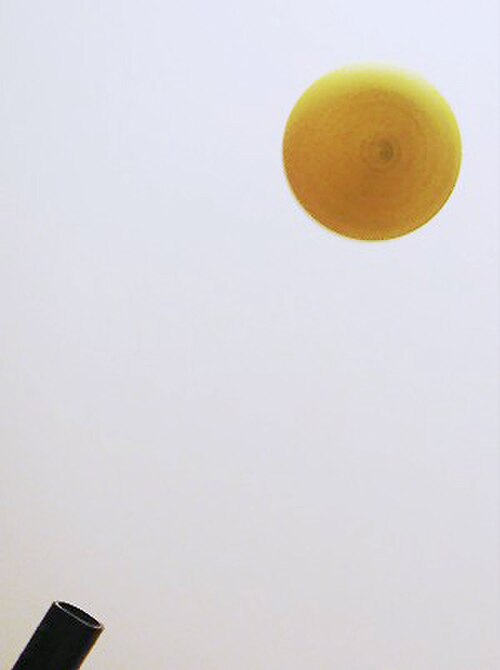
من التجارب الشائعة الأخرى تعليق كرة في تيار أو عمود من الهواء. يُزعم غالبًا أن ذلك يعود إلى انخفاض ضغط الهواء في العمود نظرًا لسرعته. مع ذلك، فإن ضغط الهواء في العمود هو نفسه ضغط الهواء المحيط. تبقى الكرة في العمود لأنها، كلما ابتعدت عن مركزه، تتعرض لتدفق هواء غير متماثل يدفعها نحو المركز. [ 51 ]
تُشرح بعض التجارب الصفية الشائعة الأخرى، مثل النفخ بين كرتين معلقتين، أو نفخ كيس كبير، بطريقة مضللة مماثلة بالقول إن "الهواء المتحرك بسرعة أكبر يكون ضغطه أقل". [ 52 ]
انظر أيضاً
- قانون توريتشيلي
- تأثير كواندا
- معادلات أويلر – لتدفق سائل غير لزج
- الهيدروليكا - ميكانيكا الموائع التطبيقية للسوائل
- معادلات نافيير-ستوكس – لتدفق سائل لزج
- تأثير إبريق الشاي
- المصطلحات في ديناميكا الموائع
ملحوظات
- ↑ إذا كان الجسيم في منطقة ذات ضغط متغير (تدرج ضغط غير معدوم في الاتجاه x ) وكان للجسيم حجم محدود l ، فإن مقدمة الجسيم ستشهد ضغطًا مختلفًا عن مؤخرته. بتعبير أدق، إذا انخفض الضغط في الاتجاه x (dp/ dx < 0 ) ، فإن الضغط عند المؤخرة يكون أعلى منه عند المقدمة، ويتعرض الجسيم لقوة محصلة (موجبة). وفقًا لقانون نيوتن الثاني ، تتسبب هذه القوة في تسارع الجسيم، وتزداد سرعته أثناء حركته على طول خط الانسياب... تصف معادلة برنولي هذا رياضيًا (انظر الاشتقاق الكامل في الملحق). [ 6 ]
- الفكرة هي أنه أثناء تحرك الطرد على طول مسار انسيابي، وعندما يدخل منطقة ذات ضغط أعلى، سيزداد الضغط أمامه (أعلى من الضغط خلفه)، مما يُؤثر بقوة على الطرد ويُبطئ حركته. وعلى العكس، إذا كان الطرد يتحرك إلى منطقة ذات ضغط أقل، فسيكون الضغط خلفه أعلى (أعلى من الضغط أمامه)، مما يُسرّع حركته. وكما هو الحال دائمًا، فإن أي قوة غير متوازنة ستُسبب تغييرًا في الزخم (والسرعة)، وفقًا لقوانين نيوتن للحركة. [ 8 ]
- ↑ «عندما يمر تيار من الهواء فوق جناح طائرة، تحدث تغيرات موضعية في السرعة حول الجناح، وبالتالي تغيرات في الضغط الساكن، وفقًا لنظرية برنولي. ويحدد توزيع الضغط قوة الرفع وعزم الدوران ومقاومة الشكل للجناح، وموقع مركز الضغط الخاص به.» [ 1 ] : § 5.5
مراجع
- 1 2 3 4 5 6 7 كلانسي، إل جيه (1975). الديناميكا الهوائية . وايلي. ISBN 978-0-470-15837-1.
- 1 2 3 4 5 6 7 باتشيلور، جي كي (2000). مقدمة في ديناميكا الموائع . كامبريدج: مطبعة جامعة كامبريدج . ISBN 978-0-521-66396-0.
- ↑ "الهيدروديناميكا" . موسوعة بريتانيكا على الإنترنت . تم الاطلاع عليه بتاريخ 30-10-2008 .
- ↑ أندرسون، جيه دي (2016)، "بعض التأملات حول تاريخ ديناميكا الموائع" ، في جونسون، آر دبليو (محرر)، دليل ديناميكا الموائع ( الطبعة الثانية)، مطبعة سي آر سي، رقم ISBN 9781439849576
- ↑ داريغول، أو.؛ فريش، يو. (2008)، "من ميكانيكا نيوتن إلى معادلات أويلر"، فيزيكا د: الظواهر غير الخطية ، 237 ( 14-17 ): 1855-1869 ، رمز Bibcode : 2008PhyD..237.1855D ، doi : 10.1016/j.physd.2007.08.003
- ↑ بابينسكي، هولجر (نوفمبر 2003)، "كيف تعمل الأجنحة؟"، تعليم الفيزياء ، 38 (6): 497-503 ، Bibcode : 2003PhyEd..38..497B ، doi : 10.1088/0031-9120/38/6/001 ، S2CID 1657792
- ↑ " ويلتنر، كلاوس؛ إنجلمان-سوندبيرج، مارتن، تفسيرات خاطئة لقانون برنولي ، مؤرشف من الأصل في 29 أبريل 2009
- ↑ دينكر، جون س. (2005). "3 أشكال انسيابية وتدفق الهواء" . انظر كيف تطير . مؤرشف من الأصل بتاريخ 27-09-2007 . تم الاسترجاع بتاريخ 27-07-2018 .
- 1 2 ستريتر، فيكتور لايل (1966). ميكانيكا الموائع . نيويورك: ماكجرو هيل.
- ↑ سميث، نورمان ف. (1973). "برنولي، نيوتن، والرفع الديناميكي - الجزء الأول" . مجلة العلوم والرياضيات المدرسية . 73 (3): 181-186 . doi : 10.1111/j.1949-8594.1973.tb08998.x – عبر wiley.com.
ينصّ نصّ نظرية برنولي كاملاً على ما يلي: "في جريان لا تُضاف إليه طاقة ولا تُفقد منه طاقة، يكون مجموع طاقاته المختلفة ثابتًا؛ وبالتالي، كلما زادت السرعة انخفض الضغط، والعكس صحيح".
- ↑ بابينسكي، هولجر (نوفمبر 2003)، "كيف تعمل الأجنحة؟"، تعليم الفيزياء ، 38 (6): 497-503 ، Bibcode : 2003PhyEd..38..497B ، doi : 10.1088/0031-9120/38/6/001 ، S2CID 1657792 ،
في بعض الأحيان، تنشأ جميع خطوط الانسياب في التدفق من منطقة ذات سرعة وضغط منتظمين (مثل الخزان أو التيار الحر المنتظم) وفي مثل هذه الحالة من الممكن تطبيق معادلة برنولي في جميع أنحاء التدفق.
- ↑ الجمعية اليابانية للمهندسين الميكانيكيين (7 سبتمبر 2013). "نفخ الهواء على ورقة" . www.jsme-fed.org . تاريخ الاطلاع: 27 يوليو 2026.
إن التفسير القائل بأن الضغط في منطقة يوجد بها تدفق يكون أقل (من الضغط المحيط) لأن السرعة في تلك المنطقة أعلى، وفقًا لنظرية برنولي، غير صحيح. فحتى لو نفخت الهواء بمجفف أو بفمك في مكان فارغ، سيظل الضغط قريبًا من الضغط الجوي. تصف نظرية برنولي قانون حفظ الطاقة في الموائع. إن إجبار الهواء على التدفق يزيد من طاقته مقارنةً بطاقة الهواء المحيط. لذلك، لا يمكن استخدام نظرية برنولي لمقارنة الهواء المتحرك بالهواء المحيط الساكن.
{{cite web}}: CS1 maint: url-status ( link ) - ↑ ريسنيك، ر.؛ هاليداي، د. (1960). الفيزياء . جون وايلي وأولاده. القسم 18-4.
- ↑ مولي، ريموند (2004). تدفق السوائل الصناعية: النظرية والمعادلات . مطبعة سي آر سي. الصفحات 43-44 . ISBN 978-0-8493-2767-4.
- ↑ شانسون، هوبرت (2004). هيدروليكا جريان القنوات المفتوحة . إلسيفير. ص 22. ISBN 978-0-08-047297-3.
- ^ أورتيل، هربرت. براندتل، لودفيج. بوهلي، م. مايز، كاثرين (2004). أساسيات براندتل لميكانيكا الموائع . سبرينغر. ص 70 – 71. ISBN 978-0-387-40437-0.
- ↑ "معادلة برنولي" . مركز أبحاث غلين التابع لناسا . تم الاطلاع عليه بتاريخ 4 مارس 2009 .
{{cite web}}: CS1 maint: deprecated archiveal service ( link ) - ↑ وايت، فرانك م. ميكانيكا الموائع ( الطبعة السادسة). ماكجرو هيل الدولية. ص 602.
- ↑ كلارك، كاثي؛ كارزويل، بوب (2007). مبادئ ديناميكا الموائع الفيزيائية الفلكية . مطبعة جامعة كامبريدج. ص 161. ISBN 978-1-139-46223-5.
- ↑ لاندو، إل دي ؛ ليفشيتز، إي إم (1987). ميكانيكا الموائع . سلسلة الفيزياء النظرية ( الطبعة الثانية). دار بيرغامون للنشر. ISBN 978-0-7506-2767-2.
- ↑ فان وايلن، جوردون جيه ؛ سونتاج، ريتشارد إي. (1965). أساسيات الديناميكا الحرارية الكلاسيكية . نيويورك: جون وايلي وأولاده.
- 1 2 3 فاينمان، آر بي ؛ لايتون، آر بي ؛ ساندز، إم. (1963). محاضرات فاينمان في الفيزياء . المجلد 2. أديسون-ويسلي. ISBN 978-0-201-02116-5.
{{cite book}}: ISBN / Date incompatibility (help):40–6 to 40–9,§40–3 - ↑Tipler, Paul (1991). Physics for Scientists and Engineers: Mechanics (3rd extended ed.). W. H. Freeman. ISBN 978-0-87901-432-2., p. 138.
- ↑Feynman, R.P.; Leighton, R.B.; Sands, M. (1963). The Feynman Lectures on Physics. Vol. 1. Addison-Wesley. ISBN 978-0-201-02116-5.
{{cite book}}: ISBN / Date incompatibility (help) - ↑Mykhailyshyn, R.; Savkiv, V.; Majewicz Fey, A.; Xiao, J. (2023). "Gripping device for textile materials". IEEE Transactions on Automation Science and Engineering. 20 (4): 2397–2408. Bibcode:2023ITASE..20.2397M. doi:10.1109/TASE.2022.3208796.
- ↑Mykhailyshyn, R.; Romancik, J.; Harada, K.; Majewicz Fey, A. (2025). "Vibration Vanquished: Enhancing Grasping of Deformable Objects with Jet Gripper Technology". 2025 IEEE 21st International Conference on Automation Science and Engineering (CASE). Los Angeles, CA, USA. pp. 2874–2880. doi:10.1109/CASE58245.2025.11164006. ISBN 979-8-3315-2246-9.
{{cite book}}: CS1 maint: location missing publisher (link) - ↑Thomas, John E. (May 2010). "The Nearly Perfect Fermi Gas"(PDF). Physics Today. 63 (5): 34–37. Bibcode:2010PhT....63e..34T. doi:10.1063/1.3431329. Archived from the original(PDF) on 2021-03-08. Retrieved 2018-07-27.
- ↑Resnick, R.; Halliday, D. (1960). Physics. New York: John Wiley & Sons. section 18–5.
Streamlines are closer together above the wing than they are below so that Bernoulli's principle predicts the observed upward dynamic lift.
- ↑Eastlake, Charles N. (March 2002). "An Aerodynamicist's View of Lift, Bernoulli, and Newton"(PDF). The Physics Teacher. 40 (3): 166–173. Bibcode:2002PhTea..40..166E. doi:10.1119/1.1466553. "The resultant force is determined by integrating the surface-pressure distribution over the surface area of the airfoil."
- ↑Mechanical Engineering Reference Manual (9th ed.).
- ↑Mykhailyshyn, R.; Savkiv, V.; Maruschak, P.; Xiao, J. (2022). "A Systematic Review on Pneumatic Gripping Devices for Industrial Robots". Transport. 37 (3): 201–231. doi:10.3846/transport.2022.17110.
- ↑"Bernoulli's law and experiments attributed to it are fascinating. Unfortunately some of these experiments are explained erroneously..." Weltner, Klaus; Ingelman-Sundberg, Martin. "Misinterpretations of Bernoulli's Law". Department of Physics, University Frankfurt. Archived from the original on June 21, 2012. Retrieved June 25, 2012.
- ↑Bobrowsky, Matt. "Q: Is It Really Caused by the Bernoulli Effect?". National Science Teaching Association. Archived from the original on October 1, 2020. Retrieved July 23, 2026.
Almost all classroom activities that purport to demonstrate the Bernoulli effect do not actually involve the Bernoulli effect.
- ↑Technical education research center (2006). Physics That Works. Kendall Hunt. ISBN 0787291811. OCLC 61918633.
One of the most widely circulated, but incorrect, explanations can be labeled the "Longer Path" theory, or the "Equal Transit Time" theory.
- ↑Smith, Norman F. (November 1972). "Bernoulli and Newton in Fluid Mechanics". The Physics Teacher. 10 (8): 451. Bibcode:1972PhTea..10..451S. doi:10.1119/1.2352317.
The airfoil of the airplane wing, according to the textbook explanation that is more or less standard in the United States, has a special shape with more curvature on top than on the bottom; consequently, the air must travel over the top surface farther than over the bottom surface. Because the air must make the trip over the top and bottom surfaces in the same elapsed time ..., the velocity over the top surface will be greater than over the bottom. According to Bernoulli's theorem, this velocity difference produces a pressure difference which is lift.
- ↑ بابينسكي، هولجر (2003). "كيف تعمل الأجنحة؟" (ملف PDF) . تعليم الفيزياء . 38 (6): 497-503 . Bibcode : 2003PhyEd..38..497B . doi : 10.1088/0031-9120/38/6/001 . S2CID 1657792. مؤرشف من الأصل (ملف PDF) بتاريخ 12-04-2022 . تم الاسترجاع بتاريخ 11-04-2022 .
...كثيرًا ما يُطرح السؤال: لماذا تلتقي جزيئات المائع مرة أخرى عند الحافة الخلفية؟ أو بعبارة أخرى، لماذا يستغرق جزيئان على جانبي الجناح نفس الوقت للانتقال من النقطة S إلى النقطة T؟ لا يوجد تفسير واضح، وتُثبت الملاحظات الواقعية أن هذا غير صحيح.
- ↑ «السرعة الفعلية فوق سطح الجناح أعلى بكثير من تلك المتوقعة وفقًا لنظرية "المسار الأطول"، وتصل الجسيمات المتحركة فوق السطح إلى الحافة الخلفية قبل الجسيمات المتحركة أسفل الجناح». مركز جلين للأبحاث (16 أغسطس 2000). «نظرية الرفع الخاطئة رقم 1» . ناسا. مؤرشف من الأصل في 27 أبريل 2014. تم الاطلاع عليه في 27 يونيو 2021 .
- ↑ أندرسون، جون (2005). مقدمة في الطيران . بوسطن: ماكجرو هيل للتعليم العالي. ص 355. ISBN 978-0072825695ثم يُفترض أن هذين العنصرين يجب أن يلتقيا عند الحافة الخلفية، ولأن مسافة الحركة فوق السطح العلوي للجناح أطول من تلك فوق السطح السفلي، فإن العنصر الموجود فوق السطح العلوي يجب أن يتحرك أسرع. هذا غير صحيح .
تُظهر النتائج التجريبية وحسابات ديناميكا الموائع الحاسوبية بوضوح أن عنصر المائع المتحرك فوق السطح العلوي للجناح يغادر الحافة الخلفية قبل وقت طويل من وصول العنصر المقابل له المتحرك فوق السطح السفلي إلى الحافة الخلفية.
- ↑ أندرسون، ديفيد؛ إيبرهاردت، سكوت. "كيف تطير الطائرات" . كيف تطير الطائرات: وصف فيزيائي للرفع . مؤرشف من الأصل في 26 يناير 2016. تم الاسترجاع في 26 يناير 2016.
لا غبار على مبدأ برنولي، أو على القول بأن الهواء يتحرك بسرعة أكبر فوق جناح الطائرة. ولكن، كما يشير النقاش أعلاه، فإن فهمنا لا يكتمل بهذا التفسير. تكمن المشكلة في أننا نفتقد عنصرًا أساسيًا عند تطبيق مبدأ برنولي. يمكننا حساب الضغوط حول الجناح إذا عرفنا سرعة الهواء فوقه وتحته، ولكن كيف نحدد هذه السرعة؟
- ↑ أندرسون، جون د. (2016). "الفصل 4. الديناميكا الهوائية الأساسية". مقدمة في الطيران ( الطبعة الثامنة). ماكجرو هيل للتعليم.
- ١ ٢ كريج، غيل م. "المبادئ الفيزيائية للطيران المجنح" . تم الاطلاع عليه في ٣١ مارس ٢٠١٦ - عبر rcgroups.com.
إذا كان الرفع في الشكل (أ) ناتجًا عن "مبدأ برنولي"، فمن المفترض أن تتدلى الورقة في الشكل (ب) أكثر عند نفخ الهواء أسفلها. ومع ذلك، كما هو موضح، فإنها ترتفع عندما يضاف تدرج الضغط الصاعد في التدفق المنحني للأسفل إلى الضغط الجوي على السطح السفلي للورقة.
- ↑ أ. تيموني، سي. "القرص الطائر المصنوع من الأوريغامي" . مجلة MAKE .
يحدث هذا بسبب مبدأ برنولي - الهواء سريع الحركة يكون ضغطه أقل من ضغط الهواء الساكن.
ب. "تأثيرات برنولي" . كلية الفيزياء والفلك، جامعة مينيسوتا . مؤرشف من الأصل بتاريخ 10 مارس 2012.سائل أسرع حركة، ضغط أقل. ... عندما يمسك المُظهِر الورقة أمام فمه وينفخ فوقها، فإنه يُنشئ منطقة من الهواء أسرع حركة.
ج. " حزمة تعليمية" (ملف PDF) . مهرجان السفن الشراعية الطويلة - ميناء جزر القنال. مؤرشف من الأصل في 3 ديسمبر 2013. تم الاطلاع عليه في 25 يونيو 2012.ينص مبدأ برنولي على أن الهواء المتحرك بسرعة أكبر يكون ضغطه أقل... يمكنك توضيح مبدأ برنولي بالنفخ على قطعة من الورق موضوعة أفقيًا على شفتيك.
- ↑ بابينسكي، هولجر (2003). "كيف تعمل الأجنحة" (ملف PDF) . تعليم الفيزياء . 38 (6). دار نشر IOP: 497. Bibcode : 2003PhyEd..38..497B . doi : 10.1088/0031-9120/38/6/001 . S2CID 1657792. تم الاطلاع عليه في 7 أبريل 2022 - عبر iopscience.iop.org.
في الواقع، يكون ضغط الهواء الخارج من الرئتين مساويًا لضغط الهواء المحيط...
- ↑Eastwell, Peter (2007). "Bernoulli? Perhaps, but What About Viscosity?"(PDF). The Science Education Review. 6 (1). Archived from the original(PDF) on 2018-03-18. Retrieved 2018-03-18.
...air does not have a reduced lateral pressure (or static pressure...) simply because it is caused to move, the static pressure of free air does not decrease as the speed of the air increases, it misunderstanding Bernoulli's principle to suggest that this is what it tells us, and the behavior of the curved paper is explained by other reasoning than Bernoulli's principle.
- ↑Raskin, Jef (February 2003). "Coanda Effect: Understanding Why Wings Work". karmak.org.
Make a strip of writing paper about 5 cm × 25 cm. Hold it in front of your lips so that it hangs out and down making a convex upward surface. When you blow across the top of the paper, it rises. Many books attribute this to the lowering of the air pressure on top solely to the Bernoulli effect. Now use your fingers to form the paper into a curve that it is slightly concave upward along its whole length and again blow along the top of this strip. The paper now bends downward...an often-cited experiment, which is usually taken as demonstrating the common explanation of lift, does not do so...
{{cite web}}:|archive-date=requires|archive-url=(help) - ↑a. Babinsky, Holger (2003). "How Do Wings Work"(PDF). Physics Education. 38 (6). IOP Publishing: 497. Bibcode:2003PhyEd..38..497B. doi:10.1088/0031-9120/38/6/001. S2CID 1657792. Retrieved April 7, 2022– via iopscience.iop.org.
Blowing over a piece of paper does not demonstrate Bernoulli's equation. While it is true that a curved paper lifts when flow is applied on one side, this is not because air is moving at different speeds on the two sides... It is false to make a connection between the flow on the two sides of the paper using Bernoulli's equation.
b. Eastwell, Peter (2007). "Bernoulli? Perhaps, but What About Viscosity?"(PDF). The Science Education Review. 6 (1). Archived from the original(PDF) on 2018-03-18. Retrieved 2018-03-18.An explanation based on Bernoulli's principle is not applicable to this situation, because this principle has nothing to say about the interaction of air masses having different speeds... Also, while Bernoulli's principle allows us to compare fluid speeds and pressures along a single streamline and... along two different streamlines that originate under identical fluid conditions, using Bernoulli's principle to compare the air above and below the curved paper in Figure 1 is nonsensical; in this case, there aren't any streamlines at all below the paper!
c. Auerbach, David. "Why Aircraft Fly"(PDF). European Journal of Physics. 21: 295 – via iopscience.iop.org.The well-known demonstration of the phenomenon of lift by means of lifting a page cantilevered in one's hand by blowing horizontally along it is probably more a demonstration of the forces inherent in the Coanda effect than a demonstration of Bernoulli's law; for, here, an air jet issues from the mouth and attaches to a curved (and, in this case pliable) surface. The upper edge is a complicated vortex-laden mixing layer and the distant flow is quiescent, so that Bernoulli's law is hardly applicable.
d. Smith, Norman F. (November 1972). "Bernoulli and Newton in Fluid Mechanics". The Physics Teacher.Millions of children in science classes are being asked to blow over curved pieces of paper and observe that the paper 'lifts'... They are then asked to believe that Bernoulli's theorem is responsible... Unfortunately, the 'dynamic lift' involved...is not properly explained by Bernoulli's theorem.
- ↑a. Babinsky, Holger (2003). "How Do Wings Work"(PDF). Physics Education. 38 (6). IOP Publishing: 497. Bibcode:2003PhyEd..38..497B. doi:10.1088/0031-9120/38/6/001. S2CID 1657792. Retrieved April 7, 2022– via iopscience.iop.org.
...if a streamline is curved, there must be a pressure gradient across the streamline, with the pressure increasing in the direction away from the centre of curvature.
ب. سميث، نورمان ف. (1973). "برنولي، نيوتن والرفع الديناميكي - الجزء الثاني" . مجلة العلوم والرياضيات المدرسية . 73 (4): 3333. doi : 10.1111/j.1949-8594.1973.tb09040.x – عبر wiley.com.يؤدي انحناء الورقة إلى تحويل تيار الهواء إلى الأسفل، وهذا الفعل يُنتج رد فعل الرفع الذي يرفع الورقة.
ج. علم الطيران: دليل للمعلمين مع أنشطة في تعليم العلوم والرياضيات والتكنولوجيا (ملف PDF) . وكالة ناسا. صفحة 26 - عبر موقع nasa.gov.يُحدث السطح المنحني للسان ضغط هواء غير متساوٍ وقوة رفع. ... ينتج الرفع عن حركة الهواء فوق سطح منحني.
د. أندرسون، ديفيد ف .؛ إيبرهاردت، سكوت. "الوصف النيوتني لرفع الجناح" (ملف PDF) . ص 12. مؤرشف من الأصل (ملف PDF) بتاريخ 11 مارس 2016 - عبر integener.com.تتسبب اللزوجة في أن يتبع الهواء السطح المنحني، وينص قانون نيوتن الأول على وجود قوة تؤثر على الهواء، بينما ينص قانون نيوتن الثالث على وجود قوة مساوية ومعاكسة تؤثر على الورقة. يؤدي انتقال الزخم إلى رفع الشريط. ويؤدي انخفاض الضغط المؤثر على السطح العلوي للورقة إلى ارتفاعها.
- ↑ أندرسون، ديفيد ف.؛ إيبرهاردت، سكوت. فهم الطيران . ص 229 – عبر كتب جوجل.
كثيراً ما تُقدَّم "عروض" مبدأ برنولي على أنها عروض لفيزياء الرفع. وهي في الحقيقة عروض للرفع، ولكنها بالتأكيد ليست عروضاً لمبدأ برنولي.
- ↑ فيل، ماكس. ملف الطيران . مؤرشف من الأصل في 17 مايو 2015.
كمثال، لنأخذ التجربة المضللة الأكثر استخدامًا "لتوضيح" مبدأ برنولي. أمسك قطعة من الورق بحيث تنحني فوق إصبعك، ثم انفخ فوقها. سترتفع الورقة. مع ذلك، لا يدرك معظم الناس أن الورقة لن
ترتفع
لو كانت مسطحة، حتى مع النفخ عليها بقوة شديدة. لا ينطبق مبدأ برنولي بشكل مباشر في هذه الحالة. ذلك لأن الهواء على جانبي الورقة لم ينطلق من المصدر نفسه. الهواء في الأسفل هو هواء الغرفة، أما الهواء في الأعلى فقد خرج من فمك حيث زدت سرعته دون أن تخفض ضغطه بدفعه خارجًا. ونتيجة لذلك، فإن ضغط الهواء على جانبي الورقة المسطحة متساوٍ، رغم أن الهواء في الأعلى يتحرك بسرعة أكبر. إن السبب في ارتفاع قطعة الورق المنحنية هو أن الهواء الخارج من فمك يتسارع أكثر أثناء اتباعه لانحناء الورقة، مما يؤدي بدوره إلى انخفاض الضغط وفقًا لقانون برنولي.
- ↑ جورتس، بيم. "بعض التجارب البسيطة" . sailtheory.com . مؤرشف من الأصل في 3 مارس 2016. تم الاطلاع عليه في 7 أبريل 2022. يلجأ البعض إلى النفخ فوق ورقة لإثبات أن تسارع الهواء فوقها يؤدي إلى انخفاض الضغط. تفسيرهم خاطئ .
ترتفع الورقة لأنها تُغيّر اتجاه الهواء، بفعل تأثير كواندا، وهذا الانحراف هو سبب القوة التي ترفع الورقة. لإثبات خطأهم، أستخدم التجربة التالية: إذا تم ثني الورقة مسبقًا في الاتجاه المعاكس عن طريق لفها أولًا، ثم نفخت فوقها، فإنها تنخفض. هذا لأن الهواء ينحرف في الاتجاه المعاكس. سرعة الهواء لا تزال أعلى فوق الورقة، لذا فهي ليست سبب انخفاض الضغط.
- ١ ٢ أ. بوبروفسكي، مات. "سؤال: هل هو حقًا ناتج عن تأثير برنولي؟" . العلوم ١٠١. الرابطة الوطنية لتدريس العلوم.
يُستعان بتأثير برنولي بشكل شائع -وغير صحيح- لتفسير: لماذا يتحرك بالونان معلقان أو كرتان من كرات تنس الطاولة باتجاه بعضهما البعض عند النفخ بينهما؛ لماذا ترتفع الورقة عند النفخ عليها؛ لماذا تنحني كرة البيسبول المقذوفة؛ لماذا تنجذب الملعقة نحو تيار الماء؛ لماذا تبقى الكرة معلقة في تيار الهواء. إليكم الخبر: لا شيء من هذه الظواهر ناتج عن تأثير برنولي.
b. Kamela, Martin (September 2007). "Thinking About Bernoulli". The Physics Teacher. 45 (6). American Association of Physics Teachers: 379–381. Bibcode:2007PhTea..45..379K. doi:10.1119/1.2768700.Finally, let's go back to the initial example of a ball levitating in a jet of air. The naive explanation for the stability of the ball in the air stream, 'because pressure in the jet is lower than pressure in the surrounding atmosphere,' is clearly incorrect. The static pressure in the free air jet is the same as the pressure in the surrounding atmosphere...
c. Smith, Norman F. (November 1972). "Bernoulli and Newton in Fluid Mechanics". The Physics Teacher. 10 (8): 455. Bibcode:1972PhTea..10..451S. doi:10.1119/1.2352317.Asymmetrical flow (not Bernoulli's theorem) also explains lift on the ping-pong ball or beach ball that floats so mysteriously in the tilted vacuum cleaner exhaust...
d. Bauman, Robert P. "The Bernoulli Conundrum"(PDF). introphysics.info. Department of Physics, University of Alabama at Birmingham. Archived from the original(PDF) on February 25, 2012. Retrieved June 25, 2012.Bernoulli's theorem is often obscured by demonstrations involving non-Bernoulli forces. For example, a ball may be supported on an upward jet of air or water, because any fluid (the air and water) has viscosity, which retards the slippage of one part of the fluid moving past another part of the fluid.
e. Craig, Gale M. "Physical Principles of Winged Flight". Retrieved March 31, 2016.In a demonstration sometimes wrongly described as showing lift due to pressure reduction in moving air or pressure reduction due to flow path restriction, a ball or balloon is suspended by a jet of air.
أندرسون ، ديفيد ف.؛ إيبرهاردت، سكوت. "الوصف النيوتني لرفع الجناح" (ملف PDF) . ص 12. مؤرشف من الأصل (ملف PDF) بتاريخ 11 مارس 2016 - عبر integener.com.مثال آخر هو انحصار
كرة تنس طاولة
في العادم الرأسي لمجفف
الشعر
. قيل لنا إن هذا توضيح لمبدأ برنولي. لكننا نعلم الآن أن العادم لا يمتلك قيمة أقل لـ ps. مرة أخرى، نقل الزخم هو ما يُبقي الكرة في تدفق الهواء. عندما تقترب الكرة من حافة العادم، يتشكل تدفق غير متماثل حولها، مما يدفعها بعيدًا عن حافة التدفق. وينطبق الأمر نفسه عند النفخ بين كرتين من كرات تنس الطاولة معلقتين بخيوط.
- ↑ أ. بوبروفسكي، مات. "سؤال: هل هو حقًا ناتج عن تأثير برنولي؟" . العلوم 101. الرابطة الوطنية لتدريس العلوم.
يُستعان بتأثير برنولي بشكل شائع -وغير صحيح- لتفسير: لماذا يتحرك بالونان معلقان أو كرتان من كرات تنس الطاولة باتجاه بعضهما البعض عند النفخ بينهما؛ لماذا ترتفع الورقة عند النفخ عليها؛ لماذا تنحني كرة البيسبول المقذوفة؛ لماذا تنجذب الملعقة نحو تيار الماء؛ لماذا تبقى الكرة معلقة في تيار الهواء. إليكم الخبر: لا شيء من هذه الظواهر ناتج عن تأثير برنولي.
ب. "صفائح معدنية رقيقة - تأثير كواندا" . physics.umd.edu . مرفق محاضرات وعروض الفيزياء، جامعة ميريلاند. مؤرشف من الأصل في 23 يونيو 2012. تم الاطلاع عليه في 23 أكتوبر 2012. غالبًا ما يُفسَّر هذا العرض التوضيحي بشكل خاطئ باستخدام مبدأ برنولي .وفقًا للتفسير الخاطئ، يكون تدفق الهواء أسرع في المنطقة بين الصفائح، مما يُؤدي إلى انخفاض الضغط مقارنةً بالهواء الساكن على السطح الخارجي للصفائح.
ج. "الإجابة رقم 256" . physics.umd.edu . مرفق محاضرات وعروض الفيزياء، جامعة ميريلاند. مؤرشف من الأصل في 13 ديسمبر 2014. تم الاطلاع عليه في 9 ديسمبر 2014.على الرغم من أن تأثير برنولي يُستخدم غالبًا لتفسير هذا العرض التوضيحي، ويبيع أحد المصنّعين المواد المستخدمة فيه تحت اسم "أكياس برنولي"، إلا أنه لا يمكن تفسيره بتأثير برنولي، بل بعملية التداخل.
روابط خارجية
- تدفق الماء الجاف - محاضرات فاينمان في الفيزياء
- سؤال في العلوم 101: هل يحدث ذلك فعلاً بسبب تأثير برنولي؟
- جامعة ميلرزفيل – تطبيقات معادلة أويلر
- NASA – Beginner's guide to aerodynamicsArchived 2012-07-15 at the Wayback Machine
- Misinterpretations of Bernoulli's equation – Weltner and Ingelman-SundbergArchived 2012-02-08 at the Wayback Machine
- Fluid dynamics
- Equations of fluid dynamics
- 1738 in science