
Livyatan
Livyatan is an extinct genus of highly predatory macroraptorial sperm whale, containing one known species: L. melvillei. The genus name was inspired by the biblical sea monster Leviathan, and the species name by Herman Melville, the author of the famous novel Moby-Dick about a white bull sperm whale. Herman Melville often referred to whales as "Leviathans" in his book. It is mainly known from the Pisco Formation of Peru during the Tortonian stage of the Miocene epoch, about 8.9–9.9 million years ago (mya); however, finds of isolated teeth from other locations such as Chile, Argentina, the United States (California), South Africa and Australia imply that either it or a close relative survived into the Pliocene, around 5 mya, and may have had a global presence. It was a member of a stem group of fossil macroraptorial sperm whales (often shortened to "raptorial") also including Brygmophyseter, Acrophyseter, and Zygophyseter, that all share several features for hunting large prey, such as deeply rooted and thick teeth, and was probably an apex predator, preying on whales, seals, dolphins and so forth. Characteristically of raptorial sperm whales, Livyatan had functional, enamel-coated teeth on the upper and lower jaws, as well as several features suitable for hunting large prey.
يبلغ طول جسم حوت ليفياتان ميلفيلي الأصلي حوالي 13.5-17.5 مترًا (44-57 قدمًا) ، وهو طولٌ يُقارب طول حوت العنبر الحديث ( Physeter macrocephalus )، مما يجعله أحد أكبر المفترسات المعروفة. بلغ طول أسنان ليفياتان 36.2 سم (14.3 بوصة) ، وهي أكبر أسنان قاطعة لأي حيوان معروف، باستثناء الأنياب. يتميز ليفياتان عن حيتان العنبر المفترسة الأخرى بوجود تجويف على جمجمته يمتد على طول خطمه . يُعتقد أن عضو العنبر الموجود في هذا التجويف كان يُستخدم في تحديد الموقع بالصدى والتواصل، أو في صدم الفرائس وحيتان العنبر الأخرى. ربما تفاعل هذا الحوت مع سمكة القرش الضخمة المنقرضة ميغالودون ( Otodus megalodon )، مُنافسًا إياها على مصدر غذائي مُشابه. يُعتقد أن انقراضه كان نتيجة لحدث تبريد في نهاية العصر الميوسيني، مما أدى إلى انخفاض أعداد الغذاء. كما أن التكوين الجيولوجي الذي عُثر فيه على الحوت قد حفظ مجموعة كبيرة من الكائنات البحرية، مثل أسماك القرش وغيرها من الثدييات البحرية .
تاريخ البحث
النموذج الأصلي والتسمية

في نوفمبر/تشرين الثاني 2008، اكتُشفت جمجمة محفوظة جزئيًا، تضم الأسنان والفك السفلي، وهي العينة النموذجية (MUSM 1676) لـ Livyatan melvillei ، في صحراء بيرو الساحلية ضمن رواسب تكوين بيسكو ، على بُعد 35 كيلومترًا (22 ميلًا) جنوب غرب مدينة إيكا . [ 1 ] [ 2 ] عثر عليها كلاس بوست، الباحث في متحف التاريخ الطبيعي في روتردام بهولندا، مصادفةً في اليوم الأخير من رحلة ميدانية. [ 3 ] [ 4 ] جُهزت الأحافير في ليما ، وهي الآن جزء من مجموعة متحف التاريخ الطبيعي في ليما التابع لجامعة سان ماركوس الوطنية . [ 3 ] [ 5 ]
The discoverers originally assigned the English name of the biblical monster, Leviathan, to the whale as Leviathan melvillei. However, the scientific name Leviathan was preoccupied by LeviathanKoch, 1841, a junior synonym for the mastodon (Mammut).[6] In August 2010, the authors rectified this situation by coining a new genus name for the whale, Livyatan, from the original Hebrew name of the monster. The species namemelvillei is a reference to Herman Melville, author of the book Moby-Dick, which features a gigantic sperm whale as the main antagonist.[4][7] The first Livyatan fossils from Peru were initially dated to around 13–12 million years ago (mya) in the Serravallian Age of the Miocene, but this was revised to 9.9–8.9 mya in the Tortonian Age of the Miocene.[8]
Additional specimens




During the late 2010s and into the 2020s, fossils of large isolated sperm whale teeth were reported from various Miocene and Pliocene localities, mostly from the Southern Hemisphere. These teeth have been identified as similar in size and shape to those of the L. melvillei holotype and may represent species of Livyatan. However, it is commonplace that authors do not identify such teeth as a conclusive species of Livyatan, instead opting to assign an open nomenclature in which the biological classifications of the specimens are restricted to comparisons or affinities with Livyatan. This is mostly because isolated teeth tend to not be informative enough to be identified at the species level, meaning that there is some undeterminable possibility that they belong to an undescribed close relative of Livyatan rather than Livyatan itself.[9][10]
في عام ٢٠١٦، في خليج بوماريس بأستراليا، اكتشف أحد السكان المحليين، يُدعى موراي أور، سنًا ضخمًا لحوت العنبر يبلغ طوله ٣٠ سم ( قدمًا واحدة) ، وهو العينة NMV P16205، في طبقات العصر البليوسيني ، وأُطلق عليه اسم "حوت عنبر بوماريس" أو "حوت العنبر العملاق". تبرع موراي بالسن لمتاحف فيكتوريا في ملبورن . ورغم عدم تصنيفه كنوع، إلا أن السن يشبه أسنان حوت العنبر L. melvillei ، مما يشير إلى أنه كان قريبًا منه. يعود تاريخ السن إلى حوالي ٥ ملايين سنة، [ ١٢ ] [ ١٣ ] [ ١٤ ] وبالتالي فهو أحدث من العينة الأصلية لحوت العنبر L. melvillei بحوالي ٤ أو ٥ ملايين سنة. [ ١ ]
في عام ٢٠١٨، اكتشف علماء الحفريات بقيادة ديفيد سيباستيان بيازا، أثناء مراجعتهم لمجموعات متحف باريلوتشي للحفريات ومتحف لامارك البلدي للحفريات، سنّين غير مكتملتين لحوت العنبر، مصنفتين تحت الرمزين MML 882 وBAR-2601، تم استخراجهما من طبقة سالادار التابعة لتكوين غران باخو ديل غواليتشو في مقاطعة ريو نيغرو بالأرجنتين ، وهو تكوين يعود تاريخه إلى ما بين ٢٠ و١٤ مليون سنة مضت. يبلغ ارتفاع السنّين الجزئيين ١٤٢ مليمترًا (٦ بوصات) و ١٧٨ مليمترًا (٧ بوصات) على التوالي. أظهرت التحليلات التشريحية للعينات أن العديد من خصائصها متطابقة مع L. melvillei باستثناء العرض، حيث يكون قطر كلا السنّين أصغر. لهذا السبب، بالإضافة إلى توفر أسنان منفردة فقط، اختار علماء الحفريات تسمية مفتوحة، وحددوا كلا العينتين على أنهما من نوع Livyatan sp. [ 9 ] [ 15 ]
في عام ٢٠١٩، أعلنت عالمة الحفريات رومالا جوفيندر عن اكتشاف سنّين كبيرتين لحوت العنبر في رواسب العصر البليوسيني بالقرب من قرية خليج هونديكليب في ناماكوالاند بجنوب إفريقيا . يبلغ طول السنّين، المحفوظين في متحف إيزيكو الجنوب إفريقي والمفهرسين تحت الرمزين SAM-PQHB-433 وSAM-PQHB-1519، ٣٢٥.١٢ مليمترًا (١٣ بوصة) و ٣٠١.٢ مليمترًا (١٢ بوصة) في الارتفاع على التوالي، مع العلم أن تاج السنّ الأخير مفقود. يحتوي كلا السنّين على تجاويف لب مفتوحة، مما يشير إلى أن كلا الحوتين كانا صغيرين. يتشابه السنّان في الشكل والحجم مع أسنان الفك السفلي للنموذج الأصلي L. melvillei ، وتمّ تحديدهما على أنهما من نوع cf. Livyatan . وكما هو الحال مع عينة بوماريس، يعود تاريخ الأسنان الجنوب إفريقية إلى حوالي ٥ ملايين سنة. [ ١٠ ]
في عام ٢٠٢٥، أبلغت كريستين واتمور ودونالد بروثرو عن اكتشاف سنّ حوت عنبر عملاق، تم تحديده على أنه من نوع cf. Livaytan، في ميشن فيجو، كاليفورنيا ، خلال مشروع تطوير سكني في ثمانينيات وتسعينيات القرن الماضي. كان السنّ موجودًا في مجموعة أورانج كاونتي لعلم الأحافير، ومفهرسًا تحت الرقم OCPC 3125/66099، وكان غير مكتمل، إلا أنه بلغ طوله ٢٥٠ مليمترًا (١٠ بوصات) على الأقل، وقطره ٨٦ مليمترًا (٣ بوصات) . نظرًا لضعف التوثيق الجغرافي وقت اكتشافه، لم يكن الموقع الطبقي الدقيق معروفًا، ولكن ذُكر أنه ينتمي إلى منطقة تضم تكوين مونتيري الذي يعود إلى منتصف العصر الميوسيني ، وتكوين كابيسترانو الأحدث ، الذي يعود تاريخه إلى ما بين ٦.٦ و٥.٨ مليون سنة. ووجد الباحثان أن حالة حفظ السنّ تتوافق بشكل أكبر مع أحافير تكوين كابيسترانو. كشف سطح السن المكسور عن طبقات من الملاط والعاج، تقع سماكتها ضمن النطاق المعروف لأسنان حوت ليفياتان ميلفيلي . مثّلت العينة OCPC 3125/66099 أول دليل على أن حيتان ليفياتان أو ما يشبهها لم تكن مقتصرة على نصف الكرة الجنوبي، وربما أشارت إلى انتشار عالمي محتمل لهذه الحيتان. [ 11 ]
وصف

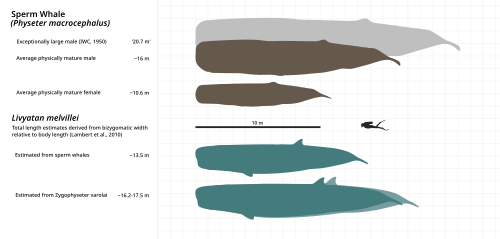
The body length of Livyatan melvillei is estimated around 13.5–17.5 meters (44–57 ft) mainly based on the holotype skull due to the lack of postcranial remains. Lambert and colleagues estimated the body length of Livyatan by comparing it to other physeteroids, Zygophyseter and modern sperm whales. The authors opted to use the relationship between the bizygomatic width (distance between the opposite zygomatic processes) of the skull and body length because of the variable rostrum length in modern sperm whales and the rostrum of Livyatan being proportionally shorter. This approach yielded length estimates of 13.5 m (44 ft) using modern sperm whales and 16.2–17.5 m (53–57 ft) using Zygophyseter, with the latter range caused by the incompleteness of the Zygophyseter type specimen.[1][16] It has been estimated to weigh 57 tonnes (62.8 short tons) based on the length estimate of 17.5 m (57 ft).[17] A 2025 study estimated the average body length of LivyatanHolotype based on averaging all previous estimates at 14.58 metres (47.8 ft).This synthesizes previous body length estimates derived from equations. [18]Supplementary Data Table S1. By comparison, the modern sperm whale length measures on average 11 m (36 ft) for females and 16 m (52 ft) for males,[19] with some males reaching up to 20.7 m (68 ft).[20][21][22] The large size was probably an anti-predator adaptation, and allowed it to feed on larger prey. Livyatan is the largest extinct physeteroid discovered, possibly having one of the strongest bite forces of any tetrapod.[1]
Skull
The holotype skull of Livyatan was about 3 m (9.8 ft) long. Like other raptorial sperm whales, Livyatan had a wide gap in between the temporal fossae on the sides of the skull and the zygomatic processes on the front of the skull, indicating a large space for holding strong temporal muscles, which are the most powerful muscles between the skull and the jaw. The snout was robust, thick, and relatively short, which allowed it to clamp down harder and better handle struggling prey. The left and right premaxillae on the snout probably did not intersect at the tip of the snout, though the premaxillae took up most of the front end of the snout. Unlike in the modern sperm whale, the premaxillae reached the sides of the snout. The upper jaw was thick, especially midway through the snout. The snout was asymmetrical, with the right maxilla in the upper jaw becoming slightly convex towards the back of the snout, and the left maxilla becoming slightly concave towards the back of the snout. The vomer reached the tip of the snout and was slightly concave, decreasing in thickness from the back to the front. A sudden thickening in the middle-left side of the vomer may indicate the location of the nose plug muscles. Each mandible in the lower jaw was higher than it was wide, with a larger gap in between the two than in the modern sperm whale. The mandibular symphysis, which connects the two halves of the mandibles in the middle of the lower jaw, was unfused. The condyloid process, which connects the lower jaw to the skull, was located near the bottom of the mandible, like other sperm whales. The head probably took up 17–22% of the total body size, compared to that of the modern sperm whale which takes up around one fourth to one third of the total body size. Like in other sperm whales, the blowhole was slanted towards the left side of the animal, and it may have lacked a right nasal passage.[1][8]
Teeth

Unlike the modern sperm whale, Livyatan had functional teeth in both jaws. The wear on the teeth indicates that the teeth sheared past each other while biting down, meaning it could bite off large portions of flesh from its prey. Also, the teeth were deeply embedded into the gums and could interlock, which were adaptations to holding struggling prey. None of the teeth of the holotype were complete, and none of the back teeth were well-preserved. The lower jaw contained 22 teeth, and the upper jaw contained 18 teeth. Unlike other sperm whales with functional teeth in the upper jaw, none of the tooth roots were entirely present in the premaxilla portion of the snout, being at least partially in the maxilla. Consequently, its tooth count was lower than those sperm whales, and, aside from the modern dwarf (Kogia sima) and pygmy (K. breviceps) sperm whales, it had the lowest tooth count in the lower jaw of any sperm whale.[1][8]
كانت أقوى أسنان ليفياتان هي الأسنان الرابعة والخامسة والسادسة في كل جانب من الفك. بلغ ارتفاع جميع الأسنان المحفوظة جيدًا أكثر من 31 سم ( قدم واحدة) ، وكان أكبر أسنان النموذج الأصلي هما السنّان الثاني والثالث في الفك السفلي الأيسر، حيث قُدِّر ارتفاعهما بحوالي 36.2 سم (1.2 قدم) . أما السن الأول في الفك الأيمن فكان الأصغر، إذ بلغ ارتفاعه حوالي 31.5 سم ( قدم واحدة ) . [ 1 ] [ 8 ] بلغ طول سن حوت العنبر في بوماريس حوالي 30 سم (قدم واحدة ) ، وهو أكبر سن أحفوري تم اكتشافه في أستراليا. [ 13 ] [ 14 ] يُعتقد أن هذه الأسنان من بين أكبر أسنان أي حيوان معروف، باستثناء الأنياب . [ 1 ] [ 8 ] وقد تبين أن بعض الأسنان السفلية تحتوي على سطح مستوٍ عند إغلاق الفكين، والذي ربما استُخدم لتثبيت أكبر الأسنان داخل الفك بشكل صحيح. في الأسنان الأمامية، كان قطر السن يتناقص باتجاه القاعدة. كان الوضع معاكساً بالنسبة للأسنان الخلفية، حيث بلغ قطرها الأقصى حوالي 11.1 سم (4.4 بوصة) في الفك السفلي. تميزت جميع الأسنان بتناقص سريع في القطر باتجاه طرف السن، وهو ما يُعزى جزئياً على الأرجح إلى التآكل على مدار حياة الحيوان. تناقص تقوس الأسنان من الأمام إلى الخلف، وكانت الأسنان السفلية أكثر تقوساً عند أطرافها من الأسنان العلوية. برزت الأسنان الأمامية للأمام بزاوية 45 درجة، وكما هو الحال في حيتان العنبر الأخرى، يُحتمل أن يكون الملاط قد أُضيف إلى الأسنان طوال حياة الحيوان. على عكس حوت العنبر الحديث الذي يمتلك أسناناً في الفك السفلي فقط، كان لدى ليفياتان أسنان في كلا الفكين. كان لدى النموذج الأصلي لـ L. melvillei ما لا يقل عن 40 سناً في فمه أثناء حياته. وكما هو الحال في حيتان العنبر الكبيرة المفترسة الأخرى، ولكن على عكس حوت العنبر الحديث، كانت الأسنان مغطاة بطبقة سميكة من المينا، يبلغ طولها حوالي 110-120 مم (11.1-12 بوصة). كانت الأسنان منحنية بشكل معتدل ومتجذرة بعمق في الجمجمة، مما يشير إلى قوة العضة. [ 1 ] [ 8 ]

All tooth sockets were cylindrical and single-rooted. The tooth sockets increased in size from the first to the fourth and then decreased, the fourth being the largest at around 197 mm (7.8 in) in diameter in the upper jaws, which is the largest of any known whale species. The tooth sockets were smaller in the lower jaw than they were in the upper jaw, and they were circular in shape, except for the front sockets, which were more oval.[1][8]
Basin
The fossil skull of Livyatan had a curved basin, known as the supracranial basin, which was deep and wide. Unlike other raptorial sperm whales, but much like in the modern sperm whale, the basin spanned the entire length of the snout, causing the entire skull to be concave on the top rather than creating a snout as seen in Zygophyseter and Acrophyseter. The supracranial basin was the deepest and widest over the braincase, and, unlike other raptorial sperm whales, it did not overhang the eye socket. It was defined by high walls on the sides. The antorbital notches, which are usually slit-like notches on the sides of the skull right before the snout, were inside the basin. A slanting crest on the temporal fossa directed towards the back of the skull separated the snout from the rest of the skull and was defined by a groove starting at the antorbital processes on the cheekbones. The basin had two foramina in the front, whereas the modern sperm whale has one foramen on the maxilla, and the modern dwarf and pygmy sperm whales have several in the basin. The suture in the basin between the maxilla and the forehead had an interlocking pattern.[8]
Classification
Livyatan was part of a fossil stem group of hyper-predatory sperm whales commonly known as macroraptorial sperm whales, or raptorial sperm whales, alongside the extinct whales Brygmophyseter, Acrophyseter and Zygophyseter. This group is known for having large, functional teeth in both the upper and lower jaws, which were used in capturing large prey, and had an enamel coating. Conversely, the modern sperm whale (Physeter macrocephalus) lacks teeth in the upper jaw, and the ability to use its teeth to catch prey.[23]Livyatan belongs to a different lineage in respect to the other raptorial sperm whales, and the size increase and the development of the spermaceti organ, an organ that is characteristic of sperm whales, are thought to have evolved independently from other raptorial sperm whales. The large teeth of the raptorial sperm whales either evolved once in the group with a basilosaurid-like common ancestor, or independently in Livyatan. The large temporal fossa in the skull of raptorial sperm whales is thought to a plesiomorphic feature, that is, a trait inherited from a common ancestor. Since the teeth of foetal modern sperm whales (Physeter macrocephalus) have enamel on them before being coated with cementum, it is thought that the enamel is also an ancient characteristic (basal). The appearance of raptorial sperm whales in the fossil record coincides with the diversification of baleen whales in the Miocene, implying that they evolved specifically to exploit baleen whales.[1][8] It has also been suggested that the raptorial sperm whales should be placed into the subfamily Hoplocetinae, alongside the genera Diaphorocetus, Idiorophus, Scaldicetus and Hoplocetus, which are known from the Miocene to the lower Pliocene. However, most of these taxa remain too fragmentary or have been used as wastebasket taxa for non-diagnostic material of stem physeteroids. This subfamily is characterized by their robust and enamel-coated teeth.[24]
The cladograms below are modified from Lambert et al. (2017)[1][8][23] and Paolucci et al. (2025),[25] and represents the phylogenetic relationships between Livyatan and other sperm whales, with genera identified as macroraptorial sperm whales in bold.
| 53 characters with down-weighting of homoplastic characters |
|---|
| 60 characters with equal weights |
|---|
Palaeobiology

Livyatan is inferred to have been a macroraptorial predator specializing in hypercarnivorous feeding on large marine vertebrates, including small cetaceans and pinnipeds, based on its cranial morphology and dentition adapted for grasping and tearing flesh. The retention of functional, enameled teeth in both upper and lower jaws, with conical crowns and robust roots up to 36.2 cm long, indicates a biting mechanism suited for capturing and processing mobile prey such as seals and smaller whales, contrasting with the suction-feeding, squid-focused diet as seen in the modern sperm whale. This predatory specialization aligns with the high diversity of marine mammals in the middle and late Miocene Pisco Formation, where L. melvillei likely targeted abundant large-sized vertebrates rather than soft-bodied cephalopods. This kind of macroraptorial predatory behavior is reconstructed as involving powerful jaw closure, facilitated by a structurally rigid rostrum with a closed mesorostral groove that enhanced stability during biting. The enameled tips of the teeth, featuring coarse longitudinal striations, suggest repeated occlusion and contact with hard tissues like bone or cartilage, implying a "grip-and-tear" strategy similar to that observed in coeval macroraptorial sperm whales such as Brygmophyseter and Zygophyseter. Wear patterns on preserved tooth fragments, including deep facets from tooth-to-tooth contact, further support frequent engagement with bony prey, though no direct evidence of gut contents or bite marks on associated fossils has been reported.[26]
Hunting
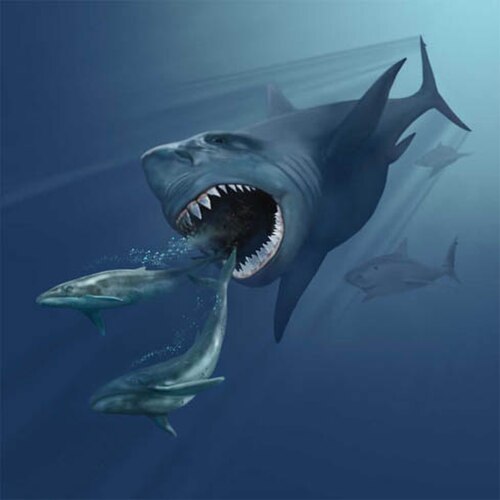
Livyatan was an apex predator, and probably had a profound impact on the structuring of Miocene marine communities. Using its large and deeply rooted teeth, it is likely to have hunted large prey near the surface, its diet probably consisting mainly of medium-sized baleen whales ranging from 7–10 m (23.0–32.8 ft) in length. It probably also preyed upon sharks, seals, dolphins and other large marine vertebrates, occupying a niche similar to the modern killer whale (Orcinus orca). It was contemporaneous with and occupied the same region as the otodontid shark O. megalodon, which was likely also an apex predator, implying competition over their similar food sources.[1][3][4][27] It is assumed that the hunting tactics of Livyatan for hunting whales were similar to that of the modern killer whale, pursuing prey to wear it out, and then drowning it.[1][28] Modern killer whales work in groups to isolate and kill whales, but, given its size, Livyatan may have been able to hunt alone.[29]
Isotopic analysis of enamel from a tooth from Chile revealed that this individual likely operated at latitudes south of 40°S. Isotopic analyses of contemporary baleen whales in the same formation show that this Livyatan was not commonly feeding on them, indicating it probably did not exclusively eat large prey, though it may have targeted baleen whales from higher latitudes.[30]
Spermaceti organ

يشير الحوض فوق الجمجمة في رأس الليفياتان إلى امتلاكه عضوًا كبيرًا يُعرف باسم عضو السبيرماسيتي ، وهو عبارة عن سلسلة من خزانات الزيت والشمع تفصلها أنسجة ضامة . ولا تزال وظائف عضو السبيرماسيتي في الليفياتان مجهولة. وكما هو الحال في حوت العنبر الحديث، يُحتمل أنه استُخدم في عملية تحديد الموقع بالصدى الحيوي لتوليد الصوت لتحديد موقع الفريسة. ومن الممكن أيضًا أنه استُخدم كوسيلة للعروض الصوتية ، مثل التواصل بين الأفراد. وربما استُخدم للصعق الصوتي، مما كان يؤدي إلى توقف وظائف الجسم لدى الحيوان المستهدف نتيجة التعرض للأصوات الشديدة. [ 1 ] [ 3 ] [ 8 ]
تقول نظرية أخرى إن الجبهة المتضخمة الناتجة عن وجود عضو العنبر تُستخدم لدى جميع حيتان العنبر بين الذكور المتنافسة على الإناث خلال موسم التزاوج، وذلك عن طريق النطح بالرأس، بما في ذلك حوت ليفياتان وحوت العنبر الحديث. وربما استُخدمت أيضًا للصدم بالفريسة؛ فإذا صحّ ذلك، فقد وردت تقارير عن هجوم حيتان العنبر الحديثة على سفن صيد الحيتان بالصدم بها، كما أن هذا العضو أكبر حجمًا بشكل غير متناسب لدى ذكور حيتان العنبر الحديثة. [ 1 ] [ 3 ] [ 8 ]
ثمة نظرية بديلة مفادها أن حيتان العنبر، بما فيها ليفياتان ، قادرة على تغيير درجة حرارة الشمع الموجود في عضوها للمساعدة في الطفو. فخفض درجة الحرارة يزيد من كثافته ليعمل كوزن للغوص في أعماق البحار، بينما رفع درجة الحرارة يقلل من كثافته ليساعده على الصعود إلى السطح. [ 1 ] [ 3 ] [ 8 ]
علم البيئة القديمة
Fossils conclusively identified as L. melvillei have been found in Peru and Chile. However, additional isolated large sperm whale teeth from other locations including California, Australia, Argentina, South Africa and the Netherlands have been identified as a species or possible close relative of Livyatan.[9][10][11][12][31] On the basis of these fossils, it was likely that the distribution of Livyatan was widespread. Prior to 2023, paleontologists initially believed that the genus was restricted to the Southern Hemisphere. The warmer waters around the equator have been known to be a climatic barrier for numerous cetaceans since Neogene times, and it was then-hypothesized is that Livyatan may have been among the cetaceans unable to cross the equatorial barrier. However, collecting bias was another explanation given the apparent rarity and poor fossil record of Livyatan,[9] now supported by the Northern Hemisphere occurrence in California.[11]
يعود النمط الأصلي لـ L. melvillei إلى العصر التورتوني من العصر الميوسيني العلوي (9.9-8.9 مليون سنة مضت) في تكوين بيسكو في بيرو، المعروف بمجموعته المحفوظة جيدًا من الفقاريات البحرية. من بين الحيتان البالينية التي عُثر عليها، كان أكثرها شيوعًا نوعًا غير موصوف من حيتان السيتوثيريد، يتراوح طوله بين 5 و8 أمتار (16 إلى 26 قدمًا) ، وكانت معظم الحيتان البالينية الأخرى التي عُثر عليها بنفس الحجم تقريبًا. تشمل بقايا الحيتان المسننة التي عُثر عليها حيتانًا منقارية (مثل Messapicetus gregarius )، وحيتان بونتوبورييد قديمة (مثل Brachydelphis mazeasi )، ودلافين محيطية ، وحوت العنبر المفترس Acrophyseter . جميع بقايا الفقمات التي عُثر عليها تمثل فقمات عديمة الأذنين . كما عُثر على سلاحف بحرية كبيرة مثل Pacifichelys urbinai ، مما يشير إلى نمو الأعشاب البحرية في هذه المنطقة. عُثر على عظام جزئية لتماسيح. ومن بين الطيور البحرية، عُثر على عظام مجزأة لطيور الغاق والنوء ، بالإضافة إلى نوعين من طيور الأطيش . كما عُثر في هذا التكوين على بقايا العديد من الأسماك الغضروفية ، بما في ذلك أكثر من 3500 سنّ قرش، معظمها لأسماك القرش القاعية ، مثل قرش الركام وقرش المطرقة . وبدرجة أقل، عُثر أيضًا على أسماك قرش الماكريل ، مثل القرش الأبيض وقرش الرمل وقرش الأوتونتيدي . وارتبطت العديد من أسنان القرش بقرش الماكو عريض الأسنان المنقرض ( Carcharodon hastalis ) وقرش الميجالودون، وقد عُثر على أسنان هذين النوعين من أسماك القرش بالقرب من بقايا الحيتان والفقمات. ومن بين الأسماك الغضروفية الأخرى التي عُثر عليها: أسماك الراي النسرية ، وأسماك المنشار، وأسماك القرش الملائكية. أما معظم عظام الأسماك التي عُثر عليها فكانت لأسماك التونة والكرواكر . ومن المرجح أن الليفياتان والميجالودون كانا من الحيوانات المفترسة الرئيسية في هذه المنطقة خلال تلك الفترة. [ 27 ] [ 32 ]

يُعرف نوع L. melvillei أيضًا من تكوين باهيا إنجليسا في تشيلي، والذي يعود تاريخ طبقاته الأحفورية إلى ما بين العصرين التورتوني والميسيني (9.03-6.45 مليون سنة مضت). ومثل تكوين بيسكو، يشتهر تكوين باهيا إنجليسا باحتوائه على واحدة من أغنى تجمعات الفقاريات البحرية. تشمل بقايا الحيتان البالينية حيتان المنك القديمة ، والحيتان الرمادية ، وحيتان القوس، وحيتان السيتوثيريات. ومن بين الحيتان المسننة، تم العثور على خمسة أنواع من حيتان البونتوبوريات، بالإضافة إلى الحيتان ذات المنقار، وخنازير البحر ، وثلاثة أنواع أخرى من حيتان العنبر مثل حيتان سكالديسيتوس ، وحيتان أودوبينوسيتوبس . وتشمل الثدييات البحرية الأخرى حيوان الكسلان البحري ثالاسوكنوس، وزعانف الأقدام مثل الأكروفوكا . تم وصف ما لا يقل عن 28 نوعًا مختلفًا من أسماك القرش، بما في ذلك العديد من أسماك القرش القاعية وأسماك القرش الأبيض الموجودة حاليًا، بالإضافة إلى أنواع منقرضة مثل قرش الماكو الكاذب ( Parotodus sp. )، وقرش الماكو عريض الأسنان، وقرش الميجالودون، وقرش القرش الأبيض الكبير الانتقالي (Carcharodon hubbelli) . وتشمل الفقاريات البحرية الأخرى طيور البطريق وأنواعًا أخرى من الطيور البحرية، وأنواعًا من التماسيح والغافيال . [ 9 ] [ 33 ] [ 34 ] [ 35 ] [ 36 ] [ 37 ] [ 38 ]
The Beaumaris sperm whale was found in the Black Rock Sandstone Formation of Beaumaris Bay, in Australia near the city of Melbourne, dating to 5 mya in the Pliocene. Beaumaris Bay is one of the most productive marine fossil sites in Australia for marine megafauna. Shark teeth belonging to twenty different species have been discovered there, such as from the whale shark (Rhincodon typus), the Port Jackson shark (Heterodontus portusjacksoni), the broad-toothed mako and megalodon. Some examples of whales found include the ancient humpback whale Megaptera miocaena, the dolphinSteno cudmorei and the sperm whale Physetodon baileyi. Other large marine animals found include ancient elephant seals, dugongs, sea turtles, ancient penguins such as Pseudaptenodytes, the extinct albatross Diomedea thyridata and the extinct toothed seabirds of the genus Pelagornis.[39][40][41][42]
The South African teeth attributed as cf. Livyatan are from the Avontuur Member of the Alexander Bay Formation near the village of Hondeklip Bay, Namaqualand, which is also dated to around 5 mya in the Pliocene. The Hondeklip Bay locality enjoys a rich heritage of marine fossils, whose diversity may have been thanks to the initiation of the Benguela Upwelling during the late Miocene, which likely provided large populations of phytoplankton traveling the cold nutrient-rich waters. Cetaceans are the most abundant fauna in the bay, although remains tend to be difficult to conclusively identify. Included are three species of balaenopterids including two undetermined species and one identified as cf. Plesiobalaenoptera, an ancient grey whale (cf. Eschrichtius sp.), an undetermined balaenid, an unidentified dolphin, and another undetermined species of macroraptorial sperm whale. Other localities of similar age on the South African west coast have also yielded many additional species of balaenopterids and sperm whales as well as ten species of beaked whales. Large sperm whale teeth of up to around ~20 cm (8 in) in length are common in Hondeklip Bay, indicating a high presence of large sperm whales like Livyatan in the area. The locality has also a high presence of sharks indicated by a large abundance of shark teeth; however, most of these teeth have not been identified. Megalodon teeth have been found in the bay, and evidence from bite marks in whale bones indicate the additional presence of the great white shark, shortfin mako and broad-toothed mako. Other marine fauna known in Hondeklip Bay include pinnipeds such as Homiphoca capensis, bony fish and rays.[10][43][44]
Extinction
Livyatan-like sperm whales became extinct by the early Pliocene likely due to a cooling trend causing baleen whales to increase in size and decrease in diversity, becoming coextinct with the smaller whales they fed on.[1][3][4][5] It has been hypothesized by some that their extinction was the result of competition large predatory globicephaline dolphins, however evidence for this hypothesis are largely unsupported.[9]
See also
Notes
- ↑Zanclean range is based on Livyatan-like fossils assigned open nomenclature as cf. Livyatan. Upper range for confirmed L. melvillei is 8.9 mya
- ↑sensu Paolucci et al. (2025). Also named "Clade A" in Kimura & Hasegawa (2022) and "Zygophyseter clade" in Peri et al. (2022).[25]
References
- 12345678910111213141516171819202122Lambert, Olivier; Bianucci, Giovanni; Post, Klaas; de Muizon, Christian; Salas-Gismondi, Rodolfo; Urbina, Mario; Reumer, Jelle (2010). "The giant bite of a new raptorial sperm whale from the Miocene epoch of Peru"(PDF). Nature. 466 (7302): 105–108. Bibcode:2010Natur.466..105L. doi:10.1038/nature09067. PMID 20596020. S2CID 4369352. Archived from the original(PDF) on 1 December 2017.
- 12"Livyatan melvillei". Paleobiology Database. Retrieved 12 November 2017.
- 1234567Fang, Janet (30 June 2010). "Call me Leviathan melvillei". Nature News. doi:10.1038/news.2010.322. Archived from the original on 3 July 2010. Retrieved 30 June 2010.
- 1234Ghosh, Pallab (30 June 2010). "'Sea monster' whale fossil unearthed". BBC News. Archived from the original on 1 July 2010. Retrieved 2 July 2010.
- 12Sample, Ian (30 June 2010). "Fossil sperm whale with huge teeth found in Peruvian desert". The Guardian. Archived from the original on 15 September 2013. Retrieved 2 July 2010.
- ↑McMillan, R. Bruce (2022). "Albert C. Koch's Missourium and the debate over the contemporaneity of humans and the Pleistocene megafauna of North America". Earth Sciences History. 41 (2): 410–439. Bibcode:2022ESHis..41..410M. doi:10.17704/1944-6187-41.2.410.
- ↑Lambert, Olivier; Bianucci, Giovanni; Post, Klaas; de Muizon, Christian; Salas-Gismondi, Rodolfo; Urbina, Mario; Reumer, Jelle (2010). "Corrigendum: the giant bite of a new raptorial sperm whale from the Miocene epoch of Peru". Nature. 466 (1134): 105–108. Bibcode:2010Natur.466.1134L. doi:10.1038/nature09381.
- 12345678910111213Lambert, O.; Bianucci, G.; de Muizon, C. (2017). "Macroraptorial Sperm Whales (Cetacea, Odontoceti, Physeteroidea) from the Miocene of Peru". Zoological Journal of the Linnean Society. 179: 404–474. doi:10.1111/zoj.12456. hdl:11568/814760. Archived from the original on 22 July 2018. Retrieved 24 November 2017.
- 1234567Piazza, David Sebastián; Agnolin, Fedrico Lisandro; Lucero, Segrio (2018). "First record of a macroraptorial sperm whale (Cetacea, Physeteroidea) from the Miocene of Argentina". Revista Brasileira de Paleontologia. 21 (3): 276–280. Bibcode:2018RvBrP..21..276P. doi:10.4072/rbp.2018.3.09. hdl:11336/94097.
- 12345Govender, R. (2021). "Early Pliocene fossil cetaceans from Hondeklip Bay, Namaqualand, South Africa". Historical Biology. 33 (4): 574–593. Bibcode:2021HBio...33..574G. doi:10.1080/08912963.2019.1650273. S2CID 202019648.
- 1234Watmore, K.; Prothero, D. (2025). "Gigantic Macroraptorial Sperm Whale Tooth From the Miocene of Orange County, California". Marine Mammal Science. 41 (4) e70036. doi:10.1111/mms.70036.
- 12Jeffrey, Andy (2016). "Giant killer sperm whales once cruised Australia's waters (and we have a massive tooth to prove it)". Earth Touch News Network. Archived from the original on 2 June 2016. Retrieved 31 May 2016.
- 12"Huge Tooth Reveals Prehistoric Moby Dick in Melbourne". Australasian Science Magazine. Archived from the original on 8 April 2019. Retrieved 24 April 2016.
- 12McSweeney, F.; Buckeridge, J. (2017). The Fossils of the Urban Sanctuary(PDF). Cheltenham, Victoria, Australia: Greypath Productions. p. 62. ISBN 978-1-76056-338-7. Archived(PDF) from the original on 1 December 2017. Retrieved 30 November 2017.
- ↑Reichler, Valeria A. (2010). "Estratigrafía y paleontología del Cenozoico marino del Gran Bajo y Salinas del Gualicho, Argentina, y descripción de 17 especies nuevas". Andean Geology (in Spanish). 37 (1): 177–219. Bibcode:2010AndGe..37a...8R. doi:10.4067/s0718-71062010000100008.
- ↑Lambert, Olivier; Bianucci, Giovanni; Post, Klaas; de Muizon, Christian; Salas-Gismondi, Rodolfo; Urbina, Mario; Reumer, Jelle (2010). "The giant bite of a new raptorial sperm whale from the Miocene epoch of Peru: Supplementary information"(PDF). Nature. 466 (7302): 105–108. Bibcode:2010Natur.466..105L. doi:10.1038/nature09067. PMID 20596020.
- ↑Villafaña, J. A.; Rivadeneira, M. M. (2014). "Rise and fall in diversity of Neogene marine vertebrates on the temperate Pacific coast of South America". Paleobiology. 40 (4): 659–674. Bibcode:2014Pbio...40..659V. doi:10.1666/13069. hdl:10533/136810. S2CID 129682627.
- ↑Paolucci, Florencia; Buono, Mónica R.; Fernández, Marta S. (2025). "Awakening Patagonia's sleeping sperm whale: a new description of the Early Miocene Idiorophus patagonicus (Odontoceti, Physeteroidea)". Papers in Palaeontology. 11 (2). doi:10.1002/spp2.70007. ISSN 2056-2799.
- ↑Shirihai, H. & Jarrett, B. (2006). Whales, Dolphins, and Other Marine Mammals of the World. Princeton: Princeton Univ. Press. pp. 21–24. ISBN 978-0-691-12757-6.
- ↑Wood, Gerald (1983). The Guinness Book of Animal Facts and Feats. Guinness Superlatives. p. 256. ISBN 978-0-85112-235-9.
- ↑Carwardine, Mark (1995). The Guinness book of Animal records. Enfield: Guinness Publishing. ISBN 978-0-85112-658-6. OCLC 60244977.
- ↑McClain, Craig R.; Balk, Meghan A.; Benfield, Mark C.; Branch, Trevor A.; Chen, Catherine; Cosgrove, James; Dove, Alistair D.M.; Gaskins, Leo C.; Helm, Rebecca R. (13 January 2015). "Sizing ocean giants: patterns of intraspecific size variation in marine megafauna". PeerJ. 3 e715. doi:10.7717/peerj.715. PMC 4304853. PMID 25649000.
- 12Berta, A. (2017). The Rise of Marine Mammals: 50 Million Years of Evolution. Baltimore, Maryland: Johns Hopkins University Press. pp. 112–113. ISBN 978-1-4214-2326-5. Archived from the original on 22 July 2018. Retrieved 12 November 2017.
- ↑Toscano, A.; Abad, M.; Ruiz, F.; Muñiz, F.; Álvarez, G.; García, E.; Caro, J. A. (2013). "Nuevos Restos de Scaldicetus (Cetacea, Odontoceti, Physeteridae) del Mioceno Superior, Sector Occidental de la Cuenca del Guadalquivir (Sur de España)"[New Remains of Scaldicetus (Cetacea, Odontoceti, Physeteridae) from the Upper Miocene, Western Sector of the Guadalquivir Basin]. Revista Mexicana de Ciencias Geológicas (in Spanish). 30 (2). Archived from the original on 22 July 2018. Retrieved 24 November 2017.
- 12Paolucci, F.; Buono, M.R.; Fernández, M.S. (2025). "Awakening Patagonia's sleeping sperm whale: a new description of the Early Miocene Idiorophus patagonicus (Odontoceti, Physeteroidea)". Papers in Palaeontology. 11 (2) e70007. Bibcode:2025PPal...11E0007P. doi:10.1002/spp2.70007.
- ↑Lambert, Olivier; Bianucci, Giovanni; Beatty, Brian L. (1 June 2014). "Bony outgrowths on the jaws of an extinct sperm whale support macroraptorial feeding in several stem physeteroids". Naturwissenschaften. 101 (6): 517–521. doi:10.1007/s00114-014-1182-2. ISSN 1432-1904. PMID 24821119.
- 12Bianucci, G.; Di Celma, C.; Landini, W.; Post, K.; Tinelli, C.; de Muizon, C. (2015). "Distribution of fossil marine vertebrates in Cerro Colorado, the type locality of the giant raptorial sperm whale Livyatan melvillei (Miocene, Pisco Formation, Peru)"(PDF). Journal of Maps. 12 (3): 543. doi:10.1080/17445647.2015.1048315. hdl:10.1080/17445647.2015.1048315. S2CID 131659988. Archived(PDF) from the original on 20 July 2018. Retrieved 6 September 2019.
- ↑Pitman, R. L.; Ballance, L. T.; Mesnick, S. I.; Chivers, S. J. (2001). "Killer Whale Predation on Sperm Whales: Observations and Implications". Marine Mammal Science. 17 (3): 494–507. Bibcode:2001MMamS..17..494P. doi:10.1111/j.1748-7692.2001.tb01000.x. Archived from the original on 11 December 2015. Retrieved 10 December 2017.
- ↑"New Leviathan Whale Was Prehistoric "Jaws"?". National Geographic. 30 June 2010. Archived from the original on 3 July 2010. Retrieved 3 July 2010.
- ↑Loch, C.; Gutstein, C. S.; Pyenson, N. D.; Clementz, M. T. (2019). But did it eat other whales? New enamel microstructure and isotopic data on Livyatan, a large physteroid from the Atacama region, northern Chile. 79th Annual Meeting of the Society of Vertebrate Paleontology Abstract of Papers.
- ↑Reumer, J. W. F.; Mens, T. H.; Post, K. (1 January 2017). "New finds of giant raptorial sperm whale teeth (Cetacea, Physeteroidea) from the Westerschelde Estuary (province of Zeeland, the Netherlands)". Deinsea. 17: 32–38. ISSN 2468-8983.
- ↑Parham, J. F.; Pyenson, N. D. (2010). "New sea turtle from the Miocene of Peru and iterative evolution of feeding ecomorphologies since the Cretaceous"(PDF). Journal of Paleontology. 84 (2): 231–247. Bibcode:2010JPal...84..231P. doi:10.1666/09-077R.1. S2CID 62811400. Archived(PDF) from the original on 1 December 2017. Retrieved 23 November 2017.
- ↑Gutstein, Carolina; Horwitz, Fanny; Valenzuela-Toro, Ana M.; Figueroa-Bravo, Constanza P. (2015). "Cetáceos fósiles de Chile: Contexto evolutivo y paleobiogeográfico"(PDF). Publicación Ocasional del Museo Nacional de Historia Natural, Chile (in Spanish). 63: 339–383. Archived(PDF) from the original on 27 March 2020. Retrieved 27 March 2020.
- ↑Suárez, Mario (2015). "Tiburones, rayas y quimeras (Chondrichthyes) fósiles de Chile"(PDF). Publicación Ocasional del Museo Nacional de Historia Natural, Chile (in Spanish). 63: 17–33. Archived(PDF) from the original on 27 March 2020. Retrieved 27 March 2020.
- ↑Sallaberry, Michel; Soto-Acuna, Sergio; Yury-Yanez, Roberto; Alarcon, Jhonatan; Rubilar-Rogers, David (2015). "Aves fósiles de Chile"(PDF). Publicación Ocasional del Museo Nacional de Historia Natural, Chile (in Spanish). 63: 265–291. Archived(PDF) from the original on 27 March 2020. Retrieved 27 March 2020.
- ↑Valenzuela Toro, Ana M.; Gutstein, Carolina (2015). "Mamíferos marinos (excepto cetáceos) fósiles de Chile"(PDF). Publicación Ocasional del Museo Nacional de Historia Natural, Chile (in Spanish). 63: 385–400. Archived(PDF) from the original on 27 March 2020. Retrieved 27 March 2020.
- ↑Soto-Acuña, Sergio; Otero, Rodrigo A.; Rubilar-Rogers, David; Vargas, Alexander O. (2015). "Arcosaurios no avianos de Chile"(PDF). Publicación Ocasional del Museo Nacional de Historia Natural, Chile (in Spanish). 63: 209–263. Archived(PDF) from the original on 27 March 2020. Retrieved 27 March 2020.
- ↑Le Roux, Jacobus P.; Achurra, Luciano; Henriquez, Alvaro; Carreno, Catalina; Rivera, Huber; Suarez, Mario E.; Ishman, Scott E.; Pyenson, Nicholas D.; Gutstei, Carolina S. (2016). "Oroclinal bending of the Juan Fern´andez Ridge suggested by geohistory analysis of the Bahía Inglesa Formation, north-central Chile". Sedimentary Geology. 333: 32–49. Bibcode:2016SedG..333...32L. doi:10.1016/j.sedgeo.2015.12.003. hdl:10533/238197.
- ↑"Beaumaris Bay Fossil Site, Beach Rd, Beaumaris, VIC, Australia". Australian Heritage Database. Archived from the original on 6 May 2018. Retrieved 24 November 2017.
- ↑Smith, B. (2012). "Trove of ancient secrets submerged under the sea". The Age. Archived from the original on 2 December 2017. Retrieved 24 November 2017.
- ↑Long, J. (2015). "We need to protect the fossil heritage on our doorstep". The Conversation. Archived from the original on 1 December 2017. Retrieved 24 November 2017.
- ↑"Beaumaris (Miocene of Australia)". fossilworks.org. Retrieved 17 December 2021.
- ↑Pether, John (1994). The sedimentology, palaeontology, and stratigraphy of coastal-plain deposits at Hondeklip Bay, Namaqualand, South Africa (MSc). University of Cape Town.
- ↑Govender, Romala (2018). "Extension of the geographic range of Homiphoca into Northern Cape Province, South Africa, with comments on the possible feeding strategies used by Homiphoca". Journal of Vertebrate Paleontology. 38 (3) e1463536. Bibcode:2018JVPal..38E3536G. doi:10.1080/02724634.2018.1463536. S2CID 90979340.

External links
- 'Sea monster' fossil found in Peru desert by CNN
- Ancient sperm whale's giant head uncovered from Los Angeles Times (The skull is on display in National History Museum in Lima)
- A killer sperm whale with details on sperm whale evolution
- Videos
- The Worlds Largest BITE on YouTube
- The jaws of the Leviathan on YouTube
- Leviathan melvillei on YouTube (a collection of images of discovery)
- Miocene mammals of Africa
- Physeteroidea
- Prehistoric toothed whales
- Monotypic prehistoric cetacean genera
- Miocene cetaceans
- Miocene mammals of South America
- Neogene Peru
- Fossils of Peru
- Pisco Formation
- Fossil taxa described in 2010
- Herman Melville
- Extinct apex predators
- Leviathan