
رئيس وزراء أوكرانيا
رئيس وزراء أوكرانيا ( بالأوكرانية : Прем'єр-міністр України ، وتُلفظ [ preˌmjɛrmiˈn⁽ʲ⁾istr ʊkrɐˈjinɪ ] ) هو رئيس حكومة أوكرانيا . [ 2 ] يترأس رئيس الوزراء مجلس وزراء أوكرانيا ، وهو أعلى هيئة في السلطة التنفيذية للحكومة الأوكرانية . بعد إعلان استقلال أوكرانيا عام 1991 ، حلّ هذا المنصب محلّ المنصب السوفيتي لرئاسة مجلس وزراء جمهورية أوكرانيا الاشتراكية السوفيتية ، الذي أُنشئ في 25 مارس 1946.
كانت يوليا تيموشينكو أول امرأة تُعيَّن رئيسة للوزراء في تاريخ أوكرانيا. [ 3 ] وكان أرسيني ياتسينيوك أول رئيس وزراء ينحدر من غرب أوكرانيا . وكان فولوديمير غرويسمان أول رئيس وزراء أوكراني يهودي . [ 4 ] وُلد رئيسان للوزراء في جمهورية روسيا الاتحادية الاشتراكية السوفيتية .
رئيس الوزراء الحالي هو سيرغي كوريتسكي ، الذي يشغل منصبه منذ 16 يوليو 2026، وقد وافق عليه البرلمان الأوكراني (فيرخوفنا رادا) بأغلبية 289 صوتًا.
ميعاد
يُعيّن رئيس الجمهورية رئيس الوزراء بموافقة البرلمان ( فيرخوفنا رادا) . وتُعتبر الموافقة مُمنوحة من البرلمان عندما تُصوّت أغلبية بسيطة من أعضائه الدستوريين لصالح المرشح الذي رشّحه الرئيس. وقد حازت يوليا تيموشينكو على أعلى نسبة موافقة برلمانية حتى الآن ، حيث عُيّنت رئيسة للوزراء في 4 فبراير/شباط 2005، بحصولها على 373 صوتًا في البرلمان. ومن بين رؤساء الوزراء الآخرين الذين حصلوا على أكثر من 300 صوت: أرسيني ياتسينيوك (371 صوتًا)، وياتسينيوك مرة أخرى في عام 2014 (341 صوتًا) [ 5 ] ، وفيتولد فوكين (332 صوتًا)، وليونيد كوتشما (316 صوتًا).
تسبق عملية منح الموافقة من البرلمان عادةً عدة أيام من المشاورات والمقابلات الشاملة مع المرشح من قبل الكتل البرلمانية. ولا تُعدّ موافقة المجلس التشريعي مجرد إجراء شكلي. فقد تمت المصادقة على بعض المرشحين بفارق ضئيل، وقد يُرفض مرشح آخر. على سبيل المثال، في عام 1999، لم يحصل فاليري بوستوفويتينكو على ثلاثة أصوات كافية لإعادة انتخابه بعد أن قدم استقالته في حفل تنصيب الرئيس ليونيد كوتشما للمرة الثانية في العام نفسه. واختار كوتشما فيكتور يوشتشينكو كمرشح بديل. ومثال آخر هو الموافقة على ترشيح يوري يخانوروف (حيث لم يحصل على ثلاثة أصوات كافية، ولكن تمت المصادقة عليه في المحاولة الثانية بعد يومين).
بعد التعديل الدستوري الذي أُجري أواخر عام ٢٠٠٤ وإعادة العمل به عام ٢٠١٤، قُيِّدت صلاحيات الرئيس في اختيار رئيس الوزراء، وأصبح مُلزماً عملياً بترشيح الشخص الذي يقترحه الائتلاف البرلماني. الاستثناء الوحيد هو عندما يتعذر ترشيح شخص ما بسبب مخالفة في إجراءات الترشيح أو عدم استيفائه للشروط المنصوص عليها في الدستور والقوانين الأوكرانية لمنصب رئيس الوزراء. في هذه الحالة، يُبلغ الرئيس البرلمان باستحالة تقديم ترشيح للشخص المُقترح.
لا يمكن لرئيس الوزراء، كما هو الحال مع جميع أعضاء السلطة التنفيذية، أن يكون عضواً في البرلمان .
الواجبات والصلاحيات

يرأس رئيس الوزراء السلطة التنفيذية للحكومة الأوكرانية، وهي مجلس الوزراء، ويوقع على المراسيم التي يصدرها مجلس الوزراء.
يملك رئيس الوزراء صلاحية ترشيح أعضاء الوزارات إلى البرلمان الأوكراني (فيرخوفنا رادا)، [ 6 ] باستثناء وزير الخارجية ووزير الدفاع ، اللذين يرشحهما الرئيس. كما يجوز لرئيس الوزراء ترشيح رؤساء الإدارات الإقليمية إلى الرئيس للنظر في ترشيحهم. [ 6 ]
يجوز لرئيس الوزراء أيضاً التوقيع على المراسيم والقوانين التي يصدرها الرئيس. ولا ينص الدستور على آلية محددة للتوقيع. ويتحمل رئيس الوزراء (والوزير المختص) مسؤولية تنفيذ القوانين التي يقرها مجلس الوزراء.
While in office, the prime minister is granted full legal immunity from all prosecutions and legal proceedings. The prime minister's office is headquartered in the Cabinet of Ministries building in central Kyiv. The prime minister was paid a yearly salary of ₴202,776 (16,898/month) (US$26,770) in 2005.[7] In 2013, following a petition in Fokus magazine, the secretariat of the cabinet stated that the monthly salary of the prime minister was ₴33,980 (US$4,173.42), which is eleven times more than the average salary in the country.[8]
Prime ministers are frequently asked by individual citizens for help in solving their personal problems, sometimes successfully. In 2012, Prime Minister Azarov received dozens of personal pleas every day on his Facebook page.[9]
Acting and deputy prime ministers

The first vice-prime minister, also known as the first deputy, heads the cabinet in the absence of the prime minister due to resignation or dismissal. Among the most notable First deputies were Yukhym Zvyahilsky and Mykola Azarov, who served as the acting prime minister for a longer period of time than anyone else. Valentyn Symonenko, Vasyl Durdynets, Oleksandr Turchynov, and others also served as acting prime minister.
Apart from the first vice-prime minister, there are also several other vice-ministers who support the prime minister and may be in charge of one or more ministries. In 1991–1992 the office of the state minister was also introduced. Traditionally vice-prime ministers are in charge of an area of general state government policy such as the agro-industrial complex, humanitarian affairs, economic affairs, or regional policy. On certain occasions, those deputies may be given regular ministerial portfolios as well, as happened in the Azarov Government in 2010.
Dismissal and resignation
The prime minister, like other Cabinet members, may resign voluntarily by tendering their resignation to parliament (according to the Constitution of Ukraine, the prime minister can only be dismissed by parliamentary vote).[10][11] Parliament must then consider the matter no later than the 10th day after the resignation application is received, if parliament was not in session at the time of resignation then no later than the first plenary week of the next regular session.[12] A resignation by the prime minister results in the dismissal of the entire Cabinet.[12] After the adoption of the current constitution in 1996, only prime ministers Pavlo Lazarenko and Mykola Azarov have left their post this way.[13] Prime ministers do not have a set term limit, staying in office for the duration of the parliament term, resignation, or dismissal.
Before the constitutional reform of 2004, the prime minister was usually dismissed unilaterally by the president. After the reform, the prime minister can only be dismissed by the parliament.[11][12] Formally, the Verkhovna Rada needed to pass a resolution of no confidence of the cabinet, which had to result in the prime minister's resignation. However, the parliament could not put such a resolution to the vote within one year of the approval of the cabinet's official programme.[14] The Cabinets of prime ministers Viktor Yushchenko and Viktor Yanukovych were dismissed in this way, with the latter refusing to tender his resignation to the president claiming a violation of the one-year period condition. The cabinet of Yuriy Yekhanurov had also been formally dismissed, but the parliamentary act was subsequently repealed.
List of prime ministers
Since Ukrainian independence from the Soviet Union in 1991, there have been 20 prime ministers.
Serhii Koretskyi is the current prime minister of Ukraine since 16 July 2026.
The longest-serving prime minister is Shmyhal; followed by Mykola Azarov (two terms) and Yulia Tymoshenko (who also served two terms).[15][16][17][18]
Tymoshenko was the first female prime minister of Ukraine.[19]
Timeline
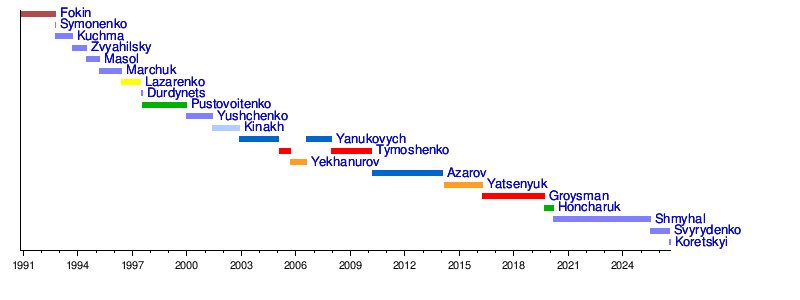
Parliamentary approval
| # | Date | Prime minister | Origin | Political party | Parliament votes | % (of 450) |
|---|---|---|---|---|---|---|
| 1 | 14 November 1990 | Vitold Fokin | Zaporizhzhia Oblast | Independent | 332 | 73.8 |
| 2 | 13 أكتوبر 1992 | ليونيد كوتشما | مقاطعة تشيرنيهيف | مستقل | 316 | 70.2 |
| 3 | 16 يونيو 1994 | فيتالي ماسول | مقاطعة تشيرنيهيف | مستقل | 199 | 44.2 |
| 4 | 6 مارس 1995 | يفغين مارشوك | مقاطعة كيروفوهراد | الحزب الديمقراطي الاجتماعي الأوكراني | ??? | ??? |
| 5 | 28 مايو 1996 | بافلو لازارينكو | مقاطعة دنيبروبيتروفسك | هرومادا | ??? | ??? |
| 6 | 16 يوليو 1997 | فاليري بوستوفويتينكو | مقاطعة ميكولايف | الحزب الديمقراطي الشعبي | 226 | 50.2 |
| 7 | 22 ديسمبر 1999 | فيكتور يوشتشينكو | مقاطعة سومي | مستقل | 296 | 65.8 |
| 8 | 29 مايو 2001 | أناتولي كيناخ | جمهورية مولدوفا الاشتراكية السوفيتية | الصناعيون | 239 | 53.1 |
| 9 | 21 نوفمبر 2002 | فيكتور يانوكوفيتش | مقاطعة دونيتسك | حزب الأقاليم | 234 | 52.0 |
| 10 | 4 فبراير 2005 | يوليا تيموشينكو | مقاطعة دنيبروبيتروفسك | باتكيفشينا | 373 | 82.9 |
| 11 | 22 سبتمبر 2005 | يوري يخانوروف | جمهورية روسيا الاتحادية الاشتراكية السوفيتية | أوكرانيا خاصتنا | 289 [ 20 ] | 64.2 |
| 12 | 4 أغسطس 2006 | فيكتور يانوكوفيتش | مقاطعة دونيتسك | حزب الأقاليم | 271 | 60.2 |
| 13 | 18 ديسمبر 2007 | يوليا تيموشينكو | مقاطعة دنيبروبيتروفسك | باتكيفشينا | 226 [ 21 ] | 50.2 |
| 14 | 11 مارس 2010 | ميكولا أزاروف | جمهورية روسيا الاتحادية الاشتراكية السوفيتية | حزب الأقاليم | 242 | 53.8 |
| 13 ديسمبر 2012 | 252 | 56.0 | ||||
| 15 | 27 فبراير 2014 | أرسيني ياتسينيوك | مقاطعة تشيرنيفتسي | باتكيفشينا | 371 | 82.2 |
| 27 نوفمبر 2014 | الجبهة الشعبية | 341 | 75.8 | |||
| 16 | 14 أبريل 2016 | فولوديمير غرويسمان | مقاطعة فينيتسا | كتلة بيترو بوروشينكو | 257 | 57.1 |
| 17 | 29 أغسطس 2019 | أوليكسي هونشاروك | مقاطعة تشيرنيهيف | خادم الشعب | 290 [ 22 ] | 64.4 |
| 18 | 4 مارس 2020 | دينيس شميهال | مقاطعة لفيف | مستقل | 291 | 64.7 |
| 19 | 17 يوليو 2025 | يوليا سفيريدينكو | مقاطعة تشيرنيهيف | مستقل | 262 | 58.2 |
| 20 | 16 يوليو 2026 | سيرغي كوريتسكي | مقاطعة فولين | مستقل | 289 [ 23 ] | 64.2 |
مراجع
- ↑ "دستور أوكرانيا" . البرلمان الأوكراني . تم الاطلاع عليه بتاريخ 25 مايو 2019 .
- ↑ الترابط الاقتصادي في العلاقات الأوكرانية الروسية، بقلم بول ج. دانييري ، مطبعة جامعة ولاية نيويورك ، 1999، رقم ISBN 978-0-7914-4246-3(الصفحة 187)
- ↑ سفيتلانا دوروش (17 يوليو 2025). "يوليا سفيريدينكو - رئيسة الوزراء. ما هو معروف عنها ولماذا ترتبط بأندريه يرماك" . بي بي سي نيوز الأوكرانية (باللغة الأوكرانية) . تم الاطلاع عليه بتاريخ 30 أغسطس 2025 .
- ↑ «انتخب الأوكرانيون أول رئيس وزراء يهودي للبلاد» . NPR . ١٤ أبريل ٢٠١٦. مؤرشف من الأصل في ١٥ سبتمبر ٢٠٢٥. تم الاطلاع عليه في ٢٦ يناير ٢٠٢٦ .
- ^ البرلمان الأوكراني يعين ياتسينيوك رئيسًا للوزراء ، انترفاكس أوكرانيا (27 نوفمبر 2014)
- 1 2 الحكومة توافق على مشروع قانون بشأن مجلس الوزراء ينص على تعيين الرئيس لرئيس الوزراء ، إنترفاكس-أوكرانيا (5 أكتوبر 2010)
- ↑ «ارتفع راتب يوشتشينكو تسعة أضعاف ليصل إلى 4.5 ألف دولار» . NTA-Privolzhye . 14 يوليو 2005. مؤرشف من الأصل في 3 أكتوبر 2011. تم الاطلاع عليه في 25 ديسمبر 2008 .
- ↑Azarov receives more than 30 thousands in a month (Азаров отримує більше 30 тисяч на місяць). Ukrayinska Pravda. 2013-1-24
- ↑Help Me, Father Czar!, Kyiv Post (5 April 2012)
- ↑Ukraine President Zelenskyy rejects PM's resignation, Al Jazeera English (17 January 2020)
- 12(in Ukrainian)"Keep me seven." What will end Goncharuk's "resignation", Glavcom (17 January 2020)
- 123(in Ukrainian)Honcharuk: The government continues to work until Zelensky makes a decision, Ukrayinska Pravda (17 January 2020)
- ↑Laws of Ukraine. President of Ukraine decree No. 599/97: On the resignation of Prime Minister P.Lazarenko. Adopted on 1997-07-02. (Ukrainian)
- ↑(in Ukrainian)Tymoshenko wants change of power: "Let them return to their 95s", Ukrayinska Pravda (16 January 2020)
- ↑"Yulia-prime minister or Shmyhal's holding. Will replace Zelenskyy's longest government in history". Ukrainska Pravda (in Ukrainian). 10 July 2024. Retrieved 12 July 2024.
- ↑Ukraine parliament approves Azarov as prime minister, Reuters (13 December 2012)
- ↑Azarov urges Ukrainians to be worthy of liberators' feat, Ukrinform (9 May 2013)
- ↑Azarov is record-holder in holding PM postArchived 8 December 2012 at the Wayback Machine, ForUm (4 December 2012)
- ↑Andreas Umland (30 November 2018). "What Would a Tymoshenko Presidency Mean?". Atlantic Council. Retrieved 12 July 2024.
- ↑Yekhanurov initially collected 223 votes out of the necessary 226, but he was appointed after the second try.
- ↑Tymoshenko initially collected 225 votes out of the necessary 226. Some deputies announced that their votes did not correspond to the results. The Tymoshenko candidacy was approved on the second try.
- ↑Ukrainian Lawmakers Approve Political Novice Honcharuk As Prime Minister, Radio Free Europe (29 August 2019)
- ↑Aslanov, Mubariz (16 July 2026). "Ukraines parliament appoints Serhiy Koretskyy as prime minister". Report.az. Retrieved 16 July 2026.
External links
- "Official page of Prime Minister of Ukraine Arseniy Yatsenyuk" (in Ukrainian). Retrieved 25 September 2014.
- "Government portal". Cabinet of Ministers of Ukraine (in Ukrainian).
- Prime ministers of Ukraine
- Government ministers of Ukraine
- 1990 establishments in Ukraine