
نظرية التفرد
في الرياضيات ، تدرس نظرية التفرد الفضاءات التي تكاد تكون متعددة الشعب ، ولكنها ليست كذلك تمامًا. يمكن اعتبار الخيط مثالًا على متعدد شعب أحادي البعد، إذا أهملنا سمكه. يمكن إحداث تفرد بتكوير الخيط، ثم إسقاطه على الأرض، ثم فرده. في بعض المواضع، يتقاطع الخيط المسطح مع نفسه على شكل حرف "X" تقريبًا. تُعدّ النقاط على الأرض التي يحدث فيها هذا التقاطع نوعًا من التفرد ، وهي النقطة المزدوجة: حيث يقابل جزء واحد من الأرض أكثر من جزء واحد من الخيط. ربما يلامس الخيط نفسه أيضًا دون أن يتقاطع، مثل حرف " U " مسطر. هذا نوع آخر من التفرد. على عكس النقطة المزدوجة، فهو غير مستقر ، بمعنى أن دفعة صغيرة سترفع الجزء السفلي من حرف "U" بعيدًا عن الخط السفلي.
يُعرّف فلاديمير أرنولد الهدف الرئيسي لنظرية التفرد بأنه وصف كيفية اعتماد الكائنات على المعاملات، لا سيما في الحالات التي تشهد فيها الخصائص تغيرًا مفاجئًا نتيجة لتغير طفيف في هذه المعاملات. تُسمى هذه الحالات "بيريسترويكا" ( بالروسية : перестройка )، أو "التشعبات" ، أو "الكوارث". ويُعدّ تصنيف أنواع التغيرات وتوصيف مجموعات المعاملات التي تُؤدي إلى هذه التغيرات من أهم الأهداف الرياضية. يمكن أن تحدث حالات التفرد في نطاق واسع من الكائنات الرياضية، بدءًا من المصفوفات التي تعتمد على المعاملات وصولًا إلى الجبهات الموجية. [ 1 ]
كيف يمكن أن تنشأ التفردات
في نظرية التفرد، تُدرس الظاهرة العامة لنقاط ومجموعات التفرد، كجزء من مفهوم أن الفضاءات متعددة الشعب (الفضاءات الخالية من التفرد) قد تكتسب نقاطًا خاصة متفردة عبر عدة مسارات. يُعد الإسقاط أحد هذه المسارات، وهو واضح جدًا بصريًا عند إسقاط الأجسام ثلاثية الأبعاد على بعدين (كما في إحدى أعيننا مثلاً ) ؛ فعند النظر إلى التماثيل الكلاسيكية، تُعد طيات الأقمشة من أبرز سماتها. تشمل التفردات من هذا النوع الانعكاسات الضوئية ، المألوفة جدًا كأنماط الضوء في قاع حوض السباحة.
من الطرق الأخرى التي تحدث بها التفردات انحلال بنية المتشعب. ويمكن أن يكون وجود التناظر سببًا وجيهًا للنظر في المتشعبات المدارية ، وهي متشعبات اكتسبت "زوايا" في عملية طي، تشبه تجعيد منديل المائدة.
حالات الشذوذ في الهندسة الجبرية
نقاط التفرد في المنحنيات الجبرية
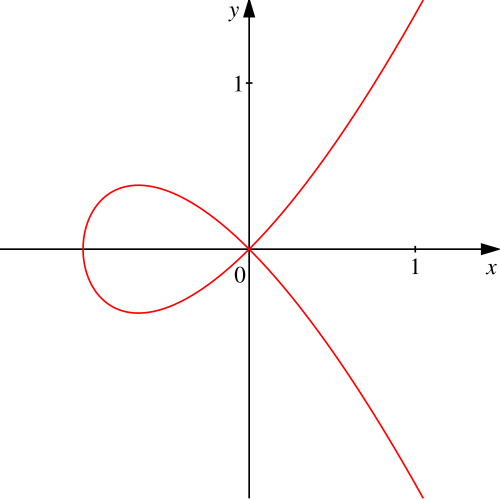
Historically, singularities were first noticed in the study of algebraic curves. The double point at (0, 0) of the curve
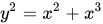
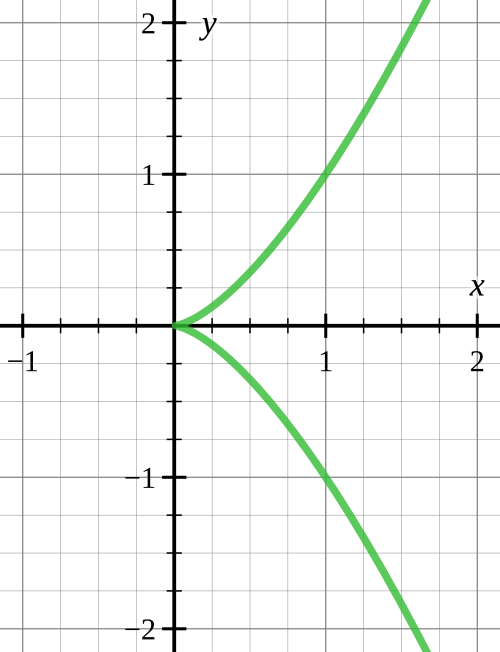
and the cusp there of

are qualitatively different, as is seen just by sketching. Isaac Newton carried out a detailed study of all cubic curves, the general family to which these examples belong. It was noticed in the formulation of Bézout's theorem that such singular points must be counted with multiplicity (2 for a double point, 3 for a cusp), in accounting for intersections of curves.
It was then a short step to define the general notion of a singular point of an algebraic variety; that is, to allow higher dimensions.
The general position of singularities in algebraic geometry
Such singularities in algebraic geometry are the easiest in principle to study, since they are defined by polynomial equations and therefore in terms of a coordinate system. One can say that the extrinsic meaning of a singular point isn't in question; it is just that in intrinsic terms the coordinates in the ambient space don't straightforwardly translate the geometry of the algebraic variety at the point. Intensive studies of such singularities led in the end to Heisuke Hironaka's fundamental theorem on resolution of singularities (in birational geometry in characteristic 0). This means that the simple process of "lifting" a piece of string off itself, by the "obvious" use of the cross-over at a double point, is not essentially misleading: all the singularities of algebraic geometry can be recovered as some sort of very general collapse (through multiple processes). This result is often implicitly used to extend affine geometry to projective geometry: it is entirely typical for an affine variety to acquire singular points on the hyperplane at infinity, when its closure in projective space is taken. Resolution says that such singularities can be handled rather as a (complicated) sort of compactification, ending up with a compact manifold (for the strong topology, rather than the Zariski topology, that is).
The smooth theory and catastrophes
At about the same time as Hironaka's work, the catastrophe theory of René Thom was receiving a great deal of attention. This is another branch of singularity theory, based on earlier work of Hassler Whitney on critical points. Roughly speaking, a critical point of a smooth function is where the level set develops a singular point in the geometric sense. This theory deals with differentiable functions in general, rather than just polynomials. To compensate, only the stable phenomena are considered. One can argue that in nature, anything destroyed by tiny changes is not going to be observed; the visible is the stable. Whitney had shown that in low numbers of variables the stable structure of critical points is very restricted, in local terms. Thom built on this, and his own earlier work, to create a catastrophe theory supposed to account for discontinuous change in nature.
Arnold's view
While Thom was an eminent mathematician, the subsequent fashionable nature of elementary catastrophe theory as propagated by Christopher Zeeman caused a reaction, in particular on the part of Vladimir Arnold.[2] He may have been largely responsible for applying the term singularity theory to the area including the input from algebraic geometry, as well as that flowing from the work of Whitney, Thom and other authors. He wrote in terms making clear his distaste for the too-publicised emphasis on a small part of the territory. The foundational work on smooth singularities is formulated as the construction of equivalence relations on singular points, and germs. Technically this involves group actions of Lie groups on spaces of jets; in less abstract terms Taylor series are examined up to change of variable, pinning down singularities with enough derivatives. Applications, according to Arnold, are to be seen in symplectic geometry, as the geometric form of classical mechanics.
Duality
An important reason why singularities cause problems in mathematics is that, with a failure of manifold structure, the invocation of Poincaré duality is also disallowed. A major advance was the introduction of intersection cohomology, which arose initially from attempts to restore duality by use of strata. Numerous connections and applications stemmed from the original idea, for example the concept of perverse sheaf in homological algebra.
Other possible meanings
The theory mentioned above does not directly relate to the concept of mathematical singularity as a value at which a function is not defined. For that, see for example isolated singularity, essential singularity, removable singularity. The monodromy theory of differential equations, in the complex domain, around singularities, does however come into relation with the geometric theory. Roughly speaking, monodromy studies the way a covering map can degenerate, while singularity theory studies the way a manifold can degenerate; and these fields are linked.
See also
Notes
- ↑Arnold, V. I. (2000). "Singularity Theory". www.newton.ac.uk. Isaac Newton Institute for Mathematical Sciences. Retrieved 31 May 2016.
- ↑Arnold 1992
References
- V.I. Arnold (1992). Catastrophe Theory. Springer-Verlag. ISBN 978-3540548119.
- E. Brieskorn; H. Knörrer (1986). Plane Algebraic Curves. Birkhauser-Verlag. ISBN 978-3764317690.
- R. Abraham and J. Marsden (1987). Foundations of Mechanics, Second Edition. Benjamin/Cummings Publishing Company.
- Singularity theory