
Southern Ndebele people
Southern Ndebele people, also known in English by their endonymAmaNdebele, are a Bantuethnic group native to Southern Africa who speak the Southern Ndebele language (isiNdebele).
The group is separate from the Northern Ndebele who broke away from the Zulu during Shaka's time. The Southern Ndebele people mainly inhabit the South African provinces of Mpumalanga, Gauteng and Limpopo in the middle-northeast of the South Africa. In academia, this ethnic group is referred to as the Southern Ndebele to differentiate it from their relatives, the Northern Ndebele people, of the historical Matabeleland of Zimbabwe and the adjoining northernmost South African provinces of Limpopo and North West.
Etymology
The term Ndebele, collectively as amaNdebele, is used among several South African groups, broadly divided into Northern and Southern. These groups are not genealogically related.[1]
Several origins have been proposed for the ethnonym. One theory is that the Tswana speaking inhabitants referred to the Nguni newcomers as the leTebele/maTebele, derived from the term tebele, meaning “a stranger” or “one who plunders”, while the Nguni variant would be amaNdebele.[1] The term was applied to any group regarded as outsiders, invaders, or refugees in a region.[2]
An alternative theory relates -tebele to either the Tswana teba, “to sink down” or “crouch”, in reference to Zulu-style shield tactics, or thebe, meaning “shield", referring the shields that the Nguni were known for.[3]
Prehistory
The history of the Ndebele people begin with the Bantu Migrations southwards from the Great Lakes region of East Africa. Bantu speaking peoples moved across the Limpopo river into modern day South Africa in the North Eastern regions of South Africa. At the time of the collapse of the Kingdom of Zimbabwe in 1450, Two main groups had emerged south of the Limpopo River: the Nguni, who occupied the eastern coastal plains, and the Sotho–Tswana, who lived on the interior plateau. Between the 1400s and early 1800s saw these two groups split into smaller distinct cultures and people. The Ndebele were just such a people.
Among the Hlubi
Chief Ndebele was living with his people in the territory of the Bhaca and Hlubi south of the Drakensberg Mountains which they called "uKhahlamba". The capital settlement in this territory was called eLundini. Chief Ndebele had broken away from the larger Mbo group and established his own rule over his own people who would take his name as the name of their nation.
Jonono, the great-grandson of Ndebele moved north with his people and settled in the area just north east of modern-day Ladysmith in the mountains surrounding the mouth of the Cwembe River. Jononoskop which is approximately 30 km (19 mi) north east of Ladysmith is said to be the burial place of Jonono.
Jonono was succeeded as "INgwenyama" which is the title of the King of the Ndebele, by his eldest son Nanasi who legend holds, was resistant to all poisons. One tale tells of how Nanasi feasted on the top of a nearby hill on poisonous fruit only to discover that he remained unharmed by the fruit. Today the alleged site is called "Butiswini" from ubuthi esiswini which roughly means 'a poisoned stomach'. Oral tradition does not tell us why Nanasi was eating poisonous fruit in the first place.
Migration to north of the Vaal river
Nanasi died without issue and so Mafana his brother succeeded him as Ngwenyama. Mafana is said to have lived in the mid-1500s. Mafana moved his people from their lands near Ladysmith moving in a north westward direction crossing first the Drakensberg Mountains and then made an attempt to cross the Vaal River. He was unsuccessful and drowned in the river along with a few others.
After the death of his father Mafana, Mhlanga assumed the throne and took his people over the Vaal River travelling in a north westward direction finally settling in an area around modern day Randfontein. Mhlanga established a new capital that was later called eMhlangeni (now known as Mehlakeng), which means Mhlanga's place, and there he stayed with the Ndebele until his death.
Musi, the son of Mhlanga succeeded his father as Ngwenyama of the Ndebele people. While at eMhlangeni, Musi found the area becoming increasingly hostile from the Sotho-Tswana tribes to the west that had not taken kindly to the Nguni Ndebele settling so close to their borders. Ultimately due the competing of resources, Musi uprooted the Ndebele once again and moved his people northwards crossing first the Jukskei River then the Hennops River. After discovering the source of the Apies River, Musi's Ndebele moved north along its banks through Wonderboompoort and settled in the hills north of Wonderboomkop on both side of the Apies River. Here Musi established two settlements. The first of which "KwaMnyamana" (The Place of Black Rocks) served as a new capitol for the Ndebele and was situated on the eastern side of the Apies river. The second settlement was that of "eMaruleni" (Named for the abundance of Marula fruit trees), which was situated on the western side of the Apies river.
Here at KwaMnyamana, Musi's Ndebele would establish a thriving homeland for themselves trading with BaKwena and BaKgatla tribes in the west.
Musi's people also encountered the indigenous nomadic San people living along the Apies River whom they called "AbaTshwa" which is said to mean "The People who we ignore".
Manala-Ndzundza conflict
Musi was a polygamist and as such fathered many children with many wives. The following are some of Musi's known progeny: Masombuka, also called Sikhosana whose name means "to begin". First born son of Musi's third wife. Ndzundza, also called Hlungwana was the first born son of his second wife. Manala, also called Mbuduma was the first born son of his 'Great Wife'. There was also Thombeni, also called Gheghana, Sibasa, Mrhwaduba, Mphafuli, Dlomu, and Tshwane, whose historicity is hotly debated with many suggesting he was not the son of Musi but the son of Musi's brother Sekhubatane or even Musi's grandson. There are others who even suggest that he may have never existed at all.
According to Ndebele tradition, it is custom for the first born son of the 'Great Wife' to succeed his father as ruler over the Ndebele people. The first born of Musi's great wife was Manala. Thus Manala was the rightful heir to the ruling seat of the Ndebele. This did not sit well with Musi's second wife whose son Ndzundza was born first before Manala. Oral tradition on the many details of the following vary from community to community however what is mostly agreed upon is that when Musi was old, he was blind and quite senile. After the death of his great wife he was being nursed and cared for by his second wife. This second wife, sensing the passing of Musi was near, instructed Manala to go out and hunt an 'imbuduma' (Wildebeest) to honour his father in his last days. While Manala was out, Musi's second wife came to him and presented her son Ndzundza as Manala and asked Musi to bestow to Ndzundza the "iNamrhali" which it is said, are magical beads or a magical staff that produce a sound that mimics the cries of a child. This mysterious gift was passed from incumbent rulers to their successors at their death to fortify their rule as the new ruler.
Alternate oral tradition holds that Musi himself sent Manala to hunt the imbuduma and knowingly bestowed iNamrhali to Ndzundza and instructed him to call an "Imbizo" (Royal counsel) and inform the elders and the people of what had transpired between him and his father. Ndzundza was further instructed to not leave KwaMnyamana at any cost. That if he should leave the seat of power, even having iNamrhali would not be enough to consolidate his power as the new ruler over the people and that his brother Manala would surely uses the forces of KwaMnyamana to seek retribution.
While it is debated how Ndzundza had obtained iNamrhali, the one consistent fact remained in almost all stories that Ndzundza was indeed in possession of iNamrhali at this point. Ndzundza did not head the warning of his father and fled eastwards with many followers including his brothers Mthombeni and Masombuka . Manala arrived with his hunt to find his father had died and Ndzundza with iNamrhali along with many followers had fled. Manala himself called an Imbizo declaring that Ndzundza had stolen iNamrhali and thus his birthright. He vowed to bring Ndzundza back to KwaMnyamana or kill him.
Manala with his army pursued Ndzundza and caught up with him at MaSongololo (Zonkolol) Between modern day Cullinan and Rayton. There they fought a battle between two branches of the Elands River. Ndzundza had narrowly claimed victory in this first battle and rather than staying in the area he fled with his forces further eastward. Manala pursued again and again lost to Ndzundza's forces in a battle at the Wilge River. It is said that at this battle, Ndzundza used iNamrhali to cast a magical spell over the river causing it to wash away some of Manala's forces. After this second defeat, Manala retreated back to KwaMnyamana to replenish their provisions and numbers. Manala and his army then continued to chase Ndzundza until they met at the Olifants River were a third battle ensued. Ndzundza allegedly cast the first blow, throwing a spear over the river towards Manala which landed at his feet.
It was then that oral tradition holds that at the moment Manala had the upper hand to kill his brother Ndzundza, a "long breasted" old woman named Noqoli from the Mnguni family stepped in and scolded the brothers for fighting. She proceeded to call a meeting to mediate peace between the two brothers. The outcome of this meeting was that henceforth there would be two kings of the Ndebele people. Ndzundza would hold Musi's iNamrhali and be recognised as his own king within the Ndebele kingdom, and Manala would continue to rule as the senior king from Musi's capital of KwaMnyamana (Wonderboom) and the Olifants River would be the border separating the two powers within the greater Ndebele Kingdom. The agreement further stated that the brothers may never again fight. That great misfortune would follow the Ndebele people should they transgress the agreement which came to be known as "isiVumelano sakoNoQoli" (Noqoli's agreement). To show their commitment to honour Noqoli's agreement, it was decided that Manala's daughters and descendants would marry the daughters and descendants of Ndzundza and vice versa. This practice would later die out. Noqoli and her descendants were honoured with the title Msiza.
This story bears great resemblance to the biblical story of Jacob and Esau which features in The Book of Genesis from Chapters 27 through to 33 telling of Esau's loss of his birthright to Jacob and the conflict that ensued between their descendants nations because of Jacob's deception of their aged and blind father, Isaac, in order to receive Esau's birthright/blessing from Isaac.
There has been much debate over the past few centuries about the exact details of isiVumelwano sakoNoQoli. This debate boiled over into a legal feud between Enoch Mabhena Makhosoke II of the Manala and Mbusi Mahlangu Mabhoko III of the Ndzundza over who holds the most senior position in the Ndebele kingdom. The matter was settled with the Nhlapo Commission onto Traditional leadership and claims which in 2010 declared Mabhena as the senior king of the Ndebele.
In November 2010, former President of South AfricaJacob Zuma caused controversy when he overturned the Nhlapo Commissions finding and declared Mahlangu to be the senior king of the Ndebele. This was later rectified in 2017, High Court and Makhosonke II was legally entrenched as the senior king of the Ndebele People of South Africa.
Post Ndebele Schism
The remaining sons of Musi all went their separate ways after the Manala-Ndzundza conflict. Thombeni and Masombuka relocated with their brother Ndzundza to east of the Olifants River.
Thombeni (Gheghana) continued on with his people north and settled at the confluence of the Mgoto and Nkumpi rivers in what is today Moletlane. Thombeni's grandson named Kgabe took a large portion of the descendants of Tqahombeni north westward crossing the mountains and settling near the Waterberg Mountains along the Nyl river where their descendants were gradually assimilated into the surrounding Sotho-Tswana groups.
By the middle of the 18th century, the Gheghana had further divided into smaller splinter groups, which spread out across the hills, valleys and plains surrounding present-day Mghumbhani(Mokopane), Zebediela and Bhulungwani (Polokwane).These groups were progressively absorbed into the numerically superior and more dominant surrounding Sotho groups, undergoing considerable cultural and social change. By contrast, the descendants of Manala and Ndzundza maintained a more recognisably distinctive cultural identity, and retained a language which was closer to the Mbo spoken by their coastal forebears (and to present-day isiHlubi).[4]
Sibasa and his brother Mphafuli moved north into the territory of the VhaVenda and were met with resistance from the Venda. After a considerable conflict the forces of Mphafuli and Sibasa established chieftainships at Tshivhase and Sibasa. Some of Mphafuli's descendents trekked southwards and joined the Ndzundza.
Dlomu had decided to leave the territories north of the Vaal and go back to the ancestral homeland of the Ndebele in Hlubi territory. Here the descendants of Dlomu established the amaNdebele Clan among the Hlubi.
The descendants of Mhwaduba stayed with Manala at KwaMnyamana for almost seven generations until the onset of a drought in the late 1700s caused one of his descendants, known to the Voortrekkers as "Pete" uprooted his people and settled near Schuinsdraai in Limpopo. After the arrival of Mzilikazi north of the Vaal, the remanents of Pete's people settled among the Masetla BaKgatla and were gradually assimilated as BaKgatla.
As for Tshwane. It is said by some that he was one of the descendants of Mhwaduba who did not leave with Pete but instead moved south and settled on the northern banks of the Hennops river. Thaba Tshwane nearby bears his name. Tshwane Metropolitan Municipality was named in honour of Tshwane as well as a 3m statue erected in-front of Pretoria City Hall. This has caused great controversy.
Manala returned from the Olifants River back to KwaMnyamana with two of his brothers daughters, Mathisi and Ganuganu as consolation for the loss of iNamrhali. Upon Manala's return he buried the body of Musi under the Wonderboom at the base of Wonderboomkop. Following Ndebele tradition would have led the funeral ceremony with his clothes inside out in a practice called "ukuhlanukela". After the burial the new Ngwenyama is announced to the people by the royal praise singer after-which there is a great feast. In the years leading up to Manala's death his people saw relative prosperity at KwaMnyamana.
Manala was succeeded by his son Ntjhele, who succeeded by his son Magutjhona who was succeeded by his son Mrhawu, who was succeeded by his brother Ncagu who served as regent until Buyambo, the son of Mrawu was of age to assume the Manala throne. Buyambo's son Mabhena I who succeeded him as Ngwenyama of the Manala throne expanded the territory of to as far south as the confluence of the Hennops River and the Sesmylspruit and as far north as Marblehall in Limpopo. Mabhena I did however struggle with expansion to the west. Never moving past the Sand River which becomes the Tolwane River. He met respectable resistance from the Sotho-Tswana groups to the west. When the son of Mabhena I, Mdibane, ascended to the throne the Manala had controlled a territory spanning the length of northern Gauteng. This included many large settlements such as KwaMnyamana (The Place of Black Rocks) which served as the Manala Capital, eMaruleni (The Place of Marula Trees), eZotjaneni (The Place in The Grass), KoNonduna (The Place of The Chiefs) and eMbilaneni (The Holy Place).
Ndzundza and his followers now free to establish their own rule moved to the source of the Steelpoort river and built the first Ndzundza capital called KwaSimkulu "The Great Place" situated approximately 20 km (12 mi) west of modern-day Belfast at the foot of Kwaggaskop. Ndzundza's Ndebele claimed all the lands from the Olifants River in the east to the western banks of the Elands River in Mpumalanga as their new territory.
Ndzundza was succeeded by his son Mrhetjha who in turn was succeeded by his son Magobholi. Bongwe, the son of Magobholi and great-grandson of Ndzundza, ruled in a time where the territory of the Ndzundza became increasingly threatened by raids from the Nguni tribes in the south east and more worry-some the growing Sotho-Tswana peoples in the north. Bongwe thus left KwaSimkulu and established a new capital for the Ndzundza at the base of the Bothasberg which was called "KwaMaza" (The Place of Ash). This new capital proved to be in a more solid position with which to push back the expansion of baKgatla tribes in the north. Bongwe died without issue and was succeeded by his brother Sindeni.
Sindeni continued his brothers campaigns in the north and defeated both the baKgatla under Moloi and the bakwaNkadimeng. Sindeni was succeeded by his grandson Mahlangu. It is not clear how power was transferred from Sindeni to Mahlangu and what happened to Mahlangu's father who should have ruled before him. Mahlangu attempted to expand the Ndzundza territory both to the north and south but had limited success. Despite this Mahlangu gained significant notoriety from his enemies as a skilled military leader.
Mahlangu was succeeded by his son Phaswana who was killed in war. Phaswana was succeeded by his brother Maridili who had greater success in war defeating Makuwa baPedi and Makwetla baPedi at eDikeni. Maridili died without issue and so the Ndzundza throne passed onto the next brother Mdalanyana who was killed in war. The throne passed to Mgwezana, son of Mahlangu, who too was killed in battle. After this Mgwezana's brother Dzela. Dzela engaged in an ambitious war to claim more territory for the Ndzundza eastwards and attacked the BoKoni around Lydenburg which they called "eMatjhitjhini" (The Place of The Long Grass). This campaign was not successful and Dzela was killed. The throne then passed to Mrhabuli who was the son of Mgwezana but served as regent for the young Gembe who was the rightful heir of Mgwezana's throne. To avenge the death Dzela, Mrhabuli split the Ndzundza force into three armies with his brother Magodongo in command of one force, his young brother and heir Gembe in command of the second and himself in command of the last. The plan was to surround the BoKoni capital and attack from three sides. Gembe and his forces had gotten scared and abandoned his brothers on the eve of battle and fled. Mrhabuli and Magodongo inflicted massive loses on the BoKoni but sustained great losses without the support of Gembe. Mrhabuli was killed in this battle and ultimately it was decided among the "Induna" or Chiefs of the Ndzundza, that Gembe's actions were unforgivable and that instead Magodongo would be named the Ngwenyama of the Ndzundza founding a new dynasty.
Mzilikazi and The Mfecane
Sibindi, the son of Mdibane of the Manala had heard of the arrival of a large Khumalo army headed by Mzilikazi north of the Vaal sometime in early 1820s. Sibindi at first made an attempt to avoid conflict by offering one of his daughters to Mzilikazi as a peace offering. The exact details of the breakdown of diplomacy between Sibindi and Mzilikazi is not clear but oral tradition tells how Mzilikazi asked Sibindi to lend him a few of his best soldiers to go hunting with. Mzilikazi's men then set upon Sibindis loaned warriors and killed them.
دعا سيبيندي بعد ذلك جميع نديبيلي، بما في ذلك قوات ندزوندزا، إلى الاتحاد كفريق واحد ومواجهة مزيليكازي في المعركة. لكن ماجودونجو من Ndzundza لم يكن لديه سوى قوات محدودة، بسبب حربه النضالية ضد ثولاري الأول من بابيدي. وهكذا سار سيبيندي مع عمه الرئيس مافولا باعتباره الثاني بدلاً من ماجودونجو، نحو حشد مزيليكازي المتقدم والتقى به في كليبكوب، غرب بريتوريا ، وفاز في بعض المناوشات الأولية مع أغنية المديح التقليدية لسيبندي وهو يغني "Ngushlangu sidabula udaka mhlana abantungwa bawa ubusolokohlo KoSomazabanye". "لقد قادوا فرق مزيليكازي عبر "كوسومازباني"" وهي كولينان الحديثة . لسوء الحظ نفد حظ سيبيندي. قُتل سيبيندي ونُهبت عاصمة مانالا كوامنيامانا.
أثبتت هذه المناوشات الأولى ضد سيبيندي أنها مجرد تجربة تمهيدية لغزو مزيليكازي لوسط ترانسفال. كانت قواته قد انتقلت بالفعل إلى منطقة ميدلبيرغ الحالية وأنشأت حصنًا يُدعى "إيكوفوموليني" والذي يعني "مكان الراحة".
بحلول عام ١٨٢٦، بدأت قوات مزيليكازي بمهاجمة كوامازا، عاصمة ماغودونغو. هذا، بالإضافة إلى وفاة سيبندي، دفع ماغودونغو إلى التراجع من كوامازا إلى عاصمة جديدة لقبيلة ندزوندزا تُدعى "إسيكهونجيني"، والتي تعني "المُختبئ تحت جلد الحيوان". على الرغم من جهود ماغودونغو الحثيثة، انهارت إسيكهونجيني، وأُسر ماغودونغو وأبناؤه على يد مزيليكازي. تروي الحكايات كيف قام مزيليكازي بتعذيب ماغودونغو، الذي كان لا يزال على قيد الحياة، بتعليق أجزاء منه على أعمدة خشبية، لكن دون قتله. ثم قتل مزيليكازي بعض أبناء ماغودونغو واحدًا تلو الآخر برميهم من أعلى جرف، وبعد ذلك ربط ماغودونغو بصخرة كبيرة وألقى به في النهر ليغرق.
في ديسمبر 1826، حطم مزيليكازي كلاً من مانالا وندزوندزا نديبيل، وأسس عاصمة جديدة لإمبراطوريته مثواكازي على ضفاف نهر أبيس بالقرب من وندربومبورت، وأطلق عليها اسم "كونجويني" أي "مكان الضباب". حكم مزيليكازي من كونجويني لأكثر من عشر سنوات، وأرسل قوات غارة شمالاً حتى الضفة الشمالية لنهر أوليفانتس، وجنوباً حتى هيلبرون في فري ستيت .
قمعت قبيلة خومالو أي محاولات من جانب قبيلة نديبيلي لاستعادة سيطرتها على المنطقة، فقتلت مافولا، خليفة سيلامبا وشقيقه، ومجيبي، شقيقه الآخر. وفي قبيلة ندزوندزا، انتقل العرش إلى سيبوكو، أحد أبناء ماغودونغو الباقين على قيد الحياة. ويُزعم أن سيبوكو قُتل إثر نزاع مع زعيم من قبيلة سوتو-تسوانا يُدعى ماتلالا شمال ماربلهول . وخلفه ابن آخر لماغودونغو يُدعى سومديي، الذي حكم كوصي على تجامبوي، الذي يُزعم أنه كان الوريث التالي لعرش ندزوندزا. وقُتل سومديي على يد إحدى فرق مزيليكازي الغازية.
أصبح احتلال مزيليكازي لمنطقة ترانسفال الوسطى مهددًا بوصول الفورتريكيرز شمال نهر فال عام 1836. وتسببت المواجهات التي دارت على مدى العامين التاليين في تكبّد مزيليكازي خسائر فادحة. وبحلول أوائل عام 1838، أُجبر مزيليكازي وشعبه على النزوح شمالًا خارج ترانسفال تمامًا وعبر نهر ليمبوبو . ودفعته هجمات أخرى إلى النزوح مجددًا، أولًا غربًا إلى ما يُعرف اليوم ببوتسوانا ، ثم شمالًا لاحقًا نحو ما يُعرف اليوم بزامبيا . ولم يتمكن من الاستقرار هناك بسبب انتشار ذبابة التسي تسي التي تنقل أمراضًا قاتلة للثيران. ولذلك، سافر مزيليكازي مرة أخرى، هذه المرة جنوب شرقًا إلى ما أصبح يُعرف باسم ماتابيليلاند (الواقعة في جنوب غرب زيمبابوي الحالية)، واستقر هناك عام 1840.
جمهورية ترانسفال
مباشرةً بعد هزيمة مزيليكازي ، أصبحت الأراضي الواقعة بين نهري فال وليمبوبو في حالة يرثى لها، واستقر بعض الرواد الأوائل (الفورتريكيرز) على أراضٍ كانت سابقًا ملكًا لجماعات أفريقية مثل ندزوندزا ومانالا نديبيل. زعموا أن المنطقة كانت عند وصولهم شبه خالية من السكان الأفارقة، لاعتقادهم أنهم جميعًا فروا أمام المفيكاني . اعتقد البوير أن الأرض مهجورة ومتروكة، وبالتالي فهي ملكٌ لهم. تسبب هذا في صراع كبير بين البوير والممالك الأفريقية في المنطقة التي كانت تسعى لاستعادة الأراضي التي سلبها منهم إمبراطورية مزيليكازي (مثواكازي).
The Manala were hardest hit by Mzilikazi's occupation. After the death of Sibindi the throne went to his brother Mvula who ruled only a year before being assassinated by Mzilikazi's forces. after Mvula the leadership of the Manala passed on to the next brother Mgibe. Mgibe ruled much longer than Mvula and had the foresight to send his brothers and their families to scatter and live far and wide so that if he should die, that there would always be another Manala of Mdibane to take over leadership. Mgibe like many before him was assassinated by Mzilikazi raiding parties after ruling in exile for only 5 years.
The throne of the Manala would then pass to Silamba who was another son of Mdibane. Silamba attempted to re-establish control over the lands previously owned by the Manala but was met with staunch resistance by Voortrekker settlers. The territories south of KwaMnyamana where occupied, Silamba discovered, by two brothers named Lucas Cornelius Bronkhorst and Johannes Gerhardus Stephanus Bronkhorst who had arrived north of the Vaal with the Trek Party of Andries Hendrik Potgieter. The Bronkhorsts had settled near Fountains Valley along the Apies River. The ruins of their first homestead can be found in Groenkloof Nature Reserve.
By 1842 Silamba had clashed with the Bronkhorsts a good deal and ultimately lost all the Manala lands south of KwaMnyamana. Silamba lived for sometime in KoNonduna near modernday Tierpoort. In 1873, After the establishment of The Transvaal Republic, Silamba moved from KoNonduna and settled in Wallmansthal and established a new capital for the Manala called "KoMjekejeke".
Among the Ndzundza after the death of Somdeyi, The throne should have passed to Tjambowe who was the grandson of Magodongo but he had gone from being fully sighted to being completely blind in a span of 6 years and this disqualified him from his claim to the throne. An Imbizo was called and the chiefs and elders of the Ndzundza consulted and the decision was made to make Mabhoko, one of Magodono's youngest sons king. He was chosen for his youth and intelligence and for his bravery in battle despite how young he was. Mabhoko became known for his internal diplomacy skills offering Tjambowe a place of honour at all special events and invited him to live with him in the royal dwelling. Mabhoko had further decided to move the Ndzundza capital from eSikhunjini to a new settlement which he heavily fortified and called "eMrholeni". This new capital was near a series of caves called "KoNomtjarhelo".
Mabhoko began immediate plans to restore the Ndzundza kingdom. Through diplomacy he entered into an alliance with one of the BaPedi Chiefs of the Marota Empire named Malewa. This alliance with Chief Malewa would ensure the Ndzundza's northernmost border would be protected. With Silamba's loss of the lands to the west let many settler enter into Ndzundza territory. With the establishment of Ohrigstad in 1845 just 120 km (75 mi) north east of the Ndzundza capital, Mabhokho moved the capital from eMrholeni into the caves of KoNomtjarhelo and established a virtually impenetrable fortress.
Almost from the onset sporadic skirmishes began to take place between these new immigrants, and the Ndebele-Pedi alliance, who actively resisted the incursions which they were beginning to make upon their ancestral lands. Mabhoko had through the used of trade and raids secured large amounts of fire arms and won many of the initial skirmishes against the Boer forces.
A malaria outbreak in Ohrigstad caused the Boers to move to deeper into Ndzundza territory and they established a settlement at Laersdrif. The settlement of Boers at Laersdrif which was less than 40 km (25 mi) south of the Ndzundza fortress of KoNomtjarhelo aggravated the Ndzundza into full out war with the Boers. This all came to a head in 1847 when Ndzundza won a decisive battle against the Boers. Many Boers left the area to settle lands in the west and those who stayed were required to recognise Mabhoko's authority and pay a tax in the form of cattle or supplies.
Tensions between African kingdoms of the Transvaal and White settlers would only worsen with the signing of the Sand River Convention 17 January 1852. This document was signed between the British Empire and the Boers. In this document The British formally recognised the independence of the Boers north of the Vaal River. With this treaty in hand, the Boers established The Transvaal Republic as all the lands between the Vaal River in the south and Limpopo River in the north. The problem with the Sand River Convention was that no mention of or regard was given to the African people already living between the Vaal and Limpopo Rivers. In reality the Boers had only established a handful of settlements by 1852 and the majority of occupied land in the Transvaal was occupied by African kingdoms.
In 1861, The throne of the Marota Empire fell to Sekhukhune who greatly expanded the lands of the BaPedi and this caused tensions with Mabhoko who resisted. After winning a few key battle against Sekhukhune. Mabhoko ultimately submitted to the rule of Sekhukhune and the Marota Empire. This drove a wedge between the Ndzundza and the BaPedi in the years to come.
In 1863, tensions between the Boers and the Ndzundza Ndebele rose to boiling point again and The Boers, seeing Mabhoko with his arsenal of firearms as threat to the safety of the Republic, attacked KoNomtjarhelo with the aid of Swazi forces. This attack failed and the Swazi having sustained most of the casualties, deserted the Boers. In 1864 a second assault was made at KoNomtjarhelo and this too failed.
Despite Mabhoko's continuous victory, the Ndundza territory, like the Manala was becoming smaller and smaller. A year later in 1865 Mabhoko died and was succeeded by his son Mkhephuli who was also called Soqaleni. Mkhephuli ruled for only 10 years and then passing the throne to his son Rhobongo/Xobongo. Rhobongo was not well loved and was described as somewhat of a tyrant. Rhobongo was succeeded by his brother Nyabela in 1879.
Mapoch War (1882–83)
In 1876, The Transvaal Republic under the controversial presidency of Thomas François Burgers, lost an expensive war against Sekhukhune north of the Steelpoort River. This led Theophilus Shepstone to annex the Transvaal on 12 April 1877 on behalf of the British Empire under the pretence of bringing stability to the region.
This annexation by the British led to The Transvaal War of Independence (1880–81), more famously called The "First Anglo-Boer War". This war resulted in Boer victory.
In the time of Nyabela's rule, The Ndzundza kingdom comprised approximately 84 km (52 mi) and had a population of about 15,000. It was after the Transvaal regained its independence in 1881 that the relationship between the Boers and Ndzundza began to deteriorate more rapidly than ever before. The Transvaal was becoming annoyed with Nyabela for asserting his independence (by, for example, declining to pay taxes, refusing to hold a census when instructed to do so and preventing a boundary commission from beaconing off his lands). What eventually became the casus belli was Nyabela's decision to harbour the Pedi Chief Mampuru, after he had assassinated his brother Sekhukhune on 13 August 1882.On two previous occasions, the Transvaal authorities had attempted to arrest Mampuru for fomenting disorder, and this latest outrage was the last straw. Mampuru and his supporters sought refuge with Makwani, one of Nyabela's subordinate chiefs. When ordered to extradite the fugitive, Nyabela made the decision not to do so.
On 12 October 1882, the Volksraad authorised General Piet Joubert to raise a commando. At first, only Mampuru was the target of the expedition, but, at the end of the month, General Joubert was also instructed to bring to heel any African peoples who had harboured or assisted him. General Joubert had allegedly little enthusiasm for his latest brief, but this would not prevent him from pursuing it to its conclusion with relentless thoroughness. Raising enough able-bodied burghers for the expedition was not an altogether easy task. Few relished having to leave their farms for months on end to take part in a dull and prolonged campaign against rebellious Africans, even under a leader as respected and popular as General Joubert. Nevertheless, an expeditionary force was duly raised. The white citizens of the Transvaal Republic had few civic obligations, but serving on commando was one of them, and most of those called out reported for duty.
By the end of October, the vanguard of General Joubert's commando, which was about ~2 000 strong, began arriving in Ndzundza territory. An ultimatum was sent to Nyabela, giving him one last chance to surrender Mampuru and to undertake to cooperate with the Transvaal authorities in future or war would ensue. General Joubert was anxious that he comply as a military campaign was not likely to be an easy one. For one, the Ndzundza Ndebele had in their possession a considerable arsenal of firearms that the Ndzundza had been trained to use in war since the rule of Mabhoko. Secondly, the fortress of KoNomtjarhelo was situated between precipitous cliffs and sheer rock faces on the eastern extremity of a range of heavily forested, boulder-strewn hills. A complex network of caves, grottos and tunnels pockmarked these heights, providing both places of refuge and space for storage to help withstand a long siege. The caves were a remarkable phenomenon, some being so extensive as to enable fighters to disappear into one entrance and reappear from a different one more than a kilometre away. Moreover, to capture the main stronghold, the attacking force would first have to overcome a series of well-fortified hills, most notably KwaPondo and KwaMrhali (called 'Vlugkraal' and 'Boskop' respectively by the Boers; KoNomtjarhelo was simply 'Spitskop') which guarded its approaches to the west.
Any hopes he might have had for compliance were soon disappointed. Nyabela famously answered that he had swallowed Mampuru, and if the Boers wanted him they would have to kill him and take him out of his belly.
General Joubert would ultimately eschew direct attacks against these strong points. The Boers were past masters when it came to storming hills (as they had demonstrated at Battle of Majuba Hill and Battle of Schuinshoogte the previous year). In this particular war, they could not be relied upon to take too many risks. Already half-hearted about the coming fight, they were liable to desert or simply refuse to cooperate. General Joubert complained after the war to the Transvaal Volksraad that the burghers "seemed to prefer looting cattle on their own account to fighting." Instead, therefore, Joubert's chosen strategy was to wear the chiefs down, confining them and their people to their mountain fortresses and allowing starvation to do the rest. This would at least minimise losses among the Boers. On the other hand, it would inevitably prolong the war. It was already known that the Ndzundza were stockpiling their food supplies in anticipation of a long siege.
في الخامس من نوفمبر، باءت محاولة أخيرة لإنهاء النزاع سلميًا بالفشل، وبعد يومين، اندلع أول اشتباك في الحرب. فجأةً، انقضت فرقة من قبيلة ندزوندزا من المرتفعات المحيطة، وبدأت في اقتياد ثيران الكوماندوز، التي بلغ عددها قرابة ألف رأس، نحو كهف في سفح الجبل. انطلق نحو 150 من البوير خلف المهاجمين، وحاصروهم قبل وصولهم إلى وجهتهم، واستعادوا ماشيتهم. قُتل نحو عشرين من ندزوندزا في المناوشة، بينما لم يتكبد البوير سوى إصابة واحدة. في غضون أسبوعين من بدء الأعمال العدائية، أصبح معقل كوابوندو مُهددًا. وصلت ثلاث مدافع، بالإضافة إلى كمية كبيرة من الديناميت، من بريتوريا للمساعدة في إضعاف الدفاعات. في السابع عشر من نوفمبر، حاول ندزوندزا صدّ القوات المُحاصرة، لكنهم هُزموا بعد ساعتين ونصف من القتال الشرس. أحضر البوير مدفعين من مدافعهم إلى خط النار أثناء الاشتباك. وبعد هذا الهزيمة بوقت قصير، أرسل نيابيلا مبعوثين للتفاوض على شروط السلام، لكن الجنرال جوبير لم يكن مستعدًا إلا للتعامل مع الزعيم شخصيًا، فأعادهم. ورفض نيابيلا المثول أمامهم، لا شك أنه كان يشك في أنها حيلة للقبض عليه.
تعرضت كوابوندو، وهي هضبة نصف دائرية محاطة بالمنحدرات ومغطاة بالصخور، لقصف عنيف في 21 نوفمبر، لكن دون جدوى تُذكر. اكتفت قوات ندزوندزا بالسخرية من سكان البرجوازية من داخل متاريسها الآمنة. كما باءت عمليات التفجير التي نفذها الجنرال جوبير بالفشل، إذ لجأ محاربو ندزوندزا إلى كهوف كانت في معظمها عميقة جدًا بحيث لم تُحدث الانفجارات فيها تأثيرًا يُذكر. وكان زرع المتفجرات أيضًا أمرًا بالغ الخطورة. تم تعزيز قوة الكوماندوز بشكل كبير في الأسبوع الأخير من نوفمبر، حيث تم اختيار العديد من الوافدين الجدد من قبائل أفريقية صديقة في الأجزاء الشمالية والشرقية من الجمهورية. في أوائل ديسمبر، تم نشر جزء من القوة ضد مامبورو. ورافق البوير عدد كبير من البيدي ، الذين كانوا موالين للراحل سيكوخون وكانوا يتوقون للثأر لمقتله. في السابع من ديسمبر، شنّت هذه القوة المشتركة هجومًا حازمًا، لكنها تراجعت في حالة من الارتباك أمام هجوم مضاد غير متوقع ومنسق جيدًا شنّه أكثر من 600 من قبيلة ندزوندزا. وبعد يومين، في غارة فجرية، دُفع عشرات من ندزوندزا إلى كهف، وقُتل جميعهم تقريبًا، باستثناء ستة، رميًا بالرصاص أو اختناقًا أثناء إخراجهم منه بالدخان.
Two days into the new year, the commandos attacked KwaMrhali (Boskop) and eventually took it after a fierce firefight. On 5 February, General Joubert mustered his forces for a determined second assault on KwaPondo, which had withstood the besiegers for three months. The battle began just before daybreak and raged all morning. The burghers and their African auxiliaries, in the teeth of a stubborn resistance, were forced to clear the stronghold ledge by ledge and cave by cave. Many lay dead and wounded before the fortress fell. The hill's fortifications were dynamited that same day to prevent the Ndzundza from reoccupying the position.
Now only KoNomtjarhelo was left. General Joubert and his war council ruled out storming the position and decided instead to use dynamite against it. This would entail digging a trench up to the base of the mountain, tunnelling deeply under it and laying sufficient charge to bring it all crashing down. It was indeed a bizarre and tortuous strategy, certainly amongst the most curious ever to have been devised in modern warfare. Digging commenced on 2 March. Unusually heavy rains that season had softened the ground, and after only a week the trench had been brought to within 400 metres of its objective. The diggers were harassed constantly by snipers. The real threat to the Ndzundza by then was imminent starvation. Four months of relentless attrition had seen their once plentiful food stocks steadily dwindled. By early April, all the chiefs of the Ndzundza had submitted to the invaders. Nyabela was promised that his own life would be spared and his people allowed to remain on their lands if he did likewise. He chose to fight on instead, perhaps still hoping, even at that late stage, to emulate his father's achievement of withstanding the Boers.
Fighting petered out in the closing months of the war. Joubert was content to maintain his stranglehold until the inevitable surrender, receiving constant reports that the besieged Ndzundza were close to starvation. Most of the Boers merely lounged around in their forts, kicking their heels and waiting to be relieved. Some worked on the trench, which at least provided something to do. The Ndzundza harried the diggers as much as possible. In the middle of April, they staged a successful night attack, doing considerable damage and delaying operations by at least two weeks.
In the meantime, one member of the commando, evidently a Scotsman by the name of Donald MacDonald, had defected to Nyabela. MacDonald proved to be of some use to his new comrades-in-arms. Amongst other things, he suggested to Nyabela to catapult large boulders down onto those working below. This tactic was one of the reasons that the Boers introduced a mobile iron fort to assist them with the digging. About two metres long, with two wheels inside and eight loopholes for firing, clumsy and unwieldy, it at least ensured that work on the trench could continue in relative safety. Shielded by the iron fort, the diggers managed to reach the base of the hill without further mishap. They commenced tunnelling underneath it, but had not progressed very far when they were held up by a bed of rock. Operations were suspended, permanently, as it turned out.
Even then, the Ndzundza continued to fight back. Early in June, they launched a daring raid on the Boer kraals and netted themselves some 200 oxen, enabling them to hold out a little longer. At the end of the month, they also proved equal to the first and only attempt to take the stronghold by storm. About seventy of the bolder Boers, frustrated by the tedium of the siege, volunteered to rush KoNomtjharhelo and get it all over with. They had climbed to within fifteen metres of the crest when an Ndzundza counter-attacked, hurling down a continuous hail of stones and bullets pitching the attackers headlong down the way they had come.
On 8 July, Nyabela belatedly decided to sacrifice Mampuru in the slender hope that this would end the siege. The Pedi fugitive was seized, trussed up and delivered to General Joubert, but the offering came too late. The prolonged campaign had cost the Transvaal Republic a small fortune (the Transvaal Volksraad later estimated the war costs to be £40 766) in addition to many burgher lives lost, and General Joubert was now bent on forcing an unconditional surrender. This came two days later. Nyabela gave himself up, along with about 8 000 of his warriors who had stayed by him to the end. As reparations, the entire Ndebele country was usurped.
Nyabela and Mampuru were tried in Pretoria and sentenced to death. Mampuru was hanged for his part in the murder of Sekhukhune. Nyabela had his sentence reduced to life imprisonment, he spent fifteen years in captivity before being released. He died on 19 December 1902 at eMlalaganye (The Place Where One Will Sleep Only Once), Hartebeestfontein, near Pretoria.
The post-war settlement imposed by the ZAR was harsh. The amaNdebele social, economic and political structures were abolished and a proclamation on 31 August 1883 divided 36 000 hectares of land among the white burghers who had fought in the campaign against Nyabela, each man receiving seven hectares.[5] Followers of the defeated chiefs were scattered around the republic and indentured to white farmers as virtual slave labourers for renewable five-year periods. In 1895, this whole country, now called Mapoch's Gronden, was incorporated as the fourth ward of the Middelburg District.
KwaNdebele Bantustan
In the Manala capital of KoMjekejeke, Silamba had died in 1892 and the Manala throne moved to his son Mdedlangeni. Like his father, Mdedlangeni made great attempts to resist the expansion of The Transvaal Republic. Mdedlangeni died under mysterious circumstances. Mdedlangeni was succeeded by his brother Libangeni who ruled as regent for Mdedlangeni's son Mabhena II. It is not known when Mabhena II ascended to the leadership of the Manala Ndebele. Mabhena II died in 1906 and was succeeded by his son Mbhongo I. Mbhongo I moved from KoMjekejeke to Jakkelsdans and in 1926 bought a farm near Klipkoppies along the Klipruit and established a new settlement called LoDini.
After Nyabela, The throne passed to Nyabela's nephew Mfene who was the son of Mkhephuli also called Soqaleni. In approximately 1904, Mfene moved from eMlalaganye and bought the farm 'Welgelegen' 60 km (37 mi) north east of Pretoria and established what would become modern day KwaMhlanga.
This site of eMlalaganye, which was on property owned by the Wolmarans family would become a Ndebele settlement called KwaMsiza and was ultimately sold in 1952 to build the Wonderboom Airport. The community of Msiza moved to the Winterveld region north of Mabopane and built new community appearing on road signs and various maps as either KwaMapoch, Speelman's Kraal, or simply as The Ndebele Village. Its residents however, prefer the term KwaMsiza.
In 1921, Mfene died at KwaMhlanga, and his son Mayitjha I succeeded him, buying his own ground at Weltevreden near Dennilton in the South Central Transvaal, where he constructed KwaSimuyembiwa (eMthambothini). This settlement would later
On the 3rd of March 1970, The Bantu Homelands Citizenship Act, 1970 (Act No. 26 of 1970; subsequently renamed the Black States Citizenship Act, 1970 and the National States Citizenship Act, 1970) was passed into Law by the Apartheid government. This law was a Self Determination or denaturalization law passed that allocated various tribes/nations of black South Africans as citizens of their traditional black tribal "homelands," or Bantustans. This led to the establishment of the KwaNdebele 'Homeland' in 1977 with Mfene's KwaSimuyembiwa forming part of the new capital Siyabuswa.
The majority of Ndebele living in this Bantustan were Ndzundza and many attempts were made to have more Manala move into the KwaNdebele homeland. Tensions however would rise when the issue of KwaNdebele independence emerged in the early 1980s came up, as members of the cabinet promised to make the present numerically smaller Manala supreme paramount of amaNdebele on the basis that the land where KwaNdebele was created originally belonged to the Manala kingdom.
In 1977, three tribal authorities in the Hammanskraal district in Bophuthatswana, the Litho under Lazarus Mahlangu, the Pungutsha under Isaac Mahlangu and the Manala under Alfred Mabena - seceded from Bophuthatswana with the land and people under their jurisdiction, and joined KwaNdebele. These three tribal authorities combined to form Mnyamana Regional Authority, and the Ndzundza Regional Authority formed the South Ndebele Territorial Authority.
With the establishment of a legislative assembly in 1979, tensions in the agendas of some of the Ndzundza-Mabhoko traditional leaders and their councillors began to emerge. The legislative assembly involved a 46-member body with a six-member cabinet appointed by the Chief minister. All 46 members were nominated by the four tribal authorities. However, once nominated, a tribal authority could not recall a Member of Parliament. Only the assembly itself could remove a Member of Parliament. The Chief Minister also had the right to appoint or remove traditional leaders.
The creation of the legislative assembly resulted in a shift in the balance of power from the traditional authorities to the legislative authorities made up of appointees. By early 1985, the split between 'traditionalist' chiefs and the legislature became apparent when Lazarus Mahlangu of the Litho Tribal Authority wrote a letter in which the tribal authority stated that it wished to excise itself from KwaNdebele and rejoin Bophuthatswana. Mahlangu was a Ndzundza traditionalist who had seceded from Bophuthatswana in 1977. The reasons given were that the administration of Simon Skosana interfered in 'traditional affairs' and dictated to, rather than consulted with, the tribal authority. A symptom of this subordinate relationship was the desire of the tribal authority to replace its nominated member of parliament with other nominees, as the present Member of Parliament was not carrying out the instructions of the tribal authority. However, once nominated, Members of Parliament could only be removed by the assembly. The tribal authority also complained that it was being ignored by the magistrate and the Commissioner General. In July 1985, Skosana withdrew recognition of Mahlangu as chief.
In 1994 The African National Congress won the 1994 General election and The Bantu Homelands Citizenship Act was repealed on 27 April 1994 by the Interim Constitution of South Africa. Thus KwaNdebele and its subjects were incorporated into the Republic of South Africa
Social and cultural life
Internal political and social structures
The authority over a tribe was vested in the tribal head (iKosi), assisted by an inner or family council (iimphakathi). Wards (izilindi) were administered by ward heads and the family groups within the wards were governed by the heads of the families. The residential unit of each family was called an umuzi. The umuzi usually consisted of a family head (unnumzana) with his wife and unmarried children. If he had more than one wife, the umuzi was divided into two halves, a right and a left half, to accommodate the different wives. An umuzi sometimes grew into a more complex dwelling unit when the head's married sons and younger brothers joined the household. Every tribe consisted of a number of patrilineal clans or izibongo. This meant that every clan consisted of a group of individuals who shared the same ancestor in the paternal line.
Personal adornment
اعتادت نساء نديبيلي أن يتزينّ بمجموعة متنوعة من الحلي، يرمز كل منها إلى مكانتها في المجتمع. وبعد الزواج، أصبحت الفساتين أكثر فخامة وروعة. [ 5 ] في الماضي، كانت زوجة نديبيلي ترتدي خواتم من النحاس الأصفر والنحاس الأحمر حول ذراعيها وساقيها وعنقها، ترمز إلى ارتباطها وولائها لزوجها، بمجرد بناء منزلها. ولم تكن تخلع هذه الخواتم إلا بعد وفاته. [ 5 ] وكان يُعتقد أن لهذه الخواتم (التي تُسمى إيدزيلا) قوى طقسية عظيمة. وكان الأزواج يُهدون زوجاتهم خواتم؛ وكلما كان الزوج أكثر ثراءً، زاد عدد الخواتم التي ترتديها الزوجة. أما اليوم، فلم يعد من الشائع ارتداء هذه الخواتم بشكل دائم. [ 5 ] بالإضافة إلى الخواتم، كانت النساء المتزوجات يرتدين أيضًا أطواقًا للعنق مصنوعة من العشب (تُسمى إيسيرهولواني) ملفوفة على شكل لولب ومغطاة بالخرز، خاصة في المناسبات الاحتفالية. تُرتدى اللينرهولواني أحيانًا كقلائد للرقبة أو كأساور للساقين والذراعين من قِبل النساء حديثات الزواج اللواتي لم يُؤمّن لهنّ أزواجهنّ مسكنًا بعد، أو من قِبل الفتيات في سن الزواج بعد إتمام مراسم بلوغهنّ سن الزواج (أوكوثومبا). كما كانت النساء المتزوجات يرتدين مئزرًا بخمسة أصابع (يُسمى إيتجوروهولو) احتفالًا ببلوغ الزواج، والذي لا يتم إلا بعد ولادة الطفل الأول. [ 5 ] وكانت بطانية الزواج (أونتسورهوانا) التي ترتديها النساء المتزوجات مُزينة بالخرز لتسجيل الأحداث المهمة في حياتهنّ. فعلى سبيل المثال، كانت الشرائط الطويلة المُزينة بالخرز تُشير إلى أن ابن المرأة يخضع لمراسم بلوغ سن الزواج، وتُشير إلى أن المرأة قد وصلت إلى مكانة أعلى في مجتمع نديبيل. وكان ذلك يرمز إلى الفرحة لأن ابنها قد بلغ سن الرشد، وكذلك إلى الحزن على فقدانه ودخوله عالم الكبار. [ 5 ] وكانت المرأة المتزوجة ترتدي دائمًا نوعًا من غطاء الرأس كعلامة على الاحترام لزوجها. [ ٥ ] تراوحت هذه الأزياء بين عصابة رأس بسيطة مزينة بالخرز أو قبعة محبوكة، وصولاً إلى أغطية رأس مزخرفة بالخرز (أماكوبي). كان الأولاد عادةً ما يرتدون ملابسهم عراة أو مئزرًا أماميًا صغيرًا من جلد الماعز. [ ٥ ] أما الفتيات، فكنّ يرتدين مآزر مزينة بالخرز أو تنانير ملفوفة مزينة بالخرز منذ الصغر. وفي الطقوس والاحتفالات، كان رجال نديبيلي يتزينون بحليّ تصنعها لهم زوجاتهم. [ ٥ ]
فن
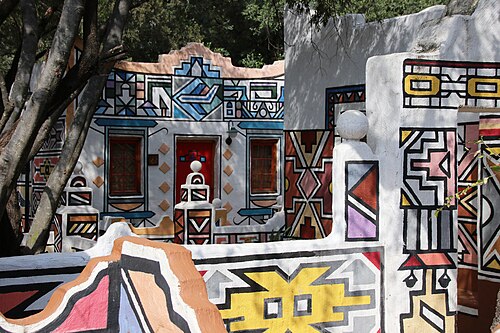
طلاء منازل قبيلة نديبيلي
أسلوب الرسم التقليدي
Ndebele art has always been an important identifying characteristic of the Ndebele. Apart from its aesthetic appeal it has a cultural significance that serves to reinforce the distinctive Ndebele identity. The Ndebele's essential artistic skill has always been understood to be the ability to combine exterior sources of stimulation with traditional design concepts borrowed from their ancestors.[5] Ndebele artists also demonstrated a fascination with the linear quality of elements in their environment and this is depicted in their artwork.[5] Painting was done freehand, without prior layouts, although the designs were planned beforehand.
The characteristic symmetry, proportion and straight edges of Ndebele decorations were done by hand without the help of rulers and squares. Ndebele women were responsible for painting the colourful and intricate patterns on the walls of their houses.[5][6] This presented the traditionally subordinate wife with an opportunity to express her individuality and sense of self-worth. In some instances, the women also created sculptures to express themselves.[5]
كانت الجدران الخلفية والجانبية للمنزل تُطلى غالبًا بألوان ترابية وتُزين بأشكال هندسية بسيطة تُشكل بالأصابع وتُحدد باللون الأسود. [ 5 ] جرت العادة على استخدام ألوان ترابية هادئة، مصنوعة من المغرة المطحونة، وأنواع مختلفة من الطين الملون طبيعيًا، كالأبيض والبني والوردي والأصفر، بالإضافة إلى الجير الأبيض. [ 5 ] [ 7 ] ونظرًا لهشاشة الأصباغ الطبيعية، كانت النساء مسؤولات أيضًا عن إعادة طلاء الجدران موسميًا. [ 7 ] أما التصاميم الأكثر ابتكارًا وتعقيدًا فكانت تُرسَم بألوان زاهية على الجدران الأمامية للمنزل. وكان الجدار الأمامي الذي يُحيط بالفناء الأمامي للمنزل يُشكل البوابة ( إيزيمبونجوانا ) ويحظى بعناية خاصة. [ 5 ] شكلت النوافذ نقطة محورية للتصاميم الجدارية، ولم تكن تصاميمها متناظرة دائمًا. في بعض الأحيان، تُرسَم نوافذ وهمية على الجدران لخلق نقطة محورية، وأيضًا كوسيلة لتخفيف جمود التصميم الهندسي للجدار. [ 5 ] رُسمت حدود بسيطة بلون داكن، مُحاطة بخطوط بيضاء، لإبراز النوافذ الأقل أهمية في الفناء الداخلي والجدران الخارجية. في أوائل العقد الأول من القرن الحادي والعشرين، أمر الملك مايتجا الثالث، خلال فترة حكمه، الفتيات الصغيرات في سن ما قبل المراهقة والفتيات في مرحلة ما قبل البلوغ بحضور دروس يومية في الرسم في مقاطعة مبومالانجا، بإشرافه هو وشيوخه وفنانتين بارعتين ( إستر ماهلانجو وفرانسينا نديماندي). [ 7 ] [ 6 ] كان ذلك نتيجة لتزايد الاهتمام بالحفاظ على فنون نديبيلي الكلاسيكية في شكلها المُطرز والمُلوّن. [ 7 ]
طلاء المنازل المعاصر
يستخدم فنانو نديبيلي المعاصرون مجموعة أوسع من الألوان (الأزرق والأحمر والأخضر والأصفر) مقارنةً بالفنانين التقليديين، ويعود ذلك أساسًا إلى توافرها التجاري. [ 5 ] ومع ازدياد تأثر مجتمع نديبيلي بالثقافة الغربية، بدأ الفنانون يعكسون هذا التغيير في لوحاتهم. [ 5 ] وكانت النساء اللواتي يسافرن للعمل كخادمات في المناطق الحضرية يستخدمن هذه اللوحات للتعبير عن أحلامهن بحياة أفضل. ويعود ذلك جزئيًا إلى تغيرات خارجية مثل: دخول الكهرباء، والظروف الاقتصادية الشخصية (التنقل اليومي بالحافلات الذي يحد من وقت الإبداع الفني)، والأسواق السياحية (تغيير حجم اللوحات إلى لوحات صغيرة من ألواح الخشب المضغوط)، وسفر الفنانين محليًا وعالميًا. [ 7 ] وقد تتضمن لوحات المنازل صورًا للسيارات والساعات والطائرات وغيرها من وسائل الراحة الحديثة كالمياه الجارية. [ 6 ] ومن التغييرات الأخرى إضافة أشكال تمثيلية منمقة إلى التصاميم الهندسية التجريدية التقليدية. [ 5 ] وقد وسّع العديد من فناني نديبيلي نطاق أعمالهم الفنية ليشمل تزيين المنازل من الداخل. [ 5 ]

زخرفة خرزية
يمكن أن تدلّ أعمال الخرز التي تصنعها النساء على عمر المرأة، وحالتها الاجتماعية (عزباء، متزوجة، خضعت لطقوس التنشئة)، وما إذا كانت قد أنجبت أطفالًا. [ 8 ] كانت أعمال الخرز البيضاء هي السائدة حتى حوالي عشرينيات وثلاثينيات القرن العشرين، عندما أصبح الخرز الملون متوفرًا بكثرة في المتاجر. [ 8 ] [ 6 ] بدأت أعمال الخرز تُظهر مشاهد منزلية وأشكالًا هندسية. لطالما كانت هذه الهواية ممارسة اجتماعية تمارسها النساء بعد الانتهاء من أعمالهن المنزلية، ولكن اليوم، تتضمن العديد من المشاريع إنتاج هذه القطع لبيعها للجمهور. بدأ التحول إلى بيع أعمال الخرز في ستينيات القرن العشرين عندما وصل أول هواة جمع أعمال خرز نديبيلي إلى المنطقة، مما ساهم في انتعاش الاقتصاد. وبدافع الضرورة جزئيًا، بدأ إنتاج المزيد من أعمال الخرز لغرض وحيد هو بيعها، وذلك لمواجهة سياسات الفصل العنصري الحكومية التي صعّبت التجارة. [ 8 ]
قطع من تطريز الخرز لدى شعب نديبيلي
Iinrholwani (colourful neck, arms, hips and legs hoops) are made by winding grass into a hoop, binding it tightly with cotton and decorating it with beads.[5] In order to preserve the grass and to enable the hoop to retain its shape and hardness, the hoop is boiled in sugar water and left in the hot sun for a few days.[5] They are usually worn in stacks of two to three or more in alternating colours and can be worn by initiated girls and married women as beauty adornments.[8]
Isithimba is a back skirt worn by unmarried women made from a piece of semi-circular leather (usually goatskin) and decorated with beadwork suspended by bead covered roll of grass with a row of brass rings (nkosi) attached to signal status.[8][9] In the past, a second skirt known as an amabeja would be worn with the isithimba; The amabeja is also made from leather but had strings of beads suspended in rows to form a curtain like shape.[8]
The Nyoga (snake) is a long beaded train made from white beads is worn by the bride at the first wedding ceremony is woven by their female relatives.[9] The patterns, length, and structure can indicate whether the bride the groom's first wife or if she is a virgin.[9]
linga koba ("the long tears") are worn by mothers while their son is away for male initiation. They represent the sorrow of losing a son, but also the joy of gaining a man.[6]
isiphephetu are stiff beaded aprons worn by girl initiates to show they are undergoing the ritual into womanhood.[6]
Special occasions
Initiation
In Ndebele culture, the initiation rite, symbolising the transition from childhood to adulthood, plays an important role. Initiation schools for boys are held every four years and for girls, as soon as they get into puberty stage.[5] During the male initiation process (ukuwela) only one son at a time from a family can participate to enter manhood.[6] The girl's initiation ritual (ukuthombisa) lasts about two months and coincides with the full moon as a symbolic return to nature.[6] During the period of initiation, relatives and friends come from far and wide to join in the ceremonies and activities associated with initiation.
Boys
Boys are initiated as a group when they are about 18 years of age when a special regiment (iintanga) is set up and led by a boy of high social rank. Each regiment has a distinguishing name. Among the Ndzundza tribe there is a cycle of 15 such regimental names, allocated successively, and among the Manala there is a cycle of 13 such names. The initiation process begins when the fathers of the boys nominate them for male initiation (wela or ingoma) in front of the king.[8] The boys wear headbands of plaited grass (izisonyana), an animal loincloth, and wrapped in a single blanket before leaving to a sacred place at the river escorted by their fathers and other men in the tribe; The adult men are armed so none of the boys can run away.[8] The boys are circumcised with a Okapi (knife) by a man specially appointed by the king and then march some ten miles into the bush where there is a shelter built nearby (built by elder guides) where they will live for three months.[8][6] The boys get divided into groups of eight based on villages of origin and meet up with an elder brother (one who has endured initiation rites).[8] During these first two months, the elder brothers are responsible for cleaning the wounds at the river through a cleansing ceremony, informing them of the laws of the tribe and ancestors, as well as mythologies.[8] In the third month, the initiates embark a ritualized game of hide and seek with their mothers. Around this time the elder brothers will engage in combat with other elder brothers, two by two armed with long sticks made into whips (attached to a thinner stick) and shields made of animal hide.[8] The elder brothers fight on the behalf initiates in the name of honour and the bloodline; If the elder brother fights well their honor reflects well onto the young brothers.[8][6] At the end of the third month, the shelters are burned along with blanket and headbands.[8] At the end of the three months they return to the village and wait by the gate until personage appears to give them his blessing and formal stamp of attainment of manhood; the Ndzunda king will hold a feast for the new men and then they will have a final cleansing ceremony at the river before the groups return to their respective villages.[8]
Girls
All hair is shaved from their bodies and at dawn they are ritually washed at the river.[6] The girls spend a day holding a feast and celebration for this transition into womanhood accompanied by music.[6] The young girls dance their girlhood away, taking turns being the center of attention, and blow into whistles to charm the males.[6] The older women have their own dance with axes and whistles.[6] During initiation girls wear an array of colourful beaded hoops (iinrholwani) around their legs, arms, waist and neck.[5] The girls are kept in isolation for a month and are prepared and trained to become homemakers and matriarchs; They are taught by grandmothers.[6] Beadwork and house painting are activities practiced during the initiation process.[7] This allows the women to transfer the knowledge of their patterning strategies for daughters and new in-laws that came from other indigenous groups.[7] The coming-out ceremony marks the conclusion of the initiation school and the girls then wear stiff rectangular aprons (iphephetu),[8] beaded in geometric and often three-dimensional patterns, to celebrate the event. After initiation, these aprons are replaced by stiff, square ones, made from hardened leather and adorned with beadwork.[5]
Courtship and marriage
Marriages were only concluded between members of different clans, that is, between individuals who did not have the same clan name. However, a man could marry a woman from the same family as his paternal grandmother. The prospective bride was kept secluded for two weeks before the wedding in a specially made structure in her parents' house, to shield her from men's eyes.[5] When the bride emerged from her seclusion, she was wrapped in a blanket and covered by an umbrella that was held for her by a younger girl (called Ipelesi) who also attended to her other needs.[5] On her marriage, the bride was given a marriage blanket, which she would, in time, adorn with beadwork, either added to the blanket's outer surface or woven into the fabric.[5] There is a Ndebele saying that "a woman without a blanket is not a woman."; Married women wear a blanket as a sign of modesty to the men and respect to the king.[6] After the wedding, the couple lived in the area belonging to the husband's clan. Women retained the clan name of their fathers but children born of the marriage took their father's clan name.
Ama-Ndebele-Kingdom
Legendary
| Name | Notes | |
|---|---|---|
| King Ndebele | He was the Son of King Mabhudu | Originally a Chief in the lands of the Bhaca and Hlubi. |
| King Mntungwe | He was the son of King Ndebele. | King Ndebele also had a daughter named MaKoro. |
| King Mkhalangwana | He was The son of King Mntungwe. | |
| King Jonono | He was the Son of King Mkhalangwana. Also occasionally spelled "Njonono". King Jonono moved with his people and settled in the area just north east of modern-day Ladysmith in the mountains surrounding the mouth of the Cwembe River. | |
| King Nanasi | He was the Son of King Jonono. Oral tradition holds that Nanasi feasted on poisonous fruit that would kill anyone else, but had no effect on him. This led many to the folk belief that he was so fierce even the forces of nature where to scared to kill him. | |
Semi-historical
| Name | Notes |
|---|---|
| King Mafana | he is said to have lived in the mid-1500s. He was the son of King Nanasi, King Mafana moved his people from their lands near Ladysmith and moved north west crossing first the Drakensberg Mountains and then the Vaal River in which it is said he drowned. |
| King Mhlanga | King Mhlanga, He was the son of King Mafana continued his fathers journey in a north westward direction finally settling in an area around modern day Randfontein which he called eMlhangeni. |
| King Musi | He was the son of King Mhlanga and finding the area around eMhlangeni too hostile with competing Sotho-Tswana tribes from the west, King Musi moved his people north of the Magaliesberg Mountains and settled in the hills north of Wonderboomkop on both side of the Apies River establishing two settlements. A senior settlement called "KwaMnyamana" (Place of the Black Rocks), on the eastern side and a junior settlement. "eMaruleni" (Named for the abundance of Marula fruit trees), on the western side. The Ama-Ndebele-People of King Musi's time found great prosperity in this region and despite minor conflict with neighbouring tribes, they established a thriving territory. |
Schism of the Ndebele people
After King Musi there was a succession dispute fought between his two sons Prince Manala and Prince Ndzundza over the throne fighting three great battles first at MaSongololo (Zonkolol) Between modern day Cullinan and Rayton. The second battle at Wilge River with the final battle being at Olifants River. The ends result gave both sons a kingdom within the greater Ndebele kingdom to rule with other peace conditions.
The matter of seniority has been somewhat of a grey area among the Ama-Ndebele-People since that time and it was not until the Nhlapo Commission established in 2004 that Prince Manala was the senior house of the Ndebele kingdom in South Africa.
| Names | Notes |
|---|---|
| King Manala | After battling his brother Prince Ndundza for paramountcy over the Ndebele, King Manala He was the son of King Musi returned to KwaMnyamana and expanding the Manala territory. |
| King Ntsele | He was the Son of King Manala. |
| Magutshona | He was the Son of King Ntsele. |
| King Ncagu | He was the Son of King Magutshona. |
| Prince Mrawu ‡ | He was the Son of King Magutshona. Served as regent until the ascension of his nephew Prince Mbuyambo. |
| King Mbuyambo | He was the Son of King Ncagu. |
| Mabhena I | Son of Buyambo. Also spelled "Mabena" Expanded Manala territory as far south as the confluence of the Hennops River and the Sesmylspruit and as far north as modern day Marblehall. |
| Mdibane | Son of Mabhena I. Mdibane inherited his fathers territories which included the settlements of KwaMnyamana (The Place of Black Rocks)(also Capital), eMaruleni (The Place of Marula Trees), eZotshaneni, KoNonduna (The Place of The Chiefs) and eMbilaneni (The Holy Place) and many more. |
| Name | Notes |
|---|---|
| Ndzundza | Ndzundza through war with his brother Manala had established himself a duel kingship with his brother and claimed the lands from the eastern banks of the Olifants River to the western banks of the Elands River in Mpumalanga. Ndzundza established his capital at the source of the Steelpoort River approximately 20 km (12 mi) west of modern-day Belfast at the foot of Kwaggaskop and called it "KwaSimkulu" (The Great Place). |
| Mrhetjha | Son of Ndzundza. Also spelled "Mxetya" |
| Magobholi | Son of Mrhetjha. |
| Bongwe | Son of 'Magobholi. The Ndzundza territory became increasingly threatened by raids from the Swazi in the east and more worry-some the growing BaPedi in the north. Bongwe left KwaSimkulu and established a new capital for the Ndzundza at the base of the Bothasberg which was called "KwaMaza" (The Place of Ash) and proved to be a solid position with which to push the Pedi back northwards. Bongwe died without issue. |
| Sindeni | Son of Mrhetjha and brother to Bongwe's father Magobholi. |
| Mahlangu | The grandson of Sindeni. It is not clear how power was transferred from Sindeni to Mahlangu without Mahlangu's father. Mahlangu attempted to expand the Ndzundza territory both to the north and south but had limited success against the Swazi and Pedi but gained significant notoriety from his enemies as a skilled military leader. |
| Phaswana | Son of Mahlangu. Killed without issue. |
| Maridili | Son of Mahlangu. Killed without issue. |
| Mdalanyana | Son of Mahlangu. Killed without issue. |
| Mgwezana | Son of Mahlangu. Killed without issue. |
| Dzela ‡ | Son of Mahlangu. Served as regent for the son of Mgwezana. |
| Mrhabuli Srudla | Son of Mahlangu. Also spelled "Mxabului". After many wars with the expanding BaPedi in the north, which led to the death of Mrhabuli's father and uncles, Musi's iNamrhali were lost forever. Oral tradition is not clear on who was the last owner of the mystical iNamrhali. |
Historical
| Name | Dates | Notes |
|---|---|---|
| Sibindi | 1817–1826 | ابن مديبان . فر سيبيندي من كوامينيامانا إلى كومجيكجيكي وقتل على يد قوات مزيليكازي خومالو . |
| مفولا | 1826–1827 | ابن مديبان . كما قُتل مفولا على يد قوات مزيليكازي خومالو . |
| مجيبي | 1827–1832 | مقتل ابن مديباني على يد قوات مزيليكازي خومالو . |
| سيلامبا | 1832–1892 | ابن مديباني . تُرك سيلامبا ليعيد بناء ما تبقى من مانالا بعد احتلال مزيليكازي خومالو . حكم لمدة 60 عامًا وأعاد بناء ما تبقى من مانالا، خلال تلك الفترة التي وصل فيها الڤورتريكيرز شمال نهر فال ، وفقدوا خلالها جزءًا كبيرًا من أراضي مانالا. |
| مديدلانجيني | 1892–1896 | ابن ساليمبا . ومثل والده، بذل مبيدلينجاني جهودًا كبيرة لمقاومة توسع جمهورية ترانسفال . توفي مبيدلينجاني في ظروف غامضة. |
| ليبانجيني ‡ | 1896– غير معروف | ابن ساليمبا . دخل ليبانجيني في صراع كبير مع جمهورية ترانسفال وعاش في المنفى. شغل منصب الوصي على ابن مبيدلينجاني . |
| مابينا الثاني | غير معروف – 1906 | ابن مبيدلانجيني . من غير المعروف متى تولى مابينا الثاني زعامة مانالا نديبيل، لكنه عاد من المنفى إلى أراضي مانالا وتوفي عام 1906. |
| مبهونغو الأول | 1906–1933 | ابن مابينا الثاني . |
| مبولاوا | 1933–1941 | ابن مبهونغو الأول . |
| ماخوسوكي الأول | 1941–1960 | ابن مبولاوا . |
| مبونغو الثاني | 1960–1986 | ابن ماخوسوكي الأول . |
| إينوك مابينا (بصفته ماخوسوكي الثاني ) | 1986–2026 | ابن مبونغو الثاني و"نجوينياما" (ملك) مانالا نديبيلي الحالي. تزوج ماكوسوكي الثاني من أميرة ليسوتو سيخوتالي سييسو في أكتوبر 2019. |
| اسم | بلح | ملحوظات |
|---|---|---|
| ماغودونغو | 1811–1827 | ابن مجوزانا . قام ماغودونغو بنقل عاصمة ندزوندزا من كوامازا إلى إي سيخونجيني . بعد تعرضه للهجوم من قبل مزيليكازي كومالو ، تعرض ماغودونغو للتعذيب وقتل أخيرًا مع بعض أبنائه الأكبر. |
| سيبوكو ‡ | 1827–1835 | ابن ماغودونغو . شغل منصب الوصي حتى بلوغ ابن ماغودونغو سن الرشد. يُزعم أن سيبوكو قُتل إثر نزاع مع زعيم من قبيلة سوتو-تسوانا يُدعى ماتلالا شمال ماربلهول . |
| SoMdeyi ‡ | 1835–1840 | Son of Magodongo. Served as regent until the coming of age of Magodongo's son. Was killed by a raiding party of Mzilikazi Khumalo. |
| Mabhoko I | 1840–1865 | Son of Magodongo. Mabhoko moved the Ndzundza capital from eSikhunjini to a new capital called eMrholeni which was near a cave complex called KoNomtjarhelo. In the years of Mabhoko's reign there developed considerable strain in between the Ndzundza Ndebele and The Transvaal Republic. |
| Mkhephuli | 1865–1873 | Son of Mabhoko I. Also called Soqaleni. Mkhephuli was known by the Afrikaans name Cornelis. |
| Rhobongo ‡ | 1873–1879 | Son of Mabhoko I. Also spelled "Xobongo"Served as regent for Fene. |
| Nyabela ‡ | 1879–1902 | Son of Mabhoko I. Served as regent for Fene. Nyabela lost a bitter war to The Transvaal Republic and is often cited as the last free leader of the Ndzundza. |
| Fene | 1902–1921 | Son of Mkhephuli. Also spelled Mfene. Fene bought the farm 'Welgelegen' 60 km (37 mi) north east of Pretoria and established what would become modern day KwaMhlanga. |
| Mayitjha | 1921–1961 | Son of Fene. |
| Mabusa Mabhoko II | 1961–1992 | Son of Mayitjha. |
| Nyumbabo Mayitjha II | 1992–2005 | Son of Mabusa Mabhoko II. |
| Sililo ‡ | 2005-2006 | The son of Mhlahlwa who was a son of Mayitjha. Served as regent for Mabhoko III. |
| Mbusi Mahlangu (as Mabhoko III) | 2006–present | Son of Nyumbabo Mayitjha II. Since ascending to the throne of the Ndzundza, Mabhoko III has contested the paramountcy of the Ndebele people. Mabhoko has lost several court bids to overturn the ruling by the Nhlapo Commission whose findings state Makhosoke II as the senior king of the Ndebele. |
(‡ = Ruled as regent.)
Notable Southern Ndebele
See also
References
- 12Skhosana, Philemon Buti (2010). "The (ama)Ndebele of Africa and their name '(ama)Ndebele'". Retrieved 15 May 2026.
{{cite journal}}: Cite journal requires|journal=(help) - ↑ "شعب نديبيلي في التاريخ" . تاريخ جنوب أفريقيا على الإنترنت . تم الاطلاع عليه بتاريخ 15 مايو 2026 .
- ↑ "ماتابيلي" . قاموس التراث الأمريكي للغة الإنجليزية ( الطبعة الخامسة). هاربر كولينز. 2022. تم الاطلاع عليه بتاريخ 15 مايو 2026 .
- ↑ نديبيلي
- 1 2 3 4 5 6 7 8 9 10 11 12 13 14 15 16 17 18 19 20 21 22 23 24 25 26 27 28 29 " نديبيل - قبيلة أفريقية - جنوب أفريقيا ... " www.krugerpark.co.za . تم الاطلاع عليه بتاريخ 28 فبراير 2025 .
- ١ ٢ ٣ ٤ ٥ ٦ ٧ ٨ ٩ ١٠ ١١ ١٢ ١٣ ١٤ ١٥ ١٦ الدموع الطويلة: قصة من قبيلة نديبيلي. إخراج نادين دراير وديفيد فوربس. مكتبة صناع الأفلام، ٢٠٠٠. https://video.alexanderstreet.com/watch/the-long-tears-an-ndebele-story.
- 1 2 3 4 5 6 7 كامبريدج، ماساتشوستس؛ هورد، أدريان (شتاء 2001). "تسليع الفن: نساء نديبيلي في تيار التغيير". مجلة البقاء الثقافي الفصلية . 24 (4): 37-40 .
- 1 2 3 4 5 6 7 8 9 10 11 12 13 14 15 16 باول، إيفور؛ لويس، مارك (1995). نديبيل: شعب وفنهم . دار نشر كروس ريفر. ISBN 978-0-7892-0073-0.
- ١ ٢ ٣ "خرز يتحدث: النساء ولغة خرز نديبيلي من مجموعة متحف كرانرت للفنون | متحف كرانرت للفنون" . kam.illinois.edu . تم الاطلاع عليه بتاريخ ٦ مارس ٢٠٢٥ .
مصادر
- "التصميم على بارامونتسي مانالا-مبونغو وندزوندزامابهوكو" (PDF) . حكومة الجنوب الأفريقي .
- بيريس، ج. (22 أكتوبر 2014). "التاريخ مقابل القانون العرفي: لجنة القيادة التقليدية: النزاعات والمطالبات" . مجلة الجريمة في جنوب أفريقيا . 49 (1): 7. doi : 10.4314/sacq.v49i1.1 . ISSN 1991-3877 .
- "المجلد 16 العدد 1 (1986)" . ساينتيا ميليتاريا: المجلة الجنوب أفريقية للدراسات العسكرية .
- إدارة شؤون السكان الأصليين في ترانسفال (1968). تاريخ موجز للقبائل الأصلية في ترانسفال . بريتوريا: مكتبة الدولة.
{{cite book}}: CS1 maint: publisher location ( link )
للمزيد من القراءة
- نديبيلي: فن قبيلة أفريقية ، 1986. مارغريت كورتني-كلارك ، لندن: تيمز وهدسون. رقم الكتاب المعياري الدولي (ISBN) 0-500-28387-7
- صور نديبيلي، ١٩٨٣. ناتالي نايت وسوزان بريباتش، شركة ناتالي نايت للإنتاج المحدودة. ASIN: B0026835HO
- فن شعب نديبيلي: تطور الهوية الثقافية ، 1998. ناتالي نايت وسوزان بريباتش، شركة ناتالي نايت للإنتاج المحدودة.
روابط خارجية
- شعب نديبيلي الجنوبي
- نديبيلي
- شعوب البانتو في جنوب أفريقيا