
قائمة طيور بريطانيا العظمى
تضم هذه القائمة جميع أنواع الطيور المسجلة في بريطانيا العظمى في بيئتها الطبيعية . وهي تتبع القائمة البريطانية الرسمية التي يحتفظ بها اتحاد علماء الطيور البريطاني ( BOU). [ 1 ] تُنشر القرارات المتعلقة بالقائمة البريطانية من قِبل لجنة سجلات اتحاد علماء الطيور البريطاني (BOURC) في تقاريرها السنوية في مجلة الاتحاد " إيبس " . كانت هذه التقارير سابقًا جغرافية وتشمل جميع الجزر البريطانية، ولكن تُنشر الآن سجلات جمهورية أيرلندا وأيرلندا الشمالية من قِبل جمعيات علم الطيور الخاصة بهما. أما سجلات جزيرة مان، فتُراجعها جمعية مانكس لعلم الطيور. [ 2 ]
أنواع الطيور المدرجة في القائمة البريطانية هي تلك المصنفة ضمن فئات BOU A أو B أو C:
- أ: الأنواع التي تم تسجيلها في حالة طبيعية على ما يبدو مرة واحدة على الأقل منذ 1 يناير 1950.
- ب: الأنواع التي تم تسجيلها في حالة طبيعية على ما يبدو مرة واحدة على الأقل بين 1 يناير 1800 و31 ديسمبر 1949، ولكن لم يتم تسجيلها بعد ذلك.
- ج: الأنواع التي، على الرغم من أنها أُدخلت في الأصل بواسطة البشر، سواء عن عمد أو عن طريق الخطأ، إلا أنها أنشأت مجموعات تكاثر مشتقة من سلالات مُدخلة، والتي تحافظ على نفسها دون اللجوء الضروري إلى مزيد من الإدخال.
يمكن إدراج الطيور في أكثر من فئة واحدة: على سبيل المثال، لدى الإوز الكندي عدد كبير من الطيور الدخيلة، ولكن كان هناك أيضًا عدد قليل من الطيور المهاجرة التي ظهرت بشكل طبيعي، والنسر ذو الذيل الأبيض هو نوع أصلي يخضع أيضًا لمشروع إعادة توطين مستمر، لذلك فإن كلا النوعين يستوفيان معايير الفئتين أ و ج.
تُستخدم الفئتان D و E (غير المدرجتين هنا) لأغراض حفظ السجلات فقط، ولا يتم تضمين الأنواع الموجودة في هذه الفئات في القائمة البريطانية:
- د: الأنواع التي قد تظهر في الفئتين أ أو ب باستثناء وجود شك معقول في أنها قد ظهرت في حالة طبيعية.
- هـ: الأنواع التي تم تسجيلها على أنها أنواع دخيلة أو منقولة أو هاربة من الأسر، والتي لا يُعتقد أن مجموعات التكاثر الخاصة بها (إن وجدت) قادرة على الاكتفاء الذاتي.
يجري تجميع فئة أخرى (غير مدرجة هنا):
- F: الأنواع المسجلة قبل عام 1800، بما في ذلك الأنواع الأحفورية. [ 3 ]
اعتبارًا من 13 أغسطس 2024، كان هناك 641 نوعًا من الطيور في القائمة البريطانية، وآخر إضافة هي طائر النوء الزيتوني الغربي في 20-21 أكتوبر 2023. [ 4 ] تم تضمين خمس مجموعات من الأنواع (الطيور التي لم يتم تحديدها على مستوى الأنواع) في ملحق تعديل ديسمبر 2023 - طائر النوء العملاق الجنوبي/الشمالي ( Macronectes giganteus / halli )، Fea's/Desertas طائر النوء ( Pterodroma feae / desertas )، وطائر النوء العاصف ذو البطن السوداء/البيضاء ( Fregetta tropica/grallaria )، والسكوا القطبية البنية/الجنوبية ( Stercorarius antarctica/maccormickii )، والقبرة الآسيوية/المتوسطية/التركستانية قصيرة الأصابع ( Alaudala cheleensis / rufescens / heinei ). هناك عدد من الأنواع الإضافية التي تنتظر النظر فيها من قبل لجنة سجلات اتحاد علماء الطيور البريطانيين .
الأنواع المدرجة في هذه الصفحة على أنها "نادرة" هي تلك التي تتطلب وصفًا كاملاً لقبول تسجيلها من قبل لجنة الطيور النادرة البريطانية . أما الأنواع الأخرى، فيُشار فيها إلى حالة تكاثرها وشتائها في بريطانيا العظمى.
بشكل عام، تتشابه طيور بريطانيا مع طيور بقية أوروبا. وبفضل شتائها المعتدل، تضم بريطانيا العظمى أعدادًا كبيرة من الطيور الشتوية، لا سيما البط والإوز والبجع . كما يوجد عدد من الأنواع، مثل طائر المحار ، التي تستوطن جزيرة بريطانيا العظمى، بينما تهاجر إلى أماكن أخرى. وتستقبل بريطانيا عددًا من الطيور المهاجرة من آسيا وأمريكا الشمالية. بعض أنواع النوارس والبط والطيور الخواضة الأمريكية شائعة بما يكفي لعدم اعتبارها نادرة، بما في ذلك نورس ذو المنقار الحلقي ، وبط البحر الأسود ، والزقزاق الصدري . يوجد طائر واحد مستوطن في بريطانيا العظمى، وهو طائر الكروسبيل الاسكتلندي ، على الرغم من أن تصنيفه كنوع غير مؤكد ومثير للجدل؛ [ 5 ] [ 6 ] أما طائر التدرج الأحمر فهو شبه مستوطن، إذ يوجد فقط في بريطانيا العظمى وأيرلندا المجاورة .
البط والإوز والبجع
الرتبة: الإوزيات، العائلة: البطيات
البجع والبط والإوز طيور متوسطة إلى كبيرة الحجم، تتكيف مع الحياة المائية بفضل أقدامها المكففة ومناقيرها المسطحة بدرجات متفاوتة. في كثير من أنواع البط، يكون الذكر زاهي الألوان بينما الأنثى بنية باهتة. يتكون غذاؤها من مجموعة متنوعة من الحيوانات والنباتات . تنتشر هذه الفصيلة بكثرة في بريطانيا، وخاصة في فصل الشتاء عندما تزورها أعداد كبيرة من غرينلاند واسكندنافيا وروسيا .
| الأسماء الشائعة والأسماء الثنائية | صورة | حالة | حالة الحفظ |
|---|---|---|---|
| إوزة برنت ( Branta bernicle ) |  | أ - زائر شتوي | LC [ 7 ] |
| الإوزة ذات الصدر الأحمر ( Branta ruficollis ) |  | أ - متجول نادر | VU [ 8 ] |
| الإوز الكندي ( Branta canadensis ) |  | أ و ج – مجموعة سكانية مقيمة، وبعض الطيور البرية المتجولة | LC [ 9 ] |
| إوزة البرنقيل ( Branta leucopsis ) |  | أ و ج – السكان الوافدون والمقيمون في فصل الشتاء | LC [ 10 ] |
| الإوزة الضاحكة ( Branta hutchinsii ) |  | أ - متجول نادر | LC [ 11 ] |
| إوزة روس ( Anser rossii ) |  | أ - زائر نادر [ 12 ] | LC [ 13 ] |
| أوزة الثلج ( Anser caerulescens ) |  | أ و ج - بعض الحيوانات البرية المتجولة، بالإضافة إلى مجموعة صغيرة جدًا من الحيوانات البرية الدخيلة | LC [ 14 ] |
| الإوز الرمادي ( أنسر أنسر ) |  | أ و ج – مجموعات برية ومتوحشة مقيمة، زائر شتوي | LC [ 15 ] |
| أوزة فاصوليا التايغا ( Anser fabalis ) |  | أ - زائر شتوي | LC [ 16 ] |
| الإوزة ذات القدم الوردية ( Anser brachyrhynchus ) |  | أ - زائر شتوي | LC [ 17 ] |
| إوزة فول التندرا ( Anser srrirostris ) |  | أ - زائر شتوي | |
| الإوزة ذات الجبهة البيضاء ( Anser albifrons ) |  | أ - زائر شتوي | VU [ 18 ] |
| الإوزة ذات الجبهة البيضاء الصغيرة ( Anser erythropus ) |  | أ - متجول نادر | VU [ 19 ] |
| البجعة الأخرس ( Cygnus olor ) |  | أ و ج – أنواع التكاثر المقيمة | LC [ 20 ] |
| بجعة بيويك ( Cygnus columbianus ) |  | أ - زائر شتوي | VU [ 21 ] |
| البجعة الوبرية ( Cygnus cygnus ) |  | أ - زائر شتوي ومتكاثر عرضي | LC [ 22 ] |
| الإوز المصري ( الألوبوشين aegyptiaca ) |  | ج - السكان الأصليون الوافدون | LC [ 23 ] |
| بطة الشهرمان ( Tadorna tadorna ) |  | أ - مربي مقيم وزائر شتوي | LC [ 24 ] |
| بطة الشهرمان ( Tadorna ferruginea ) |  | ب - يُفترض أن العديد من السجلات منذ عام 1946 تعود إلى حيوانات برية أو هاربة من الأسر | LC [ 25 ] |
| البط الماندرين ( Aix galericulata ) |  | ج - السكان الأصليون الوافدون | LC [ 26 ] |
| بايكال البط البري ( سيبيريونيتا فورموزا ) |  | أ - متجول نادر | LC [ 27 ] |
| جارجاني ( ملعقة querquedula ) |  | أ - زائر صيفي متكاثر | LC [ 28 ] |
| البط ذو الجناح الأزرق ( Spatula discors ) | 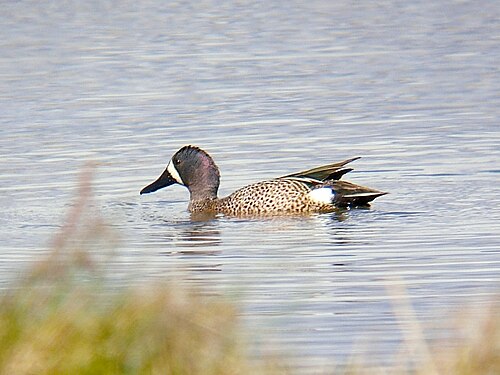 | أ - متجول نادر | LC [ 29 ] |
| طائر المجرفة ( Spatula clypeata ) |  | أ - مربي مقيم وزائر شتوي | LC [ 30 ] |
| بطة الغادوال ( ماريكا ستريبيرا ) |  | أ و ج – مربي مقيم وزائر شتوي | LC [ 31 ] |
| البط المنجلي ( ماريكا فالكاتا ) |  | أ - متجول نادر | LC [ 32 ] |
| بطة الحمام ( ماريكا بينيلوب ) |  | أ - مربي مقيم وزائر شتوي | LC [ 33 ] |
| البط الأمريكي ( Mareca americana ) |  | أ - مهاجر نادر | LC [ 34 ] |
| مالارد ( أنس بلاتيرينخوس ) |  | A & C – مربي مقيم، زائر شتوي، وإطلاقات متأقلمة | LC [ 35 ] |
| البط الأسود ( Anas rubripes ) |  | أ - متجول نادر | LC [ 36 ] |
| البط ذو الذيل المدبب ( Anas acuta ) |  | أ - مربي مقيم وزائر شتوي | LC [ 37 ] |
| البط البري ( Anas crecca ) |  | أ - مربي مقيم وزائر شتوي | LC [ 38 ] |
| البط ذو الجناح الأخضر ( أناس كارولينينسيس ) |  | أ - مهاجر نادر | LC [ 39 ] |
| البط ذو العرف الأحمر ( Netta rufina ) |  | أ & ج – مهاجر نادر ومربي مُدخَل | LC [ 40 ] |
| نبات الكانفاسباك ( Aythya valisineria ) |  | أ - متجول نادر | LC [ 41 ] |
| ريد هيد ( Aythya americana ) |  | أ - متجول نادر | LC [ 42 ] |
| البطة ( Aythya ferina ) |  | أ - مربي مقيم وزائر شتوي | VU [ 43 ] |
| البط الحديدي ( Aythya nyroca ) |  | أ - مهاجر نادر | LC [ 44 ] |
| البط ذو العنق الحلقي ( Aythya collaris ) |  | أ - مهاجر نادر | LC [ 45 ] |
| البط ذو الخصلة ( Aythya fuligula ) |  | أ - مربي مقيم وزائر شتوي | NT [ 46 ] |
| الغطاس ( Aythya marila ) |  | أ - زائر شتوي ومتكاثر عرضي | LC [ 47 ] |
| سكوب الصغرى ( أيثيا أفينيس ) |  | أ - متجول نادر | LC [ 48 ] |
| عيدر ستيلر ( Polysticta stelleri ) |  | أ - متجول نادر | LC [ 49 ] |
| ملك العيدر ( Somateria spectabilis ) |  | أ - متجول نادر | LC [ 50 ] |
| العيدر ( Somateria mollissima ) |  | أ - مربي مقيم وزائر شتوي | EN [ 51 ] |
| بطة هارلكوين ( Histrionicus histrionicus ) |  | أ - متجول نادر | LC [ 52 ] |
| بطة البحر ( Melanitta perspicillata ) |  | أ - مهاجر نادر | LC [ 53 ] |
| سكوتر مخملي ( ميلانيتا فوسكا ) |  | أ - زائر شتوي | VU [ 54 ] |
| البطة السوداء ذات الأجنحة البيضاء ( Melanitta deglandi ) | 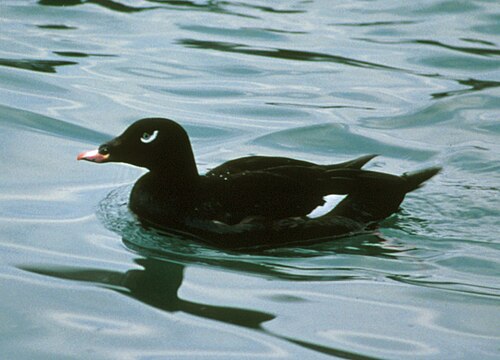 | أ - متجول نادر | LC [ 55 ] |
| سكوتر ستينيجر ( ميلانيتا ستينيجيري ) |  | أ - طائر مهاجر نادر، تم تسجيله لأول مرة في عام 2022 [ 56 ] | LC [ 57 ] |
| البط الأسود الشائع ( Melanitta nigra ) |  | أ - زائر عابر وزائر شتوي، ومتكاثر نادر | LC [ 58 ] |
| البط الأسود ( ميلانيتا أمريكانا ) |  | أ - متجول نادر | NT [ 59 ] |
| البط طويل الذيل ( Clangula hyemalis ) | 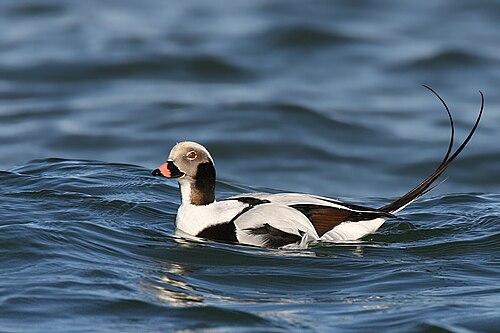 | أ - زائر شتوي ومتكاثر عرضي | LC [ 60 ] |
| البوفلهيد ( Bucephala albeola ) |  | أ - متجول نادر | LC [ 61 ] |
| العين الذهبية ( Bucephala clangula ) |  | أ - مربي مقيم وزائر شتوي | LC [ 62 ] |
| طائر العين الذهبية بارو ( Bucephala islandica ) |  | أ - متجول نادر | NT [ 63 ] |
| سميو ( Mergellus albellus ) |  | أ - زائر شتوي | LC [ 64 ] |
| البط الغواص المقنع ( Lophodytes cucullatus ) |  | أ - متجول نادر | LC [ 65 ] |
| جوساندر ( ميرجوس ميرجانسر ) |  | أ - مربي مقيم وزائر شتوي | LC [ 66 ] |
| البط الغواص أحمر الصدر ( Mergus serrator ) |  | أ - مربي مقيم وزائر شتوي | NT [ 67 ] |
| البط الأحمر ( Oxyura jamaicensis ) |  | ج - الأنواع الدخيلة الخاضعة حاليًا لبرنامج استئصال | LC [ 68 ] |
طيور التدرج، والطيور البرية، وما شابهها
الرتبة: الدجاجيات، العائلة: التدرجية
هذه أنواع برية، تتغذى وتبني أعشاشها على الأرض. وهي متفاوتة الأحجام، لكنها عموماً ممتلئة الجسم، ذات أجنحة عريضة وقصيرة نسبياً. أُدخل أربعة منها لأغراض الصيد أو الزينة، لكن اثنين منها انقرضا الآن.
| الأسماء الشائعة والأسماء الثنائية | صورة | حالة | حالة الحفظ |
|---|---|---|---|
| طائر التدرج الأحمر ( Lagopus scotica ) |  | أ - الأنواع المتكاثرة المقيمة | |
| طائر التدرج ( Lagopus muta ) |  | أ - الأنواع المتكاثرة المقيمة | LC [ 69 ] |
| كابيركايلي ( Tetrao urogallus ) |  | ج - السكان المقيمون المعاد توطينهم | LC [ 70 ] |
| طائر التدرج الأسود ( Lyrurus tetrix ) |  | أ - الأنواع المتكاثرة المقيمة | LC [ 71 ] |
| الحجل الرمادي ( Perdix perdix ) | 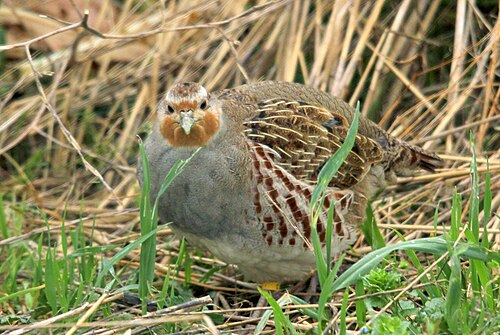 | أ و ج - مربي طيور الصيد المقيم والمستورد | LC [ 72 ] |
| الدراج الذهبي ( Chrysolophus pictus ) |  | ج – السكان الذين تم إدخالهم سابقًا، انقرضوا الآن [ 73 ] | LC [ 74 ] |
| طائر التدرج ليدي أمهرست ( Chrysolophus amherstiae ) |  | ج - السكان الذين تم إدخالهم سابقًا، والذين انقرضوا الآن | LC [ 75 ] |
| طائر التدرج ( Phasianus colchicus ) |  | ج - السكان الأصليون الوافدون | LC [ 76 ] |
| السمان ( Coturnix coturnix ) |  | أ - زائر صيفي متكاثر | NT [ 77 ] |
| الحجل ذو الأرجل الحمراء ( Alectoris rufa ) | 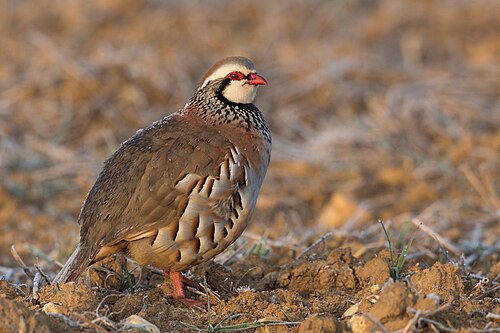 | ج - السكان الأصليون الوافدون | NT [ 78 ] |
طيور الليل وحلفاؤها
الرتبة: كابريمولجيفورميس، العائلة: كابريمولجيداي
طيور السبد هي طيور ليلية متوسطة الحجم، تعشش عادةً على الأرض. تتميز بأجنحة طويلة، وأرجل قصيرة، ومناقير قصيرة جدًا. ريشها الناعم ذو ألوان مموهة تشبه لحاء الشجر أو أوراق الشجر.
| الأسماء الشائعة والأسماء الثنائية | صورة | حالة | حالة الحفظ |
|---|---|---|---|
| طائر الليل الشائع ( Chordeiles minor ) |  | أ - متجول نادر | LC [ 79 ] |
| طائر السبد أحمر الرقبة ( Caprimulgus ruficollis ) |  | ب – طائر متجول نادر (سجل واحد، 1856) | NT [ 80 ] |
| طائر السبد ( Caprimulgus europaeus ) |  | أ - زائر صيفي متكاثر | LC [ 81 ] |
| السبد المصري ( Caprimulgus aegyptius ) |  | أ - متجول نادر | LC [ 82 ] |
طيور السنونو
الرتبة: أبوديفوميرات، العائلة: أبوديداي. طيور السنونو طيور صغيرة تقضي معظم حياتها في الطيران. تتميز هذه الطيور بأرجلها القصيرة جدًا، ولا تستقر على الأرض طواعيةً، بل تجثم فقط على الأسطح العمودية.
| الأسماء الشائعة والأسماء الثنائية | صورة | حالة | حالة الحفظ |
|---|---|---|---|
| طائر الإبرة ذو الحلق الأبيض ( Hirundapus caudacutus ) |  | أ - متجول نادر | LC [ 83 ] |
| طائر السنونو المدخني ( Chaetura pelagica ) |  | أ - متجول نادر | VU [ 84 ] |
| طائر السنونو الألبي ( Tachymarptis melba ) |  | أ - مهاجر نادر | LC [ 85 ] |
| سويفت ( Apus apus ) |  | أ - زائر صيفي متكاثر | NT [ 86 ] |
| طائر السنونو الشاحب ( Apus pallidus ) |  | أ - متجول نادر | LC [ 87 ] |
| المحيط الهادئ السريع ( أبو باسيفيكوس ) | 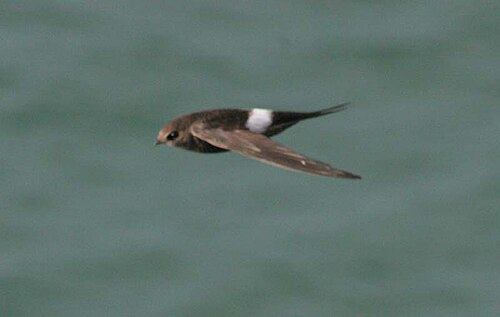 | أ - متجول نادر | LC [ 88 ] |
| السنونو الصغير ( Apus affinis ) |  | أ - متجول نادر | NT [ 89 ] |
| طائر السنونو ذو الردف الأبيض ( Apus caffer ) |  | أ - متجول نادر | NT [ 90 ] |
طيور الحبارى
الرتبة: أوتيديفورميس، العائلة: أوتيديداي
طيور كبيرة وقوية البنية تعيش في السهول المفتوحة، ذات أرجل وأعناق طويلة وأقدام قوية. جميعها طيور نادرة.
| الأسماء الشائعة والأسماء الثنائية | صورة | حالة | حالة الحفظ |
|---|---|---|---|
| الحبارى الكبرى ( أوتيس تاردا ) |  | أ - أنواع نادرة مهاجرة وأنواع مقيمة متكاثرة أعيد إدخالها مؤخرًا | LC [ 91 ] |
| طائر الحبارى ماكوين ( Chlamydotis macqueenii ) |  | أ - طائر مهاجر نادر؛ سجل واحد فقط منذ عام 1950، في عام 1962 | CR [ 92 ] |
| الحبارى الصغيرة ( Tetrax tetrax ) |  | أ - متجول نادر | VU [ 93 ] |
طيور الوقواق
الرتبة: الوقواقيات الشكل، العائلة: الوقواقيات
طيور متفاوتة الأحجام ذات أجسام نحيلة وذيول طويلة. بعض الأنواع معروفة بوضع بيضها في أعشاش طيور أخرى.
| الأسماء الشائعة والأسماء الثنائية | صورة | حالة | حالة الحفظ |
|---|---|---|---|
| طائر الوقواق المرقط الكبير ( Clamator glandarius ) |  | أ - متجول نادر | VU [ 94 ] |
| الوقواق ذو المنقار الأصفر ( Coccyzus americanus ) |  | أ - متجول نادر | LC [ 95 ] |
| طائر الوقواق ذو المنقار الأسود ( Coccyzus erythropthalmus ) |  | أ - متجول نادر | LC [ 96 ] |
| طائر الوقواق ( Cuculus canorus ) |  | أ - زائر صيفي متكاثر | LC [ 97 ] |
طائر القطا الرملي
الرتبة: بتيروكليفورميس، العائلة: بتيروكليداي
طيور قوية متوسطة الحجم ذات رأس صغير وأجنحة طويلة مدببة.
| الأسماء الشائعة والأسماء الثنائية | صورة | حالة | حالة الحفظ |
|---|---|---|---|
| قطا بالاس ( Syrrhaptes paradoxus ) |  | أ - طائر نادر متجول؛ وقد تكاثر | RE [ 98 ] |
الحمام واليمام
الرتبة: الحماميات الشكل، العائلة: الحماميات
الحمام واليمام طيور ذات أجسام ممتلئة وأعناق قصيرة ومناقير قصيرة ونحيلة ذات غشاء لحمي . يوجد 344 نوعًا منها في جميع أنحاء العالم، سبعة منها في بريطانيا.
| الأسماء الشائعة والأسماء الثنائية | صورة | حالة | حالة الحفظ |
|---|---|---|---|
| حمامة الصخور أو الحمام البري ( كولومبا ليفيا ) |  | أ و ج – مقيم؛ معظم الطيور من أصل بري؛ الطيور البرية في أقصى شمال وغرب اسكتلندا | LC [ 99 ] |
| حمامة الروم ( كولومبا أويناس ) |  | أ - الأنواع المتكاثرة المقيمة | LC [ 100 ] |
| حمامة الخشب ( كولومبا بالومبوس ) |  | أ - الأنواع المتكاثرة المقيمة | LC [ 101 ] |
| حمامة السلحفاة ( Streptopelia turtur ) |  | أ - زائر صيفي متكاثر | VU [ 102 ] |
| حمامة السلحفاة الشرقية ( Streptopelia orientalis ) |  | أ - متجول نادر | LC [ 103 ] |
| حمامة مطوقة ( Streptopelia decaocto ) |  | أ - الأنواع المتكاثرة المقيمة | LC [ 104 ] |
| حمامة الحداد ( Zenaida macroura ) |  | أ - متجول نادر | LC [ 105 ] |
طيور المرعى، والدجاجات المائية، والغطاسات
الرتبة: Gruiformes العائلة: Rallidae
تستوطن هذه الطيور في الغالب المناطق ذات الغطاء النباتي الكثيف في البيئات الرطبة قرب البحيرات والمستنقعات والأنهار. كثير منها طيور خجولة ومنعزلة، مما يجعل رصدها صعباً. تمتلك معظم الأنواع أرجلاً قوية وأصابع طويلة تتكيف جيداً مع الأسطح الناعمة غير المستوية.
| الأسماء الشائعة والأسماء الثنائية | صورة | حالة | حالة الحفظ |
|---|---|---|---|
| مرعة الماء ( Rallus aquaticus ) |  | أ - الأنواع المقيمة المتكاثرة والزائرة الشتوية | LC [ 106 ] |
| طائر الكركي ( Crex crex ) | 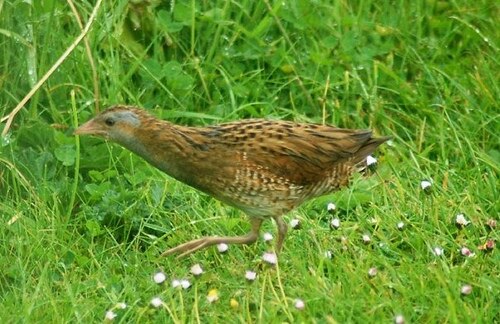 | أ - زائر صيفي متكاثر، كان وفيراً في السابق، ولكنه نادر الآن | LC [ 107 ] |
| سكة حديد سورا ( بورزانا كارولينا ) |  | أ - متجول نادر | LC [ 108 ] |
| طائر الكركي المرقط ( Porzana porzana ) |  | أ - زائر صيفي نادر التكاثر | LC [ 109 ] |
| دجاجة الماء ( جالينولا كلوروبوس ) |  | أ - الأنواع المتكاثرة المقيمة | LC [ 110 ] |
| طائر الغرة ( Fulica atra ) |  | أ - الأنواع المقيمة المتكاثرة والزائرة الشتوية | NT [ 111 ] |
| طائر الغرة الأمريكي ( Fulica americana ) |  | أ - متجول نادر | LC [ 112 ] |
| جالينول ألين ( بورفيريو أليني ) |  | أ - متجول نادر | LC [ 113 ] |
| الجالينول الأرجواني الأمريكي ( بورفيريو مارتينيكوس ) |  | أ - متجول نادر | LC [ 114 ] |
| المستنقع الغربي [ 115 ] ( بورفيريو بورفيريو ) |  | أ - طائر نادر متجول؛ أول تسجيل له كان عام 2016 | LC [ 116 ] |
| صدع بايون ( Zapornia pusilla ) | 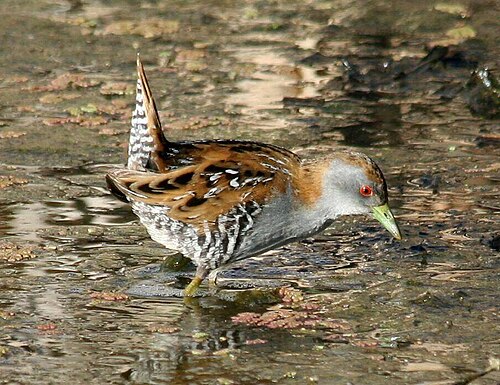 | أ - طائر متجول نادر، وقد تكاثر | LC [ 117 ] |
| كريك صغير ( زابورنيا بارفا ) |  | أ - متجول نادر | LC [ 118 ] |
الرافعات
الرتبة: الكركيات، العائلة: الكركيات
الكركي طيور كبيرة الحجم، طويلة الأرجل والأعناق. وعلى عكس طيور البلشون التي تشبهها في الشكل ولكنها لا تربطها بها صلة قرابة، فإن الكركي يطير وأعناقه ممدودة، وليست مشدودة للخلف. ولدى معظمها عروض تزاوج أو "رقصات" متقنة وصاخبة.
| الأسماء الشائعة والأسماء الثنائية | صورة | حالة | حالة الحفظ |
|---|---|---|---|
| كركي الرمل ( Antigone canadensis ) |  | أ - متجول نادر | LC [ 119 ] |
| الكركي ( Grus grus ) |  | أ – أنواع مقيمة نادرة تتكاثر وأنواع مهاجرة عابرة | LC [ 120 ] |
طيور الغطاس
الرتبة: Podicipedidae العائلة: Podicipedidae
الغطاسات طيور غوص صغيرة إلى متوسطة الحجم، ذات أصابع مفصصة ومناقير مدببة. تُشاهد بشكل رئيسي في المياه المنخفضة والسواحل. تتغذى على الحيوانات المائية وتبني أعشاشها على منصة عائمة من النباتات.
| الأسماء الشائعة والأسماء الثنائية | صورة | حالة | حالة الحفظ |
|---|---|---|---|
| غطاس صغير ( Tachybaptus ruficollis ) |  | أ - مربي مقيم وزائر شتوي | LC [ 121 ] |
| غطاس ذو منقار مرقط ( Podilymbus podiceps ) |  | أ - طائر مهاجر نادر؛ وقد تهجن مع طائر الغطاس الصغير مرة واحدة | LC [ 122 ] |
| غطاس أحمر الرقبة ( Podiceps grisegena ) |  | أ - زائر شتوي؛ وقد تكاثر | VU [ 123 ] |
| غطاس متوج كبير ( Podiceps cristatus ) |  | أ - مربي مقيم وزائر شتوي | LC [ 124 ] |
| غطاس سلافوني ( Podiceps auritus ) |  | أ - طائر مقيم نادر التكاثر وزائر شتوي | NT [ 125 ] |
| غطاس أسود الرقبة ( Podiceps nigricollis ) |  | أ - طائر مقيم نادر التكاثر وزائر شتوي | VU [ 126 ] |
طيور الكروان الحجرية
الرتبة: الزقزاقيات الشكل، العائلة: البورينيداي
عائلة صغيرة من الطيور الخواضة متوسطة إلى كبيرة الحجم ذات مناقير سوداء قوية وعيون صفراء كبيرة وريش مموه.
| الأسماء الشائعة والأسماء الثنائية | صورة | حالة | حالة الحفظ |
|---|---|---|---|
| طائر الكروان الحجري ( Burhinus oedicnemus ) |  | أ - زائر صيفي نادر التكاثر | LC [ 127 ] |
طيور المحار
الرتبة: الزقزاقيات الشكل، العائلة: الزقزاقيات ذات الأقدام الحمراء
طيور صائد المحار هي طيور خوض كبيرة الحجم، واضحة للعيان، وصاخبة، ذات مناقير قوية تستخدمها لسحق أو فتح الرخويات . يوجد أحد عشر نوعًا منها في جميع أنحاء العالم، أحدها في بريطانيا.
| الأسماء الشائعة والأسماء الثنائية | صورة | حالة | حالة الحفظ |
|---|---|---|---|
| طائر المحار ( Haematopus ostralegus ) |  | أ – الأنواع المقيمة المتكاثرة، والأنواع المهاجرة العابرة، والأنواع الزائرة الشتوية | NT [ 128 ] |
ركائز خشبية وطيور أبو المغازل
الرتبة: الزقزاقيات الشكل، العائلة: الزقزاقيات المنتصبة
عائلة من الطيور الخواضة كبيرة الحجم نسبيًا. يتميز طائر أبو المغازل بأرجله الطويلة ومنقاره الطويل المنحني للأعلى. أما طائر الزقزاق فيتميز بأرجله الطويلة جدًا ومنقاره الطويل الرفيع المستقيم. يوجد عشرة أنواع منه في جميع أنحاء العالم، اثنان منها في بريطانيا.
| الأسماء الشائعة والأسماء الثنائية | صورة | حالة | حالة الحفظ |
|---|---|---|---|
| طائر الزقزاق أسود الجناح ( Himantopus himantopus ) |  | أ - مهاجر نادر ومتكاثر عرضي | LC [ 129 ] |
| أفوسيت ( ريكوفيروسترا أفوسيتا ) |  | أ - الأنواع المتكاثرة المقيمة | LC [ 130 ] |
طيور الزقزاق والزقزاق المجنح
الرتبة: الزقزاقيات الشكل، العائلة: الزقزاقيات
طيور خوض صغيرة إلى متوسطة الحجم ذات أجسام مدمجة، وأعناق قصيرة وسميكة، وأجنحة طويلة مدببة عادةً.
| الأسماء الشائعة والأسماء الثنائية | صورة | حالة | حالة الحفظ |
|---|---|---|---|
| الزقزاق الرمادي ( Pluvialis squatarola ) |  | أ - زائر شتوي ومهاجر عابر | LC [ 131 ] |
| الزقزاق الذهبي ( Pluvialis apricaria ) |  | أ - مقيم متكاثر، مهاجر عابر، وزائر شتوي | LC [ 132 ] |
| زقزاق المحيط الهادئ الذهبي ( Pluvialis fulva ) |  | أ - متجول نادر | LC [ 133 ] |
| الزقزاق الذهبي الأمريكي ( Pluvialis dominica ) |  | أ - مهاجر نادر | LC [ 134 ] |
| طائر الزقزاق ( Eudromias morinellus ) |  | أ - طائر مهاجر عابر وزائر صيفي للتكاثر | LC [ 135 ] |
| كيلدير ( شارادريوس صوتي ) | 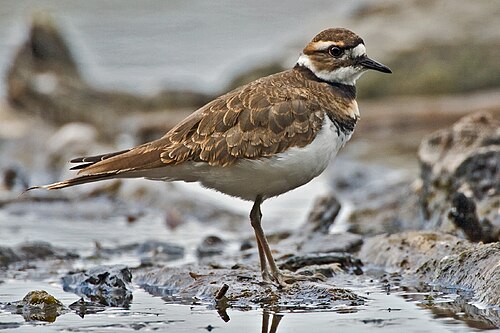 | أ - متجول نادر | NT [ 136 ] |
| Ringed plover(Charadrius hiaticula) |  | A – resident breeding species and passage and winter visitor | LC[137] |
| Semipalmated plover(Charadrius semipalmatus) | 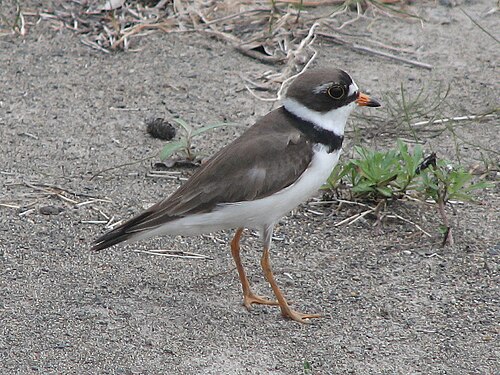 | A – rare vagrant | LC[138] |
| Little ringed plover(Thinornis dubius) |  | A – breeding summer visitor | LC[139] |
| Lapwing(Vanellus vanellus) | 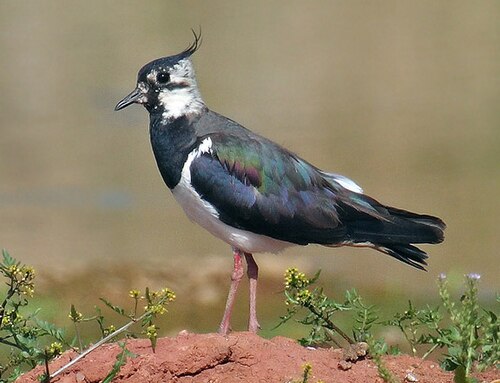 | A – resident breeding species, passage migrant, and winter visitor | VU[140] |
| Grey-headed lapwing(Vanellus cinereus) |  | A – rare vagrant; first recorded May 2023 | LC[141] |
| Sociable lapwing(Vanellus gregarius) | 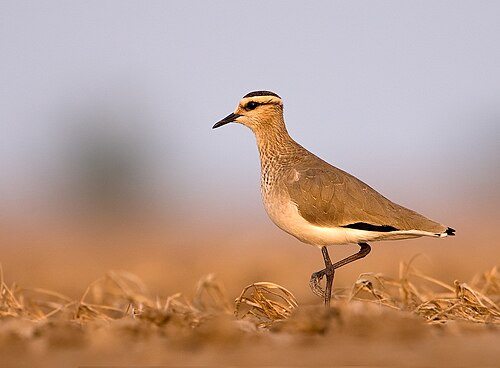 | A – rare vagrant | CR[142] |
| White-tailed lapwing(Vanellus leucurus) |  | A – rare vagrant | LC[143] |
| Caspian plover(Anarhynchus asiaticus) | 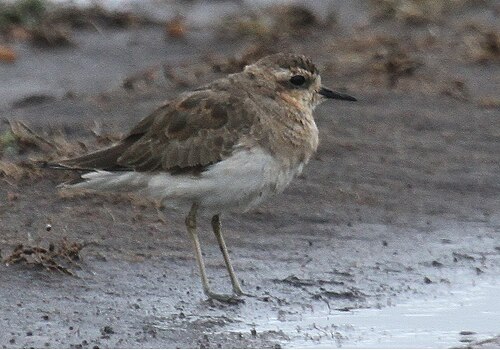 | A – rare vagrant | EN[144] |
| Tibetan sand plover(Anarhynchus atrifrons) |  | A – rare vagrant | LC[145] |
| Siberian sand plover(Anarhynchus mongolus) | 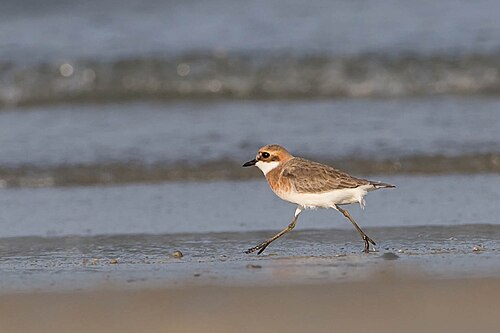 | A – rare vagrant | EN[146] |
| Greater sand plover(Anarhynchus leschenaultii) |  | A – rare vagrant | NT[147] |
| Kentish plover(Anarhynchus alexandrinus) |  | A – former breeder, now rare vagrant | LC[148] |
Sandpipers and allies
Order: Charadriiformes Family: Scolopacidae
A large, diverse family of wading birds. Different lengths of legs and bills enable multiple species to feed in the same habitat, particularly on the coast, without direct competition for food.
| Common and binomial names | Image | Status | Conservation status |
|---|---|---|---|
| Upland sandpiper(Bartramia longicauda) |  | A – rare vagrant | LC[149] |
| Whimbrel(Numenius phaeopus) |  | A – passage migrant and scarce breeding summer visitor in far north | LC[150] |
| Hudsonian whimbrel(Numenius hudsonicus) |  | A – rare vagrant | |
| Little whimbrel(Numenius minutus) |  | A – rare vagrant | LC[151] |
| Eskimo curlew(Numenius borealis) | 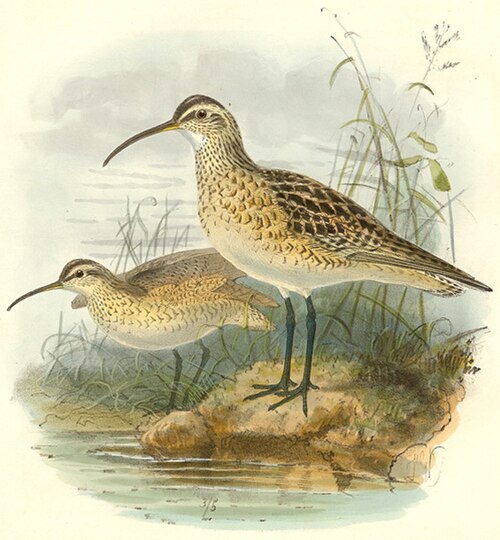 | B – extinct | CR[152] |
| Curlew(Numenius arquata) |  | A – resident breeding species | NT[153] |
| Bar-tailed godwit(Limosa lapponica) |  | A – winter visitor and passage migrant | LC[154] |
| Black-tailed godwit(Limosa limosa) |  | A – winter visitor, passage migrant and scarce summer breeding species | NT[155] |
| Hudsonian godwit(Limosa haemastica) |  | A – rare vagrant | VU[156] |
| Turnstone(Arenaria interpres) |  | A – winter visitor and passage migrant | LC[157] |
| Great knot(Calidris tenuirostris) |  | A – rare vagrant | EN[158] |
| Knot(Calidris canutus) |  | A – winter visitor and passage migrant | LC[159] |
| Ruff(Calidris pugnax) |  | A – passage migrant and winter visitor, also a former scarce breeding resident | NT[160] |
| Broad-billed sandpiper(Calidris falcinellus) |  | A – rare vagrant | VU[161] |
| Sharp-tailed sandpiper(Calidris acuminata) |  | A – rare vagrant | VU[162] |
| Stilt sandpiper(Calidris himantopus) |  | A – rare vagrant | NT[163] |
| Curlew sandpiper(Calidris ferruginea) |  | A – passage migrant, rarely also wintering | VU[164] |
| Temminck's stint(Calidris temminckii) | 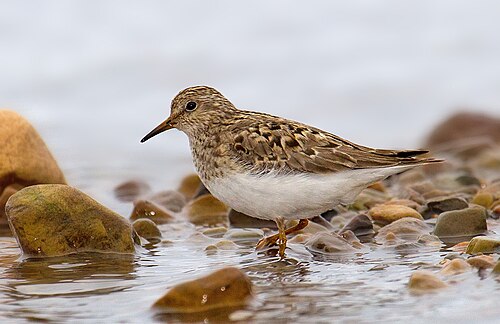 | A – scarce passage migrant, occasional breeder | LC[165] |
| Long-toed stint(Calidris subminuta) |  | A – rare vagrant | LC[166] |
| Red-necked stint(Calidris ruficollis) |  | A – rare vagrant | NT[167] |
| Sanderling(Calidris alba) |  | A – winter visitor and passage migrant | LC[168] |
| Dunlin(Calidris alpina) |  | A – winter visitor and passage migrant, scarce breeder | LC[169] |
| Purple sandpiper(Calidris maritima) | 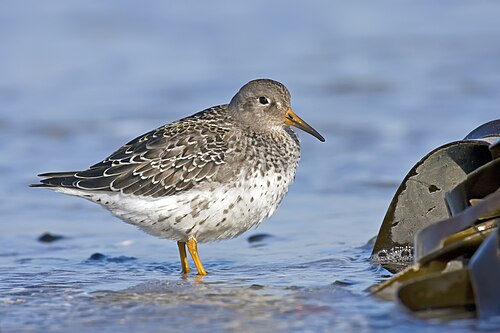 | A – winter visitor and passage migrant, occasional breeder | LC[170] |
| Baird's sandpiper(Calidris bairdii) |  | A – rare vagrant | LC[171] |
| Little stint(Calidris minuta) |  | A – passage migrant, rarely also wintering | LC[172] |
| Least sandpiper(Calidris minutilla) |  | A – rare vagrant | NT[173] |
| White-rumped sandpiper(Calidris fuscicollis) |  | A – scarce passage migrant | VU[174] |
| Buff-breasted sandpiper(Calidris subruficollis) |  | A – scarce passage migrant | VU[175] |
| Pectoral sandpiper(Calidris melanotos) |  | A – scarce passage migrant | LC[176] |
| Semipalmated sandpiper(Calidris pusilla) |  | A – rare vagrant | NT[177] |
| Western sandpiper(Calidris mauri) |  | A – rare vagrant | LC[178] |
| Long-billed dowitcher(Limnodromus scolopaceus) |  | A – rare vagrant | NT[179] |
| Short-billed dowitcher(Limnodromus griseus) |  | A – rare vagrant | VU[180] |
| Woodcock(Scolopax rusticola) |  | A – resident breeding species | LC[181] |
| Jack snipe(Lymnocryptes minimus) |  | A – winter visitor and passage migrant | LC[182] |
| Great snipe(Gallinago media) | 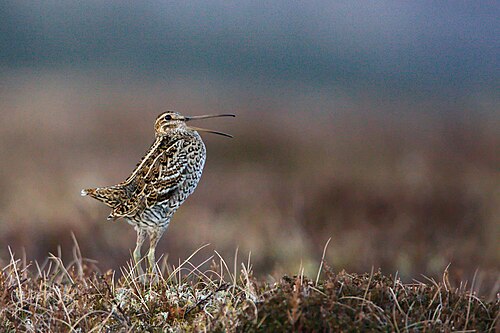 | A – rare vagrant | LC[183] |
| Snipe(Gallinago gallinago) | 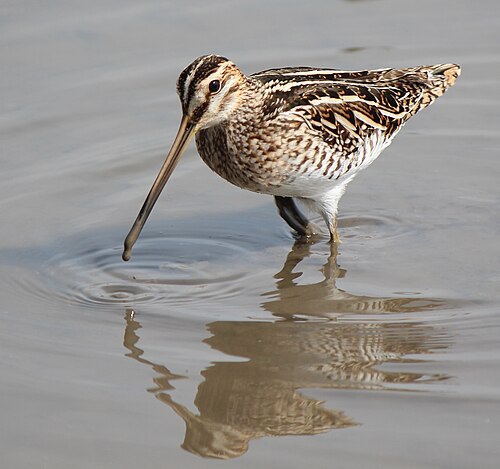 | A – resident breeding species and winter visitor | VU[184] |
| Wilson's snipe(Gallinago delicata) |  | A – rare vagrant | LC[185] |
| Terek sandpiper(Xenus cinereus) |  | A – rare vagrant | LC[186] |
| Wilson's phalarope(Phalaropus tricolor) |  | A – rare vagrant | LC[187] |
| Red-necked phalarope(Phalaropus lobatus) |  | A – winter visitor: scarce and localised summer breeding in far North | LC[188] |
| Grey phalarope(Phalaropus fulicaria) |  | A – scarce winter visitor | LC[189] |
| Common sandpiper(Actitis hypoleucos) |  | A – resident breeding species and passage migrant | LC[190] |
| Spotted sandpiper(Actitis macularius) |  | A – rare vagrant | LC[191] |
| Green sandpiper(Tringa ochropus) |  | A – winter visitor and passage migrant, occasional breeder | LC[192] |
| Solitary sandpiper(Tringa solitaria) |  | A – rare vagrant | LC[193] |
| Grey-tailed tattler(Tringa brevipes) |  | A – rare vagrant | LC[194] |
| Lesser yellowlegs(Tringa flavipes) | 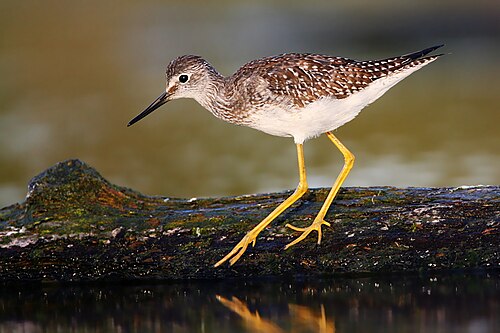 | A – scarce migrant, formerly a rare vagrant[195] | VU[196] |
| Redshank(Tringa totanus) | 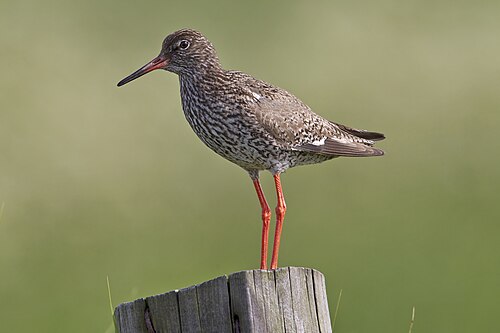 | A – resident breeding species | VU[197] |
| Marsh sandpiper(Tringa stagnatilis) |  | A – rare vagrant | LC[198] |
| Wood sandpiper(Tringa glareola) |  | A – passage migrant and rare localised breeder in far North | LC[199] |
| Spotted redshank(Tringa erythropus) |  | A – winter visitor and passage migrant | LC[200] |
| Greenshank(Tringa nebularia) |  | A – resident breeding species and passage migrant | LC[201] |
| Greater yellowlegs(Tringa melanoleuca) |  | A – rare vagrant | NT[202] |
Pratincoles and coursers
Order: Charadriiformes Family: Glareolidae
A family of slender, long-winged wading birds.
| Common and binomial names | Image | Status | Conservation status |
|---|---|---|---|
| Cream-coloured courser(Cursorius cursor) |  | A – rare vagrant | NT[203] |
| Collared pratincole(Glareola pratincola) |  | A – rare vagrant | LC[204] |
| Oriental pratincole(Glareola maldivarum) |  | A – rare vagrant | LC[205] |
| Black-winged pratincole(Glareola nordmanni) |  | A – rare vagrant | LC[206] |
Gulls, terns, and skimmers
Order: Charadriiformes Family: Laridae
Medium to large seabirds with grey, white and black plumage, webbed feet and strong bills. Many are opportunistic and adaptable feeders.
| Common and binomial names | Image | Status | Conservation status |
|---|---|---|---|
| Kittiwake(Rissa tridactyla) |  | A – breeding summer visitor and resident species | VU[207] |
| Ivory gull(Pagophila eburnea) |  | A – rare vagrant | VU[208] |
| Sabine's gull(Xema sabini) |  | A – scarce winter visitor | LC[209] |
| Slender-billed gull(Chroicocephalus genei) | 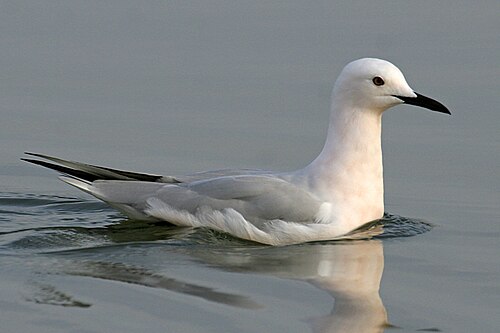 | A – rare vagrant | VU[210] |
| Bonaparte's gull(Chroicocephalus philadelphia) |  | A – rare vagrant | LC[211] |
| Black-headed gull(Chroicocephalus ridibundus) |  | A – resident breeding species | LC[212] |
| Little gull(Hydrocoloeus minutus) |  | A – winter visitor, occasional breeder | LC[213] |
| Ross's gull(Rhodostethia rosea) |  | A – rare vagrant | EN[214] |
| Laughing gull(Leucophaeus atricilla) |  | A – rare vagrant | LC[215] |
| Franklin's gull(Leucophaeus pipixcan) |  | A – rare vagrant | LC[216] |
| Audouin's gull(Ichthyaetus audouinii) |  | A – rare vagrant | VU[217] |
| Mediterranean gull(Ichthyaetus melanocephalus) |  | A – breeding summer visitor, and resident in south. | LC[218] |
| Great black-headed gull(Ichthyaetus ichthyaetus) |  | B – rare vagrant (one record, 1859) | LC[219] |
| Common gull(Larus canus) | 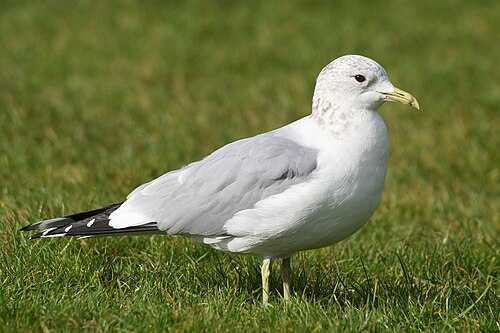 | A – resident breeding species, winter visitor and passage migrant | LC[220] |
| Ring-billed gull(Larus delawarensis) |  | A – scarce winter visitor and passage migrant | LC[221] |
| Great black-backed gull(Larus marinus) |  | A – resident breeding species and passage migrant | LC[222] |
| Kelp gull(Larus dominicanus) |  | A – rare vagrant; first recorded 2022[223][224] | LC[225] |
| Glaucous-winged gull(Larus glaucescens) |  | A – rare vagrant | LC[226] |
| Glaucous gull(Larus hyperboreus) |  | A – winter visitor; has bred | LC[227] |
| Iceland gull(Larus glaucoides) |  | A – scarce winter visitor | LC[228] |
| European herring gull(Larus argentatus) | 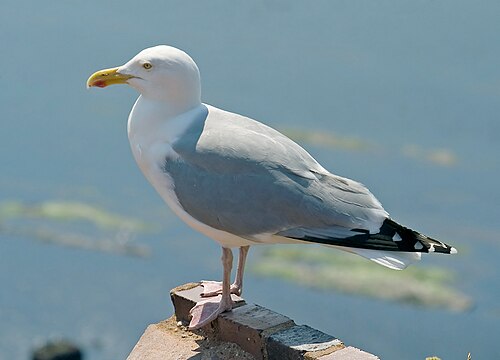 | A – resident breeding species | LC[229] |
| American herring gull(Larus smithsonianus) |  | A – rare vagrant | LC[230] |
| Caspian gull(Larus cachinnans) |  | A – scarce migrant | LC[231] |
| Yellow-legged gull(Larus michahellis) |  | A – scarce visitor and passage migrant; has bred[232] | LC[233] |
| Slaty-backed gull(Larus schistisagus) |  | A – rare vagrant | LC[234] |
| Lesser black-backed gull(Larus fuscus) |  | A – resident breeding species and passage migrant | LC[235] |
| Gull-billed tern(Gelochelidon nilotica) |  | A – rare vagrant; has bred | LC[236] |
| Caspian tern(Hydroprogne caspia) | 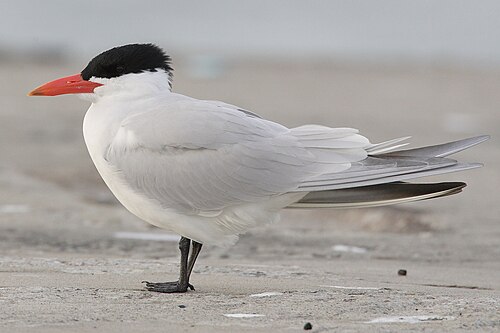 | A – rare vagrant | LC[237] |
| Royal tern(Thalasseus maximus) | 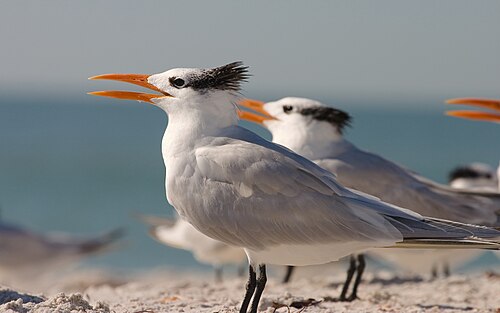 | A – rare vagrant | LC[238] |
| Lesser crested tern(Thalasseus bengalensis) |  | A – rare vagrant | LC[239] |
| Sandwich tern(Thalasseus sandvicensis) |  | A – breeding summer visitor | LC[240] |
| Cabot's tern(Thalasseus acuflavida) |  | A – rare vagrant | |
| Elegant tern(Thalasseus elegans) | 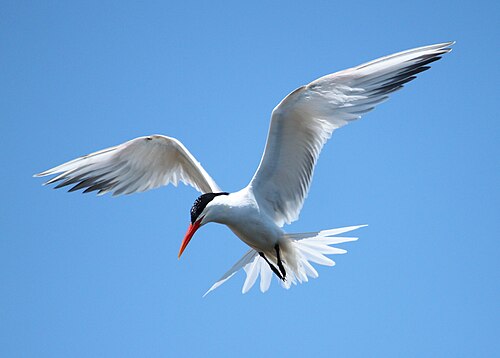 | A – rare vagrant | NT[241] |
| Little tern(Sternula albifrons) |  | A – breeding summer visitor | LC[242] |
| Least tern(Sternula antillarum) |  | A – rare vagrant | LC[243] |
| Aleutian tern(Onychoprion aleutica) |  | A – rare vagrant | VU[244] |
| Bridled tern(Onychoprion anaethetus) |  | A – rare vagrant | LC[245] |
| Sooty tern(Onychoprion fuscata) | 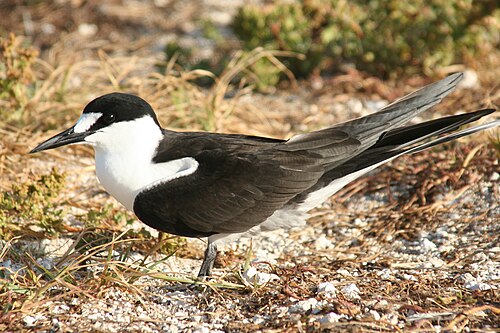 | A – rare vagrant | VU[246] |
| Roseate tern(Sterna dougallii) |  | A – scarce breeding summer visitor | LC[247] |
| Common tern(Sterna hirundo) |  | A – breeding summer visitor | LC[248] |
| Arctic tern(Sterna paradisaea) | 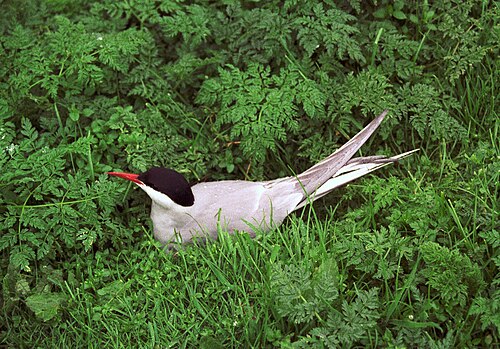 | A – breeding summer visitor | LC[249] |
| Forster's tern(Sterna forsteri) |  | A – rare vagrant | LC[250] |
| Whiskered tern(Chlidonias hybridus) |  | A – rare vagrant | LC[251] |
| White-winged black tern(Chlidonias leucopterus) |  | A – scarce migrant | LC[252] |
| Black tern(Chlidonias niger) |  | A – passage migrant, occasional breeder | LC[253] |
Skuas
Order: Charadriiformes Family: Stercorariidae
Medium to large seabirds with mainly grey or brown plumage, sharp claws and a hooked tip to the bill. They chase other seabirds to force them to drop their catches.
| Common and binomial names | Image | Status | Conservation status |
|---|---|---|---|
| South polar skua(Stercorarius maccormicki) |  | A – rare vagrant[254] | LC[255] |
| Great skua(Stercorarius skua) |  | A – passage migrant and localised summer breeder | LC[256] |
| Pomarine skua(Stercorarius pomarinus) |  | A – passage migrant | LC[257] |
| Arctic skua(Stercorarius parasiticus) | 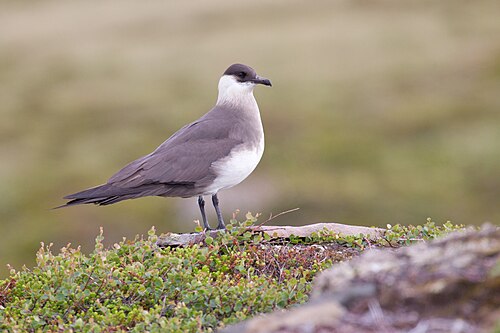 | A – passage migrant and localised summer breeder | EN[258] |
| Long-tailed skua(Stercorarius longicaudus) |  | A – passage migrant | LC[259] |
Auks, murres, and puffins
Order: Charadriiformes Family: Alcidae
A family of seabirds which are superficially similar to penguins, with their black-and-white colours, upright posture and some of their habits, but which are able to fly.
| Common and binomial names | Image | Status | Conservation status |
|---|---|---|---|
| Little auk(Alle alle) |  | A – rare winter visitor | LC[260] |
| Brünnich's guillemot(Uria lomvia) |  | A – rare vagrant | LC[261] |
| Common guillemot(Uria aalge) |  | A – breeding summer visitor and resident species | LC[262] |
| Razorbill(Alca torda) |  | A – breeding summer visitor and resident species | LC[263] |
| Great auk(Pinguinus impennis) |  | B – extinct | EX[264] |
| Black guillemot(Cepphus grylle) |  | A – resident localised breeding species | LC[265] |
| Long-billed murrelet(Brachyramphus perdix) |  | A – rare vagrant | NT[266] |
| Ancient murrelet(Synthliboramphus antiquus) |  | A – rare vagrant | LC[267] |
| Puffin(Fratercula arctica) |  | A – breeding summer visitor | EN[268] |
| Tufted puffin(Fratercula cirrhata) |  | A – rare vagrant | LC[269] |
Tropicbirds
Order: Phaethontiformes Family: Phaethontidae
Tropicbirds are slender white birds of tropical oceans, with exceptionally long central tail feathers. Their heads and long wings have black markings.
| Common and binomial names | Image | Status | Conservation status |
|---|---|---|---|
| Red-billed tropicbird(Phaethon aethereus) |  | A – rare vagrant | LC[270] |
Divers
Order: Gaviiformes Family: Gaviidae
Divers are aquatic birds the size of a large duck, to which they are unrelated. They swim well and fly adequately but are almost helpless on land, because their legs are placed towards the rear of the body. They feed on fish and other aquatic animals.
| Common and binomial names | Image | Status | Conservation status |
|---|---|---|---|
| Red-throated diver(Gavia stellata) |  | A – resident breeder and winter visitor | LC[271] |
| Black-throated diver(Gavia arctica) |  | A – resident breeder and winter visitor | LC[272] |
| Pacific diver(Gavia pacifica) | 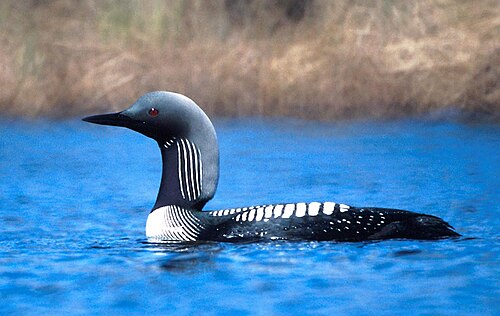 | A – rare vagrant | LC[273] |
| Great northern diver(Gavia immer) |  | A – winter visitor; has bred | LC[274] |
| White-billed diver(Gavia adamsii) |  | A – rare vagrant | VU[275] |
Southern storm petrels
Order: Procellariiformes Family: Oceanitidae
The southern storm petrels are the smallest seabirds, feeding on plankton and small fish picked from the surface, typically while hovering. They nest in colonies on the ground, most often in burrows.
| Common and binomial names | Image | Status | Conservation status |
|---|---|---|---|
| Wilson's storm petrel(Oceanites oceanicus) |  | A – rare vagrant, more regularly seen well offshore | LC[276] |
| White-faced storm petrel(Pelagodroma marina) |  | A – rare vagrant | EN[277] |
Albatrosses
Order: Procellariiformes Family: Diomedeidae
The albatrosses are among the largest flying birds, with long, narrow wings for gliding. The majority are found in the Southern Hemisphere with only vagrants occurring in the North Atlantic.
| Common and binomial names | Image | Status | Conservation status |
|---|---|---|---|
| Black-browed albatross(Thalassarche melanophris) |  | A – rare vagrant | LC[278] |
| Atlantic yellow-nosed albatross(Thalassarche chlororhynchos) |  | A – rare vagrant | EN[279] |
Northern storm petrels
Order: Procellariiformes Family: Hydrobatidae
The northern storm-petrels are the smallest seabirds, feeding on plankton and small fish picked from the surface, typically while hovering. They nest in colonies on the ground, most often in burrows.
| Common and binomial names | Image | Status | Conservation status |
|---|---|---|---|
| Storm petrel(Hydrobates pelagicus) | 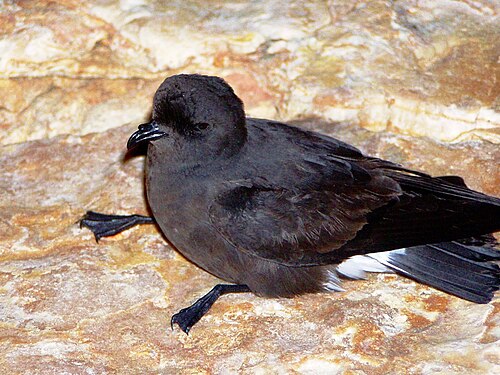 | A – breeding summer visitor | LC[280] |
| Swinhoe's petrel(Hydrobates monorhis) |  | A – rare vagrant | NT[281] |
| Leach's petrel(Hydrobates leucorhous) | 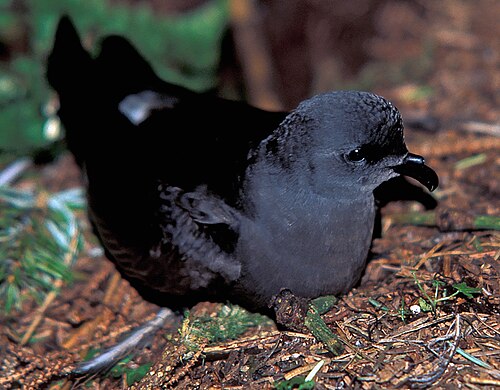 | A – breeding summer visitor | VU[282] |
| Madeiran petrel(Hydrobates castro) |  | A – rare vagrant; first recorded 2021, with a geotagged bird from a Tenerife breeding colony entering UK waters about 285 km southwest of Bishop Rock, Isles of Scilly | LC[283] |
Shearwaters and petrels
Order: Procellariiformes Family: Procellariidae
These are highly pelagic birds with long, narrow wings and tube-shaped nostrils. They feed at sea on fish, squid and other marine life. They come to land to breed in colonies, nesting in burrows or on cliffs.
| Common and binomial names | Image | Status | Conservation status |
|---|---|---|---|
| Fulmar(Fulmarus glacialis) | 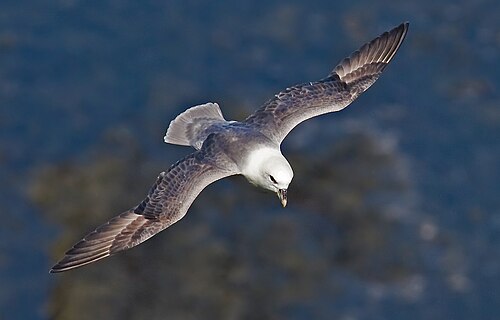 | A – resident and migrant breeder, passage migrant | VU[284] |
| Soft-plumaged petrel(Pterodroma mollis) |  | A – rare vagrant; first recorded 2021 | LC[285] |
| Zino's petrel(Pterodroma madeira) |  | A – rare vagrant; first recorded 2020[286][287] | EN[288] |
| Black-capped petrel(Pterodroma hasitata) |  | B – rare vagrant | EN[289] |
| White-chinned petrel(Procellaria aequinoctialis) |  | A – rare vagrant; first recorded 2020 | VU[290] |
| Scopoli's shearwater(Calonectris diomedea) |  | A – rare vagrant | LC[291] |
| Cory's shearwater(Calonectris borealis) | 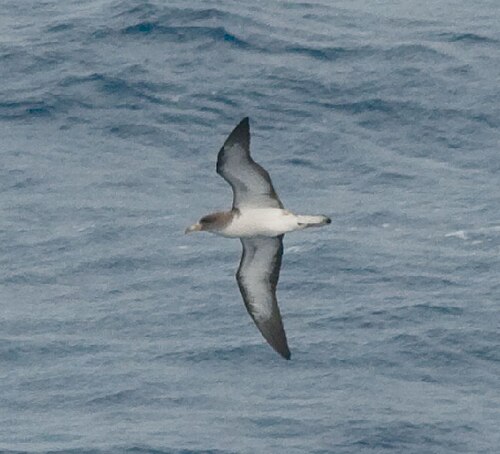 | A – scarce migrant | LC[292] |
| Sooty shearwater(Ardenna grisea) |  | A – passage migrant | NT[293] |
| Great shearwater(Ardenna gravis) |  | A – passage migrant | LC[294] |
| Manx shearwater(Puffinus puffinus) |  | A – breeding summer visitor | LC[295] |
| Yelkouan shearwater(Puffinus yelkouan) |  | A – rare vagrant | VU[296] |
| Balearic shearwater(Puffinus mauretanicus) | 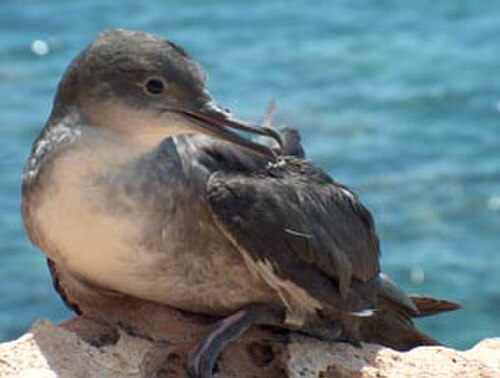 | A – passage migrant | CR[297] |
| Barolo shearwater(Puffinus baroli) |  | A – rare vagrant |
Storks
Order: Ciconiiformes Family: Ciconiidae
Storks are large, heavy, long-legged, long-necked wading birds with long stout bills and wide wingspans. They fly with the neck extended.
| Common and binomial names | Image | Status | Conservation status |
|---|---|---|---|
| Black stork(Ciconia nigra) |  | A – rare vagrant | LC[298] |
| White stork(Ciconia ciconia) |  | A – scarce migrant, formerly bred. Birds from a reintroduced population bred at Knepp Wildland in 2020. | LC[299] |
Frigatebirds
Order: Suliformes Family: Fregatidae
Frigatebirds are large seabirds usually found over tropical oceans. They are large, black-and-white, or completely black, with long wings and deeply forked tails. The males have red inflatable throat pouches. They do not swim or walk and cannot take off from a flat surface. Having the largest wingspan-to-body-weight ratio of any bird, they are essentially aerial, able to stay aloft for more than a week.
| Common and binomial names | Image | Status | Conservation status |
|---|---|---|---|
| Ascension frigatebird(Fregata aquila) |  | A – rare vagrant | VU[300] |
| Magnificent frigatebird(Fregata magnificens) | 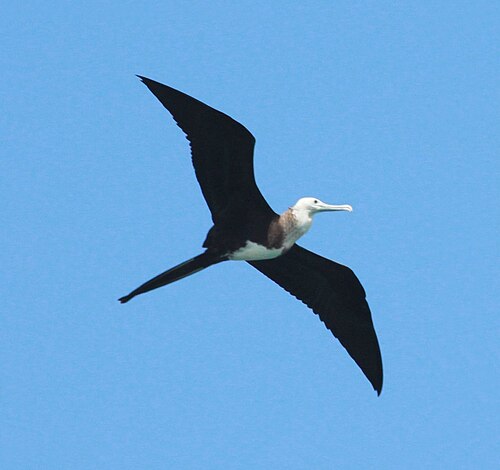 | A – rare vagrant | LC[301] |
Boobies and gannets
Order: Suliformes Family: Sulidae
Gannets are large seabirds that plunge-dive for fish and nest in large colonies. They have a torpedo-shaped body, long, narrow, pointed wings and a fairly long tail. There are ten species worldwide with three in Britain.
| Common and binomial names | Image | Status | Conservation status |
|---|---|---|---|
| Gannet(Morus bassanus) |  | A – breeding summer visitor and passage migrant | LC[302] |
| Red-footed booby(Sula sula) |  | A – rare vagrant | LC[303] |
| Brown booby(Sula leucogaster) | 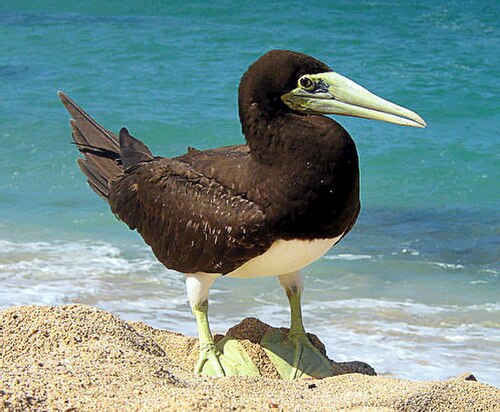 | A – rare vagrant; first recorded 2019[304] | LC[305] |
Cormorants and shag
Order: Suliformes Family: Phalacrocoracidae
Cormorants are medium to large aquatic birds with mainly dark plumage and areas of coloured skin on the face. The bill is long, thin and sharply hooked for catching fish and aquatic invertebrates. They nest in colonies by water, usually by the sea or on the banks of rivers.
| Common and binomial names | Image | Status | Conservation status |
|---|---|---|---|
| Cormorant(Phalacrocorax carbo) |  | A – resident breeding species | LC[306] |
| Shag(Gulosus aristotelis) |  | A – resident breeding species | LC[307] |
| Double-crested cormorant(Nannopterum auritum) |  | A – rare vagrant | LC[308] |
Ibises and spoonbills
Order: Pelecaniformes Family: Threskiornithidae
A family of long-legged, long-necked wading birds. Ibises have long, curved bills. Spoonbills have a flattened bill, wider at the tip.
| Common and binomial names | Image | Status | Conservation status |
|---|---|---|---|
| Glossy ibis(Plegadis falcinellus) |  | A – scarce migrant, formerly a rare vagrant;[195] has bred[309] | LC[310] |
| Spoonbill(Platalea leucorodia) |  | A – scarce migrant, recently bred | LC[311] |
Bitterns, herons and egrets
Order: Pelecaniformes Family: Ardeidae
Herons and egrets are medium to large wading birds with long necks and legs. Bitterns tend to be shorter-necked and more secretive. They all fly with their necks retracted. The sharp bill is used to catch fish, amphibians and other animals. Many species nest in colonies, often in trees. There are 64 species worldwide and 15 in Britain.
| Common and binomial names | Image | Status | Conservation status |
|---|---|---|---|
| Bittern(Botaurus stellaris) |  | A – resident breeding species and winter migrant | LC[312] |
| American bittern(Botaurus lentiginosus) | 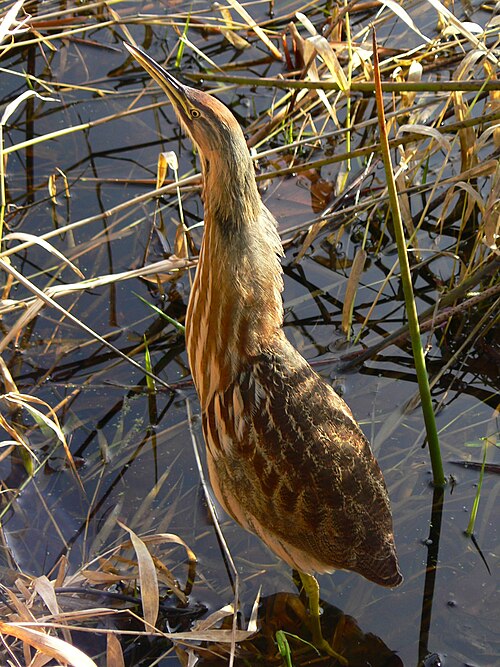 | A – rare vagrant | LC[313] |
| Least bittern(Botaurus exilis) | 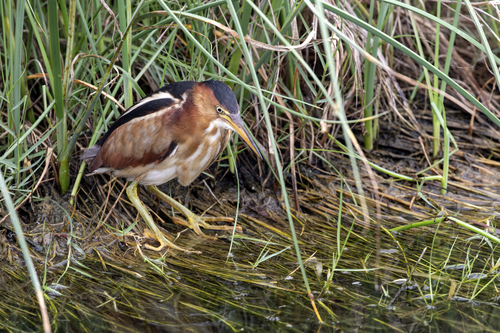 | A – rare vagrant; first recorded 2022[314][224] | LC[315] |
| Little bittern(Botaurus minutus) |  | A – scarce migrant, recently bred | LC[316] |
| Night-heron(Nycticorax nycticorax) |  | A – scarce migrant, has bred | LC[317] |
| Green heron(Butorides virescens) |  | A – rare vagrant | LC[318] |
| Squacco heron(Ardeola ralloides) |  | A – rare vagrant | LC[319] |
| Chinese pond heron(Ardeola bacchus) |  | A – rare vagrant | LC[320] |
| Cattle egret(Ardea ibis) |  | A – scarce but increasing breeding resident | LC[321] |
| Grey heron(Ardea cinerea) | 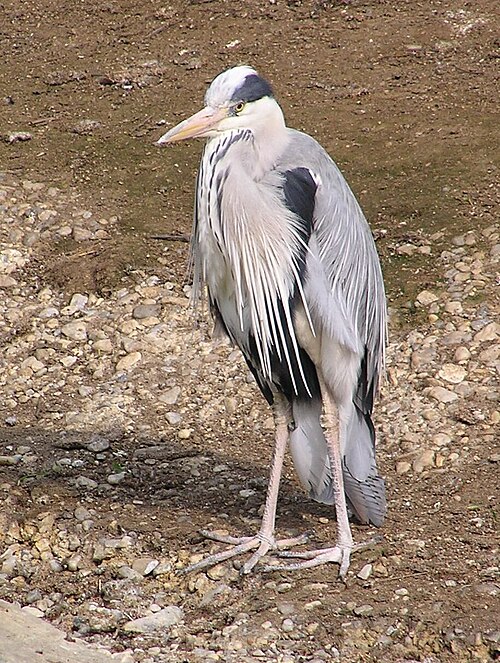 | A – resident breeding species and winter migrant | LC[322] |
| Great blue heron(Ardea herodias) |  | A – rare vagrant | LC[323] |
| Purple heron(Ardea purpurea) |  | A – scarce migrant, recently bred | LC[324] |
| Great white egret(Ardea alba) | 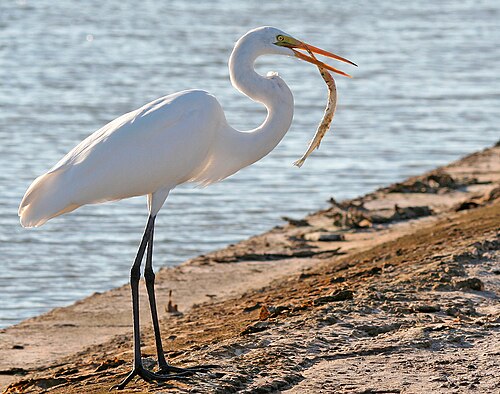 | A – resident breeding species, first bred 2012 | LC[325] |
| Snowy egret(Egretta thula) |  | A – rare vagrant | LC[326] |
| Little egret(Egretta garzetta) | 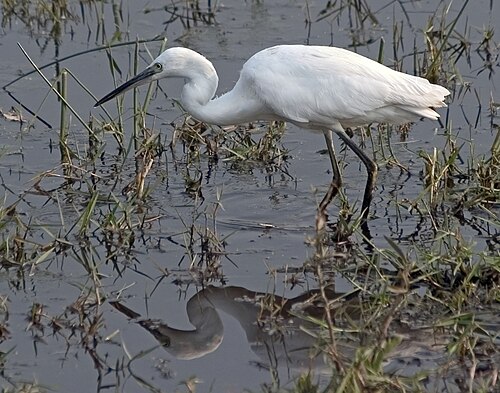 | A – resident breeding species and passage migrant | LC[327] |
Pelicans
Order: Pelecaniformes Family: Pelecanidae
Pelicans are large water birds with a distinctive pouch under their beak. As with other members of the order Pelecaniformes, they have webbed feet with four toes.
| Common and binomial names | Image | Status | Conservation status |
|---|---|---|---|
| Dalmatian pelican(Pelecanus crispus) |  | A – very rare migrant[328] | LC[329] |
Osprey
Order: Accipitriformes Family: Pandionidae
A large fish-eating bird of prey belonging to a family of its own. It is mainly brown above and white below with long, angled wings.
| Common and binomial names | Image | Status | Conservation status |
|---|---|---|---|
| Osprey(Pandion haliaetus) |  | A – breeding summer visitor | LC[330] |
Hawks, eagles, and kites
Order: Accipitriformes Family: Accipitridae
A family of birds of prey which includes hawks, buzzards, eagles, kites and harriers. These birds have very large powerful hooked beaks for tearing flesh from their prey, strong legs, powerful talons and keen eyesight.
| Common and binomial names | Image | Status | Conservation status |
|---|---|---|---|
| Black-winged Kite(Elanus caeruleus) |  | A – rare vagrant; first recorded April 2023 | LC[331] |
| Egyptian vulture(Neophron percnopterus) |  | A – rare vagrant | VU[332] |
| Honey-buzzard(Pernis apivorus) |  | A – breeding summer visitor and passage migrant | LC[333] |
| Short-toed eagle(Circaetus gallicus) |  | A – rare vagrant | LC[334] |
| Spotted eagle(Clanga clanga) | 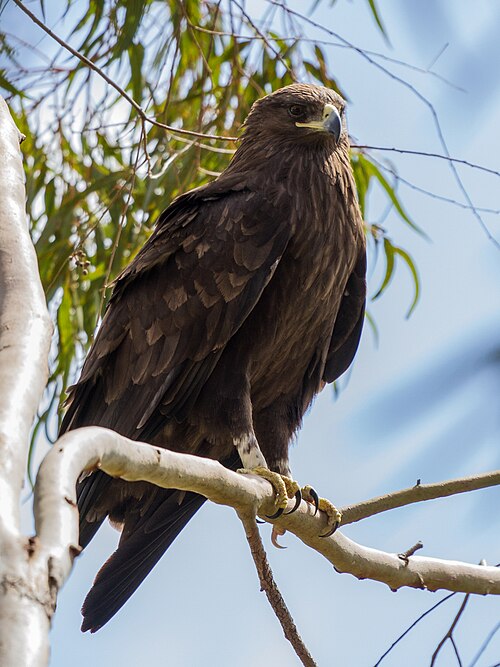 | B – rare vagrant; last record 1915 | VU[335] |
| Booted eagle(Hieraaetus pennatus) | 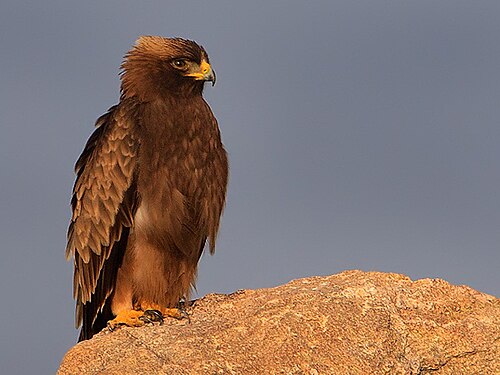 | A – rare vagrant | LC[336] |
| Golden eagle(Aquila chrysaetos) |  | A – resident breeding species | LC[337] |
| Sparrowhawk(Accipiter nisus) |  | A – resident breeder and passage migrant | LC[338] |
| Goshawk(Accipiter gentilis) |  | A & C – resident breeder and naturalised escapes | LC[339] |
| Marsh harrier(Circus aeruginosus) |  | A – resident breeder and passage migrant | LC[340] |
| Hen harrier(Circus cyaneus) |  | A – resident breeder, winter visitor and passage migrant | LC[341] |
| Northern harrier(Circus hudsonius) |  | A – rare vagrant | LC[342] |
| Pallid harrier(Circus macrourus) |  | A – rare vagrant | LC[343] |
| Montagu's harrier(Circus pygargus) |  | A – breeding summer visitor and passage migrant | LC[344] |
| Red kite(Milvus milvus) |  | A & C – resident breeder and widespread introductions | LC[345] |
| Black kite(Milvus migrans) |  | A – scarce migrant | LC[346] |
| White-tailed eagle(Haliaeetus albicilla) |  | A & C – resident breeder; reintroduction projects underway and ongoing | LC[347] |
| Rough-legged buzzard(Buteo lagopus) | 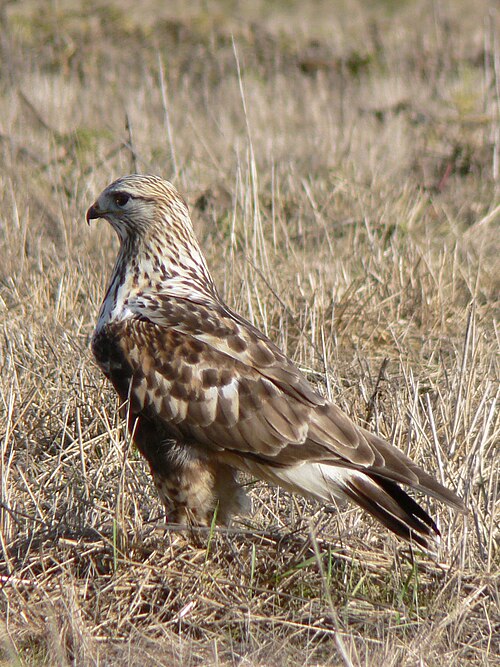 | A – winter visitor | LC[348] |
| Buzzard(Buteo buteo) |  | A – resident breeder and passage migrant | LC[349] |
| Long-legged Buzzard(Buteo rufinus) |  | A – rare vagrant | LC[350] |
Barn owls
Order: Strigiformes Family: Tytonidae
Barn owls are medium to large owls with large heads and characteristic heart-shaped faces. They have long strong legs with powerful talons.
| Common and binomial names | Image | Status | Conservation status |
|---|---|---|---|
| Western barn owl(Tyto alba) |  | A – resident breeding species | LC[351] |
Owls
Order: Strigiformes Family: Strigidae
Typical owls are small to large solitary nocturnal birds of prey. They have large forward-facing eyes and ears, a hawk-like beak and a conspicuous circle of feathers around each eye called a facial disc.
| Common and binomial names | Image | Status | Conservation status |
|---|---|---|---|
| Tengmalm's owl(Aegolius funereus) |  | A – rare vagrant | LC[352] |
| Little owl(Athene noctua) |  | C – resident introduced population | LC[353] |
| Hawk owl(Surnia ulula) |  | A – rare vagrant | LC[354] |
| Scops owl(Otus scops) |  | A – rare vagrant | LC[355] |
| Long-eared owl(Asio otus) |  | A – scarce resident breeding species | LC[356] |
| Short-eared owl(Asio flammeus) |  | A – resident breeding species or winter visitor | LC[357] |
| Snowy owl(Bubo scandiacus) |  | A – rare vagrant; has bred Shetland Islands | LC[358] |
| Tawny owl(Strix aluco) |  | A – resident breeding species | LC[359] |
Hoopoe
Order: Bucerotiformes Family: Upupidae
A small family with a long curved bills, crests and black-and-white striped wings and tails.
| Common and binomial names | Image | Status | Conservation status |
|---|---|---|---|
| Eurasian hoopoe(Upupa epops) | 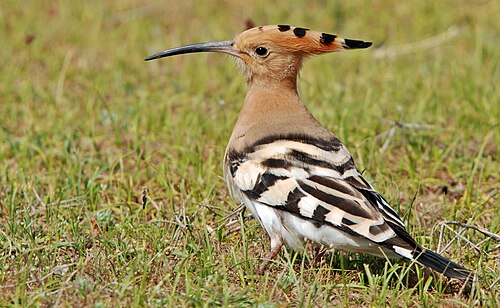 | A – scarce summer visitor, occasional breeder | LC[360] |
Rollers
Order: Coraciiformes Family: Coraciidae
A small family of colourful, medium-sized birds with a crow-like shape that feed mainly on insects.
| Common and binomial names | Image | Status | Conservation status |
|---|---|---|---|
| European roller(Coracias garrulus) | 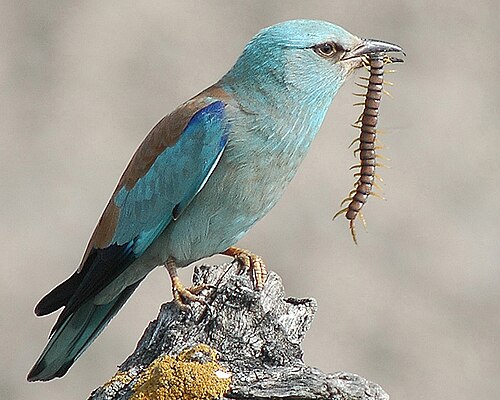 | A – rare vagrant | LC[361] |
Kingfishers
Order: Coraciiformes Family: Alcedinidae
Kingfishers are medium-sized birds with large heads, long pointed bills, short legs and stubby tails.
| Common and binomial names | Image | Status | Conservation status |
|---|---|---|---|
| Kingfisher(Alcedo atthis) |  | A – resident breeding species | LC[362] |
| Belted kingfisher(Megaceryle alcyon) |  | A – rare vagrant | LC[363] |
Bee-eaters
Order: Coraciiformes Family: Meropidae
A group of near-passerine birds characterised by richly coloured plumage, slender bodies and usually elongated central tail-feathers.
| Common and binomial names | Image | Status | Conservation status |
|---|---|---|---|
| Blue-cheeked bee-eater(Merops persicus) | 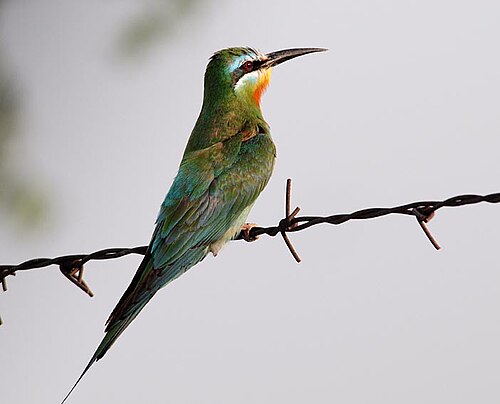 | A – rare vagrant | LC[364] |
| Bee-eater(Merops apiaster) |  | A – scarce summer visitor; occasional breeder | LC[365] |
Woodpeckers
Order: Piciformes Family: Picidae
Woodpeckers are small to medium-sized birds with chisel-like beaks, short legs, stiff tails and long tongues used for capturing insects. Many woodpeckers have the habit of tapping noisily on tree trunks with their beaks.
| Common and binomial names | Image | Status | Conservation status |
|---|---|---|---|
| Wryneck(Jynx torquilla) |  | A – rare passage migrant; occasional breeder | LC[366] |
| Yellow-bellied sapsucker(Sphyrapicus varius) | 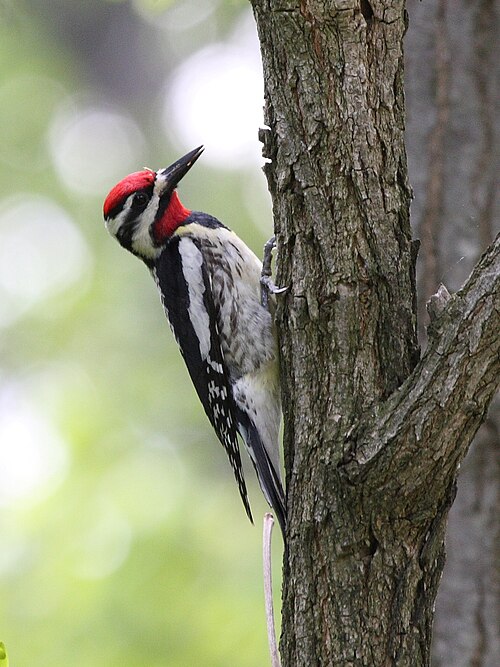 | A – rare vagrant | LC[367] |
| Lesser spotted woodpecker(Dryobates minor) | 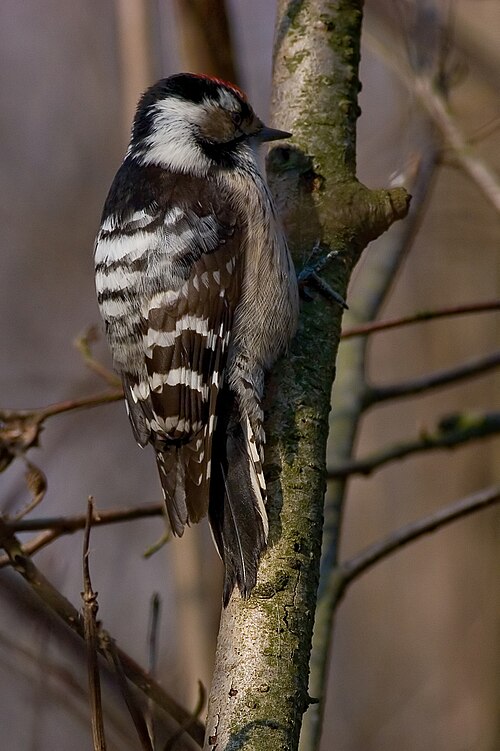 | A – resident breeding species | LC[368] |
| Great spotted woodpecker(Dendrocopos major) | 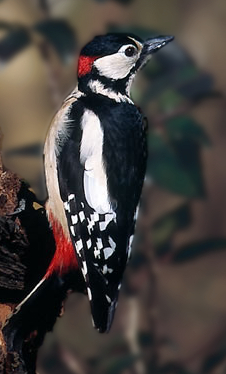 | A – resident breeding species | LC[369] |
| Green woodpecker(Picus viridis) |  | A – resident breeding species | LC[370] |
Falcons and caracaras
Order: Falconiformes Family: Falconidae
A family of small to medium-sized, diurnal birds of prey with pointed wings. They do not build their own nests and mainly catch prey in the air.
| Common and binomial names | Image | Status | Conservation status |
|---|---|---|---|
| Lesser kestrel(Falco naumanni) |  | A – rare vagrant | LC[371] |
| Kestrel(Falco tinnunculus) |  | A – resident breeding species | LC[372] |
| American kestrel(Falco sparverius) |  | A – rare vagrant | LC[373] |
| Red-footed falcon(Falco vespertinus) |  | A – scarce migrant | VU[374] |
| Amur falcon(Falco amurensis) |  | A – rare vagrant | LC[375] |
| Eleonora's falcon(Falco eleonorae) |  | A – rare vagrant | LC[376] |
| Merlin(Falco columbarius) |  | A – resident breeding species | VU[377] |
| Hobby(Falco subbuteo) |  | A – breeding summer visitor | LC[378] |
| Gyr falcon(Falco rusticolus) | 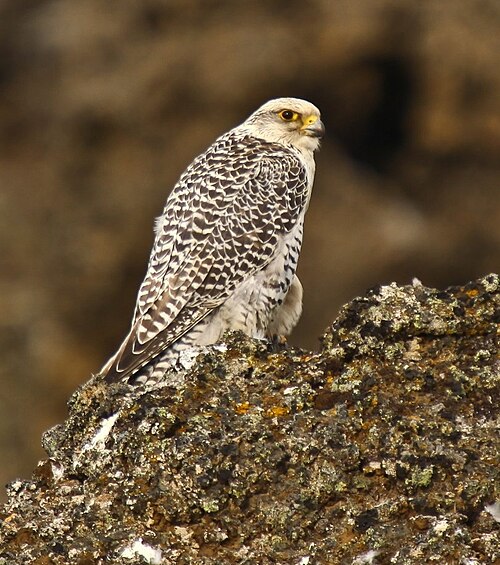 | A – rare vagrant | LC[379] |
| Peregrine(Falco peregrinus) |  | A – resident breeding species | LC[380] |
Parrots
Order: Psittaciformes Family: Psittaculidae
Parrots are small to large birds with a characteristic curved beak shape. They are found mainly in areas with warm climates.
| Common and binomial names | Image | Status | Conservation status |
|---|---|---|---|
| Ring-necked parakeet(Psittacula krameri) |  | C – resident introduced population | LC[381] |
Tyrant flycatchers
Order: Passeriformes Family: Tyrannidae
A large family from the Americas.
| Common and binomial names | Image | Status | Conservation status |
|---|---|---|---|
| Eastern phoebe(Sayornis phoebe) |  | A – rare vagrant | LC[382] |
| Yellow-bellied flycatcher(Empidonax flaviventris) |  | A – rare vagrant; first recorded 2020[383] | LC[384] |
| Acadian flycatcher(Empidonax virescens) |  | A – rare vagrant | LC[385] |
| Alder flycatcher(Empidonax alnorum) |  | A – rare vagrant | LC[386] |
| Eastern kingbird(Tyrannus tyrannus) |  | A – rare vagrant | LC[387] |
Shrikes
Order: Passeriformes Family: Laniidae
Shrikes are passerine birds known for their habit of catching other birds and small animals and impaling the uneaten portions of their bodies on thorns. A typical shrike's beak is hooked, like a bird of prey.
| Common and binomial names | Image | Status | Conservation status |
|---|---|---|---|
| Brown shrike(Lanius cristatus) |  | A – rare vagrant | LC[388] |
| Red-backed shrike(Lanius collurio) | 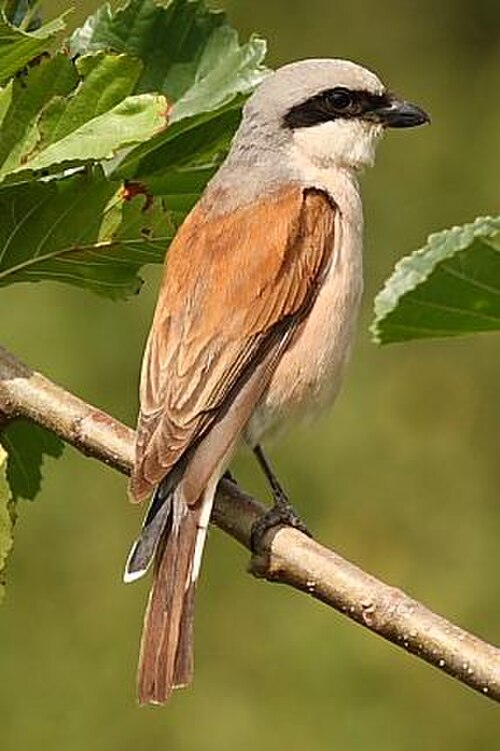 | A – scarce passage migrant, occasional breeder | LC[389] |
| Daurian shrike(Lanius isabellinus) |  | A – rare vagrant | LC[390] |
| Turkestan shrike(Lanius phoenicuroides) | 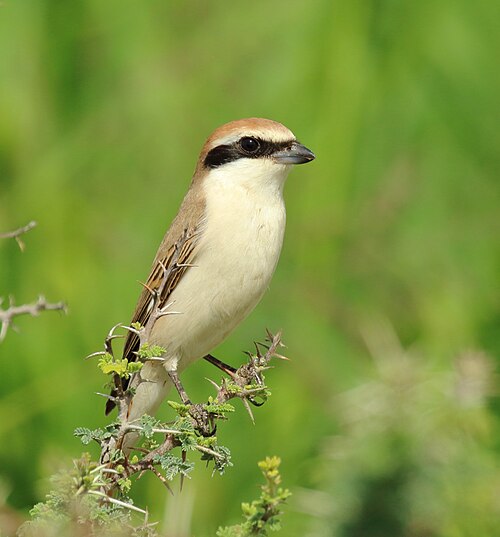 | A – rare vagrant | LC[391] |
| Long-tailed shrike(Lanius schach) |  | A – rare vagrant | LC[392] |
| Lesser grey shrike(Lanius minor) |  | A – rare vagrant | LC[393] |
| Great grey shrike(Lanius excubitor) |  | A – scarce winter visitor | LC[394] |
| Woodchat shrike(Lanius senator) |  | A – scarce migrant | NT[395] |
| Masked shrike(Lanius nubicus) |  | A – rare vagrant | LC[396] |
Vireos
Order: Passeriformes Family: Vireonidae
The vireos are a group of small to medium-sized passerine birds restricted to the New World.
| Common and binomial names | Image | Status | Conservation status |
|---|---|---|---|
| Yellow-throated vireo(Vireo flavifrons) |  | A – rare vagrant | LC[397] |
| Philadelphia vireo(Vireo philadelphicus) |  | A – rare vagrant | LC[398] |
| Red-eyed vireo(Vireo olivaceus) |  | A – rare vagrant | LC[399] |
Old World orioles
Order: Passeriformes Family: Oriolidae
The orioles are medium-sized passerines, mostly with bright and showy plumage, the females often have duller plumage than the males The beak is long, slightly curved and hooked. Orioles are arboreal and tend to feed in the canopy. There are 36 species worldwide, one of which has been recorded in Great Britain.
| Common and binomial names | Image | Status | Conservation status |
|---|---|---|---|
| Golden oriole(Oriolus oriolus) | 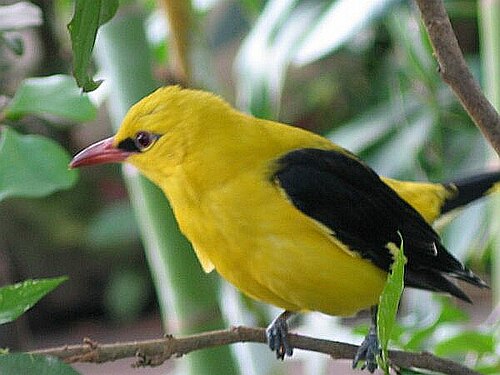 | A – scarce breeding summer visitor | LC[400] |
Crows, jays, and magpies
Order: Passeriformes Family: Corvidae
The crows and their relatives are fairly large birds with strong bills and are usually intelligent and adaptable.
| Common and binomial names | Image | Status | Conservation status |
|---|---|---|---|
| Jay(Garrulus glandarius) |  | A – resident breeding species | LC[401] |
| Magpie(Pica pica) | 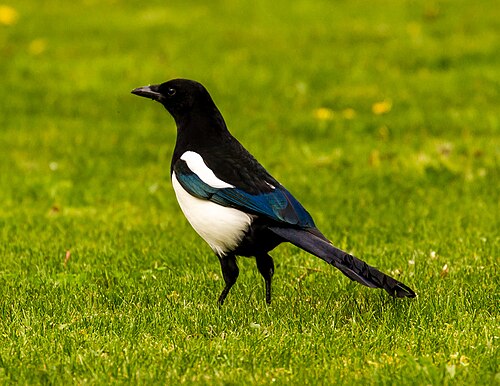 | A – resident breeding species | LC[402] |
| Nutcracker(Nucifraga caryocatactes) | 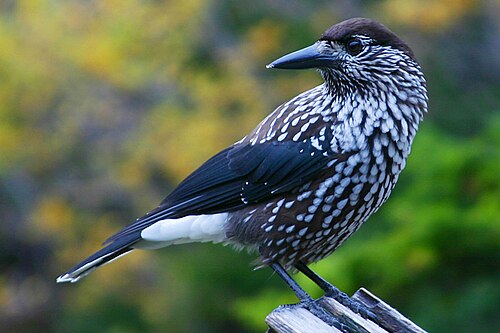 | A – rare vagrant | LC[403] |
| Chough(Pyrrhocorax pyrrhocorax) |  | A – resident breeding species | LC[404] |
| Jackdaw(Coloeus monedula) |  | A – resident breeding species | LC[405] |
| Rook(Corvus frugilegus) |  | A – resident breeding species | VU[406] |
| Carrion crow(Corvus corone) |  | A – resident breeding species | LC[407] |
| Hooded crow(Corvus cornix) |  | A – resident breeding species | |
| Raven(Corvus corax) |  | A – resident breeding species | LC[408] |
Waxwings
Order: Passeriformes Family: Bombycillidae
The waxwings are a group of passerine birds characterised by soft, silky plumage and unique red tips to some of the wing feathers.
| Common and binomial names | Image | Status | Conservation status |
|---|---|---|---|
| Waxwing(Bombycilla garrulus) | 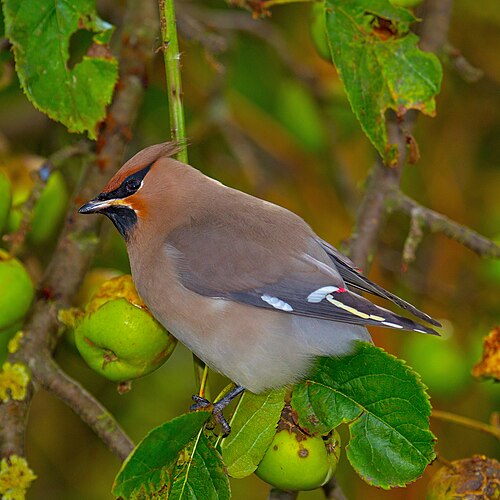 | A – winter visitor in highly variable numbers | LC[409] |
| Cedar waxwing(Bombycilla cedrorum) |  | A – rare vagrant | LC[410] |
Tits, chickadees, and titmice
Order: Passeriformes Family: Paridae
Tits are mainly small, stocky, woodland species with short stout bills. They are adaptable birds, with a mixed diet including seeds and insects.
| Common and binomial names | Image | Status | Conservation status |
|---|---|---|---|
| Coal tit(Periparus ater) |  | A – resident breeding species | LC[411] |
| Crested tit(Lophophanes cristatus) |  | A – resident breeding species | LC[412] |
| Marsh tit(Poecile palustris) | 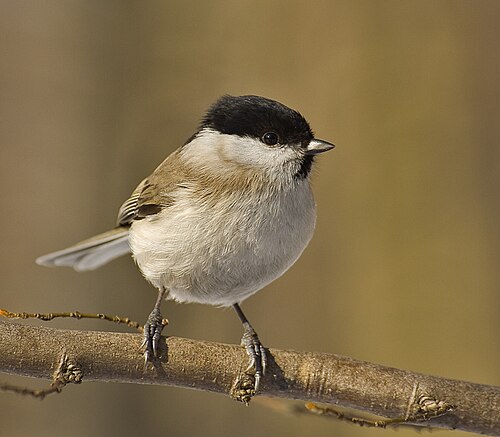 | A – resident breeding species | LC[413] |
| Willow tit(Poecile montana) |  | A – resident breeding species | LC[414] |
| Blue tit(Cyanistes caeruleus) |  | A – resident breeding species | LC[415] |
| Great tit(Parus major) | 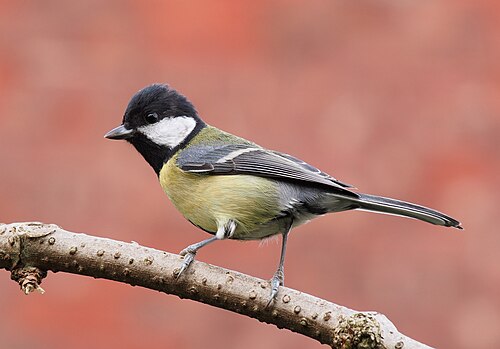 | A – resident breeding species | LC[416] |
Penduline tits
Order: Passeriformes Family: Remizidae
Small birds with finely pointed bills that build purse-like nests hanging from a branch.
| Common and binomial names | Image | Status | Conservation status |
|---|---|---|---|
| Penduline tit(Remiz pendulinus) |  | A – rare vagrant | LC[417] |
Bearded tit
Order: Passeriformes Family: Panuridae
A single species formerly placed in the family Sylviidae.
| Common and binomial names | Image | Status | Conservation status |
|---|---|---|---|
| Bearded tit(Panurus biarmicus) |  | A – resident breeding species | LC[418] |
Larks
Order: Passeriformes Family: Alaudidae
Larks are small terrestrial birds with often extravagant songs and display flights. Most larks are fairly dull in appearance. Their food is insects and seeds.
| Common and binomial names | Image | Status | Conservation status |
|---|---|---|---|
| Woodlark(Lullula arborea) |  | A – scarce resident breeding species and summer migrant | LC[419] |
| White-winged lark(Alauda leucoptera) |  | A – rare vagrant | LC[420] |
| Skylark(Alauda arvensis) | 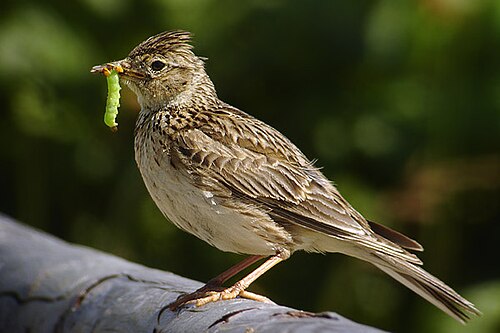 | A – resident breeding species | LC[421] |
| Crested lark(Galerida cristata) |  | A – rare vagrant | LC[422] |
| Shore lark(Eremophila alpestris) |  | A – scarce winter visitor and passage migrant, occasional breeder | LC[423] |
| Short-toed lark(Calandrella brachydactyla) |  | A – scarce migrant | LC[424] |
| Bimaculated lark(Melanocorypha bimaculata) | 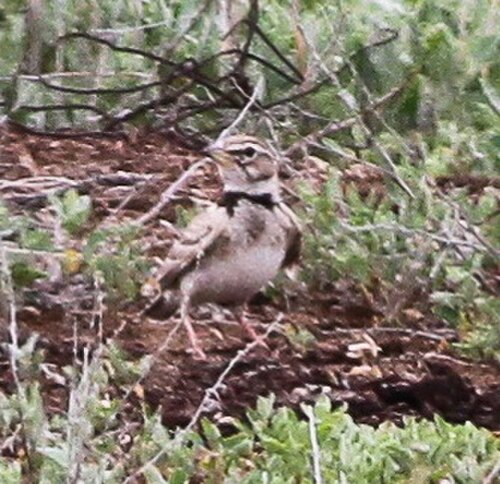 | A – rare vagrant | LC[425] |
| Calandra lark(Melanocorypha calandra) | 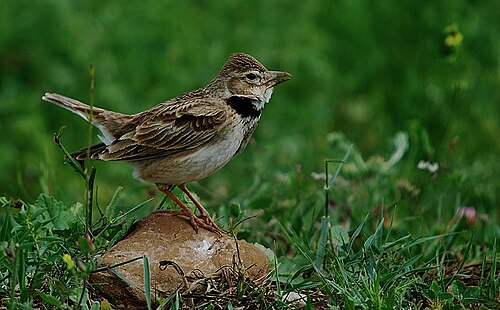 | A – rare vagrant | LC[426] |
| Black lark(Melanocorypha yeltoniensis) |  | A – rare vagrant | EN[427] |
Swallows
Order: Passeriformes Family: Hirundinidae
The family Hirundinidae is adapted to aerial feeding. They have a slender streamlined body, long pointed wings and a short bill with a wide gape.
| Common and binomial names | Image | Status | Conservation status |
|---|---|---|---|
| Sand martin(Riparia riparia) |  | A – breeding summer visitor | LC[428] |
| Tree swallow(Tachycineta bicolor) |  | A – rare vagrant | LC[429] |
| Purple martin(Progne subis) |  | A – rare vagrant | LC[430] |
| Crag martin(Ptyonoprogne rupestris) |  | A – rare vagrant | LC[431] |
| Swallow(Hirundo rustica) | 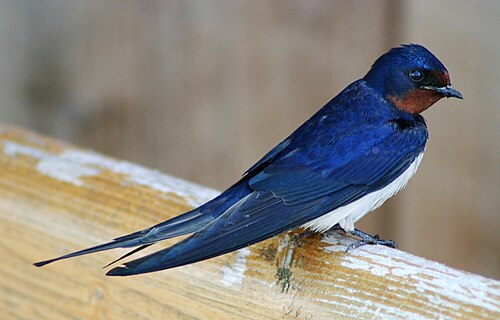 | A – breeding summer visitor | LC[432] |
| House martin(Delichon urbicum) |  | A – breeding summer visitor | LC[433] |
| Red-rumped swallow(Cecropis daurica) |  | A – scarce migrant | LC[434] |
| American cliff swallow(Petrochelidon pyrrhonota) | 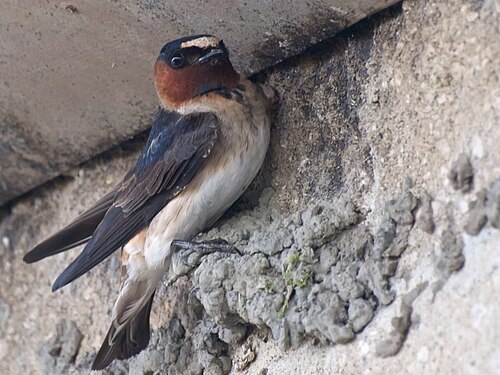 | A – rare vagrant | LC[435] |
Bush warblers
Order: Passeriformes Family: Cettiidae
A recently split family formerly placed in the Sylviidae family. There are 32 species worldwide, with one found in Britain.
| Common and binomial names | Image | Status | Conservation status |
|---|---|---|---|
| Cetti's warbler(Cettia cetti) |  | A – recently colonised resident breeding species | LC[436] |
Long-tailed tits
Order: Passeriformes Family: Aegithalidae
Small, long-tailed birds that typically live in flocks for much of the year. There are 13 species worldwide with one in Britain.
| Common and binomial names | Image | Status | Conservation status |
|---|---|---|---|
| Long-tailed tit(Aegithalos caudatus) |  | A – resident breeding species | LC[437] |
Leaf warblers
Order: Passeriformes Family: Phylloscopidae
A recently split family of small insectivorous birds, formerly included within the Sylviidae. There are 81 species, with 16 in Britain.
| Common and binomial names | Image | Status | Conservation status |
|---|---|---|---|
| Wood warbler(Phylloscopus sibilatrix) |  | A – breeding summer visitor | LC[438] |
| Western Bonelli's warbler(Phylloscopus bonelli) |  | A – rare vagrant | LC[439] |
| Eastern Bonelli's warbler(Phylloscopus orientalis) |  | A – rare vagrant | LC[440] |
| Hume's warbler(Phylloscopus humei) |  | A – rare vagrant | LC[441] |
| Yellow-browed warbler(Phylloscopus inornatus) |  | A – scarce migrant | LC[442] |
| Pallas's warbler(Phylloscopus proregulus) |  | A – scarce migrant | LC[443] |
| Radde's warbler(Phylloscopus schwarzi) |  | A – scarce migrant | LC[444] |
| Sulphur-bellied warbler(Phylloscopus griseolus) |  | A – rare vagrant; first reported 2021[445] | LC[446] |
| Dusky warbler(Phylloscopus fuscatus) |  | A – scarce migrant | LC[447] |
| Willow warbler(Phylloscopus trochilus) |  | A – breeding summer visitor | LC[448] |
| Chiffchaff(Phylloscopus collybita) | 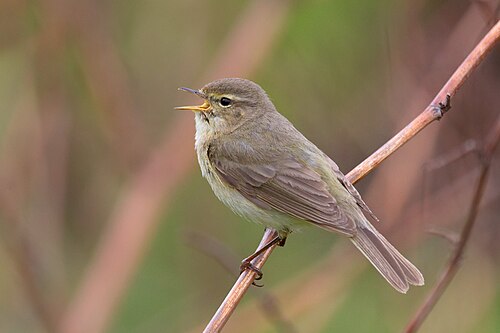 | A – breeding summer visitor and passage and winter visitor | LC[449] |
| Iberian chiffchaff(Phylloscopus ibericus) | 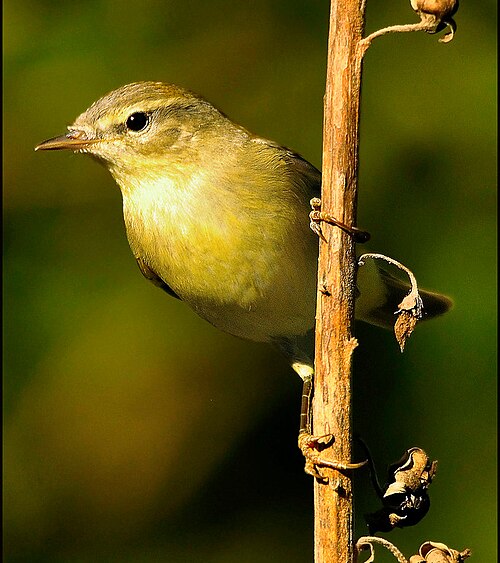 | A – rare vagrant, occasional breeder | LC[450] |
| Eastern crowned warbler(Phylloscopus coronatus) | 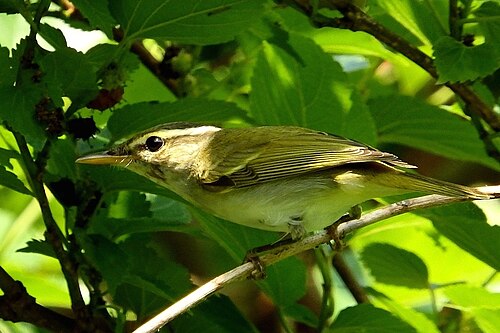 | A – rare vagrant | LC[451] |
| Green warbler(Phylloscopus nitidus) | 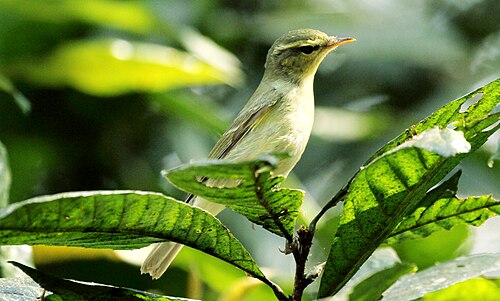 | A – rare vagrant | LC[452] |
| Two-barred greenish warbler(Phylloscopus plumbeitarsus) | 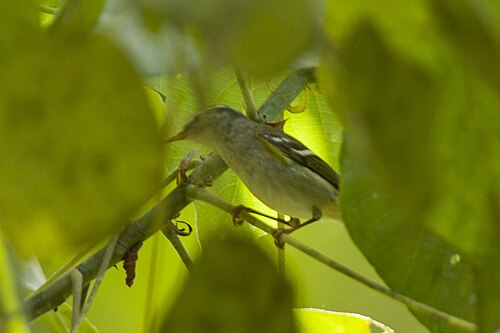 | A – rare vagrant | LC[453] |
| Greenish warbler(Phylloscopus trochiloides) |  | A – scarce migrant | LC[454] |
| Pale-legged leaf warbler(Phylloscopus tenellipes) |  | A – rare vagrant | LC[455] |
| Arctic warbler(Phylloscopus borealis) |  | A – scarce migrant | LC[456] |
Reed warblers
Order: Passeriformes Family: Acrocephalidae
A small, insectivorous and vocal group of species, formerly included within the family Sylviidae.
| Common and binomial names | Image | Status | Conservation status |
|---|---|---|---|
| Great reed warbler(Acrocephalus arundinaceus) |  | A – rare vagrant; has bred | LC[457] |
| Aquatic warbler(Acrocephalus paludicola) |  | A – formerly a scarce migrant, now a rare vagrant[195] | VU[458] |
| Sedge warbler(Acrocephalus schoenobaenus) |  | A – breeding summer visitor | LC[459] |
| Paddyfield warbler(Acrocephalus agricola) |  | A – rare vagrant | LC[460] |
| Blyth's reed warbler(Acrocephalus dumetorum) |  | A – formerly a rare vagrant, now a scarce migrant[195] | LC[461] |
| Reed warbler(Acrocephalus scirpaceus) |  | A – breeding summer visitor | LC[462] |
| Marsh warbler(Acrocephalus palustris) |  | A – breeding summer visitor | LC[463] |
| Thick-billed warbler(Arundinax aedon) |  | A – rare vagrant | LC[464] |
| Booted warbler(Iduna caligata) |  | A – rare vagrant | LC[465] |
| Sykes's warbler(Iduna rama) |  | A – rare vagrant | LC[466] |
| Eastern olivaceous warbler(Iduna pallida) |  | A – rare vagrant | LC[467] |
| Western olivaceous warbler(Iduna opaca) |  | A – rare vagrant; first recorded in October 2023 | LC[468] |
| Olive-tree warbler(Hippolais olivetorum) |  | A – rare vagrant | LC[469] |
| Melodious warbler(Hippolais polyglotta) | 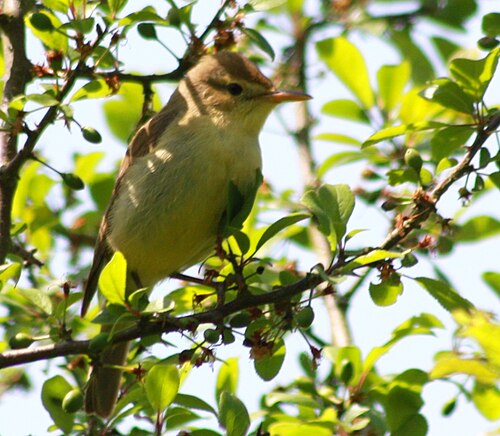 | A – scarce migrant | LC[470] |
| Icterine warbler(Hippolais icterina) |  | A – scarce migrant, occasional breeder | LC[471] |
Grassbirds and allies
Order: Passeriformes Family: Locustellidae
A recently split family, previously part of the family Sylviidae.
| Common and binomial names | Image | Status | Conservation status |
|---|---|---|---|
| Pallas's grasshopper warbler(Helopsaltes certhiola) |  | A – rare vagrant | LC[472] |
| Lanceolated warbler(Locustella lanceolata) |  | A – rare vagrant | LC[473] |
| River warbler(Locustella fluviatilis) |  | A – rare vagrant | LC[474] |
| Savi's warbler(Locustella luscinioides) |  | A – rare breeding summer visitor | LC[475] |
| Grasshopper warbler(Locustella naevia) |  | A – breeding summer visitor | LC[476] |
Cisticolas and allies
Order: Passeriformes Family: Cisticolidae
A group of insectivorous species, previously included within the family Sylviidae.
| Common and binomial names | Image | Status | Conservation status |
|---|---|---|---|
| Fan-tailed warbler(Cisticola juncidis) |  | A – rare vagrant | LC[477] |
Sylviid warblers, parrotbills, and allies
Order: Passeriformes Family: Sylviidae
A group of small insectivorous birds.
| Common and binomial names | Image | Status | Conservation status |
|---|---|---|---|
| Blackcap(Sylvia atricapilla) |  | A – resident breeding species and summer visitor | LC[478] |
| Garden warbler(Sylvia borin) |  | A – breeding summer visitor | LC[479] |
| Barred warbler(Curruca nisoria) |  | A – passage migrant | LC[480] |
| Lesser whitethroat(Curruca curruca) |  | A – breeding summer visitor | LC[481] |
| Western Orphean warbler(Curucca hortensis) |  | A – rare vagrant | LC[482] |
| Eastern Orphean warbler(Curucca crassirostris) |  | A – rare vagrant | LC[483] |
| Asian desert warbler(Curruca nana) |  | A – rare vagrant | VU[484] |
| Rüppell's warbler(Curruca ruppeli) | 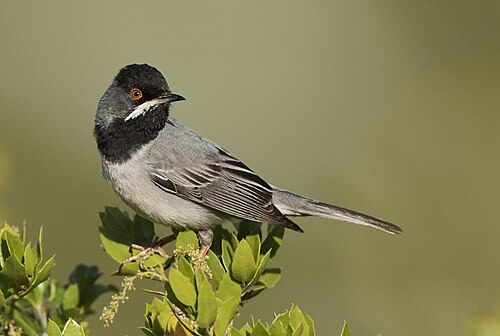 | A – rare vagrant | LC[485] |
| Sardinian warbler(Curruca melanocephala) | 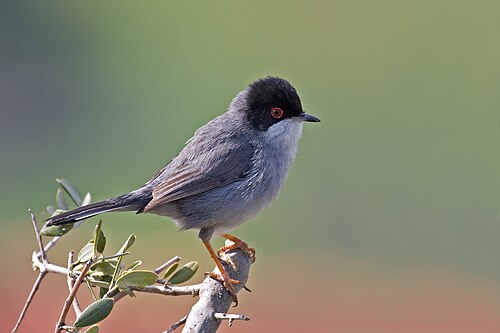 | A – rare vagrant | LC[486] |
| Western subalpine warbler(Curruca iberiae) |  | A – rare vagrant | |
| Moltoni's subalpine warbler(Curruca subalpina) |  | A – rare vagrant | LC[487] |
| Eastern subalpine warbler(Curruca cantillans) |  | A – rare vagrant | LC[488] |
| Whitethroat(Curruca communis) |  | A – breeding summer visitor | LC[489] |
| Spectacled warbler(Curruca conspicillata) |  | A – rare vagrant | LC[490] |
| Marmora's warbler(Curruca sarda) |  | A – rare vagrant | LC[491] |
| Dartford warbler(Curruca undata) |  | A – resident breeding species | NT[492] |
Kinglets
Order: Passeriformes Family: Regulidae
A family of very small birds.
| Common and binomial names | Image | Status | Conservation status |
|---|---|---|---|
| Ruby-crowned kinglet(Corthylio calendula) | 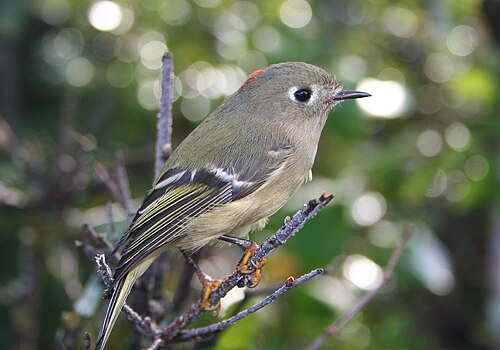 | A – rare vagrant; first recorded 2020[493] | LC[494] |
| Goldcrest(Regulus regulus) |  | A – resident breeding species | LC[495] |
| Firecrest(Regulus ignicapillus) |  | A – scarce resident breeding species and passage migrant | LC[496] |
Wrens
Order: Passeriformes Family: Troglodytidae
Wrens are small and inconspicuous birds, except for their loud songs. They have short wings and thin down-turned bills.
| Common and binomial names | Image | Status | Conservation status |
|---|---|---|---|
| Wren(Troglodytes troglodytes) |  | A – resident breeding species | LC[497] |
Nuthatches
Order: Passeriformes Family: Sittidae
Nuthatches are small woodland birds with the unusual ability to climb down trees head-first, unlike other birds which can only go upwards.
| Common and binomial names | Image | Status | Conservation status |
|---|---|---|---|
| Red-breasted nuthatch(Sitta canadensis) | 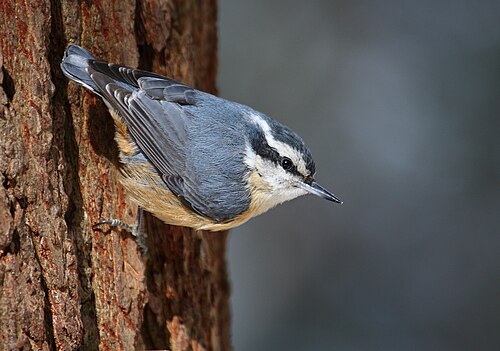 | A – rare vagrant | LC[498] |
| Nuthatch(Sitta europaea) |  | A – resident breeding species | LC[499] |
Wallcreeper
Order: Passeriformes Family: Tichodromadidae
One species, in its own family, a rare visitor to Britain.
| Common and binomial names | Image | Status | Conservation status |
|---|---|---|---|
| Wallcreeper(Tichodroma muraria) |  | A – rare vagrant | LC[500] |
Treecreepers
Order: Passeriformes Family: Certhiidae
Treecreepers are small woodland birds, brown above and white below. They have thin, pointed, down-curved bills, which they use to extricate insects from bark.
| Common and binomial names | Image | Status | Conservation status |
|---|---|---|---|
| Treecreeper(Certhia familiaris) |  | A – resident breeding species | LC[501] |
| Short-toed treecreeper(Certhia brachydactyla) |  | A – rare vagrant | LC[502] |
Mockingbirds and thrashers
Order: Passeriformes Family: Mimidae
Medium-sized passerine birds with long tails. Some are notable for their ability to mimic sounds such as other birds' songs.
| Common and binomial names | Image | Status | Conservation status |
|---|---|---|---|
| Grey catbird(Dumetella carolinensis) |  | A – rare vagrant (two records) | LC[503] |
| Northern mockingbird(Mimus polyglottos) |  | A – rare vagrant | LC[504] |
| Brown thrasher(Toxostoma rufum) |  | A – rare vagrant (one record) | LC[505] |
Starlings
Order: Passeriformes Family: Sturnidae
Starlings are small to medium-sized passerine birds with strong feet. Their flight is strong and direct and most are very gregarious.
| Common and binomial names | Image | Status | Conservation status |
|---|---|---|---|
| Rose-coloured starling(Pastor roseus) |  | A – rare vagrant | LC[506] |
| Starling(Sturnus vulgaris) |  | A – resident breeding species and winter visitor | LC[507] |
Thrushes and allies
Order: Passeriformes Family: Turdidae
The thrushes are plump, soft-plumaged, small to medium-sized insectivores or sometimes omnivores, often feeding on the ground. Many have attractive songs.
| Common and binomial names | Image | Status | Conservation status |
|---|---|---|---|
| Varied thrush(Ixoreus naevius) | 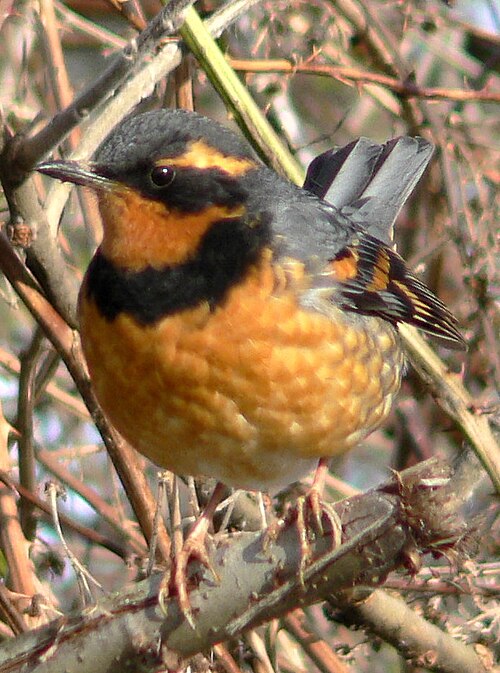 | A – very rare vagrant (two records as of 2023) | LC[508] |
| Wood thrush(Hylocichla mustelina) |  | A – rare vagrant | LC[509] |
| Swainson's thrush(Catharus ustulatus) |  | A – rare vagrant | LC[510] |
| Hermit thrush(Catharus guttatus) |  | A – rare vagrant | LC[511] |
| Grey-cheeked thrush(Catharus minimus) | 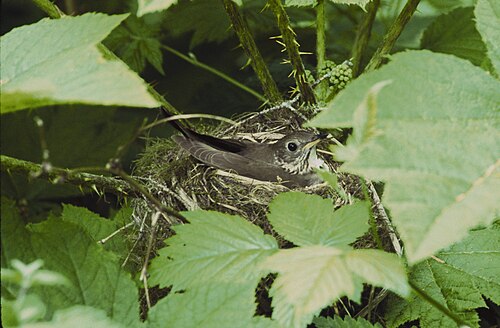 | A – rare vagrant | LC[512] |
| Veery(Catharus fuscescens) |  | A – rare vagrant | LC[513] |
| White's thrush(Zoothera aurea) |  | A – rare vagrant | LC[514] |
| Siberian thrush(Geokichla sibirica) |  | A – rare vagrant | LC[515] |
| Song thrush(Turdus philomelos) |  | A – resident breeding species | LC[516] |
| Mistle thrush(Turdus viscivorus) |  | A – resident breeding species | LC[517] |
| Redwing(Turdus iliacus) | 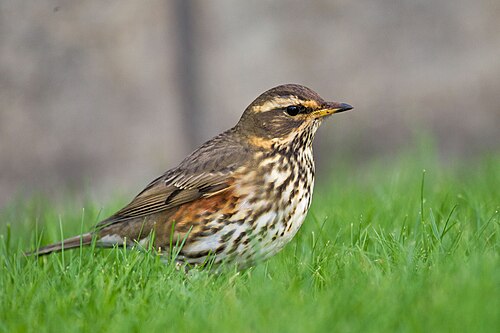 | A – winter visitor, rare breeder; two subspecies:
| LC[518] |
| Blackbird(Turdus merula) | 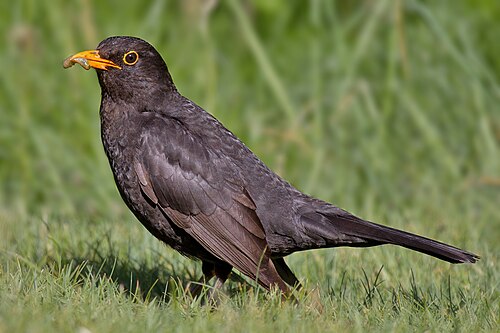 | A – resident breeding species | LC[519] |
| Eyebrowed thrush(Turdus obscurus) | 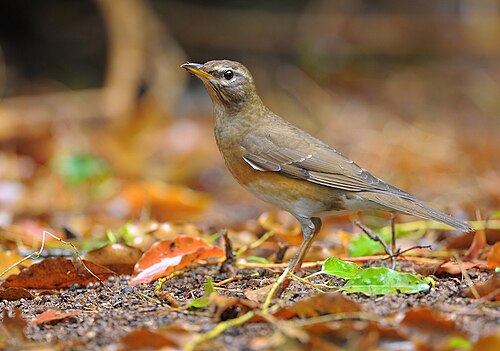 | A – rare vagrant | LC[520] |
| Fieldfare(Turdus pilaris) |  | A – winter visitor, rare breeder | LC[521] |
| Ring ouzel(Turdus torquatus) |  | A – breeding summer visitor | LC[522] |
| Black-throated thrush(Turdus atrogularis) |  | A – rare vagrant | LC[523] |
| Red-throated thrush(Turdus ruficollis) |  | A – rare vagrant | LC[524] |
| Dusky thrush(Turdus eunomus) |  | A – rare vagrant | LC[525] |
| Naumann's thrush(Turdus naumanni) |  | A – rare vagrant | LC[526] |
| American robin(Turdus migratorius) | 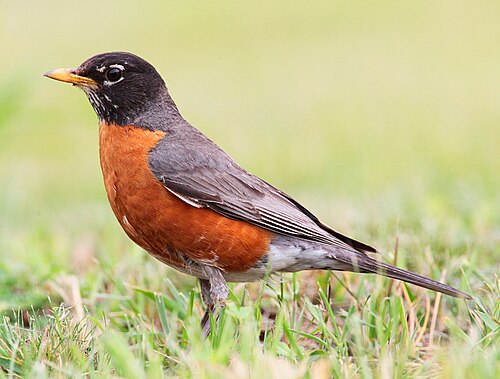 | A – rare vagrant | LC[527] |
Old World flycatchers
Order: Passeriformes Family: Muscicapidae. Subfamily: Muscicapinae
The flycatchers and chats are small, mainly insectivorous birds. The flycatchers fly out from a perch to catch insects in the air.
| Common and binomial names | Image | Status | Conservation status |
|---|---|---|---|
| Rufous-tailed scrub robin(Cercotrichas galactotes) |  | A – rare vagrant | LC[528] |
| Spotted flycatcher(Muscicapa striata) |  | A – breeding summer visitor | LC[529] |
| Asian brown flycatcher(Muscicapa dauurica) |  | A – rare vagrant | LC[530] |
| Robin(Erithacus rubecula) | 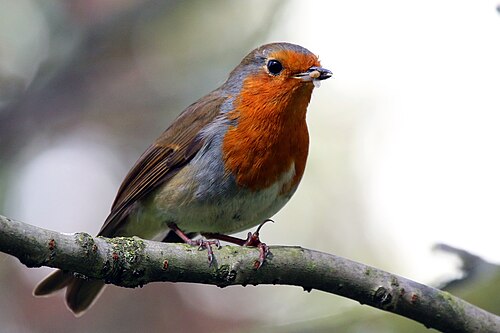 | A – resident breeding species | LC[531] |
| Siberian blue robin(Larvivora cyanea) |  | A – rare vagrant | LC[532] |
| Rufous-tailed robin(Larvivora sibilans) |  | A – rare vagrant | LC[533] |
| Bluethroat(Luscinia svecica) |  | A – scarce migrant, occasional breeder; two subspecies:
| LC[534] |
| Thrush nightingale(Luscinia luscinia) |  | A – rare vagrant | LC[535] |
| Nightingale(Luscinia megarhynchos) |  | A – breeding summer visitor | LC[536] |
| White-throated robin(Irania gutturalis) | 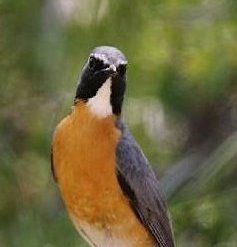 | A – rare vagrant | LC[537] |
| Siberian rubythroat(Calliope calliope) |  | A – rare vagrant | LC[538] |
| Red-flanked bluetail(Tarsiger cyanurus) | 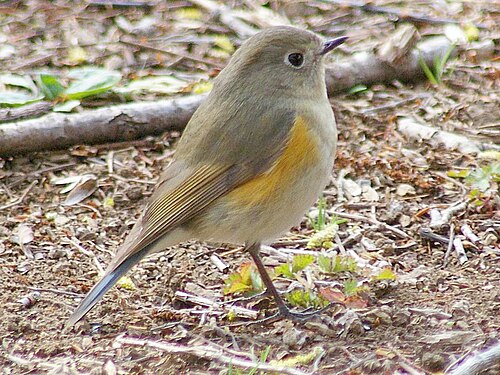 | A – scarce migrant, formerly a rare vagrant[195] | LC[539] |
| Taiga flycatcher(Ficedula albicilla) | 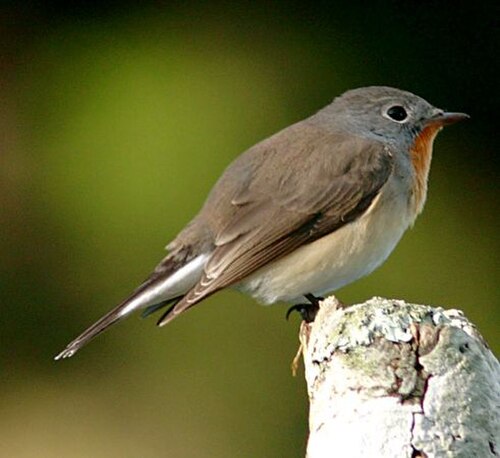 | A – rare vagrant | LC[540] |
| Red-breasted flycatcher(Ficedula parva) | 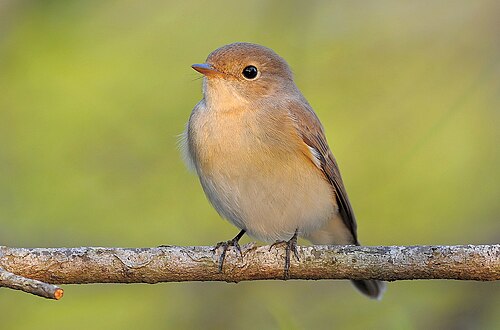 | A – scarce migrant | LC[541] |
| Pied flycatcher(Ficedula hypoleuca) |  | A – breeding summer visitor | LC[542] |
| Collared flycatcher(Ficedula albicollis) |  | A – rare vagrant | LC[543] |
| Black redstart(Phoenicurus ochruros) |  | A – scarce breeding resident, passage migrant and winter visitor | LC[544] |
| Redstart(Phoenicurus phoenicurus) |  | A – breeding summer visitor | LC[545] |
| Moussier's redstart(Phoenicurus moussieri) |  | A – rare vagrant | LC[546] |
| Rock thrush(Monticola saxatilis) | 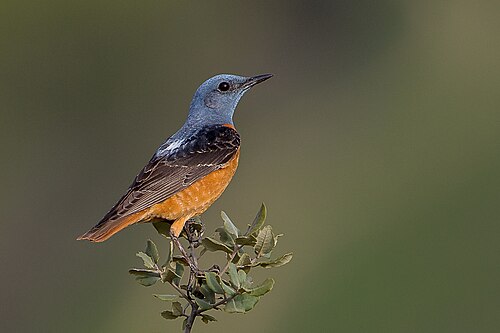 | A – rare vagrant | LC[547] |
| Blue rock thrush(Monticola solitarius) |  | A – rare vagrant | LC[548] |
| Whinchat(Saxicola rubetra) |  | A – breeding summer visitor and passage migrant | LC[549] |
| Stonechat(Saxicola rubicola) |  | A – resident breeding species | |
| Siberian stonechat(Saxicola maurus) |  | A – rare vagrant | |
| Stejneger's stonechat(Saxicola stejnegeri) |  | A – rare vagrant | |
| Wheatear(Oenanthe oenanthe) | 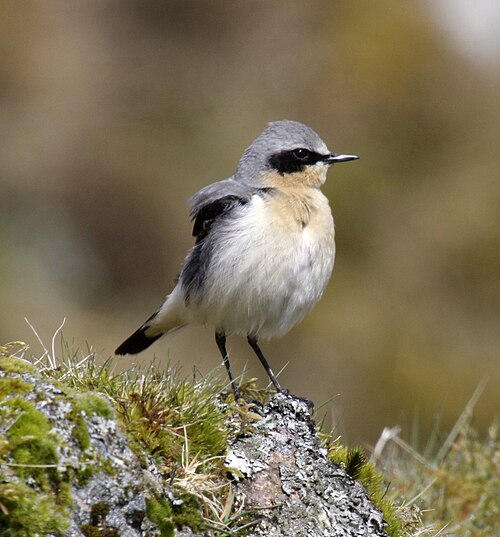 | A – breeding summer visitor and passage migrant | LC[550] |
| Isabelline wheatear(Oenanthe isabellina) |  | A – rare vagrant | LC[551] |
| Desert wheatear(Oenanthe deserti) |  | A – rare vagrant | NT[552] |
| Western black-eared wheatear(Oenanthe hispanica) |  | A – rare vagrant | LC[553] |
| Eastern black-eared wheatear(Oenanthe melanoleuca) |  | A – rare vagrant | |
| Pied wheatear(Oenanthe pleschanka) |  | A – rare vagrant | LC[554] |
| White-crowned black wheatear(Oenanthe leucopyga) |  | A – rare vagrant | LC[555] |
Dippers
Order: Passeriformes Family: Cinclidae
Dark, dumpy, aquatic birds which are able to forage for food on the beds of rivers.
| Common and binomial names | Image | Status | Conservation status |
|---|---|---|---|
| Dipper(Cinclus cinclus) |  | A – resident breeding species | LC[556] |
Old World sparrows
Order: Passeriformes Family: Passeridae
Sparrows tend to be small, plump, brownish or greyish birds with short tails and short, powerful beaks. They are seed-eaters and they also consume small insects.
| Common and binomial names | Image | Status | Conservation status |
|---|---|---|---|
| Rock sparrow(Petronia petronia) |  | A – rare vagrant | LC[557] |
| Tree sparrow(Passer montanus) |  | A – resident breeding species | LC[558] |
| Spanish sparrow(Passer hispaniolensis) | 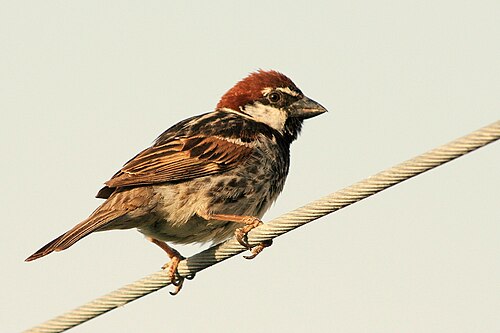 | A – rare vagrant | LC[559] |
| House sparrow(Passer domesticus) |  | A – resident breeding species | LC[560] |
Accentors
Order: Passeriformes Family: Prunellidae
A small family of drab, unobtrusive, insectivorous birds with thin, pointed bills.
| Common and binomial names | Image | Status | Conservation status |
|---|---|---|---|
| Alpine accentor(Prunella collaris) |  | A – rare vagrant | LC[561] |
| Siberian accentor(Prunella montanella) |  | A – rare vagrant with multiple records in 2016 | LC[562] |
| Dunnock(Prunella modularis) |  | A – resident breeding species | LC[563] |
Wagtails and pipits
Order: Passeriformes Family: Motacillidae
Motacillidae is a family of small passerine birds with medium to long tails. They are slender, ground-feeding insectivores of open country.
| Common and binomial names | Image | Status | Conservation status |
|---|---|---|---|
| Yellow wagtail(Motacilla flava) |  | Six subspecies:
| LC[564] |
| Eastern yellow wagtail(Motacilla tschutschensis) |  | A – rare vagrant | LC[565] |
| Citrine wagtail(Motacilla citreola) |  | A – scarce migrant, formerly a rare vagrant[195] | LC[566] |
| Grey wagtail(Motacilla cinerea) |  | A – resident breeding species | LC[567] |
| Pied wagtail(Motacilla alba) |  | A – resident breeding species with three additional visiting subspecies
| LC[568] |
| Richard's pipit(Anthus richardi) |  | A – scarce migrant | LC[569] |
| Blyth's pipit(Anthus godlewskii) |  | A – rare vagrant | LC[570] |
| Tawny pipit(Anthus campestris) |  | A – rare vagrant, formerly a scarce migrant[195] | LC[571] |
| Meadow pipit(Anthus pratensis) |  | A – resident breeding species | LC[572] |
| Tree pipit(Anthus trivialis) |  | A – breeding summer visitor | LC[573] |
| Olive-backed pipit(Anthus hodgsoni) | 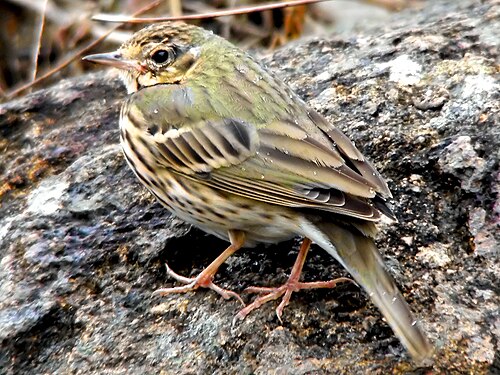 | A – rare vagrant | LC[574] |
| Pechora pipit(Anthus gustavi) |  | A – rare vagrant | CR[575] |
| Red-throated pipit(Anthus cervinus) | 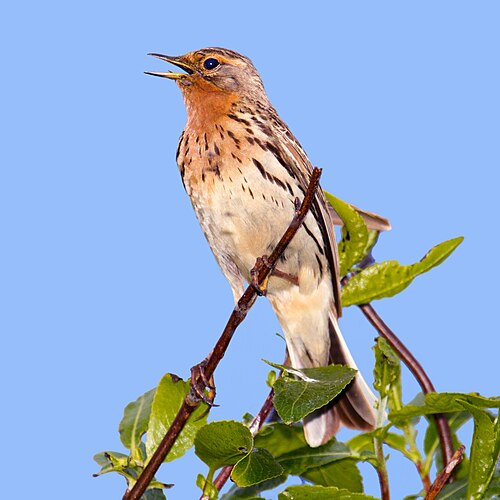 | A – rare vagrant, formerly a scarce migrant[195] | LC[576] |
| Buff-bellied pipit(Anthus rubescens) |  | A – rare vagrant | LC[577] |
| Water pipit(Anthus spinoletta) |  | A – winter visitor | LC[578] |
| Rock pipit(Anthus petrosus) |  | A – resident breeding species | LC[579] |
Finches, euphonias, and allies
Order: Passeriformes Family: Fringillidae
Seed-eating passerine birds that are small to moderately large and have a strong beak, usually conical and in some species very large.
| Common and binomial names | Image | Status | Conservation status |
|---|---|---|---|
| Chaffinch(Fringilla coelebs) | 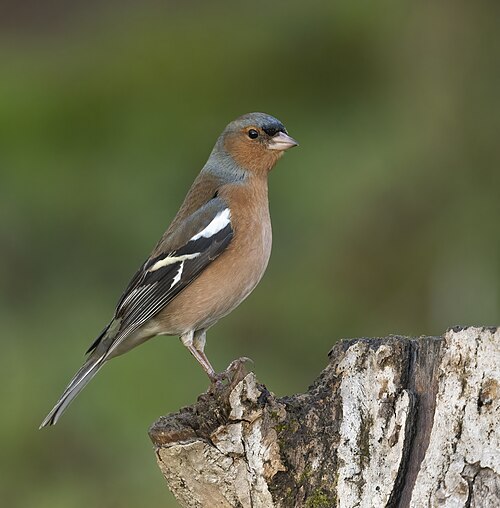 | A – resident breeding species | LC[580] |
| Brambling(Fringilla montifringilla) |  | A – winter visitor, occasional breeder | LC[581] |
| Evening grosbeak(Hesperiphona vespertina) |  | A – rare vagrant | VU[582] |
| Hawfinch(Coccothraustes coccothraustes) |  | A – scarce resident breeding species | LC[583] |
| Pine grosbeak(Pinicola enucleator) |  | A – rare vagrant | LC[584] |
| Bullfinch(Pyrrhula pyrrhula) |  | A – resident breeding species | LC[585] |
| Trumpeter finch(Bucanetes githagineus) |  | A – rare vagrant | LC[586] |
| Common rosefinch(Carpodacus erythrinus) |  | A – scarce migrant, occasional breeder | LC[587] |
| Greenfinch(Chloris chloris) |  | A – resident breeding species | LC[588] |
| Twite(Linaria flavirostris) |  | A – resident breeding species | LC[589] |
| Linnet(Linaria cannabina) |  | A – resident breeding species | LC[590] |
| Common redpoll(Acanthis flammea) |  | A – winter visitor and passage migrant, occasional breeder | LC[591] |
| Lesser redpoll(Acanthis cabaret) |  | A – resident breeding species | |
| Arctic redpoll(Acanthis hornemanni) |  | A – rare vagrant[195] | |
| Parrot crossbill(Loxia pytyopsittacus) |  | A – resident breeding species | LC[592] |
| Scottish crossbill(Loxia scotica) | A – resident endemic breeding species | LC[593] | |
| Common crossbill(Loxia curvirostra) |  | A – resident breeding species | LC[594] |
| Two-barred crossbill(Loxia leucoptera) |  | A – rare vagrant | LC[595] |
| Goldfinch(Carduelis carduelis) |  | A – resident breeding species | LC[596] |
| Citril finch(Carduelis citrinella) |  | A – rare vagrant | LC[597] |
| Serin(Serinus serinus) |  | A – scarce passage migrant, occasional breeder | LC[598] |
| Siskin(Spinus spinus) | 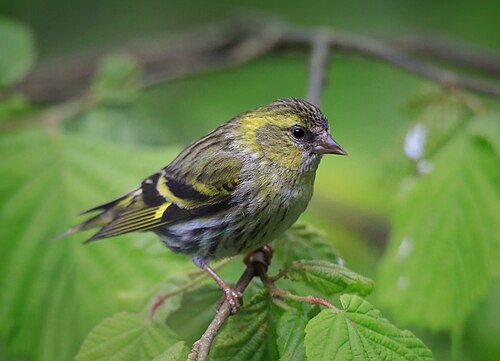 | A – resident breeding species and winter visitor | LC[599] |
Longspurs and arctic buntings
Order: Passeriformes Family: Calcariidae
A small family of migratory seed eating birds.
| Common and binomial names | Image | Status | Conservation status |
|---|---|---|---|
| Lapland bunting(Calcarius lapponicus) |  | A – winter visitor, occasional breeder | LC[600] |
| Snow bunting(Plectrophenax nivalis) |  | A – winter visitor and scarce breeder | LC[601] |
Old World buntings
Order: Passeriformes Family: Emberizidae. A large group of seed-eating passerine birds with a distinctively shaped bill.
| Common and binomial names | Image | Status | Conservation status |
|---|---|---|---|
| Corn bunting(Emberiza calandra) |  | A – resident breeding species | LC[602] |
| Yellowhammer(Emberiza citrinella) |  | A – resident breeding species | LC[603] |
| Pine bunting(Emberiza leucocephalos) |  | A – rare vagrant | RE[604] |
| Rock bunting(Emberiza cia) |  | A – rare vagrant | LC[605] |
| Ortolan bunting(Emberiza hortulana) |  | A – scarce migrant | LC[606] |
| Cretzschmar's bunting(Emberiza caesia) |  | A – rare vagrant | LC[607] |
| Cirl bunting(Emberiza cirlus) |  | A – resident breeding species | LC[608] |
| Chestnut-eared bunting(Emberiza fucata) |  | A – rare vagrant | LC[609] |
| Little bunting(Emberiza pusilla) |  | A – scarce migrant | LC[610] |
| Yellow-browed bunting(Emberiza chrysophrys) |  | A – rare vagrant | LC[611] |
| Rustic bunting(Emberiza rustica) |  | A – rare vagrant, formerly a scarce migrant[195] | LC[612] |
| Yellow-breasted bunting(Emberiza aureola) |  | A – rare vagrant | CR[613] |
| Chestnut bunting(Emberiza rutila) |  | A – rare vagrant | LC[614] |
| Black-headed bunting(Emberiza melanocephala) |  | A – rare vagrant | LC[615] |
| Red-headed bunting(Emberiza bruniceps) |  | A – rare vagrant | LC[616] |
| Black-faced bunting(Emberiza spodocephala) |  | A – rare vagrant | LC[617] |
| Pallas's reed bunting(Emberiza pallasi) |  | A – rare vagrant | LC[618] |
| Reed bunting(Emberiza schoeniclus) |  | A – resident breeding species | LC[619] |
New World sparrows
Order: Passeriformes Family: Passerellidae.
A seed eating group of species, recently split from the family Emberizidae.
| Common and binomial names | Image | Status | Conservation status |
|---|---|---|---|
| Lark sparrow(Chondestes grammacus) | 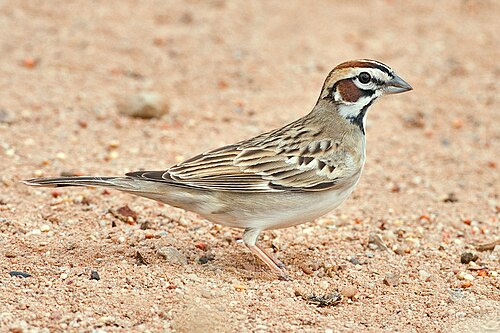 | A – rare vagrant | LC[620] |
| Dark-eyed junco(Junco hyemalis) |  | A – rare vagrant | LC[621] |
| White-crowned sparrow(Zonotrichia leucophrys) |  | A – rare vagrant | LC[622] |
| White-throated sparrow(Zonotrichia albicollis) |  | A – rare vagrant | LC[623] |
| Savannah sparrow(Passerculus sandwichensis) |  | A – rare vagrant | LC[624] |
| Song sparrow(Melospiza melodia) |  | A – rare vagrant | LC[625] |
| Eastern towhee(Pipilo erythrophthalmus) |  | A – rare vagrant | LC[626] |
Troupials and allies
Order: Passeriformes Family: Icteridae.
The icterids are a group of small to medium-sized, often colorful passerine birds restricted to the New World and include the grackles, New World blackbirds, and New World orioles. Most species have black as a predominant plumage color, often enlivened by yellow, orange, or red.
| Common and binomial names | Image | Status | Conservation status |
|---|---|---|---|
| Bobolink(Dolichonyx oryzivorus) |  | A – rare vagrant | NT[627] |
| Baltimore oriole(Icterus galbula) | 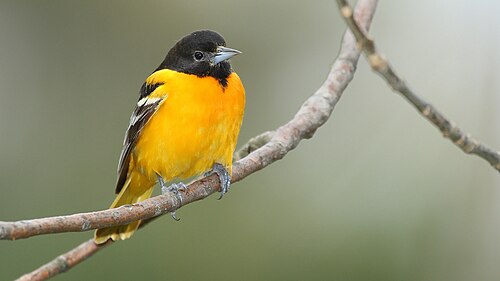 | A – rare vagrant | LC[628] |
| Red-winged blackbird(Agelaius phoeniceus) |  | A – rare vagrant | LC[629] |
| Brown-headed cowbird(Molothrus ater) |  | A – rare vagrant | LC[630] |
New World warblers
Order: Passeriformes Family: Parulidae
A group of small, often colourful passerine birds restricted to the New World. Most are arboreal and insectivorous.
| Common and binomial names | Image | Status | Conservation status |
|---|---|---|---|
| Ovenbird(Seiurus aurocapilla) |  | A – rare vagrant | LC[631] |
| Northern waterthrush(Parkesia noveboracensis) |  | A – rare vagrant | LC[632] |
| Golden-winged warbler(Vermivora chrysoptera) |  | A – rare vagrant | NT[633] |
| Black-and-white warbler(Mniotilta varia) |  | A – rare vagrant | LC[634] |
| Tennessee warbler(Leiothlypis peregrina) |  | A – rare vagrant | LC[635] |
| Common yellowthroat(Geothlypis trichas) | 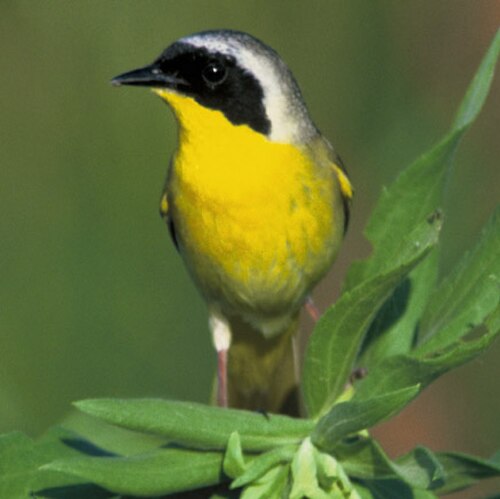 | A – rare vagrant | LC[636] |
| Hooded warbler(Setophaga citrina) |  | A – rare vagrant | LC[637] |
| American redstart(Setophaga ruticilla) |  | A – rare vagrant | LC[638] |
| Cape May warbler(Setophaga tigrina) |  | A – rare vagrant | LC[639] |
| Northern parula(Setophaga americana) |  | A – rare vagrant | LC[640] |
| Magnolia warbler(Setophaga magnolia) |  | A – rare vagrant | LC[641] |
| Bay-breasted warbler(Setophaga castanea) |  | A – rare vagrant | LC[642] |
| Blackburnian warbler(Setophaga fusca) |  | A – rare vagrant | LC[643] |
| Yellow warbler(Setophaga petechia) |  | A – rare vagrant | LC[644] |
| Chestnut-sided warbler(Setophaga pensylvanica) |  | A – rare vagrant | LC[645] |
| Blackpoll warbler(Setophaga striata) |  | A – rare vagrant | NT[646] |
| Yellow-rumped warbler(Setophaga coronata) |  | A – rare vagrant | LC[647] |
| Canada warbler(Cardellina canadensis) |  | A – rare vagrant, one record | LC[648] |
| Wilson's warbler(Cardellina pusilla) |  | A – rare vagrant | LC[649] |
Cardinals and allies
Order: Passeriformes Family: Cardinalidae
The cardinals are a family of robust, seed-eating birds with strong bills. They are typically associated with open woodland. The sexes usually have distinct plumages.
| Common and binomial names | Image | Status | Conservation status |
|---|---|---|---|
| Summer tanager(Piranga rubra) |  | A – rare vagrant | LC[650] |
| Scarlet tanager(Piranga olivacea) |  | A – rare vagrant | LC[651] |
| Rose-breasted grosbeak(Pheucticus ludovicianus) |  | A – rare vagrant | LC[652] |
| Indigo bunting(Passerina cyanea) |  | A – rare vagrant | LC[653] |
The links above lead to family accounts and individual species. Taxonomy is very fluid in the age of DNA analysis, so other arrangements may be found, as in Sibley-Ahlquist taxonomy.
Species awaiting acceptance
The following species have been recorded recently and the British Ornithologists' Union Records Committee has not yet made a decision on whether to accept them onto the British List.
| Common and binomial names | Image | Status |
|---|---|---|
| Fea's petrel(Pterodroma feae) |  | A – rare vagrant, previously accepted onto the British list as Fea's petrel but since split into three distinct species |
See also
References
- ↑British Ornithologists' Union (2013). "The British List". Ibis. 155: 635–676. doi:10.1111/ibi.12069.
- ↑"Maintaining the British List". BOU. Retrieved 4 May 2020.
- ↑BOURC. "Species categories". Retrieved 9 December 2012.
- ↑Dudley, Steve P. "Changes to the British List (13 August 2024)". British Ornithologists' Union. Retrieved 13 August 2024.
- ↑"Scottish Crossbill information". Trees for Life. 2 September 2025. Retrieved 24 March 2026.
- ↑Benkman, Craig (2025). Crossbills and Conifers: One Million Years of Adaptation and Coevolution. Exeter: Pelagic Publishing Ltd. p. 9. ISBN 978-1-78427-552-5.
- ↑BirdLife International. (2021). "Branta bernicla". IUCN Red List of Threatened Species. 2021 e.T22679946A189780266. doi:10.2305/IUCN.UK.2021-3.RLTS.T22679946A189780266.en. Retrieved 25 March 2026.
- ↑BirdLife International. (2025). "Branta ruficollis". IUCN Red List of Threatened Species. 2025 e.T22679954A154473642. doi:10.2305/IUCN.UK.2025-2.RLTS.T22679954A154473642.en. Retrieved 27 March 2026.
- ↑BirdLife International. (2018). "Branta canadensis". IUCN Red List of Threatened Species. 2018 e.T22679935A131909406. doi:10.2305/IUCN.UK.2018-2.RLTS.T22679935A131909406.en. Retrieved 27 March 2026.
- ↑BirdLife International. (2018). "Branta leucopsis". IUCN Red List of Threatened Species. 2018 e.T22679943A131909954. doi:10.2305/IUCN.UK.2018-2.RLTS.T22679943A131909954.en. Retrieved 27 March 2026.
- ↑BirdLife International. (2021). "Branta hutchinsii". IUCN Red List of Threatened Species. 2021 e.T22733619A139214707. doi:10.2305/IUCN.UK.2021-3.RLTS.T22733619A139214707.en. Retrieved 27 March 2026.
- ↑"Ross's Goose added to Category A of British list". Birdguides. 29 November 2021. Retrieved 2 December 2021.
- ↑BirdLife International. (2021). "Anser rossii". IUCN Red List of Threatened Species. 2021 e.T22679909A136898830. doi:10.2305/IUCN.UK.2021-3.RLTS.T22679909A136898830.en. Retrieved 27 March 2026.
- ↑BirdLife International. (2021). "Anser caerulescens (Europe assessment)". IUCN Red List of Threatened Species. 2021 e.T22679896A166194881. doi:10.2305/IUCN.UK.2021-3.RLTS.T22679896A166194881.en. Retrieved 27 March 2026.
- ↑BirdLife International. (2021). "Anser anser (Europe assessment)". IUCN Red List of Threatened Species. 2021 e.T22679889A166194209. doi:10.2305/IUCN.UK.2021-3.RLTS.T22679889A166194209.en. Retrieved 27 March 2026.
- ↑BirdLife International. (2021). "Anser fabalis (Europe assessment)". IUCN Red List of Threatened Species. 2021 e.T22679875A166192296. doi:10.2305/IUCN.UK.2021-3.RLTS.T22679875A166192296.en. Retrieved 27 March 2026.
- ↑BirdLife International. (2025). "Anser brachyrhynchus". IUCN Red List of Threatened Species. 2025 e.T22679872A281837234. doi:10.2305/IUCN.UK.2025-2.RLTS.T22679872A281837234.en. Retrieved 27 March 2026.
- ↑BirdLife International. (2022). "Anser albifrons". IUCN Red List of Threatened Species. 2022 e.T22679881A213839615. doi:10.2305/IUCN.UK.2022-2.RLTS.T22679881A213839615.en. Retrieved 27 March 2026.
- ↑BirdLife International. (2021). "Anser erythropus (Europe assessment)". IUCN Red List of Threatened Species. 2021 e.T22679886A166193479. doi:10.2305/IUCN.UK.2021-3.RLTS.T22679886A166193479.en. Retrieved 27 March 2026.
- ↑BirdLife International. (2021). "Cygnus olor (Europe assessment)". IUCN Red List of Threatened Species. 2021 e.T22679839A166189862. doi:10.2305/IUCN.UK.2021-3.RLTS.T22679839A166189862.en. Retrieved 27 March 2026.
- ↑BirdLife International. (2021). "Cygnus columbianus (Europe assessment)". IUCN Red List of Threatened Species. 2021 e.T22679862A166191206. doi:10.2305/IUCN.UK.2021-3.RLTS.T22679862A166191206.en. Retrieved 27 March 2026.
- ↑BirdLife International. (2025). "Cygnus cygnus". IUCN Red List of Threatened Species. 2025 e.T22679856A281843607. doi:10.2305/IUCN.UK.2025-2.RLTS.T22679856A281843607.en. Retrieved 27 March 2026.
- ↑BirdLife International. (2018). "Alopochen aegyptiaca". IUCN Red List of Threatened Species. 2018 e.T22679993A131910647. doi:10.2305/IUCN.UK.2018-2.RLTS.T22679993A131910647.en. Retrieved 27 March 2026.
- ↑BirdLife International. (2021). "Tadorna tadorna (Europe assessment)". IUCN Red List of Threatened Species. 2021 e.T22680024A166197940. doi:10.2305/IUCN.UK.2021-3.RLTS.T22680024A166197940.en. Retrieved 27 March 2026.
- ↑BirdLife International. (2021). "Tadorna ferruginea (Europe assessment)". IUCN Red List of Threatened Species. 2021 e.T22680003A166197286. doi:10.2305/IUCN.UK.2021-3.RLTS.T22680003A166197286.en. Retrieved 27 March 2026.
- ↑BirdLife International. (2018). "Aix galericulata". IUCN Red List of Threatened Species. 2018 e.T22680107A131911544. doi:10.2305/IUCN.UK.2018-2.RLTS.T22680107A131911544.en. Retrieved 27 March 2026.
- ↑BirdLife International. (2025). "Sibirionetta formosa". IUCN Red List of Threatened Species. 2025 e.T22680317A280907776. doi:10.2305/IUCN.UK.2025-2.RLTS.T22680317A280907776.en. Retrieved 27 March 2026.
- ↑BirdLife International. (2021). "Spatula querquedula (Europe assessment)". IUCN Red List of Threatened Species. 2021 e.T22680313A166201991. doi:10.2305/IUCN.UK.2021-3.RLTS.T22680313A166201991.en. Retrieved 27 March 2026.
- ↑BirdLife International. (2021). "Spatula discors". IUCN Red List of Threatened Species. 2021 e.T22680229A137731845. doi:10.2305/IUCN.UK.2021-3.RLTS.T22680229A137731845.en. Retrieved 27 March 2026.
- ↑BirdLife International. (2021). "Spatula clypeata (Europe assessment)". IUCN Red List of Threatened Species. 2021 e.T22680247A166200605. doi:10.2305/IUCN.UK.2021-3.RLTS.T22680247A166200605.en. Retrieved 27 March 2026.
- ↑BirdLife International. (2021). "Mareca strepera (Europe assessment)". IUCN Red List of Threatened Species. 2021 e.T22680149A166198537. doi:10.2305/IUCN.UK.2021-3.RLTS.T22680149A166198537.en. Retrieved 27 March 2026.
- ↑BirdLife International. (2024). "Mareca falcata". IUCN Red List of Threatened Species. 2024 e.T22680153A228594770. doi:10.2305/IUCN.UK.2024-2.RLTS.T22680153A228594770.en. Retrieved 27 March 2026.
- ↑BirdLife International. (2021). "Mareca penelope (Europe assessment)". IUCN Red List of Threatened Species. 2021 e.T22680157A166199138. doi:10.2305/IUCN.UK.2021-3.RLTS.T22680157A166199138.en. Retrieved 27 March 2026.
- ↑BirdLife International. (2021). "Mareca americana". IUCN Red List of Threatened Species. 2021 e.T22680163A137010293. doi:10.2305/IUCN.UK.2021-3.RLTS.T22680163A137010293.en. Retrieved 27 March 2026.
- ↑BirdLife International. (2025). "Anas platyrhynchos". IUCN Red List of Threatened Species. 2025 e.T22680186A281835571. doi:10.2305/IUCN.UK.2025-2.RLTS.T22680186A281835571.en. Retrieved 27 March 2026.
- ↑BirdLife International. (2021). "Anas rubripes". IUCN Red List of Threatened Species. 2021 e.T22680174A137023072. doi:10.2305/IUCN.UK.2021-3.RLTS.T22680174A137023072.en. Retrieved 27 March 2026.
- ↑BirdLife International. (2019). "Anas acuta". IUCN Red List of Threatened Species. 2019 e.T22680301A153882797. doi:10.2305/IUCN.UK.2019-3.RLTS.T22680301A153882797.en. Retrieved 27 March 2026.
- ↑BirdLife International. (2021). "Anas crecca (Europe assessment)". IUCN Red List of Threatened Species. 2021 e.T22680321A200197945. doi:10.2305/IUCN.UK.2021-3.RLTS.T22680321A200197945.en. Retrieved 27 March 2026.
- ↑BirdLife International. (2020). "Anas carolinensis". IUCN Red List of Threatened Species. 2020 e.T22729498A181562690. doi:10.2305/IUCN.UK.2020-3.RLTS.T22729498A181562690.en. Retrieved 27 March 2026.
- ↑BirdLife International. (2021). "Netta rufina (Europe assessment)". IUCN Red List of Threatened Species. 2021 e.T22680348A166203300. doi:10.2305/IUCN.UK.2021-3.RLTS.T22680348A166203300.en. Retrieved 27 March 2026.
- ↑BirdLife International. (2021). "Aythya valisineria". IUCN Red List of Threatened Species. 2021 e.T22680364A137943278. doi:10.2305/IUCN.UK.2021-3.RLTS.T22680364A137943278.en. Retrieved 27 March 2026.
- ↑BirdLife International. (2021). "Aythya americana". IUCN Red List of Threatened Species. 2021 e.T22680367A137752425. doi:10.2305/IUCN.UK.2021-3.RLTS.T22680367A137752425.en. Retrieved 27 March 2026.
- ↑BirdLife International. (2021). "Aythya ferina (Europe assessment)". IUCN Red List of Threatened Species. 2021 e.T22680358A166203854. doi:10.2305/IUCN.UK.2021-3.RLTS.T22680358A166203854.en. Retrieved 27 March 2026.
- ↑BirdLife International. (2021). "Aythya nyroca (Europe assessment)". IUCN Red List of Threatened Species. 2021 e.T22680373A166204665. doi:10.2305/IUCN.UK.2021-3.RLTS.T22680373A166204665.en. Retrieved 27 March 2026.
- ↑BirdLife International. (2021). "Aythya collaris". IUCN Red List of Threatened Species. 2021 e.T22680370A137908133. doi:10.2305/IUCN.UK.2021-3.RLTS.T22680370A137908133.en. Retrieved 27 March 2026.
- ↑BirdLife International. (2021). "Aythya fuligula (Europe assessment)". IUCN Red List of Threatened Species. 2021 e.T22680391A166205462. doi:10.2305/IUCN.UK.2021-3.RLTS.T22680391A166205462.en. Retrieved 27 March 2026.
- ↑BirdLife International. (2021). "Aythya marila (Europe assessment)". IUCN Red List of Threatened Species. 2021 e.T22680398A166206177. doi:10.2305/IUCN.UK.2021-3.RLTS.T22680398A166206177.en. Retrieved 27 March 2026.
- ↑BirdLife International. (2021). "Aythya affinis". IUCN Red List of Threatened Species. 2021 e.T22680402A139381357. doi:10.2305/IUCN.UK.2021-3.RLTS.T22680402A139381357.en. Retrieved 27 March 2026.
- ↑BirdLife International. (2022) [errata version of 2021 assessment]. "Polysticta stelleri (Europe assessment)". IUCN Red List of Threatened Species. 2021 e.T22680415A223059785. doi:10.2305/IUCN.UK.2021-3.RLTS.T22680415A223059785.en. Retrieved 27 March 2026.
- ↑BirdLife International. (2021). "Somateria spectabilis (Europe assessment)". IUCN Red List of Threatened Species. 2021 e.T22680409A166207567. doi:10.2305/IUCN.UK.2021-3.RLTS.T22680409A166207567.en. Retrieved 27 March 2026.
- ↑BirdLife International. (2021). "Somateria mollissima (Europe assessment)". IUCN Red List of Threatened Species. 2021 e.T22680405A166206891. doi:10.2305/IUCN.UK.2021-3.RLTS.T22680405A166206891.en. Retrieved 28 March 2026.
- ↑BirdLife International. (2021). "Histrionicus histrionicus (Europe assessment)". IUCN Red List of Threatened Species. 2021 e.T22680423A166208474. doi:10.2305/IUCN.UK.2021-3.RLTS.T22680423A166208474.en. Retrieved 28 March 2026.
- ↑BirdLife International. (2018). "Melanitta perspicillata". IUCN Red List of Threatened Species. 2018 e.T22680441A132528934. doi:10.2305/IUCN.UK.2018-2.RLTS.T22680441A132528934.en. Retrieved 28 March 2026.
- ↑BirdLife International. (2021). "Melanitta fusca (Europe assessment)". IUCN Red List of Threatened Species. 2021 e.T22724836A166428184. doi:10.2305/IUCN.UK.2021-3.RLTS.T22724836A166428184.en. Retrieved 28 March 2026.
- ↑BirdLife International. (2018). "Melanitta deglandi". IUCN Red List of Threatened Species. 2018 e.T22734194A132663794. doi:10.2305/IUCN.UK.2018-2.RLTS.T22734194A132663794.en. Retrieved 28 March 2026.
- ↑"Stejneger's Scoter added to the British List". Rare Bird Alert. Retrieved 19 February 2024.
- ↑BirdLife International. (2018). "Melanitta stejnegeri". IUCN Red List of Threatened Species. 2018 e.T22724845A132655325. doi:10.2305/IUCN.UK.2018-2.RLTS.T22724845A132655325.en. Retrieved 28 March 2026.
- ↑BirdLife International. (2021). "Melanitta nigra (Europe assessment)". IUCN Red List of Threatened Species. 2021 e.T22724879A166428834. doi:10.2305/IUCN.UK.2021-3.RLTS.T22724879A166428834.en. Retrieved 28 March 2026.
- ↑BirdLife International. (2021). "Melanitta americana". IUCN Red List of Threatened Species. 2021 e.T22732425A178236617. doi:10.2305/IUCN.UK.2021-3.RLTS.T22732425A178236617.en. Retrieved 28 March 2026.
- ↑BirdLife International. (2021). "Clangula hyemalis (Europe assessment)". IUCN Red List of Threatened Species. 2021 e.T22680427A166208883. doi:10.2305/IUCN.UK.2021-3.RLTS.T22680427A166208883.en. Retrieved 28 March 2026.
- ↑BirdLife International. (2022). "Bucephala albeola". IUCN Red List of Threatened Species. 2022 e.T22680462A137784330. doi:10.2305/IUCN.UK.2022-1.RLTS.T22680462A137784330.en. Retrieved 28 March 2026.
- ↑BirdLife International. (2021). "Bucephala clangula (Europe assessment)". IUCN Red List of Threatened Species. 2021 e.T22680455A166209537. doi:10.2305/IUCN.UK.2021-3.RLTS.T22680455A166209537.en. Retrieved 28 March 2026.
- ↑BirdLife International. (2021). "Bucephala islandica (Europe assessment)". IUCN Red List of Threatened Species. 2021 e.T22680459A166210191. doi:10.2305/IUCN.UK.2021-3.RLTS.T22680459A166210191.en. Retrieved 28 March 2026.
- ↑BirdLife International. (2021). "Mergellus albellus (Europe assessment)". IUCN Red List of Threatened Species. 2021 e.T22680465A166210547. doi:10.2305/IUCN.UK.2021-3.RLTS.T22680465A166210547.en. Retrieved 28 March 2026.
- ↑BirdLife International. (2021). "Lophodytes cucullatus". IUCN Red List of Threatened Species. 2021 e.T22680472A137932133. doi:10.2305/IUCN.UK.2021-3.RLTS.T22680472A137932133.en. Retrieved 28 March 2026.
- ↑BirdLife International. (2021). "Mergus merganser (Europe assessment)". IUCN Red List of Threatened Species. 2021 e.T22680492A166211915. doi:10.2305/IUCN.UK.2021-3.RLTS.T22680492A166211915.en. Retrieved 28 March 2026.
- ↑BirdLife International. (2021). "Mergus serrator (Europe assessment)". IUCN Red List of Threatened Species. 2021 e.T22680485A166211173. doi:10.2305/IUCN.UK.2021-3.RLTS.T22680485A166211173.en. Retrieved 28 March 2026.
- ↑BirdLife International. (2018). "Oxyura jamaicensis". IUCN Red List of Threatened Species. 2018 e.T22727750A132178041. doi:10.2305/IUCN.UK.2018-2.RLTS.T22727750A132178041.en. Retrieved 28 March 2026.
- ↑BirdLife International. (2021). "Lagopus muta (Europe assessment)". IUCN Red List of Threatened Species. 2021 e.T22679464A166187006. doi:10.2305/IUCN.UK.2021-3.RLTS.T22679464A166187006.en. Retrieved 28 March 2026.
- ↑BirdLife International. (2021). "Tetrao urogallus (Europe assessment)". IUCN Red List of Threatened Species. 2021 e.T22679487A166188330. doi:10.2305/IUCN.UK.2021-3.RLTS.T22679487A166188330.en. Retrieved 28 March 2026.
- ↑BirdLife International. (2022) [errata version of 2021 assessment]. "Lyrurus tetrix (Europe assessment)". IUCN Red List of Threatened Species. 2021 e.T22679480A213356381. Retrieved 28 March 2026.
- ↑BirdLife International. (2021). "Perdix perdix (Europe assessment)". IUCN Red List of Threatened Species. 2021 e.T22678911A166185485. doi:10.2305/IUCN.UK.2021-3.RLTS.T22678911A166185485.en. Retrieved 28 March 2026.
- ↑British Ornithologists’ Union Records Committee. "Changes to the British List (21 May 2024)". BOU. Retrieved 23 June 2024.
- ↑BirdLife International. (2018). "Chrysolophus pictus". IUCN Red List of Threatened Species. 2018 e.T22679355A131874282. doi:10.2305/IUCN.UK.2018-2.RLTS.T22679355A131874282.en. Retrieved 28 March 2026.
- ↑BirdLife International. (2018). "Chrysolophus amherstiae". IUCN Red List of Threatened Species. 2018 e.T22679358A131905673. doi:10.2305/IUCN.UK.2018-2.RLTS.T22679358A131905673.en. Retrieved 28 March 2026.
- ↑BirdLife International. (2021). "Phasianus colchicus (Europe assessment)". IUCN Red List of Threatened Species. 2021 e.T45100023A166454046. doi:10.2305/IUCN.UK.2021-3.RLTS.T45100023A166454046.en. Retrieved 28 March 2026.
- ↑BirdLife International. (2021). "Coturnix coturnix (Europe assessment)". IUCN Red List of Threatened Species. 2021 e.T22678944A166185991. doi:10.2305/IUCN.UK.2021-3.RLTS.T22678944A166185991.en. Retrieved 28 March 2026.
- ↑BirdLife International. (2021). "Alectoris rufa (Europe assessment)". IUCN Red List of Threatened Species. 2021 e.T22678711A166184840. doi:10.2305/IUCN.UK.2021-3.RLTS.T22678711A166184840.en. Retrieved 28 March 2026.
- ↑BirdLife International. (2021). "Chordeiles minor". IUCN Red List of Threatened Species. 2021 e.T22689714A189010894. doi:10.2305/IUCN.UK.2021-3.RLTS.T22689714A189010894.en. Retrieved 28 March 2026.
- ↑BirdLife International. (2021). "Caprimulgus ruficollis (Europe assessment)". IUCN Red List of Threatened Species. 2021 e.T22689875A166229189. doi:10.2305/IUCN.UK.2021-3.RLTS.T22689875A166229189.en. Retrieved 28 March 2026.
- ↑BirdLife International. (2021). "Caprimulgus europaeus (Europe assessment)". IUCN Red List of Threatened Species. 2021 e.T22689887A166229510. doi:10.2305/IUCN.UK.2021-3.RLTS.T22689887A166229510.en. Retrieved 28 March 2026.
- ↑BirdLife International. (2019) [amended version of 2018 assessment]. "Caprimulgus aegyptius". IUCN Red List of Threatened Species. 2019 e.T22689902A155483722. doi:10.2305/IUCN.UK.2019-3.RLTS.T22689902A155483722.en. Retrieved 28 March 2026.
- ↑BirdLife International. (2024). "Hirundapus caudacutus". IUCN Red List of Threatened Species. 2024 e.T22686677A263688709. doi:10.2305/IUCN.UK.2024-2.RLTS.T22686677A263688709.en. Retrieved 28 March 2026.
- ↑BirdLife International. (2018). "Chaetura pelagica". IUCN Red List of Threatened Species. 2018 e.T22686709A131792415. doi:10.2305/IUCN.UK.2018-2.RLTS.T22686709A131792415.en. Retrieved 28 March 2026.
- ↑BirdLife International. (2021). "Tachymarptis melba (Europe assessment)". IUCN Red List of Threatened Species. 2021 e.T22686774A166220226. doi:10.2305/IUCN.UK.2021-3.RLTS.T22686774A166220226.en. Retrieved 28 March 2026.
- ↑BirdLife International. (2021). "Apus apus (Europe assessment)". IUCN Red List of Threatened Species. 2021 e.T22686800A166220766. doi:10.2305/IUCN.UK.2021-3.RLTS.T22686800A166220766.en. Retrieved 28 March 2026.
- ↑BirdLife International. (2021). "Apus pallidus (Europe assessment)". IUCN Red List of Threatened Species. 2021 e.T22686815A166221548. doi:10.2305/IUCN.UK.2021-3.RLTS.T22686815A166221548.en. Retrieved 28 March 2026.
- ↑BirdLife International. (2024). "Apus pacificus". IUCN Red List of Threatened Species. 2024 e.T22686845A263660872. doi:10.2305/IUCN.UK.2024-2.RLTS.T22686845A263660872.en. Retrieved 28 March 2026.
- ↑BirdLife International. (2021). "Apus affinis (Europe assessment)". IUCN Red List of Threatened Species. 2021 e.T22686856A166221903. doi:10.2305/IUCN.UK.2021-3.RLTS.T22686856A166221903.en. Retrieved 28 March 2026.
- ↑BirdLife International. (2021). "Apus caffer (Europe assessment)". IUCN Red List of Threatened Species. 2021 e.T22686882A166222237. doi:10.2305/IUCN.UK.2021-3.RLTS.T22686882A166222237.en. Retrieved 28 March 2026.
- ↑BirdLife International. (2021). "Otis tarda (Europe assessment)". IUCN Red List of Threatened Species. 2021 e.T22691900A166234672. doi:10.2305/IUCN.UK.2021-3.RLTS.T22691900A166234672.en. Retrieved 28 March 2026.
- ↑BirdLife International. (2021). "Chlamydotis macqueenii (Europe assessment)". IUCN Red List of Threatened Species. 2021 e.T22733562A166442019. doi:10.2305/IUCN.UK.2021-3.RLTS.T22733562A166442019.en. Retrieved 28 March 2026.
- ↑BirdLife International. (2021). "Tetrax tetrax (Europe assessment)". IUCN Red List of Threatened Species. 2021 e.T22691896A166234017. doi:10.2305/IUCN.UK.2021-3.RLTS.T22691896A166234017.en. Retrieved 28 March 2026.
- ↑BirdLife International. (2021). "Clamator glandarius (Europe assessment)". IUCN Red List of Threatened Species. 2021 e.T22683819A166219246. doi:10.2305/IUCN.UK.2021-3.RLTS.T22683819A166219246.en. Retrieved 28 March 2026.
- ↑BirdLife International. (2021). "Coccyzus americanus". IUCN Red List of Threatened Species. 2021 e.T22684331A188608493. doi:10.2305/IUCN.UK.2021-3.RLTS.T22684331A188608493.en. Retrieved 28 March 2026.
- ↑BirdLife International. (2021). "Coccyzus erythropthalmus". IUCN Red List of Threatened Species. 2021 e.T22684328A152319639. doi:10.2305/IUCN.UK.2021-3.RLTS.T22684328A152319639.en. Retrieved 28 March 2026.
- ↑BirdLife International. (2021). "Cuculus canorus (Europe assessment)". IUCN Red List of Threatened Species. 2021 e.T22683873A166219659. doi:10.2305/IUCN.UK.2021-3.RLTS.T22683873A166219659.en. Retrieved 28 March 2026.
- ↑BirdLife International. (2021). "Syrrhaptes paradoxus (Europe assessment)". IUCN Red List of Threatened Species. 2021 e.T22692980A166240632. doi:10.2305/IUCN.UK.2021-3.RLTS.T22692980A166240632.en. Retrieved 28 March 2026.
- ↑BirdLife International. (2021). "Columba livia (Europe assessment)". IUCN Red List of Threatened Species. 2021 e.T22690066A166230154. doi:10.2305/IUCN.UK.2021-3.RLTS.T22690066A166230154.en. Retrieved 28 March 2026.
- ↑BirdLife International. (2021). "Columba oenas (Europe assessment)". IUCN Red List of Threatened Species. 2021 e.T22690088A166230841. doi:10.2305/IUCN.UK.2021-3.RLTS.T22690088A166230841.en. Retrieved 28 March 2026.
- ↑BirdLife International. (2021). "Columba palumbus (Europe assessment)". IUCN Red List of Threatened Species. 2021 e.T22690103A166231450. doi:10.2305/IUCN.UK.2021-3.RLTS.T22690103A166231450.en. Retrieved 28 March 2026.
- ↑BirdLife International. (2021). "Streptopelia turtur (Europe assessment)". IUCN Red List of Threatened Species. 2021 e.T22690419A166232970. doi:10.2305/IUCN.UK.2021-3.RLTS.T22690419A166232970.en. Retrieved 28 March 2026.
- ↑BirdLife International. (2024). "Streptopelia orientalis". IUCN Red List of Threatened Species. 2024 e.T22690439A264165100. doi:10.2305/IUCN.UK.2024-2.RLTS.T22690439A264165100.en. Retrieved 28 March 2026.
- ↑BirdLife International. (2019). "Streptopelia decaocto". IUCN Red List of Threatened Species. 2019 e.T22727811A154457750. doi:10.2305/IUCN.UK.2019-3.RLTS.T22727811A154457750.en. Retrieved 28 March 2026.
- ↑BirdLife International. (2024). "Zenaida macroura". IUCN Red List of Threatened Species. 2024 e.T22690736A264596868. doi:10.2305/IUCN.UK.2024-2.RLTS.T22690736A264596868.en. Retrieved 28 March 2026.
- ↑BirdLife International. (2021). "Rallus aquaticus (Europe assessment)". IUCN Red List of Threatened Species. 2021 e.T22725141A166431056. doi:10.2305/IUCN.UK.2021-3.RLTS.T22725141A166431056.en. Retrieved 28 March 2026.
- ↑BirdLife International. (2021). "Crex crex (Europe assessment)". IUCN Red List of Threatened Species. 2021 e.T22692543A166236520. doi:10.2305/IUCN.UK.2021-3.RLTS.T22692543A166236520.en. Retrieved 28 March 2026.
- ↑BirdLife International. (2025). "Porzana carolina". IUCN Red List of Threatened Species. 2025 e.T22692684A281860971. doi:10.2305/IUCN.UK.2025-2.RLTS.T22692684A281860971.en. Retrieved 28 March 2026.
- ↑BirdLife International. (2021). "Porzana porzana (Europe assessment)". IUCN Red List of Threatened Species. 2021 e.T22692676A166238324. doi:10.2305/IUCN.UK.2021-3.RLTS.T22692676A166238324.en. Retrieved 28 March 2026.
- ↑BirdLife International. (2021). "Gallinula chloropus (Europe assessment)". IUCN Red List of Threatened Species. 2021 e.T62120190A166459135. doi:10.2305/IUCN.UK.2021-3.RLTS.T62120190A166459135.en. Retrieved 28 March 2026.
- ↑BirdLife International. (2021). "Fulica atra (Europe assessment)". IUCN Red List of Threatened Species. 2021 e.T22692913A166239776. doi:10.2305/IUCN.UK.2021-3.RLTS.T22692913A166239776.en. Retrieved 28 March 2026.
- ↑BirdLife International. (2025). "Fulica americana". IUCN Red List of Threatened Species. 2025 e.T62169677A281035771. doi:10.2305/IUCN.UK.2025-2.RLTS.T62169677A281035771.en. Retrieved 28 March 2026.
- ↑BirdLife International. (2025). "Porphyrio alleni". IUCN Red List of Threatened Species. 2025 e.T22692816A154262782. doi:10.2305/IUCN.UK.2025-2.RLTS.T22692816A154262782.en. Retrieved 28 March 2026.
- ↑BirdLife International. (2025). "Porphyrio martinicus". IUCN Red List of Threatened Species. 2025 e.T22692827A281859572. doi:10.2305/IUCN.UK.2025-2.RLTS.T22692827A281859572.en. Retrieved 28 March 2026.
- ↑Harvey, Robert (2018). "Western Swamphen in Suffolk and Lincolnshire:new to Britain". British Birds. 111 (9): 512–514.
- ↑BirdLife International. (2021). "Porphyrio porphyrio (Europe assessment)". IUCN Red List of Threatened Species. 2021 e.T22692792A166238933. doi:10.2305/IUCN.UK.2021-3.RLTS.T22692792A166238933.en. Retrieved 28 March 2026.
- ↑BirdLife International. (2019). "Zapornia pusilla". IUCN Red List of Threatened Species. 2019 e.T22692667A154256374. doi:10.2305/IUCN.UK.2019-3.RLTS.T22692667A154256374.en. Retrieved 28 March 2026.
- ↑BirdLife International. (2021). "Zapornia parva (Europe assessment)". IUCN Red List of Threatened Species. 2021 e.T22692663A166237188. doi:10.2305/IUCN.UK.2021-3.RLTS.T22692663A166237188.en. Retrieved 28 March 2026.
- ↑BirdLife International. (2021). "Grus canadensis". IUCN Red List of Threatened Species. 2021 e.T22692078A188597759. doi:10.2305/IUCN.UK.2021-3.RLTS.T22692078A188597759.en. Retrieved 28 March 2026.
- ↑BirdLife International. (2021). "Grus grus (Europe assessment)". IUCN Red List of Threatened Species. 2021 e.T22692146A166235832. doi:10.2305/IUCN.UK.2021-3.RLTS.T22692146A166235832.en. Retrieved 28 March 2026.
- ↑BirdLife International. (2021). "Tachybaptus ruficollis (Europe assessment)". IUCN Red List of Threatened Species. 2021 e.T22696545A166311395. doi:10.2305/IUCN.UK.2021-3.RLTS.T22696545A166311395.en. Retrieved 28 March 2026.
- ↑BirdLife International. (2021). "Podilymbus podiceps". IUCN Red List of Threatened Species. 2021 e.T22696574A138962202. doi:10.2305/IUCN.UK.2021-3.RLTS.T22696574A138962202.en. Retrieved 28 March 2026.
- ↑BirdLife International. (2021). "Podiceps grisegena (Europe assessment)". IUCN Red List of Threatened Species. 2021 e.T22696599A166312031. doi:10.2305/IUCN.UK.2021-3.RLTS.T22696599A166312031.en. Retrieved 28 March 2026.
- ↑BirdLife International. (2021). "Podiceps cristatus (Europe assessment)". IUCN Red List of Threatened Species. 2021 e.T22696602A166312625. doi:10.2305/IUCN.UK.2021-3.RLTS.T22696602A166312625.en. Retrieved 28 March 2026.
- ↑BirdLife International. (2022) [errata version of 2021 assessment]. "Podiceps auritus (Europe assessment)". IUCN Red List of Threatened Species. 2021 e.T22696606A220422990. doi:10.2305/IUCN.UK.2021-3.RLTS.T22696606A220422990.en. Retrieved 28 March 2026.
- ↑BirdLife International. (2021). "Podiceps nigricollis (Europe assessment)". IUCN Red List of Threatened Species. 2021 e.T22696610A166313934. doi:10.2305/IUCN.UK.2021-3.RLTS.T22696610A166313934.en. Retrieved 28 March 2026.
- ↑BirdLife International. (2021). "Burhinus oedicnemus (Europe assessment)". IUCN Red List of Threatened Species. 2021 e.T45111439A166454549. doi:10.2305/IUCN.UK.2021-3.RLTS.T45111439A166454549.en. Retrieved 28 March 2026.
- ↑BirdLife International. (2019). "Haematopus ostralegus". IUCN Red List of Threatened Species. 2019 e.T22693613A154998347. doi:10.2305/IUCN.UK.2019-3.RLTS.T22693613A154998347.en. Retrieved 28 March 2026.
- ↑BirdLife International. (2021). "Himantopus himantopus (Europe assessment)". IUCN Red List of Threatened Species. 2021 e.T22727969A166436026. doi:10.2305/IUCN.UK.2021-3.RLTS.T22727969A166436026.en. Retrieved 28 March 2026.
- ↑BirdLife International. (2021). "Recurvirostra avosetta (Europe assessment)". IUCN Red List of Threatened Species. 2021 e.T22693712A166261413. doi:10.2305/IUCN.UK.2021-3.RLTS.T22693712A166261413.en. Retrieved 28 March 2026.
- ↑BirdLife International. (2021). "Pluvialis squatarola (Europe assessment)". IUCN Red List of Threatened Species. 2021 e.T22693749A166262763. doi:10.2305/IUCN.UK.2021-3.RLTS.T22693749A166262763.en. Retrieved 28 March 2026.
- ↑BirdLife International. (2021). "Pluvialis apricaria (Europe assessment)". IUCN Red List of Threatened Species. 2021 e.T22693727A166262122. doi:10.2305/IUCN.UK.2021-3.RLTS.T22693727A166262122.en. Retrieved 28 March 2026.
- ↑BirdLife International. (2025). "Pluvialis fulva". IUCN Red List of Threatened Species. 2025 e.T22693735A282528168. doi:10.2305/IUCN.UK.2025-2.RLTS.T22693735A282528168.en. Retrieved 28 March 2026.
- ↑BirdLife International. (2024). "Pluvialis dominica". IUCN Red List of Threatened Species. 2024 e.T22693740A254411509. doi:10.2305/IUCN.UK.2024-2.RLTS.T22693740A254411509.en. Retrieved 28 March 2026.
- ↑BirdLife International. (2021). "Eudromias morinellus (Europe assessment)". IUCN Red List of Threatened Species. 2021 e.T22693906A166265665. doi:10.2305/IUCN.UK.2021-3.RLTS.T22693906A166265665.en. Retrieved 28 March 2026.
- ↑BirdLife International. (2024). "Charadrius vociferus". IUCN Red List of Threatened Species. 2024 e.T22693777A256247816. doi:10.2305/IUCN.UK.2024-2.RLTS.T22693777A256247816.en. Retrieved 28 March 2026.
- ↑BirdLife International. (2021). "Charadrius hiaticula (Europe assessment)". IUCN Red List of Threatened Species. 2021 e.T22693759A166263388. doi:10.2305/IUCN.UK.2021-3.RLTS.T22693759A166263388.en. Retrieved 28 March 2026.
- ↑BirdLife International. (2024). "Charadrius semipalmatus". IUCN Red List of Threatened Species. 2024 e.T22693764A262195475. doi:10.2305/IUCN.UK.2024-2.RLTS.T22693764A262195475.en. Retrieved 28 March 2026.
- ↑BirdLife International. (2021). "Charadrius dubius (Europe assessment)". IUCN Red List of Threatened Species. 2021 e.T22693770A166264107. doi:10.2305/IUCN.UK.2021-3.RLTS.T22693770A166264107.en. Retrieved 28 March 2026.
- ↑BirdLife International. (2021). "Vanellus vanellus (Europe assessment)". IUCN Red List of Threatened Species. 2021 e.T22693949A166266204. doi:10.2305/IUCN.UK.2021-3.RLTS.T22693949A166266204.en. Retrieved 28 March 2026.
- ↑BirdLife International. (2024). "Vanellus cinereus". IUCN Red List of Threatened Species. 2024 e.T22694010A265011262. doi:10.2305/IUCN.UK.2024-2.RLTS.T22694010A265011262.en. Retrieved 28 March 2026.
- ↑BirdLife International. (2021). "Vanellus gregarius (Europe assessment)". IUCN Red List of Threatened Species. 2021 e.T22694053A166267604. doi:10.2305/IUCN.UK.2021-3.RLTS.T22694053A166267604.en. Retrieved 28 March 2026.
- ↑BirdLife International. (2021). "Vanellus leucurus (Europe assessment)". IUCN Red List of Threatened Species. 2021 e.T22694064A166268195. doi:10.2305/IUCN.UK.2021-3.RLTS.T22694064A166268195.en. Retrieved 28 March 2026.
- ↑BirdLife International. (2021). "Charadrius asiaticus (Europe assessment)". IUCN Red List of Threatened Species. 2021 e.T22693868A166265315. doi:10.2305/IUCN.UK.2021-3.RLTS.T22693868A166265315.en. Retrieved 28 March 2026.
- ↑BirdLife International. (2023). "Charadrius atrifrons". IUCN Red List of Threatened Species. 2023 e.T230026276A154673176. doi:10.2305/IUCN.UK.2023-1.RLTS.T230026276A154673176.en. Retrieved 28 March 2026.
- ↑BirdLife International. (2023). "Charadrius mongolus". IUCN Red List of Threatened Species. 2023 e.T230027154A234712764. doi:10.2305/IUCN.UK.2023-1.RLTS.T230027154A234712764.en. Retrieved 28 March 2026.
- ↑BirdLife International. (2021). "Charadrius leschenaultii (Europe assessment)". IUCN Red List of Threatened Species. 2021 e.T22693862A166264762. doi:10.2305/IUCN.UK.2021-3.RLTS.T22693862A166264762.en. Retrieved 28 March 2026.
- ↑BirdLife International. (2021). "Charadrius alexandrinus (Europe assessment)". IUCN Red List of Threatened Species. 2021 e.T22727487A166434019. doi:10.2305/IUCN.UK.2021-3.RLTS.T22727487A166434019.en. Retrieved 28 March 2026.
- ↑BirdLife International. (2021). "Bartramia longicauda". IUCN Red List of Threatened Species. 2021 e.T22693203A190253009. doi:10.2305/IUCN.UK.2021-3.RLTS.T22693203A190253009.en. Retrieved 28 March 2026.
- ↑BirdLife International. (2021). "Numenius phaeopus (Europe assessment)". IUCN Red List of Threatened Species. 2021 e.T22693178A166245989. doi:10.2305/IUCN.UK.2021-3.RLTS.T22693178A166245989.en. Retrieved 28 March 2026.
- ↑BirdLife International. (2024). "Numenius minutus". IUCN Red List of Threatened Species. 2024 e.T22693165A264971936. doi:10.2305/IUCN.UK.2024-2.RLTS.T22693165A264971936.en. Retrieved 28 March 2026.
- ↑BirdLife International. (2021). "Numenius borealis". IUCN Red List of Threatened Species. 2021 e.T22693170A178901365. doi:10.2305/IUCN.UK.2021-3.RLTS.T22693170A178901365.en. Retrieved 28 March 2026.
- ↑BirdLife International. (2021). "Numenius arquata (Europe assessment)". IUCN Red List of Threatened Species. 2021 e.T22693190A166247142. doi:10.2305/IUCN.UK.2021-3.RLTS.T22693190A166247142.en. Retrieved 28 March 2026.
- ↑BirdLife International. (2021). "Limosa lapponica (Europe assessment)". IUCN Red List of Threatened Species. 2021 e.T22693158A166245372. doi:10.2305/IUCN.UK.2021-3.RLTS.T22693158A166245372.en. Retrieved 28 March 2026.
- ↑BirdLife International. (2021). "Limosa limosa (Europe assessment)". IUCN Red List of Threatened Species. 2021 e.T22693150A166244428. doi:10.2305/IUCN.UK.2021-3.RLTS.T22693150A166244428.en. Retrieved 28 March 2026.
- ↑BirdLife International. (2024). "Limosa haemastica". IUCN Red List of Threatened Species. 2024 e.T22693154A255829868. doi:10.2305/IUCN.UK.2024-2.RLTS.T22693154A255829868.en. Retrieved 28 March 2026.
- ↑BirdLife International. (2021). "Arenaria interpres (Europe assessment)". IUCN Red List of Threatened Species. 2021 e.T22693336A166253234. doi:10.2305/IUCN.UK.2021-3.RLTS.T22693336A166253234.en. Retrieved 28 March 2026.
- ↑BirdLife International. (2025). "Calidris tenuirostris". IUCN Red List of Threatened Species. 2025 e.T22693359A254641184. doi:10.2305/IUCN.UK.2025-2.RLTS.T22693359A254641184.en. Retrieved 28 March 2026.
- ↑BirdLife International. (2021). "Calidris canutus (Europe assessment)". IUCN Red List of Threatened Species. 2021 e.T22693363A166253934. doi:10.2305/IUCN.UK.2021-3.RLTS.T22693363A166253934.en. Retrieved 28 March 2026.
- ↑BirdLife International. (2021). "Calidris pugnax (Europe assessment)". IUCN Red List of Threatened Species. 2021 e.T22693468A166259298. doi:10.2305/IUCN.UK.2021-3.RLTS.T22693468A166259298.en. Retrieved 28 March 2026.
- ↑BirdLife International. (2021). "Calidris falcinellus (Europe assessment)". IUCN Red List of Threatened Species. 2021 e.T22693464A166258709. doi:10.2305/IUCN.UK.2021-3.RLTS.T22693464A166258709.en. Retrieved 28 March 2026.
- ↑BirdLife International. (2022). "Calidris acuminata". IUCN Red List of Threatened Species. 2022 e.T22693414A152588591. doi:10.2305/IUCN.UK.2022-1.RLTS.T22693414A152588591.en. Retrieved 28 March 2026.
- ↑BirdLife International. (2024). "Calidris himantopus". IUCN Red List of Threatened Species. 2024 e.T22693437A255355399. doi:10.2305/IUCN.UK.2024-2.RLTS.T22693437A255355399.en. Retrieved 28 March 2026.
- ↑BirdLife International. (2021). "Calidris ferruginea (Europe assessment)". IUCN Red List of Threatened Species. 2021 e.T22693431A166258054. doi:10.2305/IUCN.UK.2021-3.RLTS.T22693431A166258054.en. Retrieved 28 March 2026.
- ↑BirdLife International. (2021). "Calidris temminckii (Europe assessment)". IUCN Red List of Threatened Species. 2021 e.T22693388A166255832. doi:10.2305/IUCN.UK.2021-3.RLTS.T22693388A166255832.en. Retrieved 28 March 2026.
- ↑BirdLife International. (2024). "Calidris subminuta". IUCN Red List of Threatened Species. 2024 e.T22693392A264990411. doi:10.2305/IUCN.UK.2024-2.RLTS.T22693392A264990411.en. Retrieved 28 March 2026.
- ↑BirdLife International. (2025). "Calidris ruficollis". IUCN Red List of Threatened Species. 2025 e.T22693383A270814378. doi:10.2305/IUCN.UK.2025-2.RLTS.T22693383A270814378.en. Retrieved 28 March 2026.
- ↑BirdLife International. (2021). "Calidris alba (Europe assessment)". IUCN Red List of Threatened Species. 2021 e.T22693369A166254550. doi:10.2305/IUCN.UK.2021-3.RLTS.T22693369A166254550.en. Retrieved 28 March 2026.
- ↑BirdLife International. (2021). "Calidris alpina (Europe assessment)". IUCN Red List of Threatened Species. 2021 e.T22693427A166257283. doi:10.2305/IUCN.UK.2021-3.RLTS.T22693427A166257283.en. Retrieved 28 March 2026.
- ↑BirdLife International. (2021). "Calidris maritima (Europe assessment)". IUCN Red List of Threatened Species. 2021 e.T22693420A166256821. doi:10.2305/IUCN.UK.2021-3.RLTS.T22693420A166256821.en. Retrieved 28 March 2026.
- ↑BirdLife International. (2021). "Calidris bairdii (Europe assessment)". IUCN Red List of Threatened Species. 2021 e.T22693404A166256449. doi:10.2305/IUCN.UK.2021-3.RLTS.T22693404A166256449.en. Retrieved 28 March 2026.
- ↑BirdLife International. (2021). "Calidris minuta (Europe assessment)". IUCN Red List of Threatened Species. 2021 e.T22693379A166255168. doi:10.2305/IUCN.UK.2021-3.RLTS.T22693379A166255168.en. Retrieved 28 March 2026.
- ↑BirdLife International. (2024). "Calidris minutilla". IUCN Red List of Threatened Species. 2024 e.T22693396A255801668. doi:10.2305/IUCN.UK.2024-2.RLTS.T22693396A255801668.en. Retrieved 28 March 2026.
- ↑BirdLife International. (2024). "Calidris fuscicollis". IUCN Red List of Threatened Species. 2024 e.T22693399A255764059. doi:10.2305/IUCN.UK.2024-2.RLTS.T22693399A255764059.en. Retrieved 28 March 2026.
- ↑BirdLife International. (2024). "Calidris subruficollis". IUCN Red List of Threatened Species. 2024 e.T22693447A256354281. doi:10.2305/IUCN.UK.2024-2.RLTS.T22693447A256354281.en. Retrieved 28 March 2026.
- ↑BirdLife International. (2024). "Calidris melanotos". IUCN Red List of Threatened Species. 2024 e.T22693408A255807787. doi:10.2305/IUCN.UK.2024-2.RLTS.T22693408A255807787.en. Retrieved 28 March 2026.
- ↑BirdLife International. (2024). "Calidris pusilla". IUCN Red List of Threatened Species. 2024 e.T22693373A255806237. doi:10.2305/IUCN.UK.2024-2.RLTS.T22693373A255806237.en. Retrieved 28 March 2026.
- ↑BirdLife International. (2024). "Calidris mauri". IUCN Red List of Threatened Species. 2024 e.T22693376A261733225. doi:10.2305/IUCN.UK.2024-2.RLTS.T22693376A261733225.en. Retrieved 28 March 2026.
- ↑BirdLife International. (2024). "Limnodromus scolopaceus". IUCN Red List of Threatened Species. 2024 e.T22693348A256610578. doi:10.2305/IUCN.UK.2024-2.RLTS.T22693348A256610578.en. Retrieved 28 March 2026.
- ↑BirdLife International. (2024). "Limnodromus griseus". IUCN Red List of Threatened Species. 2024 e.T22693344A260758243. doi:10.2305/IUCN.UK.2024-2.RLTS.T22693344A260758243.en. Retrieved 28 March 2026.
- ↑BirdLife International. (2021). "Scolopax rusticola (Europe assessment)". IUCN Red List of Threatened Species. 2021 e.T22693052A166241741. doi:10.2305/IUCN.UK.2021-3.RLTS.T22693052A166241741.en. Retrieved 28 March 2026.
- ↑BirdLife International. (2021). "Lymnocryptes minimus (Europe assessment)". IUCN Red List of Threatened Species. 2021 e.T22693133A166243794. doi:10.2305/IUCN.UK.2021-3.RLTS.T22693133A166243794.en. Retrieved 28 March 2026.
- ↑BirdLife International. (2021). "Gallinago media (Europe assessment)". IUCN Red List of Threatened Species. 2021 e.T22693093A166242603. doi:10.2305/IUCN.UK.2021-3.RLTS.T22693093A166242603.en. Retrieved 28 March 2026.
- ↑BirdLife International. (2021). "Gallinago gallinago (Europe assessment)". IUCN Red List of Threatened Species. 2021 e.T22693097A166243239. doi:10.2305/IUCN.UK.2021-3.RLTS.T22693097A166243239.en. Retrieved 28 March 2026.
- ↑BirdLife International. (2020). "Gallinago delicata". IUCN Red List of Threatened Species. 2020 e.T22729867A182637179. doi:10.2305/IUCN.UK.2020-3.RLTS.T22729867A182637179.en. Retrieved 28 March 2026.
- ↑BirdLife International. (2021). "Xenus cinereus (Europe assessment)". IUCN Red List of Threatened Species. 2021 e.T22693251A166251971. doi:10.2305/IUCN.UK.2021-3.RLTS.T22693251A166251971.en. Retrieved 28 March 2026.
- ↑BirdLife International. (2024). "Steganopus tricolor". IUCN Red List of Threatened Species. 2024 e.T22693472A262488394. doi:10.2305/IUCN.UK.2024-2.RLTS.T22693472A262488394.en. Retrieved 28 March 2026.
- ↑BirdLife International. (2021). "Phalaropus lobatus (Europe assessment)". IUCN Red List of Threatened Species. 2021 e.T22693490A166260001. doi:10.2305/IUCN.UK.2021-3.RLTS.T22693490A166260001.en. Retrieved 28 March 2026.
- ↑BirdLife International. (2021). "Phalaropus fulicarius (Europe assessment)". IUCN Red List of Threatened Species. 2021 e.T22693494A166260605. doi:10.2305/IUCN.UK.2021-3.RLTS.T22693494A166260605.en. Retrieved 28 March 2026.
- ↑BirdLife International. (2021). "Actitis hypoleucos (Europe assessment)". IUCN Red List of Threatened Species. 2021 e.T22693264A166252539. doi:10.2305/IUCN.UK.2021-3.RLTS.T22693264A166252539.en. Retrieved 28 March 2026.
- ↑BirdLife International. (2024). "Actitis macularius". IUCN Red List of Threatened Species. 2024 e.T22693277A262691229. doi:10.2305/IUCN.UK.2024-2.RLTS.T22693277A262691229.en. Retrieved 28 March 2026.
- ↑BirdLife International. (2021). "Tringa ochropus (Europe assessment)". IUCN Red List of Threatened Species. 2021 e.T22693243A166250734. doi:10.2305/IUCN.UK.2021-3.RLTS.T22693243A166250734.en. Retrieved 28 March 2026.
- ↑BirdLife International. (2024). "Tringa solitaria". IUCN Red List of Threatened Species. 2024 e.T22693239A260808693. doi:10.2305/IUCN.UK.2024-2.RLTS.T22693239A260808693.en. Retrieved 28 March 2026.
- ↑BirdLife International. (2024). "Tringa brevipes". IUCN Red List of Threatened Species. 2024 e.T22693289A154695285. doi:10.2305/IUCN.UK.2024-2.RLTS.T22693289A154695285.en. Retrieved 28 March 2026.
- 12345678910"BBRC Species". BBRC. Retrieved 10 October 2023.
- ↑BirdLife International. (2024). "Tringa flavipes". IUCN Red List of Threatened Species. 2024 e.T22693235A208218115. doi:10.2305/IUCN.UK.2024-2.RLTS.T22693235A208218115.en. Retrieved 28 March 2026.
- ↑BirdLife International. (2021). "Tringa totanus (Europe assessment)". IUCN Red List of Threatened Species. 2021 e.T22693211A166248623. doi:10.2305/IUCN.UK.2021-3.RLTS.T22693211A166248623.en. Retrieved 28 March 2026.
- ↑BirdLife International. (2021). "Tringa stagnatilis (Europe assessment)". IUCN Red List of Threatened Species. 2021 e.T22693216A166249343. doi:10.2305/IUCN.UK.2021-3.RLTS.T22693216A166249343.en. Retrieved 28 March 2026.
- ↑BirdLife International. (2021). "Tringa glareola (Europe assessment)". IUCN Red List of Threatened Species. 2021 e.T22693247A166251358. doi:10.2305/IUCN.UK.2021-3.RLTS.T22693247A166251358.en. Retrieved 28 March 2026.
- ↑BirdLife International. (2021). "Tringa erythropus (Europe assessment)". IUCN Red List of Threatened Species. 2021 e.T22693207A166247954. doi:10.2305/IUCN.UK.2021-3.RLTS.T22693207A166247954.en. Retrieved 28 March 2026.
- ↑BirdLife International. (2021). "Tringa nebularia (Europe assessment)". IUCN Red List of Threatened Species. 2021 e.T22693220A166249933. doi:10.2305/IUCN.UK.2021-3.RLTS.T22693220A166249933.en. Retrieved 28 March 2026.
- ↑BirdLife International. (2024). "Tringa melanoleuca". IUCN Red List of Threatened Species. 2024 e.T22693231A261626967. doi:10.2305/IUCN.UK.2024-2.RLTS.T22693231A261626967.en. Retrieved 28 March 2026.
- ↑BirdLife International. (2021). "Cursorius cursor (Europe assessment)". IUCN Red List of Threatened Species. 2021 e.T22735845A166448044. doi:10.2305/IUCN.UK.2021-3.RLTS.T22735845A166448044.en. Retrieved 28 March 2026.
- ↑BirdLife International. (2021). "Glareola pratincola (Europe assessment)". IUCN Red List of Threatened Species. 2021 e.T22694127A166268593. doi:10.2305/IUCN.UK.2021-3.RLTS.T22694127A166268593.en. Retrieved 28 March 2026.
- ↑BirdLife International. (2024). "Glareola maldivarum". IUCN Red List of Threatened Species. 2024 e.T22694132A264981548. doi:10.2305/IUCN.UK.2024-2.RLTS.T22694132A264981548.en. Retrieved 28 March 2026.
- ↑BirdLife International. (2021). "Glareola nordmanni (Europe assessment)". IUCN Red List of Threatened Species. 2021 e.T22694136A166269161. doi:10.2305/IUCN.UK.2021-3.RLTS.T22694136A166269161.en. Retrieved 28 March 2026.
- ↑BirdLife International. (2021). "Rissa tridactyla (Europe assessment)". IUCN Red List of Threatened Species. 2021 e.T22694497A166280839. doi:10.2305/IUCN.UK.2021-3.RLTS.T22694497A166280839.en. Retrieved 28 March 2026.
- ↑BirdLife International. (2021). "Pagophila eburnea (Europe assessment)". IUCN Red List of Threatened Species. 2021 e.T22694473A166279666. doi:10.2305/IUCN.UK.2021-3.RLTS.T22694473A166279666.en. Retrieved 28 March 2026.
- ↑BirdLife International. (2021). "Xema sabini (Europe assessment)". IUCN Red List of Threatened Species. 2021 e.T22694479A166280460. doi:10.2305/IUCN.UK.2021-3.RLTS.T22694479A166280460.en. Retrieved 28 March 2026.
- ↑BirdLife International. (2021). "Larus genei (Europe assessment)". IUCN Red List of Threatened Species. 2021 e.T22694428A166277542. doi:10.2305/IUCN.UK.2021-3.RLTS.T22694428A166277542.en. Retrieved 28 March 2026.
- ↑BirdLife International. (2018). "Larus philadelphia". IUCN Red List of Threatened Species. 2018 e.T22694432A132550875. doi:10.2305/IUCN.UK.2018-2.RLTS.T22694432A132550875.en. Retrieved 28 March 2026.
- ↑BirdLife International. (2021). "Larus ridibundus (Europe assessment)". IUCN Red List of Threatened Species. 2021 e.T22694420A166276688. doi:10.2305/IUCN.UK.2021-3.RLTS.T22694420A166276688.en. Retrieved 28 March 2026.
- ↑BirdLife International. (2021). "Hydrocoloeus minutus (Europe assessment)". IUCN Red List of Threatened Species. 2021 e.T22694469A166278859. doi:10.2305/IUCN.UK.2021-3.RLTS.T22694469A166278859.en. Retrieved 28 March 2026.
- ↑BirdLife International. (2021). "Rhodostethia rosea (Europe assessment)". IUCN Red List of Threatened Species. 2021 e.T22694476A166280143. doi:10.2305/IUCN.UK.2021-3.RLTS.T22694476A166280143.en. Retrieved 28 March 2026.
- ↑BirdLife International. (2018). "Larus atricilla". IUCN Red List of Threatened Species. 2018 e.T22694455A132552784. doi:10.2305/IUCN.UK.2018-2.RLTS.T22694455A132552784.en. Retrieved 28 March 2026.
- ↑BirdLife International. (2018). "Larus pipixcan". IUCN Red List of Threatened Species. 2018 e.T22694462A132553472. doi:10.2305/IUCN.UK.2018-2.RLTS.T22694462A132553472.en. Retrieved 28 March 2026.
- ↑BirdLife International. (2021). "Larus audouinii (Europe assessment)". IUCN Red List of Threatened Species. 2021 e.T22694313A166272726. doi:10.2305/IUCN.UK.2021-3.RLTS.T22694313A166272726.en. Retrieved 28 March 2026.
- ↑BirdLife International. (2021). "Larus melanocephalus (Europe assessment)". IUCN Red List of Threatened Species. 2021 e.T22694443A166278154. doi:10.2305/IUCN.UK.2021-3.RLTS.T22694443A166278154.en. Retrieved 28 March 2026.
- ↑BirdLife International. (2021). "Larus ichthyaetus (Europe assessment)". IUCN Red List of Threatened Species. 2021 e.T22694379A166276122. doi:10.2305/IUCN.UK.2021-3.RLTS.T22694379A166276122.en. Retrieved 28 March 2026.
- ↑BirdLife International. (2021). "Larus canus (Europe assessment)". IUCN Red List of Threatened Species. 2021 e.T22694308A166271946. doi:10.2305/IUCN.UK.2021-3.RLTS.T22694308A166271946.en. Retrieved 28 March 2026.
- ↑BirdLife International. (2018). "Larus delawarensis". IUCN Red List of Threatened Species. 2018 e.T22694317A132541912. doi:10.2305/IUCN.UK.2018-2.RLTS.T22694317A132541912.en. Retrieved 28 March 2026.
- ↑BirdLife International. (2021). "Larus marinus (Europe assessment)". IUCN Red List of Threatened Species. 2021 e.T22694324A166273324. doi:10.2305/IUCN.UK.2021-3.RLTS.T22694324A166273324.en. Retrieved 28 March 2026.
- ↑"Kelp gull first sighting in UK is 'extraordinary'". BBC News. 13 August 2022. Retrieved 3 December 2022.
- 12"Changes to the British List". British Ornithologists' Union. 19 September 2023. Retrieved 10 October 2023.
- ↑BirdLife International. (2018). "Larus dominicanus". IUCN Red List of Threatened Species. 2018 e.T22694329A132542863. doi:10.2305/IUCN.UK.2018-2.RLTS.T22694329A132542863.en. Retrieved 28 March 2026.
- ↑BirdLife International. (2018). "Larus glaucescens". IUCN Red List of Threatened Species. 2018 e.T22694334A132543276. doi:10.2305/IUCN.UK.2018-2.RLTS.T22694334A132543276.en. Retrieved 28 March 2026.
- ↑BirdLife International. (2021). "Larus hyperboreus (Europe assessment)". IUCN Red List of Threatened Species. 2021 e.T22694343A166273983. doi:10.2305/IUCN.UK.2021-3.RLTS.T22694343A166273983.en. Retrieved 28 March 2026.
- ↑BirdLife International. (2021). "Larus glaucoides (Europe assessment)". IUCN Red List of Threatened Species. 2021 e.T22729877A196469259. doi:10.2305/IUCN.UK.2021-3.RLTS.T22729877A196469259.en. Retrieved 28 March 2026.
- ↑BirdLife International. (2021). "Larus argentatus (Europe assessment)". IUCN Red List of Threatened Species. 2021 e.T62030608A166457685. doi:10.2305/IUCN.UK.2021-3.RLTS.T62030608A166457685.en. Retrieved 28 March 2026.
- ↑BirdLife International. (2019) [amended version of 2018 assessment]. "Larus smithsonianus". IUCN Red List of Threatened Species. 2019 e.T62030590A155596462. doi:10.2305/IUCN.UK.2018-2.RLTS.T62030590A155596462.en. Retrieved 28 March 2026.
- ↑BirdLife International. (2021). "Larus cachinnans (Europe assessment)". IUCN Red List of Threatened Species. 2021 e.T22735929A166449913. doi:10.2305/IUCN.UK.2021-3.RLTS.T22735929A166449913.en. Retrieved 28 March 2026.
- ↑"Yellow-legged Gull". BTO. 7 April 2015. Retrieved 2 August 2023.
...including a small number of breeding pairs along the south coast
- ↑BirdLife International. (2021). "Larus michahellis (Europe assessment)". IUCN Red List of Threatened Species. 2021 e.T62030970A166458471. doi:10.2305/IUCN.UK.2021-3.RLTS.T62030970A166458471.en. Retrieved 28 March 2026.
- ↑BirdLife International. (2018). "Larus schistisagus". IUCN Red List of Threatened Species. 2018 e.T22694362A132544713. doi:10.2305/IUCN.UK.2018-2.RLTS.T22694362A132544713.en. Retrieved 28 March 2026.
- ↑BirdLife International. (2021). "Larus fuscus (Europe assessment)". IUCN Red List of Threatened Species. 2021 e.T22694373A166275319. doi:10.2305/IUCN.UK.2021-3.RLTS.T22694373A166275319.en. Retrieved 28 March 2026.
- ↑BirdLife International. (2021). "Gelochelidon nilotica (Europe assessment)". IUCN Red List of Threatened Species. 2021 e.T62026481A166457160. doi:10.2305/IUCN.UK.2021-3.RLTS.T62026481A166457160.en. Retrieved 28 March 2026.
- ↑BirdLife International. (2021). "Hydroprogne caspia (Europe assessment)". IUCN Red List of Threatened Species. 2021 e.T22694524A166281584. doi:10.2305/IUCN.UK.2021-3.RLTS.T22694524A166281584.en. Retrieved 28 March 2026.
- ↑BirdLife International. (2018). "Thalasseus maximus". IUCN Red List of Threatened Species. 2018 e.T22694542A132559155. doi:10.2305/IUCN.UK.2018-2.RLTS.T22694542A132559155.en. Retrieved 28 March 2026.
- ↑BirdLife International. (2018). "Thalasseus bengalensis". IUCN Red List of Threatened Species. 2018 e.T22694561A132560333. doi:10.2305/IUCN.UK.2018-2.RLTS.T22694561A132560333.en. Retrieved 28 March 2026.
- ↑BirdLife International. (2021). "Thalasseus sandvicensis (Europe assessment)". IUCN Red List of Threatened Species. 2021 e.T22694591A166282359. doi:10.2305/IUCN.UK.2021-3.RLTS.T22694591A166282359.en. Retrieved 28 March 2026.
- ↑BirdLife International. (2020). "Thalasseus elegans". IUCN Red List of Threatened Species. 2020 e.T22694552A178970750. doi:10.2305/IUCN.UK.2020-3.RLTS.T22694552A178970750.en. Retrieved 28 March 2026.
- ↑BirdLife International. (2021). "Sternula albifrons (Europe assessment)". IUCN Red List of Threatened Species. 2021 e.T22694656A166285129. doi:10.2305/IUCN.UK.2021-3.RLTS.T22694656A166285129.en. Retrieved 28 March 2026.
- ↑BirdLife International. (2018). "Sternula antillarum". IUCN Red List of Threatened Species. 2018 e.T22694673A132567260. doi:10.2305/IUCN.UK.2018-2.RLTS.T22694673A132567260.en. Retrieved 28 March 2026.
- ↑BirdLife International. (2020). "Onychoprion aleuticus". IUCN Red List of Threatened Species. 2020 e.T22694716A178964431. doi:10.2305/IUCN.UK.2020-3.RLTS.T22694716A178964431.en. Retrieved 28 March 2026.
- ↑BirdLife International. (2019). "Onychoprion anaethetus". IUCN Red List of Threatened Species. 2019 e.T22694730A154676367. doi:10.2305/IUCN.UK.2019-3.RLTS.T22694730A154676367.en. Retrieved 28 March 2026.
- ↑BirdLife International. (2021). "Onychoprion fuscatus (Europe assessment)". IUCN Red List of Threatened Species. 2021 e.T22694740A200199027. doi:10.2305/IUCN.UK.2021-3.RLTS.T22694740A200199027.en. Retrieved 28 March 2026.
- ↑BirdLife International. (2021). "Sterna dougallii (Europe assessment)". IUCN Red List of Threatened Species. 2021 e.T22694601A166283090. doi:10.2305/IUCN.UK.2021-3.RLTS.T22694601A166283090.en. Retrieved 28 March 2026.
- ↑BirdLife International. (2021). "Sterna hirundo (Europe assessment)". IUCN Red List of Threatened Species. 2021 e.T22694623A166283664. doi:10.2305/IUCN.UK.2021-3.RLTS.T22694623A166283664.en. Retrieved 28 March 2026.
- ↑BirdLife International. (2021). "Sterna paradisaea (Europe assessment)". IUCN Red List of Threatened Species. 2021 e.T22694629A166284438. doi:10.2305/IUCN.UK.2021-3.RLTS.T22694629A166284438.en. Retrieved 28 March 2026.
- ↑BirdLife International. (2018). "Sterna forsteri". IUCN Red List of Threatened Species. 2018 e.T22694646A132564836. doi:10.2305/IUCN.UK.2018-2.RLTS.T22694646A132564836.en. Retrieved 28 March 2026.
- ↑BirdLife International. (2021). "Chlidonias hybrida (Europe assessment)". IUCN Red List of Threatened Species. 2021 e.T22694764A166285984. doi:10.2305/IUCN.UK.2021-3.RLTS.T22694764A166285984.en. Retrieved 28 March 2026.
- ↑BirdLife International. (2021). "Chlidonias leucopterus (Europe assessment)". IUCN Red List of Threatened Species. 2021 e.T22694782A166286651. doi:10.2305/IUCN.UK.2021-3.RLTS.T22694782A166286651.en. Retrieved 28 March 2026.
- ↑BirdLife International. (2021). "Chlidonias niger (Europe assessment)". IUCN Red List of Threatened Species. 2021 e.T22694787A166287261. doi:10.2305/IUCN.UK.2021-3.RLTS.T22694787A166287261.en. Retrieved 28 March 2026.
- ↑"South Polar Skua added to British list". Birdguides. 21 August 2021. Retrieved 2 December 2021.
- ↑BirdLife International. (2018). "Catharacta maccormicki". IUCN Red List of Threatened Species. 2018 e.T22694218A132533643. doi:10.2305/IUCN.UK.2018-2.RLTS.T22694218A132533643.en. Retrieved 28 March 2026.
- ↑BirdLife International. (2021). "Catharacta skua (Europe assessment)". IUCN Red List of Threatened Species. 2021 e.T22694160A166269759. doi:10.2305/IUCN.UK.2021-3.RLTS.T22694160A166269759.en. Retrieved 28 March 2026.
- ↑BirdLife International. (2021). "Stercorarius pomarinus (Europe assessment)". IUCN Red List of Threatened Species. 2021 e.T22694240A166270303. doi:10.2305/IUCN.UK.2021-3.RLTS.T22694240A166270303.en. Retrieved 28 March 2026.
- ↑BirdLife International. (2021). "Stercorarius parasiticus (Europe assessment)". IUCN Red List of Threatened Species. 2021 e.T22694245A166270832. doi:10.2305/IUCN.UK.2021-3.RLTS.T22694245A166270832.en. Retrieved 28 March 2026.
- ↑BirdLife International. (2021). "Stercorarius longicaudus (Europe assessment)". IUCN Red List of Threatened Species. 2021 e.T22694251A166271454. doi:10.2305/IUCN.UK.2021-3.RLTS.T22694251A166271454.en. Retrieved 28 March 2026.
- ↑BirdLife International. (2021). "Alle alle (Europe assessment)". IUCN Red List of Threatened Species. 2021 e.T22694837A166287942. doi:10.2305/IUCN.UK.2021-3.RLTS.T22694837A166287942.en. Retrieved 28 March 2026.
- ↑BirdLife International. (2021). "Uria lomvia (Europe assessment)". IUCN Red List of Threatened Species. 2021 e.T22694847A166289057. doi:10.2305/IUCN.UK.2021-3.RLTS.T22694847A166289057.en. Retrieved 28 March 2026.
- ↑BirdLife International. (2021). "Uria aalge (Europe assessment)". IUCN Red List of Threatened Species. 2021 e.T22694841A166288433. doi:10.2305/IUCN.UK.2021-3.RLTS.T22694841A166288433.en. Retrieved 28 March 2026.
- ↑BirdLife International. (2021). "Alca torda (Europe assessment)". IUCN Red List of Threatened Species. 2021 e.T22694852A166289520. doi:10.2305/IUCN.UK.2021-3.RLTS.T22694852A166289520.en. Retrieved 28 March 2026.
- ↑BirdLife International. (2015). "Pinguinus impennis (Europe assessment)". IUCN Red List of Threatened Species. 2015 e.T22694856A69555689. Retrieved 28 March 2026.
- ↑BirdLife International. (2021). "Cepphus grylle (Europe assessment)". IUCN Red List of Threatened Species. 2021 e.T22694861A166290441. doi:10.2305/IUCN.UK.2021-3.RLTS.T22694861A166290441.en. Retrieved 28 March 2026.
- ↑BirdLife International. (2018). "Brachyramphus perdix". IUCN Red List of Threatened Species. 2018 e.T22729000A132305542. doi:10.2305/IUCN.UK.2018-2.RLTS.T22729000A132305542.en. Retrieved 28 March 2026.
- ↑BirdLife International. (2018). "Synthliboramphus antiquus". IUCN Red List of Threatened Species. 2018 e.T22694896A132580015. doi:10.2305/IUCN.UK.2018-2.RLTS.T22694896A132580015.en. Retrieved 28 March 2026.
- ↑BirdLife International. (2021). "Fratercula arctica (Europe assessment)". IUCN Red List of Threatened Species. 2021 e.T22694927A166290968. doi:10.2305/IUCN.UK.2021-3.RLTS.T22694927A166290968.en. Retrieved 28 March 2026.
- ↑BirdLife International. (2020). "Fratercula cirrhata". IUCN Red List of Threatened Species. 2020 e.T22694934A168852266. doi:10.2305/IUCN.UK.2020-3.RLTS.T22694934A168852266.en. Retrieved 28 March 2026.
- ↑BirdLife International. (2019). "Phaethon aethereus". IUCN Red List of Threatened Species. 2019 e.T22696637A155736224. doi:10.2305/IUCN.UK.2019-3.RLTS.T22696637A155736224.en. Retrieved 28 March 2026.
- ↑BirdLife International. (2021). "Gavia stellata (Europe assessment)". IUCN Red List of Threatened Species. 2021 e.T22697829A166326588. doi:10.2305/IUCN.UK.2021-3.RLTS.T22697829A166326588.en. Retrieved 28 March 2026.
- ↑BirdLife International. (2021). "Gavia arctica (Europe assessment)". IUCN Red List of Threatened Species. 2021 e.T22697834A166327249. doi:10.2305/IUCN.UK.2021-3.RLTS.T22697834A166327249.en. Retrieved 28 March 2026.
- ↑BirdLife International. (2018). "Gavia pacifica". IUCN Red List of Threatened Species. 2018 e.T22697839A132607134. doi:10.2305/IUCN.UK.2018-2.RLTS.T22697839A132607134.en. Retrieved 28 March 2026.
- ↑BirdLife International. (2021). "Gavia immer (Europe assessment)". IUCN Red List of Threatened Species. 2021 e.T22697842A166327842. doi:10.2305/IUCN.UK.2021-3.RLTS.T22697842A166327842.en. Retrieved 28 March 2026.
- ↑BirdLife International. (2021). "Gavia adamsii (Europe assessment)". IUCN Red List of Threatened Species. 2021 e.T22697847A166328403. doi:10.2305/IUCN.UK.2021-3.RLTS.T22697847A166328403.en. Retrieved 28 March 2026.
- ↑BirdLife International. (2018). "Oceanites oceanicus". IUCN Red List of Threatened Species. 2018 e.T22698436A132646007. doi:10.2305/IUCN.UK.2018-2.RLTS.T22698436A132646007.en. Retrieved 28 March 2026.
- ↑BirdLife International. (2021). "Pelagodroma marina (Europe assessment)". IUCN Red List of Threatened Species. 2021 e.T22698453A166331309. doi:10.2305/IUCN.UK.2021-3.RLTS.T22698453A166331309.en. Retrieved 28 March 2026.
- ↑BirdLife International. (2018). "Thalassarche melanophris". IUCN Red List of Threatened Species. 2018 e.T22698375A132643647. doi:10.2305/IUCN.UK.2018-2.RLTS.T22698375A132643647.en. Retrieved 28 March 2026.
- ↑BirdLife International. (2018). "Thalassarche chlororhynchos". IUCN Red List of Threatened Species. 2018 e.T22698425A132645225. doi:10.2305/IUCN.UK.2018-2.RLTS.T22698425A132645225.en. Retrieved 28 March 2026.
- ↑BirdLife International. (2021). "Hydrobates pelagicus (Europe assessment)". IUCN Red List of Threatened Species. 2021 e.T22698477A166331807. doi:10.2305/IUCN.UK.2021-3.RLTS.T22698477A166331807.en. Retrieved 28 March 2026.
- ↑BirdLife International. (2018). "Hydrobates monorhis". IUCN Red List of Threatened Species. 2018 e.T22698520A132651372. doi:10.2305/IUCN.UK.2018-2.RLTS.T22698520A132651372.en. Retrieved 28 March 2026.
- ↑BirdLife International. (2018). "Hydrobates leucorhous". IUCN Red List of Threatened Species. 2018 e.T132438298A132438484. doi:10.2305/IUCN.UK.2018-2.RLTS.T132438298A132438484.en. Retrieved 28 March 2026.
- ↑BirdLife International. (2021). "Hydrobates castro (Europe assessment)". IUCN Red List of Threatened Species. 2021 e.T132341128A196470292. doi:10.2305/IUCN.UK.2021-3.RLTS.T132341128A196470292.en. Retrieved 28 March 2026.
- ↑BirdLife International. (2021). "Fulmarus glacialis (Europe assessment)". IUCN Red List of Threatened Species. 2021 e.T22697866A166328870. doi:10.2305/IUCN.UK.2021-3.RLTS.T22697866A166328870.en. Retrieved 28 March 2026.
- ↑BirdLife International. (2018). "Pterodroma mollis". IUCN Red List of Threatened Species. 2018 e.T22698080A132623309. doi:10.2305/IUCN.UK.2018-2.RLTS.T22698080A132623309.en. Retrieved 28 March 2026.
- ↑"Zino's Petrel of Scilly – a first for Britain". BirdGuides. 4 August 2020. Retrieved 5 August 2020.
- ↑"Changes to the British List (17 June 2022)". BOURC. 17 June 2022. Retrieved 2 August 2023.
- ↑BirdLife International. (2021). "Pterodroma madeira (Europe assessment)". IUCN Red List of Threatened Species. 2021 e.T22698062A166329388. doi:10.2305/IUCN.UK.2021-3.RLTS.T22698062A166329388.en. Retrieved 28 March 2026.
- ↑BirdLife International. (2018). "Pterodroma hasitata". IUCN Red List of Threatened Species. 2018 e.T22698092A132624510. doi:10.2305/IUCN.UK.2018-2.RLTS.T22698092A132624510.en. Retrieved 28 March 2026.
- ↑BirdLife International. (2018). "Procellaria aequinoctialis". IUCN Red List of Threatened Species. 2018 e.T22698140A132628887. doi:10.2305/IUCN.UK.2018-2.RLTS.T22698140A132628887.en. Retrieved 28 March 2026.
- ↑BirdLife International. (2021). "Calonectris diomedea (Europe assessment)". IUCN Red List of Threatened Species. 2021 e.T45061132A166453509. doi:10.2305/IUCN.UK.2021-3.RLTS.T45061132A166453509.en. Retrieved 28 March 2026.
- ↑BirdLife International. (2021). "Calonectris borealis (Europe assessment)". IUCN Red List of Threatened Species. 2021 e.T22732244A166440797. doi:10.2305/IUCN.UK.2021-3.RLTS.T22732244A166440797.en. Retrieved 28 March 2026.
- ↑BirdLife International. (2019). "Ardenna grisea". IUCN Red List of Threatened Species. 2019 e.T22698209A154440143. doi:10.2305/IUCN.UK.2019-3.RLTS.T22698209A154440143.en. Retrieved 28 March 2026.
- ↑BirdLife International. (2021). "Ardenna gravis". IUCN Red List of Threatened Species. 2021 e.T22698201A168963992. doi:10.2305/IUCN.UK.2021-3.RLTS.T22698201A168963992.en. Retrieved 28 March 2026.
- ↑BirdLife International. (2021). "Puffinus puffinus (Europe assessment)". IUCN Red List of Threatened Species. 2021 e.T22698226A166330248. doi:10.2305/IUCN.UK.2021-3.RLTS.T22698226A166330248.en. Retrieved 28 March 2026.
- ↑BirdLife International. (2021). "Puffinus yelkouan (Europe assessment)". IUCN Red List of Threatened Species. 2021 e.T22698230A166330721. doi:10.2305/IUCN.UK.2021-3.RLTS.T22698230A166330721.en. Retrieved 28 March 2026.
- ↑BirdLife International. (2021). "Puffinus mauretanicus (Europe assessment)". IUCN Red List of Threatened Species. 2021 e.T22728432A166437191. doi:10.2305/IUCN.UK.2021-3.RLTS.T22728432A166437191.en. Retrieved 28 March 2026.
- ↑BirdLife International. (2021). "Ciconia nigra (Europe assessment)". IUCN Red List of Threatened Species. 2021 e.T22697669A166325281. doi:10.2305/IUCN.UK.2021-3.RLTS.T22697669A166325281.en. Retrieved 28 March 2026.
- ↑BirdLife International. (2021). "Ciconia ciconia (Europe assessment)". IUCN Red List of Threatened Species. 2021 e.T22697691A166325948. doi:10.2305/IUCN.UK.2021-3.RLTS.T22697691A166325948.en. Retrieved 28 March 2026.
- ↑BirdLife International. (2018). "Fregata aquila". IUCN Red List of Threatened Species. 2018 e.T22697728A132597828. doi:10.2305/IUCN.UK.2018-2.RLTS.T22697728A132597828.en. Retrieved 28 March 2026.
- ↑BirdLife International. (2020). "Fregata magnificens". IUCN Red List of Threatened Species. 2020 e.T22697724A168982712. doi:10.2305/IUCN.UK.2020-3.RLTS.T22697724A168982712.en. Retrieved 28 March 2026.
- ↑BirdLife International. (2021). "Morus bassanus (Europe assessment)". IUCN Red List of Threatened Species. 2021 e.T22696657A166314602. doi:10.2305/IUCN.UK.2021-3.RLTS.T22696657A166314602.en. Retrieved 28 March 2026.
- ↑BirdLife International. (2021). "Sula sula". IUCN Red List of Threatened Species. 2021 e.T22696694A168988714. doi:10.2305/IUCN.UK.2021-3.RLTS.T22696694A168988714.en. Retrieved 28 March 2026.
- ↑"Changes to the British List (8 June 2021)". British Ornithologists' Union. 8 June 2021. Retrieved 8 June 2021.
- ↑BirdLife International. (2018). "Sula leucogaster". IUCN Red List of Threatened Species. 2018 e.T22696698A132590197. doi:10.2305/IUCN.UK.2018-2.RLTS.T22696698A132590197.en. Retrieved 28 March 2026.
- ↑BirdLife International. (2021). "Phalacrocorax carbo (Europe assessment)". IUCN Red List of Threatened Species. 2021 e.T22696792A166315940. doi:10.2305/IUCN.UK.2021-3.RLTS.T22696792A166315940.en. Retrieved 28 March 2026.
- ↑BirdLife International. (2021). "Gulosus aristotelis (Europe assessment)". IUCN Red List of Threatened Species. 2021 e.T22696894A166316717. doi:10.2305/IUCN.UK.2021-3.RLTS.T22696894A166316717.en. Retrieved 28 March 2026.
- ↑BirdLife International. (2018). "Nannopterum auritum". IUCN Red List of Threatened Species. 2018 e.T22696776A133552919. Retrieved 28 March 2026.
- ↑Hutchinson, Steve (13 September 2023). "Glossy Ibis breeds in Britain for first time". BirdGuides. Retrieved 13 October 2023.
- ↑BirdLife International. (2021). "Plegadis falcinellus (Europe assessment)". IUCN Red List of Threatened Species. 2021 e.T22697422A166322500. doi:10.2305/IUCN.UK.2021-3.RLTS.T22697422A166322500.en. Retrieved 28 March 2026.
- ↑BirdLife International. (2021). "Platalea leucorodia (Europe assessment)". IUCN Red List of Threatened Species. 2021 e.T22697555A166323490. doi:10.2305/IUCN.UK.2021-3.RLTS.T22697555A166323490.en. Retrieved 28 March 2026.
- ↑BirdLife International. (2021). "Botaurus stellaris (Europe assessment)". IUCN Red List of Threatened Species. 2021 e.T22697346A166321351. doi:10.2305/IUCN.UK.2021-3.RLTS.T22697346A166321351.en. Retrieved 28 March 2026.
- ↑BirdLife International. (2025). "Botaurus lentiginosus". IUCN Red List of Threatened Species. 2025 e.T22697340A276609491. doi:10.2305/IUCN.UK.2025-2.RLTS.T22697340A276609491.en. Retrieved 28 March 2026.
- ↑Viles, Sam (10 October 2022). "Review of the Week: 3-9 October 2022". BirdGuides. Retrieved 10 October 2022.
- ↑BirdLife International. (2025). "Ixobrychus exilis". IUCN Red List of Threatened Species. 2025 e.T22697314A281851669. doi:10.2305/IUCN.UK.2025-2.RLTS.T22697314A281851669.en. Retrieved 28 March 2026.
- ↑BirdLife International. (2019) [amended version of 2018 assessment]. "Ixobrychus minutus". IUCN Red List of Threatened Species. 2019 e.T22735766A155511258. doi:10.2305/IUCN.UK.2018-2.RLTS.T22735766A155511258.en. Retrieved 28 March 2026.
- ↑BirdLife International. (2021). "Nycticorax nycticorax (Europe assessment)". IUCN Red List of Threatened Species. 2021 e.T22697211A166320723. doi:10.2305/IUCN.UK.2021-3.RLTS.T22697211A166320723.en. Retrieved 28 March 2026.
- ↑BirdLife International. (2022). "Butorides striata". IUCN Red List of Threatened Species. 2022 e.T22728182A163804848. doi:10.2305/IUCN.UK.2022-2.RLTS.T22728182A163804848.en. Retrieved 28 March 2026.
- ↑BirdLife International. (2021). "Ardeola ralloides (Europe assessment)". IUCN Red List of Threatened Species. 2021 e.T22697123A166320143. doi:10.2305/IUCN.UK.2021-3.RLTS.T22697123A166320143.en. Retrieved 28 March 2026.
- ↑BirdLife International. (2024). "Ardeola bacchus". IUCN Red List of Threatened Species. 2024 e.T22697133A264998112. doi:10.2305/IUCN.UK.2024-2.RLTS.T22697133A264998112.en. Retrieved 28 March 2026.
- ↑BirdLife International. (2021). "Bubulcus ibis (Europe assessment)". IUCN Red List of Threatened Species. 2021 e.T22697109A166319497. doi:10.2305/IUCN.UK.2021-3.RLTS.T22697109A166319497.en. Retrieved 28 March 2026.
- ↑BirdLife International. (2021). "Ardea cinerea (Europe assessment)". IUCN Red List of Threatened Species. 2021 e.T22696993A166317370. doi:10.2305/IUCN.UK.2021-3.RLTS.T22696993A166317370.en. Retrieved 28 March 2026.
- ↑BirdLife International. (2020). "Ardea herodias". IUCN Red List of Threatened Species. 2020 e.T181500967A181565357. doi:10.2305/IUCN.UK.2020-3.RLTS.T181500967A181565357.en. Retrieved 28 March 2026.
- ↑BirdLife International. (2021). "Ardea purpurea (Europe assessment)". IUCN Red List of Threatened Species. 2021 e.T22697031A166318222. doi:10.2305/IUCN.UK.2021-3.RLTS.T22697031A166318222.en. Retrieved 28 March 2026.
- ↑BirdLife International. (2021). "Ardea alba (Europe assessment)". IUCN Red List of Threatened Species. 2021 e.T22697043A166318863. doi:10.2305/IUCN.UK.2021-3.RLTS.T22697043A166318863.en. Retrieved 28 March 2026.
- ↑BirdLife International. (2025). "Egretta thula". IUCN Red List of Threatened Species. 2025 e.T22696974A281845566. doi:10.2305/IUCN.UK.2025-2.RLTS.T22696974A281845566.en. Retrieved 28 March 2026.
- ↑BirdLife International. (2021). "Egretta garzetta (Europe assessment)". IUCN Red List of Threatened Species. 2021 e.T62774969A166459851. doi:10.2305/IUCN.UK.2021-3.RLTS.T62774969A166459851.en. Retrieved 28 March 2026.
- ↑"Dalmatian pelican seen 'for first time' in UK at Land's End". BBC News. 11 May 2016. Retrieved 11 September 2020.
- ↑BirdLife International. (2021). "Pelecanus crispus (Europe assessment)". IUCN Red List of Threatened Species. 2021 e.T22697599A166324702. doi:10.2305/IUCN.UK.2021-3.RLTS.T22697599A166324702.en. Retrieved 28 March 2026.
- ↑BirdLife International. (2021). "Pandion haliaetus (Europe assessment)". IUCN Red List of Threatened Species. 2021 e.T22694938A166291627. doi:10.2305/IUCN.UK.2021-3.RLTS.T22694938A166291627.en. Retrieved 28 March 2026.
- ↑BirdLife International. (2021). "Elanus caeruleus (Europe assessment)". IUCN Red List of Threatened Species. 2021 e.T22695028A166292971. doi:10.2305/IUCN.UK.2021-3.RLTS.T22695028A166292971.en. Retrieved 28 March 2026.
- ↑BirdLife International. (2021). "Neophron percnopterus (Europe assessment)". IUCN Red List of Threatened Species. 2021 e.T22695180A166295484. doi:10.2305/IUCN.UK.2021-3.RLTS.T22695180A166295484.en. Retrieved 28 March 2026.
- ↑BirdLife International. (2021). "Pernis apivorus (Europe assessment)". IUCN Red List of Threatened Species. 2021 e.T22694989A166292381. doi:10.2305/IUCN.UK.2021-3.RLTS.T22694989A166292381.en. Retrieved 28 March 2026.
- ↑BirdLife International. (2021). "Circaetus gallicus (Europe assessment)". IUCN Red List of Threatened Species. 2021 e.T22734216A166443230. doi:10.2305/IUCN.UK.2021-3.RLTS.T22734216A166443230.en. Retrieved 28 March 2026.
- ↑BirdLife International. (2021). "Clanga clanga (Europe assessment)". IUCN Red List of Threatened Species. 2021 e.T22696027A166302380. doi:10.2305/IUCN.UK.2021-3.RLTS.T22696027A166302380.en. Retrieved 28 March 2026.
- ↑BirdLife International. (2021). "Hieraaetus pennatus (Europe assessment)". IUCN Red List of Threatened Species. 2021 e.T22696092A166305741. doi:10.2305/IUCN.UK.2021-3.RLTS.T22696092A166305741.en. Retrieved 28 March 2026.
- ↑BirdLife International. (2021). "Aquila chrysaetos (Europe assessment)". IUCN Red List of Threatened Species. 2021 e.T22696060A166304641. doi:10.2305/IUCN.UK.2021-3.RLTS.T22696060A166304641.en. Retrieved 28 March 2026.
- ↑BirdLife International. (2021). "Accipiter nisus (Europe assessment)". IUCN Red List of Threatened Species. 2021 e.T22695624A166300043. doi:10.2305/IUCN.UK.2021-3.RLTS.T22695624A166300043.en. Retrieved 28 March 2026.
- ↑BirdLife International. (2021). "Accipiter gentilis (Europe assessment)". IUCN Red List of Threatened Species. 2021 e.T22695683A166300716. doi:10.2305/IUCN.UK.2021-3.RLTS.T22695683A166300716.en. Retrieved 28 March 2026.
- ↑BirdLife International. (2021). "Circus aeruginosus (Europe assessment)". IUCN Red List of Threatened Species. 2021 e.T22695344A166297363. doi:10.2305/IUCN.UK.2021-3.RLTS.T22695344A166297363.en. Retrieved 28 March 2026.
- ↑BirdLife International. (2021). "Circus cyaneus (Europe assessment)". IUCN Red List of Threatened Species. 2021 e.T22727733A166434775. doi:10.2305/IUCN.UK.2021-3.RLTS.T22727733A166434775.en. Retrieved 28 March 2026.
- ↑BirdLife International. (2025). "Circus hudsonius". IUCN Red List of Threatened Species. 2025 e.T22727740A152420106. doi:10.2305/IUCN.UK.2025-2.RLTS.T22727740A152420106.en. Retrieved 28 March 2026.
- ↑BirdLife International. (2021). "Circus macrourus (Europe assessment)". IUCN Red List of Threatened Species. 2021 e.T22695396A166298169. doi:10.2305/IUCN.UK.2021-3.RLTS.T22695396A166298169.en. Retrieved 28 March 2026.
- ↑BirdLife International. (2021). "Circus pygargus (Europe assessment)". IUCN Red List of Threatened Species. 2021 e.T22695405A166298788. doi:10.2305/IUCN.UK.2021-3.RLTS.T22695405A166298788.en. Retrieved 28 March 2026.
- ↑BirdLife International. (2021). "Milvus milvus (Europe assessment)". IUCN Red List of Threatened Species. 2021 e.T22695072A166293437. doi:10.2305/IUCN.UK.2021-3.RLTS.T22695072A166293437.en. Retrieved 28 March 2026.
- ↑BirdLife International. (2021). "Milvus migrans (Europe assessment)". IUCN Red List of Threatened Species. 2021 e.T181568721A166444585. doi:10.2305/IUCN.UK.2021-3.RLTS.T181568721A166444585.en. Retrieved 28 March 2026.
- ↑BirdLife International. (2021). "Haliaeetus albicilla (Europe assessment)". IUCN Red List of Threatened Species. 2021 e.T22695137A166294180. doi:10.2305/IUCN.UK.2021-3.RLTS.T22695137A166294180.en. Retrieved 28 March 2026.
- ↑BirdLife International. (2021). "Buteo lagopus (Europe assessment)". IUCN Red List of Threatened Species. 2021 e.T22695973A166301294. doi:10.2305/IUCN.UK.2021-3.RLTS.T22695973A166301294.en. Retrieved 28 March 2026.
- ↑BirdLife International. (2021). "Buteo buteo (Europe assessment)". IUCN Red List of Threatened Species. 2021 e.T61695117A166456567. doi:10.2305/IUCN.UK.2021-3.RLTS.T61695117A166456567.en. Retrieved 28 March 2026.
- ↑BirdLife International. (2021). "Buteo rufinus (Europe assessment)". IUCN Red List of Threatened Species. 2021 e.T22736562A166453039. doi:10.2305/IUCN.UK.2021-3.RLTS.T22736562A166453039.en. Retrieved 28 March 2026.
- ↑BirdLife International. 2021. Tyto alba (Europe assessment). The IUCN Red List of Threatened Species 2021: e.T22688504A166222469. https://dx.doi.org/10.2305/IUCN.UK.2021-3.RLTS.T22688504A166222469.en. Accessed on 28 March 2026.
- ↑BirdLife International. (2021). "Aegolius funereus (Europe assessment)". IUCN Red List of Threatened Species. 2021 e.T22689362A166227347. doi:10.2305/IUCN.UK.2021-3.RLTS.T22689362A166227347.en. Retrieved 28 March 2026.
- ↑BirdLife International. (2021). "Athene noctua (Europe assessment)". IUCN Red List of Threatened Species. 2021 e.T22689328A166226777. doi:10.2305/IUCN.UK.2021-3.RLTS.T22689328A166226777.en. Retrieved 28 March 2026.
- ↑BirdLife International. (2021). "Surnia ulula (Europe assessment)". IUCN Red List of Threatened Species. 2021 e.T22689189A166225954. doi:10.2305/IUCN.UK.2021-3.RLTS.T22689189A166225954.en. Retrieved 28 March 2026.
- ↑BirdLife International. (2021). "Otus scops (Europe assessment)". IUCN Red List of Threatened Species. 2021 e.T155019854A199151627. doi:10.2305/IUCN.UK.2021-3.RLTS.T155019854A199151627.en. Retrieved 28 March 2026.
- ↑BirdLife International. (2021). "Asio otus (Europe assessment)". IUCN Red List of Threatened Species. 2021 e.T22689507A166227851. doi:10.2305/IUCN.UK.2021-3.RLTS.T22689507A166227851.en. Retrieved 28 March 2026.
- ↑BirdLife International. (2021). "Asio flammeus (Europe assessment)". IUCN Red List of Threatened Species. 2021 e.T22689531A166228510. doi:10.2305/IUCN.UK.2021-3.RLTS.T22689531A166228510.en. Retrieved 28 March 2026.
- ↑BirdLife International. (2021). "Bubo scandiacus (Europe assessment)". IUCN Red List of Threatened Species. 2021 e.T22689055A166224787. doi:10.2305/IUCN.UK.2021-3.RLTS.T22689055A166224787.en. Retrieved 28 March 2026.
- ↑BirdLife International. (2021). "Strix aluco (Europe assessment)". IUCN Red List of Threatened Species. 2021 e.T22725469A166431700. doi:10.2305/IUCN.UK.2021-3.RLTS.T22725469A166431700.en. Retrieved 28 March 2026.
- ↑BirdLife International. (2021). "Upupa epops (Europe assessment)". IUCN Red List of Threatened Species. 2021 e.T22682655A166215872. doi:10.2305/IUCN.UK.2021-3.RLTS.T22682655A166215872.en. Retrieved 28 March 2026.
- ↑BirdLife International. (2021). "Coracias garrulus (Europe assessment)". IUCN Red List of Threatened Species. 2021 e.T22682860A166216485. doi:10.2305/IUCN.UK.2021-3.RLTS.T22682860A166216485.en. Retrieved 28 March 2026.
- ↑BirdLife International. (2021). "Alcedo atthis (Europe assessment)". IUCN Red List of Threatened Species. 2021 e.T22683027A166217110. doi:10.2305/IUCN.UK.2021-3.RLTS.T22683027A166217110.en. Retrieved 28 March 2026.
- ↑BirdLife International. (2022). "Megaceryle alcyon". IUCN Red List of Threatened Species. 2022 e.T22683623A152353788. doi:10.2305/IUCN.UK.2022-2.RLTS.T22683623A152353788.en. Retrieved 28 March 2026.
- ↑BirdLife International. (2021). "Merops persicus (Europe assessment)". IUCN Red List of Threatened Species. 2021 e.T22683740A166218261. doi:10.2305/IUCN.UK.2021-3.RLTS.T22683740A166218261.en. Retrieved 28 March 2026.
- ↑BirdLife International. (2021). "Merops apiaster (Europe assessment)". IUCN Red List of Threatened Species. 2021 e.T22683756A166218648. doi:10.2305/IUCN.UK.2021-3.RLTS.T22683756A166218648.en. Retrieved 28 March 2026.
- ↑BirdLife International. (2021). "Jynx torquilla (Europe assessment)". IUCN Red List of Threatened Species. 2021 e.T22680683A166212849. doi:10.2305/IUCN.UK.2021-3.RLTS.T22680683A166212849.en. Retrieved 28 March 2026.
- ↑BirdLife International. (2025). "Sphyrapicus varius". IUCN Red List of Threatened Species. 2025 e.T22680868A152410836. doi:10.2305/IUCN.UK.2025-2.RLTS.T22680868A152410836.en. Retrieved 28 March 2026.
- ↑BirdLife International. (2021). "Dryobates minor (Europe assessment)". IUCN Red List of Threatened Species. 2021 e.T22681076A166213495. doi:10.2305/IUCN.UK.2021-3.RLTS.T22681076A166213495.en. Retrieved 28 March 2026.
- ↑BirdLife International. (2021). "Dendrocopos major (Europe assessment)". IUCN Red List of Threatened Species. 2021 e.T22681124A166214479. doi:10.2305/IUCN.UK.2021-3.RLTS.T22681124A166214479.en. Retrieved 28 March 2026.
- ↑BirdLife International. (2021). "Picus viridis (Europe assessment)". IUCN Red List of Threatened Species. 2021 e.T22725022A166429742. doi:10.2305/IUCN.UK.2021-3.RLTS.T22725022A166429742.en. Retrieved 28 March 2026.
- ↑BirdLife International. (2021). "Falco naumanni (Europe assessment)". IUCN Red List of Threatened Species. 2021 e.T22696357A166306288. doi:10.2305/IUCN.UK.2021-3.RLTS.T22696357A166306288.en. Retrieved 28 March 2026.
- ↑BirdLife International. (2021). "Falco tinnunculus (Europe assessment)". IUCN Red List of Threatened Species. 2021 e.T22696362A166306910. doi:10.2305/IUCN.UK.2021-3.RLTS.T22696362A166306910.en. Retrieved 28 March 2026.
- ↑BirdLife International. (2025). "Falco sparverius". IUCN Red List of Threatened Species. 2025 e.T22696395A140950605. doi:10.2305/IUCN.UK.2025-2.RLTS.T22696395A140950605.en. Retrieved 28 March 2026.
- ↑BirdLife International. (2021). "Falco vespertinus (Europe assessment)". IUCN Red List of Threatened Species. 2021 e.T22696432A166307599. doi:10.2305/IUCN.UK.2021-3.RLTS.T22696432A166307599.en. Retrieved 28 March 2026.
- ↑BirdLife International. (2021). "Falco amurensis". IUCN Red List of Threatened Species. 2021 e.T22696437A205646027. doi:10.2305/IUCN.UK.2021-3.RLTS.T22696437A205646027.en. Retrieved 28 March 2026.
- ↑BirdLife International. (2021). "Falco eleonorae (Europe assessment)". IUCN Red List of Threatened Species. 2021 e.T22696442A166308227. doi:10.2305/IUCN.UK.2021-3.RLTS.T22696442A166308227.en. Retrieved 28 March 2026.
- ↑BirdLife International. (2021). "Falco columbarius (Europe assessment)". IUCN Red List of Threatened Species. 2021 e.T22696453A166308600. doi:10.2305/IUCN.UK.2021-3.RLTS.T22696453A166308600.en. Retrieved 28 March 2026.
- ↑BirdLife International. (2021). "Falco subbuteo (Europe assessment)". IUCN Red List of Threatened Species. 2021 e.T22696460A166309232. doi:10.2305/IUCN.UK.2021-3.RLTS.T22696460A166309232.en. Retrieved 28 March 2026.
- ↑BirdLife International. (2021). "Falco rusticolus (Europe assessment)". IUCN Red List of Threatened Species. 2021 e.T22696500A166310968. doi:10.2305/IUCN.UK.2021-3.RLTS.T22696500A166310968.en. Retrieved 28 March 2026.
- ↑BirdLife International. (2021). "Falco peregrinus (Europe assessment)". IUCN Red List of Threatened Species. 2021 e.T45354964A166455186. doi:10.2305/IUCN.UK.2021-3.RLTS.T45354964A166455186.en. Retrieved 28 March 2026.
- ↑BirdLife International. (2024). "Alexandrinus krameri". IUCN Red List of Threatened Species. 2024 e.T22685441A264075173. doi:10.2305/IUCN.UK.2024-2.RLTS.T22685441A264075173.en. Retrieved 28 March 2026.
- ↑BirdLife International. (2021). "Sayornis phoebe". IUCN Red List of Threatened Species. 2021 e.T22699886A137980753. doi:10.2305/IUCN.UK.2021-3.RLTS.T22699886A137980753.en. Retrieved 28 March 2026.
- ↑"Yellow-bellied Flycatcher on Tiree". BirdGuides. 25 September 2020. Retrieved 8 December 2020.
- ↑BirdLife International. (2021). "Empidonax flaviventris". IUCN Red List of Threatened Species. 2021 e.T22699839A138029777. doi:10.2305/IUCN.UK.2021-3.RLTS.T22699839A138029777.en. Retrieved 28 March 2026.
- ↑BirdLife International. (2021). "Empidonax virescens". IUCN Red List of Threatened Species. 2021 e.T22699842A138028636. doi:10.2305/IUCN.UK.2021-3.RLTS.T22699842A138028636.en. Retrieved 28 March 2026.
- ↑BirdLife International. (2021). "Empidonax alnorum". IUCN Red List of Threatened Species. 2021 e.T22699845A138007144. doi:10.2305/IUCN.UK.2021-3.RLTS.T22699845A138007144.en. Retrieved 28 March 2026.
- ↑BirdLife International. (2021). "Tyrannus tyrannus". IUCN Red List of Threatened Species. 2021 e.T22700506A137917704. doi:10.2305/IUCN.UK.2021-3.RLTS.T22700506A137917704.en. Retrieved 28 March 2026.
- ↑BirdLife International. (2024). "Lanius cristatus". IUCN Red List of Threatened Species. 2024 e.T22705011A263845008. doi:10.2305/IUCN.UK.2024-2.RLTS.T22705011A263845008.en. Retrieved 28 March 2026.
- ↑BirdLife International. (2024). "Lanius collurio". IUCN Red List of Threatened Species. 2024 e.T22705001A264579697. doi:10.2305/IUCN.UK.2024-2.RLTS.T22705001A264579697.en. Retrieved 28 March 2026.
- ↑BirdLife International. (2025). "Lanius isabellinus". IUCN Red List of Threatened Species. 2025 e.T103718693A280959277. doi:10.2305/IUCN.UK.2025-2.RLTS.T103718693A280959277.en. Retrieved 28 March 2026.
- ↑BirdLife International. (2024). "Lanius phoenicuroides". IUCN Red List of Threatened Species. 2024 e.T103718714A263760016. doi:10.2305/IUCN.UK.2024-2.RLTS.T103718714A263760016.en. Retrieved 28 March 2026.
- ↑BirdLife International. (2024). "Lanius schach". IUCN Red List of Threatened Species. 2024 e.T22705029A263856924. doi:10.2305/IUCN.UK.2024-2.RLTS.T22705029A263856924.en. Retrieved 28 March 2026.
- ↑BirdLife International. (2021). "Lanius minor (Europe assessment)". IUCN Red List of Threatened Species. 2021 e.T22705038A166333515. doi:10.2305/IUCN.UK.2021-3.RLTS.T22705038A166333515.en. Retrieved 28 March 2026.
- ↑BirdLife International. (2024). "Lanius excubitor". IUCN Red List of Threatened Species. 2024 e.T103718932A264540897. doi:10.2305/IUCN.UK.2024-2.RLTS.T103718932A264540897.en. Retrieved 28 March 2026.
- ↑BirdLife International. (2021). "Lanius senator (Europe assessment)". IUCN Red List of Threatened Species. 2021 e.T22705095A166334095. doi:10.2305/IUCN.UK.2021-3.RLTS.T22705095A166334095.en. Retrieved 28 March 2026.
- ↑BirdLife International. (2021). "Lanius nubicus (Europe assessment)". IUCN Red List of Threatened Species. 2021 e.T22705099A166334663. doi:10.2305/IUCN.UK.2021-3.RLTS.T22705099A166334663.en. Retrieved 28 March 2026.
- ↑BirdLife International. (2021). "Vireo flavifrons". IUCN Red List of Threatened Species. 2021 e.T22705237A137791991. doi:10.2305/IUCN.UK.2021-3.RLTS.T22705237A137791991.en. Retrieved 28 March 2026.
- ↑BirdLife International. (2021). "Vireo philadelphicus". IUCN Red List of Threatened Species. 2021 e.T22705240A137782775. doi:10.2305/IUCN.UK.2021-3.RLTS.T22705240A137782775.en. Retrieved 28 March 2026.
- ↑BirdLife International. (2019). "Vireo olivaceus". IUCN Red List of Threatened Species. 2019 e.T155115462A137780032. doi:10.2305/IUCN.UK.2019-3.RLTS.T155115462A137780032.en. Retrieved 28 March 2026.
- ↑BirdLife International. (2021). "Oriolus oriolus (Europe assessment)". IUCN Red List of Threatened Species. 2021 e.T103692938A199146170. doi:10.2305/IUCN.UK.2021-3.RLTS.T103692938A199146170.en. Retrieved 28 March 2026.
- ↑BirdLife International. (2021). "Garrulus glandarius (Europe assessment)". IUCN Red List of Threatened Species. 2021 e.T103723684A196469765. doi:10.2305/IUCN.UK.2021-3.RLTS.T103723684A196469765.en. Retrieved 28 March 2026.
- ↑BirdLife International. (2024). "Pica pica". IUCN Red List of Threatened Species. 2024 e.T103727048A264575751. doi:10.2305/IUCN.UK.2024-2.RLTS.T103727048A264575751.en. Retrieved 28 March 2026.
- ↑BirdLife International. (2021). "Nucifraga caryocatactes (Europe assessment)". IUCN Red List of Threatened Species. 2021 e.T103727252A199147339. doi:10.2305/IUCN.UK.2021-3.RLTS.T103727252A199147339.en. Retrieved 28 March 2026.
- ↑BirdLife International. (2021). "Pyrrhocorax pyrrhocorax (Europe assessment)". IUCN Red List of Threatened Species. 2021 e.T22705916A166337531. doi:10.2305/IUCN.UK.2021-3.RLTS.T22705916A166337531.en. Retrieved 28 March 2026.
- ↑BirdLife International. (2021). "Corvus monedula (Europe assessment)". IUCN Red List of Threatened Species. 2021 e.T22705929A166338407. doi:10.2305/IUCN.UK.2021-3.RLTS.T22705929A166338407.en. Retrieved 28 March 2026.
- ↑BirdLife International. (2021). "Corvus frugilegus (Europe assessment)". IUCN Red List of Threatened Species. 2021 e.T22705983A166339000. doi:10.2305/IUCN.UK.2021-3.RLTS.T22705983A166339000.en. Retrieved 28 March 2026.
- ↑BirdLife International. (2021). "Corvus corone (Europe assessment)". IUCN Red List of Threatened Species. 2021 e.T22706016A166339564. doi:10.2305/IUCN.UK.2021-3.RLTS.T22706016A166339564.en. Retrieved 28 March 2026.
- ↑BirdLife International. (2021). "Corvus corax (Europe assessment)". IUCN Red List of Threatened Species. 2021 e.T22706068A166340260. doi:10.2305/IUCN.UK.2021-3.RLTS.T22706068A166340260.en. Retrieved 28 March 2026.
- ↑BirdLife International. (2021). "Bombycilla garrulus (Europe assessment)". IUCN Red List of Threatened Species. 2021 e.T22708146A166341825. doi:10.2305/IUCN.UK.2021-3.RLTS.T22708146A166341825.en. Retrieved 28 March 2026.
- ↑BirdLife International. (2021). "Bombycilla cedrorum". IUCN Red List of Threatened Species. 2021 e.T22708153A137475540. doi:10.2305/IUCN.UK.2021-3.RLTS.T22708153A137475540.en. Retrieved 28 March 2026.
- ↑BirdLife International. (2021). "Periparus ater (Europe assessment)". IUCN Red List of Threatened Species. 2021 e.T22735965A166450344. doi:10.2305/IUCN.UK.2021-3.RLTS.T22735965A166450344.en. Retrieved 28 March 2026.
- ↑BirdLife International. (2021). "Lophophanes cristatus (Europe assessment)". IUCN Red List of Threatened Species. 2021 e.T22711810A166366252. doi:10.2305/IUCN.UK.2021-3.RLTS.T22711810A166366252.en. Retrieved 28 March 2026.
- ↑BirdLife International. (2021). "Poecile palustris (Europe assessment)". IUCN Red List of Threatened Species. 2021 e.T22735995A166451604. doi:10.2305/IUCN.UK.2021-3.RLTS.T22735995A166451604.en. Retrieved 28 March 2026.
- ↑BirdLife International. (2021). "Poecile montanus (Europe assessment)". IUCN Red List of Threatened Species. 2021 e.T155139697A200206517. doi:10.2305/IUCN.UK.2021-3.RLTS.T155139697A200206517.en. Retrieved 28 March 2026.
- ↑BirdLife International. (2021). "Cyanistes caeruleus (Europe assessment)". IUCN Red List of Threatened Species. 2021 e.T103761667A200218007. doi:10.2305/IUCN.UK.2021-3.RLTS.T103761667A200218007.en. Retrieved 28 March 2026.
- ↑BirdLife International. (2021). "Parus major (Europe assessment)". IUCN Red List of Threatened Species. 2021 e.T22735990A166451105. doi:10.2305/IUCN.UK.2021-3.RLTS.T22735990A166451105.en. Retrieved 28 March 2026.
- ↑BirdLife International. (2021). "Remiz pendulinus (Europe assessment)". IUCN Red List of Threatened Species. 2021 e.T155249960A199571653. doi:10.2305/IUCN.UK.2021-3.RLTS.T155249960A199571653.en. Retrieved 28 March 2026.
- ↑BirdLife International. (2021). "Panurus biarmicus (Europe assessment)". IUCN Red List of Threatened Species. 2021 e.T22716776A166384259. doi:10.2305/IUCN.UK.2021-3.RLTS.T22716776A166384259.en. Retrieved 28 March 2026.
- ↑BirdLife International. (2021). "Lullula arborea (Europe assessment)". IUCN Red List of Threatened Species. 2021 e.T22717411A166395567. doi:10.2305/IUCN.UK.2021-3.RLTS.T22717411A166395567.en. Retrieved 28 March 2026.
- ↑BirdLife International. (2021). "Alauda leucoptera (Europe assessment)". IUCN Red List of Threatened Species. 2021 e.T22717298A166392265. doi:10.2305/IUCN.UK.2021-3.RLTS.T22717298A166392265.en. Retrieved 28 March 2026.
- ↑BirdLife International. (2021). "Alauda arvensis (Europe assessment)". IUCN Red List of Threatened Species. 2021 e.T102998555A200204640. doi:10.2305/IUCN.UK.2021-3.RLTS.T102998555A200204640.en. Retrieved 28 March 2026.
- ↑BirdLife International. (2021). "Galerida cristata (Europe assessment)". IUCN Red List of Threatened Species. 2021 e.T22717383A166394681. doi:10.2305/IUCN.UK.2021-3.RLTS.T22717383A166394681.en. Retrieved 28 March 2026.
- ↑BirdLife International. (2021). "Eremophila alpestris (Europe assessment)". IUCN Red List of Threatened Species. 2021 e.T22717434A166397043. doi:10.2305/IUCN.UK.2021-3.RLTS.T22717434A166397043.en. Retrieved 28 March 2026.
- ↑BirdLife International. (2021). "Calandrella brachydactyla (Europe assessment)". IUCN Red List of Threatened Species. 2021 e.T103766207A199580368. doi:10.2305/IUCN.UK.2021-3.RLTS.T103766207A199580368.en. Retrieved 28 March 2026.
- ↑BirdLife International. (2021). "Melanocorypha bimaculata (Europe assessment)". IUCN Red List of Threatened Species. 2021 e.T22717288A166391995. doi:10.2305/IUCN.UK.2021-3.RLTS.T22717288A166391995.en. Retrieved 28 March 2026.
- ↑BirdLife International. (2021). "Melanocorypha calandra (Europe assessment)". IUCN Red List of Threatened Species. 2021 e.T22717285A166391455. doi:10.2305/IUCN.UK.2021-3.RLTS.T22717285A166391455.en. Retrieved 28 March 2026.
- ↑BirdLife International. (2021). "Melanocorypha yeltoniensis (Europe assessment)". IUCN Red List of Threatened Species. 2021 e.T22717301A166392617. doi:10.2305/IUCN.UK.2021-3.RLTS.T22717301A166392617.en. Retrieved 28 March 2026.
- ↑BirdLife International. (2021). "Riparia riparia (Europe assessment)". IUCN Red List of Threatened Species. 2021 e.T103815961A199568748. doi:10.2305/IUCN.UK.2021-3.RLTS.T103815961A199568748.en. Retrieved 28 March 2026.
- ↑BirdLife International. (2025). "Tachycineta bicolor". IUCN Red List of Threatened Species. 2025 e.T22712057A137687319. doi:10.2305/IUCN.UK.2025-2.RLTS.T22712057A137687319.en. Retrieved 28 March 2026.
- ↑BirdLife International. (2025). "Progne subis". IUCN Red List of Threatened Species. 2025 e.T22712098A137690434. doi:10.2305/IUCN.UK.2025-2.RLTS.T22712098A137690434.en. Retrieved 28 March 2026.
- ↑BirdLife International. (2021). "Ptyonoprogne rupestris (Europe assessment)". IUCN Red List of Threatened Species. 2021 e.T22712216A166369327. doi:10.2305/IUCN.UK.2021-3.RLTS.T22712216A166369327.en. Retrieved 28 March 2026.
- ↑BirdLife International. (2021). "Hirundo rustica (Europe assessment)". IUCN Red List of Threatened Species. 2021 e.T22712252A166369730. doi:10.2305/IUCN.UK.2021-3.RLTS.T22712252A166369730.en. Retrieved 28 March 2026.
- ↑BirdLife International. (2021). "Delichon urbicum (Europe assessment)". IUCN Red List of Threatened Species. 2021 e.T103811886A199580873. doi:10.2305/IUCN.UK.2021-3.RLTS.T103811886A199580873.en. Retrieved 28 March 2026.
- ↑BirdLife International. (2021). "Cecropis daurica (Europe assessment)". IUCN Red List of Threatened Species. 2021 e.T103812643A199581436. doi:10.2305/IUCN.UK.2021-3.RLTS.T103812643A199581436.en. Retrieved 28 March 2026.
- ↑BirdLife International. (2025). "Petrochelidon pyrrhonota". IUCN Red List of Threatened Species. 2025 e.T22712427A137674232. doi:10.2305/IUCN.UK.2025-2.RLTS.T22712427A137674232.en. Retrieved 28 March 2026.
- ↑BirdLife International. (2021). "Cettia cetti (Europe assessment)". IUCN Red List of Threatened Species. 2021 e.T22714445A166372378. doi:10.2305/IUCN.UK.2021-3.RLTS.T22714445A166372378.en. Retrieved 28 March 2026.
- ↑BirdLife International. (2021). "Aegithalos caudatus (Europe assessment)". IUCN Red List of Threatened Species. 2021 e.T103871923A200205305. doi:10.2305/IUCN.UK.2021-3.RLTS.T103871923A200205305.en. Retrieved 28 March 2026.
- ↑BirdLife International. (2021). "Phylloscopus sibilatrix (Europe assessment)". IUCN Red List of Threatened Species. 2021 e.T22715260A166382121. doi:10.2305/IUCN.UK.2021-3.RLTS.T22715260A166382121.en. Retrieved 28 March 2026.
- ↑BirdLife International. (2021). "Phylloscopus bonelli (Europe assessment)". IUCN Red List of Threatened Species. 2021 e.T22715255A200215664. doi:10.2305/IUCN.UK.2021-3.RLTS.T22715255A200215664.en. Retrieved 28 March 2026.
- ↑BirdLife International. (2021). "Phylloscopus orientalis (Europe assessment)". IUCN Red List of Threatened Species. 2021 e.T22729503A200216010. doi:10.2305/IUCN.UK.2021-3.RLTS.T22729503A200216010.en. Retrieved 28 March 2026.
- ↑BirdLife International. (2025). "Phylloscopus humei". IUCN Red List of Threatened Species. 2025 e.T22729514A280898107. doi:10.2305/IUCN.UK.2025-2.RLTS.T22729514A280898107.en. Retrieved 28 March 2026.
- ↑BirdLife International. (2021). "Phylloscopus inornatus (Europe assessment)". IUCN Red List of Threatened Species. 2021 e.T22715310A166382661. doi:10.2305/IUCN.UK.2021-3.RLTS.T22715310A166382661.en. Retrieved 28 March 2026.
- ↑BirdLife International. (2025). "Phylloscopus proregulus". IUCN Red List of Threatened Species. 2025 e.T22734364A280957990. doi:10.2305/IUCN.UK.2025-2.RLTS.T22734364A280957990.en. Retrieved 28 March 2026.
- ↑BirdLife International. (2025). "Phylloscopus schwarzi". IUCN Red List of Threatened Species. 2025 e.T22715284A280939958. doi:10.2305/IUCN.UK.2025-2.RLTS.T22715284A280939958.en. Retrieved 28 March 2026.
- ↑"Sulphur-bellied Warbler in Devon". BirdGuides. 22 June 2021. Retrieved 7 July 2021.
- ↑BirdLife International. (2024). "Phylloscopus griseolus". IUCN Red List of Threatened Species. 2024 e.T22715278A263913947. doi:10.2305/IUCN.UK.2024-2.RLTS.T22715278A263913947.en. Retrieved 28 March 2026.
- ↑BirdLife International. (2025). "Phylloscopus fuscatus". IUCN Red List of Threatened Species. 2025 e.T22715264A154684106. doi:10.2305/IUCN.UK.2025-2.RLTS.T22715264A154684106.en. Retrieved 28 March 2026.
- ↑BirdLife International. (2021). "Phylloscopus trochilus (Europe assessment)". IUCN Red List of Threatened Species. 2021 e.T22715240A166380977. doi:10.2305/IUCN.UK.2021-3.RLTS.T22715240A166380977.en. Retrieved 28 March 2026.
- ↑BirdLife International. (2021). "Phylloscopus collybita (Europe assessment)". IUCN Red List of Threatened Species. 2021 e.T103843725A199149673. doi:10.2305/IUCN.UK.2021-3.RLTS.T103843725A199149673.en. Retrieved 28 March 2026.
- ↑BirdLife International. (2021). "Phylloscopus ibericus (Europe assessment)". IUCN Red List of Threatened Species. 2021 e.T22729520A166438443. doi:10.2305/IUCN.UK.2021-3.RLTS.T22729520A166438443.en. Retrieved 28 March 2026.
- ↑BirdLife International. (2024). "Phylloscopus coronatus". IUCN Red List of Threatened Species. 2024 e.T22715348A264219341. doi:10.2305/IUCN.UK.2024-2.RLTS.T22715348A264219341.en. Retrieved 28 March 2026.
- ↑BirdLife International. (2021). "Phylloscopus nitidus (Europe assessment)". IUCN Red List of Threatened Species. 2021 e.T22731553A199145847. doi:10.2305/IUCN.UK.2021-3.RLTS.T22731553A199145847.en. Retrieved 28 March 2026.
- ↑BirdLife International. (2024). "Phylloscopus plumbeitarsus". IUCN Red List of Threatened Species. 2024 e.T103845702A264194469. doi:10.2305/IUCN.UK.2024-2.RLTS.T103845702A264194469.en. Retrieved 28 March 2026.
- ↑BirdLife International. (2021). "Phylloscopus trochiloides (Europe assessment)". IUCN Red List of Threatened Species. 2021 e.T103845399A199150541. doi:10.2305/IUCN.UK.2021-3.RLTS.T103845399A199150541.en. Retrieved 28 March 2026.
- ↑BirdLife International. (2024). "Phylloscopus tenellipes". IUCN Red List of Threatened Species. 2024 e.T22715324A264216701. doi:10.2305/IUCN.UK.2024-2.RLTS.T22715324A264216701.en. Retrieved 28 March 2026.
- ↑BirdLife International. (2021). "Phylloscopus borealis (Europe assessment)". IUCN Red List of Threatened Species. 2021 e.T103845882A199151140. doi:10.2305/IUCN.UK.2021-3.RLTS.T103845882A199151140.en. Retrieved 28 March 2026.
- ↑BirdLife International. (2021). "Acrocephalus arundinaceus (Europe assessment)". IUCN Red List of Threatened Species. 2021 e.T104317670A200200508. doi:10.2305/IUCN.UK.2021-3.RLTS.T104317670A200200508.en. Retrieved 28 March 2026.
- ↑BirdLife International. (2021). "Acrocephalus paludicola (Europe assessment)". IUCN Red List of Threatened Species. 2021 e.T22714696A166375063. doi:10.2305/IUCN.UK.2021-3.RLTS.T22714696A166375063.en. Retrieved 28 March 2026.
- ↑BirdLife International. (2021). "Acrocephalus schoenobaenus (Europe assessment)". IUCN Red List of Threatened Species. 2021 e.T22714700A166375661. doi:10.2305/IUCN.UK.2021-3.RLTS.T22714700A166375661.en. Retrieved 28 March 2026.
- ↑BirdLife International. (2021). "Acrocephalus agricola (Europe assessment)". IUCN Red List of Threatened Species. 2021 e.T22714714A166376173. doi:10.2305/IUCN.UK.2021-3.RLTS.T22714714A166376173.en. Retrieved 28 March 2026.
- ↑BirdLife International. (2021). "Acrocephalus dumetorum (Europe assessment)". IUCN Red List of Threatened Species. 2021 e.T22714736A166377072. doi:10.2305/IUCN.UK.2021-3.RLTS.T22714736A166377072.en. Retrieved 28 March 2026.
- ↑BirdLife International. (2021). "Acrocephalus scirpaceus (Europe assessment)". IUCN Red List of Threatened Species. 2021 e.T22714722A166376541. doi:10.2305/IUCN.UK.2021-3.RLTS.T22714722A166376541.en. Retrieved 28 March 2026.
- ↑BirdLife International. (2021). "Acrocephalus palustris (Europe assessment)". IUCN Red List of Threatened Species. 2021 e.T22714741A166377430. doi:10.2305/IUCN.UK.2021-3.RLTS.T22714741A166377430.en. Retrieved 28 March 2026.
- ↑BirdLife International. (2024). "Arundinax aedon". IUCN Red List of Threatened Species. 2024 e.T22714871A263875705. doi:10.2305/IUCN.UK.2024-2.RLTS.T22714871A263875705.en. Retrieved 28 March 2026.
- ↑BirdLife International. (2021). "Iduna caligata (Europe assessment)". IUCN Red List of Threatened Species. 2021 e.T22714891A166379027. doi:10.2305/IUCN.UK.2021-3.RLTS.T22714891A166379027.en. Retrieved 28 March 2026.
- ↑BirdLife International. (2021). "Iduna rama (Europe assessment)". IUCN Red List of Threatened Species. 2021 e.T22714894A166379355. doi:10.2305/IUCN.UK.2021-3.RLTS.T22714894A166379355.en. Retrieved 28 March 2026.
- ↑BirdLife International. (2022) [errata version of 2021 assessment]. "Iduna pallida (Europe assessment)". IUCN Red List of Threatened Species. 2021 e.T22734747A214665579. Retrieved 28 March 2026.
- ↑BirdLife International. (2021). "Iduna opaca (Europe assessment)". IUCN Red List of Threatened Species. 2021 e.T22734089A166442970. doi:10.2305/IUCN.UK.2021-3.RLTS.T22734089A166442970.en. Retrieved 28 March 2026.
- ↑BirdLife International. (2021). "Hippolais olivetorum (Europe assessment)". IUCN Red List of Threatened Species. 2021 e.T22714908A166379786. doi:10.2305/IUCN.UK.2021-3.RLTS.T22714908A166379786.en. Retrieved 28 March 2026.
- ↑BirdLife International. (2021). "Hippolais polyglotta (Europe assessment)". IUCN Red List of Threatened Species. 2021 e.T22714912A166380106. doi:10.2305/IUCN.UK.2021-3.RLTS.T22714912A166380106.en. Retrieved 28 March 2026.
- ↑BirdLife International. (2021). "Hippolais icterina (Europe assessment)". IUCN Red List of Threatened Species. 2021 e.T22714916A166380455. doi:10.2305/IUCN.UK.2021-3.RLTS.T22714916A166380455.en. Retrieved 28 March 2026.
- ↑BirdLife International. (2024). "Helopsaltes certhiola". IUCN Red List of Threatened Species. 2024 e.T22714664A263693539. doi:10.2305/IUCN.UK.2024-2.RLTS.T22714664A263693539.en. Retrieved 28 March 2026.
- ↑BirdLife International. (2021). "Locustella lanceolata (Europe assessment)". IUCN Red List of Threatened Species. 2021 e.T22714654A166372824. doi:10.2305/IUCN.UK.2021-3.RLTS.T22714654A166372824.en. Retrieved 28 March 2026.
- ↑BirdLife International. (2021). "Locustella fluviatilis (Europe assessment)". IUCN Red List of Threatened Species. 2021 e.T22714679A166373650. doi:10.2305/IUCN.UK.2021-3.RLTS.T22714679A166373650.en. Retrieved 28 March 2026.
- ↑BirdLife International. (2021). "Locustella luscinioides (Europe assessment)". IUCN Red List of Threatened Species. 2021 e.T22714684A166374120. doi:10.2305/IUCN.UK.2021-3.RLTS.T22714684A166374120.en. Retrieved 28 March 2026.
- ↑BirdLife International. (2021). "Locustella naevia (Europe assessment)". IUCN Red List of Threatened Species. 2021 e.T22714657A166373109. doi:10.2305/IUCN.UK.2021-3.RLTS.T22714657A166373109.en. Retrieved 28 March 2026.
- ↑BirdLife International. (2021). "Cisticola juncidis (Europe assessment)". IUCN Red List of Threatened Species. 2021 e.T22713491A166371682. doi:10.2305/IUCN.UK.2021-3.RLTS.T22713491A166371682.en. Retrieved 28 March 2026.
- ↑BirdLife International. (2021). "Sylvia atricapilla (Europe assessment)". IUCN Red List of Threatened Species. 2021 e.T22716901A166384785. doi:10.2305/IUCN.UK.2021-3.RLTS.T22716901A166384785.en. Retrieved 28 March 2026.
- ↑BirdLife International. (2021). "Sylvia borin (Europe assessment)". IUCN Red List of Threatened Species. 2021 e.T22716906A166385396. doi:10.2305/IUCN.UK.2021-3.RLTS.T22716906A166385396.en. Retrieved 28 March 2026.
- ↑BirdLife International. (2021). "Curruca nisoria (Europe assessment)". IUCN Red List of Threatened Species. 2021 e.T22716937A166387562. doi:10.2305/IUCN.UK.2021-3.RLTS.T22716937A166387562.en. Retrieved 28 March 2026.
- ↑BirdLife International. (2021). "Curruca curruca (Europe assessment)". IUCN Red List of Threatened Species. 2021 e.T22734992A199566735. doi:10.2305/IUCN.UK.2021-3.RLTS.T22734992A199566735.en. Retrieved 28 March 2026.
- ↑BirdLife International. (2021). "Sylvia hortensis (Europe assessment)". IUCN Red List of Threatened Species. 2021 e.T22735012A199567569. doi:10.2305/IUCN.UK.2021-3.RLTS.T22735012A199567569.en. Retrieved 28 March 2026.
- ↑BirdLife International. (2021). "Curruca crassirostris (Europe assessment)". IUCN Red List of Threatened Species. 2021 e.T22734793A199566176. doi:10.2305/IUCN.UK.2021-3.RLTS.T22734793A199566176.en. Retrieved 28 March 2026.
- ↑BirdLife International. (2021). "Curruca nana (Europe assessment)". IUCN Red List of Threatened Species. 2021 e.T103872996A200214831. doi:10.2305/IUCN.UK.2021-3.RLTS.T103872996A200214831.en. Retrieved 28 March 2026.
- ↑BirdLife International. (2021). "Curruca ruppeli (Europe assessment)". IUCN Red List of Threatened Species. 2021 e.T22716954A166388527. doi:10.2305/IUCN.UK.2021-3.RLTS.T22716954A166388527.en. Retrieved 28 March 2026.
- ↑BirdLife International. (2021). "Sylvia melanocephala (Europe assessment)". IUCN Red List of Threatened Species. 2021 e.T22716959A166388810. doi:10.2305/IUCN.UK.2021-3.RLTS.T22716959A166388810.en. Retrieved 28 March 2026.
- ↑BirdLife International. (2021). "Curruca subalpina (Europe assessment)". IUCN Red List of Threatened Species. 2021 e.T22735596A200217420. doi:10.2305/IUCN.UK.2021-3.RLTS.T22735596A200217420.en. Retrieved 28 March 2026.
- ↑BirdLife International. (2021). "Sylvia cantillans (Europe assessment)". IUCN Red List of Threatened Species. 2021 e.T103874024A200219271. doi:10.2305/IUCN.UK.2021-3.RLTS.T103874024A200219271.en. Retrieved 28 March 2026.
- ↑BirdLife International. (2021). "Curruca communis (Europe assessment)". IUCN Red List of Threatened Species. 2021 e.T22716910A166385937. doi:10.2305/IUCN.UK.2021-3.RLTS.T22716910A166385937.en. Retrieved 28 March 2026.
- ↑BirdLife International. (2021). "Curruca conspicillata (Europe assessment)". IUCN Red List of Threatened Species. 2021 e.T22716976A166390203. doi:10.2305/IUCN.UK.2021-3.RLTS.T22716976A166390203.en. Retrieved 28 March 2026.
- ↑BirdLife International. (2021). "Curruca sarda (Europe assessment)". IUCN Red List of Threatened Species. 2021 e.T22735017A200217188. doi:10.2305/IUCN.UK.2021-3.RLTS.T22735017A200217188.en. Retrieved 28 March 2026.
- ↑BirdLife International. (2021). "Curruca undata (Europe assessment)". IUCN Red List of Threatened Species. 2021 e.T22716984A166390539. doi:10.2305/IUCN.UK.2021-3.RLTS.T22716984A166390539.en. Retrieved 28 March 2026.
- ↑"First Ruby-crowned Kinglet for Britain on Barra". BirdGuides. 23 November 2020. Retrieved 18 January 2021.
- ↑BirdLife International. (2021). "Regulus calendula". IUCN Red List of Threatened Species. 2021 e.T22712567A137575998. doi:10.2305/IUCN.UK.2021-3.RLTS.T22712567A137575998.en. Retrieved 28 March 2026.
- ↑BirdLife International. (2021). "Regulus regulus (Europe assessment)". IUCN Red List of Threatened Species. 2021 e.T22734997A166445158. doi:10.2305/IUCN.UK.2021-3.RLTS.T22734997A166445158.en. Retrieved 28 March 2026.
- ↑BirdLife International. (2021). "Regulus ignicapilla (Europe assessment)". IUCN Red List of Threatened Species. 2021 e.T22735002A166445678. doi:10.2305/IUCN.UK.2021-3.RLTS.T22735002A166445678.en. Retrieved 28 March 2026.
- ↑BirdLife International. (2021). "Troglodytes troglodytes (Europe assessment)". IUCN Red List of Threatened Species. 2021 e.T103883277A199569861. doi:10.2305/IUCN.UK.2021-3.RLTS.T103883277A199569861.en. Retrieved 28 March 2026.
- ↑BirdLife International. (2018). "Sitta canadensis". IUCN Red List of Threatened Species. 2018 e.T22711196A132094796. doi:10.2305/IUCN.UK.2018-2.RLTS.T22711196A132094796.en. Retrieved 28 March 2026.
- ↑BirdLife International. (2021). "Sitta europaea (Europe assessment)". IUCN Red List of Threatened Species. 2021 e.T103879804A199569378. doi:10.2305/IUCN.UK.2021-3.RLTS.T103879804A199569378.en. Retrieved 28 March 2026.
- ↑BirdLife International. (2021). "Tichodroma muraria (Europe assessment)". IUCN Red List of Threatened Species. 2021 e.T22711234A166363538. doi:10.2305/IUCN.UK.2021-3.RLTS.T22711234A166363538.en. Retrieved 28 March 2026.
- ↑BirdLife International. (2021). "Certhia familiaris (Europe assessment)". IUCN Red List of Threatened Species. 2021 e.T22735060A166446051. doi:10.2305/IUCN.UK.2021-3.RLTS.T22735060A166446051.en. Retrieved 28 March 2026.
- ↑BirdLife International. (2021). "Certhia brachydactyla (Europe assessment)". IUCN Red List of Threatened Species. 2021 e.T22711249A166363985. doi:10.2305/IUCN.UK.2021-3.RLTS.T22711249A166363985.en. Retrieved 28 March 2026.
- ↑BirdLife International. (2025). "Dumetella carolinensis". IUCN Red List of Threatened Species. 2025 e.T22711013A137508094. doi:10.2305/IUCN.UK.2025-2.RLTS.T22711013A137508094.en. Retrieved 28 March 2026.
- ↑BirdLife International. (2025). "Mimus polyglottos". IUCN Red List of Threatened Species. 2025 e.T22711026A137499595. doi:10.2305/IUCN.UK.2025-2.RLTS.T22711026A137499595.en. Retrieved 28 March 2026.
- ↑BirdLife International. (2025). "Toxostoma rufum". IUCN Red List of Threatened Species. 2025 e.T22711099A137505393. doi:10.2305/IUCN.UK.2025-2.RLTS.T22711099A137505393.en. Retrieved 28 March 2026.
- ↑BirdLife International. (2021). "Pastor roseus (Europe assessment)". IUCN Red List of Threatened Species. 2021 e.T22710881A166360431. doi:10.2305/IUCN.UK.2021-3.RLTS.T22710881A166360431.en. Retrieved 28 March 2026.
- ↑BirdLife International. (2021). "Sturnus vulgaris (Europe assessment)". IUCN Red List of Threatened Species. 2021 e.T22710886A166360937. doi:10.2305/IUCN.UK.2021-3.RLTS.T22710886A166360937.en. Retrieved 28 March 2026.
- ↑BirdLife International. (2021). "Ixoreus naevius". IUCN Red List of Threatened Species. 2021 e.T22708385A137512073. doi:10.2305/IUCN.UK.2021-3.RLTS.T22708385A137512073.en. Retrieved 28 March 2026.
- ↑BirdLife International. (2020). "Hylocichla mustelina". IUCN Red List of Threatened Species. 2020 e.T22708670A154163742. doi:10.2305/IUCN.UK.2020-3.RLTS.T22708670A154163742.en. Retrieved 28 March 2026.
- ↑BirdLife International. (2021). "Catharus ustulatus". IUCN Red List of Threatened Species. 2021 e.T103881682A139429014. doi:10.2305/IUCN.UK.2021-3.RLTS.T103881682A139429014.en. Retrieved 28 March 2026.
- ↑BirdLife International. (2021). "Catharus guttatus". IUCN Red List of Threatened Species. 2021 e.T22708667A137548137. doi:10.2305/IUCN.UK.2021-3.RLTS.T22708667A137548137.en. Retrieved 28 March 2026.
- ↑BirdLife International. (2021). "Catharus minimus". IUCN Red List of Threatened Species. 2021 e.T22708658A137548762. doi:10.2305/IUCN.UK.2021-3.RLTS.T22708658A137548762.en. Retrieved 28 March 2026.
- ↑BirdLife International. (2018). "Catharus fuscescens". IUCN Red List of Threatened Species. 2018 e.T22708655A131949838. doi:10.2305/IUCN.UK.2018-2.RLTS.T22708655A131949838.en. Retrieved 28 March 2026.
- ↑BirdLife International. (2021). "Zoothera aurea (Europe assessment)". IUCN Red List of Threatened Species. 2021 e.T155646620A199572114. doi:10.2305/IUCN.UK.2021-3.RLTS.T155646620A199572114.en. Retrieved 28 March 2026.
- ↑BirdLife International. (2024). "Geokichla sibirica". IUCN Red List of Threatened Species. 2024 e.T22708382A264256843. doi:10.2305/IUCN.UK.2024-2.RLTS.T22708382A264256843.en. Retrieved 28 March 2026.
- ↑BirdLife International. (2021). "Turdus philomelos (Europe assessment)". IUCN Red List of Threatened Species. 2021 e.T22708822A166346863. doi:10.2305/IUCN.UK.2021-3.RLTS.T22708822A166346863.en. Retrieved 28 March 2026.
- ↑BirdLife International. (2021). "Turdus viscivorus (Europe assessment)". IUCN Red List of Threatened Species. 2021 e.T22708829A166347517. doi:10.2305/IUCN.UK.2021-3.RLTS.T22708829A166347517.en. Retrieved 28 March 2026.
- ↑BirdLife International. (2021). "Turdus iliacus (Europe assessment)". IUCN Red List of Threatened Species. 2021 e.T22708819A166346241. doi:10.2305/IUCN.UK.2021-3.RLTS.T22708819A166346241.en. Retrieved 28 March 2026.
- ↑BirdLife International. (2021). "Turdus merula (Europe assessment)". IUCN Red List of Threatened Species. 2021 e.T103888106A199570467. doi:10.2305/IUCN.UK.2021-3.RLTS.T103888106A199570467.en. Retrieved 28 March 2026.
- ↑BirdLife International. (2025). "Turdus obscurus". IUCN Red List of Threatened Species. 2025 e.T22708793A154681905. doi:10.2305/IUCN.UK.2025-2.RLTS.T22708793A154681905.en. Retrieved 28 March 2026.
- ↑BirdLife International. (2021). "Turdus pilaris (Europe assessment)". IUCN Red List of Threatened Species. 2021 e.T22708816A166345664. doi:10.2305/IUCN.UK.2021-3.RLTS.T22708816A166345664.en. Retrieved 28 March 2026.
- ↑BirdLife International. (2021). "Turdus torquatus (Europe assessment)". IUCN Red List of Threatened Species. 2021 e.T22708768A166343915. doi:10.2305/IUCN.UK.2021-3.RLTS.T22708768A166343915.en. Retrieved 28 March 2026.
- ↑BirdLife International. (2021). "Turdus atrogularis (Europe assessment)". IUCN Red List of Threatened Species. 2021 e.T22736108A199567991. doi:10.2305/IUCN.UK.2021-3.RLTS.T22736108A199567991.en. Retrieved 28 March 2026.
- ↑BirdLife International. (2018). "Turdus ruficollis". IUCN Red List of Threatened Species. 2018 e.T103892167A132202551. doi:10.2305/IUCN.UK.2018-2.RLTS.T103892167A132202551.en. Retrieved 28 March 2026.
- ↑BirdLife International. (2024). "Turdus eunomus". IUCN Red List of Threatened Species. 2024 e.T22736111A263781962. doi:10.2305/IUCN.UK.2024-2.RLTS.T22736111A263781962.en. Retrieved 28 March 2026.
- ↑BirdLife International. (2025). "Turdus naumanni". IUCN Red List of Threatened Species. 2025 e.T103892088A280927393. doi:10.2305/IUCN.UK.2025-2.RLTS.T103892088A280927393.en. Retrieved 28 March 2026.
- ↑BirdLife International. (2021). "Turdus migratorius". IUCN Red List of Threatened Species. 2021 e.T103889499A139392811. doi:10.2305/IUCN.UK.2021-3.RLTS.T103889499A139392811.en. Retrieved 28 March 2026.
- ↑BirdLife International. (2021). "Cercotrichas galactotes (Europe assessment)". IUCN Red List of Threatened Species. 2021 e.T22709936A166353350. doi:10.2305/IUCN.UK.2021-3.RLTS.T22709936A166353350.en. Retrieved 28 March 2026.
- ↑BirdLife International. (2021). "Muscicapa striata (Europe assessment)". IUCN Red List of Threatened Species. 2021 e.T22709192A166348124. doi:10.2305/IUCN.UK.2021-3.RLTS.T22709192A166348124.en. Retrieved 28 March 2026.
- ↑BirdLife International. (2024). "Muscicapa dauurica". IUCN Red List of Threatened Species. 2024 e.T22709207A264258972. doi:10.2305/IUCN.UK.2024-2.RLTS.T22709207A264258972.en. Retrieved 28 March 2026.
- ↑BirdLife International. (2021). "Erithacus rubecula (Europe assessment)". IUCN Red List of Threatened Species. 2021 e.T22709675A166350059. doi:10.2305/IUCN.UK.2021-3.RLTS.T22709675A166350059.en. Retrieved 28 March 2026.
- ↑BirdLife International. (2024). "Larvivora cyane". IUCN Red List of Threatened Species. 2024 e.T22709730A264257804. doi:10.2305/IUCN.UK.2024-2.RLTS.T22709730A264257804.en. Retrieved 28 March 2026.
- ↑BirdLife International. (2024). "Larvivora sibilans". IUCN Red List of Threatened Species. 2024 e.T22709688A264258135. doi:10.2305/IUCN.UK.2024-2.RLTS.T22709688A264258135.en. Retrieved 28 March 2026.
- ↑BirdLife International. (2021). "Cyanecula svecica (Europe assessment)". IUCN Red List of Threatened Species. 2021 e.T22709707A166352021. doi:10.2305/IUCN.UK.2021-3.RLTS.T22709707A166352021.en. Retrieved 28 March 2026.
- ↑BirdLife International. (2021). "Luscinia luscinia (Europe assessment)". IUCN Red List of Threatened Species. 2021 e.T22709691A166350710. doi:10.2305/IUCN.UK.2021-3.RLTS.T22709691A166350710.en. Retrieved 28 March 2026.
- ↑BirdLife International. (2021). "Luscinia megarhynchos (Europe assessment)". IUCN Red List of Threatened Species. 2021 e.T22709696A166351180. doi:10.2305/IUCN.UK.2021-3.RLTS.T22709696A166351180.en. Retrieved 28 March 2026.
- ↑BirdLife International. (2021). "Irania gutturalis (Europe assessment)". IUCN Red List of Threatened Species. 2021 e.T22709758A166353083. doi:10.2305/IUCN.UK.2021-3.RLTS.T22709758A166353083.en. Retrieved 28 March 2026.
- ↑BirdLife International. (2021). "Calliope calliope (Europe assessment)". IUCN Red List of Threatened Species. 2021 e.T22709701A166351754. doi:10.2305/IUCN.UK.2021-3.RLTS.T22709701A166351754.en. Retrieved 28 March 2026.
- ↑BirdLife International. (2021). "Tarsiger cyanurus (Europe assessment)". IUCN Red List of Threatened Species. 2021 e.T105294257A199571148. doi:10.2305/IUCN.UK.2021-3.RLTS.T105294257A199571148.en. Retrieved 28 March 2026.
- ↑BirdLife International. (2024). "Ficedula albicilla". IUCN Red List of Threatened Species. 2024 e.T22734119A264281397. doi:10.2305/IUCN.UK.2024-2.RLTS.T22734119A264281397.en. Retrieved 28 March 2026.
- ↑BirdLife International. (2021). "Ficedula parva (Europe assessment)". IUCN Red List of Threatened Species. 2021 e.T22735909A166448490. doi:10.2305/IUCN.UK.2021-3.RLTS.T22735909A166448490.en. Retrieved 28 March 2026.
- ↑BirdLife International. (2021). "Ficedula hypoleuca (Europe assessment)". IUCN Red List of Threatened Species. 2021 e.T22709308A166348688. doi:10.2305/IUCN.UK.2021-3.RLTS.T22709308A166348688.en. Retrieved 28 March 2026.
- ↑BirdLife International. (2021). "Ficedula albicollis (Europe assessment)". IUCN Red List of Threatened Species. 2021 e.T22709315A166349196. doi:10.2305/IUCN.UK.2021-3.RLTS.T22709315A166349196.en. Retrieved 28 March 2026.
- ↑BirdLife International. (2021). "Phoenicurus ochruros (Europe assessment)". IUCN Red List of Threatened Species. 2021 e.T22710051A166353782. doi:10.2305/IUCN.UK.2021-3.RLTS.T22710051A166353782.en. Retrieved 28 March 2026.
- ↑BirdLife International. (2021). "Phoenicurus phoenicurus (Europe assessment)". IUCN Red List of Threatened Species. 2021 e.T22710055A166354374. doi:10.2305/IUCN.UK.2021-3.RLTS.T22710055A166354374.en. Retrieved 28 March 2026.
- ↑BirdLife International. (2018). "Phoenicurus moussieri". IUCN Red List of Threatened Species. 2018 e.T22710069A132085033. doi:10.2305/IUCN.UK.2018-2.RLTS.T22710069A132085033.en. Retrieved 28 March 2026.
- ↑BirdLife International. (2021). "Monticola saxatilis (Europe assessment)". IUCN Red List of Threatened Species. 2021 e.T22708257A166342892. doi:10.2305/IUCN.UK.2021-3.RLTS.T22708257A166342892.en. Retrieved 28 March 2026.
- ↑BirdLife International. (2021). "Monticola solitarius (Europe assessment)". IUCN Red List of Threatened Species. 2021 e.T22708286A166343408. doi:10.2305/IUCN.UK.2021-3.RLTS.T22708286A166343408.en. Retrieved 28 March 2026.
- ↑BirdLife International. (2021). "Saxicola rubetra (Europe assessment)". IUCN Red List of Threatened Species. 2021 e.T22710156A166355215. doi:10.2305/IUCN.UK.2021-3.RLTS.T22710156A166355215.en. Retrieved 28 March 2026.
- ↑BirdLife International. (2021). "Oenanthe oenanthe (Europe assessment)". IUCN Red List of Threatened Species. 2021 e.T103773898A200214214. doi:10.2305/IUCN.UK.2021-3.RLTS.T103773898A200214214.en. Retrieved 28 March 2026.
- ↑BirdLife International. (2021). "Oenanthe isabellina (Europe assessment)". IUCN Red List of Threatened Species. 2021 e.T22710333A166360048. doi:10.2305/IUCN.UK.2021-3.RLTS.T22710333A166360048.en. Retrieved 28 March 2026.
- ↑BirdLife International. (2021). "Oenanthe deserti (Europe assessment)". IUCN Red List of Threatened Species. 2021 e.T22710325A166359644. doi:10.2305/IUCN.UK.2021-3.RLTS.T22710325A166359644.en. Retrieved 28 March 2026.
- ↑BirdLife International. (2021). "Oenanthe hispanica (Europe assessment)". IUCN Red List of Threatened Species. 2021 e.T22710302A166358503. doi:10.2305/IUCN.UK.2021-3.RLTS.T22710302A166358503.en. Retrieved 28 March 2026.
- ↑BirdLife International. (2021). "Oenanthe pleschanka (Europe assessment)". IUCN Red List of Threatened Species. 2021 e.T22710308A166358991. doi:10.2305/IUCN.UK.2021-3.RLTS.T22710308A166358991.en. Retrieved 28 March 2026.
- ↑BirdLife International. (2025). "Oenanthe leucopyga". IUCN Red List of Threatened Species. 2025 e.T22710238A280928383. doi:10.2305/IUCN.UK.2025-2.RLTS.T22710238A280928383.en. Retrieved 28 March 2026.
- ↑BirdLife International. (2021). "Cinclus cinclus (Europe assessment)". IUCN Red List of Threatened Species. 2021 e.T22708156A166342358. doi:10.2305/IUCN.UK.2021-3.RLTS.T22708156A166342358.en. Retrieved 28 March 2026.
- ↑BirdLife International. (2021). "Petronia petronia (Europe assessment)". IUCN Red List of Threatened Species. 2021 e.T22718307A166399862. doi:10.2305/IUCN.UK.2021-3.RLTS.T22718307A166399862.en. Retrieved 28 March 2026.
- ↑BirdLife International. (2021). "Passer montanus (Europe assessment)". IUCN Red List of Threatened Species. 2021 e.T22718270A166399056. doi:10.2305/IUCN.UK.2021-3.RLTS.T22718270A166399056.en. Retrieved 28 March 2026.
- ↑BirdLife International. (2021). "Passer hispaniolensis (Europe assessment)". IUCN Red List of Threatened Species. 2021 e.T22718179A166398308. doi:10.2305/IUCN.UK.2021-3.RLTS.T22718179A166398308.en. Retrieved 28 March 2026.
- ↑BirdLife International. (2021). "Passer domesticus (Europe assessment)". IUCN Red List of Threatened Species. 2021 e.T103818789A199147773. doi:10.2305/IUCN.UK.2021-3.RLTS.T103818789A199147773.en. Retrieved 28 March 2026.
- ↑BirdLife International. (2021). "Prunella collaris (Europe assessment)". IUCN Red List of Threatened Species. 2021 e.T22718617A166407911. doi:10.2305/IUCN.UK.2021-3.RLTS.T22718617A166407911.en. Retrieved 28 March 2026.
- ↑BirdLife International. (2021). "Prunella montanella (Europe assessment)". IUCN Red List of Threatened Species. 2021 e.T22718630A166408429. doi:10.2305/IUCN.UK.2021-3.RLTS.T22718630A166408429.en. Retrieved 28 March 2026.
- ↑BirdLife International. (2021). "Prunella modularis (Europe assessment)". IUCN Red List of Threatened Species. 2021 e.T22718651A166409165. doi:10.2305/IUCN.UK.2021-3.RLTS.T22718651A166409165.en. Retrieved 28 March 2026.
- ↑BirdLife International. (2022) [errata version of 2021 assessment]. "Motacilla flava (Europe assessment)". IUCN Red List of Threatened Species. 2021 e.T103822349A221311302. doi:10.2305/IUCN.UK.2021-3.RLTS.T103822349A221311302.en. Retrieved 28 March 2026.
- ↑BirdLife International. (2019). "Motacilla tschutschensis". IUCN Red List of Threatened Species. 2019 e.T103822471A154735918. doi:10.2305/IUCN.UK.2019-3.RLTS.T103822471A154735918.en. Retrieved 28 March 2026.
- ↑BirdLife International. (2022) [errata version of 2021 assessment]. "Motacilla citreola (Europe assessment)". IUCN Red List of Threatened Species. 2021 e.T22718379A221312383. doi:10.2305/IUCN.UK.2021-3.RLTS.T22718379A221312383.en. Retrieved 28 March 2026.
- ↑BirdLife International. (2022) [errata version of 2021 assessment]. "Motacilla cinerea (Europe assessment)". IUCN Red List of Threatened Species. 2021 e.T22718392A221313612. doi:10.2305/IUCN.UK.2021-3.RLTS.T22718392A221313612.en. Retrieved 28 March 2026.
- ↑BirdLife International. (2022) [errata version of 2021 assessment]. "Motacilla alba (Europe assessment)". IUCN Red List of Threatened Species. 2021 e.T22718348A221312886. doi:10.2305/IUCN.UK.2021-3.RLTS.T22718348A221312886.en. Retrieved 28 March 2026.
- ↑BirdLife International. (2025). "Anthus richardi". IUCN Red List of Threatened Species. 2025 e.T103821389A280913702. doi:10.2305/IUCN.UK.2025-2.RLTS.T103821389A280913702.en. Retrieved 28 March 2026.
- ↑BirdLife International. (2025). "Anthus godlewskii". IUCN Red List of Threatened Species. 2025 e.T22718505A280946603. doi:10.2305/IUCN.UK.2025-2.RLTS.T22718505A280946603.en. Retrieved 28 March 2026.
- ↑BirdLife International. (2021). "Anthus campestris (Europe assessment)". IUCN Red List of Threatened Species. 2021 e.T22718501A166403902. doi:10.2305/IUCN.UK.2021-3.RLTS.T22718501A166403902.en. Retrieved 28 March 2026.
- ↑BirdLife International. (2021). "Anthus pratensis (Europe assessment)". IUCN Red List of Threatened Species. 2021 e.T22718556A166405843. doi:10.2305/IUCN.UK.2021-3.RLTS.T22718556A166405843.en. Retrieved 28 March 2026.
- ↑BirdLife International. (2021). "Anthus trivialis (Europe assessment)". IUCN Red List of Threatened Species. 2021 e.T22718546A166404675. doi:10.2305/IUCN.UK.2021-3.RLTS.T22718546A166404675.en. Retrieved 28 March 2026.
- ↑BirdLife International. (2021). "Anthus hodgsoni (Europe assessment)". IUCN Red List of Threatened Species. 2021 e.T22718550A166405231. doi:10.2305/IUCN.UK.2021-3.RLTS.T22718550A166405231.en. Retrieved 28 March 2026.
- ↑BirdLife International. (2021). "Anthus gustavi (Europe assessment)". IUCN Red List of Threatened Species. 2021 e.T22718553A166405568. doi:10.2305/IUCN.UK.2021-3.RLTS.T22718553A166405568.en. Retrieved 28 March 2026.
- ↑BirdLife International. (2021). "Anthus cervinus (Europe assessment)". IUCN Red List of Threatened Species. 2021 e.T22718560A166406488. doi:10.2305/IUCN.UK.2021-3.RLTS.T22718560A166406488.en. Retrieved 28 March 2026.
- ↑BirdLife International. (2019) [amended version of 2018 assessment]. "Anthus rubescens". IUCN Red List of Threatened Species. 2019 e.T22718575A155437845. doi:10.2305/IUCN.UK.2018-2.RLTS.T22718575A155437845.en. Retrieved 28 March 2026.
- ↑BirdLife International. (2021). "Anthus spinoletta (Europe assessment)". IUCN Red List of Threatened Species. 2021 e.T22718571A166407360. doi:10.2305/IUCN.UK.2021-3.RLTS.T22718571A166407360.en. Retrieved 28 March 2026.
- ↑BirdLife International. (2021). "Anthus petrosus (Europe assessment)". IUCN Red List of Threatened Species. 2021 e.T22718567A166407009. doi:10.2305/IUCN.UK.2021-3.RLTS.T22718567A166407009.en. Retrieved 28 March 2026.
- ↑BirdLife International. (2021). "Fringilla coelebs (Europe assessment)". IUCN Red List of Threatened Species. 2021 e.T22720030A166409759. doi:10.2305/IUCN.UK.2021-3.RLTS.T22720030A166409759.en. Retrieved 28 March 2026.
- ↑BirdLife International. (2021). "Fringilla montifringilla (Europe assessment)". IUCN Red List of Threatened Species. 2021 e.T22720041A166410720. doi:10.2305/IUCN.UK.2021-3.RLTS.T22720041A166410720.en. Retrieved 28 March 2026.
- ↑BirdLife International. (2018). "Hesperiphona vespertina". IUCN Red List of Threatened Species. 2018 e.T22720702A131500502. doi:10.2305/IUCN.UK.2018-2.RLTS.T22720702A131500502.en. Retrieved 28 March 2026.
- ↑BirdLife International. (2021). "Coccothraustes coccothraustes (Europe assessment)". IUCN Red List of Threatened Species. 2021 e.T22720681A166419719. doi:10.2305/IUCN.UK.2021-3.RLTS.T22720681A166419719.en. Retrieved 28 March 2026.
- ↑BirdLife International. (2021). "Pinicola enucleator (Europe assessment)". IUCN Red List of Threatened Species. 2021 e.T22720625A166417310. doi:10.2305/IUCN.UK.2021-3.RLTS.T22720625A166417310.en. Retrieved 28 March 2026.
- ↑BirdLife International. (2021). "Pyrrhula pyrrhula (Europe assessment)". IUCN Red List of Threatened Species. 2021 e.T22720671A166418813. doi:10.2305/IUCN.UK.2021-3.RLTS.T22720671A166418813.en. Retrieved 28 March 2026.
- ↑BirdLife International. (2021). "Bucanetes githagineus (Europe assessment)". IUCN Red List of Threatened Species. 2021 e.T22720513A166415730. doi:10.2305/IUCN.UK.2021-3.RLTS.T22720513A166415730.en. Retrieved 28 March 2026.
- ↑BirdLife International. (2021). "Carpodacus erythrinus (Europe assessment)". IUCN Red List of Threatened Species. 2021 e.T22720556A166416529. doi:10.2305/IUCN.UK.2021-3.RLTS.T22720556A166416529.en. Retrieved 28 March 2026.
- ↑BirdLife International. (2021). "Chloris chloris (Europe assessment)". IUCN Red List of Threatened Species. 2021 e.T22720330A166412593. doi:10.2305/IUCN.UK.2021-3.RLTS.T22720330A166412593.en. Retrieved 28 March 2026.
- ↑BirdLife International. (2021). "Linaria flavirostris (Europe assessment)". IUCN Red List of Threatened Species. 2021 e.T22720438A166414564. doi:10.2305/IUCN.UK.2021-3.RLTS.T22720438A166414564.en. Retrieved 28 March 2026.
- ↑BirdLife International. (2021). "Linaria cannabina (Europe assessment)". IUCN Red List of Threatened Species. 2021 e.T22720441A166415057. doi:10.2305/IUCN.UK.2021-3.RLTS.T22720441A166415057.en. Retrieved 28 March 2026.
- ↑BirdLife International. (2021). "Acanthis flammea (Europe assessment)". IUCN Red List of Threatened Species. 2021 e.T22725044A166430280. doi:10.2305/IUCN.UK.2021-3.RLTS.T22725044A166430280.en. Retrieved 28 March 2026.
- ↑BirdLife International. (2021). "Loxia pytyopsittacus (Europe assessment)". IUCN Red List of Threatened Species. 2021 e.T22720638A166417690. doi:10.2305/IUCN.UK.2021-3.RLTS.T22720638A166417690.en. Retrieved 28 March 2026.
- ↑BirdLife International. (2021). "Loxia scotica (Europe assessment)". IUCN Red List of Threatened Species. 2021 e.T22720641A166418040. doi:10.2305/IUCN.UK.2021-3.RLTS.T22720641A166418040.en. Retrieved 28 March 2026.
- ↑BirdLife International. (2021). "Loxia curvirostra (Europe assessment)". IUCN Red List of Threatened Species. 2021 e.T22720646A166418271. doi:10.2305/IUCN.UK.2021-3.RLTS.T22720646A166418271.en. Retrieved 28 March 2026.
- ↑BirdLife International. (2021). "Loxia leucoptera (Europe assessment)". IUCN Red List of Threatened Species. 2021 e.T22728944A166438050. doi:10.2305/IUCN.UK.2021-3.RLTS.T22728944A166438050.en. Retrieved 28 March 2026.
- ↑BirdLife International. (2021). "Carduelis carduelis (Europe assessment)". IUCN Red List of Threatened Species. 2021 e.T103764950A199579742. doi:10.2305/IUCN.UK.2021-3.RLTS.T103764950A199579742.en. Retrieved 28 March 2026.
- ↑BirdLife International. (2021). "Carduelis citrinella (Europe assessment)". IUCN Red List of Threatened Species. 2021 e.T22720062A166412292. doi:10.2305/IUCN.UK.2021-3.RLTS.T22720062A166412292.en. Retrieved 28 March 2026.
- ↑BirdLife International. (2021). "Serinus serinus (Europe assessment)". IUCN Red List of Threatened Species. 2021 e.T22720049A166411537. doi:10.2305/IUCN.UK.2021-3.RLTS.T22720049A166411537.en. Retrieved 28 March 2026.
- ↑BirdLife International. (2021). "Spinus spinus (Europe assessment)". IUCN Red List of Threatened Species. 2021 e.T22720354A166413194. doi:10.2305/IUCN.UK.2021-3.RLTS.T22720354A166413194.en. Retrieved 28 March 2026.
- ↑BirdLife International. (2021). "Calcarius lapponicus (Europe assessment)". IUCN Red List of Threatened Species. 2021 e.T22721033A166427206. doi:10.2305/IUCN.UK.2021-3.RLTS.T22721033A166427206.en. Retrieved 28 March 2026.
- ↑BirdLife International. (2021). "Plectrophenax nivalis (Europe assessment)". IUCN Red List of Threatened Species. 2021 e.T22721043A166427658. doi:10.2305/IUCN.UK.2021-3.RLTS.T22721043A166427658.en. Retrieved 28 March 2026.
- ↑BirdLife International. (2021). "Emberiza calandra (Europe assessment)". IUCN Red List of Threatened Species. 2021 e.T22721020A166426657. doi:10.2305/IUCN.UK.2021-3.RLTS.T22721020A166426657.en. Retrieved 28 March 2026.
- ↑BirdLife International. (2021). "Emberiza citrinella (Europe assessment)". IUCN Red List of Threatened Species. 2021 e.T22720878A166420307. doi:10.2305/IUCN.UK.2021-3.RLTS.T22720878A166420307.en. Retrieved 28 March 2026.
- ↑BirdLife International. (2021). "Emberiza leucocephalos (Europe assessment)". IUCN Red List of Threatened Species. 2021 e.T22720881A166420913. doi:10.2305/IUCN.UK.2021-3.RLTS.T22720881A166420913.en. Retrieved 28 March 2026.
- ↑BirdLife International. (2021). "Emberiza cia (Europe assessment)". IUCN Red List of Threatened Species. 2021 e.T22720894A166421770. doi:10.2305/IUCN.UK.2021-3.RLTS.T22720894A166421770.en. Retrieved 28 March 2026.
- ↑BirdLife International. (2021). "Emberiza hortulana (Europe assessment)". IUCN Red List of Threatened Species. 2021 e.T22720916A166422798. doi:10.2305/IUCN.UK.2021-3.RLTS.T22720916A166422798.en. Retrieved 28 March 2026.
- ↑BirdLife International. (2021). "Emberiza caesia (Europe assessment)". IUCN Red List of Threatened Species. 2021 e.T22720920A166423375. doi:10.2305/IUCN.UK.2021-3.RLTS.T22720920A166423375.en. Retrieved 28 March 2026.
- ↑BirdLife International. (2021). "Emberiza cirlus (Europe assessment)". IUCN Red List of Threatened Species. 2021 e.T22720888A166421322. doi:10.2305/IUCN.UK.2021-3.RLTS.T22720888A166421322.en. Retrieved 28 March 2026.
- ↑BirdLife International. (2025). "Emberiza fucata". IUCN Red List of Threatened Species. 2025 e.T22720951A280921365. doi:10.2305/IUCN.UK.2025-2.RLTS.T22720951A280921365.en. Retrieved 28 March 2026.
- ↑BirdLife International. (2021). "Emberiza pusilla (Europe assessment)". IUCN Red List of Threatened Species. 2021 e.T22720954A166423716. doi:10.2305/IUCN.UK.2021-3.RLTS.T22720954A166423716.en. Retrieved 28 March 2026.
- ↑BirdLife International. (2025). "Emberiza chrysophrys". IUCN Red List of Threatened Species. 2025 e.T22720957A280920083. doi:10.2305/IUCN.UK.2025-2.RLTS.T22720957A280920083.en. Retrieved 28 March 2026.
- ↑BirdLife International. (2021). "Emberiza rustica (Europe assessment)". IUCN Red List of Threatened Species. 2021 e.T22720960A166424122. doi:10.2305/IUCN.UK.2021-3.RLTS.T22720960A166424122.en. Retrieved 28 March 2026.
- ↑BirdLife International. (2021). "Emberiza aureola (Europe assessment)". IUCN Red List of Threatened Species. 2021 e.T22720966A166424599. doi:10.2305/IUCN.UK.2021-3.RLTS.T22720966A166424599.en. Retrieved 28 March 2026.
- ↑BirdLife International. (2025). "Emberiza rutila". IUCN Red List of Threatened Species. 2025 e.T22720969A280929461. doi:10.2305/IUCN.UK.2025-2.RLTS.T22720969A280929461.en. Retrieved 28 March 2026.
- ↑BirdLife International. (2021). "Emberiza melanocephala (Europe assessment)". IUCN Red List of Threatened Species. 2021 e.T22720990A166425044. doi:10.2305/IUCN.UK.2021-3.RLTS.T22720990A166425044.en. Retrieved 28 March 2026.
- ↑BirdLife International. (2021). "Emberiza bruniceps (Europe assessment)". IUCN Red List of Threatened Species. 2021 e.T22720993A166425532. doi:10.2305/IUCN.UK.2021-3.RLTS.T22720993A166425532.en. Retrieved 28 March 2026.
- ↑BirdLife International. (2025). "Emberiza spodocephala". IUCN Red List of Threatened Species. 2025 e.T103768039A154688412. doi:10.2305/IUCN.UK.2025-2.RLTS.T103768039A154688412.en. Retrieved 28 March 2026.
- ↑BirdLife International. (2021). "Emberiza pallasi (Europe assessment)". IUCN Red List of Threatened Species. 2021 e.T22721007A166425810. doi:10.2305/IUCN.UK.2021-3.RLTS.T22721007A166425810.en. Retrieved 28 March 2026.
- ↑BirdLife International. (2021). "Emberiza schoeniclus (Europe assessment)". IUCN Red List of Threatened Species. 2021 e.T22721012A166426048. doi:10.2305/IUCN.UK.2021-3.RLTS.T22721012A166426048.en. Retrieved 28 March 2026.
- ↑BirdLife International. (2021). "Chondestes grammacus". IUCN Red List of Threatened Species. 2021 e.T22721191A136926221. doi:10.2305/IUCN.UK.2021-3.RLTS.T22721191A136926221.en. Retrieved 28 March 2026.
- ↑BirdLife International. (2021). "Junco hyemalis". IUCN Red List of Threatened Species. 2021 e.T22721097A138466281. doi:10.2305/IUCN.UK.2021-3.RLTS.T22721097A138466281.en. Retrieved 28 March 2026.
- ↑BirdLife International. (2021). "Zonotrichia leucophrys". IUCN Red List of Threatened Species. 2021 e.T22721088A136821496. doi:10.2305/IUCN.UK.2021-3.RLTS.T22721088A136821496.en. Retrieved 28 March 2026.
- ↑BirdLife International. (2021). "Zonotrichia albicollis". IUCN Red List of Threatened Species. 2021 e.T22721085A138469176. doi:10.2305/IUCN.UK.2021-3.RLTS.T22721085A138469176.en. Retrieved 28 March 2026.
- ↑BirdLife International. (2021). "Passerculus sandwichensis". IUCN Red List of Threatened Species. 2021 e.T103780243A138559631. doi:10.2305/IUCN.UK.2021-3.RLTS.T103780243A138559631.en. Retrieved 28 March 2026.
- ↑BirdLife International. (2021). "Melospiza melodia". IUCN Red List of Threatened Species. 2021 e.T22721058A136876593. doi:10.2305/IUCN.UK.2021-3.RLTS.T22721058A136876593.en. Retrieved 28 March 2026.
- ↑BirdLife International. (2021). "Pipilo erythrophthalmus". IUCN Red List of Threatened Species. 2021 e.T22721310A136948895. doi:10.2305/IUCN.UK.2021-3.RLTS.T22721310A136948895.en. Retrieved 28 March 2026.
- ↑BirdLife International. (2025). "Dolichonyx oryzivorus". IUCN Red List of Threatened Species. 2025 e.T22724367A136679828. doi:10.2305/IUCN.UK.2025-2.RLTS.T22724367A136679828.en. Retrieved 28 March 2026.
- ↑BirdLife International. (2018). "Icterus galbula". IUCN Red List of Threatened Species. 2018 e.T22724126A132026652. doi:10.2305/IUCN.UK.2018-2.RLTS.T22724126A132026652.en. Retrieved 28 March 2026.
- ↑BirdLife International. (2018). "Agelaius phoeniceus". IUCN Red List of Threatened Species. 2018 e.T22724191A132027891. doi:10.2305/IUCN.UK.2018-2.RLTS.T22724191A132027891.en. Retrieved 28 March 2026.
- ↑BirdLife International. (2018). "Molothrus ater". IUCN Red List of Threatened Species. 2018 e.T22724354A132175819. doi:10.2305/IUCN.UK.2018-2.RLTS.T22724354A132175819.en. Retrieved 28 March 2026.
- ↑BirdLife International. (2021). "Seiurus aurocapilla". IUCN Red List of Threatened Species. 2021 e.T22721779A139133223. doi:10.2305/IUCN.UK.2021-3.RLTS.T22721779A139133223.en. Retrieved 28 March 2026.
- ↑BirdLife International. (2021). "Parkesia noveboracensis". IUCN Red List of Threatened Species. 2021 e.T22721793A137354632. doi:10.2305/IUCN.UK.2021-3.RLTS.T22721793A137354632.en. Retrieved 28 March 2026.
- ↑BirdLife International. (2018). "Vermivora chrysoptera". IUCN Red List of Threatened Species. 2018 e.T22721618A132145282. doi:10.2305/IUCN.UK.2018-2.RLTS.T22721618A132145282.en. Retrieved 28 March 2026.
- ↑BirdLife International. (2021). "Mniotilta varia". IUCN Red List of Threatened Species. 2021 e.T22721758A137353554. doi:10.2305/IUCN.UK.2021-3.RLTS.T22721758A137353554.en. Retrieved 28 March 2026.
- ↑BirdLife International. (2021). "Leiothlypis peregrina". IUCN Red List of Threatened Species. 2021 e.T22721621A137338345. doi:10.2305/IUCN.UK.2021-3.RLTS.T22721621A137338345.en. Retrieved 28 March 2026.
- ↑BirdLife International. (2021). "Geothlypis trichas". IUCN Red List of Threatened Species. 2021 e.T22721836A137315462. doi:10.2305/IUCN.UK.2021-3.RLTS.T22721836A137315462.en. Retrieved 28 March 2026.
- ↑BirdLife International. (2021). "Setophaga citrina". IUCN Red List of Threatened Species. 2021 e.T22721876A137314200. doi:10.2305/IUCN.UK.2021-3.RLTS.T22721876A137314200.en. Retrieved 28 March 2026.
- ↑BirdLife International. (2021). "Setophaga ruticilla". IUCN Red List of Threatened Species. 2021 e.T22721762A137278860. doi:10.2305/IUCN.UK.2021-3.RLTS.T22721762A137278860.en. Retrieved 28 March 2026.
- ↑BirdLife International. (2021). "Setophaga tigrina". IUCN Red List of Threatened Species. 2021 e.T22721670A137276381. doi:10.2305/IUCN.UK.2021-3.RLTS.T22721670A137276381.en. Retrieved 28 March 2026.
- ↑BirdLife International. (2021). "Setophaga americana". IUCN Red List of Threatened Species. 2021 e.T22721639A138880067. doi:10.2305/IUCN.UK.2021-3.RLTS.T22721639A138880067.en. Retrieved 28 March 2026.
- ↑BirdLife International. (2021). "Setophaga magnolia". IUCN Red List of Threatened Species. 2021 e.T22721667A137273211. doi:10.2305/IUCN.UK.2021-3.RLTS.T22721667A137273211.en. Retrieved 28 March 2026.
- ↑BirdLife International. (2021). "Setophaga castanea". IUCN Red List of Threatened Species. 2021 e.T22721734A138876918. doi:10.2305/IUCN.UK.2021-3.RLTS.T22721734A138876918.en. Retrieved 28 March 2026.
- ↑BirdLife International. (2021). "Setophaga fusca". IUCN Red List of Threatened Species. 2021 e.T22721695A137271384. doi:10.2305/IUCN.UK.2021-3.RLTS.T22721695A137271384.en. Retrieved 28 March 2026.
- ↑BirdLife International. (2021). "Setophaga petechia". IUCN Red List of Threatened Species. 2021 e.T22721657A137268484. doi:10.2305/IUCN.UK.2021-3.RLTS.T22721657A137268484.en. Retrieved 28 March 2026.
- ↑BirdLife International. (2021). "Setophaga pensylvanica". IUCN Red List of Threatened Species. 2021 e.T22721664A137263338. doi:10.2305/IUCN.UK.2021-3.RLTS.T22721664A137263338.en. Retrieved 28 March 2026.
- ↑BirdLife International. (2018). "Setophaga striata". IUCN Red List of Threatened Species. 2018 e.T22721737A131459482. doi:10.2305/IUCN.UK.2018-2.RLTS.T22721737A131459482.en. Retrieved 28 March 2026.
- ↑BirdLife International. (2023). "Setophaga coronata". IUCN Red List of Threatened Species. 2023 e.T103798425A139138664. doi:10.2305/IUCN.UK.2023-1.RLTS.T103798425A139138664.en. Retrieved 28 March 2026.
- ↑BirdLife International. (2021). "Cardellina canadensis". IUCN Red List of Threatened Species. 2021 e.T22721882A137213211. doi:10.2305/IUCN.UK.2021-3.RLTS.T22721882A137213211.en. Retrieved 28 March 2026.
- ↑BirdLife International. (2021). "Cardellina pusilla". IUCN Red List of Threatened Species. 2021 e.T22721879A137211627. doi:10.2305/IUCN.UK.2021-3.RLTS.T22721879A137211627.en. Retrieved 28 March 2026.
- ↑BirdLife International. (2025). "Piranga rubra". IUCN Red List of Threatened Species. 2025 e.T22722456A136812093. doi:10.2305/IUCN.UK.2025-2.RLTS.T22722456A136812093.en. Retrieved 28 March 2026.
- ↑BirdLife International. (2025). "Piranga olivacea". IUCN Red List of Threatened Species. 2025 e.T22722466A136809279. doi:10.2305/IUCN.UK.2025-2.RLTS.T22722466A136809279.en. Retrieved 28 March 2026.
- ↑BirdLife International. (2018). "Pheucticus ludovicianus". IUCN Red List of Threatened Species. 2018 e.T22723813A132168899. doi:10.2305/IUCN.UK.2018-2.RLTS.T22723813A132168899.en. Retrieved 28 March 2026.
- ↑BirdLife International. (2018). "Passerina cyanea". IUCN Red List of Threatened Species. 2018 e.T22723951A132171198. doi:10.2305/IUCN.UK.2018-2.RLTS.T22723951A132171198.en. Retrieved 28 March 2026.
External links
- List of British birds published by The British Ornithologists' Union.
- Taxonomic Recommendations for European Birds
- توصيات تصنيفية للطيور البريطانية (كلاهما بصيغة PDF).
- الجمعية الملكية لحماية الطيور (RSPB) ودليلها الشامل لطيور المملكة المتحدة (من الألف إلى الياء)
- هل تُسبب لك هذه التغييرات صداعًا شديدًا؟ التغييرات التصنيفية الحديثة التي تؤثر على قوائم الطيور البريطانية وغرب المنطقة القطبية الشمالية القديمة - مارتن كولينسون، الطيور البريطانية، المجلد 99 (يونيو 2006)، 306-323
- مسوحات الصندوق البريطاني لعلم الطيور
- قوائم حيوانات الجزر البريطانية
- الطيور في المملكة المتحدة
- حيوانات بريطانيا العظمى
- قوائم طيور أوروبا
- قوائم الكائنات الحية في بريطانيا العظمى
- قوائم طيور المملكة المتحدة