
Military career of Adolf Hitler
The military career of Adolf Hitler, who was the dictator of Germany from 1933 until 1945, can be divided into two distinct portions of his life. Mainly, the period during World War I when Hitler served as a Gefreiter (lance corporal[A 1]) in the Bavarian Army, and the era of World War II when he served as the Supreme Commander-in-Chief of the Wehrmacht (German Armed Forces) through his position as Führer of Nazi Germany.
Evasion of military service in the Austro-Hungarian Army
In Vienna, where he had been living in relative poverty since 1907, Hitler received the final part of his father's estate in May 1913 and moved to Munich in the German Empire, where he earned money painting architectural scenes. He may have left Vienna to evade conscription into the Austro-Hungarian Army.[3] The Austro-Hungarian military subsequently deemed him "stellungsflüchtig", meaning that he had purposefully evaded the aptitude tests for conscription. He was wanted by the police and eventually located in Munich, where authorities demanded that he present himself at the local Austro-Hungarian consulate. Hitler did as he was told, but told the consul a variety of reasons for being unable to enlist in the Austro-Hungarian military, including poverty, illnesses, and other troubles. The consul pitied him and decided to ignore regulations, thus not ordering Hitler's extradition. Regardless, it was decided to again check Hitler's case in Austria.[4] The Bavarian police thus sent him back to Salzburg for another induction into the Austro-Hungarian Army, but he failed his physical exam on 5 February 1914 and returned to Munich.[3][5]
بحسب المؤرخ هنريك إيبرلي، يُرجّح أن هتلر تهرب من التجنيد في الجيش النمساوي المجري بسبب ازدرائه المتزايد لطبيعة النمسا-المجر كدولة متعددة الأعراق. وقد أفاد شهود عيان معاصرون، مثل ماكس أمان ، أحد رؤساء هتلر في الحرب العالمية الأولى، لاحقًا بأنه لم يكن متطرفًا سياسيًا كما أصبح فيما بعد. ومع ذلك، فقد أظهر هتلر بالفعل التزامًا بالقومية الألمانية المتشددة وكراهية شديدة للجماعات غير الألمانية في النمسا، مثل التشيك في فيينا . [ 5 ] عند اندلاع الحرب العالمية الأولى، كان هتلر من أوائل المؤيدين المتحمسين للجيش الإمبراطوري الألماني . [ 5 ]
الحرب العالمية الأولى
الخدمة المبكرة ومعركة إيبر الأولى

كان هتلر يبلغ من العمر 25 عامًا في أغسطس 1914، عندما دخلت النمسا-المجر والإمبراطورية الألمانية الحرب العالمية الأولى . [ 6 ] استقبل اندلاع الحرب في 2 أغسطس بحماس، وحاول الانضمام إلى الجيش الإمبراطوري الألماني بعد يومين من بدء الصراع. ومع ذلك، تم رفضه في البداية لعدم حاجة الجيش إلى المزيد من المتطوعين في ذلك الوقت. في 16 أغسطس، صدرت إليه أوامر بالتوجه إلى مركز التجنيد في ميونيخ . [ 7 ] وبسبب جنسيته النمساوية، كان عليه طلب الإذن بالخدمة في الجيش البافاري ، وقد مُنح الإذن. [ 6 ] استنادًا إلى تقرير صادر عن السلطات البافارية عام 1924، والذي تساءل عن كيفية السماح لهتلر بالخدمة في الجيش البافاري، فمن شبه المؤكد أن هتلر قد جُنّد عن طريق خطأ من جانب الحكومة. لم تستطع السلطات تفسير سبب عدم ترحيله إلى النمسا عام 1914 بعد فشله في الفحص الطبي للجيش النمساوي. وخلصوا إلى أن مسألة جنسية هتلر لم تُثر أصلاً؛ ولذلك سُمح له بالانضمام إلى الجيش البافاري. [ 8 ] وفي الجيش، واصل هتلر طرح أفكاره القومية الألمانية التي نما لديه منذ صغره. [ 5 ] [ 9 ]
After enlisting, Hitler was assigned to the Bavarian Reserve Infantry Regiment 16 (1st Company of the List Regiment) which would serve in France and Belgium during the war.[10][8][11] By the time Hitler reached the front lines, the early German advances on the Western Front had already been blunted, but the conflict had not yet entered its full trench warfare stage.[11] Hitler first saw combat during the First Battle of Ypres (October 1914), which Germans later remembered as the Kindermord bei Ypern (Massacre of the Innocents at Ypres) because approximately 40,000 men (between a third and a half, many of them university students) of nine newly enlisted infantry divisions became casualties in the first twenty days.[12][13] Serving as an infantryman in the 1st Company, Hitler first encountered enemies on 29 October 1914 when the Reserve Infantry Regiment 16 ran into an entrenched but heavily depleted Scottish unit. He later recounted that the morale of his unit was very high at the time, as he and his comrades did not truly understand the true dangers of battle. The Bavarians easily overran the Scottish force in a charge, but their temper cooled after they started to suffer their first losses.[14]
The German units in the area then kept advancing, but soon stalled as they ran into more numerous and well camouflaged English positions. Having overcome three trench lines, the Bavarians eventually stopped at a small forest, later dubbed the "Bayernwald" ("Bavarians' forest") by its new occupants. At this point, the Allies launched a heavy artillery barrage, forcing Hitler's unit to seek shelter in a nearby trench system where he and his comrades engaged more Allied troops. The Bavarians then sought to capture a number of farmsteads, but Hitler was initially sent back to the "Bavarians' forest" to collect stragglers. Upon his return, he joined the fight for the farmsteads. After a three-hour-long battle, the houses were captured, with Hitler narrowly avoiding being shot in his right arm.[15]
بعد قضاء ليلة في المزارع، صدرت الأوامر لفوج المشاة الاحتياطي البافاري السادس عشر باستئناف هجماته. وعلى عكس عملياتهم في اليوم الأول، لم يحقق البافاريون مكاسب ملموسة تُذكر هذه المرة، بل تكبدوا خسائر فادحة؛ ولم يكتب هتلر قط عن تجاربه في ذلك اليوم. شارك في البداية في بعض الهجمات غير الناجحة، ثم صدرت إليه الأوامر بالبقاء في الاحتياط مع بعض القوات الأخرى بينما هاجم باقي الفوج بلدة غيلوفيلت الصغيرة . وبعد أربعة أيام، انسحب الفوج من البلدة. عند هذه النقطة، كان فوج المشاة الاحتياطي البافاري السادس عشر قد تكبد خسائر بلغت حوالي 75%، حيث لم يتبق سوى 725 جنديًا عاملًا من أصل 3000 جندي أصلي. [ 16 ] وصف هتلر وبعض رفاقه لاحقًا اشتباك غيلوفيلت بأنه حدث بطولي، لكن ناجين آخرين اعتبروه أمرًا مروعًا. [ 17 ] بحلول ديسمبر، انخفض عدد أفراد سرية هتلر من 250 إلى 42 جنديًا. ويزعم كاتب سيرته جون كيغان أن هذه التجربة دفعت هتلر إلى الانعزال والانطواء خلال السنوات المتبقية من الحرب. [ 18 ] بعد المعركة، رُقّي هتلر من جندي ( شوتزه ) إلى عريف ( جيفريتر ). وكُلّف بمهمة نقل الرسائل في الفوج. [ 19 ] [ 20 ]
بحلول أواخر عام ١٩١٤، كانت الجبهة الغربية قد تجمدت إلى حد كبير. وفي رسائل معاصرة، أعرب هتلر عن إحباطه من حرب الخنادق المتصاعدة. واعترف بأن القصف المدفعي المتواصل قد أثار قلق حتى أولئك الذين يتمتعون بمعنويات عالية، في حين تحولت مساحات شاسعة من الأرض إلى أراضٍ قاحلة مدمرة وغير صالحة للسكن . ومع ذلك، ظل مقتنعًا بانتصار ألمانيا، معربًا عن أمله في شن هجوم كبير في المستقبل القريب. [ ٢١ ]
تقييم الخدمة ونمط الحياة أثناء الحرب

اعتبر هتلر الحرب أفضل سنوات حياته. وصفه جنود آخرون بأنه منعزل، هادئ، ومُحب للعزلة، لا يتلقى رسائل من أهله، لكنه يقرأ الكتيبات والأدب بانتظام. كثيرًا ما عبّر هتلر عن استيائه من زيارة زملائه الجنود لبائعات الهوى الفرنسيات، سواءً بسبب جنسيتهن أو بسبب ما اعتبروه فعلًا غير أخلاقي. مع ذلك، ورغم اعتبارهم له غريب الأطوار، كان هتلر محبوبًا ومقبولًا بين أقرانه. [ 22 ] وبحلول أواخر عام 1914، بدأت رسائله تتضمن تعليقات سياسية يمينية؛ إذ تأمل في ضرورة تطهير ألمانيا من " التأثيرات الأجنبية " وتدمير الأممية . اعتبر هتلر هذه الأمور أهم من أي غزو إقليمي. [ 23 ]
اعتبر البعض مهمته كحامل رسائل في الفوج "وظيفة آمنة نسبيًا"، لأن مقرات الفوج كانت غالبًا ما تقع على بعد عدة أميال خلف خط الجبهة. [ 24 ] ووفقًا لتوماس ويبر، لم يُميّز المؤرخون السابقون لتلك الفترة بين حاملي رسائل الفوج، الذين كانوا يتمركزون بعيدًا عن الجبهة "في راحة نسبية"، وحاملي رسائل السرية أو الكتيبة، الذين كانوا يتنقلون بين الخنادق ويتعرضون لإطلاق النار بشكل متكرر. [ 24 ] تغيرت مهام حاملي الرسائل مع استقرار الجيش الألماني على الجبهة الغربية في مواقعه الدفاعية نتيجةً للجمود المستمر. قلّت الرسائل التي تُنقل سيرًا على الأقدام أو بالدراجة، وزادت الرسائل التي تُنقل عبر الهاتف. كما خدم رفاق هتلر المقربون في المقر. كانوا يسخرون من "آدي" لنفوره من القصص الفاحشة، ويتبادلون حصصهم من المربى مقابل تبغه. [ A 2 ]

في أوائل عام 1915، تبنى الجندي هتلر كلبًا ضالًا أطلق عليه اسم فوكسل (الثعلب الصغير)، والذي دُرِّب على العديد من الحيل وأصبح رفيقه. وصفه هتلر بأنه "كلب سيرك حقيقي". في أغسطس 1917، انتقل فوج ليست إلى قطاع هادئ من الجبهة في الألزاس . خلال الرحلة، سُرق كل من فوكسل وحقيبة هتلر التي تضم رسوماته ولوحاته. [ 26 ] على الرغم من حزن هتلر الشديد على خسارته، فقد حصل على إجازته الأولى، والتي تمثلت في زيارة لمدة 18 يومًا إلى برلين حيث أقام مع عائلة أحد رفاقه. [ 27 ]
At the Nuremberg Trials, two of his former superiors testified that Hitler had refused to be considered for promotion.[A 3] Hitler was twice decorated for bravery. He received the Iron Cross Second Class in 1914 and the Iron Cross First Class in 1918, an honour rarely given to a lance corporal.[28] Hitler's First Class Iron Cross was recommended by Lieutenant Hugo Gutmann, a Jewish adjutant in the List Regiment.[29] According to Weber, this rare award was commonly awarded to those posted to regimental headquarters, such as Hitler, who had contact with more senior officers than did combat soldiers.[24] Hitler's Iron Cross First Class was awarded after an attack in open warfare during which messengers were indispensable and on a day in which the depleted regiment lost 60 killed and 211 wounded.[30]
Hitler was an excellent marksman. After he became leader of Germany, Pierre Huss witnessed him twice shooting a snowball in the air with his Luger pistol. Hitler boasted "I am a better pistol shot" than most of the top Waffen-SS and German Army marksmen.[31]
1916–1918

Hitler subsequently fought in the Battle of the Somme (1916), the Battle of Arras (1917), and the Battle of Passchendaele (1917).[32] During the Battle of Fromelles on 19–20 July 1916 the Australians, mounting their first attack in France, assaulted the Bavarian positions. The Bavarians repulsed the attackers, who suffered the second-highest losses they had on any day on the Western Front, about 7,000 men.[33] The history of the List Regiment hailed this brilliant defense as the "personification of the German Army on the Western Front".[34]
During the Battle of the Somme in October 1916 Hitler received a wound in his left thigh when a shell exploded at the entrance to the dispatch runners' dugout.[35] He begged not to be evacuated, but was sent for almost two months to the Red Cross hospital at Beelitz in Brandenburg. Thereafter, he was ordered to the depot in Munich. He wrote to his commanding officer, HauptmannFritz Wiedemann, asking that he be recalled to the regiment because he could not tolerate Munich when he knew his comrades were at the Front.[36] Wiedemann arranged for Hitler's return to his regiment on 5 March 1917.[27]
On 15 October 1918, he and several comrades were temporarily blinded—and according to Friedelind Wagner,[37] Hitler also lost his voice—due to a British mustard gas attack. After initial treatment, Hitler was hospitalized in Pasewalk in Pomerania.[38] While there, on 10 November, Hitler learned of Germany's defeat from a pastor, and—by his own account—on receiving this news he suffered a second bout of blindness.[39] In Mein Kampf Hitler wrote that this was the moment he decided to become a politician:[40] "When I was confined to bed, the idea came to me that I would liberate Germany, that I would make it great. I knew immediately that it would be realized."[41] However, it is unlikely that he committed himself to a career in politics at that point in time.[42][40] Hitler was outraged by the subsequent Treaty of Versailles (1919), which forced Germany to accept responsibility for starting the war, deprived Germany of various territories, demilitarised the Rhineland (which the Allies occupied), and imposed economically damaging sanctions.
On 19 November 1918, Hitler was discharged from the Pasewalk hospital and returned to Munich. Arriving on 21 November, he was assigned to 7th Company of the 1st Replacement Battalion of the 2nd Infantry Regiment. In December he was reassigned to a Prisoner of War camp in Traunstein as a guard.[43] There he would stay until the camp dissolved in January 1919.[A 4]
He returned to Munich and spent a few months in barracks waiting for reassignment. Munich, then part of the People's State of Bavaria, was in a state of chaos with a number of assassinations occurring, including that of socialist Kurt Eisner[A 5] who was shot dead in Munich by a German nationalist on 21 February 1919. His rival Erhard Auer was also wounded in an attack. Other acts of violence were the killings of both Major Paul Ritter von Jahreiß and the conservative MP Heinrich Osel. In this political turmoil, Berlin sent in the military–called the "White Guards of Capitalism" by the communists. On 3 April 1919, Hitler was elected as the liaison of his military battalion and again on 15 April. During this time he urged his unit to stay out of the fighting and not join either side.[44] The Bavarian Soviet Republic was officially crushed on 6 May 1919, when Lt. General Burghard von Oven and his military forces declared the city secure. In the aftermath of arrests and executions, Hitler denounced a fellow liaison, Georg Dufter, as a Soviet "radical rabble-rouser."[45] Other testimony he gave to the military board of inquiry allowed them to root out other members of the military that "had been infected with revolutionary fervor."[46] For his anti-communist views he was allowed to avoid discharge when his unit was disbanded in May 1919.[47]
Impact of World War I on Hitler's military thinking
Historian Steven J. Zaloga argued that Hitler was strongly influenced in his military vision by his experiences during World War I. This manifested in Hitler's belief in the importance of will and morale for victory, as he –like many other Germans of his generation– believed the stab-in-the-back myth. Accordingly, he became convinced that Germany could win World War II as long as it maintained its willingness to fight.[48]
Furthermore, Hitler's military thinking was also influenced by the perceived achievements of Erich Ludendorff, one of the leading German commanders of World War I. During Operation Barbarossa, Hitler expressed admiration for Ludendorff's past strategies and his ability to win a "Vernichtungsschlacht" (battle of annihilation) at Tannenberg in 1914, claiming that Operation Barbarossa would be similar yet on a vastly greater scale.[49]
Army intelligence agent
في يونيو 1919، نُقل إلى مكتب تسريح الجنود التابع للفوج الثاني للمشاة. [ A 6 ] في ذلك الوقت تقريبًا، أصدرت القيادة العسكرية الألمانية مرسومًا ينص على أن الأولوية الرئيسية للجيش هي "تنفيذ مراقبة أكثر صرامة للسكان، بالتنسيق مع الشرطة... حتى يتسنى اكتشاف أي بؤرة اضطرابات جديدة وإخمادها". [ 45 ] في مايو 1919، أصبح كارل ماير قائدًا للكتيبة السادسة من فوج الحرس في ميونيخ، ومنذ 30 مايو، تولى رئاسة "قسم التعليم والدعاية" (القسم 1ب/ب) في مقر قيادة الرايخسفير البافاري الرابع. [ 50 ] وبصفته رئيسًا لقسم الاستخبارات، جند ماير هتلر كعميل سري في أوائل يونيو 1919. تحت إشراف الكابتن ماير، نُظمت دورات "التفكير القومي" في معسكر الرايخسفير ليشفيلد بالقرب من أوغسبورغ، [ 50 ] وحضرها هتلر من 10 إلى 19 يوليو. صُممت هذه الدورات في المقام الأول للتثقيف حول التاريخ الألماني، ومسار الحرب، وكبح انتشار البلشفية . [ 51 ] خلال هذه الفترة، أثار هتلر إعجاب ماير. أدرك هتلر نفسه خلال هذه الدورات أنه يتمتع بقدرة خطابية مميزة، وكان يُلقي بانتظام خطابات معادية للسامية. [ 51 ] عيّن ماير هتلر في "فرقة تعليمية" مناهضة للبلشفية كواحد من 26 مدربًا في صيف عام 1919. [ 52 ] [ 53 ] [ 54 ] [ A 7 ]
بصفته عميل استخبارات مُعيّنًا في وحدة استطلاع تابعة للرايخسفير ، كانت مهمة هتلر التأثير على الجنود الآخرين والتسلل إلى حزب العمال الألماني . أثناء مراقبته لأنشطة الحزب، انجذب هتلر إلى أفكار مؤسسه أنطون دريكسلر المعادية للسامية، والقومية، والرأسمالية ، والماركسية . [ 55 ] أُعجب دريكسلر بمهارات هتلر الخطابية، فدعاه للانضمام إلى الحزب، وهو ما فعله هتلر في 12 سبتمبر 1919. [ 56 ]
الديكتاتورية وإعادة تسليح ألمانيا
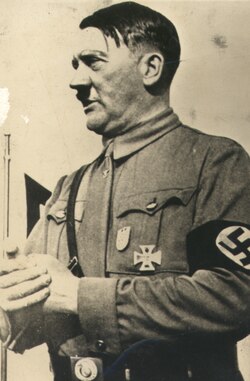
Six days after being sworn in as Chancellor in 1933, Hitler met with the German military leaders, declaring that his first priority was rearmament.[57] The new Defense Minister, General Werner von Blomberg, introduced Nazi principles into the armed forces, emphasizing the concept of Volksgemeinschaft (national community), in which Germans were united in a classless society.[58] "The uniform makes all men equal."[59] Military rank specified a chain of command, not class boundaries. Officers were instructed to mingle with other ranks. Blomberg's decree on the army and National Socialism on 25 May 1934 ordered: "When non-commissioned officers and men take part in any festivity, care must be taken that the officers do not all sit together. I request that this guidance be given the most serious attention."[60] The rapidly expanding armed forces enlisted many new officers and men from the Hitler Youth. The American William L. Shirer reported that all ranks ate the same rations, socialized when off duty, and that officers were concerned with their men's personal problems.[61]
On 1 August 1934, a new law stated that on Hindenburg's death the presidency would be abolished, and its powers merged with those of the Chancellor. From that day onward, Hitler would be known as Führer and Reich Chancellor. As head of state, Hitler became supreme commander of all armed forces.[62] Hindenburg died the following day. (The new office was confirmed by a plebiscite on 19 August 1934.) Blomberg, on his own initiative, introduced the Oath of 2 August 1934: "I swear by God this sacred oath that I will render unconditional obedience to the Führer of the German Reich and people, Adolf Hitler, the commander in chief of the armed forces, and, as a brave soldier, will be prepared at all times to stake my life for this oath." (In 1939, God was removed from the oath.[63]) The Reichswehr was reorganized as the Wehrmacht on 21 May 1935, bringing the army, navy and air force under unified command.
Hitler guided the steps of their rearmament, thanks to his retentive memory and interest in technical questions. General Alfred Jodl wrote that Hitler's "astounding technical and tactical vision led him also to become the creator of modern weaponry for the army".[64] He hammered home arguments by reciting long passages from Frederick the Great and other military thinkers. "Although the generals might at times refer to Hitler as a 'facile amateur', he was so far as an understanding of military history and weapons technology went, better educated and equipped than most of them."[65] On 4 February 1938, after Blomberg's disgrace and retirement, Hitler announced in a decree: "From henceforth I exercise personally the immediate command over the whole armed forces."[66] He abolished the War Ministry and took Blomberg's other title, Commander-in-Chief, for himself. By that year's end, the army had more than 1 million men and 25,000 officers.
World War II

In his speech of 1 September 1939 at Kroll Opera House following the invasion of Poland, Hitler declared: "From now on I am just the first soldier of the German Reich.[A 8] I have once more put on the coat that was most sacred and dear to me. I will not take it off again until victory is secured, or I will not survive the outcome."[67] From then on, he began wearing a grey military jacket with a swastika eagle sewn on the upper left sleeve. Throughout the war, the only military decorations Hitler displayed were his Wound Badge and Iron Cross from World War I and the Nazi Golden Party Badge. Hitler's position in World War II was essentially supreme commander of the German Armed Forces (Oberbefehlshaber der Deutschen Wehrmacht).
After ordering the preparations for the attack on Poland, he scrutinised all the staff prepared for the first three days of operations down to the regimental level. He rewrote the plans for the capture of a crucial bridge, making them much bolder.[68] His status with the military escalated when they seized Norway and conquered Western Europe, with the major thrust coming through the Ardennes, which he had implemented despite the misgivings of many professional advisers.[69] According to Zaloga, Hitler initially proved to be "a skilled amateur at military planning".[48] To cement his control over the military as the war escalated, Hitler used systematic bribery of senior Wehrmacht officers to ensure their loyalty. This strategy proved effective at making senior officers increasingly dependent on the dictator's favor and loyal to his cause, though it also reduced their willingness to oppose his decisions.[70] Though the bribery system remained technically legal, historians such as Wolfram Wette characterized it as deliberate corruption from above.[71]
After the early German victories in World War II, Hitler became increasingly obsessed with his life mission and convinced of his own infallibility. He stopped listening to counter-opinions and became overconfident in his own political moves and military abilities.[72] He started to attribute all victories to his leadership and any defeats to his subordinates' incompetence.[73] Hitler ultimately came to the conclusion that a full victory on the Western front, especially over Great Britain, would only be possible by eliminating the Allies' hope in a Soviet intervention. He thus ordered his high command to prepare an invasion of the Soviet Union in summer 1940.[74] Hitler's strategic views were largely backed by his top commanders who earnestly agreed with his stated goals and overoptimistic beliefs in regards to an eastern campaign.[75] Historian David Stahel argued that "reckless assumptions [...] astonishingly were allowed to persist throughout the numerous planning phases and operational studies" for the eastern campaign, as the German senior commanders shared the dictator's assumption of a swift victory over the Soviet Union. Both Hitler and his generals were mainly inspired by "ideological precepts" in their strategic planning.[76]
Following Operation Barbarossa, Hitler deepened his involvement in the war effort by appointing himself commander-in-chief of the German Army (Heer) in December 1941; thus taking a direct operational posting usually held by a full German general. From this point forward he personally directed the war against the Soviet Union, while his military commanders facing the Western Allies retained a degree of autonomy.[77] Faced with growing problems on the Eastern Front, Hitler held an "almost religious faith that new weapons" would ensure an eventual German victory.[78] He thus took a keen interest in the development of weaponry, and was directly involved in design decisions such as for the Tiger I and Panther tanks,[79]V-2 rocket,[80] and jet aircraft.[81] Even though German military figures later claimed that Hitler's interventions in weaponry design and production decisions had been wholly negative and amateurish, historians found many of these claims to be fabrications to shift blame onto the dictator.[82] Historians such as Henrik Eberle and Robert Forczyk judged Hitler's design decisions as being of mixed value, some being sensible, some arbitrary, some based on ideological thinking, some based on resource necessities, and others based on faulty information relied to him.[83][84][a]
Hitler's leadership became increasingly disconnected from reality as the war turned against Germany, with the military's defensive strategies often hindered by his slow decision making and frequent directives to hold untenable positions. Nevertheless, he continued to believe that only his leadership could deliver victory.[86] By 1944, Hitler was largely surrounded by "sycophants" who backed his "increasingly deluded view" of the war, while he removed officers who opposed his decisions.[48] For instance, he dismissed Erich von Manstein –considered to be among the best German commanders on the Eastern Front– in spring 1944, deeming the latter's "realistic appraisals" of the strategic situation to be defeatist.[87] Fearing the loss of favors connected to the dictator's bribery system, many senior officers opted to go along with Hitler's decision making even when they understood the war's realities; this further increased his self-perception as the sole "genius strategist" of the German war effort.[70] Yet elements of the officer corps of the German army struck back at Hitler. Unhappy with his repeated interventions, his increasingly impossible orders, and the war situation turning worse and worse as the Eastern front began to slowly collapse, multiple conspiracies were formed against him, resulting in several attempts upon Hitlers life, including the famous July 20th plot.[88]
By mid-1944, Hitler continued to hold the belief that the Soviet Union was teetering on the edge of collapse despite the latter's increasingly effective military operations, thinking that Germany merely needed to hold out until the Soviets had exhausted themselves. Based on his experiences in World War I, Hitler assumed that victory would be possible as long as Germany maintained its will to resist.[48] As a result of this belief, he increasingly viewed any kind of retreat as a form of defeatism and thus insisted on fighting for all territory, regardless of strategic worth. This manifested in the order to prepare more and more feste Plätze, fortresses which were supposed to hold out in enemy territory.[89] Hitler's holding orders and reluctancy to permit tactical retreats accelerated the destruction of Army Group Centre during Operation Bagration (June–August 1944).[90]
As evidence of Germany's impending defeat mounted, Hitler focused on "wonder weapons" and enemy mistakes to maintain his belief in an Endsieg (final victory).[48] In the final months of the war Hitler refused to consider peace from a position of weakness, regarding the destruction of Germany as preferable to surrender.[91] The military did not challenge Hitler's dominance of the war effort and senior officers generally supported and enacted his decisions.[92] By 22 April 1945, when he finally acknowledged that the war was lost, Hitler told Generals Wilhelm Keitel and Jodl that he had no further orders to give.[93]
Awards and decorations
Decorations from World War I
- Iron Cross, Second Class – 2 December 1914[28]
- Bavarian Cross of Military Merit, Third Class with Swords – 17 September 1917
- Regimental Diploma (Regiment "List") – 5 May 1918
- Wound Badge in Black – 18 May 1918[94]
- Iron Cross, First Class – 4 August 1918[28]
- Bavarian Medal of Military Service, Third Class – 25 August 1918
- Honour Cross of the World War 1914/1918 with Swords – 13 July 1934 (retroactively awarded to all war veterans)
Toward the end of the war, the only decorations Hitler wore regularly were the Wound Badge and First Class Iron Cross. Of the Nazi Party badges, the Golden Party Badge number '7' was the only one he wore on a regular basis.[95]
Notes
- ↑As a Gefreiter, Hitler wore one stripe on his uniform, the rank being the result of his sole promotion, from his initial rank of private. Most English-language sources refer to Hitler as "lance corporal" or "corporal", while occasionally a source – such as Volker Ullrich in his biography of Hitler, in the English translation from German by Jefferson Chase – chose to use "private first class" or "private".[1][2]
- ↑Two of them joined him in 1940 after the victory over France and the Low Countries for a nostalgic tour of their old haunts in Flanders.[25]
- ↑Compare:Koebner, Thomas, ed. (1989). "Bruder Hitler": Autoren des Exils und des Widerstands sehen den "Führer" des Dritten Reiches[«الأخ هتلر»: مؤلفو كتاب المنفى والمقاومة ضد «الفوهرر» للرايخ الثالث . هاينه، هاينه، ص 21. ISBN 9783453033856. تم الاسترجاع في 12 سبتمبر 2017 .
Frage: Warum ist dieser 'Führer' viereinhalb Kriegsjahre lang ewig nur Gefreiter geblieben؟ Es war Mangel an Unteroffizieren؛ trotzdem sagte sein Kompanieführer: 'Diesen Hysteriker mache ich niemals zum Unteroffizier!' [سؤال: لماذا ظل هذا "الفوهرر" مجرد عريف لمدة أربع سنوات ونصف من الحرب؟ كان هناك نقص في ضباط الصف. ومع ذلك، قال قائد فرقته: «لن أجعل هذا الرجل الهستيري شخصًا غير عادي أبدًا!»]
- ↑ مهمة حراسة في معسكر أسرى حرب شرقًا، قرب الحدود النمساوية. كان الأسرى روسًا، وقد تطوع هتلر لهذه المهمة. (شيرر 1960 ، ص 34؛ تولاند 1976 ، ص xx).
- ↑ بصفته صحفيًا اشتراكيًا، نظم إيسنر الثورة الاشتراكية التي أطاحت بملكية فيتلسباخ في بافاريا في نوفمبر 1918، مما أدى إلى وصفه بأنه "رمز الثورة البافارية".
- ↑ يشير جون تولاند إلى أن تعيين هتلر في هذا القسم كان جزئياً مكافأةً لخدمته "المثالية" في الخطوط الأمامية، وجزئياً لأن الضابط المسؤول شعر بالشفقة على هتلر لعدم وجود أصدقاء له، ولكنه كان على استعداد تام لفعل أي شيء يطلبه الجيش. تولاند 1976 ، ص. xx.
- ↑ يبدو أن أحدهم في "جلسة تثقيفية" بالجيش أدلى بتصريح اعتبره هتلر "مؤيدًا لليهود"، فكان رد فعل هتلر شرسًا كعادته. يذكر شيرر أن هتلر لفت انتباه أستاذ جامعي يميني كان مكلفًا بتثقيف المجندين في المعتقدات السياسية "الصحيحة"، وأن توصية الأستاذ لأحد الضباط أدت إلى ترقية هتلر. (شيرر، 1960 ، ص 35). "أُتيحت لي فرصة التحدث أمام جمهور أكبر؛ و ... تأكد الآن أنني أستطيع 'التحدث'. لا توجد مهمة تُسعدني أكثر من هذه؛ ... تمكنت من تقديم خدمات جليلة للجيش...وفي محاضراتي، قُدتُ مئاتالرفاق عائدين إلى وطنهم وشعبهم." هتلر ، 1999 ، ص215-216).
- ^ إرستر سولدات دي دويتشين رايخس – رتبة ادعى نفسه، أي ما يعادل Generalissimo
- ↑For instance, military figures such as Adolf Galland claimed that Hitler had completely mishandled jet aircraft development by demanding the creation of a jet fighter-bomber instead of jet fighters. According to Eberle, this claim was not rooted in reality, as the German military experts themselves preferred jet bomber development during much of the war.[82] Technicians as well as Luftwaffe commanders also assured Hitler that the Messerschmitt Me 262 had been designed as a bomber, only to later change the designs without his knowledge, much to the dictator's anger.[85]
References
- ↑O'Donnell 1978, p. 48.
- ↑Ullrich 2016, p. 56.
- 12Shirer 1960, p. 27.
- ↑Eberle 2014, pp. 23–24.
- 1234Eberle 2014, p. 24.
- 12Weber 2010, p. 16.
- ↑Eberle 2014, pp. 24–25.
- 12Kershaw 1998, p. 90.
- ↑Evans 2003, pp. 163–164.
- ↑Weber 2010, pp. 12–13.
- 12Eberle 2014, p. 25.
- ↑Solleder 1932.
- ↑Eberle 2014, pp. 25–26.
- ↑Eberle 2014, pp. 26–27.
- ↑Eberle 2014, p. 27.
- ↑Eberle 2014, p. 28.
- ↑Eberle 2014, pp. 28–29.
- ↑Keegan 1987, p. 239.
- ↑Kershaw 2008, pp. 53–54.
- ↑Weber 2010, p. 100.
- ↑Eberle 2014, pp. 29–30.
- ↑Childers, Thomas (2001). "The Weimar Republic and the Rise of the Nazi Party". A History of Hitler's Empire, 2nd Edition. Episode 3. The Great Courses. Event occurs at 17:20-18:30. Archived from the original on 27 March 2023. Retrieved 27 March 2023.
- ↑Eberle 2014, pp. 30–31.
- 123Alberge 2010
- ↑Kershaw 2000, p. 299.
- ↑Joachimsthaler, A. (1989) Korrektur einer Biographie. Adolf Hitler 1908–1920, München:Herbig, pp. 141–144
- 12Kershaw 2008, p. 58.
- 123Bullock 1962, pp. 52–53.
- ↑Kershaw 2008, p. 59.
- ↑Meyer, A. (1934) Mit Adolf Hitler im Bayr. R.I.R. 16 List, Neustat-Aisch: Georg Apperle
- ↑"PIERRE J. HUSS, 59, REPORTER, IS DEAD; Foreign Correspondent for Hearst Collapses at U.N."The New York Times. 23 March 1966. p. 47. ISSN 0362-4331. Retrieved 12 July 2026.
- ↑Shirer 1960, p. 30.
- ↑Weber 2010, p. 156.
- ↑Solleder 1932, p. 114.
- ↑Kershaw 2008, p. 57.
- ↑Langer 1972, pp. 135–136.
- ↑Langer 1972, p. 136.
- ↑Kershaw 2008, pp. 59–60.
- ↑Kershaw 2008, pp. 60, 62.
- 12Childers, Thomas (2001). "The Weimar Republic and the Rise of the Nazi Party". A History of Hitler's Empire, 2nd Edition. Episode 3. The Great Courses. Event occurs at 18:30-19:30. Archived from the original on 27 March 2023. Retrieved 27 March 2023.
- ↑Langer 1972, p. 37.
- ↑Kershaw 2008, p. 64.
- ↑Ullrich 2016, p. 75.
- ↑Ullrich 2016, p. 79.
- 12Ullrich 2016, p. 80.
- ↑Mitchell 2013, p. 37.
- ↑Shirer 1960, p. 34.
- 12345Zaloga 1997, p. 15.
- ↑Nebelin 2011, p. 139.
- 12Kershaw 2008, pp. 72–74.
- 12Childers, Thomas (2001). "The Weimar Republic and the Rise of the Nazi Party". A History of Hitler's Empire, 2nd Edition. Episode 3. The Great Courses. Event occurs at 20:00-22:00. Archived from the original on 27 March 2023. Retrieved 27 March 2023.
- ↑Rees 2012, pp. 17–18.
- ↑Ullrich 2016, p. 82.
- ↑Shirer 1960, p. 35.
- ↑Kershaw 2008, p. 82.
- ↑Stackelberg 2007, p. 9.
- ↑Kershaw 1998, p. 441.
- ↑Messerschmidt, M. (1969). Die Wehrmacht im NS-staat. Zeit der indoctrination, Hamburg:Decker's Verlag, pp. 18–47
- ↑Schoenbaum, D.(1967). Hitler's social revolution. Class and Status in Nazi Germany 1933–1939, London, Weidenfeld and Nicolson, p. 68
- ↑O'Neill, R. J. (1966). The German Army and the Nazi Party, 1933–1939, London: Cassell, p. 65
- ↑Shirer, W.S. (1941). Berlin Diary, London: Hamish Hamilton, p. 346
- ↑Strawson 1971, p. 43.
- ↑Rosinski, H. (1939). The German Army, London: Hogarth Press, p. 237
- ↑Schramm 1972, p. 104.
- ↑Strawson 1971, p. 51.
- ↑Strawson 1971, p. 66.
- ↑Stein 2002, p. 26.
- ↑Strawson 1971, p. 92.
- ↑Schramm 1972, p. 148.
- 12Goda 2005, pp. 120–121.
- ↑Wette 2009, pp. 154–156.
- ↑Kershaw 2008, pp. 420, 446–447, 559–561, 571.
- ↑Zaloga 1997, pp. 14–15.
- ↑Stahel 2011, pp. 36–39.
- ↑Stahel 2011, pp. 36–38.
- ↑Stahel 2011, pp. 37–38.
- ↑Kershaw 2012, pp. 169–170.
- ↑Forczyk 2007, p. 5.
- ↑Forczyk 2007, pp. 4, 11–12.
- ↑Eberle 2014, pp. 281–284.
- ↑Eberle 2014, pp. 284–287.
- 12Eberle 2014, p. 15.
- ↑Eberle 2014, pp. 15, 281–287.
- ↑Forczyk 2007, pp. 11–12.
- ↑Eberle 2014, p. 286.
- ↑Overy 2005, pp. 421–425.
- ↑Zaloga 1997, pp. 9–10.
- ↑Heinemann 2022.
- ↑Zaloga 1997, pp. 15–16.
- ↑Zaloga 1997, p. 85.
- ↑Kershaw 2012, pp. 396–397.
- ↑Kershaw 2008, pp. 171–395, 569.
- ↑ ستروسون 1971 ، ص 226.
- ↑ شتاينر 1976 ، ص 392.
- ↑ أنغوليا 1989 ، ص 183.
مصادر
- ألبرج، داليا (16 أغسطس/آب 2010). "أدولف هتلر بطل حرب؟ كلا، على حد قول رفاقه في الحرب العالمية الأولى" . صحيفة الغارديان . مؤرشف من الأصل في 15 سبتمبر/أيلول 2013. تم الاطلاع عليه في 7 يوليو/تموز 2019 .
- أنغوليا، جون (1989). من أجل الفوهرر والوطن: الأوسمة السياسية والمدنية للرايخ الثالث . دار نشر آر. جيمس بيندر. رقم ISBN 978-0-912-13816-9.
- بولوك، آلان (1962) [1952]. هتلر: دراسة في الطغيان . لندن: كتب بنغوين. LCCN 63005065 .
- إيبرل، هنريك (2014). هتلر العالمية: Wie der Gefreite zum Feldherrn wurde [ حروب هتلر العالمية: كيف أصبح الجندي قائدًا عسكريًا ] . هوفمان وكامب فيرلاغ. رقم ISBN 978-3455502657.
- إيفانز، ريتشارد ج. (2003). مجيء الرايخ الثالث . مجموعة بنغوين. ISBN 978-0-14-303469-8.
- جودا، نورمان (2005). "علامات سوداء: رشوة هتلر لكبار ضباطه خلال الحرب العالمية الثانية". في: كريك، إيمانويل؛ جوردان، ويليام تشيستر (محرران). تواريخ فاسدة . تورنتو: دار هاشيون. ص 96-137 . ISBN 978-1-58046-173-3.
- فورتشيك، روبرت (2007). بانثر ضد تي-34. أوكرانيا 1943. أكسفورد: دار نشر أوسبري . ISBN 978-184603-149-6.
- هتلر، أدولف (1999) [1925]. مين كامبف . نيويورك: هوتون ميفلين. رقم ISBN 978-0-395-92503-4.
- كيغان، جون (1987). قناع القيادة: دراسة في فن القيادة العامة . لندن: بيمليكو. ISBN 978-0-7126-6526-1.
- كيرشو، إيان (1998). هتلر 1889-1936: الغطرسة . لندن: ألين لين - دار بنغوين للنشر. ISBN 0-713-99047-3.
- كيرشو، إيان (2000). هتلر 1936-1945: العدو اللدود . ألين لين - دار بنغوين للنشر. ISBN 0-713-99229-8.
- كيرشو، إيان (2008). هتلر: سيرة ذاتية . نيويورك: دبليو دبليو نورتون وشركاه. ISBN 978-0-393-06757-6.
- كيرشو، إيان (2012). النهاية: ألمانيا هتلر، 1944-1945 ( طبعة ورقية). لندن: بنغوين. ISBN 978-0-14-101421-0.
- لانجر، والتر سي. (1972) [1943]. عقل أدولف هتلر: التقرير السري في زمن الحرب . نيويورك: بيسيك بوكس. ISBN 978-0-465-04620-1.
- ميتشل، أوتيس سي. (2013). قوات العاصفة التابعة لهتلر والهجوم على الجمهورية الألمانية، 1919-1933 . ماكفارلاند. ISBN 9780786477296.
- نيبيلين، مانفريد (2011). لودندورف: Diktator im Ersten Weltkrieg [ لودندورف: دكتاتور في الحرب العالمية الأولى ] . ميونيخ: سيدلر. رقم ISBN 978-3886809653.
- أودونيل، جيمس ب. (1978). الملجأ . بوسطن: هوتون ميفلين. ISBN 0-395-25719-0.
- أوفري، ريتشارد (2005). "هتلر كقائد حرب". في: دير، آي سي بي ؛ فوت، إم آر دي (محرران). موسوعة أكسفورد للحرب العالمية الثانية . أكسفورد: مطبعة جامعة أكسفورد. ISBN 978-0-19-280670-3.
- ريس، لورانس (2012). كاريزما هتلر: قيادة الملايين إلى الهاوية . دار بانثيون للنشر. رقم ISBN 9780307377296.
- شرام، بيرسي إي. (1972). هتلر: الرجل والقائد العسكري . لندن: ألين لين، دار بنغوين للنشر.
- شيرر، ويليام ل. (1960). صعود وسقوط الرايخ الثالث . نيويورك: سيمون وشوستر. LCCN 60-6729 .
- سوليدر ، فريدولين (1932). فير ياهر الواجهة الغربية. قائمة Geschichte des Regiments RJR 16 . ميونيخ: دار النشر ماكس شريفت.
- ستاكلبرغ، رودريك (2007). دليل روتليدج لألمانيا النازية . نيويورك: روتليدج. ISBN 978-0-415-30860-1.
- ستاهل، ديفيد (2011). عملية بارباروسا وهزيمة ألمانيا في الشرق ( طبعة ورقية). كامبريدج: مطبعة جامعة كامبريدج. ISBN 978-0-521-17015-4.
- شتاين، جورج (2002) [1966]. قوات فافن إس إس: الحرس النخبوي لهتلر في الحرب 1939-1945 . دار نشر سيربيروس. رقم ISBN 978-1841451008أُرشف من الأصل بتاريخ 18 أبريل 2023. تم الاطلاع عليه بتاريخ 20 أكتوبر 2020 .
- شتاينر، جون مايكل (1976). سياسات القوة والتغيير الاجتماعي في ألمانيا النازية: عملية تصعيد نحو الدمار الشامل . لاهاي: موتون. ISBN 978-90-279-7651-2.
- ستروسون، جون (1971). هتلر كقائد عسكري . لندن: بي تي باستفورد.
- تولاند، جون (1976). أدولف هتلر . نيويورك: دابلداي وشركاه. ISBN 978-0-385-03724-2.
- أولريش، فولكر (2016). هتلر: الصعود، 1889-1939 . مجموعة كنوبف دابلداي للنشر. ISBN 9780385354394.
- ويبر، توماس (2010). حرب هتلر الأولى . نيويورك: مطبعة جامعة أكسفورد . ISBN 978-0-19-923320-5.
- Wette, Wolfram (2009). The Wehrmacht. Translated by Deborah Lucas Schneider. Harvard University Press. ISBN 9780674045118.
- Zaloga, Steven (1997) [1st pub. 1996]. Bagration 1944: The Destruction of Army Group Centre (reprint ed.). Oxford: Osprey Publishing. ISBN 1-85532-478-4.
- Heinemann, Winfried (2022). Operation "Valkyrie". A Military History of the 20 July 1944 Plot. Berlin: de gruyter. ISBN 978-3110699180.
Further reading
- Fritz, Stephen G. (2020). The First Soldier: Hitler as Military Leader. New Haven: Yale University Press. ISBN 978-0300251463.
- O'Brien, Phillips Payson (2025). The Strategists: A bold revisionist history exploring the impact of WW1 on the decisions of WW2's most important leaders. Penguin. ISBN 978-1405966597.
- Pyta, Wolfram (2015). Hitler. Der Künstler als Politiker und Feldherr[Hitler. The artist as politician and military commander]. Munich: Siedler Verlag. ISBN 978-3-641-15701-2.
- Riecker, Joachim (2009). Hitlers 9. November: Wie der Erste Weltkrieg zum Holocaust führte[Hitler's 9 November: How World War I led to the Holocaust]. WJS. ISBN 978-3937989570.
- Sangster, Andrew; Battistelli, Pier Paolo (2024). How Hitler Evolved the Traditional Army Establishment: A Study Through Field Marshals Keitel, Paulus and Manstein. Barnsley: Pen & Sword Books. ISBN 978-1036106027.
- Adolf Hitler
- Military careers by individual