
Hundred (county division)
A hundred is an administrative division that is geographically part of a larger region. It was formerly used in England, Wales, some parts of the United States, Denmark, Sweden, Finland, Norway, and in Cumberland County in the British Colony of New South Wales. It is still used in other places, including in Australia (in South Australia and the Northern Territory). Other terms for the hundred in English and other languages include wapentake, herred (Danish and Bokmål Norwegian), herad (Nynorsk Norwegian), härad or hundare (Swedish), Harde (German), hiird (North Frisian), kihlakunta (Finnish), kihelkond (Estonian), and cantref (Welsh). In Ireland, a similar subdivision of counties is referred to as a barony, and a hundred is a subdivision of a particularly large townland (most townlands are not divided into hundreds).
Etymology
The origin of the division of counties into hundreds is described by the Oxford English Dictionary as "exceedingly obscure". It may once have referred to an area of 100 hides; in early Anglo-Saxon England a hide was the amount of land farmed by and required to support a peasant family, but by the 11th century in many areas it supported four families.[1] Alternatively the hundred may have been an area originally settled by one "hundred" men at arms, or the area liable to provide one "hundred" men under arms.[2] In this early medieval use, the number term "hundred" can be unclear, meaning the "short" hundred (100) or in some contexts the long hundred of 120.
There was an equivalent traditional Germanic system. In Old High German a huntari is a division of a gau, but the Oxford English Dictionary states that the link between the two is not established.[2]
England
Administrative functions
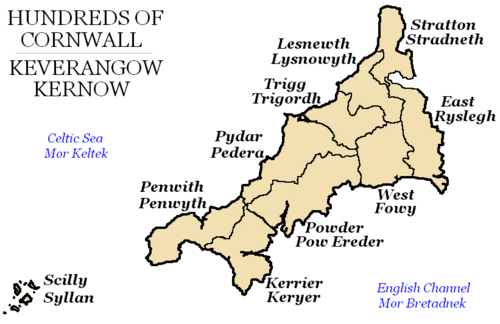
From the 11th century in England – and to a lesser extent from the 16th century in Wales – to the middle of the 19th century, the annual assemblies had varying degrees of power at a local level in the feudal system.[3] Of chief importance was their more regular use for taxation, and six centuries of taxation returns for the divisions survive to this day.[3]
Groupings of divisions, small shires, were used to define parliamentary constituencies from 1832 to 1885. On the redistribution of seats in 1885 a different county subdivision, the petty sessional division, was used. Hundreds were also used to administer the first five[3] national censuses from 1801 to 1841.[3]
The system of county divisions was not as stable as the system of counties being established at the time, and lists frequently differ on how many hundreds a county had. In many parts of the country, the Domesday Book of 1086 contained a radically different set of divisions from that which later became established. The numbers of divisions in each county varied widely. For example Leicestershire had six (up from four at Domesday), whereas Devon, nearly three times the size, had 32.
By the end of the 19th century, several single-purpose subdivisions of counties, such as poor law unions, sanitary districts, and highway districts, had sprung up, which, together with the introduction of urban districts and rural districts in 1894, mostly replaced the role of the parishes, and to a lesser extent the less extensive role of hundreds. The division names gave their name to multiple modern local government districts.
Description

In southern and western England, a hundred was the division of a shire for military and judicial purposes under the common law, which could have varying extent of common feudal ownership, from complete suzerainty to minor royal or ecclesiastical prerogatives and rights of ownership.[4] Until the introduction of districts by the Local Government Act 1894, hundreds were the only widely used assessment unit intermediate in size between the parish, with its various administrative functions, and the county, with its formal ceremonial functions.[3]
The term "hundred" is first recorded in the 10th-century laws of King Edmund I as a measure of land and the area served by a hundred court. In the Midlands, they often covered an area of about 100 hides, but this did not apply in the south; this may suggest that it was an ancient West Saxon measure that was applied rigidly when Mercia became part of the newly established English kingdom in the 10th century. The Hundred Ordinance, which dates to the middle of the 10th century, provides that the court was to meet monthly, and thieves were to be pursued by all the leading men of the district.[5]
During Norman times, the hundred would pay geld based on the number of hides.[6] To assess how much everyone had to pay, a clerk and a knight were sent by the king to each county; they sat with the shire-reeve (or sheriff) of the county and a select group of local knights.[6] There would be two knights from each hundred. After it was determined what geld had to be paid, the bailiff and knights of the hundred were responsible for getting the money to the sheriff and the sheriff for getting it to the Exchequer.[6]
Above the hundred was the shire, under the control of a sheriff. Hundred boundaries were independent of both parish and county boundaries, although often aligned, meaning that a hundred could be split between counties, or a parish could be split between hundreds. Exceptionally, in the counties of Kent and Sussex, there was a subdivision intermediate in size between the hundred and the shire: several hundreds were grouped together to form lathes in Kent and rapes in Sussex. At the time of the Norman Conquest, Kent was divided into seven lathes and Sussex into four rapes.
Hundred courts
Over time, the principal functions of the hundred became the administration of law and the keeping of the peace. By the 12th century, the hundred court was held twelve times a year.[7] This was later increased to fortnightly, although an ordinance of 1234 reduced the frequency to once every three weeks. In some hundreds, courts were held at a fixed place; while in others, courts moved with each sitting to a different location. The main duty of the hundred court was the maintenance of the frankpledge system. The court was formed of twelve freeholders, or freemen.[8] According to a 13th-century statute, freeholders did not have to attend their lord's manorial courts, thus any suits involving them would be heard in a hundred court.[8][9]
For especially serious crimes, the hundred was under the jurisdiction of the Crown; the chief magistrate was a sheriff, and his circuit was called the sheriff's tourn.[8] However, many hundreds came into private hands, with the lordship of the hundred being attached to the principal manor of the area and becoming hereditary. Historian Helen Cam estimates that even before the Conquest, over 130 hundreds were in private hands; while an inquest of 1316 found that by that date 388 of 628 named hundreds were held by the king's subjects.[10] Where a hundred was under a lord, a steward– acting as a judge and the chief official of the lord of the manor– was appointed in place of a sheriff.[11]
The importance of the hundred courts declined from the 17th century, and most of their powers were extinguished with the establishment of county courts in 1867.[12] The remaining duty of the inhabitants of a hundred to make good damages caused by riot was ended by the Riot (Damages) Act 1886, when the cost was transferred to the county police rate.[13] The jurisdiction of hundred courts was curtailed by the Administration of Justice Act 1977.[14]
Chiltern Hundreds
ينص القانون في المملكة المتحدة على أنه لا يجوز لعضو البرلمان الاستقالة من مقعده ، ولكنه يُحرم من شغل المنصب إذا عُيّن في " وظيفة ربحية تابعة للتاج". وقد عُيّن مسؤولٌ عن حفظ الأمن والنظام في منطقة تشيلترن هاندردز ، إلا أن هذه المهام توقفت في القرن السادس عشر، وتوقف شاغل هذا المنصب عن جني أي منافع خلال القرن السابع عشر. ولا يزال هذا المنصب يُستخدم كإجراء شكلي، حيث يُعيّن أعضاء البرلمان الراغبون في الاستقالة كمسؤولين عن حفظ الأمن والنظام.
وابينتاكي
كانت "الوابنتايك"، وهي مصطلح مشتق من اللغة النوردية القديمة وشائع في شمال إنجلترا ، تُعادل " الهاندرد " الأنجلوسكسونية في منطقة دانيلو الشمالية . في كتاب يوم القيامة، يُستخدم هذا المصطلح بدلاً من "الهاندرد" في يوركشاير ، والأحياء الخمسة لديربي ، وليستر ، ولينكولن ، ونوتنغهام ، وستامفورد ، وأحيانًا في نورثامبتونشاير. كانت القوانين في "الوابنتايك " مشابهة لتلك الموجودة في "الهاندرد" مع اختلافات طفيفة.
بحسب المؤرخ تاسيتوس ، الذي عاش في القرن الأول الميلادي، كان مصطلح "وابنتايك" في الدول الإسكندنافية يُشير إلى تصويت يُقرّ في اجتماعٍ ما عن طريق التلويح بالأسلحة. [ 16 ] في بعض المقاطعات، مثل ليسترشاير، تطورت مصطلحات "وابنتايك" المسجلة في زمن كتاب يوم القيامة لاحقًا إلى "مئات". وفي مقاطعات أخرى، مثل لينكولنشاير ، ظلّ المصطلح مستخدمًا. [ 17 ] على الرغم من أنها لم تعد جزءًا من الحكم المحلي، إلا أن هناك بعض أوجه التشابه بين عمادة الريف و"وابنتايك" أو "المئات" السابقة؛ لا سيما في شرق ميدلاندز، وأسقفية باكنغهام، وأبرشية يورك. [ 18 ]
ويلز

في ويلز، كان نظام تقسيم سلتيكي قديم يُسمى "كانتريفي" (مئة مزرعة؛ المفرد: كانتريف ) قائمًا لقرون، وكان ذا أهمية خاصة في تطبيق القانون الويلزي . ويُستدل على قِدم نظام "الكانتريفي" من كونه غالبًا ما يُحدد الحدود بين اللهجات . بعضها كان في الأصل ممالك قائمة بذاتها، بينما ربما كانت أخرى وحدات اصطناعية أُنشئت لاحقًا. [ 19 ] مع دخول المسيحية، غالبًا ما اتخذت الكنائس السلتيكية القائمة على نظام "اللان" (المشابه للرعية) حدود "الكانتريفي" القديمة، وحدث الأمر نفسه عندما فُرضت "المئات" النورماندية على سكان ويلز.
كان لكل مقاطعة محكمة خاصة بها، وهي عبارة عن مجلس يضمّ كبار ملاك الأراضي في المقاطعة . وكان الملك يرأس هذه المحكمة إن كان حاضرًا، أو يرأسها ممثله إن لم يكن حاضرًا. وإلى جانب القضاة، كان يوجد كاتب ومساعد، وأحيانًا محاميان محترفان. وكانت محكمة المقاطعة تختصّ بالنظر في الجرائم، وتحديد الحدود، والميراث. [ 20 ]
دول الشمال الأوروبي

استُخدم مصطلح "هوندار " ( مئة ) في سفيلاند وفنلندا الحالية. يُفترض أن الاسم كان يُشير إلى منطقة تُنظّم مئة رجل لتشغيل أربعة قوارب حربية، كل منها مزوّد باثني عشر زوجًا من المجاديف وقائد. لاحقًا، استُبدل هذا التقسيم بمصطلح " هاراد" أو "هيريد" ، وهو المصطلح المُستخدم في بقية دول الشمال . اشتُقّت هذه الكلمة إما من اللغة النوردية البدائية * harja-raiðō (فرقة حربية) أو من اللغة الجرمانية البدائية * harja-raiða (معدات حربية، انظر wapentake) . [ 21 ] وهو مُشابه لمصطلح "سكيب رايد" ، وهو جزء من الساحل كان سكانه مسؤولين عن تجهيز السفن الحربية وتزويدها بالرجال.
لم تكن مئات القرى منظمة في نورلاند ، الجزء الشمالي من السويد ذي الكثافة السكانية المنخفضة. في السويد، كانت القرية الريفية (هاراد) تُقسّم عادةً إلى عدد قليل من الوحدات المحلية (سوكن)، حيث تتداخل الوحدات الإدارية الكنسية والدنيوية في كثير من الأحيان. بدأ هذا التقسيم يفقد أهميته الأساسية مع الإصلاح البلدي السويدي عام 1862. كانت القرية في الأصل قسمًا فرعيًا من المقاطعة (لاندسكاب)، ولكن منذ الإصلاح الحكومي عام 1634، تولت المقاطعة (لان) جميع الأدوار الإدارية للمقاطعة. كما كانت القرية بمثابة دائرة انتخابية لممثل فلاحي واحد خلال البرلمان السويدي ( ريكسداغ ) (1436-1866). كانت محكمة الجنايات ( هارادسرات ) هي المحكمة الابتدائية في الريف، وقد أُلغيت عام 1971 وحلّت محلها محاكم المقاطعات الحديثة ( تينغسرات ).
اليوم، لا تؤدي المئات أي دور إداري في السويد، على الرغم من أن بعض المحاكم القضائية لا تزال تحمل الاسم (مثل Attunda tingsrätt ) ويتم استخدام المئات أحيانًا في التعبيرات، مثل Sjuhäradsbygden (منطقة السبع مئات).
ليس من الواضح تمامًا متى تم تنظيم المئات في الجزء الغربي من فنلندا. يشير اسم مقاطعة ساتكونتا ، الذي يعني تقريبًا مئة ( ساتا تعني "مئة" باللغة الفنلندية)، إلى تأثيرات من العصور التي سبقت الحروب الصليبية الشمالية ، والتنصير ، والاندماج في السويد.
ظلت المقاطعات، أو ما يُعرف باسم "كيهلكونتا" ، التقسيم الإداري الأساسي لسلطات الدولة حتى عام ٢٠٠٩. وكانت كل مقاطعة تابعة لـ "لاني " (محافظة/إقليم) ولها قسم شرطة ومحكمة محلية وهيئة ادعاء خاصة بها. عادةً ما كانت المدن تُشكّل " كيهلكونتا " حضرية مستقلة، بينما كانت عدة بلديات ريفية تُشكّل "كيهلكونتا " ريفية . في المقاطعة الريفية، كان يُطلق على رئيس السلطات المحلية اسم " نيميسميس " (الرجل المُعيّن)، أو "فاليسماني " (من اللغة السويدية). في العصر السويدي (حتى عام ١٨٠٩)، كانت مسؤولياته الرئيسية صيانة محطات العربات ونُزُلها ، وتوفير الطعام والمأوى لموظفي الحكومة المسافرين، ونقل السجناء، والمهام الشرطية، وترتيب إجراءات المحكمة المحلية ( تينغسرات )، وجمع الضرائب، وأحيانًا تنظيم رحلات صيد للحد من أعداد الذئاب والدببة. بعد إلغاء المقاطعات كوحدة إدارية في عام 2009، أصبح بالإمكان ترسيم حدود كل سلطة على حدة، أي أن عدد مناطق الشرطة لا يشترط أن يساوي عدد مناطق المحاكم. ولا يزال لقب "هاراد" مستخدماً في اللقب الفخري " هيراستوماري " (بالفنلندية) أو "هارادسدوماري " (بالسويدية)، والذي يُمنح للقضاة غير المتخصصين بعد 8 إلى 10 سنوات من الخدمة.
استُخدم مصطلح "herred" أو "herad" في النرويج بين عامي 1863 و1992 للإشارة إلى البلديات الريفية، إلى جانب مصطلح "kommune" (heradskommune). اليوم، ثلاث بلديات فقط في غرب النرويج تُطلق على نفسها اسم "herad" : أولفيك هيراد ، وكفام هيراد ، وفوس هيراد . بعض الأماكن النرويجية تحمل كلمة "herad" في اسمها لأسباب تاريخية، مثل كرودشراد وهيرادسبيغد في النرويج.
الولايات المتحدة
Counties in Delaware, Maryland, New Jersey and Pennsylvania were divided into hundreds in the 17th century, following the English practice familiar to the colonists. They survive in Delaware and were used as tax reporting and voting districts until the 1960s but now serve no administrative role: their only official legal use is in real estate title descriptions.[22] Following American independence, the term "hundred" fell out of favor and was replaced by "election district". However, the names of the old hundreds continue to show up in deeds for another 50 years.
The hundred was used as a division of the county in Maryland. Carroll County was formed in 1836 by taking hundreds from Baltimore County and from Frederick County. Somerset County, which was established in 1666, was initially divided into six hundreds: Mattapony, Pocomoke, Boquetenorton, Wicomico, and Baltimore Hundreds; later subdivisions of the hundreds added five more: Pitts Creek, Acquango, Queponco, Buckingham, and Worcester Hundreds. The original borders of Talbot County (founded at some point prior to 12 February 1661[23]) contained nine hundreds: Treadhaven Hundred, Bolenbroke Hundred, Mill Hundred, Tuckahoe Hundred, Worrell Hundred, Bay Hundred, Island Hundred, Lower Kent Island Hundred, Chester Hundred.[24] In 1669 Chester Hundred was given to Kent County.[24][25] In 1707 Queen Anne's County was created from the northern parts of Talbot County, reducing the latter to seven hundreds (Lower Kent Island Hundred becoming a part of the former). Of these, only Bay Hundred legally remains in existence, as District 5 in Talbot County.[26][27] The geographic region, which includes several unincorporated communities and part of present-day Saint Michaels, continues to be known by the name Bay Hundred, with state and local governments using the name in ways ranging from water trail guides[28] to community pools,[29] while local newspapers regularly use the name in reporting news.[30][31][32][33][34]
Some plantations in Colonial Virginia used the term hundred in their names, such as Martin's Hundred, Flowerdew Hundred, and West and Shirley Hundred.[35]Bermuda Hundred was the first incorporated town in Virginia; it was founded by Sir Thomas Dale in 1613, six years after Jamestown. While debating what became the Land Ordinance of 1785, Thomas Jefferson's committee wanted to divide the public lands in the west into "hundreds of ten geographical miles square, each mile containing 6086 and 4-10ths of a foot".[36] The legislation instead introduced the six-mile square township of the Public Land Survey System.
Australia
In South Australia, land titles record in which hundred a parcel of land is located. Similar to the notion of the South Australian counties listed on the system of titles, hundreds are not generally used when referring to a district and are little known by the general population, except when transferring land title. When the land in the region of the present Darwin, in the Northern Territory, was first surveyed, the territory was administered by South Australia, and the surveyed land was divided up into hundreds.[37] The Cumberland County (Sydney) was also allocated hundreds in the nineteenth century, although these were later repealed. A hundred is traditionally one hundred square miles or 64,000 acres (26,000 ha), although this is often not exact as boundaries often follow local topography.[38]
See also
- Attundaland
- Feudal measurement
- Fjärdhundraland
- Henry de Bracton
- Hundred Rolls
- Leidang
- Moot mound, the meeting place of an Anglo-Saxon hundred
- Roslagen
- Tiundaland
Explanatory notes
- ↑Old English wǣpen(ge)tæc, from Old Norse] vápnatak, from vápn 'weapon' + taka 'take', perhaps with reference to voting in an assembly (known as a thing) by weapons taken out at a meeting point.[15]
References
- ↑Faith, Rosamund (2014). "Hide". In Lapidge, Michael; Blair, John; Keynes, Simon; Scragg, Donald (eds.). The Wiley Blackwell Encyclopedia of Anglo-Saxon England (Second ed.). Chichester, UK: Blackwell Publishing. pp. 243–44. ISBN 978-0-470-65632-7.
- 12"Hundred". Oxford English Dictionary. Oxford University Press. 1989.
- 12345"Mapping the Hundreds of England and Wales in GIS". Department of Geography, University of Cambridge. 8 June 2008. Retrieved 12 October 2011.
- ↑"Administrative Units Typology: Hundred". Vision of Britain. Retrieved 31 January 2010.
- ↑Miller, Sean (2014). "Hundreds". In Lapidge, Michael; Blair, John; Keynes, Simon; Scragg, Donald (eds.). The Wiley Blackwell Encyclopedia of Anglo-Saxon England (2nd ed.). Chichester, UK: Wiley Blackwell. p. 249. ISBN 978-0-631-22492-1.
- 123Bartlett, Robert (2000). J.M.Roberts (ed.). England Under the Norman and Angevin Kings 1075–1225. London, UK: OUP. pp. 165–167. ISBN 978-0-19-925101-8.
- ↑Coulton, G. G. (1938). Medieval Panorama. Cambridge University Press. p. 367.
- 123Mortimer, Ian (2011). The Time Traveler's Guide to Medieval England: A Handbook for Visitors to the Fourteenth Century. Simon & Schuster. ISBN 978-1-43911-290-8.
- ↑Mortimer (2011), p.308. fn.14.
- ↑Cam, Helen (1962). Law-Finders and Law-Makers. London: Merlin Press. pp. 59 & 67–70.
- ↑Chisholm, Hugh, ed. (1911). . Encyclopædia Britannica (11th ed.). Cambridge University Press.
- ↑County Courts Act 1867 (30 & 31 Vict. c. 142) s.28
- ↑Riot (Damages) Act 1886 (49 & 50 Vict. c. 38), s.2
- ↑"Administration of Justice Act 1977, Schedule 4"(PDF). The National Archives. Retrieved 5 February 2019.
- ↑"Wapentake". Online Etymology Dictionary. Retrieved 13 July 2015.
- ↑Miller, Sean (2014). "Wapentakes". In Lapidge, Michael; Blair, John; Keynes, Simon; Scragg, Donald (eds.). The Wiley Blackwell Encyclopedia of Anglo-Saxon England (Second ed.). Chichester, UK: Blackwell Publishing. p. 488. ISBN 978-0-470-65632-7.
- ↑"Introduction: Lost vills and other forgotten places". Final Concords of the County of Lincoln: 1244–1272. 1920. pp. L–LXV. Retrieved 23 September 2013..
- ↑Addy, John (1963). Archdeacon and Ecclesiastical Discipline in Yorks., 1598-1714. York, England: St Anthony's Press. pp. 4–5. ISBN 0-9007-0123-4.
{{cite book}}: ISBN / Date incompatibility (help) - ↑Davies, John; Jenkins, Nigel; Baines, Menna; Lynch, Peredur I. (2008). The Welsh Academy Encyclopedia of Wales. Cardiff: University of Wales Press. p. 113. ISBN 978-0-7083-1953-6.
- ↑Davies, John; Jenkins, Nigel; Baines, Menna; Lynch, Peredur I. (2008). The Welsh Academy Encyclopedia of Wales. Cardiff: University of Wales Press. p. 113. ISBN 978-0-7083-1953-6.
- ↑"259 (Svensk etymologisk ordbok)". Runeberg.org. 30 July 2009. Retrieved 31 January 2010.
- ↑"The Hundreds of Delaware". University of Delaware. 30 August 1999. Archived from the original on 19 May 2011. Retrieved 31 January 2010.
- ↑Skirven, Percy G. (1923). The First Parishes of the Province of Maryland. Baltimore: The Norman, Remington Company. p. 146.
- 12Harrison, Samuel Alexander; Tilghman, Oswald (1915). History of Talbot County, Maryland, 1661–1861. Williams & Wilkins Company. p. 6. Retrieved 10 July 2018– via Internet Archive.
- ↑Walker, Karen (28 February 2014). "Tax List: Chester Hundred, Kent County (1749)"(PDF). Maryland Genealogical Society. Retrieved 1 January 2019.
- ↑"District 5, Bay Hundred, Talbot County, Maryland". US Boundary.com.
- ↑"District 5 Bay Hundred MD Demographic Data and Boundary Map". Maryland Hometown Locator.com. Retrieved 1 January 2019.
- ↑"Tilghman Island and Bay Hundred Water Trails (Talbot County)". DNR Outdoor Store.
- ↑"Bay Hundred Community Pool". StMichaelsMD.com.
- ↑Griep, John. "Community group forms in Bay Hundred". The Star Democrat.
- ↑"Overnight rain floods Bay Hundred". The Star Democrat.
- ↑"Bay Hundred Elves to hold fundraiser". The Star Democrat.
- ↑"Band marches through Bay Hundred". The Star Democrat.
- ↑"Bay Hundred businesses give to Fireman's Auction". The Star Democrat.
- ↑Tyler, Lyon G. (January 1896). "Title of Westover". William and Mary College Quarterly Historical Magazine. 4 (3): 151–55. doi:10.2307/1914946. JSTOR 1914946..
- ↑"A Century of Lawmaking for a New Nation: U.S. Congressional Documents and Debates, 1774-1875". Journal of Continental Congress. 27. Library of Congress: 446. 28 May 1784..
- ↑"Origin of the Term 'Hundred'". Place Names Committee. Darwin, AU: NT Government. 2017. Archived from the original on 19 March 2018. Retrieved 7 April 2018.
- ↑"Land Survey and Disposal". Atlas of South Australia. AU: SA. 28 April 2004. Archived from the original on 15 July 2009. Retrieved 31 January 2010.
- Hundreds (county division)
- Anglo-Norse England
- Defunct types of subdivision in the United Kingdom
- Former subdivisions of England
- History of Scandinavia
- Types of administrative division