
كرونيكون بيكتوم
The Chronicon Pictum أو Illuminated Chronicle ( بالهنغارية : Képes Krónika ، السلوفاكية : Obrázková kronika ، الألمانية : Ungarische Bilderchronik ، ويشار إليها أيضًا باسم Illustrated Chronicle ، Chronica Hungarorum ، Chronicon Hungarie Pictum ، Chronica Picta أو Chronica de Gestis Hungarorum ) هو سجل تاريخي مصور من العصور الوسطى من مملكة المجر من القرن السادس عشر. القرن الرابع عشر. إنه يمثل الأسلوب الفني للبلاط الملكي للملك لويس الأول ملك المجر . تعد المخطوطة مصدرًا فريدًا للفن وتاريخ العصور الوسطى والتاريخ الثقافي.
الاسم الكامل للتاريخ هو: Chronicon Pictum – Marci de Kalt Chronica de Gestis Hungarorum (سجل مصور – سجل تاريخ كالت حول أفعال المجريين).
تاريخ السجل التاريخي

أمر الملك لويس الأول ملك المجر بتأليف كتابي "Chronicon Pictum" و" Secretum Secretorum" ، اللذين أُنتجا في ورشة مجرية. ويُعتقد تقليديًا أن ميكلوس ميجيسي، ابن هيرتول رسام البلاط لدى لويس، هو من قام بتزيين الكتابين، على الرغم من عدم وجود دليل قاطع على ذلك. [ 1 ] كتب مارك الكالتي ( باللاتينية : Marci de Kalt ، وبالهنغارية : Kálti Márk ) كتاب "التاريخ المزخرف" عام 1358 باللغة اللاتينية ، واكتملت آخر رسوماته بين عامي 1370 و1373.
بحسب المؤرخ بالينت هومان ، فإن المصدر الأصلي لجميع السجلات المجرية الموجودة هو كتاب "جيستا أونغاروروم" المفقود ، والذي كُتب في عهد الملك القديس لاديسلاوس . [ 2 ] وتنص الفرضية الأساسية لتقاليد السجلات المجرية في العصور الوسطى على أن الهون ، أي المجريين ، خرجوا مرتين من مناطق سكيثيا ، والمبدأ التوجيهي هو استمرارية الهون والمجر. [ 3 ]
أهدى الملك المجري لويس الأول هذه السجلات التاريخية إلى الملك الفرنسي شارل الخامس ، عندما خُطبت ابنة لويس، كاثرين ، لابن شارل، لويس الأول، دوق أورليان، عام ١٣٧٤. [ ٤ ] ثم أُهديت السجلات لاحقًا إلى الحاكم الصربي دوراد برانكوفيتش كهدية من الملك الفرنسي شارل السابع . نُسخت السجلات عام ١٤٦٢. وبين عامي ١٤٥٨ و١٤٩٠، حُفظت في المجر، في بلاط الملك ماتياس كورفينوس . [ ٥ ] ثم فُقدت لاحقًا، وربما قضت بعض الوقت في حوزة العثمانيين . [ ٤ ] وتشير الأدلة إلى أن السجلات كانت في المجر مرة أخرى في النصف الثاني من القرن الخامس عشر، إذ تحتوي على عدة مدخلات مكتوبة بخط اليد باللغتين المجرية واللاتينية من تلك الفترة. كما عثر الباحثون في ثلاثة مواضع على كتابات تركية تتضمن تعليقات متنوعة حول المجر. لهذا السبب، استنتج الباحثون أن المخطوطة كانت مملوكةً في الفترة ما بين القرنين الخامس عشر والسابع عشر لرجلٍ مجريٍّ مُلِمٍّ باللغة التركية إلمامًا تامًّا. ويُحتمل أن تكون المخطوطة قد وُجدت في فيينا خلال الحصار العثماني الشهير في القرن السادس عشر، إذ كانت، على الأقل منذ القرن السابع عشر، جزءًا من المحفوظات الملكية في فيينا . وقد ذكرها سيباستيان تينغناغل في فهرس مخطوطات مكتبة البلاط من عام ١٦٠٨ إلى ١٦٣٦، ولذا تُعرف أحيانًا باسم " مخطوطة فيينا المُزخرفة" . ونتيجةً لاتفاقية البندقية الثقافية، أُعيدت المخطوطة إلى المجر عام ١٩٣٤. وهي محفوظة الآن في مكتبة سيتشيني الوطنية في بودابست ، المجر . [ ١ ] [ ٤ ]
إضاءات
تمثل الصور الـ 147 في السجل مصدرًا غنيًا بالمعلومات حول التاريخ الثقافي المجري في العصور الوسطى، بما في ذلك الأزياء والحياة في البلاط، كما أنها تُعدّ أهم السجلات التي تُظهر مدى ممارسات الرسم المجري في القرن الرابع عشر. تتميز هذه الصور بقيمتها الفنية العالية، حيث رُسمت الشخصيات بدقة متناهية على يد فنانين مُلِمّين بعلم التشريح. [ 6 ] يحتوي السجل على 147 صورة مصغرة : 10 صور كبيرة، و29 صورة في أعمدة، وصور أصغر حجمًا مرسومة على شكل ميداليات أسفل 4 صفحات، و99 صورة داخل الأحرف الأولى ، و5 أحرف أولى بدون صور. إضافةً إلى ذلك، توجد 82 قطعة فنية زخرفية مرسومة على الهوامش.
تم إدراج الصور بنفس ترتيب ظهورها في السجل التاريخي.
| صفحة | إضاءة | وصف |
|---|---|---|
| الصفحة 1 |  | الملك لويس على العرش: يجلس الملك لويس الأول في المنتصف داخل إطار مزين بالكروم والأوراق، على عرش مرتفع مزين بالفسيفساء، ومظلة، وأبراج صغيرة. يميل رأسه المتوج قليلاً إلى اليمين، ويصعب تمييز ملامح وجهه بسبب تآكل الصورة المصغرة حول الفم والذقن. يمسك صولجانًا في يده اليمنى وكرة في يده اليسرى، ويرتدي قفازًا أبيض. يغطي رداءه المخطط ذو اللون البني المحمر عباءة مبطنة بفرو الهرمين. على يمينه تقف مجموعة من الفرسان المدرعين بملابس غربية، يحملون سيوفًا ودروعًا، بينما على يساره تقف مجموعة من الشخصيات بملابس شرقية، يرتدون أردية طويلة ويحملون أقواسًا وسهامًا وسيوفًا كأسلحة. [ 7 ] القديسة كاترين الإسكندرية: في الحرف "أ" الأول، تظهر سمات القديسة كاترين الإسكندرية : غصن نخيل وعجلة مكسورة. ويظهر الزوجان الملكيان، الملك لويس الأول وزوجته الملكة إليزابيث ، راكعين يصلّيان أمام القديسة. [ 7 ] |
| الصفحة 2 |  | المؤرخ مارك من كالت ، مؤلف كتاب "التاريخ المزخرف ". الرداء الذي يرتديه الراوي في الصورة ليس رداءً رهبانيًا بالمعنى الحرفي، بل هو أكثر زخرفةً، إذ أنه مُزيّن بحافة ذهبية. يجلس رجل ملتحٍ أمام منبر مزخرف بالفسيفساء، يكتب في مخطوطة. يمسك بأداة الكتابة بيده اليمنى، بينما يضغط بيده اليسرى على ورقة الرق بسكين. محبرتاه مثبتتان على حافة المنبر. [ 7 ] |
| الصفحة 4 |  | غارات ومطاردة المحاربين: في مشهد صخري مُغطى بالأشجار، تظهر ثلاث مجموعات من المحاربين. في المنتصف، يصطاد محاربان دبًا بمساعدة الكلاب والرماح الطويلة، بينما يراقب رجال مسلحون يقفون على جانبي المشهد الأفق. يستحضر هذا الرسم التوضيحي رواية السجلات التاريخية عن سكيثيا ، التي استكشفها الهون ، أسلاف المجريين ، وفقًا للنص، من خلال "الدهاء الخفي"، واشتهرت بغاباتها ونباتاتها الوفيرة وتنوع الحياة البرية فيها. [ 7 ] |
| الصفحة 5 |  | الأيل المعجزة: مطاردة الأيل المعجزة. تُصوّر اللوحة مجموعة صيد برفقة كلاب، مع قائد بارز في المقدمة، يُعرف باسم هونور أو ماجور . في الخلفية اليسرى، يمكن رؤية غابة تتجه نحوها أنثى أيل. [ 7 ] |
| الصفحة 7 |  | وصول المجريين الأول إلى بانونيا: تظهر في الخلفية قلاع وأبراج سكنية شامخة على قمم الجبال. ويظهر الهون ، الذين تعتبرهم السجلات التاريخية أسلاف المجريين ، وهم يدخلون من اليمين في المقدمة: فرسان مدرعون، من بينهم قائد يرتدي ملابس فاخرة. يحمل أحد المحاربين في يده اليمنى راية تمتد خارج إطار الصورة، تحمل صورة طائر التورول ، الطائر الأسطوري للمجريين. يصوره رسام المنمنمات كطائر أسود يشبه الصقر أو النسر على خلفية حمراء. في الوسط، يتبعهم رجال ونساء يحملون حزمًا تشبه الأكياس وأطفالًا على ظهورهم. وخلفهم، تسافر النساء والأطفال في عربات مغطاة بأغطية قماشية، يتبعهم محاربون يمتطون الجمال، ويشكلون مؤخرة الموكب. [ 7 ] |
| الصفحة 9 |  | معركة أتيلا مع الرومان في زايزلمور: تُصوّر هذه اللوحة معركة زايزلمور الأسطورية، التي غزا فيها الهون ، وفقًا للروايات التاريخية، بانونيا من الرومان . تخوض مجموعتان من الفرسان قتالًا ضاريًا، بينما تغطي الأرض جثث المحاربين القتلى، وتصبغ دماؤهم ساحة المعركة باللون الأحمر القاني. على الجانب الأيمن من اللوحة، يحمل جندي درعًا مخططًا بالأحمر والأبيض ، بينما يحمل محارب آخر في وسطها راية ذهبية مزينة بطائر التورول ، وكأنه ينبثق من اللوحة المصغرة نفسها. [ 7 ] |
| الصفحة 10 |  | الملك أتيلا على العرش: أتيلا ، بصفته أول ملك مجري ، يجلس على عرش ويرتدي ملابس ملكية، ويحمل رموز الملكية: تاج وكرة صولجان. [ 7 ] |
| الصفحة 11 |  | |
| الصفحة 13 |  | الملك أتيلا، أول ملك مجري في السجلات المزخرفة . يظهر مرتدياً تاجاً، ممسكاً سيفاً بيده اليمنى وكرةً في يده اليسرى. الملك المحارب الذي "يجعل الأمم تفرّ". [ 7 ] |
| الصفحة 14 |  | أتيلا يحاصر أكويليا. الهون ، بقيادة أتيلا ، يحاصرون أكويليا . يحمل أحد محاربي الهون درعًا مزينًا بأسد، بينما يحمل آخر راية تورول . [ 7 ] |
| الصفحة 14 |  | الملك أتيلا الملك أتيلا متوجًا بسيف، وطائر التورول على درعه. [ 7 ] |
| الصفحة 15 |  | تأسيس البندقية: حاصر الملك أتيلا ملك الهون مدينة أكويليا . يظهر سكان أكويليا، وهم يرتدون ملابس على الطراز الإيطالي، وهم يفرون بالقوارب عبر البحر. قد تكون المدينة المصورة في الخلفية هي أكويليا، ولكن من المرجح أنها تمثل البندقية ، المبنية على بحيرات بالقرب من الساحل. ووفقًا للنص، فرّ سكان أكويليا أولًا إلى جزيرة بحرية، ثم أسسوا البندقية لاحقًا على جزيرة ريالتو. [ 7 ] |
| الصفحة 16 |  | الملك أتيلا والبابا ليو. أتيلا يلتقي البابا ليو . يجلس أتيلا المدرع على حصان أبيض بين جنوده وينظر إلى الشخصية التي تحلق فوق رأسه. [ 7 ] |
| الصفحة 17 |  | موت أتيلا: صورة مصغرة ضبابية للغاية وبالكاد مرئية. وفقًا للروايات التاريخية، توفي أتيلا بنزيف أنفي ليلة زفافه من ميكولت. في الصورة، يظهر أتيلا ميتًا، بينما تجلس ميكولت بجانبه على السرير، معلنةً وفاة الملك لمن يقفون بالقرب منه. [ 7 ] |
| الصفحة 21 |  | وصول المجريين إلى بانونيا: وفقًا للسجلات التاريخية، يُمثل هذا الوصول الثاني للمجريين إلى بانونيا ، وهو الحدث المعروف الآن باسم الغزو المجري لحوض الكاربات . تُصوّر الصورة عدة مشاهد في آنٍ واحد. في المنتصف، يظهر أرباد ، محاطًا بالمجريين الذين يهتفون باسم الله ثلاث مرات، وهو يتذوق ماء نهر الدانوب من قرن الشرب، وإلى يساره يقف كوسيد ممسكًا بقارورة. على الجانب الأيسر، يستقبل الأمير سفاتوبلوك ، جالسًا على عرشه، كوسيد، مبعوث المجريين. بجانبه، يقف خادم راكع يرتدي قبعة من الفرو ممسكًا بحصان أبيض ذي سرج ذهبي. في وسط اليمين، يظهر أرباد على حصان أبيض، برفقة ستة من الزعماء ومحاربين مدرعين يحملون الرماح. في مقدمة اليمين، تخرج مجموعة من النساء والأطفال من طريق منخفض. تمتلئ خلفية الصورة بأكملها بمنظر طبيعي جبلي صخري تتخلله قلاع، بينما يقود الرعاة الماشية بين الصخور. [ 7 ] إيلود، الزعيم المجري. في الحرف "د" الأول، يظهر الزعيم المجري إيلود ، والد ألموس، ممسكًا رمحًا بيده اليمنى، ويضع يده اليسرى على درع مزين برمز التورول . (استنادًا إلى النص، ليس من الواضح تمامًا ما إذا كان الزعيم المصور هو إيلود أم أرباد). [ 7 ] ألموس، الزعيم المجري. في الحرف "أ" الأول، يظهر الزعيم المجري ألموس ممسكًا بسيف ودرع مزينين برمز التورول. (ليس من الواضح تمامًا ما إذا كان الزعيم المصور هو ألموس أم أرباد). [ 7 ] |
| الصفحة 21 |   | وصول المجريين إلى بانونيا: وفقًا للسجلات التاريخية، يُمثل هذا الوصول الثاني للمجريين إلى بانونيا ، وهو الحدث المعروف الآن باسم الغزو المجري لحوض الكاربات . تُصوّر الصورة عدة مشاهد في آنٍ واحد. في المنتصف، يظهر أرباد ، محاطًا بالمجريين الذين يهتفون باسم الله ثلاث مرات، وهو يتذوق ماء نهر الدانوب من قرن الشرب، وإلى يساره يقف كوسيد ممسكًا بقارورة. على الجانب الأيسر، يستقبل الأمير سفاتوبلوك ، جالسًا على عرشه، كوسيد، مبعوث المجريين. بجانبه، يقف خادم راكع يرتدي قبعة من الفرو ممسكًا بحصان أبيض ذي سرج ذهبي. في وسط اليمين، يظهر أرباد على حصان أبيض، برفقة ستة من الزعماء ومحاربين مدرعين يحملون الرماح. في مقدمة اليمين، تخرج مجموعة من النساء والأطفال من طريق منخفض. تمتلئ خلفية الصورة بأكملها بمنظر طبيعي جبلي صخري تتخلله قلاع، بينما يقود الرعاة الماشية بين الصخور. [ 7 ]
- علامة كالت: كرونكون بيكتوم [ 8 ] |
| الصفحة 21 |  | إيلود، الزعيم المجري: يُصوَّر الزعيم المجري إيلود ، والد ألموس ، وهو يحمل رمحًا في يده اليمنى ويضع يده اليسرى على درع مزين برسمٍ لتورول . (استنادًا إلى النص، ليس من الواضح تمامًا ما إذا كان الزعيم المصوَّر هو إيلود أم أرباد ). [ 7 ] |
| الصفحة 21 |  | ألموس، الزعيم المجري. يظهر الزعيم المجري ألموس ممسكًا بسيف ودرع مزينين برمز التورول . (ليس من الواضح تمامًا ما إذا كان الزعيم المصور هو ألموس أم أرباد ). [ 7 ]
- علامة كالت: كرونكون بيكتوم [ 8 ] |
| الصفحة 23 |  | القادة السبعة: يظهر القادة السبعة للمجريين وهم يرتدون الدروع. يقف أرباد ، الأمير الأكبر للمجريين، في المنتصف، مرتدياً قبعة أميرية ودرعاً يحمل شعار تورول . [ 7 ] |
| الصفحة 23 |  | يظهر أرباد، القائد الأول أرباد ، الأمير الأكبر للمجريين، وهو يرتدي قبعة أميرية ويحمل سيفًا ودرعًا يحمل شعار تورول . [ 7 ]
- علامة كالت: كرونكون بيكتوم [ 8 ] |
| الصفحة 25 |  | يقف سابولكس، القائد الثاني سابولكس ، أحد الزعماء السبعة للمجريين ، ممسكًا برمح ودرع. [ 7 ] |
| الصفحة 25 |  | جيولا، القائد الثالث جيولا ، أحد الزعماء السبعة للمجريين ، يقف مرتدياً درعاً وخوذة، ممسكاً برمح. [ 7 ] |
| الصفحة 26 |  | يقف كوند، القائد الرابع ، أحد الزعماء السبعة للمجريين ، مرتدياً درعاً ويحمل رمحاً ودرعاً على ظهره. [ 7 ] |
| الصفحة 26 |  | ليهيل، القائد الخامس ليهيل ، أحد الزعماء السبعة للمجريين ، يحمل سيفًا ودرعًا بدون شعار نبالة. [ 7 ] |
| الصفحة 26 |  | بولكسو ، القائد السادس ، أحد الزعماء السبعة للمجريين ، يظهر وهو يرتدي قبعة مدببة. [ 7 ] |
| الصفحة 26 |  | أورس، القائد السابع ، أحد الزعماء السبعة للمجريين ، يقف ممسكاً بسيف ودرع. [ 7 ] |
| الصفحة 28 |  | يفتتح الكونت ديوداتوس سلسلة السلالات الضيفة المصورة في السجل التاريخي. ويظهر وهو يرتدي خوذة مكشوفة الوجه، ويحمل سيفًا، ويحمل درعًا موجهًا بعيدًا عن المشاهد. [ 7 ] |
| الصفحة 28 |  | يظهر هيدر هيدر ، سلف عائلة هيدر أو هيدرفاري، حاملاً نجمة ذهبية سداسية الرؤوس مصحوبة بهلال على ملابسه ودرعه ورايته. إلا أن هذا في الواقع شعار عائلة هونت . يُفترض أن الرسام لم يكن على دراية بشعار عائلة هيدرفاري، ولذلك استخدم شعار عائلة هونت بدلاً منه. [ 7 ] |
| الصفحة 29 |  | فينسيلين فينسيلين ، سلف قبيلة جاك. [ 7 ] |
| الصفحة 29 |  | هونت هونت، جدّ عائلة هونت-بازماني . رسم الرسام عن طريق الخطأ رأس كلب على شعاره ورايته، ربما استنادًا إلى ربط اسم هونت بالكلمة الألمانية هوند التي تعني "كلب". في الصفحة السابقة، صوّر الرسام عن طريق الخطأ شعار عائلة هونت على أنه شعار الفارس هيدر . [ 7 ] |
| الصفحة 29 |  | يظهر بوث بوث ، الذي يعتبره النص سلفًا لعائلة بوت، مع طائر ذي أرجل بيضاء على درعه ورايته. [ 7 ] |
| الصفحة 30 |  | يظهر أوليفر وراتولد على شعار النبالة الخاص بهما ورقة زيزفون ذهبية . [ 7 ] |
| الصفحة 30 |  | هيرمان الألماني ، مع تنين ذهبي على درعه. [ 7 ] |
| الصفحة 30 |  | يظهر بوزاد ، سلف عشيرة بوزاد ، برأس عظمة جبهية حمراء ذات قرون على درعه. كان من المفترض أن يتضمن شعار عشيرة بوزاد رأس ثور، إلا أن الصورة الواردة في السجلات التاريخية تُشبه رأس غزال الشامواه أكثر. [ 7 ] |
| الصفحة 31 |  | كيليد كيليد، سلف عشيرة كيليد. [ 7 ] |
| الصفحة 31 |  | يظهر في الصورة سيمون ومايكل ، وهما من أسلاف عائلة مارتونفالفي . أما ميليندا، زوجة بانك ، فكانت من نسل العائلة التي هاجرت من إسبانيا، والتي عُرفت أولاً باسم مارتونفالفي ثم باسم بوجوت. [ 7 ] |
| الصفحة 32 |  | ثلاثة فرسان يرتدون دروعهم الكاملة. [ 7 ] |
| الصفحة 32 |  | وصول القبائل المختلفة إلى المجر: تُصوّر اللوحة منظرًا طبيعيًا جبليًا مُشجّرًا، مع قلاع في الخلفية. وفي المقدمة، تسير شخصيات ترتدي أنواعًا مختلفة من الملابس، يُفترض أنها تُمثل مجموعات عرقية مختلفة، على الرغم من أنه لا يمكن تحديدها بدقة أكبر. [ 7 ] |
| الصفحة 33 |  | الأمير تاكسوني |
| الصفحة 33 |  | المجريون يدمرون بلغاريا. على اليسار، مجموعة من الفرسان المجريين مع قائدهم. على اليمين، منظر طبيعي جبلي يضم قلعتين ومستوطنة مسورة. [ 7 ] |
| الصفحة 34 |  | الكابتن ليهيل وبولكسو، جبهة الإمبراطور الألماني
- علامة كالت: كرونكون بيكتوم [ 8 ] |
| الصفحة 36 |  | مبارزة بوتوند والمحارب اليوناني أمام أبواب القسطنطينية
|
| الصفحة 36 |  | الكابتن أبور ، قائد الجيش المجري، يحمل طائر التورول كشعار له على رايته ودرعه. [ 7 ] |
| الصفحة 37 |  | ميلاد الملك ستيفن
|
| الصفحة 38 |  | يجلس الأمير جيزا جيزا ، أمير المجريين، على عرش من الرخام الأخضر، ممسكاً بكرة صولجان في يديه، ويرتدي قبعة أميرية حمراء على رأسه. [ 7 ] |
| الصفحة 38 | 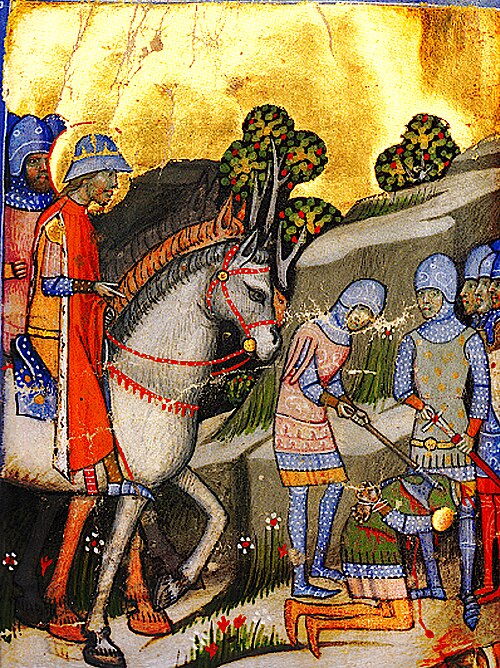 | قطع رأس كوباني
|
| الصفحة 39 |  | الملك القديس إسطفانوس في زي عسكري: يُصوَّر الملك القديس إسطفانوس مرتديًا زيًا عسكريًا. يقف الملك المحارب، في ريعان شبابه، على أرض صخرية أمام خلفية زرقاء. يرتدي واقيات ساق بنية اللون مزينة بنقاط ذهبية، بينما يُغطى درعه بغطاء يحمل خطوط أرباد الحمراء والبيضاء . يعلو رأسه تاج ملكي، محاط بهالة. يحمل في يده اليمنى راية، وفي يده اليسرى درعًا، وكلاهما يحمل شعار النبالة مع الصليب المزدوج على حامل ثلاثي ، رمزًا لمكانته كملك رسولي . [ 7 ] |
| الصفحة 40 |  | الملك القديس ستيفن يأسر جيولا
- علامة كالت: كرونكون بيكتوم [ 8 ] |
| الصفحة 40 |  | الملك القديس ستيفن على العرش: يجلس الملك القديس ستيفن ملك المجر على قاعدة من الرخام الأخضر مزينة بالزخارف الملكية، مع هالة تحيط برأسه. [ 7 ] |
| الصفحة 41 |  | انتصار الملك ستيفن على كين، دوق البلغار والسلاف. في المنتصف يقف الملك المجري القديس ستيفن ، متوجًا بهالة، مرتديًا درعًا مزينًا بشعار نبالة يحمل الصليب المزدوج ، وقد وضع قدميه على جثة الدوق كين الساقط، الملقى على الأرض ممسكًا بقوس. يمسك أحد جنود الملك بزمام حصانه، المجهز بسرج فروسية على الطراز الغربي، بالإضافة إلى درعه المزخرف بالصليب المزدوج. في الخلفية، يطارد المحاربون المجريون محاربين بلغاريين فارين يرتدون ملابس على الطراز الشرقي. [ 7 ] |
| الصفحة 41 |  | الملك ستيفن في حلة ملكية: يظهر الملك القديس ستيفن مرتدياً حلة ملكية. وعلى صدره شعار النبالة المجري ذو الصليب المزدوج ، ويرتدي تاجاً وهالة، ويمسك صولجاناً في يده اليمنى وكرة في يده اليسرى. [ 7 ] |
| الصفحة 42 |  | مؤسسة كنيسة القديسين بطرس وبولس في أوبودا
|
| الصفحة 44 |  | جنازة الأمير إيميريك وإعماء فازول
|
| الصفحة 44 |  | الملك ستيفن يشجع الأمير أندرو وبيلا وليفينتي على الفرار. يرقد الملك القديس ستيفن مريضاً في الفراش، رافعاً يده اليمنى في إشارة تحذيرية للأمراء الثلاثة الواقفين بجانب سريره: أندرو وبيلا وليفينتي . [ 7 ] |
| الصفحة 46 |  | جنازة الملك ستيفن
|
| الصفحة 47 |  | الملك بيتر أورسيلو ، مرتدياً درعاً، يحمل سيفاً في يده اليمنى وتاجاً ملكياً. [ 7 ] |
| الصفحة 47 |  | يُطرد الملك بيتر على يد صموئيل أبا وجنوده. يطارد صموئيل أبا وفرسانه المجريون الملك بيتر أورسيلو ، الذي كان يحمل تاجًا في إحدى يديه. [ 7 ] |
| الصفحة 48 |  | الملك صموئيل أبا ، مرتدياً درعاً من حلقات معدنية، يحمل سيفاً في يده اليمنى بينما يمسك التاج الملكي في يده اليسرى. [ 7 ] |
| الصفحة 50 |  | معركة مينفو: انتصار الإمبراطور هنري الثالث على الملك صموئيل أبا
|
| الصفحة 50 |  | معركة مينفو: انتصار الإمبراطور هنري الثالث على الملك صموئيل أبا (تفاصيل)
|
| الصفحة 50 |  | مبعوث الملك آبا يُسلّم رسالةً تدعو للسلام إلى الإمبراطور الألماني. يُسلّم مبعوث الملك صموئيل آبا ملك المجر رسالةً يطلب فيها السلام إلى الإمبراطور الروماني المقدس هنري الثالث . (يسبق الحدث المصوّر في هذه اللوحة المصغّرة معركة مينفو الموضّحة في الرسم التوضيحي السابق). [ 7 ] |
| الصفحة 53 |  | الملك بيتر يمنح المجر كدولة تابعة للإمبراطور الألماني
|
| الصفحة 54 |  | مبارزة الأمير بيلا مع البوميراني: أسقط الأمير بيلا خصمه البوميراني عن حصانه برمحه. من بين الأمراء الثلاثة - أندرو ، وبيلا، وليفينتي - الذين فروا من المجر أولاً إلى بوهيميا ثم إلى بولندا ، قاتل بيلا نيابةً عن الدوق البولندي وأبنائه ضد حاكم البوميرانيين، الذي رفض دفع الجزية السنوية، وخرج منتصراً. [ 7 ] |
| الصفحة 59 |  | إقالة الملك بيتر، وتولي الأمير أندرو العرش
|
| Page 60 |  | Coronation of King AndrewThe coronation of King Andrew I of Hungary (1046). King Andrew is seated on the throne in ceremonial attire, holding a scepter in his left hand. Two bishops place the royal crown upon his head, while a third bishop presents him with a sword. (The presence of three bishops in the scene is likely explained by the chronicle's account that, following Vata's pagan uprising, only three bishops survived.)[7] |
| Page 61 |  | The Destruction of Emperor Henry's Ships at PozsonySiege of Pozsony (1052). Holy Roman Emperor Henry III launched his fifth campaign against the Kingdom of Hungary and unsuccessfully besieged Pozsony (now Bratislava, Slovakia). The Hungarians sank the imperial supply ships on the Danube, depriving the besieging army of its provisions. Knight Zotmund (Kund the Diver) was a soldier in the army of King Andrew I of Hungary, he swam beneath the German ships, scuttling and sinking them one after another. The miniature depicts Emperor Henry III below the castle of Pozsony, standing on the Danube in a leaking boat with two knights as it fills with water. Beside them, another boat, also deliberately holed and sinking, carries two desperate men.[7] |
| Page 64 |   | The Scene of Várkony: The Crown and SwordAt the time of the expulsion of King Peter Orseolo from Hungary in 1046, the Hungarians invited back the sons of Vazul to take the throne in his place. Of the returning brothers, Andrew and Levente, Andrew came to power. Béla returned to Hungary only later, in 1048, at his brother's request. Sharing his rule with him, the king entrusted Béla with the governance of one-third of the country, thereby establishing the institution of the duchy. According to the chronicle, Andrew also declared his younger brother to be his heir. The peaceful relationship between the two brothers changed toward the end of Andrew I's reign, when he concluded peace with King Henry IV of Germany. To strengthen the agreement, the Hungarian king's five-year-old son, Solomon, was married to Henry's sister, Judith. Shortly afterward, the child Solomon was crowned king as well. This harmed Béla's interests, and he openly expressed his opposition. At the end of 1059, King Andrew summoned Duke Béla to Várkony Castle, located on the banks of the Tisza River, and demanded that he declare his intentions: would he accept the newly crowned Solomon as his successor, or, according to their earlier agreement, did he intend to rule after Andrew's death? The ill king had both the symbols of royal and ducal authority – the crown and the sword – placed beside him. He then offered Béla a choice: "If you desire the kingdom, take the crown. If you desire the duchy, take the sword." However, Andrew had no intention of leaving Béla's decision to chance. He instructed his trusted men that if Béla chose the crown, they were not to let him leave. As the duke entered the hall, Ispán (Count) Miklós quietly warned him: "If you wish to live, choose the sword." Béla therefore chose the sword, the symbol of the duchy. Immediately afterward, he fled with his family to Poland, intending to return later with military assistance. The miniature depicts two scenes: On the right, Duke Béla stands before the doorway while Ispán Nicholas advises him to choose the sword. On the left, inside the chamber, Duke Béla stands at the foot of King Andrew's sickbed. The ill king lies in bed, with two of his leading nobles and his young son Solomon, wearing the crown, standing behind him. On the step of the bed lie the sword and the crown: the sword symbolises the duchy, while the crown represents the kingship.[7] |
| Page 67 |  | Prince Béla Wins the CrownOn the left, two noblemen remove the crown from Solomon's head. On the right stands King Béla, holding the orb in his left hand. An elderly nobleman presents him with the sword, while another places the crown upon his head.[7] |
| Page 69 |  | German Emperor Henry IV Brings Solomon Back to Hungary
|
| Page 71 |  | King Solomon and His Younger Brother Prince DavidOn the left is King Solomon of Hungary, depicted wearing a crown and holding a scepter and an orb, while on the right is his younger brother, Prince David, shown wearing a princely cap and carrying a shield and a sword.[7] |
| Page 72 |   | Prince Ladislaus Is Fighting a Duel With a Cuman Warrior Who Kidnapped a GirlIn the foreground, Saint Ladislaus, distinguished by his halo, is engaged in combat with the Cuman warrior, behind whom stands the abducted maiden wearing a crown. In the background, set against a rocky mountainous landscape, the Hungarians pursue the retreating Cumans, while King Solomon of Hungary and Prince Géza are depicted in the center. The Hungarian flag bearing the double cross projects beyond the frame of the miniature.[7] |
| Page 74 |  | The Capture of Belgrade and the Distribution of the Spoils of WarThe Siege of Belgrade (1071). In the background, the fortress of Belgrade, besieged by the Hungarians, rises atop rocky cliffs. The fortress is set on fire by a Hungarian girl held captive within its walls, who uses a torch to ignite it. In the foreground, the distribution of the spoils of war is depicted: seated at a table is Count Vid, chief advisor of King Solomon of Hungary, dividing the booty into four shares. Standing beside the table are King Solomon and Princes Géza and Ladislaus, the latter depicted with a halo.[7] |
| Page 78 |  | The Feud Between King Solomon and Prince Géza
—Mark of Kalt: Chronicon Pictum[8] |
| Page 78 |  | The People of Niš Pay Homage to King Solomon and Prince Géza
|
| Page 81 |  | Prince Géza and Abbot VillermusThe abbot of the monastery of Szekszárd, Villermus, is depicted putting on a knight's disguise over his bare upper body. In the same scene, he is shown leading a saddled horse as he stands before Prince Géza, waking him from his sleep and urging him to flee. Behind the head of the reclining prince stand the two traitors, Petrud and Bikás.[7] |
| Page 81 |  | Escape of Prince GézaThe Battle of Kemej (1074). Prince Géza is depicted fleeing with his soldiers. Some distance behind him follow his two disloyal knights, Petrud and Bikás. As a sign of their treachery, they raise their shields, however, the soldiers of King Solomon of Hungary, not recognizing the signal, cut them down.[7] |
| Page 83 |  | The Vision of Prince LadislausPrince Géza is shown on a white horse as a descending angel places a crown upon his head. Prince Ladislaus, likewise mounted on a white horse, gazes upward with outstretched arms at the heavenly vision. According to the chronicle, only Ladislaus sees the vision and recounts it to his brother Géza, who vows that, if the vision is fulfilled, he will build a church on that very spot.[7] |
| Page 85 |  | The Battle of Mogyoród |
| Page 87 |  | The Vision of King Géza and Prince LadislausThe miniature on page 83 of the Illuminated Chronicle depicts the vision of Prince Saint Ladislaus, in which a descending angel places a crown upon Géza's head, foreshadowing his coronation as king. After they defeated their cousin, King Solomon of Hungary, at the Battle of Mogyoród, Géza was crowned king, and he then visited with his brother the place where the vision had occurred. In the miniature, on the banks of the Danube at Vác, King I Géza of Hungary is shown holding the orb, while Prince Saint Ladislaus holds a battle axe, the two stand embracing each other. Among the trees appears a stag with burning candles on the tips of its antlers. According to the chronicle, they are deciding where to build the church they had vowed to erect in the event of their victory. At the place where the stag, identified as the Angel of God, set down its feet, Géza founded the church.[7] |
| Page 89 |  | King Solomon Again Asks for Help From the German EmperorHoly Roman Emperor Henry IV sits enthroned, wearing a crown and holding a sceptre in his left hand. Kneeling before him, King Solomon of Hungary grasps with both hands the outstretched right hand of Emperor Henry IV, the brother of his wife, Judith. In the foreground, the royal crown lies on the ground.[7] |
| Page 91 |  | The Escape of King SolomonIn the background stands Pozsony Castle, with warriors looking down from its walls. In the left foreground is King Géza I of Hungary, beside whom Prince Saint Ladislaus leads his warriors on a white horse. He holds a shield bearing the Hungarian double cross in his left hand and a sword in his right. Above his haloed head, an angel hovers, wielding a flaming sword. On the right, King Solomon of Hungary is depicted fleeing on horseback while looking back at his pursuers. He holds a sword in his right hand and a red-and-white Árpád-striped shield in his left.[7] |
| Page 92 |  | The Coronation of Ladislaus the First
|
| Page 93 |  | King Saint Ladislaus, the Knight KingKing Saint Ladislaus of Hungary, is depicted with a halo and a crown, clad in full knightly armor. On his breast is the Hungarian coat of arms bearing the double cross. He holds a battle axe in his right hand and an orb in his left.[7] |
| Page 98 |  | The Ruthenians Pledge Allegiance to King LadislausSeated on his throne, King Saint Ladislaus is surrounded by his warriors. Before him kneel several Ruthenians wearing caps, their hands raised in supplication. At their head is their prince, who has placed his cap at the king's feet.[7] |
| Page 98 |  | Siege of KrakówIn the background stands Kraków Castle on the bank of the Vistula River. In the left foreground, King Saint Ladislaus leans with his left hand on a shield bearing the Árpád-striped coat of arms while holding a sword in his right hand. In the right foreground, a soldier pours flour from his greave onto a pile of earth, while another soldier behind him carries more flour in the same manner. According to the chronicle, the defenders of the castle, seeing that the besieging army still had an abundant supply of food, voluntarily surrendered the fortress.[7] |
| Page 99 |  | Construction of the Nagyvárad's ChurchOn the bank of the Körös River, King Saint Ladislaus, depicted with a halo and raising his hand, stands before the church under construction at Nagyvárad.[7] |
| Page 99 |  | King Saint Ladislaus Receives AmbassadorsThe left side of the image depicts King Saint Ladislaus accompanied by two attendants. On the right, four foreign envoys approach him, the foremost presenting a letter in a gesture of homage. According to the chronicle, the envoys came to invite Ladislaus to assume command of the First Crusade.[7] |
| Page 101 |  | Funeral of King Saint LadislausThe image depicts a scene that is not mentioned in the text of the chronicle but appears in every known version of the legend of King Saint Ladislaus: a wagon without horses carries the king's body toward the place of burial he had chosen, the church in Nagyvárad. The body of King Ladislaus lies on a four-wheeled wagon, with a crown and halo on his head and a scepter and orb in his hands. The wagon pole extending out of the image clearly indicates that no horses are harnessed to the wagon. On the right, a group of astonished onlookers can be seen, while in the background stands the church in Nagyvárad built by Ladislaus.[7] |
| Page 101 |  | The Coronation of ColomanThe Coronation of King Coloman the Learned (1095). A bishop places the crown upon the head of King Coloman of Hungary, who is depicted as a hunchback and in simple attire, in accordance with the tradition preserved in medieval Hungarian chronicles.[7] |
| Page 105 |  | King Coloman and Prince Álmos in Front of the Church of Dömös |
| Page 105 |  | The Hunt in Csór
—Mark of Kalt: Chronicon Pictum[8] |
| Page 106 |  | The Blinding of Prince Álmos and His Little Son BélaSeated on his throne, King Coloman orders two soldiers to blind Prince Álmos and his son Béla, and to castrate the boy. In the background on the right, Prince Álmos lies on the ground while a soldier gouges out his eyes. In front of him lies the blinded child Béla, however, the soldier kneeling beside him castrates a dog instead of the boy. Later, Coloman's son, King Stephen II, remained childless, so he arranged the marriage of his blinded cousin Béla. Béla had at least six children, thereby ensuring the continuation of the Árpád dynasty's royal bloodline.[7] |
| Page 106 |  | King Coloman Wants to Capture Prince Álmos
|
| Page 108 |  | The Coronation of Stephen II, Coloman's SonTwo bishops crown the young King Stephen II, the son of King Coloman. He holds the orb in one hand and the scepter in the other. His coronation took place in 1116.[7] |
| Page 113 |  | The Bloody Assembly of the Realm at AradThe blind King Béla II of Hungary was crowned at Székesfehérvár in 1131. Shortly afterwards, a royal assembly (Diet) was held near Arad, where, at the urging of Queen Helena, Béla's supporters massacred the 68 magnates whom they held responsible for the king's blinding in childhood. The miniature depicts King Béla II and his wife, Queen Helena, seated on the throne. The queen orders the execution of the magnates who had advised the blinding of the young Béla during the reign of King Coloman of Hungary. On the right are the magnates who have already been executed and those awaiting execution, behind them, a soldier, his enormous sword raised high, is about to strike.[7] |
| Page 114 |  | King Béla II the BlindKing Béla II with the crown, scepter, and orb.[7] |
| Page 117 |  | Coronation of King Géza IIThe coronation of King Géza II of Hungary (1141). Two bishops place the crown upon Géza's head, while a young man – presumably Géza's eldest younger brother, Prince Ladislaus, the future usurper – wearing a princely cap, leads a white horse by the reins and presents the royal sword to Géza.[7] |
| Page 117 |  | King Géza II in Royal RegaliaStanding figure of King Géza II, wearing a hauberk and a crown, holding a scepter in his left hand and resting his right hand on his shield.[7] |
| Page 119 |  | German Emperor Konrad III and French King Louis VII March through Hungary with Their Crusader Army
|
| Page 120 |  | King Géza II of Hungary and King Louis VII of FranceOn the left is King Louis VII of France, wearing a crown, on the right is King Géza II of Hungary, attired in royal regalia. The joint depiction of the two rulers symbolizes the cordial relations between them, which the Illuminated Chronicle emphasizes by contrasting it with the truculent behavior of the German crusaders.[7] |
| Page 121 |  | The Coronation of Stephen III
|
| Page 121 |  | Prince Ladislaus, the Usurper of the Throne and the Stealing of the Crown |
| Page 122 |  | The Usurper Prince StephenPrince Stephen, the son of King Béla II, is depicted wearing a princely cap and a crimson mantle, holding a sword in his left hand. He later became the anti-king Stephen IV.[7] |
| Page 122 |  | King Béla IIIKing Béla III is depicted wearing a royal crown and chain mail, holding an orb in his right hand and a red-and-white striped flag bearing the Árpád stripes in his left hand.[7] |
| Page 122 |  | Coronation of King EmericThe coronation of King Emeric in 1196. Emeric is enthroned holding a scepter and an orb, while two bishops place the crown upon his head.[7] |
| Page 123 |  | King EmericKing Emeric is depicted with a crown, a scepter, and an orb.[7] |
| Page 123 |  | Coronation of King Ladislaus IIIIA bishop places the crown upon Ladislaus's head. Although King Ladislaus III was only five years old at the time of his coronation, the illuminator depicts him as a mature man. Because the chronicler did not refer to the rival king Ladislaus as Ladislaus II, he presents this Ladislaus as the second of that name, even though he is the third in the sequence of Hungarian kings.[7] |
| Page 123 |  | King Ladislaus IIIIKing Ladislaus III, with crown, sceptre, and orb.[7] |
| Page 123 |  | Coronation of King Andrew IIOne of the two bishops places the crown on the head of King Andrew II, who is seated on the throne. To the right stand the king's daughter, Saint Elizabeth, distinguished by a halo, and two of his sons, most likely the future King Béla IV and Prince Coloman.[7] |
| Page 124 |  | King Andrew IIKing Andrew II of Hungary in royal regalia, holding the orb and the Hungarian flag bearing the double cross.[7] |
| Page 124 |  | King Andrew II at the Head of His Crusader ArmyKing Andrew II rides along a rocky riverbank at the head of his warriors. One of them carries a red banner bearing the Hungarian coat of arms with the double cross. King Andrew led the Fifth Crusade in 1217–1218.[7] |
| Page 125 |  | Coronation of King Béla IVThe coronation of King Béla IV of Hungary (1235). Seated on the throne, Béla IV is crowned by a bishop, while his younger brother, Prince Coloman, presents him with the Sword of State.[7] |
| Page 125 |  | The First Arrival of the Mongols |
| Page 126 |  | The Fight of King Béla IV of Hungary with King Ottokar II of BohemiaThe Battle of Kressenbrunn (1260). A cavalry battle between the armies of King Ottokar II of Bohemia and King Béla IV of Hungary. At the center, Béla IV is depicted riding a white horse, wearing armor and a crown.[7] |
| Page 126 | 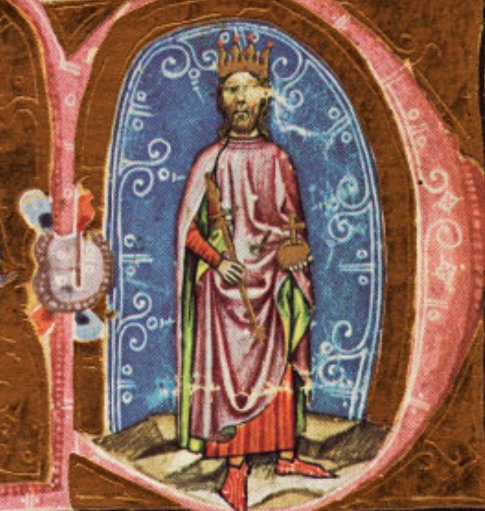 | King Béla IV
|
| Page 126 |  | FlagellantsFlagellants in 1263, according to the chronicle. Rocky landscape with churches in the background. In the foreground are four flagellants, two of whom are scourging themselves bloody.[7] |
| Page 127 |  | Coronation of King Stephen VThe Coronation of Stephen V of Hungary as Junior King (1246, from 1262, he used the title "Junior King" as his royal title). In the miniature, Stephen V stands on the right, while his elderly father, King Béla IV of Hungary, places the crown upon his head. On the left, behind him, stands his wife, Queen Maria Laskarina.[7] |
| Page 128 |  | King Ladislaus IV
|
| Page 128 |  | The Second Mongol Invasion
|
| Page 129 |  | Bishop Philip of Fermo, the Papal Legate Is Coming to HungaryBishop Philip of Fermo, the papal legate, dressed in cardinal's robes, rides a white horse, accompanied by a mounted soldier.[7] |
| Page 129 |  | The Murdered King Ladislaus the Cuman and His Murderers
|
| Page 130 |  | Prince Andrew Is Brought to HungaryPrince Andrew rides wearing a princely cap, in 1290, he is crowned King Andrew III.[7] |
| Page 131 |  | The Child Charles Robert Is Brought to HungaryThe future King Charles I of Hungary is depicted wearing a princely cap and riding a white horse, accompanied by two noblemen.[7] |
| Page 132 |  | Prince Wenceslaus Arrives in HungaryPrince Wenceslaus, son of King Wenceslaus II of Bohemia, comes to Hungary accompanied by two noblemen.[7] |
| Page 133 |  | King Wenceslaus Returns to BohemiaFrom left, King Wenceslaus II of Bohemia is depicted riding a white horse. Beside him is his son, King Wenceslaus of Hungary, wearing a princely cap. As the name Wenceslaus was not commonly used among the Hungarians, King Wenceslaus was called Ladislaus.[7] |
| Page 134 |  | The Priests of Buda Curse the PopeAccording to the chronicle, papal legate Nicola Boccasini (the future Pope Benedict XI) came to Hungary to support Charles Robert (the future King of Hungary), but he was unable to carry out his mission successfully. Upon his departure, he placed the citizens of Buda under an ecclesiastical interdict. In protest, some priests of Budaexcommunicated the Pope. In the miniature, two priests from Buda stand in front of a church with a bell tower. One holds a burning candle and rings a bell, while the other points with his hand toward Cardinal Nicola of the Dominican Order seated on the ground.[7] |
| Page 135 |  | Recovery of the Lost CrownAccording to the chronicle, Duke Otto of Bavaria obtained the Holy Crown of Hungary from Wenceslaus, who had returned to Bohemia, and brought it to Hungary. Fearing his enemies, he concealed the Crown inside a wooden drinking vessel. During the journey, the vessel was lost, but it was eventually found. In the miniature, the already crowned Otto, King of Hungary, is depicted on the right, riding a white horse. One of his attendants picks up the wooden drinking vessel from the road, in which the Crown had been hidden, and with his other hand is already handing the Crown to the King.[7] |
| Page 136 |  | Cardinal Gentile Arrives in HungaryThe papal legate, Cardinal Gentile, rides a white horse, wearing the habit of the Franciscan Order and a cardinal's hat. He is accompanied by a priest and two men in secular dress.[7] |
| Page 137 | 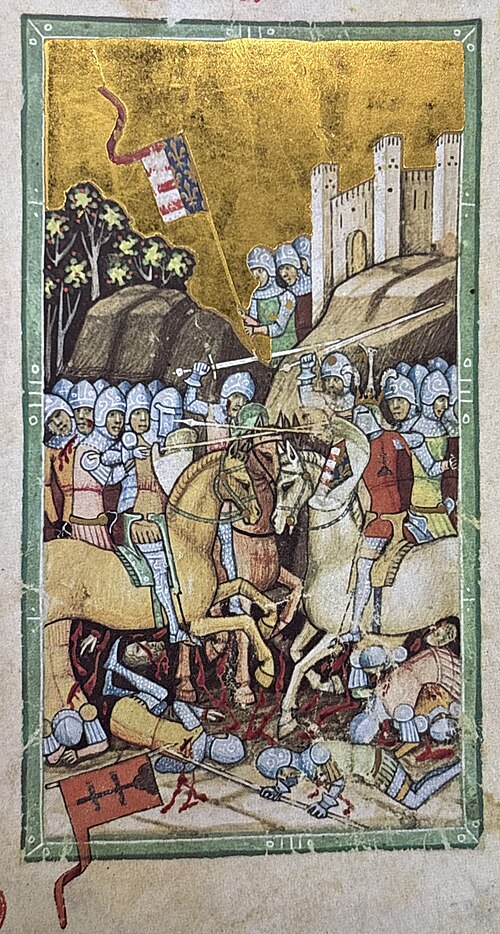 | Battle of RozgonyThe Battle of Rozgony (1312). The battle was the most significant engagement of King Charles I of Hungary's campaign to reunify Kingdom of Hungary. In this battle, fought on the field near Rozgony (now Rozhanovce, Slovakia) close to Kassa (now Košice, Slovakia), the king defeated the army of the family of Palatine Amade Aba. The Illuminated Chronicle describes it as the fiercest battle fought since the Mongol invasions of Hungary. Although the royal army also suffered heavy losses, King Charles Robert's decisive victory brought an end to the Aba family's dominance in northeastern Hungary, weakened his most powerful internal rival, Matthew Csák, the magnate who ruled northwestern Hungary, and firmly consolidated Charles Robert's reign throughout the kingdom. Through his maternal line, Charles Robert was one of the heirs of the ruling House of Árpád, which had only recently become extinct in the male line. In the miniature, the battle is depicted taking place in a valley between two rocky hills, with the castle of Kassa standing on the heights. In the foreground lie the bloodied bodies of fallen warriors. On the right, King Charles Robert rides a white horse in full armor, wearing a crown and a visored helmet adorned with the crest of the Hungarian Angevins. His breastplate bears the Hungarian coat of arms with the double cross. His similarly decorated banner lies on the ground in the hand of his fallen standard-bearer, Györke. In his left hand, the king carries a shield displaying the fleur-de-lis of the House of Anjou, while in the background, beneath the royal Hungarian Angevin banner, the relieving army arrives to support him. On the left, the opposing commander – presumably one of Aba Amadé's sons – also wearing a closed helmet, is shown engaged in single combat with the king.[7] |
| Page 138 |  | King Charles RobertKing Charles I is depicted in full armor, wearing the royal crown over his kettle hat. He holds the orb in his right hand and a lowered shield bearing the royal Hungarian Angevin coat of arms in his left.[7] |
| Page 139 |  | The First Wife of King Charles Robert, Mary Is Placed in a CoffinA man places the body of Queen Mary, the first wife of King Charles I, into a coffin, while two bishops officiate at the funeral rites.[7] |
| Page 139 |  | The Wedding of King Charles Robert With Elizabeth, the Daughter of the Polish King WładysławThe royal wedding (1320). Elizabeth, daughter of Władysław I Łokietek, King of Poland, and the third wife of Charles Robert of Hungary. On the left, two elderly figures lead the richly dressed Elizabeth, wearing a golden crown. On the right, facing her, the king extends the queen's crown toward her. At the far right, two heralds blow trumpets from which hang royal banners bearing the Hungarian Angevin coat of arms.[7] |
| Page 140 |  | Queen Elizabeth With Her ChildrenIn the center is Queen Elizabeth, the consort of King CharlesRobert, surrounded by her five children. On the left stand two boys wearing royal crowns: the future King LouisI and his younger brother, Prince Andrew, heir to the throne of the Kingdom of Naples. On the right are three boys wearing princely caps: Stephen, Duke of Slavonia; Charles, who died in infancy; and Ladislaus, who died at the age of five. According to another interpretation, the two figures on the right represent the royal couple's daughters: Catherine, Duchess of Świdnica, and Elizabeth.[7] |
| Page 140 |  | The Founding of the Monastery in LippaKneeling opposite each other, King Charles Robert of Hungary and Queen Elizabeth hold a miniature model of the church at Lippa (now Lipova, Romania). in their hands as a symbol of its foundation.[7] |
| Page 140 |  | Saint Louis of ToulouseSaint Louis of Toulouse (Louis of Anjou, Bishop of Toulouse) is depicted with a halo. The clasp fastening his liturgical cope across his chest bears the Hungarian Angevin coat of arms. The saint was a maternal descendant of the House of Árpád: his mother was Mary, daughter of King Stephen V of Hungary. He raises his right hand in blessing, while the royal crown lies at his feet, symbolizing his renunciation of the Kingdom of Naples when he chose an ecclesiastical vocation.[7] |
| Page 140 |  | Birth of King LouisKing Charles I of Hungary's son was born in 1326 and was named Louis after the king's paternal uncle, Saint Louis of Toulouse, who was canonized in 1317. Queen Elizabeth is depicted lying in bed, wearing a crown, while one of the three female attendants presents the crowned infant Louis to his mother.[7] |
| Page 141 |  | The Burning of the Coronation Basilica at SzékesfehérvárThis scene depicts the 1327 burning of the Basilica of the Assumption of the Blessed Virgin Mary at Székesfehérvár, the largest and most important church of the medieval Kingdom of Hungary. Flames rise from three of the four towers and the lead-covered roof of the Romanesque basilica. According to the accompanying text, the fourth tower, which stood above the sacristy, did not burn down because the holy relics were kept there.[7] |
| Page 141 |  | Felician Záh's Assassination Against the Royal FamilyThe 1330 assassination attempt. In one of the chambers of the royal palace in Visegrád, King Charles Robert and Queen Elizabeth are seated at a table lavishly set with dishes and tableware. The elderly Felician Záh wounds the queen's right hand with his sword as she attempts to shield the king. However, John, the royal carver, rushes in and stabs the assassin from behind. Meanwhile, on the left, a servant is just entering the room carrying a platter of food.[7] |
| Page 143 |  | The Defeat of King Charles in the Campaign Against Basarab
|
| Page 144 |  | King Charles Receives the Envoy of Voivode BasarabKing Charles I is depicted wearing armor. Before him stands a messenger with long hair and a long robe, holding a helmet in his left hand while presenting a letter from Voivode Basarab to the Hungarian king. (The event depicted in this miniature precedes the Battle of Posada shown in the previous illustration).[7] |
| Page 146 | 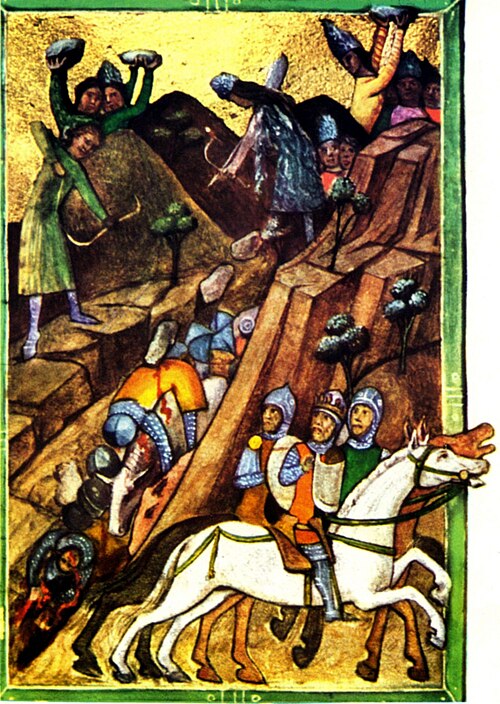 | Victory of Basarab Over the Royal Army
|
See also
References
- 12"The Secretum Secretorum of Louis the Great". Hertford College – Library & Archives.
- ↑Hóman, Bálint (1925). "A magyarok hún-hagyománya – Kézai Simon hún-krónikája"[The Hun Tradition of the Hungarians - The Hun Chronicle of Simon Kézai]. A magyar hún-hagyomány és hún-monda[The Hungarian Hun Tradition and Hun Legend] (in Hungarian). Budapest: Hungarian Academy of Sciences.
- ↑Dr. Szabados, György (1998). "A krónikáktól a Gestáig – Az előidő-szemlélet hangsúlyváltásai a 15–18. században"[From the chronicles to the Gesta - Shifts in emphasis of the pre-time perspective in the 15th–18th centuries]. Irodalomtörténeti Közlemények, 102 (5-6)(PDF) (in Hungarian). MTA Irodalomtudományi Intézet (Institute for Literary Studies of Hungarian Academy of Sciences). pp. 615–641. ISSN 0021-1486.
- 123Pražák, Nechutová, Bartoňková (1988). Legendy a kroniky koruny Uherské (Legends and chronicles of Hungarian crown). Prague: Nakladatelství Vyšehrad. pp. 340–346.
{{cite book}}: CS1 maint: multiple names: authors list (link) - ↑Dercsinyi, Dezső (1964). A Képes krónika és kora (The Chronicon Pictum and Its Age) (in Hungarian). Budapest.
{{cite book}}: CS1 maint: location missing publisher (link) - ↑CEU Press (2018). "The Illuminated Chronicle: Chronicle of the Deeds of the Hungarians from the Fourteenth-Century Illuminated Codex". CEU Press – Central European University.
- 123456789101112131415161718192021222324252627282930313233343536373839404142434445464748495051525354555657585960616263646566676869707172737475767778798081828384858687888990919293949596979899100101102103104105106107108109110111112113Geréb, László; Dercsinyi, Dezső; Csapodiné Gárdonyi, Klára; Mezey, László (1964). Képes Krónika[Illuminated Chronicle](PDF) (in Hungarian). Budapest: Magyar Helikon.
- 1234567Mark of Kalt: Chronicon Pictumhttps://mek.oszk.hu/10600/10642/10642.htm
External links
- Kalt, Marci (1358). Chronicon Pictum(PDF) (in Latin). Archived from the original(PDF) on 2012-03-04.
- M. Florianus, ed. (1883). Chronica Hungarorum: Chronicon Pictum Vindobonense (in Latin). Lipsiae (Leipzig). pp. 100–302.
{{cite book}}: CS1 maint: location missing publisher (link) - Podhradczky, József (1838) [1365]. Chronicon Budense (in Latin). Buda. – A more readable Latin text, with notes in Latin
- غريب، لازلو؛ ديركسيني، ديزسو؛ كاسابوديني جاردوني، كلارا؛ ميزي، لازلو (1964). Képes Krónika [ وقائع مضيئة ] (PDF) (باللغة المجرية). بودابست: المجرية هيليكون.
- غريب، لازلو (1993). Képes Krónika [ وقائع مضيئة ] (باللغة المجرية). ماجيار هيرلاب ومايسيناس كيادو. رقم ISBN 963-8164-07-7.
- سجلات المجر
- تاريخ المجر في العصور الوسطى
- تاريخ مُنير
- مخطوطات مزخرفة من القرن الرابع عشر
- كتب التاريخ التي تعود إلى القرن الرابع عشر
- كتب من القرن الرابع عشر مكتوبة باللاتينية
- كتب القرن الرابع عشر