
العصر البرمي
العصر البرمي ( يُلفظ /ˈpɜːrmii.ən/ ) [ 4 ] هو فترة جيولوجية ونظام طبقي يمتد على مدى 47 مليون سنة ، من نهاية العصر الكربوني قبل 298.9 مليون سنة إلى بداية العصر الترياسي قبل 251.902 مليون سنة. وهو العصر السادس والأخير من حقبة الحياة القديمة ؛ أما العصر الترياسي الذي يليه فينتمي إلى حقبة الحياة الوسطى . وقد طُرح مفهوم العصر البرمي عام 1841 من قِبل الجيولوجي السير رودريك مورشيسون ، الذي أطلق عليه هذا الاسم نسبةً إلى منطقة بيرم في روسيا . [ 5 ] [ 6 ] [ 7 ] [ 8 ] [ 9 ]
شهد العصر البرمي تنوع مجموعتي السلويات ، وهما السنابسيدات والزواحف . في ذلك الوقت ، كانت تهيمن على العالم قارة بانجيا العظمى ، التي تشكلت نتيجة اصطدام أورامريكا وجوندوانا خلال العصر الكربوني. كانت بانجيا محاطة بمحيط بانثالاسا العظيم . وقد خلّف انهيار الغابات المطيرة في العصر الكربوني مناطق شاسعة من الصحراء في قلب القارة. [ 10 ] وبرزت السلويات، التي استطاعت التكيف بشكل أفضل مع هذه الظروف الأكثر جفافًا، لتسيطر على العالم بدلًا من أسلافها البرمائية.
Various authors have proposed at least three,[11] and possibly four major extinction events in the Permian, though the validity of some of these extinctions has been disputed.[12] The end of the Early Permian (Cisuralian) was marked by a major faunal shift as most lineages of primitive "pelycosaur" synapsids became extinct, being replaced by more advanced therapsids during the Middle Permian (Guadalupian), though the nature of this transition (which may have been an extinction event dubbed "Olson's Extinction") is poorly understood. The end of the Capitanian Stage at the end of the Middle Permian was marked by the major Capitanian mass extinction event,[13] associated with the eruption of the Emeishan Traps. The Permian (along with the Paleozoic) ended with the Permian–Triassic extinction event (colloquially known as the Great Dying), the largest mass extinction in Earth's history (which is the last of the three or four crises that occurred in the Permian), in which nearly 81% of marine species and 70% of terrestrial species died out, associated with the eruption of the Siberian Traps. It took well into the Triassic for life to recover from this catastrophe;[14][15][16] on land, ecosystems took 30 million years to recover.[17]
Etymology and history
Prior to the introduction of the term Permian, rocks of equivalent age in Germany had been named the Rotliegend and Zechstein, and in Great Britain as the New Red Sandstone.[18]
The term Permian was introduced into geology in 1841 by Sir Roderick Impey Murchison, president of the Geological Society of London, after extensive Russian explorations undertaken with Édouard de Verneuil in the vicinity of the Ural Mountains in the years 1840 and 1841. Murchison identified "vast series of beds of marl, schist, limestone, sandstone and conglomerate" that succeeded Carboniferous strata in the region.[19][20] Murchison, in collaboration with Russian geologists,[21] named the period after the surrounding Russian region of Perm, which takes its name from the medieval kingdom of Permia that occupied the same area hundreds of years prior, and which is now located in the Perm Krai administrative region.[21] Between 1853 and 1867, Jules Marcou recognised Permian strata in a large area of North America from the Mississippi River to the Colorado River and proposed the name Dyassic, from Dyas and Trias, though Murchison rejected this in 1871.[21] The Permian system was controversial for over a century after its original naming, with the United States Geological Survey until 1941 considering the Permian a subsystem of the Carboniferous equivalent to the Mississippian and Pennsylvanian.[18]
Geology
ينقسم العصر البرمي إلى ثلاث حقب ، من الأقدم إلى الأحدث، وهي حقبة السيسوراليان ، وحقبة الغوادالوبيان ، وحقبة اللوبينجيان ، والمعروفة شعبياً باسم العصر البرمي المبكر، والمتوسط، والمتأخر على التوالي. يقسم الجيولوجيون صخور العصر البرمي إلى مجموعة طبقية من وحدات أصغر تُسمى مراحل ، تشكلت كل منها خلال فترات زمنية مقابلة تُسمى عصوراً. يمكن تعريف المراحل على المستوى العالمي أو الإقليمي. وللمواءمة الطبقية العالمية ، تُصادق اللجنة الدولية لعلم الطبقات (ICS) على المراحل العالمية استناداً إلى مقطع ونقطة نموذجية للحدود العالمية (GSSP) من تكوين واحد ( نموذج طبقي ) يُحدد الحد الأدنى للمرحلة. أعمار العصر البرمي، من الأحدث إلى الأقدم، هي: [ 22 ]
| سلسلة/حقبة | المرحلة العمرية | الحد السفلي |
|---|---|---|
| العصر الترياسي المبكر | إندو | 251.902 ± 0.024 مليون سنة |
| لوبينجيان | تشانغشينغيان | 254.14 ± 0.07 مليون سنة |
| ووتشيابينجيان | 259.51 ± 0.21 مليون سنة | |
| غوادالوبيان | كابيتانيان | 264.28 ± 0.16 مليون سنة |
| وورديان | 266.9 ± 0.4 مليون سنة | |
| روديان | 274.4 ± 0.4 مليون سنة | |
| سيسوراليان | كونغوريان | 283.3 ± 0.4 مليون سنة |
| أرتينسكيان | 290.1 ± 0.26 مليون سنة | |
| ساكماريان | 293.52 ± 0.17 مليون سنة | |
| أسيليان | 298.9 ± 0.15 مليون سنة |
خلال معظم القرن العشرين، قُسِّم العصر البرمي إلى العصر البرمي المبكر والعصر البرمي المتأخر، مع اعتبار العصر الكونغوري المرحلة الأخيرة من العصر البرمي المبكر. [ 23 ] اقترح غلينيستر وزملاؤه في عام 1992 تقسيمًا ثلاثيًا، مؤكدين أن العصر الرودي-الكابتاني يختلف عن بقية العصر البرمي المتأخر، ويجب اعتباره حقبة منفصلة. [ 24 ] اعتُمد هذا التقسيم الثلاثي بعد اقتراح رسمي من غلينيستر وآخرون (1999). [ 25 ]
تاريخيًا، استندت معظم الدراسات الطبقية الحيوية البحرية للعصر البرمي إلى الأمونيتات ؛ إلا أن مواقع الأمونيتات نادرة في المقاطع الطبقية للعصر البرمي، وتتميز الأنواع بفترات زمنية طويلة نسبيًا. تستند جميع نقاط التفرع العالمية للعصر البرمي إلى تاريخ الظهور الأول لأنواع محددة من المخروطيات السنية ، وهي مجموعة غامضة من الحبليات عديمة الفك ذات عناصر فموية صلبة تشبه الأسنان. تُستخدم المخروطيات السنية كأحافير دليلية لمعظم حقبة الحياة القديمة والعصر الترياسي. [ 26 ]
سيسوراليان
The Cisuralian Series is named after the strata exposed on the western slopes of the Ural Mountains in Russia and Kazakhstan. The name was proposed by J. B. Waterhouse in 1982 to comprise the Asselian, Sakmarian, and Artinskian stages. The Kungurian was later added to conform to the Russian "Lower Permian". Albert Auguste Cochon de Lapparent in 1900 had proposed the "Uralian Series", but the subsequent inconsistent usage of this term meant that it was later abandoned.[27]
The Asselian was named by the Russian stratigrapher V.E. Ruzhenchev in 1954, after the Assel River in the southern Ural Mountains. The GSSP for the base of the Asselian is located in the Aidaralash River valley near Aqtöbe, Kazakhstan, which was ratified in 1996. The beginning of the stage is defined by the first appearance of Streptognathodus postfusus.[2]
The Sakmarian is named in reference to the Sakmara River in the southern Urals, and was coined by Alexander Karpinsky in 1874. The GSSP for the base of the Sakmarian is located at the Usolka section in the southern Urals, which was ratified in 2018. The GSSP is defined by the first appearance of Sweetognathus binodosus.[28]
The Artinskian was named after the city of Arti in Sverdlovsk Oblast, Russia. It was named by Karpinsky in 1874. The Artinskian currently lacks a defined GSSP.[22] The proposed definition for the base of the Artinskian is the first appearance of Sweetognathus aff. S. whitei.[26]
The Kungurian takes its name after Kungur, a city in Perm Krai. The stage was introduced by Alexandr Antonovich Stukenberg in 1890. The Kungurian currently lacks a defined GSSP.[22] Recent proposals have suggested the appearance of Neostreptognathodus pnevi as the lower boundary.[26]
Guadalupian
The Guadalupian Series is named after the Guadalupe Mountains in Texas and New Mexico, where extensive marine sequences of this age are exposed. It was named by George Herbert Girty in 1902.[25]
The Roadian was named in 1968 in reference to the Road Canyon Member of the Word Formation in Texas.[25] The GSSP for the base of the Roadian is located 42.7m above the base of the Cutoff Formation in Stratotype Canyon, Guadalupe Mountains, Texas, and was ratified in 2001. The beginning of the stage is defined by the first appearance of Jinogondolella nankingensis.[26]
The Wordian was named in reference to the Word Formation by Johan August Udden in 1916, Glenister and Furnish in 1961 was the first publication to use it as a chronostratigraphic term as a substage of the Guadalupian Stage.[25] The GSSP for the base of the Wordian is located in Guadalupe Pass, Texas, within the sediments of the Getaway Limestone Member of the Cherry Canyon Formation, which was ratified in 2001. The base of the Wordian is defined by the first appearance of the conodont Jinogondolella aserrata.[26]
The Capitanian is named after the Capitan Reef in the Guadalupe Mountains of Texas, named by George Burr Richardson in 1904, and first used in a chronostratigraphic sense by Glenister and Furnish in 1961 as a substage of the Guadalupian Stage.[25] The Capitanian was ratified as an international stage by the ICS in 2001. The GSSP for the base of the Capitanian is located at Nipple Hill in the southeast Guadalupe Mountains of Texas, and was ratified in 2001, the beginning of the stage is defined by the first appearance of Jinogondolella postserrata.[26]
Lopingian
The Lopingian was first introduced by Amadeus William Grabau in 1923 as the "Loping Series" after Leping, Jiangxi, China. Originally used as a lithostraphic unit, T.K. Huang in 1932 raised the Lopingian to a series, including all Permian deposits in South China that overlie the Maokou Limestone. In 1995, a vote by the Subcommission on Permian Stratigraphy of the ICS adopted the Lopingian as an international standard chronostratigraphic unit.[29]
The Wuchiapinginan and Changhsingian were first introduced in 1962, by J. Z. Sheng as the "Wuchiaping Formation" and "Changhsing Formation" within the Lopingian series. The GSSP for the base of the Wuchiapingian is located at Penglaitan, Guangxi, China and was ratified in 2004. The boundary is defined by the first appearance of Clarkina postbitteri postbitteri[29] The Changhsingian was originally derived from the Changxing Limestone, a geological unit first named by the Grabau in 1923, ultimately deriving from Changxing County, Zhejiang .The GSSP for the base of the Changhsingian is located 88 cm above the base of the Changxing Limestone in the Meishan D section, Zhejiang, China and was ratified in 2005, the boundary is defined by the first appearance of Clarkina wangi.[30]
The GSSP for the base of the Triassic is located at the base of Bed 27c at the Meishan D section, and was ratified in 2001. The GSSP is defined by the first appearance of the conodont Hindeodus parvus.[3]
Regional stages
The Russian Tatarian Stage includes the Lopingian, Capitanian and part of the Wordian, while the underlying Kazanian includes the rest of the Wordian as well as the Roadian.[23]
In North America, the Permian is divided into the Wolfcampian (which includes the Nealian and the Lenoxian stages); the Leonardian (Hessian and Cathedralian stages); the Guadalupian; and the Ochoan, corresponding to the Lopingian.[31][32]
The New Zealand geologic time scale divides the Permian into three epochs, Pre-Telfordian (undivided), D'Urville (divided into the Makarewan, Waiitian, and Puruhauan stages), and Aparima (Flettian, Barrettian, Mangapirian, and Telfordian stages). The Pre-Telfordian epoch corresponds approximately to the Asselian, Sakmarian, and Artinskian stages; the D'Urville epoch is roughly contemporary with the Kungurian stage and Guadalupian epoch; and the Aparima epoch is closely contemporary with the Lopingian epoch.[33]
Paleogeography

During the Permian, all the Earth's major landmasses were collected into a single supercontinent known as Pangaea, with the microcontinental terranes of Cathaysia to the east. Pangaea straddled the equator and extended toward the poles, with a corresponding effect on ocean currents in the single great ocean ("Panthalassa", the "universal sea"), and the Paleo-Tethys Ocean, a large ocean that existed between Asia and Gondwana. The Cimmeria continent rifted away from Gondwana and drifted north to Laurasia, causing the Paleo-Tethys Ocean to shrink. A new ocean was growing on its southern end, the Neotethys Ocean, an ocean that would dominate much of the Mesozoic Era.[34] A magmatic arc, containing Hainan on its southwesternmost end, began to form as Panthalassa subducted under the southeastern South China.[35] The Central Pangean Mountains, which began forming due to the collision of Laurasia and Gondwana during the Carboniferous, reached their maximum height during the early Permian around 295 Ma, comparable to the present Himalayas, but became heavily eroded as the Permian progressed.[36] The Kazakhstania block collided with Baltica during the Cisuralian, while the North China Craton, the South China Block and Indochina fused to each other and Pangea by the end of the Permian.[37] The Zechstein Sea, a hypersaline epicontinental sea, existed in what is now northwestern Europe.[38]
Large continental landmass interiors experience climates with extreme variations of heat and cold ("continental climate") and monsoon conditions with highly seasonal rainfall patterns. Deserts seem to have been widespread on Pangaea.[39] Such dry conditions favored gymnosperms, plants with seeds enclosed in a protective cover, over plants such as ferns that disperse spores in a wetter environment. The first modern trees (conifers, ginkgos and cycads) appeared in the Permian.
تُعرف ثلاث مناطق رئيسية على وجه الخصوص برواسبها الواسعة من العصر البرمي، وهي جبال الأورال (حيث تقع مدينة برمي نفسها)، والصين، وجنوب غرب أمريكا الشمالية، بما في ذلك طبقات الصخور الحمراء في تكساس . سُمّي حوض برمي في ولايتي تكساس ونيو مكسيكو الأمريكيتين بهذا الاسم لاحتوائه على أحد أثخن رواسب صخور العصر البرمي في العالم. [ 40 ]
علم المحيطات القديمة
انخفضت مستويات سطح البحر انخفاضًا طفيفًا خلال العصر البرمي المبكر (الأسيلي). استقر مستوى سطح البحر عند عدة عشرات من الأمتار فوق مستواه الحالي خلال العصر البرمي المبكر، ولكن حدث انخفاض حاد بدءًا من العصر الرودي، وبلغ ذروته عند أدنى مستوى لسطح البحر في حقبة الحياة القديمة بأكملها عند مستوى سطح البحر الحالي تقريبًا خلال العصر الووتشيبينجي، تلاه ارتفاع طفيف خلال العصر التشانغسينجي. [ 41 ]
مناخ
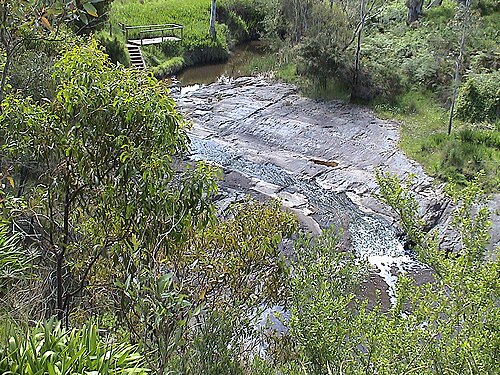
The Permian was cool in comparison to most other geologic time periods, with modest pole to Equator temperature gradients. At the start of the Permian, the Earth was still in the Late Paleozoic icehouse (LPIA), which began in the latest Devonian and spanned the entire Carboniferous period, with its most intense phase occurring during the latter part of the Pennsylvanian epoch.[42][43] A significant trend of increasing aridification can be observed over the course of the Cisuralian.[44] Early Permian aridification was most notable in Pangaean localities at near-equatorial latitudes.[45] Sea levels also rose notably in the Early Permian as the LPIA slowly waned.[46][47] At the Carboniferous-Permian boundary, a warming event occurred.[48] In addition to becoming warmer, the climate became notably more arid at the end of the Carboniferous and beginning of the Permian.[49][50] Nonetheless, temperatures continued to cool during most of the Asselian and Sakmarian, during which the LPIA peaked.[43][42] By 287 Ma, temperatures warmed and the South Pole ice cap retreated in what was known as the Artinskian Warming Event (AWE),[51] though glaciers remained present in the uplands of eastern Australia,[42][52] and perhaps also the mountainous regions of far northern Siberia.[53] Southern Africa also retained glaciers during the late Cisuralian in upland environments.[54] The AWE also witnessed aridification of a particularly great magnitude.[51]
In the late Kungurian, cooling resumed,[55] resulting in a cool glacial interval that lasted into the early Capitanian,[56] though average temperatures were still much higher than during the beginning of the Cisuralian.[52] Another cool period began around the middle Capitanian.[56] This cool period, lasting for 3–4 Myr, was known as the Kamura Event.[57] It was interrupted by the Emeishan Thermal Excursion in the late part of the Capitanian, around 260 million years ago, corresponding to the eruption of the Emeishan Traps.[43] This interval of rapid climate change was responsible for the Capitanian mass extinction event.[13]
During the early Wuchiapingian, following the emplacement of the Emeishan Traps, global temperatures declined as carbon dioxide was weathered out of the atmosphere by the large igneous province's emplaced basalts.[58] The late Wuchiapingian saw the finale of the Late Palaeozoic Ice Age, when the last Australian glaciers melted.[42] The end of the Permian is marked by a temperature excursion, much larger than the Emeishan Thermal Excursion, at the Permian-Triassic boundary, corresponding to the eruption of the Siberian Traps, which released more than 5 teratonnes of CO2, more than doubling the atmospheric carbon dioxide concentration.[43] A -2% δ18O excursion signifies the extreme magnitude of this climatic shift.[59] This extremely rapid interval of greenhouse gas release caused the Permian-Triassic mass extinction,[60] as well as ushering in an extreme hothouse that persisted for several million years into the next geologic epoch, the Triassic.[61]
The Permian climate was also extremely seasonal and characterised by megamonsoons,[62] which produced high aridity and extreme seasonality in Pangaea's interiors.[63] Precipitation along the western margins of the Palaeo-Tethys Ocean was very high.[64] Evidence for the megamonsoon includes the presence of megamonsoonal rainforests in the Qiangtang Basin of Tibet,[65] enormous seasonal variation in sedimentation, bioturbation, and ichnofossil deposition recorded in sedimentary facies in the Sydney Basin,[66] and palaeoclimatic models of the Earth's climate based on the behaviour of modern weather patterns showing that such a megamonsoon would occur given the continental arrangement of the Permian.[67] The aforementioned increasing equatorial aridity was likely driven by the development and intensification of this Pangaean megamonsoon.[68]
Life

Marine biota
تُعدّ الرواسب البحرية البرمية غنيةً بأحافير الرخويات ، [ 69 ] والذراعيات ، [ 70 ] [ 71 ] [ 72 ] وشوكيات الجلد . [ 73 ] [ 74 ] وقد تميّزت الذراعيات بتنوّعٍ كبيرٍ خلال العصر البرمي. وكانت رتبة برودكتيدا المنقرضة هي المجموعة السائدة من الذراعيات البرمية، حيث شكّلت ما يصل إلى نصف أجناس الذراعيات البرمية تقريبًا. [ 75 ] كما لعبت الذراعيات دورًا هامًا في هندسة النظم البيئية في مجمعات الشعاب المرجانية البرمية. [ 76 ] ومن بين الأمونيتات ، شكّلت رتبة غونياتيتيدا مجموعةً رئيسيةً خلال أوائل ومنتصف العصر البرمي، لكنها تراجعت خلال أواخر العصر البرمي. وكانت أفراد رتبة بروليكانيتيدا أقل تنوّعًا. ونشأت رتبة سيراتيتيدا من عائلة دارايليتيدا ضمن بروليكانيتيدا خلال منتصف العصر البرمي، وتنوّعت بشكلٍ كبيرٍ خلال أواخر العصر البرمي. [ 77 ] لا تُعرف من العصر البرمي سوى ثلاث عائلات من ثلاثيات الفصوص ، وهي: برويتيداي ، وبراكيمتوبيداي، وفيليبسيداي . كانت معدلات التنوع والنشأة والانقراض منخفضة خلال العصر البرمي المبكر. شهدت ثلاثيات الفصوص تنوعًا خلال العصرين الكونغوري والووردي، وهو الأخير في تاريخها التطوري، قبل أن تتراجع خلال العصر البرمي المتأخر. وبحلول العصر التشانغسينجي، لم يتبق سوى عدد قليل (4-6) من الأجناس. [ 78 ] أظهرت الشعاب المرجانية انخفاضًا في التنوع خلال العصرين البرمي الأوسط والمتأخر. [ 79 ]
الكائنات الحية الأرضية
شملت الحياة البرية في العصر البرمي نباتات وفطريات ومفصليات وأشكالًا مختلفة من رباعيات الأطراف . شهدت هذه الفترة صحراء شاسعة غطت المناطق الداخلية من بانجيا . امتدت المنطقة الدافئة إلى نصف الكرة الشمالي، حيث ظهرت صحراء قاحلة واسعة. [ 80 ] تلونت الصخور المتكونة في ذلك الوقت باللون الأحمر بفعل أكاسيد الحديد، نتيجة التسخين الشديد الذي تعرضت له سطح الأرض الخالي من الغطاء النباتي بفعل الشمس. انقرضت أنواع عديدة من النباتات والحيوانات القديمة أو أصبحت من الكائنات الحية النادرة.
بدأ العصر البرمي مع ازدهار نباتات العصر الكربوني. وفي منتصف العصر البرمي تقريبًا، بدأ تحول كبير في الغطاء النباتي. فقد حلت السرخسيات البذرية الأكثر تطورًا والصنوبريات المبكرة تدريجيًا محل أشجار الليكوبود المحبة للمستنقعات التي كانت سائدة في العصر الكربوني، مثل الليبيدوديندرون والسيجيلاريا ، في المناطق الداخلية للقارات نتيجة لانهيار الغابات المطيرة في العصر الكربوني . وفي نهاية العصر البرمي، لم يبقَ من مستنقعات الليكوبود والإكويست التي تُذكّر بنباتات العصر الكربوني إلا في كاثايسيا ، وهي سلسلة من الجزر الاستوائية في محيط باليو-تثيس التي أصبحت فيما بعد جنوب الصين . [ 81 ]
شهد العصر البرمي انتشارًا واسعًا للعديد من مجموعات الصنوبريات المهمة، بما في ذلك أسلاف العديد من العائلات النباتية الحالية. وامتلأت مناطق عديدة بغابات كثيفة تضم مزيجًا متنوعًا من النباتات. وشهدت القارة الجنوبية غابات واسعة من السرخسيات البذرية من جنس جلوسوبترس . ومن المرجح أن مستويات الأكسجين كانت مرتفعة هناك. كما ظهرت أشجار الجنكة والسيكاديات خلال هذه الفترة.
الحشرات

شهدت الحشرات، التي ظهرت لأول مرة وانتشرت بكثرة خلال العصر الكربوني السابق، زيادةً هائلةً في التنوع خلال العصر البرمي المبكر. ومع اقتراب نهاية العصر البرمي، انخفضت معدلات ظهورها وانقراضها انخفاضًا ملحوظًا. [ 82 ] وبحلول بداية العصر البرمي، كان هناك بالفعل سباق تسلح تطوري مشترك نشط بين الحشرات والأعضاء التناسلية للنباتات، ويتجلى ذلك في كل من الأضرار التي تُسببها الحشرات للنباتات والهياكل الدفاعية في النباتات التي تهدف إلى تقليل افتراس الحشرات لها. [ 83 ] كانت الحشرات السائدة خلال العصر البرمي من أوائل ممثلي رتب Paleoptera و Polyneoptera و Paraneoptera . أما فصيلة Palaeodictyopteroidea ، التي كانت تمثل المجموعة السائدة من الحشرات خلال العصر الكربوني، فقد تراجعت خلال العصر البرمي. ويرجع ذلك على الأرجح إلى المنافسة من رتبة Hemiptera ، نظرًا لتشابه أجزاء فمها وبالتالي بيئتها. شهدت أسلاف اليعاسيب البدائية ( Meganisoptera )، التي تضم أكبر الحشرات الطائرة على مر العصور، انخفاضًا ملحوظًا خلال العصر البرمي. [ 84 ] كما شهدت الحشرات كاملة التحول (Holometabola ) ، وهي أكبر مجموعة من الحشرات الحديثة، تنوعًا كبيرًا خلال هذه الفترة. [ 82 ] وبلغت مجموعة " Grylloblattidas "، وهي مجموعة منقرضة من الحشرات المجنحة يُعتقد أنها مرتبطة بزواحف الجليد الحديثة ، ذروة تنوعها خلال العصر البرمي، حيث مثلت ما يصل إلى ثلث جميع الحشرات في بعض المواقع. [ 85 ] وظهرت رتبة Mecoptera (المعروفة أحيانًا باسم ذباب العقرب) لأول مرة خلال العصر البرمي المبكر، ثم ازداد تنوعها خلال العصر البرمي المتأخر. تمتلك بعض أنواع Mecoptera البرمية، مثل Mesopsychidae، خراطيم طويلة تشير إلى أنها ربما تكون قد لقحت عاريات البذور. [ 86 ] وظهرت أقدم الخنافس المعروفة في بداية العصر البرمي. من المرجح أن الخنافس المبكرة، مثل أفراد عائلة Permocupedidae ، كانت تتغذى على الخشب المتحلل. وقد توسعت عدة سلالات، مثل عائلة Schizophoridae، إلى البيئات المائية بحلول أواخر العصر البرمي. [ 87 ] كما عُثر على أفراد من رتبتي Archostemata و Adephaga الحديثتين في أواخر العصر البرمي. [ 88 ] [ 89 ] وتشير آثار حفر الخشب المعقدة التي عُثر عليها في أواخر العصر البرمي في الصين إلى أن أفرادًا منPolyphaga, the most diverse group of modern beetles, were also present by the Late Permian.[90]
Tetrapods
The terrestrial fossil record of the Permian is patchy and temporally discontinuous. Early Permian records are dominated by equatorial Europe and North America, while those of the Middle and Late Permian are dominated by temperate Karoo Supergroup sediments of South Africa and the Ural region of European Russia.[91] Early Permian terrestrial faunas of North America and Europe were dominated by primitive pelycosaursynapsids including the herbivorous edaphosaurids, and carnivorous sphenacodontids, diadectids and amphibians.[92][93] Early Permian reptiles, such as acleistorhinids, were mostly small insectivores.[94]
Amniotes
Synapsids (the group that would later include mammals) thrived and diversified greatly during the Cisuralian. Permian synapsids included some large members such as Dimetrodon. The special adaptations of synapsids enabled them to flourish in the drier climate of the Permian and they grew to dominate the vertebrates.[92] A faunal turnover occurred around the transition between the Cisuralian and Guadalupian, with the decline of amphibians and the replacement of pelycosaurs (a paraphyletic group) with more advanced therapsids,[11] although the decline of early synapsid clades was apparently a slow event that lasted about 20 Ma, from the Sakmarian to the end of the Kungurian.[95] Predator-prey interactions among terrestrial synapsids became more dynamic.[96] If terrestrial deposition ended around the end of the Cisuralian in North America and began in Russia during the early Guadalupian, a continuous record of the transition is not preserved. Uncertain dating has led to suggestions that there is a global hiatus in the terrestrial fossil record during the late Kungurian and early Roadian, referred to as "Olson's Gap" that obscures the nature of the transition. Other proposals have suggested that the North American and Russian records overlap,[97][98][91][99] with the latest terrestrial North American deposition occurring during the Roadian, suggesting that there was an extinction event, dubbed "Olson's Extinction".[12]
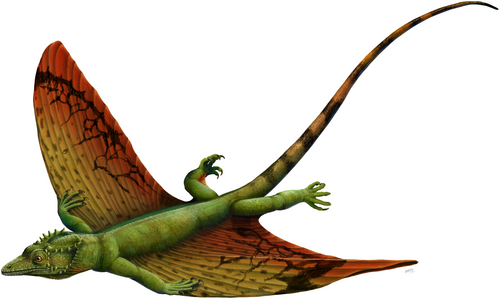
هيمنت الثيرابسيدات على حيوانات العصر البرمي الأوسط في جنوب إفريقيا وروسيا، وخاصةً الديناصورات الرأسية المتنوعة . انقرضت الديناصورات الرأسية في نهاية العصر البرمي الأوسط، خلال حدث الانقراض الجماعي الكابيتاني . أما حيوانات العصر البرمي المتأخر، فقد هيمنت عليها الثيرابسيدات المتطورة، مثل الغورغونوبسيات المفترسة ذات الأسنان السيفية والديسينودونتات العاشبة ذات المنقار ، إلى جانب البارياصورات العاشبة الكبيرة . [ 12 ] ظهرت الأركوصورومورفا ، وهي مجموعة الزواحف التي ستنشأ منها البسودوسوكيان والديناصورات والتيروصورات في العصر الترياسي اللاحق، لأول مرة وتنوعت خلال العصر البرمي المتأخر، بما في ذلك الظهور الأول للأركوصوريفورميس خلال أواخر العصر البرمي. [ 100 ] ظهرت السينودونتات ، وهي مجموعة من الثيرابسيدات التي تُعدّ أسلاف الثدييات الحديثة ، لأول مرة وانتشرت عالميًا خلال العصر البرمي المتأخر. [ 101 ] وظهرت مجموعة أخرى من الثيرابسيدات، وهي الثيروسفاليات (مثل ليكوسوكس )، في العصر البرمي الأوسط. [ 102 ] [ 103 ] لم تكن هناك فقاريات طائرة، على الرغم من أن عائلة الزواحف الشبيهة بالسحالي المنقرضة ويجيلتيصوريداي من العصر البرمي المتأخر كانت تمتلك أجنحة قابلة للتمدد مثل السحالي المنزلقة الحديثة ، وهي أقدم الفقاريات المنزلقة المعروفة. [ 104 ] [ 105 ]
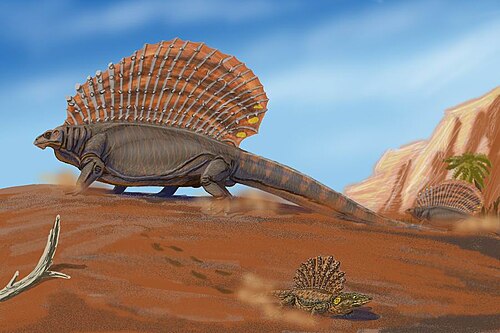 إيدافوصوروس بوغونياس وبلاتيهيستريكس – العصر البرمي المبكر، أمريكا الشمالية وأوروبا
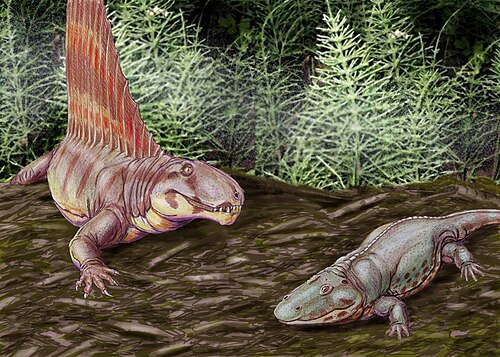 ديمترودون غرانديس وإريوبس– العصر البرمي المبكر، أمريكا الشمالية
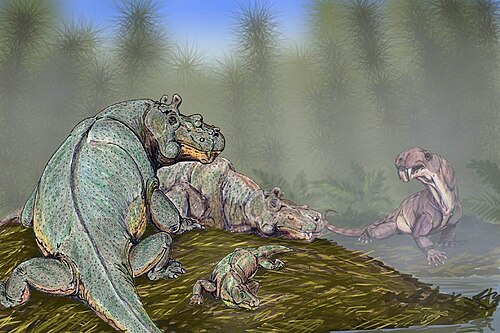 حيوانات ذات لون مغرة، إستيمينوسوكس أورالينسيس وإيوتيتانوسوكس – العصر البرمي الأوسط، منطقة الأورال
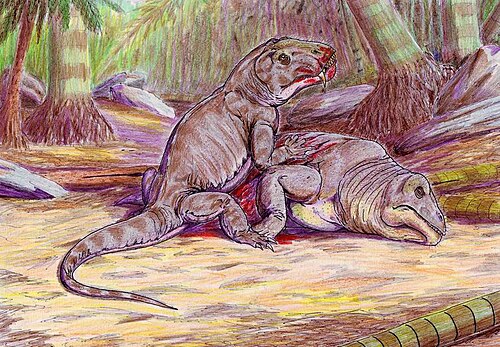 Titanophoneus و Ulemosaurus – منطقة الأورال
 Inostrancevia alexandri و Scutosaurus – العصر البرمي المتأخر، شمال أوروبا روسيا (شمال دفينا)
البرمائيات
تألفت السلويات الجذعية في العصر البرمي من الليبوسبونديلي والباتراكوصورات ، وفقًا لبعض التصنيفات التطورية؛ [ 106 ] ووفقًا لتصنيفات أخرى، فإن السلويات الجذعية ممثلة فقط بالدياديكتومورفات . [ 107 ]
Temnospondyls reached a peak of diversity in the Cisuralian, with a substantial decline during the Guadalupian-Lopingian following Olson's extinction, with the family diversity dropping below Carboniferous levels.[108]
Embolomeres, a group of aquatic crocodile-like limbed vertebrates that are reptilliomorphs under some phylogenies. They previously had their last records in the Cisuralian, are now known to have persisted into the Lopingian in China.[109]
Modern amphibians (lissamphibians) are suggested to have originated during Permian, descending from a lineage of dissorophoid temnospondyls[110] or lepospondyls.[107]
Fish
كان تنوع الأسماك خلال العصر البرمي منخفضًا نسبيًا مقارنةً بالعصر الترياسي اللاحق. وكانت المجموعة المهيمنة من الأسماك العظمية خلال العصر البرمي هي " الباليوبتريجية "، وهي مجموعة شبه عرقية من الأكتينوبتريجية تقع خارج نطاق النيوبتريجية . [ 111 ] ظهرت أقدم أفراد النيوبتريجية المؤكدة خلال العصر الترياسي المبكر، ولكن يُشتبه في أن أصلها يعود إلى العصر البرمي. [ 112 ] كان تنوع أسماك السيلاكانث منخفضًا نسبيًا طوال العصر البرمي مقارنةً بالأسماك البحرية الأخرى، على الرغم من وجود زيادة في التنوع خلال نهاية العصر البرمي (التشانغسينجي)، وهو ما يتوافق مع أعلى مستوى للتنوع في تاريخها التطوري خلال العصر الترياسي المبكر. [ 111 ] كان تنوع أسماك المياه العذبة منخفضًا بشكل عام، وسادته أسماك الرئة و"الباليوبتريجية". [ 111 ] يُعتقد أن السلف المشترك الأخير لجميع أسماك الرئة الحية قد وُجد خلال العصر البرمي المبكر. على الرغم من أن السجل الأحفوري مجزأ، يبدو أن أسماك الرئة قد شهدت تنوعًا تطوريًا وزيادة في الحجم في بيئات المياه العذبة خلال العصر البرمي المبكر، لكنها تراجعت لاحقًا خلال العصر البرمي الأوسط والمتأخر. [ 113 ] شهدت المخروطيات أدنى مستويات التنوع في تاريخها التطوري خلال العصر البرمي. [ 114 ] لا تزال معلوماتنا عن حيوانات الغضروفية في العصر البرمي قليلة. [ 115 ] بلغت أفراد مجموعة هولوسيفالي من الغضروفية ، والتي تضم كائنات حية تشبه الكيميرا ، ذروة تنوعها خلال العصر الكربوني-البرمي، وكان أشهر ممثليها في العصر البرمي هو "قرش المنشار" هيليكوبريون ، المعروف بأسنانه الحلزونية غير العادية في الفك السفلي. [ 116 ] كانت الهيبودونتات ، وهي مجموعة من الغضروفيات الشبيهة بالقرش، منتشرة بكثرة في بيئات المياه العذبة والمالحة طوال العصر البرمي. [ 115 ] [ 117 ] كانت أسماك زيناكانثيفورميس ، وهي مجموعة أخرى منقرضة من الأسماك الغضروفية الشبيهة بأسماك القرش، شائعة في بيئات المياه العذبة، ومثّلت الحيوانات المفترسة العليا في النظم البيئية للمياه العذبة. [ 118 ]
فلورا

Four floristic provinces in the Permian are recognised, the Angaran, Euramerican, Gondwanan, and Cathaysian realms.[119] The Carboniferous Rainforest Collapse would result in the replacement of lycopsid-dominated forests with tree-fern dominated ones during the late Carboniferous in Euramerica, and result in the differentiation of the Cathaysian floras from those of Euramerica.[119] The Gondwanan floristic region was dominated by Glossopteridales, a group of woody gymnosperm plants, for most of the Permian, extending to high southern latitudes. The ecology of the most prominent glossopterid, Glossopteris, has been compared to that of bald cypress, living in mires with waterlogged soils.[120] The tree-like calamites, distant relatives of modern horsetails, lived in coal swamps and grew in bamboo-like vertical thickets. A mostly complete specimen of Arthropitys from the Early Permian Chemnitz petrified forest of Germany demonstrates that they had complex branching patterns similar to modern angiosperm trees.[121] By the Late Permian, high thin forests had become widespread across the globe, as evidenced by the global distribution of weigeltisaurids.[122]

أقدم سجل محتمل لنباتات الجنكة (المجموعة التي تضم الجنكة وأقاربها المقربين) هو نبات تريكوبيتيس هيترومورفا من العصر البرمي المبكر في فرنسا. [ 123 ] أما أقدم الأحافير المعروفة التي يمكن نسبها بشكل قاطع إلى السيكاديات الحديثة فتعود إلى أواخر العصر البرمي. [ 124 ] في كاثايسيا، حيث ساد مناخ استوائي رطب خالٍ من الصقيع، كانت نباتات نوغيراثياليس ، وهي مجموعة منقرضة من نباتات عاريات البذور الشبيهة بسراخس الأشجار، مكونًا شائعًا للنباتات. [ 125 ] [ 126 ] تتميز نباتات طف وودا في كاثايسيا، التي تعود إلى أقدم العصر البرمي (منذ حوالي 298 مليون سنة)، والتي تمثل مجتمعًا نباتيًا في مستنقعات الفحم، بغطاء علوي يتكون من شجرة سيجيلاريا من فصيلة الليكوبسيد ، وغطاء سفلي يتكون من سراخس أشجار من فصيلة الماراتيال ، ونباتات نوغيراثياليس. [ 119 ] ظهرت الصنوبريات المبكرة في أواخر العصر الكربوني، ممثلةً بالصنوبريات البدائية من نوع والشيان ، ولكنها استُبدلت بصنوبريات فولتزياليان الأكثر تطورًا خلال العصر البرمي. كانت صنوبريات العصر البرمي متشابهة جدًا من الناحية المورفولوجية مع نظيراتها الحديثة، وكانت متكيفة مع الظروف المناخية الجافة أو الموسمية القاسية. [ 121 ] سهّل ازدياد الجفاف، لا سيما في خطوط العرض المنخفضة، انتشار الصنوبريات وتزايد انتشارها في جميع النظم البيئية الأرضية. [ 127 ] ظهرت صنوبريات بينيتيتاليس ، التي ستصبح واسعة الانتشار في حقبة الحياة الوسطى، لأول مرة خلال العصر السيسورالي في الصين. [ 128 ] نجت صنوبريات ليجينوبتيريد ، التي انخفضت أعدادها في أواخر العصر البنسلفاني، والتي لا يزال سجلها الأحفوري متقطعًا، حتى أواخر العصر البرمي في كاثايسيا وشرق غوندوانا الاستوائية. [ 129 ]
حدث انقراض العصر البرمي-الترياسي
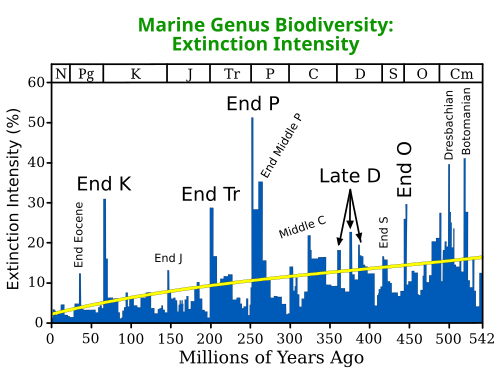
انتهى العصر البرمي بأوسع حدث انقراض مسجل في علم الأحياء القديمة : انقراض العصر البرمي-الترياسي . انقرضت فيه ما بين 90 و95% من الأنواع البحرية ، بالإضافة إلى 70% من جميع الكائنات البرية. وهو أيضاً الانقراض الجماعي الوحيد المعروف للحشرات. [ 16 ] [ 130 ] كان التعافي من انقراض العصر البرمي-الترياسي بطيئاً؛ فعلى اليابسة، استغرقت النظم البيئية 30 مليون سنة للتعافي. [ 17 ] انقرضت الترايلوبيتات ، التي ازدهرت منذ العصر الكامبري ، قبل نهاية العصر البرمي. ومن المثير للدهشة أن النوتيلويدات ، وهي فئة فرعية من رأسيات الأرجل، نجت من هذا الانقراض.
تشير الأدلة إلى أن الصهارة ، على شكل بازلت فيضي ، تدفقت على سطح الأرض فيما يُعرف الآن باسم مصائد سيبيريا ، لآلاف السنين، مما ساهم في الضغط البيئي الذي أدى إلى الانقراض الجماعي. ومن المحتمل أن يكون تقلص الموائل الساحلية وزيادة الجفاف الشديد قد ساهما أيضًا في ذلك. وبناءً على كمية الحمم البركانية المُقدَّر إنتاجها خلال هذه الفترة، فإن أسوأ سيناريو مُحتمل هو انبعاث كمية كافية من ثاني أكسيد الكربون من الانفجارات البركانية لرفع درجة حرارة الأرض خمس درجات مئوية. [ 131 ]
تُطرح فرضية أخرى تتعلق بانبعاث غاز كبريتيد الهيدروجين من المحيط . تفقد أجزاء من أعماق المحيط بشكل دوري كل الأكسجين المذاب فيها، مما يسمح للبكتيريا التي تعيش في غياب الأكسجين بالازدهار وإنتاج غاز كبريتيد الهيدروجين. إذا تراكمت كمية كافية من كبريتيد الهيدروجين في منطقة خالية من الأكسجين ، فقد يرتفع الغاز إلى الغلاف الجوي. تعمل الغازات المؤكسدة في الغلاف الجوي على تدمير الغاز السام، لكن كبريتيد الهيدروجين سرعان ما يستهلك كل الغازات المتاحة في الغلاف الجوي. ربما تكون مستويات كبريتيد الهيدروجين قد ارتفعت بشكل كبير على مدى بضع مئات من السنين. تشير نماذج مثل هذا الحدث إلى أن الغاز سيدمر طبقة الأوزون في الغلاف الجوي العلوي، مما يسمح للأشعة فوق البنفسجية بقتل الأنواع التي نجت من الغاز السام. [ 132 ] توجد أنواع قادرة على استقلاب كبريتيد الهيدروجين.
Another hypothesis builds on the flood basalt eruption theory. An increase in temperature of five degrees Celsius would not be enough to explain the death of 95% of life. But such warming could slowly raise ocean temperatures until frozen methane reservoirs below the ocean floor near coastlines melted, expelling enough methane (among the most potent greenhouse gases) into the atmosphere to raise world temperatures an additional five degrees Celsius. The frozen methane hypothesis helps explain the increase in carbon-12 levels found midway in the Permian–Triassic boundary layer. It also helps explain why the first phase of the layer's extinctions was land-based, the second was marine-based (and starting right after the increase in C-12 levels), and the third land-based again.[133]
See also
- List of fossil sites(with link directory)
- Olson's Extinction
- List of Permian tetrapods
References
- ↑"International Chronostratigraphic Chart"(PDF). International Commission on Stratigraphy. September 2023. Retrieved October 23, 2025.
- 12Davydov, Vladimir I.; Glenister, Brian F.; Spinosa, Claude; Ritter, Scott M.; Chernykh, V. V.; Wardlaw, B. R.; Snyder, W. S. (1 March 1998). "Proposal of Aidaralash as Global Stratotype Section and Point (GSSP) for base of the Permian System". Episodes. 21 (1): 11–18. Bibcode:1998Episo..21...11D. doi:10.18814/epiiugs/1998/v21i1/003.
- 12Hongfu, Yin; Kexin, Zhang; Jinnan, Tong; Zunyi, Yang; Shunbao, Wu (June 2001). "The Global Stratotype Section and Point (GSSP) of the Permian-Triassic Boundary". Episodes. 24 (2): 102–114. doi:10.18814/epiiugs/2001/v24i2/004.
- ↑"Permian". Dictionary.com Unabridged (Online). n.d.
- ↑Olroyd, D.R. (2005). "Famous Geologists: Murchison". In Selley, R.C.; Cocks, L.R.M.; Plimer, I.R. (eds.). Encyclopedia of Geology, volume 2. Amsterdam: Elsevier. p. 213. ISBN 0-12-636380-3.
- ↑Ogg, J.G.; Ogg, G.; Gradstein, F.M. (2016). A Concise Geologic Time Scale: 2016. Amsterdam: Elsevier. p. 115. ISBN 978-0-444-63771-0.
- ↑ مورشيسون، ر. إ.؛ دي فيرنوي، إ.؛ فون كايزرلينغ، أ. (1842). حول البنية الجيولوجية للمناطق الوسطى والجنوبية من روسيا في أوروبا، وجبال الأورال . لندن: ريتشارد وجون إ. تايلور. ص 14.
النظام البرمي. (زيكشتاين ألمانيا - الحجر الجيري المغنيسي لإنجلترا) - توضح بعض الملاحظات التمهيدية سبب لجوء المؤلفين إلى استخدام اسم جديد للإشارة إلى مجموعة من الصخور التي يعتبرونها، ككل، موازية لزيكشتاين ألمانيا والحجر الجيري المغنيسي لإنجلترا. ويفعلون ذلك ليس فقط لأن جزءًا من الرواسب معروف منذ فترة طويلة باسم "حصى برمي"، ولكن لأنها، نظرًا لتطورها الهائل في منطقتي
برمي
وأورينبورغ، تتخذ هناك مجموعة كبيرة ومتنوعة من الخصائص الليثولوجية...
- ↑ مورشيسون، ر. إ.؛ دي فيرنوي، إ.؛ فون كايزرلينغ، أ. (1845). جيولوجيا روسيا في أوروبا وجبال الأورال. المجلد 1: الجيولوجيا . لندن: جون موراي. الصفحات 138-139 .
... بعد أن تأكدنا ميدانيًا من أن هذه الطبقات متميزة لدرجة أنها تُشكل نظامًا متصلًا بصخور العصر الكربوني من جهة، ومستقلًا عن العصر الترياسي من جهة أخرى، تجرأنا على تسميتها بمصطلح جغرافي مشتق من مملكة
بيرميا
القديمة ، التي جُمعت الأدلة اللازمة داخلها وحولها. ... لهذه الأسباب، دفعنا ذلك إلى التخلي عن كلٍ من التسمية الألمانية والبريطانية، وتفضيل اسم جغرافي مأخوذ من المنطقة التي تزخر فيها الطبقات بأحافير ذات طابع مستقل ووسيط؛ حيث يكون ترتيب التراكب واضحًا، إذ تُرى الطبقات السفلى من المجموعة مستقرة على صخور العصر الكربوني.
- ^ فيرنويل، إي. (1842). "المراسلات والاتصالات". نشرة الشركة الجيولوجية الفرنسية . 13 : 11– 14. الصفحات من 12 إلى 13:
Le nom de Système Permien، nom derivé de l'ancien royaume de Permie، aujourd'hui gouvernement de Perm، donc ce dépôt une big Part، semblerait assez lui conference ...
[ اسم النظام البرمي، اسم المستمدة من مملكة بيرميا القديمة ، اليوم يبدو أن حكومة بيرم ، التي تحتل هذه الوديعة جزءًا كبيرًا منها، تناسبها تمامًا ... ] - ↑Sahney, S.; Benton, M.J.; Falcon-Lang, H.J. (2010). "Rainforest collapse triggered Pennsylvanian tetrapod diversification in Euramerica". Geology. 38 (12): 1079–1082. Bibcode:2010Geo....38.1079S. doi:10.1130/G31182.1.
- 12Didier, Gilles; Laurin, Michel (9 December 2021). "Distributions of extinction times from fossil ages and tree topologies: the example of mid-Permian synapsid extinctions". PeerJ. 9 e12577. Bibcode:2021PeerJ...912577D. doi:10.7717/peerj.12577. PMC 8667717. PMID 34966586.
- 123Lucas, S.G. (July 2017). "Permian tetrapod extinction events". Earth-Science Reviews. 170: 31–60. Bibcode:2017ESRv..170...31L. doi:10.1016/j.earscirev.2017.04.008.
- 12Day, Michael O.; Ramezani, Jahandar; Bowring, Samuel A.; Sadler, Peter M.; Erwin, Douglas H.; Abdala, Fernando; Rubidge, Bruce S. (22 July 2015). "When and how did the terrestrial mid-Permian mass extinction occur? Evidence from the tetrapod record of the Karoo Basin, South Africa". Proceedings of the Royal Society B: Biological Sciences. 282 (1811) 20150834. Bibcode:2015RSPSB.28250834D. doi:10.1098/rspb.2015.0834. PMC 4528552. PMID 26156768.
- ↑Zhao, Xiaoming; Tong, Jinnan; Yao, Huazhou; Niu, Zhijun; Luo, Mao; Huang, Yunfei; Song, Haijun (July 2015). "Early Triassic trace fossils from the Three Gorges area of South China: Implications for the recovery of benthic ecosystems following the Permian–Triassic extinction". Palaeogeography, Palaeoclimatology, Palaeoecology. 429: 100–116. Bibcode:2015PPP...429..100Z. doi:10.1016/j.palaeo.2015.04.008.
- ↑Martindale, Rowan C.; Foster, William J.; Velledits, Felicitász (January 2019). "The survival, recovery, and diversification of metazoan reef ecosystems following the end-Permian mass extinction event". Palaeogeography, Palaeoclimatology, Palaeoecology. 513: 100–115. Bibcode:2019PPP...513..100M. doi:10.1016/j.palaeo.2017.08.014.
- 12"GeoKansas--Geotopics--Mass Extinctions". ku.edu. Archived from the original on 2012-09-20. Retrieved 2009-11-05.
- 12Sahney, S.; Benton, M. J. (2008). "Recovery from the most profound mass extinction of all time". Proceedings of the Royal Society B: Biological Sciences. 275 (1636): 759–65. doi:10.1098/rspb.2007.1370. PMC 2596898. PMID 18198148.
- 12Benton, Michael J.; Sennikov, Andrey G. (January 2022). "The naming of the Permian System". Journal of the Geological Society. 179 (1) jgs2021-037. Bibcode:2022JGSoc.179...37B. doi:10.1144/jgs2021-037.
- ↑Benton, M.J. et al., Murchison's first sighting of the Permian, at Vyazniki in 1841Archived 2012-03-24 at WebCite, Proceedings of the Geologists' Association, accessed 2012-02-21
- ↑Murchison, Roderick Impey (1841) "First sketch of some of the principal results of a second geological survey of Russia", Archived 2023-07-16 at the Wayback MachinePhilosophical Magazine and Journal of Science, series 3, 19 : 417–422. From p. 419: "The carboniferous system is surmounted, to the east of the Volga, by a vast series of marls, schists, limestones, sandstones and conglomerates, to which I propose to give the name of "Permian System," … ."
- 123Henderson, C.M.; Davydov And, V.I.; Wardlaw, B.R.; Gradstein, F.M.; Hammer, O. (2012). "The Permian Period". The Geologic Time Scale. pp. 653–679. doi:10.1016/b978-0-444-59425-9.00024-x. ISBN 978-0-444-59425-9.
- 123Cohen, K.M., Finney, S.C., Gibbard, P.L. & Fan, J.-X. (2013; updated) The ICS International Chronostratigraphic ChartArchived 2023-05-28 at the Wayback Machine. Episodes 36: 199–204.
- 12Olroyd, Savannah L.; Sidor, Christian A. (August 2017). "A review of the Guadalupian (middle Permian) global tetrapod fossil record". Earth-Science Reviews. 171: 583–597. Bibcode:2017ESRv..171..583O. doi:10.1016/j.earscirev.2017.07.001.
- ↑Glenister, Brian F.; Boyd, D. W.; Furnish, W. M.; Grant, R. E.; Harris, M. T.; Kozur, H.; Lambert, L. L.; Nassichuk, W. W.; Newell, N. D.; Pray, L. C.; Spinosa, C.; Wardlaw, B. R.; Wilde, G. L.; Yancey, T. E. (September 1992). "The Guadalupian: Proposed International Standard for a Middle Permian Series". International Geology Review. 34 (9): 857–888. Bibcode:1992IGRv...34..857G. doi:10.1080/00206819209465642.
- 12345Glenister, Brian F.; Wardlaw, Bruce R.; Lambert, Lance L.; Spinosa, Claude; Bowring, S. A.; Erwin, D. H.; Menning, Manfred; Wilde, Garner L. (1999). "Proposal of Guadalupian and component Roadian, Wordian, and Capitanian Stages as international standards for the Middle Permian Series"(PDF). Permophiles. 34: 3–11.
- 123456Lucas, Spencer G.; Shen, Shu-Zhong (January 2018). "The Permian timescale: an introduction". Geological Society, London, Special Publications. 450 (1): 1–19. Bibcode:2018GSLSP.450....1L. doi:10.1144/SP450.15.
- ↑Gradstein, Felix M.; Ogg, James G.; Smith, Alan G. (2004). A geologic time scale 2004. Cambridge University Press. p. 250. ISBN 978-0-521-78673-7. Archived from the original on 2023-07-16. Retrieved 2021-04-17.
- ↑ تشيرنيخ، فاليري ف.؛ تشوفاشوف، بوريس إ.؛ شين، شو-تشونغ؛ هندرسون، تشارلز م.؛ يوان، دونغ-شون؛ ستيفنسون، مايكل هـ. (ديسمبر 2020). "القطاع والنقطة النمطية العالمية (GSSP) لمرحلة قاعدة السكماري (السيسورالي، البرمي السفلي)" . إبيسودز . 43 (4): 961-979 . doi : 10.18814/epiiugs/2020/020059 .
- 1 2 جين، يوغان؛ شين، شوزونغ؛ هندرسون، تشارلز م. وانغ، شيانغدونغ؛ وانغ، وي. وانغ، يو. تساو، تشانغكون؛ شانغ، تشينغهوا (ديسمبر 2006). "قسم ونقطة النموذج الطبقي العالمي (GSSP) للحدود بين مرحلة Capitanian وWuchiapingian (Permian)" . الحلقات . 29 (4): 253-262 . دوى : 10.18814/epiiugs/2006/v29i4/003 .
- ↑ جين، يوجان؛ وانغ، يو؛ هندرسون، تشارلز؛ واردلو، بروس ر.؛ شين، شوتشونغ؛ كاو، تشانغتشون (سبتمبر 2006). "القسم والنقطة النموذجية للحدود العالمية (GSSP) لقاعدة مرحلة تشانغشينغيان (العصر البرمي العلوي)" . إبيسودز . 29 (3): 175-182 . doi : 10.18814/epiiugs/2006/v29i3/003 .
- ↑ روس، سي. أ.؛ روس، جون آر. بي. (1995). "علم طبقات التتابع البرمي". العصر البرمي في شمال بانجيا . ص 98-123 . doi : 10.1007/978-3-642-78593-1_7 . ISBN 978-3-642-78595-5.
- ↑ "العصر البرمي: علم الطبقات" . متحف علم الأحياء القديمة بجامعة كاليفورنيا، بيركلي. مؤرشف من الأصل في 5 فبراير 2022. تم الاطلاع عليه في 17 يونيو 2021 .
- ↑ كوبر، ر. أ. (2004). "المقياس الزمني الجيولوجي لنيوزيلندا" . دراسة معهد العلوم الجيولوجية والنووية . 22 : 1-284 .
- ↑ سكوتيس، سي آر؛ لانغفورد، آر بي (1995). "بانجيا والجغرافيا القديمة للعصر البرمي". العصر البرمي في شمال بانجيا . ص 3-19 . doi : 10.1007/978-3-642-78593-1_1 . ISBN 978-3-642-78595-5.
- ↑ هو، ليشا؛ كاوود، بيتر أ.؛ دو، يوانشنغ؛ شو، ياجون؛ وانغ، تشنغهاو؛ وانغ، تشيوين؛ ما، تشيانلي؛ شو، شينران (نوفمبر 2017). "سجلات الرواسب البرمي-الترياسي في جنوب الصين وآثارها على أحداث الهنود الصينيين في شرق آسيا". علم الجغرافيا القديمة، علم المناخ القديم، علم البيئة القديمة . 485 : 84-100 . Bibcode : 2017PPP...485...84H . doi : 10.1016/j.palaeo.2017.06.005 . hdl : 10023/14143 .
- ↑ سكوتيس، سي آر؛ شيتينو، أ. (2017). "الجغرافيا القديمة لغرب تيثيس والعالم في أواخر العصر البرمي - أوائل العصر الجوراسي". مقاطعات الملح البرمي-الترياسي في أوروبا وشمال إفريقيا وهوامش المحيط الأطلسي . ص 57-95 . doi : 10.1016/b978-0-12-809417-4.00004-5 . ISBN 978-0-12-809417-4.
- ↑ ليو، جون؛ يي، جيان؛ تشين، جيان-يي (أغسطس 2020). "تحديد زمن تجميع بعض الكتل على الحافة الشرقية لبانجيا باستخدام سجلات رباعيات الأطراف غير البحرية من العصرين البرمي والترياسي". مراجعات علوم الأرض . 207 103215. Bibcode : 2020ESRv..20703215L . doi : 10.1016/j.earscirev.2020.103215 .
- ↑ راداكس، كريستيان؛ غروبر، كلوديا؛ ستان-لوتر، هيلغا (أغسطس 2001). "تسلسلات جينية جديدة لـ 16S rRNA من هالواركيا من ملح صخري من العصرين البرمي والترياسي في جبال الألب". إكستريموفيلز . 5 (4): 221-228 . Bibcode : 2001Extmo...5..221R . doi : 10.1007/s007920100192 . PMID 11523891 .
- ↑ باريش، جيه تي (1995). "الأدلة الجيولوجية على مناخ العصر البرمي". العصر البرمي في شمال بانجيا . الصفحات 53-61 . doi : 10.1007/978-3-642-78593-1_4 . ISBN 978-3-642-78595-5.
- ↑ هيلز، جون م. (1972). "الترسبات في أواخر حقبة الحياة القديمة في حوض بيرميان غرب تكساس". نشرة الجمعية الأمريكية لجيولوجيي البترول . 56 (12): 2302-2322 . رمز Bibcode : 1972BAAPG..56.2303H . doi : 10.1306/819A421C-16C5-11D7-8645000102C1865D .
- ↑Haq, Bilal U.; Schutter, Stephen R. (3 October 2008). "A Chronology of Paleozoic Sea-Level Changes". Science. 322 (5898): 64–68. Bibcode:2008Sci...322...64H. doi:10.1126/science.1161648. PMID 18832639.
- 1234Rosa, Eduardo L.M.; Isbell, John L. (2021). "Late Paleozoic Glaciation". Encyclopedia of Geology. pp. 534–545. doi:10.1016/B978-0-08-102908-4.00063-1. ISBN 978-0-08-102909-1.
- 1234Scotese, Christopher R.; Song, Haijun; Mills, Benjamin J.W.; van der Meer, Douwe G. (April 2021). "Phanerozoic paleotemperatures: The earth's changing climate during the last 540 million years". Earth-Science Reviews. 215 103503. Bibcode:2021ESRv..21503503S. doi:10.1016/j.earscirev.2021.103503.
- ↑Mujal, Eudald; Fortuny, Josep; Marmi, Josep; Dinarès-Turell, Jaume; Bolet, Arnau; Oms, Oriol (January 2018). "Aridification across the Carboniferous–Permian transition in central equatorial Pangea: The Catalan Pyrenean succession (NE Iberian Peninsula)". Sedimentary Geology. 363: 48–68. Bibcode:2018SedG..363...48M. doi:10.1016/j.sedgeo.2017.11.005.
- ↑Tabor, Neil J.; Poulsen, Christopher J. (October 2008). "Palaeoclimate across the Late Pennsylvanian–Early Permian tropical palaeolatitudes: A review of climate indicators, their distribution, and relation to palaeophysiographic climate factors". Palaeogeography, Palaeoclimatology, Palaeoecology. 268 (3–4): 293–310. Bibcode:2008PPP...268..293T. doi:10.1016/j.palaeo.2008.03.052.
- ↑Ma, Rui; Yang, Jianghai; Wang, Yuan; Yan, Jiaxin; Liu, Jia (February 2023). "Estimating the magnitude of early Permian relative sea-level changes in southern North China". Global and Planetary Change. 221 104036. Bibcode:2023GPC...22104036M. doi:10.1016/j.gloplacha.2023.104036.
- ^ يانغ، وينلي؛ تشن، جيتاو؛ جاو، بياو؛ تشونغ، يوتيان؛ هوانغ، شينغ؛ وانغ، يو. تشي، يوبينغ؛ شين، كوي شو؛ مي، هورنج شنغ؛ وانغ، شيانغ دونغ؛ شين ، شو تشونغ (فبراير 2023). “السحنات الرسوبية ونظائر الكربون من العصر الكربوني العلوي إلى العصر البرمي السفلي في جنوب الصين: الآثار المترتبة على التحول إلى البيت الجليدي إلى الدفيئة”. التغير العالمي والكوكبي . 221 104051. بيب كود : 2023GPC...22104051Y . دوى : 10.1016/j.gloplacha.2023.104051 .
- ↑ تابور، نيل ج. (15 يناير 2007). "درجات الحرارة القديمة للعصر البرمي-البنسلفاني من قيم δ18O لأكاسيد الحديد والسيليكات الصفائحية". رسائل علوم الأرض والكواكب . 253 (1): 159-171 . doi : 10.1016/j.epsl.2006.10.024 .
- ↑ ميشيل، لورين أ.؛ تابور، نيل ج.؛ مونتانيز، إيزابيل ب.؛ شميتز، مارك د.؛ دافيدوف، فلاديمير (15 يوليو 2015). "التسلسل الزمني الطبقي وعلم المناخ القديم لحوض لوديف، فرنسا: دليل على حدث تصحر استوائي شامل عبر حدود العصر الكربوني-البرمي" . علم الجغرافيا القديمة، علم المناخ القديم، علم البيئة القديمة . 430 : 118-131 . Bibcode : 2015PPP...430..118M . doi : 10.1016/j.palaeo.2015.03.020 .
- ↑ تابور، نيل جيه؛ ديميشيل، ويليام أ؛ مونتانيز، إيزابيل ب؛ تشاني، دان س. (نوفمبر 2013). "الاحترار القاري في أواخر حقبة الحياة القديمة لحوض استوائي بارد والتغير النباتي في غرب بانجيا". المجلة الدولية لجيولوجيا الفحم . 119 : 177-186 . Bibcode : 2013IJCG..119..177T . doi : 10.1016/j.coal.2013.07.009 .
- ماركيتي ، لورينزو؛ فورتي، جوزيبيّا؛ كوستاتشر، إيفلين؛ ديميشيل، ويليام أ.؛ لوكاس، سبنسر ج.؛ روغي، غيدو؛ جونكال، مانويل أ.؛ هارتكوف-فرودر، كريستوف؛ كراينر، كارل؛ موريللي، كورادو؛ رونشي، أوسونيو (مارس 2022). "حدث أرتينسكيان الدافئ: تغير مناخي وتغير في الحياة البرية في أمريكا الشمالية خلال العصر البرمي المبكر". مراجعات علوم الأرض . 226 103922. Bibcode : 2022ESRv..22603922M . doi : 10.1016/j.earscirev.2022.103922 .
- 12Montañez, Isabel P.; Tabor, Neil J.; Niemeier, Deb; DiMichele, William A.; Frank, Tracy D.; Fielding, Christopher R.; Isbell, John L.; Birgenheier, Lauren P.; Rygel, Michael C. (5 January 2007). "CO2-Forced Climate and Vegetation Instability During Late Paleozoic Deglaciation". Science. 315 (5808): 87–91. Bibcode:2007Sci...315...87M. doi:10.1126/science.1134207. PMID 17204648.
- ↑Isbell, John L.; Biakov, Alexander S.; Vedernikov, Igor L.; Davydov, Vladimir I.; Gulbranson, Erik L.; Fedorchuk, Nicholas D. (March 2016). "Permian diamictites in northeastern Asia: Their significance concerning the bipolarity of the late Paleozoic ice age". Earth-Science Reviews. 154: 279–300. Bibcode:2016ESRv..154..279I. doi:10.1016/j.earscirev.2016.01.007.
- ↑Götz, Annette E.; Hancox, P. John; Lloyd, Andrew (1 June 2020). "Southwestern Gondwana's Permian climate amelioration recorded in coal-bearing deposits of the Moatize sub-basin (Mozambique)". Palaeoworld. Carboniferous-Permian biotic and climatic events. 29 (2): 426–438. Bibcode:2020Palae..29..426G. doi:10.1016/j.palwor.2018.08.004.
- ↑Korte, Christoph; Jones, Peter J.; Brand, Uwe; Mertmann, Dorothee; Veizer, Ján (4 November 2008). "Oxygen isotope values from high-latitudes: Clues for Permian sea-surface temperature gradients and Late Palaeozoic deglaciation". Palaeogeography, Palaeoclimatology, Palaeoecology. 269 (1–2): 1–16. Bibcode:2008PPP...269....1K. doi:10.1016/j.palaeo.2008.06.012.
- 12Shi, G. R.; Nutman, Allen P.; Lee, Sangmin; Jones, Brian G.; Bann, Glen R. (February 2022). "Reassessing the chronostratigraphy and tempo of climate change in the Lower-Middle Permian of the southern Sydney Basin, Australia: Integrating evidence from U–Pb zircon geochronology and biostratigraphy". Lithos. 410–411 106570. Bibcode:2022Litho.41006570S. doi:10.1016/j.lithos.2021.106570.
- ↑ إيزوزاكي، يوكيو؛ كاواهااتا، هوداكا؛ مينوشيما، كايو (يناير 2007). "حدث تبريد كامورا الكابيتاني (البرمي): بداية الانتقال من حقبة الحياة القديمة إلى حقبة الحياة الوسطى". عالم الأحافير . مساهمات في علم طبقات العصر البرمي والكربوني، وعلم أحافير عضديات الأرجل، والانقراضات الجماعية في نهاية العصر البرمي، في ذكرى البروفيسور يو-غان جين. 16 (1): 16-30 . doi : 10.1016/j.palwor.2007.05.011 .
- ↑ يانغ، جيانغهاي؛ كاوود، بيتر أ.؛ دو، يوانشنغ؛ كوندون، دانيال ج.؛ يان، جياشين؛ ليو، جيانتشونغ؛ هوانغ، يان؛ يوان، دونغشون (15 يونيو 2018). "هل يرتبط التبريد المبكر في ووتشيابينغيان بتجوية بازلت إيميشيان؟" . رسائل علوم الأرض والكواكب . 492 : 102-111 . Bibcode : 2018E & PSL.492..102Y . doi : 10.1016/j.epsl.2018.04.004 .
- ↑ تشين، بو؛ يواكيمسكي، مايكل م.؛ شين، شو-تشونغ؛ لامبرت، لانس ل.؛ لاي، شو-لونغ؛ وانغ، شيانغ-دونغ؛ تشين، جون؛ يوان، دونغ-شون (يوليو 2013). "حجم الجليد في العصر البرمي وتاريخ المناخ القديم: إعادة النظر في مؤشرات نظائر الأكسجين". أبحاث غوندوانا . 24 (1): 77-89 . Bibcode : 2013GondR..24...77C . doi : 10.1016/j.gr.2012.07.007 .
- ↑ يواكيمسكي، م.م.؛ لاي، ش.؛ شين، س.؛ جيانغ، هـ.؛ لو، ج.؛ تشين، ب.؛ تشين، ج.؛ صن، ي. (1 مارس 2012). "الاحترار المناخي في أواخر العصر البرمي وانقراض العصر البرمي-الترياسي الجماعي". مجلة الجيولوجيا . 40 (3): 195-198 . Bibcode : 2012Geo....40..195J . doi : 10.1130/G32707.1 .
- ↑ كاو، تشنغ؛ باتاي، كليمنت ب.؛ سونغ، هايجون؛ سالتزمان، ماثيو ر.؛ تيرني كرامر، كيت؛ وو، هوايتشون؛ كورت، كريستوف؛ تشانغ، تشاوفنغ؛ ليو، شياو مينغ (3 أكتوبر 2022). "الدفء المستمر من أواخر العصر البرمي إلى أوائل العصر الترياسي مرتبط بتعزيز التجوية العكسية". مجلة نيتشر للعلوم الجيولوجية . 15 (10): 832-838 . Bibcode : 2022NatGe..15..832C . doi : 10.1038/s41561-022-01009-x .
- ↑Shields, Christine A.; Kiehl, Jeffrey T. (February 2018). "Monsoonal precipitation in the Paleo-Tethys warm pool during the latest Permian". Palaeogeography, Palaeoclimatology, Palaeoecology. 491: 123–136. Bibcode:2018PPP...491..123S. doi:10.1016/j.palaeo.2017.12.001.
- ↑Ziegler, Alfred; Eshel, Gidon; Rees, P. McAllister; Rothfus, Thomas; Rowley, David; Sunderlin, David (2 January 2007). "Tracing the tropics across land and sea: Permian to present". Lethaia. 36 (3): 227–254. Bibcode:2003Letha..36..227Z. doi:10.1080/00241160310004657.
- ↑López-Gómez, José; Arche, Alfredo; Marzo, Mariano; Durand, Marc (12 December 2005). "Stratigraphical and palaeogeographical significance of the continental sedimentary transition across the Permian–Triassic boundary in Spain"(PDF). Palaeogeography, Palaeoclimatology, Palaeoecology. 229 (1–2): 3–23. Bibcode:2005PPP...229....3L. doi:10.1016/j.palaeo.2004.11.028.
- ↑Fang, Xiaomin; Song, Chunhui; Yan, Maodu; Zan, Jinbo; Liu, Chenglin; Sha, Jingeng; Zhang, Weilin; Zeng, Yongyao; Wu, Song; Zhang, Dawen (September 2016). "Mesozoic litho- and magneto-stratigraphic evidence from the central Tibetan Plateau for megamonsoon evolution and potential evaporites". Gondwana Research. 37: 110–129. Bibcode:2016GondR..37..110F. doi:10.1016/j.gr.2016.05.012.
- ↑Luo, Mao; Shi, G. R.; Li, Sangmin (1 March 2020). "Stacked Parahaentzschelinia ichnofabrics from the Lower Permian of the southern Sydney Basin, southeastern Australia: Palaeoecologic and palaeoenvironmental significance". Palaeogeography, Palaeoclimatology, Palaeoecology. 541 109538. Bibcode:2020PPP...54109538L. doi:10.1016/j.palaeo.2019.109538.
- ↑Kutzbach, J. E.; Gallimore, R. G. (20 March 1989). "Pangaean climates: Megamonsoons of the megacontinent". Journal of Geophysical Research. 94 (D3): 3341–3357. Bibcode:1989JGR....94.3341K. doi:10.1029/JD094iD03p03341.
- ↑Kessler, Jennifer L. P.; Soreghan, Gerilyn S.; Wacker, Herbert J. (1 September 2001). "Equatorial Aridity in Western Pangea: Lower Permian Loessite and Dolomitic Paleosols in Northeastern New Mexico, U.S.A.". Journal of Sedimentary Research. 15 (5): 817–832. Bibcode:2001JSedR..71..817K. doi:10.1306/2DC4096B-0E47-11D7-8643000102C1865D.
- ↑Runnegar, Bruce; Newell, Norman Dennis (1971). "Caspian-like relict molluscan fauna in the South American Permian". Bulletin of the American Museum of Natural History. 146 (1). hdl:2246/1092. Archived from the original on 1 April 2023. Retrieved 31 March 2023.
- ↑Shen, Shu-Zhong; Sun, Tian-Ren; Zhang, Yi-Chun; Yuan, Dong-Xun (December 2016). "An upper Kungurian/lower Guadalupian (Permian) brachiopod fauna from the South Qiangtang Block in Tibet and its palaeobiogeographical implications". Palaeoworld. 25 (4): 519–538. Bibcode:2016Palae..25..519S. doi:10.1016/j.palwor.2016.03.006.
- ↑Torres-Martinez, M. A.; Vinn, O.; Martin-Aguilar, L. (2021). "Paleoecology of the first Devonian-like sclerobiont association on Permian brachiopods from southeastern Mexico". Acta Palaeontologica Polonica. 66 (1): 131–141. doi:10.4202/app.00777.2020.
- ↑Olszewski, Thomas D.; Erwin, Douglas H. (15 April 2004). "Dynamic response of Permian brachiopod communities to long-term environmental change". Nature. 428 (6984): 738–741. Bibcode:2004Natur.428..738O. doi:10.1038/nature02464. PMID 15085129.
- ↑Donovan, Stephen K.; Webster, Gary D.; Waters, Johnny A. (27 September 2016). "A last peak in diversity: the stalked echinoderms of the Permian of Timor". Geology Today. 32 (5): 179–185. Bibcode:2016GeolT..32..179D. doi:10.1111/gto.12150.
- ↑Thompson, Jeffrey R.; Petsios, Elizabeth; Bottjer, David J. (18 April 2017). "A diverse assemblage of Permian echinoids (Echinodermata, Echinoidea) and implications for character evolution in early crown group echinoids". Journal of Paleontology. 91 (4): 767–780. Bibcode:2017JPal...91..767T. doi:10.1017/jpa.2016.158.
- ↑Carlson, S.J. (2016). "The Evolution of Brachiopoda". Annual Review of Earth and Planetary Sciences. 44: 409–438. Bibcode:2016AREPS..44..409C. doi:10.1146/annurev-earth-060115-012348.
- ↑Xuesong, Tian; Wei, Wang; Zhenhua, Huang; Zhiping, Zhang; Dishu, Chen (25 June 2022). "Reef-dwelling brachiopods record paleoecological and paleoenvironmental changes within the Changhsingian (late Permian) platform-margin sponge reef in eastern Sichuan Basin, China". The Anatomical Record. 308 (10): 2790–2805. doi:10.1002/ar.25023. PMID 35751577.
- ↑McGOWAN, Alistair J.; Smith, Andrew B. (May 2007). "Ammonoids Across the Permian/Triassic Boundary: A Cladistic Perspective". Palaeontology. 50 (3): 573–590. Bibcode:2007Palgy..50..573M. doi:10.1111/j.1475-4983.2007.00653.x.
- ↑Lerosey-Aubril, Rudy; Feist, Raimund (2012). "Quantitative Approach to Diversity and Decline in Late Palaeozoic Trilobites". Earth and Life. pp. 535–555. doi:10.1007/978-90-481-3428-1_16. ISBN 978-90-481-3427-4.
- ↑Wang, Xiang-Dong; Wang, Xiao-Juan (January 2007). "Extinction patterns of Late Permian (Lopingian) corals in China". Palaeoworld. 16 (1–3): 31–38. doi:10.1016/j.palwor.2007.05.009.
- ↑"The Permian Period". berkeley.edu. Archived from the original on 2017-07-04. Retrieved 2015-04-09.
- ↑Xu, R. & Wang, X.-Q. (1982): Di zhi shi qi Zhongguo ge zhu yao Diqu zhi wu jing guan (Reconstructions of Landscapes in Principal Regions of China). Ke xue chu ban she, Beijing. 55 pages, 25 plates.
- 12Labandeira, Conrad C. (2018). "The Fossil History of Insect Diversity". Insect Biodiversity. pp. 723–788. doi:10.1002/9781118945582.ch24. ISBN 978-1-118-94557-5.
- ↑Santos, Artai A.; Wappler, Torsten; McLoughlin, Stephen (14 October 2024). Cascales-Miñana, Borja (ed.). "Earliest evidence of granivory from China (Shanxi Formation) points to seeds as a food source and nursing habitat for insects in the earliest Permian humid tropical forests of Cathaysia". PLOS ONE. 19 (10) e0311737. Bibcode:2024PLoSO..1911737S. doi:10.1371/journal.pone.0311737. PMC 11472943. PMID 39401203.
- ↑Schachat, Sandra R; Labandeira, Conrad C (12 March 2021). "Are Insects Heading Toward Their First Mass Extinction? Distinguishing Turnover From Crises in Their Fossil Record". Annals of the Entomological Society of America. 114 (2): 99–118. doi:10.1093/aesa/saaa042.
- ↑Cui, Yingying; Bardin, Jérémie; Wipfler, Benjamin; Demers-Potvin, Alexandre; Bai, Ming; Tong, Yi-Jie; Chen, Grace Nuoxi; Chen, Huarong; Zhao, Zhen-Ya; Ren, Dong; Béthoux, Olivier (7 March 2024). "A winged relative of ice-crawlers in amber bridges the cryptic extant Xenonomia and a rich fossil record". Insect Science. 31 (5) 1744-7917.13338. Bibcode:2024InsSc..31.1645C. doi:10.1111/1744-7917.13338. PMID 38454304.
- ↑Lin, Xiaodan; Shih, Chungkun; Li, Sheng; Ren, Dong (2019). "Mecoptera – Scorpionflies and Hangingflies". Rhythms of Insect Evolution. pp. 555–595. doi:10.1002/9781119427957.ch24. ISBN 978-1-119-42798-8.
- ↑Ponomarenko, A. G.; Prokin, A. A. (December 2015). "Review of paleontological data on the evolution of aquatic beetles (Coleoptera)". Paleontological Journal. 49 (13): 1383–1412. Bibcode:2015PalJ...49.1383P. doi:10.1134/S0031030115130080.
- ↑Ponomarenko, A. G.; Volkov, A. N. (November 2013). "Ademosynoides asiaticus Martynov, 1936, the earliest known member of an extant beetle family (Insecta, Coleoptera, Trachypachidae)". Paleontological Journal. 47 (6): 601–606. Bibcode:2013PalJ...47..601P. doi:10.1134/s0031030113060063.
- ↑Yan, Evgeny Viktorovich; Beutel, Rolf Georg; Lawrence, John Francis; Yavorskaya, Margarita Igorevna; Hörnschemeyer, Thomas; Pohl, Hans; Vassilenko, Dmitry Vladimirovich; Bashkuev, Alexey Semenovich; Ponomarenko, Alexander Georgievich (13 September 2020). "Archaeomalthus -(Coleoptera, Archostemata) a 'ghost adult' of Micromalthidae from Upper Permian deposits of Siberia?". Historical Biology. 32 (8): 1019–1027. Bibcode:2020HBio...32.1019Y. doi:10.1080/08912963.2018.1561672.
- ↑Feng, Zhuo; Wang, Jun; Rößler, Ronny; Ślipiński, Adam; Labandeira, Conrad (15 September 2017). "Late Permian wood-borings reveal an intricate network of ecological relationships". Nature Communications. 8 (1) 556. Bibcode:2017NatCo...8..556F. doi:10.1038/s41467-017-00696-0. PMC 5601472. PMID 28916787.
- 12Brocklehurst, Neil (2020-06-10). "Olson's Gap or Olson's Extinction? A Bayesian tip-dating approach to resolving stratigraphic uncertainty". Proceedings of the Royal Society B: Biological Sciences. 287 (1928) 20200154. doi:10.1098/rspb.2020.0154. PMC 7341920. PMID 32517621.
- 12Huttenlocker, A. K., and E. Rega. 2012. The Paleobiology and Bone Microstructure of Pelycosaurian-grade Synapsids. Pp. 90–119 in A. Chinsamy (ed.) Forerunners of Mammals: Radiation, Histology, Biology. Indiana University Press.
- ↑"NAPC Abstracts, Sto - Tw". berkeley.edu. Archived from the original on 2020-02-26. Retrieved 2014-03-31.
- ↑Modesto, Sean P.; Scott, Diane M.; Reisz, Robert R. (1 July 2009). "Arthropod remains in the oral cavities of fossil reptiles support inference of early insectivory". Biology Letters. 5 (6): 838–840. doi:10.1098/rsbl.2009.0326. PMC 2827974. PMID 19570779.
- ↑Didier, Gilles; Laurin, Michel (June 2024). "Testing extinction events and temporal shifts in diversification and fossilization rates through the skyline Fossilized Birth-Death (FBD) model: The example of some mid-Permian synapsid extinctions". Cladistics. 40 (3): 282–306. doi:10.1111/cla.12577. PMID 38651531.
- ↑Singh, Suresh A.; Elsler, Armin; Stubbs, Thomas L.; Rayfield, Emily J.; Benton, Michael James (17 February 2024). "Predatory synapsid ecomorphology signals growing dynamism of late Palaeozoic terrestrial ecosystems". Communications Biology. 7 (1): 201. doi:10.1038/s42003-024-05879-2. PMC 10874460. PMID 38368492.
- ↑Reisz, Robert R.; Laurin, Michel (1 September 2001). "The reptile Macroleter: First vertebrate evidence for correlation of Upper Permian continental strata of North America and Russia". GSA Bulletin. 113 (9): 1229–1233. Bibcode:2001GSAB..113.1229R. doi:10.1130/0016-7606(2001)113<1229:TRMFVE>2.0.CO;2.
- ↑Lozovsky, Vladlen R. (1 January 2005). "Olson's gap or Olson's bridge, that is the question". New Mexico Museum of Natural History and Science Bulletin. 30, The Nonmarine Permian. New Mexico Museum of Natural History and Science: 179–184.
- ↑Laurin, Michel; Hook, Robert W. (2022). "The age of North America's youngest Paleozoic continental vertebrates: a review of data from the Middle Permian Pease River (Texas) and El Reno (Oklahoma) Groups". BSGF - Earth Sciences Bulletin. 193: 10. doi:10.1051/bsgf/2022007.
- ↑Spiekman, Stephan N.F.; Fraser, Nicholas C.; Scheyer, Torsten M. (3 May 2021). "A new phylogenetic hypothesis of Tanystropheidae (Diapsida, Archosauromorpha) and other 'protorosaurs', and its implications for the early evolution of stem archosaurs". PeerJ. 9 e11143. doi:10.7717/peerj.11143. PMC 8101476. PMID 33986981.
- ↑Huttenlocker, Adam K.; Sidor, Christian A. (December 2020). "A Basal Nonmammaliaform Cynodont from the Permian of Zambia and the Origins of Mammalian Endocranial and Postcranial Anatomy". Journal of Vertebrate Paleontology. 40 (5) e1827413. Bibcode:2020JVPal..40E7413H. doi:10.1080/02724634.2020.1827413.
- ↑Huttenlocker A. K. (2009). "An investigation into the cladistic relationships and monophyly of therocephalian therapsids (Amniota: Synapsida)". Zoological Journal of the Linnean Society. 157 (4): 865–891. doi:10.1111/j.1096-3642.2009.00538.x.
- ↑Huttenlocker, Adam K.; Sidor, Christian A.; Smith, Roger M. H. (17 March 2011). "A new specimen of Promoschorhynchus (Therapsida: Therocephalia: Akidnognathidae) from the Lower Triassic of South Africa and its implications for theriodont survivorship across the Permo-Triassic boundary". Journal of Vertebrate Paleontology. 31 (2): 405–421. Bibcode:2011JVPal..31..405H. doi:10.1080/02724634.2011.546720.
- ↑Pritchard, Adam C.; Sues, Hans-Dieter; Scott, Diane; Reisz, Robert R. (20 May 2021). "Osteology, relationships and functional morphology of Weigeltisaurus jaekeli (Diapsida, Weigeltisauridae) based on a complete skeleton from the Upper Permian Kupferschiefer of Germany". PeerJ. 9 e11413. Bibcode:2021PeerJ...911413P. doi:10.7717/peerj.11413. PMC 8141288. PMID 34055483.
- ↑Bulanov, V. V.; Sennikov, A. G. (October 2006). "The first gliding reptiles from the upper Permian of Russia". Paleontological Journal. 40 (S5): S567–S570. Bibcode:2006PalJ...40S.567B. doi:10.1134/S0031030106110037.
- ↑Ruta, Marcello; Coates, Michael I. (January 2007). "Dates, nodes and character conflict: Addressing the Lissamphibian origin problem". Journal of Systematic Palaeontology. 5 (1): 69–122. Bibcode:2007JSPal...5...69R. doi:10.1017/S1477201906002008.
- 12Marjanović, David; Laurin, Michel (4 January 2019). "Phylogeny of Paleozoic limbed vertebrates reassessed through revision and expansion of the largest published relevant data matrix". PeerJ. 6 e5565. Bibcode:2019PeerJ...6e5565M. doi:10.7717/peerj.5565. PMC 6322490. PMID 30631641.
- ↑Ruta, Marcello; Benton, Michael J. (November 2008). "Calibrated Diversity, Tree Topology and the Mother of Mass Extinctions: The Lesson of Temnospondyls". Palaeontology. 51 (6): 1261–1288. Bibcode:2008Palgy..51.1261R. doi:10.1111/j.1475-4983.2008.00808.x.
- ↑Chen, Jianye; Liu, Jun (December 2020). "The youngest occurrence of embolomeres (Tetrapoda: Anthracosauria) from the Sunjiagou Formation (Lopingian, Permian) of North China". Fossil Record. 23 (2): 205–213. Bibcode:2020FossR..23..205C. doi:10.5194/fr-23-205-2020.
- ↑Schoch, Rainer R. (January 2019). "The putative lissamphibian stem-group: phylogeny and evolution of the dissorophoid temnospondyls". Journal of Paleontology. 93 (1): 137–156. Bibcode:2019JPal...93..137S. doi:10.1017/jpa.2018.67.
- 123Romano, Carlo; Koot, Martha B.; Kogan, Ilja; Brayard, Arnaud; Minikh, Alla V.; Brinkmann, Winand; Bucher, Hugo; Kriwet, Jürgen (February 2016). "Permian– T riassic O steichthyes (bony fishes): diversity dynamics and body size evolution". Biological Reviews. 91 (1): 106–147. doi:10.1111/brv.12161. PMID 25431138.
- ↑Romano, Carlo (27 January 2021). "A Hiatus Obscures the Early Evolution of Modern Lineages of Bony Fishes". Frontiers in Earth Science. 8 618853. Bibcode:2021FrEaS...8.8853R. doi:10.3389/feart.2020.618853.
- ↑Kemp, Anne; Cavin, Lionel; Guinot, Guillaume (April 2017). "Evolutionary history of lungfishes with a new phylogeny of post-Devonian genera". Palaeogeography, Palaeoclimatology, Palaeoecology. 471: 209–219. Bibcode:2017PPP...471..209K. doi:10.1016/j.palaeo.2016.12.051.
- ↑Ginot, Samuel; Goudemand, Nicolas (December 2020). "Global climate changes account for the main trends of conodont diversity but not for their final demise". Global and Planetary Change. 195 103325. Bibcode:2020GPC...19503325G. doi:10.1016/j.gloplacha.2020.103325.
- 12Koot, Martha B.; Cuny, Gilles; Tintori, Andrea; Twitchett, Richard J. (March 2013). "A new diverse shark fauna from the Wordian (Middle Permian) Khuff Formation in the interior Haushi-Huqf area, Sultanate of Oman". Palaeontology. 56 (2): 303–343. Bibcode:2013Palgy..56..303K. doi:10.1111/j.1475-4983.2012.01199.x.
- ↑Tapanila, Leif; Pruitt, Jesse; Wilga, Cheryl D.; Pradel, Alan (February 2020). "Saws, Scissors, and Sharks: Late Paleozoic Experimentation with Symphyseal Dentition". The Anatomical Record. 303 (2): 363–376. doi:10.1002/ar.24046. PMID 30536888.
- ↑Peecook, Brandon R.; Bronson, Allison W.; Otoo, Benjamin K.A.; Sidor, Christian A. (November 2021). "Freshwater fish faunas from two Permian rift valleys of Zambia, novel additions to the ichthyofauna of southern Pangea". Journal of African Earth Sciences. 183 104325. Bibcode:2021JAfES.18304325P. doi:10.1016/j.jafrearsci.2021.104325.
- ↑Kriwet, Jürgen; Witzmann, Florian; Klug, Stefanie; Heidtke, Ulrich H.J (2008-01-22). "First direct evidence of a vertebrate three-level trophic chain in the fossil record". Proceedings of the Royal Society B: Biological Sciences. 275 (1631): 181–186. doi:10.1098/rspb.2007.1170. PMC 2596183. PMID 17971323.
- 123Wang, Jun; Pfefferkorn, Hermann W.; Zhang, Yi; Feng, Zhuo (27 March 2012). "Permian vegetational Pompeii from Inner Mongolia and its implications for landscape paleoecology and paleobiogeography of Cathaysia". Proceedings of the National Academy of Sciences. 109 (13): 4927–4932. doi:10.1073/pnas.1115076109. PMC 3323960. PMID 22355112.
- ↑McLoughlin, S (2012). "Glossopteris – insights into the architecture and relationships of an iconic Permian Gondwanan plant". Journal of the Botanical Society of Bengal. 65 (2): 1–14.
- 12Feng, Zhuo (September 2017). "Late Palaeozoic plants". Current Biology. 27 (17): R905–R909. Bibcode:2017CBio...27.R905F. doi:10.1016/j.cub.2017.07.041. PMID 28898663.
- ↑Bulanov, V. V.; Sennikov, A. G. (16 December 2010). "New data on the morphology of permian gliding weigeltisaurid reptiles of Eastern Europe". Paleontological Journal. 44 (6): 682–694. Bibcode:2010PalJ...44..682B. doi:10.1134/S0031030110060109.
- ↑Zhou, Zhi-Yan (March 2009). "An overview of fossil Ginkgoales". Palaeoworld. 18 (1): 1–22. doi:10.1016/j.palwor.2009.01.001.
- ↑Feng, Zhuo; Lv, Yong; Guo, Yun; Wei, Hai-Bo; Kerp, Hans (November 2017). "Leaf anatomy of a late Palaeozoic cycad". Biology Letters. 13 (11) 20170456. doi:10.1098/rsbl.2017.0456. PMC 5719380. PMID 29093177.
- ↑Pfefferkorn, Hermann W.; Wang, Jun (April 2016). "Paleoecology of Noeggerathiales, an enigmatic, extinct plant group of Carboniferous and Permian times". Palaeogeography, Palaeoclimatology, Palaeoecology. 448: 141–150. Bibcode:2016PPP...448..141P. doi:10.1016/j.palaeo.2015.11.022.
- ↑Wang, Jun; Wan, Shan; Kerp, Hans; Bek, Jiří; Wang, Shijun (November 2021). "A whole noeggerathialean plant Tingia unita Wang from the earliest Permian peat-forming flora, Wuda Coalfield, Inner Mongolia". Review of Palaeobotany and Palynology. 294 104204. Bibcode:2021RPaPa.29404204W. doi:10.1016/j.revpalbo.2020.104204.
- ↑Forte, Giuseppa; Kustatscher, Evelyn; Roghi, Guido; Preto, Nereo (15 April 2018). "The Permian (Kungurian, Cisuralian) palaeoenvironment and palaeoclimate of the Tregiovo Basin, Italy: Palaeobotanical, palynological and geochemical investigations". Palaeogeography, Palaeoclimatology, Palaeoecology. 495: 186–204. Bibcode:2018PPP...495..186F. doi:10.1016/j.palaeo.2018.01.012.
- ↑Blomenkemper, Patrick; Bäumer, Robert; Backer, Malte; Abu Hamad, Abdalla; Wang, Jun; Kerp, Hans; Bomfleur, Benjamin (26 March 2021). "Bennettitalean Leaves From the Permian of Equatorial Pangea—The Early Radiation of an Iconic Mesozoic Gymnosperm Group". Frontiers in Earth Science. 9 652699. Bibcode:2021FrEaS...9..162B. doi:10.3389/feart.2021.652699.
- ↑Zavialova, Natalia; Blomenkemper, Patrick; Kerp, Hans; Hamad, Abdalla Abu; Bomfleur, Benjamin (4 March 2021). "A lyginopterid pollen organ from the upper Permian of the Dead Sea region". Grana. 60 (2): 81–96. Bibcode:2021Grana..60...81Z. doi:10.1080/00173134.2020.1772360.
- ↑Andrew Alden. "The Great Permian-Triassic Extinction". About.com Education. Archived from the original on 2012-11-18. Retrieved 2009-11-05.
- ↑Palaeos: Life Through Deep Time > The Permian PeriodArchived 2013-06-29 at the Wayback Machine Accessed 1 April 2013.
- ↑Kump, L.R.; Pavlov, A.; Arthur, M.A. (2005). "Massive release of hydrogen sulfide to the surface ocean and atmosphere during intervals of oceanic anoxia". Geology. 33 (May): 397–400. Bibcode:2005Geo....33..397K. doi:10.1130/G21295.1.
- ↑Benton, Michael J.; Twitchett, Richard J. (7 July 2003). "How to kill (almost) all life: the end-Permian extinction event". Trends in Ecology and Evolution. 18 (7): 358–365. doi:10.1016/S0169-5347(03)00093-4.
Further reading
- Ogg, Jim (June 2004). "Overview of Global Boundary Stratotype Sections and Points (GSSP's)". stratigraphy.org. Archived from the original on 2004-02-19. Retrieved April 30, 2006.
External links
- University of California offers a more modern Permian stratigraphy
- Classic Permian strata in the Glass Mountains of the Permian Basin
- "International Commission on Stratigraphy (ICS)". Geologic Time Scale 2004. Retrieved September 19, 2005.
- Examples of Permian Fossils
- Permian (chronostratigraphy scale)
- Schneebeli-Hermann, Elke (2012), "Extinguishing a Permian World", Geology, 40 (3): 287–288, Bibcode:2012Geo....40..287S, doi:10.1130/focus032012.1
- Permian
- Geological periods