
مضروب
| 0 | 1 |
| 1 | 1 |
| 2 | 2 |
| 3 | 6 |
| 4 | 24 |
| 5 | 120 |
| 6 | 720 |
| 7 | 5040 |
| 8 | 40 320 |
| 9 | 362880 |
| 10 | 3,628,800 |
| 11 | 39916800 |
| 12 | 479 001 600 |
| 13 | 6 227 020 800 |
| 14 | 87 178 291 200 |
| 15 | 1 307 674 368 000 |
| 16 | 20 922 789 888 000 |
| 17 | 355 687 428 096 000 |
| 18 | 6 402 373 705 728 000 |
| 19 | 121 645 100 408 832 000 |
| 20 | 2 432 902 008 176 640 000 |
| 25 | 1.551 121 004 × 10 25 |
| 50 | 3.041 409 320 × 10 64 |
| 52 | 8.065817517 × 1067 |
| 70 | 1.197857167 × 10100 |
| 100 | 9.332621544 × 10157 |
| 450 | 1.733368733 × 101000 |
| 1000 | 4.023872601 × 102567 |
| 3249 | 6.412 337 688 × 10 10 000 |
| 10000 | 2.846 259 681 × 10 35 659 |
| 25 206 | 1.205703438 × 10100000 |
| 100000 | 2.824 229 408 × 10 456 573 |
| 205 023 | 2.503898932 × 101000004 |
| 1,000,000 =10 6 | 8.263931688 × 10⁵565708 ≈ 105.565 708 9172 × 10 6 |
| 10 10 | 109.565 705 5186 × 10 10 |
| 10 20 | 1019.565 705 5181 × 10 20 |
| 10 50 | 1049.565 705 5181 × 10 50 |
| 10 100 | 1099.565 705 5181 × 10 100 |
| 10 1000 | 10999.565 705 5181 × 10 1000 |


في الرياضيات ، مضروب عدد صحيح غير سالب، ويرمز إليه بـ، هو حاصل ضرب جميع الأعداد الصحيحة الموجبة الأقل من أو تساويمضروب العدديساوي أيضًا حاصل ضربمع المضروب الأصغر التالي: على سبيل المثال، قيمة 0! هي 1، وفقًا للاتفاقية الخاصة بالضرب الفارغ . [ 1 ]


تم اكتشاف المضروب في العديد من الحضارات القديمة، ولا سيما في الرياضيات الهندية في الأعمال الكلاسيكية للأدب الجيني ، ومن قبل المتصوفين اليهود في كتاب سفر يتزيرا التلمودي . وتُصادف عملية المضروب في العديد من مجالات الرياضيات، وخاصة في التوافقية ، حيث يتمثل استخدامها الأساسي في حساب التسلسلات المتميزة الممكنة - التباديل - لـأشياء مميزة: هناكفي التحليل الرياضي ، تُستخدم المضروبات في متسلسلات القوى للدالة الأسية وغيرها من الدوال، ولها أيضًا تطبيقات في الجبر ونظرية الأعداد ونظرية الاحتمالات وعلوم الحاسوب .
بدأ تطوير معظم الرياضيات المتعلقة بدالة المضروب في أواخر القرن الثامن عشر وأوائل القرن التاسع عشر. يوفر تقريب ستيرلنغ تقريبًا دقيقًا لمضروب الأعداد الكبيرة، موضحًا أنه ينمو أسرع من النمو الأسي . تصف صيغة ليجندر أسس الأعداد الأولية في تحليل المضروب إلى عوامله الأولية ، ويمكن استخدامها لحساب الأصفار اللاحقة للمضروب. قام دانيال برنولي وليونهارد أويلر بتحويل دالة المضروب إلى دالة متصلة للأعداد المركبة ، باستثناء الأعداد الصحيحة السالبة، وهي دالة غاما (المُزاحة) .
Many other notable functions and number sequences are closely related to the factorials, including the binomial coefficients, double factorials, falling factorials, primorials, and subfactorials. Implementations of the factorial function are commonly used as an example of different computer programming styles, and are included in scientific calculators and scientific computing software libraries. Although directly computing large factorials using the product formula or recurrence is not efficient, faster algorithms are known, matching to within a constant factor the time for fast multiplication algorithms for numbers with the same number of digits.
History
The concept of factorials has arisen independently in many cultures:
- In Indian mathematics, one of the earliest known descriptions of factorials comes from the Anuyogadvāra-sūtra,[2] one of the canonical works of Jain literature, which has been assigned dates varying from 300 BCE to 400 CE.[3] It separates out the sorted and reversed order of a set of items from the other ("mixed") orders, evaluating the number of mixed orders by subtracting two from the usual product formula for the factorial. The product rule for permutations was also described by 6th-century CE Jain monk Jinabhadra.[2] Hindu scholars have been using factorial formulas since at least 1150, when Bhāskara II mentioned factorials in his work Līlāvatī, in connection with a problem of how many ways Vishnu could hold his four characteristic objects (a conch shell, discus, mace, and lotus flower) in his four hands, and a similar problem for a ten-handed god.[4]
- في رياضيات الشرق الأوسط، يسرد كتاب الخلق الصوفي العبري "سفر يتزيرا" ، من العصر التلمودي (200 إلى 500 ميلادي)، المضروب حتى 7! كجزء من بحث في عدد الكلمات التي يمكن تكوينها من الأبجدية العبرية . [ 5 ] [ 6 ] كما درس النحوي العربي الخليل بن أحمد الفراهيدي ، في القرن الثامن الميلادي، المضروب لأسباب مماثلة . [ 5 ] وكان ابن الهيثم (المعروف أيضًا باسم ابن الهيثم، حوالي 965 - حوالي 1040) أول من صاغ نظرية ويلسون التي تربط المضروب بالأعداد الأولية . [ 7 ]
- في أوروبا، على الرغم من أن الرياضيات اليونانية تضمنت بعضًا من علم التوافيق، وأن أفلاطون استخدم العدد 5040 (وهو مضروب) كعدد سكان مجتمع مثالي، ويعود ذلك جزئيًا إلى خصائص قابليته للقسمة، [ 8 ] إلا أنه لا يوجد دليل مباشر على دراسة اليونانيين القدماء للمضروب. بدلًا من ذلك، كان أول عمل حول المضروب في أوروبا من قِبل علماء يهود مثل شبيتاي دونولو ، الذين شرحوا مقطع سفر يتزيرا. [ 9 ] في عام 1677، وصف الكاتب البريطاني فابيان ستيدمان تطبيق المضروب على قرع الأجراس المتغيرة ، وهو فن موسيقي يتضمن قرع عدة أجراس مضبوطة النغمات. [ 10 ] [ 11 ]
منذ أواخر القرن الخامس عشر فصاعدًا، أصبحت المضروبات موضوعًا للدراسة من قبل علماء الرياضيات الغربيين. في رسالة عام 1494، حسب عالم الرياضيات الإيطالي لوكا باتشولي المضروبات حتى 11!، وذلك في سياق مسألة ترتيب طاولات الطعام. [ 12 ] ناقش كريستوفر كلافيوس المضروبات في تعليق عام 1603 على عمل يوهانس دي ساكروبوسكو ، وفي أربعينيات القرن السابع عشر، نشر العالم الفرنسي الموسوعي مارين ميرسين جداول كبيرة (وإن لم تكن دقيقة تمامًا) للمضروبات، حتى 64!، استنادًا إلى عمل كلافيوس. [ 13 ] صاغ إسحاق نيوتن متسلسلة القوى للدالة الأسية ، مع مقلوبات المضروبات كمعاملات لها، لأول مرة عام 1676 في رسالة إلى جوتفريد فيلهلم لايبنتز . [ 14 ] تشمل الأعمال المهمة الأخرى في الرياضيات الأوروبية المبكرة حول المضروب تغطية شاملة في رسالة جون واليس عام 1685 ، ودراسة لقيمها التقريبية للقيم الكبيرة لـفي عام 1721، نشر أبراهام دي مويفر رسالةً من جيمس ستيرلنغ إلى دي مويفر عام 1729، أوضح فيها ما عُرف لاحقًا بتقريب ستيرلنغ ، بالتزامن مع عمل دانيال برنولي وليونهارد أويلر اللذين صاغا الامتداد المتصل لدالة المضروب إلى دالة غاما . [ 15 ] وفي عام 1808، أدرج أدريان ماري ليجندر صيغة ليجندر ، التي تصف الأسس في تحليل المضروب إلى قوى أولية ، في كتابٍ له عن نظرية الأعداد . [ 16 ]
الترميزتم تقديم رمز المضروب من قبل عالم الرياضيات الفرنسي كريستيان كرامب عام 1808. [ 17 ] كما تم استخدام العديد من الرموز الأخرى. وهناك رمز آخر لاحقكانت صيغة المضروب، التي يُحاط فيها وسيط المضروب بنصف مربع من الجانبين الأيسر والسفلي، شائعةً لفترة من الزمن في بريطانيا وأمريكا، لكنها تراجعت شعبيتها، ربما لصعوبة طباعتها. [ 17 ] استُخدم مصطلح "المضروب" (أصله من الفرنسية: factorielle ) لأول مرة عام 1800 من قِبل لويس فرانسوا أنطوان أربوغاست ، [ 18 ] في أول عمل له على صيغة فا دي برونو ، [ 19 ] لكنه كان يشير إلى مفهوم أعمّ لحاصل ضرب المتتابعات الحسابية . و"العوامل" التي يشير إليها هذا الاسم هي حدود صيغة حاصل ضرب المضروب. [ 20 ]

تعريف
دالة المضروب لعدد صحيح موجبيُعرَّف بأنه حاصل ضرب جميع الأعداد الصحيحة الموجبة التي لا تزيد عن: [ 1 ] يمكن كتابة هذا بشكل أكثر إيجازًا باستخدام تدوين المنتج على النحو التالي: [ 1 ]


إذا تم تغيير صيغة هذا المنتج بحيث تبقى جميع الحدود باستثناء الحد الأخير، فسيتم تعريف منتج من نفس الشكل، ولكن بقيمة مضروب أصغر. وهذا يؤدي إلى علاقة تكرارية ، يمكن بموجبها الحصول على كل قيمة من دالة المضروب بضرب القيمة السابقة في[ 21 ] على سبيل المثال،.


مضروب الصفر
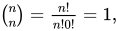
مضروب العدديكونأو بالرموز،هناك عدة دوافع وراء هذا التعريف :


- لتعريفبما أن الناتج يتضمن ضرب لا أعداد على الإطلاق، فهو مثال على الاتفاقية الأوسع التي تنص على أن الناتج الفارغ ، وهو ناتج لا يحتوي على عوامل، يساوي العنصر المحايد للضرب. [ 22 ]
- يوجد تبديل واحد فقط لصفر من العناصر: عندما لا يكون هناك شيء لتبديله، فإن إعادة الترتيب الوحيدة هي عدم القيام بأي شيء. [ 21 ]
- يجعل هذا الاتفاق العديد من المتطابقات في علم التوافيق صالحة لجميع الخيارات الصحيحة لمعاملاتها. على سبيل المثال، عدد طرق اختيار جميععناصر من مجموعةيكونهوية معامل ذات الحدين التي لا تكون صالحة إلا مع[ 23 ]
- معتظل علاقة التكرار للعامل صالحة عندلذلك ، وفقًا لهذا الاصطلاح، فإن الحساب التكراري للمضروب لا يحتاج إلا إلى قيمة الصفر كحالة أساسية ، مما يبسط الحساب ويتجنب الحاجة إلى حالات خاصة إضافية. [ 24 ]
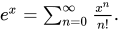
- Setting allows for the compact expression of many formulae, such as the exponential function, as a power series: [14]
- This choice matches the gamma function, and the gamma function is defined as a continuous function of complex numbers that does not involve a separate choice at this value.[25]



Applications
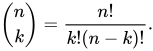
The earliest uses of the factorial function involve counting permutations: there are different ways of arranging distinct objects into a sequence.[26] Factorials appear more broadly in many formulas in combinatorics, to account for different orderings of objects. For instance the binomial coefficients count the -elementcombinations (subsets of elements) from a set with elements, and can be computed from factorials using the formula[27] The Stirling numbers of the first kind sum to the factorials, and count the permutations of grouped into subsets with the same numbers of cycles.[28] Another combinatorial application is in counting derangements, permutations that do not leave any element in its original position; the number of derangements of items is the nearest integerto .[29]



In algebra, the factorials arise through the binomial theorem, which uses binomial coefficients to expand powers of sums.[30] They also occur in the coefficients used to relate certain families of polynomials to each other, for instance in Newton's identities for symmetric polynomials.[31] Their use in counting permutations can also be restated algebraically: the factorials are the orders of finite symmetric groups.[32] In calculus, factorials occur in Faà di Bruno's formula for chaining higher derivatives.[19] In mathematical analysis, factorials frequently appear in the denominators of power series, most notably in the series for the exponential function,[14] وفي معاملات متسلسلات تايلور الأخرى (وخاصة معاملات الدوال المثلثية والزائدية ) ، حيث تلغي عوامل منقادمًا منالمشتقة من[ 33 ] يرتبط استخدام المضروب في متسلسلات القوى بالتوافقية التحليلية من خلال الدالة المولدة الأسية ، والتي بالنسبة لفئة توافقية مععناصر الحجميتم تعريفها على أنها متسلسلة القوى [ 34 ]


في نظرية الأعداد ، الخاصية الأبرز للمضروب هي قابلية القسمةبواسطة جميع الأعداد الصحيحة الموجبة حتى، وهو ما يُوصف بدقة أكبر بالنسبة للعوامل الأولية بواسطة صيغة ليجندر . ويترتب على ذلك أنه يمكن إيجاد أعداد أولية كبيرة كيفما كانت كعوامل أولية للأعداد مما يؤدي إلى إثبات نظرية إقليدس التي تنص على أن عدد الأعداد الأولية لا نهائي. [ 35 ] عندماإذا كان العدد أوليًا، يُسمى عددًا أوليًا مضروبًا ؛ [ 36 ] وبالمثل، تتعلق مسألة بروكارد ، التي طرحها أيضًا سرينيفاسا رامانوجان ، بوجود أعداد مربعة من الشكل[ 37 ] في المقابل ، الأرقاميجب أن تكون جميعها أعدادًا مركبة، مما يثبت وجود فجوات أولية كبيرة كيفما شاءت . [ 38 ] برهان أولي لمسلمة برتراند حول وجود عدد أولي في أي فترة من الشكلاستندت إحدى أولى نتائج بول إردوش إلى خصائص قابلية قسمة المضروب. [ 39 ] [ 40 ] نظام المضروب هو نظام تدوين عدّي مختلط للأعداد، حيث تمثل القيم المكانية لكل رقم مضروبًا. [ 41 ]



![{\displaystyle [n,2n]}](https://wikimedia.org/api/rest_v1/media/math/render/svg/4a6f7024fbcdf1ab8eee885b5e5054776e04ea57)
Factorials are used extensively in probability theory, for instance in the Poisson distribution[42] and in the probabilities of random permutations.[43] In computer science, beyond appearing in the analysis of brute-force searches over permutations,[44] factorials arise in the lower bound of on the number of comparisons needed to comparison sort a set of items,[45] and in the analysis of chained hash tables, where the distribution of keys per cell can be accurately approximated by a Poisson distribution.[46] Moreover, factorials naturally appear in formulae from quantum and statistical physics, where one often considers all the possible permutations of a set of particles. In statistical mechanics, calculations of entropy such as Boltzmann's entropy formula or the Sackur–Tetrode equation must correct the count of microstates by dividing by the factorials of the numbers of each type of indistinguishable particle to avoid the Gibbs paradox. Quantum physics provides the underlying reason for why these corrections are necessary.[47]

Properties


Growth and approximation
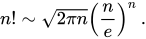
As a function of , the factorial has faster than exponential growth, but grows more slowly than a double exponential function.[48] Its growth rate is similar to , but slower by an exponential factor. One way of approaching this result is by taking the natural logarithm of the factorial, which turns its product formula into a sum, and then estimating the sum by an integral: Exponentiating the result (and ignoring the negligible term) approximates as .[49] More carefully bounding the sum both above and below by an integral, using the trapezoid rule, shows that this estimate needs a correction factor proportional to . The constant of proportionality for this correction can be found from the Wallis product, which expresses as a limiting ratio of factorials and powers of two. The result of these corrections is Stirling's approximation:[50] Here, the symbol means that, as goes to infinity, the ratio between the left and right sides approaches in the limit. Stirling's formula provides the first term in an asymptotic series that becomes even more accurate when taken to greater numbers of terms:[51] An alternative version (the approximation derived directly from the Euler–Maclaurin formula) converges faster because it only requires odd exponents in the correction terms:[51] Many other variations of these formulas have also been developed, by Srinivasa Ramanujan, Bill Gosper, and others.[51]







The binary logarithm of the factorial, used to analyze comparison sorting, can be very accurately estimated using Stirling's approximation. In the formula below, the term invokes big O notation.[45]


Divisibility and digits
The product formula for the factorial implies that is divisible by all prime numbers that are at most , and by no larger prime numbers.[52] More precise information about its divisibility is given by Legendre's formula, which gives the exponent of each prime in the prime factorization of as[53][54] Here denotes the sum of the base- digits of . The exponent given by this formula can more technically be called the p-adic valuation of the factorial.[54] Applying Legendre's formula to the product formula for binomial coefficients produces Kummer's theorem, a similar result on the exponent of each prime in the factorization of a binomial coefficient.[55] Grouping the prime factors of the factorial into prime powers in different ways produces the multiplicative partitions of factorials.[56]

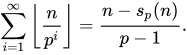

The special case of Legendre's formula for gives the number of trailing zeros in the decimal representation of the factorials.[57] According to this formula, the number of zeros can be obtained by subtracting the base-5 digits of from , and dividing the result by four.[58] Legendre's formula implies that the exponent of the prime is always larger than the exponent for , so each factor of five can be paired with a factor of two to produce one of these trailing zeros.[57] The leading digits of the factorials are distributed according to Benford's law.[59] Every sequence of digits, in any base, is the sequence of initial digits of some factorial number in that base.[60]


Another result on divisibility of factorials, Wilson's theorem, states that is divisible by if and only if is a prime number.[52] For any given integer , the Kempner function of is given by the smallest for which divides .[61] For almost all numbers (all but a subset of exceptions with asymptotic density zero), it coincides with the largest prime factor of .[62]


The product of two factorials, , always evenly divides .[63] There are infinitely many factorials that equal the product of other factorials: if is itself any product of factorials, then equals that same product multiplied by one more factorial, . The only known examples of factorials that are products of other factorials but are not of this "trivial" form are ,, and .[64] It would follow from the abc conjecture that there are only finitely many nontrivial examples.[65]





The greatest common divisor of the values of a primitive polynomial of degree over the integers evenly divides .[63]


Continuous interpolation and non-integer generalization
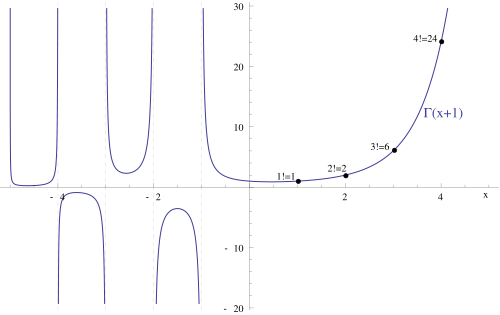
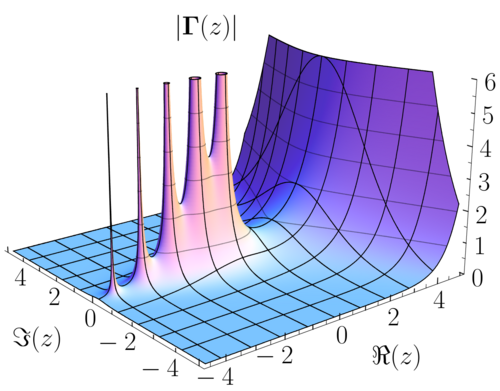
There are infinitely many ways to extend the factorials to a continuous function.[66] The most widely used of these[67] uses the gamma function, which can be defined for positive real numbers as the integral The resulting function is related to the factorial of a non-negative integer by the equation which can be used as a definition of the factorial for non-integer arguments. At all values for which both and are defined, the gamma function obeys the functional equation generalizing the recurrence relation for the factorials.[66]





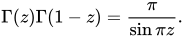
The same integral converges more generally for any complex number whose real part is positive. It can be extended to the non-integer points in the rest of the complex plane by solving for Euler's reflection formula However, this formula cannot be used at integers because, for them, the term would produce a division by zero. The result of this extension process is an analytic function (more specifically a meromorphic function), the analytic continuation of the integral formula for the gamma function. It has a nonzero value at all complex numbers, except for the non-positive integers where it has simple poles. Correspondingly, this provides a definition for the factorial at all complex numbers other than the negative integers.[67] One property of the gamma function, distinguishing it from other continuous interpolations of the factorials, is given by the Bohr–Mollerup theorem, which states that the gamma function (offset by one) is the only log-convex function on the positive real numbers that interpolates the factorials and obeys the same functional equation. A related uniqueness theorem of Helmut Wielandt states that the complex gamma function and its scalar multiples are the only holomorphic functions on the positive complex half-plane that obey the functional equation and remain bounded for complex numbers with real part between 1 and 2.[68]


تتضمن الدوال المركبة الأخرى التي تُستخدم لاستكمال قيم المضروب دالة غاما لهادامارد ، وهي دالة شاملة لجميع الأعداد المركبة، بما في ذلك الأعداد الصحيحة غير الموجبة. [ 69 ] [ 70 ] في الأعداد p -adic ، لا يمكن استكمال دالة المضروب بشكل مباشر ومستمر، لأن مضروب الأعداد الصحيحة الكبيرة (وهي مجموعة فرعية كثيفة من الأعداد p -adic) يتقارب إلى الصفر وفقًا لصيغة ليجندر، مما يجعل أي دالة مستمرة قريبة من قيمها تساوي صفرًا في كل مكان. بدلاً من ذلك، توفر دالة غاما p -adic استكمالًا مستمرًا لشكل مُعدَّل من المضروب، مع حذف العوامل القابلة للقسمة على p . [ 71 ]
دالة ديغاما هي المشتقة اللوغاريتمية لدالة غاما. وكما توفر دالة غاما استيفاءً متصلاً للمضروب، بإزاحة قدرها واحد، فإن دالة ديغاما توفر استيفاءً متصلاً للأعداد التوافقية ، بإزاحة قدرها ثابت أويلر-ماسكيروني . [ 72 ]
حساب

تُعدّ دالة المضروب ميزة شائعة في الآلات الحاسبة العلمية . [ 73 ] كما أنها مُضمنة في مكتبات البرمجة العلمية مثل وحدة الدوال الرياضية في بايثون [ 74 ] ومكتبة Boost C++ . [ 75 ]
إذا لم تكن الكفاءة مصدر قلق، فإن حساب المضروب أمر بسيط: ما عليك سوى ضرب متغير مهيأ إلىبواسطة الأعداد الصحيحة حتىإن بساطة هذه العملية الحسابية تجعلها مثالاً شائعاً في استخدام أساليب وطرائق برمجة الحاسوب المختلفة. [ 76 ] حسابيمكن التعبير عنها بلغة شبه رمزية باستخدام التكرار [ 77 ] كما يلي
عرّف دالة حساب المضروب ( n ): f := 1، ثم لكل i := 1، 2، 3، ...، n : f := f * i ، ثم أرجع f
أو باستخدام التكرار [ 78 ] بناءً على علاقة التكرار الخاصة به كما
define factorial(n): if (n = 0) return 1 returnn * factorial(n − 1)
Other methods suitable for its computation include memoization,[79]dynamic programming,[80] and functional programming.[81] The computational complexity of these algorithms may be analyzed using the unit-cost random-access machine model of computation, in which each arithmetic operation takes constant time and each number uses a constant amount of storage space. In this model, these methods can compute in time , and the iterative version uses space . Unless optimized for tail recursion, the recursive version takes linear space to store its call stack.[82] However, this model of computation is only suitable when is small enough to allow to fit into a machine word.[83] The values 12! and 20! are the largest factorials that can be stored in, respectively, the 32-bit[84] and 64-bitintegers.[85]Floating point can represent larger factorials, but approximately rather than exactly, and will still overflow for factorials larger than .[84]


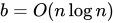
The exact computation of larger factorials involves arbitrary-precision arithmetic, because of fast growth and integer overflow. Time of computation can be analyzed as a function of the number of digits or bits in the result.[85] By Stirling's formula, has bits.[86] The Schönhage–Strassen algorithm can produce a -bit product in time , and faster multiplication algorithms taking time are known.[87] However, computing the factorial involves repeated products, rather than a single multiplication, so these time bounds do not apply directly. In this setting, computing by multiplying the numbers from 1 to in sequence is inefficient, because it involves multiplications, a constant fraction of which take time each, giving total time . A better approach is to perform the multiplications as a divide-and-conquer algorithm that multiplies a sequence of numbers by splitting it into two subsequences of numbers, multiplies each subsequence, and combines the results with one last multiplication. This approach to the factorial takes total time : one logarithm comes from the number of bits in the factorial, a second comes from the multiplication algorithm, and a third comes from the divide and conquer.[88]




Even better efficiency is obtained by computing n! from its prime factorization, based on the principle that exponentiation by squaring is faster than expanding an exponent into a product.[86][89] An algorithm for this by Arnold Schönhage begins by finding the list of the primes up to , for instance using the sieve of Eratosthenes, and uses Legendre's formula to compute the exponent for each prime. Then it computes the product of the prime powers with these exponents, using a recursive algorithm, as follows:
- Use divide and conquer to compute the product of the primes whose exponents are odd
- Divide all of the exponents by two (rounding down to an integer), recursively compute the product of the prime powers with these smaller exponents, and square the result
- Multiply together the results of the two previous steps
The product of all primes up to is an -bit number, by the prime number theorem, so the time for the first step is , with one logarithm coming from the divide and conquer and another coming from the multiplication algorithm. In the recursive calls to the algorithm, the prime number theorem can again be invoked to prove that the numbers of bits in the corresponding products decrease by a constant factor at each level of recursion, so the total time for these steps at all levels of recursion adds in a geometric seriesto . The time for the squaring in the second step and the multiplication in the third step are again , because each is a single multiplication of a number with bits. Again, at each level of recursion the numbers involved have a constant fraction as many bits (because otherwise repeatedly squaring them would produce too large a final result) so again the amounts of time for these steps in the recursive calls add in a geometric series to . Consequentially, the whole algorithm takes time , proportional to a single multiplication with the same number of bits in its result.[89]

Related sequences and functions
توجد عدة متواليات عددية صحيحة أخرى مشابهة أو مرتبطة بمتوالية المضروب:
- العاملي المتناوب
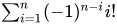
- المضروب المتناوب هو القيمة المطلقة للمجموع المتناوب للأولالمضروب،وقد دُرست هذه الأعداد بشكل رئيسي فيما يتعلق بكونها أولية؛ إذ لا يمكن أن يكون عدد محدود منها أوليًا، ولكن القائمة الكاملة للأعداد الأولية من هذا النوع غير معروفة. [ 90 ]
- بهارجافا فاكتوريال
- مضروب بهارجافا هو عائلة من المتتاليات العددية الصحيحة التي عرّفها مانجول بهارجافا، ولها خصائص نظرية عددية مشابهة للمضروب، بما في ذلك المضروب نفسه كحالة خاصة. [ 63 ]
- العامل المزدوج
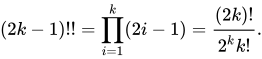
- حاصل ضرب جميع الأعداد الفردية حتى عدد صحيح فردي موجبيُطلق عليه اسم مضروب العدد المزدوج لـ، ويرمز إليه بـ[ 91 ] أي ،على سبيل المثال، 9!! = 1 × 3 × 5 × 7 × 9 = 945. تُستخدم المضروبات المزدوجة في التكاملات المثلثية ، [ 92 ] وفي تعابير دالة غاما عند أنصاف الأعداد الصحيحة وحجوم الكرات الفائقة ، [ 93 ] وفي عدّ الأشجار الثنائية والمطابقات الكاملة . [ 91 ] [ 94 ]
- العامل الأسي
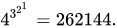
- تمامًا كما أن الأعداد المثلثية تجمع الأعداد منلوإذا أخذنا المضروب حاصل ضربه، فإن المضروب الأسي يتضاعف. ويُعرَّف المضروب الأسي بشكل تكراري على النحو التالي:على سبيل المثال ، مضروب العدد 4 هوتنمو هذه الأرقام بسرعة أكبر بكثير من المضروب العادي. [ 95 ]
- العاملي المتساقط
- الرموزأوتُستخدم أحيانًا لتمثيل ناتج أكبرالأعداد الصحيحة التي تُحسب حتى وشاملة، يساوييُعرف هذا أيضًا باسم العاملي الهابط أو العاملي العكسي ، والرمز هو رمز بوخامر. [ 96 ] تحسب المضروبات المتناقصة عدد التسلسلات المختلفة لـعناصر مميزة يمكن استخلاصها من عالم من items.[97] They occur as coefficients in the higher derivatives of polynomials,[98] and in the factorial moments of random variables.[99]
- Hyperfactorials
- The hyperfactorial of is the product . These numbers form the discriminants of Hermite polynomials.[100] They can be continuously interpolated by the K-function,[101] and obey analogues to Stirling's formula[102] and Wilson's theorem.[103]
- Jordan–Pólya numbers
- The Jordan–Pólya numbers are the products of factorials, allowing repetitions. Every tree has a symmetry group whose number of symmetries is a Jordan–Pólya number, and every Jordan–Pólya number counts the symmetries of some tree.[104]
- Primorial
- The primorial is the product of prime numbers less than or equal to ; this construction gives them some similar divisibility properties to factorials,[36] but unlike factorials they are squarefree.[105] As with the factorial primes, researchers have studied primorial primes.[36]
- Subfactorial
- The subfactorial yields the number of derangements of a set of objects. It is sometimes denoted , and equals the closest integer to .[29]
- Superfactorial
- The superfactorial of is the product of the first factorials. The superfactorials are continuously interpolated by the Barnes G-function.[106]
- Triangular number
- Just as the th factorial is the product of the first positive integers, the th triangular number is the sum of the first positive integers. Donald Knuth has proposed the name termial and the notation for the triangular numbers, making the analogy to factorials more explicit, but these are not in wide use.[107]




References
- 123Graham, Ronald L.; Knuth, Donald E.; Patashnik, Oren (1988). Concrete Mathematics. Reading, MA: Addison-Wesley. p. 111. ISBN 0-201-14236-8.
- 12Datta, Bibhutibhusan; Singh, Awadhesh Narayan (2019). "Use of permutations and combinations in India". In Kolachana, Aditya; Mahesh, K.; Ramasubramanian, K. (eds.). Studies in Indian Mathematics and Astronomy: Selected Articles of Kripa Shankar Shukla. Sources and Studies in the History of Mathematics and Physical Sciences. Springer Singapore. pp. 356–376. doi:10.1007/978-981-13-7326-8_18. ISBN 978-981-13-7325-1. S2CID 191141516.. Revised by K. S. Shukla from a paper in Indian Journal of History of Science 27 (3): 231–249, 1992, MR 1189487. See p. 363.
- ↑Jadhav, Dipak (August 2021). "Jaina Thoughts on Unity Not Being a Number". History of Science in South Asia. 9. University of Alberta Libraries: 209–231. doi:10.18732/hssa67. S2CID 238656716.. See discussion of dating on p. 211.
- ↑Biggs, Norman L. (May 1979). "The roots of combinatorics". Historia Mathematica. 6 (2): 109–136. doi:10.1016/0315-0860(79)90074-0. MR 0530622.
- 12Katz, Victor J. (June 1994). "Ethnomathematics in the classroom". For the Learning of Mathematics. 14 (2): 26–30. JSTOR 40248112.
- ↑Sefer Yetzirah at Wikisource, Chapter IV, Section 4
- ↑Rashed, Roshdi (1980). "Ibn al-Haytham et le théorème de Wilson". Archive for History of Exact Sciences (in French). 22 (4): 305–321. doi:10.1007/BF00717654. MR 0595903. S2CID 120885025.
- ↑ أسيربي، ف. (2003). "على أكتاف هيبارخوس: إعادة تقييم التوافقية اليونانية القديمة". أرشيف تاريخ العلوم الدقيقة . 57 (6 ) : 465-502 . doi : 10.1007 / s00407-003-0067-0 . JSTOR 41134173. MR 2004966. S2CID 122758966 .
- ↑ كاتز، فيكتور ج. (2013). "الفصل 4: التوافقية اليهودية". في ويلسون، روبن ؛ واتكينز، جون ج. (محرران). التوافقية: القديمة والحديثة . مطبعة جامعة أكسفورد . ص 109-121 . ISBN 978-0-19-965659-2.انظر الصفحة 111.
- ↑ هانت، كاثرين (مايو 2018). "فن التغييرات: قرع الأجراس، والجناس، وثقافة التركيب في إنجلترا في القرن السابع عشر" (ملف PDF) . مجلة الدراسات القروسطية والحديثة المبكرة . 48 (2): 387-412 . doi : 10.1215/10829636-4403136 .
- ↑ ستيدمان، فابيان (1677). كامبانالوجيا . لندن. ص 6-9 . تم ذكر الناشر باسم "WS" والذي ربما كان ويليام سميث، وربما كان يعمل كوكيل لجمعية شباب الكلية ، والتي تم توجيه "الإهداء" إليها.
- ↑ كنوبلوخ، إيبرهارد (2013). "الفصل 5: التوافقية في عصر النهضة". في ويلسون، روبن؛ واتكينز، جون جيه (محرران). التوافقية: القديمة والحديثة . مطبعة جامعة أكسفورد . ص 123-145 . ISBN 978-0-19-965659-2. انظر الصفحة 126.
- ^ كنوبلوخ 2013 ، ص 130-133.
- 1 2 3 إبنجهاوس، إتش.-د. ; هيرميس، ه . هيرزبروخ، ف . كوشر، م . ماينزر، ك . نيوكيرش، J .؛ بريستل، أ.؛ ريميرت، ر. (1990). أرقام . نصوص الدراسات العليا في الرياضيات. المجلد. 123. نيويورك: سبرينغر-فيرلاغ. ص. 131. دوى : 10.1007/978-1-4612-1005-4 . رقم ISBN 0-387-97202-1MR 1066206
- ↑ دوتكا، جاك (1991). " التاريخ المبكر لدالة المضروب". أرشيف تاريخ العلوم الدقيقة . 43 (3): 225-249 . doi : 10.1007/BF00389433 . JSTOR 41133918. MR 1171521. S2CID 122237769 .
- ↑ ديكسون، ليونارد إي. (1919). "الفصل التاسع: قابلية قسمة المضروب ومعاملات الحدود المتعددة" . تاريخ نظرية الأعداد . المجلد 1. مؤسسة كارنيجي في واشنطن. الصفحات 263-278 . انظر على وجه الخصوص الصفحة 263.
- 1 2 كاجوري، فلوريان (1929). "448-449. مضروب " ن "" تاريخ الرموز الرياضية، المجلد الثاني: الرموز المستخدمة بشكل رئيسي في الرياضيات العليا . شركة أوبن كورت للنشر. الصفحات 71-77 ."
- ↑ ميلر، جيف. "أقدم الاستخدامات المعروفة لبعض مصطلحات الرياضيات (F)" . أرشيف ماك تيوتور لتاريخ الرياضيات . جامعة سانت أندروز.
- 1 2 كريك، أليكس د (2005). “ما قبل التاريخ لصيغة Faà di Bruno”. الرياضيات الأمريكية الشهرية . 112 (2): 119– 130. دوى : 10.1080/00029890.2005.11920176 . جستور 30037410 . السيد 2121322 . S2CID 45380805 .
- ^ أربوغاست، لويس فرانسوا أنطوان (1800). Du calcul des dérivations (بالفرنسية). ستراسبورغ: L'imprimerie de Levrault، frères. ص 364 – 365.
- 1 2 هامكينز، جويل ديفيد (2020). البرهان وفن الرياضيات . كامبريدج، ماساتشوستس: مطبعة معهد ماساتشوستس للتكنولوجيا. ص 50. ISBN 978-0-262-53979-1MR 4205951
- ↑ دورف، ريتشارد سي. (2003). "العوامل" . دليل سي آر سي لجداول الهندسة . مطبعة سي آر سي. ص 5-5. ISBN 978-0-203-00922-2.
- ^ غولدنبرغ، إي بول؛ كارتر، سينثيا ج. (أكتوبر 2017). "طالب يسأل عن ( - 5)!". مدرس الرياضيات . 111 (2): 104-110 . دوى : 10.5951/matheacher.111.2.0104 . جستور 10.5951/matheacher.111.2.0104 .
- ↑Haberman, Bruria; Averbuch, Haim (2002). "The case of base cases: Why are they so difficult to recognize? Student difficulties with recursion". In Caspersen, Michael E.; Joyce, Daniel T.; Goelman, Don; Utting, Ian (eds.). Proceedings of the 7th Annual SIGCSE Conference on Innovation and Technology in Computer Science Education, ITiCSE 2002, Aarhus, Denmark, June 24-28, 2002. Association for Computing Machinery. pp. 84–88. doi:10.1145/544414.544441.
- ↑Farrell, Orin J.; Ross, Bertram (1971). Solved Problems in Analysis: As Applied to Gamma, Beta, Legendre and Bessel Functions. Dover Books on Mathematics. Courier Corporation. p. 10. ISBN 978-0-486-78308-6.
- ↑Conway, John H.; Guy, Richard (1998). "Factorial numbers". The Book of Numbers. Springer Science & Business Media. pp. 55–56. ISBN 978-0-387-97993-9.
- ↑Graham, Knuth & Patashnik 1988, p. 156.
- ↑Riordan, John (1958). An Introduction to Combinatorial Analysis. Wiley Publications in Mathematical Statistics. Chapman & Hall. p. 76. MR 0096594.Reprinted, Princeton Legacy Library, Princeton University Press, 2014, ISBN 9781400854332.
- 12Graham, Knuth & Patashnik 1988, p. 195.
- ↑Graham, Knuth & Patashnik 1988, p. 162.
- ↑Randić, Milan (1987). "On the evaluation of the characteristic polynomial via symmetric function theory". Journal of Mathematical Chemistry. 1 (1): 145–152. doi:10.1007/BF01205340. MR 0895533. S2CID 121752631.
- ↑Hill, Victor E. (2000). "8.1 Proposition: Symmetric group Sn". Groups and Characters. Chapman & Hall. p. 70. ISBN 978-1-351-44381-4. MR 1739394.
- ↑Christensen, Kim; Moloney, Nicholas R. (2005). "Appendix A: Taylor expansion". Complexity and Criticality. Advanced physics texts. Vol. 1. Imperial College Press. p. 341. ISBN 978-1-86094-504-5.
- ↑ ويلف، هربرت س. (2006). علم وظائف التوليد ( الطبعة الثالثة). ويليسلي، ماساتشوستس: إيه كيه بيترز. ص 22. ISBN 978-1-56881-279-3MR 2172781 .
- ↑ أور، أويستين (1948). نظرية الأعداد وتاريخها . نيويورك: ماكجرو هيل. ص 66. MR 0026059 . أُعيد طبعه ، منشورات كوريير دوفر، 1988، رقم ISBN 9780486656205.
- 1 2 3 كالدول، كريس ك.؛ غالوت، إيف (2002). "حول أسبقيةو" . رياضيات الحوسبة . 71 (237): 441– 448. doi : 10.1090/S0025-5718-01-01315-1 . MR 1863013 .
- ↑ جاي، ريتشارد ك. (2004). "D25: المعادلات التي تتضمن المضروب" مسائل غير محلولة في نظرية الأعداد . سلسلة كتب المسائل في الرياضيات. المجلد 1 ( الطبعة الثالثة). نيويورك: سبرينغر-فيرلاغ. الصفحات 301-302 . doi : 10.1007/978-0-387-26677-0 . ISBN 0-387-20860-7MR 2076335
- ↑ نيل، فيكي (2017). سد الفجوة: السعي لفهم الأعداد الأولية . مطبعة جامعة أكسفورد. ص 146-147 . ISBN 978-0-19-878828-7.
- ^ إردوس ، بال (1932). "Beweis eines Satzes von Tschebyschef" [ إثبات نظرية تشيبيشيف ] (PDF) . اكتا ليت. الخيال العلمي. سيجد (في المانيا). 5 : 194 – 198. زبل 0004.10103 .
- ↑ تشفاتال، فاشيك (2021). "1.5: برهان إردوش على مسلمة برتراند" . سحر الرياضيات المتقطعة لبول إردوش: مقدمة بسيطة . كامبريدج، إنجلترا: مطبعة جامعة كامبريدج. ص 7-10 . doi : 10.1017/9781108912181 . ISBN 978-1-108-83183-3. MR 4282416 . S2CID 242637862 .
- ↑ فرانكل، أفيزري س. (1985). " أنظمة الترقيم". المجلة الرياضية الأمريكية الشهرية . 92 (2): 105-114 . doi : 10.1080/00029890.1985.11971550 . JSTOR 2322638. MR 0777556 .
- ↑Pitman, Jim (1993). "3.5: The Poisson distribution". Probability. New York: Springer. pp. 222–236. doi:10.1007/978-1-4612-4374-8. ISBN 978-0-387-94594-1.
- ↑Pitman 1993, p. 153.
- ↑Kleinberg, Jon; Tardos, Éva (2006). Algorithm Design. Addison-Wesley. p. 55.
- 12Knuth, Donald E. (1998). The Art of Computer Programming, Volume 3: Sorting and Searching (2nd ed.). Addison-Wesley. p. 182. ISBN 978-0-321-63578-5.
- ↑Sedgewick, Robert; Wayne, Kevin (2011). Algorithms (4th ed.). Addison-Wesley. p. 466. ISBN 978-0-13-276256-4.
- ↑Kardar, Mehran (2007). Statistical Physics of Particles. Cambridge University Press. pp. 107–110, 181–184. ISBN 978-0-521-87342-0. OCLC 860391091.
- ↑Cameron, Peter J. (1994). "2.4: Orders of magnitude". Combinatorics: Topics, Techniques, Algorithms. Cambridge University Press. pp. 12–14. ISBN 978-0-521-45133-8.
- ↑Magnus, Robert (2020). "11.10: Stirling's approximation". Fundamental Mathematical Analysis. Springer Undergraduate Mathematics Series. Cham: Springer. p. 391. doi:10.1007/978-3-030-46321-2. ISBN 978-3-030-46321-2. MR 4178171. S2CID 226465639.
- ↑Palmer, Edgar M. (1985). "Appendix II: Stirling's formula". Graphical Evolution: An introduction to the theory of random graphs. Wiley-Interscience Series in Discrete Mathematics. Chichester: John Wiley & Sons. pp. 127–128. ISBN 0-471-81577-2. MR 0795795.
- 123Chen, Chao-Ping; Lin, Long (2012). "Remarks on asymptotic expansions for the gamma function". Applied Mathematics Letters. 25 (12): 2322–2326. doi:10.1016/j.aml.2012.06.025. MR 2967837.
- 1 2 بيلر، ألبرت هـ. (1966). تسليات في نظرية الأعداد: ملكة الرياضيات تُسلّي . سلسلة دوفر للرياضيات الترفيهية ( الطبعة الثانية). مؤسسة كورير. ص 49. ISBN 978-0-486-21096-4.
- ↑ شفاتال 2021 . “1.4: صيغة ليجيندر”. ص 6-7.
- 1 2 روبرت، آلان م. (2000). "3.1: الـالتقييم الأدي للمضروب. دورة فيالتحليل -adic . نصوص الدراسات العليا في الرياضيات . المجلد 198. نيويورك: سبرينغر-فيرلاغ. الصفحات 241-242 . doi : 10.1007/978-1-4757-3254-2 . ISBN 0-387-98669-3MR 1760253
- ^ بيتجن، هاينز أوتو ؛ الأماكن القريبة : سوبي، ديتمار (2004). “نتيجة كومر وهوية ليجيندر”. الفوضى والفركتلات: حدود جديدة للعلوم . نيويورك: سبرينغر. ص 399 – 400. دوى : 10.1007 / b97624 . رقم ISBN 978-1-4684-9396-2.
- ↑ ألادي، كريشناسوامي ؛ غرينستيد، تشارلز (1977). "حول تحليل n! إلى قوى أولية" . مجلة نظرية الأعداد . 9 (4): 452-458 . doi : 10.1016/0022-314x(77)90006-3 .
- 1 2 كوشي، توماس (2007). "مثال 3.12" . نظرية الأعداد الأولية مع التطبيقات ( الطبعة الثانية). إلسيفير. ص 178. ISBN 978-0-08-054709-1.
- ↑ سلون، ن. ج. أ. (محرر). "المتتالية A027868 (عدد الأصفار اللاحقة في n!؛ أعلى قوة للعدد 5 تقسم n!)" . الموسوعة الإلكترونية لمتتاليات الأعداد الصحيحة . مؤسسة OEIS.
- ↑ دياكونيس، بيرسي (1977). "توزيع الأرقام الرائدة والتوزيع المنتظم بتردد 1" . حوليات الاحتمالات . 5 (1): 72-81 . doi : 10.1214/aop/1176995891 . MR 0422186 .
- ↑Bird, R. S. (1972). "Integers with given initial digits". The American Mathematical Monthly. 79 (4): 367–370. doi:10.1080/00029890.1972.11993051. JSTOR 2978087. MR 0302553.
- ↑Kempner, A. J. (1918). "Miscellanea". The American Mathematical Monthly. 25 (5): 201–210. doi:10.2307/2972639. JSTOR 2972639.
- ↑Erdős, Paul; Kastanas, Ilias (1994). "The smallest factorial that is a multiple of n (solution to problem 6674)"(PDF). The American Mathematical Monthly. 101: 179. doi:10.2307/2324376. JSTOR 2324376..
- 123Bhargava, Manjul (2000). "The factorial function and generalizations". The American Mathematical Monthly. 107 (9): 783–799. CiteSeerX 10.1.1.585.2265. doi:10.2307/2695734. JSTOR 2695734.
- ↑Guy 2004. "B23: Equal products of factorials". p. 123.
- ↑Luca, Florian (2007). "On factorials which are products of factorials". Mathematical Proceedings of the Cambridge Philosophical Society. 143 (3): 533–542. Bibcode:2007MPCPS.143..533L. doi:10.1017/S0305004107000308. MR 2373957. S2CID 120875316.
- 12Davis, Philip J. (1959). "Leonhard Euler's integral: A historical profile of the gamma function". The American Mathematical Monthly. 66 (10): 849–869. doi:10.1080/00029890.1959.11989422. JSTOR 2309786. MR 0106810. Archived from the original on 2023-01-01. Retrieved 2021-12-20.
- 12Borwein, Jonathan M.; Corless, Robert M. (2018). "Gamma and factorial in the Monthly". The American Mathematical Monthly. 125 (5): 400–424. arXiv:1703.05349. doi:10.1080/00029890.2018.1420983. MR 3785875. S2CID 119324101.
- ↑Remmert, Reinhold (1996). "Wielandt's theorem about the -function". The American Mathematical Monthly. 103 (3): 214–220. doi:10.1080/00029890.1996.12004726. JSTOR 2975370. MR 1376175.
- ↑Hadamard, J. (1968) [1894]. "Sur l'expression du produit 1·2·3· · · · ·(n−1) par une fonction entière"(PDF). Œuvres de Jacques Hadamard (in French). Paris: Centre National de la Recherche Scientifiques.
- ↑Alzer, Horst (2009). "A superadditive property of Hadamard's gamma function". Abhandlungen aus dem Mathematischen Seminar der Universität Hamburg. 79 (1): 11–23. doi:10.1007/s12188-008-0009-5. MR 2541340. S2CID 123691692.
- ↑Robert 2000. "7.1: The gamma function ". pp. 366–385.
- ↑Ross, Bertram (1978). "The psi function". Mathematics Magazine. 51 (3): 176–179. doi:10.1080/0025570X.1978.11976704. JSTOR 2689999. MR 1572267.
- ↑Brase, Charles Henry; Brase, Corrinne Pellillo (2014). Understandable Statistics: Concepts and Methods (11th ed.). Cengage Learning. p. 182. ISBN 978-1-305-14290-9.
- ↑"math — Mathematical functions". Python 3 Documentation: The Python Standard Library. Retrieved 2021-12-21.
- ↑"Factorial". Boost 1.78.0 Documentation: Math Special Functions. Retrieved 2021-12-21.
- ↑ أديس، توم؛ أديس، جان (2009). برامج الرسم: نظرية وممارسة البرمجة الوظيفية التخطيطية . سبرينغر. ص 149-150 . ISBN 978-1-84882-618-2.
- ↑ تشابمان، ستيفن ج. (2019). "مثال 5.2: دالة المضروب" . برمجة MATLAB للمهندسين ( الطبعة السادسة). سينجايج ليرنينج. ص 215. ISBN 978-0-357-03052-3.
- ↑ هاي، توني؛ باباي، جيوري (2014). عالم الحوسبة: رحلة عبر ثورة . مطبعة جامعة كامبريدج. ص 64. ISBN 9781316123225.
- ↑ بولبواكا، ألكساندرو (2019). البرمجة الوظيفية العملية باستخدام لغة C++: دليل فعال لكتابة كود وظيفي مُسرّع باستخدام C++17 وC++20 . دار نشر Packt. ص 188. ISBN 978-1-78980-921-3.
- ↑ غراي، جون دبليو. (2014). إتقان ماثيماتيكا: أساليب البرمجة والتطبيقات . دار النشر الأكاديمية. ص 233-234 . ISBN 978-1-4832-1403-0.
- ↑ تورا، فيسينس (2016). سكالا من منظور البرمجة الوظيفية: مقدمة إلى لغة البرمجة . سلسلة محاضرات في علوم الحاسوب. المجلد 9980. سبرينغر. ص 96. ISBN 978-3-319-46481-7.
- ↑ سوسمان، جيرالد جاي (1982). "ليسب، البرمجة، والتنفيذ". البرمجة الوظيفية وتطبيقاتها: دورة متقدمة . دورات كريست المتقدمة. مطبعة جامعة كامبريدج. ص 29-72 . ISBN 978-0-521-24503-6.انظر على وجه الخصوص الصفحة 34 .
- ↑ تشودري، رانجان (يونيو 2003). "هل تُنفَّذ العمليات الحسابية فعلاً في وقت ثابت؟". نشرة ACM SIGCSE . 35 (2). رابطة آلات الحوسبة: 43-44 . doi : 10.1145/782941.782977 . S2CID 13629142 .
- 1 2 فيتمان، ريتشارد ج. (11 أبريل 2006). "تعليقات على البرامج العاملية" (ملف PDF) . جامعة كاليفورنيا، بيركلي.
- 1 2 وينكلر، يورغن إف إتش؛ كاور، ستيفان (مارس 1997). "إثبات الادعاءات مفيد أيضًا" . إشعارات ACM SIGPLAN . 32 (3). رابطة آلات الحوسبة: 38-41 . doi : 10.1145/251634.251638 . S2CID 17347501 .
- 1 2 بورواين، بيتر ب. (1985). "حول تعقيد حساب المضروب". مجلة الخوارزميات . 6 (3): 376-380 . doi : 10.1016/0196-6774(85)90006-9 . MR 0800727 .
- ^ هارفي ، ديفيد. فان دير هوفن، يوريس (2021). "ضرب الأعداد الصحيحة في الوقت المناسب( ملف PDF) . حوليات الرياضيات . السلسلة الثانية. 193 (2): 563-617 . doi : 10.4007/annals.2021.193.2.4 . MR 4224716. S2CID 109934776 .
- ↑ أرندت، يورغ (2011). "34.1.1.1: حساب المضروب". مسائل حسابية: أفكار، خوارزميات، شفرة مصدرية (ملف PDF) . سبرينغر. ص 651-652 . انظر أيضًا "34.1.5: الأداء"، الصفحات 655-656.
- 1 2 شونهاج، أرنولد (1994). خوارزميات سريعة : تنفيذ آلة تورينج متعددة الأشرطة BI Wissenchaftsverlag. ص. 226.
- ↑ جاي 2004. "B43: المجاميع المتناوبة للمضروب". ص 152-153.
- 1 2 كالان، ديفيد (2009). "دراسة توافقية للهويات الخاصة بالعامل المزدوج". arXiv : 0906.1317 [ math.CO ].
- ↑ ميسيرف، بي إي (1948). " ملاحظات صفية: المضروب المزدوج". المجلة الرياضية الأمريكية الشهرية . 55 (7): 425-426 . doi : 10.2307/2306136 . JSTOR 2306136. MR 1527019 .
- ↑ ميزي، بول ج. (2009). "بعض مشاكل الأبعاد في قواعد البيانات الجزيئية". مجلة الكيمياء الرياضية . 45 (1): 1-6 . doi : 10.1007/s10910-008-9365-8 . S2CID 120103389 . .
- ↑ ديل، إم آر تي؛ مون، جيه دبليو (1993). "النظائر المتبادلة لثلاث مجموعات كاتالانية". مجلة التخطيط والاستدلال الإحصائي . 34 (1): 75-87 . doi : 10.1016/0378-3758(93)90035-5 . MR 1209991 . .
- ^ لوكا، فلوريان ؛ ماركيز، دييغو (2010). "القوى المثالية في الوظيفة التلخيصية لبرج الطاقة" . جورنال دي Théorie des Nombres de Bordeaux . 22 (3): 703-718 . دوى : 10.5802/jtnb.740 . السيد 2769339 .
- ^ جراهام ونوث وباتاشنيك 1988 ، ص. x، 47–48.
- ↑ ساغان، بروس إي. (2020). "النظرية 1.2.1" . التوافقية: فن العد . دراسات عليا في الرياضيات. المجلد 210. بروفيدنس، رود آيلاند: الجمعية الرياضية الأمريكية. ص 5. ISBN 978-1-4704-6032-7MR 4249619 .
- ↑ هاردي، جي إتش (1921). "أمثلة 45" . دورة في الرياضيات البحتة ( الطبعة الثالثة). مطبعة جامعة كامبريدج. ص 215.
- ↑ دالي، دي جيه؛ فير-جونز، دي. (1988). "5.2: العزوم العاملية، والتراكمات، وعلاقات الدوال المولدة للتوزيعات المنفصلة" . مقدمة في نظرية العمليات النقطية . سلسلة سبرينغر في الإحصاء. نيويورك: سبرينغر-فيرلاغ. ص 112. ISBN 0-387-96666-8MR 0950166 .
- ↑ سلون، ن. ج. أ. (محرر). "المتتالية A002109 (المضروب الفائق: حاصل ضرب k = 1..n) k^k" . الموسوعة الإلكترونية لمتتاليات الأعداد الصحيحة . مؤسسة OEIS.
- ^ كينكلين، هـ. (1860). "Ueber eine mit der Gammafunction verwandte Transcendente und deren Anwendung auf die Integralrechung" [ حول الاختلاف التجاوزي لدالة جاما وتطبيقها على حساب التفاضل والتكامل ] . Journal für die reine und angewandte Mathematik (باللغة الألمانية). 1860 (57): 122–138 . دوى : 10.1515/crll.1860.57.122 . S2CID 120627417 .
- ↑ غليشر، جيه دبليو إل (1877). "حول حاصل ضرب 1 1 .2 2 .3 3 ... n n " . رسول الرياضيات . 7 : 43-47 .
- ↑ أيبي، كريستيان؛ كيرنز، غرانت (2015). "تعميمات لنظرية ويلسون للمضروب المزدوج، والمضروب الفائق، والمضروب الفرعي، والمضروب الفائق". المجلة الرياضية الأمريكية الشهرية . 122 (5): 433-443 . doi : 10.4169/amer.math.monthly.122.5.433 . JSTOR 10.4169/amer.math.monthly.122.5.433 . MR 3352802. S2CID 207521192 .
- ↑ سلون، ن. ج. أ. (محرر). "المتتالية A001013 (أعداد جوردان-بوليا: نواتج أعداد مضروبة)" . الموسوعة الإلكترونية لمتتاليات الأعداد الصحيحة . مؤسسة OEIS.
- ↑ نيلسون، راندولف (2020). رحلة موجزة في الرياضيات المتقطعة . تشام: سبرينغر. ص 127. doi : 10.1007/978-3-030-37861-5 . ISBN 978-3-030-37861-5. MR 4297795 . S2CID 213895324 .
- ↑ بارنز، إي دبليو (1900). "نظرية الدالة G " . المجلة الفصلية للرياضيات البحتة والتطبيقية . 31 : 264-314 . JFM 30.0389.02 .
- ↑ كنوت، دونالد (1997). الخوارزميات الأساسية . فن برمجة الحاسوب . المجلد 1 ( الطبعة الثالثة). ريدينغ، ماساتشوستس: أديسون-ويسلي بروفيشنال. ص 48.



روابط خارجية
- تسلسل OEIS A000142 (الأعداد العاملية)
- "العاملي" . موسوعة الرياضيات . مطبعة EMS . 2001 [1994].
- وايسشتاين، إريك دبليو. "العاملي" . عالم الرياضيات .
- التوافقية
- جاما والوظائف ذات الصلة
- موضوعات المضروب والثنائي
- العمليات الأحادية