
قائمة بالمواقع التاريخية في فينيكس
هذه قائمة، تتضمن معارض صور، لبعض المباني والمعالم التاريخية المتبقية ذات الأهمية التاريخية في مدينة فينيكس بولاية أريزونا الأمريكية. وتشمل صورًا لعقارات تم تحديدها من خلال مسوحات العقارات التاريخية الأفريقية والآسيوية والإسبانية لمدينة فينيكس، مع التركيز على تاريخ فينيكس من عام 1870 إلى عام 1975.
مع ذلك، لا تقتصر هذه القائمة على المباني والمعالم التاريخية فحسب، بل تشمل أيضًا معالم تاريخية، بعضها مُدرج في السجل الوطني للأماكن التاريخية، مثل أطلال بويبلو غراندي ومواقع الري ومركز دير فالي لفنون الصخور . تحتوي هذه المواقع على آثار وهياكل تعود إلى شعب هوهوكام الذين سكنوا منطقة مدينة فينيكس الحالية قبل وصول المستوطنين من غير السكان الأصليين.
لعب سد جوينت هيد المهجور والقنوات القديمة التي بناها الرواد الأوائل من أصول أوروبية دورًا هامًا في ري وتطوير مدينة فينيكس والمناطق المحيطة بها. تظهر في الصورة أطلال سد جوينت هيد المهجور الذي شُيّد عام ١٨٨٤. كما تظهر في الصورة القناة الكبرى، وهي أقدم قناة في فينيكس والتي بناها الرواد عام ١٨٧٧، وقناة أولد كروسكت التي شُيّدت عام ١٨٨٨.
تتضمن هذه القائمة صورًا لمدافن شخصيات بارزة دُفنت في مقابر فينيكس التاريخية، ممن كان لهم دور تاريخي هام في فينيكس وأريزونا. ووفقًا لتعريف "جمعية مقابر الرواد"، فإن "المقبرة التاريخية" هي التي يزيد عمرها عن خمسين عامًا. ومن بين المقابر المذكورة مقبرة كروسكت المهجورة، التي أُنشئت عام ١٨٧٠، وهي بذلك أقدم مقبرة في فينيكس، بالإضافة إلى منتزه الرواد والنصب التذكاري العسكري ، المُدرج في السجل الوطني للأماكن التاريخية.
فيما يلي بعض المتاحف في فينيكس التي تعرض صورًا لقطع أثرية ذات أهمية تاريخية. ومن بينها متحف ترام فينيكس الذي يعرض عربة الترام التاريخية رقم 116. كما يضم المتحف متحف مارتن للسيارات الذي يعرض سيارات من عام 1886 فصاعدًا، ومتحف الآلات الموسيقية.
تم إدراج لافين ومنطقة صنيسلوب بشكل منفصل لأن هاتين المنطقتين كانتا منطقتين أراد مواطنوهما إعلان المناطق كمدن مستقلة، ولكن تم دمج مناطقهم بدلاً من ذلك في مدينة فينيكس.
فينيكس

فينيكس هي عاصمة ولاية أريزونا الأمريكية وأكبر مدنها . [ 1 ] تأسست فينيكس كمدينة عام 1881، بعد أن كانت مدينة قائمة عام 1867 بالقرب من نهر سولت عند ملتقاه مع نهر جيلا . تضم المدينة العديد من المواقع التاريخية المدرجة في السجل الوطني للأماكن التاريخية . كما يوجد 33 معلمًا وموقعًا سياحيًا في فينيكس تُعتبر من أبرز معالم المدينة، وقد صُنفت هذه المعالم ضمن " معالم فخر فينيكس " [ 2 ] ، أو أنها مدرجة في سجل فينيكس للمواقع التاريخية. أُنشئ سجل فينيكس للمواقع التاريخية عام 1986، وهو السجل الرسمي للمدينة للمواقع التاريخية وما قبل التاريخية التي تستحق الحفظ. بعض هذه المواقع مُدرجة في كل من السجل الوطني للأماكن التاريخية وسجل فينيكس للمواقع التاريخية. [ 3 ] [ 4 ] [ 5 ] [ 6 ]
تُعدّ ساحة التراث التاريخية جزءًا من منتزه التراث والعلوم في الطرف الشرقي من وسط المدينة. وهي تضم المجموعة الوحيدة المتبقية من المباني السكنية من الموقع الأصلي لمدينة فينيكس. [ 7 ] وتُرفق صور هذه المباني مع وصف موجز لكل منها.
طائر الفينيق المتلاشي

بحسب روبرت أ. ميليكيان، مؤلف كتاب "فينيكس المتلاشية" ، لا يملك مكتب الحفاظ على التراث في فينيكس صلاحية رفض تراخيص الهدم. لذا، يحق لمالك أي عقار، سواءً كان مُدرجًا في السجل الوطني للأماكن التاريخية أو سجل فينيكس للعقارات التاريخية، هدم هذا العقار التاريخي. [ 8 ] وقد هُدمت أحياء بأكملها، مثل حي غولدن غيت ، حيث سكن أفراد من الأقليات. فقد هُدم كلٌ من منزل الحاكم الإقليمي السابق جوزيف كيبي، الكائن في 1334 شارع إي جيفرسون، والذي كان مسكنًا وعيادة للدكتور وينستون سي. هاكيت ، أول طبيب أمريكي من أصل أفريقي في أريزونا، والمبنى الكائن في 1342 شارع إي جيفرسون، حيث أسس هاكيت مستشفى بوكر تي. واشنطن التذكاري. [ 9 ] [ 10 ] يُعد فندق سانت جيمس التاريخي مثالًا على مبنى مُدرج في السجل الوطني للأماكن التاريخية، والذي سيتم هدمه، على الرغم من احتجاجات جماعات الحفاظ على التراث، لإفساح المجال أمام موقف سيارات لكبار الشخصيات لحاملي التذاكر الموسمية لفريق فينيكس صنز . ومن بين العقارات المُدرجة في السجل الوطني للأماكن التاريخية والتي تم هدمها ما يلي: [ 11 ]
- مستودع جمعية مزارعي الحمضيات في أريزونا - 601 شارع جاكسون الشرقي.
- منزل من الطوب الخرساني – 618-620 شمال الجادة الرابعة.
- بقالة هيغيرا – 923 جنوب الجادة الثانية.
- مستودع شركة لايتنينج ديليفري - 425 شارع إي جاكسون.
- شركة أوفرلاند أريزونا – 12 شمال الجادة الرابعة.
- منزل القاضي دبليو إتش ستيلويل – 2039 شارع مونرو الغربي.
- منزل كلينتون كامبل – 361 شمال الجادة الرابعة.
بعض المنازل والمباني التاريخية المدرجة في السجل الوطني للأماكن التاريخية و/أو سجل فينيكس للممتلكات التاريخية مدرجة أيضًا في "قائمة المواقع التاريخية المهددة بالخطر"، الصادرة عن ائتلاف أحياء فينيكس التاريخية. هذه المباني عرضة للتخريب وعوامل التعرية. ومن بين المباني المهملة والمعرضة لخطر الاندثار في المستقبل القريب ما يلي: [ 12 ]
- نُزُل شتاينيغر، الذي بُني عام 1889 ويقع في 27 شارع إي مونرو.
- منزل ويليام ر. نورتون، الذي تم بناؤه عام 1895 ويقع في 2222 غرب شارع واشنطن.
- منزل تشارلز بو ، الذي بُني عام 1897 ويقع في 356 شمال الجادة الثانية / 362 شمال الجادة الثانية. (يُظهر السجل الحالي المنزل بالرقم 356، بينما كان مُسجلاً بالرقم 362 في السجلات القديمة).
- منزل لويس إيمرسون، الذي تم بناؤه عام 1902 ويقع في 623 شارع نورث فورث.
- المنزل ذو الطوب الخرساني، الذي تم بناؤه عام 1908 ويقع في 606 شمال شارع 9.
- منزل لايتون جي. نيب، الذي تم بناؤه عام 1909 ويقع في 1025 شمال الجادة الثانية.
- منزل مزرعة ساكس-ويبستر، الذي تم بناؤه عام 1909 ويقع في الركن الشمالي الغربي من شارع 75th Avenue وشارع Baseline.
- منزل سارة بيمبرتون، الذي تم بناؤه عام 1920 ويقع في 1121 شمال شارع 2.
- منزل السيدة نيل، الذي تم بناؤه عام 1920 ويقع في 102 شارع إيست ويليتا.
أطلال بويبلو غراندي
يُعدّ موقع بويبلو غراندي الأثري بقايا قرية هوهوكام التي تعود إلى عصور ما قبل التاريخ، والتي يعود تاريخها إلى عام 450 قبل الميلاد. ولأسباب غير معروفة، هُجر الموقع بحلول عام 1450 ميلادي. هذه بعض آثار مباني هوهوكام التي تم اكتشافها، وتقع في متحف بويبلو غراندي والمنتزه الأثري .
 علامة معلم تاريخي وطني لآثار بويبلو غراندي. العلامة ومحتوياتها من عمل وزارة الداخلية الأمريكية، وبالتالي فهي ملكية عامة.
 يقع متحف أطلال بويبلو غراندي في 4619 شارع واشنطن الشرقي في فينيكس، أريزونا. وقد أُدرجت هذه الأطلال في السجل الوطني للأماكن التاريخية برقم مرجعي 66000184 .
 القطع الأثرية المعروضة داخل متحف بويبلو غراندي الأثري
 معروض داخل متحف أطلال بويبلو غراندي.
 كان حكام هوهوكام ذوو النفوذ والسلطة يعيشون في منازل محاطة بتلال .
 عند شروق الشمس في الانقلاب الصيفي والانقلاب الشتوي، يحدث اصطفاف فلكي. يمتد شعاع من الضوء من مدخل إلى آخر، مشيرًا إلى منتصف الدورة الشمسية السنوية.
 كانت الأدوات والأسلحة تُخزن في هذه الغرف.
 كانت هذه الغرف كبيرة وجدرانها بارتفاع ثمانية أقدام. وكانت تُحفظ فيها القطع الأثرية.
 سميت غرفة ميلر على اسم الدكتور جوشوا ميلر، رئيس جمعية أريزونا للآثار، الذي أجرى في عام 1901 أول عملية تنقيب في أطلال بويبلو غراندي.
 هذا هو أكبر تل في أطلال بويبلو غراندي.
 هذا تمثيل لما كان يبدو عليه منزل هوهوكام قبل 700 عام.
 منظر داخلي لنسخة طبق الأصل من Adobe Compound.
 القطع الأثرية الموجودة داخل نسخة Adobe Compound.
 تمثل هذه النماذج المقلدة كيف كانت تبدو بيوت هوهوكام المحفورة في الأرض قبل 1000 عام.
 كان هذا ملعبًا للكرة تابعًا لقبيلة هوهوكام، حيث كانوا يلعبون ألعاب الكرة الاحتفالية. وقف القرويون على قمة التل المحيط لمشاهدة اللعبة.
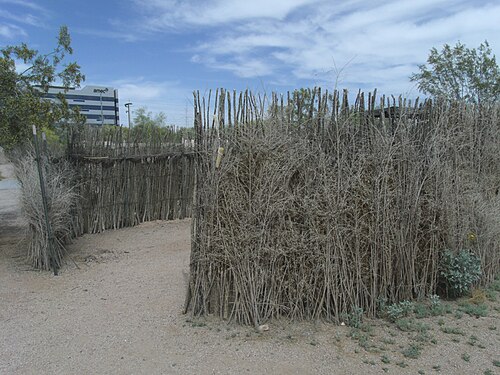 كانت هذه المطابخ، المصنوعة من خشب المسكيت، تستخدم من قبل شعب أودهام، الذين يُعتقد أنهم من نسل شعب هوهوكام، في القرن السابع عشر.
 كانت الأفران مشتركة بين أفراد مجتمع هوهوكام.
 منظر جزئي لقرية هوهوكام.
 منظر مختلف لقرية هوهوكام.
 تم بناء قناة أولد كروسكت في عام 1888 من قبل الرواد، بجوار قناة هوهوكام القديمة التي تم ملؤها الآن بالتراب.
سد وقنوات جوينت هيد
عندما استقر الرواد من أصول أوروبية في فينيكس، كانت المنطقة صحراوية في معظمها. استلهم مستوطنون مثل جاك سويلينغ من قنوات هوهوكام القديمة. وسرعان ما بدأ الرواد بحفر الخنادق لنقل المياه من نهر سولت لريّ مزارعهم. وفي نهاية المطاف، تأسست شركات بناء القنوات، مثل شركة قناة أريزونا التي شُكّلت في ديسمبر 1882، والتي قامت ببناء القنوات الحالية في المنطقة. بُني سد جوينت هيد عام 1884، في الموقع الذي حفر فيه جاك سويلينغ خندقه، المعروف باسم "خندق سويلينغ"، حيث يقع نهر سولت. خدم السد القناة الكبرى (التي بُنيت عام 1878) ثم قناة أولد كروسكت (التي بُنيت عام 1888). وقد تقرر أن سد جوينت هيد المهجور مؤهل للإدراج في السجل الوطني للأماكن التاريخية بموجب المعيار "أ" لارتباطه بتاريخ استصلاح الأراضي ذي الأهمية المحلية، وبالتالي، فهو مورد من موارد القسم 4 (و). [ 13 ]
 أطلال سد جوينت هيد المهجور. بُني سد جوينت هيد عام 1884 وجُدد عام 1913. ويقع على قطعة أرض مملوكة لمدينة فينيكس، قبالة شارع 48 مباشرةً.
 أطلال سد جوينت هيد المهجور.
 أطلال سد جوينت هيد.
 أطلال الجانب الأمامي من سد رأس المشترك
 المزيد من أطلال سد جوينت هيد المهجور
 أطلال سد جوينت هيد المهجور
 مجرى نهر سولت الجاف المؤدي إلى سد جوينت هيد
 الجزء الجاف من نهر سولت حيث تقع بقايا البوابة الرئيسية المهجورة لسد جوينت هيد. هنا قام جاك سويلينغ بحفر أول قناة "قناة سويلينغ" وأسسها .
 تم بناء القناة الكبرى عام 1878 في فينيكس.
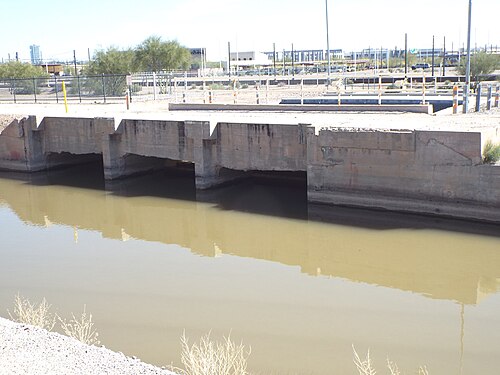 مخرج الفائض على القناة الكبرى. تم بناؤه عام 1878، ويقع بالقرب من نهاية شارع 48 على قطعة أرض مملوكة لمدينة فينيكس.
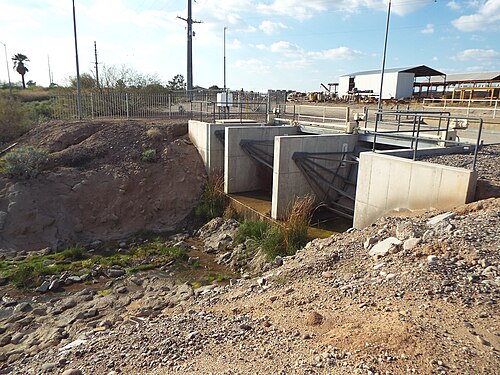 الجانب الآخر من منفذ تصريف المياه الزائدة في القناة الكبرى
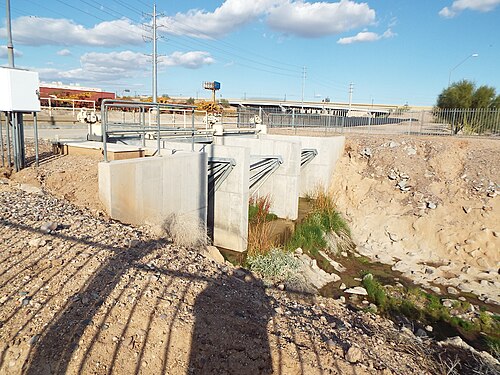 منظر مختلف لتصريف المياه الزائدة في القناة الكبرى
 قناة أولد كروسكت المبنية بجوار أطلال بويبلو غراندي في فينيكس.
 تم بناء قناة أولد كروسكت في عام 1888.
 منظر مختلف لقناة أولد كروسكت التي تعود لعام 1888.
ساحة التراث
تقع ساحة التراث في فينيكس في ما كان يُعرف سابقًا بالقطعة رقم 14 من الموقع الأصلي لمدينة فينيكس. يعود تاريخ الساحة إلى العصر الفيكتوري في أواخر القرن التاسع عشر. أُدرج موقع المدينة في السجل الوطني للأماكن التاريخية في 7 نوفمبر 1978، برقم مرجعي: 78000550. كما يقع في الساحة التاريخية منزل الدكتور رولاند لي روسون (1895)، الذي يُعد الآن متحفًا تاريخيًا يعود إلى العصر الفيكتوري ، وورشة بيرد للآلات (1920)، وكلاهما مُدرج بشكل منفصل في السجل الوطني للأماكن التاريخية. [ 14 ]
 بُني منزل الدكتور رولاند لي روسون عام ١٨٩٥، ويقع في ١٣٩ شارع نورث السادس في فينيكس. أُضيف إلى السجل الوطني للأماكن التاريخية عام ١٩٧١. رقم المرجع: ٧١٠٠٠١١٢
 تم بناء بيت عربات روسون في عام 1899 (PHPR)
 تم بناء ورشة بيرد للآلات عام 1920، وهي الآن جزء من ساحة التراث في فينيكس. أُدرجت في السجل الوطني للأماكن التاريخية عام 1985، برقم مرجعي 85002047.
 مبنى هيوز-ستيفنز المزدوج ، الذي تم بناؤه عام 1923 (PHPR).
 تم بناء منزل عربات بورغيس فورست عام 1881 (PHPR)
 منزل ستيفنز الذي تم بناؤه عام 1901 (PHPR)
 منزل بوفير تيتر الذي تم بناؤه عام 1899 (PHPR)
 تم بناء منزل توماس عام 1909. (PHPR)
 تم بناء منزل ستيفنز-هاوجستن في عام 1901 (PHPR ) .
المباني والمنشآت
يضم هذا القسم المباني التاريخية المدرجة إما في السجل الوطني للأماكن التاريخية أو في سجل فينيكس للممتلكات التاريخية. أقدم هذه المباني، والذي لا يزال قائماً ويُستخدم، هو "مبنى فرايز" الذي شُيّد عام 1885. أما أقدم فندق، والذي اكتمل بناؤه عام 1893 ولا يزال يُستخدم حتى اليوم، فهو "فندق وندسور".
كما يشمل هذا القسم هياكل تاريخية مثل "صوامع حبوب مزرعة هيرد"، المدرجة في سجل المواقع التاريخية التاريخية، بالإضافة إلى منصة عرض معرض ولاية أريزونا التي بُنيت في أوائل القرن العشرين، و"نفق الجادة السابعة عشرة" و"نفق الجادة المركزية"، وكلاهما مؤهل للإدراج في السجل الوطني للأماكن التاريخية. [ 15 ]
 ما تبقى من مبنى مخبز فينيكس . شُيّد المبنى عام ١٨٨١ وكان موقعه الأصلي في ٧ شارع واشنطن الغربي. تم التبرع بالمبنى لمتحف بايونير للتاريخ الحي في فينيكس. في عام ٢٠١٩، نُقل المخبز وأُعيد تركيبه في حديقة حيوان فينيكس . [ ١٦ ]
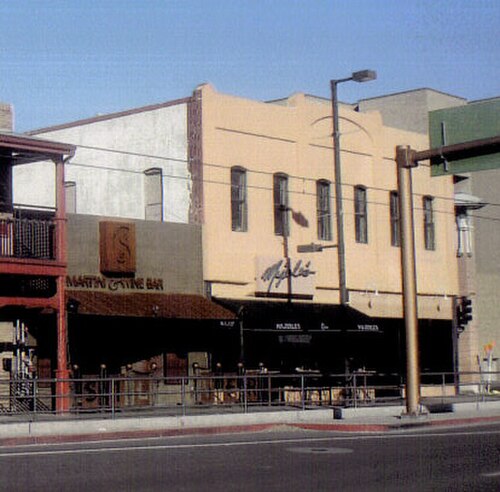 تم بناء مبنى فرايز في عام 1885 ويقع في 146 شارع واشنطن الشرقي. مدرج في السجل الوطني للأماكن التاريخية، المرجع: #85002056.
 نُزُل شتاينغر . شُيّد هذا المبنى المهجور حاليًا عام ١٨٨٩، وأُدرج في السجل الوطني للأماكن التاريخية، برقم مرجعي ٨٦٠٠١٣٦٩، بتاريخ ١٩ يونيو ١٩٨٦. عُرف أيضًا باسم فندق ألامو ، وفندق سانت فرانسيس ، وفندق غولدن ويست . يقع في ٢٧ شارع مونرو الشرقي. هُدم نُزُل شتاينغر في ١٣ يوليو ٢٠٢٠. [ ١٧ ]
 بُني مبنى شركة فينيكس للبناء والإقراض عام 1890، ويقع في 1138-1140 شارع إيست تايلور. أُدرج المبنى في السجل الوطني للأماكن التاريخية في 12 يناير 1995، برقم مرجعي: 94001534.
 فندق وندسور ، المعروف أصلاً باسم فندق الجادة السادسة، تم الانتهاء من بناء الفندق في عام 1893 ويقع في 546 غرب شارع آدامز. تم إدراج الفندق في السجل الوطني للأماكن التاريخية، المرجع: #85002041.
 هذا هو مكتب خدمة فندق وندسور التاريخي ، والذي كان يُطلق عليه في الأصل اسم "فندق الجادة السادسة" .
 هذه هي ردهة فندق وندسور التاريخي .
 تم بناء مبنى شركة فينيكس لزيت القطن عام 1895 ويقع في 606 شارع إي جرانت في فينيكس، أريزونا. وهو مدرج في سجل الممتلكات التاريخية في فينيكس.
 محطة سكة حديد بريسكوت وإيسترن التاريخية ، التي شُيّدت عام ١٨٩٨ في ماير، أريزونا. اشترى المبنى مواطنٌ خاص ونقله إلى تلة في فينيكس، حيث حوّله إلى جزء من منزله. يقع المبنى في ١٧١١ شمال شارع ١٨. [ ١٨ ]
 تم بناء متجر أرفيزو إل فريسنال للبقالة ، المعروف أيضًا باسم 25-23، في عام 1900 ويقع في 310 إي. بوكانان، فينيكس، أريزونا. أُضيف إلى السجل الوطني للأماكن التاريخية في عام 1985، المرجع: #85002046 (NRHP).
 تم بناء متجر ياون آه جيم للبقالة عام 1900 ويقع في 1002 جنوب الجادة الرابعة. وقد تم إدراج المبنى، الذي هو في حالة مهجورة، في السجل الوطني للأماكن التاريخية في 8 يوليو 1986، المرجع: #86001553 (NRHP).
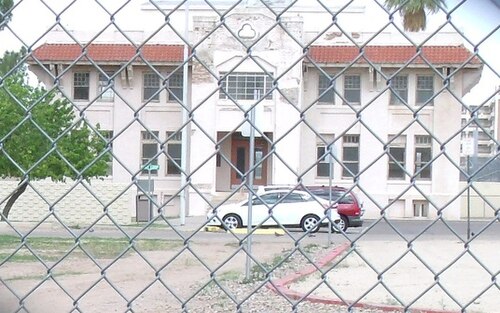 تم بناء مبنى مستشفى ولاية أريزونا، المعروف أيضًا باسم مبنى إدارة ماهوني، في عام 1900 ويقع في 2500 شارع فان بورين الشرقي . وقد تم إدراجه في السجل الوطني للأماكن التاريخية في 15 يوليو 2009، رقم المرجع 09000510.
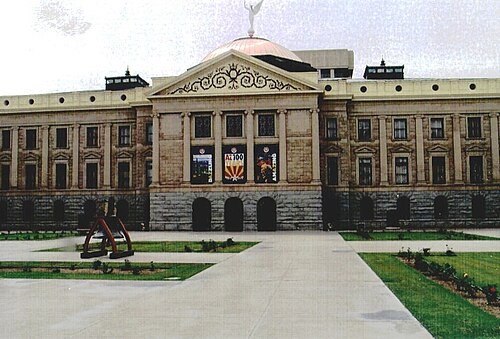 شُيّد مبنى الكابيتول بولاية أريزونا عام 1900 ويقع في 1700 غرب شارع واشنطن. أُدرج في السجل الوطني للأماكن التاريخية في 29 أكتوبر 1974، برقم مرجعي 74000455.
 مستودع فينيكس للبذور والأعلاف، الذي شُيّد عام ١٩٠٥ ويقع في ٤١١ شارع ساوث سكند، هو أقدم مستودع في موقع مدينة فينيكس الأصلي. مُدرج في السجل الوطني للأماكن التاريخية، رقم المرجع: ٨٥٠٠٢٠٧١
 تم بناء محرقة الجثث الأصلية في منتزه غرينوود التذكاري عام 1906. وهي تقع في أرض مقبرة ودار جنازات غرينوود/ميموري لون.
 تم بناء مكتبة فينيكس كارنيجي في عام 1907 وتقع في 1101 غرب شارع واشنطن. العقار مدرج في السجل الوطني للأماكن التاريخية.
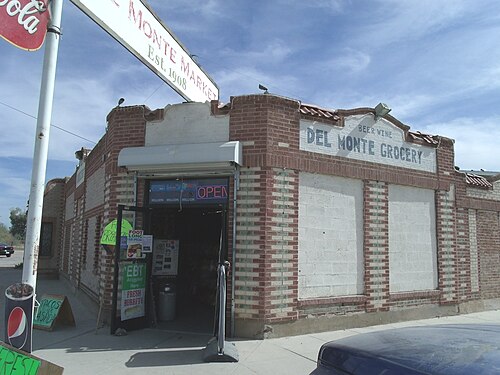 يقع سوق ديل مونتي، الذي شُيّد عام ١٩٠٨، في ٢٦٥٩ غرب طريق دوبينز في قرية ساوث ماونتن، وهي قرية حضرية ضمن مدينة فينيكس. يُعدّ أقدم سوق عامل باستمرار في الولاية، ومُصنّف كمعلم تاريخي بموجب قانون الحفاظ على المعالم التاريخية (HP-L) (سجل فينيكس للممتلكات التاريخية).
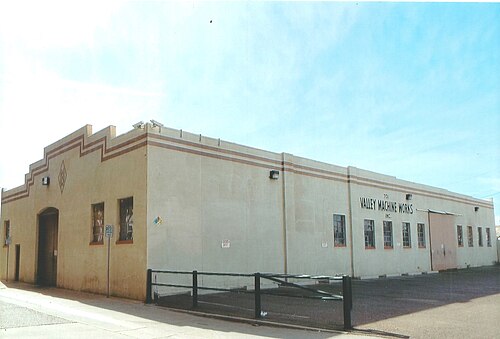 تم بناء مصنع فالي ماشين ووركس عام 1909 ويقع في 701 شارع جاكسون الغربي.
 تم بناء نصب تذكاري لرجال الإطفاء المتطوعين في فينيكس عام 1910 ويقع في أرض مقبرة غرينوود/ميموري لون.
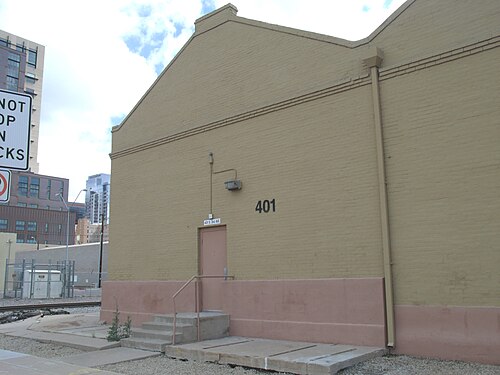 تم بناء مبنى شركة الغاز عام 1910 ويقع في 401 جنوب الجادة الثانية. وقد أُدرج في سجل الممتلكات التاريخية في فينيكس في يوليو 2000.
 بُني نُزُل سويندال السياحي عام ١٩١٣ ويقع في ١٠٢١ شارع واشنطن الشرقي. قبل عام ١٩٦٤، كانت أماكن الإقامة العامة في فينيكس وأريزونا مُفصولة عنصريًا، حيث لم يكن يُسمح للأمريكيين من أصل أفريقي بالإقامة في فنادق وسط مدينة فينيكس. يُعد هذا المبنى، المُدرج في السجل الوطني للأماكن التاريخية برقم ٩٥٠٠١٠٨١، النُزُل الوحيد المعروف المتبقي الذي كان مخصصًا للأمريكيين من أصل أفريقي في فينيكس.
 تم بناء مستودع شركة واكلين (ES) للبقالة في عام 1913 ويقع في زاوية 219 جنوب الجادة الخامسة / 440 غرب شارع جاكسون. وقد تم إدراجه في سجل الممتلكات التاريخية في فينيكس في يوليو 2000.
 شُيّد فندق جيفرسون عام ١٩١٥ ويقع في ١٠١ شارع سنترال الجنوبي في فينيكس. لم يعد فندقًا، ويُعرف الآن باسم مبنى باريستر بليس. المبنى مملوك لمدينة فينيكس، ويضم حاليًا متحف شرطة فينيكس (المسجل في سجل ممتلكات فينيكس التاريخية).
 شُيّد مبنى متجر دوراند للبقالة عام 1916 ويقع في 901 غرب شارع غراند. أُدرج المبنى في السجل الوطني للأماكن التاريخية في 1 أكتوبر 1985، برقم مرجعي: 85002891.
 تم بناء مبنى إدارة منطقة مدارس فينيكس الابتدائية رقم 1 في عام 1917 ويقع في 331 شمال الجادة الأولى. تم إدراج المبنى في سجل الممتلكات التاريخية في فينيكس في أكتوبر 1996.
 تم بناء مخبز لويس لوغو ، المعروف أيضاً باسم "لا باتيليرا"، عام 1917 ويقع في 415 غرب شارع شيرمان. يُعد هذا المبنى من أقدم العقارات التجارية التي أنشأها الأمريكيون من أصول لاتينية في فينيكس. وهو مُصنّف كمعلم تاريخي بموجب قانون الحفاظ على المعالم التاريخية (HP-L) (سجل فينيكس للعقارات التاريخية).
 منظر مختلف لمخبز لويس لوغو المعروف أيضاً باسم "لا باتيليرا".
 شُيّد مبنى شركة ساوث ويست كوتون/كارلسون ماشين ووركس المكون من طابقين عام ١٩١٨، ويقع في ١٠٤ شارع إي. غرانت. وهو مُصنّف كمعلم تاريخي بموجب نظام تقسيم المناطق الخاص بالحفاظ على المعالم التاريخية (HP-L). مُدرج في سجل فينيكس للممتلكات التاريخية.
 مبنى الأحجار الكريمة والمعادن، الذي شُيّد عام ١٩١٨ في أرض معارض ولاية أريزونا، والواقعة في ١٨٢٦ غرب طريق ماكدويل، هو أقدم مبنى في المنطقة حاليًا. مُدرج في سجل فينيكس للمواقع التاريخية.
 الجدار الجانبي لمبنى الأحجار الكريمة والمعادن
 صورة مقربة لمبنى الأحجار الكريمة والمعادن
 داخل مبنى الأحجار الكريمة والمعادن
 يقع مبنى إدارة شركة توفريا للأراضي والماشية/مطعم ستوكياردز في 5009 شارع واشنطن الشرقي. في عام 1919، افتتح إدوارد أ. توفريا، الملقب بـ"بارون الماشية"، مصنع تعبئة اللحوم الخاص به في فينيكس غرب شارع 48 وشارع فان بورين لدعم عملياته المتنامية في تربية الأبقار. توسعت شركة توفريا للأراضي والماشية لتضم ما يقارب 40,000 رأس من الماشية موزعة على 200 فدان من حظائر الماشية، مما جعلها أكبر مزرعة تسمين في العالم. في عام 1947، افتُتح مطعم ستوكياردز رسميًا وسرعان ما أصبح مكانًا مفضلًا لتجمع مربي الماشية والمصرفيين والسياسيين. على الرغم من تراجع ازدهار تجارة الماشية في أواخر الخمسينيات من القرن الماضي وتراجع حظائر الماشية تدريجيًا لصالح التوسع العمراني، إلا أن شعبية مطعم شرائح اللحم الأصلي في أريزونا ظلت راسخة. [ 19 ] أُدرج العقار في سجل فينيكس للعقارات التاريخية في مارس 2004.
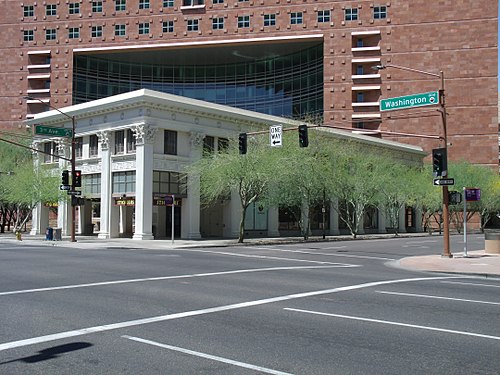 بُني مبنى جيه دبليو ووكر ، المعروف أيضاً باسم مبنى شركة سنترال أريزونا للكهرباء والطاقة ، عام 1920. يقع المبنى في شارع 12 شمال الجادة الرابعة. أُضيف إلى السجل الوطني للأماكن التاريخية عام 1985، برقم مرجعي: 85002077.
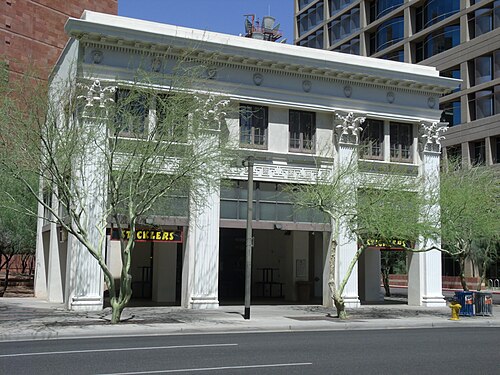 منظر أمامي لمبنى جيه دبليو ووكر .
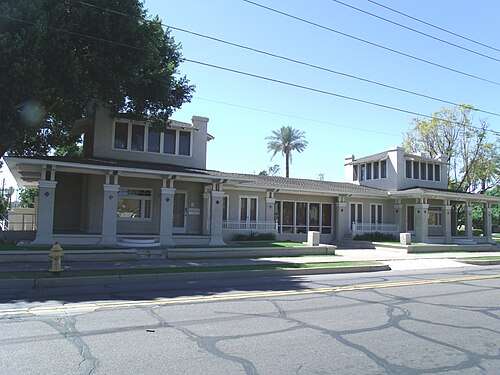 تم بناء مبنى كوربشتاين المزدوج في عام 1920 ويقع في 417 غرب شارع روزفلت. وقد تم إدراجه في سجل الممتلكات التاريخية في فينيكس في سبتمبر 1986.
 شُيّد قصر كول ومنزل بيكر في عشرينيات القرن الماضي، ويقعان في 1418 شارع سنترال الشمالي في فينيكس. اشترت عائلة كول منزل بيكر، وفي عام 1940 ربطت المنزلين بمبنى بينهما. يشغل مطعم "سباغيتي فاكتوري" هذا المبنى منذ عام 1996، وهو مُدرج في سجل فينيكس للمواقع التاريخية.
 مبنى عيادة الدكتور شاكلفورد لطب الأسنان، والذي يضم حاليًا معرضًا صغيرًا لمتحف سكة حديد أريزونا. مُدرج في سجل الممتلكات التاريخية في فينيكس.
 بُني مبنى شركة كونستابل للثلج والوقود (المعروف الآن باسم "بيت الثلج ") عام ١٩٢٠، ويقع في ٤٢٩ غرب شارع جاكسون. قبل ذلك، كان يُخزن الثلج المبرد في هذا المبنى. يقع "بيت الثلج" في الموقع التاريخي الأصلي لمدينة فينيكس. يُعد المبنى الآن مركزًا ثقافيًا مُكرسًا لتعزيز الفنون والقضايا الإنسانية. وهو مُصنف كمعلم تاريخي بموجب قانون الحفاظ على المعالم التاريخية (HP-L). أُدرج المبنى في السجل الوطني للأماكن التاريخية في ٤ سبتمبر ١٩٨٥، برقم مرجعي: ٨٥٠٠٢٠٧٤.
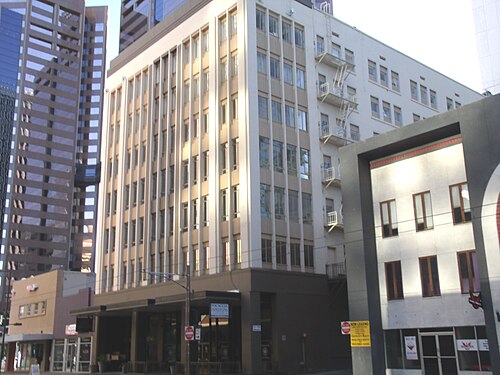 شُيّد مبنى هيرد عام 1920 ويقع في 112 شارع نورث سنترال. وكان أول ناطحة سحاب في فينيكس. أُدرج المبنى في السجل الوطني للأماكن التاريخية في 4 سبتمبر 1985، برقم مرجعي 85002059، وظهر في فيلم ألفريد هيتشكوك "سايكو" عام 1960.
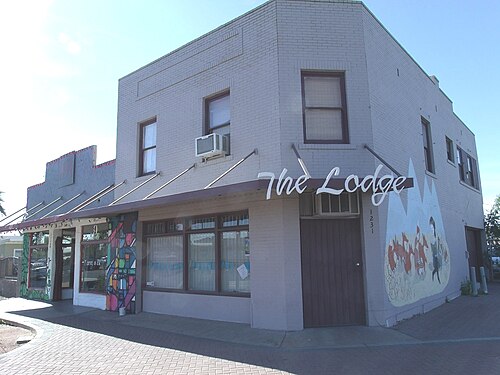 بقالة ريبين، التي شُيّدت عام ١٩٢٠، تقع في ١٢٢٧-١٢٣١ شارع غراند. مُدرجة في السجل الوطني للأماكن التاريخية، رقم المرجع: ٨٥٠٠٢٨٩٥
 قاعة ضريح الزريبة ، التي تُعرف الآن باسم مبنى بولي روزنباوم ، تم بناؤها في عام 1921 وتقع في 1502 غرب شارع واشنطن. تم إدراجها في السجل الوطني للأماكن التاريخية في 9 مارس 1989.
 مستودع شركة أريزونا للضغط والتخزين، الذي بُني عام 1922 ويقع في 215 شارع 13 الجنوبي. في 4 سبتمبر 1985، أُدرج العقار في السجل الوطني للأماكن التاريخية، برقم مرجعي: 85002044.
 منظر مختلف لمستودع شركة أريزونا للضغط والتخزين، الذي شُيّد عام ١٩٢٢ ويقع في ٢١٥ شارع ١٣ الجنوبي. في ٤ سبتمبر ١٩٨٥، أُدرج العقار في السجل الوطني للأماكن التاريخية، برقم مرجعي: ٨٥٠٠٢٠٤٤.
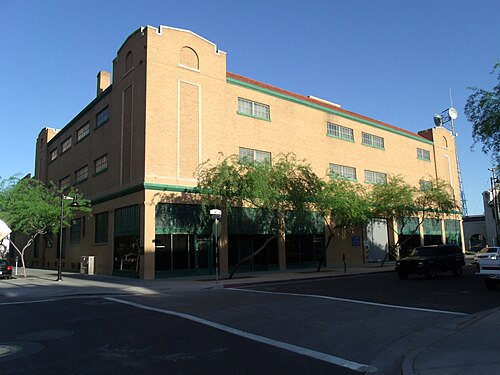 تم بناء مبنى تشامبرز للتخزين عام 1923 ويقع في 309 جنوب الجادة الرابعة. وقد أُدرج في السجل الوطني للأماكن التاريخية في 4 سبتمبر 1985، برقم مرجعي: #85002052.
 تم بناء مستودع تشامبرز للنقل والتخزين المركزي في عام 1923 ويقع في 15-39 شارع جاكسون الشرقي. وقد تم إدراجه في السجل الوطني للأماكن التاريخية في 4 سبتمبر 1985، المرجع: #85002051.
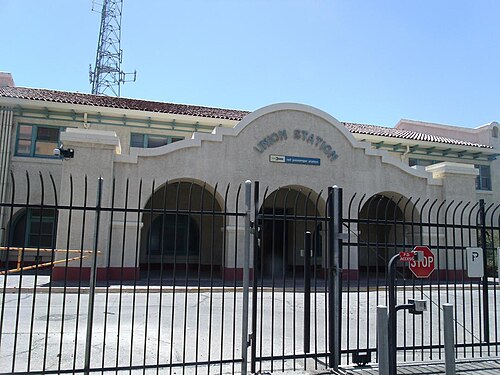 شُيِّدت محطة فينيكس يونيون عام ١٩٢٣، وتقع عند تقاطع الجادة الرابعة وخطوط سكة حديد ساوثرن باسيفيك في مدينة فينيكس بولاية أريزونا. أُدرجت المحطة في السجل الوطني للأماكن التاريخية عام ١٩٨٥، برقم مرجعي: ٨٥٠٠٣٠٥٦.
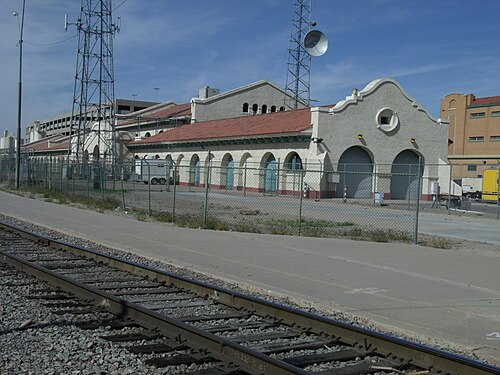 منظر مختلف لمحطة فينيكس يونيون التاريخية التي شُيدت عام 1923 وتقع في 401 غرب شارع هاريسون. مُدرجة في السجل الوطني للأماكن التاريخية، رقم المرجع 85003056
 تم بناء مبنى مستودع بريكهاوس عام 1924 وكان يُستخدم في الأصل كمستودع. يقع المبنى في 1 شارع إيست جاكسون في الموقع الأصلي لمدينة فينيكس. [ 20 ]
 منظر مختلف لمبنى مستودع بريكهاوس .
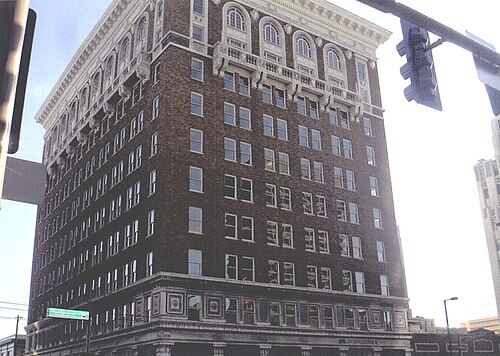 مبنى لورز هو مبنى تاريخي مكون من عشرة طوابق شُيّد عام 1924. يقع في 11 غرب شارع جيفرسون في وسط مدينة فينيكس. وهو مُدرج في السجل الوطني للأماكن التاريخية.
 يقع متجر وينغ إف. أونغ للبقالة في 1246 شارع إي. جيفرسون، وقد بُني عام 1925. ترشح وينغ إف. أونغ لعضوية مجلس نواب الولاية عن الحزب الديمقراطي عام 1946، وانتُخب، ليصبح أول أمريكي من أصل صيني في البلاد يحقق هذا الإنجاز. وخلال مسيرته السياسية، انتُخب مرتين لعضوية مجلس نواب الولاية ومرة واحدة لعضوية مجلس شيوخ الولاية.
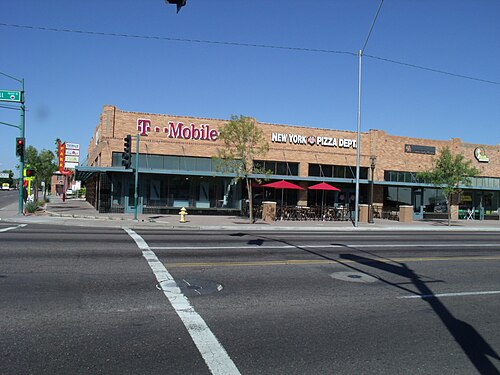 شُيّد مبنى هيرلي عام ١٩٢٥، ويقع في ٥٣٦ و٥٤٤-٥٤٨ غرب شارع ماكدويل، و١٦٠١ شمال الجادة السابعة. أُدرج المبنى في السجل الوطني للأماكن التاريخية في ٤ سبتمبر ١٩٨٥، برقم مرجعي: ٨٥٠٠٢٠٦٢.
 تم بناء محطة خدمة كوبلاند وتراشيت ، والتي تُعرف الآن باسم إطارات الجد سال، في عام 1925 وتقع في 1702 غرب طريق فان بورين. وقد تم إدراجها في السجل الوطني للأماكن التاريخية في 4 سبتمبر 1985، المرجع: #85002054.
 تم بناء مبنى براغ للفطائر عام 1925 ويقع في 1301 شارع غراند. أُدرج العقار في السجل الوطني للأماكن التاريخية في 16 يونيو 2009.
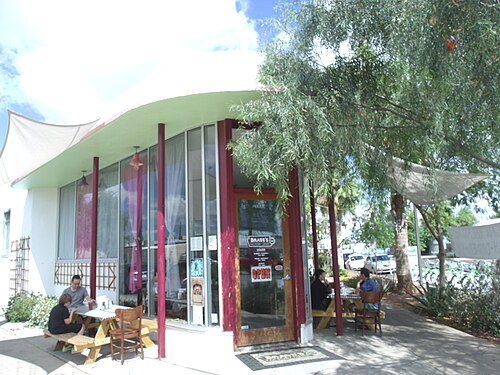 واجهة مبنى براغ للفطائر .
 تم بناء مبنى وادي السباكة والصفائح المعدنية في عام 1925 ويقع في 530 غرب شارع آدامز. وقد تم إدراجه في السجل الوطني للأماكن التاريخية في 1 أكتوبر 1985، المرجع: #85002894.
 تم بناء مستودع شركة شل للنفط عام 1925 ويقع في 425 شارع إس إن السادس عشر. وهو مدرج في السجل الوطني للأماكن التاريخية، رقم المرجع: 85002073.
 مستودع شركة ويسترن هولسيل دراغ، الذي شُيّد عام ١٩٢٥ ويقع في ١٠١ شارع جاكسون الشرقي. المبنى مملوك لأسطورة الروك أليس كوبر ، ويضم الآن مطعم أليس كوبرستاون. مُصنّف كمعلم تاريخي بموجب قانون الحفاظ على المعالم التاريخية (HP-L).
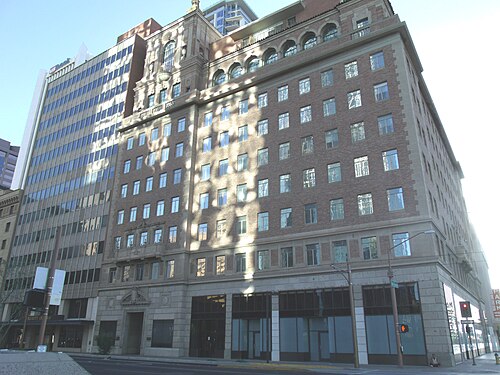 تم بناء مبنى الأمن عام 1925 ويقع في 234 شارع نورث سنترال. وقد تم إدراج العقار في السجل الوطني للأماكن التاريخية.
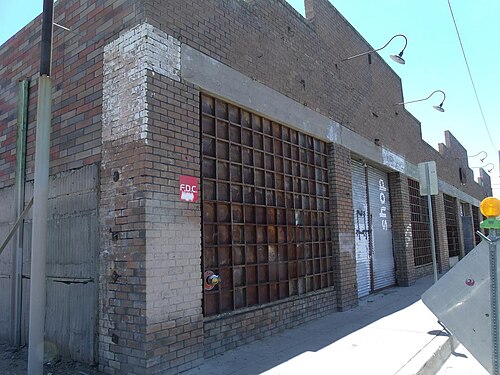 شركة أنكور للتصنيع ، المعروفة أيضاً باسم 41-3، شُيّدت عام 1925. تقع في 525 (525-551) شارع سنترال الجنوبي. أُدرج المبنى في السجل الوطني للأماكن التاريخية عام 1985، برقم مرجعي: 85002042.
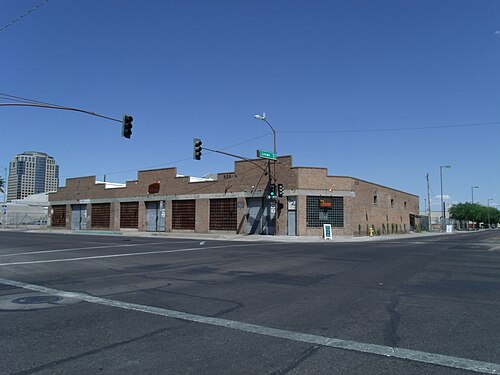 وجهة نظر مختلفة لشركة Anchor Manufacturing Co.
 فندق سان كارلوس ، المعروف أيضًا باسم فندق سان كارلوس ، شُيّد عام ١٩٢٥ ويقع في ٢٠٢ شارع سنترال الشمالي. من بين المشاهير الذين أقاموا في فندق سان كارلوس: ماي ويست ، وكلارك غيبل ، وكارول لومبارد ، ومارلين مونرو ، وجين أوتري. أُدرج الفندق في السجل الوطني للأماكن التاريخية عام ١٩٨٣، برقم مرجعي ٨٣٠٠٣٤٩٨.
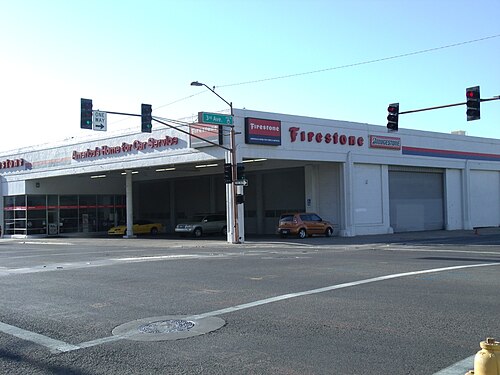 مبنى فايرستون الذي شُيّد عام 1925 ويقع في 302 غرب شارع فان بورين. أُدرج العقار في السجل الوطني للأماكن التاريخية في 1 أكتوبر 1985، برقم مرجعي: 85002891.
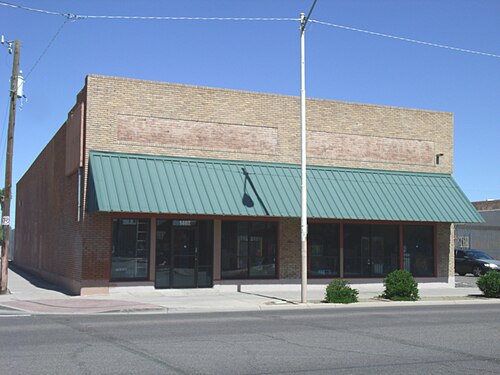 تم بناء Pay n Takit #13 في عام 1925 ويقع في 1402 E. Van Buren Rd. تم إدراجه في السجل الوطني للأماكن التاريخية في عام 1985، المرجع: #85002068.
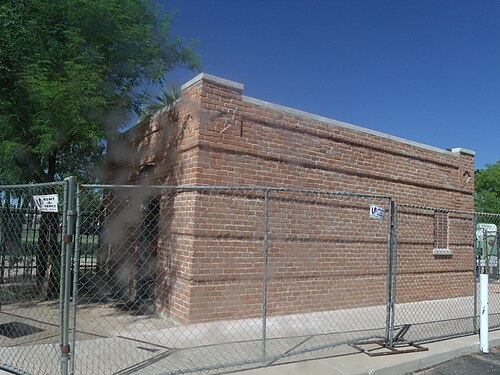 بُنيت محطة ضخ المياه في حديقة فيردي عام ١٩٢٥، وتقع عند تقاطع شارع التاسع وشارع فان بورين. أُدرجت في السجل الوطني للأماكن التاريخية في ٧ سبتمبر ١٩٩٥، برقم مرجعي ٩٥٠٠١٠٧٨. مجال الأهمية: التخطيط والتنمية المجتمعية؛ الفترة الزمنية للأهمية: ١٩٢٥-١٩٤٩.
 تم بناء مستودع شركة أريزونا ساش، دور آند جلاس في عام 1926 ويقع في 850 غرب شارع لينكولن. وقد تم إدراجه في سجل الممتلكات التاريخية في فينيكس في فبراير 2020.
 فندق سانت جيمس . تم بناء هذا المبنى المهجور الآن في عام 1925 وتم إدراجه في السجل الوطني للأماكن التاريخية، رقم المرجع: #85002061 في 4 سبتمبر 1985. تم هدم المبنى الذي كان يقع في 21 شارع ماديسون الشرقي في عام 2012.
 محطة وقود متنقلة تم بناؤها عام 1926 وتقع في 1301 شارع ويست جيفرسون. وهي الآن تضم مطعم "ذا أولد ستيشن سابز".
 تم بناء معبد فينيكس الماسوني في عام 1926 ويقع في 345 غرب شارع مونرو. وهو مدرج في سجل الممتلكات التاريخية في فينيكس.
 تم بناء مبنى باين تاكيت رقم 25 عام 1926، ويقع في 1753-1755 غرب شارع فان بورين. أُدرج المبنى في السجل الوطني للأماكن التاريخية في 5 سبتمبر 1985، برقم مرجعي 85002070. وحتى عام 2012، كان يضم نادي سنترال يونايتد للملاكمة.
 تم بناء مبنى شركة إيه إي إنجلاند موتورز عام 1926 ويقع في 424 شارع نورث سنترال. وهو مدرج في سجل الممتلكات التاريخية في فينيكس.
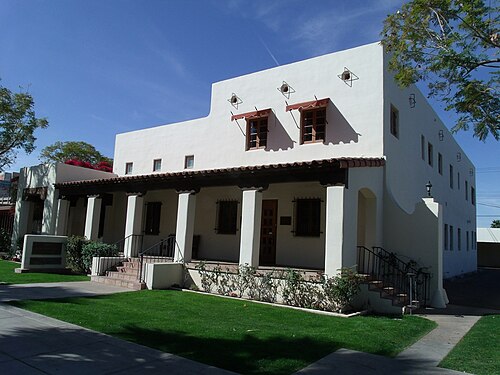 كنيسة جيه تي ويتني الجنائزية، التي شُيّدت عام ١٩٢٦، تقع في ٣٣٠ شمال الجادة الثانية. كانت في السابق منزل جيه تي ويتني، مُجهّز الموتى. مُدرجة في السجل الوطني للأماكن التاريخية، رقم المرجع: ٨٥٠٠٢٠٧٩.
 تم بناء مبنى متجر ويلنيك أركيد للبقالة عام 1927 ويقع في 324 شارع فان بورين. أُدرج المبنى في السجل الوطني للأماكن التاريخية في 9 أغسطس 2016، برقم مرجعي: #16000490. [ 20 ]
 زينة على مبنى متجر البقالة في ويلنيك أركيد .
 تم بناء مبنى "باي إن تاكيت رقم 5" عام 1927 ويقع في 1012 شمال الجادة السابعة. وقد أُدرج في السجل الوطني للأماكن التاريخية عام 1985، برقم مرجعي: 85002069.
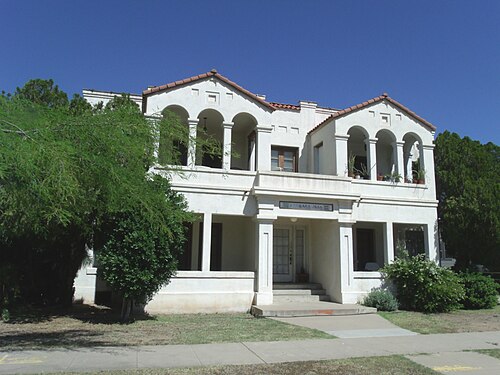 تم بناء شقق باربرا جين في عام 1927 وتقع في 212-214 شارع بورتلاند الشرقي. تم إدراجها في سجل الممتلكات التاريخية في فينيكس في سبتمبر 2004.
 مستودع شركة بليك، موفيت، تاون للتنظيف، الذي شُيّد عام ١٩٢٧ ويقع في ١٠١ شارع إي. بوكانان. مُصنّف كمعلم تاريخي بموجب قانون الحفاظ على المعالم التاريخية (HP-L). مُدرج في سجلّ فينيكس للممتلكات التاريخية.
 شُيّد مبنى شركة سي بي ستيفانز دي سوتو للسيارات الست عام ١٩٢٧، ويقع في ٩١٥ شارع سنترال الجنوبي. وفي ٢٠ فبراير ٢٠١٣، أُدرج العقار في السجل الوطني للأماكن التاريخية، برقم مرجعي ١٣٠٠٠٠١٩.
 مركز غولد سبوت للتسوق، الذي شُيّد عام ١٩٢٥ ويقع في ١٠٠١ شمال الجادة الثالثة، كان مركزًا تجاريًا ومتجرًا للبقالة من عام ١٩٢٥ إلى عام ١٩٨٣. ويُستخدم حاليًا كمركز تسويق. يقع المبنى ضمن منطقة روزفلت التاريخية، المُدرجة في السجل الوطني للأماكن التاريخية في ٣٠ نوفمبر ١٩٨٣، برقم مرجعي ٨٣٠٠٣٤٩٠. [ ٢١ ]
 منظر مختلف لمركز التسوق غولد سبوت .
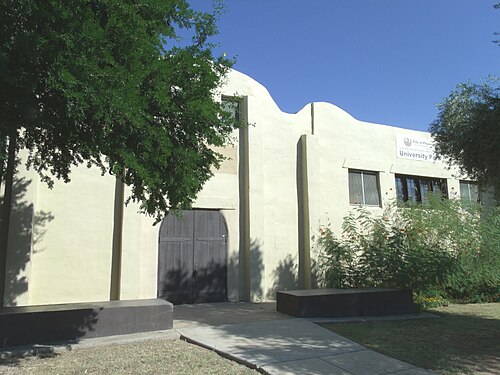 تم بناء مبنى متحف أريزونا في عام 1927 ويقع في أرض جامعة بارك في 1002 غرب شارع فان بورين. تم إدراج المبنى في سجل الممتلكات التاريخية في فينيكس في أبريل 1989.
 تم بناء مسرح أورفيوم في عام 1927 ويقع في 209 غرب شارع آدامز. وقد تم إدراجه في السجل الوطني للأماكن التاريخية في 1 أكتوبر 1985، المرجع: #85002067.
 زخرفة مسرح أورفيوم .
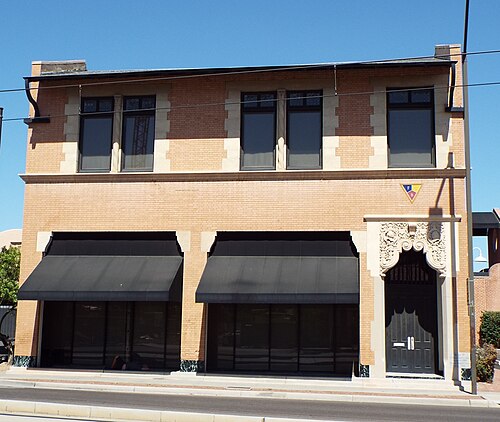 مبنى فرسان بيثياس الذي تم بناؤه عام 1928 ويقع في 146 شارع واشنطن الشرقي. مدرج في السجل الوطني للأماكن التاريخية، المرجع: #85002063.
 المدخل الأمامي لمبنى فرسان بيثياس .
 متجر جيه بي بايلس رقم 7، الذي تم بناؤه عام 1928 ويقع في 825 شارع نورث سيفينث. مدرج في السجل الوطني للأماكن التاريخية، رقم المرجع: 85002048
 مستودع شركة سنترال أريزونا للكهرباء والطاقة، الذي شُيّد عام ١٩٢٨ ويقع في ٥٠١ جنوب الجادة الثالثة. مُصنّف كمعلم تاريخي بموجب قانون الحفاظ على المعالم التاريخية (HP-L). مُدرج في سجلّ فينيكس للممتلكات التاريخية.
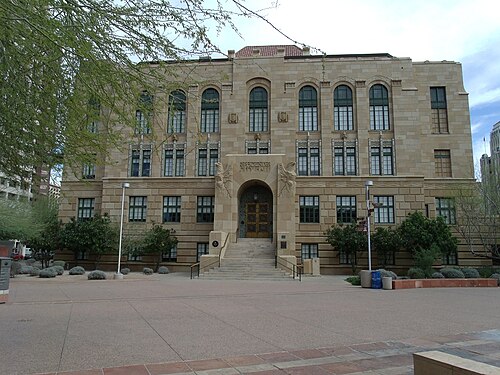 مبنى بلدية فينيكس القديم التاريخي ، الذي شُيّد عام ١٩٢٨ ويقع في ١٧ شارع ساوث سكند أفينيو. استُخدم هذا المبنى كقاعة بلدية لمدينة فينيكس حتى عام ١٩٩٤، حين تمّ الانتهاء من بناء مبنى جديد ليحلّ محلّه. وهو مُصنّف كمعلم تاريخي بموجب قانون الحفاظ على المعالم التاريخية (HP-L). مُدرج في سجلّ فينيكس للممتلكات التاريخية.
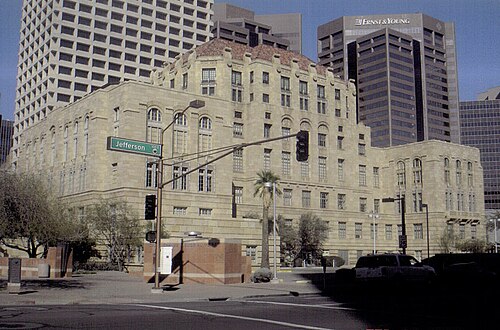 بُنيت محكمة مقاطعة ماريكوبا عام ١٩٢٨. وفي هذه المحكمة عُقدت محاكمة ويني روث جود سيئة السمعة ، والمعروفة باسم "قاتلة الصندوق". كما أُقرت " حقوق ميراندا " التاريخية في هذه المحكمة بعد اعتقال إرنستو ميراندا . سُجن كل من جود وميراندا في السجن الواقع في الطابق السادس. وهي مُدرجة في السجل الوطني للأماكن التاريخية.
 سجن مقاطعة ماريكوبا حيث كان جود وميراندا محتجزين سابقاً.
 لوحة جاك وترينيداد سويلينغ لعام 1931 على نافورة المياه أمام مبنى محكمة مقاطعة ماريكوبا التاريخي
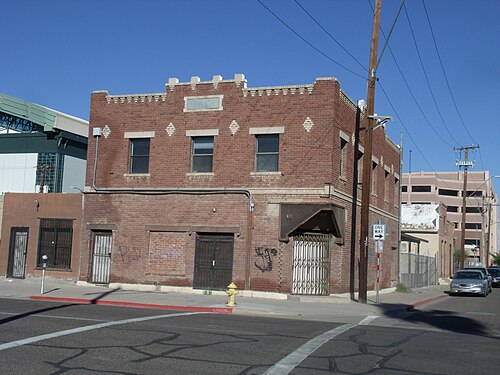 مبنى جيراردو، الذي شُيّد عام ١٩٢٨ ويقع في ٤٢١ شارع ساوث ثيرد، كان يضمّ في السابق مقهى في الطابق الأرضي وشققًا سكنية للإيجار في الطابق العلوي. مُدرج في السجل الوطني للأماكن التاريخية، رقم المرجع: ٨٥٠٠٢٠٥٧.
 بُني سوق جيم أونغ عام ١٩٢٨ ويقع في ١١١٠ شارع واشنطن الشرقي. كان هذا المبنى، وهو واحد من مبنيين بناهما المالك في الحي الصيني، مسكنًا لعائلة أونغ. مُدرج في السجل الوطني للأماكن التاريخية، رقم المرجع: ٨٢٠٠٢٠٨٤.
 شُيّد مبنى شركة ستابلي (OS) عام 1928، ويقع في 723-735 شارع غراند. أُدرج العقار في السجل الوطني للأماكن التاريخية في سبتمبر 2012.
 تم بناء مستودع شركة فولر (WP) للدهانات في عام 1929 ويقع في 117 شارع جاكسون الشرقي. تم إدراج العقار في سجل الممتلكات التاريخية في فينيكس في يوليو 2009.
 تم بناء مستودع شركة Phoenix Linen & Towel Supply Company في عام 1929 ويقع في 702-706 S. Third St. / 215 E. Grant St. تم إدراج العقار في سجل الممتلكات التاريخية في فينيكس في فبراير 2010.
 تم بناء صيدلية براونز عام 1929 وتقع في 1000 شارع إي بيرس. وقد أُدرجت في السجل الوطني للأماكن التاريخية في 4 سبتمبر 1985، برقم مرجعي: #85002949.
 بُني برج لورز عام ١٩٢٩ ويقع في ٤٥ غرب شارع جيفرسون. ظهر البرج في خلفية مشهد من فيلم "سايكو" عام ١٩٦٠، حيث عبرت شخصية ماريون كرين (التي جسدتها جانيت لي) الشارع حاملةً المبلغ الذي كان من المفترض أن تودعه لمديرها. مُدرج في السجل الوطني للأماكن التاريخية، رقم المرجع: ٨٥٠٠٣٥٥٩
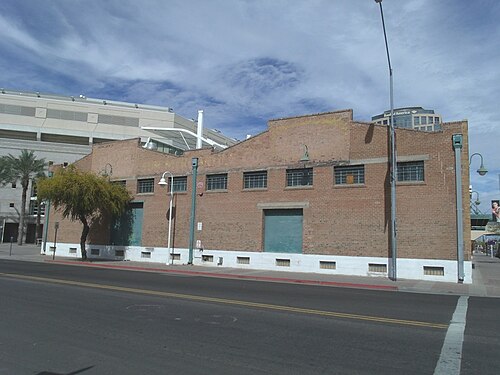 شُيّد مبنى صن ميركانتايل عام ١٩٢٩ ويقع في ٢٣٢ جنوب الجادة الثالثة. وهو آخر مستودع متبقٍ في ما كان يُعرف سابقًا باسم الحي الصيني في فينيكس. مُدرج في السجل الوطني للأماكن التاريخية، رقم المرجع: ٨٥٠٠٣٠٧٥.
 تم بناء مستودع شحن سانتا فيه عام 1929 ويقع عند تقاطع الجادة الخامسة وشارع جاكسون. وهو مُدرج في سجل الممتلكات التاريخية في فينيكس.
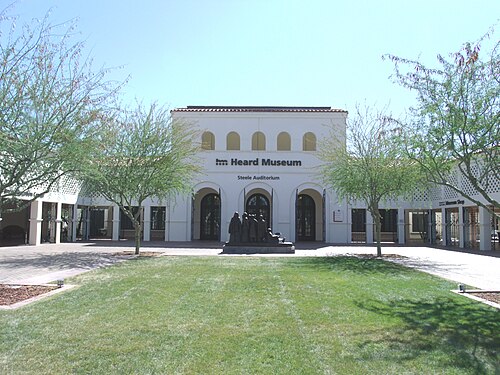 المدخل الأمامي لمبنى متحف هيرد الذي شُيّد عام 1929 ويقع في 2301 شمال شارع سنترال / 22 شرق طريق مونتي فيستا. وقد أُدرج في سجل الممتلكات التاريخية في فينيكس في أغسطس 1992.
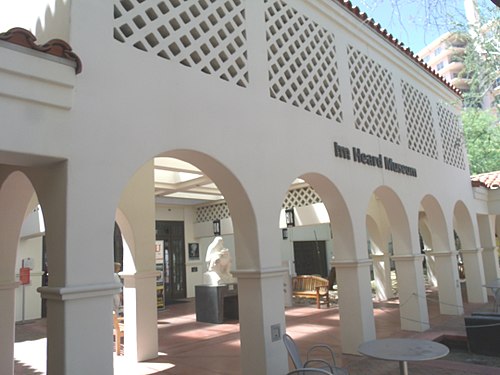 شُيّد مبنى متحف هيرد عام ١٩٢٩، ويقع في ٢٣٠١ شمال شارع سنترال، تقاطع ٢٢ شرق طريق مونتي فيستا. أضافت ماي هيرد أعمالًا فنية قيّمة إلى المجموعة، وعملت بتعاون وثيق مع مجلس الأمناء لتوجيه أنشطة المتحف. كما أشرفت على برامج المتحف، ووافقت على المتحدثين، وضمنت توفير التغطية الإعلامية المناسبة. أُدرج المتحف في سجل فينيكس للمواقع التاريخية في أغسطس ١٩٩٢.
 شُيّدت صوامع حبوب مزرعة هيرد عام ١٩٣٠، وتقع داخل ملعب الغولف بمنتجع ليجاسي، بالقرب من شارع ٣٠ وطريق فينيارد. كانت المزرعة ملكًا لرجل الأعمال دوايت ب. هيرد، الذي يُنسب إليه الفضل في تأسيس صحيفة أريزونا ريبابليك (التي كان ناشرها)، ومتحف هيرد، وتطوير قنوات الري الحيوية، وصناعة تربية الماشية في أريزونا. أُدرجت المزرعة في سجل فينيكس للعقارات التاريخية في مارس ١٩٩٣.
 في ثلاثينيات القرن العشرين، كان هذا المكان عبارة عن حظيرة طائرات ومبنى ركاب تابع لمطار فينيكس، حيث أصبحت روث راينهولد في عام 1933 أول طيارة أنثى في ولاية أريزونا.
 بُنيت شقق غريستون عام 1930 وتقع في 645-649 شمال الجادة الرابعة. وقد أُدرجت في سجل الممتلكات التاريخية في فينيكس في سبتمبر 1986.
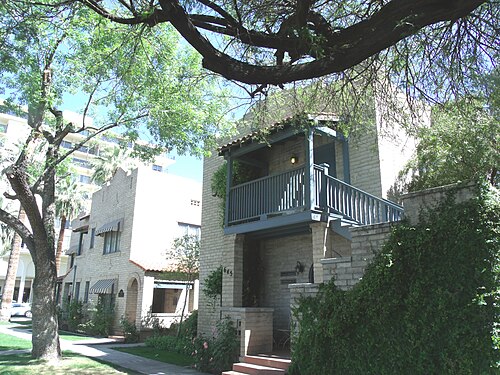 منظر مختلف لشقق غريستون التي شُيّدت عام ١٩٣٠ وتقع في ٦٤٥-٦٤٩ شمال الجادة الرابعة. أُدرجت في سجلّ فينيكس للعقارات التاريخية في سبتمبر ١٩٨٦.
 تم بناء مستودع جنرال إلكتريك للإمدادات في عام 1930 ويقع في 435-441 غرب شارع ماديسون. تم إدراج العقار في سجل الممتلكات التاريخية في فينيكس في يوليو 2000.
 مبنى وزارة الزراعة الذي شُيّد عام 1930 ويقع في 1688 غرب شارع آدامز. مُدرج في سجل الممتلكات التاريخية في فينيكس.
 تم بناء منصة العرض الرئيسية لمعرض ولاية أريزونا في أوائل القرن العشرين وتقع في 1826 طريق ويست ماكدويل.
 منظر مختلف لمنصة عرض معرض ولاية أريزونا التي تم بناؤها في أوائل القرن العشرين وتقع في 1826 طريق ويست ماكدويل.
 تم بناء مستودع سوق أونغ يوت جيونغ في عام 1930 ويقع في 502 شارع إس 2nd. مدرج في السجل الوطني للأماكن التاريخية، المرجع: #86002066 (NRHP).
 تم بناء مستودع شركة أريزونا لتوريد الأدوات المعدنية عام 1930، ويقع في 22 شارع جاكسون الشرقي. وهو مصنف كمعلم تاريخي بموجب قانون الحفاظ على المعالم التاريخية (HP-L). مُدرج في سجل الممتلكات التاريخية في فينيكس.
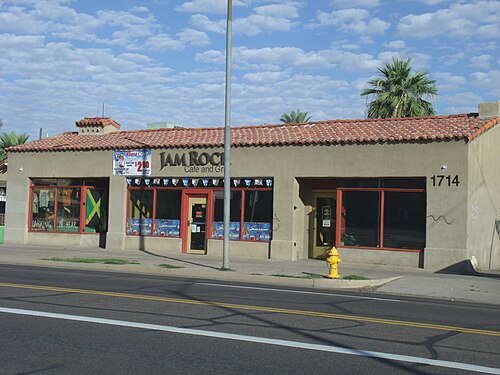 شُيّد مبنى مقهى بوبي براون عام 1930 ويقع في 1714-18 غرب شارع فان بورين. وقد أُدرج هذا العقار في سجلّ فينيكس للعقارات التاريخية.
- تم بناء مستودع شركة واكلين (ES) للبقالة في عام 1930 ويقع في زاوية 219 إس. فيفث أفينيو / 440 دبليو. جاكسون ستريت. تم إدراجه في سجل الممتلكات التاريخية في فينيكس في يوليو 2000.
 شُيّد هذا الموقع، الذي كان يضم سابقًا صالة "ليفينج روم لاونج" ، عام 1930، ويقع في 4007 شارع كاميلباك الشرقي في فينيكس. وقبل عام 1968، كان المبنى يضم صالة "سيلفر بودل" للكوكتيلات ، حين أصبح ملاكم الوزن المتوسط توني ديماركو مالكًا للعقار وأسس ما أسماه "ليفينج روم لاونج". لم يعد ديماركو يملك العقار، الذي أصبح الآن ملكًا لشركة يو-هول. [ 22 ]
 شُيّد مبنى شركة داي (دود آر.) موتور/شركة فينيكس موتور عام ١٩٣٠، ويقع في ٤٠١ شارع فان بورين الغربي. ويضم اليوم مطعم ذا فان بورين . وقد أُدرج في سجل فينيكس للعقارات التاريخية في مايو ٢٠١٧.
 شُيّد مبنى التحكم في محطة معالجة مياه الصرف الصحي عام ١٩٣١، ويقع في ٢٣٠١ غرب شارع دورانجو. يقع المبنى حاليًا ضمن حدود منطقة إدارة النقل في ولاية أريزونا، وعنوانها ٢١٤٠ غرب شارع هيلتون. أُدرج المبنى في سجل فينيكس للمواقع التاريخية في أكتوبر ١٩٩٢.
 تم بناء فندق ستاغ/باتيو عام 1931 ويقع في 27 غرب شارع ماديسون. ويضم الآن مطعمًا صينيًا. وقد أُدرج في سجل فينيكس للعقارات التاريخية في أكتوبر 2001.
 بُنيت أبراج فينيكس تايتل آند تراست، ذات الشكل "U"، عام 1931، وتقع في 112 شمال الجادة الأولى. أُدرجت الأبراج في السجل الوطني للأماكن التاريخية في 4 سبتمبر 1985، برقم مرجعي: 85002076.
 مدخل عيادة لويس غرونو التذكارية ، التي بنيت عام 1931 وتقع في 926 إي. ماكدويل رود. في 4 سبتمبر 1985، تم إدراج العقار في السجل الوطني للأماكن التاريخية، المرجع: #85002065.
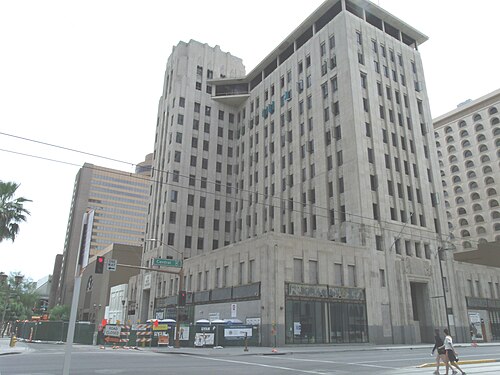 تم بناء مبنى المكاتب المهنية عام 1931 ويقع في 137 شارع نورث سنترال. وقد تم إدراجه في السجل الوطني للأماكن التاريخية عام 1993، برقم مرجعي: #85003563.
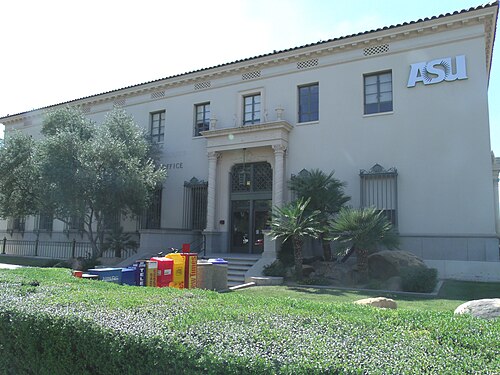 شُيّد مبنى مكتب البريد الأمريكي /المبنى الفيدرالي بين عامي 1932 و1936، ويقع في 522 شارع نورث سنترال. أُدرج المبنى في سجل الممتلكات التاريخية في فينيكس في أكتوبر 1990، وفي السجل الوطني للأماكن التاريخية في 10 فبراير 1983، برقم مرجعي 83002993.
 مستودع سوق كوب براذرز، الذي شُيّد عام ١٩٣٢ ويقع في ٤٣٠ جنوب الجادة الثانية، مُصنّف كمعلم تاريخي بموجب قانون الحفاظ على المعالم التاريخية (HP-L). مُدرج في سجلّ فينيكس للممتلكات التاريخية.
 تم بناء حمام (مسبح) جامعة بارك في عام 1934 ويقع في أراضي جامعة بارك في 1002 غرب شارع فان بورين. تم إدراج المبنى في سجل الممتلكات التاريخية في فينيكس في أبريل 1989.
 يُعدّ نفق الجادة السابعة عشرة، الذي شُيّد عام 1935، مثالاً محفوظاً جيداً على بناء الجسور في حقبة الكساد الكبير. وهو مؤهل للإدراج في السجل الوطني للأماكن التاريخية.
 تم بناء نادي إنكانتو بارك في عام 1936 ويقع في 1202 غرب شارع إنكانتو. وهو مدرج في سجل الممتلكات التاريخية في فينيكس.
 شُيّد مبنى ترسانة الحرس الوطني لجيش أريزونا، المبني من الطوب اللبن الخام، عام ١٩٣٦، ويقع في ٥٦٣٦ شارع ماكدويل الشرقي. استُخدم المبنى كمستودع أسلحة للحرس الوطني حتى الحرب العالمية الثانية، حيث حُوّل إلى ورشة صيانة لأسرى الحرب الألمان المحتجزين في معسكر يقع فيما يُعرف الآن بمحمية باباجو بارك العسكرية . يضم المبنى حاليًا متحف أريزونا العسكري . أُدرج المبنى في السجل الوطني للأماكن التاريخية في ٣١ مارس ٢٠١٠، برقم مرجعي: ١٠٠٠٠١٠٨.
 الجدران الطينية الأصلية داخل مبنى ترسانة الحرس الوطني لجيش ولاية أريزونا .
 بُني منزل حارس مفرخ أسماك القاروص في هانت عام ١٩٣٦، ويقع ضمن أراضي حديقة حيوان فينيكس في ٤٥٥ شمال جالفين باركواي. في أعقاب الكساد الكبير، أمر الحاكم هانت (أول حاكم منتخب لأريزونا) بإنشاء مفرخ لأسماك القاروص في منتزه باباجو بأريزونا عام ١٩٣٢. أُدرج الموقع في السجل الوطني للأماكن التاريخية في ٢٣ يناير ٢٠٠٣، برقم مرجعي: ٠٢٠٠١٧٢٣.
 تم بناء بيت الحي في عام 1937 ويقع في 6029 شارع السابع الجنوبي. وقد تم إدراجه في سجل الممتلكات التاريخية في فينيكس في مايو 1990.
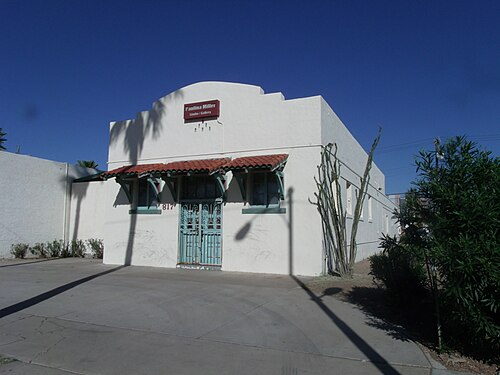 تم بناء دار جنازات ميريمان في عام 1937 وتقع في 817 شارع نورث فيرست. تم إدراج العقار في سجل الممتلكات التاريخية في فينيكس في نوفمبر 2005.
 بُني نُزُل سكوا بيك عام ١٩٣٧، ويقع في ٤٤٢٥ طريق هورسشو بالقرب من الطرف الشرقي لجبل سكوا بيك في فينيكس. من بين المشاهير الذين أقاموا في النُزُل أو زاروه، والذي كان يُسمى في الأصل مزرعة سكوا بيك، ديك باول، وجون أليسون ، ومامي أيزنهاور . وقد استُخدم النُزُل كخلفية صوتية لفيلم " بروب: الخطة التاسعة من الفضاء الخارجي " الذي عُرض على التلفزيون عام ١٩٨٧. كما استُخدم النُزُل كخلفية خلال مقابلة أجرتها قناة ABC مع تشارلز باركلي، لاعب فريق فينيكس صنز، في برنامج "تايم لايف" في ٢٧ مايو ١٩٩٣. وفي ١٢ يناير ١٩٩٥، أُدرج العقار في السجل الوطني للأماكن التاريخية، برقم مرجعي: ٩٤٠٠١٥٣٧.
 تم بناء فندق كينغز ريست موتور كورت عام 1937 ويقع في 801 جنوب الجادة السابعة عشرة. وهو مدرج في السجل الوطني للأماكن التاريخية، برقم مرجعي: 87001882.
 بدأ هذا الموتيل باسم " موتيل آرو" ثم أصبح " موتيل رينبو" . بُني عام ١٩٣٧ ويقع في ٢٢٦٢ شارع غراند. أُدرج العقار ضمن قائمة العقارات التاريخية في فينيكس في أكتوبر ٢٠٢٠.
 تم بناء مبنى WPA المدني لمعرض ولاية أريزونا خلال فترة الكساد الكبير في عام 1938 ويقع في 1826 طريق ماكدويل الغربي.
 المدخل الأمامي لمبنى WPA المدني لمعرض ولاية أريزونا، والذي تم بناؤه خلال فترة الكساد الكبير في عام 1938. ويقع في 1826 طريق ماكدويل الغربي.
 شُيّد مبنى قاعة ويبستر عام ١٩٣٩، ويقع داخل مجمع حديقة ديزرت النباتية في ١٢٠١ شمال جالفين باركواي. سُمّيت القاعة تيمّنًا بجيرترود ويبستر . في ١٣ يونيو ١٩٩٠، صنّفت إدارة المتنزهات الوطنية قاعة ويبستر موقعًا تاريخيًا وطنيًا. أُدرجت القاعة في السجل الوطني للأماكن التاريخية في ١ مايو ١٩٩٠، برقم مرجعي: ٩٠٠٠٨٢٣.
 داخل قاعة ويبستر.
 تم بناء مبنى الاقتصاد المنزلي في معرض ولاية أريزونا عام 1940 في أرض معرض ولاية أريزونا وهو معرض لخطر الهدم.
 صورة مقربة لمبنى الاقتصاد المنزلي في معرض ولاية أريزونا.
 الفناء الوحيد المتبقي من مشروع ماثيو هينسون للإسكان العام، ويضم المنازل الأصلية التي حُفظت من الهدم. بُني المشروع عام ١٩٤٠، ووفر سكنًا بأسعار معقولة للمجتمع الأمريكي من أصل أفريقي. يقع حي مشروع ماثيو هينسون للإسكان العام على الجانب الغربي من الجادة السابعة، جنوب شارع شيرمان مباشرةً. وقد أُدرج ضمن قائمة الأحياء التاريخية في سجل فينيكس للعقارات التاريخية في يونيو ٢٠٠٥.
 The Central Avenue Underpass was built in 1940 and is located on Central Avenue just south of Madison Street in downtown Phoenix. The above bridge was originally built for the ATSF railway. It was listed in the Phoenix Historic Property Register.
 The Crippled Children's Hospital was built in 1041 and is located at 1825 E. Garfield St. It was listed in the Phoenix Historic Property Register in September 2020.
 The Phoenix Housing Authority Building was built in 1941 and located at 1301 – 1305 1301 S. Third Avenue. It was listed in the Phoenix Historic Property Register in October 2007.
 The Good Shepherd Home for Girls structure was built in 1942 and is located near the northeast corner of Northern and 19th Avenues. The home for girls closed in 1981 and is now a commercial property. The owners have kept the main architectural features intact. Designated as a landmark with Historic Preservation-Landmark (HP-L) overlay zoning. It was listed in the Phoenix Historic Property Register
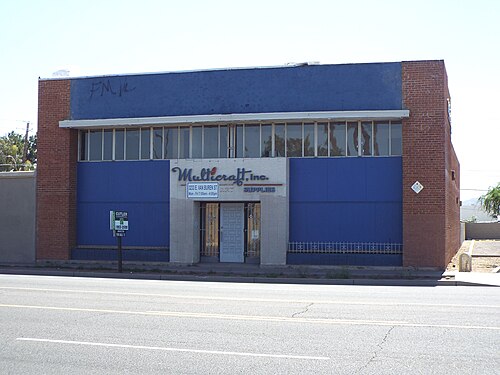 The Pohle Dry Cleaning Building was built in 1946. It is located at 3233 E. Van Buren Street. The style of the building at the time was a progressive international style. The building is considered historical by the Phoenix Historic Preservation Office.
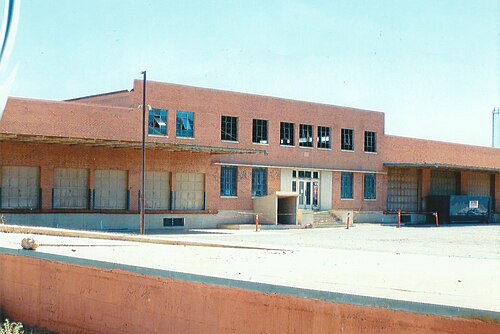 The General Sales Co. building was built in 1946. It is located at 515 E. Grant St. The builders combined the Classicism with the feeling of Organicism styles. The building was listed in the National Register of Historic Places on October 4, 2016, reference: #16000681.
 Hanny's, also known as 29-22, was built in 1947 and is located at 44 N. 1st. street. It was added to the National Register of Historic Places in 1985, reference: #85002058.
 The Graham Paper Company Warehouse was built in 1949 and is located at 521 S. Third St. / 310 E. Lincoln St. It was listed in the Phoenix Historic Property Register in July 2009.
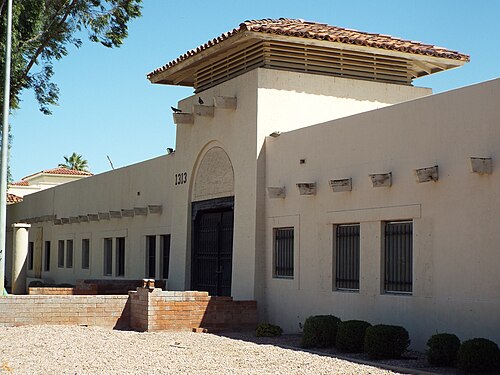 The Medical Center building was built in 1949. The property now houses Summit Elementary School. It is located at 1313 N. 2nd Street. The building is considered historical by the Phoenix Historic Preservation Office.
 The Farmers & Stockmens Bank was built in 1950–1951 and is located at 5001 E. Washington St. It was listed in the Phoenix Historic Property Register in October 2004.
 The original Sky Harbor Air Traffic Control Tower was built in 1952 along with Terminal 1. Terminal 1 was demolished in 1991 and the truncated iconic control tower was moved to 2768 East Old Tower Road, where it is currently located.[23]
 Close up view of the original Sky Harbor Air Traffic Control Tower.
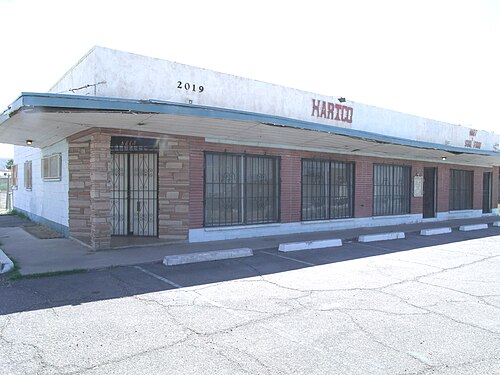 The Progressive Builders Association Building was built in 1953 and is located at 2019 E. Broadway Road. The Progressive Builders Association built homes in downtown Phoenix, giving many African Americans their first opportunity to buy a brand-new home. In 1945, members of the community met at the First Institutional Baptist Church and formed the Progressive Builders Association. It was listed as historic by the Phoenix African-American Survey and listed in the Phoenix Historic Property Register in June 2005.
 The Crown Filter Queen Building was built in 1955. It is located at 1800 W. Van Buren Avenue. The builders used clay brick and ashler sandstone. The building is listed in the National Register of Historic Places on July 10, 1992, reference #92000847, as part of the Oakland Historic District.
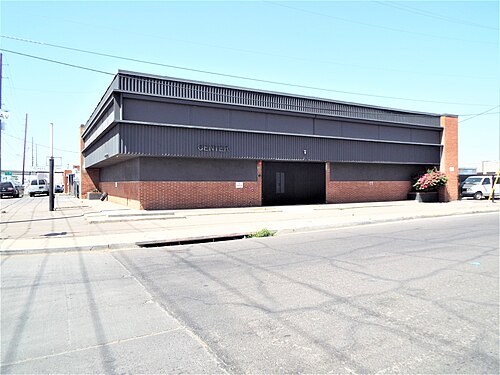 The Produce Center Building was builtin 1956 and is located at 2202 W. McDowell Road. It was listed in the Phoenix Historic Property Register in October 2020.
 The Paris Laundry and Dry Cleaning Building was built in 1957. It is located 4130 N. 7h Avenue. This building was designed Googie style. Googie architecture is a form of modern architecture influenced by the Space Age and the Atomic Age. The building is considered historical by the Phoenix Historic Preservation Office.
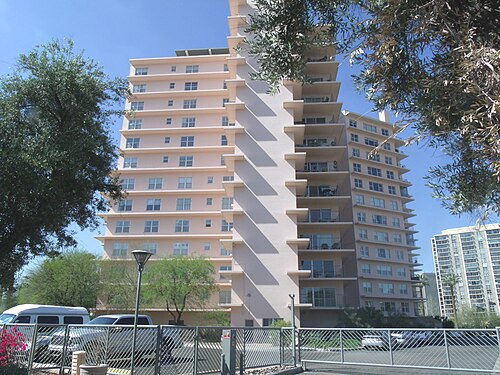 The Phoenix Towers were built in 1957 and are located at 2201 N. Central Avenue. Phoenix Towers was built as a resident-owned cooperative community, Phoenix Towers is now considered an outstanding example of mid-century architecture and was listed in the National Register of Historic Places on January 2, 2008, reference #07001334.
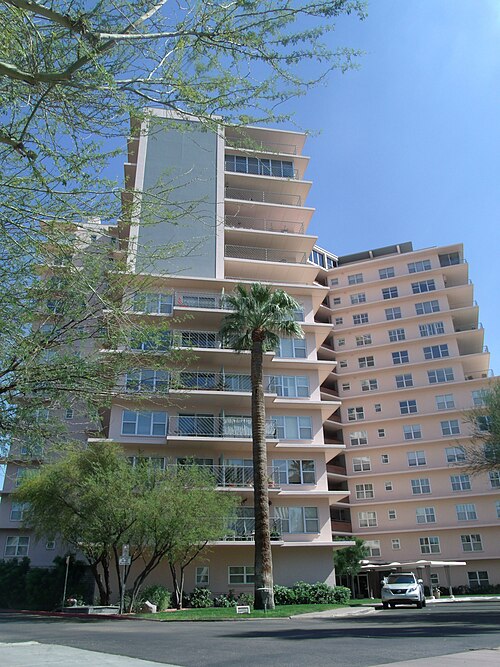 Front view of the Phoenix Towers. The towers were built in 1957 and are located at 2201 N. Central Avenue. Phoenix Towers was built as a resident-owned cooperative community, Phoenix Towers is now considered an outstanding example of mid-century architecture and was listed in the National Register of Historic Places on January 2, 2008, reference #07001334.
 The Sacred Heart House for the Aged was built in 1958 and is located at 1110 N. 16th Street. On February 2, 2010, the building was listed in the National Register of Historic Places, reference: #05001548.
 The 300 Bowl building, which now houses the AMF Christown Lanes, was built in 1960. It is located 1911 W. Bethany Home Road. The three point roofline pegs this building as Googie architecture in style. Googie architecture is a form of modern architecture influenced by the Space Age, and the Atomic Age. The building is considered historical by the Phoenix Historic Preservation Office.
 Different view of the 300 Bowl building.
 The Conn and Candlin CPA Office was built in 1962. It is located at 2701 N. 7th Avenue. On January 9, 1991, the building was listed in the National Register of Historic Places, reference #90002099, as part of the Willo Historic District.
 Side view of the Conn and Candlin CPA Office.
 The Roman Roads built in 1962 and located at 1691 E Maryland Avenue. It was listed in the National Register of Historic Places on November 21, 2018, reference #100003124.
 The Roman Roads
 The Executive Towers were built in 1962 and are located at 207 West Clarendon Street. It was listed in the National Register of Historic Places on January 17, 2017, reference # 100000455.
 The Phoenix Star Theatre a.k.a. Celebrity Theatre was built in 1963 and is located 440 N. 32nd St. It was listed in the Phoenix Historic Property Register in September 2013.
 The Regency House was built in 1964 and is located at 2323 North Central Avenue. It was listed in the National Register of Historic Places on September 26, 2016, reference # 16000630.
 Arizona Veterans Memorial Coliseum built in 1965 and located at and located at 1826 W. McDowell Road. The coliseum served as the home of the Phoenix Suns from 1968 to 1992. The Monkees performed there in 1967 and so did Elvis Presley in 1970 and 73.[24]
 Different view of the Arizona Veterans Memorial Coliseum. On February 2, 1980, boxing Hall of Famer, Salvador Sanchez won the WBC World featherweight title when he beat Danny Lopez. Both Pope John Paul II (Sept. 14, 1987) and Mother Teresa (1989) made appearances there. Among the U.S. presidents that have visited the coliseum are Richard Nixon and Barack Obama.[24]
 The Valley National Bank building was built in 1968 and is located at 4401 E. Camelback Road in Phoenix. The building was designed by Frank Henry. It is listed in the Phoenix Historic Property Register.
 Different view of the Valley National Bank.
 Side view of the Valley National Bank.
 The Vlassis Ruzow and Associates Building was built in 1974. It is located at 1545 W. Thomas Road. The structure is listed in the National Register of Historic Places on April 12, 2007, reference #07000279, as part of the Margarita Historic District.
 Western Savings & Loan Building. The vase-like shaped building was built in 1975 and is located at 10005 South Metro Parkway. It is listed as historic by the Phoenix Historic Property Register.
 Inside view of the curved roof of the Western Savings & Loan Building.
Houses of religious worship
Many of the historic houses of religious worship, such as the "First Presbyterian Church" (1892), are listed in the National Register of Historic Places. Others, such as the "Tanner Chapel A.M.E. Church" (1929), have been designated historic by the Phoenix Historic Property Register. The Tanner Chapel A.M.E. Church, one of the oldest African-American churches in the state, is the only Arizona church where civil rights leader Martin Luther King Jr. is known to have given a sermon. Houses of religious worship such as the "First Mexican Baptist Church" (1920), Phoenix's oldest Hispanic church, are recognized as historic by surveys, as in the case of the Hispanic American Historic Property Survey of the City of Phoenix.
 The First Presbyterian Church was built in 1892 and is located at 402 W. Monroe St. The property is listed in the National Register of Historic Places.
 The Sacred Heart Church was built in 1900 and is located in 920 S. 17th Street. It was added to the National Register of Historic Places March 20, 2012. Reference number 12000124.
 The Brooks Memorial United Methodist Church was built in 1908 and is located on 5921 West Thomas Road. Since 1985, the old church has been used as a funeral home.[25]
 The Saint Mary's Basilica was built in 1914 and is located at 231 N. 3rd. Street. It was listed in the National Register of Historic Places on November 29, 1978, ref. #78000551.
 The Trinity Episcopal Cathedral was built in 1915 and is located at 100 W Roosevelt Street. It is listed in the Phoenix Historic Property Register.
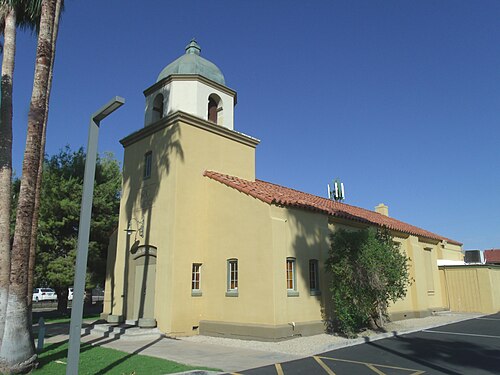 The First Mexican Baptist Church was built in 1920 and is located at 1002 E. Jefferson Avenue. It is Phoenix's oldest Hispanic church. This property is recognized as historic by the Hispanic American Historic Property Survey of the City of Phoenix.
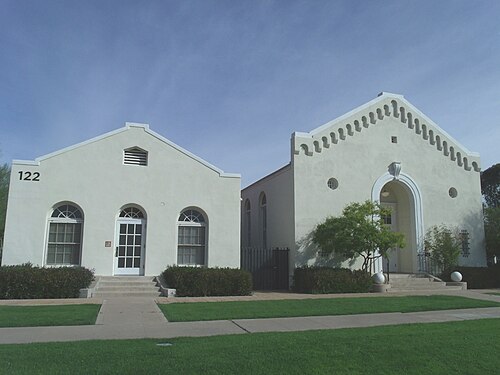 The Temple Beth Israel (1922)/ First Chinese Baptist Church (1957)/ Iglesia Bautista Central (1981) was built in 1922 and is located at 122 E. Culver Street. It was Phoenix's first synagogue and the building later served as Phoenix's First Chinese Baptist Church and from 1981 to 2002, the Hispanic community as the Iglesia Bautista Central. It was listed in the National Register of Historic Places on February 22, 2011, reference #11000043.
 The First Baptist Church was built in 1923 and is located at 302 W. Monroe Street. The First Baptist Church is an Italian Gothic design by Phoenix architectural firm Fitzhugh & Byron. It was badly damaged by fire in 1980 and has been abandoned since. the structure is listed in the National Register of Historic Places.
 The Shiloh Baptist Church was built in 1924 and is located at 901 W. Buckeye Road. This is one of the earliest African-American churches in the West side of Phoenix. It is listed in the African American Historic Property Survey of the City of Phoenix.
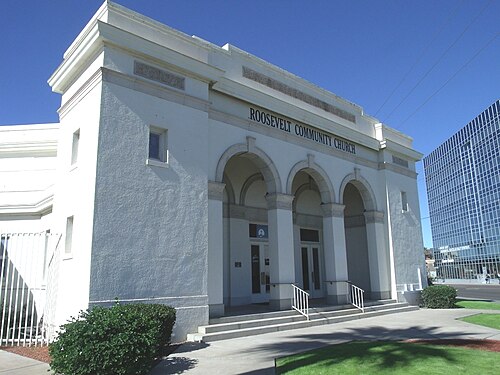 The Roosevelt Community Church was built in 1925 and was originally called the "First Church of Christ Scientist". It is located at 924 N. 1st Street and was listed in the National Register of Historic Places on August 10, 1993, reference #93000745.
 The Phoenix LDS Second Ward Church was built in 1929, and is the oldest LDS chapel in Phoenix. It was used by the "Phoenix Arts Council" for several years before being sold to the "Great Arizona Puppet Theater" in 1996. The building is located at 302 W Latham Street. It was added to the "National Register of Historic Places" in 1983. Reference number 83003492.
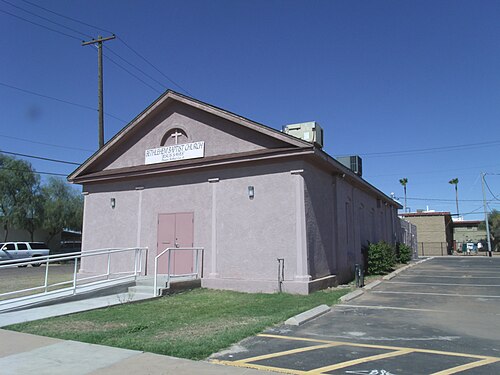 The Bethlehem Baptist Church was built in 1925 and is located at 1402 E. Adams Street. It was listed in the National Register of Historic Places in 1993, ref.: #93000744.
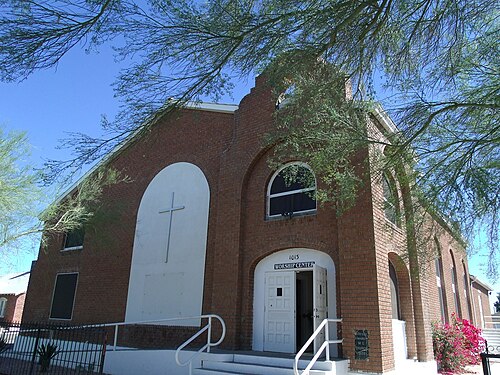 The Garfield Methodist Church was built in 1926 and is located at 1302 E. Roosevelt Street. It was listed in the National Register of Historic Places on August 10, 1993, reference #93000743.
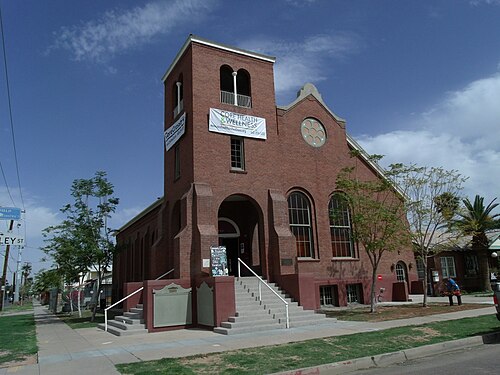 The First Missionary Church was built in 1928 and is located at 902 E. McKinley in Phoenix's historic Garfield neighborhood. The architecture of the structure is that of Mission Revival. It is designated as a landmark by the Historic Preservation-Landmark (HP-L) overlay zoning. It is listed in the Phoenix Historic Property Register.
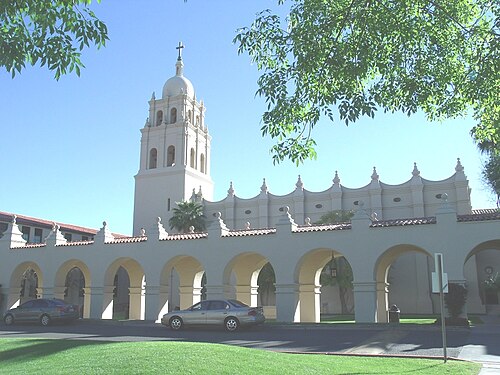 The Brophy College Chapel was built in 1928 and is located at 4701 N. Central Avenue. The Chapel was donated by Mrs. William Henry Brophy in memory of her husband. The Spanish Colonial chapel was built by the students of Brophy College. It was listed in the National Register of Historic Places on August 10, 1993, reference #93000747.
 The Grace Lutheran Church was built in 1928 and is located at 1124 N. 3rd Street. It was added to the National Register of Historic Places in 1993, Reference number 93000835.
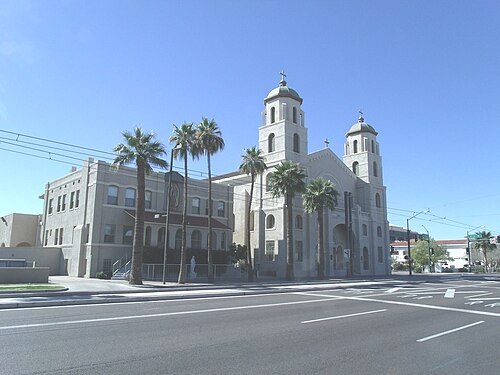 The Immaculate Heart of Mary Catholic Church was built in 1928 and is located at 909 E. Washington Street. It is Phoenix’ second oldest Hispanic church. The church was listed in the National Register of Historic Places on October 8, 1993, ref. number 93000742 (NRHP).
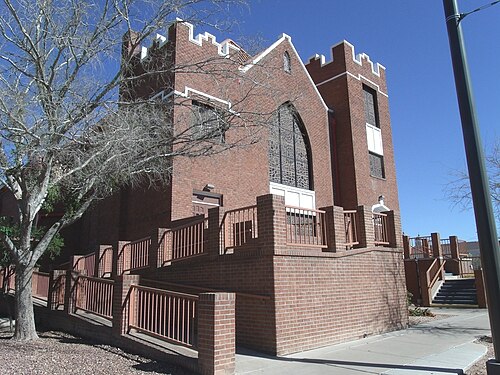 The Tanner Chapel A.M.E. Church, named after Bishop Benjamin T. Tanner, was built in 1929 and is located at 20 S. 8th Avenue. it is the oldest African-American congregation in Arizona. Designated as a landmark with Historic Preservation-Landmark (HP-L) overlay zoning. It is listed in the Phoenix Historic Property Register.
 The Arizona Buddhist Temple built in 1930 and located at 4142 West Clarendon Avenue was the first church if its kind in Arizona.
 The St. Pius X Catholic Church was built in 1935 and is located at 802-815 South 7th Avenue. The church is listed in the Phoenix Historic Property Register.
 The Mennonite Church Meetinghouse was built in 1946 at 9835 N. 7th Street in what was then Sunnyslope. Sunnyslope later became part of Phoenix. In 1949, a new church was erected beside it. The older building was then used as a Christian day school and Sunday school. The church is listed in the Phoenix Historic Property Register.
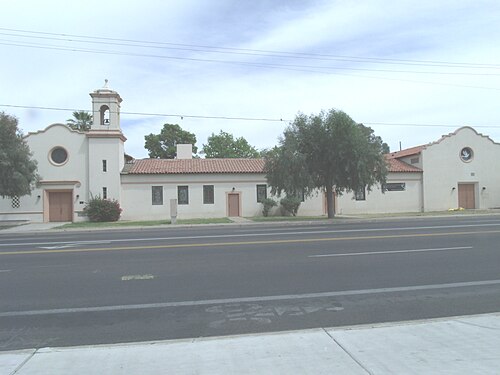 The South Mountain Community Church was built 1944 and is located 717 E Southern Avenue. It was listed in the Phoenix Historic Property Register in July 1993.
 The Mount Calvary Baptist Church was built in 1944 and is located at 998 South 13th Avenue. It is one of the earliest churches to serve the Phoenix Afro-American community. It is listed in the African American Historic Property Survey of the City of Phoenix.
 The Faith Lutheran Church was built in 1946 and is located at 801 E. Camelback Road. It is listed in the Phoenix Historic Property Register.
 The Primera Iglesia Metodista (First Methodist Church) was built in 1947 and is located at 701 S. 1st Street. This property is recognized as historic by the Hispanic American Historic Property Survey of the City of Phoenix.
 The Lucy Phillips Memorial C.M.E. Church was built in 1947 and is located at 1401 E. Adams Street. The church was built by the African-American community in Phoenix. It was named Lucy Phillips Memorial C.M.E. Church in honor of the wife of the first presiding bishop, the Rev. Charles Henry Phillips. The church was listed in the Phoenix Historic Property Register in June 2005.
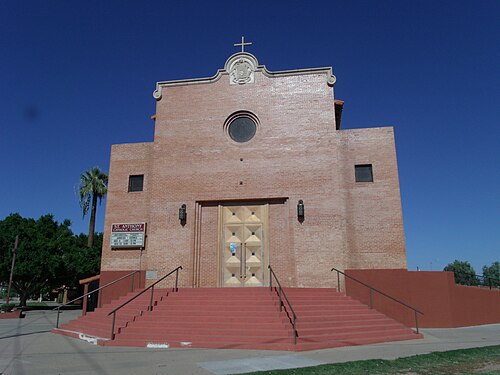 The St. Anthony Church was built in 1948 and is located at 909 S. 1st Street. This property is recognized as historic by the Hispanic American Historic Property Survey of the City of Phoenix.
 The Sunnyslope Presbyterian Church was founded in 1927 in Sunnyslope. The structure was built in 1949 and is located at 9317 N 2nd Street, in the Sunnyslope District of Phoenix. The church is listed in the Phoenix Historic Property Register.
 The building which once housed the historic Iglesia Betania Presbiteriana was constructed in 1950. It is located at 301 W Pima in Phoenix. This property is recognized as historic by the Hispanic American Historic Property Survey.
 The Pavilion of Light of the Phoenix First Assembly of God, or simply "Phoenix First", is an Assemblies of Godmegachurch. The structure was built in the 1980s and is located at 13613 N. Cave Creek Road. As of 2011, it was the second largest Assembly of God church in the U.S. with an average Sunday attendance of 10,000.
Educational institutions
The first school in Phoenix was established in 1873. It was known as the Little Adobe School and it was located in 202 N. Central Avenue where the San Carlos Hotel currently stands. Schools were segregated then and therefore, so were many of the historic schools on this list. The Phoenix Indian School was established in 1891 under the federal "assimilation" policy which sought to regimentalize and culturally exterminateNative American students.[26] African-American students were only allowed to attend racially segregated schools such as the Dunbar School which was built in 1925, the Phoenix Union Colored High School (Later renamed George Washington Carver High School) built in 1926, and the Booker T. Washington Elementary School built in 1928.
 The Phoenix Indian School main building was built in 1891 and is located at 300 E. Indian School Rd. It was listed in the National Register of Historic Places on May 31, 2001, ref. #01000521.
 Different view of the Phoenix Indian School, located in the compounds of Phoenix's Steele Park in 300 E. Indian School Rd.
 Phoenix Union High School was built in 1912 and is located at 512 E. Van Buren. It was listed in the National Register of Historic Places on July 15, 1982, ref. #82002085.
 Phoenix Union High School Domestic Arts building was built in 1912 and is located at 512 E. Van Buren. It was listed in the National Register of Historic Places on July 15, 1982, ref. #82002085.
 Phoenix Union High School Auditorium was built in 1912 and is located at 512 E. Van Buren. It was listed in the National Register of Historic Places on July 15, 1982, ref. #82002085.
 Phoenix Union High School Science building was built in 1912 and is located at 512 E. Van Buren. It was listed in the National Register of Historic Places on July 15, 1982, ref. #82002085.
 Monroe High School was built in 1914 and is located at 215 N. 7th St. It was listed in the National Register of Historic Places on August 26, 1977, ref. #77000237.
- The Phoenix Elementary School District #1 Administration Building was built in 1917 and is located at 331 N. 1st Avenue. the building was listed in the Phoenix Historic Property Register in October 1996.
 The McKinley School was built in 1919 and is located at 512 E. Pierce St. The property was listed in the Phoenix Historic Property Register in September 2004.
 The Kenilworth School was built in 1919 and is located at 1210 N. 5th Avenue. It was listed in the National Register of Historic Places on March 25, 1982, reference #82002083.
 The current Cartwright School was built in 1921 and is located at 5833 W. Thomas Rd. It was listed in the National Register of Historic Places on August 12, 1993, ref. #93000739.
 The first Cartwright one-room school house was built in 1910. This is the original 1910 Cartwright School bell.
 Phoenix Indian School Memorial Hall was built in 1922 and is located at 300 E. Indian School Rd. It was listed in the National Register of Historic Places on May 31, 2001, ref. #01000521.
 Adams School (now Grace Court School) was built in 1924 and located at 800 W. Adams St. It was listed in the National Register of Historic Places on November 29, 1979, ref. #79000418.
 Franklin High School was built in 1925 and is located at 1625 W. McDowell Rd. It was listed in the National Register of Historic Places on August 12, 1993, reference: #93000814.
 Dunbar School was built in 1925 and is located at 707 W. Grant St. It was listed in the National Register of Historic Places on August 12, 1993, ref. #93000740.
 Phoenix Union Colored High School (Later renamed George Washington Carver High School) was built in 1926 and is located at 415 E. Grant St. It was listed in the National Register of Historic Places on May 2, 1991, ref. #91000543.
 The Booker T. Washington Elementary School was built in 1928 and is located at 1201 E. Jefferson St. The school was the first all African-American elementary school in Phoenix. It now houses the "Sun Times" of Phoenix. It is listed in the Phoenix Historic Property Register.
 The Arizona Academy North and South Halls were built in 1928 and are located at 1325 N. 14th Street. The former academy is now known as the Stepping Stone Place. The North Hall is addressed as 1307 and the South Hall as 1305. Both towers were listed in the National Register of Historic Places in 1993, ref.: #93000813.
 The John G. Whittier School was built in 1929 and is located at 2004 N. 16th Street. On August 12, 1993, it was listed in the National Register of Historic Places, ref.: #93000741.
 The Indian School Band Building built in 1931 and located in the compounds of Phoenix's Steele Park in 300 E. Indian School Rd. It was listed in the National Register of Historic Places on May 31, 2001, ref. #01000521.
 North Phoenix High School, now North High School (1954), was built in 1939 and is located on 1101 East Thomas Road. This is the original building which was planned and financed through the New Deal Works Projects Administration and Public Administration funds.[27]
19th century historic houses
Some of these houses meet the National Register criteria for evaluation. The quality of significance in American history, architecture, archeology, engineering, and culture is present in districts, sites, buildings, structures, and objects that possess integrity of location, design, setting, materials, workmanship, feeling, and association and that are associated with the lives of persons significant in Phoenix's past. The following prominent people who at one time or another lived in Phoenix and whose houses are listed here are:
- Clinton Campbell, a locally prominent builder who worked in Phoenix. His house however, was demolished in 2017.
- Phillip "Lord" Darrell Duppa. Duppa is credited with naming "Phoenix" and "Tempe" and the founding of the town of New River.
- Burgess A. Hadsell, Hadsell, together with William J. Murphy, promoted the temperance colony of Glendale, Arizona in the western Salt River Valley.
- William John Murphy. Murphy created the Arizona Improvement Company in 1887 and bought land in areas that would eventually become the towns of Peoria and Glendale of Arizona.
- William R. Norton. Norton founded the Sunnyslope subdivision of Phoenix and designed the Carnegie Library, the city's first library, and the Gila County Courthouse in Globe, Arizona.
- William Osborn, one of Phoenix's first homesteaders.
- Judge Charles A. Tweed. Judge Tweed was appointed an Associate Justice to the Arizona Territorial Supreme Court. Tweed then moved to Arizona Territory and was appointed to serve two terms as an Associate Justice of the Arizona Territorial Supreme Court.
 The Duppa-Montgomery Adobe House was built in 1870 and is located at 116 W. Sherman St. It is one of Phoenix's oldest houses.
 The Jones-Montoya House, located at 1008 E. Buckeye Road, was built in 1879 and is one of Phoenix's oldest houses. The house is listed as historic by the Phoenix Historic Property Register. This was the homestead house of "Lord" Darrell Duppa, an Englishman who is credited with naming "Phoenix" and "Tempe" and the founding of the town of New River. Duppa later sold the adobe house to John Britt Montgomery. Designated as a landmark with Historic Preservation-Landmark (HP-L) overlay zoning. The house is listed as historic by the Phoenix Historic Property Register.
 The Judge Charles A. Tweed House, built in 1880 and located at 1611 W. Filmore St. On April 14, 1870, Judge Tweed was appointed an Associate Justice to the Arizona Territorial Supreme Court. Tweed then moved to Arizona Territory and was appointed to serve two terms as an Associate Justice of the Arizona Territorial Supreme Court. The house is listed as historic by the Phoenix Historic Property Register.
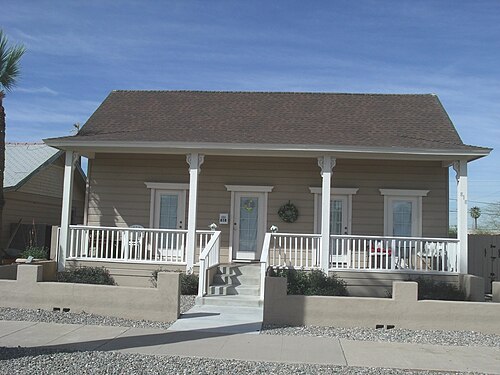 The House at 818 South 1st Avenue a.k.a. the Vernacular Residence was built in 1885 and is located at 818 S. First Avenue. It was listed in the National Register of Historic Places on January 12, 1995, as the "House at 818 South 1st Avenue", reference #94001538.
 The Eyrich-Kohl House was built in 1885 and is located at 1015 Woodland Avenue. Eyrich was a German immigrant who moved to Arizona in 1875. According to the Phoenix Historical Society, Eyrich was a plumber who in the past had served as a cavalryman, "Indian fighter," prospector, miner, hotel and café employee and proprietor. Kohl, cattle rancher, lived in the house from 1917 to 1920. The house is listed in the National Register of Historic Places. Reference #94001530.
 The William Lewis Osborn House, one of Phoenix's first homesteaders, was built in 1890. It is located at 1266 W. Pierce St. Listed in the National Register of Historic Places on May 15, 1991; Reference #91000544.
 Abandoned Victorian House built in 1890 and located on East Grant St.
 The M.J. Sharp House was built in 1890 and is located at 1012 S. 1st Avenue. It was listed in the National Register of historic Places on January 12, 1995, reference: #94001535.
 The Burgess A. Hadsell House was built in 1893 and is located at 1001 E. Fillmore St. Hadsell, together with William J. Murphy, promoted the temperance colony of Glendale, Arizona in the western Salt River Valley. The house was listed in the National Register of Historic Places on January 12, 1995, reference #94001531.
 The Oscar Roberts Madison House was built in 1893 and is located at 2004 W. Madison St. The house is listed as historic by the Phoenix Historic Property Register
 The Dr. Evans' House was built in 1893 and is located at 1100 W. Washington Street. The house belonged to Dr. John M. Evans who used it as both a residence and medical office. It was listed in the National Register of Historic Places on September 1, 1976, reference #76000375 (NRHP).
 The C. P. Cronin House was built in 1893 and is located at 2029 W. Jefferson St. Designated as a landmark with Historic Preservation-Landmark (HP-L) overlay zoning. The house is listed as historic by the Phoenix Historic Property Register.
 The Eder-Moffitt House was built in 1894 and is located at 1336 Taylor St. Listed in the National Register of Historic Places. Reference #94001605.
- The Clinton Campbell House belonged to Clinton Campbell, a locally prominent builder in Phoenix. It was built in 1895 and was located at 361 N. 4th Avenue. The house was listed in the National Register of Historic Places on January 12, 1995, reference #94001526. The historic house was demolished on September 15, 2017, by its owners.[28]
 The H.M. Coe House was built in 1895 and is located at 365 N. 4th Avenue. Coe was a mechanic. He and his family occupied the house until after the turn of the century. The house is listed in the National Register of Historic Places. Reference #94001529.
 The William R. Norton House was built in 1895 and is located at 2222 W. Washington Street. Norton founded the Sunnyslope subdivision of Phoenix and designed the Carnegie Library, the city's first library, and the Gila County Courthouse in Globe, Az. The house is listed as historic by the Phoenix Historic Property Register.
 The William J. Murphy House was built in 1895 and is located at 7514 N. Central Avenue. William J. Murphy created the Arizona Improvement Company in 1887 and bought land in areas that would eventually become the towns of Peoria and Glendale. The house is listed as historic by the Phoenix Historic Property Register.
 The Anderson-Joannes House was built in 1895 and is located 1027 N. 10th Avenue. It was listed in the National Register of Historic Places in 1995, ref.: #94001525.
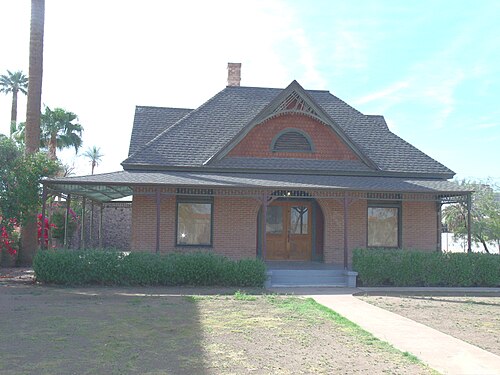 The George Hidden House was built in 1896 and is located at 763 E. Moreland St. It was listed in the National Register of Historic Places on January 11, 1995, reference #94001532.
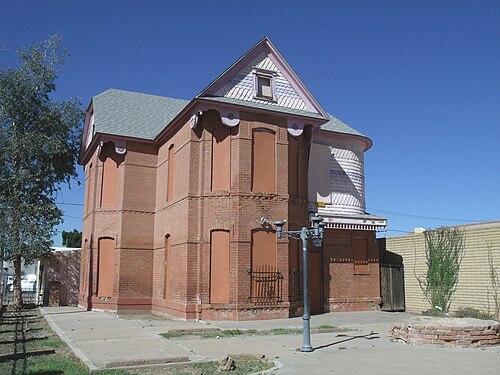 The Charles Pugh House was built in 1897 and is located at 356 N. 2nd Avenue. Designated as a landmark with Historic Preservation-Landmark (HP-L) overlay zoning. The house is listed as historic by the Phoenix Historic Property Register.
 The Smurthwaite House was built in 1897 and is located 1317 W. Jefferson Street. The house currently serves as the office of the historic Pioneer and Military Cemetery. It was listed in the National Register of Historic Places on May 17, 2001, reference #01000479 (NRHP).
 The living room of the Smurthwaite House, which was built in 1897.
 The staircase leading to the second floor of the Smurthwaite House.
 The George Cisney House was built in 1897 and is located at 916 E. McKinley St. It was listed in the National Register of Historic Places on January 12, 1995, reference #94001528.
 The O.C. Thompson House was built in 1897 and is located at 850 N. 2nd Avenue. The building was converted to apartments long after O.C. Thompson and family moved out and now houses several office spaces. Designated as a landmark with Historic Preservation-Landmark (HP-L) overlay zoning. The house is listed as historic by the Phoenix Historic Property Register.
 The E. W. Skinner House was built in 1899 and is located at 917 E. Roosevelt St. Skinner was a local contractor. It was listed in the National Register of Historic Places on January 12, 1995, reference #94001536.
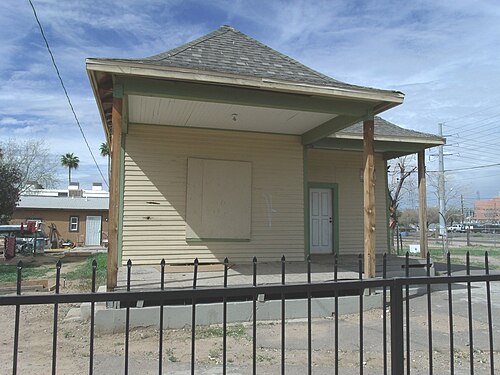 The C. A. Larson House was built in 1899 and is located at 7105 1st. Avenue. Listed in the National Register of Historic Places. Reference #9001533.
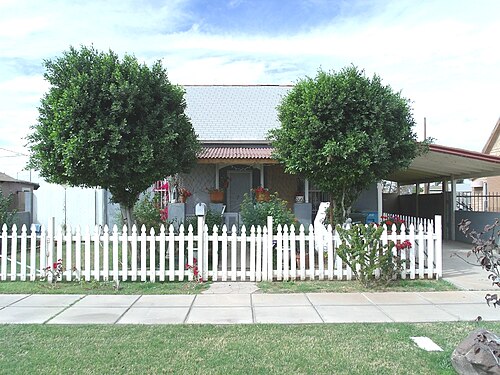 The W. E. Adams House was built in 1899 and is located at 1014 S. 1st. Avenue. Listed in the National Register of Historic Places. Reference #94001524.
 The Dougherty-Peterson House was built in 1899 and is located at 2141 W. Washington St. The house is listed as historic by the Phoenix Historic Property Register.
 The William & Nathalie Pinney House was built in 1899 and is located at 1930 W. Adams St. It was listed in the Phoenix Historic Property Register in November 2007.
20th century historic houses
The following prominent people who at one time or another lived in Phoenix and whose houses are listed here are:
- Dr. Charles "Charley" Borah, an Americanathlete, who won the gold medal in the 4 × 100 m relay at the 1928 Summer Olympics.[29]
- Jorgine Slettede Boomer, the widow of Lucius Boomer, a successful hotelier. Her house was designed by Frank Lloyd Wright.
- Dr. George Brockway, a physician who served as the Pinal County Superintendent of Public Health as well as two terms as Mayor of Florence.
- L. Ron Hubbard, the founder of the Church of Scientology religion.
- John McCain, a statesman who served as a United States Senator from Arizona from January 1987 until his death. He previously served two terms in the United States House of Representatives and was the Republican nominee for President of the United States in the 2008 election.
- Colonel James McClintock, whose full name was "James Henry McClintock", was a veteran of the United States Army who served in the Spanish–American War. He moved to Arizona and served as state historian from 1917 through 1922. He was also one of the founders of the Arizona Republican newspaper, now The Arizona Republic.
- Dr. James C. Norton, the territorial veterinarian.
- Wing F. Ong, the first person born in China to be elected to a state legislative house.
- Henry E. Pierce, who served as County Assessor during the 1920s and was secretary to Governor John C. Phillips from 1929 until 1932. He was chairperson of the Maricopa County Republican Central Committee. In addition to his political activities, Pierce was a partner in the real estate firm of Jacobs & Pierce.
- Aubrey and Winstona Aldridge. Winstona Hackett was the daughter of Dr. Winston Hackett the first African-American doctor in the area, and her husband Aubrey Aldridge.
- William Wrigley Jr., the Chewing-gum magnate whose mansion in Phoenix is known by some people as "La Colina Solana".
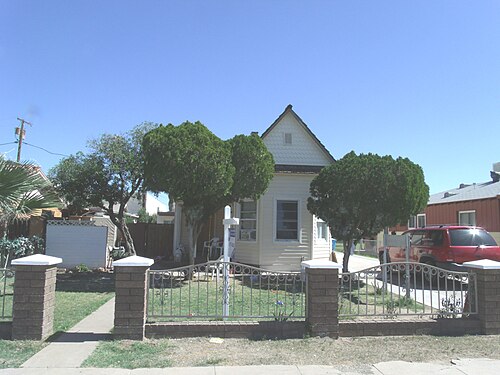 The M.J. Sharp House was built in 1900 and is located at 1012 S, 1st. Avenue. On January 12, 1995 it was listed in the National register of Historic Places, ref.: #954001535.
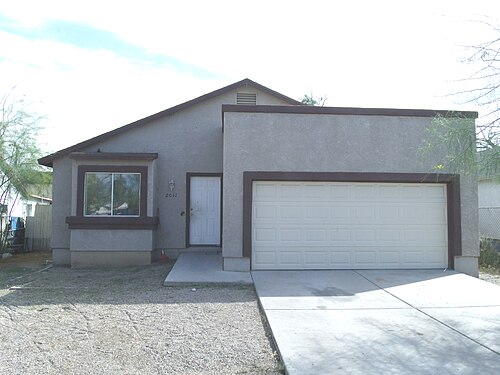 The C. W. Cisney House was built in 1900 and is located at 2011 W. Madison St. C. W. Cisney House' built the house which is constructed in the Colonial Revival architectural style and represents the Builder's Plan Book property type. It was listed in the National Register of Historic Places on January 12, 1995, reference #94001527.
 The Helen Anderson House was built in 1900 and is located at 149 W. McDowell Road. The property was listed in the National Register of Historic Places in 1983, ref.: #83002449.
 The William A. Farish House was built in 1900 and is located at 816 N. Third St. It was listed in the Phoenix Historic Property Register in October 2002.
 The William and Mary Grier House was built in 1901 and located at 1942 W. Adams St. William Grier was a merchant who took to ranching after moving to Arizona in 1896. He built the house as a primary residence for himself and his wife, Mary. Designated as a landmark with Historic Preservation-Landmark (HP-L) overlay zoning. It was listed in the Phoenix Historic Property Register.
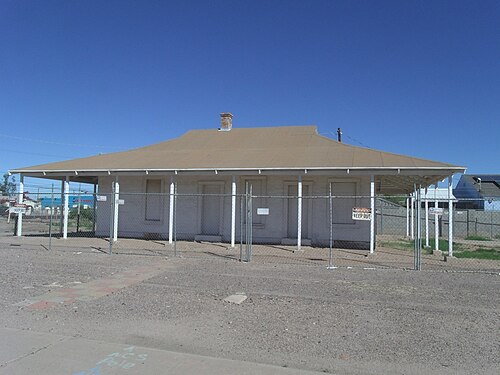 The Kunz-Carbajal House (formally known as the Montgomery Homestead) was built in 1904 and is located at 1721 S. 7th Avenue. Built by pioneer Louis Kunz, it is among the oldest adobe houses still in existence in Phoenix. The house was later sold to Felix Carbajal, one of the first Filipinos to live in Phoenix. The house is listed as historic by the Phoenix Historic Property Register.
 The Louis Emerson House was built in 1904 and is located at 623 N. 4th St. Emerson was a butcher for the "Palace Meat Market". He used to advertise "Meat fit for a king." Designated as a landmark with Historic Preservation-Landmark (HP-L) overlay zoning. It was listed in the Phoenix Historic Property Register
 The Adam Diller/Lightning "Z" Ranch House was built in 1904 and is located at 8702 N. 7th Avenue. The ranch house is one of the few remaining once-isolated ranch houses that dotted the outskirts of the city in the early part of the century. Designated as a landmark with Historic Preservation-Landmark (HP-L) overlay zoning. It was listed in the Phoenix Historic Property Register
 The Concrete Block Neoclassical House was built in 1906 and is located at 614 N. 4th Avenue. On November 30, 1983, it was listed in the National Register of Historic Places ref. number 83003455.
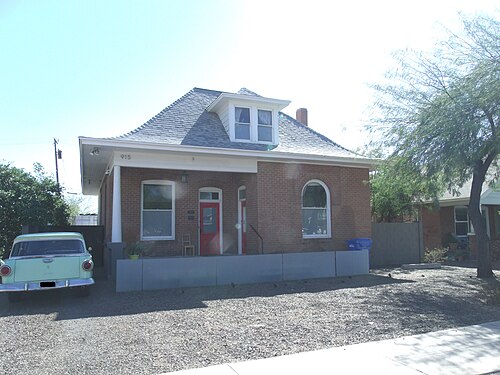 The Grand Pyramid House was built in 1907 and is located at 915 E, Pierce Street. The house was listed in the National Register of Historic Places in 1907, ref.: #02000800.
 The Dr. George Brockway House was built in 1908 and is located at 506 E. Portland St. Dr. Brockway was a physician who moved to Florence, Arizona from New York in 1894. He served as the Pinal County superintendent of public health as well as two terms as mayor of Florence. He later relocated to Phoenix and built this house in what is now the Evans-Churchill neighborhood of Phoenix. It was listed in the Phoenix Historic Property Register
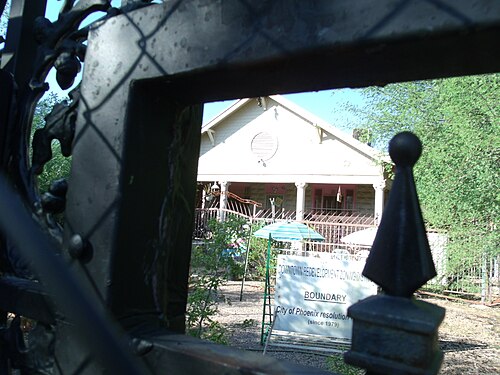 The Concrete Block Bungalow was built in 1908 and is located at 606 N. 9th Street, Phoenix. It was listed in the Phoenix Historic Property Register in February 2005. This property is considered to be an endangered historic house which someday may be demolished.
 The Elizabeth Seargeant-Emery Oldaker House was built in 1909 and is located at 649 N. Third Avenue. It was listed in the National Register of Historic Places on November 30, 1983, reference #83003472.
 The Leighton G. Knipe House was built in 1909 and is located at 1025 N. 2nd Avenue. The house is listed in the Phoenix Historic Property Register. This property is considered to be an endangered historic house which someday may be demolished.
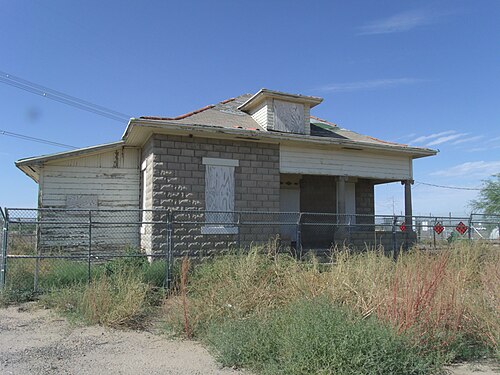 The Sach's-Webster Farmstead House was built in 1909 and is located in the Northwest corner of 75th Avenue and Baseline. The house was listed in the Phoenix Historic Property Register in December 2003. This property is considered to be an endangered historic house which someday may be demolished.
 The Henry Campbell House was built in 1910 and is located at 826 3rd. Avenue. Designated as a landmark with Historic Preservation Landmark (HP-L) overlay zoning. It was listed in the Phoenix Historic Property Register.
 The Meritt Farm House which was built in 1910 on 100 acres which John and Emma Meritt purchased in Phoenix. The house was donated to the Pioneer Living History Museum[30]
 Inside the Meritt Farm House.
 The Stoddard-Harmon House was built in 1910 and is located ta 801 N. 1st. Avenue. It was owned at one time by Celora Stoddard and Lon Harmon. Listed in the National Register of Historic Places on November 30, 1983, reference #83003451.
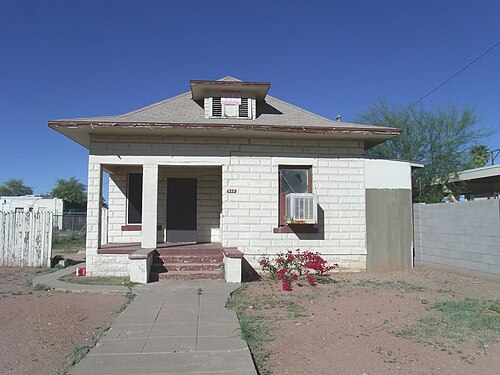 The Concrete Block House was built in 1910 and is located at 640 N. 6th Avenue. It was listed in the National Register of Historic Places on November 30, 1983, reference #83003456.
 The Harry E. Pierce House was built in 1910 and is located at 632 N. 3rd Avenue. The house is the former residence of Harry E. Pierce. Pierce served as County Assessor during the 1920s, was secretary to Governor John C. Phillips from 1929 until 1932, and was chairperson of the Maricopa County Republican Central Committee. In addition to his political activities, Pierce was a partner in the real estate firm of Jacobs & Pierce. Pierce lived here from about 1911 until about 1930. It was listed in the National Register of Historic Places in 1983, reference #83003493.
 The Herman P. DeMund House was built in 1910 and is located at 649 N. Second Avenue. Designated as a landmark with Historic Preservation-Landmark (HP-L) overlay zoning. It was listed in the Phoenix Historic Property Register.
 The Colonel James McClintock House was built in 1911 and is located at 323 E. Willetta St. McClintock, whose full name was "James Henry McClintock", was a veteran of the United States Army who served in the Spanish–American War. He moved to Arizona and served as state historian from 1917 through 1922. He was also one of the founders of the Arizona Republican newspaper, now The Arizona Republic. Listed in the National Register of Historic Places on October 4, 1990. Reference #90001525.
 The John Seddar House was built in 1912 and is located at 1204 E. Roosevelt St. John Sedler built this home on five acres, and it looked out on alfalfa fields and a silo to the south of Roosevelt Street. It is now home to the "Alwun House", an alternative art gallery. It was listed in the Phoenix Historic Property Register.
 The Harry M. Fennemore House was built in 1912 and is located at 501 E. Moreland St. It was listed in the Phoenix Historic Property Register in September 2004.
 The Morse-Kelley House was built in 1912 and is located at 2141 W. Madison St. The house takes its name from Menzo Morse, a grocer, and Dorrian Kelley, a salesman for the Standard Oil Co., each of whom lived there for a time. Designated as a landmark with Historic Preservation-Landmark (HP-L) overlay zoning. It was listed in the Phoenix Historic Property Register.
 The Dr. Norton House was built in 1912 and is located at 2700 N. 15th Avenue. Dr. James C. Norton and his wife Clara Tufts moved to Phoenix from Iowa and served as territorial veterinarian.
 Dr. Norton's Carriage House was built in 1912 and is located at 2700 N. 15th Avenue. It was listed in the Phoenix Historic Property Register.
 The houses in Sierra Vista were built in 1913 and are located at 6802 S. 28th Street. They were listed in the Phoenix Historic Property Register in March 1993.
 The houses in Sierra Vista were built in 1913 and are located at 6802 S. 28th Street. They were listed in the Phoenix Historic Property Register in March 1993.
 The William E. Cavness House was built in 1914 and is located at 606 N. 4th Avenue. William E. Cavness built this Craftsman Bungalow style house for his bride, Nettie. It was listed in the National Register of Historic Places on November 3, 2001, reference #01001191.
 The Charles Dunlap House was built in 1914 and is located at 650 N. 1st. Avenue. This was the house of Charles Dunlap founder of the People's Ice and Fuel Company and the Phoenix Wood and Coal Company and listed in the National Register of Historic Places on November 30, 1983, reference #83003466. Designated as a landmark with Historic Preservation-Landmark (HP-L) overlay zoning. The structure is now occupied by a local law firm.
 The Vernacular Farm Residence was built in 1915 and is located at 2956 E. Southern Avenue. The property was listed in the Phoenix Historic Property Register in September 1993.
 The Spanish Colonial Revival Residence located at 333 E. Carter Road was built in 1916. It was listed in the Phoenix Historic Property Register in July 1993.
 The Dr. Ellis-Shackelfield House was built in 1917 and is located at 1242 N. Central Avenue. On November 30, 1983, the house was listed in the National Register of Historic Places, ref.: #83003475.
 The living room of the Dr. Ellis Shackelford House. The house was built in 1917 and is located in 1242 Central Avenue. On November 30, 1983, the house was listed in the National Register of Historic Places, ref.: #83003475.
 The Dension Kitchel House was built in 1918 and is located at 2912 E. Sherran Lane. It was listed in the National Register of Historic Places on May 19, 1994, reference #94000448.
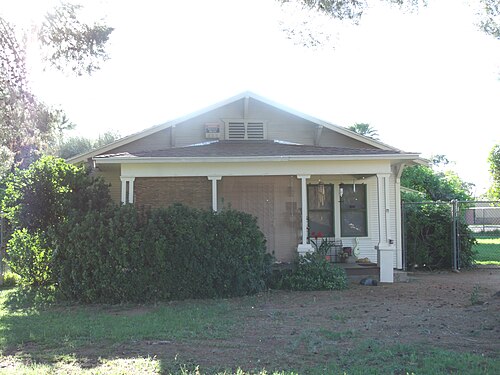 The Kaler House was built in 1918 and is located at 301 W. Frier Dr. It was listed in the National Register of Historic Places on December 17, 1992, reference #92001686.
 The Guy P. Nevitt House was built in 1919 and is located at 507 E. Moreland St. It was listed in the Phoenix Historic Property Register in September 2004.
 The Winship House built in 1919 and is located at 216 W. Portland Avenue, Phoenix. It was built for Dr. Welter D. Schackelford and in 1923 sold to Fred Winship. The house is listed in the Phoenix Historic Property Register.
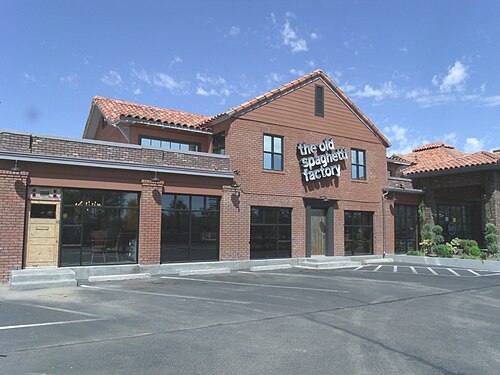 The Baker House was built in the 1920s and is located at 1418 N. Central Avenue. It is listed as Historic by the Phoenix Historic Property Register.
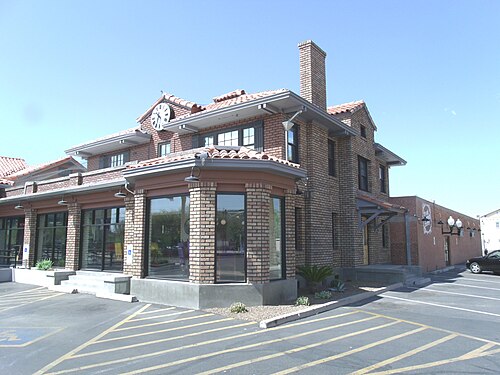 The Cole Mansion was built in the 1920s and is located at 1418 N. Central Avenue. It is listed as Historic by the Phoenix Historic Property Register.
 The Frank and Emma Avery House was built in 1920 and is located at 4203 North 44th St. It was listed in the National Register of Historic Places on June 25, 2020; reference: #100005297
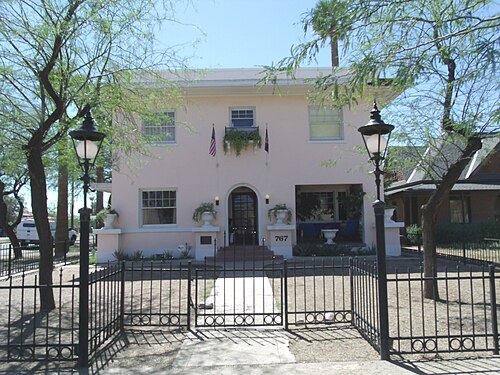 The Pieri-Elliot House was built in 1920 and is located at 767 E. Moreland St. It was listed in the National Register of Historic Places on December 29, 1983, reference #83003500.
 The Mrs. Neal House was built in 1920 and is located at 102 East Willetta Street. According to the local media, this house is in danger of being demolished. It is listed in the Phoenix Historic Property Register.
 The Salim Ackel House was built in 1920 and is located at 94 E. Monte Vista Street in Phoenix. It was listed in the National Register of Historic Places in 1994, reference number 94000574.
 The Cartwright Heritage House together with the Cartwright School was listed in the National Register of Historic Places on August 12, 1993, ref.:#93000739. The house, which housed Mr. Glenn L. Downs in 1923, is located at 5833 W. Thomas Rd. Downs was the first superintendent of the Cartwright School Dist.
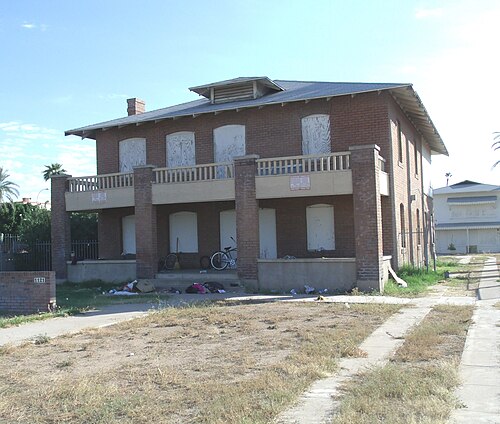 The Sarah Pemberton House was built in 1920 and is located at 1121 N. 2nd St. The house is listed in the Phoenix Historic Property Register and the National Register of Historic Places on September 5, 2017, reference #100001557. This property is considered to be an endangered historic house which someday may be demolished.
 The Agren-Taylor House was built in 1921 and is located at 521 East Willetta Street. The house was listed in the Phoenix Historic Property Register in June 2009.
 The J.F. Kelly House was built in 1922 and is located at 44 E. Palm Lane. It was listed in the Phoenix Historic Property Register in September 1992
 The Lewis Williams Douglas House was built 1923 and is located at 815 E. Orangewood Avenue. The house is historically significant for its association with Douglas, a nationally prominent Arizona politician and United States Congressman whose public career extended from 1922 through the years following World War II. During this period, Douglas served his home state and the nation in a number of elected and appointed positions of leadership. The house is listed in the National Register of Historic Places in 1985 ref. 85000188.
 A different view of the Lewis Williams Douglas House. The house was built 1923 and is located at 815 E. Orangewood Avenue. The house is listed in the National Register of Historic Places in 1985 ref. 85000188.
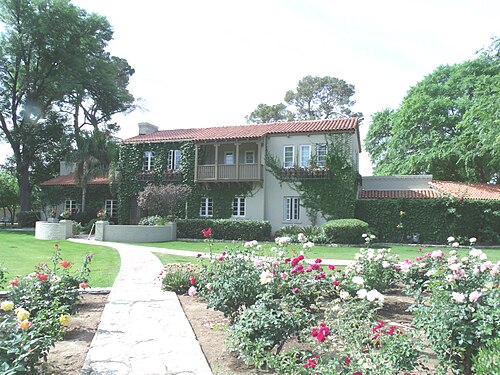 The Craig Mansion was built in 1925 and is located at 131 E. Country Club Dr., The mansions' architectural styles are that of a late 19th and 20th Century Revival: Mission/Spanish Revival and architectural type; Spanish Colonial Revival. It was listed in the National Register of Historic Places on August 18, 1992, reference #92001013.
 The George H. Vradenburg House/Tudor Revival Residence was built in 1925 and is located at 1600 W. Colter St. It was listed in the National Register of Historic Places in March 2003, reference #10000156.
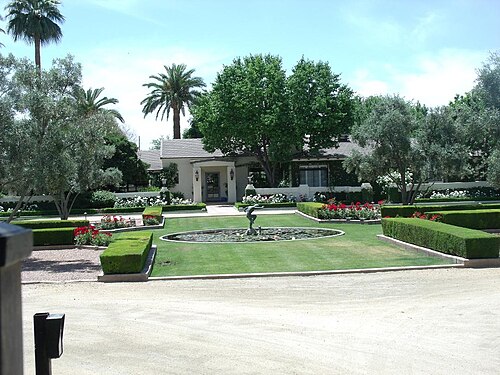 The El Chaparal House was built in 1925 and is located at 4935 E. Lafayette Blvd. Listed in the National Register of Historic Places in 2011. Reference number 11000631.
 The Wing F. Ong House located in the back of the Wing F. Ong grocery store. It was listed in the Phoenix Historic Property Register.
 The Charles H. Pratt House was built in 1925 and is located at 4979 E Camelback Road. It was added to the National Register of Historic Places in 1996. Reference number 96001274
 Sarah and Jack Harelson House was built in 1925. It is located at 4437 E. Arlington Road. Phoenix. Listed in the National Register of Historic Places in 2010. Reference number 10000152.
 The Samuel L. Bartlett House was built in 1925 and is located at 325 W. Northern Avenue. On October 3, 1996, the house was listed on the National Register of Historic Places, ref.: #96001057.
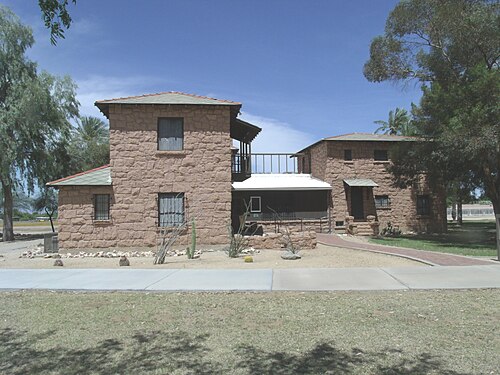 The Rancho Ko-Mat-Ke House was built in 1925 and is located at 1346 E. South Mountain Avenue. It was listed in the Phoenix Historic Property Register in April 1989.
 Side view of the Rancho Ko-Mat-Ke House, which was built in 1925 and is located at 1346 E. South Mountain Avenue. It was listed in the Phoenix Historic Property Register in April 1989.
 Rancho Arroyo main gate. The ranch was established in 1926 and is located on 6737 North 20th Street. It was listed in the National Register of Historic Places on September 12, 2003, reference: #03000901.
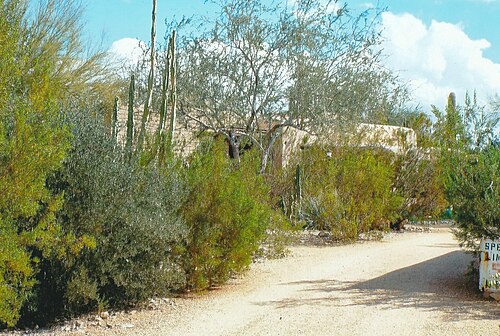 Rancho Arroyo House .
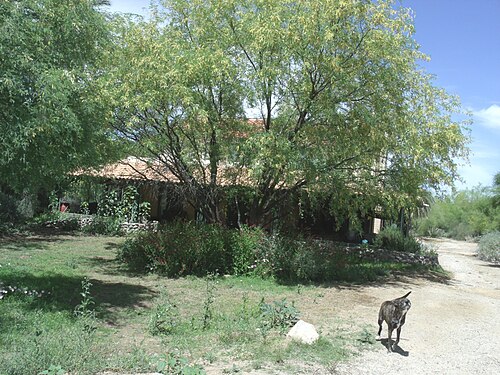 The Spanish Colonial Revival Residence located at 1200 W. South Mountain Avenue. was built in 1926. It was listed in the Phoenix Historic Property Register in March 2008.
 The Pueblo Revival Residence located at 46 E. Greenway Road was built in 1926. It was listed in the Phoenix Historic Property Register in July 1993.
 The Monterey Ranch Residence located at 40 E. Carter Road was built in 1927. It was listed in the Phoenix Historic Property Register in July 1993.
 The Spanish Colonial Revival Residence located at 47 E. Carter Road was built in 1927. It was listed in the Phoenix Historic Property Register in March 2008.
 The Harry J. Felch House was built in 1927 and is located in 525 W. Lynwood Street. The Dutch Colonial Home is in Phoenix's historic Roosevelt District. The district is listed in the National Register of Historic Places, reference 83003490.
 The David Morgan-Earl A. Bronson House was built in 1927 and is located at 8030 N. Central Avenue. the house is listed on the National Register of Historic Places.
 The N. Clyde Pierce House was built in 1927 and is located at 4505 E. Osborn Road. It was listed in the Phoenix Historic Property Register in May 1990 and on the National Register of Historic Places on January 8, 1998, reference #97001602.
 The Walter Lee Smith House was built in 1928 and is located at 7202 N. Seventh Avenue. It was listed in the National Register of Historic Places on January 24, 2011, reference #10001167.
 The Col. Edward Power Conway House was built in 1928 and is located at 7625 N. 10th St. It was listed in the National Register of Historic Places on January 24, 2011, reference #10001164.
 The Courtney and Hilda Stubbs House was built in 1928 and is located at 1245 E. Ocotillo Road. It was listed in the National Register of Historic Places on January 24, 2011, reference #10001166.
 The Abner Elliot England-Guy Hidden Lawrence House was built in 1929 and is located at 6234 N Central Avenue. The house is listed on the National Register of Historic Places.
 The Kinter K. Koontz House was built in 1928 and is located at 7620 N. 7th Street. The house is listed in the Phoenix Historic Property Register. On July 20, 2011, the house was listed in the National Register of Historic Places, reference number 11000463.
 The Bennitt Mansion was built in 1928 and is located 126 E. Country Club Dr. The mansion was listed in the National Register of Historic Places on August 12, 2009, reference #09000609.
 The Louis Bohn House. a.k.a. the Louis and Gertrude Bohn House was built in 1928 and is located at the corner of 8001 N. 7th Street/E. Northern Avenue. The house was called El Domingo by the Bohns. It was listed in the National Register of Historic Places on January 24, 2011, reference #10001165.
 The Colonel Willard H. McCormack House was built in 1929 and is located at 85 North Country Club Dr. The house was listed in the National Register of Historic Places on March 13, 2020; reference: #100005074
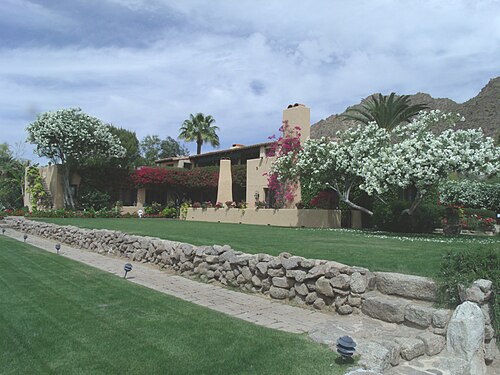 The Neil H. Gates House was built in 1929 and located at 4602 N. Elsie Avenue. It was listed in the National Register of Historic Places on August 11, 1986, reference #86002646.
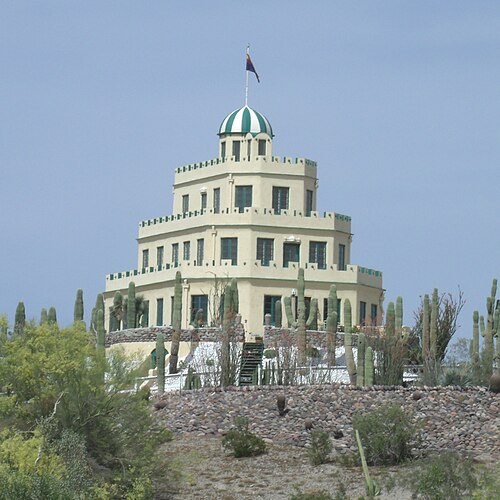 The Tovrea Castle was built between December 1929 and January 1931 and is located at 5041 E. Van Buren St. 'the house is listed on the National Register of Historic Places on Oct. 1, 1996.
 The Judge Fred C. Jacobs House was built in 1928 and is located at 6224 N. Central Avenue. The house is listed on the National Register of Historic Places.
 The Neil and Louise House was built in 1929 and is located at 5725 North 20th Place. It was listed in the National Register of Historic Places on November 22, 2016, reference #16000782.
 The Wrigley Mansion was built between 1929 and 1931. It is located at 2501 East Telewa Trail. The historic mansion was built by chewing-gum magnate William Wrigley Jr. It is also known as "La Colina Solana". The mansion has been designated as a Phoenix Point of Pride. The mansion was listed as the "William Wrigley Jr., Winter Cottage" on the National Register of Historic Places on August 16, 1989, ref.: #89001045.
 The Fred G. Hilvert House was built in 1929 and is located at 106 E. Country Club Drive. It was listed in the National Register of Historic Places on October 11, 2016, reference #16000700.
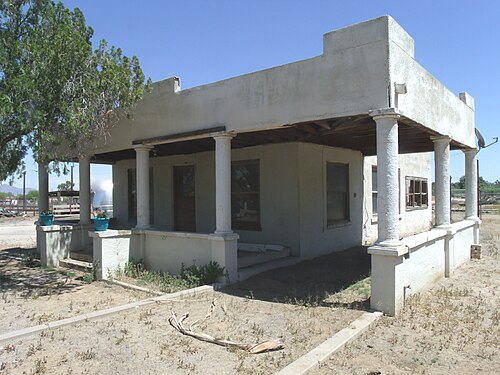 The Spanish Colonial Revival Residence located at 6451 S. 28th St. was built in 1930. It was listed in the Phoenix Historic Property Register in March 2008.
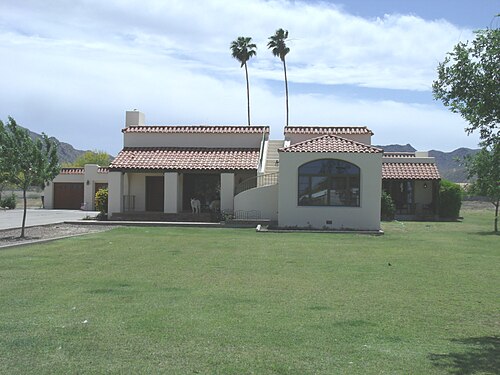 The Ralph H. Stoughton Estate house was built in 1930 and is located at 805 W. South Mountain Avenue. It was listed in the Phoenix Historic Property Register in May 1990 and in the National Register of Historic Places on July 3, 1986, reference #85001475. Boundary adjustments were made in June 2006. It was relisted in the Phoenix Historic Property Register in October 2010.
 The Lester DeMund House was built in 1930 and is located at 363 E. Monte Vista Road. It was listed in the National Register of Historic Places on January 6, 1995, reference #94001520.
 The Carter W. Gibbes House was built in 1930 and is located at 2233 N. Alvarado Road. It was listed in the National Register of Historic Places on August 25, 1983, reference #83002992.
 The Spanish Colonial Revival Residence located at 133 E. Carter Road was built in 1930. It was listed in the Phoenix Historic Property Register in July 1993.
 The Pueblo Revival House was built in 1930 and is located at 8040-50 S. 14th Street. It was listed in The Phoenix Historic Property Register in March 2008
 The Tudor Revival Residence located at 106 E. Greenway Road was built in 1931. It was listed in the Phoenix Historic Property Register in July 1993.
 The Borah Mansion located at 72 E. Country Club Dr. It was listed in the National Register of Historic Places on March 15, 2015, reference: #100002209.
 The William K. Humbert House was built in 1932 and is located at 2238 N. Alvarado Road. It was listed in the National Register of Historic Places on December 1, 1983, reference #83003476.
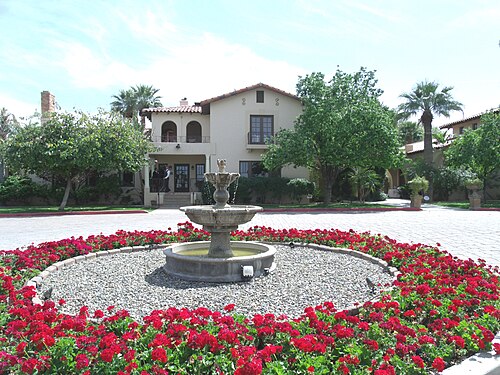 The Walter Strong House was built in 1929 and is located at 2501 E. Baseline Road. The property was listed in the Phoenix Historic Property Register in March 1993.
 The Franklin Hilgeman House was built in 1933 and is located at 333 West Loma Lane. It was listed in the National Register of Historic Places on June 26, 2017, reference #100001229
 The Bungalow Farm Residence was built ib 1935 and is located at 6413 S. 26th St. It was listed in the Phoenix Historic Property Register in January 1993.
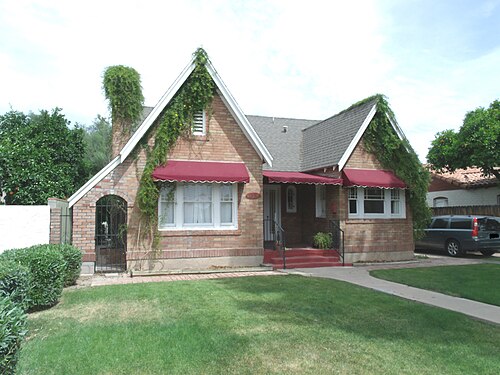 The Tudor Revival Residence, located at 1614 W. Vernon Avenue, was built in 1936. It is listed in the Del Norte Historic District of the Phoenix Historic Property Register in July 1993. The Del Norte Historic District was also listed in the National Register of Historic Places on December 21, 1994, reference: #94001482.
 The Tudor Revival Residence, located at 120 E. Carter Road, was built in 1936. It was listed in the Phoenix Historic Property Register in July 1993.
 The Main Ranch House of what once was a ranch in the base of Squaw Peak Mountain. The house, which has been converted into a restaurant, was built in the 1940s and is the oldest property located within the terrain of the Pointe Hilton Squaw Peak Resort, which was built in 1977. Both are located at 7677 North 16th Street.
 Inside the Main Ranch House located within the terrain of the Pointe Hilton Squaw Peak Resort.
 The Daniel & Clara Boone House was built in 1940 and is located at 1720 E. Elm St. It was listed in the Phoenix Historic Property Register in November 2005.
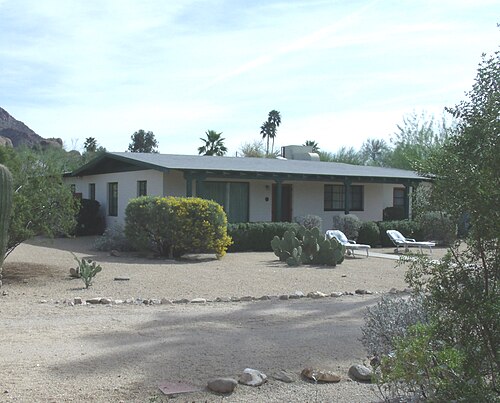 The L. Ron Hubbard House , a.k.a. as the L. Ron Hubbard House at Camelback , was built in 1945 and is located at 5501 N. 44th Street in Phoenix. The house belonged to Lafayette Ronald Hubbard, who was better known as L. Ron Hubbard, an American author who founded the Church of Scientology. The house is listed on the National Register of Historic Places.
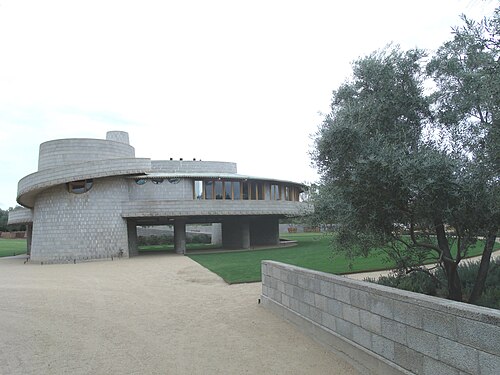 The David and Gladys Wright House was built from 1950-1952 and is located at 5212 East Exeter Boulevard, but currently has an entrance on the 4500 block of North Rubicon Avenue. The house was built in the Arcadia section of Phoenix as part of a Frank Lloyd Wright magazine story circa 1948 on how to live in the desert southwest. Both the circular design and the spiral ramps are features Wright also used in his design of the Solomon R. Guggenheim Museum. After Wright's death in 1959, his son David and daughter-in-law Gladys lived in the home until his death in 1997 at 102 years of age and his widow, Gladys, died in 2008 at 104, outliving their only son, who died at 49 years of age. David and Gladys were the only owners of the home and lived in it their entire lives. As of early 2022 the house has been registered on the national list of historic places.
 The John and Cindy McCain House built in 1951 and located at 7110 N. Central Avenue.
 The Benjamin Adelman House was built in 1951 and is located at 5802 N. 30th Street in Phoenix. The house was designed by Frank Lloyd Wright. It was a winter retreat for the Adelman's who owned a laundry business in Milwaukee, Wisconsin.
 The Dea Hong Toy House was built in 1954 and is located at 2222 East Pasadena Avenue. This property is recognized as historic by the Asian American Historic Property Survey.
 The Ozell M. Trask House was built in 1956 and is located at 333 W. Gardenia Dr. It was listed in the Phoenix Historic Property Register in October 2020.
 The Jorgine Boomer House was built in 1956 and is located at 5808 30th Street in Phoenix. The house was designed by Frank Lloyd Wright for Jorgine Slettede Boomer, the widow of Lucius Boomer, a successful hotelier. The house was listed in the National Register of Historic Places on March 15, 2016, reference #16000071.
 The Beadley House #11 was built in 1963 and is located at 4323 East McDonald Drive. It was listed in the National Register of Historic Places on November 13, 2017 reference #100001786.
 The White Gates Residence was built in 1964 and is located in 5202 Saddle Road in the corner of White Gates Drive in the southern end of Camelback Mountain. In 2009 it was listed in the Arizona Preservation Foundation Historic Properties Endangered list. The property is listed as Historic by the Phoenix Historic Property Register.
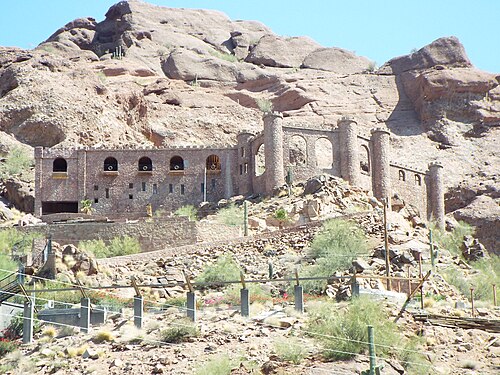 The construction of the Camelback Castle/Copenhaver Castle began in 1967 was finished in 1977. The castle is located at 5050 E. Red Rock Dr. The architectural style of the castle is that of medieval Moorish. The castle has a dungeon, a drawbridge and a moat as well.[31]
Historic African, Asian and Hispanic properties
The City of Phoenix conducted various historic property surveys focusing on the themes of African, Asian and Hispanic history in Phoenix from 1870 to 1975. The purpose of the surveys was to identify the number and locations of minority associated historic properties citywide and to document their significance to their community. The surveys were funded by the Phoenix Historic Preservation Bonds funds as well as a Certified Local Government grant received from the National Park Service through the Arizona State Historic Preservation Office. While the National Register of Historic Places Criteria is only concentrated on the properties of these communities prior to 1955, the study included in the surveys take into consideration the significance of the struggle for civil rights and equality. Therefore, the properties which were involved in ending segregation in Phoenix are also included.[32][33][34]
The areas covered in the African American Historic Property Survey are 1. East – the region south of Van Buren Avenue to the Southern Pacific Railroad tracks, east of Central Avenue to 24th Street; 2. West – the region south of Grant Avenue to the Salt River, west of 7th Avenue to 19th Avenue; and 3. South – the region south of the Salt River to Southern Avenue, east of 16th Street to 28th Street.[32]
The areas covered in the Asian American Historic Property Survey are spread throughout Phoenix and not concentrated in one area. The concentration of the areas depends on the nationality from which they are descended, such as Chinese, Japanese, Filipino and Asian Indian.[33]
The areas covered in the Hispanic American Historic Property Survey are the regions south of the Southern Pacific Railroad tracks to the Salt River, east of Central Avenue to 24th Street; west of Central Avenue to 27th Avenue and south of the Salt River to Baseline, east to 48th Street and west to 35th Avenue. One of the structures considered as iconic is the Sacred Heart Church which is located in 920 S. 17th St. The church was built in 1900 in what was once a Hispanic neighborhood called "Golden Gate". The City of Phoenix forced the residents of the community in question to move and demolished the entire neighborhood. The reason given for this act was that the city needed the land to expand Sky Harbor Airport. The church was added to National Register of Historic Places on March 20, 2012. Reference number 12000124.[35][34]
The following prominent people who at one time or another lived in Phoenix and whose houses are listed here are:
- Judge Hazel Burton Daniels – Daniels was the first African American elected to the Arizona legislature and was the first African-American municipal judge in Phoenix, serving as such from 1965 to 1971.
- Dr. Lincoln Johnson Ragsdale Sr. and Eleanor D. Ragsdale – The Ragsdales were influential leader in the Phoenix Civil Rights Movement. They played an instrumental role in the reforms made of voting rights and the desegregation of schools, neighborhoods and public housing.
- Charles Smith – Smith was the only African-American blacksmith in Phoenix in the early 1920s.
- John Ford Smith – Smith is the only Arizonan known to have played in the national Negro Baseball Leagues. In 1941 Smith joined the Kansas City Monarchs, a team that won its third straight pennant in the Negro American League that year. Smith worked for Phoenix Union High School, served as director of Eastlake Park, and eventually became assistant vice president of human resources at the Arizona Bank. He was active in civil rights issues and served as director of the Arizona Civil Rights Commission.[36]
- Travis L. Williams – Williams was one of the founders of Williams and Jones Construction Company which built homes primarily in South Phoenix. From 1964 to 1989 he worked for the City of Phoenix where he retired as the head of the Human Resources Department. He was a member of several service and civic organizations including the NAACP and Southminster Presbyterian Church.[37]
 Eastlake Park is bounded by 15th, 16th, Jefferson and Jackson streets. The period of historic significance of this park was from 1890 to 1949. In 1911, Booker T. Washington spoke there during the celebration called the Great Emancipation Jubilee. W. E. B. DuBois also addressed a crowd in the park. The park was listed in the Phoenix Historic Property Register in June 2009.
- The Swindall Tourist Inn was built in 1913 and is located at 1021 E. Washington Street. Prior to 1964, public accommodations in Phoenix and Arizona were segregated: African Americans were not allowed to stay in the hotels in downtown Phoenix. The structure, which is listed in the National register of Historic Places ref. number 95001081, is the only known surviving African-American boarding house in Phoenix. It is also listed on the African American Historic Property Survey.
 The Charles Smith Blacksmith Shop was built in the early 1920s and located at 1441 E. Van Buren St.
 African-American home built in 1920 and located at 1412 E. Jefferson Street. It is listed on the African American Historic Property Survey.
- The Shiloh Baptist Church built in 1924 and located at 901 W. Buckeye Road. This is one of the earliest African-American churches in the West side of Phoenix. It is listed on the African American Historic Property Survey.
- The Dunbar School was built in 1925 and is located at 707 W. Grant St. It was listed in the National Register of Historic Places on August 12, 1993, ref. #93000740.
- The Phoenix Union Colored High School (Later renamed George Washington Carver High School) was built in 1926 and is located at 415 E. Grant St. It was listed in the National Register of Historic Places on May 2, 1991, ref. #91000543.
- The Booker T. Washington School was built in 1928 and is located at 1201 E. Jefferson St. The school was the first all Black elementary school in Phoenix. It now houses the "Sun Times" of Phoenix. It is listed in the Phoenix Historic Property Register.
 Different view of the Booker T. Washington School
- The Tanner Chapel A.M.E. Church, named after Bishop Benjamin T. Tanner, is located at 20 S. 8th Avenue. Built in 1929, it is the oldest African-American congregation in Arizona. Designated as a landmark with Historic Preservation-Landmark (HP-L) overlay zoning. It is listed in the Phoenix Historic Property Register (PHPR).
 Three of the six cottages that Dr. Winston C. Hackett had built in the 1930s for his patients who were suffering from tuberculosis. They are located on 14th Avenue between East Jefferson and Washington Streets.
 The W.A. Robinson House was built in 1935 and is located at 1314 East Jefferson Street. Robinson was the principal of Washington Carver High School, an African-American school. He was concerned about the effects which the desegregation of the schools may have on the African-American students. It is recognized as historical by the City of Phoenix African-American Survey.
 Entrance of where the historic Matthew Henson Public Housing Project once stood. The Matthew Henson Public Housing Project was built in 1940 and provided affordable housing for the African-American community. The Matthew Henson Public Housing Project District is located on the west side of Seventh Avenue just south of the Sherman Street alignment. It was named as a historic district by the Phoenix Historic Property Register in June 2005.
 One of the original houses in the courtyard of the Matthew Henson Public Housing Project. The house was built in 1940 and in a courtyard which has been preserved from demolition. The housing project was built in 1940 and provided affordable housing for the African-American community. The Matthew Henson Public Housing Project district is located on the west side of Seventh Avenue just south of the Sherman Street alignment. It was named as a historic district by the Phoenix Historic Property Register in June 2005.
 The Dr. Lincoln Johnson Ragsdale, Sr. House was built in 1941 and located at 1606 West Thomas Road.
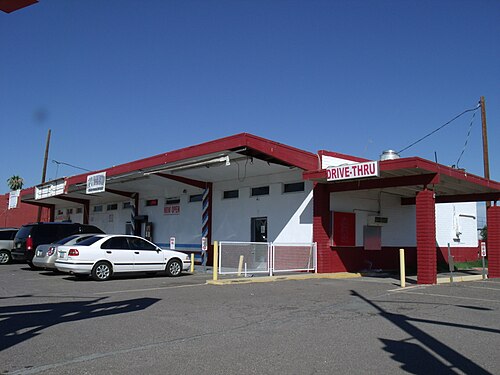 This is the building where in 1944, Gordon Fritch established his Gordon Fritch Cafe. The cafe, which was a popular place among Phoenix's African Americans, is located at 1602 East Jefferson Street. Later, Reddey's Corner was established. "Reddey's Corner" was the oldest Drive-in Liquor Store in Phoenix. It is listed on the African American Historic Property Survey.
- The Mount Calvary Baptist Church was built in 1944 and is located at 998 South 13th Avenue in Phoenix. It is one of the earliest churches to serve the Phoenix Afro-American community. It is listed on the African American Historic Property Survey.
 The Bethel CME Church (Bethel Mission) was built in 1944 and is located in 998 S. 13th Avenue. It is listed as historic by the Phoenix African-American Survey.
 The St. John's Institutional Baptist Church was built in 1944 and is located in 1428 S. 13th Avenue. The Rev. L.J. Dunbar led St. John's Institutional Baptist Church, starting in 1941. Dunbar helped organized approximately 35 other Baptist churches in the state. He died in 1994 at the age of 91. It is listed as historic by the Phoenix African-American Survey.
 The Geogie M. & Calvin C. Goode Bandshell was built in 1945 and is located in Eastlake Park at 1549 E. Jefferson St. In 1948 African American activist Claudia Jones spoke from the bandshell to a crowd of 1,000 people at Eastlake Park about equal rights for African Americans. The bandshell is named after African-American Geogie M. Goode, an author, educator and activist. She was married to Calvin C. Goode, who served a total of 22 years as a representative to the Phoenix, Arizona City Council. The bandshell is listed in the Phoenix Historic Property Register.
 The Robert and Louise Phillips House was built in 1946 and is located at 4417 S. 19th St. In December 1946, Phoenix dentist Robert Phillips and his wife, Louise, created a subdivision called Carlotta Place. Both Dr. and Mrs. Phillips were involved in the school desegregation effort in the early 1950s, and Louise was president of the Maricopa branch of the NAACP until 1960. It was listed as historic by the Phoenix African-American Survey.
 The William H. Patterson Elks Lodge No. 477 was built in 1946 and is located at 1007 S. Seventh Avenue. Built by the African-American community and named after William H. Patterson, who once was a Buffalo Soldier, in what once was a segregated Phoenix. Designated as a landmark with Historic Preservation-Landmark (HP-L) overlay zoning. It is listed in the Phoenix Historic Property Register.
- The Lucy Phillips Memorial C.M.E. Church was built in 1947 and is located at 1401 E. Adams St. The church was built by the African-American community in Phoenix. It was named Lucy Phillips Memorial C.M.E. Church in honor of the wife of the first presiding bishop, the Rev. Charles Henry Phillips. The church was listed in the Phoenix Historic Property Register in June 2005.
 The Hazel Burton Daniels House was built in 1947 and is located at 2801 North 5th Street.
 The Mary McLeod Bethune School (Bethune Elementary School) was built in 1947 and is located at 1510 S. 15th Avenue. The Mary McLeod Bethune Elementary School is another segregated school opened by the Phoenix School District. It was built to provide for the rapidly expanding Black community on the west side of Phoenix. It is listed as historic by the Phoenix African-American Survey.
 This building, located in 1203 East 11th Avenue in Phoenix, is where the Westside Theater was located in 1948. The Westside Theater was the first theater owned by an African American in Arizona. It is listed on the African American Historic Property Survey.
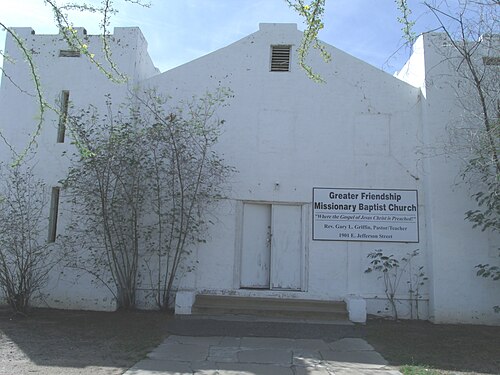 The Greater Friendship Missionary Baptist Church was built in 1949 and is located at 1901 E. Jefferson St. The Greater Friendship is one of several churches founded in the area in the 1940s. City of Phoenix historians call the building a modest Norman Revival-style of architecture, with a front parapet, gabled roof and two towers. It was listed as historic by the Phoenix African-American Survey.
 The Higher Ground Church of God in Christ was built in 1949 and is located at 1302 E. Madison St. Later called Abundant Life Baptist Church, the property was purchased by Pilgrim Rest Baptist Church in 2004. No services are currently held here, but the building is used for youth groups, funerals and other Pilgrim Rest gatherings. It was listed as historic by the Phoenix African-American Survey.
 The Dr. Lowell Wormley House was built in 1949 and is located at 1910 E. Broadway Road. Dr. Lowell Wormley was born in Washington, D.C., and studied medicine at Howard University Medical School. When he arrived in Arizona in the mid-1940s, he was one of only three African-American doctors in Phoenix. He was on the staff of both St. Joseph's and Good Samaritan hospitals. He opened his own practice in 1946 in the Midtown Medical Building, 1 N. 12th St., and practiced there until the early 1980s. In 1949, he and his wife, Olivia, built this home on East Broadway Road. The house was listed in the Phoenix Historic Property Register in June 2005.
 The Aldridge House, also known as Aubrey and Winstona Aldridge House, is located at 1326 E. Jefferson St. and was built in 1950. It was the home of Winstona Hackett, daughter of Dr. Winston Hackett the first African-American doctor in the area, and her husband Aubrey Aldridge. Designated as a landmark with Historic Preservation-Landmark (HP-L) overlay zoning. It is listed in the Phoenix Historic Property Register (PHPR).
- The Progressive Builders Association Building was built in 1953 and is located at 2019 E. Broadway Road. The Progressive Builders Association built homes in downtown Phoenix, giving many African Americans their first opportunity to buy a brand-new home. In 1945, members of the community met at the First Institutional Baptist Church and formed the Progressive Builders Association. It was listed as historic by the Phoenix African-American Survey, in the Phoenix Historic Property Register in June 2005 and in the National Register of Historic Places.
 The Southminster Presbyterian Church was built in 1954 and is located at 1923 E. Broadway Road It was the only African-American Presbyterian church in Phoenix when it was founded in 1954. The Rev. George Benjamin Brooks, a Phoenix civil-rights leader, was the founding pastor. It was listed as historic by the Phoenix African-American Survey.
 The Morrison E. Warren House was built in 1956 and is located at 2131 E. Violet Dr. Morrison E. Warren was the first African American elected to the Phoenix City Council (1966 to 1970). He also served as vice-mayor from 1972 to 1994. The property was listed as historic by the Phoenix African-American Survey.
 The Calvin and Georgie Goode Duplex House were built in 1959 (1508) and 1959 (1510) and is located at 1508-10 East Jefferson Street. Calvin Goode served a Phoenix City Councilman for 22 years. His wife, Georgie Goode, was a Civil Rights leader and activist. It is recognized as historical by the City of Phoenix African-American Survey.
 Part of the Calvin and Georgie Goode Duplex House (5010) where the Ragsdale;s once resided.
 The John Ford Smith House built in 1959 and located at 5025 S. 21 Way.
 The Travis Williams House built in 1959 and located at 5044 S. 21 Way.
- Dea Hong Toy – Toy was born in China and moved to Phoenix in 1923. He was a successful merchant. Toy was among those in the Asian community of Phoenix who in 1938 founded the Chinese Chamber of Commerce to protect and promote their businesses.
- Wing F. Ong – Ong lived in a house in the rear of his grocery store which is listed here. He ran for the state House of Representatives as a Democrat in 1946 and was elected, the first Chinese American in the country to achieve such status. Over the course of his career, he was elected twice to the state House and once to the state Senate.
- Lee Jew – Jew was a Chinese merchant who owned the "Lee Jew Market" on E. Jefferson St. He was influential as a leader in the Phoenix Chinese community.
- The Yaun Ah Gim Groceries is located at 1002 S. 4th Avenue. The building which was built in 1900 is in a state of abandonment. It was added to the National Register of Historic Places July 8, 1986. Reference number 86001553 (NRHP).
- The Kunz-Carbajal House, located at 1721 S. Seventh Avenue was built in 1904. Felix Carbajal was one of first Filipino residents in Phoenix.
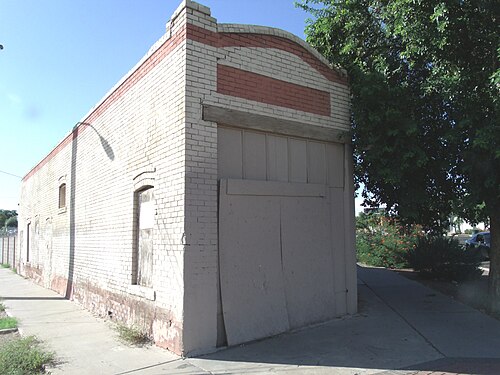 The K.S. Tang Grocery building was built in 1914 and is located at 901 Northwest Grand Avenue. The property was leased to Chinese grocers, Yung Yee Ghee from 1916 to 1920, and to K. S. Tang from 1928 to 1937. This property is recognized as historic by the Asian American Historic Property Survey. On October 1, 1985, the building was listed in the National Register of Places together with its neighbor, the Durand Grocery as Durand Grocery, ref. #85002891.
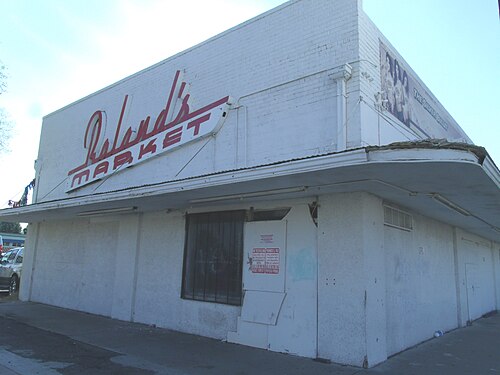 The Roland's Market building was built in 1917 and is located at 1505 East Van Buren Street. This property is recognized as historic by the Asian American Historic Property Survey.
- The Temple Beth Israel (1922)/ First Chinese Baptist Church (1957)/ Iglesia Bautista Central (1981) was built in 1922 and is located at 122 E. Culver St. It was Phoenix's first synagogue and the building later served as Phoenix's first Chinese Baptist Church and from 1981 to 2002, the Hispanic community as the Iglesia Bautista Central. It was listed in the National Register of Historic Places on February 22, 2011, reference #11000043.
- The Wing F. Ong Grocery Store located at 1246 E. Jefferson St. and built in 1925.
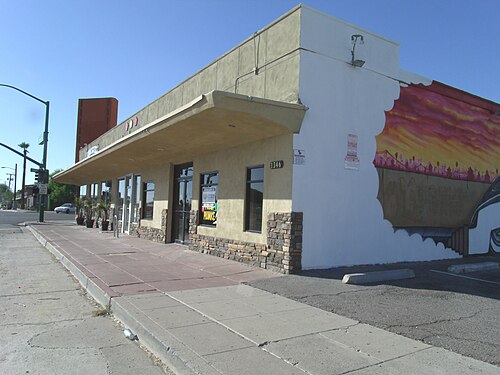 The building where Henry & Co. was once housed was built in 1928 and is located at 1346 West Roosevelt Avenue. This property is recognized as historic by the Asian American Historic Property Surve.
- The Jim Ong's Market was built in 1928 and is located at 1110 E. Washington St. The structure, one of two built by the owner in the Chinese Community, also served as the home of the Ong family. Listed in the National Register of Historic Places. Reference number 82002084 (NRHP).
 Different view of Jim Ong's Market built in 1928 and located at 1110 E. Washington St. The structure, one of two built by the owner in the Chinese Community, also served as the home of the Ong family. Listed in the National Register of Historic Places. Reference number 82002084 (NRHP).
- The Ong Yut Geong Market Warehouse was built in 1930 and is located at 502 S. 2nd. St. Listed in the National Register of Historic Places. Reference #86002066.
- The Arizona Buddhist Church/Temple built in 1930 and located at 4142 West Clarenden Avenue was the first church if its kind in Arizona.
 The Lee Jew Market building was built in 1931 and is located at 1501 East Washington Street. The building is listed as historical by the City of Phoenix Asian American Historic Property Survey.
 The T and T Market building was built in 1939 and is located at 2145 East Van Buren Avenue. This property is recognized as historic by the Asian American Historic Property Survey.
 The K.L. Tang Grocery building was built in 1942 and is located at 1141 East Buckeye Road. The "Tang House" was built in the early 1900s. This property is recognized as historic by the Asian American Historic Property Survey.
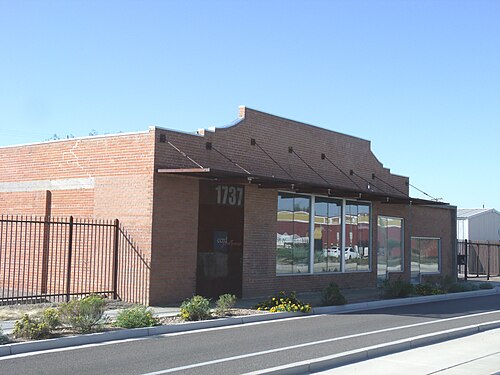 The Modern Food Market building was built in 1948 and is located at 1737 E. Washington Avenue. This property is recognized as historic by the Asian American Historic Property Survey of the City of Phoenix.
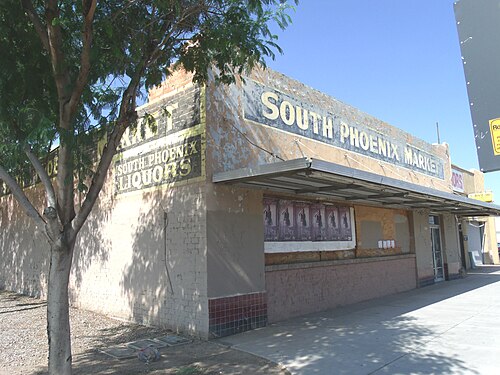 The South Phoenix Market building was built in 1948 and is located at 4341 S. Central Avenue. This property is recognized as historic by the Asian American Historic Property Survey of the City of Phoenix.
- The Dea Hong Toy House was built in 1954 and is located at 2222 East Pasadena Avenue. Toy was born in China and moved to Phoenix in 1923. He was a successful merchant. Toy was among those in the Asian community of Phoenix who in 1938 founded the Chinese Chamber of Commerce to protect and promote their businesses. This property is recognized as historic by the Asian American Historic Property Survey.
- Vincente Canalez – In 1945 Canalez was selected to serve as Maricopa County chairman to fight infantile paralysis, and served on the City of Phoenix's planning commission in the 1950s. He moved to the Arizona town of Buckeye in 1957, and served as mayor of Buckeye in 1960.
- Valdemar Aguirre Cordova – Cordova served as the first Mexican American Maricopa County Superior Court judge, from 1965 to 1967, and then appointed to a second term in 1976 by Governor Raul Castro.
- Jesus Franco – The Spanish-language newspaper, El Sol, emerged in 1938 under the leadership of Jesús Franco, who became a very well-known individual in the Mexican community.
- Albert and Mary Garcia – Albert Garcia was Arizona's first Hispanic Assistant Attorney General. María García was an activist for social issues.
- Placida Garcia Smith – Placida Garcia Smith founded the "Friendly House" in the mid-1920s as a two-room "community house" where classes in English, citizenship, hygiene and homemaking were taught to Mexican residents.
- Rudolf Zepeda – Zepeda was the first Hispanic official at Valley National Bank in the 1950s, serving as the vice-president for foreign trade.
- Adam Perez Diaz – In 1954, Diaz became the first Hispanic elected to the Phoenix City Council and also served as Vice-Mayor. President Bill Clinton appointed Diaz to the National Council on Aging
- The Jones-Montoya House, located at 1008 E. Buckeye Road, was built in 1879 and is one of Phoenix's oldest houses. It is listed in the Phoenix Historic Property Register.
 The Sotelo-Heard Cemetery was established in 1896 and is located at 1127 W Broadway Road. This is on the southeast intersection of 12th Avenue and Broadway Road. Hundreds of Mexican laborers and their children were buried near 12th Avenue and Broadway Road from the late 1880s to the 1920s. The cemetery received heavy use between 1896 and 1922 in a community where a majority of the residents were of Mexican descent and settled, farmed, or dug irrigation canals in the Lower Salt River Valley. Many were laborers on the Bartlett-Heard Ranch or other Anglo-owned ranches in the area. The cemetery was listed in the Phoenix Historic Property Register in October 2007. Throughout the years, grave robbers and kids trampled on the headstones and destroyed them. The site is in complete state of abandonment.
 The Rancho Joaquina House was built in 1900 and is located at 4630 E. Cheery Lynn Rd. Listed in the National Register of Historic Places in 1984. Reference number 84000786.
- The Sacred Heart Church built in 1900, is located in 920 S. 17th St. It was added to National Register of Historic Places on March 20, 2012. Reference number 12000124.
- The Arvizu's El Fresnal Grocery Store, also known as 25-23 was built in 1900 and is located at 310 E. Buchanan. It was added to the National Register of Historic Places in 1985. Reference number 85002046.
- The Del Monte Market was built in 1908 and is located at 2659 W. Dobbins Road. It is the oldest continuously operating market in the state. Designated as a landmark with Historic Preservation-Landmark (HP-L) overlay zoning. Listed in the Phoenix Historic Property Register.
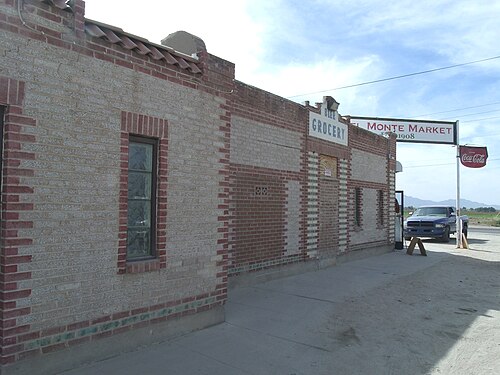 Different view of Del Monte Market built in 1908 and located at 2659 W. Dobbins Road. It is the oldest continuously operating market in the state. Designated as a landmark with Historic Preservation-Landmark (HP-L) overlay zoning. It was listed in the Phoenix Historic Property Register.
 The Pete Romo House was built in 1913 and is located at 753 E. Pierce St. Pete Romo owned a butcher shop on Washington Street, near the Ramona Theater in the 1920s. This property is recognized as historic by the Hispanic American Historic Property Survey of the City of Phoenix. The house is part of the Garfield Historic District which is listed in the National Register of Historic Places, reference number: #10000325.
- The Luis Lugo Bakery "La Patellera" was built in 1917 and is located at 415 W. Sherman St. This structure is one of the earliest Hispanic commercial properties in Phoenix. Designated as a landmark with Historic Preservation-Landmark (HP-L) overlay zoning. It is listed in the Phoenix Historic Property Register.
- The First Mexican Baptist Church was built in 1920 and is located at 1002 E. Jefferson Avenue. This property is recognized as historic by the Hispanic American Historic Property Survey of the City of Phoenix.
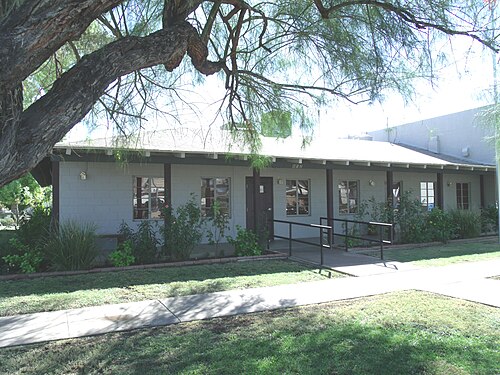 The Friendly House structure was built in 1900 and is located at 802 South 1st. Avenue. The Friendly House was established in 1922 by the Phoenix Americanization Committee presided by Placida Garcia Smith with the help of Mary Garcia to assist immigrants in transitioning their lives to Arizona. This property is recognized as historic by the Hispanic American Historic Property Survey.
 The Placida Garcia Smith House was built in 1925 and is located at 111 W. Granada Rd. Placida Garcia Smith founded the "Friendly House", located at 802 S. 1st. Avenue, in the mid-1920s as a two-room "community house" where classes in English, citizenship, hygiene and homemaking were taught to Mexican residents. This property is recognized as historic by the Hispanic American Historic Property Survey. It is located in the Willo Historic District which was listed in the National Register of Historic Places on January 9, 1991, ref.: 90002099.
 The John and Enriqueta House built in 1926 and located at 1322 S. 1st. Avenue. This property is recognized as historic by the Hispanic American Historic Property Survey.
 Harmon Park was built in 1927 and is located at 1425 S. 5th Avenue. It was listed in the Phoenix Historic Register in October 2007.
- Gerardo's Building built in 1928 and located at 421 S. Third St. It once housed a café on the first floor and residential rentals on the upper level. Listed in the National Register of Historic Places. Reference number 85002057.
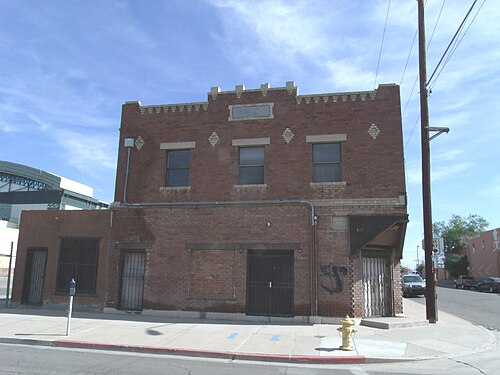 Different view of Gerardo's Building. Listed in the National Register of Historic Places, reference number 85002057.
- The Immaculate Heart of Mary Catholic Church was built in 1928 and is Phoenix's oldest Hispanic church. It is located at 909 E. Washington St. It was listed in the National Register of Historic Places on October 8, 1993, ref. number 93000742.
 This is the Albert and Mary Garcia House located at 2201 N Dayton St. The house was built in 1930. Albert Garcia became Arizona's first Hispanic Assistant Attorney General, from 1937 until 1942. María Garcia stood out as a woman who courageously spoke up for social issues, even though she was an immigrant and carried a heavy accent. The house is in the Historic Coronado District which is listed in the National Register of Historic Places, reference: #86000206.
 The Valdemar Aguirre Cordova House built in 1930 is located at 1917 W Monte Vista Rd. Cordova served as the first Mexican American Maricopa County Superior Court judge, from 1965 to 1967, and then appointed to a second term in 1976 by Governor Raul Castro. This property is recognized as historic by the Hispanic American Historic Property Survey.
 Grant Park is bounded by 714 S. Second Avenue / 701 S. Third Avenue. Grant Park, created in 1934 as part of a WPA construction project, functioned as an important site for Mexican American children's recreation. The recreation programs were led by a recreation director, Laura McClelland, who was well-known in the community for her time and compassion for the area children. The park was listed in the Phoenix Historic Property Register in November 2007.
- The St. Pius X Catholic Church was built in 1935 and is located at 802-815 South 7th Avenue. The church is listed in the Phoenix Historic Property Register.
 815 is the location where Father Emmett McLoughlin established the historic "Father Emmett Mission" in 1930. The St. Pius X Catholic Church, which merged with the building was built in 1935 and is located at 802-815 South 7th Avenue. It is listed on the Hispanic American Historic Property Survey.
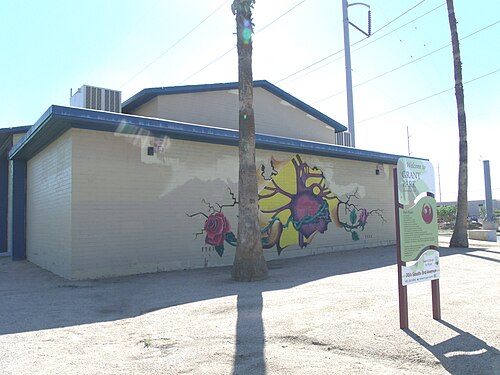 The Grant Park Pool building was built in 1944 as a result of the 1934 Civil Works Administration funding. It is located in the corner of Grant St. and 2nd Avenue. The Pool served the Hispanic community of Phoenix at a time when the usage of public swimming pools was segregated. Grant Park, where the pool is located, is listed in the Phoenix Historic Property Register.
 This is where La Estrella Tortilla Shop was once located. The building was built in 1938 and is located at 302 Yavapai St. and 3rd Aven ue. This property is recognized as historic by the Hispanic American Historic Property Survey of the City of Phoenix.
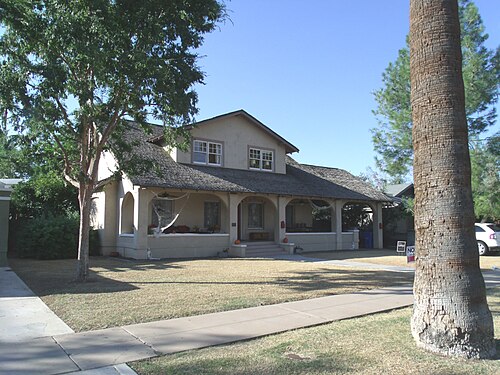 The Jesus Franco House was built in 1940 and is located at 321 W. Portland Avenue. The Spanish-language newspaper, El Sol, emerged in 1938 under the leadership of Jesús Franco, who became a very well-known individual in the Mexican community. This property is recognized as historic by the Hispanic American Historic Property Survey of the City of Phoenix. The house is listed in the National Register of Historic Places as part of the Roosevelt Historic District reference number: #83003490.
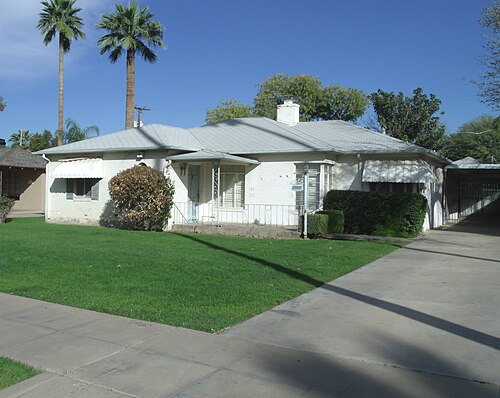 The Rudolf Zepeda House was built in 1940 and is locate at 1310 W Palm Lane. Rudolf Zepeda, became the first Hispanic official at Valley National Bank in the 1950s, serving as the vice-president for foreign trade. The house is located in the Encanto Historic District which was listed in the National Register of Historic Places on February 16, 1984, reference #84000696.
 The Marcos de Niza Housing Project was established by Father Emmett McLoughlin in 1941. The housing project is located at 305 W. Pima St. This property is recognized as historic by the Hispanic American Historic Property Survey of the City of Phoenix.
 The Adam Perez Diaz House was built in 1942 and is located at 1313 S. 1st St. This property is recognized as historic by the Hispanic American Historic Property Survey of the City of Phoenix.
 The American Legion Post #41 , also known as the "Tony Souza-Ray Martinez Thunderbird Post #41", was built in 1945 and is located at 715 S. 3rd Avenue. This property is recognized as historic by the Hispanic American Historic Property Survey of the City of Phoenix. The building was listed in the Phoenix Historic Property Register in November 2007.
 Different view of the American Legion Post #41.
- The Primera Iglesia Metodista (First Methodist Church) was built in 1947 and located at 701 S. 1st St. This property is recognized as historic by the Hispanic American Historic Property Survey of the City of Phoenix. It was designated as a landmark with Historic Preservation-Landmark (HP-L) overlay zoning. It is listed in the Phoenix Historic Property Register.
 Different view of the El Portal restaurant.
- St. Anthony Church was built in 1948 and is located at 909 S. 1st St. This property is recognized as historic by the Hispanic American Historic Property Survey of the City of Phoenix.
- The once location of the Iglesia 'Betania Presbiteriana. The structure was built in 1950 and is located at 301 W Pima Street. This property is recognized as historic by the Hispanic American Historic Property Survey.
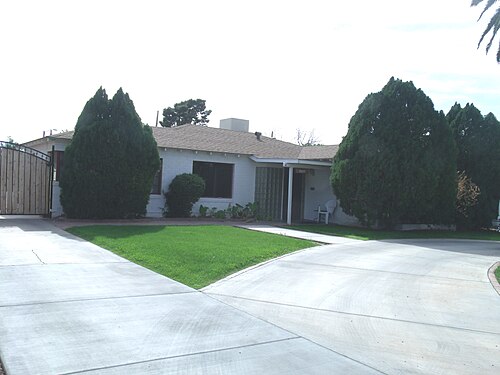 The Vincente Canalez House was built in 1951 and is located at 2627 N Evergreen St. Canalez co-owned the Ramona Pharmacy with future Arizona governor Bob Jones. Canalez later became involved in the Democratic Party as a precinct committeeman. In 1945 he was selected to serve as Maricopa County chairman to fight infantile paralysis, and served on the City of Phoenix's planning commission in the 1950s. He moved to the Arizona town of Buckeye in 1957, and served as mayor of Buckeye in 1960. This property is recognized as historic by the Hispanic American Historic Property Survey.
 This historic building is the Santa Rita Center (also known as Santa Rita Hall). It is located at 1017 E. Hadley Street between 10th Street and 10th Place. It was here where Arizona native Cesar Chavez, the hero of farm workers, began his 24-day hunger strike on May 11, 1972, to draw attention to the inhumane conditions farm workers endured in the fields. Coretta King met with Chavez in the hall during his fast. For a while, the hall was the headquarters of what became the United Farm Workers of America Union. The structure, which was built in 1962, was listed in the Phoenix Historic Property Register in October 2007.
 A different view of the historic Santa Rita Center.
Arizona Biltmore Hotel

 Hotel street entrance
 Arizona Biltmore Hotel bridge
 Stylized bricks by architect, Albert Chase McArthur.
 Inside view of the main entrance of the Arizona Biltmore Hotel.
 The lobby of the Arizona Biltmore Hotel.
 The Paradise Wing of the Arizona Biltmore Hotel built in 1929 and located at 2400 Missouri Avenue.
 Mystery Room secret passageway.
 The fireplace inside the Mystery Room.
 Stained glass ceiling in the Mystery Room.
 Spotlight on top of the hotel tower
 Room 1201, Clark Gables room.
 Inside the Arizona Biltmore Hotel Aztec Room.
 Inside the Biltmore History Room
 The Wooden key on display above the fireplace in the History Room.
 Furnishings inside the Biltmore History Room.
 The Gold Room.
 The "Legend of the Sun" painting.
 Large chess board on the grounds of the Arizona Biltmore Hotel. According to the Arizona Biltmore Hotel historians, American actress Martha Raye played there.
 The Arizona Biltmore Hotel Catalina Pool was built in the 1930s. The pool was often used by actress Marilyn Monroe and allegedly the site where American composer Irving Berlin wrote "White Christmas".
 Paradise Pool three story water slide
 The Reagan honeymoon cottage, Cottage I.
 The Frank Lloyd Wright "Sprites" are statues that were made in 1914 and adorned the Midway Gardens in Chicago. After World War II, the "Sprites" were in a state of abandonment and in pieces. They were restored and became part of the adornment of the Arizona Biltmore Hotel gardens in 1985.
Arizona State Capitol Museum
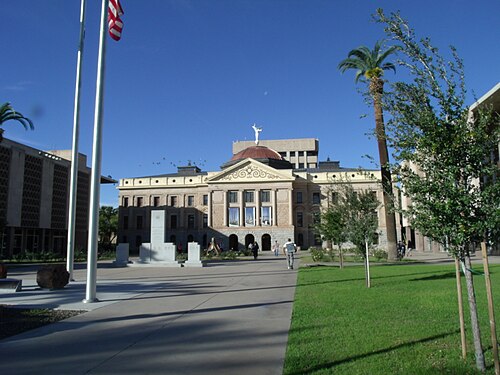
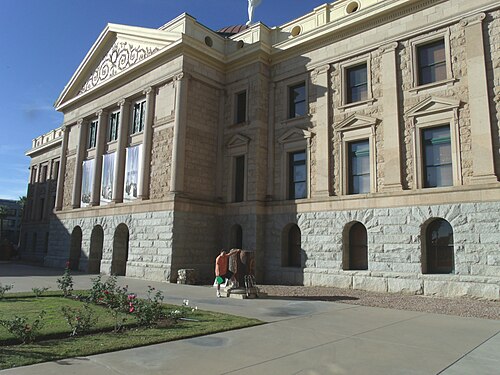 Another view of the Arizona State Capitol built in 1901 which is now the Arizona State Capital Museum.
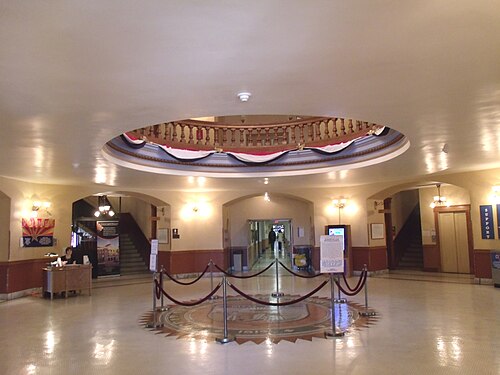 The rotunda floor of the Arizona State Capitol Building.
 Part of the USS Arizona superstructure which was salvaged and which is on display at the Arizona State Capitol Museum.
 The U.S. flag that flew on the battleship USS Arizona when it sank during the Pearl Harbor. The flag is on display in the first floor of the Arizona State Capitol Museum.
 The Arizona Capitol Museum is home to the silver service (silverware) that was donated to the USS Arizona by the citizens of Arizona in 1919. This service is composed of 59 distinct pieces on display at the Capitol Museum.
 Additional silver service (silverware) that was donated to the USS Arizona by the citizens of Arizona in 1919. on display at the Arizona Capitol Museum.
 Model of the USS Arizona at the Arizona State Capitol Museum.
 The Governor's office on the second floor has a wax figure of Arizona's First State Governor, George W. P. Hunt.
 The sword and scabbard which Alexander Oswald Brodie, who served as the Governor of the Territory of Arizona from 1902 to 1905, used during his service with the Rough Riders during the Spanish–American War. The exhibit is located in the second floor of the Arizona State Capitol Museum.
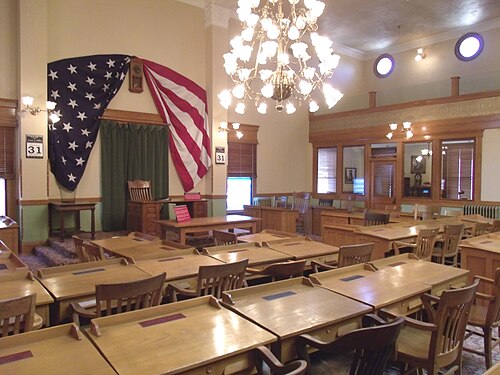 Inside the historic House Chamber. The Chamber is located on the third floor of the Arizona State Capitol Museum.
 Replica of the original Office of the Secretary of State. The office is located on the third floor of the Arizona State Capitol Museum.
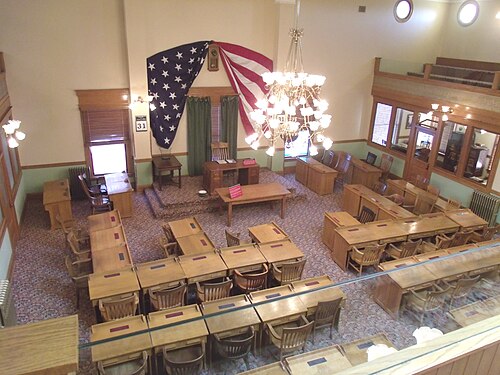 On the fourth floor of the Arizona State Capitol Museum you can look down into the original House Chamber from the gallery.
 On the fourth floor of the Arizona State Capitol Museum you can look down into the original House of Representatives from the gallery.
Bennitt Mansion
 The Bennitt Mansion was built in 1928 and is located at 126 E. Country Club Drive. The mansion is a good example of Spanish Colonial Revival Style residential architecture by master architect, Herbert Harmon Green. E.J. Bennitt was among the investors who in November 1882, organized the First National Bank of Phoenix, which later was reorganized as Valley Bank, which became the largest bank in Arizona. In March 1892, he organized the Phoenix National Bank. He organized the Phoenix Commandery No. 3, K.T., in 1891; was appointed gereneralissimo, elected eminent commander in 1893 and grand commander of the Grand Commandery of Arizona in 1895. The mansion was listed in the National Register of Historic Places on August 12, 2009, reference #09000609.
 The focal point of the Bennitt Mansion is its arched doorway. The arch is articulated by the use of natural finish concrete formed to replicate cut stone jamb blocks and voussoirs with raked joints. Special craftsmanship is found in the milled door casing, which follows the curve of the semicircular arched opening. The heavy, stained wood door has 11 recessed panel delineated by high-relief moldings. The mansion was listed in the National Register of Historic Places on August 12, 2009, reference #09000609.
 Different view of the Bennitt Mansion
 Back of the Bennitt Mansion
Mystery Castle
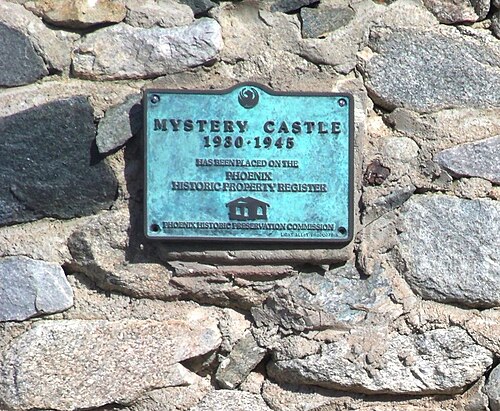 Historic Mystery Castle plaque.
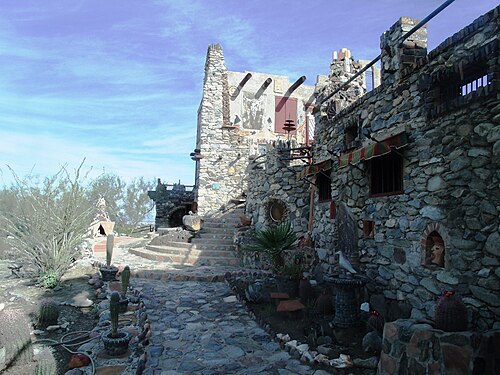 Mystery Castle is located at 800 E. Mineral Road, in the city of Phoenix, in the foothills of South Mountain Park. It was built in the 1930s by Boyce Luther Gulley. The castle is designated as a Phoenix Point of Pride.
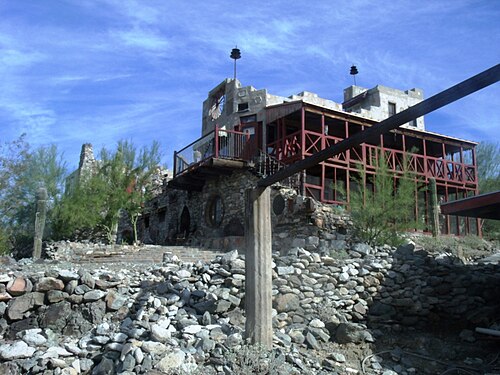 Different view of the Mystery Castle.
 Main entrance of the castle/
 One of 18 rooms in the castle.
 Another room in the castle.
 Mary Lou Gulley's bedroom.
 Another bedroom in the castle.
 Pictured is a window that Gulley made with the spoke rim of an old car. The castle is designated as a Phoenix Point of Pride.
 Image of the BBQ Pit.
 Ornament on a wall outside of the castle which resembles a cat.
Scorpion Gulch
 Scorpion Gulch historical marker, which reads "Scorpion Gulch Trading Post 1936".
 The Scorpion Gulch store was built in 1936 by William Lunsford. It is located at 10225 S. Central Ave, in South Mountain Park in Phoenix, Arizona. The property was listed in the Phoenix Historic Property and Preservation Register in October of 1990 (PHPR).
 Different view of the Scorpion Gulch store (PHPR).
 Inside view of the Scorpion Gulch store (PHPR).
 The ruins of the Scorpion Gulch residence. It is located at 10225 S. Central Ave, in South Mountain Park in Phoenix, Arizona. The property was listed in the Phoenix Historic Property and Preservation Register in October of 1990 (PHPR).
 Front view of the ruins of the Scorpion Gulch residence (PHPR).
 The main room (living room) ruins of the Scorpion Gulch residence (PHPR).
 The Scorpion Gulch Well (PHPR).
Squaw Peak Inn
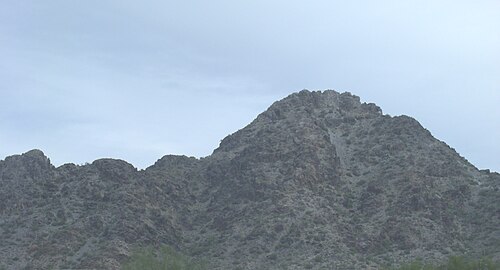 Squaw Peak Mountain
 The first building built in 1929 by William Eugene D'Allemund in what became Squaw Peak Ranch and later Squaw Peak Inn.
 Another view of the first adobe building built in 1929 by William Eugene D’Allemund. The building was the first property of what was to become Squaw Peak Ranch and later Squaw Peak Inn.
 Main entrance to the historic Inn. The Water fountain was added after the Epley's purchased the property.
 A gazebo on the property of Squaw Peak Inn built by William "Bill" Epley.
 Room of the original 1937 Squaw Peak Inn building constructed by the Stopford family.
 Another room of the original 1937 Squaw Peak Inn building constructed by the Stopford family.
 One of the rooms inside the historic Squaw Peak Inn.
 Restored and modernized bathroom inside the historic Squaw Peak Inn.
 Early 19th-century organ in the main room of Squaw Peak Inn.
 Wall decoration created by Ann Epley in the Squaw Peak Inn.
 View of the outside of second floor of the Squaw Peak Inn
 Room in the second floor of the Squaw Peak Inn.
 The stairs leading downstairs from the second floor of the Squaw Peak Inn.
Westward Ho Hotel

 Different view of Westward Ho Hotel. The Westward Ho Hotel was built in 1928 and is located at 618 N. Central Avenue. It was listed in the National Register of Historic Places on February 19, 1982. ref. #82002082.
 Main entrance of the Westward Ho Hotel. The hotel was built in 1928 and is located at 618 N. Central Avenue. On November 3, 1960, Senator John F. Kennedy made a campaign speech during a Westward Ho Hotel Democratic Breakfast.[39]
 The lobby of the Westward Ho Hotel. The hotel was built in 1928 and is located at 618 N. Central Avenue. Among the notable people who have passed through this lobby are John F. Kennedy, Marilyn Monroe, Paul Newman, Elizabeth Taylor, Nicky Hilton, Roy Rogers, Jackie Gleason, Myrna Loy, Amelia Earhart, Esther Williams, Danny Thomas, Gary Cooper, Lucille Ball, Clark Gable, Henry Fonda, Bob Hope, Liberace, Lee Marvin, Tyrone Power, Eleanor Roosevelt, Shirley Temple, Al Capone, Spencer Tracy, John Wayne, and Robert Wagner married Natalie Wood on the hotel Patio.[40]
 The Grand Dining Room of the Westward Ho Hotel. The hotel was built in 1928 and is located at 618 N. Central Avenue. On November 3, 1960, Senator John F. Kennedy made a campaign speech during a Westward Ho Hotel Democratic Breakfast.[41] The hotel was listed in the National Register of Historic Places on February 10, 1983, reference #83002993.
 Side entrance of the Westward Ho Hotel.
Wrigley Mansion
 Pedestrian entrance of the Wrigley Mansion.
 View from the top of the pedestrian entrance of the Wrigley Mansion.
 The main entrance of the Wrigley Mansion.
 Telephone operator's booth in the Wrigley Mansion
 Wrigley Mansion living room.
 Inside the main entrance of the Wrigley Mansion.
 View from the top of the staircase inside the Wrigley Mansion.
 Different view from the top of the staircase inside the Wrigley Mansion.
 Wrigley Mansion hallway.
 Room in the second floor of the Wrigley Mansion.
 Another room in the second floor of the Wrigley Mansion.
 This was once the bedroom in the Wrigley Mansion where, according to the owners, Elvis Presley stayed.
 Bathroom adjacent to the room where, according to the owners, Elvis Presley stayed in the Wrigley Mansion.
 View from the second floor balcony of the Wrigley Mansion.
 View of another staircase in the Wrigley Mansion.
 Different view of the Wrigley Mansion.
Central Avenue Corridor
The north and south sides of the Central Avenue Corridor of Phoenix are lined with historical houses and buildings. These are the images of those properties. Some are listed in the National Register of Historic Places and some are listed in the Phoenix Historic Properties Register. There are also some historic properties which are listed in both registers.
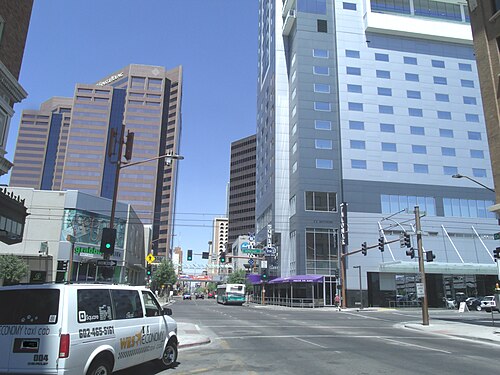
- The David Morgan-Earl A. Bronson House was built in 1927 and is located at 8030 N. Central Avenue. It was listed in the National Register of Historic Places.
 The Asbury-Salmon House was built in 1934 and is located at 7801 N. Central Avenue. This house was built by Cline Asbury who managed the Crystal Ice and Cold Storage in Phoenix, founded by his brother Harry. Cline died in 1942 and in 1945 his wife Delia sold the house to Riney Salmon. The Salmon family lived in the house until 1970, when Mr. Salmon died of injuries received in an auto accident. At the time of his death, his firm was said to be the largest law firm in the state. The house was listed in the Phoenix Historic Properties Register in March 2003. It was listed in the National Register of Historic Places on April 8, 2010.
 The Dr. Jean S. Holloway House was built in 1928 and is located 7215 N. Central Avenue. It was listed in the Phoenix Historic Properties Register in November 2005.
- The John and Cindy McCain House built in 1951 and located at 7110 N. Central Avenue.
 The George M. Halm and Mary Alverda Howard House was built in 1906 and is located at 6850 N. Central Avenue. It was listed in the Phoenix Historic Properties Register in November 2005 and in the National Register of Historic Places on January 24, 2011, reference #10001161.
 The Olney-Ellinwood House was built in 1912 and is located at 6810 N. Central Avenue. It was listed in the Phoenix Historic Properties Register in March 2003. It was listed in the National Register of Historic Places on April 8, 2010. reference #10000155.
 The John M. Ross House was built in 1926 and is located at 6722 N. Central Avenue. John Mason Ross was a partner with the successful and well-known law firm of Ellinwood and Ross. The firm represented large clients such as the Phelps-Dodge (mining) Corporation. In addition, Ross also participated in many Arizona civic and political affairs. It was listed in the National Register of Historic Places on February 24, 2000, reference #00000145.
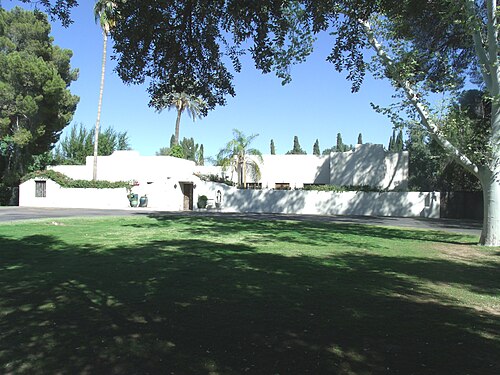 The Ralph Converse House was built in 1935 and is located at 6617 N. Central Avenue. It was listed in the Phoenix Historic Properties Register in March 2003. It was listed in the National Register of Historic Places on April 8, 2010, reference #10000153.
 The Mrs. Leonard George House was built in 1929 and is located at 6611 N. Central Avenue. It was listed in the Phoenix Historic Properties Register in March 2003.
- The Abner Elliot England-Guy Hidden Lawrence House was built in 1929 and is located at 6234 N. Central Avenue. It was listed in the National Register of Historic Places.
- The Judge Fred C. Jacobs House was built in 1928 and is located at 6224 N. Central Avenue. It was listed in the National Register of Historic Places.
 The E. Payne Palmer House was built in 1929 and is located at 6012 N. Central Avenue. Dr. Errol Payne Palmer was a significant member of the medical community at local, national and international levels. He made tremendous contributions to advance hospital standardization and administration in the United States. Additionally, his contributions in surgical techniques, cancer research and patient care coincide with the advancements in medicine in the early 20th century. Dr. Palmer was also a prominent member and contributor to his community giving selflessly of his time and money to religious, arts and social organizations in order to improve the quality of life for others in Phoenix. It was listed in the Phoenix Historic Properties Register in June 1999. It was listed in the National Register of Historic Places on May 2, 2002, reference #02000420.
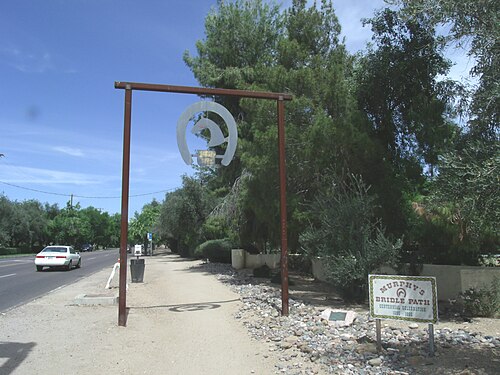 The Murphy Bridle Path begins at Bethany Homes Road and ends two and half miles north at the Arizona Canal. This particular landscape or streetscape history is significant in telling the story of how Phoenix developed in the late 1880s and the early years of the 20th century. William John Murphy, who moved from Illinois to Phoenix in 1883, built the Arizona Canal and established the Valley citrus industry in the northern extension of Central Avenue in 1895. The roadway cut through the Orangewood subdivision he developed and was first paved in 1920. The earliest reference to the Murphy Bridle Path that the city's historic preservation office discovered was in 1948 when the bridle path was dedicated by the "Arizona Horse Lover's Club." The North Central Avenue streetscape is now on the Phoenix Historic Property Register and has been nominated to the National Register of Historic Places.
- The Brophy College Chapel was built in 1928 and is located at 4701 N. Central Avenue. The Chapel was donated by Mrs. William Henry Brophy in memory of her husband. The Spanish Colonial chapel was built by the students of Brophy College. It was listed in the National Register of Historic Places on August 10, 1993, reference #93000747.
- The front entrance of the Heard Museum building, which was built in 1929 and is located at 2301 N. Central Avenue. / 22 E. Monte Vista Road. It was listed in the Phoenix Historic Property Register in August 1992.
- The Heard Museum building was built in 1929 and is located at 2301 N. Central Avenue. / 22 E. Monte Vista Road. Maie Heard added quality artworks to the collection and worked closely with the board of trustees to direct the activities of the museum. She also oversaw the programming activities of the museum, approving speakers and insuring appropriate publicity was available. It was listed in the Phoenix Historic Property Register in August 1992.
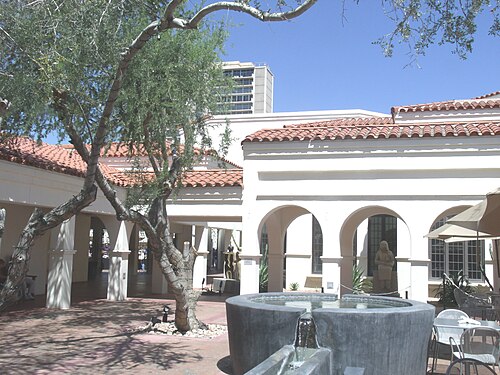 Different view of the Heard Museum
- The Regency House was built in 1964 and is located at 2323 North Central Avenue. It was listed in the National Register of Historic Places on September 26, 2016, reference # 16000630.
- The Phoenix Towers were built in 1957 and are located at 2201 N. Central Avenue. Phoenix Towers was built as a resident-owned cooperative community, Phoenix Towers is now considered an outstanding example of mid-century architecture and was listed in the National Register of Historic Places on January 2, 2008, reference #07001334.
- Front view of the Phoenix Towers. The towers were built in 1957 and are located at 2201 N. Central Avenue. Phoenix Towers was built as a resident-owned cooperative community, Phoenix Towers is now considered an outstanding example of mid-century architecture and was listed in the National Register of Historic Places on January 2, 2008, reference #07001334.
 The El Encanto Apartment Building was built in 1939 and is located at 2214 N. Central Avenue. The El Encanto Apartment Building was the largest apartment complex in Phoenix at the time. The Inter Tribal Council of Arizona Inc. is oversaw the renovation of the complex. It was listed in the Phoenix Historic Properties Register in December 1990.
- The Dr. Shackelford Dental Office Building which currently houses a small exhibit of the Arizona Street Railway Museum and is located at 1242 N. Central Avenue. It is listed in the Phoenix Historic Property Register.
- The Dr. Ellis-Shackelford House was built in 1917 and is located at 1242 N. Central Avenue. It was listed in the National Register of Historic Places.
- Living room of the Dr. Ellis-Shackelford House. The house was built in 1917 and is located in 1242 N. Central Avenue. On November 30, 1983, the house was listed in the National Register of Historic Places, ref.: #83003475.
- The C. P. Stephans De Soto Six Motor Cars building was built in 1927 and is located at 915 N. Central Avenue. On February 20, 2013, the property was listed in the National Register of Historic Places, reference: #13000019.
- The Westward Ho Hotel was built in 1928 and is located at 618 N. Central Avenue. It was listed in the National Register of Historic Places on February 19, 1982, reference: #82002082.
- The U.S. Post Office / Federal Building was built 1932–1936 and is located at 522 N. Central Avenue. The building was listed in the Historic Properties in Phoenix Historic Property Register in October 1990. It was listed in the National Register of Historic Places on February 10, 1983, reference #83002993.
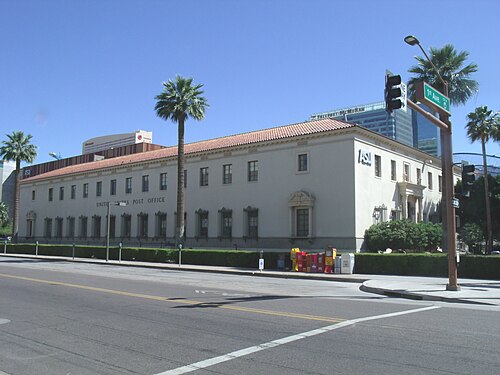 Different view of The U.S. Post Office/Federal Building, which was built 1932–1936 which is located at 522 N. Central Avenue. The building was listed in the Phoenix Historic Property Register in October 1990. It was listed in the National Register of Historic Places on February 10, 1983, reference #83002993.
- The A.E. England Motors Building was built in 1926 and is located at 424 N. Central Avenue. It is listed in the Phoenix Historic Property Register.
- The Security Building was built in 1925 and is located at 234 N. Central Avenue. The property is Listed in the National Register of Historic Places.
- The San Carlos Hotel, also known as Hotel San Carlos, was built in 1925 and is located at 202 N. Central Avenue. Mae West, Clark Gable, Carole Lombard, Marilyn Monroe and Gene Autry are among the celebrities who at one time stayed at the San Carlos. The hotel was added to the National Register of Historic Places in 1983. Reference number 83003498.
- The Professional Building built in 1931 and located at 137 N. Central Avenue. It was listed in the National Register of Historic Places in 1993, reference: #85003563.
- The Heard Building was built in 1920 and is located at 112 N. Central Avenue. It was Phoenix's first skyscraper. The building, which was listed in the National register of Historic Places on September 4, 1985, reference: #85002059, was featured in Alfred Hitchcocks 1960 film "Psycho".
- The Central Avenue Underpass was built in 1940. The above bridge was originally built for the ATSF railway.
- The Jefferson Hotel was built in 1915 and is located at 101 S. Central Avenue in Phoenix. It is no longer a hotel and is called the Barrister Place Building. The building is owned by the city of Phoenix and is currently the home to the Phoenix Police Museum. It is listed in the Phoenix Historic Property Register.
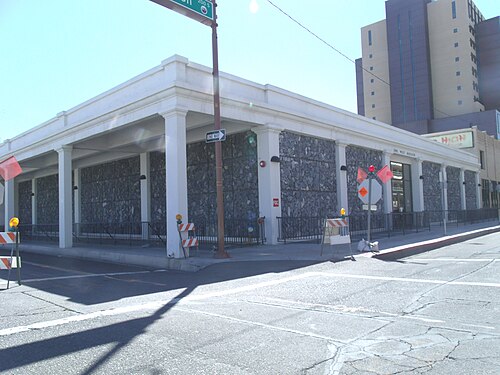 The Pratt-Gilbert Building was built in 1913 and is located at 200 S. Central Avenue / 1 W. Madison Street. It was listed in the Phoenix Historic Properties Register in October 2001.
- The Anchor Manufacturing Co., also known as 41-3, was built in 1925. It is located at 525 (525-551) S. Central Avenue. The building was listed in the National Register of Historic Places in 1985, reference: #85002042.
- The South Phoenix Market building was built in 1948 and is located at 4341 S. Central Avenue. This property is recognized as historic by the Asian American Historic Property Survey of the City of Phoenix.
- The Scorpion Gulch store was built in 1936 by William Lunsford. It is located at 10225 S. Central Avenue in South Mountain Park. It was listed in the Phoenix Historic Property Register in October 1990.
Cemeteries
The Pioneers' Cemetery Association (PCA) defines an "historic cemetery" as one which has been in existence for more than fifty years.[42] There are various historic cemeteries which were established in the late 19th century. These cemeteries serve as the final resting place of various notable citizens of Arizona. Among which can be found pioneers, governors, congressman, government officials, journalists, race car drivers, soldiers, actors and actresses.
The four historic cemeteries listed are:
- Crosscut Cemetery sometimes referred to the Williams Crosscut Cemetery – Established in 1870.
- Pioneer and Military Memorial Park – Seven historic cemeteries founded in 1884.
- St. Francis Catholic Cemetery – Established in 1897
- Greenwood/Memory Lawn Mortuary & Cemetery – Established in 1906.
Crosscut Cemetery
The Crosscut Cemetery, a.k.a. the Williams Crosscut Cemetery, was established in 1870 by John Wesley and Amanda "Manda" Williams. The historic cemetery, which at the time was located in the desert far from central Phoenix, is the oldest pioneer cemetery in Phoenix.[43] It is located in what is now the corner of 48th St. and East. Van Buren St. Many of the headstones are missing and some of the graves vandalized. The cemetery, which continues to belong to the Williams family, has a locked gate and a chained-linked fence with barbered wire surrounding it.[44]

 Chained and locked entrance of the Phoenix Crosscut Cemetery.
 Grave of John Wesley Williams (1836–1912) and Manda W. Williams (1856–1934). John and Manda (Amanda) were the owners of a large farm. They established the cemetery in their property.
 Grave of J. W. Williams (1872–1947), son of John and Manda.
 Grave of Allen Preston Hill (1859–1940). Mr. Hill served as superintendent of the Arizona State Hospital Farm.
 Grave of Christian Christopher Cline (1810–1898) and his wife Margaret Cline (1814–1898). The Clines brought the first cattle into the Tonto Basin in 1876.
 Grave of James Ansley Young (1822–1877). Young was the first Justice of Peace of Phoenix.
 Grave of Harrison Monroe "Harry" Hill (1864–1925)
 Lula Davis (1875–1941) and William Davis (1872–1901). William Davis worked in the wholesale department of the Wakelin Grocery Company. He died from Pulmonary Tuberculosis.
 Vandalized grave.
Pioneer and Military Memorial Park
The Pioneer and Military Memorial Park is the official name given to seven historic cemeteries in Phoenix. The cemeteries were founded in 1884 in what was known as "Block 32". On February 1, 2007, "Block 32" was renamed Pioneer and Military Memorial Park.

 Entrance of the historic Pioneer Military and Memorial Park. The Cemetery dates back to 1884. The main entrance is located at 1317 W. Jefferson Street. The Pioneer & Military Memorial Park was listed in the National Register of Historic Places on February 1, 2007, reference #06001317.
 The grave of John T. Alsap in the "Masons Cemetery" section. Alsap was the first Mayor of Phoenix.
 Grave site of Phillip "Lord" Darrell Duppa located in the "Masons Cemetery" section. Duppa is credited with naming "Phoenix" and "Tempe" and the founding of the town of New River, Arizona.
 Grave site of Jacob "Dutchman" Waltz located in the "City/Loosley Cemetery" section. Waltz was a German immigrant who in the 19th century discovered a gold mine in Arizona and kept its location a secret, hence the name "Lost Dutchman's Mine".
 The grave of King S. Woolsey in the "City/Loosley Cemetery" section. Woosley founded one of the first flour mills in the Salt River Valley.
 Grave site of Benjamin Joseph Franklin located in the "Rosedale Cemetery" section. Franklin was Arizona's 12th Territorial Governor.
 Grave site of Czar J. Dyer located in the "Rosedale Cemetery" section. Dyer once served as City Councilman and in 1899 as the acting Mayor of Phoenix. Dyer drew the "Bird's Eye view of Phoenix" map.
 Grave site of Noah M. Broadway located in the "Rosedale Cemetery" section. Broadway was one of the original settlers of Phoenix.
St. Francis Catholic Cemetery
St. Francis Catholic Cemetery, established in 1897, is one of the oldest in the city. Its inhabitants represent pioneer families, community and business leaders, miners, those who succumbed to tuberculosis, and others who helped write the history of Phoenix and Arizona. Margaret Geare of Dublin, Ireland, who was buried on October 12, 1897, is believed to be the first to be buried in the cemetery. The cemetery is located at 2033 N. 48th Street.

 Grave of Margaret Geare (1817–1897), also known as Mary and Marguerite was the first person buried in the cemetery. She was buried on Oct. 12, 1897
 Grave of Joseph Geare (1854–1911), son of Hubert and Margaret who founded the Central Avenue Dairy on the land that is now Park Central Mall.
 Grave of Governor Rose P. Moffort (1922–2016). Moffort was Arizona's first female Secretary of State (1977–88) and first female and 18th Governor of Arizona (1988–91).
 Grave of Trinidad Escalante Swilling Shumaker (1849–1925). Known as the "Mother of Phoenix". Swilling Shumaker was the wife of Jack Swilling, who is credited with being the founding father of Phoenix.
 Crypt of Louis J. (Lou Ambers) D’Ambrosio (1913–1995) and his wife Margaret M. D’Ambrosio (1916–2009). Ambers, was a World lightweight boxing champion from 1936 to 1940.
 Grave of Ladimir Kwiatkowski (1928–1994), better known as Ladmo, Kwiatkowski co-hosted The Wallace and Ladmo Show, a daily children's variety show broadcast on KPHO in Phoenix, Arizona.[45]
Greenwood/Memory Lawn Mortuary & Cemetery
Greenwood/Memory Lawn Mortuary & Cemetery is the final resting place of various notable people. Among them are three Arizona Territory Governors, six Arizona State Governors, a Secretary of Arizona Territory, the founder of Glendale, Arizona, the 1958 Indianapolis 500 winner and a journalist.
 Grave-site of Joseph H. Kibbey (1853–1924) and Nora Burbank Kibbey (1867–1923). J. H. Kibbey served as Associate Justice of the Arizona Territorial Supreme Court from 1889 to 1893 and as the 16th Governor of Arizona Territory from 1905 to 1909. As governor, Kibbey was a leader in the effort to prevent Arizona and New Mexico territories from being combined into a single U.S. state.
 Grave-sight of Richard Elihu Sloan (1857–1933), the 17th and last Governor Arizona Territory. He served from 1909 to 1912.
 Crypt of Ernest William McFarland (1894–1984). McFaland served as U.S. Senator (1941–1953), the tenth Governor of Arizona (1955–59) and Arizona Supreme Court Justice (1968).
 Crypt of Paul Jones Fannin (1907–2002). Fannin served as U.S. Senator (1965–77) and as the 11th Governor of Arizona from 1959–65.
 Grave-site of William John Murphy (1839–1923), founder of Glendale, Arizona.
 Grave site of Walter Winchell (1897–1972). Winchell was a newspaper columnist who is credited with inventing the gossip column.[46]
 Grave site of James Ernest Bryan (1926–1960). Bryan was a racecar driver who won the 1958 Indianapolis 500.
Historic structures related to "The Trunk Murderess"
Winnie Ruth Judd was a native of Indiana who worked in Phoenix as a medical secretary. Judd was accused of murdering and dismembering the bodies of her two roommates, friends Agnes Anne LeRoi and Hedvig Samuelson. The prosecutors in her trial alleged that she placed the dismembered parts of the bodies in two trunks (suitcases) and took them to Los Angeles. According to prosecutors, the murders were committed by Judd and an accomplice, Phoenix businessman John "Happy Jack" Halloran, whom she claimed was her lover. Her trial was marked by sensationalized nationwide newspaper coverage, who referred to Judd as "The Trunk Murderess". She was pronounced guilty and sentenced to death by hanging. The sentence she received raised debate about capital punishment. Days before her execution Winnie Ruth was called back to the courtroom for an insanity hearing. In 1933, she was found to be insane and moved from prison to the Arizona State Mental Hospital.[47]
The historic properties pictured are all either directly or indirectly related to Judd and the infamous crime. Three of the buildings are listed in the National Register of Historic Places, two of the houses are located in the Historic Roosevelt District which is listed in the National Register of Historic Places and the house where the murders took place was once listed in the "enDangered Dozen Historic Places List," released by the Phoenix Historic Neighborhoods Coalition.[48] It is now in the process of restoration and will be used to house a law firm.
 The Leigh's Ford House was built in 1926 and is located at 510 W. Lynwood St. This is the house where the infamous Winnie Ruth Judd, known as "The truck Murderess", lived and first met her lover and alleged accomplice in crime Jack Halloran. The house is located in the Historic Roosevelt District of Phoenix which was listed in 1983 in the National Register of Historic Places, reference #83003490.
 The Jack Halloran House was built in 1920 and is located at 514 W. Lynwood St. This where Jack Halloran, the lover and alleged accomplice of Winnie Ruth Judd, also known as "The Trunk Murderess" lived. The house is located in the Historic Roosevelt District of Phoenix which in 1983 was listed in the National Register of Historic Places, reference #83003490.
- Entrance of the Lois Grunow Memorial Clinic, built in 1931 and located at 926 E. McDowell Rd. This is where Winnie Ruth Judd worked. Here she became acquainted with the two girls who became her roommates and whom she murdered. On September 4, 1985, the property was listed in the National Register of Historic Places, reference #85002065.
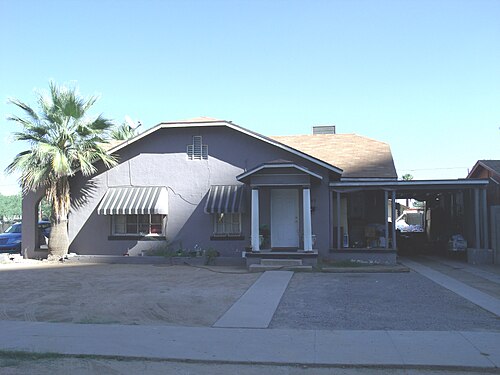 The "Winnie Ruth Judd House" was built in the 1920s and is located at 2947 N. 2nd Street. This house, which was rented by Winnie Ruth Judd, is where she murdered and dismembered her two roommates, Agnes Anne LeRoi and Hedvig Samuelson, on the night of October 16, 1931.
- The Phoenix Union Station was built in 1923 and is located at Fourth Avenue and Southern Pacific RR tracks. Winnie Ruth Judd boarded the train heading to Los Angeles with the two trunks containing the dismembered bodies of her two roommates in this station. The station was added to the National Register of Historic Places in 1985. Reference number 85003056
- The Maricopa County Courthouse where Judd was imprisoned and her trail held. The historical structure, which was built in 1928, is listed in the National Register of Historic Places.
- The Arizona State Hospital Building, also known as Mahoney Administration Building, was built in 1900 and is located at 2500 E. Van Buren St. Winnie Ruth Judd was committed here on April 24, 1933. The building was listed in the National Register of Historic Places on July 15, 2009, reference #09000510.
Landmarks
Among the landmarks that are pictured and included in this article are the Deer Valley Rock Art Center and Papago Park. The Deer Valley Rock Art Center, also known as the Hedgpeth Hills Petroglyph Site and the Sonoran Desert preserve, is a 47-acre archaeological site containing over 1500 Hohokam, Patayan, and Archaic petroglyphs.[49] The petroglyphs are between 500 and 7,000 years old,[50] and at least one source dates the petroglyphs to 10,000 years ago.[51] The site was listed on the National Register of Historic Places in 1984, and it was also listed with the Phoenix Points of Pride. A museum designed by Will Bruder was constructed on the site in 1994.[52][53][54][55]
Papago Park is a hilly desert park covering 1200 acres in its Phoenix extent and 296 acres in its Tempe extent. It is where the Desert Botanical Garden, the Phoenix Zoo, and Hunt's Tomb, the pyramidal tomb of Arizona's first governor, George W. P. Hunt are located.
Deer Valley Rock Art Center(Hedgpeth Hills Petroglyph Site)
 Entrance of the Deer Valley Rock Art Center Museum. Deer Valley Rock Art Center is located in North Phoenix at 3711 W. Deer Valley Road. The site was listed on the National Register of Historic Places on February 16, 1984 and on the Phoenix Points of Pride. National Register of Historic Places ref: 84000718
 National Register of Historic Places Marker of the Deer Valley Rock Art Center.
 A prehistoric Hohokam cooking pit.
 A Petroglyph is a marking carved into a rock usually using a stone tool.
 This Petroglyph with a spiral figure carved into it was made by the Hohokams over 1000 years ago.
 This Hohokam Petroglyph is that of a "scene". In the far right hand corner of the Petroglyph the Hohokams sketched two deers bumping heads.
 Notice, in this Petroglyph the Hohokams sketched two deers bumping heads in the far lower right hand corner. The two deers bumping heads are the symbol of the Deer Valley Rock Art Center.
 View of the Hedgepath Hills and Sonoran Desert from the Deer Valley Rock Art Center. The rocks in the Hedge Hills were formed in the Pliocene era when lava squeezed up through fissures in the earth. This type of volcanic rock is called basalt.
 Hohokam Petroglyph scene. The Petroglyphs in this site are dated from 700 AD to 1050 AD.
 Hohokam Petroglyph.
 Hohokam Petroglyph.
 Hohokam Petroglyph.
Papago Park
The Desert Botanical Garden, Hole-in-the-Rock and Hunt's tomb are located in Papago Park. Papago Park was listed in the Phoenix Historic Property Register in October 1989. The Desert Botanical Garden is designated as a Phoenix Point of Pride. The Webster Auditorium is listed in the National Register of Historic Places.
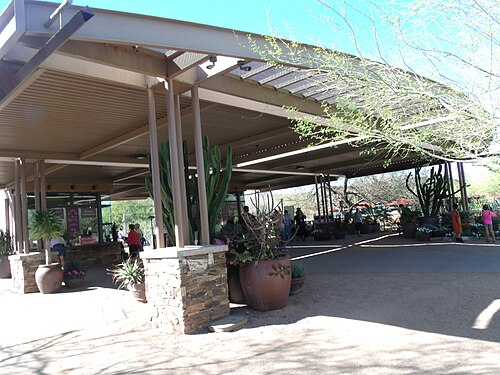 The main entrance of the Desert Botanical Garden.
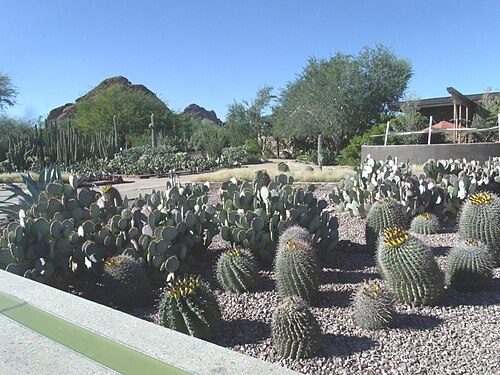 Different species of cacti on display in the Desert Botanical Garden of Phoenix.
- The Webster Auditorium building was constructed in 1939 and is located inside the compounds of the Desert Botanical Garden at 1201 N. Galvin Parkway in Phoenix. In 1937, Gertrude Webster joined newly established Arizona Cactus and Native Flora Society. She offered her encouragement, connections and financial support. Webster served as society's first president and served in its board of directors. The auditorium is named after Gertrude Webster. On June 13, 1990, the National Park Service certified Webster Auditorium as listed in the National Register of Historic Places on May 1, 1990, assigned it the reference number 9000823.
 Webster Auditorium.
- Inside the historic Webster Auditorium, located inside the compounds of the Desert Botanical Garden at 1201 Galvin Parkway. The auditorium was listed in the National Register of Historic Places on May 1, 1990, ref: 9000823.
 The Hole-in-the-Rock is a Phoenix landmark located in Papgo Park. It is a series of openings (tafoni) eroded in a small hill composed of bare red arkosic conglomeritic sandstone. The sandstone was first formed some 6-15 million years ago from the accumulation of materials eroding from a Precambrian granite, long since eroded away.
 View from inside the Hole-in-the-Rock, a Phoenix landmark located in Papago Park.
 Hunt's Tomb in Papago Park. George W. P. Hunt was the first Governor of Arizona, serving a total of seven terms. The tomb was listed in the National Register of Historic Places, reference #08000526.
Museums
A museum is a building or place where objects of historical, artistic, or scientific interest are exhibited, preserved, or studied. There are many museums in Phoenix, among them the Heard Museum, an art museum which serves as a showcase for Native American culture and the Phoenix Art Museum, which showcases artwork since the Renaissance.
This section of the list includes the Pioneer Living History Museum and the Phoenix Trolley Museum. The Pioneer Living History Museum has 30 historic original and reconstructed buildings from the 1880s and early 1900s on its 90-acre property. The main exhibit of the Phoenix Trolley Museum is the historic trolley car #116, a restored 1928 trolley which served the original Phoenix trolley system.
This section also includes images of cars exhibited in the Martin Auto Museum and some of the historic musical instruments on exhibit in the Musical Instrument Museum. The Martin Auto Museum is dedicated to the preservation of historical and collectible automobiles for educational purposes and the Musical Instrument Museum, which bills itself as "The World's Only Global Musical Instrument Museum", displays more than 6,500 instruments collected from around 200 of the world's countries and territories. Among the exhibits is the Steinway piano that John Lennon used to compose the song "Imagine", Elvis Presley's guitar, a 1900 Cuatro, and displays dedicated to various countries.[56]
Pioneer Living History Museum
 The Ashurst Cabin was built in 1878 near Prescott. This was the boyhood home of Senator Henry Fountain Ashurst, the first Arizona senator following statehood. Ashurst served in the senate from 1912 to 1942. The family cooked their food in the fireplace, however during the summer they did their cooking outside over a campfire. The family lived in the cabin until 1893.[57]
 The Phoenix Bakery building was built in 1881 and was originally located at 7 West Washington Street in Phoenix. Edward Elsele and Alfred Becker owned the bakery. In 1910, the bakery became the first one in the territory to try out a horseless carriage to deliver their products. In 1929, the sons of the original owners inherited the bakery. They decided to go wholesale and renamed their product Holsum. What was left of the shell of the bakery building was donated to the Pioneer Living History Museum.[58]
 The Flying "V" Cabin was built in 1880 and was located in Canyon Creek, Young, Arizona. The cabin has notched gun ports which were used on July 17, 1882, during the Battle of Big Dry Wash, the last Apache War in that area. John D. Tewksbury Sr., of Pleasant Valley War fame lived here with his two wives and children.[59]
Phoenix Trolley Museum
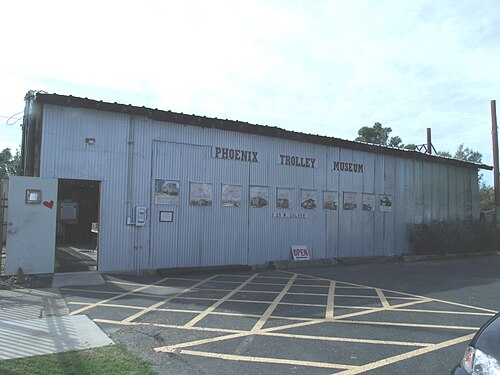
 Historic Trolley Car #116 . The 1928 trolley served the original Phoenix trolley system from 1928 to 1947. It was restored by the Arizona Historical Society. The trolley is on exhibit in the Phoenix Trolley Museum at 25 W. Culver St.
 Inside the historic Trolley Car #116
 Front inside view of Trolley Car #116. Pictured is a restored farebox.
 Different view of Trolley Car #116.
Martin Auto Museum
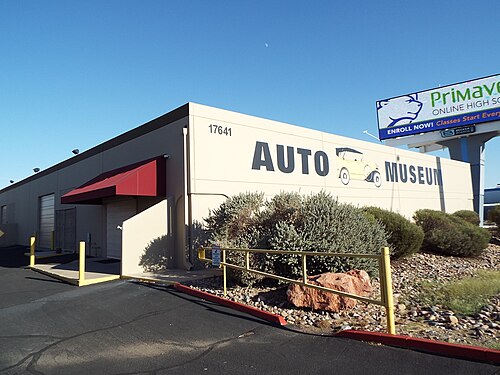
 1886 Benz Patent-Motorwagen.
 A 1930 convertible Duesenberg "J" Boattail Speedster which once belonged to gangster John Factor, an associate of Al Capone.
 A 1965 Shelby Cobra, once owned by Carroll Shelby. The vehicles dashboard was autographed by Shelby.
 1990 Jeff Gordon's Ford NASCAR Race Car.
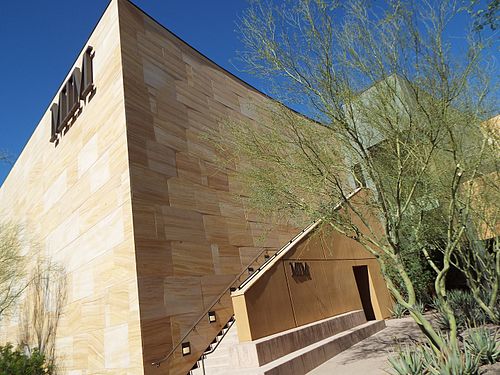

 Elvis Presley's guitar.
 A Puerto Rican Cuatro.
 Cambodia exhibit.
 Puerto Rico exhibit.
 Singapore exhibit.
Laveen
Laveen, an urban village within the city of Phoenix, which was first settled by farmers and dairymen in 1884. In the early 1900s, Walter E. Laveen and his family homesteaded an area encompassing all four corners of present-day 51st Avenue and Dobbins Road, where they also built the area's first general store –the Laveen Store –on the southeast corner.[61] Two properties in Laveen are listed in the National Register of Historic Places.

 Different view of the Laveen Village welcoming water tower.
- The Del Monte Market built in 1908 and located at 2659 W. Dobbins Road in South Phoenix. It is the oldest continuously operating market in the state. Designated as a landmark with Historic Preservation-Landmark (HP-L) overlay zoning (Phoenix Historic Property Register).
- Different view of Del Monte Market.
 The Laveen School Auditorium was built in 1925 and is located at 5001 W. Dobbins Road. The building was listed in the National Register of Historic Places on August 30, 2011, reference #88001601.
 Different view of the Laveen School Auditorium.
 The Laveen Post Office located in the corner of 51st Avenue and Dobbins Road. This is the located where the original Laveen Village post office was established in 1918.
Sunnyslope District
The Sunnyslope community is a long-established cohesive neighborhood within the borders of the city of Phoenix. It has its own "small town" identity and a sense of place that is a point of pride embraced by community members. Sunnyslope has attempted to be incorporated as its own town on four occasions but failed every time. In 1959 the City of Phoenix annexed the community of Sunnyslope. Most of the structures of historic significance have been razed.[62][63]

 Sunnyslope Mountain, a.k.a. "S" Mountain. In December 1954, various students from Sunnyslope High School painted an "S" on the mountain which now is in the Phoenix Historic Property Register. It is located near Central Avenue and Hatcher Street. The mountain was listed in the Phoenix Historic Property Register in October 2011.
 This is where the trail which leads to the "S" of the historic Sunnyslope Mountain begins.
 This is a view from the trail which leads to the "S' of Sunnyslope Mountain
 This is where the historic Desert Mission of Sunnyslope was founded. The area in which the Desert Mission was located at 5th Street and Eva Road and its area consisted less than an acre in size. It served the community from 1927 to 1940. A plaque marking the historical site, commissioned by the Sunnyslope Historical Society and the John C. Lincoln Hospital, was placed on this site on March 7, 1992.
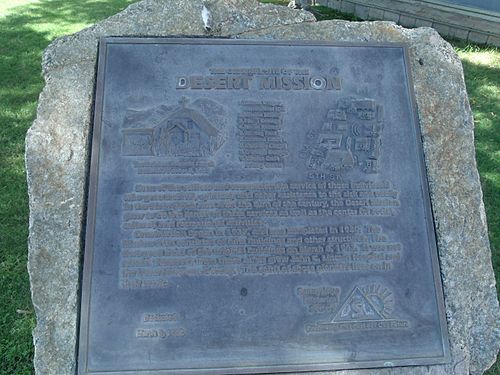 This Marker was placed on the site where the historic Desert Mission of Sunnyslope was founded in 1927. It is located on 5th Street and Eva Road, Sunnyslope, Phoenix.
 One of the low rent cabins of what once known as Beatty's Court on Ruth Street was built in the 1940s. The Elizabeth Beatty Cabins were provided to families suffering from tuberculosis. Beatty was a retired secretary who moved to Sunnyslope in 1918. She inherited land between Ruth St. and Central Avenue where she established the low rent cabins
 Beatty Court Cabins on Ruth Street built in the 1930s and 40s.
 The Abandoned Sunnyslope Auto Upholstery Building, located at 742 E. Dunlap Avenue, was built in 1940.[66]
 This historic building once housed "Peoples Drug Store". This structure was built c. 1940s and was originally located at 111 East Dunlap Avenue. Pharmacist Bob Rice established his pharmacy there and in 1953 installed what was the first pharmacy drive through window in Arizona and the fifth in all the nation. The building was moved in 1999, to 737 E. Hatcher Road, Phoenix its current location and currently is the home of the Sunnyslope Historical Society and Museum.
 A display of pharmacy equipment is among the many displays in the Sunnyslope Historical Society and Museum. The Sunnyslope Historical Society and Museum are housed in what once was the historic "Peoples Drug Store" building.
 Dorothy Gunderson, of the Sunnyslope Historical Society and Museum, poses in front of the John C. Lincoln display in the historical building which once housed the "Peoples Drug Store".
 The Dr. Kenneth E. Hall house built in 1946 and located at 9840 N. 2nd. Street. Hall moved into the house in 1954 after some renovations were made.
- The Sunnyslope Presbyterian Church was founded in 1927 in Sunnyslope. The historic structure was built in 1949. It is located at 9317 N 2nd Street, in Sunnyslope.
- The historic Mennonite Church Meetinghouse was built in 1946 on 9835 N. 7th Street in what was then Sunnyslope an area which later became part of Phoenix. In 1949, a new church was erected beside it. The older building was then used as a Christian day school and Sunday school.
 The First Mennonite Church of Sunnyslope was built in 1949 alongside the older Mennonite Church Meetinghouse, which was built in 1946. It is located at 9835 N. 7th Street, in Sunnyslope.
 The historic Lovinggood House was built in 1945, by Walter Leon Lovinggood on a lot on 8924 2nd Street in Sunnyslope. In 1999, the house became property of the Sunnyslope Historical Society, which is located at 737 E. Hatcher Street.
 Different view of the 1945 historic Lovinggood House.
 Inside the living room of the Lovinggood House.
 The kitchen of the Lovinggood House.
 The bedroom of the Lovinggood House.
 The Sunnyslope Rock Garden created by local artist Grover Cleveland Thompson between 1952 and 1972 is located on 10023 N. 13th Place.
 The snake created by Grover Cleveland Thompson which adorned the entrance of his house.
 The Sunnyslope Rock Garden was created Thompson between the years of 1952 to 1972.
 Thompson's art in the Sunnyslope Rock Garden.
 The Charles and Eleanor Abel House was built in 1955 and is located at 11430 Cave Creek Roa. It was the first house in Sunnyslope with a bomb shelter, which also served as a basement. The residence is now used for commercial purposes.[66]
 Location of one of the bomb shelter windows of the Charles and Eleanor Abel House, which was covered up with cement.[66]
 Phoenix Fire Station #7 was built in 1966 and is located at 403 E. Hatcher Rd. in the Sunnyslope District. The fire station is considered historic by the Sunnyslope Historic Society ,
 Area of the Phoenix Fire Station #7 located at 403 E. Hatcher Rd. which was dedicated to the people of Sunnyslope who used to gather and discuss issues regarding their community.
 The historic "El Cid Castle" was a bowling alley that resembled a Moorish Castle. It was built by the late Dr. Kenneth Hall, a physician who served the Community of Sunnyslope in Phoenix. Construction on the structure began in 1963 and was completed in 1980. It is located at the Northwest corner of 19th Ave and West Cholla Drive, which technically is on the opposite side Sunnyslope's western boundary.[63]
 Different view of El Cid Castle. It is currently under restoration.
 Side view El Cid Castle. The castle was a bowling alley that resembled a Moorish castle.
 Different side view of El Cid Castle, located at the Northwest corner of 19th Ave and West Cholla Drive in Phoenix.
 The John C. Lincoln Medical Center built in 1965 in Sunnyslope, Arizona. Named after John C. Lincoln (1866–1959) an American inventor, entrepreneur and philanthropist.
Miscellaneous
 The Jail Rock. Jack Swilling, the founder of Phoenix, was named constable. This river rock was used as a temporary jail before the first wooden jail house was built. It served as a leg iron to shackle prisoners. On display in the Phoenix Police Museum.
 1879 Wells Fargo Stagecoach used in Phoenix on exhibit in the Wells Fargo Museum.
 1919 Ford Model T Phoenix Police Cruiser. It had a 20 horsepower engine and ran a maximum speed of 45 mph. On display in the Phoenix Police Museum.
 USS Arizona Signal Mast
 The Anchor from the USS Arizona located at Wesley Bolin Memorial Plaza on the grounds of Arizona's State Capital.
 The restored gun barrel from the USS Missouri on display in Wesley Bolin Plaza.
 Different view of the restored gun barrel from the USS Missouri. It is on display in Wesley Bolin Plaza.
 Airport Inn is located at 2501 East Van Buren St. on the land where Phoenix's first airport, the Van Buren Airport, once stood.
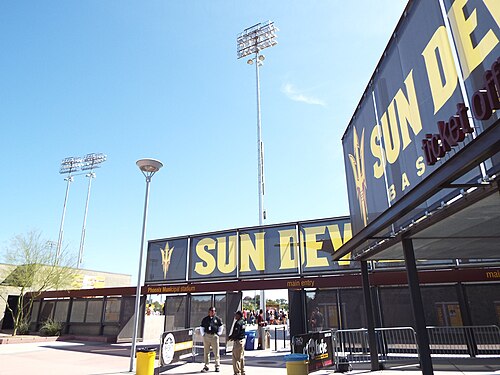 The main entrance of the Phoenix Municipal Stadium. The Phoenix Municipal Stadium was built in 1964 and is located at 5999 E. Van Buren Street in Phoenix. The stadiums’ light poles are the original light poles which were installed in New York's Polo Grounds Stadium in 1940. They served the stadium until 1964, when the stadium was demolished. Horace Stoneham, owner of the San Francisco Giants, whose club started spring training at the previous iteration of the Phoenix Municipal in 1947, had the poles shipped here. The San Francisco Giants played at the ballpark during the spring training of 1964.
 One of the Phoenix Municipal Stadium light pole . The light pole once served the Polo Grounds Stadium in New York. They were shipped to Phoenix after the Polo Grounds Stadium was demolished in 1964 and placed in the Phoenix Municipal Stadium where they still stand today.[68]
 South Mountain Park & Preserves located south of Baseline Road extends as far as the alignment of Chandler Boulevard, between 48th Street on the east and 47th Avenue on the west. It was listed in the South Mountain Park & Preserves located south of Baseline Road extending as far as the alignment of Chandler Boulevard, between 48th Street on the east and 47th Avenue on the west. It was listed in the Phoenix Historic Property Register in October 1989.
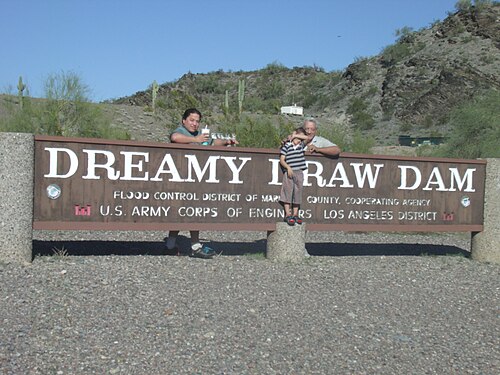 Dreamy Draw Dam is a compacted earthfill flood control dam and was the first of four dams built under the Phoenix, Arizona, and Vicinity plan. According to local legend Dreamy Draw Dam is supposedly a UFO crash site where in 1947 the Army Corps of Eng. used rock to cover up the crash site. Dreamy Draw Dam is located in the Phoenix Mountain Reserves at approximate 24th Street alignment, just east of Northern Avenue.
 The chimney of the Rose Paulson House is the only thing that remains. The house was built in 1940 by Frank Lloyd Wright and was located on a hill by Camelback Road and Stanford Dr. The house caught fire in 1945 and what remains is the chimney that serves as part of the entrance to the Alta Vista Estates community.
 Different angle of the Rose Paulson House ruins – 1940
 This is the SPAD XIII flown by Arizona native Frank Luke Jr., the first aviator awarded the Medal of Honor, the highest military decoration in the United States, in World War I. The plane has 80% of its original parts. The other 20% have been restored. It is one of five surviving today and is on display in the 44th Street Sky Train Station of Phoenix Sky Harbor International Airport.
 L. Ron Hubbard's car, a 1947 Buick Super 8 . Hubbard founded the Church of Scientology. His house is listed in the National Register of Historic Places, ref: #09000953. The car is parked in the back of the property.
 The Hotel Clarendon (now Clarendon Hotel) where on June 2, 1976, Arizona Republic journalist Don Bolles was supposed to meet with a prospective informant named John Harvey Adamson. The meeting never took place and instead Adamson placed six sticks of dynamite under Bolles car in the parking lot blowing the journalist to pieces. The hotel is located 401 W. Clarendon Dr.[69]
 Parking space in the south parking area on 4th Avenue of the Hotel Clarendon (now called the Clarendon Hotel) where on June 2, 1976, Arizona Republic journalist Don Bolles was murdered. The parking space is now a covered parking.
 Hall in the Clarendon Hotel dedicated to Don Bolles.
 Grave site of Evan Mecham (1924–2008) and Florence L. Mecham (1925–2012). Evan Mechem served as the 17th Governor of Arizona from 1987 to 1988 when he was impeached. He is buried in the Section 53, site 505 of the National Memorial Cemetery of Arizona located at 23024 N. Cave Creek Road.
 Grave site of Nathan Edward Cook (1855–1992) and his wife Elizabeth Cook (1887–1982). Cook was a sailor in the United States Navy during the Philippine-American War whose naval service continued through WWII. When he died at the age of 106, he was the oldest surviving American war veteran. He is buried in Section 11; Plot 2023.
 The grave of Bil and Thel Keane in the Holy Redeemer Cemetery. Bil was the creator of the cartoon "Family Circus".
See also
- National Register of Historic Places listings in Phoenix, Arizona
- Phoenix Historic Property Register
- Pioneer and Military Memorial Park
- USS Arizona salvaged artifacts
- National Register of Historic Places listings in Maricopa County, Arizona
- Martin Auto Museum
Historic structures in Phoenix with articles
References
- ↑"Phoenix QuickFacts from US Census Bureau". United States Census Bureau. Archived from the original on June 21, 2012. Retrieved September 11, 2012.
- ↑National Register of Historic Places
- ↑Phoenix historic buildings.
- ↑Phoenix historic homes.
- ↑"Phoenix Historic Property Register". Archived from the original on April 27, 2013. Retrieved July 29, 2013.
- ↑"Phoenix Historic Homes in Historic Districts Arizona". dwellarizona.com. Retrieved January 14, 2017.
- ↑"Heritage Park". Archived from the original on August 3, 2013. Retrieved July 29, 2013.
- ↑Robert A. Melikian, Vanishing Phoenix, Arcadia Publishing ISBN 978-0738578811, p. 127.
- ↑"Arizona Informant". Archived from the original on September 25, 2017. Retrieved September 25, 2017.
- ↑"Color Blind Care". Archived from the original on September 7, 2015. Retrieved September 25, 2017.
- ↑"Vanishing Downtown Phoenix". Archived from the original on September 21, 2013. Retrieved September 20, 2013.
- ↑Endangered Historic Phoenix Home
- ↑"Central Phoenix/East Valley Corridor: Environmental Impact Statement, Volume 2"; Published: 2002; Original from: Northwestern University
- ↑Heritage Square
- ↑National Register of Historic Places Continuation Sheet
- ↑Phoenix New Times, May 28, 2019, "Baked Goods: How Did the Historic Phoenix Bakery End Up at the Zoo?"
- ↑AZCentral, June 24,1920, "Historic downtown Phoenix Steinegger Lodging House building to be demolished"
- ↑Arizona Central
- ↑"The Stockyards Restaurant". Archived from the original on October 8, 2013. Retrieved April 5, 2015.
- 12"Downtown Phoenix"; Authors: Seth Anderson; Suad Mahmulin and Jim McPherson; Publisher: Arcadia Publishing; ISBN 978-0738585239
- ↑Sweet Old Buildings
- ↑"Punk Drunk". Archived from the original on April 2, 2016. Retrieved March 20, 2016.
- ↑Arizona Republic
- 12AZ Central
- ↑Funerarias Del Angel
- ↑Historic American Buildings Survey (HABS) No. AZ-145, "Phoenix Indian School, Northeast Corner of Central Avenue & Indian School Road, Phoenix, Maricopa County, AZ", 4 measured drawings, 14 data pages
- ↑17 Historic Schools in Metro Phoenix
- ↑Why The 120-Year-Old Clinton Campbell House Is Slated for Demolition
- ↑Borah Death Notice
- ↑"Meritt Farm House". Archived from the original on August 18, 2016. Retrieved February 20, 2018.
- ↑Copenhaver Castle
- 123African American Historic Property Survey – City of PhoenixArchived 2014-10-10 at the Wayback Machine
- 123Asian American Historic Property Survey
- 123"Hispanic American Historic Property Survey"(PDF). Archived from the original(PDF) on October 23, 2014. Retrieved October 17, 2014.
- ↑Golden Gate
- ↑City of Phoenix African American Historic Property Survey
- ↑Arizona Republic
- ↑History of the Arizona Biltmore Hotel
- ↑"Remarks of Senator John F. Kennedy, Westward Ho Hotel Democratic Breakfast, Phoenix, AZ, November 3, 1960". Archived from the original on April 2, 2015. Retrieved March 21, 2015.
- ↑Westward Ho
- ↑"JFK Speech". Archived from the original on April 2, 2015. Retrieved March 21, 2015.
- ↑Known Burial Sites in Arizona
- ↑The oldest pioneer cemetery in Phoenix, Arizona
- ↑"Phoenix Crosscut Cemetery". Archived from the original on June 28, 2016. Retrieved February 13, 2017.
- ↑"Wallace & Ladmo Official Site". wallacewatchers.com.
- ↑Obituary Variety, February 23, 1972, p. 71.
- ↑Goldstein, Richard (October 27, 1998). "Winnie R. Judd, 93, Infamous As 1930's 'Trunk Murderess'". The New York Times. Retrieved January 12, 2010.
Winnie Ruth Judd, who spent three decades in an Arizona state mental hospital as the notorious trunk murderess in one of the most sensational criminal cases of 1930s, died in Phoenix on Friday. She was 93.
- ↑Endangered Dozen Historic Places in Phoenix
- ↑Welsh, Liz; Welsh, Peter (2000). Rock-Art of the Southwest: A Visitor's Companion (Second (2004) ed.). Berkeley, California: Wilderness Press. p. 114. ISBN 0-89997-258-6.
- ↑"Deer Valley Rock Art Center". Smithsonian Magazine. Archived from the original on November 29, 2013. Retrieved October 17, 2014.
- ↑"Deer Valley Rock Art Center". About.Com. Archived from the original on December 13, 2013. Retrieved December 12, 2013.
- ↑"Best Will Bruder Building No One Knows About Phoenix". Phoenix New Times.
- ↑"Pioneers' Cemetery Association, Inc". Archived from the original on April 21, 2014. Retrieved October 17, 2014.
- ↑"Phoenix Government". Archived from the original on March 16, 2014. Retrieved October 17, 2014.
- ↑Cemetery history
- ↑Musical Instrument Museum
- ↑"Ashurst Cabin". Archived from the original on August 18, 2016. Retrieved July 2, 2016.
- ↑"Phoenix Bakery". Archived from the original on May 29, 2016. Retrieved July 2, 2016.
- ↑"Flying "V" Cabin". Archived from the original on May 29, 2016. Retrieved July 2, 2016.
- ↑Arizona Historical Society
- ↑History section of http://www.laveen.org. Accessed 21 April 2006.
- ↑Sunnyslope History from the Sunnyslope Historical Society and MuseumArchived 2014-09-03 at the Wayback Machine
- 12"There's No Place Like Sunnyslope by The Modern Phoenix Neighborhood Network". Archived from the original on May 23, 2016. Retrieved August 29, 2014.
- ↑Sage Publication
- ↑"Sunnyslope (Images of America)"; by Reba Wells Grandrud; p. 101; Publisher: Arcadia Publishing (2013); ISBN 978-0738599571
- 123"Sunnyslope (Images of America)"; by Reba Wells Grandrud; Publisher: Arcadia Publishing 2013; ISBN 978-0738599571
- ↑The Arizona State Fair has come to Phoenix
- ↑Polo Grounds Light Poles
- ↑Arizona republic
Further reading
- Robert A. Melikian, Vanishing Phoenix. Arcadia Publishing; ISBN 978-0738578811.
- Paul Scharbach and John H. Akers, Phoenix Then and Now. Thunder Bay Press; ISBN 978-1592233021
- Reba Wells Grandrud, Sunnyslope (Images of America). Arcadia Publishing (July 29, 2013); ISBN 978-0738599571
- City of Phoenix Historic Preservation and Ryden Architects, Midcentury Marvels: Commercial Architecture of Phoenix, 1945–1975. City of Phoenix; ISBN 978-0615409894
- Buildings and structures in Phoenix, Arizona
- Culture of Phoenix, Arizona
- History of Phoenix, Arizona
- Lists of historic properties in Arizona by city